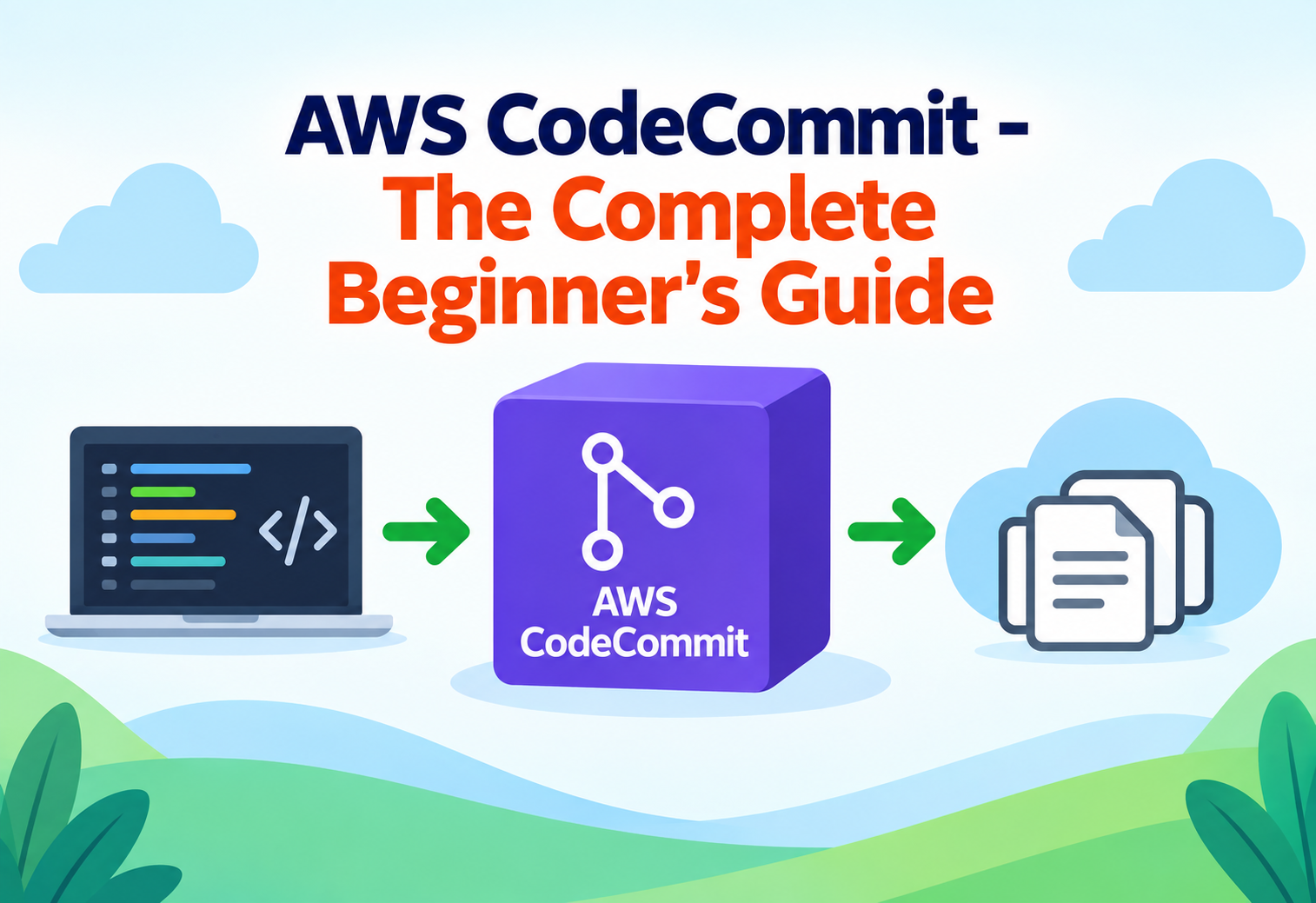
AWS CodeCommit — The Complete Beginner's Guide
A private, fully managed Git repository service on AWS — how it stores your code, who can touch it, and how it fits into a real deployment pipeline, explained from zero.
Imagine you and four teammates are writing a novel together. Every night, each of you edits a few chapters on your own laptop. Now imagine trying to combine everyone’s changes into one final manuscript by emailing files back and forth — someone will overwrite someone else’s work within a week. Software teams face the exact same problem with code, except the “novel” might have thousands of files and dozens of authors editing it every hour. AWS CodeCommit is Amazon’s answer to that problem inside the AWS ecosystem: a private, managed place to store code where every change is tracked, nothing is silently overwritten, and only the right people can look at or touch it. This guide starts from zero — you do not need to know Git, AWS, or any command-line tool to follow along.
1Core Concepts
What is version control?
Version control is a system that remembers every change ever made to a set of files, who made it, when, and why. Instead of one file called report_final_v3_REALLYFINAL.docx, version control keeps one file with a complete, searchable history of every edit — so you can always go back to any earlier version, compare two versions, or figure out exactly which change broke something.
What is Git?
Git is the most widely used version control system in the world, created in 2005 by Linus Torvalds (the same person who created Linux). Git stores a project as a series of snapshots called commits. Each commit is like a save-point in a video game — you can jump back to any save-point at any time. A collection of commits lives inside a repository (or “repo” for short), which is really just a folder that Git is watching closely.
Think of a Git repository as a video game’s save-file system. Every time you commit, you create a new save-point with a note describing what changed (“defeated the boss,” “picked up the sword”). You can reload any save-point, compare two save-points to see what’s different, or even branch off into a parallel playthrough and merge it back later. Git is the save-system; CodeCommit is where AWS stores your save-files securely, so they never live only on one person’s laptop.
What is AWS CodeCommit, specifically?
AWS CodeCommit is a fully managed source control service that hosts private Git repositories in the AWS Cloud. “Fully managed” means AWS runs the servers, handles the storage, replicates your data, patches the software, and scales the service — you never provision a server or worry about disk space. You simply create a repository and start pushing (uploading) and pulling (downloading) code using the same git commands developers already use with services like GitHub or GitLab. The difference is that CodeCommit repositories live entirely inside your AWS account, protected by AWS Identity and Access Management (IAM) instead of a separate username-and-password system.
As of July 25, 2024, AWS stopped onboarding new customers to CodeCommit. Existing customers with repositories created before that date can continue using the service fully, and AWS has not announced an end-of-life date. This guide explains CodeCommit as it works today for the many teams still running on it, and the underlying Git and CI/CD concepts apply directly to whatever repository service you use next, including GitHub or GitLab connected through AWS CodeStar Connections.
Why would a team choose it (or have chosen it)?
Three reasons kept teams on CodeCommit for years: it lives inside the same AWS account as everything else, so permissions are managed with the same IAM roles used for EC2, S3, and Lambda; it never leaves AWS’s network boundary, which matters for regulated industries like banking and healthcare; and it plugs directly into AWS’s own build and deploy tools — CodeBuild, CodeDeploy, and CodePipeline — with almost no configuration.
2Architecture & Components
When you interact with CodeCommit, you never see AWS’s internal machinery — you just run familiar git commands. But underneath, several components cooperate to make that possible.
Git Protocol Endpoint
Accepts standard Git-over-HTTPS or Git-over-SSH traffic, so any existing Git client works unmodified.
AWS IAM
Every push, pull, and repository action is authorized through IAM users, roles, or policies — no separate login system.
Durable Object & Metadata Stores
Repository content (commits, blobs, trees) is stored redundantly across multiple facilities in the region, similar in spirit to how S3 stores objects.
AWS KMS
Every repository is encrypted at rest using a key managed through AWS Key Management Service, either AWS-managed or your own customer-managed key.
Amazon EventBridge / SNS
Repository events (a push, a pull request comment, a branch created) can trigger notifications or downstream automation.
CodePipeline / CodeBuild / CodeDeploy
A push to CodeCommit can automatically kick off a build-test-deploy pipeline with zero custom glue code.
flowchart TB
    Dev1["Developer A
(git client)"] -->|"git push (HTTPS/SSH)"| Endpoint["CodeCommit
Git Protocol Endpoint"]
    Dev2["Developer B
(git client)"] -->|"git push (HTTPS/SSH)"| Endpoint
    Endpoint --> IAM["AWS IAM
Authentication & Authorization"]
    IAM --> Repo["CodeCommit Repository
(commits, branches, tags)"]
    Repo --> Storage["Durable Storage Layer
(replicated across AZs)"]
    Repo --> KMS["AWS KMS
Encryption at Rest"]
    Repo -->|"push event"| EventBridge["Amazon EventBridge / SNS"]
    EventBridge --> Pipeline["AWS CodePipeline"]
    Pipeline --> Build["AWS CodeBuild
(compile & test)"]
    Build --> Deploy["AWS CodeDeploy
(release to EC2/ECS/Lambda)"]
    Repo --> CW["Amazon CloudWatch
Metrics & Logs"]
    Repo --> CT["AWS CloudTrail
API Audit Log"]
Notice that CodeCommit itself only handles the “storage and version history” job. Everything else — building the code, running tests, deploying it — is deliberately handed off to specialist services. This is a hallmark of AWS’s design philosophy: small, focused services connected by events, rather than one giant service trying to do everything.
3Internal Working
git push against a CodeCommit repository?Your Git client connects
Your local git tool opens a connection to CodeCommit’s endpoint, either over HTTPS (using Git credentials or the credential helper) or SSH (using an SSH key registered to your IAM user).
IAM checks who you are and what you’re allowed to do
CodeCommit asks IAM: does this identity have permission to run GitPush on this specific repository? IAM policies can restrict access down to individual repositories or even individual branches.
Git objects are transferred and validated
Your new commits (each a small package containing a snapshot of changed files plus metadata) are uploaded. CodeCommit verifies the objects are well-formed Git data before accepting them.
The branch pointer moves
Internally, a branch is just a label pointing at the latest commit in a chain. Once your commits are safely stored, CodeCommit moves the branch label (for example, main) to point at your newest commit.
Data is encrypted and replicated
The underlying storage layer encrypts the new data using your configured KMS key and stores redundant copies across multiple Availability Zones in the region, the same durability pattern AWS uses for services like S3.
Events fire
CodeCommit emits an event describing what just happened. Anything subscribed to that event — a CodePipeline pipeline, a Lambda function, an SNS topic — can react within seconds.
Because CodeCommit speaks the standard Git protocol, it does not reinvent version control — it reuses the exact same data format Git has used for two decades. This is why any Git-aware tool (VS Code, IntelliJ, the command line) works with CodeCommit without a special plugin.
4Data Flow & Lifecycle
Step 1 — Clone. A developer runs a clone command to download a full copy of the repository, including its entire history, onto their laptop. From this point on, they have every past commit available locally, even without internet access.
Step 2 — Branch. Rather than editing the shared main branch directly, the developer creates a new branch — a separate, safe line of work — to build their feature without disturbing anyone else.
Step 3 — Commit locally. As they work, they save snapshots (commits) to their local copy of the branch. Nothing is uploaded yet; this is all happening on their own machine.
Step 4 — Push. When ready, they push their branch up to CodeCommit, making their work visible to the team for the first time.
Step 5 — Pull request. They open a pull request (CodeCommit calls it exactly that), which is a formal proposal to merge their branch into main. Teammates can leave comments on specific lines, request changes, and approve.
Step 6 — Merge. Once approved, the pull request is merged, combining the feature branch’s commits into main. CodeCommit supports three merge strategies: fast-forward, squash (combining all commits into one), and three-way merge.
Step 7 — Automated reaction. The merge event fires, and a connected CodePipeline pipeline can automatically build, test, and deploy the newly merged code — all without a human manually triggering anything.
Approval Rule Templates
CodeCommit lets teams define an “approval rule template” that automatically requires, say, two approvals before any pull request can merge into a protected branch like main — enforcing code review as policy rather than trusting people to remember.
5Advantages, Disadvantages & Trade-offs
Advantages
- Access control is unified with the rest of your AWS account through IAM — no second identity system to manage.
- Data never leaves the AWS network boundary, simplifying compliance for regulated industries.
- Zero server management — no patching a Git server, no worrying about disk space.
- Native, low-friction integration with CodePipeline, CodeBuild, and CodeDeploy.
- Encryption at rest and in transit is enabled by default, using AWS KMS.
Disadvantages
- Closed to new customers since July 2024, making it a diminishing choice for new projects.
- Smaller ecosystem of third-party integrations compared to GitHub or GitLab.
- No built-in social/discovery features (no public profiles, stars, or open-source community tooling).
- Fewer advanced code-review and project-management features than dedicated platforms like GitHub.
- Cross-region repository replication is not automatic — a repository lives in one AWS Region.
6Performance & Scalability
Git itself is already efficient — it only transfers the differences between what you have and what has changed, not the entire repository every time. CodeCommit inherits this efficiency and adds AWS’s own scaled storage infrastructure underneath, so repository size and commit history length are handled transparently as they grow.
Scalability here means two different things: how large a single repository can grow, and how many repositories and users an organization can operate. CodeCommit scales along both axes automatically — you never provision more “capacity” the way you would size an EC2 instance. Very large monorepos (single repositories holding an entire company’s code) can, however, hit practical Git performance limits regardless of hosting provider, which is a Git characteristic rather than something specific to CodeCommit.
7High Availability & Reliability
CodeCommit stores repository data redundantly across multiple Availability Zones within a Region — physically separate data centers connected by low-latency links. If one Availability Zone experiences a problem, your repository data remains accessible from the others, without any action needed from you.
Imagine keeping copies of an important family photo album in three different fireproof safes, in three different buildings across town, all updated at the same moment. If one building has a problem, you still have two perfectly intact copies. That is conceptually what Multi-AZ replication does for your repository’s commits.
Because CodeCommit is a regional service, a full AWS Region outage would affect it — the same as almost every other regional AWS service. For most teams, Multi-AZ durability within a Region is more than sufficient, since local Git clones (every developer’s laptop already has a full copy of the history) act as an additional layer of resilience.
8Security
IAM Users & Roles
Every action — clone, push, merge, delete — is an IAM-authorized API call, so the same permission boundaries you use elsewhere in AWS apply here too.
At Rest & In Transit
Repository contents are encrypted at rest using AWS KMS, and all Git traffic travels over HTTPS or SSH, both encrypted in transit.
Branch-Level Permissions
IAM conditions can restrict who is allowed to push directly to specific branches, such as protecting main from direct pushes.
AWS CloudTrail
Every API call made against a repository is logged, giving a full, tamper-evident audit trail of who did what and when.
Anti-Pattern
Granting an entire team the broad AWSCodeCommitFullAccess managed policy “to keep things simple.”
Why It’s A Problem
This gives every member the ability to delete repositories entirely, rewrite history on protected branches, and change repository settings — far more power than most developers ever need day-to-day.
Better Approach
Write scoped IAM policies granting read/write access only to the specific repositories a team owns, and use approval rule templates plus branch conditions to prevent direct pushes to protected branches.
9Monitoring, Logging & Metrics
Visibility into a source control system answers two questions: “is the service healthy?” and “who did what, and when?” CodeCommit answers both through existing AWS observability services rather than a bespoke dashboard.
| Tool | What It Tells You |
|---|---|
| Amazon CloudWatch Metrics | Repository-level metrics such as the number of pull requests, comments, and pushes over time. |
| Amazon CloudWatch Events / EventBridge | Real-time notifications the moment a push, comment, or pull-request state change happens — used to trigger automation. |
| AWS CloudTrail | An immutable audit log of every API call: who ran it, from where, and exactly when. |
| Amazon SNS Notifications | Email or messaging alerts when specific repository events occur, configured through the CodeCommit console. |
A common beginner setup is: CloudTrail for security auditing (who deleted that branch?), plus an EventBridge rule that notifies a Slack channel on every merge to main, so the whole team sees releases happening in real time.
10Deployment & Cloud Integration
A typical AWS-native continuous delivery setup looks like this: code lives in CodeCommit; a push or merge event triggers AWS CodePipeline, which orchestrates the release process; AWS CodeBuild compiles the code and runs automated tests inside a temporary, isolated container; and AWS CodeDeploy ships the tested build out to its destination — whether that’s a fleet of EC2 instances, an ECS cluster running containers, or a Lambda function.
Infrastructure as Code
Many teams store their infrastructure definitions (using AWS CloudFormation or Terraform) inside a CodeCommit repository alongside application code, so infrastructure changes go through the exact same pull-request review process as application changes.
Because every one of these services is IAM-aware, permissions flow naturally: a CodePipeline service role is granted read access to a specific CodeCommit repository, and nothing more — following the security principle of least privilege discussed in Chapter 8.
11Design Patterns & Anti-patterns
Trunk-Based Development
Small, frequent merges into a single main branch, protected by approval rules and automated tests, avoiding long-lived feature branches that drift apart.
Repository-per-Service
In a microservices architecture, giving each service its own CodeCommit repository keeps permissions and deployment pipelines cleanly separated per team.
The Never-Merging Branch
A feature branch left open for months accumulates so many conflicting changes with main that merging becomes a painful, error-prone event.
Committing Secrets
Pushing API keys or passwords directly into a repository’s history — because Git preserves history forever, this cannot be fixed by simply deleting the file in a later commit.
12Best Practices & Common Mistakes
Protect your main branch
Require pull requests and at least one approval before anything merges into main.
Write meaningful commit messages
“Fixed bug” tells a future teammate nothing; “Fix null pointer when cart is empty at checkout” tells them everything.
Use least-privilege IAM policies
Scope access to the specific repositories and actions a person actually needs.
Never commit secrets
Use AWS Secrets Manager or Parameter Store for credentials, and add a pre-commit scanning tool to catch accidental leaks.
Keep repositories focused
Avoid dumping unrelated projects into one giant repository “for convenience” — it complicates permissions and pipelines later.
Assuming a private repository is automatically “safe” to store secrets in. Private only means restricted visibility — it does not mean the content is treated as a secret by any downstream tool that reads the repository, and history is permanent even after a file is deleted in a later commit.
13Real-World & Industry Examples
Financial Services
Banks and fintech companies with strict data-residency and network-isolation requirements have historically favored CodeCommit because source code never has to leave the AWS network boundary, simplifying audits against frameworks like PCI-DSS and SOC 2.
Government & Public Sector
Agencies operating in AWS GovCloud have used CodeCommit to keep source code within accredited environments, paired with CodePipeline for compliant, auditable software delivery.
Startups Building AWS-Native Stacks
Small teams already living entirely inside AWS — using Lambda, DynamoDB, and API Gateway — often chose CodeCommit in the past simply to avoid managing a separate account with a third-party Git host, keeping billing and permissions under one roof.
Amazon’s Own Internal Tooling
AWS has described CodeCommit’s architecture as being informed by the same internal source-control lessons Amazon learned running its own massive-scale retail and cloud engineering organizations, prioritizing durability and access control from day one.
14Frequently Asked Questions
15Summary and Key Takeaways
Key Takeaways
- AWS CodeCommit is a fully managed, private Git repository service that lives inside your AWS account and speaks the standard Git protocol.
- Access is controlled entirely through IAM, unifying source-code permissions with the rest of your AWS security model rather than a separate login system.
- Repository data is encrypted at rest with AWS KMS and encrypted in transit, and replicated redundantly across multiple Availability Zones for durability.
- The push → pull request → review → merge lifecycle mirrors standard Git workflows, with approval rule templates enforcing code-review policy automatically.
- CodeCommit’s biggest strength is frictionless integration with CodePipeline, CodeBuild, and CodeDeploy to build fully automated, AWS-native delivery pipelines.
- Since July 2024, CodeCommit is closed to new customers, though existing repositories continue to operate fully — new projects typically look toward GitHub, GitLab, or Bitbucket connected via AWS CodeStar Connections instead.
- The core Git concepts you learn here — commits, branches, pull requests, merges — transfer directly to any Git hosting platform you use in the future.