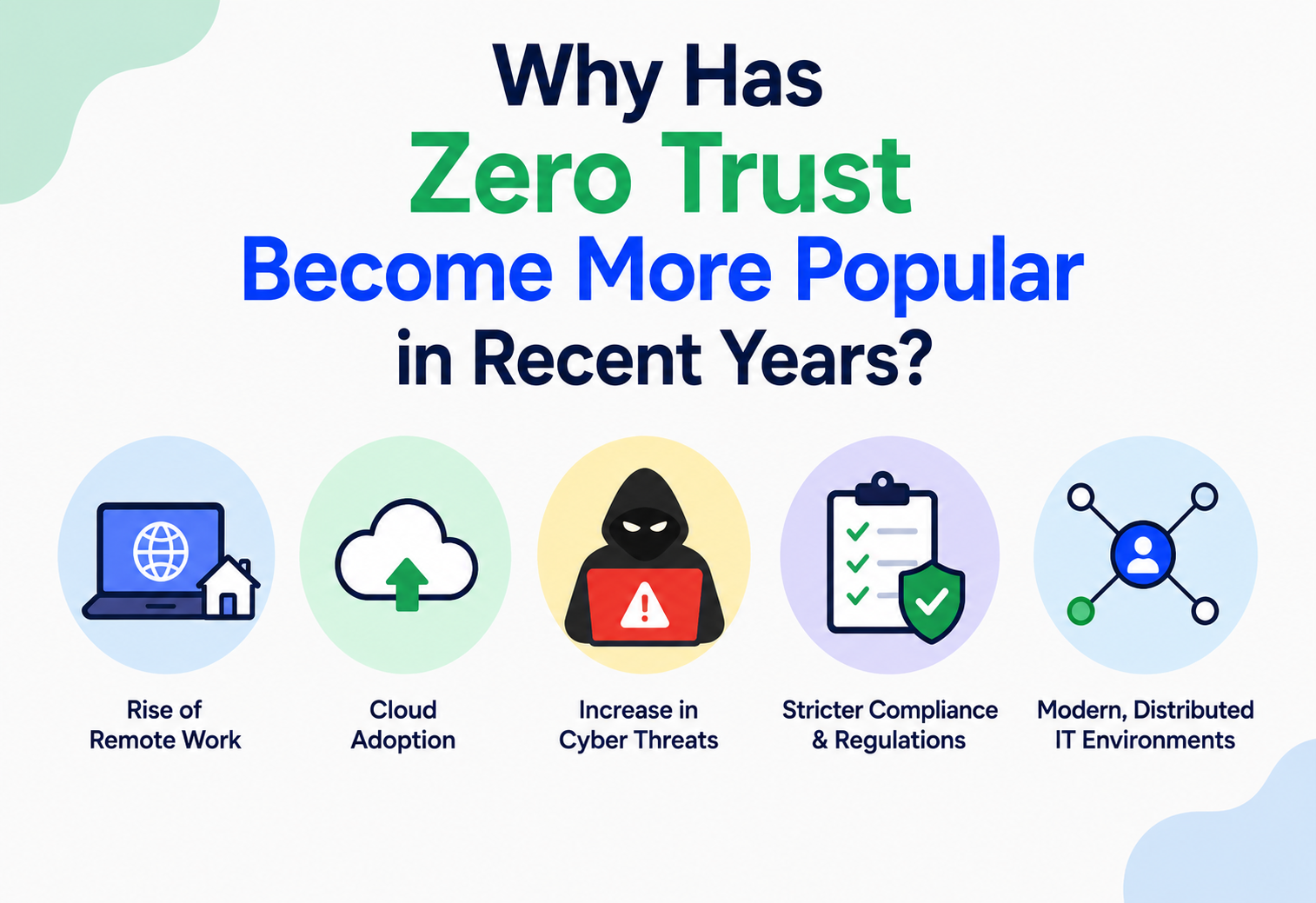
Why Has Zero Trust Become More Popular in Recent Years?
From “trust but verify” to “never trust, always verify” — how cloud adoption, remote work and a decade of perimeter breaches turned Zero Trust from a niche idea into the default security architecture.
Introduction & History
Imagine an office building where, once you badge in at the front door, you can walk into any room — the CEO’s office, the server closet, the payroll files — with nobody checking again. That is roughly how corporate networks worked for decades: get past the firewall at the edge (the “front door”), and you were largely trusted everywhere inside. Zero Trust is the security philosophy that rejects this model entirely.
Its guiding principle, often summarised as “never trust, always verify”, says that no user, device or application should be trusted by default — regardless of whether it is sitting inside the corporate network or out on the open internet. Every single request to access something must be authenticated, authorised and continuously validated, every time.
More formally: Zero Trust is a security architecture that assumes breach is inevitable or has already happened, and therefore verifies every access request as though it originates from an untrusted network — based on strong identity, device health and contextual risk signals — rather than granting broad trust based on network location alone.
1.1 Where the term comes from
The phrase “Zero Trust” was formally coined in 2010 by John Kindervag, then an analyst at Forrester Research, in a report describing a new model for network security. But the underlying idea — that network location should not imply trust — had been building for years before that, most notably in a 2004 concept called the “de-perimeterisation” model championed by the Jericho Forum, an industry group that argued the traditional network perimeter was dissolving and could no longer be relied upon as the primary security boundary.
1.2 A short history
2004 — De-perimeterisation
The Jericho Forum argues that as businesses connect to partners, contractors and the cloud, a hard network perimeter is becoming meaningless, and security must move closer to the data and the user.
2010 — “Zero Trust” is named
John Kindervag at Forrester publishes the model and coins the term, framing it around the principle that trust is a vulnerability that attackers exploit, so it should be eliminated from network design.
2011–2014 — Google’s BeyondCorp
Following a sophisticated 2009 breach (Operation Aurora), Google begins building BeyondCorp, an internal Zero Trust architecture that lets employees work from any network, including public Wi-Fi, without a traditional VPN, by authenticating every request based on user and device identity instead.
2018–2019 — Standardisation begins
NIST starts drafting what becomes Special Publication 800-207, a formal, vendor-neutral definition of Zero Trust Architecture (ZTA), giving the industry a shared reference model instead of dozens of competing vendor definitions.
2020 — Pandemic-driven remote work
COVID-19 forces a near-overnight shift to remote work at global scale. Traditional VPN-and-perimeter architectures buckle under the load and prove clumsy for a fully distributed workforce, accelerating enterprise interest in Zero Trust dramatically.
2021 — US federal mandate
Following major incidents including the SolarWinds supply-chain attack and the Colonial Pipeline ransomware attack, US Executive Order 14028 formally directs federal agencies to adopt Zero Trust Architecture, cementing it as a mainstream requirement rather than a niche best practice.
2020s–present — Mainstream adoption
Zero Trust becomes a standard line item in enterprise security budgets, integrated into cloud provider offerings, identity platforms and service mesh technology, moving from “innovative idea” to “expected baseline”.
The old model was an office building with one guarded front door and no further checks — a “castle and moat” design. Zero Trust turns every internal door into its own checkpoint: to open the server-room door, you need to prove who you are, that your badge is valid right now (not just this morning), that you are actually authorised for that specific room, and that nothing about your behaviour looks unusual — every single time, whether you are coming from inside the castle walls or from an entirely different building.
1.3 Why this took over a decade to catch on
It is worth asking why an idea coined in 2010 did not become mainstream until roughly a decade later. Part of the answer is that Zero Trust, in its early years, was largely theoretical for most organisations — implementing it required exactly the kind of custom, in-house engineering effort Google poured into BeyondCorp, which very few companies had the resources or expertise to replicate. The commercial tooling needed to make Zero Trust achievable off-the-shelf — mature cloud identity providers, service mesh technology, Zero Trust Network Access (ZTNA) products — simply did not exist yet in a form most IT teams could adopt without building it themselves. This is the same pattern seen throughout the history of security technology: a sound idea often waits years for the surrounding ecosystem of tools, standards and organisational pressure to catch up before it becomes practical at scale, rather than remaining an interesting paper or an internal project at one exceptionally well-resourced company.
The Problem & Motivation
The traditional “castle and moat” model has one very dangerous assumption baked into it: that everything inside the network perimeter can be trusted. For decades this seemed reasonable, because reaching the inside of the network required either physical presence in the building or a VPN connection guarded by the firewall. But several forces broke that assumption, all pointing to the same underlying problem.
The perimeter has holes
Cloud services, SaaS applications, mobile devices and remote employees all need access from outside the traditional network boundary — the “moat” no longer surrounds everything that matters.
Lateral movement after breach
Once an attacker gets past the perimeter (via phishing, a stolen credential or a vulnerable VPN appliance), the castle-and-moat model gives them broad freedom to move sideways to far more valuable systems.
Stolen credentials look “trusted”
A firewall cannot tell the difference between the real employee and an attacker using that employee’s stolen password — both arrive looking like legitimate, “inside” traffic.
Vendors & supply chains
Contractors, partners and vendor software increasingly need some level of access, each representing a trust relationship the perimeter model was not built to reason about carefully.
Unmanaged & personal devices
BYOD (bring your own device) policies mean the network can be reached from laptops and phones the organisation does not fully control or trust.
Microservices dissolve “inside”
In modern architectures, hundreds of services talk to each other constantly — there is no longer a meaningful single “inside” to defend as a perimeter.
The core motivation, then, is to replace an assumption (“if you are inside the network, you are trusted”) with a verification process (“every request proves it should be trusted, regardless of where it comes from”). This is the same “least privilege” philosophy that underlies traditional firewalling, just applied continuously, to identity and context, rather than once, to network location.
2.1 A concrete before-and-after
Consider an employee whose laptop is infected with malware after clicking a phishing link at home. Under the traditional model, once that employee connects to the corporate VPN, their laptop — and by extension, whatever malware is now running on it — is treated as “inside” and broadly trusted, often able to reach file shares, internal admin panels and other employees’ machines with little further scrutiny. The malware does not need to defeat any additional security control; it just needs to piggyback on a connection the network already trusts.
Under a Zero Trust architecture, that same infected laptop connecting to the corporate network gains almost nothing extra. Every request it makes — to a file share, to an admin panel, to another service — is independently verified against the employee’s identity, the laptop’s current device posture (which a well-configured endpoint agent might flag as compromised the moment the malware installs itself) and behavioural signals. Even if the malware manages to authenticate as the legitimate employee, it is confined to only the narrow, specific resources that employee’s identity is authorised for, and any behaviour that deviates from that employee’s normal pattern can trigger a step-up challenge or immediate revocation — rather than the malware inheriting broad, unquestioned access simply by virtue of being “inside”.
Core Concepts
Before going further, let us define the vocabulary you will need.
3.1 Identity
In Zero Trust, identity — not network location — becomes the primary basis for access decisions. This includes both human identity (a specific employee, verified via strong authentication) and non-human identity (a specific service, workload or device, verified via certificates or tokens).
3.2 Least privilege access
Every identity is granted only the minimum access it needs to do its job, for only as long as it needs it — the same principle traditional firewalls apply to network traffic, extended to specific resources, actions and time windows.
3.3 Micro-segmentation
Instead of one large trusted “inside” network, Zero Trust divides resources into small, individually-protected segments, so that gaining access to one does not imply access to any others.
3.4 Continuous verification
Trust is never granted permanently. Even after initial login, ongoing signals — device health, location, time of day, behaviour patterns — are continuously re-evaluated, and access can be revoked mid-session if something looks wrong.
3.5 Policy Decision Point (PDP) & Policy Enforcement Point (PEP)
NIST’s reference architecture splits Zero Trust into two logical roles. The Policy Decision Point is the “brain” that evaluates a request against policy and contextual signals and decides allow / deny. The Policy Enforcement Point is the “gate” that sits directly in front of the resource and actually lets traffic through or blocks it, based on the PDP’s decision. This is conceptually similar to the control-plane / data-plane split in traditional firewalls, just reframed around identity and policy rather than IP addresses.
3.6 Device posture
A request is not just “who”, it is also “from what”. Device posture refers to signals like whether the device has up-to-date patches, disk encryption enabled and an approved security agent installed — a compromised or non-compliant device can be denied access even with valid user credentials.
3.7 mTLS (mutual TLS)
Where traditional TLS proves the server’s identity to the client, mutual TLS has both sides present certificates, so a service can cryptographically prove its own identity to whatever it is connecting to — a foundational building block for Zero Trust between machines and services, not just humans.
3.8 Trust score / risk score
Rather than a binary “trusted or not”, many Zero Trust systems compute a numeric risk score for each request, blending signals like device health, location, time of day and behavioural anomaly detection. Low scores are approved instantly, medium scores may trigger step-up authentication (an extra MFA prompt) and high scores are denied — giving the system a graduated response instead of a blunt allow / deny.
3.9 ZTNA (Zero Trust Network Access)
ZTNA is the practical, product-category name for the technology that replaces traditional remote-access VPNs — a cloud-delivered service that authenticates and authorises each individual application request, rather than granting broad network-level access once a VPN tunnel connects.
3.10 SASE (Secure Access Service Edge)
SASE is a broader architectural category, coined by Gartner in 2019, that bundles ZTNA together with other network and security functions (secure web gateway, cloud access security broker, firewall-as-a-service) into a single cloud-delivered edge platform — Zero Trust principles applied at the scale of an entire organisation’s network edge.
Least privilege is like a hotel keycard that only opens your assigned room and the gym, not every door in the building, and stops working the day you check out — rather than a master key that opens everything for as long as you happen to be a guest.
Architecture & Components
NIST SP 800-207 describes a reference architecture with a handful of key logical components, regardless of specific vendor implementation.
Policy Enforcement Point (PEP)
Sits directly in front of a resource (an app, an API, a database) and enforces the allow / deny decision on every request.
Policy Decision Point (PDP)
Comprises a Policy Engine (calculates trust score / decision) and Policy Administrator (establishes or terminates the session).
Identity Provider (IdP)
Authenticates users and issues verifiable tokens (e.g., via SAML, OIDC) — Okta, Azure AD / Entra ID and Google Workspace are common examples.
Device posture / MDM
Mobile Device Management or endpoint tools report device health signals into the policy engine’s decision.
Threat intelligence feeds
External data about known-malicious IPs, compromised credentials or active attack campaigns feeds into risk scoring.
SIEM / behaviour analytics
Continuously scores anomalous behaviour (impossible travel, unusual access times) that can trigger step-up authentication or session termination.
Data security & encryption
Classification and encryption of the underlying data itself, since Zero Trust assumes any layer might eventually be breached.
4.1 Zero Trust vs traditional perimeter architecture
| Aspect | Traditional Perimeter | Zero Trust |
|---|---|---|
| Basis for trust | Network location (inside vs outside) | Verified identity + device + context, continuously |
| Access granted | Broad, once past the firewall / VPN | Narrow, per-resource, per-session |
| Verification frequency | Once, at login / VPN connect | Continuous, throughout the session |
| Lateral movement risk | High, once inside | Low, due to micro-segmentation |
| Remote vs office access | Different (VPN required remotely) | Identical experience regardless of location |
4.2 Control plane vs data plane, revisited
Just as a traditional firewall separates a fast-moving data plane (touching every packet) from a more feature-rich control plane (managing rules), Zero Trust architectures make a similar split: the Policy Decision Point and its supporting identity / context systems form a control plane that can afford to be relatively complex and slow-changing (computing rich risk scores, consulting multiple data sources), while the Policy Enforcement Point sitting directly in front of each resource must remain lightweight and fast, since it is on the critical path of every single request. Keeping this split clean — heavy decision logic centralised, lightweight enforcement distributed — is one of the main reasons well-designed Zero Trust systems can scale to enormous request volumes without every request paying the full cost of a complex policy evaluation.
How It Works Internally
Let us walk through what actually happens, mechanically, when a request is evaluated under a Zero Trust architecture.
5.1 Step 1 — Request interception
A user or service attempts to reach a protected resource. The request is intercepted by the Policy Enforcement Point before it ever reaches the resource itself — nothing is reachable directly.
5.2 Step 2 — Identity verification
The PEP confirms the requester holds a valid, current identity token (issued by the Identity Provider after authentication — ideally multi-factor). An expired, missing or invalid token results in immediate denial.
5.3 Step 3 — Context gathering
The Policy Engine collects contextual signals: device posture (is the laptop patched and encrypted?), network signals (is this a known corporate IP or an unfamiliar country?) and behavioural signals (does this access pattern match the user’s history?).
5.4 Step 4 — Policy evaluation
The Policy Engine evaluates all gathered signals against policy, often producing a dynamic trust / risk score rather than a simple yes or no. Low-risk requests may be approved instantly; medium-risk requests may trigger step-up authentication (e.g., a fresh MFA prompt); high-risk requests are denied outright.
5.5 Step 5 — Decision & enforcement
The Policy Administrator issues a short-lived credential or session token scoped narrowly to the specific resource requested, and the PEP allows the (now narrowly-scoped) traffic through.
5.6 Step 6 — Continuous re-evaluation
Unlike a traditional VPN session that, once established, is trusted until it is manually disconnected, a Zero Trust session is re-evaluated continuously or at frequent intervals. If device posture changes mid-session (e.g., the device’s security agent is disabled) or behaviour looks anomalous, access can be revoked immediately, not just at the next login.
A traditional VPN is like getting your passport checked once at the airport and then being free to roam an entire country for weeks with no further checks. Continuous Zero Trust evaluation is like having your identity spot-checked every time you enter a new building, so a passport that was stolen or a person who has started behaving suspiciously gets caught immediately, not at the end of the trip.
5.7 A minimal illustrative example (Java)
Real Zero Trust policy engines are distributed systems integrating many external data sources, but here is a simplified Java model of a policy decision point to make the logic concrete.
import java.util.*;

public class SimpleZeroTrustEngine {

    record AccessRequest(String userId, String resource, boolean deviceCompliant,
                          String sourceCountry, boolean mfaVerified, int riskScore) {}
    record Policy(String resource, int maxAllowedRisk, boolean requireCompliantDevice,
                  boolean requireMfa, Set<String> allowedCountries) {}

    private final Map<String, Policy> policies = new HashMap<>();

    public void addPolicy(Policy p) { policies.put(p.resource(), p); }

    public String evaluate(AccessRequest req) {
        Policy policy = policies.get(req.resource());
        if (policy == null) {
            return "DENY (no policy defined - default-deny)";
        }
        if (policy.requireMfa() && !req.mfaVerified()) {
            return "DENY (MFA required but not verified)";
        }
        if (policy.requireCompliantDevice() && !req.deviceCompliant()) {
            return "DENY (device posture non-compliant)";
        }
        if (!policy.allowedCountries().contains(req.sourceCountry())) {
            return "STEP-UP (unusual location - require re-authentication)";
        }
        if (req.riskScore() > policy.maxAllowedRisk()) {
            return "DENY (behavioural risk score too high: " + req.riskScore() + ")";
        }
        return "ALLOW (scoped, short-lived session token issued)";
    }

    public static void main(String[] args) {
        SimpleZeroTrustEngine engine = new SimpleZeroTrustEngine();
        engine.addPolicy(new Policy("payroll-db", 30, true, true, Set.of("US", "CA")));

        AccessRequest goodReq         = new AccessRequest("alice", "payroll-db", true,  "US", true, 10);
        AccessRequest riskyReq        = new AccessRequest("alice", "payroll-db", true,  "US", true, 85);
        AccessRequest unusualLocation = new AccessRequest("alice", "payroll-db", true,  "RU", true, 10);

        System.out.println(engine.evaluate(goodReq));
        System.out.println(engine.evaluate(riskyReq));
        System.out.println(engine.evaluate(unusualLocation));
    }
}
This toy example captures the essential idea: every dimension (identity, device, location, behaviour) is checked independently, and any single failing dimension denies or challenges the request — there is no single “you are inside the network, so you are fine” shortcut anywhere in the logic.
5.8 The algorithms and data structures behind fast policy evaluation
The naive approach above — walking through each policy field sequentially for every request — is fine for a handful of policies, but real Policy Decision Points must evaluate requests against potentially thousands of granular rules (specific users, groups, resources and conditions) at high volume. Several techniques keep this fast:
- Attribute-Based Access Control (ABAC) engines compile policies into efficient boolean expression trees, so a request’s attributes (department, device type, resource sensitivity) can be evaluated against many rules simultaneously rather than one at a time.
- Hash-based group and role lookups let the engine answer “is this user in the finance group?” in constant time, rather than scanning a full membership list for every request.
- Decision caching stores the outcome of recent, identical requests (same user, same resource, same context) for a short time window, so repeated calls from the same authenticated session do not re-run the full policy evaluation every single time.
- Pre-computed risk baselines — a background job continuously updates each user’s “normal” behavioural baseline (typical login times, typical locations), so the real-time request path only needs to compare against an already-computed baseline rather than recalculating it from scratch.
5.9 Concurrency considerations
A production Policy Decision Point must handle many simultaneous requests from different users and services without one slow evaluation blocking others, and without race conditions corrupting shared state like a user’s active session count or rate-limit counter. This is typically solved the same way any high-throughput API service solves it: stateless policy engine instances behind a load balancer, with genuinely shared state (like active session tokens or rate limits) kept in a fast, purpose-built external store such as Redis, which offers atomic increment / check operations specifically to avoid the read-then-write race conditions that naive in-process counters would suffer under concurrent load.
Data Flow & Request Lifecycle
Let us trace a real example end-to-end: an employee working from a coffee shop, accessing an internal HR application.
6.1 What is different from a traditional VPN flow
| Aspect | Traditional VPN | Zero Trust |
|---|---|---|
| Initial check | Username / password, sometimes MFA, once | Identity + device + context, every request |
| Scope granted | Broad network access (“you are on the LAN now”) | Narrow, specific to the one resource requested |
| Session duration | Hours, until manual disconnect | Minutes, with automatic re-evaluation |
| Mid-session changes | Not detected until next login | Detected and can trigger immediate revocation |
Why Zero Trust Has Grown So Popular in Recent Years
This is the central question this guide set out to answer, and the honest answer is that no single cause explains it — several long-building trends converged over roughly the same five-to-ten-year window, each independently pushing organisations toward the same architectural answer.
Cloud & SaaS adoption
As critical applications and data moved out of the corporate data centre and into AWS, Azure, Salesforce and hundreds of SaaS tools, “the network perimeter” stopped containing most of what actually needed protecting. There was no longer one castle to build a moat around.
Remote & hybrid work
The pandemic forced a near-instant, massive shift to remote work. Traditional VPN infrastructure — designed for occasional remote access, not an entire workforce — buckled under load and proved clunky, pushing IT teams toward identity-based access that works identically regardless of location.
Lateral-movement incidents
Incidents like the 2020 SolarWinds supply-chain attack and numerous ransomware campaigns showed attackers repeatedly using one initial foothold to move laterally across a “trusted” internal network — the exact failure mode Zero Trust is designed to prevent.
Credential theft at scale
As phishing and credential-stuffing attacks became industrialised, “you have valid credentials” stopped being a reliable trust signal on its own — organisations needed additional continuous checks beyond a one-time login.
Microservices & API-first
Modern applications are built from many small, independently-deployed services calling each other constantly — there is no longer a meaningful “inside” to defend as a single perimeter, forcing security down to the level of individual service-to-service calls.
Government mandates
US Executive Order 14028 (2021) required federal agencies to adopt Zero Trust Architecture on a timeline, and NIST SP 800-207 gave the industry a shared reference model — turning a loose philosophy into a procurement requirement that rippled into the private sector via contractors and vendors.
Insurance & compliance pressure
Cyber-insurance underwriters and auditors (PCI-DSS, SOC 2, ISO 27001) increasingly ask specifically about identity-based access controls and micro-segmentation, giving Zero Trust adoption a direct financial incentive beyond pure risk reduction.
Vendor tooling matured
Identity providers, service meshes and Secure Access Service Edge (SASE) platforms matured enough by the early 2020s that implementing Zero Trust stopped requiring a custom in-house build (like Google’s BeyondCorp) and became achievable with off-the-shelf products.
Notice the pattern: cloud adoption and remote work removed the technical justification for trusting network location, while breaches and mandates removed the option of ignoring the problem, and maturing vendor tooling removed the practical barrier to actually implementing the alternative. Zero Trust did not become popular because it is a new idea — the concept is over a decade old — it became popular because the conditions that made the old model “good enough” all disappeared within the same few years, and the tools to replace it finally became widely available.
It is also worth distinguishing between necessary and sufficient causes here. Cloud adoption alone might have simply led to organisations extending their VPNs to reach cloud resources, without fundamentally rethinking the trust model. Remote work alone might have simply pushed for better VPN capacity. It is the combination — cloud adoption dissolving the perimeter’s boundaries, remote work overwhelming the perimeter’s capacity and breaches repeatedly demonstrating the perimeter’s core weakness (unchecked lateral movement) — that made a genuine architectural rethink, rather than an incremental patch, the only response that actually addressed the underlying problem. Mandates and maturing tooling then provided both the push and the practical path for organisations to act on that rethink at scale, rather than each one having to independently reason through and build the solution from scratch, the way Google did over a decade earlier.
“Zero Trust did not win an argument about ideas. It won because the world it was designed for — cloud-first, remote-first, breach-assumed — became the actual world everyone was operating in.”
Advantages, Disadvantages & Trade-offs
Advantages
- Dramatically limits lateral movement after an initial breach
- Works identically for remote and in-office access — no more clunky VPNs
- Access is scoped narrowly and continuously re-verified, not permanent
- Reduces reliance on any single trust signal (like a password) being unbreakable
- Aligns naturally with cloud and microservice architectures
- Provides rich, granular audit logs of exactly who accessed what, when and why
Disadvantages & limits
- Significant upfront investment: identity systems, device management, policy engines
- Can add latency if policy evaluation is not well-optimised
- Migrating legacy applications not designed for identity-aware access is hard and slow
- Poorly-tuned continuous verification can frustrate users with excessive re-authentication
- Requires cultural change — IT teams used to perimeter thinking must adopt new mental models
- Not a silver bullet: a compromised identity provider or policy engine is a high-value single point of failure
No organisation flips a switch and “becomes Zero Trust” overnight. It is typically a multi-year migration, prioritising the highest-risk systems first, layering identity- and context-aware controls incrementally alongside (not instead of) some existing perimeter defences during the transition.
8.1 Why the trade-offs matter for adoption timing
Understanding these trade-offs also helps explain the “why now” question from a different angle: many of the disadvantages listed above — the upfront identity infrastructure investment, the difficulty of retrofitting legacy applications, the need for mature device management — were simply harder and more expensive to address in 2012 than they are today. Cloud identity platforms have absorbed much of the infrastructure cost that used to require custom engineering; mobile device management and endpoint detection tools have matured into reliable, widely-deployed products; and a decade of collective industry experience has produced well-documented migration playbooks that reduce the risk of a botched rollout. In other words, the trade-offs did not disappear, but the cost of managing them dropped substantially over the past decade, which is a large part of why the same architecture that was a bold, expensive bet for Google in 2011 is a comparatively routine adoption decision for a mid-sized company in the mid-2020s.
Performance & Scalability
Because every single request now requires an identity and policy check, Zero Trust systems must be engineered carefully to avoid becoming the bottleneck that a slow firewall used to be.
9.1 Key performance metrics
9.2 Scaling techniques
- Short-lived cached tokens: rather than calling the policy engine on every single packet, a scoped token is issued once and cached for a short window (minutes, not hours), balancing security freshness against overhead.
- Local policy evaluation: distributing policy decision logic (as in a service mesh sidecar) closer to the resource, rather than round-tripping to a central policy engine for every call, cuts latency significantly.
- Asynchronous risk scoring: expensive behavioural analytics can run continuously in the background, updating a risk score the fast-path can simply check, rather than being computed synchronously on the request’s critical path.
- Horizontal scaling of the PDP: Policy Decision Points are typically stateless and horizontally scalable behind a load balancer, similar to any other high-traffic API service.
Re-checking a passport at every single door in a building would make movement unbearably slow. Instead, a well-designed Zero Trust system is more like getting a wristband at the first checkpoint that is valid for 15 minutes and scoped to the floors you are allowed on — fast for the common case, while still expiring quickly enough that a stolen wristband does not stay useful for long.
High Availability & Reliability
Because every request now depends on the Identity Provider and Policy Decision Point being reachable, these components become critical infrastructure — if they go down, does access stop entirely, or fail open?
| Pattern | How it works | Trade-off |
|---|---|---|
| Multi-region IdP | Identity provider replicated across regions with automatic failover | Higher cost, but avoids a single outage blocking all access globally |
| Local token caching | PEPs honour previously-issued, unexpired tokens even if the PDP is briefly unreachable | Improves availability, but slightly delays detection of a just-revoked identity |
| Fail-closed (typical default) | If the PDP cannot be reached for a new request, access is denied | Maximises security, but a PDP outage becomes a productivity outage |
| Fail-open (rare, high-risk) | If the PDP is unreachable, some organisations fall back to a lesser-verified access mode | Keeps the business running, but reintroduces exactly the risk Zero Trust was meant to remove |
Zero Trust removes network location as a systemic weak point, but concentrates enormous importance onto the Identity Provider and Policy Decision Point. Securing and scaling these components — including their own HA design — becomes one of the most consequential engineering decisions in the whole architecture.
10.1 A distributed-systems trade-off hiding inside Zero Trust
Once an Identity Provider and Policy Decision Point are replicated across multiple regions for availability, the same trade-off described by the CAP theorem in distributed databases resurfaces: a policy change made in one region (revoking a compromised user’s access, for instance) takes some non-zero amount of time to propagate to every other region’s replica. During that propagation window, a request evaluated in a region that has not yet received the update could be approved based on stale policy. Well-designed systems minimise this window aggressively — often to well under a second for critical revocation events — but engineers building Zero Trust infrastructure at global scale have to consciously decide how much staleness is acceptable in exchange for keeping every region fast and available, exactly the kind of trade-off that shows up in any horizontally-scaled, stateful distributed system.
Security Considerations
Zero Trust dramatically raises the bar against many classic attack patterns, but it also concentrates security significance into a smaller number of very high-value components. The list below covers the hardening topics every implementation must address.
- Identity Provider hardening: since the IdP is now the most valuable target in the whole architecture, it demands its own layered defences, phishing-resistant MFA (e.g., hardware security keys) and rigorous monitoring.
- Token theft & replay: short-lived, narrowly-scoped tokens limit the damage if one is stolen, but token binding to a specific device or session further reduces replay risk.
- Policy sprawl: just like firewall rule sets, Zero Trust policies can accumulate into an unmanageable, undocumented mess over time if not actively reviewed and pruned.
- Insider threats remain a live concern: Zero Trust limits an insider’s blast radius via least privilege, but does not eliminate insider risk entirely — a legitimately authorised user misusing their own access still requires behavioural monitoring to catch.
- Supply-chain trust: verifying non-human identities (services, CI/CD pipelines, third-party integrations) is just as important as verifying human users, and often less mature in practice.
- Legacy system gaps: older applications that cannot be made identity-aware often get wrapped in a compatibility layer (a proxy that adds Zero Trust checks in front of them), which itself needs careful security review.
11.1 Backup, disaster recovery and configuration drift
Because a Zero Trust architecture’s entire behaviour lives in its identity configuration and policy set, losing or corrupting that configuration can be as damaging as an actual breach — either locking out legitimate users entirely or, worse, silently granting far broader access than intended. Mature operational practice treats identity and policy configuration the same way it treats critical application code: versioned in source control, backed up automatically on every change and restorable to a known-good state quickly. Regular disaster-recovery drills — deliberately simulating “the primary Identity Provider region just failed, verify failover works and no access gaps appear” — catch problems long before a real outage forces the issue during an actual incident.
Monitoring, Logging & Metrics
Zero Trust naturally produces far richer audit data than perimeter security ever could, since every single access decision is now tied to a specific verified identity rather than an anonymous “someone inside the network”.
12.1 What to log
- Every access decision (allow / deny / step-up), with the identity, resource, device posture and risk score involved
- Policy changes — who modified which policy, and when
- Authentication events, including MFA challenges and failures
- Token issuance and revocation events
- Device posture changes reported by endpoint agents
12.2 What to alert on
Spike in denies for one identity
Could indicate a compromised or misbehaving account, or a misconfigured policy.
“Impossible travel”
The same identity authenticating from two geographically distant locations within a timeframe that rules out real travel.
Unexpected policy change
Any modification to access policy outside a documented change window should trigger review.
IdP or PDP degraded performance
Since these are now critical-path infrastructure, latency or error-rate increases should page someone immediately.
As with traditional firewall logs, Zero Trust telemetry is most valuable when correlated centrally in a SIEM alongside endpoint, network and application logs — a suspicious access decision alone is a data point, but combined with an unusual login location and a newly-installed device it becomes an actionable signal.
12.3 Retention and volume trade-offs
Because Zero Trust evaluates every single request rather than only the initial connection, the volume of access-decision events it generates is typically far larger than what a traditional perimeter firewall produced for the same amount of user activity. Most organisations apply the same tiered approach used for other high-volume security logs: recent decisions are kept in a fast, queryable store for active investigation and dashboards, while older records move to cheaper archival storage to satisfy compliance retention windows (often a year or more under frameworks like PCI-DSS or HIPAA) without paying premium storage costs indefinitely. Denials, step-up challenges and policy-change events are almost always retained in full given their forensic value, while routine, successful low-risk access decisions are more often aggregated into summary metrics once they age out of the hot tier.
Deployment & the Cloud
Zero Trust is not tied to a single vendor or product; it maps onto a range of deployment surfaces, from workforce access down to service-mesh traffic inside a Kubernetes cluster.
| Environment | Typical mechanism |
|---|---|
| Enterprise workforce access | Identity provider (Okta, Azure AD / Entra ID) + Zero Trust Network Access (ZTNA) proxy replacing traditional VPN |
| SASE (Secure Access Service Edge) | Cloud-delivered combination of ZTNA, secure web gateway and CASB, unifying network and security into one edge service |
| AWS / Azure / GCP | IAM roles and policies scoped narrowly per-resource, combined with Security Groups for network-level micro-segmentation |
| Kubernetes | Service mesh (e.g., Istio) enforcing mTLS and identity-based policy between pods, alongside NetworkPolicies |
| On-premises legacy apps | Identity-aware proxy placed in front of the application, adding Zero Trust checks without modifying the app itself |
As with modern firewall rules, Zero Trust policies are increasingly defined declaratively (via IAM policy documents, service mesh configuration or ZTNA platform APIs) and deployed through version-controlled CI/CD pipelines, giving the same auditability benefits seen elsewhere in cloud-native security.
A typical rollout inside a mid-sized organisation tends to follow a predictable sequence rather than a single cutover event. First, the organisation consolidates identity onto a single provider and enforces strong MFA for all users, since nothing else in the architecture works without a reliable source of verified identity. Next, a ZTNA product is layered in front of the highest-value internal applications, replacing VPN access to those specific systems while leaving lower-risk applications on the legacy VPN temporarily. Device posture checks are then added, requiring endpoint management enrolment before access to sensitive resources is granted. Only once these foundations are solid does the organisation typically tackle the harder, slower work of extending Zero Trust principles down into service-to-service communication between internal microservices, since that requires deeper application and infrastructure changes than simply fronting existing systems with an identity-aware proxy.
APIs, Microservices & Zero Trust
Zero Trust and microservices architecture grew up together, almost out of necessity — a system built from hundreds of independently-deployed services has no meaningful single “inside” to defend as a perimeter, so identity-based, per-call verification becomes the only workable option.
- Service mesh mTLS: every service-to-service call is mutually authenticated via certificates, giving each service a cryptographic identity rather than relying on “it is inside our network, so it is trusted”.
- Fine-grained authorisation policies: beyond just “can service A talk to service B”, modern systems enforce which specific API endpoints and actions are permitted, per calling identity.
- API gateways as PEPs: public-facing API gateways act as Policy Enforcement Points, validating tokens and applying rate limits and authorisation rules before traffic ever reaches internal services.
- Workload identity, not IP-based trust: ephemeral containers and pods get new IP addresses constantly, making IP-based rules fragile — cryptographic workload identity (e.g., SPIFFE / SPIRE) solves this by tying identity to the workload itself, not its transient address.
This diagram illustrates the same least-privilege philosophy seen in traditional network firewalling, just enforced through cryptographic identity and policy rather than IP address and port — the Order Service is explicitly denied direct access to the User Database, regardless of network reachability, because no identity-based policy grants it.
Design Patterns & Anti-patterns
15.1 Good patterns
- Identity-aware proxy in front of legacy apps: adds Zero Trust verification without requiring a rewrite of applications that cannot natively support it.
- Phased migration by risk: start with the highest-value, highest-risk systems (financial data, admin consoles) rather than attempting a “big bang” org-wide rollout.
- Short-lived, narrowly-scoped credentials everywhere: applied consistently to both human and non-human (service) identities.
- Policy as code with review: every access policy change goes through the same review process as application code changes.
15.2 Anti-patterns to avoid
“Zero Trust” as a rebrand of an unchanged VPN
- Slapping the label on existing perimeter infrastructure without actually implementing identity-based, continuously-verified access — you get the marketing benefit and none of the security benefit.
Trusting the network for service-to-service calls
- Assuming “it is inside our VPC, so it is fine” for internal microservice traffic defeats the entire model — the same lateral-movement risk simply moves inside your cloud account.
Over-aggressive continuous verification
- Re-authenticating users so frequently that they route around security controls out of sheer frustration — a user-hostile Zero Trust is an insecure Zero Trust.
No fallback plan for IdP outages
- Failing to plan for what happens to business operations if the newly-critical Identity Provider goes down — the whole workforce can be locked out of everything at once.
Best Practices & Common Mistakes
Best practices
- Start with strong identity and MFA before building anything else
- Migrate incrementally, prioritising highest-risk systems first
- Apply least privilege to both human and non-human (service) identities
- Log every access decision, not just denials
- Design the Identity Provider and Policy Decision Point for high availability from day one
- Review and prune policies on a regular schedule, just like firewall rules
Common mistakes
- Treating Zero Trust as a single product you can buy instead of an architecture you build
- Leaving legacy systems entirely outside the Zero Trust perimeter indefinitely
- Underestimating the organisational and cultural change required
- Ignoring service-to-service traffic while focusing only on human user access
- Not testing IdP / PDP failure scenarios until a real outage forces the issue
Real-World / Industry Examples
Google (BeyondCorp)
Built its own internal Zero Trust architecture after a 2009 breach, letting employees work securely from any network without a traditional VPN — later commercialised as BeyondCorp Enterprise.
US Federal Government
Executive Order 14028 (2021) mandated Zero Trust adoption across federal agencies, following the SolarWinds and Colonial Pipeline incidents, using NIST SP 800-207 as the reference model.
Uber
Uses service-mesh-based micro-segmentation with mutual TLS between its large number of internal microservices, since a traditional perimeter model does not scale to that architecture.
Financial services
Banks widely adopt Zero Trust for both workforce access and service-to-service communication, driven heavily by regulatory and cyber-insurance requirements around access auditability.
Healthcare
Hospitals increasingly apply identity-aware access to electronic health record systems, balancing strict access control with the need for clinical staff to move quickly between systems during patient care.
A recurring theme across these examples: the organisations that adopted Zero Trust earliest (Google, and later the US federal government) did so directly in response to a specific, painful breach, rather than as a proactive best practice. This pattern — reactive adoption following an incident, rather than purely preventive planning — is itself part of the answer to why Zero Trust has become so popular: high-profile breaches created concrete, well-publicised case studies that made the abstract risk of perimeter-based trust suddenly feel immediate and personal to security leaders everywhere else.
It is also worth noting how the vendor landscape shifted in step with this demand. In the early 2010s, implementing anything resembling Zero Trust meant building custom infrastructure in-house, the way Google did with BeyondCorp — a multi-year engineering investment few companies could justify or staff. By the early 2020s, identity providers like Okta and Microsoft Entra ID, ZTNA vendors and service mesh projects like Istio had matured to the point where a mid-sized company could assemble a credible Zero Trust architecture largely from off-the-shelf products, integrated rather than built from scratch. This maturation of the supply side is just as important a part of the “why now” story as the demand-side pressures from breaches and remote work — an idea can only become mainstream once it is actually practical for the average organisation to adopt, not just the handful of companies with Google-scale engineering resources.
Frequently Asked Questions
Is Zero Trust a specific product I can buy?
No. Zero Trust is an architectural philosophy and set of principles, implemented using a combination of identity providers, device management, network micro-segmentation and policy engines — often from multiple vendors working together.
Does Zero Trust replace firewalls entirely?
No. Firewalls and network segmentation remain valuable layers within a Zero Trust architecture; Zero Trust adds identity- and context-based verification on top, rather than replacing network controls outright.
Why did remote work during the pandemic accelerate Zero Trust adoption specifically?
Traditional VPNs were designed for occasional remote access by a minority of staff, not an entire workforce connecting daily. The sudden scale exposed both capacity and usability limits of VPN-and-perimeter architecture, pushing organisations toward identity-based access that performs identically regardless of where an employee is located.
Is Zero Trust only relevant to large enterprises?
No — cloud identity providers and SaaS-based ZTNA products have made core Zero Trust capabilities accessible to small and mid-sized organisations as well, not just companies with the resources to build a custom system like Google’s BeyondCorp.
How long does a Zero Trust migration typically take?
Most organisations treat it as a multi-year, phased effort rather than a single project, starting with identity and MFA foundations, then progressively extending continuous verification and micro-segmentation to higher-risk systems.
Does adopting Zero Trust guarantee a company will not be breached?
No. Zero Trust significantly reduces the damage an attacker can do after gaining an initial foothold — mainly by limiting lateral movement — but it does not prevent every possible attack vector, such as a sophisticated zero-day vulnerability in an application itself, or a fully compromised, legitimately-authorised insider misusing their own valid access.
Why do regulators and cyber-insurers care about Zero Trust specifically?
Frameworks like PCI-DSS, HIPAA and SOC 2 increasingly expect demonstrable, granular access controls and audit trails, and Zero Trust architectures naturally produce exactly that kind of detailed, identity-tied logging — making compliance audits and insurance underwriting assessments considerably easier to satisfy than under a perimeter model with coarse, network-level logging.
Summary & Key Takeaways
Zero Trust represents a genuine architectural shift, not a re-labelling of existing security tools. If the rest of this tutorial fades from memory in a year, the bullets below are the ideas worth keeping.
Key takeaways
- Zero Trust replaces “trust based on network location” with “trust based on continuously verified identity, device and context” — never trust, always verify.
- The term was coined in 2010, but adoption stayed niche until several trends converged: cloud / SaaS adoption, the pandemic-driven shift to remote work, high-profile breaches involving lateral movement and government mandates like US Executive Order 14028.
- Core architecture centres on a Policy Enforcement Point (the gate) and Policy Decision Point (the brain), drawing on identity providers, device posture and behavioural risk signals.
- Unlike a traditional VPN session trusted for hours, Zero Trust sessions are narrowly scoped and continuously re-evaluated, often expiring in minutes.
- Microservices and API-first architectures made Zero Trust almost inevitable, since there is no longer a meaningful single “inside” to defend as a perimeter.
- The Identity Provider and Policy Decision Point become new, highly critical infrastructure requiring their own careful high-availability and security design.
- Zero Trust is best understood as a multi-year architectural journey and organisational shift, not a single product purchase or overnight switch.