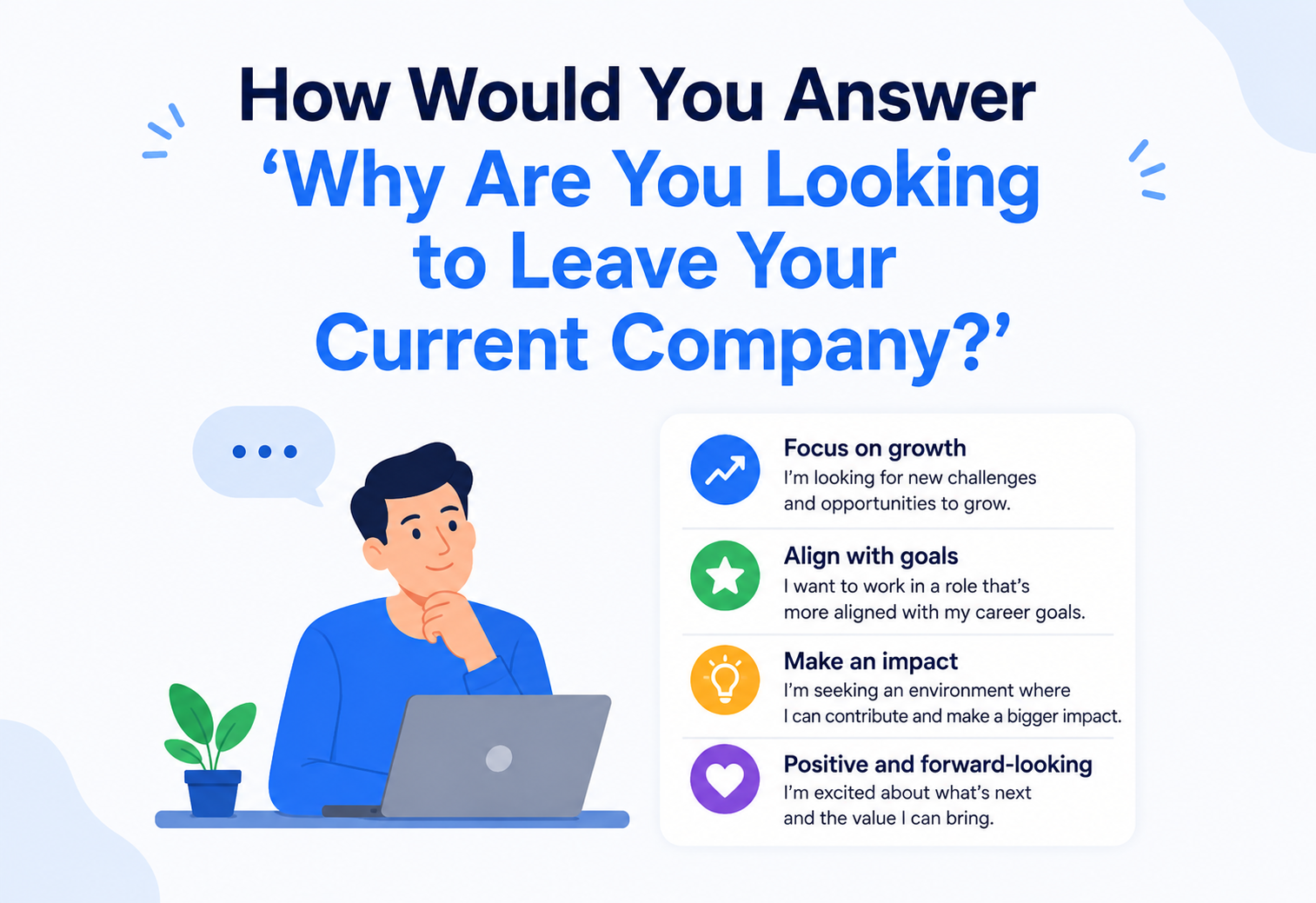
How would you answer, “Why are you looking to leave your current company?”
It’s one of the most ordinary questions in an interview — and somehow one of the hardest to answer without over-explaining, under-explaining, or accidentally sounding a little bitter. Here is a warmer, steadier way to think about it, with a simple framework, phrase swaps, and twelve real answers you can adapt in your own voice.
Why This One Question Feels So Loaded
You would think, after years of interviews, that this question would get easier. It rarely does. Somehow, “why are you leaving?” manages to feel bigger than it is — like you are being asked to put your entire professional life on trial in front of a stranger who has known you for eleven minutes.
Part of the discomfort is practical. You might genuinely be unhappy where you are, and it is hard to talk about unhappiness without sounding like you are complaining. Part of it is fear — the worry that if you say too much, you will come across as difficult, disloyal, or burned out. And part of it is simply that leaving a job, even a job you do not love, is a small grief. You gave time to that place. You built relationships, learned systems, maybe even loved it once. Explaining why you are walking away can feel like admitting something did not work.
Here is the reassurance worth holding onto before we go any further: this question is not a trap. Interviewers ask it because they genuinely want to understand your motivations, not because they are hoping to catch you saying something damaging. Almost everyone changes jobs at some point. Almost everyone has a “why.” Yours does not need to be dramatic, tragic, or perfectly polished — it just needs to be honest, and told with a bit of care.
Think of this guide less like a script to memorize and more like a conversation with a friend who happens to have sat on the other side of the interview table a few hundred times. We will talk about what is really being asked, how to reframe your story so it feels less like a confession, and — because concrete examples are more useful than abstract advice — we will walk through real, situation-specific answers you can adapt in your own words.

This is not an interrogation about your past. It is a small opportunity to describe the direction you are walking in — and to let a thoughtful listener decide whether they would like to walk beside you for a while.
What the Interviewer Is Actually Listening For
It helps to remember that the person asking this question is not a mind reader and not, usually, an adversary. They are doing a version of what you would do if a friend told you they were switching jobs — trying to understand the story so they can trust the decision.
Underneath the surface question, there are usually three quieter questions being asked at once:
Are you moving toward something, or just away from something?
A candidate who talks about growth, curiosity, or new challenges reads as forward-looking. A candidate who only talks about what was wrong with the last place reads as someone still processing frustration.
Will you speak about us the same way one day?
This is the quiet, human part of the question. If you describe your current employer with contempt, the interviewer cannot help but wonder how you will describe them in eighteen months.
Do your reasons make sense with the role I’m offering?
If you say you are leaving because you want more mentorship, and the role you are interviewing for is a solo, self-directed one, that is a mismatch worth noticing — for both of you.
None of this means you need to pretend everything at your current company is fine when it is not. It simply means the goal of your answer is not to relitigate the past. It is to show that you have thought clearly about what you want next, and that this role is a genuine, considered step toward it — not an escape hatch you are diving through blindly.
An interviewer is not grading your last job. They are trying to picture what kind of colleague you will be at this one.
The Mindset Shift That Changes Everything
Most people prepare for this question the way you would prepare a legal defense — gathering evidence for why leaving is justified, bracing for cross-examination. That posture, understandably, tends to come across as guarded. And guarded answers, even when true, sound less trustworthy than open ones.
There is a gentler way in. Instead of thinking of your answer as a defense, think of it as a compass reading. A defense looks backward and justifies. A compass reading looks forward and orients. One says, “here is why I had to get out.” The other says, “here is the direction I am walking in, and this role happens to be right along that path.”
This shift sounds subtle, but it changes almost every sentence you would otherwise say. Compare these two openers, both describing the exact same situation — a company that stopped growing and stopped promoting people:
Backward-looking, justifying
“Honestly, my company has been a mess for the last year. Nobody is getting promoted, leadership keeps changing direction, and I just do not see a future there anymore.”
Forward-looking, orienting
“I have grown a lot in my current role, and I am at a point where I am ready for more scope and more ownership than the structure there can offer right now. That is exactly what drew me to this position.”
Notice that the compass version does not hide the truth — there is still an honest acknowledgment that things stalled. But it spends its energy describing what you want next, not cataloguing what went wrong. That is the whole shift: same facts, different center of gravity.
One more thing worth saying plainly, because it tends to get lost in “interview strategy” advice: you are allowed to want better things for yourself. Wanting more growth, better pay, healthier culture, or simply a change of scenery is not a character flaw you need to spin your way around. It is a normal, human, entirely legitimate reason to move. The goal here is not to disguise your motivations — it is to talk about them in a way that lets the listener actually hear them.

A Simple Three-Part Framework You Can Lean On
When a question feels big and personal, it helps enormously to have a small, steady shape to hold your thoughts in — not a script, just a shape. Here is one that works for almost any situation, whether your reasons are simple or complicated.
A brief, warm nod to the good
Start with something true and appreciative about your current role, even a small thing. This is not flattery for its own sake — it signals that you are not someone who trashes every place they have worked, and it is usually true anyway: even hard jobs teach you something.
The honest “why now”
One or two sentences on what has changed or what you have realized — not a list of grievances, just the core truth. This is where you name the real reason, gently: you have outgrown the scope, the path forward is not there, the team’s direction shifted, or you need something the current role cannot offer.
The forward-facing bridge
Connect that reason directly to why this particular role, team, or company is a good next step. This is the part people skip, and it is the part that makes the whole answer land. It shows the interviewer you are not just leaving a job — you are choosing this one, specifically.
Put together, in about four sentences, it might sound like this:
“I have learned a lot in my current role, especially around [specific skill or experience]. But over the last year, I have realized I am ready for more [ownership / scope / mentorship / technical depth], and the structure where I am does not really have room for that right now. That is actually what made this role stand out to me — [specific detail about the new company or role] feels like exactly the kind of next step I have been looking for.”
You will notice this shape is short. That is intentional. A long, winding answer to this question tends to make interviewers lean in with follow-up questions, wondering what is being left out. A short, composed answer — one that clearly required some thought but does not over-explain — tends to earn a nod and a “makes sense,” and the conversation moves on. If they want more detail, they will ask, and you can go deeper naturally rather than pre-emptively.
Practice saying your version of this out loud, not just in your head. Answers that sound fine internally sometimes reveal an odd word choice or a slightly sharp tone once you actually hear them spoken. Say it to your phone’s voice memo app once. It is a little embarrassing and extremely useful.
Phrases Worth Softening — and What to Say Instead
Some words are perfectly true and still land harder than intended. It is not about lying or spinning; it is about choosing the version of the truth that describes your situation accurately without triggering the listener’s instinct to worry. Here are a few common swaps.
Blaming a manager
“My manager is terrible and does not support anyone.”
Naming what you need
“I am looking for a team with a bit more structure around mentorship and feedback than my current setup offers.”
Sounding resentful about pay
“I am underpaid and honestly kind of resentful about it.”
Anchoring pay to scope
“I am looking for compensation that reflects the scope of what I have taken on, which is part of what drew me to this role.”
Sounding alarmed about the company
“The company is falling apart and everyone’s job feels shaky.”
Naming a need for stability
“There has been a lot of organizational change recently, and I am looking for a bit more stability to build on.”
Confessing boredom
“I am bored out of my mind doing the same tasks every day.”
Reframing as readiness
“I have mastered the core of my current role, and I am ready for a position with more variety and room to stretch.”
Notice the pattern underneath all four swaps: the “avoid” version centers the problem and the emotion attached to it. The “try” version centers the need and the forward step. Both are honest. One simply gives the listener something constructive to hold onto instead of a complaint to feel awkward about.
This is not about scrubbing every hard feeling out of your story — sometimes a company really was mismanaged, or a manager really was unkind, and pretending otherwise would feel dishonest to you. In those cases, it is fine to be a little more direct in a later, deeper conversation, once trust has built. But for this first answer, in this first pass, softer and shorter almost always serves you better than raw and detailed.

Real Answers for Real Situations
Frameworks are useful, but sometimes what actually helps is seeing your specific situation reflected back with words already attached to it. Below are twelve common, very real reasons people leave jobs, each with a sample answer you can borrow from, reshape, and make your own. None of these are meant to be recited word for word — swap in your own details, your own voice, your own softer edges.
You have simply outgrown your current role
The most common reason — and the easiest to talk about honestly.
“I have grown a lot in my current position over the past few years, and I have reached a point where I have taken on most of the responsibility the role can offer. I am looking for a next step with more scope, and this position’s focus on [specific responsibility] is exactly the kind of stretch I am ready for.”
The company has gone through instability or layoffs
You survived the changes, but you do not want to keep surviving.
“My company has been through a lot of organizational change recently, and while I have learned a great deal navigating it, I am looking for an environment with a bit more stability where I can focus on long-term work instead of constant reorientation.”
You want compensation that reflects your growth
There is nothing to be embarrassed about here — wanting fair pay is reasonable.
“I have taken on a lot more responsibility over the last couple of years, and I am looking for a role where the compensation grows alongside that. This position felt like a strong match both for the scope of work and for where I am hoping to land financially.”
Your team or manager relationship is not healthy
Keep this one especially gentle — you do not need to relive it here.
“I have realized I do my best work with more regular feedback and a bit more structure around mentorship, which is not really part of how my current team operates. I am looking for an environment where that kind of support is built in, and from what I have learned about this team, that felt like a strong fit.”
You were laid off or let go
More on this in the next chapter — you are not alone here, and it is more common than it feels.
“My position was affected by a round of restructuring a few months ago, which was unrelated to my individual performance. It gave me some time to think clearly about what I want next, and I have been genuinely excited about roles like this one ever since.”
You are relocating
One of the easiest reasons to explain — practical, neutral, and easy to trust.
“I am relocating to [city/region] for [personal reason, if you are comfortable sharing — family, partner, cost of living], so I have been looking for roles based here or open to remote work. This position stood out immediately once I started looking.”
You need more flexibility or a different work arrangement
Especially common for caregivers, or anyone whose life has simply changed shape.
“My priorities outside of work have shifted a bit, and I am looking for a role with more flexibility around [remote work / hours / travel]. I did some research into how this team works day-to-day, and it seems like a much better match for the way I want to structure my time.”
The company’s direction changed under you
A pivot, a merger, a new strategy — you did not sign up for the version they became.
“The company shifted its focus significantly over the past year, moving away from the kind of work that originally drew me there. I am looking to get back to [specific area of focus], which is what made this role feel like such a natural fit.”
You want to move closer to work you actually care about
A quiet, honest kind of leaving — toward interest, not away from dislike.
“I have enjoyed my current role, but I have realized over time that I am most energized by [specific type of work or industry], and I have been looking for a chance to focus more deliberately in that direction. This role lines up closely with that.”
You are returning after a career break
This is not really about “leaving” a job — it is about explaining a gap with confidence.
“I stepped away for [caregiving / health / personal reasons] for a period, and I am returning now with a clear sense of what I want next. I have kept my skills current through [specific example — courses, freelance work, volunteering], and I am genuinely excited to bring that back into a full-time role like this one.”
You want a shift in company scale (bigger to smaller, or the reverse)
Scale itself can be a perfectly good reason, once you name what it actually gives or takes away.
“I have learned a lot working within a large organization, but I have realized I do my best work when I can see the direct impact of what I am building and work closely with the people making decisions. I am looking for a smaller, more hands-on environment, and everything I have read about how this team operates points to exactly that.”
You simply need a change, and that is the honest whole truth
Sometimes there is not a single dramatic reason — just a quiet, accumulating sense that it is time.
“Nothing dramatic prompted this — I have just reached a natural point where I am ready for a new environment, new problems to solve, and a fresh set of people to learn from. When I came across this role, it felt like the right kind of change at the right time.”
If none of these map exactly onto your situation, that is completely normal — most real reasons are a blend of two or three of the above. The important thing is not finding the perfect pre-written sentence. It is borrowing the shape: a warm acknowledgment, an honest “why,” and a bridge to what is next.
6.1 Matching Your Reason to the Role You Are Actually Interviewing For
One quiet detail people miss: your “why” should make sense next to the specific job you are sitting down for, not just in the abstract. If you tell an interviewer you are leaving because you are desperate for a slower pace and more predictable hours, and the role in front of you is a fast-moving, ambiguous, ship-fast startup position, that mismatch will surface eventually — either in this conversation or, worse, three months into the new job.
Before your interview, take a few minutes to actually hold your reason for leaving up against the role description. Ask yourself honestly: does what I am looking for line up with what this place seems to offer? If it mostly does, wonderful — say so plainly, and let that alignment be part of your answer. If it only partly does, it is worth being a little more precise in your language, focusing on the parts of your “why” that this specific role does address, rather than a broad, generic version of your motivations that happens to gloss over the mismatch.
This is not about performing a perfect match you do not feel. It is about doing the same reflection the interviewer is quietly doing on their end — checking that this move makes sense for both sides — so that if you do get the offer, it is one you can say yes to with a clear, settled feeling, rather than a nagging doubt you talked yourself past.

If You Were Let Go, Not Just “Leaving”
This one deserves its own quiet space, because it comes with a different kind of weight. Being laid off or let go can leave a lingering feeling of embarrassment, even when you know, logically, that it was not really about you. If this is your situation, take a breath — this is genuinely one of the more common threads in modern careers, and most interviewers have either been through it themselves or have hired several people who have.
There is an important distinction worth naming clearly, because your honest answer depends on which one is true for you.
7.1 If It Was a Layoff
If your role was affected by a restructuring, budget cuts, a team being dissolved, or a company downsizing — this is genuinely one of the easiest versions of this question to answer, because it is not about your individual performance at all. A simple, calm, factual sentence does all the work:
“My role was eliminated as part of a broader restructuring — the whole team I was on was affected, not just me. It gave me a chance to think carefully about what I want next, and I have been excited about roles like this one since.”
Notice there is no need to over-explain, apologize, or provide extra reassurance that it “really was not your fault.” Said plainly and once, it reads as fact, not as something you are anxious about. Over-explaining is usually what makes a listener wonder if there is more to the story — a short, steady answer closes the door gently and moves the conversation forward.
7.2 If It Was a Performance-Related Departure
This is harder, and there is no framework that makes it painless. But there is a version of honesty that still serves you well. The goal here is not to hide what happened; it is to show that you understood it, learned something real from it, and have already put that lesson into practice.
“Things did not work out in my last role — the expectations and my strengths were not as aligned as they could have been, and I have reflected a lot on what I would do differently. Since then, I have focused on [specific concrete action: a course, a mentor, freelance work, a smaller project], and I feel much better prepared for a role like this one, especially because [specific reason tied to this job].”
You do not owe anyone a detailed account of exactly what went wrong. A brief, honest acknowledgment followed by evidence of growth is almost always more persuasive than either a defensive denial or an over-detailed confession. Most interviewers are listening less for what happened and more for how you talk about it now — with steadiness, some self-awareness, and no bitterness toward your former employer.

Whichever version applies to you, resist the urge to name specific people or air grievances, even if you were genuinely wronged. It is not about protecting the company that let you go — it is about protecting how trustworthy and composed you appear to someone meeting you for the first time.
How to Practice Without Sounding Rehearsed
There is a fine line between “prepared” and “recites answers like a brochure,” and this particular question tends to reveal over-rehearsal faster than almost any other. Here is how to prepare in a way that still sounds like you, on the day.
Write it once, then never read it again
Draft your answer in full sentences to get the shape right, then set the page aside. The goal is to internalize the ideas, not memorize the exact words — memorized answers tend to come out in a slightly flat, performed tone.
Practice out loud, in low-stakes moments
Speak it a few times in the shower, on a walk, in the car. Saying it aloud in low-stakes settings lets the sentence structure settle naturally, so it does not come out stiff when it matters.
Let it be slightly different every time
If you say it to three different friends and it comes out a little differently each time, that is a good sign — it means you are speaking from understanding, not from a script.
Time yourself, gently
If your honest answer runs past about 45 seconds to a minute, look for what can be trimmed. Long answers to this question tend to invite more scrutiny, not less.
Practice the pause
It is completely fine to take a breath before answering, even to say “that is a fair question” while you gather your thought. A small pause reads as thoughtful, not unprepared.
One more small but real piece of advice: practice this answer even if you are not currently interviewing. Life has a way of presenting this question at inconvenient moments — a chance coffee with a recruiter, an unplanned conversation at a conference, a friend’s referral call that turns into something more formal. Having a settled, comfortable version of your “why” ready in the back of your mind means you are never caught flat-footed by it.
It is also worth paying a little attention to how your body carries the answer, not just the words. A slight softening of your shoulders, a steady pace instead of a rushed one, eye contact that stays warm rather than defensive — these small physical cues do almost as much work as your sentences. Interviewers, even without realizing it, read tension in a hurried voice or a fixed stare as a sign that a question has hit a nerve. You can say every “right” word and still leave someone unconvinced if your posture is telling a different story. So when you practice out loud, practice standing or sitting the way you actually will be in the interview — it is a small rehearsal detail that pays off more than people expect.
Follow-up Questions to Expect
A good answer to “why are you leaving” often invites a gentle follow-up or two. This is not a sign you did something wrong — it usually just means the interviewer is genuinely curious, or is checking that your story holds together comfortably under a little more detail. Here are the ones that come up most often.
“Have you talked to your manager about these concerns?”
If you have, say so briefly and describe what happened. If you have not, it is fine to say honestly that you felt the structural issue was bigger than a single conversation could solve, or that timing and circumstances did not allow for it. There is no need to feel caught out either way.
“What would need to be true for you to stay?”
This is a genuinely useful question to have thought through, separate from the interview — it helps you understand your own priorities. A short, honest answer (more growth opportunities, better pay, a healthier team dynamic) works well here.
“How long have you been thinking about leaving?”
Honesty serves you here too. Whether it has been two months or two years, a calm, specific answer (“I started seriously considering it about six months ago, once it became clear the growth path I wanted was not opening up”) sounds more credible than a vague one.
“What did you like about your current company?”
Keep a genuine answer ready for this — most people can find something true and appreciative even in a job they are eager to leave. It rounds out your story and confirms you are not someone who only sees the negative in a place.
“Does your current employer know you are interviewing?”
There is no single right answer here, and interviewers generally understand why most people keep a job search private until there is an offer on the table. A simple, honest line works well: “Not yet — I would like to have something concrete before that conversation.”
“Is there anything that would change your mind about leaving?”
This is sometimes a genuine question, and sometimes a soft way of checking whether you are using this interview as leverage for a counteroffer. A steady, honest answer serves you either way: “I have thought about this carefully, and I am looking forward to a fresh start rather than staying in the current situation.”
None of these follow-ups need to feel like a cross-examination. Answer them the same way you would answer a curious friend: briefly, honestly, and without defensiveness. If your original answer was calm and composed, the follow-ups usually stay light too.

What if You Are Honestly Not Sure Why You Want to Leave?
Sometimes the truth is not a tidy paragraph — it is a vague, restless feeling that something is not quite right, without a clean label attached to it. If that is where you are, you are in good company, and it is worth sitting with that feeling for a moment before your next interview rather than forcing it into a reason that is not quite true.
A useful exercise is to think back over the last few months and notice the small moments that made you open a job board in the first place. Was it a Sunday-night dread before the work week? A specific meeting that left you deflated? A friend describing their job in a way that made you quietly jealous? These small, specific memories are often more honest than any big-picture explanation you could invent, and they usually point toward one of the situations described earlier in this guide, even if it did not feel that clear at first.
It is also completely fine to tell an interviewer a slightly more exploratory version of your “why,” as long as it is genuine and still forward-looking:
“I have been doing some real reflection on what I want next, and a few things kept coming up — more variety in my day-to-day work, and a team that collaborates more closely. This role seemed to speak to both of those.”
A little uncertainty, framed with curiosity instead of confusion, reads as self-aware rather than unprepared. In fact, an interviewer will often trust a candidate more for admitting they are figuring it out honestly than for reciting an overly-polished reason that does not quite fit.
Common Mistakes Worth Sidestepping
Even a well-prepared candidate can slip into one of these traps if they are not watching for it. None of these are catastrophic on their own — but they add up to an answer that quietly loses the interviewer’s trust.
Only talking about what is wrong
Speaking only about what is wrong, never about what is next. A list of grievances, however justified, leaves the listener without a sense of where you are headed.
Naming specific people unkindly
Even a truthful, specific complaint about a named manager tends to make the listener quietly wonder how you would describe them one day.
Over-explaining
A long, winding answer often reads as less trustworthy than a short, composed one — brevity signals that you have made peace with the decision.
Being vague to the point of suspicion
The opposite extreme — “just looking for a change,” repeated with no further detail — can leave an interviewer without enough to trust either. A little specificity goes a long way.
Letting your tone slip into bitterness
Even accurate criticism lands differently depending on tone. The words can stay almost the same; the warmth in your voice is what does the real work.
Forgetting the bridge to this role
The single most common gap: explaining why you are leaving without ever connecting it to why you are excited about arriving here.
None of these mistakes get you rejected on the spot. But together, they add friction to a conversation that could have flowed easily — and after a long day of interviews, the interviewer often only remembers whether an exchange felt easy or heavy, not which specific sentence caused it.
One Last Thing Before Your Interview
However complicated your reasons for leaving actually are, you are allowed to tell a simple, honest, forward-looking version of them. You do not owe anyone your full story in the first ten minutes of a conversation — you owe them clarity, warmth, and a sense of where you are headed. That is genuinely enough.
Take a Breath. You’ve Got This.
- This question is not a trap. It is a chance to describe the direction you are walking in.
- Move toward something, not just away from something — even if your reasons started as frustration.
- Use the three-part shape: a warm nod to the good, an honest “why now,” and a bridge to this role.
- Soften the phrases, not the truth. Same facts, different center of gravity.
- Keep it short: a composed 30–60 second answer beats a long, defensive one every time.
- If you were let go, name it plainly and once — then talk about what you have done since.
- Practice out loud so your body and voice carry the same steadiness as your words.
- And remember: wanting better things for yourself is a completely legitimate reason to move.