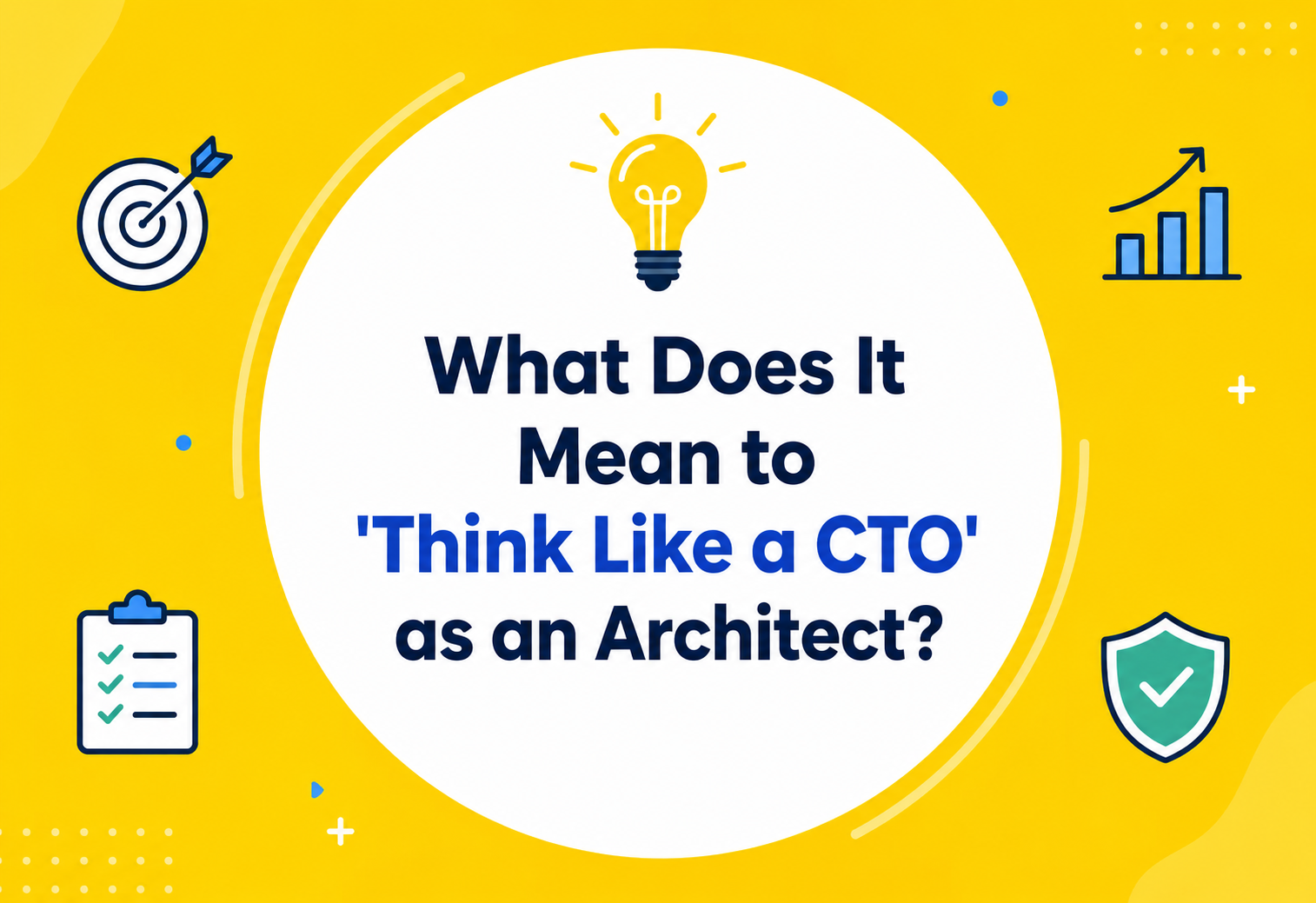
What Does It Mean to “Think Like a CTO” as an Architect?
You already know how to design the system. This is about learning to see the same decision from a higher vantage point — where cost, people, timing, and risk matter just as much as the diagram.
Why This Phrase Gets Said So Often
At some point, almost every architect hears a version of this note: “Great design — now think like a CTO about it.” It usually lands a little strangely. You weren’t hired to run the company. You were hired to make sure the system holds up, scales sensibly, and doesn’t quietly fall apart six months from now. So what exactly is being asked of you?
The honest answer is that it’s less about a job title and more about a change in altitude. An architect, most days, is standing close to the system — looking at services, data flows, failure modes, and trade-offs between patterns. That’s exactly where you need to be to do the technical work well. A CTO, by contrast, spends most of their time a little higher up, looking at the same landscape but asking different questions of it: what does this cost over three years, not three months? What happens to the roadmap if this takes twice as long? What does the board, or the biggest customer, or the newest hire on the team, need to hear about this decision?
“Thinking like a CTO” doesn’t mean abandoning the ground-level view — it means learning to hold both altitudes in your head at once, and knowing when to climb from one to the other. The best architects aren’t the ones who’ve stopped caring about elegant design. They’re the ones who’ve learned that an elegant design which nobody can afford, staff, or explain to the business is, in a very real sense, not actually a good design.
Early on, an architect’s job is mostly to prove they can be trusted with the ground-level view — that the diagrams hold up, that the trade-offs are sound, that nothing important has been overlooked. Once that trust is established, the natural next question becomes: can this person also be trusted with the parts of the decision that live outside the diagram entirely? That’s usually the exact moment this feedback starts appearing in reviews, and it’s less a criticism of your technical work than an invitation to a bigger table.
This isn’t really a leap unique to architecture. Every discipline has some version of this altitude change — a doctor who becomes a department head starts weighing staffing and budget alongside diagnoses; a lead teacher who becomes a principal starts weighing enrollment and community trust alongside lesson plans. What makes the architect-to-CTO version distinctive is simply how deep the technical layer runs underneath it — you can’t fake your way through the ground-level view here, which is exactly why this guide spends real time there before ever getting to the higher-altitude questions.
This guide is an attempt to make that shift concrete — not abstract leadership advice, but the specific lenses, questions, and habits that separate “a very good technical decision” from “a very good decision, full stop.”
The Core Shift — From Correctness to Consequence
Most architects are trained, quite rightly, to optimize for correctness. Is this design sound? Does it handle the failure cases? Will it scale to the numbers in the requirements doc? These are the right questions to ask, and no amount of “CTO thinking” should make you stop asking them.
But a purely technical view tends to treat every well-designed option as roughly equal, differentiated only by engineering merit. A CTO’s view adds a second axis entirely: consequence. Not “is this correct,” but “what does choosing this actually set in motion — for the budget, for the team, for the next eighteen months of decisions that will now be built on top of it?”
Here’s a small, concrete example. Imagine two equally valid architectures for a new service: one uses a message queue and asynchronous processing, the other keeps things synchronous and simpler. Purely on engineering merit, the asynchronous version might be the more “correct” long-term choice — more resilient, more scalable. A ground-level view stops there. A CTO-level view keeps going: does the team currently on this project have experience operating a queue-based system at 2am when something breaks? Does the timeline allow for the extra weeks of complexity? Is the expected scale even close to where that resilience would matter in the next year? Sometimes the answer still favors the queue. Sometimes it doesn’t. The point isn’t which option wins — it’s that a whole extra layer of real questions gets asked before the decision is made.
This shift is uncomfortable at first, because it can feel like diluting technical purity with “business noise.” It isn’t. It’s expanding your definition of a good decision to include everything that decision actually touches — which, if you look honestly, was always more than just the diagram.
There’s a useful way to notice when you’re still stuck at the “correctness only” altitude: pay attention to how a design decision gets defended in a review. If every defense of a choice ends at “because it’s the more scalable pattern” or “because it follows best practice,” that’s usually a sign the conversation hasn’t yet climbed to consequence. A decision that’s been examined at both altitudes tends to sound a little different — something closer to “it’s the more scalable pattern, and given our runway and the team’s current experience with this stack, the added complexity is worth taking on now rather than retrofitting it under pressure later.” Same technical merit, but now anchored to the actual situation rather than floating in the abstract.
What a CTO’s Week Actually Looks Like
It’s easier to understand the mindset once you understand the actual texture of the job it comes from. Most CTOs, even at companies known for strong engineering cultures, spend surprisingly little of their week deep in a single architecture diagram.
A more typical week includes a budget review where headcount and infrastructure spend get weighed against next quarter’s plans; a conversation with a sales or product leader about whether a customer’s request is technically feasible on the current timeline; a candid check-in with an engineering manager about whether a team is stretched too thin; and a board or investor update that needs to translate months of technical work into a handful of plain, honest sentences.
Budget & Headcount Review
Weighing infrastructure spend and hiring plans against next quarter’s roadmap. Every line item is also a small technical bet.
Feasibility Talk With Sales
“Can we ship this for the customer by end of quarter?” — a question whose honest answer depends on architecture, staffing, and risk at once.
Check-in With an Engineering Manager
Is a team stretched too thin? Is on-call fatigue building? These conversations shape which designs are safe to greenlight.
Board / Investor Update
Translating months of technical work into a few plain, honest sentences a non-engineer will remember and act on.
None of these conversations are less rigorous than a design review — they’re just rigorous about different variables. A CTO who does this well isn’t skimming past technical depth to get to the “important” business conversations. They’re applying the same care to a budget line item that an architect applies to a data model: understanding it fully before making a call, rather than skimming the surface and hoping it holds.
This is partly why the phrase “think like a CTO” can feel disorienting at first — it’s not asking you to do a smaller version of your current job, it’s describing an entirely different rhythm of attention, one that moves across many decisions in a week rather than sitting inside one for days. You don’t need to adopt that entire rhythm as an architect. But understanding it explains why a CTO, looking at your design, is often silently running it through cost, staffing, and timeline questions before they’ve even finished reading the diagram — and why learning to anticipate those questions yourself tends to make your proposals land more smoothly.

Six Lenses a CTO Looks Through
Rather than trying to import an entire executive mindset overnight, it helps to borrow it one lens at a time. Below are six questions that tend to run quietly in a CTO’s head during almost any architectural conversation — alongside the equally valid architect’s question sitting right next to it. The goal isn’t to replace one with the other. It’s to hold both.
Every architectural choice is also, quietly, a financial commitment.
An architect asks: Does this design handle the load, the edge cases, and the failure modes correctly?
A CTO also asks: What does this cost to run every month at current scale, and at ten times current scale? Are we paying for resilience we don’t need yet, or skipping resilience we’ll desperately need in six months?
The “right” answer changes depending on how much runway you actually have.
An architect asks: What’s the most robust way to solve this problem for the long run?
A CTO also asks: Do we have three months or three weeks before this needs to ship? Is there a smaller version of the “right” answer we can build now and expand later, without painting ourselves into a corner?
A design is only as good as the team’s ability to run it at 3am.
An architect asks: What’s the theoretically cleanest way to structure these services?
A CTO also asks: Can the team we actually have — not the team we wish we had — build, operate, and debug this? What happens if the one engineer who understands it takes a new job next quarter?
Not “could this fail,” but “how bad is it, and how loudly would we know?”
An architect asks: What are the failure modes, and how do we handle each one gracefully?
A CTO also asks: If this fails at 2pm on the busiest day of the year, what does that actually cost us — in money, in trust, in headlines? Does the size of that risk match the amount of engineering effort we’re spending to prevent it?
If you can’t explain it plainly, it’s harder to defend it when it matters.
An architect asks: How do I document this so the next engineer understands the design?
A CTO also asks: How do I explain this in two sentences to a product lead, a finance partner, or a customer who has no technical background — without either lying or losing them?
Some decisions are easy to undo. Others quietly become permanent.
An architect asks: Which technology or pattern best fits today’s known requirements?
A CTO also asks: If our assumptions turn out wrong in a year, how expensive is it to change course? Are we buying flexibility we might need, or paying for flexibility we’ll never use?
Notice that none of these six lenses ask you to abandon rigor. If anything, they ask for more of it — rigor extended past the point where most technical analysis quietly stops, into the territory of money, timing, people, risk, communication, and reversibility that the business actually lives in.
4.1 Watching All Six Lenses Work on One Real Decision
Lenses are easier to trust once you’ve seen them applied together, in order, to something concrete. Imagine a mid-sized product team debating whether to move their monolith to microservices ahead of a major growth push. At the ground level, the technical case is genuinely strong — the monolith has real coupling problems, deploys are slow, and a handful of services would clearly reduce blast radius. A purely technical review would likely greenlight the migration on that basis alone.
Run through the six lenses, though, and the picture gets more textured. The money lens surfaces that the migration would roughly double infrastructure spend for the first year, before any efficiency gains show up. The timing lens reveals that the growth push leadership is planning around is only four months out — not nearly enough runway to migrate safely and hit that date. The people lens turns up an uncomfortable truth: only two engineers on the team have ever operated a distributed system in production, and both are already stretched thin. The risk lens asks what actually breaks today, and the honest answer is “slow deploys,” not “outages” — a real problem, but a containable one. The story lens asks whether this trade-off could be explained plainly to the product lead pushing for the growth date, and the answer is a clean, honest “not yet, and here’s why.” And the optionality lens points out that a smaller, reversible step — splitting off just the one service causing the worst coupling — captures much of the benefit without locking in the bigger, harder-to-reverse commitment.
It’s worth noticing, too, what this kind of decision does for trust over time. The team gets to ship something real within their actual runway instead of missing a date on an ambitious rewrite. Leadership gets a credible plan instead of either a flat “no” or a quietly doomed “yes.” And the architect who walked through all six lenses out loud, in the room, tends to be the person invited into the next big decision a little earlier than before — not because they were the loudest voice, but because their view was the most complete one.
What Doesn’t Change About Your Job
It’s worth saying plainly, because this advice can otherwise tip into an unhelpful place: thinking like a CTO does not mean becoming less technical, less rigorous, or less willing to push back on a bad idea because it happens to be cheap or fast. A CTO who has lost their technical judgment entirely tends to make worse decisions, not better ones — they just make them more confidently.
Your technical depth is exactly what makes the higher-altitude view useful in the first place. Without it, “thinking about cost and timing” collapses into simply picking the cheapest, fastest option every time, which is its own kind of bad decision-making, just as one-dimensional as picking the theoretically purest option every time. The whole value of an architect who can also think like a CTO is that they can hold the technical truth and the business truth in the same sentence, and find the option that respects both.
So the goal isn’t to trade your engineering judgment for business judgment. It’s to widen the aperture — to notice that “will this design hold up under load” and “can we afford to build this the right way, on this timeline, with this team” are both real, both important, and often answerable in the same conversation if you simply remember to ask both.
There’s a reassuring way to think about this balance: the technical lens tells you what’s possible, and the business lens tells you what’s worth doing right now, in this specific context, with these specific constraints. Neither one is more “senior” than the other — they’re simply answering different halves of the same question. An architect who only asks what’s possible ends up proposing beautiful solutions to the wrong problem at the wrong time. A leader who only asks what’s affordable ends up making cheap, fast decisions that quietly accumulate into a system nobody can maintain. The skill this whole guide is describing sits exactly in the middle, refusing to let either half of the question go unanswered.
A CTO who can’t tell you why a particular data model is a bad idea is not someone architects tend to trust. The technical fluency is the foundation the rest of this thinking stands on — it’s an addition, not a replacement.
Three Questions Before Any Big Decision
When a decision feels big enough that it deserves this wider view, it helps to have a short, memorable set of questions to run it through — not a full framework, just a habit of pausing before committing.
6.1 What Does This Cost Us if We’re Right, and What Does It Cost Us if We’re Wrong?
Every architectural bet has an asymmetry hiding in it. Sometimes being wrong is cheap to recover from — you can migrate later with a few weeks of work. Sometimes being wrong is expensive and slow to unwind — a data model that’s painful to change, a vendor contract with years left on it. Knowing which kind of bet you’re making changes how much caution the decision deserves. Picture choosing a database for a new product: picking a slightly less optimal but well-understood option might cost a little performance if you’re right about future scale, but picking an exotic, higher-performance option that turns out to be the wrong fit could cost months of migration work later. Naming that asymmetry out loud, before committing, is often the entire difference between a considered decision and a lucky one.
6.2 Who Has to Live With This After I’ve Moved On to the Next Project?
Architects often hand a design off to a team that will operate it long after the interesting design work is done. Thinking one level higher means asking, honestly, whether that team — with their current skills, their current staffing, their current level of on-call fatigue — can actually carry this well. A design that’s a joy to build and a nightmare to operate tends to quietly erode goodwill with the team stuck maintaining it, even if nobody says so directly in a retro.
6.3 Could I Explain This Decision, in Plain Language, to Someone Who Will Feel Its Consequences but Doesn’t Understand the Technology?
This is a genuinely useful test. If you can’t explain why a decision makes sense to a finance lead, a customer success manager, or a new hire without technical background, it’s worth asking whether the decision itself is as sound as it feels from inside the engineering conversation, or whether it’s just comfortable and familiar. Try it literally: write the explanation in two sentences, read it back, and notice whether it still sounds convincing once the technical jargon is gone.
Common Traps Along the Way
Learning any new lens tends to come with an overcorrection phase, and this one is no exception. Here are the traps that show up most often once architects start genuinely trying to widen their view — worth naming early, so you can recognize them if they start creeping into your own thinking.
- Treating “thinking like a CTO” as an excuse to cut corners. Sometimes people use this phrase to justify skipping tests, documentation, or proper review because “we need to move fast.” That’s not higher-altitude thinking — it’s just short-term thinking wearing a business costume.
- Assuming every decision needs the full weight of this thinking. Not every choice is a big one. Applying six lenses and three questions to a small, easily reversible decision just slows everything down. Save the wider view for decisions that are genuinely expensive, risky, or hard to undo.
- Losing your technical voice in the room. The point of widening your view is to add a dimension, not to become a generic “business person” who defers on every technical question. Your engineering judgment is still the thing people are relying on you for.
- Forgetting to bring the team along. If you start making decisions with cost, timing, and risk in mind but never explain why, your team may feel like good engineering practices are being quietly deprioritized for reasons nobody’s shared. Narrate the “why,” not just the “what.”
- Confusing “higher altitude” with “less detail.” Thinking about consequences doesn’t mean skimming the technical details — often it means understanding them even more precisely, because you need to know exactly what could go wrong before you can honestly weigh the risk.
- Mistaking confidence for correctness. Speaking with the calm, decisive tone often associated with senior leadership doesn’t make an under-examined decision correct. The tone should follow the rigor, not substitute for it.
Most of these traps share a common root: treating this shift as a costume to put on rather than a habit to build slowly. Given a little time and a few real decisions to practice on, the overcorrection phase tends to settle into something more natural — a view that’s simply wider than it used to be, without losing anything that made your technical judgment valuable in the first place.
How to Practice This Without the Title
You don’t need to be handed the title to start building this habit — in fact, most people who eventually earn a CTO-level role are the ones who were already thinking this way well before anyone asked them to.
Add One Sentence of “Why” to Every Design Doc
Alongside the technical rationale, add a short line about cost, timeline, or team impact. It trains you to consider it every time, and it quietly signals to leadership that you already think this way.
Sit In on a Budget or Planning Conversation, Even as a Guest
Watching how leadership weighs trade-offs in real time — with real constraints, not hypothetical ones — teaches this instinct faster than any framework.
Ask “What Would This Cost to Undo?” Out Loud in Design Reviews
It’s a small habit that reliably surfaces the reversibility question before a decision is locked in, and it tends to make the whole team a little sharper about long-term consequences.
Practice Explaining Your Own Designs to a Non-Technical Friend or Partner
If you can make them understand, in plain words, what a design does and why it matters, you’ve built the exact muscle this whole guide is about.
Keep a Short List of Past Decisions and How They Aged
A quiet, personal log of “we chose X, here’s what actually happened eighteen months later” builds the kind of pattern recognition that no framework can substitute for.
None of this requires permission. It requires attention — noticing, a little more often, the parts of a decision that live just outside the diagram.
It’s worth adding one more thing, gently: this practice is slow, and that’s fine. Nobody develops this instinct from reading a single guide or attending a single planning meeting. It builds the same way technical intuition does — through repetition, through watching decisions play out over months and years, through occasionally being wrong about a cost estimate or a timeline and remembering that lesson the next time. Give yourself the same patience you’d give a junior engineer learning to reason about distributed systems. This is just as real a skill, and it takes just as long to grow.
A Short Pass Before You Sign Off
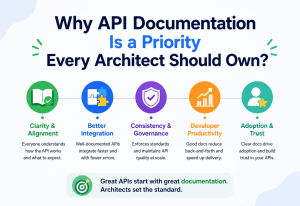
Before signing off on a decision that genuinely matters, a quick pass through these six questions tends to catch what a purely technical review misses.
The Six-Question Field Check
- Cost: What does this cost to run, this year and at ten times this year’s scale?
- Increment: Is there a smaller version of this we could ship now and expand later?
- Operability: Can the team we actually have operate this at 3am without me?
- Blast radius: If this fails at the worst possible moment, how bad is it, really?
- Legibility: Could I explain this, plainly, to someone outside engineering?
- Reversibility: How expensive would it be to change our minds a year from now?
If most of these questions have honest, confident answers, the decision has probably been examined at both altitudes and is ready to move forward. If two or three of them come back as “I’m not sure yet,” that’s not a reason to abandon the design — it’s a signal that the wider view still has work to do before the decision fully lands.
Questions People Quietly Wonder
Does this mean I should stop caring about elegant, well-crafted architecture?
Not at all — elegance still matters, both for its own sake and because well-crafted systems tend to be cheaper to run and easier to change later. The shift is about widening what “good” means, not narrowing it to only business concerns.
What if leadership doesn’t actually want this kind of input from an architect?
Start small and low-stakes: a single sentence about cost or timeline in a document, a single question in a review. Most leadership teams welcome this once they see it’s additive, not a challenge to their authority — it tends to build trust quickly rather than threaten it.
Isn’t this just “soft skills” dressed up in architecture language?
It overlaps with communication and business awareness, yes, but at its core it’s still a technical skill — the ability to weigh trade-offs accurately requires real engineering judgment. It’s less “soft skills” and more “a wider technical lens.”
How do I know if I’m overcorrecting into pure business thinking?
A good sign you’ve kept your balance: you can still explain, in technical depth, why you’d push back on a plan that’s cheap and fast but genuinely unsound. If cost and speed have started to override every technical concern without exception, that’s worth noticing and course-correcting.
Does company size change how much of this applies to me?
It changes the scale of the numbers, not the relevance of the thinking. A five-person startup and a thousand-person company both face the same underlying questions about cost, timing, staffing, and risk — the startup’s version just tends to move faster and forgive fewer mistakes.
What if I try this and my input still gets overruled?
That happens, and it doesn’t mean the thinking was wrong. Leadership weighs factors you may not have full visibility into. The value of building this habit isn’t a guarantee your view will always win — it’s that your input becomes sharper, more trusted, and more likely to shape the decision over time, even when it isn’t the deciding vote on any single day.
Signs This Shift Is Starting to Happen Naturally
This kind of growth rarely announces itself with a single dramatic moment. It tends to show up in small, easy-to-miss ways, and it’s worth knowing what to look for so you can notice your own progress rather than waiting for someone else to point it out.
You might catch yourself, mid-design-review, mentioning a cost or timeline consideration before anyone asks — not because you rehearsed it, but because it genuinely occurred to you alongside the technical question. You might notice a proposal getting approved a little faster than usual, not because the technical bar dropped, but because the reviewer’s usual follow-up questions about cost or staffing were already answered in your first draft. You might find yourself, in a hallway conversation with a product manager, able to explain a technical trade-off in a sentence or two without reaching for jargon, and watch their face relax with understanding instead of politely nodding along.
Mentioning Cost Before Anyone Asks
Mid-review, a cost or timeline consideration surfaces alongside your technical point — not because you rehearsed it, but because it genuinely occurred to you.
Faster Approvals on Proposals
Reviewers’ usual follow-up questions about staffing or spend are already answered in your first draft. The bar didn’t drop — your view got wider.
Non-Engineers Actually Understand You
In a hallway conversation with a PM, you explain a trade-off in a sentence or two, and their face relaxes with understanding instead of polite nodding.
None of these moments feel like a graduation ceremony. They feel almost unremarkable, which is exactly the point — the wider view has stopped being an effortful exercise and started being simply how you think. That’s the real destination this whole guide has been pointing toward: not a title, not a framework memorized and recited, but a slightly wider, slightly steadier way of seeing the same systems you already understood so well.
Carrying the Technical Work to a Higher Vantage
Thinking like a CTO as an architect isn’t about leaving the technical work behind — it’s about carrying it up to a higher vantage point, where cost, timing, people, and risk sit right alongside the diagram, not apart from it. The view is wider. The judgment underneath it is still yours.