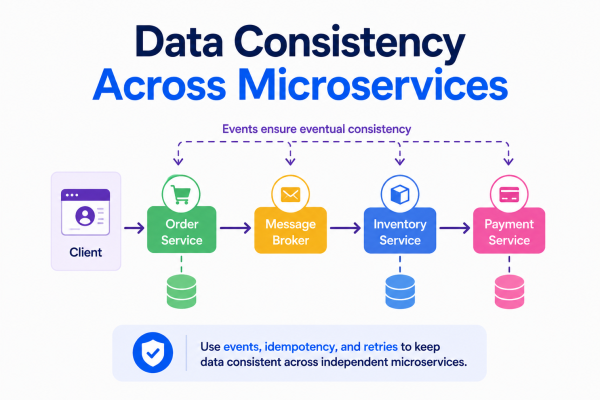
Data Consistency Across Microservices

Data Consistency Across Microservices

A complete, plain-language guide to data consistency across microservices: what “consistency” really means when many services each own their own database, a short history from monoliths to microservices, the ShopFast e-commerce running example, careful definitions of ACID, BASE, strong / eventual / causal consistency, idempotency, and distributed transactions, the CAP…

Read More
What Is a Message Queue Used For?

What Is a Message Queue Used For?

A complete, ground-up tutorial on message queues: introduction and history (from 1970s mainframe middleware and IBM MQ through JMS, ActiveMQ, RabbitMQ, Kafka, and today’s managed cloud services), the problem and motivation, eight core concepts (message, producer, consumer, broker, queue, topic, acknowledgment, dead letter queue), full architecture, internal working for both…

Read More
What Is Eventual Consistency in System Design?

What Is Eventual Consistency in System Design?

A complete, beginner-to-production guide to eventual consistency in system design: the texting-with-bad-signal analogy and a plain-English definition; a short history from the 1990s research literature through Amazon Dynamo (2007), Google Bigtable, Cassandra, and Voldemort; why replication exists and the two possible answers when copies disagree (strong vs eventual consistency); the…

Read More
What Is Graceful Degradation in System Architecture?

What Is Graceful Degradation in System Architecture?

A complete, beginner-to-interview-ready tutorial on graceful degradation – the design approach that lets a system deliberately reduce features or quality in a controlled, planned way rather than failing completely. Uses the four-engine airplane analogy to introduce the mindset shift from “prevent every failure” to “plan the reduced experience in advance,”…

Read More
When Would You Choose Eventual Consistency Over Strong Consistency?

When Would You Choose Eventual Consistency Over Strong Consistency?

A first-principles guide to the single most important trade-off in distributed systems: strong consistency versus eventual consistency. Covers the history and physical motivation, all the vocabulary (linearisability, causal, read-your-writes, session, bounded staleness), the CAP theorem and PACELC extension, architecture components (replicas, leader-follower, leaderless, quorums N/W/R, vector clocks), how strongly and…

Read More
What Is Strong Consistency in System Design?

What Is Strong Consistency in System Design?

A complete, beginner-friendly guide to strong consistency in distributed systems. Covers: what strong consistency really is and its short history, the problem it solves, the shared-notebook analogy, core terminology (consistency, replication, quorum, consensus, linearizability, eventual consistency), the full consistency spectrum from strong to eventual, the six-component architecture behind it, the…

Read More