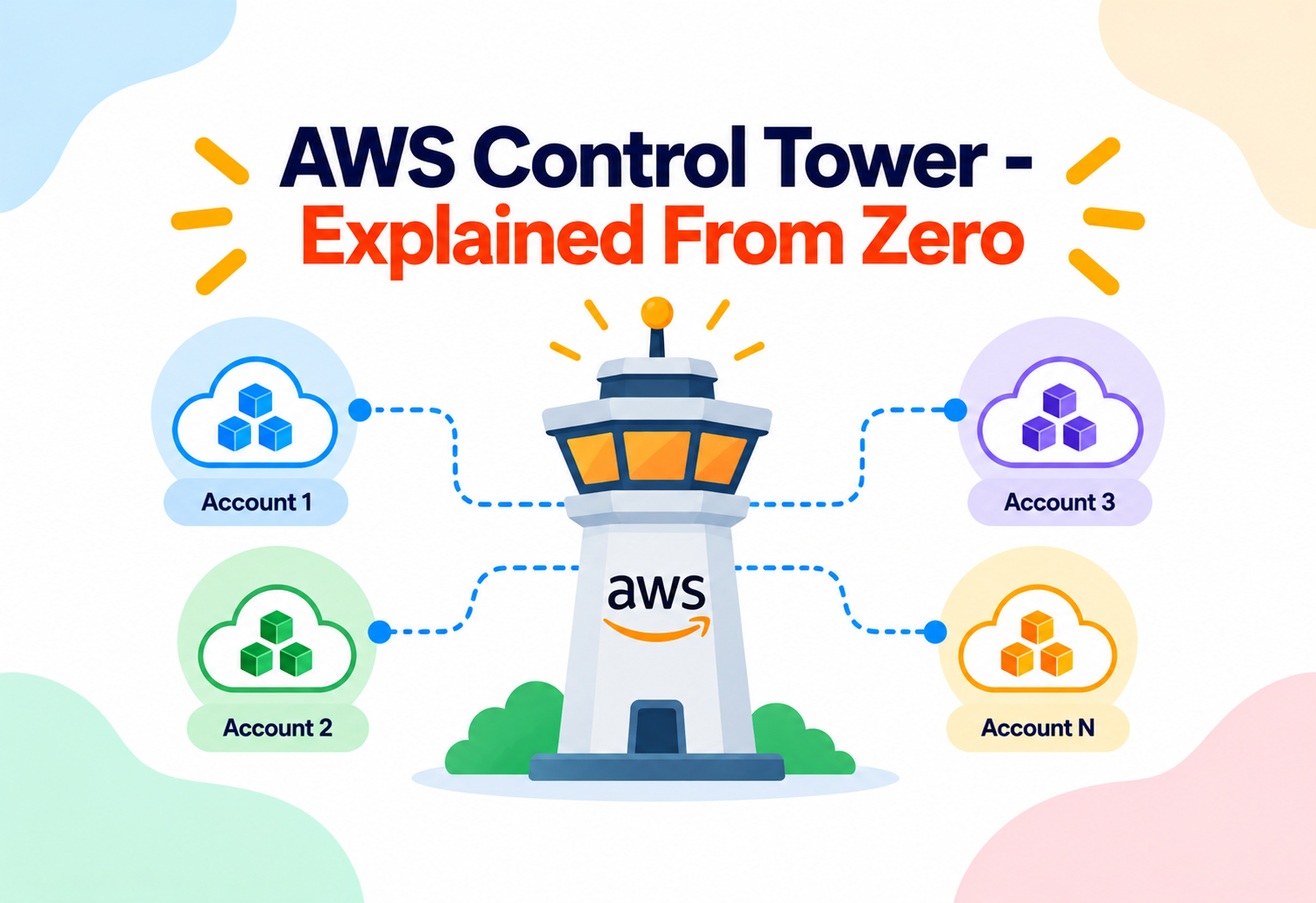
AWS Control Tower – Explained From Zero
A complete, plain-English walkthrough of how AWS Control Tower sets up a secure, well-governed multi-account AWS environment in hours instead of months.
Imagine a company decides every new employee should get their own separate house, complete with matching locks, matching alarm systems, and matching house rules, applied automatically the moment they join — no builder needed, no forgetting to install a smoke detector in house number forty-seven. That is essentially the problem AWS Control Tower solves, except the “houses” are AWS accounts. As organizations grow, they don’t run everything in one AWS account — they create many, to isolate teams, environments, and workloads. Doing that safely and consistently, by hand, becomes a nightmare past a handful of accounts. AWS Control Tower automates the entire process: it sets up a well-architected, secure multi-account environment for you, and keeps every account that joins it compliant with the rules you define. This guide explains what Control Tower actually is, how it works internally, and how real organizations use it — assuming zero prior AWS knowledge, and building toward a genuinely solid, interview-ready understanding of multi-account governance on AWS.
1Core Concepts
Before any diagrams, let’s build a solid mental model of why companies use many AWS accounts, and what “governance” means in that context.
Why Do Companies Use Multiple AWS Accounts?
A single AWS account can technically run everything — development, testing, and production workloads for every team in a company. But mixing everything into one account creates real risk: a mistake made by a junior developer testing a new feature could accidently affect the production database serving real customers. Separate AWS accounts create hard security and billing boundaries between teams, environments, and workloads, so a problem in one account cannot spill into another. This isolation also makes cost tracking dramatically simpler, since each account’s bill maps cleanly to a specific team or project rather than requiring complex internal cost allocation across a single shared account.
Think of a large apartment building. Each tenant has their own locked unit, their own lease, and their own utility bill, even though they all share the same building infrastructure. If one tenant’s kitchen catches fire, the building’s design contains that damage to their unit rather than letting it spread to every apartment. Separate AWS accounts work the same way — each is its own locked unit within the larger “building” of your company’s AWS usage, containing risk and keeping billing clearly separated.
What “Governance” Means for a Multi-Account Environment
Once you have many accounts, a new problem appears: how do you make sure every single one of them follows the same security rules, logs activity the same way, and stays compliant with company policy — without manually configuring each one by hand, and without that configuration drifting apart over time? This is what “governance” means in cloud terms: consistently enforced rules and guardrails across every account in the environment, applied the same way whether an account was created on day one or day one thousand.
What AWS Control Tower Actually Is
AWS Control Tower is a service that automates the setup of a secure, well-governed multi-account AWS environment, called a “landing zone,” based on AWS’s recommended best practices. It builds on top of AWS Organizations (the underlying multi-account management service) and layers on automated account provisioning, centralized logging, identity management, and ongoing policy enforcement called “guardrails” — all set up through a guided process rather than manual configuration.
Control Tower does not replace AWS Organizations — it is built on top of it. Think of AWS Organizations as the raw framework for grouping accounts, and Control Tower as the automated, opinionated setup process and ongoing governance layer built on that framework.
Landing Zone in Hours
What used to take a specialized team weeks to design is automated into a guided setup.
Guardrails Everywhere
Every account created through Control Tower inherits the same baseline security rules.
One Place to See It All
A single dashboard shows account status, compliance, and provisioning across the whole environment.
Account Factory
Teams can request new, pre-configured accounts without needing central IT to build each one by hand.
2Architecture & Core Components
Control Tower is composed of a handful of specific building blocks that combine to form the “landing zone.”
- Landing Zone — the overall multi-account environment Control Tower sets up, including a management account and a set of foundational accounts and organizational units.
- Management Account — the top-level account where Control Tower and AWS Organizations are configured; it should be used only for governance, never for running actual workloads.
- Organizational Units (OUs) — folders that group related accounts together (for example, a “Production” OU and a “Sandbox” OU), letting you apply different guardrails to different groups.
- Log Archive Account — a dedicated, automatically created account that centrally stores logs (like AWS CloudTrail and AWS Config data) from every account in the landing zone.
- Audit Account — a dedicated account granting designated security or auditing teams read access across the environment for compliance review, without giving them the ability to modify workloads.
- Guardrails — pre-built or custom rules that either prevent an action outright (preventive) or continuously check for and flag non-compliant configurations (detective).
- Account Factory — the self-service account provisioning tool that creates new, pre-configured accounts already compliant with the landing zone’s guardrails.
graph TD
    M[Management Account
Control Tower + Organizations] --> LA[Log Archive Account]
    M --> AA[Audit Account]
    M --> OU1[Production OU]
    M --> OU2[Sandbox OU]
    OU1 --> A1[Account: Payments Service]
    OU1 --> A2[Account: Web Frontend]
    OU2 --> A3[Account: Dev Team Sandbox]
    AF[Account Factory] -->|Provisions New Accounts| OU1
    AF -->|Provisions New Accounts| OU2
    G[Guardrails] -.Enforced Across.-> OU1
    G -.Enforced Across.-> OU2
Fig. 1 — The core structure of a Control Tower landing zone: a management account, dedicated foundational accounts, and guardrail-enforced organizational units.
Why Separate Log Archive and Audit Accounts?
Keeping logs in a dedicated account, separate from the workloads that generate them, means that even if a workload account is compromised, an attacker cannot tamper with or delete the historical log evidence needed to investigate what happened — the logs live somewhere entirely outside their reach.
3Internal Working
What actually happens when you set up Control Tower, or when a new account is created through it?
When you first launch Control Tower, it walks you through setting up the landing zone: choosing a home Region, configuring the Log Archive and Audit accounts, and enabling an initial set of mandatory and recommended guardrails. Behind the scenes, Control Tower uses AWS CloudFormation (an infrastructure-as-code service) to actually build out all of this infrastructure consistently, rather than leaving room for manual configuration mistakes.
Picture a franchise restaurant chain that hands every new location the exact same blueprint, the exact same equipment checklist, and the exact same health-and-safety training — guaranteeing that walking into any branch anywhere in the country feels consistent and meets the same standards. Control Tower’s Account Factory works the same way: every new account it provisions starts from the identical, vetted blueprint, rather than being built up ad hoc by whichever engineer happens to set it up that day.
How Guardrails Actually Enforce Rules
Preventive guardrails work by attaching Service Control Policies (SCPs) at the OU level, which are enforced by AWS Organizations itself — meaning a blocked action is rejected at the API level before it can even happen, regardless of what IAM permissions an individual user might otherwise have. Detective guardrails, by contrast, use AWS Config rules that continuously evaluate resource configurations against the desired state and flag any account that drifts out of compliance, surfacing that violation in the Control Tower dashboard for someone to address.
Drift Detection
Because accounts can still be modified directly after being provisioned, Control Tower continuously checks whether an account’s actual configuration still matches what the landing zone expects. If someone manually changes something that Control Tower manages — for example, disabling a required CloudTrail log — Control Tower detects this “drift” and flags it, so administrators know exactly which account needs to be brought back into compliance.
The Role of AWS Config Behind the Scenes
Detective guardrails rely heavily on AWS Config, a service that continuously records the configuration state of resources across an account and evaluates them against defined rules. Control Tower automatically enables and manages a specific set of these Config rules across every account in the landing zone, so administrators never need to individually configure AWS Config account by account — it comes bundled as part of what “joining the landing zone” means for a new account.
How Account Factory Templates Work
Account Factory doesn’t just create a bare, empty account — it can apply a chosen network configuration, baseline IAM roles, and any custom account customizations defined through Account Factory Customizations (AFC), which uses CloudFormation StackSets to deploy additional resources automatically into every new account as it’s created, such as a standard set of security tooling or a shared VPC configuration.
4Data Flow & Account Lifecycle
Every account’s journey through Control Tower follows a predictable, repeatable sequence.
Landing Zone Setup
An administrator configures the initial landing zone: home Region, foundational accounts, and baseline guardrails.
Organizational Unit Creation
OUs are created to represent logical groupings, such as Production, Development, or Sandbox.
Account Provisioning via Account Factory
A new account is requested — either by an administrator or a self-service request — and Account Factory builds it automatically.
Guardrails Applied Automatically
The new account inherits every guardrail assigned to its OU the moment it’s created — no manual setup needed.
Continuous Compliance Monitoring
Control Tower continuously checks the account against detective guardrails, flagging any drift.
Centralized Logging
All activity within the account is logged and routed automatically to the Log Archive account.
Moving an existing, already-in-use AWS account into a Control Tower-managed OU (rather than creating a brand-new one) requires careful planning — existing resources and configurations may conflict with guardrails, so this is typically done gradually and tested rather than all at once.
5Advantages, Disadvantages & Trade-offs
Advantages
- Turns weeks of manual multi-account setup into a guided process measured in hours
- Enforces consistent security and compliance baselines automatically across every account
- Self-service Account Factory reduces bottlenecks on central platform teams
- Centralized logging and auditing simplify security investigations and compliance reporting
- Built on native AWS services (Organizations, CloudFormation, Config), not a proprietary black box
Disadvantages
- Adds architectural complexity that a very small organization with one or two accounts may not need yet
- Opinionated defaults may not perfectly fit every organization’s existing structure without customization
- Migrating pre-existing, unmanaged accounts into Control Tower can be a nontrivial, careful process
- Guardrails, if configured too strictly, can slow down legitimate development work if not tuned thoughtfully
The Core Trade-off: Standardization vs. Flexibility
Control Tower’s biggest strength — enforcing the same rules everywhere — is also its central trade-off. A highly standardized environment is easier to secure and audit, but individual teams sometimes want more flexibility than a strict guardrail allows. Successful adoption usually means starting with a sensible baseline of guardrails and loosening or tightening specific ones per OU, rather than applying maximum strictness everywhere by default.
Organizations that skip this tuning step and simply enable every available guardrail at maximum strictness from day one often find themselves fielding a wave of complaints from development teams whose legitimate work gets blocked, which can lead to governance being seen as an obstacle rather than a safety net — undermining the very culture of security Control Tower is meant to build.
6Scaling to Hundreds of Accounts
Control Tower is designed specifically for the scale problem that appears once an organization moves past a handful of AWS accounts.
A company with three accounts can manage things manually without too much pain. A company with three hundred accounts across dozens of teams cannot — every manual step becomes an opportunity for one account to quietly drift out of compliance. Control Tower’s Account Factory and guardrail inheritance model mean the process of creating account number three hundred and one is exactly as consistent and effortless as creating account number two.
Organizing OUs for Growth
A common scaling pattern nests OUs by both environment and business unit — for example, a top-level “Production” OU containing separate child OUs per business unit, each inheriting a shared baseline of guardrails plus any additional rules specific to that unit’s regulatory requirements. This structure lets an organization grow from a handful of teams to dozens without redesigning its governance model from scratch each time.
Delegated Administration for Large Teams
As an organization scales past a certain size, having every guardrail decision flow through a single central team becomes its own bottleneck. Control Tower supports delegated administration, letting a designated member account manage day-to-day Control Tower operations — reviewing compliance, provisioning new accounts — without requiring direct access to the highly privileged management account itself. This mirrors how large companies delegate operational authority without handing out the keys to the entire kingdom.
7High Availability & Reliability
Control Tower itself is a managed control-plane service, and the underlying services it configures — AWS Organizations, AWS Config, AWS CloudTrail — are all highly available AWS services running across multiple Availability Zones. Reliability in a Control Tower context is less about “will the service stay up” and more about “will governance stay consistent as the environment grows and changes.”
Your reliability responsibility centers on responding to drift notifications promptly and periodically re-registering existing OUs when Control Tower releases updated baseline configurations, so the entire environment continues to benefit from AWS’s evolving best practices rather than being frozen at whatever configuration existed on day one.
Landing Zone Updates
AWS periodically updates the Control Tower landing zone version with new features, improved guardrails, or updated best practices. Applying these updates is a deliberate, reviewable action rather than something that happens silently in the background, giving administrators the chance to understand what’s changing before it rolls out across every managed account.
This update model reflects a broader reliability principle behind Control Tower: rather than optimizing purely for “always current,” it optimizes for “always understood and intentional,” which matters enormously in a governance context where an unexpected change to security rules across hundreds of accounts could have far-reaching consequences if it happened without warning.
8Security
Security is really the entire point of Control Tower — it exists to make sure every account in an organization follows the same strong baseline, automatically.
- Preventive Guardrails (SCPs) — hard-block certain actions outright, such as disabling CloudTrail logging, regardless of what IAM permissions a user has been granted.
- Detective Guardrails (AWS Config Rules) — continuously monitor for non-compliant configurations, such as an S3 bucket accidentally made public, and flag them for remediation.
- Centralized Identity — Control Tower integrates with AWS IAM Identity Center, giving users single sign-on access across every account in the landing zone rather than separate credentials per account.
- Separated Audit Account — grants security teams read-only visibility across the entire environment without granting them the ability to modify workload resources.
- Immutable Central Logging — logs are automatically routed to a separate Log Archive account, protecting the audit trail even if a workload account is compromised.
The Mistake
Deploying actual applications or resources directly inside the Control Tower management account, rather than keeping it dedicated purely to governance.
Why It’s Dangerous
The management account has the highest level of organizational privilege. Running workloads there means any vulnerability in that workload could potentially compromise governance controls affecting every other account in the entire organization.
The Fix
Keep the management account strictly for AWS Organizations and Control Tower administration. All actual application workloads should run in member accounts created through Account Factory, isolated from the management layer.
Mandatory vs. Strongly Recommended vs. Elective Guardrails
Control Tower’s guardrail library is organized into tiers. Mandatory guardrails are always enforced and cannot be disabled — they represent non-negotiable baseline protections, such as disallowing the deletion of the centralized logging configuration. Strongly recommended guardrails reflect AWS best practices that most organizations should adopt but technically can turn off if a specific business reason requires it. Elective guardrails are optional add-ons that address more specific or specialized compliance needs, letting an organization tailor its governance posture without being forced into a one-size-fits-all model.
9Monitoring, Logging & Compliance Dashboards
Control Tower’s dashboard gives administrators a real-time compliance overview across every account and OU in the landing zone — showing at a glance which accounts are fully compliant with every enabled guardrail, and which have drifted and need attention. Behind this dashboard, AWS Config continuously evaluates each account’s resources, and any violation surfaces there without an administrator needing to manually check each account one by one.
| Signal | What It Tells You | Typical Response |
|---|---|---|
| Guardrail Compliance Status | Which accounts violate an enabled detective guardrail | Investigate and remediate the specific non-compliant resource |
| Account Drift | An account’s configuration no longer matches the landing zone baseline | Re-register the OU or manually correct the drifted setting |
| Account Factory Provisioning Events | New accounts being created and their setup status | Confirm successful provisioning before handing the account to a team |
Because all activity logs land in the centralized Log Archive account, security teams can build cross-account monitoring and alerting on top of that consolidated data using services like Amazon CloudWatch and Amazon GuardDuty, without needing separate logging pipelines per account.
Many organizations also build a simple internal report, generated on a recurring schedule, summarizing overall guardrail compliance percentage across the entire landing zone. Presenting this as a single trend line to leadership — rather than a raw list of individual violations — makes it easy to see whether the organization’s overall security posture is improving or slipping over time, without anyone needing to dig through the Control Tower console directly.
10Deployment & Integration Patterns
Control Tower is typically the very first thing an organization sets up before building anything else in AWS at scale, and it continues to integrate with the tools built on top of it.
A common enterprise pattern pairs Control Tower with the AWS Service Catalog, publishing pre-approved, guardrail-compliant infrastructure templates that teams can self-service deploy inside their newly provisioned accounts, extending the “safe by default” philosophy beyond just account creation into the actual resources deployed inside those accounts. Control Tower’s Account Factory can also integrate with AWS Service Catalog’s account-vending workflow, allowing custom account templates tailored to specific business needs while still inheriting all baseline guardrails.
Organizations already using AWS Organizations before adopting Control Tower can bring their existing structure under Control Tower’s management gradually, rather than needing to tear down and rebuild an existing account structure from scratch.
Control Tower also plays well with infrastructure-as-code workflows more broadly: because the landing zone itself is built using CloudFormation, teams comfortable with infrastructure-as-code can extend Account Factory Customizations to automatically deploy their own standard tooling — logging agents, security scanners, cost-tracking tags — into every new account the moment it’s created, rather than treating those as manual setup steps performed after the fact.
11Best Practices & Common Mistakes
Keep the Management Account Clean
Never deploy application workloads there — it should hold only governance configuration.
Design OUs Around Real Boundaries
Structure OUs around genuine environment or business-unit boundaries, not arbitrary team names that will need renaming later.
Enabling Every Guardrail Blindly
Turning on every available guardrail without understanding its impact can unexpectedly block legitimate work.
Ignoring Drift Notifications
Letting drifted accounts accumulate defeats the entire purpose of centralized governance.
A frequently overlooked best practice is documenting exactly why each custom guardrail exists, in plain language accessible to every team — not just the security team that created it. When developers understand the reasoning behind a rule, they are far more likely to work with it rather than look for ways around it.
It’s also worth periodically reviewing the landing zone’s OU structure itself as the organization changes — a structure that made sense with three teams may no longer reflect reality once there are twenty, and forcing new teams into an outdated structure creates the same kind of confusion Control Tower was originally meant to eliminate.
12Real-World & Industry Examples
Large Enterprises — Standardizing Hundreds of Business Units
Large, multi-division enterprises use Control Tower to bring dozens or hundreds of previously inconsistent AWS accounts under one consistent governance model, dramatically simplifying security audits that previously had to be repeated separately for every division.
Regulated Industries — Enforcing Data Residency
Financial and healthcare organizations commonly use custom guardrails within Control Tower to prevent accounts from launching resources outside an approved AWS Region, helping satisfy strict data residency requirements automatically rather than relying on manual policy enforcement.
Fast-Growing Startups — Scaling Team Structure
Startups scaling from a single AWS account to dozens as they add engineering teams use Account Factory to give each new team its own pre-secured sandbox account within minutes, without waiting on a central platform team to manually configure each one. This lets a small platform team support rapid headcount growth without becoming the bottleneck that slows every new team down.
13Frequently Asked Questions
14Summary and Key Takeaways
What to Remember
- AWS Control Tower automates the setup of a secure, multi-account AWS environment, built on top of AWS Organizations.
- A landing zone includes a management account plus dedicated Log Archive and Audit accounts, isolating governance and logs from workloads.
- Guardrails come in two types — preventive (hard blocks via SCPs) and detective (continuous monitoring via AWS Config).
- Account Factory provisions new, pre-configured accounts automatically, inheriting the correct guardrails the moment they’re created.
- Drift detection flags any account that no longer matches the expected baseline, keeping the environment consistently compliant over time.
- The management account should be kept clean — used only for governance, never for running application workloads.
- Control Tower turns weeks of manual setup into a guided, repeatable process, which becomes increasingly valuable as an organization’s account count grows.