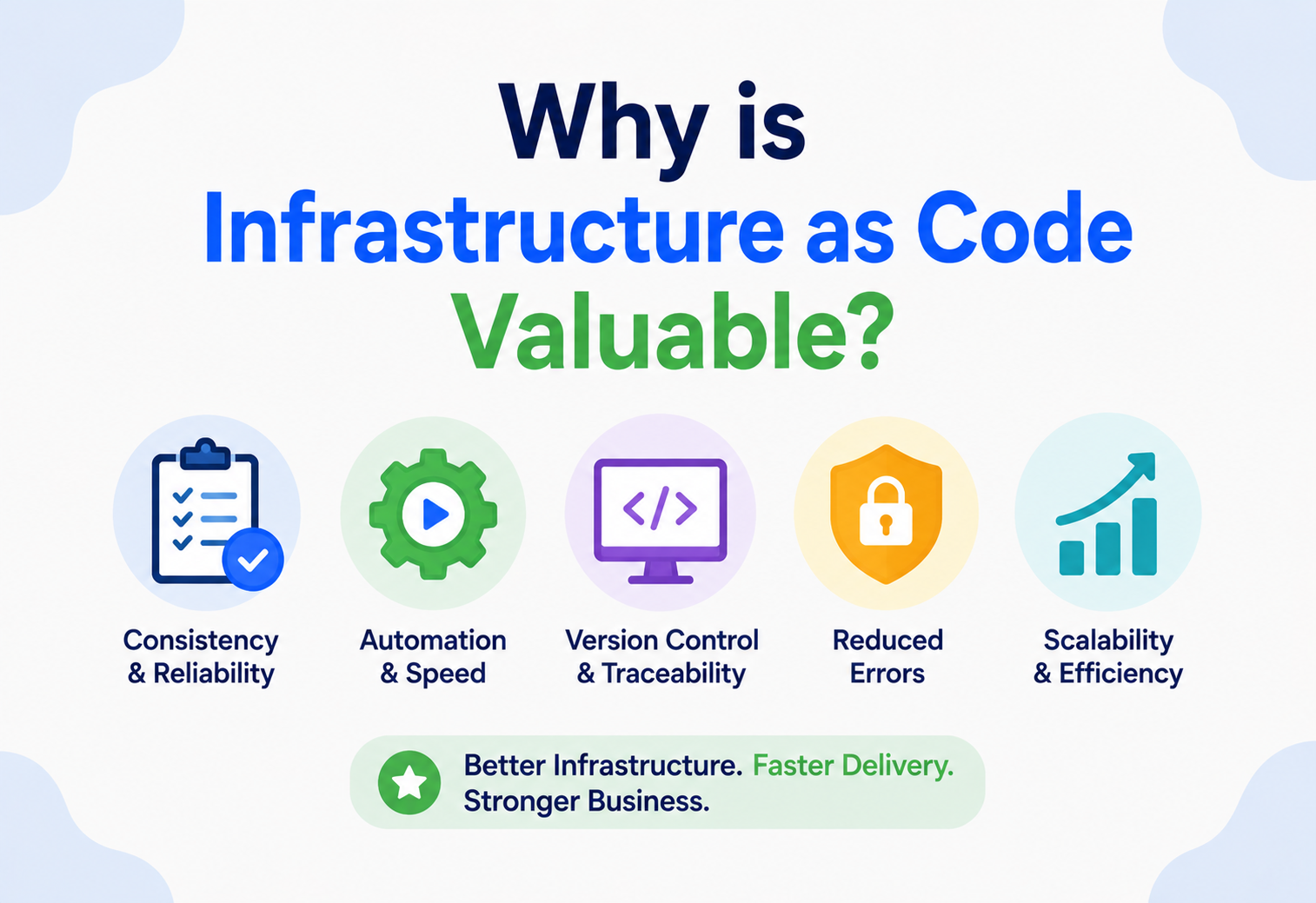
Why is Infrastructure as Code Valuable?
A complete, beginner-to-production walkthrough of why treating servers, networks, and cloud resources as versioned code changed how modern software gets built, shipped, and kept alive — explained plainly enough for a first-week engineer, and detailed enough to walk into a senior systems interview with confidence.
Introduction & History
Imagine you have been handed the job of setting up a new environment for an application: a virtual machine, a database, a load balancer, some firewall rules, and a couple of storage buckets. Twenty years ago, you would have opened a ticket, waited for the operations team, and then someone would log into a console — physically or through a web UI — and click through dozens of screens to provision each piece by hand. If it worked, wonderful. If someone forgot a checkbox, or fat-fingered a subnet range, you would only find out weeks later when something broke in production and nobody could explain why the “identical” staging and production environments behaved differently.
Infrastructure as Code (IaC) is the practice of defining and managing infrastructure — servers, networks, databases, load balancers, permissions, DNS records, literally anything you would otherwise click into existence — using machine-readable configuration files instead of manual processes. Those files live in version control, get reviewed like application code, and are applied by automated tools rather than human hands.
Think of the difference between building a house by verbally telling workers what to do each day versus handing them a detailed architectural blueprint. With verbal instructions, every house ends up slightly different, mistakes are common, and if the original crew leaves, the next crew has to guess what was intended. With a blueprint, any competent crew can reproduce the exact same house, changes can be reviewed before construction starts, and you have a permanent record of what was built and why. IaC is the blueprint for your infrastructure.
1.1 A Short History
Configuration management tools like CFEngine (1993), Puppet (2005), and Chef (2009) were the earliest attempts to describe server configuration as code, mostly focused on keeping already-provisioned servers consistent. The real shift toward “infrastructure” as a first-class, provisionable, version-controlled artifact came with the rise of public cloud APIs. When AWS launched EC2 in 2006, it became possible to create and destroy an entire server through an API call rather than a purchase order and a data center visit.
AWS CloudFormation (2011) let engineers describe entire stacks of cloud resources in JSON or YAML templates. Ansible (2012) offered agentless, YAML-based automation. Then in 2014, HashiCorp released Terraform, a cloud-agnostic declarative tool that could manage resources across AWS, Azure, GCP, and hundreds of other providers using a single consistent language (HCL). Terraform, along with Pulumi (2018, which allowed IaC in general-purpose languages like Java, TypeScript, and Python), and Kubernetes’ own declarative manifests, cemented IaC as the default way serious engineering organizations manage infrastructure today.
Understanding why IaC is valuable — not just how to write a Terraform file — is what separates engineers who treat it as ceremony from engineers who use it to genuinely reduce risk, cost, and toil. This guide focuses on the “why,” backed by the mechanics of “how.”
By the time cloud computing became the default way companies ran their software, the volume and rate of change in infrastructure had outgrown what any manual process could safely keep up with. A single engineer might be responsible for hundreds of servers, dozens of databases, and infrastructure spread across multiple regions — a scale at which manual, undocumented processes do not just become inconvenient, they become the leading cause of outages and security incidents. IaC did not emerge because engineers enjoy writing configuration files; it emerged because the alternative stopped being survivable at the scale modern software operates at.
The Problem & Motivation
To understand why IaC is valuable, you first have to feel the pain it removes. Let us walk through the world before IaC became standard practice.
2.1 The “Snowflake Server” Problem
When infrastructure is created by hand — clicking through a cloud console, SSHing into a box and running commands — every server slowly accumulates its own unique history of tweaks, patches, and manual fixes. Engineers half-jokingly call these snowflake servers: no two are alike, and nobody remembers exactly how any one of them came to be. The opposite goal, which IaC makes achievable, is pets vs. cattle thinking: instead of nursing a fragile, irreplaceable “pet” server back to health when it breaks, you treat servers as disposable “cattle” — if one misbehaves, you terminate it and let your code stand up an identical replacement.
2.2 Configuration Drift
Configuration drift is what happens when the actual state of a running environment slowly diverges from what it was originally supposed to be, usually because of undocumented manual changes. A developer SSHes into a production box at 2 AM to “quickly fix” a permission issue and never records it. Six months later, staging and production behave differently and nobody can say why.
New teams often believe documentation solves configuration drift — “we’ll just write down the setup steps in a wiki page.” Documentation rots the moment someone deviates from it and forgets to update it. Code that is actually executed to create the infrastructure cannot rot in the same way, because if it is wrong, applying it produces visibly wrong infrastructure.
2.3 Slow, Risky, Non-Reproducible Environments
Manually provisioning an environment might take hours or days and depends entirely on the specific person doing it. This creates three compounding problems:
- Slow time-to-market: Spinning up a new environment for a new microservice, a new region, or a disaster-recovery site can take days or weeks of manual coordination.
- Human error at scale: A single missed step in a 40-step manual runbook can cause an outage, and the more environments you manage by hand, the more often that error will happen.
- No audit trail: When something breaks, nobody can answer “what changed, when, and who approved it?” without codified, versioned history.
Imagine baking a cake by eyeballing every ingredient with no recipe. The first cake might turn out fine. The tenth might collapse because you unconsciously used a bit less flour. A written recipe (the “code”) guarantees the same cake every time, and lets you hand the recipe to someone else and get the same result.
2.4 The Cost of “Tribal Knowledge”
In manually-managed infrastructure, the true source of truth is often a person, not a document. “Ask Priya, she set up the payments cluster” is a common — and dangerous — answer to “how does this work?” When Priya goes on leave, changes teams, or leaves the company, that knowledge does not transfer cleanly. Onboarding a new engineer into such an environment can take weeks of shadowing and guesswork. With IaC, the source of truth is the repository itself: any engineer with access can read exactly how the payments cluster is built, because the code is the specification, not a fallible human memory of it.
2.5 The Ticket-Queue Bottleneck
In organizations without IaC, a central operations or infrastructure team frequently becomes a single point of contention: every new environment, every scaling change, every firewall rule requires filing a ticket and waiting — sometimes days — for a human to act on it. This does not just slow things down; it creates an incentive to avoid asking for infrastructure changes at all, which in turn discourages good practices like spinning up isolated test environments or tearing down unused ones. IaC turns infrastructure changes into pull requests that can be self-served, reviewed, and merged by the requesting team itself, dissolving the ticket queue as a structural bottleneck.
2.6 The Motivation, Summarized
IaC exists to solve exactly these problems: make infrastructure reproducible, reviewable, auditable, fast to provision, and safe to change, by applying the same engineering discipline that transformed application development — version control, code review, automated testing, and CI/CD — to the infrastructure layer itself. Every pain point described above — snowflake servers, configuration drift, tribal knowledge, ticket-queue bottlenecks — has the same root cause: infrastructure that exists only as a sequence of human actions rather than as an artifact that can be read, diffed, tested, and reproduced.
Core Concepts
Before diving into architecture, let us build a solid vocabulary. Every term below is something you will see again and again in IaC discussions, interviews, and production incident reports.
3.1 Declarative vs. Imperative IaC
This is the single most important conceptual distinction in IaC.
- Imperative: you specify the exact sequence of steps to reach a desired state — “create a VM, then install nginx, then open port 443.” Tools: Ansible playbooks (mostly), Chef recipes, shell scripts.
- Declarative: you specify only the desired end state — “I want one VM running nginx with port 443 open” — and the tool figures out what steps are needed to get there, including detecting and fixing drift. Tools: Terraform, CloudFormation, Kubernetes manifests, Pulumi (which uses imperative languages but produces a declarative desired-state graph).
Declarative IaC is generally preferred for infrastructure because it is idempotent by design — running it twice produces the same result as running it once, whereas naively written imperative scripts can fail or duplicate resources on a second run.
An operation is idempotent if performing it multiple times has the same effect as performing it once. terraform apply run twice in a row with no changes to the code will report “no changes” the second time, because Terraform compares desired state against real state before acting.
3.2 Desired State vs. Actual State
Declarative IaC tools maintain (or compute) two views of the world: the desired state (what your code says should exist) and the actual state (what really exists in the cloud provider right now). The tool’s core job on every run is to diff these two states and apply only the minimal set of changes needed to reconcile them.
3.3 State File
Terraform, specifically, keeps a state file (usually terraform.tfstate) that maps each resource in your code to the real-world object it created (e.g., this aws_instance block corresponds to EC2 instance i-0abc123). This state file is what allows Terraform to know an EC2 instance already exists and does not need to be recreated. Losing or corrupting this file is one of the most common real-world IaC incidents, which is why teams store it remotely (e.g., in an S3 bucket with locking via DynamoDB) rather than on a laptop.
3.4 Mutable vs. Immutable Infrastructure
| Aspect | Mutable Infrastructure | Immutable Infrastructure |
|---|---|---|
| How updates happen | Patch the existing server in place | Build a new server / image and replace the old one |
| Drift risk | High — every patch is a chance to diverge | Very low — servers are never hand-modified |
| Rollback | Hard — must manually reverse changes | Easy — redeploy the previous image / version |
| Typical tooling | Ansible, Chef, Puppet (config management) | Terraform + Packer / Docker images, Kubernetes |
IaC pairs naturally with immutable infrastructure: instead of SSHing in to fix a broken server, you terminate it and let your code create a fresh one from a known-good image.
3.5 Provisioning vs. Configuration Management
Provisioning is creating the infrastructure itself (a VM, a network, a managed database). Configuration management is installing and configuring software on top of already-provisioned infrastructure. Terraform is primarily a provisioning tool; Ansible / Chef / Puppet are primarily configuration-management tools. Many real pipelines use both together: Terraform stands up the VM, then hands off to Ansible (or a container image) to configure the software running on it.
3.6 Push vs. Pull Configuration Models
Configuration management tools further split into two delivery models. In a push model (Ansible), a central controller connects out to each target machine (typically over SSH) and pushes the desired configuration to it on demand. In a pull model (Chef, Puppet), an agent running on each machine periodically checks in with a central server and pulls down its configuration, applying it locally. Push models are simpler to reason about and require no long-running agent; pull models scale better to very large fleets and self-heal drift automatically between runs, since every machine keeps re-pulling and re-applying its configuration on a schedule.
3.7 Orchestration vs. Configuration
It is worth distinguishing orchestration — coordinating how multiple systems work together (e.g., Kubernetes deciding which node runs which container, and restarting it if it dies) — from configuration management, which is about the state of a single machine or resource. Kubernetes is best understood as a declarative orchestration system: you declare “I want 3 replicas of this container,” and its control loop continuously works to keep that true, which is conceptually the same idea as Terraform’s plan/apply loop, just running continuously rather than on demand.
3.8 Human-Readable Diffs as a First-Class Feature
A subtle but important IaC concept is that configuration files are designed to be diffed the same way application code is. A one-line change to an instance type, or a new security group rule, shows up in a pull request as a small, focused, human-reviewable diff — exactly like a code change. This is fundamentally different from a manual console change, which leaves no diff at all unless someone manually documents it after the fact.
Declarative
You describe the destination; the tool works out the route. Terraform, CloudFormation, and Kubernetes manifests are all declarative.
Idempotent
Running the same command twice has the same effect as running it once. Essential for safely re-running apply.
Drift
Real infrastructure quietly diverging from what your code says. Manual console changes are the main cause.
State file
The map between your code and the real resources it created. Losing it is one of the worst IaC incidents.
Immutable infra
Never patch a running box — rebuild and replace. Eliminates drift almost entirely.
Module
A reusable, parameterized bundle of resources — the “function” of infrastructure code.
Architecture & Components
A typical IaC setup, regardless of specific tool, is built from the same recurring pieces.
4.1 Component Breakdown
Configuration files
HCL (Terraform), YAML / JSON (CloudFormation, Kubernetes, Ansible), or general-purpose code (Pulumi). These describe resources declaratively.
Providers / plugins
Translate your generic resource declarations into specific API calls for AWS, Azure, GCP, Kubernetes, Datadog, GitHub, and hundreds of other systems.
State store
The source of truth mapping code to real resources, ideally stored remotely with locking so two engineers cannot apply conflicting changes simultaneously.
Execution engine
The core binary (e.g., terraform) that computes the diff between desired and actual state and issues the necessary create / update / delete API calls.
Modules
Packaged, parameterized bundles of resources (e.g., a “standard VPC” module) that teams reuse instead of copy-pasting.
CI/CD pipeline
Automates the plan → review → apply workflow so humans never run apply by hand from their laptop against production.
4.2 Minimal Terraform Example
terraform {
  required_providers {
    aws = {
      source  = "hashicorp/aws"
      version = "~> 5.0"
    }
  }
  backend "s3" {
    bucket         = "utivra-terraform-state"
    key            = "prod/network/terraform.tfstate"
    region         = "ap-south-1"
    dynamodb_table = "terraform-locks"
  }
}

provider "aws" {
  region = "ap-south-1"
}

resource "aws_vpc" "main" {
  cidr_block           = "10.0.0.0/16"
  enable_dns_support   = true
  enable_dns_hostnames = true

  tags = {
    Name        = "utivra-prod-vpc"
    Environment = "production"
    ManagedBy   = "terraform"
  }
}

resource "aws_subnet" "public" {
  vpc_id                  = aws_vpc.main.id
  cidr_block               = "10.0.1.0/24"
  map_public_ip_on_launch  = true
  availability_zone        = "ap-south-1a"
}
Notice there is no imperative “create a VPC” instruction — the code simply asserts that a VPC with this CIDR block and these tags should exist. Terraform figures out the AWS API calls required.
4.3 Modules: The Unit of Reuse
A module is a self-contained, parameterized bundle of resources with defined inputs and outputs — conceptually similar to a function in application code. Instead of every team writing their own VPC configuration from scratch (and inevitably making slightly different, inconsistent choices), a platform team publishes a single, well-tested vpc module that every other team calls with their own parameters:
module "network" {
  source   = "git::https://github.com/utivra/tf-modules//vpc"
  version  = "3.2.0"
  cidr     = "10.4.0.0/16"
  az_count = 3
  name     = "orders-service"
}
This is the same “don’t repeat yourself” principle that drives good application architecture, applied to infrastructure — a bug fix or security improvement made once in the module benefits every team using it, rather than needing to be manually reapplied across dozens of copy-pasted configurations.
4.4 Backends
The backend determines where Terraform stores its state file and how it manages locking. Common backends include Amazon S3 (paired with DynamoDB for locking), Azure Blob Storage, Google Cloud Storage, and Terraform Cloud’s own managed backend. Choosing a remote backend rather than the local default (a terraform.tfstate file sitting on someone’s laptop) is one of the first decisions any team moving toward production-grade IaC needs to get right.
Internal Working: How IaC Tools Actually Apply Changes
Understanding the mechanics builds real confidence — you stop treating terraform apply as magic.
5.1 Step 1 — Parse and Build a Dependency Graph
The tool parses your configuration files and builds a directed acyclic graph (DAG) of resources based on references between them. If a subnet references a VPC’s ID, the tool knows the VPC must be created first.
5.2 Step 2 — Refresh (Read Actual State)
The tool queries the cloud provider’s API for the current real-world state of every resource tracked in the state file, to detect drift since the last run.
5.3 Step 3 — Plan (Diff)
The tool compares desired state (your code) against actual state (freshly refreshed) and produces a plan: a list of resources to create, update in place, replace (destroy + recreate), or destroy. This plan is shown to the engineer before anything happens — arguably the single most valuable safety feature IaC tools offer.
Terraform will perform the following actions:

  # aws_instance.web will be updated in-place
  ~ resource "aws_instance" "web" {
        id            = "i-0abc123456"
      ~ instance_type = "t3.micro" -> "t3.small"
    }

  # aws_security_group.web_sg will be created
  + resource "aws_security_group" "web_sg" {
      + name = "web-sg"
    }

Plan: 1 to add, 1 to change, 0 to destroy.
5.4 Step 4 — Apply
Once approved, the tool walks the dependency graph, calling provider APIs in the correct order (parallelizing independent branches for speed), and updates the state file after each successful operation so a crash mid-apply does not leave state permanently out of sync.
At Netflix, infrastructure changes for services running on AWS routinely go through automated plan-review-apply pipelines rather than console clicks, specifically so that the “plan” step — a human-readable preview of exactly what will change — is visible in a pull request before anything touches production traffic.
5.5 Locking
Because two engineers running apply at the same time against the same state could corrupt it or create duplicate resources, mature setups use state locking (e.g., a DynamoDB table for Terraform + S3 backend) so only one apply can run at a time per state file.
Data Flow & Lifecycle of an Infrastructure Change
This is the lifecycle that makes IaC valuable in practice: every change to production infrastructure follows the exact same review discipline as an application code change — a diff, a reviewer, an automated check, and a permanent Git history of who changed what and why.
6.1 Typical Environment Promotion Flow
Most teams reuse the same IaC modules across environments, varying only input parameters:
# environments/staging/terraform.tfvars
instance_type = "t3.micro"
min_size      = 1
max_size      = 2

# environments/production/terraform.tfvars
instance_type = "m5.large"
min_size      = 3
max_size      = 10
Because both environments are built from the same module code, “works in staging” actually means something — the two environments are structurally identical, differing only in scale.
Pros, Cons & Trade-offs
7.1 Advantages
Reproducibility
The exact same environment can be recreated on demand — in a new region, for disaster recovery, or for a new customer.
Speed
Environments that took days to build by hand can be provisioned in minutes.
Auditability
Git history answers “who changed what, when, and why” for every infrastructure change.
Reviewability
Infrastructure changes go through pull requests, catching mistakes before they hit production.
Cost control
Ephemeral environments (spun up for a PR, destroyed after merge) prevent forgotten, orphaned resources from silently accumulating cost.
Disaster recovery
If a region goes down, you can rebuild the entire stack elsewhere from code rather than institutional memory.
7.2 Disadvantages & Real Costs
| Cost | What it looks like in practice |
|---|---|
| Learning curve | HCL, YAML templating, and state management are genuinely new skills for engineers used to clicking consoles. |
| State management complexity | Lost, corrupted, or out-of-sync state files are a real operational hazard. |
| Blast radius | A bad apply can destroy or modify many resources at once — automation multiplies mistakes just as it multiplies good changes. |
| Tooling sprawl | Provisioning (Terraform), configuration (Ansible), containers (Docker), and orchestration (Kubernetes) each solve a different layer, and teams must learn where each boundary sits. |
| Initial investment | Migrating existing hand-built (“brownfield”) infrastructure into code is slow, tedious work (often via terraform import). |
Treating IaC as a silver bullet that eliminates the need for good change management. IaC makes bad changes just as fast and repeatable as good ones. A terraform apply -auto-approve run straight to production without review has caused real, well-documented outages, precisely because automation removed the human pause that used to catch mistakes.
7.3 Weighing the Trade-off Honestly
It is tempting to present IaC as an unambiguous win, but a fair evaluation means acknowledging when the upfront cost genuinely outweighs the near-term benefit. A single, rarely-changed proof-of-concept environment that will be thrown away in a week may not justify the time spent writing and reviewing Terraform modules — a couple of console clicks might be the pragmatic choice. IaC’s value curve is roughly proportional to three things: how many times an environment will be recreated or modified, how many people need to understand or change it, and how costly a mistake in that environment would be. Long-lived, frequently-changed, multi-person, high-stakes infrastructure — which describes most production systems — sits firmly on the side where IaC pays for itself many times over. Short-lived, single-person, low-stakes experiments sometimes do not need the ceremony.
7.4 Organizational, Not Just Technical, Value
A trade-off that is easy to underweight: IaC changes who can safely make infrastructure changes. Without it, only the specific engineers with console access and tribal knowledge of a system can touch it safely. With it, any engineer who can read the module and follow the pull-request process can propose a change, and a reviewer with the right expertise can approve it without needing to be the one who executes it. This decouples “who understands the system” from “who is available right now to make a change,” which matters enormously as teams grow and people go on leave, change roles, or leave the company.
None of this means IaC eliminates the need for skilled operations engineers — it changes what they spend their time on. Instead of repeatedly executing the same manual provisioning steps, they spend more time designing good modules, defining sound policies, and handling the genuinely novel problems that automation cannot yet solve. The toil goes down; the leverage of each engineer’s expertise goes up.
Performance & Scalability
IaC’s performance value shows up less in runtime application performance and more in organizational throughput — how fast a team can scale its infrastructure footprint.
Parallel resource creation
Modern IaC engines create independent resources concurrently rather than one at a time, so a stack with 200 unrelated resources applies far faster than 200 sequential console clicks ever could.
Horizontal scale-out as code
Auto-scaling groups, Kubernetes replica counts, and database read-replica counts are just numeric parameters in code — scaling from 3 to 30 instances is a one-line change and a review, not 27 manual server builds.
Module reuse at scale
A well-built module for “standard microservice deployment” lets a platform team support hundreds of services with consistent, correct infrastructure, instead of a growing backlog of one-off manual requests.
A company like Uber, operating in hundreds of cities, cannot realistically have a human click through cloud consoles to stand up infrastructure per city. IaC modules parameterized by region / city let the same reviewed, tested infrastructure pattern be replicated at a scale no manual process could match.
8.1 Plan/Apply Performance at Scale
As a codebase grows to thousands of resources, plan operations (which must refresh state against live APIs) can become slow. Teams address this by splitting state into smaller, independently-applied units (“state segmentation” — e.g., one state file per service or per environment) rather than one giant monolithic state file for the entire company.
8.2 Elasticity Encoded as Policy, Not Manual Reaction
A subtler performance benefit: IaC lets scaling policy itself be codified, not just the base resource count. An auto-scaling group’s target CPU threshold, cooldown period, and min/max bounds are all declared in code, meaning the system reacts to real load automatically, without an on-call engineer having to notice rising latency and manually add capacity. This shifts scaling from a reactive, human-paced activity to a proactive, machine-paced one — often the difference between absorbing a traffic spike gracefully and suffering a partial outage while someone scrambles to respond.
8.3 Reducing the Cost of Experimentation
Because spinning up and tearing down a full environment becomes cheap and fast, teams can afford to run performance and load tests against a temporary, production-like environment built purely from code, then destroy it immediately afterward — something that is prohibitively expensive in time and coordination when every environment is hand-built and treated as precious and hard to reproduce. This cheapness of experimentation compounds over a project’s lifetime: the fiftieth load test costs almost nothing more to run than the first, because the infrastructure creating it is already fully described and reviewed.
High Availability & Reliability
IaC directly strengthens reliability in ways that manual processes structurally cannot.
9.1 Disaster Recovery Becomes Achievable
Without IaC, disaster recovery (“what if our entire primary region disappears?”) usually exists only on paper, because nobody has actually tested rebuilding the full stack from scratch. With IaC, DR can be tested for real: apply the same code against a different region and verify it produces a working environment. Some organizations run this as a scheduled “game day” exercise.
9.2 Consistent Multi-Region and Multi-AZ Topology
High availability architectures — resources spread across multiple availability zones, with load balancers and health checks — are tedious and error-prone to build by hand consistently. Declaring them in code guarantees every environment gets the same redundancy, not just the ones an engineer remembered to configure carefully.
resource "aws_autoscaling_group" "app" {
  min_size            = 3
  max_size            = 10
  desired_capacity    = 3
  vpc_zone_identifier = [
    aws_subnet.az_a.id,
    aws_subnet.az_b.id,
    aws_subnet.az_c.id
  ]
  health_check_type         = "ELB"
  health_check_grace_period = 300
}
This single block guarantees instances are always spread across three availability zones — a rule that is easy to state in code and easy to forget when clicking through a console at 11 PM during an incident.
9.3 Faster Mean Time to Recovery (MTTR)
When infrastructure is code, recovering from an incident where infrastructure itself is corrupted or misconfigured often means simply re-applying known-good code rather than manually diagnosing and repairing a live, drifted system — significantly shrinking recovery time.
9.4 Rollback as a Code Operation
Because infrastructure changes live in Git, rolling back a bad infrastructure change can be as simple as reverting the offending commit and re-applying — the same rollback muscle memory engineers already have for application code, rather than a bespoke, undocumented manual “undo” process that has to be improvised under incident pressure. This matters enormously for reliability: the faster and more confidently a team can undo a bad change, the less damage that change can do.
9.5 Blue-Green and Canary Infrastructure
IaC makes advanced deployment strategies practical at the infrastructure level, not just the application level. A blue-green infrastructure change — standing up a complete parallel environment, validating it, then shifting traffic over — is tedious and risky to do by hand but becomes a matter of parameterizing a module with a new environment name when the environment itself is code. This lets teams validate infrastructure changes (like a database engine upgrade) against real traffic on a shadow environment before committing the change to the primary one.
Security
10.1 Security as Reviewed Code, Not Tribal Knowledge
Firewall rules, IAM policies, and security group configurations are exactly the kind of thing that quietly drifts dangerously over time when managed by hand — an overly permissive rule added “temporarily” during an incident and never removed. In IaC, these are code, subject to the same pull-request review as anything else.
10.2 Policy as Code
Tools like Open Policy Agent (OPA), HashiCorp Sentinel, and Checkov scan IaC files automatically, before apply, to block dangerous patterns:
- Publicly exposed storage buckets (a very common, very expensive real-world mistake)
- Security groups open to
0.0.0.0/0on sensitive ports - Unencrypted databases or disks
- Overly broad IAM policies (e.g.,
"Action": "*")
# Example Checkov-style policy violation caught in CI, before apply:
Check: CKV_AWS_24: "Ensure no security groups allow ingress from 0.0.0.0:0 to port 22"
    FAILED for resource: aws_security_group.web_sg
File: main.tf:14-22Numerous major breaches over the past decade have traced back to a single misconfigured, publicly-writable storage bucket created manually and never audited. Automated policy scanning against IaC catches this class of mistake before it ever reaches production — something a manual console workflow has no equivalent safeguard for.
10.3 Secrets Management
A critical IaC discipline: secrets (passwords, API keys, certificates) must never be hardcoded into .tf or .yaml files committed to Git. Instead, IaC references secrets stored in dedicated systems like HashiCorp Vault, AWS Secrets Manager, or Azure Key Vault at apply time.

data "aws_secretsmanager_secret_version" "db_password" {
  secret_id = "prod/db/password"
}

resource "aws_db_instance" "main" {
  # ...
  password = data.aws_secretsmanager_secret_version.db_password.secret_string
}
10.4 Least Privilege for the Automation Itself
The CI/CD identity that runs terraform apply is itself a high-value target — it typically has broad permissions across your cloud account. Scoping that identity tightly, and requiring human approval gates for production applies, is a core part of securing an IaC pipeline.
10.5 Compliance and Standardized Baselines
Regulated industries (finance, healthcare, government contracting) often require demonstrating that every production system meets a baseline — encryption at rest, specific logging retention, network segmentation. Encoding these requirements directly into shared IaC modules means compliance is not something checked manually per-system after the fact; it is structurally guaranteed by the fact that every team’s infrastructure is built from the same compliant building blocks. Auditors can review the module once, rather than auditing every individual team’s hand-built environment separately.
10.6 Immutable Audit Trail for Security Investigations
When investigating a security incident, one of the first questions is “what changed, and when?” With IaC, that question has a precise answer: the Git history of the infrastructure repository, cross-referenced with CI/CD apply logs, shows exactly which commit introduced which change, who authored it, and who approved it. Without IaC, answering the same question often means combing through cloud provider audit logs (like AWS CloudTrail) trying to reconstruct intent from a stream of raw API calls with no accompanying explanation of why a change was made.
Monitoring, Logging & Metrics
IaC does not just provision the application — it should provision the observability for that application too, so nothing ships without visibility.
11.1 Provisioning Observability as Code
resource "aws_cloudwatch_metric_alarm" "high_cpu" {
  alarm_name          = "web-high-cpu"
  comparison_operator = "GreaterThanThreshold"
  evaluation_periods  = 2
  metric_name         = "CPUUtilization"
  namespace           = "AWS/EC2"
  period              = 120
  statistic           = "Average"
  threshold           = 80
  alarm_actions       = [aws_sns_topic.alerts.arn]
}
Because the alarm is code, every service built from the same module automatically gets the same baseline alerting — no service silently ships without monitoring because someone forgot to click through the CloudWatch console.
11.2 Drift Detection as a Monitoring Signal
Running scheduled terraform plan jobs (without applying) is itself a monitoring practice: a non-empty plan on a schedule means someone or something changed infrastructure outside the normal pipeline — often the first sign of either an incident-time manual fix that needs to be codified, or unauthorized access.
11.3 Logging IaC Runs Themselves
Every plan and apply should itself be logged — who triggered it, what changed, what the outcome was — typically as CI pipeline logs plus a state-change history, giving you an audit trail for the infrastructure layer equivalent to application logs for the app layer.
Deployment & Cloud
12.1 Multi-Cloud and Cloud-Agnostic Tooling
Terraform’s provider model means the same workflow (write HCL, plan, review, apply) works whether the target is AWS, Azure, GCP, Kubernetes, or even SaaS platforms like Datadog or GitHub — reducing the operational cost of supporting multiple clouds or migrating between them.
12.2 GitOps: IaC’s Natural Deployment Model
GitOps takes IaC one step further: Git becomes the single source of truth, and an in-cluster or pipeline agent (e.g., ArgoCD, Flux for Kubernetes; Atlantis for Terraform) continuously reconciles the live environment to match what is declared in Git — automatically, without a human running commands.
12.3 Deploying a Spring Boot Application via IaC
A concrete, end-to-end example: a Java Spring Boot service, containerized, deployed to Kubernetes, with its infrastructure declared as code.
@SpringBootApplication
@RestController
public class Application {

    @GetMapping("/health")
    public ResponseEntity<String> health() {
        return ResponseEntity.ok("OK");
    }

    public static void main(String[] args) {
        SpringApplication.run(Application.class, args);
    }
}apiVersion: apps/v1
kind: Deployment
metadata:
name: utivra-api
spec:
replicas: 3
selector:
matchLabels:
app: utivra-api
template:
metadata:
labels:
app: utivra-api
spec:
containers:
- name: utivra-api
image: registry.utivra.com/utivra-api:1.4.2
ports:
- containerPort: 8080
readinessProbe:
httpGet:
path: /health
port: 8080
resources:
requests:
cpu: "250m"
memory: "256Mi"
limits:
cpu: "500m"
memory: "512Mi"The Kubernetes YAML above is itself Infrastructure as Code — it declaratively states “there should always be 3 healthy replicas of this container,” and Kubernetes’ own control loop continuously reconciles reality to match, the same core idea as Terraform applied at the container-orchestration layer.
12.4 Ephemeral Environments per Pull Request
A deployment pattern only practical because of IaC: automatically provisioning a full, isolated environment for every open pull request, so reviewers can click a link and interact with the actual running change rather than reading code and imagining its behavior. When the pull request merges or closes, the pipeline automatically destroys that environment, so cost does not accumulate from forgotten test environments — a pattern that would be far too labor-intensive to sustain with manual provisioning.
12.5 Cloud Cost Attribution
Because IaC forces every resource to be declared explicitly (and, following best practice, tagged with owner and environment), cloud billing can be attributed accurately back to the team or service responsible for it. This is difficult to achieve when resources are created ad hoc through a console, where tagging is easy to skip under time pressure and orphaned, forgotten resources quietly accumulate cost with no clear owner to notice or question the bill.
Databases, Caching & Load Balancing
13.1 Provisioning Managed Databases
resource "aws_db_instance" "primary" {
  identifier            = "utivra-prod-db"
  engine                = "postgres"
  engine_version        = "15.4"
  instance_class        = "db.r6g.large"
  allocated_storage     = 100
  multi_az              = true
  backup_retention_period = 7
  storage_encrypted     = true
  deletion_protection   = true
}
Critical, easy-to-forget settings — multi_az for failover, storage_encrypted, backup retention, deletion protection — are guaranteed present on every database created from this module. Manually, these are exactly the checkboxes someone forgets under deadline pressure.
13.2 Caching Layers
resource "aws_elasticache_replication_group" "redis" {
  replication_group_id = "utivra-cache"
  engine                = "redis"
  node_type             = "cache.r6g.large"
  num_cache_clusters    = 2
  automatic_failover_enabled = true
}
A Redis cluster with automatic failover, declared in a few lines, replicable identically across every environment that needs a cache.
13.3 Load Balancers
resource "aws_lb" "app" {
  name               = "utivra-alb"
  internal           = false
  load_balancer_type = "application"
  subnets            = [aws_subnet.public_a.id, aws_subnet.public_b.id]
}

resource "aws_lb_target_group" "app" {
  name     = "utivra-tg"
  port     = 8080
  protocol = "HTTP"
  vpc_id   = aws_vpc.main.id
  health_check {
    path                = "/health"
    healthy_threshold   = 2
    unhealthy_threshold = 2
  }
}
Health-check paths, thresholds, and target groups are exactly the kind of subtle configuration that varies dangerously between hand-built environments — IaC guarantees they match.
APIs & Microservices
In a microservices architecture, IaC’s value compounds because the number of independently-deployable pieces multiplies.
14.1 Per-Service Infrastructure Modules
Platform teams commonly build a reusable module — “standard microservice” — that bundles a container deployment, an API gateway route, a database, monitoring, and IAM permissions into one parameterized unit:
module "orders_service" {
  source        = "git::https://github.com/utivra/tf-modules//microservice"
  service_name  = "orders"
  container_image = "registry.utivra.com/orders:2.1.0"
  cpu           = 512
  memory        = 1024
  replicas      = 3
  database_engine = "postgres"
}

module "inventory_service" {
  source        = "git::https://github.com/utivra/tf-modules//microservice"
  service_name  = "inventory"
  container_image = "registry.utivra.com/inventory:1.8.0"
  cpu           = 256
  memory        = 512
  replicas      = 2
  database_engine = "postgres"
}
Each new microservice a team ships reuses the exact same reviewed, security-scanned, monitored infrastructure pattern — a new service can go from code to a fully governed production environment in minutes rather than requiring a bespoke infrastructure request per team.
14.2 API Gateway Routing as Code
resource "aws_apigatewayv2_route" "orders" {
  api_id    = aws_apigatewayv2_api.main.id
  route_key = "GET /orders/{id}"
  target    = "integrations/${aws_apigatewayv2_integration.orders.id}"
}
Routing rules for dozens or hundreds of microservices are declared, reviewed, and version-controlled rather than clicked into an API gateway console one at a time.
Design Patterns & Anti-Patterns
15.1 Good Patterns
Module composition
Small, focused, well-tested modules (network, database, service) composed together, rather than one giant configuration file.
Environment parity via parameterization
The same module code, different .tfvars per environment, instead of separately maintained staging/production code that inevitably diverges.
Remote state with locking
State stored in S3 / Azure Blob / GCS with a locking mechanism, never on a laptop.
Plan-then-approve pipelines
Humans review a machine-generated plan before any apply touches production.
Immutable, versioned modules
Pin module versions (version = "2.3.0") so a downstream team is not broken by an upstream module change they did not opt into.
15.2 Anti-Patterns
| Anti-Pattern | Why It Is a Problem |
|---|---|
| Manual “ClickOps” changes alongside IaC | Reintroduces the exact drift and untracked-change problem IaC exists to eliminate |
| One giant monolithic state file for everything | Slow plans, huge blast radius per apply, contention between teams |
| Hardcoded secrets in code | Secrets end up in Git history forever, even if later removed |
| No remote state locking | Concurrent applies can corrupt state or create duplicate resources |
| Auto-approve straight to production | Removes the human review step that catches destructive mistakes |
| Copy-pasting config between environments instead of modules | Staging and production silently drift apart over time |
The single most common way teams sabotage their own IaC investment is letting engineers “just fix it quickly in the console” during an incident, and never porting that fix back into code. The next terraform apply either silently reverts the fix or, worse, produces a confusing diff nobody expected. The discipline of always making the change in code, even under incident pressure, is what actually delivers IaC’s value.
15.3 The Testing Pyramid Applied to Infrastructure
Mature IaC teams apply a layered testing strategy analogous to the application testing pyramid. At the base, static analysis and linting catch syntax errors and style issues in seconds, without touching any cloud API. Above that, policy-as-code scanning catches security and compliance violations, still without provisioning anything real. Above that, a plan-only run against a real (but shared, read-only) environment validates that the diff makes sense. At the top, a small number of full integration tests actually provision a temporary environment, verify it behaves correctly (for example, that an HTTP health check returns 200), and tear it down — expensive and slow, so used sparingly, exactly the same reasoning that keeps end-to-end application tests few in number relative to unit tests.
Best Practices & Common Mistakes
16.1 Best Practices
Always review a plan before applying
Treat terraform apply -auto-approve on production as a near-never operation.
Store state remotely with locking
And back it up. Never rely on the default local state file on a laptop.
Use small, composable modules
With clear inputs and outputs rather than one huge file that nobody wants to touch.
Pin provider and module versions
To avoid surprise breaking changes on an otherwise routine apply.
Run policy-as-code scanners in CI
Checkov, tfsec, OPA — before any human even sees the plan.
Tag every resource
With owner, environment, and cost center — untagged cloud resources are a very common source of unexplained bills.
Practice destroy-and-rebuild
In a non-production environment regularly, so disaster recovery is a tested muscle, not a hope.
Never store secrets in version control
Reference a secrets manager (Vault, AWS Secrets Manager, Key Vault) instead.
16.2 Common Mistakes Beginners Make
- Running IaC tools directly from a personal laptop against production instead of through CI/CD.
- Not understanding that a resource replace (destroy + recreate) can mean real downtime or data loss — always reading the plan output carefully, especially the
-/+replace lines. - Ignoring drift for months until a routine change unexpectedly destroys manually-created resources the state file did not know about.
- Treating the state file as disposable and deleting it “to start fresh,” orphaning real cloud resources that now cost money with nothing tracking them.
Before running apply, always search the plan output for the string -/+ (replace) and - (destroy) — these are the operations most likely to cause outages or data loss, and deserve a second pair of eyes even in an otherwise routine change.
16.3 Building the Habit, Not Just the Tooling
Adopting IaC tooling without adopting the surrounding discipline delivers little of its actual value. A team that writes Terraform but still lets anyone apply from their laptop, skips code review on infrastructure pull requests, or treats a failed policy scan as a suggestion rather than a blocker, has essentially recreated ClickOps with extra steps. The tooling is necessary but not sufficient — the habits around it (mandatory review, remote state, policy gates, tested rollback) are what actually convert “we use Terraform” into “our infrastructure is reliable, auditable, and safe to change.” Teams that get the most value from IaC tend to treat an infrastructure pull request with exactly the same seriousness as an application code pull request touching billing logic — because in terms of blast radius, it often carries more risk, not less.
Real-World / Industry Examples
Netflix
Netflix operates thousands of microservices across a large AWS footprint. Consistent, codified infrastructure patterns are what make it feasible for hundreds of independent teams to each own and deploy their own services without a central operations team becoming a bottleneck for every environment request.
Amazon
Amazon’s internal deployment culture, which directly inspired AWS CloudFormation, is built around the principle that any team should be able to stand up a full, correct copy of a service’s infrastructure without depending on tribal knowledge from another team.
Airbnb
Airbnb has publicly discussed evolving its infrastructure toward code-defined, self-service patterns specifically to let product engineering teams provision what they need without waiting on a central infra team for every request — a direct, practical illustration of IaC removing an organizational bottleneck, not just a technical one.
Financial services
Banks and payment companies operate under strict regulatory requirements to demonstrate exactly what infrastructure exists, who approved it, and when it changed. IaC’s Git-based audit trail — every change tied to a pull request, a reviewer, and a timestamp — maps directly onto the kind of change-control evidence regulators and internal auditors require, which is a major reason regulated industries were early, motivated adopters of IaC discipline well beyond what pure engineering convenience would have demanded.
E-commerce & seasonal scaling
Retailers facing predictable seasonal spikes — a big sale event, a holiday shopping season — use IaC to scale infrastructure up in a controlled, tested way ahead of the event and scale it back down afterward to control cost, using the same reviewed code path rather than a scramble of manual console changes made under time pressure right before the traffic hits.
Startups & SaaS businesses
For a small team running a platform like utivra.com, IaC’s value is less about massive scale and more about confidence and reproducibility: a solo or small-team operator can tear down and rebuild an entire environment for testing, recover quickly from a mistake, and onboard a new contributor by handing them a repository instead of a mental checklist. It also means a solo founder is not the single point of failure for infrastructure knowledge — if they are unavailable, anyone with repository access and cloud credentials can reconstruct the environment exactly.
17.1 The Common Thread
Across every one of these examples — hyperscale streaming platforms, regulated banks, seasonal retailers, and single-founder startups — the underlying value proposition is identical, only the scale differs: infrastructure that is written down, reviewed, and reproducible is safer and cheaper to operate than infrastructure that exists solely in the actions someone once took and the memory of why they took them.
FAQ, Summary & Key Takeaways
18.1 Frequently Asked Questions
Is IaC the same as configuration management?
No. IaC (Terraform, CloudFormation) primarily provisions infrastructure — creating the VM, network, or database. Configuration management (Ansible, Chef, Puppet) primarily configures software on already-provisioned machines. They are complementary, often used together.
Do I need Kubernetes to benefit from IaC?
No. IaC applies equally to a single VM, a serverless function, a DNS record, or a full Kubernetes cluster. Kubernetes manifests are themselves a form of declarative IaC, but IaC as a discipline predates and extends beyond containers.
Is Terraform better than CloudFormation?
They solve the same problem differently: Terraform is cloud-agnostic and widely adopted across multi-cloud shops; CloudFormation is AWS-native with tighter AWS service integration. The right choice depends on whether multi-cloud portability matters to your organization.
Can IaC cause outages?
Yes — automation amplifies both good and bad changes. This is exactly why plan review, policy-as-code scanning, and staged rollouts (apply to staging before production) are essential disciplines, not optional extras.
Is it worth adopting IaC for a small project?
Usually yes, even for solo projects — the value is not only about team collaboration, it is about having a reproducible, disaster-recoverable, reviewable record of your infrastructure instead of depending on your own memory of what you clicked six months ago.
What happens if the state file is lost?
The tool loses track of which real-world resources correspond to which code, and a subsequent apply may try to recreate resources that already exist, causing naming conflicts or duplicate infrastructure. Recovery usually involves manually re-importing existing resources into a fresh state file (e.g., terraform import) one at a time — slow and error-prone, which is exactly why remote, backed-up, locked state storage is treated as non-negotiable in production setups.
Can IaC manage infrastructure that already exists (brownfield)?
Yes, through an import process that reads an existing resource’s real configuration and generates matching code plus a state entry for it, without recreating the resource. This is typically slower and more error-prone than greenfield (starting fresh) IaC adoption, since existing infrastructure often has undocumented quirks that only surface once you try to describe it precisely in code.
How is IaC tested?
Common layers include static linting and policy scanning (Checkov, tfsec, OPA) that run without touching real infrastructure, plan-only validation in CI to catch syntax and logic errors, and integration tests (tools like Terratest) that actually provision a real but temporary environment, verify it behaves correctly, and then tear it down — closely mirroring how automated tests work for application code.
18.2 Summary
Infrastructure as Code is the practice of describing servers, networks, databases, and other cloud resources in versioned, reviewable configuration files instead of manual console clicks and SSH sessions. It exists because manual infrastructure management does not scale safely past a certain point: environments drift, tribal knowledge accumulates, incidents get harder to explain, and change becomes something teams start avoiding rather than embracing. IaC applies the same discipline that transformed application development — version control, code review, automated testing, CI/CD — to the infrastructure layer itself, turning “how our systems are built” from an oral tradition into a written specification that can be diffed, reviewed, and reproduced on demand.
Key Takeaways
- IaC replaces manual, error-prone, undocumented infrastructure changes with versioned, reviewable, reproducible code.
- Declarative tools (Terraform, CloudFormation, Kubernetes manifests) express desired end-state and are idempotent by design.
- The state file is the critical link between code and real-world resources — protect it with remote storage and locking.
- The plan → review → apply pipeline is IaC’s core safety mechanism, and skipping it (manual applies, auto-approve) reintroduces the exact risks IaC was built to remove.
- IaC compounds in value with scale — microservices, multi-region HA, and disaster recovery all become practically achievable rather than theoretical.
- Security and observability should be provisioned as code alongside the application itself, not bolted on manually afterward.
- The biggest real-world risk to IaC’s value is not the tooling — it is humans bypassing it (“ClickOps”) under pressure and letting drift back in.
The best infrastructure engineers do not adopt IaC because a blog post said to. They adopt it because they have felt the specific pain of 2 AM outages caused by drifted, undocumented, hand-built systems — and they never want to feel it again. Everything in this guide is really an answer to one question: “how do we make sure the way our infrastructure got built is written down somewhere other than in one person’s head?”