What Is Symmetric Encryption?
A ground-up guide to the algorithms, math, and engineering that let two parties share a secret key and keep data confidential — from Caesar’s cipher to AES-GCM in production systems.
Introduction & History
Imagine you and a friend want to pass notes in class without the teacher understanding them. You both agree, in advance, on a secret rule: “shift every letter forward by 3.” You write “HELLO,” apply the rule, and it becomes “KHOOR.” Your friend, who knows the same rule, shifts it backward by 3 and reads “HELLO” again. Anyone else who intercepts the note just sees gibberish.
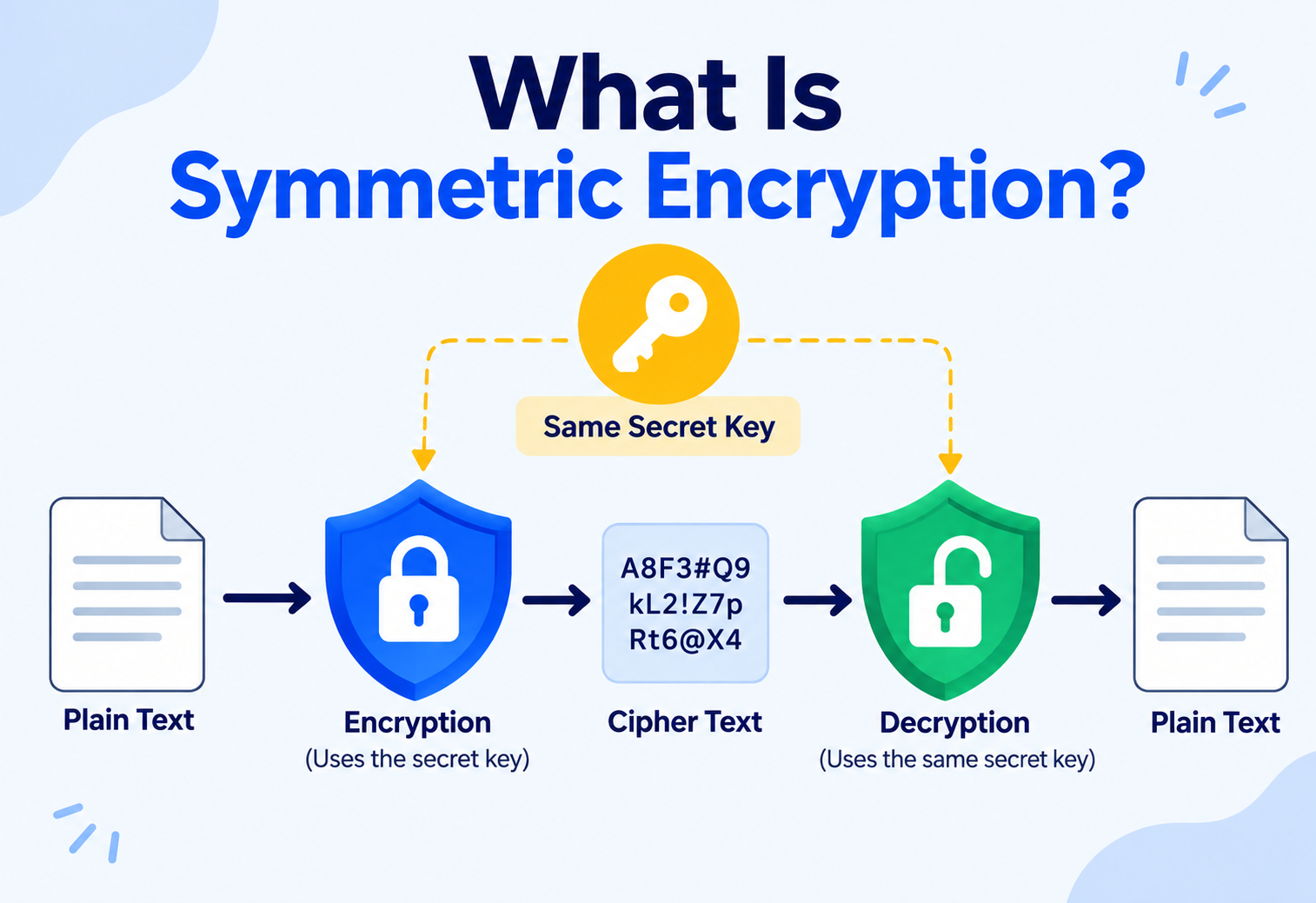
That, in a nutshell, is symmetric encryption: a way of scrambling information using a secret (called a key) so that only someone who has that exact same secret can unscramble it. The word “symmetric” means “the same on both sides” — the same key locks the data and unlocks it again. This is different from asymmetric encryption, where one key locks and a different, mathematically related key unlocks (we’ll compare the two later).
Symmetric encryption is one of the oldest ideas in cryptography, and also one of the most modern. It runs underneath almost every secure digital interaction you have today, even though you never see it directly.
1.1 A Brief History
~50 BC — Caesar Cipher
Julius Caesar reportedly shifted letters by a fixed number to hide military messages. Simple substitution — the ancestor of all symmetric ciphers.
1553 — Vigenère Cipher
A “polyalphabetic” cipher using a repeating keyword, far harder to break by simple letter-frequency analysis than Caesar’s shift.
1918 — Enigma Machine
Germany’s electromechanical rotor cipher machine used in WWII — a physical symmetric-key device. Its eventual cryptanalysis by Polish and British teams (including Alan Turing) is one of the most famous stories in cryptography.
1949 — Claude Shannon’s Theory
Shannon’s paper “Communication Theory of Secrecy Systems” gave cryptography a rigorous mathematical foundation, introducing ideas like “confusion” and “diffusion” that still define cipher design today.
1977 — DES
The U.S. government adopted DES (Data Encryption Standard), developed by IBM, as the first widely used, publicly specified symmetric cipher standard for computers.
2001 — AES
After DES’s 56-bit key became crackable, NIST ran an open competition; the Belgian-designed “Rijndael” algorithm won and became AES — still the world standard today.
2008–Present — Authenticated Encryption
Modes like AES-GCM and ciphers like ChaCha20-Poly1305 combine confidentiality with built-in tamper detection, becoming the modern default for TLS, messaging apps, and disk encryption.
Symmetric encryption is like a padlock with one physical key: whoever has a copy of that key can lock or unlock the box. It has existed in spirit since ancient Rome, but the modern version (AES) is a precisely engineered algorithm running billions of times a second inside your phone, laptop, and every website you visit over HTTPS.
The Problem & Motivation
Why does this technology need to exist at all? Because of one uncomfortable fact: data travels through — and rests on — systems you don’t fully control.
- When you send a message, it passes through routers, ISPs, and servers owned by other companies.
- When you store a file, it sits on a disk that could be stolen, a laptop that could be lost, or a cloud server an attacker could breach.
- When a company stores your password or medical record, an internal employee, a bug, or a hacker could expose that database.
Without encryption, any of these situations means your data is readable by whoever gets access to it — in plain text, exactly as you wrote it. Symmetric encryption solves this by transforming plaintext (readable data) into ciphertext (scrambled data) using a secret key, so that even if an attacker captures the ciphertext, it’s useless to them without the key.
2.1 Why Not Just Use Passwords or Obscurity?
A common beginner mistake is thinking “if I hide my data somewhere secret, or use a weird made-up scrambling method, that’s good enough.” This is called security through obscurity, and professionals avoid relying on it because:
- Homemade scrambling schemes almost always have exploitable mathematical weaknesses that their creator didn’t anticipate.
- Once an attacker figures out your “secret method,” every single thing you ever encrypted with it is broken — forever.
- Real cryptography follows Kerckhoffs’s Principle (1883): a cryptosystem should be secure even if everything about it — except the key — is public knowledge. The algorithm (like AES) is published, studied by thousands of experts, and battle-tested. Only the key stays secret.
This is why you should never write your own encryption algorithm for real use. AES has survived 20+ years of attempted attacks by the world’s best cryptanalysts. A cipher you invent this weekend has survived zero.
Core Concepts
Before going further, let us build a shared vocabulary. These are the foundational ideas that every other part of symmetric encryption is built on.
3.1 Plaintext, Ciphertext, and Keys
Plaintext is the original, readable data. Ciphertext is the scrambled output. The key is a piece of secret data (just a very large random number, really) that controls exactly how the scrambling happens. Change the key even by one bit, and the ciphertext comes out completely different.
3.2 Confusion and Diffusion
These are the two properties Claude Shannon identified as essential for a strong cipher:
Confusion
The relationship between the key and the ciphertext should be as complex and non-obvious as possible — like mixing paint colours so you can’t reverse-engineer the original colours just by looking at the mix.
Diffusion
Changing one bit of the plaintext should change roughly half the bits of the ciphertext, spreading its influence everywhere — like a drop of ink diffusing evenly through a glass of water.
3.3 Block Ciphers vs. Stream Ciphers
Symmetric ciphers come in two families:
Block Cipher
Encrypts data in fixed-size chunks (“blocks”), e.g. 16 bytes at a time for AES. If your data isn’t a clean multiple of the block size, it gets padded. Examples: AES, DES, 3DES, Blowfish.
Stream Cipher
Generates a continuous stream of pseudo-random bits (a “keystream”) and XORs it with the plaintext one bit / byte at a time — like a river flowing continuously rather than arriving in boxes. Examples: ChaCha20, RC4 (now considered broken / deprecated).
3.4 The XOR Operation — The Heart of It All
Most symmetric ciphers lean heavily on a simple binary operation called XOR (exclusive OR). XOR compares two bits: it outputs 1 if they’re different, 0 if they’re the same. Its magic property: XOR-ing twice with the same key gets you back to the original.
Plaintext bit:   1  0  1  1
Key bit:         0  1  1  0
                 -----------
Ciphertext:      1  1  0  1   (XOR)

Ciphertext:      1  1  0  1
Key bit:         0  1  1  0
                 -----------
Back to:         1  0  1  1   (XOR again = original!)
This is why a one-time XOR with a truly random, single-use key (called a one-time pad) is mathematically unbreakable — but only if the key is as long as the message, truly random, and never reused. That’s impractical for everyday use, which is why real ciphers like AES use XOR as one ingredient inside a much more elaborate, key-derived, repeatable process.
3.5 Symmetric vs. Asymmetric — The Key Distinction
| Aspect | Symmetric Encryption | Asymmetric Encryption |
|---|---|---|
| Keys used | One shared secret key | A public key + a private key |
| Speed | Very fast (hardware-accelerated) | 1,000×+ slower |
| Key distribution | Hard — both sides need the same secret | Easy — public key can be shared openly |
| Typical use | Bulk data encryption | Key exchange, digital signatures |
| Examples | AES, ChaCha20, 3DES | RSA, ECC (ECDSA / ECDH) |
Architecture & Components
A working symmetric encryption system is more than “just an algorithm.” It’s made of several cooperating pieces:
Cipher Algorithm
The mathematical transformation itself, e.g. AES. Defines how bits get scrambled given a key.
Key
The secret. Usually 128, 192, or 256 random bits, generated by a cryptographically secure random number generator (CSPRNG).
Mode of Operation
Rules for applying a block cipher to data longer than one block — e.g. CBC, CTR, GCM. Crucial for security; the raw cipher alone isn’t enough.
Initialisation Vector (IV) / Nonce
A random or unique value mixed in so that encrypting the same plaintext twice with the same key produces different ciphertext each time.
Padding Scheme
Fills out the last block to the cipher’s fixed block size (e.g. PKCS#7), or is unnecessary for stream-style modes like CTR / GCM.
Authentication Tag (MAC)
In authenticated modes, a short checksum proving the ciphertext wasn’t tampered with — verified before decryption is trusted.
Key Management System
The surrounding infrastructure that generates, stores, rotates, and destroys keys securely (e.g. AWS KMS, HashiCorp Vault, HSMs).
4.1 High-Level Architecture Diagram
Internal Working — How AES Actually Encrypts a Block
Let’s open the hood on AES, the world’s dominant symmetric cipher. AES operates on a 4×4 grid of bytes (16 bytes = 128 bits) called the state. Depending on the key size (128, 192, or 256 bits), it repeats a “round” of transformations 10, 12, or 14 times.
5.1 The Four Round Transformations
SubBytes
Every byte in the state is replaced using a fixed lookup table (the “S-box”), a substitution designed to be highly non-linear — this creates confusion.
ShiftRows
Each row of the 4×4 grid is cyclically shifted left by a different amount, spreading bytes across columns — this begins diffusion.
MixColumns
Each column is mathematically mixed (matrix multiplication in a finite field, GF(2⁸)) so every output byte in a column depends on every input byte — maximising diffusion.
AddRoundKey
The state is XORed with a portion of the expanded key unique to that round, tying the transformation to the secret.
The last round skips MixColumns, and before round 1 there’s an extra AddRoundKey. All the round keys come from a single master key via a process called key schedule / key expansion, which derives a unique 128-bit round key for every round using rotations, S-box substitutions, and fixed round constants.
Think of AES like repeatedly shuffling and stamping a deck of cards: swap cards by a lookup table (SubBytes), rearrange their positions (ShiftRows), blend groups of cards together mathematically (MixColumns), and stamp them with a unique code derived from your secret key (AddRoundKey). Do this 10–14 times and the original order becomes practically impossible to reconstruct without knowing the key.
5.2 Modes of Operation — Encrypting More Than One Block
AES itself only encrypts a single 16-byte block. Real messages are longer, so a mode of operation defines how to chain many block encryptions together.
| Mode | How It Works | Notes |
|---|---|---|
| ECB | Encrypts each block independently | Insecure — identical plaintext blocks yield identical ciphertext blocks, leaking patterns. Avoid. |
| CBC | XORs each plaintext block with the previous ciphertext block before encrypting | Needs an unpredictable IV; vulnerable to padding-oracle attacks if not handled carefully. |
| CTR | Encrypts an incrementing counter value, then XORs with plaintext (turns block cipher into stream cipher) | Parallelisable, no padding needed, but requires unique nonce per encryption. |
| GCM | CTR mode plus a built-in Galois-field authentication tag | Recommended default. Provides confidentiality + integrity + authenticity in one pass. |
Data Flow & Lifecycle
Here’s the end-to-end journey of a piece of data through a symmetric encryption system, such as an app encrypting a file before uploading it to cloud storage:
- Key generation: A CSPRNG produces a random 256-bit key. This should never come from something predictable like a timestamp or a weak password directly.
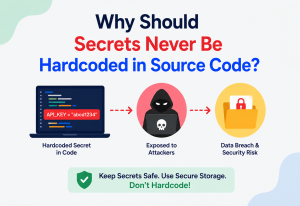
- Key storage: The key is placed in a secure store (OS keychain, HSM, or a managed KMS) — never hard-coded in source code.
- IV / Nonce generation: A fresh random IV / nonce is generated for this specific encryption operation.
- Encryption: Plaintext + key + IV are fed into the cipher (e.g. AES-GCM), producing ciphertext and an authentication tag.
- Transmission / storage: The IV, ciphertext, and tag are stored or sent together (the IV and tag aren’t secret; only the key is).
- Decryption: The receiver re-derives or retrieves the same key, uses the stored IV and tag to decrypt and verify the ciphertext.
- Integrity check: If the authentication tag doesn’t match, decryption fails loudly — this signals tampering and the data must be rejected.
- Key rotation / destruction: Eventually the key is rotated (replaced) on a schedule, and old keys are securely destroyed once no longer needed.
Advantages, Disadvantages & Trade-offs
Symmetric encryption pays for itself many times over — but only if you are honest about the constraints it introduces.
Advantages
- Extremely fast — AES can run at multiple gigabytes per second with hardware acceleration (AES-NI instructions on modern CPUs).
- Low computational and battery overhead — ideal for mobile and embedded devices.
- Well-understood, standardised, and extensively vetted by decades of cryptanalysis.
- Modern authenticated modes (GCM) give confidentiality and integrity together.
- Simple mental model: one key locks, the same key unlocks.
Disadvantages
- Key distribution problem: both parties must somehow agree on the same secret key without an eavesdropper learning it.
- Doesn’t provide non-repudiation or digital signatures on its own (can’t prove who sent a specific message the way asymmetric signing can).
- If the key leaks, every message ever encrypted with it is compromised (unless forward-secrecy techniques are layered on).
- Scaling key management across many users (N people need N(N−1)/2 pairwise keys without a shared infrastructure) gets complex fast.
7.1 Trade-off: Symmetric vs. Asymmetric in Practice
This is why real-world systems (like HTTPS / TLS) use a hybrid approach: asymmetric cryptography solves the key distribution problem (safely agreeing on a secret over an insecure channel), and symmetric cryptography does the actual heavy-lifting encryption because it’s so much faster.
Performance & Scalability
Symmetric encryption’s biggest practical selling point is speed. Modern CPUs (Intel, AMD, ARM) include dedicated instructions — AES-NI on x86, and the ARMv8 Cryptography Extensions on ARM — that perform AES rounds directly in hardware, rather than in software loops.
~3–10 GB/s
AES-256-GCM with AES-NI, single core.
~100–200 MB/s
RSA-2048 signing (asymmetric), for comparison.
16 bytes
AES block size.
10–14
AES rounds (128 to 256-bit keys).
8.1 Scaling Considerations
- Parallelism: Modes like CTR and GCM allow independent blocks to be encrypted / decrypted in parallel across CPU cores or SIMD lanes, unlike CBC’s inherently sequential chaining on encryption.
- Streaming large files: Encrypt data in chunks so you never need to hold an entire multi-gigabyte file in memory at once.
- Hardware Security Modules (HSMs): For very high key-operation volumes (e.g. a payments platform), dedicated hardware can perform key operations without ever exposing the raw key to application memory.
- Envelope encryption: Instead of encrypting every object directly with a master key, generate a unique “data key” per object, encrypt the object with that data key, and encrypt the data key itself with the master key (stored alongside the object). This avoids overusing the master key and allows fast key rotation.
High Availability & Reliability
Encryption itself is stateless and fast, but the systems around it — especially key management — need to be highly available, because if your key management system goes down, nothing that depends on decrypting data can function.
- Key backup and escrow: Losing a key permanently means losing the data it protects forever — there’s no “forgot password” recovery for a lost AES key. Production systems replicate keys across multiple availability zones / regions with strict access controls.
- Multi-region KMS replication: Cloud KMS services (AWS KMS, GCP Cloud KMS, Azure Key Vault) replicate keys or key material across regions so a regional outage doesn’t halt encryption / decryption globally.
- Graceful key rotation: Systems should support decrypting with an old key while encrypting new data with a new key, to avoid downtime during rotation.
- Failure isolation: A corrupted or lost IV / tag for one record should only break that one record’s decryption, not cascade into a system-wide failure.
Unlike a crashed web server, a lost encryption key isn’t something you can “restart” your way out of. Key durability is a first-class reliability requirement, arguably more critical than the encryption algorithm itself.
Security Considerations
The algorithm is only as strong as the assumptions you make around it. Here are the classic attacks and the disciplined defences that neutralise them.
10.1 Common Attacks and Weaknesses
Brute Force
Trying every possible key. AES-128 has 2^128 possible keys — even at billions of guesses per second, this would take longer than the age of the universe. This is why key length matters.
Weak / Reused IVs
Reusing an IV / nonce with the same key (especially in CTR or GCM mode) can catastrophically leak plaintext or even the authentication key. Always generate fresh, unique IVs.
Padding Oracle Attacks
If a system leaks whether decrypted padding was “valid” (e.g. via different error messages or timing), attackers can decrypt CBC-mode ciphertext byte-by-byte without knowing the key.
Side-Channel Attacks
Measuring power consumption, electromagnetic emissions, or execution timing of a device performing encryption can leak key bits. Defended against with “constant-time” implementations.
Weak Key Derivation
Deriving an encryption key directly from a short human password without a proper KDF (like PBKDF2, scrypt, or Argon2) makes brute-forcing dramatically easier.
ECB Pattern Leakage
ECB mode’s “identical plaintext block in, identical ciphertext block out” behaviour can reveal image outlines or repeated structures — famously demonstrated with the “ECB penguin” image.
10.2 Best-Practice Defences
- Use AES-256 or AES-128 with GCM (authenticated encryption) rather than legacy modes like ECB or unauthenticated CBC.
- Always generate IVs / nonces using a cryptographically secure random number generator, and never reuse a (key, IV / nonce) pair.
- Derive keys from passwords using a slow, memory-hard KDF (Argon2id is the current recommendation).
- Store and manage keys using vetted systems (KMS / HSM), never in source code, config files, or environment variables checked into version control.
- Use constant-time comparison functions when checking authentication tags to avoid timing attacks.
- Rotate keys periodically and immediately upon suspected compromise.
AES itself is essentially unbreakable by brute force with today’s technology. Real-world breaches almost always come from mistakes around the algorithm — reused IVs, weak passwords used as keys, keys stored in the wrong place — not from cracking AES’s math directly.
Monitoring, Logging & Metrics
Because encryption sits on the critical path of nearly every read / write operation, production systems should track:
- Key usage counts and age: alert when a key approaches organisational rotation policy limits (e.g. NIST recommends limiting how much data is encrypted under a single AES-GCM key / IV combination).
- Decryption failure rate: a spike in authentication-tag verification failures can indicate corruption, misconfiguration, or an active tampering attempt.
- KMS / HSM latency and error rates: since key operations are often on the request’s critical path, latency spikes here directly hurt application performance.
- Access audit logs: who / what requested a key, when, and from where — critical for compliance (SOC 2, HIPAA, PCI-DSS) and for detecting anomalous access patterns.
- Never log plaintext or raw keys. Logging pipelines are a very common accidental leak point for secrets.
Debug logging that accidentally prints an encryption key or the plaintext of sensitive fields is one of the most common real-world causes of security incidents — often more damaging than a flaw in the cipher itself.
Deployment & Cloud Considerations
Symmetric encryption is the workhorse of every major cloud platform, but each provider exposes it slightly differently.
12.1 Where Symmetric Encryption Is Used in Cloud Platforms
Encryption at Rest
Cloud storage (S3, GCS, Azure Blob), managed databases (RDS, Cloud SQL), and disk volumes (EBS) transparently encrypt data using AES-256, typically via envelope encryption with a cloud KMS.
Encryption in Transit
TLS connections (HTTPS, database connections, service mesh traffic) negotiate a symmetric session key (commonly AES-GCM or ChaCha20-Poly1305) for the actual data transfer after an asymmetric handshake.
Managed KMS
AWS KMS, Google Cloud KMS, and Azure Key Vault let applications request encrypt / decrypt operations without ever handling raw key material directly, with fine-grained IAM policies controlling access.
Secrets Managers
Tools like HashiCorp Vault, AWS Secrets Manager, and Kubernetes Secrets (ideally encrypted at rest themselves) store application-level symmetric keys and rotate them automatically.
A common production pattern is envelope encryption with a Customer Master Key (CMK): the application never sees the CMK; it only ever asks the KMS to generate and wrap / unwrap short-lived data keys, keeping the most sensitive key material inside audited, tamper-resistant infrastructure.
Databases, Caching & Load Balancing
Each layer of the data path needs its own encryption posture — and the caching tier is one of the most commonly overlooked pieces in a security review.
- Field-level encryption: Encrypting specific sensitive columns (e.g. social security numbers) individually with symmetric keys, so even a full database dump doesn’t expose the raw values — at the cost of losing native indexing / search on those fields.
- Transparent Data Encryption (TDE): Databases like SQL Server, Oracle, and PostgreSQL (via extensions) encrypt entire data files at rest, invisible to application queries.
- Caching encrypted data: Caches (Redis, Memcached) should generally store already-encrypted values if the underlying data is sensitive, since caches are often less tightly access-controlled than the primary database.
- Load balancers and TLS termination: Many load balancers terminate TLS (decrypting incoming traffic) before forwarding requests internally — meaning traffic inside the data centre may be unencrypted unless “TLS passthrough” or re-encryption to the backend is configured.
Decide deliberately whether encryption happens at the field level, the file level, or the whole-disk level — this affects backup strategy, search capability, and blast radius if a single key is ever compromised.
APIs & Microservices
In a microservices architecture, symmetric encryption shows up in a few recurring patterns:
- Service-to-service TLS (mTLS): Each service authenticates the other using certificates (asymmetric), then all data flows over an AES-GCM encrypted channel.
- Encrypted message payloads: Event queues (Kafka, SQS) may carry payloads pre-encrypted with a symmetric key shared between producer and consumer services, independent of transport-level TLS, for defence-in-depth.
- JWT / token encryption: While JWTs are often just signed (JWS), sensitive claims can additionally be encrypted (JWE) using a symmetric content-encryption key.
- API gateway request / response encryption: Gateways may decrypt inbound requests and re-encrypt for internal routing, centralising key management at the edge.
14.1 Java Example: Encrypting an API Payload with AES-GCM
import javax.crypto.Cipher;
import javax.crypto.KeyGenerator;
import javax.crypto.SecretKey;
import javax.crypto.spec.GCMParameterSpec;
import java.security.SecureRandom;
import java.util.Base64;

public class AesGcmExample {

    public static SecretKey generateKey() throws Exception {
        KeyGenerator keyGen = KeyGenerator.getInstance("AES");
        keyGen.init(256); // AES-256
        return keyGen.generateKey();
    }

    public static String encrypt(String plaintext, SecretKey key) throws Exception {
        byte[] iv = new byte[12]; // 96-bit nonce, recommended for GCM
        new SecureRandom().nextBytes(iv);

        Cipher cipher = Cipher.getInstance("AES/GCM/NoPadding");
        GCMParameterSpec spec = new GCMParameterSpec(128, iv); // 128-bit auth tag
        cipher.init(Cipher.ENCRYPT_MODE, key, spec);

        byte[] ciphertext = cipher.doFinal(plaintext.getBytes("UTF-8"));

        // Store IV alongside ciphertext -- it is not secret
        byte[] combined = new byte[iv.length + ciphertext.length];
        System.arraycopy(iv, 0, combined, 0, iv.length);
        System.arraycopy(ciphertext, 0, combined, iv.length, ciphertext.length);

        return Base64.getEncoder().encodeToString(combined);
    }

    public static String decrypt(String encodedPayload, SecretKey key) throws Exception {
        byte[] combined = Base64.getDecoder().decode(encodedPayload);
        byte[] iv = new byte[12];
        byte[] ciphertext = new byte[combined.length - 12];
        System.arraycopy(combined, 0, iv, 0, 12);
        System.arraycopy(combined, 12, ciphertext, 0, ciphertext.length);

        Cipher cipher = Cipher.getInstance("AES/GCM/NoPadding");
        GCMParameterSpec spec = new GCMParameterSpec(128, iv);
        cipher.init(Cipher.DECRYPT_MODE, key, spec);

        byte[] plaintext = cipher.doFinal(ciphertext); // throws if tag invalid
        return new String(plaintext, "UTF-8");
    }
}
Notice the key details: a fresh random IV per encryption, use of the authenticated GCM mode (which throws an exception on doFinal if the ciphertext was tampered with), and storing the IV alongside — but not mixed into — the secret key.
Design Patterns & Anti-Patterns
A short, opinionated list of the shapes that recur in every well-designed encryption pipeline, and the ones that quietly break in every troubled one.
Good Patterns
- Envelope encryption — encrypt data with a per-object data key, then encrypt that key with a master key held in a KMS.
- Authenticated encryption by default — always prefer AES-GCM or ChaCha20-Poly1305 over unauthenticated modes.
- Key separation by purpose — use different keys for different data classes / environments (dev, staging, prod).
- Automated key rotation — rotate on a schedule without requiring re-encryption of all historical data (via envelope encryption).
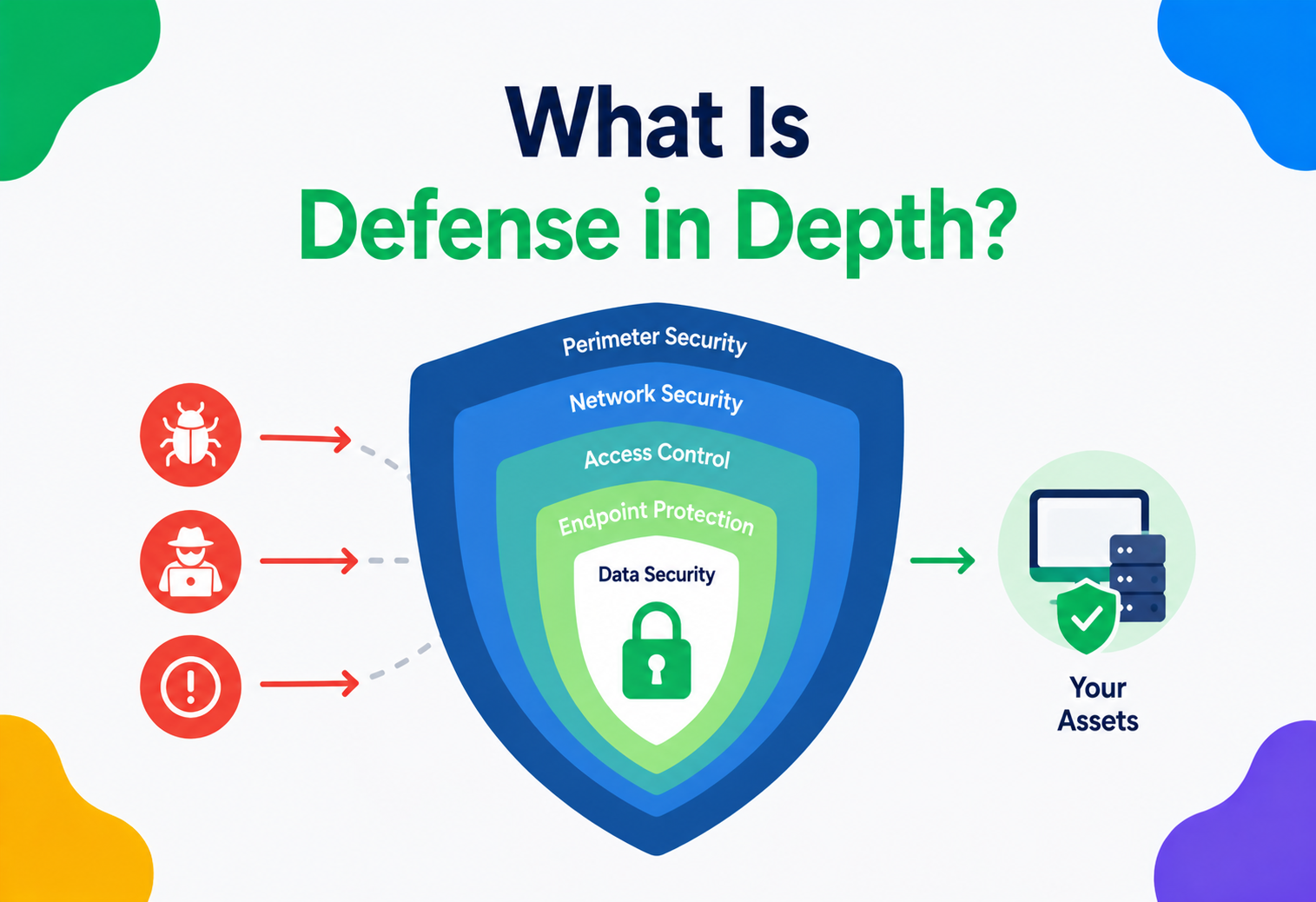
- Defense in depth — encrypt sensitive fields at the application layer even when transport and disk encryption already exist.
Anti-Patterns to Avoid
- Rolling your own crypto — inventing a custom cipher or protocol instead of using vetted libraries.
- Hardcoding keys in source code or config files committed to version control.
- Reusing IVs / nonces with the same key, especially in CTR / GCM modes.
- Using ECB mode for anything beyond a single random block.
- Deriving keys directly from passwords without a proper key-derivation function.
- Ignoring authentication — encrypting without also verifying integrity, allowing silent tampering.
Best Practices & Common Mistakes
If a code review turns up any of the mistakes listed here, treat them as real security risks waiting to surface on the next launch, not just cosmetic feedback.
16.1 Best Practices Checklist
- Default to AES-256-GCM (or ChaCha20-Poly1305 on platforms without AES hardware acceleration, like some mobile / embedded devices).
- Use audited cryptography libraries (e.g. Java’s
javax.crypto/ Bouncy Castle, Google Tink, libsodium) — never implement the algorithm yourself. - Generate keys and IVs with a CSPRNG (
SecureRandomin Java, notRandom). - Keep keys out of application code — use a managed KMS or secrets manager.
- Encrypt, then authenticate (or use a combined AEAD mode) — never “encrypt only” for anything an attacker might tamper with.
- Plan for key rotation from day one, not as an afterthought.
16.2 Common Mistakes
Using java.util.Random
Not cryptographically secure — predictable. Always use java.security.SecureRandom for keys and IVs.
Comparing tags with ==
Comparing MACs / tags with == or .equals() is vulnerable to timing attacks. Use constant-time comparison utilities.
Truncating keys
Padding a short password to “look like” a 256-bit key drastically weakens effective security — use a proper KDF instead.
Silent failure on bad tag
Catching and ignoring authentication exceptions defeats the entire purpose of authenticated encryption.
Real-World / Industry Examples
Abstract advice gets much sharper once you see how the biggest platforms translate these principles into production practice.
HTTPS / TLS (Everywhere)
Every “padlock” icon in your browser relies on TLS negotiating an AES-GCM or ChaCha20-Poly1305 session key after an initial asymmetric handshake — protecting virtually all web traffic today.
Netflix
Uses AES to encrypt video content (DRM) so streams can only be decoded by authorised, licensed devices, and encrypts data at rest across its cloud storage.
Amazon (AWS)
AWS KMS underpins encryption for S3, EBS, RDS, and dozens of other services, using envelope encryption with AES-256 as the default cipher for data at rest.
Signal & WhatsApp
The Signal Protocol uses AES for message encryption combined with constantly rotating keys (via the “Double Ratchet” algorithm) to provide forward secrecy in end-to-end encrypted messaging.
Apple FileVault / BitLocker
Full-disk encryption on Mac and Windows laptops uses AES-XTS mode to protect data if a device is lost or stolen.
Uber
Encrypts sensitive rider and driver data (location history, payment details) at the application layer using envelope encryption on top of cloud KMS, in addition to standard TLS in transit.
Frequently Asked Questions
A few of the questions that come up most often the first time an engineer thinks seriously about symmetric encryption in production.
Both are considered secure against brute force for the foreseeable future — 2^128 is already astronomically large. AES-256 offers a larger safety margin (useful against future theoretical advances, including some quantum computing scenarios) at a small performance cost, so it’s often chosen for long-lived or highly sensitive data.
Grover’s algorithm theoretically halves the effective key strength (AES-256 would behave like a 128-bit key against a sufficiently powerful quantum computer), but no such computer exists today, and AES-256 would still remain robust even in that scenario. Quantum computers pose a far bigger threat to asymmetric algorithms like RSA.
Encryption is reversible (with the right key, you get the original data back). Hashing is one-way — it’s designed so you can never recover the original input from the hash output. They solve different problems: encryption protects confidentiality; hashing verifies integrity or stores things like passwords (usually combined with a KDF, not raw hashing).
Almost never from scratch. Use established libraries and, where possible, managed services (cloud KMS, secret managers). Your job is usually integration and correct key management, not algorithm design.
The encrypted data becomes permanently unreadable — there is no backdoor by design. This is why secure key backup and escrow procedures are just as important as the encryption itself.

Summary & Key Takeaways
Symmetric encryption is less about the math — which is well settled — and more about the discipline of building the surrounding system so the math actually stays effective in production.
Key Takeaways
- Symmetric encryption uses one shared secret key to both encrypt and decrypt data — fast, efficient, and the workhorse behind almost all bulk data protection.
- AES is the modern standard, built from repeated rounds of substitution (SubBytes), permutation (ShiftRows), mixing (MixColumns), and key-mixing (AddRoundKey).
- The mode of operation (prefer authenticated modes like GCM) matters just as much as the cipher itself — a strong cipher used in a weak mode is still insecure.
- The core practical challenge isn’t the math — it’s key management: generation, distribution, storage, rotation, and destruction.
- Real systems combine symmetric encryption (speed) with asymmetric encryption (safe key exchange) — this hybrid approach powers HTTPS, secure messaging, and most cloud storage encryption.
- Most real-world breaches stem from implementation mistakes (reused IVs, hardcoded keys, weak KDFs) rather than the underlying algorithm being broken.
The best symmetric encryption in the world can be undone by a single line of code that logs a key or reuses an IV. Design the surrounding system as carefully as you would choose the algorithm, and the math will do its job for decades to come.