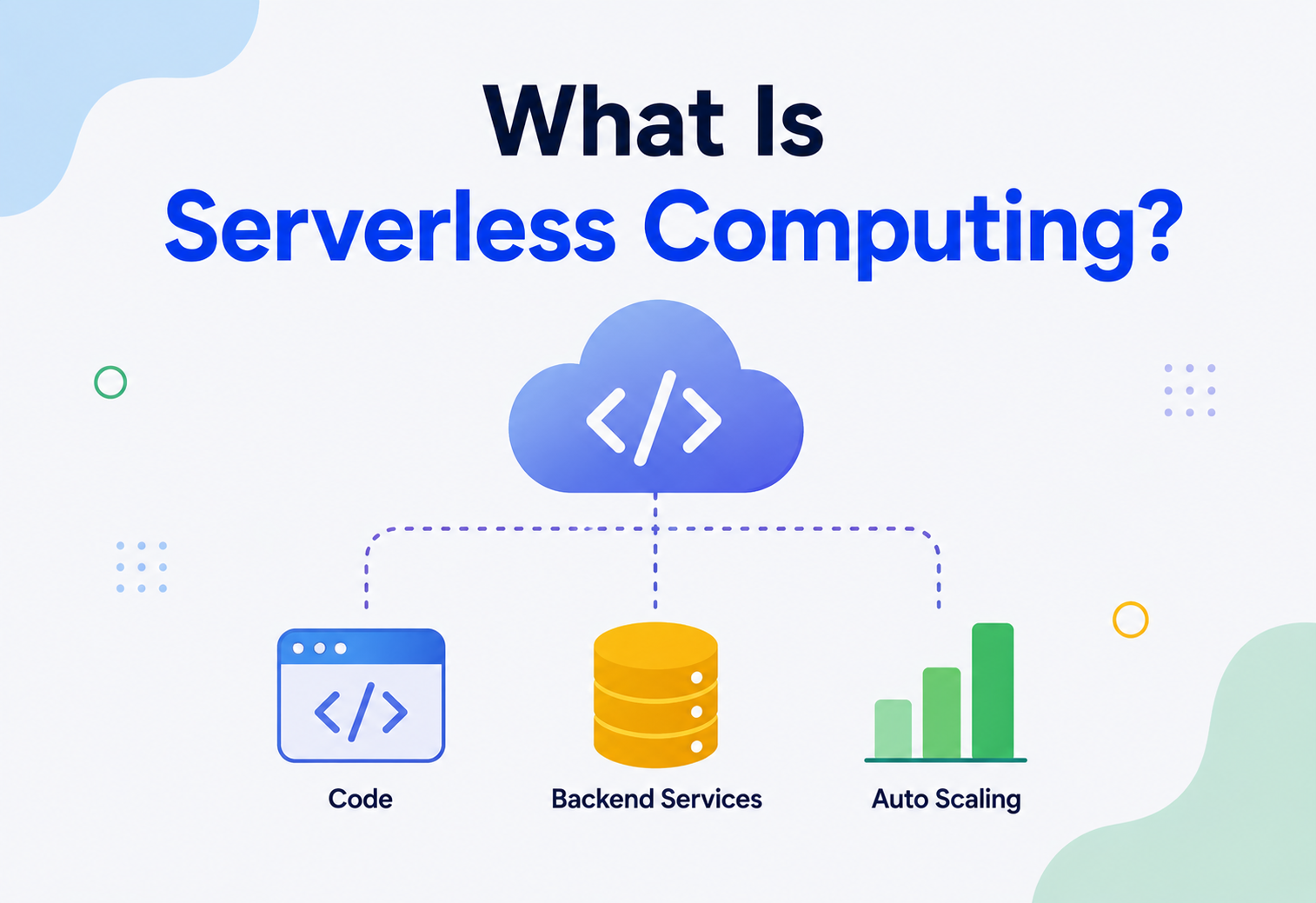
What Is Serverless Computing?
A complete, beginner-friendly guide to serverless computing — what it is, why it exists, how it works under the hood, and how to design, secure, and operate serverless systems in production.
Introduction & History
Before we go anywhere near AWS Lambda or Azure Functions, let’s build the mental picture of what “serverless” actually means — and where the idea came from.
Serverless computing is a cloud execution model where the cloud provider dynamically manages the allocation and provisioning of servers, and you — the developer — write and deploy code without thinking about the underlying infrastructure at all. You don’t pick an instance type. You don’t patch an operating system. You don’t decide how many machines to run. You simply write a small piece of logic, called a function, and the cloud platform runs it whenever it’s needed, then shuts it down when it isn’t.
Think about electricity at home. A hundred years ago, if you wanted power, you needed your own generator — you’d buy it, maintain it, fuel it, and run it even when you weren’t using any appliances. Today you just plug into the wall and pay for exactly what you consume. You never think about the power station, the turbines, or the transmission lines. Serverless computing does the same thing for compute power: you “plug in” your code, and the electricity board (the cloud provider) worries about the generators (servers).
The name “serverless” is a bit of a misnomer, and beginners often get tripped up by it. There absolutely are servers involved — someone has to run your code on physical hardware somewhere. What’s “server-less” is your relationship with those servers. You never provision them, never SSH into them, never see their IP addresses, and never pay for them while they sit idle.
1.1 A Short History
The roots of serverless go back further than most people expect. The gradual march from managing hardware to managing nothing but business logic played out over roughly two decades:
AWS launches EC2 — IaaS era begins
Infrastructure-as-a-Service arrives. You still manage virtual machines yourself, but you no longer buy physical hardware.
Platform-as-a-Service rises
Google App Engine (2008) and Heroku (2007–2011) let developers deploy applications without managing servers directly, though you still think in terms of “apps” running continuously.
AWS Lambda launches — birth of modern serverless
For the first time, you can deploy a single function, have it triggered by an event, and pay only for the milliseconds it actually executes. This is widely considered the birth of modern Function-as-a-Service (FaaS).
Azure Functions and Google Cloud Functions launch
The major cloud providers converge on the FaaS model, and the term “serverless” enters mainstream engineering vocabulary.
The ecosystem matures
Serverless frameworks (Serverless Framework, AWS SAM, Terraform support), serverless databases (DynamoDB On-Demand, Aurora Serverless), and serverless containers (AWS Fargate, Google Cloud Run) all emerge, broadening “serverless” beyond just functions.
Serverless containers go mainstream
Google Cloud Run and AWS Fargate blur the line between “serverless” and “containers,” letting you deploy full containerized apps with the same pay-per-use, no-ops model.
Edge and serverless converge
Cloudflare Workers, AWS Lambda@Edge, and Deno Deploy push serverless functions to run at edge locations physically close to users, cutting latency further.
Today, “serverless” is really an umbrella term covering several related ideas: Function-as-a-Service (FaaS), serverless databases, serverless containers, and Backend-as-a-Service (BaaS) tools like authentication and storage APIs. In this guide we’ll focus mainly on FaaS — because that’s the purest and most illustrative form of serverless — while also touching on the broader ecosystem.
You rent the whole generator
You provision VMs, patch operating systems, plan capacity for peak load, and pay for every idle hour — even when nothing is happening.
You just plug into the wall
You upload a function; the cloud runs it when an event arrives, scales it automatically, and bills you only for the milliseconds it actually executed.
The Problem & Motivation
Serverless didn’t appear out of thin air. It exists because traditional server management created real, expensive, recurring pain for engineering teams. Let’s look at exactly what problems it solves.
2.1 Problem 1: Paying for Idle Capacity
In the traditional world, if you run a web application on EC2 instances or on-premise servers, you must provision capacity for your peak load, not your average load. A food-delivery app might see 10x traffic during lunch and dinner hours and near-zero traffic at 3 AM — but the servers you provisioned for the dinner rush sit there burning money all night, doing nothing.
Imagine you run a small tool that processes an uploaded image once every few minutes. If you rent a full-time virtual machine to handle this, you’re paying for 24 hours of uptime to do maybe 10 minutes of actual work. With serverless, you’d only be billed for the exact compute time your function runs — say, 200 milliseconds per image — and nothing else.
2.2 Problem 2: Operational Overhead
Running servers means someone has to patch operating systems, apply security updates, configure auto-scaling groups, manage load balancers, handle failed instances, and monitor disk space. None of this is “your product” — it’s undifferentiated heavy lifting that every company has to do, but that provides zero unique value to your customers.
2.3 Problem 3: Slow, Manual Scaling
Traditional auto-scaling groups react to metrics like CPU usage, but they still take time — spinning up a new EC2 instance, waiting for the OS to boot, waiting for your app to initialize — often 60–120 seconds. If your traffic spikes in 10 seconds (a viral tweet, a flash sale), traditional scaling can’t keep up. Serverless platforms can scale from zero to thousands of concurrent function executions within seconds, because there is no OS boot process — the platform keeps warm execution environments ready in a shared pool.
2.4 Problem 4: Complex Capacity Planning
Forecasting exactly how many servers you’ll need next quarter, and buying reserved instances to save money, requires dedicated capacity-planning effort — effort that’s pure waste if your product-market fit shifts or your growth curve changes.
A well-known example: during Black Friday, an e-commerce company running fixed EC2 fleets might over-provision by 5x “just in case,” burning enormous unnecessary spend for 11 months of the year to be safe for one weekend. A serverless backend scales automatically to that 5x spike and back down, without anyone touching a dashboard.
2.5 What Serverless Solves
| Traditional Server Model | Serverless Model |
|---|---|
| You provision fixed capacity in advance | Capacity is allocated automatically, per request |
| You pay for uptime, even when idle | You pay only for actual execution time (often billed in milliseconds) |
| You patch OS and runtime yourself | The cloud provider patches and manages the runtime |
| Scaling requires configuration and lag | Scaling is automatic and near-instant |
| You manage load balancers, health checks | The platform handles routing and health internally |
It’s important to be honest, though: serverless doesn’t eliminate every problem — it trades one set of problems (server management) for another (cold starts, vendor lock-in, debugging distributed event flows). We’ll cover those trade-offs honestly in Section 7.
Core Concepts
Let’s define the vocabulary you’ll need before going further. Every serverless conversation revolves around these terms.
3.1 Function-as-a-Service (FaaS)
What: A cloud service where you upload a single function (a unit of code with one entry point) and the provider executes it in response to events.
Why: It’s the smallest possible unit of deployable compute, which maximizes granularity of scaling and billing.
Where: AWS Lambda, Azure Functions, Google Cloud Functions, Cloudflare Workers.
Analogy: A FaaS function is like a vending machine — it sits dormant until someone presses a button (an event), does exactly one job (dispenses a snack), and then goes back to sleep.
3.2 Event-Driven Execution
Serverless functions don’t run continuously listening for requests the way a traditional web server does. Instead, they are invoked by events — an HTTP request arriving at an API Gateway, a file landing in cloud storage, a message arriving on a queue, a database row changing, or a scheduled timer firing.
If nothing is happening, nothing is running, and nothing is being billed. This “scale to zero” property is the single most defining trait of serverless computing.
3.3 Statelessness
Each function invocation is designed to be stateless — it shouldn’t rely on data stored in memory from a previous invocation, because the underlying execution environment may be destroyed at any moment, or a completely different environment may handle the next request (especially under concurrent load). Any state that needs to persist must be written to an external store — a database, a cache, or object storage.
3.4 Cold Start vs. Warm Start
When a function hasn’t been invoked recently, the platform must create a brand-new execution environment: download your code, start the runtime (e.g., the JVM for Java), initialize your handler class, and only then run your code. This is a cold start, and it adds latency — often 100ms to several seconds depending on runtime and package size. If the environment from a previous invocation is still alive and gets reused, that’s a warm start, which skips all that setup and just runs your handler directly.
3.5 Ephemeral Compute
Execution environments are temporary. The provider may terminate them seconds after your function completes, or may keep them “warm” for reuse for a few minutes if traffic continues. You should never assume a specific environment will still exist when the next event arrives.
3.6 Backend-as-a-Service (BaaS)
Beyond FaaS, “serverless” also covers managed backend services that eliminate the need to run your own servers for common capabilities: authentication (Amazon Cognito, Firebase Auth), databases (DynamoDB, Firestore), storage (S3), and messaging (SNS, SQS, EventBridge). These are “serverless” in the same sense — you consume an API, you don’t manage the underlying servers.

Your business logic
Runs your custom code in response to events. Examples: AWS Lambda, Azure Functions, Google Cloud Functions, Cloudflare Workers.
Ready-made backend capabilities
Provides authentication, storage, databases, and messaging via API. Examples: Firebase Auth, Amazon Cognito, S3, DynamoDB, SNS.
3.7 Concurrency
The number of function instances executing simultaneously at any given moment. If 500 users hit your API at the same second, the platform may spin up 500 separate, isolated execution environments running your function in parallel — this is fundamentally different from a traditional server, which handles requests within a fixed number of threads on a fixed number of machines.
3.8 Managed Runtime
The cloud provider owns the operating system, language runtime (JVM, Node.js runtime, Python interpreter), and security patching. You are responsible only for your application code and its dependencies.
Architecture & Components
A production serverless system is rarely “just a function.” It’s a composition of several managed services wired together by events. Let’s map the anatomy.
4.1 Component Breakdown
1. Trigger / Event Source
The thing that causes your function to run. Common trigger types:
- HTTP triggers: API Gateway or Application Load Balancer forwarding a web request.
- Storage triggers: A new file landing in an object store (e.g., S3 “ObjectCreated” event).
- Queue triggers: A message arriving in SQS or a similar queue.
- Stream triggers: A new record appearing in a change stream (DynamoDB Streams, Kinesis).
- Schedule triggers: A cron-like timer (e.g., “run every night at 2 AM”).
- Pub/Sub triggers: A message published to a topic (SNS, EventBridge, Pub/Sub).
2. Function Runtime
The managed environment (JVM, Node.js, Python, Go binary, custom container) that executes your handler code.
3. API Gateway
Sits in front of your functions for HTTP-triggered use cases. It handles routing, request validation, throttling, authentication (API keys, JWT authorizers), and can transform requests/responses without invoking a function at all.
4. Managed Data Stores
Serverless architectures favor databases that themselves scale automatically and charge per-request, such as DynamoDB, Firestore, or Aurora Serverless — because a fixed-connection relational database can become a bottleneck when thousands of concurrent function instances try to open connections simultaneously (more on this in Section 13).
5. Messaging & Orchestration Layer
Queues (SQS), topics (SNS), and event buses (EventBridge) decouple functions from each other. For multi-step workflows, orchestrators like AWS Step Functions coordinate a sequence of function calls, retries, and branching logic.
6. Identity & Access Management
Every function is assigned an execution role defining exactly what it’s allowed to touch — a database table, a specific S3 bucket, nothing more.
In serverless systems, the “glue” between components — the events, the queues, the permissions — is just as important as the function code itself. Many production incidents in serverless systems come from misconfigured event wiring, not from the business logic.
4.2 A Basic Java Lambda Handler
Here’s the minimal shape of an AWS Lambda function written in Java, so you can see how little “infrastructure” code is needed:
// OrderHandler.java
package com.utivra.orders;

import com.amazonaws.services.lambda.runtime.Context;
import com.amazonaws.services.lambda.runtime.RequestHandler;
import com.amazonaws.services.lambda.runtime.LambdaLogger;

public class OrderHandler implements RequestHandler<OrderRequest, OrderResponse> {

    // This constructor runs ONCE per cold start, not per invocation.
    private final OrderService orderService = new OrderService();

    @Override
    public OrderResponse handleRequest(OrderRequest request, Context context) {
        LambdaLogger logger = context.getLogger();
        logger.log("Processing order for customer: " + request.getCustomerId());

        try {
            Order order = orderService.createOrder(request);
            return new OrderResponse(order.getId(), "CREATED");
        } catch (Exception e) {
            logger.log("Order creation failed: " + e.getMessage());
            throw new RuntimeException("Order processing failed", e);
        }
    }
}
Notice there’s no main() method, no server startup, no port binding. The platform owns the lifecycle — your job is just to implement handleRequest.
Internal Working
What actually happens on the cloud provider’s side when your function is invoked? Understanding this demystifies cold starts, concurrency limits, and billing.
5.1 MicroVMs and Isolation
Modern FaaS platforms don’t run your function inside a full, dedicated virtual machine per invocation — that would be too slow and too expensive. Instead, AWS Lambda (and similarly architected platforms) use lightweight virtualization technology, such as AWS’s own Firecracker microVM, which can boot in well under 200 milliseconds while still offering hardware-level isolation between different customers’ code running on the same physical host.
Think of a hotel with pre-built, sealed rooms. Instead of constructing a new building for every guest (a full VM), the hotel keeps a set of ready rooms available and hands one out instantly when someone checks in (a microVM). Each room is fully private and sealed off from every other guest, but setting one up is dramatically faster than building from scratch.
5.2 The Execution Environment Lifecycle
5.3 Why Java Cold Starts Are Slower
Cold start duration varies heavily by language runtime, and this is a real production concern. The JVM must start up, load classes, and JIT-compile hot paths — all of which take longer than starting an interpreted language runtime like Node.js or Python for a simple function. This is why teams running latency-sensitive Java Lambdas invest in techniques like:
- SnapStart (AWS-specific): Takes a snapshot of an initialized JVM and restores from it instead of booting from scratch.
- Reducing dependencies: Fewer classes to load means faster class-loading time.
- Provisioned concurrency: Pre-warms a set number of execution environments so cold starts never happen for those pre-allocated slots.
- GraalVM native image: Compiles Java ahead-of-time into a native binary, largely eliminating JVM startup overhead.
5.4 Multi-Tenancy and the Shared Physical Host
Behind the scenes, a single physical server in the provider’s data center hosts microVMs belonging to many different customers simultaneously. The provider’s hypervisor and microVM technology are responsible for ensuring one customer’s function can never read another customer’s memory, network traffic, or file system — a critical security property called tenant isolation.
5.5 Scaling Internally
When request volume increases, the control plane simply provisions more microVMs in parallel across the provider’s fleet of physical hosts. There is no single “server” that becomes a bottleneck the way there would be with a traditional load-balanced fleet — scaling is close to horizontal and near-linear, bounded mainly by account-level concurrency limits (a safety mechanism, not a hardware one).
Data Flow & Lifecycle
Let’s trace a single request end-to-end through a serverless system, from the moment a user clicks a button to the moment they see a response.
6.1 Synchronous vs. Asynchronous Invocation
This distinction matters enormously in serverless design:
- Synchronous invocation: The caller waits for the function to finish and return a response — typical for API Gateway-triggered functions. If the function fails, the caller sees the failure immediately.
- Asynchronous invocation: The caller (often another AWS service, like S3 or EventBridge) hands off the event and moves on. The platform queues the event internally and retries automatically on failure, without the original caller waiting or even knowing about retries.
- Stream/poll-based invocation: The platform’s polling mechanism reads batches of records from a queue or stream and invokes your function with the batch.
Treating asynchronous invocations like synchronous ones is a frequent source of bugs. If your async function throws an unhandled exception, the platform will typically retry the entire event automatically — meaning your side effects (like sending an email) can happen multiple times unless your function is idempotent (see Section 15).
6.2 The Full Lifecycle of One Invocation
- Event generation: Something happens — an HTTP call, a file upload, a timer.
- Routing: The platform’s control plane identifies which function should handle this event based on configured triggers.
- Environment selection: A warm environment is reused, or a cold start provisions a new one.
- Initialization (cold start only): Runtime boots, static/global code runs once.
- Handler invocation: Your business logic executes with the event payload and a context object (containing request ID, remaining time, memory limit, etc.).
- External calls: Your function typically reads/writes to a database, calls another API, or publishes further events.
- Response / completion: The function returns a value (sync) or simply completes (async).
- Environment freeze or teardown: The environment is frozen (paused, ready to resume quickly) or eventually torn down if unused for a while.
- Billing calculation: The platform measures execution duration (often rounded to the nearest millisecond) multiplied by allocated memory, and bills accordingly.
Pros, Cons & Trade-offs
No architecture is free. Let’s be honest about what you gain and what you give up by going serverless.
7.1 Advantages
Cost efficiency at variable load
You pay per invocation and per millisecond of execution, not for idle capacity. Ideal for spiky or unpredictable traffic.
Automatic, near-instant scaling
From zero to thousands of concurrent executions without manual configuration.
Reduced operational burden
No OS patching, no server fleet management, no capacity planning.
Faster time to market
Teams ship features without provisioning infrastructure first.
Built-in high availability
Providers run functions across multiple availability zones by default.
Natural fit for event-driven systems
Maps cleanly to microservices and reactive architectures.
7.2 Disadvantages
Cold start latency
Can add noticeable delay for latency-sensitive workloads, especially with heavier runtimes like the JVM.
Vendor lock-in
Deep integration with provider-specific event sources and IAM makes migration between clouds costly.
Execution time limits
Most FaaS platforms cap execution duration (e.g., 15 minutes on Lambda), unsuitable for long-running batch jobs.
Harder debugging & testing
Distributed, event-driven flows are harder to reproduce locally and trace end-to-end than a monolith.
Connection management complexity
Traditional relational databases struggle with the connection storms that thousands of concurrent function instances can cause.
Cost can flip at high, sustained load
At very high, constant throughput, always-on servers or containers can become cheaper than per-invocation billing.
7.3 When Serverless Is (and Isn’t) the Right Choice
| Good Fit | Poor Fit |
|---|---|
| Spiky, unpredictable, or low-frequency workloads | Sustained, high-throughput, constant workloads |
| Event-driven glue code (file processing, notifications) | Long-running batch jobs (hours-long ETL) |
| APIs with unpredictable traffic patterns | Ultra-low-latency systems (sub-10ms, e.g. HFT) |
| Startups wanting to minimize ops overhead | Teams needing full control over runtime/OS tuning |
| Microservices with independent scaling needs | Applications requiring persistent in-memory state/WebSockets at scale |
If you can’t confidently predict your traffic pattern, or your traffic is bursty, serverless usually wins on cost and simplicity. If your traffic is large and constant 24/7, run the numbers — containers or reserved instances often become cheaper at scale.
Performance & Scalability
Serverless platforms advertise “infinite scale,” but real systems have real limits and real performance characteristics worth understanding.
8.1 Auto-Scaling Behavior
Unlike a traditional auto-scaling group that watches CPU metrics and slowly adds instances, FaaS platforms scale per-request. Each concurrent invocation gets its own execution environment. If 1,000 requests arrive simultaneously, the platform can (within account limits) create up to 1,000 parallel execution environments almost immediately.
8.2 Concurrency Limits & Throttling
Cloud accounts have a default concurrency ceiling (for example, AWS Lambda’s default regional concurrency limit) to protect both the provider’s infrastructure and downstream systems (like your database) from being overwhelmed. Once that ceiling is hit, further invocations are throttled — synchronous callers get an error response, while asynchronous invocations are retried with backoff.
A classic serverless failure mode: your functions can scale to 2,000 concurrent executions in seconds, but your relational database can only handle 200 concurrent connections. The database becomes the true bottleneck even though “serverless scales infinitely.” Scalability of the whole system is bounded by its weakest, least-elastic component.
8.3 Reserved and Provisioned Concurrency
To manage this tension, platforms let you:
- Reserve concurrency for a function — capping how many instances it can run at once, protecting downstream systems.
- Provision concurrency — pre-warming a fixed number of environments so a portion of your traffic never experiences cold starts, at a fixed hourly cost (a hybrid between serverless and always-on).
8.4 Latency Budgets
When designing latency-sensitive serverless APIs, account for these contributing factors:
| Latency Source | Typical Range |
|---|---|
| API Gateway overhead | ~10–30 ms |
| Cold start (Node.js/Python, small package) | ~100–400 ms |
| Cold start (JVM, larger dependency tree) | ~500 ms – 3+ s (without SnapStart) |
| Warm invocation (simple logic) | ~1–50 ms |
| Downstream DB call (e.g., DynamoDB) | ~5–20 ms |
8.5 Measuring Real Performance: A Java Example
// Emit custom timing metric to understand cold vs warm performance
public class MetricsHandler implements RequestHandler<Event, Response> {

    private static final long CLASS_LOAD_TIME = System.currentTimeMillis();
    private static boolean isFirstInvocation = true;

    @Override
    public Response handleRequest(Event event, Context context) {
        long invokeStart = System.currentTimeMillis();
        boolean coldStart = isFirstInvocation;
        isFirstInvocation = false;

        // Business logic here...

        long duration = System.currentTimeMillis() - invokeStart;
        context.getLogger().log(String.format(
            "coldStart=%s duration=%dms requestId=%s",
            coldStart, duration, context.getAwsRequestId()));

        return new Response("OK");
    }
}
8.6 Right-Sizing Memory
On platforms like AWS Lambda, CPU allocation scales proportionally with memory allocation. Counter-intuitively, increasing memory can sometimes make a function both faster and cheaper overall, because the reduced execution time offsets the higher per-millisecond cost. Load testing at different memory settings is a standard performance-tuning practice.
High Availability & Reliability
Serverless platforms bake in a lot of resilience by default, but reliable systems still require deliberate design choices from you.
9.1 Built-In Multi-AZ Redundancy
Major FaaS platforms automatically run your function’s underlying infrastructure across multiple physically separate data centers (Availability Zones) within a region. If one AZ has a hardware failure, invocations are automatically routed to healthy zones — with zero configuration required on your part.
9.2 Failure Recovery & Retries
Different invocation types behave differently on failure:
- Synchronous: No automatic retry by the platform — the caller (e.g., API Gateway) receives the error and must decide whether to retry.
- Asynchronous: The platform automatically retries a failed invocation (commonly a couple of times), then routes the event to a dead-letter queue (DLQ) if configured, so no event silently disappears.
- Stream/poll-based: The platform retries the batch until it succeeds or the data expires, which can cause a “poison pill” record to block an entire batch if not handled carefully (e.g., with bisecting-on-error configuration).
9.3 Idempotency: The Reliability Cornerstone
Because retries can cause the same event to be processed more than once, production-grade serverless functions must be idempotent — running the same event twice should produce the same end state, not duplicate side effects (like charging a customer twice).
A common approach: before processing an event, check an idempotency key (e.g., the event’s unique ID) against a fast lookup store. If it’s already been processed, skip straight to returning the previous result instead of redoing the work.
// Idempotent payment processing using a DynamoDB-backed idempotency check
public class PaymentHandler implements RequestHandler<PaymentEvent, PaymentResult> {

    private final IdempotencyStore idempotencyStore = new IdempotencyStore();
    private final PaymentGateway paymentGateway = new PaymentGateway();

    @Override
    public PaymentResult handleRequest(PaymentEvent event, Context context) {
        String idempotencyKey = event.getEventId();

        PaymentResult existing = idempotencyStore.getIfProcessed(idempotencyKey);
        if (existing != null) {
            context.getLogger().log("Duplicate event detected, returning cached result");
            return existing;
        }

        PaymentResult result = paymentGateway.charge(event.getAmount(), event.getCustomerId());
        idempotencyStore.markProcessed(idempotencyKey, result);
        return result;
    }
}
9.4 CAP Theorem in Serverless Data Stores
Many serverless-native databases (like DynamoDB) are distributed systems under the hood, which means the CAP theorem — you can only fully guarantee two of Consistency, Availability, and Partition tolerance at once — still applies. DynamoDB defaults to eventually consistent reads for higher availability and lower latency, but offers strongly consistent reads as an opt-in for cases where correctness matters more than raw throughput. When designing serverless data flows, you must explicitly decide, table by table and query by query, whether eventual consistency is acceptable.
9.5 Graceful Degradation
Well-designed serverless systems isolate failures so one broken downstream dependency doesn’t cascade. Circuit-breaker patterns, timeouts, and fallback responses (e.g., serving cached data when a live call fails) all remain relevant in serverless — the physical servers are managed for you, but resilience patterns in your code are still entirely your responsibility.
9.6 Disaster Recovery
Because serverless functions are inherently stateless and defined as code/configuration, disaster recovery is often simpler than with traditional infrastructure: redeploying your Infrastructure-as-Code templates into a new region can recreate your entire application, provided your data stores are replicated (e.g., via DynamoDB Global Tables) and your deployment pipeline supports multi-region targets.
Security
Serverless doesn’t mean security-less. The shared responsibility model shifts infrastructure security to the provider, but application-level security remains squarely on you.
10.1 The Shared Responsibility Model
| Provider’s Responsibility | Your Responsibility |
|---|---|
| Physical data center security | Function code security (no injection flaws, no hardcoded secrets) |
| Hypervisor / microVM isolation | IAM permissions scoped to least privilege |
| OS & runtime patching | Dependency vulnerability management |
| Network infrastructure | Input validation and authentication/authorization logic |
10.2 Principle of Least Privilege
Every function should have an execution role granting only the exact permissions it needs — nothing more. A function that only reads from one DynamoDB table should not have write access to every table in the account.
Copy-pasting a broad IAM policy (like full dynamodb:* access) across every function “to save time” is one of the most common serverless security anti-patterns. If that function is ever compromised via a vulnerable dependency, the blast radius extends to every table it can touch, not just the one it needs.
10.3 Secrets Management
API keys, database credentials, and tokens should never be hardcoded or stored as plain environment variables in production. Use a dedicated secrets manager (e.g., AWS Secrets Manager, Azure Key Vault) with encryption at rest, automatic rotation, and fine-grained access control — and cache the retrieved secret in memory across warm invocations to avoid a network round-trip on every single request.
10.4 Network Isolation (VPC)
Functions that need to reach private resources (like a relational database inside a private subnet) can be configured to run inside a Virtual Private Cloud (VPC). This adds a small amount of cold-start overhead historically (though modern implementations like AWS Hyperplane have largely eliminated this) but is essential when your function must not be reachable from, or reach out to, the public internet directly.
10.5 Input Validation & Injection Risks
Because functions are frequently triggered by many different event sources — HTTP bodies, queue messages, file contents — each with a different shape, strict schema validation at the entry point of every handler is essential. Treat every event payload as untrusted input, exactly as you would an HTTP request body in a traditional server.
10.6 Authentication & Authorization at the Edge
API Gateway-level authorizers (JWT validation, OAuth token introspection, API keys) should reject unauthenticated or unauthorized requests before they ever reach your function, reducing both attack surface and unnecessary invocation costs.
// Example: Java Lambda validating a claim from a pre-verified JWT authorizer context
public class SecureHandler implements RequestHandler<APIGatewayProxyRequestEvent, APIGatewayProxyResponseEvent> {

    @Override
    public APIGatewayProxyResponseEvent handleRequest(APIGatewayProxyRequestEvent request, Context context) {
        Map<String, Object> claims = (Map<String, Object>) request.getRequestContext()
                .getAuthorizer().get("claims");

        String role = (String) claims.get("custom:role");
        if (!"ADMIN".equals(role)) {
            return new APIGatewayProxyResponseEvent()
                    .withStatusCode(403)
                    .withBody("{"error":"Forbidden"}");
        }

        // Proceed with admin-only logic
        return new APIGatewayProxyResponseEvent().withStatusCode(200).withBody("{"status":"ok"}");
    }
}
10.7 Dependency Scanning
Because a function’s deployment package bundles its own dependencies, vulnerable third-party libraries are a real risk. Automated dependency scanning (e.g., in CI/CD) and minimizing the dependency footprint both reduce attack surface and improve cold-start times as a side benefit.
Monitoring, Logging & Metrics
Observability in serverless systems is non-negotiable, because you can’t SSH into a server to check what’s wrong — the infrastructure is invisible to you by design.
11.1 Structured Logging
Every function invocation should emit structured (JSON) logs including a correlation/request ID, so a single user-facing request can be traced across every function it touched in a distributed, event-driven flow.
// Structured logging example
public void logEvent(Context context, String message, Map<String, Object> fields) {
    Map<String, Object> logEntry = new LinkedHashMap<>();
    logEntry.put("requestId", context.getAwsRequestId());
    logEntry.put("functionName", context.getFunctionName());
    logEntry.put("message", message);
    logEntry.putAll(fields);
    context.getLogger().log(new ObjectMapper().writeValueAsString(logEntry));
}
11.2 Key Metrics to Track
| Metric | Why It Matters |
|---|---|
| Invocation count | Traffic volume and usage trends |
| Error rate | Correctness and reliability signal |
| Duration (p50/p95/p99) | User-facing latency, not just averages |
| Throttles | Concurrency limit pressure |
| Cold start rate/duration | Tail latency contributor |
| Concurrent executions | Scaling behavior and cost driver |
| Dead-letter queue depth | Unrecoverable failures needing attention |
11.3 Distributed Tracing
Tools like AWS X-Ray or OpenTelemetry attach a trace ID that follows a request across API Gateway, multiple functions, queues, and databases, producing a visual timeline (a “trace map”) showing exactly where time was spent and where failures occurred — essential in event-driven systems where a single user action can fan out across a dozen functions.
11.4 Alerting
Alerts should be based on symptoms that matter to users (elevated error rate, p99 latency breach, DLQ growth) rather than low-level infrastructure signals you no longer control (you can’t alert on “disk full” — there is no disk to watch).
Set an alert directly on dead-letter queue depth greater than zero. In a well-functioning serverless system, a non-empty DLQ almost always represents a real, unhandled failure that a human needs to look at.
Deployment & Cloud
Because serverless architectures are made of many small, interconnected pieces, disciplined deployment practices matter even more than in a monolith.
12.1 Infrastructure as Code (IaC)
Manually clicking through a cloud console to configure functions, triggers, and permissions doesn’t scale and isn’t reproducible. Production serverless systems are defined in code using tools such as:
- AWS SAM (Serverless Application Model): A CloudFormation extension purpose-built for serverless resources.
- Serverless Framework: A popular multi-cloud abstraction layer over FaaS deployments.
- Terraform: Cloud-agnostic infrastructure-as-code, widely used for serverless plus everything else.
- AWS CDK: Define infrastructure using real programming languages (Java, TypeScript, Python) instead of YAML.
12.2 CI/CD for Serverless
12.3 Deployment Strategies
- All-at-once: Fastest, riskiest — every invocation immediately hits the new version.
- Canary: Shift a small percentage of traffic (e.g., 5–10%) to the new version, monitor error rates, then gradually increase.
- Linear: Increase traffic to the new version in fixed steps over a set time window.
- Blue/Green (via aliases): Keep the old version fully live behind one alias while validating the new version, then flip traffic atomically.
12.4 Versioning and Aliases
FaaS platforms typically support immutable function versions plus mutable aliases (e.g., prod, staging) that point to a specific version. This enables instant, safe rollback — you simply repoint the alias to the previous version rather than redeploying anything.
12.5 Local Development & Testing Challenges
Testing serverless code locally is harder than testing a normal server because the event sources, IAM context, and managed services aren’t present on your laptop. Common approaches include:
- Local emulators (e.g., SAM CLI’s local invoke, LocalStack) that mimic cloud services.
- Strict separation of “handler” code (thin, event-parsing layer) from “business logic” code (plain Java classes, fully unit-testable without any cloud dependency).
- Contract tests against real staging environments for integration coverage that emulators can’t fully replicate.
Keep your handleRequest method as thin as possible — parse the event, call a plain Java service class, format the response. This keeps 90% of your logic unit-testable without touching any cloud SDK at all.
Databases, Caching & Load Balancing
Data access is where many serverless architectures either shine or collapse under their own concurrency. This section covers the patterns that make the difference.
13.1 The Connection Storm Problem
Traditional relational databases (PostgreSQL, MySQL) maintain a fixed maximum number of concurrent connections — often in the hundreds. A traditional server pools a handful of long-lived connections across many requests. But a serverless function may spin up hundreds or thousands of separate execution environments simultaneously, and if each one opens its own database connection, you can exhaust the database’s connection limit within seconds.
13.2 Solutions to the Connection Problem
- Connection proxies (e.g., Amazon RDS Proxy, PgBouncer): Sit between functions and the database, pooling and reusing a small number of real database connections.
- Serverless-native databases (e.g., DynamoDB, Firestore, Aurora Serverless v2 with the Data API): Use HTTP-based or auto-scaling connection models designed from the ground up for massive concurrency.
- Reuse connections across warm invocations: Open the connection outside the handler function (in static/global initialization) so it’s reused across multiple warm invocations of the same environment, rather than reconnecting every time.
// Reusing a connection pool across warm invocations
public class InventoryHandler implements RequestHandler<Event, Response> {

    // Created once per cold start, reused across warm invocations
    private static final DynamoDbClient dynamoDbClient = DynamoDbClient.builder()
            .region(Region.AP_SOUTH_1)
            .build();

    @Override
    public Response handleRequest(Event event, Context context) {
        // dynamoDbClient is already initialized -- no reconnect cost here
        GetItemResponse item = dynamoDbClient.getItem(buildRequest(event));
        return new Response(item.item());
    }
}
13.3 Caching Strategies
| Cache Layer | Use Case |
|---|---|
| API Gateway response cache | Cache full HTTP responses for identical requests, reducing function invocations entirely |
| In-memory cache within warm environment | Cache config values, secrets, or reference data across invocations of the same warm instance |
| Distributed cache (e.g., ElastiCache Redis) | Share cached data across all function instances, not just one warm environment |
| CDN (e.g., CloudFront) | Cache static assets and cacheable API responses at edge locations near users |
13.4 Load Balancing in a Serverless World
You don’t configure a traditional load balancer for FaaS functions — the platform’s control plane inherently load-balances invocations across available execution environments. However, when serverless functions call downstream services (e.g., a fleet of containers or an external API), standard load-balancing and rate-limiting practices still apply on that side of the call.
13.5 Data Partitioning & Sharding
Serverless-native databases like DynamoDB rely on partition keys to shard data across multiple physical storage nodes automatically. Choosing a good partition key (high cardinality, evenly distributed access patterns) is critical — a poorly chosen key creates “hot partitions” that throttle regardless of how well your functions scale.
13.6 Replication and Consistency
Serverless-native databases typically replicate data across multiple AZs synchronously for durability, while offering a choice between eventually consistent reads (lower latency, higher availability) and strongly consistent reads (higher latency, guaranteed freshness) — a direct, visible manifestation of the CAP theorem trade-off introduced in Section 9.
APIs & Microservices
Serverless and microservices grew up together — the fine-grained, independently deployable nature of functions maps naturally onto microservice boundaries.
14.1 Serverless Microservices
Instead of one large service owning an entire domain, a serverless microservice is often composed of many small, single-purpose functions, each doing one job (create order, get order, cancel order), independently deployable and independently scalable.
Think of a restaurant kitchen where instead of one chef doing everything, you have a dedicated station for grilling, one for salads, one for desserts. Each station (function) can be staffed up or down independently based on how many orders of that type come in, without affecting the others.
14.2 API Gateway Patterns
- Direct Lambda proxy integration: API Gateway forwards the full request to a function and returns whatever it responds with — simplest, most flexible pattern.
- Backend-for-Frontend (BFF): A dedicated API layer tailored to a specific client (mobile app vs. web app), often implemented as its own set of functions aggregating calls to several backend microservices.
- Request/response transformation: API Gateway can validate and reshape requests/responses without invoking a function at all, for simple cases.
14.3 Service-to-Service Communication
Serverless microservices typically avoid direct, synchronous function-to-function HTTP calls where possible, preferring event-driven communication (via queues or event buses) to reduce tight coupling and cascading failures. When synchronous calls are unavoidable (e.g., a real-time price check), timeouts and circuit breakers become essential.
14.4 API Versioning
Because functions and API Gateway stages can be deployed independently, versioning strategies (URL path versioning like /v1/orders, or header-based versioning) let you evolve APIs without breaking existing clients — the same discipline required in any microservices architecture, serverless or not.
Design Patterns & Anti-Patterns
Certain patterns recur across mature serverless systems — and certain mistakes recur just as reliably. Knowing both saves painful rewrites later.
15.1 Useful Design Patterns
Fan-out / Fan-in
One event triggers multiple independent functions in parallel (fan-out), each doing a piece of work, with results optionally aggregated afterward (fan-in) — ideal for tasks like resizing an uploaded image into five different resolutions simultaneously.
Orchestration (Step Functions / Durable Functions)
For multi-step workflows with sequencing, branching, retries, and human-approval steps, a dedicated orchestrator coordinates individual functions as steps in a state machine, rather than functions calling each other directly.
Choreography (Event-Driven Saga)
Instead of a central orchestrator, each function reacts to events published by others and publishes its own events in turn — a fully decentralized alternative, well-suited to loosely coupled domains but harder to visualize and debug as a single flow.
Strangler Fig Pattern
Used to migrate a legacy monolith to serverless incrementally: route specific, narrow slices of traffic to new serverless functions while the monolith continues serving everything else, gradually “strangling” the old system piece by piece.
15.2 Anti-Patterns to Avoid
Cramming an entire application’s routing logic into one giant function (checking a path parameter to decide which “mini-controller” to run inside) defeats the purpose of independent scaling and deployment that serverless is meant to provide.
A function that writes to the same S3 bucket or table that triggers it can accidentally create an infinite invocation loop, generating runaway costs before anyone notices. Always trace event-source-to-side-effect chains carefully.
Function A calling Function B synchronously, which calls Function C synchronously, creates a fragile chain where latency and failure probability compound at every hop, and you pay for Function A’s entire wait time while it’s idle, blocked on B and C.
As covered in Section 9, treating “at-least-once” delivery as “exactly-once” leads to duplicate charges, duplicate emails, and subtle data corruption that’s very hard to trace back to its root cause.
Best Practices & Common Mistakes
A condensed, practical checklist distilled from the patterns discussed throughout this guide.
Best Practices
- Keep functions small and single-purpose — one function, one responsibility, independently deployable.
- Separate handler code from business logic so most of your code is testable without any cloud SDK dependency.
- Design for idempotency from day one, not as an afterthought once duplicate-processing bugs appear in production.
- Set explicit timeouts shorter than the platform’s maximum, tuned to what the function should realistically take.
- Apply least-privilege IAM roles per function, never a shared “do everything” role.
- Use environment-specific configuration (via parameter stores) rather than hardcoded values.
- Instrument every function with structured logs, metrics, and distributed tracing from the start.
- Load-test downstream dependencies, not just the functions themselves, to find the true bottleneck.
- Automate deployments with IaC and gradual rollout strategies (canary/linear) rather than manual, all-at-once deploys.
- Set concurrency limits deliberately on functions that talk to connection-limited resources.
Common Mistakes
- Opening a new DB connection inside the handler every invocation — leads to connection exhaustion and slower performance.
- No dead-letter queue configured — failed events vanish silently with no way to recover them.
- Overly broad IAM permissions — large blast radius if a function is compromised via a vulnerable dependency.
- Large deployment packages with unused dependencies — slower cold starts and higher package size limits hit.
- No local separation of logic from handler — slow, painful unit testing and low test coverage.
- Ignoring cost monitoring — runaway costs from recursive triggers or inefficient logic go unnoticed until the monthly bill.
Design every function as if it will be invoked twice for the same event, run in parallel with a thousand copies of itself, and have no memory of anything that happened before it started. If your function behaves correctly under those three assumptions, it’s production-ready.
Real-World / Industry Examples
Serverless isn’t just a theoretical model — it powers production workloads at massive scale across many industries.
Media processing pipelines
Netflix uses serverless functions for parts of its media encoding and processing pipelines, taking advantage of the ability to burst to massive parallel processing for encoding jobs without maintaining a permanently oversized fleet for peak load.
IoT device backend
iRobot’s Roomba vacuum cleaners send telemetry and receive commands through a serverless backend, which is well-suited to the highly bursty, unpredictable traffic pattern generated by millions of independently operating IoT devices.
Vending machine payments
Coca-Cola’s connected vending machines use serverless architecture to handle payment processing and inventory tracking, benefiting from automatic scaling during peak beverage-buying hours without maintaining always-on infrastructure for machines that are idle most of the day.
Retail event-driven glue
Retailers like Nordstrom use serverless functions to stitch together e-commerce, inventory, and fulfilment systems via events, letting each domain evolve independently without a giant integration monolith in the middle.
Event-driven fraud detection
Financial institutions commonly use serverless functions triggered by transaction-stream events to run real-time fraud-scoring logic, scaling automatically with transaction volume while keeping each check isolated and independently auditable.
No-ops early-stage backends
Beyond large enterprises, serverless is especially popular with small engineering teams and startups precisely because it removes the need for dedicated DevOps/SRE staff to manage server fleets in the early, resource-constrained stages of a company.
Across nearly every real-world serverless success story, the common denominator is unpredictable or highly variable load combined with a desire to minimize operational headcount — exactly the problem serverless was built to solve.
Frequently Asked Questions
A handful of questions come up more often than others when engineers first start working with serverless. This section collects the ones worth answering carefully.
Is serverless computing always cheaper than traditional servers?
Not always. For low-to-moderate, spiky traffic, serverless is typically much cheaper because you avoid paying for idle capacity. For very high, constant, 24/7 throughput, dedicated servers or containers can become more cost-effective — always model both options against your actual traffic pattern.
Does “serverless” mean there are no servers at all?
No — servers absolutely exist, run by the cloud provider. “Serverless” describes your relationship with those servers: you never provision, patch, or manage them directly.
What is a cold start, in simple terms?
It’s the extra delay that happens when the cloud provider has to set up a brand-new execution environment for your function because no warm one was available — similar to how a car takes longer to start on a cold morning than when the engine’s already running.
Can serverless functions maintain long-running connections, like WebSockets?
Traditional FaaS functions are short-lived and not ideal for persistent connections, but managed services (like API Gateway’s WebSocket support) can handle the persistent connection layer while delegating individual message events to short-lived functions.
Is serverless the same as microservices?
No. Microservices is an architectural style (small, independently deployable services); serverless is a deployment/execution model (no server management, pay-per-use). They pair well together, but you can build microservices on containers without going serverless, and you can build a serverless system that isn’t strictly “micro” in scope.
How do I debug a serverless application?
Rely heavily on structured logging, distributed tracing (e.g., X-Ray), and local emulation tools for development. Because you can’t attach a traditional debugger to a live production server, observability tooling is not optional — it’s foundational.
What happens if my function runs longer than the platform’s time limit?
The invocation is forcibly terminated and reported as a timeout error. Long-running tasks should be broken into smaller steps orchestrated by a workflow service, or moved to a compute model designed for long-running jobs (like containers or batch processing).
Is vendor lock-in really a big problem?
It’s a real, valid concern — heavy use of provider-specific event sources and services makes migration between clouds non-trivial. Some teams mitigate this using abstraction frameworks (like Serverless Framework) or by isolating business logic from cloud-specific SDK calls, though full portability is rarely free.
Summary & Key Takeaways
Serverless computing shifts the burden of infrastructure management from you to the cloud provider, letting you focus on business logic while paying only for what you actually use.
Key Takeaways
- Serverless doesn’t mean no servers — it means you never manage them directly; the provider handles provisioning, scaling, and patching.
- Function-as-a-Service (FaaS) is the purest form of serverless: small, event-triggered, stateless functions that scale to zero when idle.
- Cold starts are real and matter for latency-sensitive workloads, especially with heavier runtimes like the JVM — mitigated via SnapStart, provisioned concurrency, or lighter runtimes.
- Statelessness and idempotency are non-negotiable design principles, since retries and parallel execution are baked into the model.
- Downstream systems, especially relational databases, are often the real scaling bottleneck — not the functions themselves.
- Security remains your responsibility at the application layer, even though the provider secures the underlying infrastructure — least-privilege IAM is essential.
- Observability (logs, metrics, tracing) is foundational, not optional, because you can’t inspect the servers directly.
- Serverless fits bursty, event-driven, and unpredictable workloads best; sustained, constant, high-throughput workloads may favor containers or dedicated servers on a cost basis.
- Design patterns like orchestration, choreography, and fan-out/fan-in help structure complex, multi-step serverless workflows cleanly.
- Real production systems at Netflix, iRobot, Coca-Cola, and countless startups prove serverless is a mature, battle-tested model — not just a buzzword.
Serverless computing represents a genuine shift in how we think about deploying software: from “how many machines do I need?” to “what should happen when this event occurs?” Like any architectural choice, it comes with real trade-offs — but for the large and growing class of event-driven, variable-traffic workloads that define modern applications, it has become the default starting point for good reason.