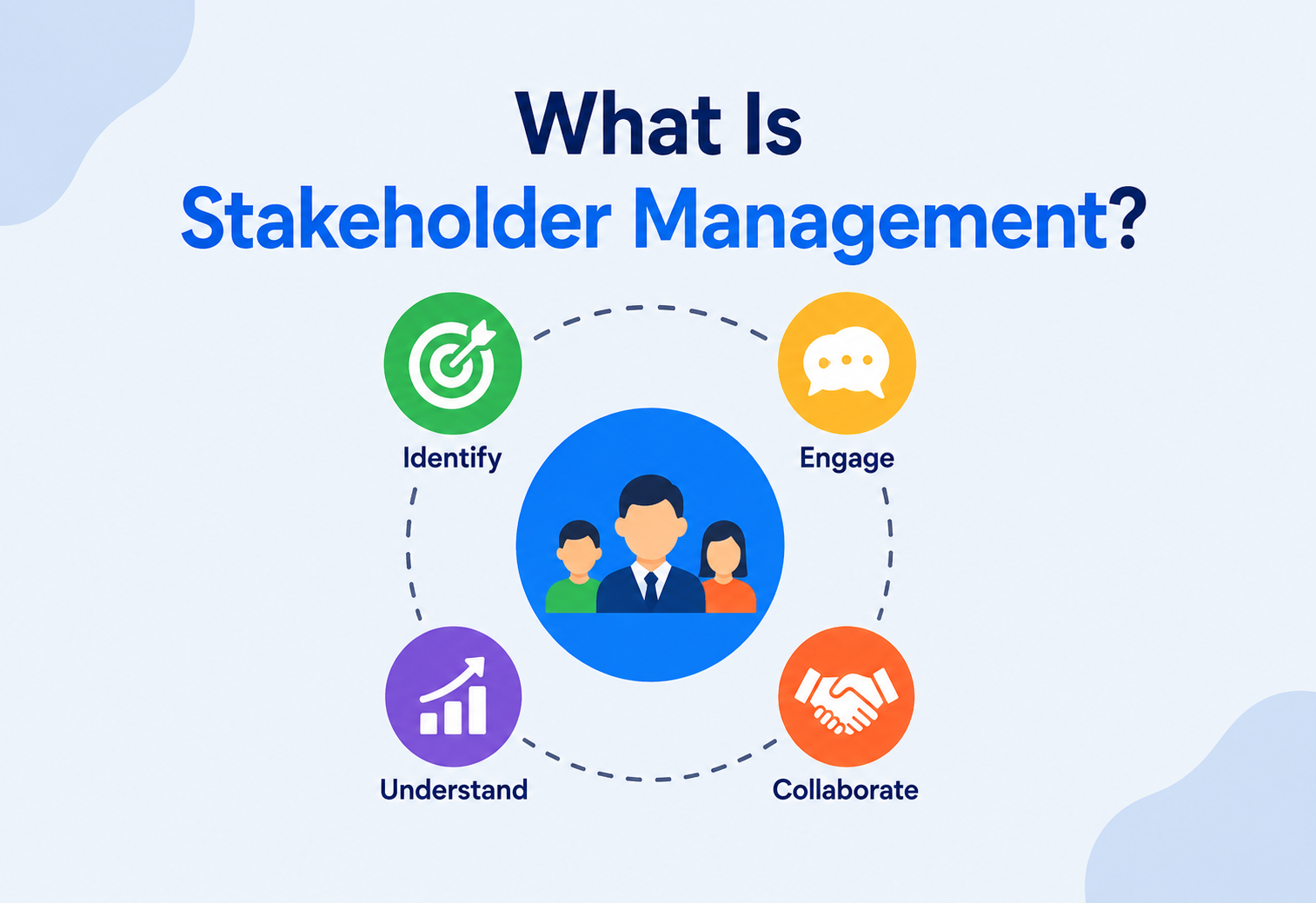
What Is Stakeholder Management?
A complete, zero-to-production guide for software architects and engineers — what it means to manage stakeholders, why it matters as much as your code, and how to do it well on real projects.
Introduction & History
Imagine you are building a new house. You are the engineer. But the house is not just for you. The family that will live in it cares about the layout. The city inspector cares about the wiring and safety codes. The bank that is lending money cares about the cost. The neighbours care about how tall the fence is. Every one of these people has a stake — something to gain or lose — in how the house turns out. If you ignore any of them, the house might get built perfectly on paper and still fail in real life: the bank refuses the final payment, the inspector shuts down the site, or the family hates the kitchen. Stakeholder management is the discipline of identifying all these people, understanding what they care about, and working with them on purpose instead of by accident.
In software, the “house” is the system you are designing: an API, a platform, a migration, a new microservice. The people around it are just as varied — product managers, end users, the security team, the finance team, other engineering squads whose systems talk to yours, and sometimes regulators. Stakeholder management is what turns a technically correct system into a system that actually gets adopted, funded, and kept alive.
1.1 Where the Idea Came From
The word “stakeholder” itself has business roots. It was popularised in a 1963 internal memo at the Stanford Research Institute, where researchers defined stakeholders as any group without whose support an organisation would cease to exist — originally contrasted with “stockholders,” who only care about profit. The idea was simple but radical for its time: a company does not only answer to its owners. It answers to employees, customers, suppliers, and the community around it too.
The concept was formalised further in 1984 by management professor R. Edward Freeman in his book Strategic Management: A Stakeholder Approach. Freeman argued that any group that can affect, or is affected by, an organisation’s goals deserves a seat at the table when decisions are made. This idea slowly spread from corporate strategy into project management, and from project management into software engineering, where the Project Management Institute (PMI) eventually made “stakeholder management” one of its ten official knowledge areas in the PMBOK Guide.
Today, in agile software teams, stakeholder management is not a separate ceremony bolted onto the sprint — it lives inside sprint reviews, architecture decision records, RFCs, roadmap discussions, and even pull request reviews. Whenever an engineer asks “who needs to sign off on this?” or “who will this break for?”, they are practising stakeholder management, whether they call it that or not.
1963 — Stanford Research Institute
Internal memo coins “stakeholder” as any group without whose support the organisation would cease to exist — contrasted with narrower “stockholders.”
1984 — Freeman’s Book
R. Edward Freeman formalises the stakeholder approach in Strategic Management, giving academic weight to the idea.
1990s — PMI Adoption
The Project Management Institute integrates stakeholder management as a formal knowledge area in the PMBOK Guide.
2000s — Agile Absorption
Sprint reviews, RFCs, and design docs turn stakeholder engagement into a continuous, embedded activity.
2010s — Platform & Cloud Era
Internal platform teams treat consuming teams as first-class stakeholders with roadmaps, changelogs, and office hours.
Today
Stakeholder management is treated as a core engineering discipline, on par with system design and code review.
The Problem & Motivation
Why does this discipline exist at all? Because technically excellent software fails all the time — not because the code was wrong, but because the people around the code were not managed well. Consider a few common software project failure stories, all of which repeat across companies every year:
- An engineering team spends six months building a beautiful new internal search API, only to discover at launch that the main consuming team quietly built their own solution because nobody asked them what they actually needed.
- A migration to a new database is technically flawless, but the on-call support team was never told about the new failure modes, so the first incident takes four hours longer to resolve than it should.
- An architect proposes a new event-driven architecture that is objectively better, but leadership rejects it because the cost and timeline were never explained in terms the finance stakeholders could evaluate.
In every case, the code worked. The relationships did not. Stakeholder management exists to close this gap — to make sure that the people who can help you, block you, fund you, or be affected by you are identified early, kept informed, and given a real chance to shape the outcome before it is too late to change course cheaply.
A single developer working alone has almost no stakeholder management to do. But the moment a system has more than one team touching it — which is true of almost every production system — stakeholder management becomes as important as the architecture itself. The bigger the blast radius of your decisions, the more people have a legitimate stake in them.
There is also a deeper motivation rooted in how decisions actually get made in organisations. Very few important technical decisions are made purely on technical merit. They are made through a mixture of technical merit, trust, timing, and political capital. Stakeholder management is not about “playing politics” in a negative sense — it is about making sure that good ideas do not die simply because nobody built the relationships needed to carry them forward.
2.1 The Hidden Cost of Skipping It
Engineers sometimes see stakeholder management as overhead that competes with “real work.” But every skipped conversation does not disappear — it simply moves later in the timeline, where it becomes more expensive. A concern raised during design review costs an hour of discussion. The same concern, discovered after launch, can cost days of rework, an emergency rollback, and a much harder conversation about why it was not caught earlier. In this sense, stakeholder management functions like writing tests: it feels like it slows you down in the moment, while it is actually moving cost from an expensive, unpredictable place — production — to a cheap, predictable place — the design phase.
Core Concepts
Before going deeper, let us build a shared vocabulary. These are the foundational ideas that every other part of stakeholder management builds on.
3.1 What Exactly Is a “Stakeholder”?
A stakeholder is any person, group, or organisation that can affect, or be affected by, a project, decision, or system. This definition has two halves, and both matter:
- Can affect it — they have power to help, fund, approve, block, or delay the work. Example: a VP of Engineering who must sign off on budget.
- Can be affected by it — the outcome changes their work, their risk, or their experience, even if they have no formal power over it. Example: the support engineers who will field customer tickets after your change ships.
3.2 Internal vs. External Stakeholders
| Type | Definition | Software example |
|---|---|---|
| Internal | Inside your own organisation | Product managers, other engineering squads, QA, DevOps, leadership, finance |
| External | Outside your organisation | End customers, regulators, third-party API vendors, open-source contributors, auditors |
3.3 Primary vs. Secondary Stakeholders
Primary stakeholders are directly and significantly impacted — the end users of your product, the team that owns the system your change depends on. Secondary stakeholders are indirectly impacted or only mildly impacted — a marketing team that will eventually need to update screenshots, or a partner company whose integration might notice a minor latency change.
3.4 Key Vocabulary You Will Hear Constantly
| Term | Meaning |
|---|---|
| Sponsor | The senior stakeholder who champions and funds the initiative |
| Champion | An influential stakeholder who actively advocates for your work, even without formal authority |
| Blocker | A stakeholder whose objection can legally or practically stop the work |
| SME (Subject Matter Expert) | A stakeholder consulted for domain knowledge, not decision power |
| RACI | A model describing who is Responsible, Accountable, Consulted, and Informed for a decision |
| Engagement | The ongoing activity of communicating with and involving a stakeholder |
3.5 Positive, Negative, and Neutral Stakeholders
Stakeholders are not just categorised by power and interest — their attitude toward your work matters just as much. A positive stakeholder wants your project to succeed and will actively help remove obstacles. A neutral stakeholder does not oppose you but will not go out of their way to help either; they simply want to be kept aware. A negative stakeholder — sometimes called a resistor — believes the project works against their interests, perhaps because it threatens their budget, their team’s relevance, or a system they already built. Identifying attitude early lets you plan differently: positive stakeholders can be turned into champions who advocate on your behalf in rooms you are not in, while negative stakeholders need to be understood and, where possible, addressed directly rather than avoided, because an unaddressed resistor rarely stays quiet forever.
3.6 Active vs. Passive Stakeholders
An active stakeholder participates — they show up to reviews, leave comments, ask questions. A passive stakeholder has a real stake but does not engage unless prompted, often because they are busy, unaware, or assume someone else is representing their interests. Passive stakeholders are dangerous precisely because their silence can be mistaken for agreement. A common technique is to explicitly ask passive but important stakeholders a direct, closed question (“Does this change your on-call runbook — yes or no?”) rather than an open one, since open questions to a passive stakeholder often get no reply at all.
3.7 Direct vs. Indirect Stakeholders
A direct stakeholder interacts with your system or decision immediately — the team calling your API, the customer clicking your button. An indirect stakeholder is one step removed but still affected — the customer support team who will handle complaints if your button behaves oddly, or the finance team whose cloud cost forecast depends on how efficiently your service runs. Indirect stakeholders are the ones most often forgotten during identification, precisely because they are not in the room and not in the code path.
When identifying stakeholders for a new piece of work, it helps to run through a fixed checklist rather than relying on memory alone: Who builds it? Who approves the budget? Who depends on its output? Who does it depend on? Who supports it once it is live? Who audits or regulates it? Who will notice if it changes behaviour even slightly? Answering each question, even briefly, surfaces people that a casual brainstorm usually misses.
3.8 Stakeholders vs. Users vs. Customers
Beginners often use “stakeholder,” “user,” and “customer” interchangeably, but each term describes a different relationship to the system, and mixing them up leads to gaps in your register. A user is anyone who directly interacts with the system, regardless of whether they pay for it — an internal engineer calling your API is a user of that API. A customer is specifically the person or organisation that pays, who may not personally use the system at all — a company’s procurement lead who buys enterprise software their employees will actually operate is a customer but rarely a user. A stakeholder is the broadest of the three categories, encompassing both of the above plus everyone else who can affect or be affected by the system without ever touching it directly, such as a legal team reviewing your terms of service. Every user and every customer is a stakeholder, but the reverse is not true.
Frameworks & Components
Just like a software system has components that work together, stakeholder management has a small set of proven frameworks. Together they form the toolkit almost every architect and project lead reaches for.
4.1 The Power / Interest Grid
This is the single most widely used stakeholder framework. You place every stakeholder on a 2×2 grid based on two questions: how much power do they have to influence the outcome, and how much interest do they have in it?
The four quadrants give you a concrete action plan:
| Quadrant | Strategy |
|---|---|
| High power, high interest | Manage closely — involve in decisions, meet regularly, get explicit sign-off |
| High power, low interest | Keep satisfied — give concise summaries, do not overload with detail |
| Low power, high interest | Keep informed — regular updates, invite feedback, they can become champions |
| Low power, low interest | Monitor — minimal effort, watch in case their position changes |
4.2 The Salience Model
A more nuanced model, proposed by Mitchell, Agle, and Wood in 1997, scores stakeholders on three attributes: power (ability to influence), legitimacy (is their claim appropriate and recognised), and urgency (how time-sensitive is their claim). A stakeholder with all three is called “definitive” and demands your fullest attention — for example, a regulator who has legal authority (power), a recognised legal mandate (legitimacy), and a compliance deadline next week (urgency).
4.3 RACI Matrix
Where the power/interest grid tells you how much attention to give someone, RACI tells you what role they play in a specific decision or deliverable.
| Letter | Meaning | Example |
|---|---|---|
| R — Responsible | Does the actual work | The engineer implementing the change |
| A — Accountable | Owns the outcome, has final sign-off (only one person per decision) | The tech lead or architect |
| C — Consulted | Gives input before the decision is made | Security team, SME |
| I — Informed | Told after the decision is made | Adjacent teams, leadership summary |
4.4 The Stakeholder Register
This is the actual artifact — usually a spreadsheet or a table in a project wiki — that stores everyone identified, their grid position, their RACI role, their communication preference, and notes. It is the “database” that all the other frameworks read from and write to.
The stakeholder register is your source of truth. The power/interest grid and salience model are the “algorithms” you run over that data to decide priority. RACI is applied per-decision, on top of the register, to clarify roles for a specific piece of work.
4.5 A Worked Example, Start to Finish
Suppose you are the architect proposing a migration from a single shared relational database to a database-per-service model for a microservices platform. Applying the architecture above might look like this:
- Register: You list fifteen names — team leads, the DBA team, the platform SRE team, the CFO’s delegate who tracks cloud spend, and three consuming teams.
- Power/interest grid: The DBA team and platform SRE land in “manage closely” — they have deep technical power and a huge interest since their daily work changes completely. The CFO’s delegate lands in “keep satisfied” — high power over budget approval, but low day-to-day interest in the technical details.
- Salience model: During a compliance audit window, the security and compliance stakeholder temporarily becomes “definitive” — power, legitimacy, and urgency all spike together — even though under normal circumstances they might sit in “keep informed.”
- RACI per decision: For the specific decision of “which database engine to use per service,” the platform architect is Accountable, the owning team’s senior engineer is Responsible, the DBA team and security team are Consulted, and everyone else on the register is Informed once the choice is finalised.
This worked example shows why the frameworks are complementary rather than competing: the register answers “who,” the grid answers “how much attention,” the salience model answers “does that change under pressure,” and RACI answers “what is their exact role in this one decision.”
How It Works Internally: The Process
Stakeholder management is usually described as a repeating cycle. This is the “internal working” — the actual mechanics that a project lead or architect executes, often without even writing the words “stakeholder management” anywhere.
5.1 Step 1 — Identify
List everyone who might have a stake. Good techniques include: reading the org chart for teams your system touches, checking who owns upstream and downstream dependencies, asking “who approved similar changes before,” and asking existing stakeholders “who else should be in this conversation?” (a technique sometimes called snowball identification).
5.2 Step 2 — Analyze
For each stakeholder, assess power, interest, legitimacy, urgency, and their likely attitude (supporter, neutral, or resistor). Place them on the power/interest grid. This step converts a flat list into a prioritised map.
5.3 Step 3 — Plan Engagement
Decide, for each stakeholder or group, what they need: how often, through what channel (Slack, email, a design doc, a live meeting), and at what level of detail. A VP does not want the same 40-slide deck a fellow engineer wants.
5.4 Step 4 — Engage & Communicate
Actually execute the plan: send the RFC, run the design review, post the update. This step is where trust is built or lost, because it is where promises made in the plan either happen or do not.
5.5 Step 5 — Monitor & Reassess
Stakeholder positions are not fixed. A stakeholder with low interest today can become high-interest overnight — for example, the moment your change causes an incident, the on-call team’s interest jumps from low to maximum instantly. Good stakeholder management treats the register as a living document, not a one-time exercise done at kickoff and forgotten.
5.6 Techniques Used At Each Step
Each of the five steps has a small toolbox of concrete techniques that experienced architects reach for. Knowing these by name helps you recognise when you are missing one:
| Step | Common techniques |
|---|---|
| Identify | Org chart review, dependency graph review, snowball sampling (“who else should be here?”), reviewing tickets/incidents from past similar work |
| Analyze | Power/interest grid, salience scoring, attitude assessment (supporter/neutral/resistor), influence mapping between stakeholders themselves |
| Plan | Communication matrix (who, what, how often, through which channel), escalation path definition, RACI assignment |
| Engage | RFC documents, design review meetings, async comment threads, demo recordings, office hours |
| Monitor | Sentiment tracking in review comments, response-time tracking, periodic re-scoring of the register, retrospectives |
It is worth noting that this cycle is intentionally similar to the classic PDCA (Plan-Do-Check-Act) loop used in quality management, and to the observe-orient-decide-act (OODA) loop used in fast-changing environments. The underlying idea in all of these models is the same: you cannot get engagement right in one pass. You gather information, act on it, observe the results, and adjust — repeatedly, for the life of the project.
Many engineers jump straight to sending updates (Engage) without doing Identify and Analyse first. The result is updates that go to the wrong people, at the wrong depth, on the wrong cadence — technically “communication,” but not actually stakeholder management, because it was never targeted using an understanding of who those people are and what they need.
Data Flow & Lifecycle Across a Project
Stakeholder engagement is not constant — it has a natural rhythm that rises and falls with the project’s phases. Understanding this rhythm helps you know when to invest more effort and when to pull back.
Notice that the register is updated at almost every step — it behaves much like a small database that the whole engagement process reads from and writes to. Early in a project, engagement is broad and shallow (many people informed once). As the project matures into design, engagement narrows and deepens (fewer people, deeper technical review). At launch, it broadens again (many people need to know it is live). After launch, engagement tapers off unless an incident or a follow-up project re-activates it.
6.1 The Engagement Curve Across a Project’s Life
If you were to plot “number of stakeholders actively engaged” against “time,” most healthy projects trace a shape like a wide W rather than a single smooth curve. There is a first peak at kickoff, when everyone who might care is quickly surveyed. Engagement then narrows sharply during detailed design, when only the deeply technical stakeholders are needed for day-to-day decisions. It rises again just before launch, as operational and support stakeholders need to be briefed. It dips after launch as the system stabilises. And it can spike unexpectedly at any point afterward if an incident, audit, or major new dependency reactivates interest in a group that had gone quiet.
Recognising this shape in advance helps you budget your own time and calendar realistically. A common scheduling mistake is assuming the heavy stakeholder load from kickoff will continue at the same intensity throughout — leading either to over-booked calendars during the quiet design phase, or under-preparedness for the second wave of engagement that launch always brings.
6.2 State Transitions in the Stakeholder Register
Much like a workflow engine, individual stakeholder entries move through recognisable states over the life of a project: identified → analyzed → engaged → satisfied / resistant → closed. A stakeholder can also move backward — a “satisfied” stakeholder can become “resistant” again if a later change surprises them, which is exactly why the monitor step in the previous section exists as a permanent loop rather than a final step.
Advantages, Disadvantages & Trade-offs
Stakeholder management pays for itself many times over — but only if you are honest about the costs it introduces along the way.
Advantages
- Fewer late-stage surprises and rejections.
- Higher adoption because people feel heard.
- Early warning of political or budget risk.
- Builds durable trust and future goodwill.
- Surfaces requirements you would have missed.
Disadvantages / Costs
- Takes real time away from “heads-down” building.
- Can slow decisions if over-consulted (“design by committee”).
- Requires soft skills that are not taught in most engineering curricula.
- Poorly done, it can feel like performative meetings with no real influence.
- Stakeholder priorities can conflict, forcing hard trade-off calls.
The central trade-off is breadth of involvement versus speed of delivery. Involve too few people, and you risk building the wrong thing or triggering resistance you could have avoided. Involve too many people too deeply, and decisions crawl to a halt. Experienced architects calibrate this using exactly the power/interest grid from Section 4 — deep involvement only for the “manage closely” quadrant, lighter touch for everyone else.
7.1 Trade-off: Transparency vs. Focus
Sharing more information with stakeholders generally builds trust, but past a certain point it also creates noise that makes the truly important signals harder to find. A design doc that includes every alternative ever considered, in full detail, protects the author from being accused of hiding options — but it also makes it harder for a busy stakeholder to find the one paragraph that matters to them. The trade-off is usually resolved with structure: a short executive summary at the top, full detail further down, so each stakeholder can self-select their depth.

7.2 Trade-off: Consensus vs. Decisiveness
Seeking full consensus from every stakeholder feels fair, but it can quietly hand veto power to the most risk-averse person in the room, since a project cannot move until literally everyone agrees. Most mature organisations instead adopt a “disagree and commit” norm: stakeholders are genuinely consulted, their concerns are documented and considered, but the accountable owner makes the final call and the group moves forward together, even those who preferred a different option.
Performance & Scalability
Just as a system that handles ten users needs a different architecture than one handling ten million, stakeholder management for a two-person feature is very different from stakeholder management for a company-wide platform migration.
One team
A quick Slack message or standup mention is often enough. The register can live in your head.
Multiple teams, one org
You need a written register, a regular sync cadence (e.g. biweekly design reviews), and a lightweight RFC process.
Cross-org / external
You need a formal governance structure — steering committee, published roadmaps, tiered communication, and often a dedicated program manager.
A common scaling technique borrowed directly from software design is batching and fan-out: instead of communicating with every stakeholder individually (an O(n) cost that grows unmanageable), architects “fan out” a single well-written update through shared channels — an internal blog post, a recorded demo, a wiki page — and reserve one-on-one time only for the small number of stakeholders in the “manage closely” quadrant. This mirrors how a publish-subscribe system avoids the cost of point-to-point messaging at scale.
Maintain a tiered update cadence: weekly async updates for close stakeholders, monthly summaries for interested-but-lower-power groups, and milestone-only announcements for everyone else. This is the stakeholder-management equivalent of caching — you avoid recomputing (re-explaining) the same information for every audience at full cost.
8.1 Horizontal Scaling: Delegating Engagement
A single architect cannot personally maintain deep relationships with fifty stakeholders across ten teams — the same way a single database instance cannot serve unlimited traffic. Large organisations solve this the same way distributed systems do: they partition the work. Each sub-team gets its own local point of contact who maintains close engagement within their slice, while a smaller steering group handles cross-cutting, organisation-wide concerns. This is directly analogous to sharding — instead of one node handling all traffic, load is partitioned by a sensible key, in this case by team or domain, with a lightweight coordination layer on top.
8.2 Vertical Scaling: Increasing Bandwidth Per Relationship
The other lever is deepening the tools used per relationship rather than adding more people. Recording a design walkthrough once instead of repeating it live five times, maintaining a well-organised FAQ document that answers the ten questions every new stakeholder asks, or setting up self-serve dashboards that let stakeholders check status without asking you directly — these all increase the “throughput” of a single architect’s engagement capacity, much like optimising a single database query instead of adding more database replicas.
Reliability & Trust
In distributed systems, reliability means the system keeps working correctly even when parts of it fail. In stakeholder management, “reliability” is trust — the confidence stakeholders have that you will do what you said you would do, communicate problems honestly, and not surprise them.
Trust behaves a lot like an SLA (service level agreement). It is built slowly, through many small kept promises, and it can be destroyed instantly by one broken one — the equivalent of a single major outage erasing months of uptime credibility. Some concrete reliability practices:
- Redundant communication channels: Do not rely on a single Slack message. Important decisions should also live in a durable document, so no stakeholder is “out of the loop” because they missed one message — this is the human equivalent of replication.
- Predictable cadence: A stakeholder who knows they will get an update every Friday does not need to chase you — this reduces “polling” load on you, similar to how a webhook is more efficient than constant polling.
- Graceful escalation: When something goes wrong, tell stakeholders proactively and early, with a clear plan, rather than letting them discover it independently. This is your “circuit breaker” — it contains damage before it cascades into lost trust.
9.1 Recovery: Rebuilding Trust After a Failure
Even well-managed relationships occasionally suffer a real failure — a missed deadline, an unannounced breaking change, a decision made without proper consultation. What separates teams that recover quickly from teams that carry the damage for years is not whether the failure happened, but how it was handled afterward. The reliable pattern looks like a well-run incident postmortem: acknowledge what happened plainly, without minimising it; explain the root cause honestly, including your own part in it; and commit to a specific, checkable change in process, not just a vague promise to “communicate better.” Stakeholders forgive mistakes far more readily than they forgive a repeated pattern of the same mistake with no visible change afterward.
9.2 Single Points of Failure in Stakeholder Relationships
It is also worth explicitly naming a reliability risk that is easy to overlook: relying on exactly one person as your only channel to an entire stakeholder group. If that one relationship sours, or that person leaves the company, your entire engagement with that group can collapse overnight — a classic single point of failure. Mature architects deliberately build at least a light relationship with more than one person per important stakeholder group, the same way a resilient system avoids a single database instance with no replica.
Security & Confidentiality
Not all stakeholder information should be shared with everyone. Some engagement involves sensitive details — layoffs tied to a system decision, unresolved vendor contract issues, security vulnerabilities under active remediation, or competitive product plans. This is where the discipline borrows the security principle of least privilege: share the minimum information each stakeholder genuinely needs, at the right time, through an appropriate channel.
- Need-to-know basis: A vulnerability under active fix should be discussed only with the security team and direct responders until it is resolved, not broadcast broadly.
- Data classification: Treat stakeholder communications like data — public roadmap items can go in an all-hands doc; unreleased financial or legal detail belongs in a restricted channel.
- Chain of custody for sensitive updates: When bad news must travel (e.g., a delayed launch affecting a customer contract), it should flow through the accountable stakeholder first, not leak sideways through informal channels.
- External stakeholder boundaries: Information appropriate for internal stakeholders — like raw incident details or unfinished cost estimates — is often not appropriate to share externally with customers, partners, or regulators until it has been reviewed and framed correctly, the same way an internal API might expose more detail than a public-facing one.
10.1 Auditability
In regulated industries, stakeholder engagement itself sometimes needs to be auditable — proof that the right people were consulted, at the right time, before a decision was made. This is why formal stakeholder registers, RFCs, and meeting notes are not just good practice but occasionally a compliance requirement, functioning like an audit log for a system: a durable, timestamped record of who knew what, and when, that can be inspected after the fact if something is later challenged.
Monitoring, Metrics & Feedback
You cannot manage what you do not measure, even in a “soft skill” discipline like this one. Experienced architects track a small set of signals to know whether stakeholder engagement is actually working:
| Metric | What it tells you |
|---|---|
| Response latency | How long stakeholders take to respond to requests — rising latency often signals disengagement or competing priorities |
| Sentiment in reviews | Are comments on design docs constructive or resistant? A rising ratio of blocking objections is an early warning sign |
| Escalation count | How often issues had to be pushed up the chain because they could not be resolved directly — high counts suggest weak working relationships |
| Attendance / engagement rate | Are the “manage closely” stakeholders actually showing up to reviews? |
| Post-launch surprises | The ultimate lagging indicator — if stakeholders are surprised at launch, the engagement process failed earlier, even if the metrics looked fine at the time |
Just as good software teams use dashboards and alerting rather than waiting for a full outage, good architects keep a lightweight, living view of stakeholder health rather than waiting for a launch-day blow-up to discover a relationship problem.
11.1 Leading vs. Lagging Indicators
Response latency and sentiment are leading indicators — they warn you something is going wrong while there is still time to fix it. Post-launch surprises and escalation counts are lagging indicators — they confirm, after the fact, that something already went wrong. A common mistake is tracking only lagging indicators, which is like a monitoring system that only alerts you after the outage is already over. Healthy stakeholder management, like healthy system observability, weights leading indicators more heavily, because they are the ones that still give you a chance to intervene.
11.2 A Simple Engagement Health Scorecard
| Signal | Green | Yellow | Red |
|---|---|---|---|
| Response time to requests | Under 2 business days | 3–5 business days | Over a week or no response |
| Review comment sentiment | Mostly constructive / clarifying | Mixed, some pushback | Repeated blocking objections |
| Meeting attendance | Key stakeholders consistently present | Occasional delegate attends instead | Repeated no-shows from “manage closely” group |
A scorecard like this, reviewed briefly at each project checkpoint, turns a vague feeling of “this stakeholder seems unhappy” into a concrete, trackable signal that can be acted on early.
Tooling and a Practical Java Example
In real organisations, stakeholder registers usually live in tools like Confluence, Jira, Airtable, or a shared spreadsheet. But because the underlying model is simple — a list of people scored on a few dimensions — it is easy, and instructive, to model it in code. Below is a small Java program that represents a stakeholder register and automatically classifies each stakeholder into a power/interest quadrant, exactly as described in Section 4.
import java.util.*;

public class StakeholderRegistry {

    enum Quadrant {
        MANAGE_CLOSELY, KEEP_SATISFIED, KEEP_INFORMED, MONITOR
    }

    record Stakeholder(String name, String role, double power, double interest) {
        Quadrant quadrant() {
            boolean highPower = power >= 0.5;
            boolean highInterest = interest >= 0.5;
            if (highPower && highInterest) return Quadrant.MANAGE_CLOSELY;
            if (highPower && !highInterest) return Quadrant.KEEP_SATISFIED;
            if (!highPower && highInterest) return Quadrant.KEEP_INFORMED;
            return Quadrant.MONITOR;
        }
    }

    public static void main(String[] args) {
        List<Stakeholder> stakeholders = List.of(
            new Stakeholder("VP Engineering", "Sponsor", 0.85, 0.35),
            new Stakeholder("Security Team", "Reviewer", 0.80, 0.55),
            new Stakeholder("Identity Team", "Dependency owner", 0.75, 0.85),
            new Stakeholder("Mobile App Team", "Consumer", 0.55, 0.80),
            new Stakeholder("Support Engineers", "Downstream", 0.30, 0.70),
            new Stakeholder("Marketing", "Peripheral", 0.20, 0.15)
        );

        Map<Quadrant, List<String>> grouped = new EnumMap<>(Quadrant.class);
        for (Quadrant q : Quadrant.values()) grouped.put(q, new ArrayList<>());

        for (Stakeholder s : stakeholders) {
            grouped.get(s.quadrant()).add(s.name() + " (" + s.role() + ")");
        }

        grouped.forEach((quadrant, names) -> {
            System.out.println(quadrant + ":");
            names.forEach(n -> System.out.println("  - " + n));
        });
    }
}
Running this program instantly answers the question every architect asks at the start of a project: who needs deep, hands-on engagement, and who can I keep satisfied with a lighter touch? In a real production tool, this same model would be backed by a database table, exposed through a small internal API, and refreshed automatically as project signals (like review comments or meeting attendance) update each stakeholder’s interest score over time.
Companies that manage stakeholder engagement at real scale (large platform teams, PMOs) often build exactly this kind of internal tool on top of their identity / org-chart data, auto-populating power scores from org hierarchy and interest scores from engagement signals like Slack activity or doc comments — turning a manual spreadsheet into a lightweight internal service.
12.1 Extending It: a Simple Escalation Reminder
The monitoring signals discussed in Section 11 — like response latency — can be encoded directly on top of the same model. Below is a small extension that flags any “manage closely” stakeholder who has gone quiet for too long, so an architect gets a nudge before silence turns into a surprise later.
import java.time.LocalDate;
import java.time.temporal.ChronoUnit;
import java.util.*;

public class EngagementMonitor {

    record Interaction(String stakeholderName, LocalDate lastContact, boolean manageClosely) {}

    static final int STALE_THRESHOLD_DAYS = 10;

    public static void main(String[] args) {
        List<Interaction> interactions = List.of(
            new Interaction("Identity Team", LocalDate.now().minusDays(3), true),
            new Interaction("Security Team", LocalDate.now().minusDays(14), true),
            new Interaction("Marketing", LocalDate.now().minusDays(40), false)
        );

        LocalDate today = LocalDate.now();
        for (Interaction i : interactions) {
            long daysSince = ChronoUnit.DAYS.between(i.lastContact(), today);
            if (i.manageClosely() && daysSince > STALE_THRESHOLD_DAYS) {
                System.out.printf(
                    "[!]  %s is in 'Manage Closely' but has been silent for %d days. Reach out today.%n",
                    i.stakeholderName(), daysSince
                );
            }
        }
    }
}
This tiny program embodies the core idea of the whole monitoring discipline: it does not try to predict the future, it simply makes an easily-missed leading indicator — silence from an important stakeholder — impossible to ignore. In a real internal tool, this check would run automatically, perhaps daily, and post a reminder into the architect’s own task list rather than requiring them to remember to check manually.
Design Patterns & Anti-Patterns
A short, opinionated list of the shapes that recur in every well-managed engagement, and the ones that quietly break in every troubled one.
13.1 Patterns (Things That Work)
The RFC Pattern
Write a short “Request for Comments” document before building. It gives stakeholders a durable, async way to weigh in, and creates a paper trail of what was decided and why.
Single Accountable Owner
Borrowed directly from RACI — always have exactly one accountable person per decision, to avoid the “everyone and no one is responsible” trap.
Pre-Wiring
Talking to key stakeholders one-on-one before a big group meeting, so no one is blindsided in public and objections surface early, in private, where they are cheaper to resolve.
Tiered Communication
Different depth of detail for different audiences, from executive summary to engineering deep-dive.
The Champion Pattern
Deliberately invest extra time in one or two influential, positive stakeholders early, so they can advocate for the work inside rooms and conversations you are not part of.
The Feedback Loop
Close the loop explicitly after incorporating (or rejecting) a stakeholder’s feedback — tell them what changed and why, or why it did not. Silence after feedback disengages people fast.
13.2 Anti-Patterns (Things That Fail)
Anti-Patterns to Avoid
- The silent build — building in isolation and only revealing the finished system at the end. This almost always triggers late, expensive rework.
- Stakeholder spam — cc’ing everyone on everything “just in case.” This trains people to ignore your updates, the same way alert fatigue trains engineers to ignore monitoring alerts.
- Consensus paralysis — trying to get unanimous agreement from every stakeholder before moving. Most frameworks only require the accountable owner’s sign-off after genuine consultation.
- Assuming power is static — treating the power/interest grid as a one-time exercise. An out-of-date register is worse than none, because it creates false confidence.
- Feedback theatre — asking for input in a review meeting but never actually incorporating any of it. Stakeholders notice this pattern quickly and disengage.
- Single-channel dependency — relying entirely on one Slack channel with no durable written record, directly contradicting the redundancy principle from Section 9.
Corresponding Fixes
- Publish an early RFC so stakeholders can weigh in long before the code is written.
- Segment your audiences and tune depth per group, so nobody gets updates they cannot use.
- Adopt a “disagree and commit” norm; a single accountable owner has the final say after real consultation.
- Re-run the power/interest analysis at every major milestone and after any reorg or incident.
- When you accept or reject a piece of feedback, tell the person — explicitly — what changed and why.
- Back every important channel with a durable, searchable written artifact (doc, wiki, ADR).
Best Practices & Common Mistakes
If a project retrospective turns up any of the mistakes listed here, treat them as real risks waiting to surface on the next launch, not just cosmetic feedback.
14.1 Best Practices
- Identify stakeholders before you write a single line of design, not after.
- Write things down. Verbal alignment evaporates; a shared document persists.
- Match communication depth to the stakeholder’s quadrant, not to your own convenience.
- Re-run the analysis at every major milestone, not just at kickoff.
- Bring bad news early and with a plan attached, never late and empty-handed.
- Give stakeholders a genuine chance to change the design, not just a chance to hear about it.
- Separate the person from the position — a stakeholder pushing back hard on your design is usually protecting a legitimate concern, not attacking you personally; treat the objection as data, not conflict.
- Keep the register visible to more than just yourself, so engagement does not silently collapse if you go on leave or change roles.
14.2 Common Mistakes
- Confusing “informed” with “engaged” — telling someone about a decision is not the same as consulting them before it is made.
- Treating stakeholder management as a one-time kickoff activity instead of a continuous loop.
- Focusing only on stakeholders with formal authority and ignoring high-interest, low-power groups who can still generate friction or become powerful allies.
- Over-promising in the engagement plan and then under-delivering, which damages trust faster than never promising at all.
- Waiting for a formal meeting to raise a concern that should have been flagged the moment it was noticed, letting a small issue grow simply because “it wasn’t the right forum yet.”
- Speaking only in your own technical vocabulary with non-technical stakeholders, which quietly excludes them from meaningfully participating even when they are physically present in the room.
Real-World / Industry Examples
Abstract advice gets much sharper once you see how the biggest engineering organisations translate these principles into practice.
Amazon
Famous for its “working backwards” process, where teams write a mock press release and FAQ before building. Cross-functional stakeholders — legal, PR, operations, finance — review it long before any code is written, directly targeting the “silent build” anti-pattern by making early, broad review structurally mandatory.
Netflix
Runs a strong internal culture of written memos and “context, not control” — leaders push detailed context out broadly so engineers can make aligned decisions without needing sign-off from every interested party for every micro-decision.
Uses formal design review committees for significant infrastructure changes, where a design document is circulated to identified stakeholder groups (security, SRE, privacy) for structured sign-off — a large-scale, formalised version of the RFC pattern from Section 13.
Uber
During rapid international expansion, had to build explicit stakeholder engagement processes with city regulators as a first-class part of shipping a new market. Cities engaged early became long-term partners; cities where engagement was skipped sometimes ended up suspending or banning the service — a vivid illustration of what happens when high-power external stakeholders are treated as an afterthought.
Internal platform teams at large enterprises — the kind of Integration Squad context many architects work in — face a milder but constant version of the same challenge: every new shared service, from a message bus to an API gateway, has dozens of consuming teams as stakeholders. Mature platform teams typically publish a public roadmap, run a regular open office hour, and maintain a changelog with advance deprecation notices — a lightweight, everyday version of the same principles seen at Amazon, Netflix, Google, and Uber, scaled down to the size of a single organisation.
Frequently Asked Questions
A few of the questions that come up most often the first time an engineer or product lead thinks seriously about stakeholder management as a discipline.
No. Project management covers scope, schedule, and budget as a whole; stakeholder management is one specific knowledge area within it, focused purely on the people and relationships around the project.
Any engineer who designs something other people depend on is doing stakeholder management, whether they use the term or not — writing a design doc, asking for review, or announcing a breaking change are all stakeholder management activities.
Every customer is a stakeholder, but not every stakeholder is a customer. Stakeholders also include internal teams, regulators, and dependency owners who never use the product directly but are still affected by or able to affect it.
Surface the conflict explicitly rather than trying to please both quietly. Bring both perspectives to the accountable decision-maker with the trade-offs clearly laid out, and let the RACI-defined owner make the call.
At minimum, at every major project milestone (kickoff, design approval, pre-launch, post-launch) and immediately after any event — like an incident or reorg — that could change someone’s power or interest.
Common choices include Confluence or Notion for the register and RFC documents, Jira for tracking related action items, and Slack or email for day-to-day engagement. Larger organisations sometimes build lightweight internal tools like the Java example in Section 12, often integrated with the org chart so power scores can be partially automated.
Yes. It is common for a team member — for example, a senior engineer on a dependent team — to also be a stakeholder in the RACI sense, consulted or informed about a decision even though they are not directly building the feature themselves.
Bring data, not just opinion, and frame the disagreement around shared goals rather than “I’m right, you’re wrong.” If the accountable owner ultimately disagrees with the stakeholder, the decision should still be documented with the stakeholder’s concern recorded, so the reasoning is transparent even to someone who was not persuaded.

Summary & Key Takeaways
Stakeholder management is less a checklist and more a habit — the habit of asking, at every design decision, “who has a stake in this, and how am I engaging them on purpose?”
Key Takeaways
- A stakeholder is anyone who can affect, or be affected by, your work — not just the people paying for it.
- The power/interest grid, the salience model, and RACI are the core frameworks used to prioritise and assign roles to stakeholders.
- Stakeholder management is a continuous loop — identify, analyse, plan, engage, monitor — not a one-time kickoff task.
- Trust behaves like an SLA: built slowly through small kept promises, and destroyed quickly by one broken one.
- Good engagement scales through tiered, fan-out communication, just as good systems scale through caching and pub/sub rather than point-to-point calls.
- Real companies — Amazon, Netflix, Google, Uber — bake stakeholder alignment directly into how they ship, not as an afterthought.
- The biggest failure mode is not bad code — it is silent building, stakeholder spam, or letting the register go stale.
Stakeholder management is the practice of deliberately identifying who has a stake in your work, understanding what they need, and engaging them at the right depth and cadence — so that good technical decisions actually survive contact with the real organisation around them.
17.1 Where to Go From Here
If you take away only one habit from this guide, make it this: before you start designing the next system, spend thirty minutes filling out a stakeholder register using the identification checklist from Section 3 and the power/interest grid from Section 4. That single habit, repeated consistently, prevents more failed launches than almost any purely technical practice — because most software does not fail in the compiler. It fails in the space between people, and that space is exactly what stakeholder management exists to manage.
As you grow from writing individual features toward owning architecture end-to-end — the kind of proactive, org-wide influence that senior architects are expected to demonstrate — stakeholder management stops being an optional soft skill and becomes one of the core engineering disciplines you practise every single week, alongside system design, coding, and code review.