What Is GDPR?
A ground-up, plain-English walkthrough of the General Data Protection Regulation — what it is, why it exists, how it actually works under the hood, and what it means for anyone who builds software or handles people’s data.
Introduction & History
Imagine you filled out a form on a website five years ago, and you have no idea what happened to that information since. Did the company sell it? Is it still sitting on a server somewhere? Could someone hack it and see your home address? For most of the internet’s history, the honest answer was: nobody outside that company really knew, and you had almost no power to find out or make them stop. The General Data Protection Regulation, or GDPR, is the law that was built to change that answer.
At its simplest, GDPR is a rulebook created by the European Union that tells organisations exactly how they are allowed to collect, store, use, and share the personal information of people who live in the EU. It does not matter where the company is headquartered — a business in California, Singapore, or Nairobi still has to follow GDPR if it handles data belonging to people in the EU. Think of it like a set of traffic rules for data: it does not stop cars (data) from moving, but it insists that every car has a driver who knows the rules, follows the speed limits, and can be held accountable if something goes wrong.
GDPR became enforceable on 25 May 2018, but its story starts much earlier. Understanding the history helps explain why the law looks the way it does today — almost every unusual clause in GDPR is a direct response to a specific weakness in the older regime that came before it.
1.1 Where It All Began: 1995
Long before GDPR, the EU had an earlier law called the Data Protection Directive (Directive 95/46/EC), passed in 1995. Back then, the internet was in its infancy — most people had never sent an email, let alone shopped online. The 1995 Directive was written for a world of paper filing cabinets and early computer databases, not smartphones, social media, or cloud computing.
A “directive” in EU law is a bit like a recipe that each country has to cook in its own kitchen. The EU tells member states the goal, but each country writes its own national law to achieve it. This meant that data protection rules were similar but not identical across the 28 (at the time) EU member states. A company operating in Germany, France, and Spain had to deal with three subtly different sets of rules, three different regulators, and three different penalty structures.
1.2 Why the Old Law Stopped Working
By the early 2010s, the gap between the 1995 Directive and the real world had become enormous. Consider what changed:
- Smartphones and apps began constantly tracking location, contacts, and behaviour.
- Social media platforms like Facebook and Twitter turned personal sharing into a business model built on advertising profiles.
- Cloud computing meant that a company’s servers could be based in a completely different country from its customers, and data could hop across borders in milliseconds.
- Data breaches became bigger and more frequent, exposing millions of records at once.
- Enforcement was weak. Under the old Directive, fines were often tiny compared to a large company’s revenue — sometimes just a few thousand euros, which a multinational could treat as a rounding error.
Regulators, privacy advocates, and even many businesses agreed that the rules needed a serious rewrite — one law, consistently applied, with penalties big enough to actually matter.
1.3 The Road to GDPR: 2012–2018
European Commission proposes a reform
The European Commission published a draft regulation intended to replace the patchwork of national laws with one single, directly-applicable rulebook across all EU member states.
Years of negotiation begin
The proposal went through the European Parliament, the Council of the European Union, and countless rounds of debate between lawmakers, industry lobbyists, and privacy groups. Every article was argued over — how big should fines be, what counts as “consent,” should children get special protection?
December — political agreement reached
The European Parliament, Council, and Commission reached agreement on the final text through a process called “trilogue” negotiation.
14 April — GDPR formally adopted
The European Parliament formally adopted the regulation. It was published in the Official Journal of the EU shortly after, starting the two-year clock before enforcement.
25 May — GDPR becomes enforceable
After a two-year transition period that gave organisations time to prepare, GDPR became legally binding and enforceable across the entire European Union (and, through related agreements, the European Economic Area).
That two-year gap between adoption and enforcement is important — it is the same reason serious software rollouts use a “grace period” before flipping a feature flag to fully on. Organisations needed time to inventory the data they held, rewrite privacy policies, retrain staff, and rebuild systems that were never designed with privacy in mind.
Think of the 1995 Directive as a set of neighbourhood rules that every street decided on their own — some streets had a 20 mph limit, others 30. GDPR is like a country deciding “actually, let’s have one nationwide limit, one set of road signs, and much bigger fines for breaking the rules” — so wherever you drive, the law is the same and it is taken seriously.
The Problem & Motivation
Every good piece of engineering — and yes, a law can be thought of as a kind of “social engineering” — exists to solve a specific problem. To understand GDPR properly, it helps to understand exactly what was broken before it existed.
2.1 Problem 1 — People Had Lost Control of Their Own Data
Before GDPR, in most cases a company could collect your data simply by putting a line in a long terms-of-service document that almost nobody read. Once collected, that data could be:
- Sold to data brokers without your knowledge.
- Combined with data from other sources to build a detailed profile of your habits, health, finances, or beliefs.
- Kept forever, with no requirement to delete it once its original purpose was served.
- Transferred to countries with weak or no privacy protections.
There was no consistent, enforceable right for an ordinary person to ask “what do you have on me?” or “please delete it.” The imbalance of power between an individual and a large data-holding company had grown enormous, and the law had not kept up.
2.2 Problem 2 — Fragmented Rules Across Borders
Because the 1995 Directive let each country write its own national version, a company operating across Europe faced 28 different flavours of the same law. This was expensive and confusing for businesses, and it created “regulatory shopping” — companies could headquarter their European data operations in whichever country had the laxest enforcement, and then serve the entire EU market from there.
2.3 Problem 3 — Toothless Enforcement
Even when a company clearly broke the old rules, penalties were often so small that violating the law was simply cheaper than complying with it. A multinational could treat a fine as a routine cost of doing business rather than a real deterrent, which meant the law had almost no practical effect on the behaviour it was supposed to shape.
2.4 Problem 4 — A Fundamentally Different Digital Economy
The 1995 Directive imagined a world of static databases. It had no real concept of real-time behavioural tracking, algorithmic profiling, cross-border cloud storage, or an advertising economy built entirely on personal data. The law needed a rewrite that assumed data would be collected constantly, automatically, and often invisibly.
2.5 The Motivation, in One Sentence
This motivation shows up as a legal principle throughout the regulation: personal data belongs, in a meaningful sense, to the person it describes. Organisations are only allowed to use it under specific, justified conditions, and people retain rights over it even after they hand it over.
GDPR is not “anti-business” or designed to stop companies from using data. Its actual goal is to make data use predictable, fair, and accountable — much like traffic laws do not ban driving, they make roads safer for everyone including the drivers.
Core Concepts
Before going any deeper, it is essential to get comfortable with GDPR’s vocabulary. Almost every misunderstanding about GDPR comes from mixing up these terms, so we will walk through each one slowly, the way you would explain it to someone hearing it for the very first time.
3.1 Personal Data
Personal data is any information that relates to an identified or identifiable living person — referred to in the law as a “natural person.” This is a much broader definition than most people expect. It includes obvious things like your name, email address, and phone number, but also less obvious things like:
- Your IP address.
- A cookie ID tracking your browser.
- Your location data from a phone app.
- Photos that show your face.
- An employee ID number, if it can be linked back to a specific person.
Why / where / example: the test is simple — could this piece of information, alone or combined with other information, be used to figure out who a specific person is? If yes, it is personal data, and GDPR applies to it.
3.2 Special Category Data
Some data is considered so sensitive that GDPR gives it extra protection. This is called special category data, and it includes information about someone’s race or ethnicity, political opinions, religious beliefs, trade union membership, genetic data, biometric data (used to identify someone, like a fingerprint), health information, and sexual orientation. Processing this kind of data generally requires a much stronger justification than ordinary personal data — think of it like the difference between a locked door and a bank vault.
3.3 Data Subject
The data subject is simply the person the data is about — you, when a website stores your email address. Nearly every right in GDPR is written as a right that belongs to the data subject, which is a subtle but important framing: the rights travel with the person, not with the company that happens to hold the record.
3.4 Data Controller
The data controller is the organisation that decides why and how personal data is processed. If a hospital decides to keep patient records to provide medical care, the hospital is the controller — it made the decision about the purpose of collecting that data. Analogy: the controller is like the architect of a house — they decide what the house is for and how it should be built.
3.5 Data Processor
A data processor is an organisation that processes personal data on behalf of the controller, following the controller’s instructions. If that hospital uses a cloud company to store its patient database, the cloud company is a processor. Analogy: the processor is like the construction contractor — they build and maintain the house, but only according to the architect’s plans, not their own.
3.6 Processing
“Processing” sounds technical, but under GDPR it means almost anything you can do with data: collecting it, recording it, storing it, changing it, retrieving it, sharing it, or even deleting it. If you touch personal data in any way, you are “processing” it — which is why almost every business function inside an organisation, from HR to marketing to customer support, falls somewhere inside the scope of the regulation.
3.7 Lawful Basis
GDPR says organisations cannot process personal data just because they feel like it — they need a valid legal reason, called a lawful basis. There are six recognised lawful bases:
Consent
The person clearly agreed to the specific processing, through a free and unambiguous affirmative action.
Contract
Processing is necessary to fulfil a contract with the person, for example shipping an order they placed.
Legal Obligation
The law requires the organisation to process the data — tax records, KYC checks, and so on.
Vital Interests
Necessary to protect someone’s life, e.g. medical emergencies where the person cannot consent themselves.
Public Task
Necessary to perform a task in the public interest, typically used by public authorities.
Legitimate Interests
A genuine business need that does not override the person’s rights, documented through a balancing test.
3.8 Consent (a Closer Look)
Because “consent” is so widely misunderstood, GDPR is very specific about what counts. Valid consent must be freely given, specific, informed, and unambiguous, given through a clear affirmative action. This rules out pre-ticked checkboxes, consent bundled into unrelated terms, or consent obtained through confusing dark patterns. And crucially, it must be just as easy to withdraw consent as it was to give it — a rule that has forced many websites to redesign consent banners that made saying “no” deliberately painful.
3.9 Data Protection Officer (DPO)
Certain organisations — public authorities, or companies whose core activity involves large-scale monitoring or special category data — must appoint a Data Protection Officer, an internal expert who monitors compliance, advises the organisation, and acts as a contact point for regulators and data subjects. Think of the DPO as a company’s in-house safety inspector for data.
3.10 Supervisory Authority
Each EU country has its own supervisory authority (sometimes called a Data Protection Authority, or DPA) — an independent government body responsible for enforcing GDPR, investigating complaints, and issuing fines. Ireland’s Data Protection Commission and Germany’s various state-level authorities are well-known examples because many global tech companies base their EU operations there, which has made those particular regulators unusually influential in shaping enforcement precedent.
3.11 The GDPR’s Core Principles
All of GDPR’s specific rules trace back to seven core principles laid out in Article 5. It is worth memorising these because they act like design principles that explain “why” behind almost every rule:
| Principle | Plain-English meaning |
|---|---|
| Lawfulness, fairness, transparency | Have a valid reason to process data, and be honest and open about it. |
| Purpose limitation | Only collect data for a specific stated reason, and do not quietly reuse it for something else. |
| Data minimisation | Only collect what you actually need — nothing extra “just in case.” |
| Accuracy | Keep the data correct and up to date; fix or delete what is wrong. |
| Storage limitation | Do not keep data longer than necessary. |
| Integrity & confidentiality | Keep data secure against loss, theft, or unauthorised access. |
| Accountability | Be able to prove you are following all of the above, not just claim it. |
Architecture & Structure of GDPR
If you think of GDPR as a piece of software, it has an “architecture” too — a structure of building blocks that fit together. Understanding this structure makes the regulation much less intimidating, because instead of one giant wall of legal text, you can see it as organised, modular components.
4.1 Chapters: the Top-Level Modules
GDPR is organised into 11 chapters, each covering a distinct area of responsibility:
General Provisions
Defines scope, key terms, and territorial reach — the “preamble” that tells you when and where the rest of the law applies.
Principles
The seven core principles covered above — the design constraints every specific rule flows from.
Rights of the Data Subject
Access, rectification, erasure, portability, and more — the public-facing “API” the law exposes to ordinary people.
Controller & Processor
Obligations, security, breach notification, DPOs, codes of conduct — the operational responsibilities on organisations.
International Transfers
Rules for moving data outside the EU — the “network policy” layer of the regulation.
Supervisory Authorities
How national regulators are structured and empowered to enforce the rules.
Cooperation & Consistency
How regulators work together across borders through the European Data Protection Board.
Remedies & Penalties
Fines, liability, and the right of individuals to complain or sue.
Special Situations
Freedom of expression, employment context, delegated acts, and final provisions covering the edge cases.
4.2 Articles: the Functions Inside Each Module
Within each chapter sit numbered Articles — think of these as the individual functions inside a code module, each doing one specific job. For example, Article 15 defines the right of access, Article 17 defines the right to erasure, and Article 33 defines the 72-hour breach notification rule. There are 99 articles in total, plus 173 explanatory “Recitals” that act like inline code comments — they do not create obligations themselves, but they explain the reasoning behind the articles, which is enormously helpful when the text is ambiguous.
4.3 Territorial Scope: Who Has to Comply
One of the most important architectural decisions in GDPR is its territorial reach, defined in Article 3. GDPR applies if:
- The organisation is established in the EU, regardless of where the actual processing takes place, or
- The organisation is outside the EU but offers goods or services to people in the EU, or monitors the behaviour of people in the EU (for example, through website analytics or targeted advertising).
This is why a small e-commerce store based in the United States, Canada, or India still needs to comply with GDPR the moment it starts selling to, or tracking, customers in the EU — the law follows the data subject, not the company.
4.4 Visualising the Structure
Think of GDPR like a large software system: Chapters are the top-level modules (auth, payments, notifications), Articles are the individual functions inside those modules, and Recitals are the code comments explaining why each function was written the way it was.
Internal Working — How Compliance Actually Happens
Knowing the definitions is one thing; understanding how an organisation actually operationalises GDPR day-to-day is another. This section walks through the internal mechanics — the “runtime behaviour” of the law inside a real company.
5.1 Step 1 — Establishing a Lawful Basis Before Collecting Anything
Before a single piece of data is collected, an organisation must decide — and document — which of the six lawful bases applies. This decision shapes everything downstream: consent-based processing can be withdrawn at any time, while contract-based processing cannot be withdrawn without also ending the contract itself.
5.2 Step 2 — Providing Transparency at the Point of Collection
GDPR requires a privacy notice at or before the moment data is collected, explaining who is collecting the data, why, how long it will be kept, and what rights the person has. This is why nearly every website now shows a detailed cookie / privacy banner instead of a single vague “we use cookies” line.
5.3 Step 3 — Data Minimisation in System Design
Internally, this principle forces engineering teams to ask “do we actually need this field?” before adding it to a signup form or a database schema. A classic real-world mistake is collecting a date of birth “just in case it is useful someday” — GDPR pushes teams toward collecting only what is needed for the stated purpose right now.
5.4 Step 4 — Recording It: Records of Processing Activities (ROPA)
Most organisations must maintain a Record of Processing Activities — essentially an internal inventory documenting what personal data they hold, why they collect it, who they share it with, and how long they keep it. Think of a ROPA like a system architecture diagram, but for data instead of code — it lets both the organisation and regulators see the full picture at a glance.
5.5 Step 5 — Handling Data Subject Requests
When a person exercises one of their rights — for example, asking “what data do you have on me?” — the organisation typically has one month to respond (extendable by two more months for complex requests). Internally, this triggers a workflow: verify the requester’s identity, search every system that might hold their data, compile it, redact any third-party information mixed in, and deliver it securely.
5.6 Step 6 — Detecting and Reporting Breaches
If a security incident exposes personal data, the organisation must assess the risk to people’s rights and freedoms. If the risk is more than negligible, it must notify the relevant supervisory authority within 72 hours of becoming aware of the breach. If the risk is high, affected individuals must be told directly, without undue delay.
5.7 A Simplified Internal Consent Flow
Below is a simplified illustration (in Java) of how a consent-management system might enforce these rules internally — not exhaustive production code, but enough to see the logic:
public class ConsentRecord {
    private String dataSubjectId;
    private String purpose;       // e.g. "marketing_emails"
    private boolean granted;
    private Instant timestamp;
    private String consentVersion; // links to the exact privacy notice text shown

    public boolean isValidConsent() {
        // Consent must be specific to a purpose, and not bundled or implied
        return granted && purpose != null && timestamp != null;
    }
}

public class ConsentService {
    private Map<String, List<ConsentRecord>> consentStore = new HashMap<>();

    public void recordConsent(String subjectId, String purpose, boolean granted, String version) {
        ConsentRecord record = new ConsentRecord();
        record.setDataSubjectId(subjectId);
        record.setPurpose(purpose);
        record.setGranted(granted);
        record.setTimestamp(Instant.now());
        record.setConsentVersion(version);

        consentStore.computeIfAbsent(subjectId, k -> new ArrayList<>()).add(record);
    }

    public boolean canProcess(String subjectId, String purpose) {
        // Always check the MOST RECENT consent record for that purpose
        return consentStore.getOrDefault(subjectId, List.of()).stream()
                .filter(r -> r.getPurpose().equals(purpose))
                .max(Comparator.comparing(ConsentRecord::getTimestamp))
                .map(ConsentRecord::isValidConsent)
                .orElse(false);
    }
}
Notice the key design decision: consent is tracked per-purpose and always evaluated using the most recent record, so that withdrawing consent for “marketing emails” does not accidentally affect “order confirmation emails,” and a withdrawal always overrides an older “yes.”
Treating consent as a single global on/off switch for a user account, instead of tracking it separately for each distinct purpose. This is one of the most common technical failures that leads to GDPR non-compliance, and it has been called out explicitly in several published regulator decisions.
Data Flow & Lifecycle Under GDPR
Personal data, from a GDPR perspective, has a lifecycle — much like an object in a program has a lifecycle from creation to garbage collection. Understanding each stage clarifies exactly where obligations apply, and it is what makes the difference between a compliance programme that reacts to problems and one that prevents them.
6.1 Collection
Data enters the system — a signup form, a mobile app, an IoT sensor, a customer service call. GDPR requires the lawful basis and privacy notice to be settled before this stage completes.
6.2 Storage
Once collected, data is stored in databases, file systems, backups, or third-party SaaS tools. GDPR requires appropriate security controls at this stage (see the Security section below), and organisations must know exactly where each type of data physically resides.
6.3 Use / Processing
The data is actually used for its stated purpose — calculating a shipping cost, personalising a recommendation, verifying an identity. Purpose limitation applies strictly here: data collected for shipping cannot silently be reused to build an advertising profile.
6.4 Sharing / Transfer
Data may need to move to a processor (like a cloud provider or a payment processor) or, in some cases, across international borders. Each transfer needs its own legal safeguard — a contract clause, an adequacy decision, or another approved mechanism (explained further in the Deployment & Cloud section).
6.5 Retention Review
Organisations must define — in advance — how long each category of data will be kept, tied to the original purpose. A retention schedule might say “transaction records: 7 years for tax law; marketing preferences: until consent is withdrawn or 24 months of inactivity.”
6.6 Deletion or Anonymisation
Once the retention period ends and there is no other valid reason to keep the data, it must be deleted or irreversibly anonymised. Anonymised data — data that can no longer be linked back to a real person, even indirectly — falls outside GDPR entirely, which is why many organisations anonymise old data rather than deleting it outright, preserving analytical value while removing the privacy risk.
These sound similar but are very different. Pseudonymisation replaces identifying details with a token (like replacing “John Smith” with “USER_48213”) but the mapping back to the real person still exists somewhere — so it is still personal data under GDPR, just safer. Anonymisation destroys that mapping completely and irreversibly — once truly anonymised, GDPR no longer applies to that data at all.
6.7 The Rights That Intersect the Lifecycle
Data subject rights do not sit outside this lifecycle — they let a person intervene at almost any stage:
| Right | Article | What it lets a person do |
|---|---|---|
| Right to be informed | Arts. 13–14 | Know what is collected and why, at collection time. |
| Right of access | Art. 15 | Get a copy of their data at any point in its lifecycle. |
| Right to rectification | Art. 16 | Correct inaccurate data during the “use” stage. |
| Right to erasure (“right to be forgotten”) | Art. 17 | Force early deletion, skipping ahead in the lifecycle. |
| Right to restrict processing | Art. 18 | Freeze data — stored but not actively used. |
| Right to data portability | Art. 20 | Take a structured copy of their data to another provider. |
| Right to object | Art. 21 | Stop specific processing, like direct marketing. |
| Rights re: automated decisions | Art. 22 | Not be subject to purely automated decisions with legal or similarly significant effects, without human review. |
Advantages, Disadvantages & Trade-offs
Like any major system design decision, GDPR involves real trade-offs. It is worth looking at both sides honestly rather than treating it as purely good or purely burdensome — both framings miss what the law is really trying to do.
Advantages
- Gives ordinary people real, enforceable control over their own data.
- Creates one consistent rulebook across all EU / EEA countries, reducing legal complexity for businesses operating region-wide.
- Forces organisations to think about privacy at the design stage (“privacy by design”), which often improves overall data quality and security.
- Large fines create a genuine incentive for board-level attention to data protection, not just a checkbox exercise.
- Has influenced privacy laws worldwide (Brazil’s LGPD, California’s CCPA / CPRA, and others), raising the global baseline.
Disadvantages / Trade-offs
- Compliance can be expensive, especially for small businesses and startups without dedicated legal or privacy teams.
- The law is principle-based rather than a strict checklist, which creates ambiguity — reasonable organisations can interpret requirements differently.
- Some smaller non-EU companies have simply blocked EU visitors rather than comply, reducing choice for EU consumers.
- Cross-border enforcement can be slow, since a case might involve regulators from multiple countries coordinating together.
- Consent banners, while well-intentioned, have often become a source of “banner fatigue,” where people click through without reading them.
7.1 The Core Trade-off, Distilled
GDPR trades some short-term operational simplicity and cost for long-term trust, legal certainty, and individual control. Much like adding proper authentication and input validation to a piece of software costs development time upfront, but prevents catastrophic failures later, GDPR asks organisations to invest in privacy infrastructure now to avoid larger risks — reputational, financial, and legal — down the road. The organisations that have leaned into this trade-off tend to report, after the initial cost, that their data estates became cleaner and easier to reason about, which is a benefit that shows up in engineering velocity long after the compliance project itself is over.
Performance & Scalability of Compliance
“Scalability” is not just a software term — organisations face a very similar challenge when trying to comply with GDPR as they grow from a handful of employees to a multinational operation processing millions of records.
8.1 The Scaling Problem
A five-person startup might be able to manually track its handful of data flows in a spreadsheet. But once an organisation has hundreds of microservices, dozens of third-party vendors, multiple regional data centres, and millions of users, manual tracking collapses under its own weight — exactly the way a single-server application collapses once traffic exceeds what one machine can handle.
8.2 How Organisations Scale Compliance
- Automated data discovery: tools that scan databases and file stores to automatically detect and classify personal data, rather than relying on manual documentation that quickly goes stale.
- Centralised consent and preference platforms: a single service (much like the ConsentService example above) that every application in the company calls, instead of each team reinventing its own logic.
- Self-service data subject request portals: automating identity verification and data retrieval across systems, so a request that once took a human days can be partially fulfilled in minutes.
- Data mapping as code: treating the Record of Processing Activities as a living, version-controlled artefact tied to each system’s deployment pipeline, instead of a static document that goes stale.
- Privacy impact automation: triggering a Data Protection Impact Assessment (DPIA) automatically whenever a new feature touches special category data or large-scale profiling, similar to how a CI/CD pipeline runs automated security scans on every code change.
8.3 Latency of Response as a Real Metric
Something worth internalising is that GDPR quietly introduces its own service-level agreements. The one-month clock on data-subject requests and the 72-hour clock on breach notifications are effectively response-time SLAs the regulator holds you to, and scaling compliance is largely about ensuring those SLAs stay achievable as the organisation grows. This is exactly the same discipline as ensuring a production API stays within its latency budget as traffic grows — the tools differ, but the mindset is identical.
Scaling GDPR compliance is like scaling a monolithic application into microservices — you cannot just do things faster with more people, you need to redesign the underlying architecture (automated discovery, centralised consent services, self-service tooling) so growth does not linearly increase manual effort.
High Availability & Reliability
In systems design, “high availability” means a system keeps working correctly even when parts of it fail. GDPR has a strikingly similar concept baked in: organisations must be able to reliably protect data and reliably respond to incidents, even under stress.
9.1 Availability as a Security Requirement
Article 32 explicitly lists the “ability to ensure the ongoing confidentiality, integrity, availability, and resilience of processing systems” as a required security measure. In other words, GDPR does not only care about stopping unauthorised access — it also cares whether legitimate data (like a patient’s medical history in an emergency) is available when it is genuinely needed.
9.2 Backup and Disaster Recovery Obligations
Article 32 also requires “the ability to restore the availability and access to personal data in a timely manner in the event of a physical or technical incident” — essentially a GDPR-mandated disaster recovery requirement. This means backups are not just good engineering practice; for personal data, they are a legal expectation, provided the backups themselves are equally well protected.
9.3 Reliability of the Breach-Response Pipeline
The 72-hour breach notification clock (discussed in the Internal Working section) puts real pressure on incident-response reliability. An organisation needs monitoring and alerting robust enough to actually detect a breach quickly — a slow, unreliable detection pipeline can eat up most of that 72-hour window before the clock even starts being manageable.
9.4 Business Continuity vs. Data Minimisation — a Genuine Tension
There is an interesting trade-off here: keeping extra redundant copies of data across multiple regions improves availability and disaster recovery, but conflicts somewhat with data minimisation and storage limitation principles. Mature organisations resolve this by applying strong security and short, clearly justified retention periods to backup copies specifically, rather than treating backups as an exemption from GDPR altogether.
Under GDPR, “the system was down when the request came in” is not a defence. Being unable to answer a subject-access request or restore data after an incident is treated by regulators as a failure of the organisation’s technical measures, not as bad luck — which is why reliability and privacy compliance are so tightly linked in practice.
Security Under GDPR
GDPR does not prescribe one single security checklist — instead, Article 32 requires “appropriate technical and organisational measures” based on the risk of the specific processing, the state of the art, and implementation cost. This is a deliberately flexible, risk-based approach rather than a rigid technical standard.
10.1 Named Security Techniques
Article 32 specifically calls out a few techniques as examples of good practice:
Pseudonymisation
Replacing identifiers with tokens so raw data alone cannot identify someone, while a separately-held mapping still allows re-identification when strictly needed.
Encryption
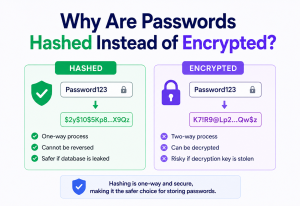
Making data unreadable without a decryption key, both at rest and in transit — the single most impactful lever most organisations have.
Confidentiality & Integrity
Preventing unauthorised access and unauthorised changes to data throughout its lifecycle.
Availability & Resilience
Keeping systems running and recoverable under stress or attack, so legitimate access is not lost.
Regular Testing
Ongoing evaluation of technical and organisational measures — audits, penetration tests, and tabletop breach drills.
10.2 A Simple Example: Pseudonymisation in Code
Here is a minimal Java example showing the difference between storing raw personal data and storing a pseudonymised reference instead:
public class UserRecord {
    // Instead of storing the raw email directly in the analytics table:
    // String email = "jane.doe@example.com";

    // Store a pseudonymous, non-reversible-without-key token:
    public static String pseudonymize(String rawIdentifier, String secretSalt) throws NoSuchAlgorithmException {
        MessageDigest digest = MessageDigest.getInstance("SHA-256");
        byte[] hash = digest.digest((rawIdentifier + secretSalt).getBytes(StandardCharsets.UTF_8));
        return Base64.getEncoder().encodeToString(hash);
    }
}

// The analytics table only ever sees: "k3F9pQ==...", never the real email.
// The mapping from token back to email is kept in a single, tightly
// access-controlled service -- separating "what happened" from "who it was."
10.3 Security and the Breach Notification Clock
Good security design directly reduces GDPR risk in two ways: it lowers the chance of a breach happening in the first place, and — because encrypted or properly pseudonymised data is much less likely to create a real risk to individuals even if it is stolen — it can reduce or even eliminate the obligation to notify affected individuals directly, as described in Article 34.
Encryption and pseudonymisation reduce risk, but they are not a magic exemption from GDPR altogether. If pseudonymised data can still realistically be linked back to a person (for example, if the mapping key is easy to obtain), it is still considered personal data.
Monitoring, Logging & Metrics
GDPR’s accountability principle means organisations must not just comply, but be able to prove compliance at any moment — much like a well-instrumented production system must not just work, but be observable enough to prove it is working correctly.
11.1 What Organisations Need to Monitor
- Consent status — real-time visibility into who has consented to what, and when it was last updated or withdrawn.
- Access logs — who accessed personal data, when, and why, especially for sensitive or special category data.
- Data subject request SLAs — tracking the one-month response clock for every access, erasure, or portability request in flight.
- Retention compliance — automated alerts when data has outlived its stated retention period and needs review or deletion.
- Vendor / processor compliance — monitoring that third-party processors are meeting their contractual data protection obligations.
- Security events — anomaly detection systems that can flag a potential breach quickly enough to meet the 72-hour notification requirement.
11.2 Data Protection Impact Assessments (DPIAs) as an Audit Trail
A DPIA is a structured risk assessment required before starting any processing that is likely to result in high risk to individuals — for example, large-scale profiling, systematic monitoring of public areas, or processing special category data at scale. It documents the purpose, necessity, proportionality, and risk-mitigation measures, creating a durable audit trail that shows the organisation thought carefully about privacy risk before, not after, launching a feature.
11.3 Metrics That Matter for Accountability
| Metric | Why it matters |
|---|---|
| Average data subject request turnaround time | Demonstrates operational ability to meet the one-month legal deadline. |
| Percentage of systems with a completed ROPA entry | Shows how much of the data estate is actually documented and understood. |
| Time to detect a breach | Directly affects ability to meet the 72-hour notification window. |
| Consent withdrawal processing time | Confirms withdrawal is honoured as quickly and easily as consent was given. |
| Number of overdue retention reviews | Flags data being kept longer than its justified purpose. |
Deployment & Cloud Considerations
Modern applications rarely run on a single server in a single country — they are deployed across cloud regions, CDNs, and third-party SaaS tools. GDPR has specific rules for exactly this situation, grouped under the concept of “international data transfers.”
12.1 Why Cross-Border Transfers Need Special Rules
If personal data leaves the EU / EEA and lands in a country without strong privacy protections, all the rights and safeguards GDPR built could effectively evaporate the moment the data crosses the border. Chapter 5 of GDPR exists to prevent this loophole.
12.2 Approved Transfer Mechanisms
Adequacy Decisions
The European Commission formally decides a country (e.g. Japan, South Korea) offers “adequate” protection, allowing free data flow to it.
Standard Contractual Clauses (SCCs)
Pre-approved contract templates that bind the receiving party to GDPR-equivalent protections, no matter where they are based.
Binding Corporate Rules (BCRs)
Internal, regulator-approved policies for transfers within a single multinational group of companies.
Derogations
Narrow exceptions, like explicit consent for a specific, one-off transfer — not usable as a routine mechanism at scale.
12.3 Practical Deployment Implications
- Data residency: many organisations choose EU-based cloud regions specifically to simplify compliance, keeping EU customer data physically within the EU / EEA wherever practical.
- Vendor due diligence: before adopting any third-party SaaS tool, teams must check whether that vendor processes data outside the EU and, if so, which transfer mechanism covers it.
- Sub-processor chains: a cloud provider might itself use other sub-processors (e.g. a CDN, a monitoring tool) — GDPR requires visibility and control over this entire chain, not just the direct vendor relationship.
- Data Processing Agreements (DPAs): a contract required between every controller and processor, spelling out exactly what the processor can and cannot do with the data, mirroring how a service-level agreement defines technical obligations between systems.
The 2020 “Schrems II” ruling from the EU’s top court invalidated the previous EU-US data transfer framework (Privacy Shield), causing major disruption for companies relying on it. A new framework, the EU-US Data Privacy Framework, was later adopted — a good reminder that this area of law continues to evolve and deployment decisions need periodic review.
APIs & Data Portability
Article 20 gives people the right to data portability — the right to receive their personal data in a “structured, commonly used, machine-readable format,” and to have it transmitted directly to another provider where technically feasible. This is where GDPR intersects directly with API design.
13.1 What This Means Technically
If someone asks to export their data from a service, “here is a PDF of your profile” does not satisfy portability — a PDF is not machine-readable in the required sense. Organisations typically need to build an export endpoint that returns something like structured JSON or CSV, containing the data the person directly provided (not data the company independently derived or inferred about them).
13.2 A Simplified Portability Endpoint (Java / Spring-style pseudocode)
@RestController
public class DataPortabilityController {

    @GetMapping("/api/users/{id}/export")
    public ResponseEntity<UserDataExport> exportUserData(@PathVariable String id,
                                                            @RequestHeader("Authorization") String authToken) {
        // 1. Verify the requester really is this user (identity check)
        User verifiedUser = identityService.verify(id, authToken);

        // 2. Collect only data the user themselves provided, not inferred/derived data
        UserDataExport export = new UserDataExport();
        export.setProfile(profileService.getRawProfile(verifiedUser));
        export.setOrders(orderService.getUserOrders(verifiedUser));
        export.setPreferences(preferenceService.getUserPreferences(verifiedUser));

        // 3. Return in a structured, machine-readable format
        return ResponseEntity.ok(export); // serialized as JSON
    }
}
13.3 Design Considerations for Portability APIs
- Scope correctly: only the data the person provided or generated through their use of the service — not the company’s proprietary algorithms, inferred scores, or third-party data mixed in.
- Authenticate rigorously: a portability endpoint is an attractive target for identity fraud, since it can hand over a complete personal data set — strong identity verification is essential.
- Rate-limit and audit: log every export request, since this endpoint handles some of the most sensitive bulk-data operations in the system.
- Interoperable formats: favour widely-used, non-proprietary formats (JSON, CSV, standard calendar / contact formats) over closed, vendor-specific ones.
13.4 Connection to Microservices Architecture
In a microservices environment, a single user’s data might be scattered across a dozen independent services — orders, preferences, support tickets, billing. Fulfilling both portability requests and erasure requests reliably usually requires a central “data subject request orchestrator” service that fans out to every microservice’s own export/delete API and aggregates the results — a pattern very similar to the API Gateway or Saga patterns used elsewhere in distributed systems design.
Design Patterns & Anti-Patterns
Just as software engineering has recognised good and bad design patterns, privacy engineering has developed its own well-known patterns for building GDPR-compliant systems — and equally well-known anti-patterns to avoid.
14.1 Good Pattern — Privacy by Design and by Default
Article 25 requires organisations to build data protection into systems from the very start of design, and to default to the most privacy-protective settings automatically (for example, a new social media account should default to a private profile, not public). This is the privacy equivalent of “secure by default” in security engineering.
14.2 Good Pattern — Data Minimisation at the Schema Level
Designing database schemas and API payloads to only include fields that are strictly necessary, rather than capturing everything that might conceivably be useful someday. A schema that cannot store a piece of data cannot leak it either.
14.3 Good Pattern — Purpose-Tagged Data Stores
Tagging every piece of stored personal data with the specific purpose it was collected for, so automated systems can enforce purpose limitation and flag any attempt to reuse it for something unrelated.
14.4 Good Pattern — Centralised Consent and Rights-Management Service
As shown earlier, funnelling all consent checks and data-subject-rights fulfilment through one well-tested internal service, rather than letting every team reinvent (and likely mis-implement) this logic independently.
14.5 Anti-Pattern — “Consent as a Formality”
Pre-ticked checkboxes, consent buried in unrelated terms of service, or “I agree” buttons where declining is deliberately hard to find. Regulators have fined companies specifically for this pattern, because it fails the “freely given and unambiguous” test.
14.6 Anti-Pattern — Data Hoarding “Just in Case”
Collecting and retaining far more data than a feature actually needs, on the theory that it might be useful for some future, undefined purpose. This directly violates both data minimisation and storage limitation.
14.7 Anti-Pattern — The “Delete” Button That Does Not Really Delete
Marking a record as deleted in the primary database while forgetting about backups, caches, log files, analytics pipelines, and third-party processors that still retain a live copy. A true erasure needs to reach every system holding a copy, not just the most visible one.
14.8 Anti-Pattern — Treating GDPR as a One-Time Project
Doing a big compliance push before the 2018 deadline and then never revisiting it, even as new features, new vendors, and new data flows are added over time. Compliance is closer to a continuous process (like ongoing security patching) than a project with a defined end date.
“Consent laundering” — obtaining consent for a broad, vague purpose and then using it to justify many unrelated activities later. Each new purpose typically needs its own clear, specific basis, and regulators have repeatedly rejected the “we got a blanket yes years ago” defence.
Best Practices & Common Mistakes
A short, opinionated checklist. If a code review or a privacy review turns up any of the common mistakes below, treat it as a compliance risk waiting to happen rather than a purely cosmetic issue.
15.1 Best Practices
- Map your data before you do anything else. You cannot protect what you do not know you have — start with a thorough, honest inventory of every system that touches personal data.
- Write privacy notices in plain language. A notice that is technically accurate but unreadable to an ordinary person fails the transparency principle in spirit, even if it might pass on paper.
- Build rights-fulfilment tooling early, not reactively after the first request arrives. Manual, ad-hoc handling of access or erasure requests does not scale and increases the risk of missing the one-month deadline.
- Bake DPIAs into your feature development process, the same way security reviews or architecture reviews are baked into a software development lifecycle.
- Vet every vendor’s data practices before integration, not after — retrofitting a Data Processing Agreement onto a vendor already embedded in production is far harder than negotiating it up front.
- Train staff continuously, not just once. Most real-world data breaches stem from human error (a misdirected email, a lost laptop) rather than sophisticated hacking.
- Test your breach-response plan before you need it, the same way disaster-recovery runbooks are tested with fire drills, not just written and filed away.
15.2 Common Mistakes
- Assuming GDPR only applies to companies based in Europe.
- Confusing “we have a privacy policy” with “we are actually compliant” — a policy document is only meaningful if operational practice matches it.
- Forgetting that internal HR and employee data is also covered by GDPR, not just customer data.
- Underestimating how long a genuine data-mapping exercise takes across a large, legacy-heavy organisation.
- Failing to update the ROPA and privacy notices when a system or vendor changes.
- Not distinguishing controller and processor responsibilities clearly in contracts, leaving both parties uncertain who is actually accountable for what.
Real-World & Industry Examples
Abstract rules become much clearer once you see how they have actually played out in practice. Here are some of the most instructive enforcement cases, each mapping back to a specific concept from earlier in this guide.
Google — France, 2019 (~€50 million fine)
France’s data protection authority, CNIL, fined Google for failing to provide sufficiently clear and transparent information about how it used personal data for ad personalisation, and for not obtaining valid, specific consent for personalised advertising. This was one of the first major fines and signalled that even the largest technology companies would be held to the same transparency and consent standards as anyone else.
Amazon — Luxembourg, 2021 (~€746 million fine)
Luxembourg’s regulator issued what was, at the time, the largest GDPR fine on record, related to how Amazon processed personal data for targeted advertising without proper legal basis, according to the regulator’s assessment. The case highlighted how advertising-driven business models face particular GDPR scrutiny.
Meta / Facebook — Ireland, 2023 (~€1.2 billion fine)
Ireland’s Data Protection Commission fined Meta over its transfers of European user data to the United States, following the “Schrems II” ruling that invalidated the previous transfer framework. This case is a clear real-world illustration of the international transfer rules discussed earlier — even a company with sophisticated legal resources can be caught out when the underlying transfer mechanism becomes legally invalid.
British Airways — UK, 2020 (~£20 million fine, reduced from an initial £183 million)
A 2018 cyberattack exposed the personal and payment data of roughly 400,000 customers. The UK regulator found British Airways had inadequate security measures, including insufficient monitoring that allowed the attack to go undetected. This case directly illustrates the Article 32 security obligations and the monitoring practices discussed earlier in this guide.
Marriott International — UK, 2020 (~£18.4 million fine)
A breach originating in a hotel reservation system Marriott had acquired exposed data on millions of guests. The case underscored that GDPR liability can follow an organisation through mergers and acquisitions — due diligence on a target company’s data protection practices is now a standard part of the M&A process.

16.1 What These Cases Have in Common
| Case | Core failure | Guide section it maps to |
|---|---|---|
| Unclear consent for ad personalisation | Core Concepts — Consent | |
| Amazon | Insufficient lawful basis for ad targeting | Core Concepts — Lawful Basis |
| Meta | Invalid international transfer mechanism | Deployment & Cloud |
| British Airways | Inadequate technical security & monitoring | Security / Monitoring |
| Marriott | Inherited security gaps from an acquisition | Best Practices — vendor / M&A due diligence |
Frequently Asked Questions
A few of the questions that come up most often when people first work seriously with GDPR — whether they are engineers, product managers, small-business owners, or simply curious individuals.
No. It applies to any organisation, anywhere in the world, that processes personal data of people located in the EU / EEA, if it is offering them goods or services or monitoring their behaviour.
Any information relating to an identified or identifiable living person — names, emails, IP addresses, location data, and more. See the Core Concepts section for the full explanation.
Fines are tiered. The higher tier can reach up to €20 million or 4% of the company’s total worldwide annual turnover, whichever is greater. The lower tier caps at €10 million or 2% of turnover, for less severe violations.
Yes, in principle GDPR applies regardless of company size, though some specific obligations (like mandatory DPO appointment) only kick in above certain thresholds or risk levels. Small businesses still need a lawful basis, transparency, and reasonable security for any personal data they handle.
The controller decides why and how data is processed (the “what and why”); the processor acts only on the controller’s instructions (the “how, technically, on someone else’s behalf”). A single organisation can be a controller for some data and a processor for other data at the same time.
Usually, yes, via the right to erasure — but it is not absolute. A company can refuse if it has an overriding legal obligation to keep the data (like tax records) or another valid legal basis to continue processing it.
No — consent is only one of six lawful bases. Plenty of everyday processing, like fulfilling an order someone already placed, relies on the “contract” basis instead, and does not need separate consent.
It must assess the risk, and if the breach poses a risk to individuals’ rights and freedoms, notify the relevant supervisory authority within 72 hours, and notify affected individuals directly if the risk is high.
Yes, as long as the paper records are part of a structured filing system (like alphabetically sorted personnel files) — not purely digital data.
They share similar goals but differ in structure and detail — for example, GDPR is opt-in for many types of processing (you need a lawful basis before you start), while CCPA / CPRA is largely opt-out (processing can happen unless the person actively objects, particularly around the sale of data). Many multinational companies now build systems flexible enough to satisfy both.
Summary & Key Takeaways
GDPR is, at its heart, a law built to restore something simple: your ability to know what happens to your own personal data, and to have a real say in it. It replaced a fragmented, weakly-enforced patchwork of national laws with one consistent, strongly-enforced rulebook across the EU / EEA, and its influence now reaches almost any organisation on Earth that touches European users’ data.
Key Takeaways
- GDPR grew out of the outdated 1995 Data Protection Directive, becoming enforceable on 25 May 2018 after years of negotiation.
- It rests on core vocabulary — personal data, data subject, controller, processor, lawful basis — that everything else builds on.
- Seven core principles (lawfulness, purpose limitation, minimisation, accuracy, storage limitation, security, accountability) drive every specific rule.
- Data has a full lifecycle under GDPR — collection, storage, use, sharing, retention, and deletion — with data subject rights intersecting at nearly every stage.
- Security (Article 32) is risk-based, not a fixed checklist, and explicitly includes availability and resilience, not just confidentiality.
- International data transfers require an approved legal mechanism, an area that continues to evolve, as seen in the Schrems II ruling and its aftermath.
- Real enforcement cases against Google, Amazon, Meta, British Airways, and Marriott show these are not abstract rules — they carry serious financial and operational consequences.
- Compliance works best as an ongoing engineering discipline — privacy by design, centralised tooling, continuous monitoring — rather than a one-time project.
Whether you are a developer designing a signup form, a product manager scoping a new feature, or simply someone curious about why every website suddenly started asking about cookies in 2018, GDPR’s underlying idea is worth remembering: personal data is not just another resource for a business to exploit — it is a reflection of a real person, and the law now insists that reflection be treated with care.