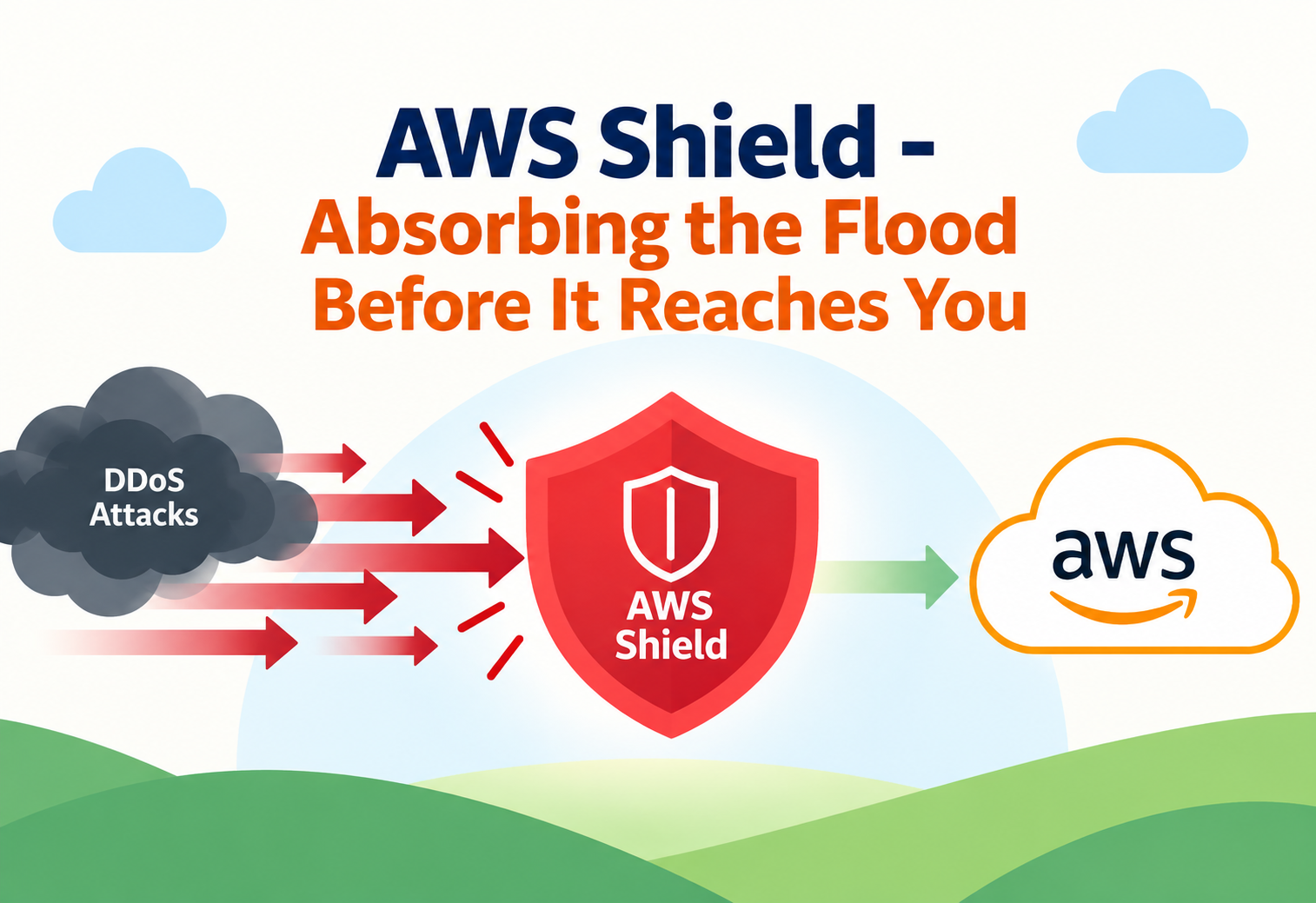
AWS Shield – Absorbing the Flood Before It Reaches You
How AWS Shield actually detects and mitigates DDoS attacks at network and application layers — and where its coverage ends and yours begins.
Imagine a popular restaurant that suddenly gets flooded with ten thousand fake reservation calls in a single minute — not customers wanting a table, just noise designed to keep every phone line busy so real customers can never get through. A bouncer at the door won’t help here; the problem isn’t who’s inside, it’s the sheer volume overwhelming the phone system itself before anyone even reaches the host stand. AWS Shield is built for exactly this category of problem: distributed denial-of-service (DDoS) attacks that aim to overwhelm capacity rather than breach a system directly. This guide assumes you already know what a DDoS attack is in general terms; it focuses on the intermediate mechanics of how Shield actually detects and absorbs one.
1Introduction & History
AWS Shield launched in two stages: Shield Standard became available to all AWS customers automatically and at no additional cost starting in 2016, while Shield Advanced launched the same year as a paid tier offering deeper protection, visibility, and support. The motivation was straightforward — DDoS attacks were, and remain, one of the most common and disruptive categories of internet attack, and because AWS itself operates the network infrastructure that customer traffic flows through, AWS is uniquely positioned to absorb attack traffic at a scale individual customers never could on their own.
Shield’s core capability rests on AWS’s global network footprint: because AWS operates edge locations and network capacity distributed across the world, it can absorb and diffuse large volumes of attack traffic across that footprint before it ever concentrates on a single customer’s resources — a scale advantage that would be prohibitively expensive for most individual organizations to replicate themselves.
Shield Standard is like a building’s design naturally including wide hallways and multiple entrances, so a sudden crowd surge doesn’t immediately create a dangerous bottleneck at one door — a baseline structural protection everyone gets by default. Shield Advanced is like additionally hiring a dedicated crowd-control team that watches for surges, actively redirects flow during an incident, and reimburses you if the surge caused you to pay for emergency overflow staffing.
A concrete example: in February 2020, AWS Shield mitigated what was, at the time, one of the largest DDoS attacks ever recorded against an AWS customer, a volumetric attack exceeding 2.3 terabits per second — an event AWS later disclosed publicly precisely because it illustrated the scale of absorption Shield’s underlying infrastructure is built to handle.
2Problem & Motivation
DDoS attacks don’t try to steal data or break into a system — their goal is simpler and, in some ways, harder to defend against: make a service unavailable by overwhelming some limited resource, whether that’s network bandwidth, connection capacity, or application processing capacity. Because the attack traffic often comes from thousands or millions of distributed sources simultaneously (frequently a botnet of compromised devices), simply blocking a single IP address does nothing — there is no single source to block.
Different layers of the network stack are vulnerable to different attack shapes. A volumetric attack at Layer 3/4 (network/transport) tries to saturate raw bandwidth or connection-handling capacity with a flood of packets. An application-layer attack at Layer 7 is more subtle — it might send what look like entirely legitimate HTTP requests, just an overwhelming number of them, aimed at exhausting server-side processing resources (like database queries) rather than raw bandwidth, making it far harder to distinguish from a genuine, if unusually large, spike in legitimate traffic.
Recognizing which layer an attack targets is central to choosing the right defense. Layer 3/4 volumetric attacks are best absorbed by infrastructure-scale mitigation (Shield’s core strength); Layer 7 application attacks require request-level inspection and rate-based rules (where Shield Advanced’s integration with AWS WAF becomes essential).
3Core Concepts (Intermediate Level)
Shield Standard vs. Shield Advanced
Automatic, Always-On, Free
Applies to every AWS customer automatically, defending against common, most-frequently-occurring network and transport layer (Layer 3/4) DDoS attacks with no configuration required.
Paid, Enhanced, Supported
Adds detection and mitigation for larger and more sophisticated attacks, near-real-time visibility, integration with the Shield Response Team (SRT), and cost protection against usage spikes caused by an attack.
A frequently misunderstood point: Shield Standard is not “no protection” — it’s meaningful, automatic protection against the most common attack patterns, built into the AWS network fabric itself. Shield Advanced is best understood as an enhancement layer for organizations with a higher risk profile (financial services, gaming, media) or a lower tolerance for even brief availability impact, rather than as “the only real protection.”
Health-Based Detection
Shield Advanced can integrate with Amazon Route 53 health checks associated with a protected resource, using the health check’s pass/fail signal as an additional input into detecting whether unusual traffic is actually degrading the resource’s real-world availability, rather than relying purely on raw traffic-volume anomalies. This matters because a spike in traffic alone doesn’t always indicate an attack — a legitimate viral traffic surge looks statistically similar to certain attack patterns — but a spike combined with an actual health degradation is a much stronger signal that mitigation is warranted.
Protection Groups
Rather than managing DDoS protection resource by resource, Shield Advanced allows grouping multiple protected resources (like several CloudFront distributions or Elastic IP addresses belonging to the same application) into a protection group, aggregating their health and traffic signals together. This is useful when an application’s true health depends on the combined behavior of several resources rather than any single one in isolation — an attack might spread load thinly across several resources in a way that looks unremarkable individually, but clearly anomalous when viewed in aggregate.
Monitoring resources individually versus as a protection group is like judging a restaurant’s health by watching one specific waiter versus watching the whole dining room. One waiter having a slow night might mean nothing; the whole dining room quietly slowing down at once is a much stronger, more reliable signal that something systemic is happening.
4Architecture & Components
Shield Standard’s protection is woven directly into the AWS network and edge infrastructure that services like CloudFront, Route 53, and Global Accelerator already run on, meaning the mitigation happens automatically at the network layer without customers deploying or configuring anything specific to Shield itself. Shield Advanced extends coverage to additional resource types — Elastic IP addresses, Application and Classic Load Balancers, CloudFront distributions, Global Accelerator accelerators, and Route 53 hosted zones — and adds a management layer of dedicated detection, alerting, and human support on top.
AWS WAF sits alongside Shield as a complementary, not competing, component: Shield focuses on detecting and mitigating the DDoS attack pattern itself, while WAF provides the rule-based engine for filtering specific malicious request patterns at Layer 7 — Shield Advanced customers get AWS WAF at no additional cost specifically because the two are designed to be used together for comprehensive DDoS defense.
5Internal Working
Shield’s detection approach relies heavily on baselining: AWS continuously observes typical traffic patterns for a given resource type and, for Shield Advanced customers, for the specific protected resource itself, so that deviations from that established baseline can be flagged as potentially anomalous. When traffic crosses recognized attack-pattern thresholds — a sudden flood of SYN packets, UDP reflection traffic, or an implausible spike in connection attempts — mitigation techniques are applied automatically at the network edge, filtering or rate-limiting the anomalous traffic before it can consume the protected resource’s actual capacity.
For Layer 7 application attacks, detection is inherently harder because the traffic often looks like legitimate, well-formed requests. Shield Advanced addresses this by combining traffic-pattern analysis with the health-based detection described earlier and by working with AWS WAF, where customers (or, during an active incident, the Shield Response Team) can deploy targeted rate-based rules or request-pattern rules to filter out the specific malicious request signature once it’s identified — a process that is necessarily more investigative than the largely automatic mitigation applied at Layer 3/4.
Detecting a Layer 3/4 flood is like noticing ten thousand cars suddenly trying to enter a parking garage designed for two hundred — obviously anomalous by volume alone. Detecting a Layer 7 attack is more like noticing that two hundred cars are entering normally, but each one is circling the garage endlessly instead of parking and leaving — the volume looks fine, but the behavior pattern reveals something is wrong.
6Data Flow & Lifecycle
During normal operation, traffic flows through the AWS edge network to the protected resource with Shield Standard’s automatic mitigations running continuously and invisibly in the background. When an attack begins, Shield’s detection systems compare incoming traffic against established baselines; for Shield Advanced customers, near-real-time metrics and notifications through Amazon CloudWatch and the AWS Shield console surface the detected event quickly, often before end users notice significant impact.
Once an attack is confirmed, mitigation techniques are applied at the network layer closest to where the attack traffic can most efficiently be filtered — often at the edge, before it travels deeper into AWS’s network toward the customer’s actual resources. For Shield Advanced customers experiencing a severe or complex attack, engaging the Shield Response Team (SRT) — available 24/7 for eligible support tiers — brings in AWS engineers who can help create custom WAF mitigations or escalate the response, effectively extending the automated pipeline with expert human judgment for cases automated detection alone doesn’t fully resolve.
7Advantages, Disadvantages & Trade-offs
Advantages
- Shield Standard provides meaningful protection automatically, at no cost, for every AWS customer
- Leverages AWS’s global network scale to absorb even very large volumetric attacks
- Shield Advanced’s cost protection guards against unexpected billing spikes caused by attack-driven traffic and scaling
- Health-based detection reduces false positives by correlating traffic anomalies with actual resource health impact
- Deep integration with WAF, CloudFront, Route 53, and Global Accelerator means DDoS protection isn’t a bolted-on afterthought
Disadvantages / Trade-offs
- Shield Advanced carries a meaningful monthly cost plus a one-year commitment, which is significant for smaller organizations
- Layer 7 attacks still require thoughtful WAF rule configuration — Shield doesn’t fully automate application-layer defense the way it does for network-layer volumetric attacks
- Advanced protection only covers specific resource types (CloudFront, Route 53, ALB/CLB, Global Accelerator, EIP) — resources outside that list don’t receive the enhanced tier’s benefits
- Effective protection still depends on sound architecture — for example, resources sitting directly on the public internet without CloudFront or an ALB in front of them benefit less from Shield’s edge-level mitigations
The core trade-off is between the breadth of automatic, free protection everyone receives and the depth of protection, visibility, and support that requires a deliberate investment — Shield’s tiered structure is designed around exactly that spectrum.
8Performance & Scalability
Because Shield’s mitigation capacity is tied to AWS’s own network infrastructure, its scalability isn’t something individual customers configure or provision — it scales with AWS’s global network footprint itself, which is precisely why it can absorb attacks measured in terabits per second that would overwhelm almost any individually operated on-premises mitigation appliance.
Using CloudFront or Global Accelerator in front of an application meaningfully improves the practical benefit of Shield’s protections, since both services place the protected entry point at the AWS edge, closer to attack sources and further from the origin infrastructure — an architectural choice that amplifies how much filtering and absorption capacity Shield can apply before traffic ever reaches origin servers.
9High Availability & Reliability
Shield’s reliability is inherently tied to the reliability of the AWS network and edge infrastructure it operates within — there is no separate “Shield cluster” that could itself become a single point of failure, since protection is built into the same globally distributed fabric that already needs to be highly available for AWS’s core services to function.
For Shield Advanced customers, the Health-Based Detection feature directly improves reliability of the detection and response pipeline itself: rather than reacting only to raw traffic anomalies (which can produce false positives during legitimate surges), correlating with actual resource health via Route 53 health checks improves confidence that a detected event genuinely threatens availability, reducing the risk of unnecessary or overly aggressive mitigations that could themselves impact legitimate traffic.
“Your application saw a huge, sudden traffic spike, but Shield Advanced didn’t flag it as an attack — why might that be?” The expected answer touches health-based detection: if the associated Route 53 health check still showed the resource healthy throughout the spike, Shield may correctly conclude the surge, while unusual, wasn’t actually degrading availability — potentially a legitimate viral traffic event rather than an attack.
10Security
Shield itself is fundamentally a security service, but it’s worth being precise about what category of security it addresses: it protects availability against volumetric and protocol-based attacks, not confidentiality or integrity against data breaches or unauthorized access — those concerns are addressed by other tools like IAM, encryption, and AWS WAF’s rule-based filtering for malicious payloads (like SQL injection attempts), which is a distinct concern from DDoS volume even though both are commonly discussed under the umbrella of “web application security.”
Access to Shield Advanced’s configuration — creating protections, protection groups, and viewing attack diagnostics — is controlled through IAM policies, allowing organizations to restrict who can modify DDoS protection settings, which is particularly important given how disruptive a misconfigured or removed protection could be during an actual incident. AWS Firewall Manager can centrally manage Shield Advanced protections and associated WAF rules across many accounts in an AWS Organization, ensuring consistent baseline protection is applied organization-wide rather than depending on each individual account team remembering to configure it themselves.
11Monitoring, Logging & Metrics
Shield Advanced publishes detailed, near-real-time metrics to Amazon CloudWatch during a detected event, including attack vector details and traffic volume, which teams can use to build dashboards and alarms specific to DDoS activity rather than relying purely on generic infrastructure metrics that might not clearly indicate an attack is underway. The Shield console also provides attack diagnostics and historical event summaries, useful for post-incident review and for demonstrating compliance or due diligence to stakeholders after a significant event.
AWS WAF’s own logging, when used alongside Shield Advanced, records which specific requests matched which rules, giving much finer-grained visibility into Layer 7 mitigation activity than Shield’s own network-layer metrics alone provide — the two logging surfaces are complementary, covering different layers of the same overall defense.
12Deployment & Cloud Integration
Shield Standard requires no deployment steps at all — it’s automatically active for every AWS customer’s eligible resources. Shield Advanced is subscribed to at the account or AWS Organization level and then explicitly enabled per resource (or per protection group), typically managed through the console, AWS CLI, or CloudFormation as part of broader infrastructure-as-code practices, especially in organizations managing protection consistently across many accounts.
Integration with CloudFront, Route 53, Global Accelerator, and Elastic Load Balancing is close to seamless because these services are themselves deeply embedded in the AWS edge network Shield already protects — placing an application behind one of these services is itself a meaningful architectural step toward maximizing Shield’s practical benefit, independent of which Shield tier is active.
13Design Patterns & Anti-Patterns
Context
A public-facing, business-critical application needs strong protection against both volumetric and application-layer DDoS attacks.
Pattern
Place the application behind CloudFront (or Global Accelerator), enable Shield Advanced on the distribution, and layer AWS WAF rules for Layer 7 filtering — combining edge-scale volumetric absorption with targeted request-level filtering in one coherent architecture.
Symptom
An application behind CloudFront still suffers significant impact during an attack because origin servers remain independently reachable via their own public IP addresses.
Root Cause
If attackers can bypass the edge service entirely and hit the origin directly, Shield’s edge-level mitigations for that traffic path are far less effective; origins should be configured to accept traffic only from the fronting service (e.g., via security groups restricted to CloudFront’s IP ranges or origin access controls).
Symptom
Application-layer attacks continue degrading performance despite having Shield Advanced enabled.
Root Cause
Shield Advanced’s Layer 7 defense relies on AWS WAF rules actually being configured and tuned for the application’s specific traffic patterns; enabling Shield Advanced alone, without deploying or maintaining relevant WAF rules, leaves a meaningful gap in application-layer coverage.
14Best Practices & Common Mistakes
- Front public-facing applications with CloudFront, Global Accelerator, or an ALB rather than exposing origin servers directly, to maximize the practical benefit of edge-level DDoS mitigation.
- Restrict origin access to only the fronting AWS service’s traffic so attackers can’t bypass edge-level protections by hitting the origin directly.
- Pair Shield Advanced with actively maintained AWS WAF rules, since Layer 7 defense depends on rule quality, not automatic detection alone.
- Configure Route 53 health checks for Shield Advanced’s health-based detection to reduce false positives and improve detection confidence.
- Group related resources into a protection group when their combined health, not any single resource’s, best represents the application’s real availability.
- Common mistake: assuming Shield Standard alone is sufficient for a business-critical, high-profile, or high-risk-industry application without evaluating whether Shield Advanced’s deeper protection and cost guarantees are warranted.
- Common mistake: enabling Shield Advanced but never engaging the Shield Response Team proactively before an incident, missing the chance to establish response runbooks and contact procedures ahead of time.
15Real-World & Industry Examples
Large-Scale Volumetric Attack Mitigation (2020)
AWS publicly disclosed mitigating a 2.3 Tbps DDoS attack against a Shield-protected customer, illustrating the sheer absorption capacity available through AWS’s global network infrastructure during a genuinely extreme volumetric event.
Gaming Platforms — Latency-Sensitive Availability
Online gaming companies commonly rely on Shield Advanced given how sensitive real-time multiplayer experiences are to even brief availability disruptions, where a successful DDoS attack against game servers can visibly and immediately impact active players.
Financial Services — Regulatory-Driven Adoption
Financial services organizations frequently adopt Shield Advanced as part of meeting regulatory expectations around operational resilience, valuing both the enhanced protection and the documented incident response support the Shield Response Team provides for compliance and audit purposes.
16Frequently Asked Questions
17Summary & Key Takeaways
Key Takeaways
- AWS Shield defends against DDoS attacks aimed at overwhelming availability, not against data breaches or unauthorized access, which remain separate security concerns.
- Shield Standard is automatic, free, and provides meaningful protection against common Layer 3/4 volumetric attacks for every AWS customer.
- Shield Advanced adds broader resource coverage, near-real-time visibility, cost protection, health-based detection, and access to the 24/7 Shield Response Team.
- Layer 3/4 volumetric attacks are largely mitigated automatically at the network edge; Layer 7 application attacks require AWS WAF rules working alongside Shield for effective defense.
- Health-based detection, using Route 53 health checks, improves detection confidence by correlating traffic anomalies with actual resource health impact.
- Fronting applications with CloudFront, Global Accelerator, or a load balancer — and restricting origin access accordingly — meaningfully amplifies Shield’s practical protective value.
- Effective DDoS defense is architectural, not just a service toggle: how an application is fronted and configured determines how much of Shield’s protection actually reaches it.