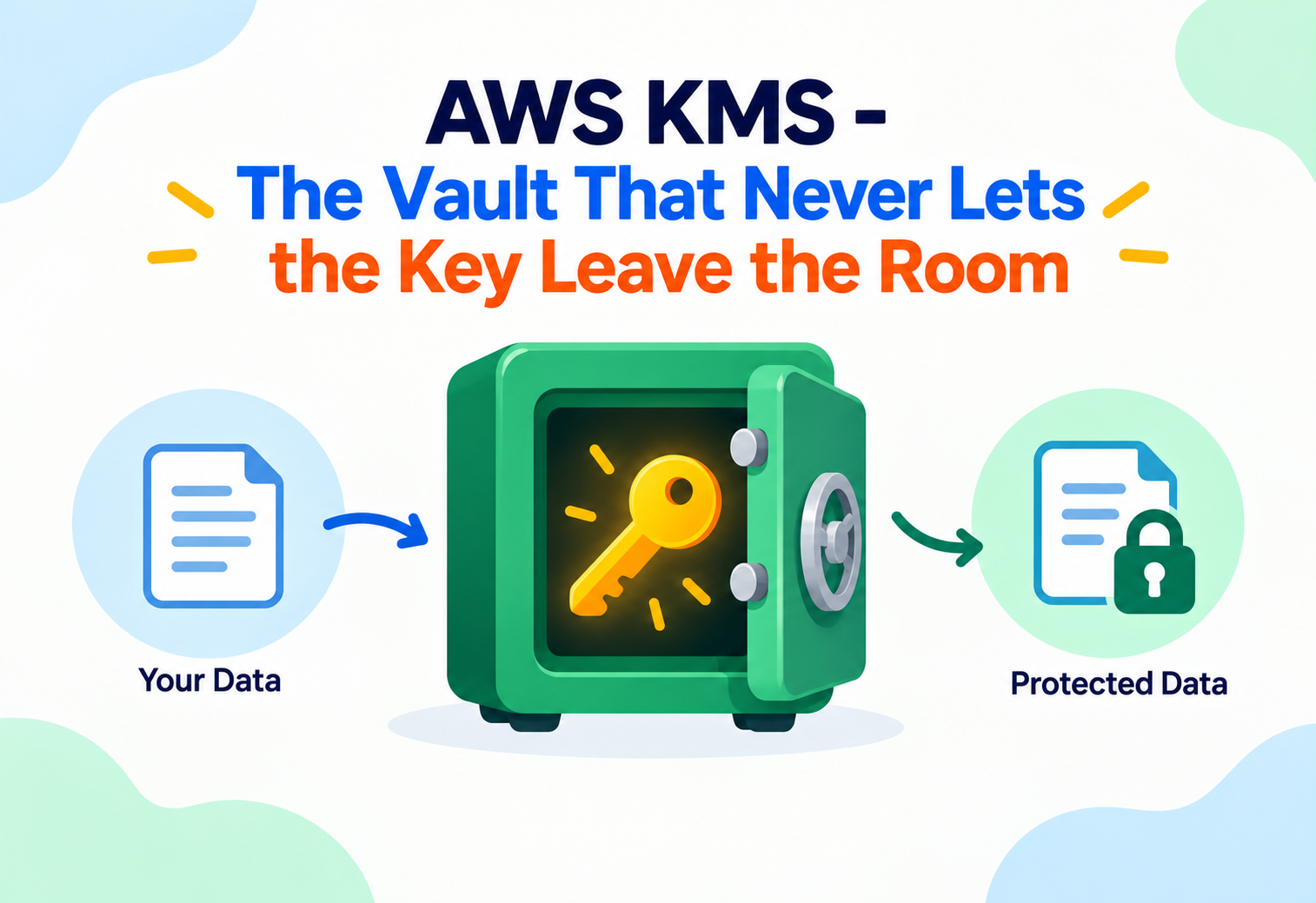
AWS KMS – The Vault That Never Lets the Key Leave the Room
An architecture-level look at how AWS Key Management Service generates, protects, and uses cryptographic keys — and why the single rule that keys never leave hardware unencrypted shapes everything else about how it works.
Picture a locksmith who will cut you a copy of any key you need, use any key to open a lock right in front of you, but will never, under any circumstance, hand you the master key itself — not even if you ask nicely, not even for a “quick look.” That refusal is not unhelpfulness; it’s the entire security model. AWS Key Management Service works on exactly this principle: it lets applications encrypt and decrypt freely, but the cryptographic key material itself never leaves the hardware that protects it in plaintext form. This tutorial walks through how that boundary is enforced and what it means for real architectures built on top of it.
1Architecture and Core Components
KMS’s architecture is built around a small set of tightly defined objects — keys, key policies, grants, and aliases — each with a specific role in controlling who can use a key and how.
Customer master keys and key material
The central object in KMS is a KMS key, a logical resource representing cryptographic key material along with metadata describing its origin, usage, and permissions. The actual key material backing it is generated and stored inside FIPS-validated hardware security modules, and by design, that raw key material is never exposed outside those modules in plaintext form — every cryptographic operation happens inside the boundary, not outside it.
Key policies versus IAM policies
Access to a KMS key is governed by a key policy attached directly to the key itself, which acts as the resource-based, foundational permission gate. IAM policies attached to users or roles can grant additional permissions, but only within what the key policy allows — a key policy denying access cannot be overridden by a permissive IAM policy, making the key policy the ultimate authority for that specific key.
KMS Key
The logical resource wrapping cryptographic key material, its metadata, and its associated key policy.
Key Policy
The resource-based policy attached to a key that sets the outer boundary of who can ever use it.
Grant
A temporary, programmatically created permission allowing a specific principal to use a key for specific operations.
Alias
A friendly, mutable name pointing to a key, letting applications reference a stable name while the underlying key can be rotated or swapped.
A key policy is like the master rulebook posted at the entrance of a high-security vault, listing exactly who is allowed in under what conditions. A grant is like a temporary visitor badge issued for one specific task — it expires or gets revoked without ever touching the rulebook itself.
graph TD
    App[Application] -->|Encrypt/Decrypt Request| KMS[KMS Service Endpoint]
    KMS --> Policy[Key Policy Check]
    Policy -->|Allowed| HSM[Hardware Security Module]
    HSM -->|Ciphertext Result| KMS
    KMS --> App
    Policy -->|Denied| Reject[Access Denied]
2Internal Working: Envelope Encryption
KMS rarely encrypts large amounts of data directly with a KMS key. Instead, nearly everything built on top of it relies on a pattern called envelope encryption, which is worth understanding in detail.
Why not encrypt data directly with the KMS key?
KMS keys are designed for small payloads — a few kilobytes at most — because every direct encrypt or decrypt call is a network round trip to the KMS service, and the hardware boundary is optimized for key protection operations, not bulk data throughput. Encrypting gigabytes of data directly against a KMS key would be both slow and impractical at scale.
The envelope pattern
Instead, applications ask KMS to generate a unique data key: KMS returns both a plaintext copy of that data key and a version of it encrypted under the KMS key. The application uses the plaintext data key to encrypt the actual bulk data locally, immediately discards the plaintext data key from memory, and stores only the encrypted data key alongside the encrypted data. To decrypt later, the encrypted data key is sent back to KMS, which decrypts it using the hardware-protected KMS key, returning the plaintext data key just long enough to decrypt the actual data.
Request a data key
The application calls KMS asking for a new data key under a specific KMS key.
Receive plaintext and encrypted versions
KMS returns both a plaintext data key and that same key encrypted under the KMS key.
Encrypt data locally
The application uses the plaintext data key to encrypt the actual data on its own, without another KMS call.
Discard plaintext, store encrypted key
The plaintext data key is wiped from memory; only the encrypted data key is persisted alongside the data.
Decrypt on demand
Later, the encrypted data key is sent to KMS, which returns the plaintext data key just long enough to decrypt the data.
It’s like sealing a document in a personal safe, then locking that safe’s small key inside a much larger vault. You never store the safe’s key lying around — you only keep the locked-away version, and you go back to the vault every time you actually need to open the safe.
Envelope encryption does not mean data itself is stored inside KMS. KMS only ever handles the small data key; the actual bulk data is encrypted and stored entirely outside KMS, wherever the application chooses.
3Data Flow and Key Lifecycle
A KMS key moves through distinct lifecycle stages, and understanding them matters because some transitions — like deletion — are deliberately hard to reverse.
Creation and key material origin
By default, KMS generates and manages key material entirely within its own hardware security modules. Alternatively, key material can be imported from an external source, or key operations can be backed by a dedicated, single-tenant hardware security module cluster for organizations needing that additional isolation — each origin choice affects who is responsible for key material availability.
Rotation
KMS keys with AWS-managed or automatically rotated customer-managed key material get new backing key material on a periodic schedule, while KMS transparently keeps older key material available so that data encrypted under a previous version can still be decrypted. Rotation changes the key material used for new encryption operations without requiring re-encryption of everything already encrypted under the old material.
| Key Type | Rotation | Who Manages Policy |
|---|---|---|
| AWS managed key | Automatic, fixed schedule | AWS |
| Customer managed key | Optional automatic or manual | Customer |
| Customer managed key, imported material | Manual only | Customer |
Deletion is deliberately slow
Deleting a KMS key is irreversible and destroys the ability to decrypt anything encrypted under it, so KMS enforces a mandatory waiting period before deletion actually completes, during which the deletion can still be cancelled. This waiting period exists specifically because key deletion has no undo once it finishes.
Before letting a scheduled deletion complete, confirm nothing still references that key’s encrypted data keys — a single overlooked backup or archive can become permanently unreadable.
4Performance and Scalability
Because envelope encryption minimizes KMS round trips, well-designed applications rarely feel KMS as a bottleneck even at very high data volumes.
Data key caching
For workloads generating many small objects rapidly, requesting a fresh data key from KMS for every single object can become a meaningful volume of API calls. Client-side data key caching libraries reuse a single data key across multiple encryption operations for a bounded time or message count, sharply reducing KMS call volume while maintaining a defined security boundary on key reuse.
Request quotas and throttling
KMS enforces request-rate quotas per account and Region to protect the shared service, and high-throughput applications should be designed with retry-with-backoff logic and, where appropriate, data key caching, rather than assuming unlimited call volume.
Calling KMS to generate a new data key for every single small record in a high-volume streaming pipeline, instead of caching and reusing data keys, is a frequent and avoidable source of throttling under load.
5High Availability and Reliability
Because so many services depend on KMS for encryption operations, its own availability model is built to avoid becoming a single point of failure for everything built on top of it.
Regional isolation and redundancy
KMS operates as a Regional service with redundancy built across multiple Availability Zones within that Region, so an outage in one Availability Zone does not take down key operations Region-wide. Key material and metadata are replicated across the Region’s zones to sustain this resilience.
Multi-Region keys
For architectures spanning multiple AWS Regions, multi-Region keys let the same underlying key material exist as related keys in more than one Region, so data encrypted in one Region can be decrypted in another without needing to re-encrypt or transmit plaintext data keys across Regions during a failover.
Disaster recovery with multi-Region keys
A common pattern replicates encrypted data to a secondary Region alongside a multi-Region key replica, so a full application failover — including its encrypted data — can proceed in the secondary Region without a dependency on the primary Region’s KMS key still being reachable.
Multi-Region keys are related but independently managed resources, not a single global key — each replica has its own key policy and lifecycle, which must be kept intentionally consistent.
6Security
Security is not a bolt-on feature for KMS — it is the entire reason the service exists, expressed through hardware boundaries, layered policy, and detailed auditability.
FIPS-Validated HSMs
Key material lives inside validated hardware security modules and is never extracted in plaintext outside that boundary.
Key Policies as the Root Gate
Every access path to a key, however granted, must ultimately be permitted by that key’s own resource policy.
Grants for Temporary Access
Services and applications can be given narrowly scoped, revocable permission to use a key without editing the key policy itself.
Full API Call Logging
Every key management and cryptographic API call can be logged, creating a complete, queryable trail of exactly who used which key and when.
Problem
Using an overly broad, wildcard-style key policy that grants near-unrestricted use of a sensitive KMS key to a wide range of principals.
Why It’s Harmful
Since the key policy is the ultimate authority for that key, an overly broad policy means IAM restrictions elsewhere in the account cannot meaningfully narrow who can actually use the key.
Correct Approach
Scope key policies tightly to the specific principals and conditions that genuinely need access, and use grants for temporary, narrowly-scoped delegation instead of broadening the base policy.
7Monitoring, Logging and Metrics
Because KMS sits at the center of so much sensitive data handling, its logging is unusually granular — every meaningful action is capturable, not just aggregate usage counts.

What gets logged
Every API call against a KMS key — including who made it, from what network location, which specific key was targeted, and whether it succeeded or was denied — can be captured in detailed audit logs. This level of detail is what allows security teams to answer very specific questions, such as which principal decrypted a particular data key at a particular time.
Metrics worth tracking
Throttled Requests
A rising count often signals a workload that should adopt data key caching rather than needing a quota increase.
Access Denied Events
Frequent denials can reveal either an application misconfiguration or a genuine unauthorized access attempt worth investigating.
8Deployment and Cloud Integration
KMS rarely stands alone — it is most often consumed as an encryption backend woven directly into other AWS services and application code.
Native service integration
Many AWS storage and database services offer built-in encryption options that transparently use a specified KMS key under the hood, meaning teams often interact with KMS indirectly — by choosing a key during resource creation — rather than writing explicit encrypt and decrypt calls themselves.
Application-level integration via encryption SDKs
For custom application code handling sensitive data directly, dedicated encryption SDKs implement the envelope encryption pattern correctly out of the box, including data key caching, reducing the chance of a hand-rolled implementation making a subtle cryptographic mistake.
Infrastructure as code
KMS keys, their policies, aliases, and grants can all be declared through infrastructure-as-code tooling, keeping who-can-access-what for sensitive keys under the same review and version-control discipline as the rest of the infrastructure.
Cross-account key sharing
A key policy can explicitly permit principals from another AWS account to use a key, enabling patterns like a central security account managing keys that application accounts are granted specific, limited permission to use.
9Design Patterns and Anti-Patterns
Most KMS design mistakes come from either under-segmenting keys across unrelated data, or trying to route far too much traffic directly through KMS instead of leaning on envelope encryption.
Pattern: one key per data classification or tenant
Rather than a single shared key for all encrypted data, many architectures use separate KMS keys per data classification level or per tenant, so access can be revoked or audited independently for each category without affecting unrelated data.
Problem
Encrypting large volumes of bulk data directly against a KMS key on every write, bypassing envelope encryption entirely.
Why It’s Harmful
Direct encryption calls are limited to small payload sizes and cost a network round trip per operation, so this pattern hits both practical payload limits and request-rate quotas quickly under real volume.
Correct Approach
Use envelope encryption: generate a data key once per object, encrypt the bulk data locally with it, and only send the small data key itself to KMS.
Pattern: dedicated key for backups and archives
Keeping a distinct KMS key for long-term backups, separate from the key used for active production data, lets an organization apply different rotation, access, and retention rules that fit each use case’s actual risk profile.
10Advantages, Disadvantages and Trade-offs
KMS removes an enormous amount of custom cryptographic engineering, but that convenience comes with its own set of constraints worth understanding upfront.
Advantages
- Key material never leaves validated hardware in plaintext form
- Deep, native integration across the majority of AWS storage and database services
- Detailed, queryable audit trail of every key usage event
- Envelope encryption pattern scales to very high data volumes efficiently
Disadvantages / Trade-offs
- Direct encryption is limited to small payloads, requiring the envelope pattern for anything larger
- Key deletion is deliberately slow and irreversible once completed
- Cross-Region key management requires deliberate multi-Region key design
- Poorly scoped key policies can be harder to reason about than typical IAM-only permissions
11Real-World and Industry Examples
Encryption key management shows up wherever regulated or sensitive data needs demonstrable, auditable protection, across nearly every industry.
Healthcare: protected patient records
Storage systems holding patient data commonly encrypt it using per-tenant or per-facility KMS keys, giving clear, auditable boundaries around exactly who could ever have decrypted a given record.
Financial services: encrypted transaction data
Payment and transaction systems rely on envelope encryption to protect financial records at rest, with strict key policies ensuring only specific, narrowly defined services can decrypt them.
SaaS platforms: tenant data isolation
Multi-tenant platforms often assign a distinct KMS key per customer, so one tenant’s data can never be decrypted using another tenant’s key, and a single tenant’s access can be revoked independently.
Government and public sector: compliance-driven encryption
Agencies handling regulated data lean on KMS’s hardware-backed key protection and detailed audit logging to satisfy compliance requirements around demonstrable, provable data protection.
12Best Practices and Common Mistakes
A small set of disciplined habits accounts for most of the difference between a KMS setup that holds up under audit and one that quietly accumulates risk.

Segment keys by sensitivity and ownership
Resist the temptation to use one convenient key everywhere. Separate keys per data classification, tenant, or environment keep the blast radius of any single compromised credential or misconfigured policy contained.
Adopt automatic rotation where appropriate
For customer managed keys where AWS can manage rotation automatically, enabling it removes a recurring manual operational task while preserving the ability to decrypt older data, since previous key material remains available.
Granting broad KMS decrypt permissions to an entire application role “to keep things simple,” when only one specific function within that application genuinely needs it — this quietly expands who can read sensitive data far beyond what’s actually necessary.
Review scheduled deletions carefully
Before a pending key deletion completes, verify nothing depends on it — including infrequently accessed backups — since deletion is irreversible and there is no recovery path once the waiting period ends.
Treat key policy changes with the same review rigor as production code changes, since a key policy is the final word on who can ever use that key, regardless of what other permissions exist elsewhere.
13Frequently Asked Questions
Key material generated and managed within KMS’s own hardware security modules is never exposed in plaintext outside that hardware boundary, including during cryptographic operations performed on your behalf.
Direct encryption operations are limited to small payloads, both by design and by practicality, since every call is a network round trip. Larger data uses the envelope encryption pattern: a locally generated data key encrypts the bulk data, and only that small data key is sent to KMS.
Rotation introduces new key material for future operations while retaining previous key material internally, so data encrypted before rotation remains decryptable without needing to be re-encrypted.
No. The key policy is the outer boundary of what’s possible for that key; IAM policies can only grant permissions within what the key policy already allows, never beyond it.
No. Deletion goes through a mandatory waiting period during which it can still be cancelled, specifically because deletion permanently destroys the ability to decrypt anything encrypted under that key.
14Summary and Key Takeaways
AWS KMS earns trust not through a feature list but through a single, uncompromising architectural rule: cryptographic key material never leaves hardware protection in plaintext form. Everything else — envelope encryption for scale, key policies as the ultimate access gate, grants for temporary delegation, multi-Region keys for resilience, and exhaustive audit logging — exists to make that hardware boundary practical to build real systems around. Teams that segment keys deliberately, lean on envelope encryption and caching rather than fighting payload limits, and treat key policy changes with real scrutiny get the full benefit of that boundary without fighting the service’s design.

Key Takeaways
- Key material never leaves hardware in plaintext — every cryptographic operation happens inside the protected boundary.
- Envelope encryption is the standard pattern for real data — direct KMS encryption is only practical for small payloads.
- Key policies are the ultimate authority — IAM policies can only narrow, never widen, what a key policy already permits.
- Grants enable temporary, revocable delegation — without ever editing the underlying key policy.
- Rotation preserves old key material — previously encrypted data stays decryptable after rotation.
- Deletion is deliberately slow and irreversible — a mandatory waiting period exists precisely because there’s no undo.
- Multi-Region keys support real disaster recovery — but remain independently managed resources per Region.