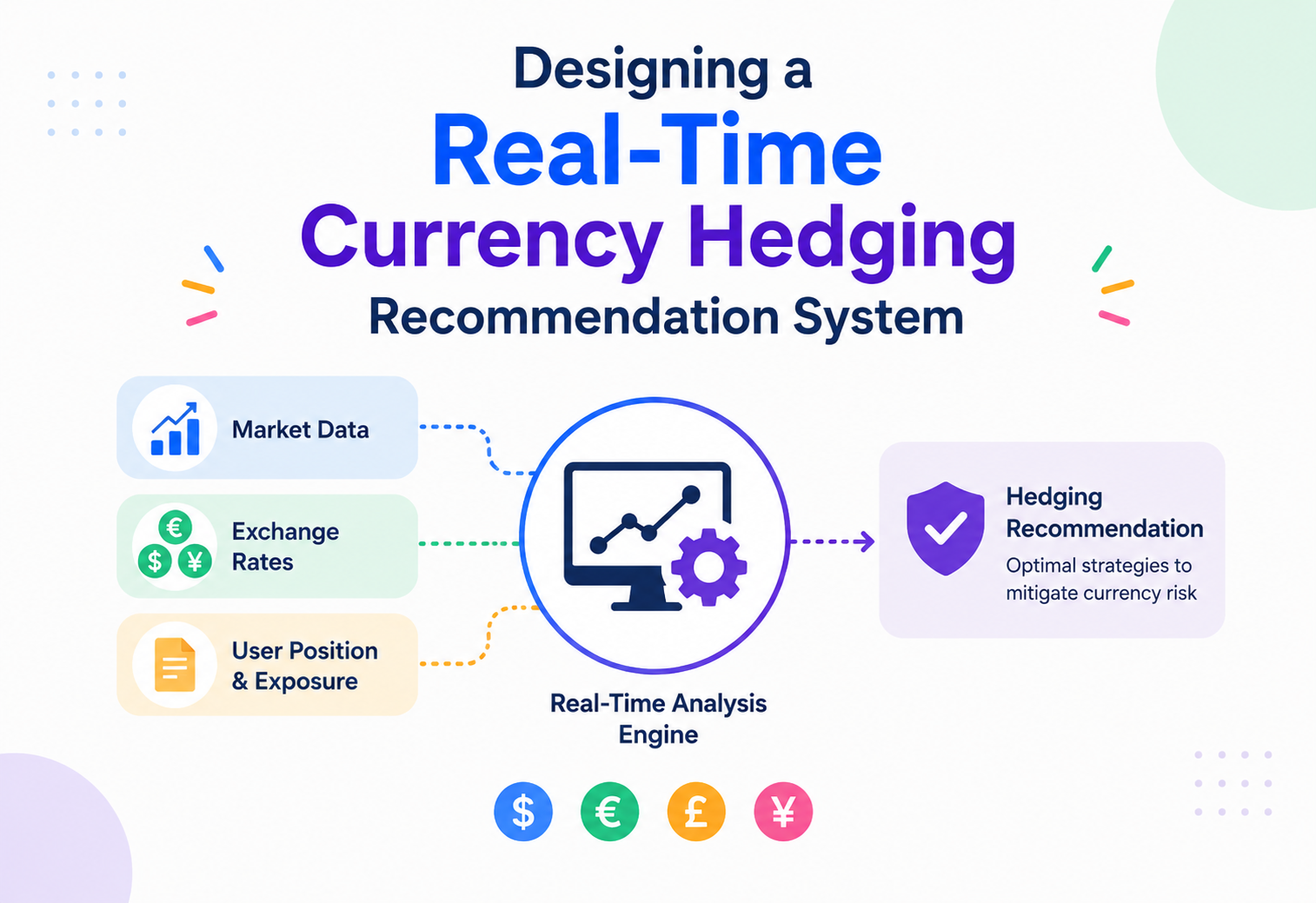
Designing a Real-Time Currency Hedging Recommendation System
How to build a system that watches a company’s international payment exposure and the currency markets simultaneously, and tells a treasury team — continuously, not just once a quarter — exactly how much foreign exchange risk they are carrying and what hedge to put on right now to protect against it.
Introduction and History
Imagine a company based in the United States that sells software to customers in Europe, pays some of its engineers in India, and buys cloud infrastructure priced in a mix of currencies. Every one of those transactions involves converting money from one currency to another at some point. If the Euro weakens against the Dollar between the day a European customer signs a contract and the day the invoice is actually paid, the company receives fewer dollars than it expected — even though the customer paid exactly what they agreed to. This gap between “what we expected in our home currency” and “what we actually received” is called foreign exchange (FX) risk, and for companies with meaningful international business, it can swing profits by millions of dollars a year without a single business decision changing.
A currency hedge is essentially an insurance policy against this risk — a financial contract (commonly a forward contract, which locks in today’s exchange rate for a transaction that will actually settle in the future) that protects the company from adverse currency moves. This tutorial designs a system that continuously calculates a business’s currency exposure and recommends — in near real time — what hedges to put on, refine, or unwind as market conditions and the business’s own payment pipeline change.
1.1 A Short History: From Quarterly Spreadsheets to Real-Time Risk Systems
Manual, Periodic Hedging (pre-2000s)
Corporate treasury teams reviewed FX exposure quarterly or monthly using spreadsheets, manually pulling data from accounting systems and placing hedges based on a snapshot that was often weeks out of date by the time it was acted on.
Treasury Management Systems (2000s–2010s)
Dedicated software consolidated exposure data from multiple systems (ERP, accounting, payment platforms) into a single view, but exposure calculations and hedge recommendations were still typically run in daily or weekly batches.
API-Driven, Event-Based Exposure Tracking (2010s onward)
As businesses started operating through cloud platforms with programmatic access to payment and billing data, it became possible to track exposure as transactions happened, rather than waiting for a batch extraction process.
Real-Time, Continuously Updated Recommendations (Today)
Modern systems combine live payment/exposure data with streaming market rates and automated hedge-sizing logic to recommend (and sometimes automatically execute, within pre-approved limits) hedges as conditions change throughout the day.
1.2 Why This Is a Genuinely Hard Problem
It is tempting to think of this as “multiply exposure by exchange rate, tell someone to hedge it.” The real difficulty comes from several forces pulling in different directions at once:
- Exposure is a moving target: New invoices are issued, payments are received, contracts are signed or cancelled, and forecasted future revenue changes constantly — the “true” exposure at any instant is a living number, not a fixed one.
- Market rates move continuously: Currency markets trade nearly 24 hours a day across global sessions, so the value of a given exposure in the company’s home currency is also constantly changing.
- Hedging has real transaction costs: Every hedge placed costs money (a spread, and sometimes a commission), so recommending a new or adjusted hedge for every tiny exposure change would be financially wasteful — the system must be selective, not reactive to every fluctuation.
- Human judgment and approval still matter: Unlike a fully automated trading system, corporate hedging usually requires a human treasury professional to review and approve recommendations, at least above certain size thresholds, because hedging strategy involves business judgment (risk appetite, cash flow timing, accounting treatment) that a pure algorithm does not fully capture.
- Accuracy has direct financial consequences: An exposure calculation that is wrong, stale, or double-counts a transaction can lead to over-hedging (locking in unnecessary cost) or under-hedging (leaving real risk unprotected) — both are expensive mistakes.
1.3 What This System Actually Delivers
By the end of the design, the system continuously produces three things for the treasury team:

- Real-time net exposure by currency pair: A live, always-current view of how much the business is exposed to each foreign currency, netted across all known receivables, payables, and forecasted future flows.
- Hedge recommendations: Specific, actionable suggestions — “hedge $2.3M of EUR exposure with a 60-day forward contract” — generated when exposure or market conditions cross meaningful thresholds, along with the reasoning behind each recommendation.
- An auditable decision trail: A full record of what exposure existed, what market conditions triggered a recommendation, who reviewed or approved it, and what hedge (if any) was ultimately executed — essential for internal risk governance and external audit.
Architecture and Components
The system needs to continuously ingest exposure-generating events from business systems, ingest live currency market data, compute net exposure per currency, evaluate hedging rules and models against that exposure, and surface clear, explainable recommendations to human treasury operators — while keeping a complete audit trail of everything.
2.1 Component-by-Component Breakdown
1. Source Connectors
Each business system that generates or forecasts foreign-currency cash flow — the ERP, billing platform, payroll system, sales contracts, and forecast tools — has a dedicated connector that pulls or receives events describing exposure-relevant activity (a new invoice issued in Euros, a payroll run in Indian Rupees, a signed contract with future Yen-denominated payments). Keeping connectors separate per source system means one system’s data quirks or outages do not affect ingestion from the others.
2. Exposure Normalizer
Different source systems describe money differently — one might report “amount and currency,” another might report amounts already converted to a reporting currency, another might use different date conventions for when a payment is expected. The Normalizer converts every incoming event into one consistent internal representation of an exposure: currency, amount, expected settlement date, source, and confidence level (a signed contract is more certain than a rough forecast).
3. Net Exposure Engine
The mathematical core of the system. It continuously aggregates all known and forecasted foreign-currency cash flows, nets offsetting exposures (money coming in in Euros can partially offset money going out in Euros), and produces a live, per-currency-pair net exposure figure, valued against the live FX feed. This is analogous to how the risk-scoring layer works in other real-time financial decisioning systems — it is the “brain” that turns raw data into a meaningful number.
4. Exposure Store
Holds the current state of net exposure per currency pair, along with the underlying contributing transactions, so the system (and human users) can always answer both “what’s our net EUR exposure right now” and “which specific invoices and forecasts make up that number.”
5. Hedging Policy Rules Engine
Applies the company’s hedging policy — deterministic, board-approved rules like “hedge at least 70% of exposure with maturity under 90 days,” “never leave more than $5M unhedged in any single currency,” “certain currencies are prohibited from hedging due to capital controls.” Just like in other risk systems, keeping policy rules separate from any predictive model keeps them explainable and instantly adjustable without retraining anything.
6. Hedge Sizing and Timing Model
Given exposure that the policy rules say should be hedged, this component determines the specific recommendation: how much to hedge, using what instrument (forward contract, option, swap), and roughly when — informed by market volatility data, forward points (the cost difference between hedging now versus later), and the exposure’s own timing profile.
7. Recommendation Generator
Assembles the final, human-readable recommendation — the specific hedge suggested, the reasoning (which exposure it covers, what market conditions triggered it, what policy rule applies), and the urgency level — and pushes it to the Treasury Dashboard and Approval Workflow.
8. Treasury Dashboard and Approval Workflow
The human-facing layer where treasury professionals see live exposure, review recommendations, and approve, modify, or reject them. Even in a highly automated system, most corporate treasury operations keep a human approval step for anything above a defined size threshold, both as a risk control and because treasury strategy involves judgment the system does not have full visibility into (like an upcoming acquisition that will change the company’s currency profile).
9. Execution Gateway
Once a hedge is approved, this component submits the actual trade instruction to the company’s bank or FX broker, and tracks confirmation that the hedge was actually executed at the agreed terms.
10. Decision Audit Ledger
Records every recommendation generated, the exposure and market data behind it, who reviewed it, and what action was ultimately taken — critical for internal risk governance, external financial audit, and post-hoc analysis of whether the hedging strategy is actually working.

- “Why separate the Hedging Policy Rules Engine from the Hedge Sizing and Timing Model?” — Policy rules encode hard, board-approved, auditable constraints (similar to compliance rules in other financial systems), while the sizing/timing model handles more nuanced, data-driven judgment about the best way to execute within those constraints — conflating them would make policy compliance harder to prove and harder to change quickly.
- “Why keep a human approval step instead of fully automating hedge execution?” — Treasury decisions often involve context the system does not fully see (upcoming corporate events, relationship considerations with banking partners, risk appetite judgment calls), and the financial stakes of an incorrect automated trade are high enough that most organizations require human sign-off above a threshold.
- “Why does the Exposure Normalizer matter so much?” — Without it, the Net Exposure Engine would be working with inconsistent, incomparable data from each source system, making accurate netting across currencies effectively impossible.
Internal Working: How a Recommendation Actually Gets Made
Zooming inside the box: what actually happens end to end when a new business event lands, from the moment an invoice is issued somewhere in the ERP to the moment a treasury operator clicks “approve” on a specific hedge suggestion.
3.1 Step 1: Exposure Events Arrive Continuously
Throughout the business day, source systems emit events: a new invoice is issued to a European customer, a payroll batch is processed in Indian Rupees, a sales contract with future Japanese Yen payments is signed. Each event flows through its connector and into the Exposure Normalizer.
3.2 Step 2: Normalization
The Normalizer converts each event into the standard internal exposure representation, tagging it with a confidence level — a signed, invoiced amount is “high confidence” (near certain to happen), while a sales forecast for next quarter is “lower confidence” (likely, but not guaranteed). This distinction matters enormously for how aggressively the system should recommend hedging against it; hedging a highly uncertain forecast at the same intensity as a confirmed invoice would be poor treasury practice.
3.3 Step 3: Net Exposure Calculation
The Net Exposure Engine continuously updates the aggregate exposure per currency pair, combining all known transactions (netting inflows against outflows in the same currency) and valuing the net position using the live FX feed. This is not a batch recalculation from scratch on every event — it is an incremental update, adding or removing the effect of each new event from the running total, which is what makes “real-time” actually achievable at scale.
3.4 Step 4: Policy Rule Evaluation
Whenever net exposure for a currency pair changes meaningfully, or market conditions shift meaningfully, the Rules Engine checks the current exposure against hedging policy — is the hedged percentage below the required minimum? Has an exposure threshold been crossed? Is there an approaching settlement date that needs urgent attention? If a rule is triggered, the flow proceeds to sizing and timing; if not, the system simply keeps watching.
3.5 Step 5: Hedge Sizing and Timing
When a rule triggers, the Sizing and Timing Model calculates a specific recommendation: the exact amount to hedge (often the gap between current hedge coverage and the policy-required minimum), the most suitable instrument given the exposure’s timing profile, and a timing recommendation informed by current volatility and forward points (for example, flagging if current market conditions make forward rates unusually favorable or unfavorable compared to recent history).
3.6 Step 6: Recommendation Delivery and Human Review
The Recommendation Generator produces a clear, explainable suggestion and surfaces it on the Treasury Dashboard, with supporting context (which invoices/contracts make up the exposure, what policy rule triggered it, current market conditions). A treasury professional reviews, and either approves it (sending it to the Execution Gateway), modifies the size or instrument, or dismisses it with a documented reason.
3.7 Step 7: Execution and Audit
Approved recommendations are submitted through the Execution Gateway to the relevant bank or broker, and every step — from the original exposure data through the final executed trade — is written to the Decision Audit Ledger.
3.8 Avoiding Over-Reaction to Every Market Tick
Currency markets move continuously — literally every second during active trading hours. If the system re-evaluated and re-recommended hedges on every single price tick, it would flood treasury teams with noise and encourage excessive, costly trading. Instead, the system uses meaningful-change thresholds and debouncing: recommendations are only generated when net exposure changes by a significant amount, when a policy threshold is actually crossed, or when market conditions move beyond a defined volatility band — not on every minor fluctuation.
“Real-time” here does not mean “react to every price tick with a new trade recommendation.” It means the underlying exposure and market picture is always current, so that when a genuine, policy-relevant change occurs, the system notices and acts on it within seconds or minutes rather than waiting for the next quarterly review. Most of the time, the system is simply watching and confirming that current hedge coverage remains adequate — silence is often the correct, intended behavior.
- “How do you avoid generating excessive hedge recommendations every time the exchange rate ticks slightly?” — Discuss meaningful-change thresholds, debouncing, and policy-driven triggers rather than continuous re-evaluation against every price tick.
- “Why does exposure confidence level (confirmed invoice vs forecast) matter to the sizing logic?” — Hedging low-confidence forecasted exposure at the same intensity as confirmed exposure risks over-hedging if the forecast does not materialize, so sizing logic typically scales recommended hedge amounts by confidence level.
- “Why is net exposure updated incrementally rather than recalculated from scratch on every event?” — Recalculating the full aggregate from all underlying transactions on every single event would not scale to a high event volume; incremental updates keep the running total current with minimal computation per event.
Data Flow and Lifecycle
Three lifecycles operate at different speeds here: the exposure event lifecycle (continuous, seconds to minutes), the market data lifecycle (continuous, sub-second to seconds), and the hedge decision and settlement lifecycle (minutes for approval, but the hedge contract itself may not settle for weeks or months).
4.1 Exposure Event Lifecycle
- An event occurs in a source system (invoice issued, payroll run, contract signed, forecast updated).
- The event is normalized and used to update the live Net Exposure Engine’s running totals.
- The underlying transaction remains linked to the exposure calculation so it can be traced later (which invoice contributed to this recommendation).
- When the underlying transaction eventually settles (the invoice is paid, the payroll is disbursed), the exposure is removed from the “open” calculation — the risk it represented has now been realized or resolved.
4.2 Market Data Lifecycle
- Live FX rates and related market data (volatility, forward points) stream continuously from market data providers.
- The Net Exposure Engine uses the latest rates to value open exposure in the company’s reporting currency.
- The Sizing and Timing Model uses volatility and forward point data to assess whether current market conditions favor hedging now versus waiting.
- Historical market data is retained for backtesting hedging strategies and for audit purposes (proving what market conditions existed when a specific recommendation was made).
4.3 Hedge Decision and Settlement Lifecycle
- A recommendation is generated and presented to a treasury operator.
- The operator approves, modifies, or rejects it, typically within minutes to hours.
- An approved hedge is executed with a bank or broker, generating a trade confirmation.
- The hedge contract itself (say, a 90-day forward) remains “open” on the books until its maturity date, at which point it settles — and this settlement event itself feeds back into the exposure picture, since the hedge no longer needs to be tracked as an open protective position once it has served its purpose.
- “Why does an executed hedge’s maturity event need to feed back into the exposure calculation?” — Once a hedge settles, the protection it provided is complete, so continuing to count it as an open protective position would misrepresent the company’s actual current hedge coverage, potentially causing under- or over-hedging on subsequent recommendations.
- “Why retain historical market data rather than just using the latest rate?” — Backtesting new hedging strategies requires historical data, and audit/compliance requirements often mandate proving exactly what market conditions existed at the moment a specific recommendation or trade was made.
Advantages, Disadvantages and Trade-offs
Every design choice below carries a specific cost as well as a benefit. Being explicit about them is what separates a defensible architecture from one that quietly under-delivers once the honeymoon of the launch demo is over.
5.1 Advantages
- Materially reduced FX risk exposure time: Moving from quarterly manual reviews to continuous monitoring means the business is protected against adverse currency moves far sooner, reducing the window during which unhedged risk sits on the books.
- More precise hedge sizing: Real-time, granular exposure data (down to individual invoices and confidence levels) allows more accurate hedge amounts than periodic, aggregated spreadsheet-based estimates.
- Consistent, auditable application of policy: Automated rule evaluation applies the same hedging policy every time, reducing the risk of inconsistent, ad hoc treasury decisions across different team members or time periods.
- Faster reaction to market volatility: The system can flag unusually favorable or risky market conditions the moment they occur, rather than a treasury team discovering them days later during a scheduled review.
5.2 Disadvantages and Costs
- Significant integration complexity: Connecting to multiple business source systems (ERP, billing, payroll, contracts, forecasting) each with different data models and update patterns is a substantial ongoing engineering investment.
- Risk of over-hedging low-confidence forecasts: If confidence weighting is not handled carefully, the system can recommend hedging speculative forecasts too aggressively, locking in unnecessary transaction costs for exposure that may never materialize.
- Market data costs: High-quality, low-latency FX rate and volatility data feeds are a recurring, sometimes substantial, licensing expense.
- Requires ongoing human oversight regardless of automation: The system does not eliminate the need for skilled treasury professionals — it changes their role from manual data-gathering to reviewing and approving well-informed recommendations, which still requires investment in the right talent and workflow.
5.3 Key Trade-off Table
| Decision | Choice Made | What We Gain | What We Give Up |
|---|---|---|---|
| Recommendation trigger frequency | Threshold-based, debounced triggers rather than continuous re-evaluation | Fewer, higher-quality recommendations; lower noise for treasury team | A small delay between a minor exposure change and any resulting action |
| Confidence-weighted exposure | Lower-confidence forecasts hedged less aggressively than confirmed transactions | Avoids over-hedging speculative exposure | Slightly more complex sizing logic to build, test, and explain |
| Human approval requirement | Mandatory review above a size threshold, rather than full automation | Retains business judgment and risk control on large decisions | Slower execution than a fully automated system; requires available, trained staff |
| Market data sourcing | Licensed, low-latency live FX and volatility feeds | Accurate, timely valuation and sizing decisions | Ongoing licensing cost, vendor dependency |
Where This Design Shines
- Multinational firms with meaningful exposure across several currency pairs at once
- Businesses whose invoice and payroll cycles produce continuous, unpredictable exposure change
- Regulated environments requiring explainable, auditable hedging decisions
- Organizations wanting to keep policy tuning in the hands of treasury, not engineering
Where It Is Overkill
- Small companies with a single currency pair and one predictable exposure per quarter
- Businesses whose FX exposure is trivially small relative to margins
- Cases where corporate policy simply forbids hedging altogether
- Early-stage startups still validating whether cross-border revenue will scale at all
Section Takeaway
This system’s value comes from turning FX risk management from a periodic, backward-looking exercise into a continuous, forward-looking one — but “continuous” must be paired with careful thresholding and confidence-awareness, or it simply produces continuous noise instead of continuous insight.
Performance and Scalability
Unlike a customer-facing system where a human is staring at a loading spinner, this system’s latency requirements are shaped by financial materiality rather than a user’s patience. A reasonable target: net exposure figures should reflect new events within a few seconds to low minutes, and hedge recommendations should be generated within seconds of a policy threshold being crossed — fast enough that a treasury team is acting on genuinely current information, not information that is hours old.
6.1 Where Load Actually Comes From
Two very different load patterns exist side by side: a relatively modest volume of business exposure events (perhaps thousands to tens of thousands per day for a large multinational company, arriving in bursts around invoicing cycles and payroll runs), and a very high volume of market data ticks (potentially thousands per second across all tracked currency pairs during active trading hours). The architecture must handle these two very different scales without either overwhelming the other.

6.2 Techniques for Handling Scale
- Separate processing paths for exposure events and market data ticks: Market data updates the “current rate” used for valuation continuously and cheaply (a simple in-memory update), while exposure recalculation and rule evaluation only run when something meaningfully changes — avoiding wasted computation on every single price tick.
- Incremental exposure aggregation: As mentioned earlier, updating a running total incrementally per event, rather than recomputing from all historical transactions, keeps per-event processing cost low and constant regardless of how much historical data exists.
- In-memory current-state store: The live net exposure per currency pair is kept in a fast, in-memory structure for instant reads by the dashboard and rules engine, with periodic durable snapshots for recovery.
- Batching non-urgent source system syncs: Not every source system needs sub-second event delivery — a forecast system that updates weekly can be polled on a much more relaxed schedule than a billing system issuing real-time invoices.
6.3 Scaling Considerations
The exposure and recommendation engine is largely a single logical view per company (net exposure has to be globally consistent, not sharded arbitrarily), so scaling here focuses more on efficient in-memory computation and read replicas for dashboard queries than on massive horizontal partitioning. Market data ingestion, by contrast, scales more like a typical high-throughput streaming problem and can be partitioned by currency pair across multiple consumer instances.
to reflected exposure
during active hours
net exposure per company
Corporate treasury platforms serving large multinational businesses typically report that market data ingestion volume dwarfs business exposure event volume by several orders of magnitude, which is why these systems are usually architected with two distinct scaling strategies: a straightforward, moderately-scaled pipeline for business events, and a purpose-built, high-throughput streaming pipeline for market data.
- “Why not recalculate rule evaluation on every single market data tick?” — The recommendation logic cares about meaningful, policy-relevant changes, not every micro-fluctuation; continuous re-evaluation would waste compute and flood treasury teams with noise for no real decision-making benefit.
- “Why is net exposure typically not sharded the way a high-throughput consumer system might be?” — Net exposure per currency pair needs to reflect a single, globally consistent aggregate across the whole business; arbitrarily partitioning it would risk producing multiple inconsistent partial views rather than one authoritative number.
High Availability and Reliability
An outage here does not cause an immediate customer-facing failure the way a checkout system going down would — but it can quietly leave a business’s real FX risk unmonitored and unmanaged, which is a slow-building but serious financial risk in its own right. Reliability here is about never silently losing visibility into exposure, and never acting on stale or incorrect market data without knowing it.
7.1 Redundancy at Every Layer
- Redundant market data feeds: A primary and secondary FX data provider, with automatic failover, since a single provider outage should never leave the system blind to current market rates.
- Multi-instance, multi-zone deployment for the exposure engine and rules engine, so a single instance or zone failure does not halt exposure tracking.
- Durable event sourcing for exposure events: Every normalized exposure event is durably persisted before being applied to the in-memory running total, so the current state can always be reconstructed even after a failure.
7.2 Failure Handling Strategies
- Staleness detection on market data: If the live FX feed stops updating (a common real failure mode — a feed staying “up” but silently stuck on old prices), the system must actively detect this and clearly flag exposure valuations as potentially stale, rather than silently continuing to use an outdated rate as if it were current.
- Circuit breakers around source system connectors: If a source system integration starts failing, the connector backs off and alerts, rather than repeatedly hammering a struggling upstream system or silently dropping events.
- Reconciliation jobs: Periodic jobs that recompute net exposure from the full underlying event history and compare it against the live running total, catching any drift caused by a missed event, a bug, or a recovery gap, before it accumulates into a materially wrong number.
- Fail-safe on recommendation generation: If the system is uncertain about data quality (stale market data, an incomplete source system sync), it should suppress new recommendations and clearly flag the uncertainty, rather than generating a recommendation based on data it cannot fully trust.
7.3 Disaster Recovery
Given that exposure calculations and the audit trail directly support financial risk decisions, the Decision Audit Ledger and Exposure Store both need a near-zero Recovery Point Objective. Regular, tested backups and a cross-region failover plan are standard, along with clear runbooks for “primary market data feed is down” and “a source system integration has been silently failing for hours” scenarios — the latter being a genuinely common and easy-to-miss failure mode in systems like this.
- “How would you detect a market data feed that’s technically ‘up’ but silently stuck on stale prices?” — Monitor the actual update frequency and rate-of-change of incoming data, not just connection health; a feed that stops changing values while still returning HTTP 200 responses is a classic, dangerous failure mode that simple uptime checks miss.
- “Why run periodic reconciliation against the full event history if the running total is updated incrementally on every event?” — Incremental updates are efficient but can silently drift from the true total due to missed events, processing bugs, or recovery gaps; periodic full recomputation acts as a safety net to catch and correct that drift before it becomes materially significant.
Security and Compliance
This system touches highly sensitive financial data — a company’s exact revenue, cost structure, and forward-looking business plans, all inferable from its currency exposure — plus it has the ability to trigger real trades with real money. Security here spans both data protection and strict control over who can approve and execute financial transactions.
8.1 Data Protection
- Encryption in transit and at rest for all exposure data, contract details, and market data, given how commercially sensitive this information is (competitors would find a company’s exact revenue mix and cost exposure extremely valuable).
- Strict access segmentation: Detailed transaction-level exposure data is typically restricted to treasury and finance personnel, while broader teams might see only aggregated, non-sensitive summaries if they need visibility at all.
- Immutable audit logging: The Decision Audit Ledger must be tamper-evident, since it is the record that proves the company followed its own hedging policy and regulatory obligations.
8.2 Authentication and Authorization
- Strong authentication (typically multi-factor) for any user with approval or execution authority, given the direct financial stakes.
- Role-based access control with clear separation of duties — commonly, the person who can generate or modify a hedging policy rule is different from the person who approves individual trade recommendations, and different again from the person with execution authority, to prevent any single individual from having end-to-end unchecked control.
- Service-to-service authentication (mutual TLS, short-lived credentials) between internal components, and carefully scoped, audited credentials for the Execution Gateway’s connection to banks and brokers.
8.3 Financial Control Considerations
- Approval limits and dual control: Hedges above certain size thresholds commonly require two independent approvals (a “four-eyes” principle), enforced by the Approval Workflow, not left as an informal team practice.
- Segregation of duties: Following standard treasury control frameworks, the system should structurally prevent the same person from both recommending/approving a hedge and executing or confirming it, reducing the risk of error or misconduct going unchecked.
- Regulatory and accounting alignment: Depending on jurisdiction and accounting standards, hedge accounting treatment (whether a hedge qualifies for specific accounting treatment that reduces earnings volatility) has its own documentation requirements, which the audit trail should support.
Allowing a single role or a single automated pipeline to both generate a hedge recommendation and execute it without any independent checkpoint is a serious internal control weakness, even if the underlying logic is technically correct. Financial control frameworks in most organizations require segregation of duties specifically to catch errors, bugs, or misuse that a single unified process — however well-tested — could otherwise let through unnoticed.
- “Why require dual approval for large hedge recommendations instead of trusting the system’s calculation?” — Segregation of duties is a standard financial control principle that protects against both software bugs and potential misuse, independent of how accurate the underlying calculation logic is believed to be; a second human check catches classes of error a single automated or single-approver process cannot.
- “What’s commercially sensitive about currency exposure data, beyond the obvious financial risk?” — A detailed view of a company’s currency exposure effectively reveals its revenue and cost mix across countries, which is competitively sensitive information that needs the same protection as other core business intelligence.
Monitoring, Logging and Metrics
A system whose whole point is producing trustworthy financial guidance has to be watched both as an engineering system (latency, saturation, error rate) and as a risk system (coverage ratio, acceptance rate, drift). Missing either lens is enough to let a subtle problem go undetected until it becomes an expensive one.
9.1 Golden Signals for This System
- Latency: Time from a source event arriving to it being reflected in net exposure; time from a policy threshold being crossed to a recommendation being generated.
- Traffic: Exposure events processed per hour by source system; market data ticks processed per second by currency pair.
- Errors: Source connector failure rates, market data feed staleness incidents, failed reconciliation runs.
- Saturation: Queue depth for exposure event processing, especially during known high-volume periods like month-end invoicing runs.
9.2 Business and Risk Health Metrics (Unique to This Domain)
- Hedge coverage ratio: What percentage of exposure (by currency, by maturity bucket) is currently hedged versus the policy target — tracked continuously as a core treasury KPI.
- Recommendation acceptance rate: How often treasury operators approve recommendations as-is versus modify or reject them — a consistently low acceptance rate may indicate the sizing model or policy rules need recalibration.
- Time-to-approval: How long recommendations sit awaiting human review — an important signal for whether the human-in-the-loop step is becoming a bottleneck during volatile market periods.
- Reconciliation drift magnitude: How much the incrementally-maintained exposure total differs from the periodically recomputed full total — a growing drift over time is an early warning of a data quality or processing bug.
- Realized hedge effectiveness: After the fact, comparing how much a hedge actually protected against adverse currency movement versus its cost, feeding back into refining the sizing and timing model over time.
9.3 Alerting Philosophy
Infrastructure alerts (a connector down, a feed unresponsive) page engineering immediately. Risk-relevant alerts (hedge coverage ratio falling meaningfully below policy target, a large new exposure appearing without a corresponding recommendation) notify the treasury team directly, since the appropriate response is a treasury judgment call, not a purely technical fix.
- “What single metric would you show a treasury leader as the headline health indicator for this system?” — Hedge coverage ratio against policy target, broken down by currency and maturity bucket, is typically the most business-relevant single number, since it directly reflects whether the company’s actual risk protection matches its stated risk appetite.
- “How would you know if your hedge sizing model was systematically wrong, not just occasionally off?” — Track realized hedge effectiveness over time and recommendation acceptance/modification rates; a consistent pattern of treasury operators resizing recommendations in the same direction is a strong signal the model’s calibration needs revisiting.
Deployment and Cloud Considerations
Because this system’s output moves real money, deployment discipline — gradual rollout, backtesting before release, and configuration-driven policy — matters at least as much as raw uptime engineering.
10.1 Application Service Deployment
- Containerized microservices for each major component (connectors, normalizer, exposure engine, rules engine, sizing model, recommendation generator, execution gateway), independently deployable and scalable.
- Careful, gradual rollout for changes to sizing and policy logic: Given the direct financial impact of this logic, changes are typically validated against historical exposure and market data (backtesting) before deployment, and rolled out with close monitoring of recommendation acceptance rates as an early signal of unexpected behavior.
- Configuration-driven policy rules: Hedging policy thresholds are stored as data, not hardcoded logic, so treasury and risk teams can adjust policy (with appropriate approval and audit trail) without requiring an engineering deployment.
10.2 Cloud Considerations
- Data residency: For multinational businesses, financial data residency requirements may dictate where exposure and transaction data can be processed and stored, similar to considerations in other regulated financial systems.
- Market data provider proximity: For latency-sensitive market data ingestion, hosting infrastructure closer to major market data provider endpoints reduces feed latency, though the sub-second timing sensitivity here is generally far less extreme than in high-frequency trading systems.
- Managed streaming and database services: Many teams lean on managed services for event streaming and durable storage to reduce operational burden, given the relatively modest (compared to consumer-scale systems) but still meaningful throughput this system needs to handle reliably.
- “Why backtest changes to the sizing model against historical data before deploying them?” — Because the model’s output directly influences real financial decisions, validating that a change behaves sensibly against known historical exposure and market scenarios catches problems before they affect a live recommendation, much like champion/challenger testing in other risk-scoring systems.
Databases, Caching and Load Balancing
Different kinds of data in this system have very different durability, latency, and query-pattern requirements. Trying to serve them all from one store is a classic way to end up with something that is bad at both the fast path and the audit path.
11.1 Choosing the Right Store for Each Job
| Data | Store Type | Why |
|---|---|---|
| Raw Exposure Events (event log) | Durable, append-only event store | Source of truth for reconstructing exposure state; needed for reconciliation and audit |
| Current Net Exposure State | In-memory store with periodic durable snapshots | Needs fast reads for the dashboard and rules engine; must survive restarts without full recomputation |
| Live Market Rates | In-memory cache, updated continuously from the feed | Extremely high read frequency, extremely high update frequency; durability of any single tick is not critical |
| Historical Market Data | Time-series database or data warehouse | Needed for backtesting and audit; optimized for range queries over time, not point lookups |
| Decision Audit Ledger | Durable, tamper-evident, strongly consistent store | Regulatory and internal control requirement to prove exactly what happened and why |
11.2 Caching Strategy
- Live rate cache: The current best-known rate per currency pair is kept in a fast in-memory cache, updated continuously as new ticks arrive, and read by both the exposure engine and the dashboard without hitting the raw market feed on every read.
- Deliberately not caching audit-relevant snapshots: Just as compliance screening results should not be cached and reused in an identity verification system, the exact market conditions and exposure figures backing a specific recommendation are captured and stored precisely at that moment, not approximated from a cache that might have since moved on.
- Reference data caching: Relatively static configuration — supported currency pairs, hedging instrument definitions, policy rule thresholds — is cached aggressively since it changes infrequently and is read constantly.
11.3 Load Balancing
- Partitioning market data ingestion by currency pair across multiple consumer instances, since different pairs are independent streams that do not need to be processed by the same instance.
- Health-check-aware routing for the dashboard and API layer, standard for any multi-instance service deployment.
- Read replicas for the audit ledger and historical data stores to keep reporting and backtesting queries from competing with the live write path.
This mirrors a pattern seen across real-time financial systems: separate the “fast, frequently-updated, okay-to-lose-a-tick” data (live rates) from the “must be exact and durable” data (the audit trail). Treating both with the same storage strategy either makes the fast path too slow (over-engineering durability where it is not needed) or the audit trail too fragile (under-engineering durability where it is legally required).
- “Why is losing a single market data tick generally acceptable, while losing a single audit ledger entry is not?” — A missed rate tick is immediately superseded by the next one arriving fractions of a second later, with negligible impact; a missing audit entry is a permanent, irrecoverable gap in the company’s ability to prove what happened and why, which has real legal and governance consequences.
APIs and Microservices Design
Two very different traffic shapes coexist here — a human treasury operator actively reading the dashboard, and a background stream of events that must never block on that human. The API design keeps them cleanly separated.
12.1 External and Internal API Design
The Treasury Dashboard consumes a query API for current net exposure, active recommendations, and historical decisions — largely synchronous, read-oriented calls. Source system connectors, by contrast, are mostly event producers, pushing (or being polled for) exposure-relevant events rather than serving synchronous requests. The Execution Gateway exposes a narrow, tightly controlled API for submitting approved trade instructions, deliberately kept separate from any broader internal API surface given its direct financial impact.
12.2 Internal Service Boundaries
Following the same single-responsibility principle used throughout this tutorial series: the Normalizer standardizes data but does not calculate exposure; the Net Exposure Engine calculates exposure but does not apply policy; the Rules Engine applies policy but does not decide sizing; the Sizing Model sizes hedges but does not execute them; the Execution Gateway executes but has no say in whether a hedge should happen in the first place. This separation lets treasury policy owners, quantitative/risk modelers, and platform engineers each work on their piece independently.
12.3 Synchronous vs Asynchronous Communication
- Synchronous: Dashboard queries for current exposure and recommendation status, since a treasury operator is actively viewing and expecting an immediate answer.
- Asynchronous (event-driven): Exposure event ingestion, market data processing, recommendation generation, audit logging, and alerting — none of these need to block on a synchronous caller, and decoupling them lets each stage scale and fail independently.
- “Why is the Execution Gateway’s API kept deliberately narrow and separate from the rest of the internal API surface?” — It is the one component with direct authority to move real money via trade instructions, so minimizing its API surface and access reduces the blast radius of any bug, misconfiguration, or credential compromise.
- “Why is exposure event ingestion asynchronous rather than a direct synchronous call from each source system?” — Decoupling lets each source system’s connector operate independently, absorbs bursts (like a month-end invoicing spike) without blocking the source system itself, and allows the exposure engine to process events at its own sustainable pace.
Design Patterns and Anti-Patterns
The patterns below are not novel inventions — they are the disciplined re-application of proven building blocks that real-time financial decisioning systems keep converging on, alongside the anti-patterns that keep sinking teams that try to skip them.
13.1 Patterns Used in This System
- Event Sourcing: Exposure state is derived from a durable, ordered log of exposure events, allowing the current state to be reconstructed or reconciled at any time from the underlying history.
- CQRS-like separation (conceptually): Writes (new exposure events) and reads (dashboard queries against current state) are handled through different paths optimized for their very different access patterns.
- Circuit Breaker: Protects the system from cascading issues when a source system connector or market data feed becomes unhealthy.
- Adapter Pattern (conceptually): Source connectors normalize each business system’s different data shape into one consistent internal exposure representation.
- Threshold-Based / Debounced Triggering: Recommendations are generated only on meaningful, policy-relevant change, not on every underlying data update — a pattern useful anywhere continuous data would otherwise produce excessive noise.
- Segregation of Duties (organizational/control pattern): Distinct roles for recommendation, approval, and execution, enforced structurally by the system rather than left as informal practice.
13.2 Anti-Patterns to Avoid
- Recalculating everything from scratch on every event: Wasteful and does not scale; incremental updates with periodic reconciliation is the sounder approach.
- Treating every exposure forecast as equally certain: Ignoring confidence levels leads to over-hedging speculative, uncertain future exposure.
- Fully automating trade execution with no human checkpoint: Removes an important business judgment and control layer that most organizations require for financial risk decisions of meaningful size.
- Silently continuing on stale market data: Using an outdated rate without flagging it can produce confidently wrong recommendations, which are more dangerous than an honest “we do not have current data” state.
- Hardcoding hedging policy thresholds in application code: Makes it slow and risky for treasury and risk teams to adjust policy in response to changing business or market conditions.
- Combining recommendation, approval, and execution authority in one role or one automated pipeline: Weakens financial control and removes an important independent check.
- “Why is event sourcing a good fit for the exposure calculation, specifically?” — It provides a durable, replayable history that supports both incremental real-time updates and full reconciliation from source truth, which matters heavily given the financial and audit stakes of getting the exposure number right.
Best Practices and Common Mistakes
The best practices below are the ones experienced FinTech and treasury teams keep converging on, and the mistakes are the ones that keep appearing in post-incident reviews after a real over- or under-hedged position produced a real financial surprise.
14.1 Best Practices
- Weight exposure by confidence level (confirmed transaction vs forecast) throughout the sizing logic, not just as an afterthought filter.
- Use threshold-based, debounced triggering for recommendations to avoid overwhelming treasury teams with noise from minor market fluctuations.
- Keep hedging policy externally configurable and auditable, so risk and treasury teams can adjust it quickly without an engineering release cycle.
- Always detect and flag stale market data explicitly, rather than silently continuing to use it — an honest “we do not know” is safer than a confident wrong answer.
- Build reconciliation into the architecture from day one, comparing incrementally-maintained state against periodically recomputed full totals to catch drift early.
- Enforce segregation of duties structurally in the system, not just as a documented policy that relies on people following it correctly.
- Backtest changes to sizing and policy logic against historical data before deploying them, given the direct financial consequences of getting this logic wrong.
14.2 Common Mistakes
- Underestimating integration effort with legacy source systems — ERP and accounting systems, especially older ones, often have inconsistent, poorly documented data models that take significant effort to normalize reliably.
- Ignoring the cost of over-hedging — focusing purely on “are we protected against currency risk” without also tracking the transaction cost of excessive or premature hedging.
- No clear ownership of hedging policy thresholds — leaving them to drift out of date as the business’s risk profile changes without anyone actively revisiting them.
- Not testing against realistic market volatility scenarios — validating the system only against calm, stable market conditions, then being surprised by how it behaves during a genuine currency crisis or shock event.
- Treating the audit ledger as a nice-to-have logging feature rather than a core system requirement from day one, leading to gaps that are difficult or impossible to backfill later.
14.3 A Pre-Launch Readiness Checklist
| Check | Question to Confirm Before Launch |
|---|---|
| Confidence weighting | Does the sizing model actually scale by confidence, verified against forecast-vs-invoice test data? |
| Debounce policy | Have thresholds been tuned on realistic historical volatility, not just a calm week of data? |
| Stale-feed detection | Is feed staleness detected by rate-of-change, not just connection uptime? |
| Reconciliation | Is a periodic full recompute wired in from day one, with drift alerts? |
| Segregation of duties | Can the system structurally prevent one person from recommending, approving, and executing? |
| Backtest gate | Are changes to sizing/policy blocked from deployment without a passing backtest? |
| Audit ledger | Is every recommendation, approval, and execution captured immutably, verified end to end? |
Section Takeaway
The best currency hedging systems succeed not by eliminating human judgment, but by making sure human treasury experts always have accurate, current, well-explained information in front of them at exactly the moments that matter — and by building enough guardrails (confidence weighting, thresholding, reconciliation, segregation of duties) that the automation itself never becomes a new source of risk.
Real-World and Industry Examples
The design principles above are not theoretical — they show up, with minor variations, in the treasury and risk infrastructures of every large multinational business, dedicated treasury software vendor, and cross-border supply chain operator.
Multinational Technology and E-Commerce Companies
Large technology and e-commerce businesses with significant international revenue are widely known for investing in continuous, programmatic FX exposure tracking, since even modest percentage swings in major currency pairs can materially affect reported earnings when applied across very large international revenue bases.
Dedicated Treasury Management Platforms
Specialized treasury management software vendors have increasingly built real-time exposure tracking and hedge recommendation capabilities directly into their platforms, integrating with common ERP and banking systems — reflecting the same architectural pattern of source connectors feeding a central exposure engine described in this tutorial, packaged as a vendor product rather than built entirely in-house.
Import/Export and Manufacturing Businesses
Companies with significant cross-border supply chains (paying overseas suppliers in one currency while selling finished goods in another) are a classic real-world case for this kind of system, since their exposure often spans many currency pairs simultaneously with meaningfully different maturity profiles across payables and receivables.
Common Threads Across the Industry
Nearly all mature treasury systems in this space separate policy rules from sizing/timing logic, mirroring the same explainability and auditability reasoning seen in other regulated financial decisioning systems; human approval workflows for hedges above a size threshold are close to universal; and confidence-weighted exposure (distinguishing confirmed transactions from forecasts) is a consistently cited best practice for avoiding costly over-hedging of speculative future exposure.
- “How might this design differ for a company with exposure concentrated in a single currency pair versus one with exposure spread across twenty currency pairs?” — Discuss how a single-pair business can rely on simpler, more centralized rule evaluation, while a twenty-pair business needs the market data and rules evaluation layers to scale efficiently per currency pair, likely through partitioned, parallelized processing.
Frequently Asked Questions
The most common questions that come up in interviews and treasury design reviews for this class of system, each answered in the same language a Software Architect would use when talking to a room of mixed-experience engineers and treasury professionals.
Typically not for anything beyond small, pre-approved thresholds. Most organizations require human review and approval for hedge recommendations above a defined size, both as a financial control measure and because treasury strategy involves business judgment the system does not have full visibility into. The system’s role is to make sure that human review is based on accurate, current, well-explained information — not to remove the human from the loop entirely.
Because hedging is not free — it has real transaction costs — hedging uncertain, speculative future exposure at the same intensity as confirmed, near-certain exposure risks locking in unnecessary cost for exposure that may never actually materialize. Confidence-weighted sizing avoids this by scaling recommended hedge amounts based on how certain the underlying exposure actually is.
The system detects the staleness (rather than silently continuing to use an old rate as if it were current), flags existing exposure valuations as potentially stale, and suppresses new hedge recommendations until fresh, trustworthy market data is available again — since a recommendation based on unknown or stale market conditions could be materially wrong.
A bank’s or trading firm’s FX system is typically optimized for speed and profit from trading itself, often operating with minimal human latency in the decision loop. This corporate treasury system, by contrast, exists purely to protect an operating business from currency risk on its actual commercial activity — the goal is not to profit from currency movements, it is to reduce their impact on the business’s real financial results, which is why human oversight and conservative, policy-driven triggering matter so much more here than raw execution speed.
Real-time, incremental updates are efficient but can drift from the true total over time due to a missed event, a processing bug, or a gap during a system recovery. Periodic reconciliation recomputes the full total from the underlying event history and compares it against the running total, catching and correcting any drift before it becomes a materially significant error.

Summary and Key Takeaways
A compact summary of the design and the ideas most worth carrying forward into any conversation about corporate currency hedging — whether in a system design interview, a treasury design review, or an engineering team’s planning meeting.
Designing a real-time currency hedging recommendation system means continuously connecting two very different worlds — a business’s own operational activity (invoices, payroll, contracts, forecasts) and the constantly moving global currency markets — and turning that combination into clear, timely, explainable, and appropriately cautious guidance for the humans who ultimately carry responsibility for the company’s financial risk.
Key Takeaways
- Separate the continuous, incremental exposure tracking from the selective, threshold-triggered recommendation generation — real-time visibility does not mean reacting to every tiny change.
- Weight exposure by confidence level so speculative forecasts are not hedged as aggressively as confirmed transactions, avoiding costly over-hedging.
- Keep policy rules, sizing logic, and execution as distinct, separately-owned components, mirroring the explainability and auditability benefits seen across other regulated financial decisioning systems.
- Treat market data staleness detection as a first-class reliability concern — a feed that’s technically “up” but silently stuck on old prices is a genuinely dangerous, easy-to-miss failure mode.
- Segregation of duties between recommendation, approval, and execution should be enforced structurally by the system, not left as an informal team practice.
- Build reconciliation between incremental and full-recompute exposure totals into the architecture from the start, as a safety net against silent drift.
- The goal is not to remove human treasury judgment — it is to make sure that judgment is always applied to accurate, current, and clearly explained information, at exactly the moments when it matters most.
Built this way, the system gives a business something genuinely valuable: the confidence that its exposure to global currency swings is being watched continuously, not rediscovered weeks too late in a quarterly spreadsheet review — while still keeping a skilled human squarely in charge of the final call.
The best hedging recommendation systems are the ones that make a treasury team’s daily job feel calmer, not busier — they surface the small number of moments that truly demand a decision, and they stay quiet the rest of the time. Silence, in this system, is a feature, not a bug.