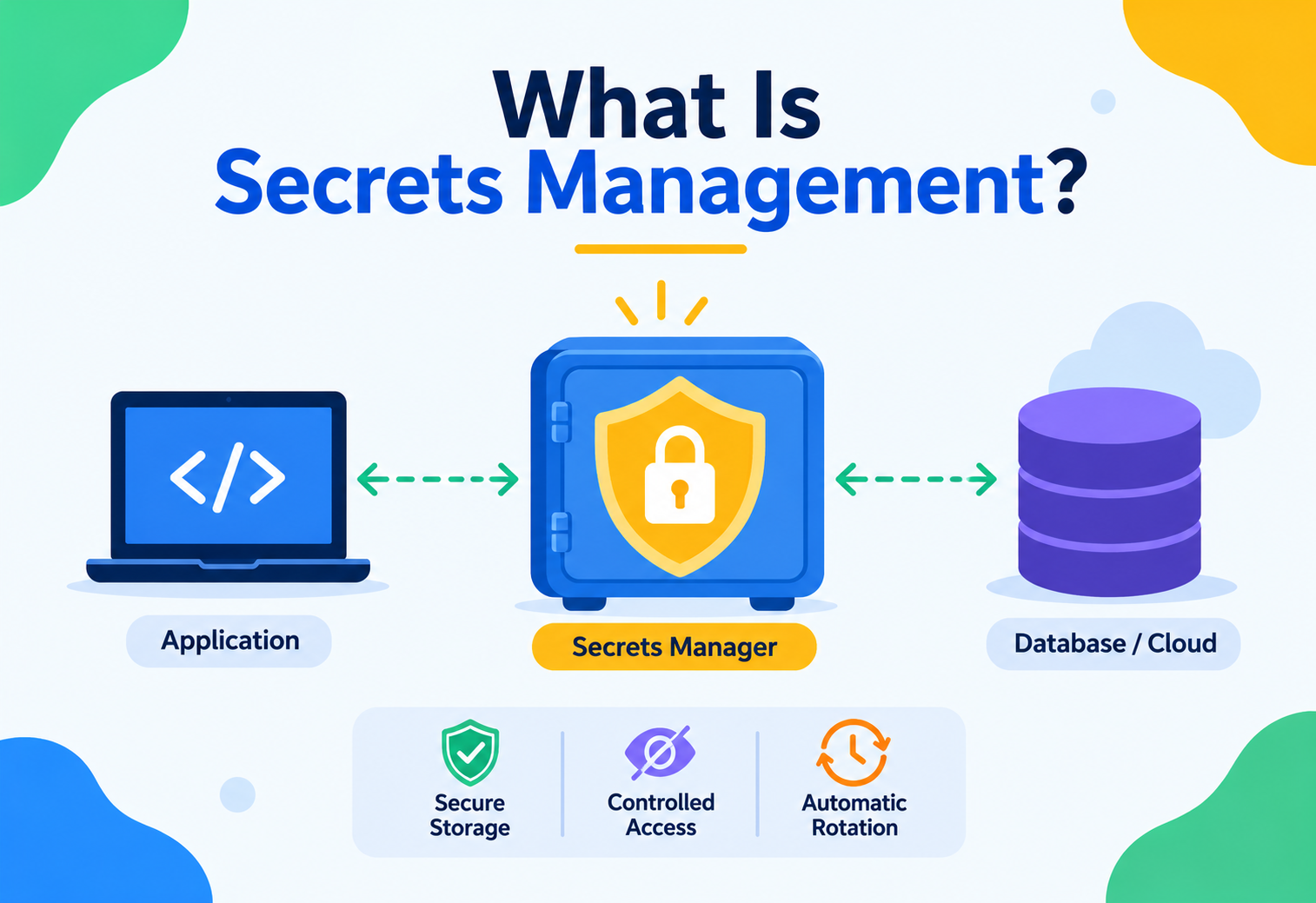
What Is Secrets Management?
A complete, beginner-to-production walkthrough of storing, distributing, rotating and auditing passwords, API keys, certificates and tokens safely — with real architecture, Java code and lessons from Netflix, Amazon, Google, Uber, Spotify and Airbnb.
Introduction & History
Every piece of software that talks to another piece of software needs to prove who it is. A web application needs a database password. A microservice needs an API key to call a payment gateway. A deployment pipeline needs credentials to push a Docker image to a registry. All of these small, powerful pieces of information — passwords, API keys, tokens, certificates, encryption keys — are called secrets. Secrets management is the discipline, and the set of tools, that let organisations create, store, distribute, rotate and eventually destroy these secrets safely, without ever letting them sit around in a place where the wrong person or the wrong process could read them.
If you are completely new to this topic, think of a secret as anything that, if leaked, would let someone impersonate your application, read your data, or spend your money. A database password is a secret. A cloud provider access key is a secret. The private key behind an HTTPS certificate is a secret. Even a Slack webhook URL can be a secret, because anyone who has it can post messages as your bot.
Imagine an apartment building with a hundred tenants, a cleaning crew, a maintenance team and food delivery riders who all need to get through the front door at different times. You would never hand out a hundred copies of the master key and hope nobody loses one or makes a copy for a friend. Instead, a good building has a front desk: it issues a temporary access card to the maintenance worker for exactly the two hours their job takes, logs who came in and out, and can instantly cancel a card if it is lost. Secrets management is that front desk for your software systems.
1.1 A Short History
In the earliest days of web development, secrets were simply written into source code or configuration files: a database password sitting in plain text inside a file called config.properties, checked into version control right alongside the application logic. This was common practice through the 1990s and 2000s, and it is still shockingly common in small projects today. The problem is obvious once you say it out loud: anyone with read access to the code repository, including every contractor, every intern, and every attacker who compromises a laptop, gets the password too.
As organisations grew, a second generation of practice emerged: environment variables. Instead of hardcoding a password into the source file, teams moved it into an environment variable set on the server, injected through deployment scripts. This was better because the secret was no longer inside version control, but it introduced new problems. Environment variables are visible to any process running on the same machine, they show up in crash dumps and process listings, and there was still no audit trail of who changed them or when.
The third generation, which began appearing around the mid-2010s, is dedicated secrets management systems. Companies like HashiCorp introduced Vault in 2015, cloud providers built AWS Secrets Manager, Azure Key Vault and Google Secret Manager, and open-source communities produced tools like Kubernetes Secrets (introduced with Kubernetes itself in 2014, though with well-known early limitations) and later Sealed Secrets and External Secrets Operator to patch those gaps. These systems introduced the idea that secrets should be centrally stored, encrypted at rest and in transit, access-controlled, automatically rotated, and every access to them should be logged.
Hardcoded in source code
Passwords written directly into config files and checked into version control alongside the application logic. Anyone with repo access — contractors, interns, attackers — got the password too.
Config files & environment variables
Secrets moved out of source code and into env vars set at deploy time. Better, but visible to any local process, prone to leaking via crash dumps, and with no audit trail.
Configuration management vaults
Chef encrypted data bags, Puppet Hiera eyaml, Ansible Vault. First real attempt to encrypt secrets at rest under a managed key.
Dedicated secrets managers emerge
HashiCorp Vault, AWS Secrets Manager, Azure Key Vault. Central storage, envelope encryption, policy engines and audit logging arrive as first-class features.
Zero-trust & workload identity
Dynamic, short-lived credentials tied to cryptographically verifiable workload identity (SPIFFE / SPIRE, Kubernetes service accounts, cloud IAM). Long-lived shared credentials become the exception, not the default.
Today, secrets management sits at the intersection of security engineering, platform engineering and compliance. It is no longer a “nice to have” — regulations like PCI-DSS, HIPAA, SOC 2, and India’s own DPDP Act 2023 effectively require organisations to demonstrate that sensitive credentials are protected, access is logged and rotation happens on a schedule.
1.2 Why the Name Changed From “Password Vault” to “Secrets Manager”
Early tools in this space were often literally called password vaults or credential stores, because the original use case was storing a fixed set of human-typed passwords for administrators. As the industry realised that machine-to-machine credentials vastly outnumber human passwords in any modern system — a single microservices platform can easily have more automated credentials than it has employees — the terminology shifted to “secrets management”, reflecting a broader scope that includes certificates, encryption keys, tokens and dynamically generated credentials that no human ever types or even sees.
1.3 The Shift From Perimeter Security to Zero Trust
Older security models assumed that anything inside the corporate network, or inside a particular data centre, could be trusted by default, so a service running “inside the firewall” was often allowed to read configuration files or environment variables without further verification. The rise of cloud computing, remote work and increasingly sophisticated attackers who routinely breach the network perimeter made this assumption dangerous. Zero-trust architecture assumes no implicit trust based on network location alone, and instead requires every request, including a request for a secret, to carry cryptographic proof of identity, checked against an explicit policy every single time. Secrets management is one of the clearest practical expressions of zero-trust thinking: instead of trusting “you are on our network, so here is the password”, the system insists on “prove exactly who you are, right now, for this specific request”.
The Problem & Motivation
To understand why secrets management exists as its own engineering discipline, it helps to walk through the failure modes that happen without it.
2.1 The Problems Secrets Management Solves
Secret sprawl
The same database password gets copy-pasted into five different services, three CI/CD pipelines and a teammate’s local .env file. Nobody knows how many places it lives, so nobody can confidently rotate it.
Hardcoded credentials in source control
A secret committed to Git remains in the repository’s history forever, even if it is deleted in a later commit, unless the entire history is rewritten. Automated bots scan public and even private repositories specifically looking for exposed keys.
No rotation
Without an automated system, rotating a password means manually updating it in every place it is used, which is risky and time-consuming, so teams simply avoid doing it — sometimes for years.
No audit trail
When a breach happens, the first question is “who accessed this secret, and when?”. Without a secrets manager, that question is often unanswerable.
Over-privileged access
Every developer on the team has the production database password because it is easier than setting up scoped access, meaning a single compromised laptop can compromise the entire database.
Secrets in logs and crash reports
An exception handler accidentally prints the full configuration object, including the API key, into an application log that then gets shipped to a third-party log aggregator.
One of the most common real incidents in the industry is a developer accidentally committing an AWS access key to a public GitHub repository. Automated scanners run by attackers (and by GitHub’s own secret-scanning service) detect this within minutes, and the credentials are used to spin up cryptocurrency mining instances on the victim’s cloud account, sometimes generating tens of thousands of dollars in charges before the key is revoked. This single failure mode — a hardcoded secret in a public repo — is one of the most frequently cited root causes of cloud account compromise across the industry.
2.2 Why “Just Encrypt the Config File” Is Not Enough
A natural first instinct is to encrypt the configuration file that holds the secrets. But this simply moves the problem one level down: now you need a key to decrypt that file, and that decryption key itself becomes a secret that needs to be managed. Secrets management systems solve this with a concept called the root of trust — a small number of master keys, protected by hardware or a tightly controlled process, from which all other encryption is derived, combined with strong identity verification so that only the right application, running in the right context, can ask for the decryption to happen.
2.3 Beginner Example
Imagine a simple Spring Boot application that needs to connect to a MySQL database. The naive approach:
spring.datasource.url=jdbc:mysql://prod-db.internal:3306/orders
spring.datasource.username=admin
spring.datasource.password=SuperSecret123!
This file gets committed to Git “just for now”, and six months later nobody remembers it is there. A secrets-management-aware version instead fetches the password at runtime:
@Value("${DB_PASSWORD}")
private String dbPassword; // injected at runtime from Vault / Secrets Manager, never stored on disk
2.4 Production Example — Netflix
Netflix, operating thousands of microservices across a large fleet, cannot rely on any human manually distributing database credentials. Netflix built and open-sourced tools in this space specifically because manual secret handling does not scale past a handful of services — at their scale, every credential must be issued, rotated and revoked automatically, with strong identity checks baked into the platform itself rather than left to individual engineering teams to remember.
Core Concepts
Before diving into architecture, let us build a vocabulary. Every term below is something you will see repeatedly in secrets management documentation and tooling.
3.1 What Counts as a Secret?
| Secret type | What it is | Example |
|---|---|---|
| Password / credential | Username + password pair for a system | Database login, admin panel login |
| API key | A token identifying an application to a third-party service | Stripe API key, SendGrid key |
| Access token | Short-lived credential proving an authenticated session | OAuth2 access token, JWT |
| TLS / SSL certificate + private key | Cryptographic identity for encrypted communication | HTTPS certificate for a website |
| Encryption key | Key used to encrypt / decrypt data at rest | AES-256 key protecting a database column |
| SSH key | Key pair used to authenticate to servers | Deploy key for a CI/CD pipeline |
| Signing key | Key used to sign artefacts, tokens or commits | Code-signing certificate, JWT signing key |
3.2 Static vs Dynamic Secrets
Static secrets are fixed values that do not change unless someone (or some system) explicitly rotates them — like a long-lived database password. Dynamic secrets are generated on demand, tied to a short lifespan and automatically expire. When an application asks for database access, a secrets manager can create a brand-new database user with a random password, valid for exactly fifteen minutes, and automatically drop that user afterwards. This dramatically shrinks the window during which a leaked credential is useful to an attacker.
A static secret is like giving every guest a metal key that opens their room forever, even after they check out, unless you physically change the lock. A dynamic secret is a hotel key card programmed to stop working automatically at checkout time, with no need to change any lock at all. The system just refuses old cards.
3.3 Encryption at Rest vs Encryption in Transit
Encryption at rest means the secret is stored on disk in encrypted form, so anyone who steals the underlying storage (a disk, a database backup, a snapshot) cannot read the secret without also having the decryption key. Encryption in transit means the secret is protected while travelling over the network, typically using TLS, so it cannot be captured by anyone eavesdropping on the connection. A production-grade secrets manager applies both.
3.4 Envelope Encryption
Almost every serious secrets manager uses a two-layer encryption scheme called envelope encryption. Instead of encrypting every secret directly with a single master key (which would mean re-encrypting everything if that key is ever rotated), the system generates a unique data encryption key (DEK) for each secret or batch of secrets, encrypts the actual secret with that DEK, and then encrypts the DEK itself with a key encryption key (KEK) that lives in a highly protected root of trust, often a Hardware Security Module (HSM).
3.5 Root of Trust and Master Keys
The root of trust is the small set of keys that everything else in the system ultimately depends on. If the root of trust is compromised, every secret protected underneath it is compromised too. This is why root keys are typically protected using techniques like Shamir’s Secret Sharing, where the master key is split into multiple fragments distributed among different trusted people, and a minimum number of fragments (say, three out of five) must be combined to reconstruct the key — a process called “unsealing” in tools like HashiCorp Vault.

3.6 Secret Versioning
Instead of overwriting a secret when it is rotated, a good secrets manager keeps a version history. This allows an application that has cached an old version briefly during a rotation window to still function, and allows an administrator to instantly roll back to a previous version if a rotation breaks something.
3.7 Least Privilege and Scoped Access
The principle of least privilege means every identity — human or machine — should be able to read only the specific secrets it actually needs, nothing more. A payments microservice should be able to read the payments database password, but should have no ability to even list the existence of the HR database’s secrets.
3.8 Identity-Based Access (Workload Identity)
Modern secrets managers do not authenticate “the request came with the right password” — they authenticate “this request came from a specific, cryptographically verifiable workload”. In Kubernetes, this is often done through a technique where the pod’s own service account token, itself short-lived and signed by the cluster, is exchanged for access to a specific secret. This removes the need to ever hand out a long-lived credential just to bootstrap access to other credentials — a problem sometimes called the “secret zero” problem.
If your application needs a secret to authenticate to the secrets manager in order to fetch its other secrets, how does it get that first secret securely? This bootstrapping challenge is called secret zero. Modern solutions avoid it entirely by using platform-native identity — cloud instance identity documents, Kubernetes service account tokens, or SPIFFE / SPIRE identities — instead of a separate credential just to get started.
3.9 Namespaces, Mounts and Multi-Tenancy
Large organisations rarely run a single flat secrets store shared by every team. Instead, secrets managers support the idea of namespaces or mounts — isolated sub-environments within the same cluster, each with its own policies, its own set of secrets engines, and sometimes its own encryption keys. A platform team might give each product team its own namespace, so that a policy mistake in one team’s configuration cannot accidentally expose another team’s secrets. This is conceptually similar to how a single database server can host many separate schemas, each isolated from the others even though they share the same underlying infrastructure.
3.10 Secret Sprawl and How It Is Remediated
Secret sprawl describes the gradual, almost invisible spread of copies of the same credential across many systems — a password that started in one configuration file ends up copied into a CI/CD pipeline variable, a teammate’s laptop, an old backup script and a monitoring dashboard’s data source configuration. Remediating sprawl typically follows a repeatable process: first, an automated discovery scan searches source code repositories, configuration management systems and infrastructure-as-code definitions for patterns that look like credentials; second, every discovered instance is inventoried and mapped back to the actual live secret it corresponds to; third, the canonical version of that secret is migrated into the secrets manager; and finally, every consuming system is updated to fetch the value dynamically instead of holding its own private copy, after which the original hardcoded copies are invalidated by rotating the underlying credential.
3.11 How Compliance Frameworks Map to Secrets Management Controls
| Framework | Relevant requirement | How secrets management helps |
|---|---|---|
| PCI-DSS | Protect stored cardholder data and restrict access on a need-to-know basis | Encrypted storage, least-privilege policies, audit trails for every access |
| HIPAA | Safeguard electronic protected health information with access controls and audit controls | Identity-based access, centralised audit logging, encryption at rest and in transit |
| SOC 2 | Demonstrate logical access controls and monitoring over sensitive systems | Policy engine enforcement, alerting on anomalous access patterns |
| DPDP Act 2023 (India) | Implement reasonable security safeguards to prevent personal data breach | Encryption of credentials protecting personal data stores, rotation and breach-ready revocation |
3.12 A Quick Glossary
| Term | Meaning |
|---|---|
| Lease | Metadata attached to a dynamic secret describing how long it remains valid before automatic revocation |
| Unseal | The process of reconstructing the master key so a secrets manager node can begin decrypting data |
| Quorum | The minimum number of nodes, or key fragments, required to make a binding decision in a distributed system |
| HSM | Hardware Security Module — a physical device designed to generate and guard cryptographic keys so they never leave the hardware in plaintext form |
| SPIFFE / SPIRE | An open standard and its reference implementation for issuing verifiable workload identities across heterogeneous infrastructure |
| Break glass | An emergency access procedure used only when normal automated access is unavailable, typically heavily logged and immediately followed by rotation |
Architecture & Components
Let us zoom out and look at the moving parts inside a typical secrets management system, using an architecture similar to HashiCorp Vault, AWS Secrets Manager or Azure Key Vault.
4.1 Component Breakdown
1. API / Gateway Layer
The single entry point every client talks to, typically over HTTPS/TLS, exposing a REST or gRPC interface for reading, writing and revoking secrets.
2. Authentication Layer
Verifies who is making the request. Production systems support multiple authentication methods simultaneously: Kubernetes service account tokens, AWS IAM roles, LDAP / Active Directory, username / password with MFA for humans, and short-lived tokens for machines.
3. Policy Engine (Authorisation)
Once identity is established, the policy engine decides what that identity is allowed to do. Policies are usually written declaratively, mapping identities or roles to specific paths and specific operations (read, write, list, delete).
# Example Vault-style policy (HCL)
path "secret/data/payments/*" {
  capabilities = ["read"]
}
path "secret/data/hr/*" {
  capabilities = ["deny"]
}
4. Secrets Engines
A secrets engine is a pluggable module that knows how to handle a specific class of secret. Common engines include:
| Engine | Purpose |
|---|---|
| Key-Value (KV) | Simple static secret storage, versioned |
| Database engine | Generates dynamic, short-lived database credentials on demand |
| PKI engine | Issues and signs short-lived TLS certificates automatically |
| Transit engine | Encryption-as-a-service — encrypts / decrypts data without ever exposing the key to the caller |
| SSH engine | Issues one-time-use SSH credentials |
| Cloud engines | Generates temporary AWS / GCP / Azure IAM credentials |
5. Encryption Layer
Applies envelope encryption before anything touches disk, using the root of trust to protect the top-level key encryption key.
6. Storage Backend
The actual persistence layer. In HashiCorp Vault this is pluggable and can be a Consul cluster, an integrated Raft-based store or cloud storage; in AWS Secrets Manager it is backed by AWS’s own internal encrypted storage.
7. Audit Log
An append-only, tamper-evident record of every single request made to the system — who asked, what they asked for, whether it was allowed, and when. This is often shipped to a separate, independently secured system (a SIEM) so that even an attacker who compromises the secrets manager cannot erase the trail.
4.2 Java Example: Fetching a Secret From a Vault-Like API
public class SecretsClient {

    private final HttpClient httpClient = HttpClient.newHttpClient();
    private final String vaultAddr;
    private final String vaultToken;

    public SecretsClient(String vaultAddr, String vaultToken) {
        this.vaultAddr = vaultAddr;
        this.vaultToken = vaultToken;
    }

    public String getDatabasePassword(String path) throws IOException, InterruptedException {
        HttpRequest request = HttpRequest.newBuilder()
                .uri(URI.create(vaultAddr + "/v1/secret/data/" + path))
                .header("X-Vault-Token", vaultToken)
                .GET()
                .build();

        HttpResponse<String> response = httpClient.send(request, HttpResponse.BodyHandlers.ofString());

        if (response.statusCode() != 200) {
            throw new RuntimeException("Failed to fetch secret: " + response.statusCode());
        }

        JSONObject json = new JSONObject(response.body());
        return json.getJSONObject("data").getJSONObject("data").getString("password");
    }
}
Notice that the password never appears in application source code or in a configuration file on disk — it is fetched at runtime, held only in memory, and the Vault token itself is short-lived and injected by the platform (for example, a Kubernetes sidecar), so there is no long-lived secret sitting anywhere permanent.
Internal Working
Let us look under the hood at how a request to read a secret actually flows through the system, step by step.
5.1 Step-by-Step: Reading a Secret
- Client authenticates. The application presents its identity — for example, a Kubernetes service account JWT — to the authentication layer.
- Identity verification. The secrets manager validates the JWT’s signature against the Kubernetes cluster’s public key, confirming the token is genuine and unexpired.
- Token issuance. On success, the secrets manager issues a short-lived internal access token bound to a specific policy, often valid for as little as a few minutes to an hour.
- Policy evaluation. When the client requests a specific secret path, the policy engine checks whether the identity’s attached policies grant read access to that exact path.
- Decryption. If authorised, the storage layer retrieves the encrypted blob, uses the key encryption key (unsealed at startup, held only in memory) to decrypt the data encryption key, and uses that to decrypt the actual secret value.
- Audit logging. Before the response is returned, an audit event is written — including the identity, the path, the timestamp and the outcome — to the audit backend.
- Response. The plaintext secret is returned over TLS, held in the client’s memory only for as long as needed.
5.2 The Unsealing Process
When a secrets manager node starts up (say, after a restart or a new deployment), it does not have the master key encryption key available in memory — that would defeat the purpose of protecting it. The node starts in a sealed state, unable to decrypt anything. To become operational, it must be unsealed: a quorum of key holders (using Shamir’s Secret Sharing, for example three out of five people each holding a fragment) submit their fragments, which are combined in memory to reconstruct the master key. Many production deployments automate this using a cloud KMS as an “auto-unseal” mechanism, trading a small amount of centralisation for the ability to restart nodes without waking up human operators at 3 a.m.
5.3 Dynamic Secret Generation Internals
When an application requests a dynamic database credential, the secrets engine does not look up a stored value — it actively connects to the target database using its own highly privileged administrative credentials, runs a CREATE USER statement with a randomly generated username and password, grants exactly the permissions defined in the role, and returns those brand-new credentials to the requester along with a lease. When the lease expires, a background revocation process connects back to the database and runs DROP USER, cleaning it up automatically.
-- Simplified version of what the database secrets engine executes on demand
CREATE USER 'v-app-role-x7f2a9'@'%' IDENTIFIED BY 'GENERATED_RANDOM_PASSWORD';
GRANT SELECT, INSERT, UPDATE ON orders.* TO 'v-app-role-x7f2a9'@'%';
-- ... after the lease (e.g. 15 minutes) expires ...
DROP USER 'v-app-role-x7f2a9'@'%';
5.4 Lease and Renewal Internals
Every dynamic secret is issued with a lease — metadata describing its time-to-live. Applications that need the credential for longer than the initial lease must actively renew it before it expires, up to a maximum TTL configured by an administrator. If the application crashes or forgets to renew, the credential simply stops working and is cleaned up, which is a safety feature rather than a bug: it guarantees that forgotten or orphaned credentials cannot linger indefinitely.
Data Flow & Lifecycle
A secret has a full lifecycle from the moment it is created to the moment it is destroyed. Understanding this lifecycle is essential to designing a system that stays secure over time, not just on day one.
Generation
A secret should ideally be generated by the secrets management system itself, using a cryptographically secure random generator, rather than chosen by a human. Human-chosen passwords tend to be predictable and reused.
Storage
The secret is immediately encrypted using envelope encryption before it ever touches persistent storage, as covered in the architecture section.
Distribution
The secret is delivered to the workloads that need it — never broadcast, always scoped to a specific, authenticated identity. Distribution mechanisms include direct API calls, sidecar injectors (like Vault Agent or the External Secrets Operator syncing into Kubernetes Secrets), or environment injection at container startup.
Usage
Best practice is that the secret lives only in application memory, never written to disk, never logged, and cleared from memory as soon as it is no longer needed.
Rotation
Rotation replaces an existing secret with a new value on a schedule (for example, every 30 or 90 days) or on demand (immediately after a suspected compromise). A well-designed rotation process is zero-downtime: both the old and new secret remain valid for a short overlap window so that in-flight requests using the previous value do not fail.
Revocation
Revocation is the emergency-brake operation: immediately invalidating a secret, typically triggered by a detected leak, an employee offboarding or a suspicious access pattern flagged by monitoring.
Destruction / expiry
Dynamic secrets expire automatically at the end of their lease. Static secrets that are no longer needed should be explicitly deleted, and older versions should eventually be purged from version history in line with the organisation’s data retention policy.
6.1 Zero-Downtime Rotation Sequence
A new microservice is deployed. On startup, it authenticates to the secrets manager using its Kubernetes identity (generation of trust, not the secret itself). It requests a database credential, and the secrets engine generates a brand-new database user on the spot, valid for one hour (generation + distribution). The service holds this credential in memory and uses it for every query during that hour (usage). Forty-five minutes in, the service’s sidecar automatically renews the lease for another hour (rotation via renewal). If the pod is deleted, the lease is not renewed, and after the final hour expires, the secrets engine connects to the database and drops that user (revocation + destruction).
Pros, Cons & Trade-offs
Secrets management is not free — it introduces a new tier-0 dependency, new failure modes and a learning curve. Naming the benefits and costs out loud makes the design decisions much easier.
Benefits of proper secrets management
- Reduced blast radius. Short-lived, scoped credentials mean a single leaked secret exposes far less than a long-lived, broadly shared one.
- Centralised audit trail. Every access is logged in one place, which is essential for incident response and compliance audits.
- Faster incident response. Revoking a compromised secret takes seconds instead of a multi-day scramble to find every place it was copied.
- Consistent policy enforcement. Access control is defined once, centrally, instead of being reimplemented (or forgotten) by every team.
- Enables automation. CI/CD pipelines, autoscaling infrastructure and ephemeral environments can all fetch exactly what they need without a human in the loop.
Costs and trade-offs
- Operational complexity. Running a highly-available secrets manager is itself a nontrivial distributed systems problem — it becomes a piece of critical infrastructure that, if it goes down, can take your entire platform down with it.
- New single point of failure risk. If not architected for high availability, the secrets manager becomes the one thing that, if unavailable, prevents every other service from starting up.
- Latency overhead. Fetching secrets over the network at startup, or generating dynamic credentials on demand, adds latency compared to reading a local file — usually milliseconds, but it must be accounted for.
- Learning curve. Teams must learn new concepts (policies, auth methods, leases) and new failure modes (a sealed vault, an expired lease) that did not exist with plain config files.
- Bootstrapping problem. As discussed, something has to authenticate first — this “secret zero” problem never fully disappears, it is only pushed to a lower-risk layer (platform identity).
| Approach | Security | Operational cost | Best for |
|---|---|---|---|
| Hardcoded in source | Very low | Very low | Never, in production |
| Environment variables (manual) | Low-medium | Low | Small hobby projects only |
| Config management vault (Ansible Vault, etc.) | Medium | Medium | Small teams, infrequent deploys |
| Cloud-native secrets manager (AWS / Azure / GCP) | High | Low-medium (managed service) | Teams already on that cloud |
| Self-hosted Vault / OpenBao cluster | Very high (fully customisable) | High (you run it) | Multi-cloud, large enterprises, strict compliance |
Performance & Scalability
Secrets managers sit directly in the critical path of application startup and, in some architectures, every single request. Performance and scalability decisions here ripple across the whole platform.
8.1 Read-Heavy Workload Characteristics
Secrets management systems are overwhelmingly read-heavy: writes (creating or rotating a secret) happen relatively rarely, while reads (an application fetching a secret) can happen thousands of times per second across a large fleet, especially during mass deployments or autoscaling events when hundreds of new pods start simultaneously and all request credentials at once.
8.2 Caching Strategies
To avoid overwhelming the central system, most production setups introduce a caching layer close to the application:
- Sidecar agent caching. A local agent (like Vault Agent) runs alongside the application, fetches the secret once, caches it in memory, and proactively renews leases before expiry — the application talks to
localhost, not the network. - Short TTL caching with jitter. Cached secrets are given a random amount of jitter added to their expiry so that thousands of instances do not all try to refresh at exactly the same second (the “thundering herd” problem).
- Read replicas. The secrets manager itself can run read replicas that serve read traffic without hitting the primary node responsible for writes and unsealing state, similar to database read replica patterns.
8.3 Horizontal Scaling
Most production-grade secrets managers use a leader-follower (or leader-based consensus) model: one node is the elected leader responsible for writes and coordinating unsealing, while multiple follower nodes can serve reads and stand ready to be promoted if the leader fails. Consensus protocols like Raft are commonly used to keep the storage backend consistent across nodes — this is directly analogous to leader election in any other distributed data store.
8.4 Batching and Connection Pooling for Dynamic Secrets
Because dynamic database credentials require the secrets engine to open a real connection to the target database and run DDL statements, at high scale this can itself become a bottleneck. Production deployments pool the administrative connections the secrets engine uses, and set sensible default lease durations (long enough to amortise the cost of generation, short enough to limit blast radius) rather than issuing a brand-new credential on every single request.
8.5 Latency Budget Example
| Operation | Typical latency |
|---|---|
| Cached secret read (local sidecar) | < 1 ms |
| Static secret read (network round-trip) | 5–30 ms |
| Dynamic secret generation (new DB user) | 50–300 ms |
| PKI certificate issuance | 50–500 ms depending on CA chain |
These numbers matter most at startup: a service that fetches ten secrets sequentially at boot, each taking 30 ms, adds 300 ms of pure startup latency — often the reason teams switch to bulk-fetch APIs or parallel requests.
8.6 Capacity Planning
Capacity planning for a secrets management cluster follows a similar exercise to capacity planning for any other stateful service, with a few domain-specific wrinkles. Teams typically model expected peak request-per-second load during the largest anticipated deployment event — for example, a full fleet rolling restart during a major release, where every instance requests fresh credentials within a short window — and size the cluster’s compute and network capacity to comfortably absorb that peak with headroom to spare, rather than sizing only for average daily traffic. Because dynamic secret generation is more expensive than a cached static read, teams often model these two traffic types separately, since a burst of dynamic database credential requests can create load on the target databases themselves, not just on the secrets manager.
8.7 Cost Considerations
Cost in a secrets management system comes from a few distinct sources: the compute and storage cost of running the cluster itself (or the per-secret and per-API-call pricing of a managed cloud offering), the operational cost of the team that maintains policies and responds to incidents, and a less obvious cost — the latency and complexity overhead pushed onto every dependent application. Teams evaluating managed versus self-hosted options typically find that at a smaller scale, the predictable per-secret pricing of a managed cloud offering is more cost-effective than dedicating engineering time to operating a highly available cluster, while at a very large scale, or across multiple clouds, the fixed operational cost of a self-hosted cluster can become cheaper than a large number of per-secret and per-API-call charges.
High Availability & Reliability
Because every other service depends on the secrets manager to start up and stay running, it must be engineered to a higher reliability bar than most of the applications it serves.
9.1 Clustering and Consensus
A production secrets manager typically runs as a cluster of an odd number of nodes (commonly 3 or 5) using a consensus protocol such as Raft to agree on the current state of the storage backend. An odd number is chosen deliberately: with 5 nodes, the cluster can tolerate 2 node failures while still maintaining a quorum (3 nodes) to keep operating — this is the same math behind CAP-theorem-aware systems like etcd or ZooKeeper.
9.2 CAP Theorem in This Context
Secrets managers generally favour consistency over availability during a network partition, because serving a stale or incorrect secret (for example, an already-revoked credential) is far more dangerous than briefly refusing to serve a request. This means during a partition where the leader is unreachable, most secrets managers will reject write requests (and sometimes reads, depending on consistency mode) rather than risk split-brain state, which is a deliberate CP choice in CAP terms.
9.3 Disaster Recovery
- Cross-region replication. Enterprise deployments run a secondary cluster in a different geographic region, continuously replicating encrypted data, ready to be promoted if the primary region suffers an outage.
- Automated snapshots. Regular, encrypted snapshots of the storage backend are taken and stored separately, allowing recovery even if the entire cluster is lost.
- Auto-unseal with cloud KMS. As mentioned earlier, using a cloud KMS to automatically unseal nodes on restart avoids the operational nightmare of needing multiple humans available at 3 a.m. during a recovery, at the cost of trusting that KMS as part of the root of trust.
9.4 Graceful Degradation for Dependent Services
Well-designed applications do not treat “the secrets manager is briefly unreachable” as a fatal error. Common patterns include caching the last-known-good secret locally with a reasonable grace period, retrying with exponential backoff, and — for genuinely critical paths — keeping a tightly access-controlled, monitored “break glass” static fallback credential that is rotated immediately after any use.
9.5 Testing Disaster Recovery Before You Need It
A backup that has never been restored is not really a backup, it is a hope. Mature secrets management programmes schedule regular disaster recovery drills where a team deliberately restores a snapshot into an isolated environment, walks through the full unsealing procedure using the documented key holders, and verifies that dependent applications can actually authenticate and fetch secrets from the restored cluster within an acceptable time window. These drills routinely surface problems that would otherwise only be discovered during a real outage — an unseal key holder who has since left the company, documentation that references an outdated procedure, or a restored cluster that comes up with a subtly different network address that no client is configured to reach.
A well-known operational scenario: after a cluster-wide restart (for example, during a cloud provider maintenance event), every node comes back up sealed, and none of them can serve secrets until a quorum of unseal keys is provided. If auto-unseal was not configured, this becomes a full platform outage until a human manually intervenes — a scenario that has taken down entire companies’ production environments for hours. This is precisely why auto-unseal and multi-region standby clusters are considered mandatory for serious production deployments.
Security
Security is not one section of secrets management — it is the entire point of the discipline. Still, some specific practices deserve focused attention.
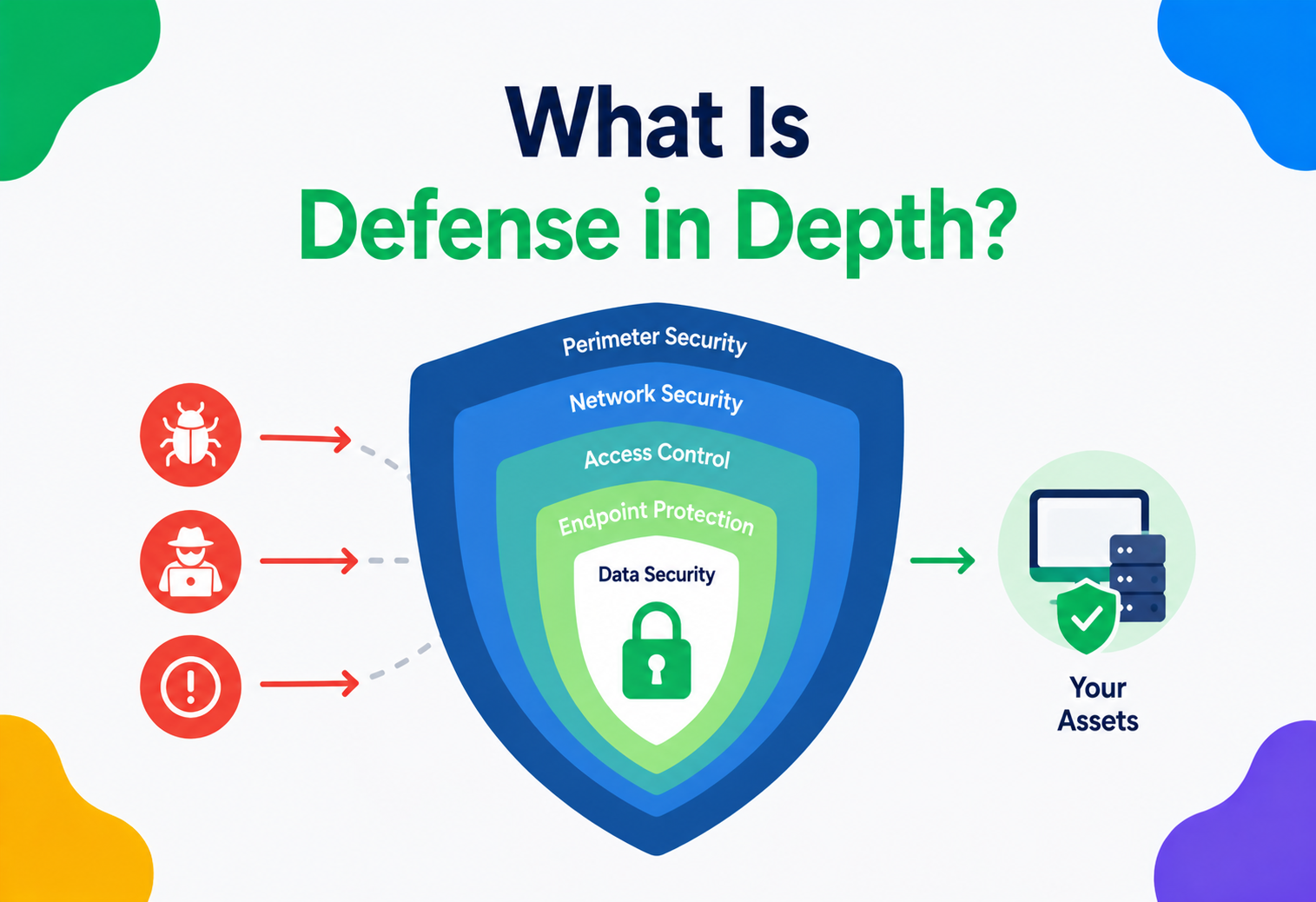
10.1 Defence in Depth
| Layer | Protection |
|---|---|
| Network | mTLS between clients and the secrets manager; private networking, no public exposure |
| Identity | Strong workload identity (SPIFFE / SPIRE, cloud IAM, Kubernetes service accounts) instead of static tokens |
| Authorisation | Least-privilege policies scoped to exact paths and operations |
| Encryption | Envelope encryption at rest, TLS 1.2+ in transit |
| Root of trust | HSM-backed or cloud-KMS-backed master keys, Shamir’s Secret Sharing for manual unseal |
| Audit | Immutable, append-only logs shipped to a separately secured system |
10.2 Principle of Least Privilege in Practice
# Bad: overly broad policy
path "secret/*" {
  capabilities = ["read", "list", "create", "update", "delete"]
}

# Good: narrowly scoped to exactly what the payments service needs
path "secret/data/payments/db-creds" {
  capabilities = ["read"]
}
10.3 Preventing Secrets in Logs
A surprisingly common leak vector is an application accidentally logging a full configuration object or a stack trace containing a secret value. Mitigations include structured logging with explicit field allow-lists (never log the whole object), automated secret-pattern scanning on log pipelines, and marking sensitive fields so serialisation libraries redact them automatically.
public class DatabaseConfig {
    @JsonIgnore // never serialise this field, even accidentally
    private String password;

    @Override
    public String toString() {
        return "DatabaseConfig{url=" + url + ", username=" + username + ", password=REDACTED}";
    }
}
10.4 Secret Scanning in CI/CD
Automated tools scan every commit and pull request for patterns that look like credentials — AWS access keys, private key headers, high-entropy strings — before they can ever be merged, catching mistakes before they become permanent history in the repository.
10.5 Break-Glass and Just-In-Time Access
For genuinely sensitive secrets (a production root credential, a signing key for releases), some organisations implement just-in-time access: a human requests temporary access, a second approver must sign off, access is granted for a short window, and every keystroke of the session may be recorded. This satisfies both operational needs and strict audit requirements.
10.6 Compliance Considerations
Regulatory frameworks commonly reference secrets management indirectly through requirements to protect access credentials and encryption keys, log access to sensitive data, and enforce least privilege — this includes PCI-DSS for payment data, HIPAA for healthcare data, SOC 2 for service organisations, and India’s DPDP Act 2023, which places obligations on organisations to implement “reasonable security safeguards” around personal data, a category that implicitly includes the credentials protecting that data.
10.7 Threat Modelling a Secrets Management System
A useful exercise when designing or auditing a secrets management deployment is to explicitly list the threats it needs to withstand, rather than relying on a vague sense that “it is secure”. Common threats include an external attacker attempting to authenticate as a legitimate workload using a stolen token, a malicious or compromised insider attempting to read secrets outside their assigned scope, an attacker who has already breached one application attempting to pivot and request additional secrets that application should never need, and a compromised administrator attempting to weaken policies or disable audit logging to cover their tracks. For each of these threats, a mature deployment maps a specific mitigating control: short token lifetimes and strong identity binding address stolen tokens; least-privilege policy scoping addresses both insider risk and lateral movement after a single-service compromise; and separation of duties, combined with tamper-evident audit logs shipped to an independently secured system, addresses a compromised administrator trying to hide their actions.
10.8 Supply Chain Considerations
Secrets management does not exist in isolation from the broader software supply chain. A compromised build pipeline, a malicious dependency, or a poisoned base container image can all become a path to secret exfiltration even when the secrets manager itself is perfectly configured. This is why leading organisations pair strong secrets management with software supply chain controls — verifying the provenance of dependencies, signing build artefacts, and restricting which pipelines are even allowed to request production secrets in the first place, rather than treating secrets management as a standalone control that can compensate for a compromised build process.
Monitoring, Logging & Metrics
You cannot secure what you cannot see. A secrets management deployment needs its own dedicated observability strategy, separate from general application monitoring.
11.1 What to Log
- Every authentication attempt, successful or failed, including the identity and source.
- Every secret read, write, delete and list operation, including the exact path.
- Every policy change (who granted or revoked access to what).
- Unsealing and sealing events.
- Lease creation, renewal and revocation events for dynamic secrets.
11.2 Key Metrics to Track
| Metric | Why it matters |
|---|---|
| Request latency (p50 / p95 / p99) | Detects performance degradation before it causes application timeouts |
| Authentication failure rate | Spike may indicate a misconfigured client — or an attack |
| Policy denial rate | Repeated denials for one identity can indicate a compromised or misbehaving workload |
| Lease expiration vs renewal ratio | High expiration without renewal may indicate orphaned resources or a broken renewal process |
| Seal status | An unexpectedly sealed node means an outage in progress |
| Storage backend latency | The underlying consensus store (Raft / Consul / etc.) becoming slow will cascade to every client |
11.3 Alerting Patterns
Anomaly detection
An identity that normally reads five secrets a day suddenly reads five hundred — this pattern often indicates a compromised credential being used to exfiltrate as much as possible before detection.
Access outside business hours
A human identity accessing production secrets at 3 a.m. from an unfamiliar location is a classic indicator worth an automatic alert.
11.4 Java Example — Emitting a Custom Metric on Secret Fetch
@Timed(value = "secrets.fetch.duration", description = "Time to fetch a secret from Vault")
public String fetchSecret(String path) {
    Timer.Sample sample = Timer.start(meterRegistry);
    try {
        String value = secretsClient.getDatabasePassword(path);
        meterRegistry.counter("secrets.fetch.success", "path", sanitizePath(path)).increment();
        return value;
    } catch (Exception e) {
        meterRegistry.counter("secrets.fetch.failure", "path", sanitizePath(path)).increment();
        throw e;
    } finally {
        sample.stop(meterRegistry.timer("secrets.fetch.duration"));
    }
}
Notice the metric labels use a sanitised path rather than the secret value itself — metrics and logs must never carry the sensitive payload, only metadata about the operation.
11.5 Building an Operational Dashboard
Beyond individual alerts, most platform teams maintain a standing dashboard summarising the health of the secrets management system at a glance, typically combining cluster health indicators such as current leader identity and seal status, aggregate request volume broken down by secrets engine, top consumers by request count to spot unexpected changes in usage patterns, and a rolling count of policy denials to catch misconfigurations early, before they escalate into a support ticket or a security incident. This dashboard is usually one of the first screens checked during any broader platform incident, since so many other systems depend on secrets being reachable.
11.6 SIEM Integration
Audit logs from the secrets manager are typically streamed in near-real-time to a Security Information and Event Management (SIEM) platform, correlated with other signals (VPN logins, endpoint detection alerts, network flow logs) to build a complete picture during an investigation.
Deployment & Cloud
Where and how you run the secrets manager itself dictates most of the operational trade-offs your team lives with day to day. This section walks through the main deployment models and the Kubernetes-native pattern most modern platforms end up adopting.
12.1 Self-Hosted vs Managed
HashiCorp Vault / OpenBao on Kubernetes
Full control over configuration, storage backend and networking. Requires your own team to handle upgrades, patching, backups and unsealing operations. Common choice for multi-cloud organisations or those with strict data-residency requirements.
AWS Secrets Manager, Azure Key Vault, GCP Secret Manager
The provider handles HA, patching and storage durability. Deep integration with that cloud’s IAM system. Usually the fastest path to production for teams already committed to a single cloud.
12.2 Kubernetes Deployment Pattern
A common production pattern combines Kubernetes-native identity with an external secrets manager, avoiding the well-known limitation that native Kubernetes Secrets are only base64-encoded (not encrypted) by default unless encryption at rest is explicitly enabled at the API server level.
apiVersion: v1
kind: Pod
metadata:
  name: orders-service
  annotations:
    vault.hashicorp.com/agent-inject: "true"
    vault.hashicorp.com/role: "orders-service"
    vault.hashicorp.com/agent-inject-secret-db-creds: "secret/data/orders/db"
spec:
  serviceAccountName: orders-service
  containers:
    - name: orders-service
      image: registry.internal/orders-service:1.4.2
Here the Vault Agent sidecar automatically injects the secret into a shared, memory-backed volume before the main application container starts, and keeps it refreshed on a schedule — the application code needs no Vault-specific logic at all, it just reads a local file.
12.3 CI/CD Pipeline Integration
Build and deployment pipelines need their own short-lived credentials, ideally using OIDC federation so the pipeline authenticates directly with a cloud provider’s identity system using a token issued by the CI platform itself, rather than a long-lived static credential stored as a pipeline secret.
12.4 Blue-Green Rollouts of the Secrets Manager Itself
Upgrading the secrets management cluster is a delicate operation precisely because so many other systems depend on it staying available throughout. Rather than upgrading nodes in place, many teams provision an entirely new cluster running the target version, replicate data into it, validate that authentication and policy evaluation behave identically against a sample of real traffic, and only then gradually shift client traffic over using DNS or load balancer weighting, keeping the old cluster on standby until the new one has proven stable under real production load for a defined observation period.
12.5 Multi-Cloud and Hybrid Considerations
Organisations operating across AWS, Azure, and on-premises data centres often centralise on a single secrets management control plane (frequently self-hosted Vault or OpenBao) precisely because each cloud’s native secrets manager only understands that cloud’s own identity system, creating fragmentation and duplicated policy logic if used independently across clouds.
APIs & Microservices
Almost every modern application ends up talking to a secrets manager through an HTTP API, and in a microservices architecture the patterns used to consume that API become as important as the API itself.
13.1 REST API Shape
Most secrets managers expose a REST API. A typical read operation:
GET /v1/secret/data/orders/db-credentials HTTP/1.1
Host: vault.internal:8200
X-Vault-Token: s.8f3jd92kfmvks9d

HTTP/1.1 200 OK
Content-Type: application/json

{
  "data": {
    "data": {
      "username": "orders_app",
      "password": "temporary-generated-value"
    },
    "metadata": {
      "version": 3,
      "created_time": "2026-07-18T10:15:00Z"
    }
  }
}
13.2 Microservices Integration Patterns
Direct SDK integration
The application uses a client library to call the secrets manager directly at startup and whenever a lease needs renewal. Simple but couples every service’s code to the secrets manager’s SDK.
Sidecar / agent pattern
A sidecar container handles authentication, fetching, caching and renewal, exposing secrets to the application as local files or a localhost API. The application stays completely unaware of the secrets manager.
Init-container injection
A one-time init container fetches secrets before the main container starts, writing them to a shared volume. Simpler than a sidecar but does not support automatic rotation while the pod runs.
13.3 Service-to-Service Authentication Using Dynamic Secrets
In a microservices architecture, service-to-service calls often need their own credentials — for example, a short-lived mTLS certificate issued by the secrets manager’s PKI engine, unique to each service instance, rotated automatically every few hours. This means even if one instance’s certificate is somehow captured, it becomes useless within a short window.
public class CertificateProvider {

    private final SecretsClient secretsClient;
    private volatile X509Certificate currentCert;

    @Scheduled(fixedRate = 3_600_000) // refresh hourly, well before the 24h TTL expires
    public void refreshCertificate() {
        CertificateBundle bundle = secretsClient.issueCertificate("orders-service");
        this.currentCert = bundle.getCertificate();
        sslContextUpdater.reload(bundle);
    }
}
13.4 Streaming Secret Updates Instead of Polling
Some secrets managers and their client agents support a push-based model, using long-lived streaming connections or watch APIs, so that when a secret is rotated centrally, every subscribed application is notified almost immediately rather than waiting for its next scheduled poll. This reduces the average staleness window between a rotation event and every consumer actually picking up the new value, which matters most for emergency rotations following a suspected compromise, where minimising the time any old, potentially leaked credential remains accepted by downstream systems is the entire point of rotating in the first place.
13.5 API Gateway Integration
API gateways sitting at the edge of a microservices architecture often fetch upstream service credentials (for example, an API key for a third-party payment provider) from the secrets manager rather than storing them in gateway configuration, so that rotating that key does not require redeploying the gateway itself.
Design Patterns & Anti-patterns
A handful of patterns keep showing up in well-run secrets programmes, and an equally short list of anti-patterns keeps showing up in the incident retros of troubled ones. Naming them out loud is one of the cheapest ways to raise the ceiling on your team’s security posture.
14.1 Recommended Patterns
Sidecar / agent injection
Decouples application code from secrets-manager-specific logic; the app only ever reads a local file or environment variable populated by the sidecar.
Dynamic secrets by default
Treat static, long-lived secrets as the exception that requires justification, not the default choice, for every new integration.
Workload identity federation
Use platform-native identity (Kubernetes service accounts, cloud instance identity) to bootstrap trust instead of a separate static bootstrap credential.
Envelope encryption
Never encrypt everything directly with one master key; always use per-secret data keys wrapped by a root key.
Automated rotation with overlap windows
Design every integration so that a secret can be rotated without downtime, by supporting two valid values simultaneously during a transition period.
Separation of duties
The person who can approve a policy change should not be the same person who can silently modify audit logs — split administrative capabilities across roles.
14.2 The Credential Broker Pattern
A particularly useful pattern for legacy systems that cannot be modified to speak to a secrets manager directly is the credential broker: a small, tightly scoped proxy service that sits between the legacy application and the secrets manager, translating an old-style request — for example, a simple lookup by a fixed key — into a properly authenticated, policy-checked call to the modern secrets management API. This allows an organisation to bring even decades-old systems under centralised policy and audit control without a risky rewrite, at the cost of the broker itself becoming a component that must be carefully secured, since it effectively holds elevated trust on behalf of the legacy system it fronts.
14.3 Anti-patterns to Avoid
Secrets in environment variables long-term
Environment variables are visible to any process on the host and often get accidentally dumped into crash reports or debugging tools.
One shared “god” credential
A single admin database password used by every microservice means a leak anywhere is a breach everywhere, and revoking it breaks the entire platform simultaneously.
Secrets baked into container images
Anyone who can pull the image (including from a registry breach) gets every secret baked into every layer, and layers are cached and distributed widely.
No rotation policy
A secret that has never been rotated since the system was built is a growing liability — the longer it lives, the more places it has likely been copied to.
Overly broad wildcard policies
A policy granting access to secret/* “to make things easier” defeats the entire purpose of least-privilege access control.
Secrets manager as general database
Storing large amounts of non-secret application data in the secrets manager adds unnecessary load to a system that should be optimised for a narrow, security-critical purpose.
Best Practices & Common Mistakes
Nearly every serious incident retrospective in this space traces back to violating one of a small handful of rules. Reading through this list before designing (or auditing) a system is one of the highest-leverage security exercises available.
15.1 Best Practices Checklist
- Prefer dynamic, short-lived secrets over static, long-lived ones wherever the target system supports it.
- Adopt workload identity (SPIFFE / SPIRE, cloud IAM, Kubernetes service accounts) to eliminate the “secret zero” bootstrap problem as much as possible.
- Enforce least privilege with narrowly scoped policies, reviewed on a regular schedule, not just at creation time.
- Enable and centrally ship audit logs from day one — retrofitting audit logging after an incident is far harder than starting with it.
- Automate rotation with overlap windows so rotation never requires a maintenance window.
- Never log, print, or serialise secret values, even at debug log levels.
- Run secret-scanning on every commit and pull request, not just periodically.
- Design for the secrets manager being briefly unavailable — cache sensibly, retry with backoff, avoid treating every hiccup as fatal.
- Use separate secrets engines / namespaces / mounts per environment (dev, staging, production) so a staging credential leak cannot touch production.
- Document and rehearse the disaster recovery and unsealing procedure before you need it under pressure.
15.2 Common Mistakes
| Mistake | Consequence | Fix |
|---|---|---|
| Committing a secret to Git, then just deleting the line | Secret remains in Git history forever | Rotate the secret immediately; treat history rewriting as a bonus, not a fix |
| Sharing one Vault token across an entire team | No individual accountability, cannot selectively revoke | Issue individual, short-lived tokens per person or per service identity |
| Setting excessively long TTLs “to reduce friction” | Wider window of exposure if a credential leaks | Set the shortest TTL that is operationally reasonable, and automate renewal |
| Forgetting to update policies when a service is decommissioned | Orphaned access rights linger indefinitely | Tie policy lifecycle to service lifecycle in infrastructure-as-code |
| No monitoring on the secrets manager itself | An outage or attack goes unnoticed until dependent services fail | Treat the secrets manager as tier-0 infrastructure with its own on-call rotation |
15.3 A Practical Adoption Roadmap
Organisations moving from ad-hoc secret handling to a proper secrets management programme rarely succeed by attempting a single, sweeping migration. A more reliable path starts with a discovery phase, scanning existing repositories, pipelines and configuration for hardcoded or scattered credentials to understand the true scope of the problem before choosing tooling. Next comes a pilot phase, where a small number of low-risk, non-production services are migrated first, giving the platform team a chance to refine policies, tooling and documentation while the blast radius of any mistake remains small. Once the pilot proves the workflow, teams typically prioritise migrating the highest-risk secrets first — production database credentials, payment provider API keys, and any credential with broad administrative scope — rather than migrating alphabetically or by convenience. Only after the highest-risk secrets are under management does it make sense to mandate the practice organisation-wide, backed by automated detection that flags any newly introduced hardcoded secret before it can be merged.
Security controls that are too painful to use get bypassed. If fetching a secret is slow, confusing or requires ten manual steps, developers will quietly fall back to a local .env file “just for now”. The most successful secrets management rollouts invest as much in developer tooling — clear SDKs, good local-development workflows, fast onboarding — as they do in the underlying security architecture.
Real-World & Industry Examples
Every large-scale engineering organisation eventually converges on a strikingly similar architecture for secrets. Here are the most instructive examples across the industry and the common thread that runs through them.
Automated credential issuance at scale
Operating one of the largest microservices fleets in the industry, Netflix’s platform teams have long emphasised automated credential issuance tied to service identity rather than manual secret distribution, because at their scale, any process requiring a human to copy a credential between systems is both a bottleneck and a security liability.
Rotation as a first-class feature
AWS Secrets Manager, used internally and offered externally, is built around automated rotation as a first-class feature — for RDS databases, it can automatically manage the entire rotation lifecycle, including updating the credential in the database and making the new version available to applications, without any custom rotation code from the application team.
Identity-based access at scale
Uber has published on building large internal platform systems that manage credentials and access at a scale spanning thousands of services across multiple data centres, emphasising dynamic, identity-based access over static shared credentials as the only approach that scales operationally without a proportional growth in a dedicated secrets-administration team.
Short-lived certificates everywhere
Google’s internal infrastructure has long used short-lived, automatically rotated certificates for service-to-service authentication rather than static shared secrets, an approach that heavily influenced the industry’s move toward the SPIFFE / SPIRE open standard for workload identity that many organisations use today.
Air-gapped, HSM-backed roots of trust
Banks and payment processors operating under PCI-DSS typically run dedicated, air-gapped or heavily isolated secrets infrastructure for the systems that touch cardholder data, with stricter rotation schedules, mandatory dual-control for master key operations, and hardware security modules required (not just recommended) for the root of trust protecting encryption keys.
Self-service secrets for autonomous squads
Spotify’s engineering culture has long emphasised giving each of its many autonomous engineering squads self-service tools, and secrets management is no exception — internal platform teams have built self-service credential issuance so that a squad launching a new service can obtain scoped secrets without filing a ticket to a central security team, keeping the discipline of least privilege compatible with a fast-moving, highly decentralised engineering organisation.
Centralised tooling for a global marketplace
As Airbnb’s infrastructure grew to support a global marketplace with strict trust-and-safety and payments requirements, its platform teams invested heavily in centralising credential issuance behind consistent tooling, reducing the number of different, inconsistent ways individual teams had previously handled secrets, and making it feasible to enforce a uniform rotation and audit standard across the whole company rather than a patchwork of team-specific practices.
Cloud-neutral open-source ecosystem
HashiCorp’s Vault became one of the most widely adopted open-source secrets managers precisely because it decoupled the core secrets engine concepts — authentication methods, policy engines, dynamic secret generation — from any single cloud provider, allowing the same tool to be used identically across AWS, Azure, GCP and on-premises data centres. Following a 2023 licensing change that moved Vault away from a fully open-source licence, a community fork called OpenBao emerged specifically to preserve an open-source option with the same architecture, illustrating how central this category of tooling has become to the broader industry.
16.1 Common Thread Across These Examples
Across every large-scale example, the same pattern repeats: static, human-managed secrets do not scale past a certain number of services, and every organisation operating at significant scale converges on the same architecture — centralised policy, decentralised short-lived credential issuance, strong workload identity, and comprehensive audit logging.
FAQ, Summary & Key Takeaways
A short set of the questions people ask most often about secrets management — useful in interviews as well as in real architectural reviews — followed by a compact summary and the takeaways worth committing to memory.
Is a password manager the same thing as a secrets manager?
No. A password manager (like a personal vault for human-remembered logins) is designed for individuals to store and retrieve their own credentials manually. A secrets manager is infrastructure designed for machines — applications and pipelines — to programmatically fetch, rotate and revoke credentials automatically, with policy-based access control and audit logging at a completely different scale.
Do I need a dedicated secrets manager for a small side project?
Not necessarily on day one — using your cloud provider’s built-in environment variable secrets (with encryption at rest enabled) or a lightweight managed option is often reasonable for small projects. The investment in a full system becomes worthwhile as the number of services, environments and team members grows.
What is the difference between Vault and a cloud provider’s native secrets manager?
Cloud-native options (AWS Secrets Manager, Azure Key Vault, GCP Secret Manager) are deeply integrated with that specific cloud’s identity system and require little operational overhead, but are tied to that cloud. Self-hosted options like HashiCorp Vault (or its open-source fork OpenBao) work across any cloud or on-premises environment and offer more secrets engines and customisation, at the cost of running and maintaining the system yourself.
What happens if the secrets manager itself is compromised?
This is precisely why the root of trust is protected so heavily, often with a hardware security module and multi-party unsealing. If the root of trust is compromised, every secret under it should be considered compromised and must be rotated. This is also why defence in depth matters — network isolation, strict authentication and monitoring exist specifically to make this worst-case scenario as unlikely as possible.
Are Kubernetes Secrets sufficient on their own?
Native Kubernetes Secrets are only base64-encoded by default, not encrypted, unless you explicitly enable encryption at rest on the API server, and they lack fine-grained audit logging and automated rotation out of the box. Most production Kubernetes deployments pair native Secrets with an external secrets manager, using something like the External Secrets Operator to sync values in securely.
How often should secrets be rotated?
There is no single universal number — it depends on the sensitivity of the secret and the operational cost of rotation. Dynamic secrets are often issued with lifespans measured in minutes to hours. Static secrets that cannot be made dynamic are commonly rotated every 30 to 90 days, or immediately upon any suspected compromise, offboarding event, or after use in a break-glass scenario.
Can secrets management prevent every kind of breach?
No single control prevents every breach. Secrets management dramatically reduces the likelihood and impact of credential-based breaches specifically — leaked passwords, orphaned API keys, overly broad access — but it is one layer within a broader security programme that also needs strong endpoint protection, network segmentation, patching discipline and a well-rehearsed incident response process.
How is secrets management different from encryption-as-a-service?
Encryption-as-a-service, sometimes offered as a “transit” secrets engine, lets applications encrypt and decrypt arbitrary data without ever handling the encryption key directly, which is a narrower capability. Secrets management is the broader discipline that includes encryption-as-a-service as one possible feature, alongside static secret storage, dynamic credential generation, certificate issuance and access policy enforcement.
Should secrets ever be stored in a team wiki or shared document?
This is one of the most common and most risky anti-patterns in smaller organisations. Wikis and shared documents typically lack fine-grained access control, versioning that supports secure rotation, and any audit trail of who viewed a page. Any credential currently living in a wiki page should be treated as already partially compromised and migrated into a proper secrets manager as a priority.
What is the single highest-impact first step for a team with no secrets management today?
Run a discovery scan across every source code repository, pipeline configuration and infrastructure-as-code file to find existing hardcoded credentials, then rotate and migrate the highest-risk ones — typically production database passwords and any credential with broad administrative privileges — into a managed cloud secrets service, even before building out a full self-hosted platform. This single step eliminates the majority of realistic risk far faster than waiting for a perfect, comprehensive rollout.
17.1 Summary
Secrets management is the discipline of treating credentials — passwords, API keys, certificates and encryption keys — as first-class, carefully governed assets rather than incidental configuration values. It replaces ad-hoc practices like hardcoding and manual environment variables with centralised, encrypted, access-controlled and audited systems. The strongest modern designs favour dynamic, short-lived credentials tied to strong workload identity over static, long-lived shared secrets, because the smaller the exposure window and the narrower the access scope, the smaller the damage any single leak can cause. This is not a one-time project but an ongoing operational discipline spanning generation, storage, distribution, rotation and eventual destruction of every secret across an organisation’s entire technology stack.
Key Takeaways
- A secret is anything that, if leaked, lets someone impersonate your application or access your data — passwords, API keys, certificates and encryption keys all qualify.
- Envelope encryption, using a data encryption key wrapped by a root key encryption key, is the standard pattern for protecting secrets at rest.
- Dynamic, short-lived secrets dramatically reduce the impact of a leak compared to static, long-lived credentials.
- Workload identity (Kubernetes service accounts, cloud IAM, SPIFFE / SPIRE) removes the need for a separate bootstrap credential, mitigating the “secret zero” problem.
- A production secrets manager must be architected for high availability, using consensus protocols and multi-region disaster recovery, because it is on the critical path for nearly everything else.
- Audit logging is not optional — it is often the single most important feature during incident response.
- Least privilege, automated rotation and never logging secret values are the three habits that prevent the majority of real-world incidents.
- At scale, every major technology organisation converges on the same architecture: centralised policy, decentralised short-lived credential issuance and strong identity-based access.