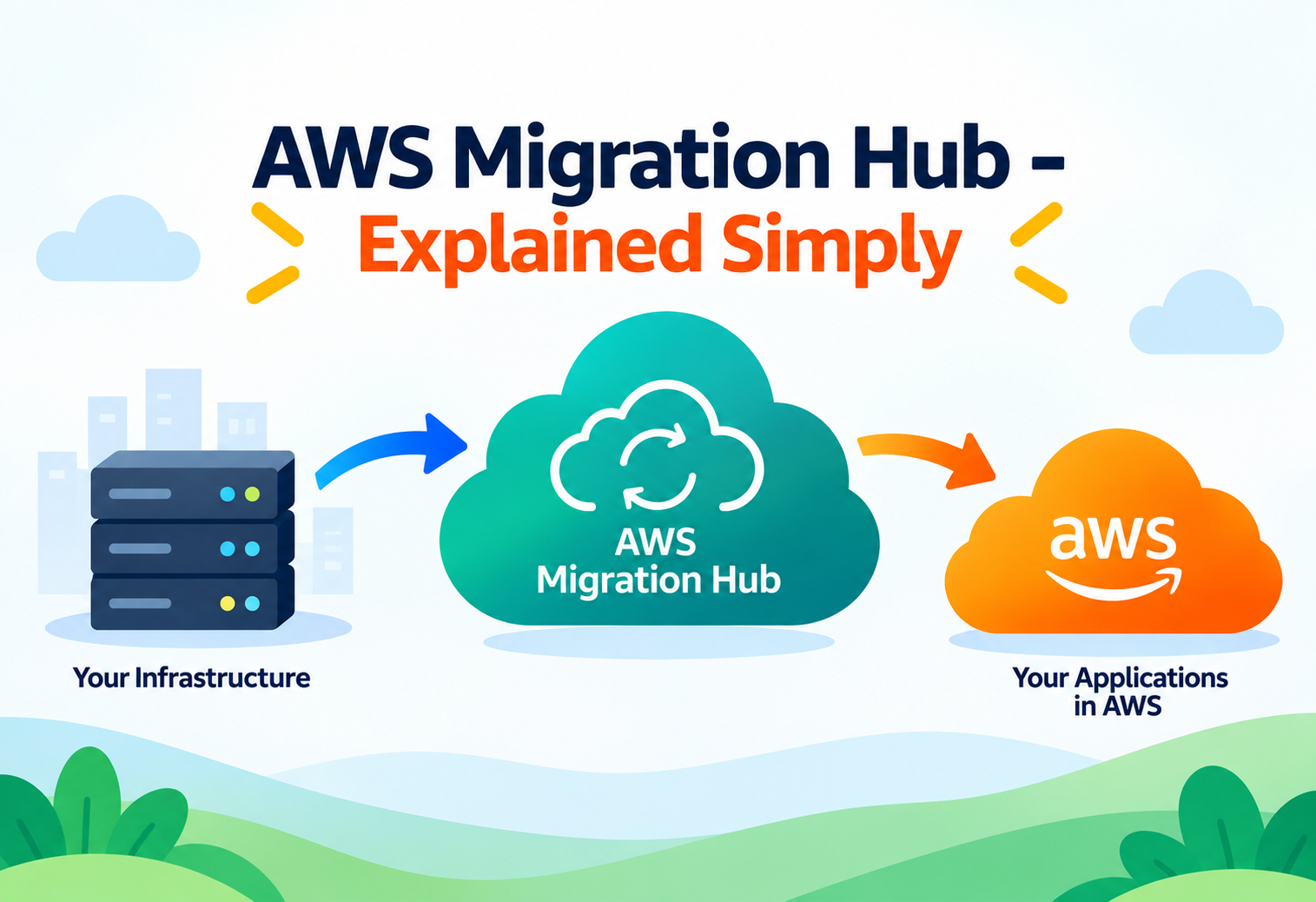
AWS Migration Hub – Explained Simply
A complete, zero-jargon walkthrough of the service that gives you one unified dashboard to track every server, database, and application moving to the cloud — no matter which tool is doing the actual moving.
Imagine a family moving from an old house into a brand-new one. Different moving trucks handle different things — one truck for furniture, another for the piano, a specialist crew for the fragile antique china, and a separate service for transferring the internet and utility accounts. If nobody kept a master checklist, it would be nearly impossible to know, at a glance, whether everything actually arrived safely at the new house. AWS Migration Hub is that master checklist for moving an entire company’s technology into the cloud. Large organizations rarely move everything using one single tool — they use different specialized AWS services to move servers, databases, and applications — and Migration Hub exists purely to give everyone one unified, central view of how every single piece of that giant move is progressing, regardless of which specific tool is doing the actual work. This guide explains what Migration Hub is, how it works internally, and how real companies use it, assuming no prior cloud knowledge at all.
1Core Concepts
Before touching architecture, let’s build a clear picture of what a “cloud migration” actually involves.
What Is AWS Migration Hub?
AWS Migration Hub is a central service that provides one unified view of the status and progress of application, server, and database migrations happening across multiple different AWS migration tools. In plain English: it does not move anything itself. Instead, it collects progress updates from the specific tools actually doing the moving — like AWS Application Migration Service for servers, or AWS Database Migration Service for databases — and displays them together on one dashboard, so a team never has to jump between five separate consoles just to answer “how is our migration going overall?”
Think of a package-tracking website that shows the status of orders from many different retailers and shipping carriers in one place, instead of you needing to visit five different company websites to check on five different packages. Migration Hub plays that same consolidating role for a company’s technology move — it pulls status updates from many different specialized migration tools into one single, unified tracking view.
Why Does It Exist?
A large company migrating to the cloud rarely moves everything with a single tool, because servers, databases, and applications each require different, specialized migration approaches. Without a central view, tracking hundreds or thousands of individual items across many different tools becomes chaotic — nobody can easily answer basic questions like “what percentage of our servers have finished migrating” without manually checking every tool one by one. Migration Hub exists to remove this chaos, acting as the single source of truth for overall migration progress across the entire organization.
Key Terms You’ll See Everywhere
Discovery
The process of automatically identifying and cataloging existing servers, applications, and their dependencies before a migration begins.
Application Grouping
Organizing individual servers and databases into logical application groups, so related pieces can be tracked and migrated together.
Migration Tool
The specific AWS service actually performing a migration, such as moving servers or replicating a database.
Migration Status
The current progress state of one item — not started, in progress, or complete — reported into Migration Hub by its migration tool.
2Architecture & Components
Migration Hub sits above several specialized migration tools, collecting and consolidating their individual progress reports.
A typical large migration involves several different specialized services working side by side: one tool handling physical or virtual server migration, another handling database replication, and a discovery tool cataloging what exists before anything moves. Each of these tools independently reports its own progress into Migration Hub using a shared tracking format, and Migration Hub combines all of these separate reports into one consolidated dashboard, organized by application group.
flowchart LR
    A["AWS Application Discovery Service
(Inventories existing servers)"] --> H["AWS Migration Hub
(Central Dashboard)"]
    B["AWS Application Migration Service
(Moves servers)"] --> H
    C["AWS Database Migration Service
(Moves databases)"] --> H
    D["Third-Party Migration Tools
(Partner solutions)"] --> H
    H --> E["Unified Migration Dashboard
(Grouped by Application)"]
FIG 1 — Multiple specialized migration tools each report their own progress into one central Migration Hub dashboard.
The Core Building Blocks
Application Discovery Service
Automatically scans existing infrastructure to build an inventory of servers, their configurations, and how they depend on each other.
Application Grouping
Groups related discovered servers and databases into a single logical “application,” so the whole group can be tracked and planned together.
Migration Tools (Server, Database, etc.)
The specific services that actually perform the migration work and report their status back to the hub.
Unified Dashboard
The consolidated view showing overall progress across every application, tool, and migration wave at a glance.
Migration Hub is free to use on its own — you only pay for the underlying discovery and migration tools it coordinates and displays progress for, not for the hub’s tracking dashboard itself.
3Internal Working
What actually happens behind the scenes as multiple tools independently report progress to one shared dashboard?
Each migration tool that supports Migration Hub integration sends periodic status updates — tagged with which application group and which specific server or database they belong to — to a shared tracking system. Migration Hub does not control or trigger the actual migration work itself; it purely listens for these status reports and reassembles them into a single, organized picture, grouped the way the organization has defined its applications.
Think of several independent contractors renovating different rooms of the same house, each texting the homeowner “kitchen: 60% done” or “bathroom: complete” throughout the day. The homeowner never has to visit each room in person to know where things stand — the combined texts alone tell the whole story. Migration Hub plays the role of collecting these separate “texts” from different migration tools into one readable summary.
Discovery Comes First
Before any migration begins, the Application Discovery Service typically scans the existing environment, identifying servers, their specifications, and crucially, which servers talk to which other servers. This dependency information is essential — moving one server without realizing three other systems depend on it can cause an unexpected outage the moment the migration happens.
4Data Flow & Lifecycle
Following one application group from initial discovery to a completed migration.
sequenceDiagram
    participant Team as Migration Team
    participant Discovery as Application Discovery Service
    participant Hub as AWS Migration Hub
    participant Server as Server Migration Tool
    participant DB as Database Migration Tool

    Team->>Discovery: Runs discovery scan on data center
    Discovery->>Hub: Reports inventory and dependencies
    Team->>Hub: Groups servers/databases into "Application A"
    Team->>Server: Starts server migration for Application A
    Server->>Hub: Reports "in progress" status
    Team->>DB: Starts database migration for Application A
    DB->>Hub: Reports "in progress" status
    Server->>Hub: Reports "complete" status
    DB->>Hub: Reports "complete" status
    Hub-->>Team: Dashboard shows Application A: 100% migrated
FIG 2 — Lifecycle of one application group: discovered, grouped, migrated by separate tools, and tracked together to completion.
Notice that the team only interacts directly with the specific migration tools to actually perform the work — Migration Hub’s role throughout is purely to observe, collect, and present, making it possible to answer “is Application A fully migrated yet?” with a single glance rather than checking two separate tool consoles.
5Advantages, Disadvantages & Trade-offs
Consolidated tracking is genuinely useful, but it is not itself a migration engine.
Advantages
- One unified view of migration progress across many different specialized tools
- Free to use — costs come only from the underlying discovery and migration tools
- Application grouping keeps related servers and databases tracked together, not scattered
- Supports both AWS-native tools and select third-party migration solutions
- Discovery data helps avoid the risk of migrating a server without knowing what else depends on it
Disadvantages
- Migration Hub itself does not perform any migration — it is purely a tracking and coordination layer
- Value depends heavily on the underlying tools actually reporting status correctly and consistently
- Not every third-party migration tool integrates with Migration Hub’s tracking
- Requires an upfront investment in discovery and application grouping to be genuinely useful at scale
Migration Hub trades hands-on migration execution for centralized visibility. For a single small server, a dedicated dashboard may feel like overkill; for a company migrating hundreds of interdependent applications across multiple teams and tools, that same visibility becomes the difference between an organized project and total chaos.
6Performance, Scalability & High Availability
How Migration Hub behaves when tracking a migration involving thousands of servers.
Performance
Because Migration Hub’s role is to display status updates rather than perform heavy processing itself, dashboard updates typically reflect the underlying migration tools’ reported status promptly, giving teams a near real-time view of overall progress without needing to refresh many separate consoles.
Scalability
Migration Hub is designed to track migrations of essentially any size, from a handful of servers to enterprise-scale efforts covering thousands of servers and databases across many application groups and migration waves, without requiring any additional infrastructure from the customer to support the tracking itself.
High Availability
The Migration Hub service itself runs on AWS’s managed, highly available infrastructure. Since it is a tracking and reporting layer rather than the system performing the actual data transfer, a brief interruption to the dashboard does not stop underlying migrations already in progress — those continue independently and simply resume reporting once the hub is reachable again.
7Security & Monitoring
Migration data can reveal a lot about a company’s internal systems, so it deserves careful access control.
Security
Access to Migration Hub’s discovery data, application groupings, and migration status is controlled through IAM policies, ensuring only authorized team members can view sensitive details about internal server inventories or migration plans. Discovery data, which can reveal detailed information about a company’s internal infrastructure, is treated with the same access-control discipline as any other sensitive operational data within AWS.
Think of blueprints for a company’s entire office building, showing where every server room, security camera, and vault is located. Those blueprints are extremely useful for planning renovations, but they would be dangerous in the wrong hands — so access to them is carefully restricted to people who genuinely need it. Discovery and migration data deserve that same careful handling.
Monitoring, Logging & Metrics
Migration progress, including which application groups are complete, in progress, or not yet started, is visible directly in the Migration Hub dashboard, giving leadership and migration teams an at-a-glance status without needing detailed technical knowledge of each underlying tool. Detailed activity can also be tracked through AWS CloudTrail for auditing who viewed or modified migration tracking data.
Review the dashboard regularly during an active migration project, not just at the very end. Spotting an application group stuck “in progress” for an unusually long time early gives the team time to investigate before it becomes a bottleneck for the entire migration timeline.
8Design Patterns & Anti-patterns
Habits that make a large migration organized, and habits that make it confusing and risky.
Good Pattern: Discover Before You Migrate
Running a thorough discovery scan first ensures dependencies between servers are understood before anything is moved, avoiding unexpected outages caused by moving one piece of an interconnected system in isolation.
Good Pattern: Group by Business Application, Not Just by Server
Organizing tracking around meaningful business applications, rather than a flat list of individual servers, makes progress reports understandable to both technical teams and business stakeholders.
Pattern
Migrating servers immediately without first running discovery to understand their dependencies.
Why It Fails
A server that looks self-contained might actually be quietly relied upon by several other systems, and moving it in isolation can trigger unexpected outages across seemingly unrelated applications.
Better Approach
Always run a discovery phase first, and use the resulting dependency map to plan migration waves that move interdependent systems together.
Pattern
Using multiple migration tools without ever grouping or connecting them through Migration Hub, tracking each in a separate spreadsheet instead.
Why It Fails
Manually maintained spreadsheets quickly become outdated and inconsistent across a large project, making it easy to lose track of true overall progress or miss a stalled migration.
Better Approach
Connect every supported migration tool to Migration Hub from the start, so progress stays automatically current in one authoritative, shared view.
9Best Practices & Common Mistakes
Habits that keep a large migration project transparent and on schedule.
| Best Practice | Why It Matters |
|---|---|
| Run discovery before planning migration waves | Prevents unexpected outages caused by hidden dependencies between systems |
| Group servers and databases by business application | Makes progress meaningful and understandable to non-technical stakeholders |
| Connect every supported tool to Migration Hub | Keeps one authoritative view instead of scattered, manually updated trackers |
| Review dashboard status on a regular cadence | Catches stalled migrations early, before they delay the whole project |
| Restrict access to discovery data through IAM | Protects sensitive internal infrastructure details from unnecessary exposure |
Common Mistakes Beginners Make
- Skipping discovery entirely and migrating servers based on incomplete or outdated documentation
- Grouping servers arbitrarily instead of by the actual business application they support
- Assuming Migration Hub performs the migration itself, rather than only tracking tools that do
- Not revisiting the dashboard regularly, only discovering a stalled migration near a critical deadline
10Real-World Usage Patterns
How organizations use centralized migration tracking during real, large-scale cloud transitions.
Large Financial Institutions
Regulated organizations migrating hundreds of legacy applications rely on discovery and unified tracking to prove, with evidence, that every dependency was accounted for before cutover.
Amazon Retail
Internal teams migrating legacy systems track progress across multiple specialized tools through one consolidated view rather than juggling separate dashboards per tool.
Companies Undergoing Acquisitions
Newly combined organizations use discovery to inventory an acquired company’s unfamiliar infrastructure before planning how to consolidate it into a shared cloud environment.
Systems Integrators
Consulting firms managing migrations for multiple clients use unified dashboards to report clear, consolidated progress updates to client leadership teams.
11Frequently Asked Questions
12Summary and Key Takeaways
Key Takeaways
- AWS Migration Hub does not migrate anything itself — it consolidates progress from specialized migration tools into one unified dashboard.
- Discovery comes first, cataloging existing servers and their dependencies before any actual migration work begins.
- Application grouping organizes related servers and databases together, making progress meaningful to both technical and business stakeholders.
- Multiple migration tools — for servers, databases, and more — each independently report their status into the same shared dashboard.
- Migration Hub is free to use, with costs coming only from the underlying discovery and migration tools it coordinates.
- Security follows IAM policies, protecting sensitive discovery and migration data from unnecessary exposure.
- Large enterprises and consulting firms alike rely on this centralized visibility to keep complex, multi-tool migrations organized, transparent, and on schedule.