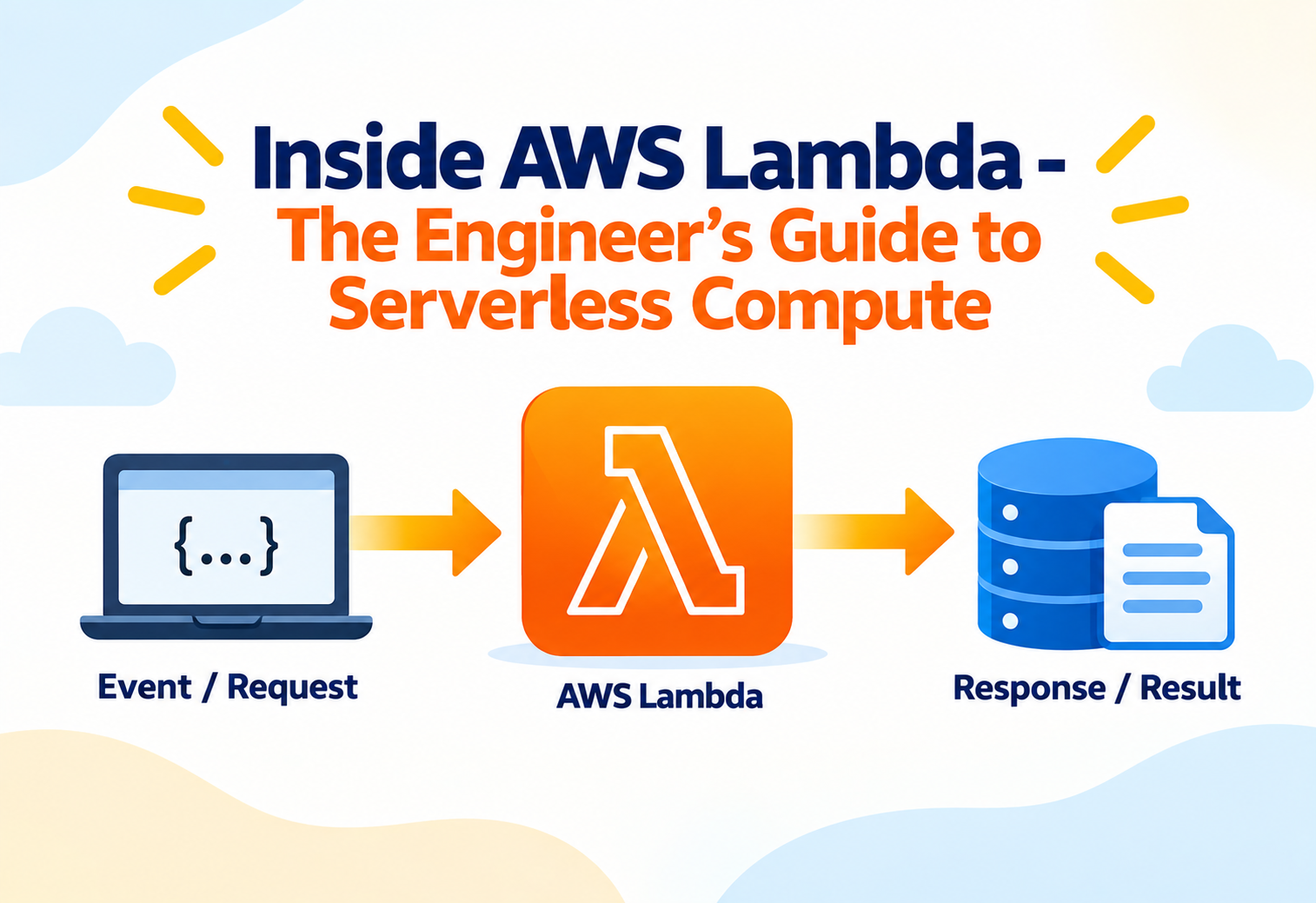
Inside AWS Lambda – The Engineer's Guide to Serverless Compute
Go beyond "just write a function." Understand how Lambda actually schedules, isolates, scales, and secures your code under the hood — and how the platforms behind Netflix, iRobot, and the Financial Times lean on it in production.
If you’ve already written a “Hello World” Lambda function, deployed it through the console, and watched it return a response, you know the basics. This guide picks up from there. We’re going to open the hood on how AWS Lambda actually works internally — the execution environments, the concurrency math, the failure modes that catch experienced engineers off guard, and the architectural patterns that separate a toy demo from a production-grade serverless system. By the end, you should be able to reason about Lambda the way a systems engineer reasons about any distributed compute platform: in terms of isolation, scheduling, state, and trade-offs.
The gap between “I can write a Lambda function” and “I can operate a Lambda-based system in production” is almost entirely made up of the topics ahead: how concurrency actually behaves under load, why cold starts happen and how to control them, what genuinely guarantees availability versus what you have to design yourself, and which architectural patterns hold up once a serverless system grows past a handful of functions into dozens of them talking to each other. None of this requires reading a single line of code — it requires understanding the platform’s actual operating model, which is the goal of everything that follows.
1Core Concepts, Revisited at Depth
At an intermediate level, “Lambda runs your code without servers” is not a useful mental model anymore — you need to know what actually happens between an event arriving and your code executing. Three concepts matter most here: the execution environment, the invocation type, and execution context reuse.
An execution environment is the sandboxed runtime — CPU, memory, ephemeral storage, and a copy of your deployment package — that AWS spins up to run one or more invocations of your function. It is not a “server” in the traditional sense; it’s a lightweight, single-tenant microVM that AWS creates, freezes, thaws, and eventually destroys entirely outside your control. Your job is to write a handler function; AWS’s job is to decide when and where that handler runs.
RequestResponse
The caller (e.g., API Gateway) waits for Lambda to finish and return a value. Errors propagate directly back to the caller.
Event
The caller hands off the event and moves on. Lambda queues it internally and retries automatically on failure (S3, SNS, EventBridge).
Event Source Mapping
Lambda itself polls a stream or queue (SQS, Kinesis, DynamoDB Streams) and invokes your function with a batch of records.
The distinction matters enormously for error handling. A synchronous caller sees failures immediately and must handle retries itself. An asynchronous invocation is retried by Lambda up to two more times, with a backoff, before optionally routing to a dead-letter queue or an on-failure destination. A poll-based source has its own retry and checkpointing semantics tied to the source service — get this wrong, and you either drop records or reprocess them endlessly.
Think of a busy commercial kitchen. RequestResponse is a customer standing at the counter waiting for their order — the kitchen must respond before they walk away. Event invocation is a mail-order form dropped in a box — the kitchen gets to it on its own schedule and someone else isn’t standing there waiting. Event source mapping is a chef who walks over to the pantry themselves, on a loop, checking if there are new ingredients (records) to cook.
Execution context reuse is the concept most engineers misunderstand until it bites them. When Lambda finishes an invocation, it doesn’t necessarily destroy the execution environment — it may freeze it and reuse it for the next invocation of the same function, skipping the expensive initialization (“init”) phase. Code and connections declared outside your handler function (a database connection pool, an SDK client) persist across these reused invocations. This is why AWS recommends initializing SDK clients and DB connections at the module/global scope rather than inside the handler — you get to amortize that cost across many invocations instead of paying it every time.
Because freezing is silent and reuse is not guaranteed, you cannot rely on in-memory state (like a counter or an in-progress transaction) surviving between invocations. Treat every invocation as potentially cold, and treat reused global state as a performance optimization only — never as correctness-critical.
Two more building blocks round out the intermediate mental model. Versions are immutable, numbered snapshots of your function’s code and configuration — once published, a version never changes, which makes it a safe rollback target. Aliases are named, mutable pointers (commonly “prod,” “staging,” “canary”) that point at a specific version, and can be repointed instantly without redeploying code. Callers invoke the alias, not the raw version number, so a deployment becomes a matter of moving a pointer rather than shipping new code to every consumer.
For event source mapping specifically, two extra knobs shape behavior: batch size (how many records from the stream or queue are delivered to a single invocation) and parallelization factor (for Kinesis and DynamoDB Streams, how many concurrent Lambda invocations can process a single shard at once). Getting batch size wrong is a common intermediate mistake — too large, and a single bad record in the batch can fail the entire batch and stall the shard; too small, and you pay the per-invocation overhead far more often than necessary.
2Architecture & Components
Lambda is not one monolithic service — it’s an orchestration of several AWS-internal subsystems working together: a front-end invoke API, a placement and scheduling service, a fleet of workers running microVMs, and a set of integrations with event source services.
flowchart TB
    subgraph Sources["Event Sources"]
        APIGW["API Gateway"]
        S3["Amazon S3"]
        SQS["Amazon SQS"]
        EB["EventBridge"]
    end
    subgraph ControlPlane["Lambda Control Plane"]
        FE["Invoke Front-End / Auth"]
        PLACE["Placement Service"]
        WM["Worker Manager"]
    end
    subgraph DataPlane["Lambda Data Plane"]
        W1["Worker Node: MicroVM 1"]
        W2["Worker Node: MicroVM 2"]
        W3["Worker Node: MicroVM N"]
    end
    IAM["IAM Execution Role"]
    CW["CloudWatch Logs / Metrics"]

    APIGW --> FE
    S3 --> FE
    SQS --> FE
    EB --> FE
    FE --> PLACE
    PLACE --> WM
    WM --> W1
    WM --> W2
    WM --> W3
    W1 -. assumes .-> IAM
    W2 -. assumes .-> IAM
    W3 -. assumes .-> IAM
    W1 --> CW
    W2 --> CW
    W3 --> CW
Every component earns its place. The invoke front-end authenticates the caller and validates the request against your function’s resource policy. The placement service decides which physical worker in the fleet should host the new execution environment, factoring in available capacity, your account’s concurrency limits, and locality. The worker fleet is where your code actually executes, each function invocation isolated inside its own microVM. The execution role is a distinct IAM identity your function assumes to call other AWS services — it is not the same as the permissions of whoever deployed the function.
Production Example — iRobot
iRobot’s cloud backend for Roomba devices uses Lambda behind API Gateway and IoT Core to process millions of device telemetry events per day, scaling the compute layer automatically as new robots come online without iRobot provisioning a single EC2 instance for that workload.
A subtlety worth internalizing: Lambda is a regional service. Your function, its concurrency pool, and its worker fleet all live within one AWS Region — there is no automatic cross-region failover. If your application needs multi-region resilience, that’s an architectural decision you make explicitly, typically by deploying the same function stack into two regions and routing traffic between them with Route 53 or a global accelerator, not something Lambda gives you for free the way AZ-level redundancy is given for free within a region.
The placement service also maintains a pool of pre-initialized, generic microVMs (“warm pools” internally) ready to be assigned to whichever customer function needs one next, which is part of why Init can be fast even for a genuinely first-time invocation — AWS isn’t always building a VM from nothing, it’s often handing off a ready-to-configure VM and then loading your specific code into it.
When API Gateway sits in front of Lambda — by far the most common synchronous-invocation pattern — the integration type you choose changes both cost and behavior. A REST API gives you the fullest feature set: request validation, usage plans, API keys, and fine-grained request/response transformation. An HTTP API is a newer, leaner option with a smaller feature set but meaningfully lower cost and latency for the common case of a straightforward proxy integration. Choosing REST by default “because it’s more powerful” is a frequent over-engineering trap for services that only need simple pass-through routing.
3Internal Working — MicroVMs and Firecracker
The isolation technology underneath Lambda (and Fargate) is Firecracker, an open-source virtual machine monitor built by AWS specifically for this use case. Firecracker microVMs are far lighter than traditional EC2 VMs — they can boot in low single-digit milliseconds and have a minimal device model, which is what makes it economically feasible for AWS to spin up a fresh, fully isolated VM per customer function rather than relying purely on container-level isolation (like cgroups/namespaces) for multi-tenant security.
This matters because it explains Lambda’s security posture: even though thousands of customers’ functions run on the same physical hardware, each execution environment is a separate, hardware-virtualized microVM. One tenant’s function cannot see another tenant’s memory, even in the event of a container-escape-class vulnerability, because there is no shared container kernel between tenants — each microVM has its own guest kernel.
BOOT TIME
MEMORY ALLOCATED
MEMORY CONFIGURABLE
Each microVM proceeds through three internal phases for every function it hosts: Init (download and unpack the deployment package, start the runtime, execute any code outside the handler), Invoke (run the handler with the given event), and eventually Shutdown (when AWS reclaims the environment, typically after a period of inactivity). A “cold start” is the latency penalty incurred when Init must run before your handler can execute; a “warm start” skips straight to Invoke because a frozen, previously-initialized environment was reused.
For runtimes with historically heavy Init costs — the JVM being the classic example — AWS offers SnapStart, which takes a memory-and-disk snapshot of a fully-initialized execution environment ahead of time and restores new environments from that snapshot instead of running Init from scratch on every cold start. It effectively converts a slow, code-executing Init into a fast, snapshot-restoring one, at the cost of some careful handling for anything that must be genuinely unique per environment, like random seeds or cached credentials that shouldn’t be reused verbatim across restored snapshots.
Each microVM also gets its own ephemeral storage, mounted at /tmp, configurable up to 10GB. It’s genuinely ephemeral — scoped to the lifetime of that specific execution environment, wiped when the environment is reclaimed, and never shared between concurrently running invocations even of the same function. It’s useful as scratch space for temporary file processing, but it is not a substitute for S3 or a database when data needs to outlive a single environment.
4Data Flow & Lifecycle
Understanding the full lifecycle of a single invocation clarifies where you have influence and where you don’t.
Event Received
The event source (API Gateway, S3, SQS, a direct SDK call) sends a payload to the Lambda invoke API.
Environment Selection
Lambda finds a warm execution environment if one is available and idle, or provisions a new microVM if not.
Init Phase (cold start only)
Runtime bootstraps, your deployment package is unpacked, and any global-scope code runs once.
Invoke Phase
Your handler function executes with the event object and a context object, bounded by your configured timeout.
Response / Freeze
The return value goes back to the caller (or the response destination). The environment is frozen, not destroyed, in case another invocation arrives soon.
Reclamation
After a period of inactivity (AWS-controlled, not published as an SLA), the environment is torn down entirely.
Your handler doesn’t just receive the event — it also receives a context object, which carries metadata about the current invocation: the remaining execution time before timeout, the request ID (invaluable for tracing a single invocation through CloudWatch logs), the function’s memory limit, and identifiers for the log stream and group. Checking remaining time inside long-running handlers is an underused technique for gracefully wrapping up work — flushing a buffer, checkpointing progress — before Lambda forcibly terminates the environment at timeout.
For synchronous invocations exposed through a Lambda Function URL, response payloads can also be streamed back to the caller incrementally rather than buffered and returned all at once. This matters for handlers generating large responses or proxying long-lived output (like an LLM token stream) — the caller starts receiving bytes as they’re produced instead of waiting for the entire handler to finish.
5Concurrency Model
Concurrency is the single most important operational concept in Lambda, and the one most likely to cause a production incident if misunderstood. Every simultaneous execution of your function — cold or warm — counts as one unit of concurrency. AWS accounts have a default regional concurrency limit (a soft quota that can be raised), and that pool is shared across every function in the account unless you configure otherwise. It’s a subtly different mental model from “requests per second”: a function with a short duration can sustain a high request rate on relatively little concurrency, while a function with a long duration consumes far more concurrent capacity for the same request rate, since each in-flight invocation holds its unit of concurrency for the full time it takes to complete.
| Setting | What it does | When to use it |
|---|---|---|
| Reserved Concurrency | Caps and guarantees a slice of the account pool exclusively for one function | Protecting a downstream database from being overwhelmed, or ring-fencing a noisy-neighbor risk |
| Provisioned Concurrency | Pre-initializes a set number of execution environments so they are always warm | Latency-sensitive synchronous APIs where cold starts are unacceptable |
| Unreserved (default) | Draws from whatever is left in the shared account pool | Background or non-critical functions where throttling is tolerable |
Reserved concurrency set to zero is a legitimate and common technique to instantly disable a misbehaving function — for example one that’s hammering a downstream dependency — without deleting or redeploying it.
Lambda also enforces a burst scaling limit: functions can scale rapidly up to an initial burst capacity (which varies by region), after which additional concurrency is added at a steadier rate per minute. If your traffic spikes faster than this ramp, excess requests are throttled — synchronous callers get a 429-class error, asynchronous invocations are retried, and event-source-mapping consumers simply back off and slow their polling.
Because unreserved concurrency is a shared account-wide pool, a “noisy neighbor” scenario is entirely possible within a single AWS account: a background job that suddenly scales to thousands of concurrent executions can starve concurrency away from an unrelated, latency-sensitive API function running in the same account and region. This is precisely the scenario reserved concurrency is designed to prevent — it’s not just a performance knob, it’s an isolation boundary between functions that happen to share billing and account infrastructure.
6Advantages, Disadvantages & Trade-offs
It helps to look at each side of this list not as a marketing bullet but as a direct consequence of the microVM isolation model covered earlier. Every advantage on the left and every disadvantage on the right traces back to the same root design decision: AWS owns the compute lifecycle, and you own only the code that runs inside it.
Advantages
- No server or OS patching — AWS owns the runtime and host layer
- Granular, pay-per-invocation billing (measured in milliseconds of execution time)
- Automatic scaling from zero to thousands of concurrent executions
- Deep native integration with the AWS event-driven ecosystem
- Built-in fault isolation — one invocation crashing cannot take down others
Disadvantages
- Cold starts introduce variable latency, especially for large deployment packages
- Maximum 15-minute execution timeout rules out long-running batch jobs
- Stateless by design — any state must be pushed to an external store
- Regional concurrency limits create a shared blast radius across functions
- Debugging distributed, event-driven chains is harder than debugging a monolith
The underlying trade-off is one every architect eventually has to make explicit: Lambda optimizes for elastic, low-operational-overhead compute at the cost of long-running, stateful, or ultra-low-and-consistent-latency workloads. It is a phenomenal fit for bursty, event-driven, short-lived work; it is the wrong tool for a 24/7 steady-state workload that would run more cheaply on reserved EC2 or Fargate capacity.
The cost crossover point is worth internalizing precisely: Lambda’s per-millisecond pricing is excellent when utilization is spiky or low, because you pay nothing during idle periods and a traditional server would sit there burning money regardless of load. But at sustained, high, predictable utilization — a service running near-constant traffic 24/7 — the per-invocation premium on Lambda can exceed what the same compute would cost on right-sized, reserved EC2 or Fargate capacity. Mature serverless organizations routinely run this cost comparison per-function rather than assuming Lambda is unconditionally cheaper.
7Performance & Scalability
Memory configuration in Lambda is deceptively powerful: CPU allocation scales linearly with the memory you assign, up to the maximum. A function configured with more memory doesn’t just get more headroom for large payloads — it gets a proportionally faster CPU, which can make a CPU-bound function both faster and cheaper overall, because you pay for duration × memory, and a shorter duration can offset the higher per-millisecond rate.
It’s like renting a bigger delivery van. You pay more per hour for the bigger van, but it can carry the whole shipment in one faster trip instead of three slow ones — your total cost can actually go down even though the hourly rate went up.
Cold-start mitigation is a recurring performance conversation at the intermediate level. The main levers are: keeping deployment packages small and dependency-light, choosing faster-starting runtimes for latency-critical paths, moving heavy imports and connection setup to global scope so they’re only paid once per environment, and — for the strictest latency budgets — provisioned concurrency, which pre-warms environments ahead of traffic.
Production Example — Financial Times
The Financial Times rebuilt parts of its content-publishing pipeline on Lambda, using it to fan out image processing and metadata enrichment across many parallel short-lived invocations rather than a single long-running batch server, cutting both processing time and idle compute cost.
Architecture choice is another meaningful performance lever: functions can run on either x86_64 or Arm-based Graviton processors. Graviton typically offers a better price-to-performance ratio for compatible workloads — often noticeably cheaper for the same throughput — but requires that your dependencies (particularly compiled native libraries) support the Arm architecture, which is worth verifying before migrating a function that leans on binary dependencies.
Network I/O is also frequently the real bottleneck behind a “slow” Lambda function, even when memory and CPU look fine on a dashboard. A handler making several sequential calls to downstream services — a database, a third-party API, another Lambda function — accumulates network round-trip latency invocation after invocation. Parallelizing independent downstream calls, or moving genuinely sequential dependency chains into a Step Functions state machine, is usually a bigger performance win than tuning memory alone.
8High Availability & Reliability
Lambda’s availability model piggybacks on the underlying region’s multi-Availability-Zone design: AWS runs the worker fleet across multiple AZs by default, so a single AZ failure doesn’t take your function offline — you don’t configure this yourself, it’s inherent to the service. This is a meaningful contrast with a self-managed EC2 fleet, where multi-AZ resilience is something you have to explicitly design, provision, and test; with Lambda, it’s the baseline behavior you get simply by using the service, and the interesting reliability decisions shift up a level, to how your application handles partial failures rather than how it survives infrastructure failures.
Reliability at the application level is where your design choices matter most. For asynchronous invocations, configure a dead-letter queue (DLQ) or an on-failure destination so events that exhaust their retries aren’t silently dropped. For poll-based sources like SQS, tune the queue’s own visibility timeout and configure a DLQ on the queue itself. And because retries mean your handler may run more than once for the same logical event, idempotency is not optional — design handlers so that processing the same event twice produces the same end state, typically using an idempotency key stored in DynamoDB or a similar store to detect and skip duplicate processing.
Problem
An order-processing Lambda charged customer cards twice after an SQS-triggered invocation timed out and was redelivered, because the handler had no way to recognize it had already run for that message.
Root Cause
The handler treated every invocation as new work rather than checking whether the associated order ID had already been processed.
Fix
Store a processed-message idempotency key in DynamoDB with a conditional write before executing the charge, so a redelivered message is detected and skipped rather than reprocessed.
For workloads that genuinely need to survive a full regional outage — not just an AZ failure — the pattern is to deploy the same function, alongside its event sources and data stores, into a second region, then route traffic between them using Route 53 health checks or a global accelerator. This is deliberately not automatic, because it has real cost and complexity implications; AWS gives you AZ-level resilience for free within a region and leaves the region-to-region decision to you, since not every workload’s availability requirements justify doubling the infrastructure.
9Security
Lambda’s security model rests on three pillars: identity, network, and secrets. The execution role should be scoped to the narrowest set of permissions the function actually needs — a common intermediate-level mistake is copying a broad managed policy across many functions “to save time,” which turns any single compromised function into a much wider blast radius than necessary.
Least-Privilege IAM
One execution role per function, scoped to exact resource ARNs and actions rather than wildcarded permissions.
VPC Attachment
Functions can be placed inside a VPC to reach private resources like RDS — at the cost of extra ENI setup latency on cold start.
Secrets Manager / SSM
Credentials and API keys are fetched at runtime from a secrets store rather than hard-coded into environment variables.
Encryption at Rest
Environment variables and deployment packages are encrypted using AWS KMS, with the option to bring your own customer-managed key.
On the network side, attaching a function to a VPC is common when it needs to reach a private RDS instance or an internal service, but it’s worth knowing the trade-off explicitly: VPC-attached functions rely on AWS-managed Hyperplane ENIs, which have largely closed the historical cold-start gap versus non-VPC functions, but still add a small amount of setup overhead and require careful subnet/NAT planning so the function can still reach the public internet (for things like calling other AWS service APIs) if needed.
Data protection has two distinct dimensions worth separating: encryption at rest, which KMS handles automatically for your deployment package and environment variables, and encryption in transit, which is your responsibility to enforce for any data your function sends over the network — always using TLS when calling downstream APIs, databases, or other AWS services, rather than assuming AWS handles this for you end-to-end. For environment variables carrying anything sensitive, AWS also lets you attach a specific KMS key and enable an additional client-side encryption helper, so the value is decrypted only inside your handler code rather than being visible in plaintext anywhere in the console or CloudFormation template.
Two more identity boundaries are easy to overlook at the intermediate level. A resource-based policy attached directly to the function controls who is allowed to invoke it — separate entirely from the execution role, which controls what the function itself can do once running. Confusing these two is a common misconfiguration: granting the execution role permission to invoke another Lambda function does nothing unless the target function’s resource-based policy also permits the caller. Similarly, if you expose a function directly via a Lambda Function URL, its authentication type (IAM or public) is a security decision made independently of both the execution role and any resource policy, and defaulting a production endpoint to public/unauthenticated is a mistake worth double-checking before deployment.
10Monitoring, Logging & Metrics
Every Lambda invocation automatically emits logs to CloudWatch Logs and metrics to CloudWatch Metrics — Duration, Invocations, Errors, Throttles, and ConcurrentExecutions are available out of the box with zero instrumentation code. For most production systems, that default visibility is not enough on its own.
CloudWatch Logs Insights
Query structured log output across many invocations to find patterns, slow paths, or recurring errors.
AWS X-Ray
Distributed tracing that follows a single request across Lambda, API Gateway, DynamoDB, and downstream services, showing where time is actually spent.
Lambda Insights
An enhanced monitoring layer surfacing memory utilization, init duration, and cold-start frequency per function.
The metric most engineers under-watch is Throttles. A rising throttle count means your function is hitting its concurrency ceiling — either the reserved limit you set, or the account-wide pool — and is a leading indicator of user-facing errors well before your error rate or latency dashboards show anything unusual.
For business-specific metrics beyond what Lambda emits automatically — orders processed, cache hit rate, records rejected by validation — the Embedded Metric Format (EMF) lets you emit structured, high-cardinality custom metrics simply by writing a specially-formatted JSON blob to standard log output, without making a separate API call to CloudWatch for every metric point. CloudWatch parses these log lines automatically, which keeps custom-metric emission cheap and fast even at high invocation volume.
11Deployment & Cloud Integration
Deployment packages come in two forms: a .zip archive (up to 250MB unzipped, including layers) or a container image (up to 10GB), which is useful when your function depends on large libraries, custom binaries, or you want to reuse existing container tooling and CI pipelines built for other services.
Lambda Layers let you package shared dependencies or internal libraries separately from your function code, so multiple functions can reference the same layer without each one bundling a duplicate copy — reducing package size and centralizing dependency updates.
Use versions and aliases together to enable safe rollouts. A version is an immutable snapshot of your function’s code and configuration; an alias is a mutable pointer (like “prod”) to a version. Combine an alias with weighted traffic shifting to run a canary or linear deployment, sending a small percentage of live traffic to a new version before fully cutting over.
For infrastructure-as-code, most teams use AWS SAM or AWS CDK rather than hand-editing console configuration — both compile down to CloudFormation, and both integrate naturally with CI/CD pipelines that build, test, and progressively deploy new versions behind an alias.
AWS CodeDeploy automates the traffic-shifting step itself: rather than manually moving an alias’s weight from the old version to the new one, CodeDeploy can shift traffic linearly (a fixed percentage every few minutes) or in canary steps (a small percentage held for a set period, then the rest), while watching CloudWatch alarms you define. If an alarm fires — an error-rate spike, a latency regression — CodeDeploy automatically rolls the alias back to the previous version without a human needing to notice and intervene first.
12Design Patterns & Anti-patterns
Fan-Out / Fan-In
One event triggers many parallel Lambda invocations (via SNS or EventBridge), each doing independent work, often reconverging through a queue or Step Functions.
Orchestration with Step Functions
Complex multi-step workflows are modeled as a state machine that invokes individual Lambda functions as steps, rather than one giant function chaining logic internally.
Strangler Fig Migration
Individual endpoints of a legacy monolith are peeled off one at a time and re-implemented as Lambda functions behind the same API surface.
Saga Pattern
A multi-step business transaction spanning several services, coordinated by Step Functions, where each step has a matching compensating action to undo it if a later step fails.
The Monolithic Lambda
A single function handling many unrelated responsibilities via internal if/else routing — it loses the isolation, independent scaling, and clear IAM boundaries that are the whole point of Lambda.
The Saga pattern deserves a closer look because it’s the standard answer to a question that trips up many teams moving from monoliths to Lambda: “how do I do a distributed transaction without a database transaction?” Instead of an all-or-nothing commit, each step in the saga executes and records what it did; if a downstream step fails, Step Functions walks backward through the already-completed steps, invoking a compensating Lambda function for each one — refunding a payment, releasing a reserved inventory item — until the system is back in a consistent state. It trades the simplicity of ACID transactions for the scalability of independently deployable, independently scaling functions.
sequenceDiagram
    participant SF as Step Functions
    participant L1 as Reserve Inventory
    participant L2 as Charge Payment
    participant L3 as Schedule Shipping
    SF->>L1: Invoke
    L1-->>SF: Success
    SF->>L2: Invoke
    L2-->>SF: Failure
    SF->>L1: Invoke Compensation
    L1-->>SF: Inventory Released
Notice what the diagram implies about failure boundaries: each Lambda function in the saga is independently retryable and independently testable, and the coordination logic — what to compensate, in what order, under which failure condition — lives in the Step Functions state machine definition rather than being hand-rolled inside application code. This separation is precisely what makes sagas maintainable at scale; without it, compensation logic tends to sprawl into deeply nested try/catch blocks scattered across multiple functions.
Problem
A function that processed uploaded files and wrote a “processed” copy back into the same S3 bucket accidentally triggered itself again on its own output, spiraling into thousands of unnecessary invocations within minutes.
Root Cause
The S3 event notification was configured on the whole bucket rather than scoped to the specific input prefix, so the function’s own writes re-triggered it.
Fix
Scope event notifications to a distinct input prefix, write outputs to a separate bucket or prefix, and add a concurrency reservation as a circuit-breaker safety net.
13Best Practices & Common Mistakes
Best Practices
- Initialize SDK clients and DB connections outside the handler, at global scope
- Set explicit, conservative timeouts rather than leaving the default
- Give every function its own narrowly-scoped execution role
- Use environment variables plus a secrets store — never hard-code credentials
- Design every handler to be safely retried (idempotency first, always)
Common Mistakes
- Setting reserved concurrency too high and starving every other function in the account
- Ignoring DLQs, so failed asynchronous events vanish without a trace
- Bundling unnecessary dependencies, bloating package size and cold-start time
- Treating in-memory variables as durable state across invocations
- Skipping X-Ray or structured logging until an incident forces the issue
- Granting a resource-based policy or Function URL broader access than the caller actually needs
- Choosing batch size for event source mappings without testing partial-failure behavior
Most of these mistakes share a root cause: treating Lambda as “just a function” instead of as a distributed system component with its own scheduling, retry, and isolation semantics. The engineers who get the most value out of Lambda are the ones who design for its actual operating model — at-least-once delivery, ephemeral compute, shared account-level limits — rather than assuming it behaves like a always-on process on a server they control.
14Real-World & Industry Examples
Netflix — Media Processing Pipelines
Netflix uses Lambda for parts of its media-processing and operational tooling pipelines, favoring the event-driven scaling model for bursty, variable-load jobs where provisioning fixed EC2 capacity would sit idle most of the time.
Bustle / A Cloud Guru — Serverless-First Backends
Several media and education platforms have built entire request-serving backends on Lambda behind API Gateway, citing reduced operational headcount for infrastructure management as the primary driver over raw cost savings.
Coca-Cola — Vending Machine Telemetry
Coca-Cola’s connected vending machines send telemetry through an event-driven pipeline that includes Lambda, processing transaction and inventory data from thousands of devices without a dedicated always-on backend fleet.
Zillow — Image and Data Pipelines
Zillow has used Lambda to process large volumes of listing images and real-estate data updates, relying on fan-out concurrency to handle the uneven, market-driven bursts of new listings without maintaining a fixed-size processing fleet sized for peak load year-round.
A pattern worth noticing across all of these examples: none of them chose Lambda because the workload was small. They chose it because the workload was unpredictable — traffic driven by device activity, market conditions, or content publishing schedules rather than a steady, forecastable curve. That’s the signal worth listening for when evaluating whether a new workload belongs on Lambda: not “is this simple enough for a function,” but “is this bursty enough that paying for idle capacity would be wasteful.”
15Lambda Extensions & the Runtime API
Beyond your handler code, Lambda exposes two extensibility surfaces that intermediate engineers eventually run into: the Runtime API and Lambda Extensions. The Runtime API is the internal HTTP interface every language runtime uses to fetch the next event and post back the response — it’s how Lambda supports custom runtimes for languages AWS doesn’t natively ship, by letting you implement that request/response loop yourself inside your deployment package.
Extensions run as a separate process alongside your function’s runtime, inside the same execution environment, and can hook into the Init, Invoke, and Shutdown phases independently of your handler code. This is how many observability and security vendors integrate with Lambda without requiring you to modify application code at all — an extension can capture telemetry, ship logs, or enforce policy in the background, sharing the environment’s lifecycle but running as its own process.
Internal Extensions
Run in-process with the runtime, inside your function’s own execution thread — typically language-specific instrumentation libraries.
External Extensions
Run as a fully separate process in the same execution environment, registered through the Extensions API, commonly shipped via a Lambda Layer.
External extensions add their own initialization time to the Init phase and consume part of the function’s memory and CPU allocation — a heavy observability extension can measurably worsen cold-start latency, so it’s worth benchmarking before and after adding one, not assuming it’s free.
16Cost Optimization
Lambda billing is a function of three variables you directly control: memory allocated, execution duration, and invocation count — plus, for provisioned concurrency, a separate charge for keeping environments warm regardless of whether they’re invoked. Because duration and memory multiply together, the highest-leverage optimization is usually right-sizing memory against actual measured usage rather than guessing.
| Lever | Effect | Risk if overdone |
|---|---|---|
| Lower memory | Reduces per-millisecond cost | Slower CPU can increase duration enough to raise total cost |
| Higher memory | Faster CPU, shorter duration | Higher per-millisecond rate can outweigh the time saved for I/O-bound code |
| Graviton (Arm) | Better price-performance for compatible workloads | Requires Arm-compatible dependencies and testing |
| Provisioned concurrency | Eliminates cold starts for a fixed slice of capacity | Billed continuously whether invoked or not — wasteful if traffic is unpredictable |
A practical workflow many teams adopt is load-testing a function at several memory settings and plotting cost against duration to find the actual minimum-cost point — it’s rarely the lowest memory setting, because CPU throttling at low memory tiers often extends duration by more than the per-millisecond savings justify. AWS’s open-source Lambda Power Tuning tool automates exactly this experiment, invoking a function repeatedly across a range of memory configurations and reporting the cost/performance curve.
It’s the same logic as choosing a cloud EC2 instance size for a batch job: the smallest instance isn’t always the cheapest way to finish the job, because it might take three times as long to run. You’re optimizing total cost of the job, not the hourly sticker price.
Provisioned concurrency deserves special scrutiny in a cost review, because unlike on-demand invocations, it bills continuously for the reserved capacity regardless of whether traffic actually arrives. It’s the right call for a small, well-understood slice of consistently latency-sensitive traffic — not a blanket setting applied to every function “just in case,” where it quietly becomes one of the largest line items on a serverless bill.
17Testing, Local Development & CI
Testing serverless code well means being deliberate about which layer you’re testing. Unit tests should exercise your handler’s business logic with mocked AWS SDK clients, running entirely on your laptop with no network calls and no deployed infrastructure — fast feedback for the logic you actually wrote. Integration tests, by contrast, need to validate behavior against real AWS services, because mocks can’t faithfully reproduce IAM permission boundaries, event source payload shapes, or service-specific throttling behavior.
Local Emulation
- Fast iteration loop, no AWS cost, works offline
- SAM CLI and similar tools can emulate the invoke lifecycle locally
- Cannot fully replicate IAM enforcement or real event source timing
Deployed Testing
- Accurately reflects real IAM, networking, and quota behavior
- Catches integration bugs local mocks structurally cannot catch
- Slower feedback loop and incurs real, if small, AWS cost
Most mature teams settle on a layered strategy: fast unit tests run on every commit, a smaller set of integration tests run against a dedicated sandbox AWS account on every pull request, and full end-to-end tests run against a staging environment before a canary release to production. CI/CD pipelines built around SAM or CDK can automate all three stages, deploying a new version, running its integration test suite against that specific version’s alias, and only then shifting production traffic via CodeDeploy.
One habit worth adopting early: write structured (JSON) log output rather than free-text strings from day one. It costs almost nothing during development, and it pays for itself the first time you need to query thousands of log lines across concurrent invocations in CloudWatch Logs Insights during an actual incident, when free-text logs turn a five-minute investigation into an hour of manual reading.
18FAQ
19Summary and Key Takeaways
Key Takeaways
- Execution environments are isolated Firecracker microVMs — reused when possible (warm start) and freshly provisioned when not (cold start).
- Invocation type matters: synchronous, asynchronous, and event-source-mapping calls each carry different retry and error-handling semantics.
- Concurrency is the critical operational lever — reserved concurrency protects and caps, provisioned concurrency pre-warms for latency, and both draw from a shared account-wide pool.
- Memory configuration controls CPU, so right-sizing memory can reduce both latency and total cost simultaneously.
- Idempotency is not optional — at-least-once delivery means your handler will eventually be invoked twice for the same event.
- Security rests on scoped IAM roles, careful VPC use, and externalized secrets — never on defaults or copy-pasted broad policies.
- Lambda is the right tool for bursty, event-driven, short-lived work — not for long-running, steady-state, or ultra-latency-sensitive workloads, where Fargate or EC2 remain the better fit.
- Deployment safety comes from versions, aliases, and automated traffic shifting — treat a rollback as a pointer change, not a redeploy.