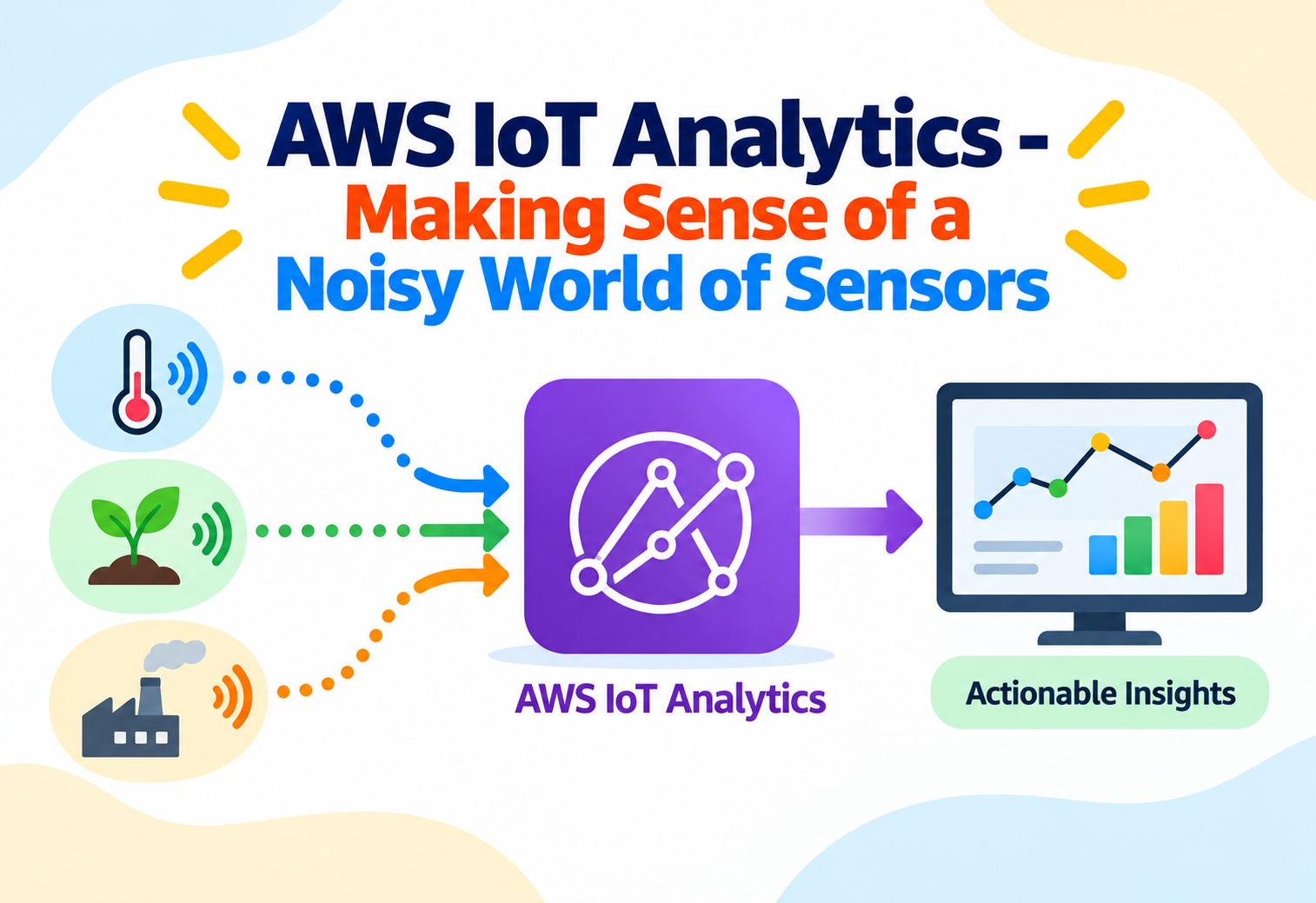
AWS IoT Analytics – Making Sense of a Noisy World of Sensors
AWS IoT Analytics was a managed service that cleaned, organized, and analyzed the messy data pouring in from millions of connected devices — a service that has since been officially retired.
AWS IoT Analytics stopped accepting new customers on July 25, 2024, and officially ended support entirely on December 15, 2025. After that date, the AWS IoT Analytics console and its resources are no longer accessible. AWS recommends migrating existing workloads to alternatives such as AWS IoT Core paired with Amazon Kinesis Data Streams, Amazon S3, Amazon Timestream, AWS Glue, and Amazon Athena. This tutorial explains AWS IoT Analytics as a historical service, useful for understanding how IoT data analytics pipelines work conceptually, rather than as a tool you can still sign up for today.
Imagine trying to listen to a friend talk to you from across a noisy, crowded room. Their voice keeps cutting in and out, other people’s conversations blend into it, and every so often you catch a word that does not make sense at all. Before you could actually understand what your friend was saying, you would need to somehow filter out the noise, fill in the gaps, and clean up the message. This is very similar to the challenge faced by devices connected to the “Internet of Things” — thermostats, factory sensors, delivery trucks, and more — which constantly send messy, incomplete, and sometimes contradictory data. AWS IoT Analytics was built to be that careful listener, cleaning up the noise so businesses could actually understand what their devices were telling them.
1What Was AWS IoT Analytics?
A service dedicated to cleaning up and making sense of data from connected devices.
AWS IoT Analytics was a fully managed service designed specifically to collect, clean, transform, enrich, store, and analyze data coming from Internet of Things (IoT) devices. Rather than requiring businesses to build their own complex data-processing systems, AWS IoT Analytics handled the entire pipeline, from raw, messy sensor readings to organized data ready for analysis and machine learning.
Think of AWS IoT Analytics like a water treatment plant. Raw water coming in from a river is full of dirt, debris, and impurities — not something you would want to drink directly. The treatment plant filters, cleans, and processes that water into something safe and usable. AWS IoT Analytics performed a similar cleaning and processing job, but for messy sensor data instead of water.
This kind of service existed because IoT devices, by their very nature, produce data that is often incomplete or unreliable. A temperature sensor might occasionally send a corrupted reading, a delivery truck’s GPS signal might briefly drop out in a tunnel, and a factory machine’s vibration sensor might record noise from nearby equipment. Before any of this raw data can be usefully analyzed, it typically needs cleaning, organizing, and enriching with additional context.
Internet of Things (IoT)
A broad term for physical devices — sensors, appliances, vehicles, and more — that connect to the internet and exchange data.
Data Pipeline
A series of steps that raw data passes through, being cleaned, transformed, and organized along the way.
Time-Series Data
Data recorded over time, such as a sensor reading taken every few seconds, where the timing of each value matters.
Predictive Maintenance
Using sensor data patterns to predict when a machine is likely to fail, before it actually breaks down.
2Why Did IoT Data Need Its Own Kind of Analytics?
Traditional business analytics tools were not built with messy sensor data in mind.
Traditional analytics and business intelligence tools were generally designed to work with clean, structured data, such as neatly organized sales records or customer information stored in a well-defined spreadsheet or database. IoT data, however, tends to come from devices recording real-world, “noisy” processes like temperature, motion, or sound, which can contain significant gaps, corrupted messages, or false readings.
Trying to run standard analytics directly on raw, uncleaned IoT data could easily produce misleading results, since corrupted or missing readings can distort averages, trends, and predictions if they are not properly handled first.
On top of the noise problem, IoT data is often only meaningful when combined with other contextual information — for example, a temperature reading only becomes useful when you also know which specific machine or location it came from, and what the expected normal range should be. AWS IoT Analytics aimed to automate the difficult steps of cleaning, transforming, and enriching this kind of data, without requiring businesses to build a custom analytics platform from scratch.
3How AWS IoT Analytics Worked Internally
Understanding its internal pipeline still helps explain how IoT data analytics generally works today.
flowchart TD
    A[IoT devices send raw data through AWS IoT Core] --> B[Data flows into an AWS IoT Analytics channel]
    B --> C[A pipeline filters, transforms, and cleans the data]
    C --> D[Data is enriched with additional contextual information]
    D --> E[Cleaned data is stored in a time-series data store]
    E --> F[Users query the data using SQL or Jupyter notebooks]
    F --> G[Results are visualized, often through Amazon QuickSight]
The Ingestion Step
Data from connected devices typically arrived first through AWS IoT Core, a service for connecting and managing IoT devices, and was then routed into an AWS IoT Analytics “channel,” which acted as the entry point for incoming raw data.
The Pipeline Step
Once inside a channel, data moved through a configurable “pipeline,” where it could be filtered to remove irrelevant messages, mathematically transformed, and cleaned of obviously corrupted or invalid readings.
The Enrichment Step
The pipeline could also enrich data by attaching additional metadata, such as which device, machine type, or physical location a particular reading came from, making the data far more meaningful for later analysis.
The Storage and Analysis Step
Cleaned and enriched data was stored in a time-series “data store,” optimized for the kind of “how did this value change over time” queries common in IoT analysis. From there, users could run SQL queries directly, or use built-in Jupyter notebooks to perform more advanced analytics and machine learning, often visualizing results through Amazon QuickSight.
4Key Building Blocks of the Service
A closer look at the main components that made up an AWS IoT Analytics workflow.
Channel
The entry point where raw, unprocessed device data first arrived into AWS IoT Analytics.
Pipeline
A configurable sequence of steps that cleaned, filtered, transformed, and enriched incoming data.
Data Store
The organized, time-series storage location where cleaned data was kept, ready for fast querying.
Dataset
A specific, queryable result created by running SQL or custom analysis against the data store, often refreshed on a schedule.
These four building blocks — channel, pipeline, data store, and dataset — worked together as a chain, with data becoming progressively cleaner and more organized as it moved from one stage to the next.
5The Typical IoT Data Lifecycle
Following a single piece of sensor data from its origin to a finished insight.
Sensor Reading Is Generated
A physical device, such as a temperature or motion sensor, records a new measurement and sends it onward.
Data Reaches AWS IoT Analytics
The raw reading is routed from AWS IoT Core into an AWS IoT Analytics channel for processing.
Cleaning and Transformation
A pipeline filters out invalid readings and applies any needed transformations to the data.
Enrichment with Context
Additional metadata, such as device location or type, is attached to make the reading more meaningful.
Storage in the Data Store
The cleaned, enriched reading is stored in the time-series data store, ready for querying.
Analysis and Visualization
Analysts query the data, run machine learning models, or visualize trends to generate actionable business insights.
6What AWS IoT Analytics Was Used For
Real examples of the kinds of problems this service was designed to solve.
Predictive Maintenance
Factories used sensor data patterns to identify machines that were likely to fail soon, allowing maintenance teams to act before a costly breakdown occurred.
Agricultural Monitoring
Agricultural equipment operators enriched soil moisture sensor data with rainfall predictions, helping optimize irrigation water usage.
Fleet Management
Companies with delivery vehicles or equipment fleets analyzed location and performance data to improve efficiency and identify maintenance needs.
Customer Device Engagement
Businesses selling connected wearable devices analyzed usage patterns to identify customers who might be at risk of abandoning their devices.
7Advantages, Disadvantages & Trade-offs (During Its Active Years)
Looking back at what the service did well, and where the broader AWS analytics ecosystem eventually moved instead.
Advantages
- Automated many of the difficult, repetitive steps of cleaning and preparing IoT data.
- Provided a complete, end-to-end pipeline from raw device data to analysis-ready storage.
- Integrated built-in Jupyter notebooks, avoiding the need for separate machine learning infrastructure.
- Connected easily with AWS IoT Core, simplifying setup for existing IoT deployments.
Disadvantages / Trade-offs
- AWS eventually chose to invest more heavily in more general-purpose streaming and storage tools instead.
- Businesses using it needed to plan a migration once the end-of-support timeline was announced.
- Newer architectures using tools like Kinesis, S3, and Timestream offered more flexibility for varied workloads.
- As a retired service, it can no longer be relied upon for any new or ongoing IoT analytics projects.
8The Retirement Timeline
Understanding how and when AWS phased the service out.
AWS first closed new customer access to AWS IoT Analytics on July 25, 2024, while allowing existing customers to continue using the service as normal for a period afterward. AWS later announced that support would end entirely on December 15, 2025, after which the AWS IoT Analytics console and all related resources would no longer be accessible. AWS published a detailed migration guide, recommending that customers move their data ingestion and processing workflows to a combination of AWS IoT Core, Amazon Kinesis Data Streams, Amazon S3, Amazon Timestream, AWS Glue, and Amazon Athena.
After December 15, 2025, the AWS IoT Analytics console and its underlying resources stopped being accessible entirely, making it essential for any remaining customers to have already exported their data and rebuilt their pipelines using the recommended alternative services.
9Where IoT Analytics Workloads Moved Instead
Understanding the recommended alternatives shows how the same underlying goals can be achieved with more general-purpose tools.
AWS IoT Core with Amazon Kinesis Data Streams
Used to ingest and route real-time device data, replacing the channel and pipeline stages that AWS IoT Analytics previously handled.
Amazon S3 for Storage
Provided scalable, durable storage for both raw and processed IoT data, replacing the dedicated IoT Analytics data store.
Amazon Timestream
A purpose-built time-series database, well suited to the kind of “value over time” queries that IoT data commonly requires.
AWS Glue and Amazon Athena
Used together to prepare, transform, and query large volumes of stored IoT data without needing to manage dedicated analytics infrastructure.
10Lessons Learned From the Retirement
A few reminders that apply to anyone building on top of managed cloud services today.
Even fully managed, purpose-built services can eventually be retired if a cloud provider decides to consolidate around more general-purpose tools, so staying aware of official service announcements matters.
A long runway between the sign-up cutoff and full end-of-support, as AWS provided here, is valuable, but only if organizations actually use that time to plan and test their migration well ahead of the deadline.
Designing systems around flexible, widely used building blocks, such as general-purpose storage and streaming services, can reduce the disruption caused if a more specialized service is retired later.
11Frequently Asked Questions
No. New customer sign-ups closed on July 25, 2024, and the service ended support entirely on December 15, 2025, meaning it is no longer accessible to any customers.
Customers were expected to migrate their data before the end-of-support date, since the console and underlying resources became inaccessible after December 15, 2025.
AWS recommended combining AWS IoT Core, Amazon Kinesis Data Streams, Amazon S3, Amazon Timestream, AWS Glue, and Amazon Athena to replicate the same data ingestion, storage, and analysis capabilities.
No. AWS IoT Core, the service used for connecting and managing IoT devices, remains active and is actually part of the recommended replacement architecture for former AWS IoT Analytics workloads.
Understanding its channel, pipeline, data store, and dataset concepts helps explain the general pattern that any IoT data analytics system follows, even when built today using different, currently active tools.
12Summary and Key Takeaways
AWS IoT Analytics was built to solve a genuinely difficult problem: turning messy, incomplete data from real-world sensors and devices into clean, organized information that businesses could actually analyze and trust. Through its channel, pipeline, data store, and dataset components, it automated much of the hard work involved in cleaning, enriching, and storing IoT data. Although AWS ultimately chose to retire the service in favor of more general-purpose tools like Kinesis, S3, Timestream, Glue, and Athena, the underlying problem it solved, and the pipeline pattern it used to solve it, remain highly relevant to anyone working with IoT data today.
Key Takeaways
- AWS IoT Analytics is retired — new sign-ups closed in July 2024, and support fully ended on December 15, 2025.
- It automated a full IoT data pipeline — from raw device data to cleaned, enriched, analysis-ready storage.
- Its four core components — channel, pipeline, data store, and dataset — formed a clear, chained processing pattern.
- Recommended alternatives combine AWS IoT Core with Kinesis, S3, Timestream, Glue, and Athena.
- Real-world use cases included predictive maintenance, agriculture, fleet management, and customer device engagement.
- The retirement is a reminder that even specialized managed services can eventually give way to more general-purpose architectures.