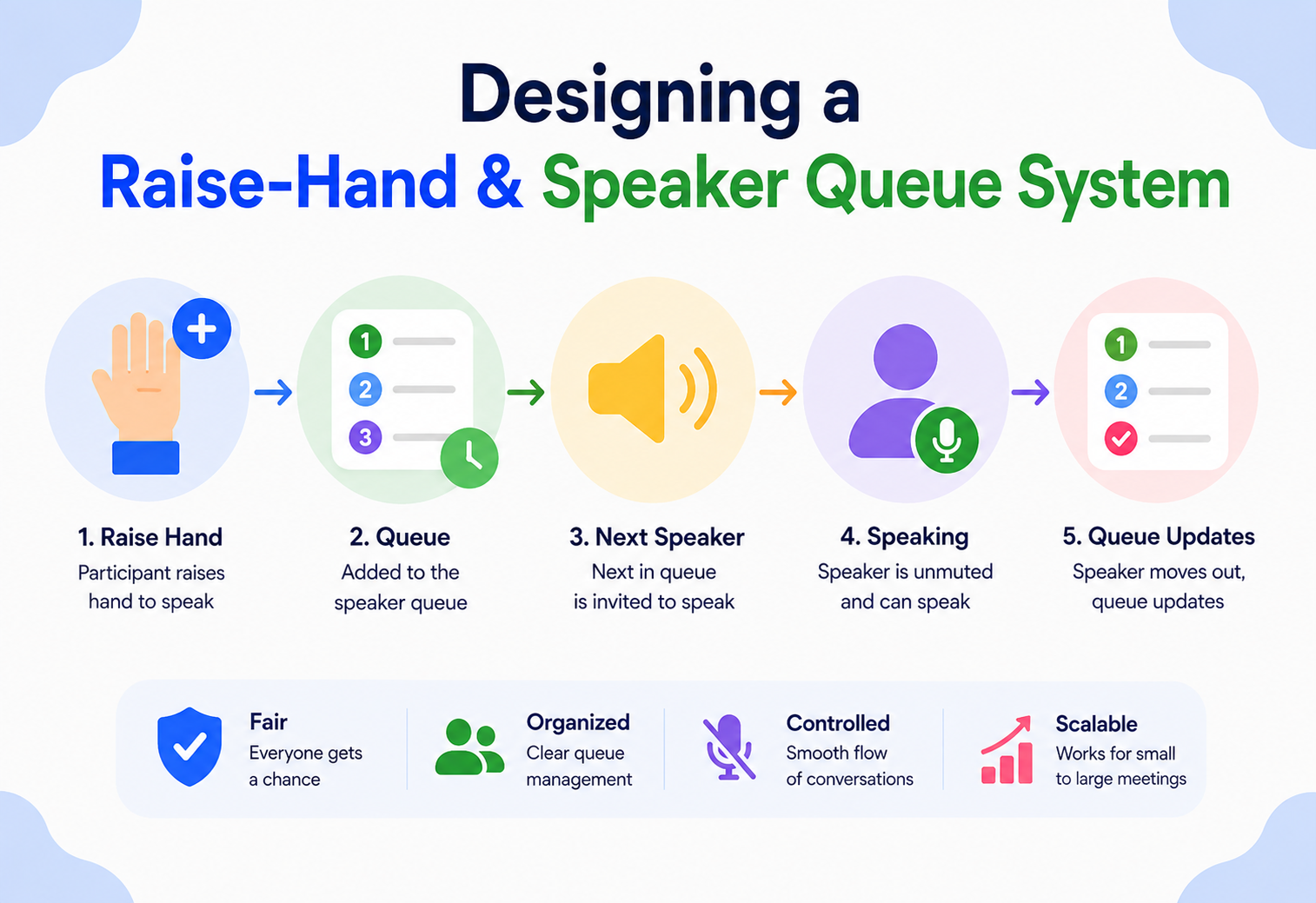
Designing a Raise-Hand & Speaker Queue System
A ground-up walkthrough of how Zoom, Google Meet, Microsoft Teams, Webex, Clubhouse, Discord Stage, Twitter/X Spaces and every large webinar or town-hall platform lets a hundred thousand participants raise a virtual hand, keeps a fair, ordered queue of who speaks next, promotes them from listener to speaker in under a second, and gracefully demotes them back — without dropping requests, losing order or letting anyone hijack the room.
The Big Idea, in One Breath
A raise-hand & speaker queue system is the machinery that turns an unstructured room of listeners into an orderly, fair line of speakers. It takes a single tap on a “raise hand” button, records the exact intent behind it, sequences it against thousands of other hands raised in the same second, offers the hosts real-time control to accept, defer or reject each request, and physically promotes accepted participants from the audience media role into the speaker media role — while the meeting continues without a beat.
Behind that one tap sits a delicate coordination problem: a distributed queue with strict per-room ordering, real-time fanout to every viewer of the queue UI, media-role transitions that must be consistent across every device, and policy that respects moderators, co-hosts, safety rules and platform-wide abuse controls.
Picture an old town-hall meeting with a moderator standing at the front. Anyone in the audience can quietly hold up their hand. The moderator sees a running list, decides whose turn is next, gives them a microphone for a bounded time, and takes the microphone back when they are done. Now imagine that town hall has a hundred thousand participants across continents, and every “hand” is a network packet that must reach the moderator with the same order and the same trust as if the audience were in the room. That is the system this chapter is about.
to visible
active speaker
single room
What a Raise-Hand & Speaker Queue Really Is
Before designing it, we need to pin down what the feature actually does and, just as important, where its edges are. A raise-hand system is not just a button; it is a stateful coordination layer that touches identity, ordering, real-time fanout, media plane control and safety.
2.1 A Working Definition
A raise-hand & speaker queue system is a distributed component that, given a room and its participants, guarantees:
- every raise-hand request is captured, timestamped and made durable within perceptual real-time,
- the queue’s ordering is deterministic and fair, resistant to network jitter and re-tries,
- hosts / co-hosts / moderators can inspect and act on the queue with predictable, per-action guarantees,
- accepted speakers are promoted into the media plane atomically (permissions + roles + UI states change together),
- demotions, timeouts and cancellations are equally graceful,
- the system enforces platform policy: mute/hand-lower, ban, cool-down, safety filters and quotas.
2.2 Where You Encounter It
Video Conferencing
Zoom, Meet, Teams, Webex — classroom Q&A, team stand-ups, town halls, all-hands.
Audio Social Rooms
Clubhouse, Twitter/X Spaces, Discord Stage — enormous listener rooms with active moderation and structured speaking turns.
Webinars & Events
Corporate webinars, virtual conferences, product launches — strict moderator control, Q&A queue integration.
Education & Training
Live classes, MOOC sessions, coding bootcamps — teachers curate speakers, students queue politely.
2.3 What It Is Not
The raise-hand system is not the media plane, not the chat system, and not the reactions system — but it borrows heavily from all three. It sits on the control plane, coordinating identity, permissions, ordering and real-time delivery, and it invokes the media plane to change who is actively speaking.
Think of it as an ordered coordination service with three faces: a producer face (participants raising hands), a consumer face (hosts inspecting and acting), and an effector face (media plane role changes). Get any one of those three wrong and the entire feature falls apart at scale.
Why It Matters So Much
A raise-hand system is a small user-interface element with enormous downstream effect on meeting fairness, safety, engagement and the trust participants place in a platform. When it works, nobody notices. When it fails, the host looks embarrassed on stage.
3.1 The Business & Human Problem
- Fairness under scale. Without a queue, whoever unmutes first “wins.” That is a marketplace of loudness, not participation.
- Host confidence. Executives, teachers and public officials rely on the queue to run structured sessions in front of large audiences.
- Safety & moderation. Every promoted speaker becomes an unfiltered voice to a large audience. Bad actors abuse this if the system does not gate promotions.
- Accessibility. Non-native speakers, shy participants and typing-only users all rely on the queue as a way to be heard without dominating.
- Regulated & enterprise. Board meetings, government sessions and regulated tenants need auditable records of who asked to speak, when and what happened.
3.2 What Makes It Uniquely Hard
Harder than a to-do list
- Ordering must be strict per room, across regions and devices.
- The queue is watched by thousands in real time.
- Every action triggers a media-plane side-effect.
Harder than chat fanout
- The queue is state, not a stream; a late viewer must see the same list as an early one.
- Concurrent host actions must not race (two co-hosts accepting different people simultaneously).
- Abuse is inherently authenticated — a raised hand from a signed-in troll looks legitimate.
Every design choice serves one quiet promise: the queue reflects everyone’s intent, is fair, is safe, is auditable, and is fast enough that it feels like a real hand being raised in a real room. Every extra millisecond, every dropped request, every phantom position is felt directly by the humans on the call.
Roles, States & the Life-Cycle of a Hand
A queue is only as clean as the state machine it enforces. Every subtle bug traces to a missing state, an ambiguous transition or an unhandled race between roles. So we start there.
4.1 Participant Roles
Listener / Attendee
Consumes media, can raise a hand. Cannot moderate, cannot see hidden safety flags.
Speaker
Currently in the media role that carries voice/video. May be time-boxed. Loses the role automatically at end of turn.
Moderator / Co-Host
Can accept, reject, defer or reorder hands. Can lower others’ hands. Bounded by host policy.
Host / Owner
Owns the room, has full policy control including delegating moderation, ending Q&A, disabling raise-hand entirely.
Bot / Automation
Assistants that curate the queue (e.g. surface duplicates), or that run structured programs (auction bidding, panel-style rotation).
4.2 Hand State Machine
NONE
  u2192 (participant taps "raise hand")     RAISED
RAISED
  u2192 (moderator accepts)                  ON_DECK      // queued to speak next
  u2192 (moderator defers)                   RAISED       // keeps position or moves to end
  u2192 (moderator rejects / participant lowers) NONE

ON_DECK
  u2192 (system promotes to speaker media)    SPEAKING
  u2192 (moderator cancels)                  NONE

SPEAKING
  u2192 (turn timer expires / moderator ends) COOL_DOWN
  u2192 (participant leaves / disconnects)   NONE

COOL_DOWN
  u2192 (timer elapses)                       NONE
4.3 Invariants
- At most one
ON_DECKpromotion happens at a time per moderator action — single-writer per room. - A participant cannot be in more than one state simultaneously per room.
- Every transition is durable and produces exactly one audit event.
- Every transition emits exactly one fanout event to every subscriber of the queue.
Modelling the states cleanly is worth more than any clever data structure. Every subtle raise-hand bug in production — phantom queue positions, host actions with no effect, promoted speakers with no audio — traces to a missing or ambiguous transition in this diagram.
The Building Blocks
A production raise-hand system is a small constellation of focused services. Each has one narrow job; the leverage is in composition — and in the discipline of a single ordering authority per room.
Client SDK / UI
Renders the raise-hand button, the “you are #7” hint, the moderator’s queue panel. Optimistic UI with server reconciliation.
Signaling / API
Idempotent endpoints: raiseHand, lowerHand, acceptHand, rejectHand, deferHand, reorderQueue, endTurn.
Room Coordinator
Single-writer authority per room. Owns the queue state, serialises actions, produces the event stream. Sharded per room.
Queue Store
Durable, ordered store of queue events, partitioned by roomId. The source of truth for reconstruction and audit.
Snapshot Store
Latest materialised queue view per room (positions, priorities, state per participant). Hot store, low-latency reads.
Fanout Gateway
WebSocket / SSE fleet that delivers queue deltas and snapshots to every subscriber of the room in real time.
Media Plane Bridge
Transactional promotion: grant speaker media role, update SFU subscriptions, enable microphone, allocate visual slot — atomic with the queue transition.
Policy Engine
Room policy (max queue length, per-user cool-down, waiting-room rules, VIP priority, tenant limits). Consumed by the coordinator.
Safety & Moderation
Real-time safety scoring on the participant about to speak: platform strikes, keyword flags on chat, previous behaviour.
Analytics & Audit
Consumes the event stream: engagement metrics, dashboards for hosts, regulated-tenant audit exports.
Observability
Metrics per room (raise rate, avg wait, promotion latency, promote-fail rate), traces per handId.
Failover & Rebuild
Coordinator can be lost and re-elected; new coordinator rebuilds state from the queue store within seconds.
The Queue Model: Order, Idempotency & Consistency
The queue looks trivial from the UI. It is anything but. Ordering must survive retries and failovers, a single-writer per room must exist without a global bottleneck, and every observer must be able to render a view identical to the coordinator’s truth.
6.1 One Coordinator per Room
The cleanest solution to per-room ordering is a single-writer coordinator per room. Two co-hosts pressing “accept” at the same millisecond are serialised by the coordinator, not by the database, not by the network.
- Rooms are sharded by
roomId. Each shard hosts many rooms. - Coordinator is an actor-style entity (Orleans, Akka, Erlang, custom) with a durable event log.
- Failover elects a new coordinator that replays the last N events to rebuild in-memory state.
6.2 Idempotent Actions
Headers:
  Authorization: Bearer <token>
  Idempotency-Key: 018f1b23-...   # client-generated per intent

Body:
  { "clientTs": 1723612345678, "note": "wants to ask about pricing" }

Responses:
  200 OK  { "handId": "h_9f2a", "position": 7, "state": "RAISED" }
  409     (already raised; returns current handId + position)
  429     (rate limited: cool-down or per-room quota)
6.3 Ordering: Priority + Timestamp
| Dimension | How it is computed | Why |
|---|---|---|
| Priority tier | Policy-driven (VIP, first-time speaker, teacher-assigned) | Enterprise / classroom scenarios need explicit override |
| Raise timestamp | Server-assigned when the coordinator accepts the raise | Client clock skew makes client timestamps unsafe |
| Tiebreaker | Deterministic (userId hash) so all viewers agree on order | Prevents flicker when two hands arrive in the same ms |
| Explicit reorder | Moderator drag/drop overrides ordering with an audit event | Human curation is a first-class action |
6.4 Deltas & Snapshots
Two message shapes are pushed to every subscriber:
{
  "type": "queue.snapshot",
  "roomId": "r_44e1",
  "version": 421,
  "entries": [
    { "handId":"h_1", "userId":"u_a", "state":"ON_DECK", "raisedAt": 1723612345678, "priority": 2 },
    { "handId":"h_2", "userId":"u_b", "state":"RAISED",  "raisedAt": 1723612345690, "priority": 0 },
    ...
  ]
}{
"type": "queue.delta",
"roomId": "r_44e1",
"fromVersion": 421,
"toVersion": 422,
"changes": [
{ "op":"add", "handId":"h_3", "userId":"u_c", "position": 3 },
{ "op":"promote","handId":"h_1", "userId":"u_a", "state":"SPEAKING" }
]
}6.5 Reconciliation Rules
- Every client tracks its last-applied version; on gap detected, it asks for a fresh snapshot.
- Optimistic UI is allowed on raise / lower for the participant themselves; server confirmation reconciles or rolls back.
- Host actions are strictly server-first; UI shows “working…” until the coordinator acks.
The coordinator is the only place where “who is next” is decided. Every other service, every client, every dashboard is a downstream materialisation. Break this rule and you get phantom queue positions, double promotions and race conditions that survive every unit test.
Fairness, Policy & Safety
Ordering is a mechanism; fairness and safety are the reasons for the mechanism. A production queue must balance first-come-first-served with priority, quotas, cool-downs, safety filters and platform-wide abuse controls.
7.1 Fairness Strategies
FIFO
Purely first-come-first-served. Simplest, cleanest for informal rooms.
Round-Robin by Group
Speakers rotate across groups (departments, cohorts, panels) to guarantee spread.
Priority Tiers
VIPs (executives, teachers, first-time speakers) get elevated priority within an audited policy.
Quota-Bounded
Each participant limited to N raises or M speaking seconds per session; enforces breadth of participation.
Cool-Down
After speaking, a participant enters cool-down and cannot re-raise for K seconds. Kills mic-hogging.
Language / Topic Aware
Advanced: LLM-tagged raise notes group similar questions together, reducing repetition.
7.2 Policy Engine
Every action passes through the policy engine before the coordinator applies it. Typical policy inputs:
- Room configuration (max queue length, cool-downs, permission levels).
- Tenant configuration (regulatory tier, audit level, VIP list).
- Participant state (role, strike count, waiting-room clearance).
- Runtime signals (current speaker count, moderator load, safety flags).
7.3 Safety Gating on Promotion
Pre-promotion checks
- Platform strikes / previous violations.
- Chat-based safety flags (keywords, prior removals).
- Anti-brigading (mass-simultaneous raises against a target).
- Tenant-specific KYC or credential requirements.
In-turn protections
- Hard time cap on the turn.
- Live safety scoring on the audio (via ASR + classifier).
- One-click host mute + demotion with audit.
- Automatic cool-down + optional cool-off “green room.”
7.4 Abuse Patterns & Countermeasures
| Abuse | Signal | Countermeasure |
|---|---|---|
| Mic hogging | Same user re-raises immediately after speaking | Enforce cool-down; policy engine rejects raise |
| Brigading | Sudden spike of raises from correlated accounts | Rate-limit per tenant / per IP block; escalate suspicion |
| Ghost hands | Raise then immediately lower to skew the queue UI | Debounce raise/lower cycles per user |
| Promotion-time attacks | Newly promoted speaker abuses stage | Time cap + safety scoring + fast demotion path |
| Fake urgency | Users mark every hand as “urgent” | Costly signals: urgency has its own quota per user per session |
Every policy decision produces an audit event with rule ID and inputs. If a participant is denied a promotion, hosts must be able to explain why — both live and in a subsequent review.
End-to-End Flow: One Hand Raised, One Speaker Promoted
Enough abstraction. Let us follow one raise-hand in a 20,000-listener town hall — from the moment a participant taps the button to the moment they are back to being an audience member with their question answered.
Tap & optimistic UI
Ada taps “raise hand” on her laptop. Local UI shows the hand raised with a subtle spinner. A fresh Idempotency-Key is generated.
API accepts & forwards
Signaling API validates auth, checks the room allows raise-hand, checks per-user cool-down and per-room quotas, and forwards to the room coordinator with a stable handId.
Coordinator serialises & assigns position
The single-writer coordinator for r_44e1 assigns raisedAt, computes priority, appends a hand.raised event to the queue store. Ada is position #47.
Delta fans out to all viewers
Fanout gateway pushes a queue.delta to the host console, co-hosts, and any participant with the queue panel open. Ada’s client reconciles from “spinner” to “#47.”
Moderator inspects, accepts
Twenty minutes later, the moderator taps “accept” on Ada’s hand. The API forwards to the coordinator, which transitions Ada’s hand from RAISED to ON_DECK and updates the queue snapshot.
Safety gate runs
Policy engine and safety scoring produce a green result. Coordinator now emits a hand.promoting event, which the media bridge picks up.
Media plane promotes atomically
Media bridge grants Ada’s device the “speaker” role, updates SFU subscriptions so every listener now hears her, and enables her microphone with a visual slot. All within < 1 s.
Ada asks her question
Turn timer starts at 60 s. In-turn safety scoring is silent. The host’s console shows a countdown; Ada’s client shows “you are on.”
End of turn + cool-down
Ada finishes; moderator ends the turn manually. Coordinator transitions Ada to COOL_DOWN. Media bridge revokes the speaker role. Fanout delivers the queue update. Ada’s UI reverts to listener view.
Analytics + audit
Queue event log is tailed by analytics for engagement dashboards and by the compliance sink for regulated tenants.
Quality Attributes: The “-ilities”
A raise-hand system is graded on unusual axes: it must be ultra-low-latency on the happy path, atomically consistent on promotion, fair under thousands of concurrent hands, and boring enough to run for years without demanding attention.
Raise Latency
< 300 ms tap-to-visible on the participant’s own device; < 500 ms to every other viewer.
Promote Latency
< 1 s from moderator accept to media plane switch; < 1.5 s including UI reconciliation.
Ordering
Deterministic per room; identical view across every subscriber.
Idempotency
Retries never duplicate a raise or produce a phantom queue slot.
Reliability
Coordinator failover rebuilds within seconds from the queue store; no lost hands, no double promotions.
Scalability
Sharded by roomId; hot rooms sub-sharded; fanout piggybacks on the existing meeting socket fabric.
Availability
Signaling degrades gracefully; if fanout is late, snapshots reconcile within seconds; media never depends on queue infra.
Observability
Every handId is traceable end-to-end. Queue length, wait time, promote latency, promote-fail rate are top-line SLOs.
9.1 The Latency Budget
| Hop | Target | How |
|---|---|---|
| Client optimistic paint | < 16 ms | Pure local UI update on tap |
| Client → signaling API | < 80 ms | Edge PoP, keep-alive HTTPS |
| Coordinator apply | < 30 ms | In-region actor, hot in-memory state |
| Log append | < 20 ms | Quorum ack; in-region log |
| Fanout to viewers | < 80 ms | Existing socket fabric |
| Total raise visible to room | ~250–300 ms | Feels instantaneous |
| Promote (accept → speaker) | < 1 s | Transactional across coord + media bridge |
Common Pitfalls & Trade-offs
Every real deployment gets bitten by the same handful of subtle bugs. Knowing them turns weeks of firefighting into a paragraph in a design review.
10.1 Ten Traps We’ve All Fallen Into
No single writer per room
Two co-hosts accept different hands in the same millisecond, and both get promoted. Root cause: relying on the DB for ordering. Fix: coordinator actor per room.
Trusting client timestamps
Clock skew produces bizarre queue orders. Server timestamps are authoritative; client timestamps are UX hints only.
Non-idempotent raise API
Retry after network glitch and now you occupy two queue slots. Every write must be idempotent with a client-generated key.
Queue in the DB, promotion in the app
State split across systems — hand goes promoted but never demoted, or vice versa. One coordinator owns the transition end-to-end.
Fanout without snapshots
Late joiners get only deltas — and never converge. Every join / drift ships a fresh snapshot with a version.
Media promotion without policy gate
Banned or shadow-restricted user gets stage access because the queue accepted them. Policy runs at promotion time, always.
Turn-timer confusion
Timer runs client-side and drifts; user complains their timer is different from the host’s. Timer is coordinator-owned; UI reflects.
Ghost promotions on network drop
User disconnects mid-promotion; role granted but nobody there to speak. Detect via presence heartbeat and rollback within seconds.
No cool-down
Same user monopolises Q&A. Add cool-down + per-session quotas; enforce in the policy engine.
Audit-in-arrears
Every host action is logged with a five-minute lag; incident review is a nightmare. Every transition emits an audit event synchronously with the log append.
10.2 The Trade-offs You Cannot Avoid
Optimistic vs Reconciled UI
- Optimistic feels instant but can lie briefly.
- Strict server-first feels honest but noticeably slower.
- Ship optimistic for the participant’s own actions; strict for host actions.
Fairness vs Freedom
- Loose policy feels inclusive; strict policy feels safer.
- The right balance depends on tenant and event type. Give hosts the dials, not a single hard-coded stance.
Context
We must decide whether queue ordering and role transitions live in one authoritative service or are distributed across the database and media plane.
Decision
Adopt a single-writer room-coordinator actor per roomId. It owns the state machine, appends to a durable event log, enforces idempotency and drives both fanout and media-plane transitions transactionally. All other services (database, snapshot store, analytics, media bridge) are downstream materialisations. Failover rebuilds coordinator state by replaying the tail of the event log.
Consequences
Predictable ordering, atomic promotions, clean audit, straightforward failover. Slightly higher operational complexity (sharded actor system) but bounded to a well-understood pattern used across the industry. This is the choice that makes every other correctness property possible.
How Raise-Hand Systems Evolve
Raise-hand is a small but load-bearing feature that has quietly grown from a toggle icon in early Skype to a first-class social primitive on massive audio platforms. Its evolution mirrors the industry’s discovery of how much fairness and safety live in a small button.

Wave 1 — Simple Flag (pre-2015)
Raise-hand as a per-participant boolean; hosts saw an icon; no queue, no ordering, no analytics.
Wave 2 — Ordered Queues (2015–2019)
Zoom, Webex and Teams evolve raise-hand into an ordered list. Basic accept / decline. Still stored in the DB.
Wave 3 — Real-Time Fanout & Media Roles (2019–2022)
Sockets deliver deltas to every participant; media plane learns the role model. Q&A becomes a first-class experience.
Wave 4 — Massive Audio Rooms (2020–2023)
Clubhouse, Spaces, Discord Stage: 100k-listener rooms with promote-to-speaker as the central action. Policy, safety and cool-downs become non-optional.
Wave 5 — AI-Curated Queues (2024+)
LLMs summarise raise notes, cluster similar questions, suggest orderings; safety models score each promotion in real time; transcripts feed automatic follow-ups.
11.1 Adjacent Systems That Plug In
Captions & Transcription
Each turn is transcribed with speaker attribution — feeds meeting notes, translation and search.
Content Moderation
Real-time safety scoring on the promoted speaker’s audio; abuse escalations tied to the queue’s audit stream.
Analytics & Engagement
Raise rate per session, average wait, quorum health — core metrics for webinars and education products.
Meeting Notes & Follow-Up
Q&A turns become searchable, linkable artefacts; unanswered hands may spawn follow-up tickets automatically.
Key Takeaways
A raise-hand and speaker queue system is a small button with an enormous responsibility: keeping large conversations fair, safe, and orderly. Every design choice here serves the illusion of a calm, well-run room.
Key Takeaways
- One coordinator per room. Ordering, state transitions and media hand-offs live behind a single-writer actor per roomId.
- Server owns time. Timestamps, priorities and tiebreakers are set by the coordinator; client hints are UX only.
- Idempotency everywhere. Client-supplied keys make every raise / lower / accept safe under retries.
- Log is truth; snapshots are convenience. Every downstream (fanout, snapshot store, analytics, audit) is a materialisation of the event log.
- Promotion is atomic. Queue transition, policy check and media role change happen together or not at all.
- Snapshots + versions + deltas. The trio that keeps thousands of viewers converged on the same queue.
- Fairness is a policy dial. FIFO, round-robin, priority, cool-downs, quotas — make them tenant-configurable, not hard-coded.
- Safety at promotion time. Every accepted hand runs through policy and safety before the microphone opens.
- Audit is synchronous. Every transition emits an audit event with rule ID; regulated tenants demand this by default.
- Design the state machine first. Every subtle bug traces back to a missing state or ambiguous transition. Solve that once, on paper, and the rest follows.
The best raise-hand system is one no participant ever thinks about. They tap the button, they wait a fair amount, they get to speak, and they hand the microphone back. Behind that quiet moment sit coordinators, logs, policy engines, media bridges and audit sinks — every one of them working precisely so nobody notices they exist.