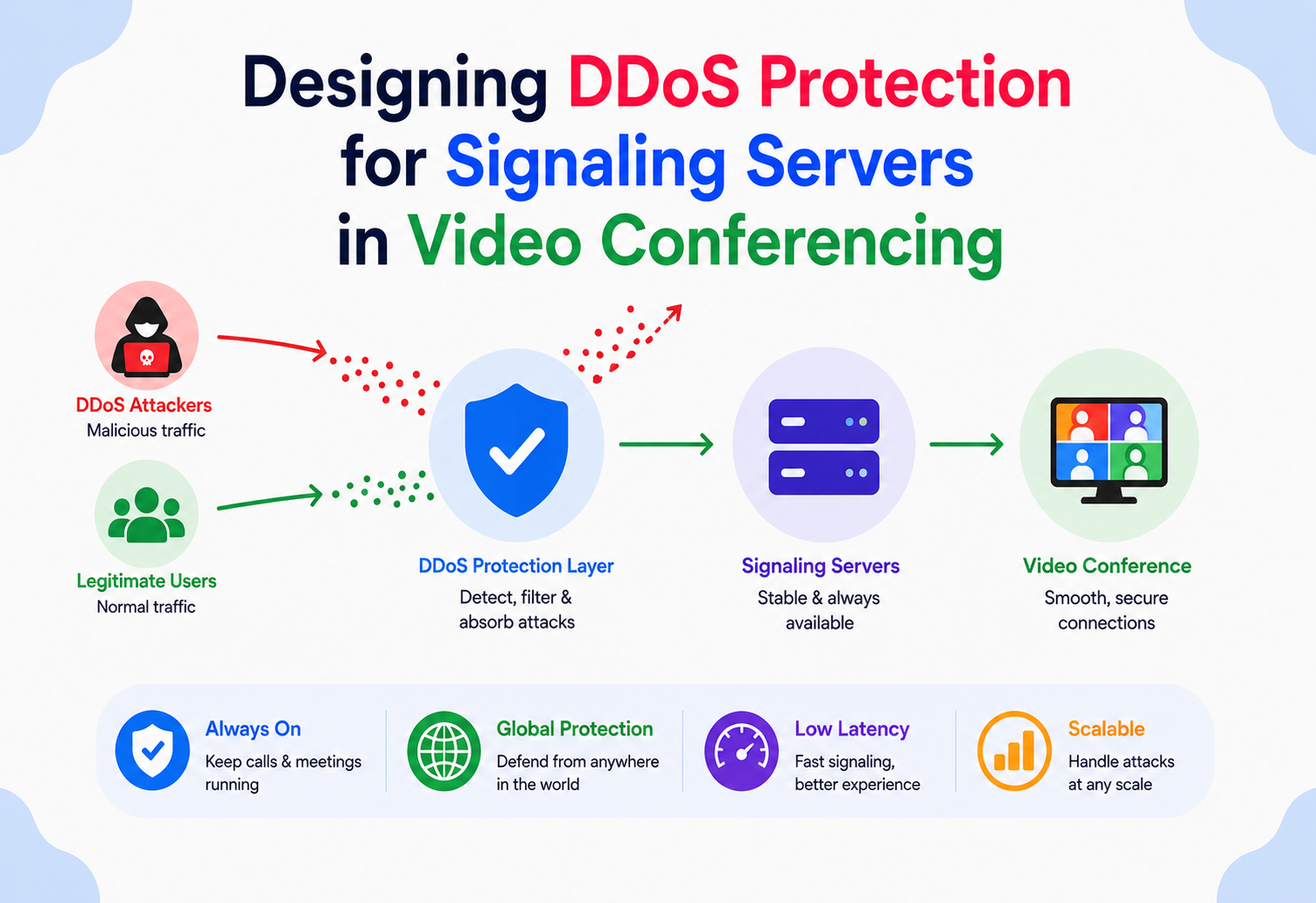
Designing DDoS Protection for Signaling Servers in Video Conferencing
A ground-up walkthrough of how Zoom, Google Meet, Microsoft Teams, Webex, Jitsi and every large video-conferencing platform keeps its signaling plane — the small, delicate control layer that decides who joins, who leaves, who speaks to whom — alive during volumetric floods, protocol abuse, credential storms and application-layer attacks, without ever letting a legitimate meeting fail to start.
The Big Idea, in One Breath
A DDoS protection system for signaling servers is the machinery that keeps the “handshake plane” of a video-conferencing platform alive under attack. The signaling servers are what let a client say “I want to join meeting X,” negotiate media capabilities, exchange ICE candidates, and get routed to the right media server. When they die, no new call starts — even if every media server in the fleet is completely healthy.
The system’s single job is to absorb hostile traffic, distinguish it from real join attempts, and let genuine users complete a signaling handshake within perceptual real-time — while attackers see nothing but tarpits, rate limits and expensive challenges.
Picture a giant office building. The elevators, hallways and meeting rooms (the media plane) are working perfectly. But at the front-desk lobby (the signaling plane), a mob of impostors is screaming names, filling out fake sign-in sheets and pressing every elevator button. DDoS protection is the security desk, the metal detectors, the ID checks and the polite receptionists who let real employees walk straight to their meetings — and gently jam the mob at the door without ever letting them slow down the building itself.
flood at edge
during attack
availability SLO
What Signaling-Server DDoS Protection Really Is
Before designing it, we need to be precise about what “signaling” means, why it is uniquely attractive to attackers, and where DDoS protection sits in the stack.
2.1 A Working Definition
DDoS protection for signaling servers is a layered defensive system that, given a mix of legitimate join / negotiate / disconnect traffic and hostile traffic (volumetric floods, protocol abuse, application-layer floods, credential-stuffing, botnets), guarantees:

- legitimate WebSocket / SIP / HTTP signaling handshakes complete within the platform’s latency SLO,
- attacker traffic is absorbed, throttled or blocked as close to the edge as physically possible,
- no single tenant / meeting / region can starve the rest of the platform,
- every mitigation decision is observable, reversible and post-incident auditable, and
- the mitigation itself never becomes the outage.
2.2 What the Signaling Plane Actually Does
Meeting Join & Auth
Client asks “can I join meeting X?” The signaling server checks identity, meeting policy, waiting-room rules and hands back a token.
SDP / ICE Negotiation
Codecs, bitrates and NAT candidates are exchanged so the client can start sending media to the right SFU.
Media Server Assignment
Signaling picks which SFU / MCU / TURN cluster in which region should carry this participant’s media.
In-Call Control
Mute, raise-hand, screen-share start, layout change, recording toggle — small, chatty messages over the same socket.
2.3 What It Is Not
Signaling DDoS protection is not media DDoS protection. Media (RTP over UDP) has its own threat model — different ports, different volume characteristics, different mitigations. It is also not a generic WAF: a signaling flood looks like legitimate WebSocket upgrades and JSON payloads, so classical L7 rules alone will strand real users.
Signaling is the low-throughput, high-value control plane. Media is the high-throughput, high-cost data plane. Attackers love signaling because a small number of malicious packets can lock the front door of the platform for everyone. DDoS protection here is not about bandwidth — it is about correctness under stress.
Why It Matters So Much
A signaling outage looks, to the user, exactly like a total product outage. It does not matter that the media fleet is fine; if the join button spins, the platform is down. That asymmetry — small target, huge blast radius — is why signaling is the favourite DDoS surface of every serious attacker.
3.1 The Business & Human Problem
- Meetings are time-critical. A board meeting or a telehealth consult that fails to start is not rescheduled — it is a lost transaction and, sometimes, a legal event.
- Concentration risk. The signaling plane is small compared to the media plane. Attackers know it and aim there deliberately.
- Reputational leverage. A short signaling outage generates screenshots, tweets and news within minutes. The recovery is slower than the story.
- Regulatory audit. Regulated tenants (finance, health, government) require attestations that mitigation happened, what it was and why.
- Cost of collateral damage. A too-blunt mitigation blocks real users — and now the platform has caused its own outage.
3.2 What Makes It Uniquely Hard
Harder than L4 flood mitigation
- Traffic is stateful WebSocket / SIP with long-lived sockets.
- Real users look like bots (mobile SDKs, retry loops).
- Signaling is chatty; per-connection budgets must be precise, not generous.
Harder than API WAF
- Payloads are small and legitimate-looking JSON / SIP.
- Authenticated attackers exist (compromised accounts, insiders).
- False positives strand real meetings; the cost of over-blocking is high.
Every design choice in this system serves one asymmetric truth: the attacker only has to make the join button stop working. The defender has to keep every legitimate meeting starting, correctly, under any attack shape, while spending money proportional to the attack — not to the panic.
The Threat Model
You cannot defend what you have not enumerated. The signaling plane faces a wide spectrum — from crude volumetric floods that a home router could produce, to surgical application-layer probes crafted specifically for your API.
4.1 The Attack Spectrum
Volumetric Floods
SYN floods, UDP amplification (DNS, NTP, memcached), reflection attacks. Aim: saturate the pipe or SYN table before packets reach the app.
TLS Handshake Floods
Half-open TLS negotiations that exhaust CPU on the edge. WebSocket upgrades require TLS — this hits the signaling plane hard.
Application Floods
Millions of “join meeting” requests with fake meeting IDs. Each request is cheap for the attacker, expensive for the auth & policy engines.
WebSocket Abuse
Open a socket, keep it silent to burn slots. Or open and spam control frames. Or slowly leak bad JSON to poison parsers.
Credential Storms
Stuffing leaked credentials into the login endpoint. Signaling servers with SSO integration are attractive because auth is upstream and expensive.
SIP-Specific Attacks
INVITE floods, REGISTER floods, malformed SDP payloads, dial-plan probing. Enterprise telephony gateways are a common target.
Botnet-Driven Joins
Thousands of authenticated bots joining a public webinar to disrupt it. Traffic is technically legitimate.
Compromised Tenants
A single tenant’s API key is leaked and used to hammer signaling from many IPs. Blocking the key is easy; blocking the abuse without blocking the tenant’s real users is not.
4.2 What Attackers Optimise For
| Attacker goal | Preferred attack | Why it hurts |
|---|---|---|
| Cheap outage | UDP amplification | Bandwidth math heavily favours attacker |
| CPU exhaustion | TLS handshake flood | Every negotiation costs the defender crypto CPU |
| State exhaustion | Slowloris WebSocket | Cheap for attacker, ties up sockets for hours |
| Auth backend meltdown | Credential stuffing | Amplifies via SSO / IdP round-trips |
| Meeting disruption | Authenticated bot join | Bypasses classical DDoS defences entirely |
A serious defence treats every attack class as a first-class threat model, with its own detector, its own mitigation and its own SLO. Wrapping everything in “WAF + rate limit” and hoping is what turns a small attack into a global incident.
The Building Blocks
A production DDoS defence for signaling is a small constellation of specialised layers. Each has one narrow job. The leverage is in how they compose — and in the strict ordering of the concentric rings around the signaling servers.
Anycast Edge Network
Global Anycast IPs so an attack is diluted across many PoPs. First absorption ring; also the fastest place to drop obviously-bad packets.
Volumetric Scrubbing
Line-rate BGP-diverted scrubbing centres that clean multi-Tbps floods and hand clean traffic back over GRE / private links.
Edge L4 Firewall
Stateful SYN-cookie, per-IP conntrack limits, connection age eviction. Executes in-kernel or in NIC hardware for line-rate.
Edge TLS Terminator
Offloads TLS with session resumption, TLS ticket enforcement, JA3 fingerprinting for early classification.
WAF / L7 Firewall
Signaling-aware rules: JSON schema validation on join, SIP method allow-lists, header sanity, geo / ASN scoring.
Signaling Gateway
Terminates WebSocket / SIP, enforces per-connection budgets, translates protocol into internal RPC for downstream services.
Rate & Quota Manager
Global, tenant-aware, meeting-aware quotas. Backed by a low-latency counter store; enforces fair-share.
Challenge Service
Progressive challenges: TLS puzzles, JavaScript proof-of-work, invisible CAPTCHA, hard CAPTCHA. Escalates with suspicion.
Behavioural Detector
Streaming ML on join sequences, socket lifetimes, retry patterns. Feeds the mitigation controller.
Mitigation Controller
The brain. Consumes detector signals, decides which rules go active where, propagates policy to edges, and rolls back automatically.
Observability
Metrics (per-PoP RPS, drop reasons, challenge rates), traces per correlationId, dashboards per tenant / region / attack.
Runbook & Human Loop
Attack drills, on-call rotation, red/blue exercises, formal post-mortems. The system is only as good as its operator’s reflexes.
Defense Layers: Absorb, Filter, Challenge, Isolate
The defence is not one filter — it is four concentric responsibilities. Absorb what you cannot inspect. Filter what you can classify cheaply. Challenge what you cannot classify. Isolate what still slips through so it cannot take the platform down.
6.1 Absorb at the Edge
- Anycast dilution spreads any single attack across dozens of PoPs; no single PoP has to survive the whole flood.
- Volumetric scrubbing at multi-Tbps handles the crude L3/L4 floods before they reach any application logic.
- SYN cookies + conntrack quotas in kernel bypass keep the TCP state table survivable.
6.2 Filter Cheaply
| Signal | What it catches | Cost |
|---|---|---|
| Geo / ASN allow-list | Attacks from ASNs that never serve real customers | Micro-CPU per packet |
| JA3 / JA4 fingerprint | Custom TLS stacks used by botnets | One hash per handshake |
| Protocol schema | Malformed SIP / JSON / SDP | Small; catches bulk L7 abuse |
| Reputation feed | Known-bad IPs, TOR exits, residential proxies | Feed-refresh-bound |
6.3 Challenge Progressively
When a request looks suspicious but not clearly bad, ask it for proof of humanity or client capability. The escalation ladder is:
- TLS ticket / session resumption check — free, invisible.
- Cookie challenge — a short redirect that most SDKs handle transparently.
- JavaScript proof-of-work — browser-only, low friction, expensive for a botnet at scale.
- Invisible CAPTCHA — risk-scored, silent for most humans.
- Interactive CAPTCHA — last resort, only for high-suspicion sessions.
6.4 Isolate What Still Gets Through
Cell-based sharding
- Signaling servers are partitioned into isolated cells per region / tenant tier.
- A cell can be sacrificed without collapsing the plane; the mitigation controller can drain it in seconds.
Priority queues
- Enterprise-tier tenants get their own signaling capacity that can never be starved by free-tier abuse.
- In-progress meetings outrank new join requests during saturation.
Never trust one layer to save the platform. Every legitimate request should be filtered by many cheap, boring checks before reaching an expensive one — and every mitigation should have a well-lit rollback so it cannot itself become the outage.
Rate Limiting, Quotas & Behavioural Detection
Once traffic passes the outer rings, the fine-grained defences kick in: quotas that respect who the user is, and behavioural detectors that notice when a request “shape” suddenly stops looking human.
7.1 Multi-Dimensional Rate Limiting
A single “requests per second per IP” is useless against modern botnets. Real limits are multi-dimensional:
rate_key = hash(
    ipPrefix,       # /24 for IPv4, /64 for IPv6
    asn,            # AS-level bucket
    tenantId,       # per-workspace fair share
    userId,         # authenticated identity
    meetingId,      # per-meeting join budget
    apiEndpoint     # different limits per action
)
budget = policy_engine.resolve(rate_key, currentSuspicion)
7.2 Token-Bucket + Sliding-Window
- Token bucket for smooth per-second bursts (legit clients retry with backoff).
- Sliding window for slow-drip abuse detection (attackers pacing under a per-second limit).
- Backing store is a low-latency counter service (Redis, DynamoDB, ScyllaDB) with quorum writes and per-region replicas.
7.3 Behavioural Detection
Socket Lifetime Anomaly
Median WebSocket lifetime drops from minutes to seconds — classic Slowloris variant or connect-and-drop flood.
Join-Fail Ratio Spike
Join attempts to non-existent meeting IDs climb from < 1% to 40% — meeting-ID enumeration.
Auth-Fail Storm
Login endpoint sees a burst of unique usernames with the same password — credential stuffing.
Retry Fingerprint
Retry timings become suspiciously deterministic — humans jitter, bots do not.
Geo Shift
A tenant that has only ever joined from three countries suddenly sees traffic from 40 ASNs — compromised API key.
SDP Anomaly
Millions of SDP payloads all advertise identical, unusual codec ordering — single toolkit driving the attack.
7.4 The Mitigation Controller
The controller consumes signals in real time and drives the outer rings automatically:
- Elevates challenge tier when composite suspicion crosses thresholds.
- Pushes per-tenant / per-ASN / per-endpoint quotas to the edge in seconds.
- Auto-rolls-back when signals return to baseline — mitigations should always be time-boxed by default.
- Escalates to human on-call when signals are contradictory or when the controller itself is uncertain.
A mitigation that never rolls back is an outage waiting to happen. Every automatic rule must carry a TTL and every persistent rule must go through a change-management workflow with human sign-off.
End-to-End Flow: One Attack, One Legitimate User
Enough abstraction. Let us follow two requests at the same moment during a live incident: a botnet packet that wants to burn our CPU, and a doctor trying to start a telehealth call from a mobile hotspot.
Both packets hit the Anycast edge
The nearest PoP receives both. The botnet packet is one of 30M/s aimed at the same VIP; the doctor’s TLS ClientHello is one of a few thousand.
Volumetric scrubbing takes the flood
BGP-diverted scrubbing centre absorbs the 30M/s of amplification. Only shaped, clean traffic returns over private links.
L4 firewall triages surviving connections
Botnet SYNs that made it past scrubbing hit SYN cookies and per-/24 conntrack quotas. Most are dropped. The doctor’s handshake progresses.
TLS terminator fingerprints the client
JA3 hash of the doctor’s official mobile SDK matches the known-good set. JA3 of the botnet TLS stack is on the suspicious list; suspicion score climbs.
WAF checks the WebSocket upgrade
Doctor: valid Sec-WebSocket-Protocol, valid Auth header, valid tenant. Bot: malformed protocol claim — rejected at L7 without hitting the signaling server.
Challenge service escalates the suspicious
A residual batch of authenticated bot joins is served an invisible PoW challenge. Most fail silently. The doctor’s SDK completes challenge transparently.
Signaling gateway accepts the socket
The gateway assigns the doctor’s socket a per-connection budget. Its identity is enterprise-tier — it lands in the enterprise cell, isolated from the general population.
Meeting join completes; media is negotiated
Doctor completes SDP negotiation, gets assigned to an SFU, and starts sending media — end-to-end under 300 ms despite the attack raging outside.
Controller auto-rolls-back
Ten minutes later, attacker signals normalise. TTLs on mitigations expire. Challenge tier de-escalates. Post-incident timeline is auto-generated for the review.
Quality Attributes: The “-ilities”
The non-functional targets for signaling DDoS protection are unusual: it must be simultaneously fast, correct, elastic and cheap — and stay that way during the worst hour of the year.
Handshake Latency
Legitimate WebSocket / SIP handshake completes < 300 ms P95 during peak attack; < 150 ms in steady state.
Throughput
Absorbs multi-Tbps volumetric floods at the edge; processes millions of L7 signaling attempts per second across the fleet.
Low False-Positive Rate
< 0.01% of legitimate joins ever face a hard block or interactive CAPTCHA.
Mitigation Auditability
Every drop, challenge, quota decision is logged with rule ID, actor, and TTL.
Reliability
Availability SLO 99.999% for signaling under attack; media plane insulated from any signaling incident.
Scalability
Global Anycast + PoP-level autoscaling; per-cell scaling of signaling servers; regional isolation.
Availability under mitigation
Every mitigation is time-boxed; controller auto-rolls-back; humans can override with a single command.
Observability
Every packet path, drop reason, challenge decision and quota block is traceable in real time.
9.1 The Latency Budget
| Hop | Target | How |
|---|---|---|
| Anycast + L4 filter | < 5 ms | Kernel bypass, NIC hardware, in-PoP |
| TLS handshake | < 60 ms | Session resumption, TLS 1.3, edge terminator |
| WAF / L7 checks | < 15 ms | Rule cache, JSON schema JIT, JA3 lookup |
| Challenge (invisible) | < 40 ms | Short PoW / silent cookie |
| Signaling gateway + auth | < 80 ms | Cached tokens, in-region policy engine |
| SDP negotiate + SFU assign | < 60 ms | Regional SFU catalog, warm workers |
| Total legit handshake under attack | < 300 ms P95 | Feels normal to the user |
Common Pitfalls & Trade-offs
Every real deployment gets bitten by the same handful of subtle failures. Knowing them turns weeks of firefighting into a paragraph in a design review.
10.1 Ten Traps We’ve All Fallen Into
One giant rate limit per IP
Modern botnets spread across millions of IPs. A per-IP limit alone is theatre. Use composite keys with tenant, meeting, endpoint, geo.
Mitigation without TTL
Someone bans a /16 “temporarily.” A year later it is still blocking a whole country. Every rule must expire by default.
Same plane for signaling and media
An attack on signaling collapses media too. Isolate cells, IP ranges, and even providers if possible.
Auth-heavy first line
Auth checks run before cheap filters, so a credential-stuffing storm melts the IdP. Always order: cheap → expensive.
Blind trust in JA3
Attackers spoof fingerprints. Use JA3 as one signal among many, not a boolean allow/deny.
CAPTCHA fatigue
Hard CAPTCHA in front of every join alienates real users faster than any attacker could. Reserve interactive challenges for the top-1% suspicion.
No fair-share for enterprise tenants
A single abusive free-tier tenant starves the whole platform. Give paid tiers their own capacity floors.
Playbook lives in one head
The one engineer who knows how to swing the rule fleet is on holiday. Runbooks and dry-runs must be first-class artefacts.
Observability collapses first
Metrics pipeline gets DDoSed by its own edge, and now the operator is blind. Metrics must survive the attack too.
Never drilling the plan
The first time you test the defence is during a real attack. Chaos drills, red-team exercises and shadow floods are non-negotiable.
10.2 The Trade-offs You Cannot Avoid
Security vs Latency
- More checks mean higher confidence but higher handshake latency.
- The right answer is always “cheap checks always on, expensive checks only when suspicion warrants.”
Automation vs Human Judgement
- Automated mitigation is fast but can amplify a misclassification globally.
- Every high-impact rule needs a two-person sign-off; every low-impact rule needs a well-lit rollback.
Context
We must decide whether signaling and media share a defence and edge, or whether they are physically and operationally isolated.
Decision
Signaling and media planes run on separate IP ranges, separate PoPs where possible, separate cells and separate mitigation policies. A DDoS incident on one plane must never be able to degrade the other. In-call media of already-connected participants is protected by design from any subsequent signaling-plane attack.
Consequences
Higher operational complexity and slightly higher cost, but sharply reduced blast radius. Legitimate meetings already in progress survive most signaling incidents; new joins may be delayed or challenged, but never denied silently. This is the choice that turns a “total outage” into a “degraded join, active calls fine” incident.
How These Systems Evolve
DDoS mitigation is a decades-old craft, but its application to real-time signaling planes is comparatively recent. The trajectory shows a clear direction: from single-appliance gates to global, ML-driven, cell-isolated fabrics.
Wave 1 — Appliance Era (pre-2010)
Single scrubbing appliances in one datacentre. Great against small floods; useless against modern amplification.
Wave 2 — Cloud Scrubbing (2010–2016)
Third-party scrubbing providers absorb multi-Tbps volumetric attacks. Signaling apps still largely untouched but no longer knocked offline by pure bandwidth.
Wave 3 — L7 & Bot Management (2016–2020)
WAFs, bot managers, JS challenges become standard in front of every signaling endpoint. Behavioural detection joins the pipeline.
Wave 4 — Cell-Based Isolation (2020–2024)
Signaling servers deployed as isolated cells per tier and region. Mitigation controllers automate rule propagation with time-boxed rules. Chaos drills go mainstream.
Wave 5 — AI-Assisted Defence (2024+)
Streaming ML classifies attack shapes in real time. Generative-AI-crafted attacks (perfect-looking join payloads) push defence toward continuous fingerprinting, tenant-graph reasoning and privacy-preserving telemetry.
11.1 Adjacent Systems That Plug In
Identity & SSO
Signaling defence collaborates with the IdP for risk-based auth — suspicious sessions get elevated challenges before signaling ever sees them.
SecOps / SOC
Real-time alerting, playbook automation, incident-response tooling with ticketing and comms integration.
Fraud & Abuse
Signals cross-flow with the trust & safety platform — meeting-bombers and coordinated abuse feed the same detectors.
Media-Plane Defence
Separate SRTP-aware protections, but shared control — a signaling incident triggers proactive throttling of new media allocations.
Key Takeaways
Signaling DDoS protection is one of those quiet, load-bearing subsystems whose success is measured in things nobody notices. Every decision in this chapter serves a single goal: make hostile traffic irrelevant to the legitimate act of joining a meeting.
Key Takeaways
- Signaling is small, high-value, and asymmetric. Attackers love it. Defend accordingly.
- Layered, concentric defence. Absorb, filter, challenge, isolate — each ring cheap enough to run at line-rate for its input.
- Composite rate keys, not just IPs. Tenant, meeting, endpoint, ASN, identity — all combined.
- Progressive challenges. Save hard CAPTCHAs for the top-1% suspicion; make the invisible ones do the work.
- Cell isolation is a superpower. A blast contained to one cell is a minor incident; a blast that hits the whole plane is a headline.
- Every mitigation has a TTL. Auto-rollback is the mechanism that makes automation safe.
- Signaling and media are separate planes. An attack on one must never take out the other.
- Observability must survive the attack. A blind operator is worse than a broken filter.
- Drill the plan constantly. Red teams, shadow floods, chaos days. The first real attack is not the moment to discover your runbook is fiction.
- The best defence disappears. Users just click Join and the meeting starts — even on the worst day of the year.
Every serious video-conferencing platform has been attacked, and every one will be attacked again. The systems that stayed reliable did not have magic — they had layered, boring, well-drilled defences and the humility to know that the attack they had not yet seen was the one that mattered most. Design for that attack, and the ordinary experience of joining a meeting will feel like the miracle it quietly is.