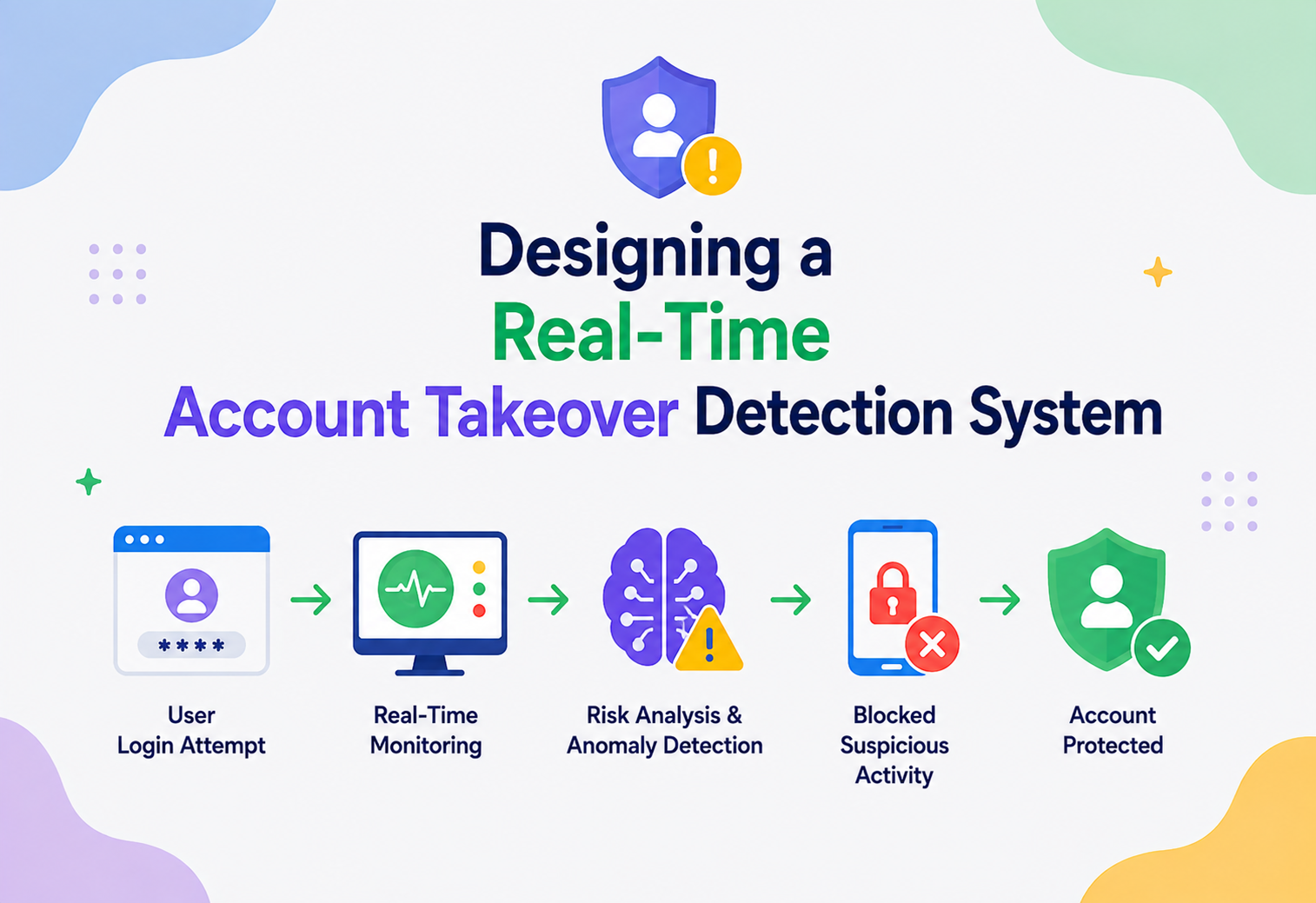
Real-Time Account Takeover Detection
A production-grade, interview-ready system design walkthrough for engineers building the intelligence layer that catches attackers the moment they walk in wearing someone else’s identity — combining device, network, behavior, and transaction signals into a millisecond-latency risk decision.
Introduction
Every day, millions of people log into their bank, brokerage, or payments app using nothing more than a password, a fingerprint, or a one-time code delivered to their phone. That thin layer of proof is supposed to guarantee one thing: the person on the other side of the screen really is who they claim to be. Account Takeover, usually shortened to ATO, is what happens when that guarantee breaks. An attacker who is not the real customer slips past login and gains control of the account, and from that moment on, everything the account can do — transferring money, changing contact details, opening new credit lines — is available to someone who has no right to it.
Detecting ATO is one of the hardest problems in financial engineering because the attacker is not doing anything technically illegal at the protocol level. They are logging in with a correct username, a correct password, and often a correct one-time code, because they stole all three. Nothing is broken. No firewall is breached. No exploit is used. The system worked exactly as designed — it just authenticated the wrong human being. This is why ATO detection cannot rely purely on traditional security controls like encryption or access-control lists. It needs a layer of intelligence that watches behavior, context, and intent, and then makes a probabilistic judgment in the time it takes a web page to load.
This tutorial walks through how to design a production-grade, real-time ATO detection system for a financial platform — the kind that has to evaluate millions of login and transaction events per minute without adding noticeable friction to legitimate customers, while still catching attackers within milliseconds of them stepping through the front door.
It helps to be precise about what “account takeover” actually covers, because the term gets used loosely. It is not the same as a data breach, where an attacker steals information from the company’s own servers. It is not the same as first-party fraud, where the account owner themselves misuses the account — for instance, by disputing a legitimate charge they actually made. Account takeover specifically means a third party, who is not the account owner and has no authorization, gains control of an existing, legitimate account belonging to someone else, and then uses that access for their own benefit.
The victim in an ATO case is almost always innocent; they did not make a mistake beyond, at most, reusing a password or falling for a well-crafted phishing message. That asymmetry — an innocent victim on one side, a resourceful and often organized attacker on the other — is exactly why regulators, courts, and financial institutions treat ATO losses very differently from cases of confirmed customer-initiated fraud, and why building a detection system for it carries both an engineering challenge and a duty of care.
Understanding this distinction early matters for anyone designing such a system, because it shapes almost every downstream decision: how aggressively to challenge suspicious activity, how quickly to reimburse a confirmed victim, and how much friction is acceptable for the ninety-nine-point-something percent of logins that are completely legitimate. A system designer who treats ATO as “just another fraud type” tends to under-invest in behavioral signals and over-rely on transaction-amount thresholds, which is precisely the kind of design an attacker who has done their homework will walk straight past.
A Brief History of ATO Fraud
Account takeover is not a new crime; it is an old crime that moved online. In the physical world, its ancestor was check fraud and impersonation at a bank counter. As banking moved to the internet in the late 1990s and early 2000s, fraud moved with it, and phishing emails became the primary tool for harvesting usernames and passwords at scale.
Counter-based impersonation
ATO’s ancestor was check fraud and in-person impersonation at a bank counter — a physical crime with a physical attacker facing a human teller.
Phishing goes mainstream
Online banking arrived and phishing emails became the default tool for harvesting usernames and passwords at industrial scale.
Credential stuffing & SIM swap
Massive third-party breaches leaked billions of reused passwords; SIM-swap attacks let attackers intercept SMS OTPs and defeat the era’s strongest 2FA.
Fully automated pipelines
Botnets, residential proxies, and dark-web “fullz” marketplaces made ATO an industrialized supply chain — detection had to become adaptive and learning-based.
The 2010s saw two changes that made ATO dramatically more dangerous. First, massive third-party data breaches — retailers, social networks, email providers — leaked billions of username-and-password combinations onto the dark web. Because people reuse passwords across services, attackers could take a password stolen from an unrelated website and try it against banking logins, a technique called credential stuffing. Second, mobile-first banking made SIM-swap attacks lucrative: by tricking or bribing a telecom employee into porting a victim’s phone number to a new SIM card, an attacker could intercept SMS one-time passcodes and defeat what was, at the time, considered strong second-factor authentication.
By the 2020s, attackers had automated the entire pipeline. Botnets could test tens of thousands of stolen credentials per minute across hundreds of financial institutions simultaneously, residential proxy networks made attacker traffic look like it was coming from ordinary home internet connections, and underground marketplaces sold ready-made “fullz” — complete identity packages including passwords, device fingerprints, and answers to security questions. Detection systems had to evolve from simple rule lists (“block this IP”) into adaptive, learning systems that model what normal behavior looks like for each individual customer and flag deviations in real time.
Why Detection Is Hard
An ATO detection system has to solve a problem that sounds simple and is not: given a login or an in-session action, decide within a few hundred milliseconds whether the actor is the genuine account owner or an impostor, using only indirect, circumstantial evidence.
The password is right
The attacker did not guess the password; they possess it. Password correctness carries almost no signal once credential theft is assumed.
Attackers adapt quickly
As soon as a detection rule becomes public knowledge or gets reverse-engineered through trial and error, attackers route around it, so static rules decay in value within weeks.
False positives ≠ false negatives
Blocking a genuine customer from their own money during an emergency erodes trust and generates support costs and regulatory complaints. Missing a real attacker leads to direct financial loss and potential liability. The system has to balance both, not just minimize one.
Legitimate behavior is diverse
A customer who travels for work, buys a new phone, or logs in from hotel Wi-Fi looks statistically similar to an attacker on several dimensions. Context has to be layered on top of anomaly signals to tell the two apart.
Milliseconds, not seconds
The decision has to be made inline, before the login completes or before a transaction is authorized, which rules out slow batch analysis for the primary defense layer.
Attackers operate at scale
A single attack is rarely one person manually testing one stolen password against one account. It is usually one node in a much larger, automated operation testing thousands of stolen credentials against many institutions simultaneously, often using rented infrastructure and residential proxy networks specifically built to make each individual attempt look like ordinary traffic from a real household. A detection system that only looks at a single event in isolation, without any awareness of the broader pattern it belongs to, will keep missing the forest for the trees.
“Why can’t you just block logins from new devices or new locations?” A strong answer explains that most genuine logins also come from new devices and locations — new phones, new cities, public Wi-Fi — so a rule that blunt would generate an unacceptable false-positive rate. The system instead needs to combine many weak signals into one strong probabilistic score, and use risk-based step-up authentication rather than an outright block for medium-risk cases.
Requirements
Before jumping into architecture, it helps to nail down what the system must actually do and how well it must do it. The functional requirements describe the behavior; the non-functional requirements set the bar the design has to clear.
Functional Requirements
- Score every login attempt, session, and sensitive in-session action (password change, payee addition, large transfer) for takeover risk in real time.
- Support risk-based responses: allow silently, prompt for step-up authentication, force a password reset, or block and route to fraud review.
- Maintain a per-customer behavioral profile (typical devices, locations, login times, transaction patterns) that updates continuously.
- Provide fraud analysts a case-management view with full evidence trails for manual review and dispute handling.
- Feed confirmed-fraud and confirmed-genuine outcomes back into the models as labeled training data.
- Support real-time blocking of known attacker infrastructure (IP ranges, device fingerprints, proxy networks) as new intelligence arrives.
Non-Functional Requirements
Sub-200ms p99
Scoring decisions must complete in well under 200 milliseconds at the 99th percentile so login flows are not visibly slowed down.
Millions of events/minute
The system must handle millions of authentication and transaction events per minute during peak periods (salary days, festive shopping seasons) without degrading.
Four-nines with a policy
The scoring path is on the critical login path, so it needs at least 99.99% availability, with safe fail-open or fail-closed behavior clearly defined per event type.
Frequently retrainable
Models must be retrainable frequently and support rapid deployment of new rules without a full release cycle.
Explainable decisions
Every decision must be explainable and traceable for regulatory and dispute purposes.
Compliance by design
Behavioral and biometric data must be handled under data-protection regulations (GDPR, DPDP Act, PCI DSS scope where applicable).
High-Level Architecture
At the highest level, an ATO detection system is a real-time decision engine sitting between the customer-facing authentication service and the account. Every login attempt, and every sensitive action after login, is streamed through an event pipeline, enriched with features from a low-latency feature store, scored by a combination of rules and machine-learning models, and turned into an actionable decision — all before the customer’s screen finishes its next transition.
Notice the shape of this design: everything to the left of the decision layer is about gathering evidence as fast as possible, and everything to the right is about turning a score into a customer-facing consequence. This separation matters because it lets each side scale and evolve independently — you can add a brand-new signal source without touching the action layer, and you can add a brand-new response type (say, a soft warning banner) without touching how features are computed.

Core Components Explained
Each box in the architecture diagram earns its place by owning one narrow responsibility. Understanding what each component does — and just as importantly, what it does not do — is what lets a team reason about the system under load and under attack.
| Component | Responsibility | Why it exists |
|---|---|---|
| API Gateway & WAF | Terminate TLS, apply basic rate limiting per IP and per API key, block traffic matching known bad signatures (malformed headers, known bot user agents, requests from data-center IP ranges). | Structural, not intelligent — removes the crudest attack traffic before it ever reaches expensive scoring logic. |
| Authentication Service | Verify password, biometric, or token; emit an event for every login attempt, successful or failed. | Failed attempts are often the earliest evidence of an attack in progress — a burst of failed logins across many accounts from one IP is a classic credential-stuffing signature. |
| Event Bus | Distributed log (Kafka or managed equivalent) that decouples event producers from consumers. | Lets the same login event be consumed by feature enrichment, the historical event store, and analytics independently, without slowing down the auth service itself. |
| Device Fingerprint Service | Derive a stable identifier from browser/OS characteristics, installed fonts, canvas rendering, screen resolution, and mobile hardware attestation. | Goal is consistency, not perfect identification — the same physical device should produce a similar fingerprint across sessions. |
| Geo & IP Intelligence | Resolve IP to geography, ASN, and reputation (VPN, residential proxy, data-center, previously fraudulent). | Powers classic checks like “impossible travel” — a Mumbai login followed twelve minutes later by a Frankfurt login cannot both be the genuine customer. |
| Real-Time Feature Store | Low-latency key-value store holding pre-computed, continuously updated features per customer and per device. | Rolling login counts, known-good device sets, average transaction size — feature freshness is critical because even a minute of staleness can miss an attack unfolding in real time. |
| Behavioral Profile Service | Maintain a longer-horizon model of “normal” per customer: typical hours, geographic radius, payees, device set. | Updated asynchronously from history and consulted synchronously during scoring — a personalized baseline beats a single global threshold applied to everyone. |
| Rules Engine | Deterministic, human-auditable conditions encoding known attack patterns and regulatory requirements. | Fast to write, fast to deploy, easy to explain to a regulator — indispensable even in an ML-heavy system. |
| ML Scoring Service | Take the assembled feature vector and return a calibrated probability of takeover. | Typically an ensemble rather than a single model, covering different attack patterns and time horizons. |
| Decision Orchestrator | Combine rules verdict and ML score into one action, apply business policy, dispatch to the right action service, and write an auditable record. | Central point where “never let a high-risk score bypass step-up even if a rule says otherwise” is enforced. |
“Why have both a rules engine and an ML model instead of just one?” The expected answer is that rules give you speed of response, explainability, and regulatory compliance for known, well-understood attack patterns, while ML gives you the ability to catch novel patterns that no one has written a rule for yet. Mature systems always run both and let the orchestrator reconcile them.
Data Flow & Lifecycle
Walking through a single login attempt end to end makes the architecture concrete. The sequence below shows what happens between the moment a customer taps “Log in” and the moment they either land on their dashboard or are asked for a second factor.
Two things are worth noticing here. First, the synchronous path (the one the customer waits on) is kept as short as possible: fetch features, score, decide. Everything that does not need to happen before the customer sees a result — updating long-term behavioral profiles, writing to the historical event store, feeding analytics dashboards — happens asynchronously off the event bus, in parallel with the customer already being let through or challenged. Second, the same pipeline is reused for in-session actions, not just login: adding a new payee or initiating a large transfer triggers the identical flow, just with a different, action-specific feature set and a different set of rules.
Feature Engineering & Signals
The quality of an ATO detection system is determined less by which algorithm is used and more by the richness and freshness of the signals fed into it. Signals generally fall into a handful of categories.
| Signal Category | Examples | Why It Matters |
|---|---|---|
| Device signals | Device fingerprint, jailbreak/root status, browser and OS version, whether device is on the customer’s known-device list | New attacker-controlled devices rarely match a customer’s established device history |
| Network signals | IP reputation, ASN, VPN/proxy/Tor detection, impossible-travel velocity | Attackers frequently operate through proxy networks or from geographies unrelated to the victim |
| Behavioral biometrics | Typing cadence, mouse movement patterns, touchscreen pressure and swipe dynamics | Even with correct credentials, the physical act of interacting with the app differs person to person |
| Velocity signals | Login attempts per IP per minute, password reset attempts per account per hour | Automated attacks show bursts that manual human behavior does not |
| Account context | Time since account creation, recent profile changes, recent password reset, dormant account reactivation | A password change followed immediately by a large transfer is a well-known takeover pattern |
| Transaction context | Payee novelty, transaction amount versus historical average, destination account risk score | The end goal of ATO is usually moving money out, so the payment step carries strong signal |
| Historical / global intelligence | Credential-stuffing lists, known compromised device denylists, consortium fraud data shared across institutions | Attackers reuse infrastructure across multiple victim institutions, so shared intelligence catches repeat offenders fast |
Think of feature engineering like a bank teller who has served the same customer for ten years. The teller does not need a lie detector to get suspicious — they simply notice that the person at the counter today is holding the pen with the wrong hand, is asking for the wrong branch’s forms, and wants to withdraw an unusually large amount right after claiming they lost their card. No single detail proves fraud, but the combination is what makes the teller pause and ask for a manager. The feature store is what gives the machine that same decade of memory, compressed into milliseconds.
PayPal’s fraud systems have long been cited as pioneering the use of hundreds of real-time behavioral and device features combined through machine learning, rather than static rules, to catch account takeover and payment fraud within the transaction flow itself — one of the earliest large-scale proofs that behavioral signals could outperform purely credential-based checks.
Machine Learning Models & Scoring
Most production ATO systems do not rely on one model but on a small ensemble, because different model types are good at catching different kinds of attacks.
Gradient-boosted trees
XGBoost or LightGBM are the industry workhorse, trained on historical labeled data of confirmed fraud versus confirmed genuine activity. Excellent at learning known patterns from millions of past examples and fast enough to score in single-digit milliseconds.
Anomaly detection
Isolation forests and autoencoders do not need fraud labels at all — they simply learn what “normal” looks like for a customer or the population, and flag statistically unusual events. Valuable for catching brand-new attack patterns that have never been labeled before.
Relationship-aware models
Look at the network of relationships between accounts, devices, and IPs. A single device that has logged into fifty unrelated accounts in the last day is a very strong fraud-ring signal that a per-account model alone would never see.
Order & timing models
Recurrent networks or transformers over event sequences evaluate the order and timing of actions in a session, since attackers often follow a distinctive sequence — login, immediate profile check, payee addition, transfer — that differs from typical genuine usage patterns.
The outputs of these models are combined, typically through a lightweight meta-model or a weighted ensemble, into a single calibrated risk score between zero and one. Calibration matters as much as raw accuracy: a score of 0.8 should genuinely mean an 80% chance of fraud, because that number is what downstream business rules use to pick a response (below 0.3 allow silently, 0.3 to 0.7 step-up authentication, above 0.7 block and route to manual review, for example).
Explainability deserves its own attention here, separate from accuracy. A model can be highly accurate and still be operationally useless if nobody can say why it flagged a particular event, because both fraud analysts resolving disputes and regulators examining the institution’s practices will ask that question. Tree-based ensemble models have an advantage here: techniques like SHAP (Shapley Additive Explanations) can decompose any single prediction into the contribution of each individual feature, so an analyst reviewing a blocked login can see, in plain terms, that the decision was driven mostly by an unrecognized device combined with a login time far outside the customer’s usual pattern, rather than treating the score as an unexplainable black box. Deep-learning and sequence models are harder to explain this way, which is one practical reason many institutions keep gradient-boosted trees as the primary production model and use more complex architectures as secondary signals rather than the sole decision-maker, at least for the highest-stakes actions like large fund transfers.
“How do you handle the fact that confirmed fraud labels arrive weeks after the event, while the model needs to work today?” A good answer discusses using a combination of fast proxy labels (customer disputes a transaction, customer reports unauthorized login, step-up authentication failed) as early training signal, alongside slower-arriving, higher-confidence labels from confirmed investigations, and retraining on a rolling window so the model does not go stale as attacker tactics shift.
Rules Engine vs ML: Hybrid Decisioning
A common mistake in system-design interviews is to present rules and machine learning as competing choices. In production, they are complementary layers that run side by side inside the decision orchestrator.
Rules engine strengths
- Instantly deployable for a new known threat — no retraining needed
- Fully explainable, which regulators and auditors require
- Deterministic and testable, no probabilistic drift
- Cheap to compute — essentially free at the tail of latency
Rules engine weaknesses
- Cannot generalize to attack patterns nobody has written a rule for yet
- Rule sets grow unwieldy and can conflict with each other over time
- Attackers can probe and reverse-engineer static thresholds
ML scoring strengths
- Captures subtle, high-dimensional combinations of weak signals
- Adapts automatically as it is retrained on fresh data
- Generalizes to novel variations of known attack families
ML scoring weaknesses
- Harder to explain a single decision in plain language for a dispute
- Requires labeled data and ongoing retraining infrastructure
- Vulnerable to model drift if attacker behavior shifts faster than retraining cadence
The orchestrator typically applies a policy such as: any deterministic rule marked “hard block” always wins regardless of ML score, because it usually encodes a known, confirmed threat or a regulatory requirement; otherwise, the ML score drives the response tier, with rules contributing as additional weighted features into the ensemble rather than as separate overriding logic. This hybrid approach gives the system both the speed and certainty of rules and the adaptability of learning models.

Real-Time vs Near-Real-Time Processing
Not every part of the system needs the same latency guarantee, and treating all of it as “must be instant” wastes engineering effort and cost. It helps to separate the pipeline into three tiers.
Inline synchronous scoring — sub-200ms
The login and transaction decision path described earlier. This has to complete before the customer’s action is allowed to proceed, so it uses only pre-computed features already sitting in the low-latency feature store.
Enrichment — seconds
Updating rolling counters, refreshing device trust scores, and recomputing session-level risk as new events arrive within an active session — so a session that starts low-risk can still be escalated mid-session if the customer’s subsequent actions look suspicious.
Offline processing — minutes to hours
Retraining models on the latest labeled data, recomputing long-horizon behavioral baselines, running graph analysis across the entire customer base to detect fraud rings, and generating training datasets used to improve the next model version.
This is essentially a Lambda-style architecture: a fast, simple path for immediate decisions, and a slower, more thorough path that continuously improves the fast path’s underlying features and models.
Case Management & Human-in-the-Loop
No automated system is trusted to be right one hundred percent of the time when the outcome is freezing someone’s bank account, so every ATO platform needs a human review layer. When a score lands in an ambiguous range, or when a customer disputes an automated block, the case is routed to a fraud analyst’s queue with the full evidence trail attached: the feature vector at the time of decision, the rules that fired, the model score and the top contributing features (using an explainability technique such as SHAP values), and the customer’s recent account history.
The analyst’s final verdict — confirmed fraud or confirmed genuine — is the single most valuable piece of data the whole system produces, because it becomes a ground-truth label that feeds directly back into the next round of model training. This feedback loop is what allows the system to keep improving instead of slowly decaying as attackers adapt.
The relationship between the automated scoring engine and the human fraud analyst is like an air-traffic-control system and its controllers. Radar and automated conflict-detection software handle the vast majority of routine decisions instantly, but whenever the automation flags something ambiguous, a trained human makes the final call — and every one of those human calls is later used to make the automated system itself smarter.
Databases & Storage Choices
An ATO detection platform touches several very different data-access patterns, and a single database technology cannot serve all of them well.
| Store | Technology Pattern | Purpose |
|---|---|---|
| Real-time feature store | In-memory key-value store (Redis-style) or wide-column store optimized for low read latency | Millisecond reads of per-customer and per-device rolling features during scoring |
| Historical event store | Append-only distributed log plus columnar analytical store (data lake with Parquet, queried via a distributed engine) | Long-term retention of every event for model training, audits, and investigations |
| Case management database | Relational database (strong consistency, transactional guarantees) | Analyst workflows, case status, audit trail, dispute records — needs ACID guarantees |
| Model registry | Object storage plus a metadata database | Versioned storage of trained model artifacts and their evaluation metrics |
| Behavioral profile store | Document or wide-column store | Semi-structured, evolving per-customer baseline profiles updated asynchronously |
The feature store deserves special attention because it sits directly on the critical path. It typically uses a partitioned, replicated in-memory design where the customer ID or device ID is the partition key, so a lookup during scoring is a single, predictable-latency operation rather than a scatter-gather query across many nodes.
“Why not just use one database for everything to keep the system simple?” The strong answer is that the access patterns are fundamentally incompatible: the feature store needs sub-millisecond reads at massive read volume with relaxed durability requirements for any single write, while the case-management store needs strong transactional consistency at much lower volume. Forcing both into one engine means over-provisioning for one workload or under-serving the other.
Caching Strategy
Caching in an ATO system is not an optimization added later — it is structurally part of the design, because the feature store itself functions as a cache of continuously updated aggregates rather than raw event history. A few caching layers work together.
Device & IP reputation cache
Lookups against third-party threat-intelligence feeds are cached locally with a short time-to-live, because calling an external service on every single login would blow the latency budget.
Model artifact cache
The currently active model version is loaded into memory on every scoring node, avoiding a network call to the model registry on every request.
Session-level cache
Once a session’s initial risk has been computed, subsequent in-session events reuse and incrementally update that cached context rather than recomputing everything from scratch.
Denylist & allowlist cache
Known-bad device fingerprints and known-good trusted devices are held in a fast, frequently refreshed cache so the rules engine can check membership in constant time.
Cache invalidation follows a short time-to-live plus event-driven invalidation hybrid: most entries simply expire after a few minutes, but high-confidence updates — such as a device just confirmed as compromised by a fraud analyst — are pushed as an invalidation event so the denylist reflects the change within seconds, not minutes.
APIs & Microservices
The system is decomposed into independently deployable services, each owning a narrow responsibility, communicating through a mix of synchronous request-response calls on the critical path and asynchronous events everywhere else.
Risk Scoring API
The synchronous entry point called by the authentication and transaction services, accepting an event context and returning a decision with a risk tier and supporting evidence, designed for very tight latency service-level objectives.
Feature Retrieval API
An internal service exposing read access to the feature store, used by both the rules engine and the ML scoring service so feature-computation logic is not duplicated.
Case Management API
A CRUD-style API backing the analyst dashboard, with strict authorization since it exposes sensitive customer data.
Model Serving API
Wraps the currently deployed model versions behind a stable interface, so the scoring service can be upgraded to a new model without any change to its callers.
Intelligence Ingestion API
Accepts external threat-intelligence feeds (consortium fraud data, known bad device lists) and pushes updates into the relevant caches and denylists.
Microservice boundaries here are drawn along the same lines as the data stores: each service owns the store it needs low-latency access to, and cross-service calls are minimized on the synchronous path. This is a direct application of the single-responsibility principle at the service level, and it allows the ML scoring service, for example, to be scaled independently and far more aggressively than the case-management service, which sees orders of magnitude less traffic.
Design Patterns & Anti-Patterns
The same architectural patterns show up repeatedly in mature ATO platforms, and so do the same recurring mistakes. Naming them explicitly helps a design review catch problems before they reach production.
Patterns Worth Using
Strangler pattern for rule migration
When replacing a legacy rules-only system with a hybrid ML system, run the new scoring path in shadow mode alongside the old one, comparing decisions without acting on the new system’s output, until confidence is established.
Circuit breaker
If an external threat-intelligence provider becomes slow or unavailable, a circuit breaker trips and the system falls back to cached or default values rather than letting the entire login path stall.
Command-query separation
The write path (ingesting raw events) and the read path (querying features for scoring) are deliberately separated and optimized independently, since their volume and latency needs differ enormously.
Immutable historical store
Every event is stored immutably in sequence, which allows the behavioral profile and any model-training pipeline to be recomputed from scratch at any time if a bug is found in the aggregation logic.
Isolated compute pools
Scoring service, case-management service, and model-retraining pipeline run on isolated compute pools, so a spike or failure in one (say, a runaway retraining job consuming memory) cannot starve the latency-critical scoring path of resources.
Anti-Patterns to Avoid
Calling a full third-party identity-verification API inline on every login, instead of only for elevated-risk cases, needlessly adds latency to the vast majority of genuine logins.
Applying one fixed risk cutoff to every customer ignores that a customer who travels weekly looks different from one who has logged in from the same city for ten years; thresholds should be informed by personalized baselines.
Letting rule sets grow without periodic pruning leads to conflicting, redundant, or stale rules that are hard to reason about and slow to evaluate.
Training only on immediately available signals and never incorporating slower, higher-confidence confirmed-fraud labels leads to models that are fast but shallow, missing sophisticated attacks that only get confirmed weeks later.
Pushing a newly trained model straight to production without first comparing its decisions against the live model on real traffic risks a sudden spike in false positives or a silent drop in detection rate.
Scalability for Millions of Requests
At the scale of millions of login and transaction events per minute, every component in the synchronous path must be horizontally scalable and stateless where possible.
- Stateless scoring nodes: The risk-scoring service holds no session state of its own; all state lives in the feature store, so scoring nodes can be added or removed behind a load balancer purely based on CPU and request-rate metrics.
- Partitioned event streaming: The event bus is partitioned by customer ID or device ID, which both parallelizes throughput and guarantees that all events for a given customer are processed in order on the same partition, which matters for correctly maintaining rolling counters.
- Feature-store sharding: The feature store is sharded across many nodes using consistent hashing on customer ID, so adding capacity means adding shards without a full data reshuffle.
- Model inference batching and hardware acceleration: For heavier models (deep sequence models, for example), micro-batching multiple concurrent scoring requests together and using accelerated inference hardware keeps per-request cost low even at very high volume.
- Backpressure and load shedding: Under extreme load spikes, the system is designed to gracefully degrade — for example, temporarily skipping the most expensive optional models and relying on the fastest core model and rules — rather than letting latency balloon across all traffic.
Large card networks such as Visa have described real-time fraud-scoring systems that evaluate a very high volume of transactions per second globally, illustrating that this class of problem is routinely engineered to operate at massive scale while keeping per-transaction scoring time in the low milliseconds.
High Availability & Disaster Recovery
Because the risk-scoring service sits on the login critical path, its own failure cannot be allowed to lock every customer out of their account. The design has to explicitly answer the question: what happens when the scoring system itself is down?
- Multi-region active-active deployment: Scoring services and feature stores are deployed across at least two geographically separate regions, with traffic routed to the nearest healthy region and automatic failover if one region degrades.
- Explicit fail-open versus fail-closed policy: For most consumer logins, the system is configured to fail open with a fallback to a lightweight, conservative rules-only check if the full ML pipeline is unreachable, so customers are not locked out entirely during an outage. For very high-value or clearly sensitive actions (large wire transfers), the system may instead fail closed, requiring step-up authentication or manual approval, accepting some customer friction in exchange for safety.
- Feature-store replication: Feature data is replicated synchronously within a region and asynchronously across regions, so a regional failover loses at most a few seconds of the freshest feature updates rather than the entire behavioral history.
- Graceful model fallback: If the primary ML ensemble becomes unavailable, the orchestrator falls back to a simpler, previously validated model or to rules-only scoring, rather than blocking all traffic.
Fail-open for routine logins, fail-closed for high-value actions
Context: The scoring path sits inline on login. A complete lockout during a scoring outage is unacceptable for consumer trust, but silently letting a large wire transfer complete without any risk evaluation is also unacceptable.
Decision: Route routine logins to a lightweight rules-only fallback when the full ML pipeline is unreachable; require step-up authentication or manual approval for high-value or irreversible actions in the same failure mode.
Consequences: Customers keep access to their accounts during scoring degradation, at the cost of slightly weaker detection for the routine path. High-value paths trade some customer friction for guaranteed loss containment.

“If your fraud-model service goes down, do you block all logins or let everyone through?” There is no single correct universal answer, and interviewers are testing whether the candidate recognizes it is a risk-based business decision, not a purely technical one. The right answer explains the trade-off explicitly and proposes a tiered policy: fail open with rules-only checks for routine actions, fail closed for high-value or irreversible actions.
Security
An ATO detection system is itself a high-value target, since compromising it could let an attacker learn how to evade detection or directly manipulate risk scores.
Strict internal access control
Access to raw behavioral data, model internals, and rule definitions is limited on a need-to-know basis, with all access logged and reviewed.
Encryption in transit and at rest
All event data, feature stores, and case-management records are encrypted, given the sensitivity of behavioral and financial data involved.
Model & rule change auditing
Every change to a rule threshold or a deployed model version is logged with who made it and why, both for internal governance and for regulatory examination.
Defense against probing
Rate-limit and monitor for patterns suggesting an attacker is deliberately testing the boundaries of the detection system itself — small variations in login parameters submitted rapidly to map out thresholds.
Segregation of duties
The team or system that can adjust risk thresholds should be separate from the team that resolves individual fraud cases, to prevent any single point of insider manipulation.
PCI DSS & data protection
Where the system touches card data or falls under regional data-protection law, it must be scoped and audited accordingly, with data minimization applied so only the signals genuinely needed for detection are retained.
Incident Response for Confirmed Takeovers
Detection is only half the story; the system also needs a well-rehearsed response path for the moment a takeover is confirmed, because the first few minutes after confirmation determine how much damage is contained. A mature response flow typically includes an immediate, automated session-wide lockout across every device and channel the attacker’s session touched, not just the single session that triggered the alert, since a sophisticated attacker often opens several sessions in parallel. It also includes an automatic hold on any pending outbound transfers initiated during the compromised window, a forced credential reset that invalidates the stolen password and any linked second factor, and a notification to the genuine customer through a channel the attacker is unlikely to also control, such as a verified email address or a callback to a phone number on file before the suspected compromise began. Building these response actions as pre-defined, tested playbooks that the decision orchestrator can trigger automatically, rather than as manual steps an analyst has to remember under pressure, is what separates a system that merely detects fraud from one that actually limits loss.
Monitoring, Logging & Observability
A fraud-detection system that cannot see its own performance in real time is flying blind, because attacker behavior shifts continuously and a model that was accurate last month can silently degrade.
- Business metrics: False-positive rate, false-negative rate (estimated from later-confirmed fraud), step-up authentication conversion rate, and total fraud loss prevented, tracked on rolling dashboards and compared against historical baselines.
- System metrics: p50, p95, and p99 scoring latency, feature-store read latency, event-bus consumer lag, and error rates per service, all with automated alerting on threshold breaches.
- Model health metrics: Score-distribution drift over time, feature-distribution drift (a sudden change in the typical values of an input feature can signal either a real shift in customer behavior or a data-pipeline bug), and calibration checks comparing predicted risk to observed outcomes.
- Distributed tracing: Every scoring decision is traceable end to end across the services it touched, which is essential both for debugging latency issues and for reconstructing exactly what happened during a disputed decision.
- Alerting on attack patterns: Automated alerts for sudden spikes in failed logins, unusual concentrations of activity from a single IP range or device cluster, or an abrupt rise in step-up authentication triggers, since these often indicate an attack campaign starting in real time, before it shows up in fraud-loss numbers days later.
Monitoring an ATO system is like a hospital’s vital-signs monitor for the fraud pipeline itself. It is not enough to know the patient (the business) is currently healthy; you need continuous readings — heart rate, blood pressure, oxygen — so that a problem is caught in the minutes after it starts, not the days after it becomes a crisis.
Deployment & Cloud Strategy
Modern ATO detection platforms are deployed on cloud infrastructure using container orchestration, with a strong emphasis on safe, gradual rollout given how directly the system affects customer access to their money.
- Containerized microservices on Kubernetes (or a managed equivalent) allow each service to be scaled, versioned, and deployed independently, with horizontal pod autoscaling tied to request volume and latency metrics.
- Canary and shadow deployments for models: New model versions are first deployed in shadow mode, scoring live traffic without influencing decisions, then rolled out to a small percentage of real traffic, with automated rollback if key metrics (false-positive rate, latency) regress.
- Infrastructure as code: The entire environment, from networking to service configuration to feature-store cluster sizing, is defined declaratively, so environments are reproducible and disaster-recovery regions can be stood up predictably.
- Managed streaming and data platforms: Rather than operating the event bus and analytical data stores entirely from scratch, most teams use managed cloud offerings for the underlying Kafka-compatible streaming and data-lake infrastructure, reserving engineering effort for the fraud-specific logic layered on top.
- Multi-cloud or multi-region resilience: Given the criticality of the login path, many financial institutions deliberately avoid a single-region, single-provider dependency for this system, even if other, less critical systems run in a single region.
Best Practices & Common Mistakes
Every mature ATO team ends up rediscovering roughly the same set of habits — and the same set of avoidable mistakes. Codifying them saves the next team from paying the same tuition.
Best practices
- Treat every automated decision as something that must be explainable to a human, whether that human is a fraud analyst, a customer-support agent, or a regulator.
- Build the feedback loop from confirmed-fraud and confirmed-genuine outcomes back into training data from day one, rather than bolting it on later — it is the single highest-leverage piece of the entire system.
- Personalize risk thresholds per customer rather than applying one global cutoff, since normal behavior genuinely varies across the customer base.
- Run new models and new rules in shadow mode before they can affect a real customer, every single time, with no exceptions for “small” changes.
- Design the response ladder (allow, step-up, block) so that medium-confidence risk defaults to friction rather than an outright block, preserving the customer experience while still raising the bar for an attacker.
- Share high-confidence fraud intelligence (compromised devices, known bad IP ranges) across the organization’s own product lines quickly, since attackers who succeed on one channel often pivot to another within the same institution.
Common mistakes
- Optimizing purely for fraud-loss reduction without tracking customer friction, which eventually drives away genuine customers who get blocked too often.
- Letting the rules engine and the ML model be owned by completely separate teams with no shared review process, leading to contradictory or duplicated logic.
- Neglecting to retrain models on a regular cadence, allowing performance to quietly decay as attacker tactics evolve.
- Under-investing in the historical event store and treating it as a low priority, then discovering during an investigation or an audit that critical evidence was never retained.
- Designing the system assuming a single point of failure is acceptable because “the login page has other protections,” without stress-testing what actually happens to real customers during a full regional outage.
Real-World Industry Examples
The patterns discussed here are not academic. They show up under different brand names in almost every mature consumer financial platform, and the industry has largely converged on the same broad shape.
Layered risk engines at scale
Major banks and card networks widely deploy layered risk engines that combine device fingerprinting, behavioral biometrics, and machine-learning scoring at login and at the point of transaction, reflecting the same hybrid rules-plus-ML pattern covered in this tutorial, applied at national and global scale across billions of transactions annually.
Shared fraud intelligence
Consortium-based fraud-intelligence sharing, where multiple financial institutions contribute anonymized signals about confirmed fraudulent devices and accounts into a shared pool, has become a standard industry practice — because a device or network used to attack one institution is very frequently reused against others within days.
Passive behavioral signals
Behavioral-biometrics vendors serving retail banks have demonstrated that passive signals like typing rhythm and touchscreen interaction patterns can distinguish a genuine account owner from an impostor even when the impostor has entered fully correct credentials — reinforcing why credential correctness alone cannot be trusted as proof of identity in a modern ATO defense.
Frequently Asked Questions
Why not just require two-factor authentication for every login and skip real-time scoring entirely?
Two-factor authentication helps but is not sufficient on its own, because SIM-swap attacks, SS7 network exploits, and phishing-based real-time relay attacks can defeat SMS and even some app-based one-time codes. Real-time scoring adds a layer that works even when the second factor itself has been compromised, and it also avoids forcing every single genuine customer through extra friction on every login.
How does the system avoid becoming biased against customers who travel frequently or use shared devices?
By building personalized behavioral baselines per customer rather than one global rule, and by weighting travel-related signals in combination with many other independent signals rather than in isolation, so that travel alone rarely pushes a genuine customer into a high-risk tier without corroborating evidence.
What happens if an attacker discovers exactly how the scoring works?
This is why the system layers many independent, continuously evolving signals rather than relying on any single check, and why models are retrained regularly on fresh data. Even if an attacker learns to evade one signal, the combination of dozens of weak signals across device, network, behavior, and transaction context is far harder to fully reverse-engineer and evade simultaneously.
How is a false positive (blocking a genuine customer) handled operationally?
Through the case-management and human-in-the-loop layer: the customer is typically offered an alternative verification path (identity document upload, callback verification) rather than a permanent block, and once cleared by an analyst, that outcome is fed back as a labeled example to help the model avoid similar false positives in the future.
Does this system replace traditional authentication, or work alongside it?
It works alongside it. Authentication answers “did this request present valid credentials,” while the ATO detection system answers a separate, harder question: “even though the credentials are valid, does this look like the genuine account owner.” Both layers are necessary, and neither is a substitute for the other.
How large a training dataset does the ML layer actually need before it is useful?
There is no single fixed number, but the more practical constraint is class balance rather than raw volume: confirmed fraud events are naturally a tiny fraction of total activity, so most teams need at least many thousands of confirmed fraud labels, gathered over months, before a supervised model generalizes well. Institutions launching a new ATO program typically lean more heavily on rules and vendor-supplied device and network intelligence in the early period, and shift weight toward their own trained models as their labeled dataset matures.
Can this same architecture be reused for fraud types other than account takeover?
Largely yes. The pipeline of event ingestion, feature enrichment, hybrid rules-and-ML scoring, and human-in-the-loop case review is a general-purpose fraud-detection pattern, and the same infrastructure is commonly extended to cover payment fraud, new-account fraud, and money-laundering monitoring — typically by adding domain-specific features and rules rather than rebuilding the platform from scratch.

Summary & Key Takeaways
Zooming out from the individual layers, an ATO detection platform is really an exercise in composing four disciplines — distributed systems, machine learning, security engineering, and operational risk — into a single millisecond-latency decision loop that customers never notice when it works and never forgive when it doesn’t.
Judge identity, not credentials
ATO detection is fundamentally different from traditional access control because the attacker holds valid credentials; the system must judge identity from indirect, circumstantial evidence rather than a simple pass or fail check.
Rules + ML, reconciled
A production-grade system combines a deterministic, explainable rules engine with adaptive machine-learning models, reconciled by a decision orchestrator, rather than relying on either approach alone.
Feature freshness > model exotic-ness
Feature freshness is as important as model sophistication; a low-latency feature store that keeps device, network, and behavioral signals continuously updated is the backbone the entire scoring layer depends on.
Fast path, slow path, feedback
The architecture separates a fast synchronous scoring path from slower near-real-time and batch layers, so millisecond-level decisions are made using pre-computed features while heavier analysis, retraining, and fraud-ring detection happen asynchronously.
Key takeaways
- Judge identity, not credentials. ATO detection is fundamentally different from traditional access control because the attacker holds valid credentials; the system must judge identity from indirect, circumstantial evidence rather than a simple pass or fail check.
- Hybrid decisioning wins. A production-grade system combines a deterministic, explainable rules engine with adaptive machine-learning models, reconciled by a decision orchestrator, rather than relying on either approach alone.
- Feature freshness is the backbone. Feature freshness is as important as model sophistication; a low-latency feature store that keeps device, network, and behavioral signals continuously updated is what the entire scoring layer depends on.
- Layered processing tiers. The architecture separates a fast synchronous scoring path from slower near-real-time and batch layers, so millisecond-level decisions are made using pre-computed features while heavier analysis, retraining, and fraud-ring detection happen asynchronously.
- Humans close the loop. Human fraud analysts and the feedback loop from their confirmed decisions are not a side feature but the mechanism that keeps the entire system improving as attacker behavior evolves.
- Availability policy is a business decision. Availability design must explicitly define fail-open versus fail-closed behavior per action type, since the risk of a scoring outage is not symmetrical between a routine login and a large fund transfer.
- Security & auditability are core, not extras. Because the system directly gates access to customer money, every decision must be traceable, and the system itself must be protected as a high-value target.
- Personalize before you generalize. A per-customer baseline beats a single global threshold applied to everyone — and it is the most effective single lever for reducing false positives without sacrificing detection rate.
- Shadow-mode everything. Every new rule and every new model version earns its way to production by matching or beating the current live pipeline on real traffic first.
- Design the response, not just the detection. A confirmed takeover is only the start — automated, tested playbooks for lockout, transfer holds, credential resets, and out-of-band customer notification are what actually limit loss.
Strong candidates don’t reach for “just add MFA” and don’t reach for “just add a model” either. They reason about the exact evidence available at decision time, name the specific signals in each category, choose the specific latency budget for each tier, and are explicit about which decisions are made structurally (rules), which probabilistically (ML), and which by a human in the loop.