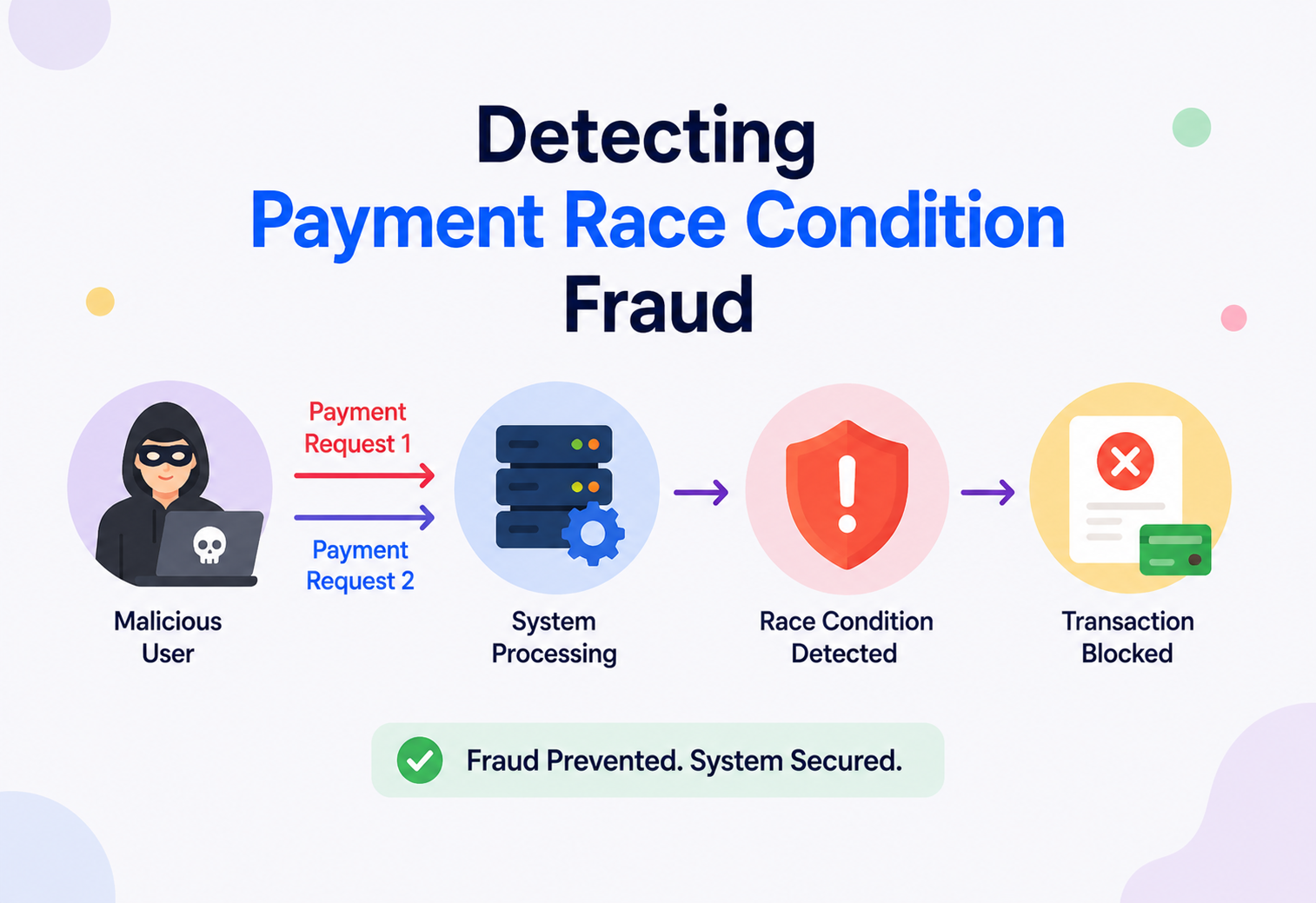
Detecting Payment Race Condition Fraud
A complete, interview-ready system design walkthrough for engineers building fraud detection systems that catch attackers exploiting timing gaps in payment processing pipelines — combining structural prevention, real-time detection, and post-hoc forensics.
Introduction & History
Every payment system, at its core, makes a promise: a charge will either happen completely or not at all. This promise sounds simple, but underneath it sits a web of distributed services, databases, external bank networks, and asynchronous callbacks, all of which take measurable time to agree with one another. Fraud that exploits payment race conditions lives in the gap between “the customer clicked pay” and “the money has actually, verifiably, irreversibly moved.” An attacker who understands that gap can walk away with goods, services, or account credit while the corresponding charge silently fails, gets reversed, or never completes at all.
This class of fraud is not new, but it has become dramatically more attractive to attackers as commerce has moved to instant digital checkout, one-click purchases, real-time balance top-ups, and buy-now-pay-later flows. Every millisecond a payment system spends being “optimistic” — assuming success before confirmation — is a millisecond an attacker can exploit.
A Short History of the Problem
Race condition exploitation is a concept borrowed directly from concurrent systems programming, where a race condition occurs when the correctness of a program depends on the relative timing of events that are not properly synchronized. In the earliest days of card processing, transactions were largely serial: a merchant physically swiped a card, a phone line dialed an authorization network, and nothing shipped until a human saw an approval code. There was no meaningful concurrency to exploit.
As payments digitized, the same operation started happening in parallel across many systems: a checkout service, an inventory service, a wallet-balance service, a fraud-scoring service, and a settlement service, all reacting to the same “payment initiated” event. The more services that had to coordinate, the more opportunities existed for one service to act on stale or unconfirmed information. Attackers noticed that firing multiple simultaneous requests, or exploiting slow webhook delivery, or manipulating retry logic, could cause a system to grant value twice, or grant value once while never actually collecting payment.
Serial card processing
Manual swipes, phone-line dial-ups, human-verified approval codes — effectively no concurrency, so no exploitable race window.
Digital & parallel
Checkout, inventory, wallet, fraud scoring, and settlement all react to the same event in parallel; the more services coordinating, the more timing gaps appear.
Instant everything
One-click checkout, real-time top-ups, BNPL, and instant-payment rails put optimism directly in the critical path — and attackers built scripts to industrialize the exploit.
Well-known early examples include double-submission of the same payment request that resulted in a wallet or gift card being credited twice, and rapid parallel checkout requests that both read an “available balance” before either write had completed, letting a user spend more than they had. Modern instant-payment rails, cryptocurrency-adjacent settlement systems, and BNPL (buy-now-pay-later) providers have all publicly acknowledged incidents rooted in exactly this pattern.
What makes this era of fraud especially interesting from a systems-design perspective is that the attacker rarely needs any privileged access, stolen credentials, or malware to succeed. The entire exploit can often be carried out using nothing more than a script that fires a handful of ordinary, perfectly valid-looking API requests within a tight time window. This is fundamentally different from most fraud categories, which usually require some form of stolen identity, compromised credential, or social engineering. Race condition fraud instead targets a structural weakness in how the system itself was assembled, which means the defense has to be structural too, not merely a matter of better identity verification or better customer authentication.
Imagine a busy coffee shop with two cashiers who cannot see each other’s screens and both consult the same shared “free drink” loyalty card. If a customer hands each cashier a copy of the same card within the same second, both cashiers see “one free drink available,” both punch it, and the customer walks out with two free drinks against a card that was only ever worth one. A payment race condition is exactly this — two services reading the same “still available” state before either has written its debit.
This also explains why the topic sits squarely at the intersection of two disciplines that do not always talk to each other inside a typical engineering organization: distributed systems engineering, which understands concurrency, consistency, and consensus, and fraud and risk engineering, which understands attacker behavior, incentives, and detection. A detection system built by only one of these disciplines tends to be incomplete. Distributed-systems engineers without fraud context often build technically correct but commercially unusable systems, for example locking every single transaction so strictly that legitimate checkout latency becomes unacceptable. Fraud engineers without distributed-systems context often build detection-only systems that can identify an attack after the fact but have no mechanism to prevent the underlying race from occurring in the first place. The strongest systems, and the ones this guide describes, are built by teams that deliberately bridge both disciplines.
- Why do race conditions matter more in payments than in most other domains?
- Can you describe, from first principles, why distributed payment systems are inherently vulnerable to timing attacks?
- How is this different from card-not-present fraud or stolen-card fraud?
Understanding the Attack: How Race Condition Fraud Works
Before designing a detection system, it helps to be precise about what we are detecting. Payment race condition fraud generally falls into a few recognizable patterns.
The Double-Submit Attack
Attacker submits the same payment request multiple times in rapid succession, often within milliseconds of each other, before the first has been recorded. If the “has this order already been paid?” check queries a database that has not yet committed the first write, both requests pass and both trigger fulfillment while at most one charge actually completes.
Slow-Confirmation Exploit
Systems that optimistically mark an order as “paid” or release digital goods before the bank’s final result is back invite an attacker to submit a payment they know will be declined or reversed, then immediately consume the value before asynchronous reconciliation catches up.
Cancellation Race
Attacker initiates a payment and, near-simultaneously, cancels or disputes it. If fulfillment and cancellation are handled by different services with different views of state, fulfillment may still ship because it has not yet learned about the cancellation.
Idempotency-Key Abuse
Attackers exploit poorly implemented idempotency logic by sending a request with a fresh idempotency key immediately after a first request, before the first key has been persisted — effectively bypassing the very protection meant to stop duplicate processing.
Balance Check-Then-Act Gap
In wallets, credit lines, and BNPL, a common implementation reads available balance, checks whether the amount is covered, and debits in a separate step. Two requests interleaving between check and act each see the same pre-debit balance and spend far more than the account actually holds.
Detection-Aware Timing Probing
Sophisticated attackers deliberately probe a system’s rules-engine thresholds, spacing duplicate requests just outside the “suspicious” window they’ve inferred — which is why static thresholds alone are never sufficient and ML-driven anomaly detection matters.
Imagine an account with a balance of one hundred dollars. The attacker fires twenty parallel requests, each attempting to spend ninety dollars. If the balance check and the balance debit are not atomic, many of those twenty requests can each read “one hundred dollars available” before any of them writes the debit — letting the attacker walk away with roughly eighteen hundred dollars in goods against a hundred-dollar balance.
Why Attackers Favor Digital Goods and Instant Fulfillment
Attackers exploiting race conditions overwhelmingly target flows where the value received is instantly usable and difficult to claw back: digital gift cards, in-game currency, streaming credits, gift certificates, instantly transferable wallet balance, and digital tickets are all favorites, precisely because once the attacker has moved that value somewhere else, reversing the underlying failed payment does not automatically reverse the damage. Physical goods, by contrast, are somewhat less attractive to this specific attack because shipping introduces a natural delay during which a detection system has time to catch the anomaly and intervene before the good ever leaves a warehouse. This is an important design insight: the highest-priority flows for both structural prevention and fast detection are exactly the ones where fulfillment is closest to instantaneous.
Attacker Tooling and Automation
In practice, this fraud pattern is rarely carried out by a single manual attempt. Attackers typically write small automated scripts, sometimes distributed across many compromised or rented accounts and many different IP addresses and devices, to maximize the number of simultaneous attempts and to avoid basic rate-limiting defenses. Some attacker communities even share pre-built tooling and step-by-step guides describing which specific merchants or platforms have historically had exploitable timing windows, meaning a single unpatched race condition can be discovered, shared, and exploited by many independent actors within a very short period once it becomes known, which is exactly why the speed of the “detect and remediate” cycle described throughout this guide is so operationally important.
- Walk me through exactly how a check-then-act race condition leads to overspending. What would the fix look like at the database level?
- Why can’t idempotency keys alone fully solve this class of fraud?
- How would you distinguish an attacker exploiting a race condition from a legitimate user whose network retried a request?
Architecture & Components
A production detection system for payment race condition fraud is not a single service; it is a layered pipeline that combines real-time transactional safeguards with near-real-time behavioral detection and offline forensic analysis.
Component Breakdown
| Component | Role |
|---|---|
| API Gateway | Entry point for every checkout, wallet top-up, and payment-related request; enforces authentication, per-user and per-device rate limiting, and attaches a correlation identifier that follows the request end-to-end. |
| Payment Orchestration Service | Sequences validation, lock acquisition, balance or credit check, external authorization, and final commit; the single most important place to eliminate races structurally. |
| Atomic Ledger Store | Strongly consistent transactional store — the single source of truth for balances and order payment status. Every mutation is an atomic read-modify-write, never a separate read then separate write. |
| Idempotency Key Store | Fast, strongly consistent key-value store (never eventually consistent) that records every idempotency key the instant a request begins, so concurrent duplicates are rejected or made to wait. |
| Distributed Lock Manager | Short-lived, per-account or per-order locks; the primary structural defense against check-then-act races. |
| Event Streaming Bus | Every meaningful lifecycle state transition is published as an immutable, ordered event, powering both real-time detection and forensic replay. |
| Race Condition Detection Service | Consumes the event stream, looks for near-simultaneous duplicates, fulfillment events before capture-confirmed events, and would-be-negative-balance debits. |
| Real-Time Fraud Scoring Engine | Broader risk scoring: device fingerprinting, velocity checks, behavioral biometrics feeding a combined score that decides hold / challenge / allow. |
| Rules Engine + ML Model | Rules give explicit, explainable heuristics; the ML model catches subtler statistical signatures that are hard to hand-write. |
| Case Management + Analyst UI | Human analysts review, confirm or dismiss findings, and feed labels back into ML training. |
| Automated Response Service | For high-confidence detections, freezes an account, reverses fulfillment, holds a wallet, or triggers manual review — without waiting for a human, because speed matters. |
| Offline Batch Forensics + Data Lake | Re-examines historical transactions with the latest rules and freshest model; produces precision/recall statistics; serves as the ultimate forensic record for compliance and law enforcement. |
| Model Retraining Pipeline | Consumes analyst-confirmed true positives and false positives to keep the ML model reflective of current attacker behavior rather than growing stale. |
- Why do we need both a rules engine and a machine learning model rather than just one?
- Where exactly does the distributed lock manager sit in the request path, and what happens if it becomes unavailable?
- Why is the event bus described as producing “immutable” events, and why does that property matter for fraud forensics?
Internal Working
The detection system’s internal logic can be understood as two cooperating layers: a prevention layer that structurally removes race windows wherever possible, and a detection layer that assumes some race windows will always remain (because you cannot always add a distributed lock to every third-party integration point) and instead watches for the fingerprints those races leave behind.
Prevention Layer Internals
When a payment request arrives, the orchestration service first computes a lock key, typically a combination of account identifier and order identifier. It then attempts to acquire a short-lived distributed lock on that key, usually backed by a fast in-memory data store that supports atomic compare-and-set operations. If the lock cannot be acquired because another request is already holding it, the new request is either queued briefly or rejected with a clear “request already in progress” response, rather than being allowed to proceed independently.
Once the lock is held, the service performs the balance or credit check and the corresponding debit as a single atomic transaction against the ledger store, so that no other process can observe an intermediate state. Only after this atomic step succeeds does the service call out to the external payment network. The lock is held until either a definitive success or definitive failure result is known, and only then is it released.
Idempotency keys are checked against the idempotency store using an atomic “insert if not exists” operation. If the key already exists, the new request is treated as a duplicate and is either given the cached result of the original request or told to wait until that original request resolves, rather than being processed as if it were new.
Mutual exclusion alone is not sufficient; the critical section must also be correctly bounded. A lock released too early — before all operations that depend on exclusive access have completed — provides a false sense of safety while the underlying race persists. The orchestrator therefore holds its lock across the reservation, external authorization call, and commit sequence, not just the balance check.
Detection Layer Internals
Even with a well-built prevention layer, some payment paths involve third-party systems the organization does not fully control, legacy integrations that cannot easily support distributed locking, or edge cases like network partitions that momentarily defeat the lock manager. The detection layer exists precisely for these residual risks.
The detection service subscribes to the full event stream and reconstructs, for every order or account, the expected sequence of lifecycle events. It looks for violations of expected ordering and expected timing, such as a fulfillment event appearing in the stream before the corresponding payment-captured event, or two debit events against the same account appearing within a window narrower than the system’s own minimum processing latency, which would be a strong signal that a lock was bypassed or ineffective.
It also computes derived signals: the “ledger drift” between what the ledger store believes an account’s balance to be and what a strict replay of all events, applied one at a time, would compute that balance to be. Any nonzero drift is itself evidence that something was applied out of order or applied more than once.

- What is “ledger drift” and how would you compute it efficiently at scale without replaying every event for every account on every check?
- If the lock manager itself fails during a network partition, what is your fallback strategy?
- How would you set the “minimum processing latency” threshold used to flag suspiciously close duplicate debits, and how would you avoid false positives from legitimate fast retries?
Data Flow & Lifecycle
Understanding the full lifecycle of a single payment event — from the moment a user taps “pay” to the moment the detection system either clears or flags it — is essential to reasoning about where race conditions can be introduced and where they can be caught.
Stage-by-Stage Description
- Submission stage: the client sends a payment request tagged with a client-generated idempotency key that survives network retries.
- Validation and locking stage: the gateway performs basic checks (authentication, malformed input, rate limiting) and forwards to the orchestrator, which immediately acquires an exclusive lock scoped to the relevant account or order.
- Reservation stage: with the lock held, the orchestrator performs an atomic “check and reserve” against the ledger, earmarking the funds so no concurrent request can spend them even before the external bank call resolves.
- External authorization stage: the orchestrator calls out to the bank or card network — the slowest, most variable-latency step, and exactly the stage where naive systems are tempted to optimistically respond “success” before this call finishes.
- Commit or rollback stage: once the external result is known, the reservation is either committed as a real debit or released back to available balance, atomically.
- Event publication stage: a single, immutable, well-ordered event describing the final result is appended to the event stream, carrying a precise timestamp and full context including lock hold duration.
- Downstream consumption stage: fulfillment services are only permitted to act on a “payment succeeded” event, never on the initial request itself — closing the door on the slow-confirmation exploit. In parallel, the detection service consumes the same event to check for anomalies.
- Why does fulfillment only subscribe to the final result event rather than the initial request event? What race would allowing the latter reopen?
- What happens to the reserved funds if the orchestrator crashes after acquiring the lock but before receiving the bank’s authorization result?
- How would you guarantee exactly-once event publication to the event bus given that the orchestrator itself might retry internally?
Advantages, Disadvantages & Trade-offs
No design is free. A system this strict about locking and atomicity buys strong correctness guarantees at the cost of latency, throughput, and operational complexity. It is worth being explicit about what is being traded.
Advantages
- Eliminates the majority of race-condition fraud structurally, rather than only detecting it after the fact.
- Produces a strongly auditable, replayable history of every payment decision.
- Detection layer catches residual gaps left by third-party integrations that cannot support locking.
- Combining rules and ML gives both explainability and adaptability.
- Automated response can stop an in-progress attack within milliseconds, not hours.
Disadvantages / Trade-offs
- Distributed locking adds latency to every single payment request, even the overwhelming majority that are legitimate.
- Lock contention on extremely popular accounts (for example, a single corporate wallet used by many automated processes) can create a throughput bottleneck.
- Strong consistency requirements on the ledger store limit certain horizontal scaling techniques that rely on eventual consistency.
- False positives in the detection layer can freeze legitimate customer accounts, causing real business harm and support burden.
- The system adds meaningful operational surface area: a lock manager, an idempotency store, and a streaming pipeline all become critical-path dependencies that must themselves be highly available.
Choosing Where to Trade Strictness for Speed
Not every payment path deserves the same level of strictness. A five-dollar in-app purchase and a fifty-thousand-dollar wire transfer do not carry the same risk, and treating them identically wastes latency budget on the low-risk case while potentially under-protecting the high-risk one. Mature systems tier their strictness: low-value, low-risk transactions may use lighter-weight optimistic concurrency with fast asynchronous reconciliation, while high-value or high-risk transactions always go through full pessimistic locking.
- How would you decide which transactions get pessimistic locking versus optimistic concurrency with reconciliation?
- What is the business cost of a false positive here compared to the cost of a missed fraud case, and how does that shape your threshold tuning?
- If lock contention became a measured bottleneck on a specific high-traffic account, what would you change first?
Performance & Scalability
A detection and prevention system built for payments has to operate at the scale of the business it protects. For a large digital wallet or payments platform, this can mean sustaining well into the millions of requests per minute during peak shopping events, flash sales, or salary-disbursement days, while keeping added latency from fraud checks in the single-digit-millisecond range.
Scaling the Lock Manager
The lock manager is typically backed by a low-latency, in-memory store capable of atomic compare-and-set operations, deployed as a sharded cluster where each shard owns a partition of the key space (commonly hashed by account identifier). This lets lock throughput scale horizontally by adding shards, since most locks are independent of one another and only contend when the same account is targeted repeatedly in a short window, which is itself a useful fraud signal.
Scaling the Event Stream
The event bus is partitioned by account or order identifier so that all events for a given entity land on the same partition and are therefore strictly ordered relative to each other, which the detection service depends on to reason about sequencing. Partition count is sized well above expected peak throughput divided by per-partition throughput limits, with headroom for traffic spikes during known high-volume events.
Scaling the Detection Service
Because the detection service is a stream consumer, it scales by adding consumer instances up to the partition count of the event stream. Stateful per-account windows (used to compute things like inter-arrival time between debit events) are kept in a fast local or co-located cache keyed by account, with periodic checkpointing so that a consumer restart does not lose recent state.
Scaling the ML Scoring Path
Real-time ML inference is kept fast by using lightweight models suitable for sub-ten-millisecond inference (such as gradient-boosted trees or small neural networks) in the synchronous path, while heavier models that need more context or longer inference time run asynchronously and only feed into slightly-delayed secondary reviews rather than blocking the initial transaction decision.
Latency Budgeting
A useful mental model is to give the entire fraud and race-detection path a hard latency budget, for example twenty milliseconds, and to allocate that budget explicitly across lock acquisition, ledger reservation, rules evaluation, and ML scoring, rejecting any change that would blow the budget rather than allowing latency to creep upward unnoticed release after release.
Much like Netflix’s playback and billing systems use partitioned, horizontally scalable event pipelines to handle enormous simultaneous demand during a popular release, a payment detection system uses the same partition-and-shard philosophy so that no single account, order, or event type ever becomes a global bottleneck for every other unrelated transaction happening at the same moment.
Handling Hot Accounts
Certain accounts naturally see disproportionately high transaction volume: a large corporate treasury account issuing many payroll disbursements, a popular merchant processing thousands of orders per minute, or a shared account used by multiple automated systems. These “hot” accounts can create a single point of lock contention even when the overall system has plenty of spare capacity elsewhere. Practical mitigations include splitting a single hot account into multiple internal sub-ledgers that are periodically reconciled into a single externally visible balance, queuing and batching requests against a hot account rather than treating every request as fully independent, and applying tighter monitoring specifically to hot accounts, since unusually rapid activity on a normally hot account can itself be a meaningful signal, either of a real operational surge or of an attacker specifically targeting a high-value target.
Backpressure and Overload Protection
During extreme traffic spikes, such as a flash sale or a viral promotional event, the system must be able to protect itself from being overwhelmed rather than degrading unpredictably. Backpressure mechanisms, where the API gateway begins shedding or queuing lower-priority requests once the payment orchestrator’s queue depth crosses a safe threshold, ensure that the system degrades gracefully and predictably rather than allowing queues to grow unbounded, response times to spiral, and, most dangerously, allowing engineers under pressure to disable safety checks like locking in order to “get throughput back,” which is exactly the kind of decision that reopens a race window at the worst possible moment.
Benchmarking and Capacity Planning
Before any major promotional event or seasonal peak, the team runs realistic load tests against a staging environment that mirrors production topology as closely as possible, deliberately including simulated race-condition attack traffic as part of the load test, not just simulated legitimate traffic. This ensures capacity planning accounts for the fact that detection and prevention logic itself consumes compute and adds latency under load, and that this overhead does not unexpectedly become the bottleneck precisely when traffic, and therefore fraud attempts, are at their highest.
- How would you size the number of partitions on the event stream for a target throughput of several million events per minute?
- What is your strategy for keeping ML inference latency low enough to sit in the synchronous payment path?
- How do you prevent a single “hot” account from degrading performance for the entire lock manager cluster?
- Why is it important to include simulated attack traffic, not just simulated legitimate traffic, in your load tests?
High Availability & Reliability
Because this system sits directly in the critical path of revenue-generating transactions, availability failures are not merely inconvenient — they can either block legitimate commerce or, worse, silently disable the very protections meant to stop fraud, which an attacker would be delighted to discover.
Lock Manager Failure Modes
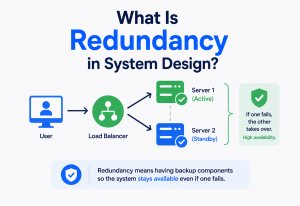
The lock manager must be deployed in a replicated, quorum-based configuration so that the loss of a single node does not cause locks to be lost or, worse, granted twice to two different callers. When the lock manager is genuinely unreachable, the orchestration service must fail closed for high-risk transactions (reject or queue rather than proceed without a lock) while allowing a carefully limited fail-open path only for very low-risk, low-value transactions where the business has explicitly accepted the residual race risk in exchange for availability.
Ledger Store Reliability
The ledger store, being the ultimate source of truth for money, is typically deployed across multiple availability zones with synchronous replication for the primary and asynchronous replication to a secondary region, combined with regular reconciliation jobs that compare the ledger’s computed balances against independent event-replay calculations to catch any silent divergence early.
Event Bus Durability
Events are replicated across multiple brokers before being acknowledged as written, and retention is set long enough (often many days) that the detection service and any downstream forensic job can be replayed from any recent point in time in the event of a processing bug or a need to re-run detection with an improved model.
Graceful Degradation of the Detection Layer
If the ML scoring service becomes unavailable, the system should be designed to fall back to the rules engine alone rather than failing the entire fraud check, since a partial detection capability is far better than none, while the outage itself is treated as a high-priority incident precisely because the organization is temporarily more exposed to race-condition exploitation.
Orchestrator fails closed on lock-manager unavailability for high-risk transactions
Context: A network partition or full lock-manager cluster outage removes the primary structural defense against check-then-act races.
Decision: Any transaction above the low-risk threshold (value, velocity, or risk score) is rejected or queued rather than allowed to proceed unlocked. Only explicitly whitelisted low-value, low-risk paths may fail open, and only with product/finance sign-off.
Consequence: During a lock-manager outage, a small fraction of legitimate high-value transactions are delayed or rejected. This is treated as strictly preferable to a silent race window during the exact moment attackers are most likely to be watching for degraded defenses.
- Should the payment orchestrator fail open or fail closed if the lock manager becomes unreachable, and does your answer change based on transaction value?
- How do you detect “silent” ledger divergence before it accumulates into a large financial loss?
- What is your disaster recovery plan if an entire region hosting the event bus becomes unavailable during a peak traffic event?
Security Considerations
The detection system itself becomes an attractive target, because compromising it or blinding it is often more valuable to a sophisticated attacker than exploiting any single race condition.
Protecting the detection pipeline
Access to rules-engine configuration, ML decision thresholds, and the automated response service must be tightly restricted and every change audited. An attacker (or a compromised insider) could quietly raise thresholds or disable automated freezing, effectively opening the door to undetected exploitation.
Tamper-evident event logs
Events feeding the detection system should be cryptographically chained or checksummed so that any attempt to retroactively alter the event history to hide evidence of an attack is detectable — important for internal integrity and for regulatory or law-enforcement purposes.
Detection-aware attackers
Sophisticated attackers probe timing thresholds and deliberately stay just outside the “suspicious” window a rules engine flags. Thresholds should never be static or predictable; they should be complemented by ML anomaly detection over a broader feature set and updated on a cadence unknown to the attacker.
Least privilege for automated response
The response service can freeze accounts and reverse fulfillment. It must operate under least-privilege credentials scoped as narrowly as possible, with strict rate limits on how many accounts it can act on in a short window, to contain the blast radius of a bug or a compromised credential within its own systems.
Protecting against insider threats
Engineers and analysts with legitimate access can, in principle, misuse it. Separation of duties: no single individual can both approve a change to detection thresholds and deploy that change to production without a second reviewer, and every analyst action — including dismissing a flagged transaction as a false positive — is permanently logged and periodically sampled for independent audit.
Encryption & data handling
All payment-related data, in transit and at rest, is encrypted with strong industry-standard cryptography. Sensitive fields such as full card numbers are tokenized so even internal detection services generally never see or store raw payment credentials at all, reducing the value of the detection system itself as a target.
- How would you prevent an attacker who has learned your detection thresholds from deliberately staying just below them?
- Why does the event log need to be tamper-evident, and how would you implement that without adding significant write latency?
- What controls would you put around the automated response service so a bug can’t mass-freeze legitimate customer accounts?
Monitoring, Logging & Metrics
Because the entire system exists to catch subtle timing anomalies, its own observability has to be equally precise, with high-resolution timestamps and end-to-end tracing across every hop a payment request takes.
Key Metrics to Track
- Lock acquisition latency and contention rate, to catch both performance regressions and suspicious spikes in repeated lock contention on the same account.
- Ledger drift rate, the frequency and magnitude of discrepancies between computed and replayed balances.
- Detection precision and recall, tracked against analyst-confirmed labels, to know whether the system is catching real fraud without overwhelming analysts with false positives.
- Time-to-detection, measuring how long after an anomalous event occurs the system raises an alert, since speed directly limits how much value an attacker can extract before being stopped.
- Automated response accuracy, the rate at which automated freezes are later confirmed correct versus overturned on appeal.
- Event bus consumer lag, since a lagging detection consumer effectively means detection is happening too late to matter.
Logging Practices
Every lock acquisition, reservation, and event publication should be logged with a shared correlation identifier that ties the entire lifecycle of a single payment together, since fraud investigations almost always require reconstructing an exact, ordered timeline of what happened and when, down to the millisecond.
Alerting Philosophy
Alerts should be tiered: informational alerts for statistically unusual but low-confidence patterns that simply get logged for later analysis, actionable alerts that route to an analyst queue, and critical alerts that trigger automated response immediately. Alert fatigue is a real risk; a system that pages engineers for every minor anomaly quickly gets its alerts ignored, which is itself a security risk.
Distributed Tracing
Because a single payment touches many independent services, distributed tracing that follows a single correlation identifier across the gateway, orchestrator, lock manager, ledger, and detection service is essential for both performance debugging and fraud investigation. A trace lets an engineer or analyst see, at a glance, exactly how long each stage took and in what order, which is often the fastest way to confirm or rule out a suspected race condition during an active investigation, rather than manually stitching together separate log files from five different systems after the fact.
Dashboards for Different Audiences
Engineers responsible for the payment pipeline’s operational health need dashboards focused on latency, error rates, and lock contention. Fraud analysts need dashboards focused on open cases, detection precision trends, and emerging attack patterns. Business and compliance stakeholders need higher-level dashboards summarizing total fraud losses prevented, false positive rates affecting genuine customers, and overall trend lines over time. Building all three from the same underlying metrics and event data, rather than maintaining separate, potentially inconsistent reporting pipelines for each audience, keeps the numbers trustworthy and consistent across the organization.
- How would you measure “time-to-detection” precisely, and why does it matter more here than in many other monitoring contexts?
- What would you do if you noticed detection precision dropping over several weeks even though recall stayed constant?
- How do you avoid alert fatigue while still catching genuinely urgent cases quickly?
Deployment & Cloud Strategy
Given the criticality of payment infrastructure, deployment strategy has to minimize the risk that a bad release either introduces a new race condition or disables detection entirely.
Progressive Delivery
Changes to the payment orchestrator, lock manager configuration, or detection rules are rolled out using canary deployments, where a small percentage of traffic is routed to the new version first, with automated rollback triggered immediately if key metrics like ledger drift rate or lock acquisition failures spike beyond a safe threshold.
Multi-Region Deployment
For global payment platforms, the orchestration and ledger services are deployed across multiple regions, with careful attention to which region owns the authoritative write path for a given account to avoid cross-region race conditions being reintroduced at the geographic level, which is its own subtle failure mode if not handled deliberately.
Infrastructure as Code and Immutable Deployments
All infrastructure for the lock manager, event bus, and ledger cluster is defined declaratively and version-controlled, with immutable deployments (new instances replace old rather than being patched in place) reducing the chance of configuration drift silently reopening a previously closed race window.
Cloud Provider Considerations
Managed, strongly consistent database offerings and managed streaming services are commonly used to reduce the operational burden of running the ledger store and event bus, though many large payment platforms still run self-managed clusters for the ledger specifically, given how central strict consistency guarantees are to correctness and given the desire to avoid being surprised by a managed service’s own eventual-consistency trade-offs.
Every canary rollout of a payment-orchestrator change carries an automated rollback rule tied to ledger drift rate and lock acquisition failure rate, not just to generic HTTP error rates — because a race-condition regression can produce a perfectly healthy 200-response profile while quietly corrupting balances.
- What metrics would trigger an automatic rollback of a canary deployment to the payment orchestrator?
- How would you avoid reintroducing a race condition at the multi-region level even after solving it within a single region?
- Would you use a managed database for the ledger store or run it yourself, and what factors drive that decision?
Databases, Caching & Load Balancing
Different data has different consistency and staleness tolerance. Applying one policy to everything is exactly the trap this design avoids.
Database Choice for the Ledger
The ledger store demands strict serializable or strong-consistency guarantees for any operation touching account balances, which typically points toward a relational database configured for serializable isolation, or a distributed database purpose-built for strongly consistent transactions across partitions. Eventual consistency, while excellent for scaling many other kinds of data, is specifically the property that must be avoided here, because it is exactly what creates the race window attackers exploit.
Caching Strategy
Caching is used carefully and only for data where staleness cannot be exploited: for example, caching a merchant’s catalog price or a user’s non-financial profile information is safe, while caching account balance for read purposes must always be clearly labeled as a “last known” value, never used as the basis for a debit decision, which must always go back to the authoritative ledger under lock.
Load Balancing
Requests are load balanced with session or account affinity where useful, but critically, load balancing must never allow two requests for the same account to be routed to two independent orchestrator instances that could each independently attempt to acquire the same lock without a shared, consistent lock manager behind them; the lock manager, not the load balancer, is what ultimately guarantees serialized access to a given account.
Read Replicas and Reporting
Read replicas of the ledger are used freely for reporting, analytics, and the fraud analyst dashboard, since those use cases can tolerate small amounts of replication lag, while every operational decision that grants or denies value always reads from the primary, strongly consistent path.
- Why is eventual consistency specifically dangerous for the ledger store in this system, when it’s often a perfectly good trade-off elsewhere?
- Where exactly would you allow caching, and where would you explicitly forbid it?
- How do you ensure the load balancer’s routing decisions can never bypass the lock manager’s guarantees?
APIs & Microservices
Service boundaries in this system are drawn along the same fault lines they’ll fail along — so they can each be given the consistency, scaling, and security posture their specific job actually needs.
API design for idempotency
Every payment-mutating API requires a client-supplied idempotency key. The contract explicitly documents that retried requests with the same key return the original result rather than reprocessing — protecting legitimate users from network-retry duplicate charges and removing one attacker tool for creating ambiguity.
Service boundaries
Orchestration, ledger, lock manager, and detection are deliberately kept as separate services with narrow, well-defined responsibilities, so different consistency, scaling, and security postures can be applied to each rather than forcing a monolith to compromise across all these concerns.
Sync vs. async boundaries
Everything that must be correct before the user is told “your payment succeeded” is synchronous and lock-protected. Everything that can tolerate a short delay (detailed scoring refinement, analyst review, retraining) is asynchronous over the event bus, which also improves resilience.
Contract testing between services
Precise event ordering and field semantics (e.g., what “reserved” vs. “committed” balance means) are enforced with strict schema contracts and automated contract tests, so a well-intentioned change in one service can’t silently break another’s assumptions.
- Why keep the lock manager and ledger store as separate services rather than combining them into one?
- How do you decide what belongs in the synchronous critical path versus the asynchronous event-driven path?
- How would you prevent a schema change in one service from silently breaking the detection service’s event parsing?
Design Patterns & Anti-Patterns
Every production system in this space is a chosen set of patterns and an avoided set of anti-patterns. Name them explicitly.
Helpful Patterns
Pessimistic locking on the critical path
Acquiring an exclusive lock before any balance-affecting read guarantees serialized access to a given account across the whole check-and-act sequence.
Atomic check-and-reserve
Combining the balance check and the reservation into a single atomic database operation rather than two separate calls closes the primary race window.
Event sourcing for the ledger
The ledger’s current state is the result of replaying an ordered, immutable log of events — which makes drift detection and forensic replay natural rather than bolted on.
Saga for multi-step flows
Compensating actions (like releasing a reservation) let multi-service payment flows recover cleanly without needing distributed two-phase commit across services that can’t share a single transaction.
Circuit breaker around bank calls
Prevents a slow or failing external authorization network from holding locks open indefinitely and starving other legitimate transactions.
Idempotent state machines
Modeling every entity as a small, well-defined set of valid states and transitions rejects invalid sequences (e.g., pending → fulfilled without capture) that could otherwise be exploited as a race.
Anti-Patterns to Avoid
Releasing goods or services before a payment is definitively confirmed, purely to shave milliseconds off perceived checkout speed, directly enables the slow-confirmation exploit.
Reading a balance in one call and debiting it in a separate call, with no lock or atomic guarantee between them, is the exact structural weakness attackers script against.
A malicious client can freely manipulate timestamps it controls; server-received timestamps must be authoritative for any ordering decision.
Client or internal retry logic that fires duplicate requests without a stable idempotency key effectively manufactures artificial race conditions even without malicious intent.
Relying solely on catching fraud after the fact rather than structurally closing the race window guarantees some fraud will always succeed before detection catches up.
- Give an example of a legitimate business need that might tempt a team into the “assume success” anti-pattern, and how would you satisfy that need safely instead?
- Why is event sourcing particularly well suited to this problem compared to a simple mutable balance column?
- How does the saga pattern help when a distributed transaction across services isn’t feasible?
Best Practices & Common Mistakes
The design above is only as good as the disciplines that keep it healthy. These are the practices that separate a system that ages well from one that quietly regresses.
Documentation as a Safety Net
Every service that touches a financial mutation should carry clear, up-to-date documentation describing exactly which operations are atomic, which are protected by a lock, and which invariants the surrounding code depends on to remain correct. New engineers joining a payments team are frequently the ones who unknowingly reintroduce a race condition, simply because the original reasoning behind a piece of locking logic was never written down and has since been forgotten by the team that originally built it. Treating this documentation as a living artifact, reviewed and updated alongside every meaningful change to the payment path, meaningfully reduces this specific and surprisingly common source of regressions.
Best practices
- Treat every financial state mutation as requiring atomicity by default, and require an explicit, reviewed justification for any exception.
- Instrument lock hold duration and contention from day one, since these metrics double as both performance indicators and early fraud signals.
- Build the detection layer to consume the same event stream used for legitimate business logic, rather than a separate, potentially inconsistent copy of events.
- Regularly run red-team style exercises where internal engineers deliberately attempt race-condition exploits against a staging environment to validate that both the prevention and detection layers hold up.
- Keep detection thresholds and rules under version control with an audit trail, and rotate or randomize aspects of detection logic that an attacker could otherwise learn and evade.
- Feed every confirmed fraud case, and every confirmed false positive, back into the ML training pipeline so the system continuously improves rather than staying static.
Common mistakes
- Assuming that because a system uses a database with ACID transactions, race conditions are automatically impossible; ACID guarantees only apply within the scope of what is actually wrapped in a single transaction, and many real bugs occur precisely because a check and an act were left in separate transactions.
- Under-provisioning the lock manager, leading engineers to loosen locking under load pressure “temporarily,” a temporary change that quietly becomes permanent and reopens the exact race window the system was built to close.
- Treating fraud detection as purely a data science problem and neglecting the structural, architectural prevention layer, which leaves an organization permanently one step behind attackers.
- Setting automated response thresholds too aggressively, causing frequent false freezes of legitimate customers, which erodes trust in the system and often leads teams to disable automation entirely.
- Failing to test failure modes of the lock manager and event bus themselves, discovering only during a real outage that the payment system’s fallback behavior was worse than expected.
- Assuming that a single test environment lightly exercised by a handful of manual QA test cases is sufficient validation for concurrency-sensitive logic; race conditions by their nature often only surface under genuine, high-volume concurrent load.
- Ignoring the human side of the system, such as under-training fraud analysts on how to distinguish a genuine race-condition exploit from an unusual but legitimate customer behavior pattern, which leads to noisy training labels that degrade the ML model over time.
Building a Culture of Concurrency Awareness
Beyond specific technical practices, the organizations that handle this problem best tend to treat concurrency correctness as a first-class design review criterion, alongside more commonly emphasized concerns like security review and performance review, for any change touching a financial code path. This often takes the shape of a dedicated concurrency checklist that engineers must explicitly work through before a payment-related change is approved, prompting questions such as whether a given operation needs to be atomic, whether it currently is, and what the worst-case outcome would be if two instances of this exact operation executed at precisely the same moment.
- Describe a scenario where a database’s ACID guarantees would not actually prevent a race condition, and explain why.
- How would you run a controlled red-team exercise against your own payment system without risking real financial loss?
- What would you do if you discovered that engineers had quietly loosened locking under load and never reverted it?
Advanced Topics: Concurrency, CAP Theorem & Consensus
Understanding payment race condition fraud at a deep level requires grounding in the underlying theory of concurrent and distributed systems. This section connects the practical defenses already described to the foundational computer science concepts that explain why the problem exists in the first place, and why certain classes of solution are theoretically guaranteed to work while others are not.
Concurrency Fundamentals
At its root, a race condition is a violation of what concurrency theory calls a critical section: a sequence of operations that must execute as though no other process can interleave with it. Classical operating systems solve this with mutexes, semaphores, and monitors, all of which guarantee mutual exclusion, meaning only one thread of execution can be inside the critical section at a time. The distributed lock manager described earlier in this guide is, conceptually, the distributed-systems equivalent of a mutex: it extends mutual exclusion across process and machine boundaries rather than just across threads within a single process.
A subtlety worth internalizing is that mutual exclusion alone is not sufficient; the critical section must also be correctly bounded. If a lock is acquired but released too early, before all operations that depend on exclusive access have completed, the lock provides a false sense of safety while the underlying race condition persists. This is precisely why the payment orchestrator in this design holds its lock across the entire reservation, external authorization call, and commit sequence, rather than releasing it immediately after the balance check.

Data Structures for Efficient Concurrency Control
At scale, using a single global lock for all accounts would be catastrophic for throughput, so practical systems rely on fine-grained locking implemented with hash-partitioned lock tables, where each partition independently manages locks for a subset of accounts. This is conceptually similar to how a hash map distributes keys across buckets: the account identifier is hashed, and the hash determines which shard of the lock manager owns that account’s lock, allowing near-linear horizontal scalability as long as hot accounts (repeatedly contended keys) remain a small minority of overall traffic. Skip lists and lock-free queues are sometimes used internally within a single lock-manager shard to efficiently manage pending lock requests without introducing additional contention at the data-structure level itself.
The CAP Theorem and Its Implications
The CAP theorem states that a distributed data store can only guarantee two of the following three properties at any given moment during a network partition: consistency, availability, and partition tolerance. Because network partitions are a fact of life in any sufficiently large distributed system, the real-world choice usually comes down to consistency versus availability during a partition event. For the ledger store specifically, this system deliberately favors consistency over availability: during a partition that prevents the ledger from confirming a write with strong consistency guarantees, the system refuses to process the affected transactions rather than risk an inconsistent balance, because an inconsistent balance is precisely the vulnerability that enables race condition fraud. This is a conscious and important design trade-off, and it is different from many other domains, such as content delivery or social media feeds, where availability is typically favored over strict consistency because the cost of showing slightly stale content is far lower than the cost of an incorrect financial balance.
Replication and Consensus Algorithms
To achieve both durability and strong consistency without a single point of failure, the ledger store and the lock manager both rely on consensus algorithms such as Raft or Paxos-family protocols. These algorithms allow a cluster of replicas to agree on an ordered sequence of operations even when some replicas are slow, temporarily unreachable, or have failed outright, as long as a majority (a quorum) of replicas remain reachable and healthy. A write is only acknowledged as successful once it has been durably replicated to a quorum of nodes, which guarantees that even if the node that accepted the write immediately crashes, the write is not lost, because a majority of other nodes already have it.
This matters directly for race condition defense because it guarantees that once a lock acquisition or a ledger commit is acknowledged as successful, that result is durable and will be consistently observed by any subsequent read, from any node in the cluster, even across a leader failover. Without this guarantee, a lock could theoretically be “lost” during a leadership change, silently reopening the exact race window the lock was meant to close.
Partitioning Strategy and Its Trade-offs
Partitioning (also called sharding) the ledger and lock manager by account identifier allows horizontal scalability, but it introduces its own subtlety: any operation that must atomically touch two different accounts, such as a peer-to-peer transfer between two wallet users, potentially spans two different partitions. This is handled using a two-phase commit style protocol or, more commonly in modern systems, a saga pattern with compensating actions, since true distributed two-phase commit across partitions can itself become a source of blocking and reduced availability under partition or node failure. Careful partition key selection, generally the identifier of whichever account is considered the primary owner of the transaction, minimizes how often cross-partition atomicity is even needed in the first place.
Failure Recovery and Correctness After a Crash
Because the payment orchestrator can crash at any point in its sequence, from immediately after acquiring a lock to immediately after receiving a bank authorization result but before committing it, the system relies on write-ahead logging and idempotent recovery procedures. On restart or failover, a recovery process scans for any in-flight transactions whose locks were held by a now-dead orchestrator instance, consults the durable event log to determine the true last-known state of that transaction, and either safely completes it (if the external authorization definitively succeeded) or safely rolls it back (if it did not), before releasing the associated lock. This recovery procedure is itself designed to be idempotent and safe to run multiple times, since a recovery process can itself crash mid-recovery.
Networking Considerations
Because lock acquisition, ledger commits, and event publication all cross network boundaries, the system has to account for the reality that a network call can fail in three distinct ways: a fast, clean failure (connection refused), a timeout with unknown outcome (the request may have succeeded on the far end even though no response was received), and a slow success that arrives after the caller has already given up waiting. The middle case, the ambiguous timeout, is the most dangerous for race condition defense, because a naive retry after a timeout can itself create a duplicate operation; this is exactly why idempotency keys and atomic “insert if not exists” semantics are treated as first-class citizens throughout the design, since they make retries after ambiguous failures safe by construction rather than by convention.
Clock Synchronization and Logical Ordering
Because the detection layer relies heavily on comparing timestamps across events produced by different machines, physical clock drift between servers becomes a genuine concern: two machines whose clocks differ by even a few tens of milliseconds can make two events appear to have occurred in a different order than they actually did, which could either mask a real anomaly or create a false one. Production systems address this by combining tightly synchronized physical clocks, typically kept accurate to within a few milliseconds using dedicated time-synchronization infrastructure, with logical ordering mechanisms such as per-partition sequence numbers on the event bus, so that the guaranteed order of events within a single account’s partition never depends purely on physical clock readings, and physical timestamps are used only for computing durations and windows rather than as the sole source of truth for ordering.
Idempotent State Machines
Every entity in this system, whether an order, a payment attempt, or a wallet reservation, can be modeled as a state machine with a small, well-defined set of valid states and a small, well-defined set of valid transitions between them, such as moving from pending to reserved, from reserved to captured or released, and from captured to fulfilled. Enforcing that every state transition is applied idempotently, meaning applying the same transition twice has no additional effect beyond applying it once, and enforcing that only valid transitions are ever accepted, rejecting any attempt to move an entity through an invalid sequence such as jumping directly from pending to fulfilled without passing through captured, closes off an entire category of subtle bugs that could otherwise be exploited as a race condition even in an otherwise well-locked system.
- Explain the CAP theorem in your own words and describe exactly where this system chooses consistency over availability, and why.
- How does a consensus algorithm like Raft prevent a lock from being silently lost during a leader failover?
- Why is an ambiguous network timeout more dangerous than a clean failure, in the context of payment race conditions?
- How would you handle an atomic transfer that spans two different partitions of a sharded ledger?
Real-World Industry Examples
Different corners of the industry hit different flavors of this problem — and their public writeups all converge on the same architectural DNA.
Digital wallets & balance races
Large digital wallet providers — in ride-sharing, food delivery, and peer-to-peer payments — have publicly discussed engineering investments in atomic check-and-reserve logic after early growth revealed that rapid parallel spend requests could outrun naive balance-check implementations, particularly during promotional campaigns that drove sudden request-volume spikes.
Buy-Now-Pay-Later platforms
BNPL providers, whose business model depends on extending short-term credit at checkout, are particularly exposed to check-then-act races on available credit limits, since a compromised or coordinated set of accounts can attempt to draw far beyond an approved limit if credit check and reservation are not atomic. This has driven the industry toward pessimistic locking and atomic reservation.
Card networks & authorization holds
Traditional card networks have long used authorization holds specifically to close a related race window: a hold reserves funds the moment a card is swiped, even though final settlement happens later. This is conceptually the same “reserve before confirm” pattern applied at an industry-wide scale decades before modern digital wallets existed — a battle-tested defensive pattern, not a novel idea.
Cloud infrastructure billing
Large cloud providers effectively run enormous real-time metering and billing pipelines. They’ve discussed the architectural importance of atomic, ordered event processing for usage-based billing, since a race condition in usage metering could similarly allow a customer to consume more compute or storage than their account limits should allow — structurally the same problem as a wallet overspend, measured in compute-hours rather than dollars.
Streaming & subscription services
Subscription-based platforms, including major streaming services, have described using idempotent, event-driven billing pipelines partly to prevent duplicate charge attempts during retry storms, and partly to ensure that access to content is only granted after a definitively confirmed payment event — the “fulfillment only on confirmed success” principle applied at scale.
E-commerce during flash sales
Large marketplaces have historically seen concentrated spikes in both legitimate demand and coordinated attack attempts during major promotional events. A sudden surge of simultaneous checkouts creates exactly the high-concurrency environment where a poorly protected system’s race windows become far more likely to be hit purely by volume, even without any deliberate attacker present.
Ride-sharing & on-demand platforms
Platforms combining a wallet-style balance with rapid, frequent, small-value transactions (ride fares, delivery fees) have discussed the operational importance of atomic balance operations, because their transaction volume per active user is unusually high — even a very small race window, if left unaddressed, gets discovered and exploited simply through the sheer volume of naturally occurring concurrent requests.
Disaster Recovery and Backup Strategy
Beyond day-to-day high availability, the system must also plan for catastrophic scenarios: an entire data center going offline, a corrupted backup, or a bug that silently corrupts ledger data over an extended period before being noticed. Point-in-time recovery snapshots of the ledger store are taken frequently, combined with the durable, append-only event log, which together allow the ledger to be reconstructed from any prior point in time by replaying events forward, rather than relying solely on periodic backups that might themselves be stale or incomplete by the time they are needed.
Regular disaster recovery drills, where the team deliberately fails over production traffic to a secondary region or rebuilds a ledger from event replay in a sandboxed environment, are essential to validate that recovery procedures actually work under realistic conditions rather than only in theory. Many organizations learn the hard way that a backup strategy which has never been tested end to end is not actually a reliable backup strategy.
A particularly important drill specific to this domain is a targeted reconciliation drill, where the team intentionally injects a small, controlled inconsistency into a sandboxed copy of the ledger and measures how long the reconciliation and drift-detection machinery takes to notice it, how accurately it pinpoints the affected accounts, and whether the automated response service correctly contains the issue without requiring manual intervention. Measuring this “detection-to-containment” time on a recurring basis, rather than assuming the system will behave the same way it did the last time it was tested months or years earlier, keeps the organization honest about how its real-world defenses would perform against a genuine, unexpected inconsistency rather than a carefully anticipated one.
Cost Optimization
Running a strongly consistent, quorum-replicated ledger and lock manager at scale is not cheap, and it is tempting to reduce replication factor or downgrade instance sizes to save money. This system treats the ledger and lock manager as the last place to cut costs, given that a single successful race-condition exploit at scale can easily cost far more than years of the infrastructure savings from a smaller cluster. Cost optimization instead focuses on the less consistency-sensitive parts of the pipeline: the offline batch forensics job and ML training pipeline can run on cheaper, interruptible compute instances since they are not on the critical path, and the event data lake can use tiered, lower-cost storage classes for older, less frequently accessed event history, while recent event history stays on faster storage to keep the detection service’s real-time lookups fast.
- Why do you think card networks converged on the authorization hold pattern decades before modern distributed systems theory was mainstream?
- How is a cloud billing race condition similar to, and different from, a wallet balance race condition?
- What lessons from BNPL credit-limit races would you apply to a system granting any form of short-term credit?
Frequently Asked Questions
The questions engineers, product managers, and interviewers actually ask — answered honestly.
Is this the same thing as a “double-spend” attack in cryptocurrency?
It is conceptually related but not identical. Cryptocurrency double-spend attacks typically exploit the time it takes a decentralized network to reach consensus on which transaction is valid, while payment race condition fraud in centralized systems exploits internal timing gaps between a company’s own services. The underlying principle — exploiting a window before finality — is shared, but the mechanisms and defenses differ significantly.
Can this fraud be completely eliminated, or only reduced?
In theory, a system that never grants value before a payment is fully, atomically, and irreversibly confirmed can eliminate this specific fraud pattern entirely. In practice, business pressure for fast checkout experiences, integration with third-party systems outside an organization’s direct control, and rare infrastructure failures mean most real systems aim to minimize the race window as close to zero as reasonably achievable while maintaining a detection layer for residual risk.
Why not just add a small delay before releasing goods, to let everything settle?
A fixed delay helps somewhat but is a blunt instrument: it degrades the experience for the overwhelming majority of legitimate customers, it does not structurally close the race window (an attacker can simply time their duplicate requests to fit within the delay), and it does not help at all for asynchronous authorization flows where the true confirmation can arrive well after any reasonable delay window.
How is this different from chargeback fraud or friendly fraud?
Chargeback and friendly fraud typically involve a payment that genuinely completes and is later disputed or reversed by the cardholder, often well after the goods or services were delivered. Race condition fraud is distinct in that the attacker is exploiting the payment process itself, before or during processing, so that the charge never truly completes in the first place, even though value was released.
Does using a well-known cloud database automatically protect against this?
No. Even a strongly consistent, transactional database only protects operations that are actually wrapped inside a single atomic transaction. If application code performs a balance check and a balance debit as two separate calls, the database’s consistency guarantees do nothing to prevent the race between them; the application logic itself must be designed to make that check-and-act sequence atomic.
What is the single highest-leverage change a team can make if they only have time for one?
Converting every check-then-act sequence on a financial balance into a single atomic operation, protected by a lock or a database-level atomic transaction, closes the largest and most commonly exploited race window and typically prevents the majority of real-world incidents in this category.
Should smaller companies without payments-at-scale still worry about this?
Yes, arguably even more so in some respects, since smaller companies are less likely to have dedicated fraud engineering teams and more likely to have grown their checkout, wallet, or credit features quickly without a rigorous concurrency review. Attackers do not only target the largest platforms; a smaller platform with a known, easily discoverable race condition can be an equally attractive, and sometimes easier, target. The good news is that the core structural fix — atomic check-and-reserve logic guarded by a lock or a database transaction — is achievable at almost any scale.
How do false positives get handled once a legitimate customer is incorrectly flagged?
A well-designed system provides a clear, fast appeal path for affected customers, and treats every confirmed false positive as valuable training data rather than simply reversing the freeze and moving on. Tracking false positive rate as a first-class metric, alongside detection precision and recall, ensures the team has a continuous incentive to tune thresholds and improve the ML model rather than allowing an overly aggressive detection posture to persist simply because it appears to be “catching more fraud.”
Does this design apply equally to card payments, wallet transfers, and cryptocurrency-adjacent settlement?
The core principles — atomic check-and-reserve, strong consistency on the source of truth, and event-driven detection — apply broadly across all of these domains, though the specific mechanics differ. Card payments involve an external bank network with its own authorization hold semantics; wallet transfers are typically fully internal and therefore easier to make atomic end to end; and cryptocurrency-adjacent settlement introduces additional complexity because finality itself is defined by a separate, often decentralized, consensus process outside the organization’s direct control, which usually requires waiting for a minimum number of confirmations before treating a transaction as truly final.
How long should the system wait before treating a payment as “final” for fulfillment purposes?
This depends entirely on the specific payment rail’s own finality guarantees. Some rails provide near-instant, cryptographically final confirmation, while others provide only a provisional authorization that can still be reversed for a period of time afterward. The fulfillment service should only treat a payment as safe to act on once it has received an event that reflects the payment rail’s actual definition of finality, not simply the first optimistic acknowledgment the rail returns.

Summary & Key Takeaways
Payment race condition fraud exploits the unavoidable reality that distributed payment systems take time to reach agreement across multiple services — and that time is exactly the window an attacker looks for.
Prevent structurally
Atomic check-and-reserve, distributed locking across the whole critical section, and strong-consistency ledger writes eliminate most race windows before they can be exploited.
Detect the residual
An event-driven detection layer watches an ordered, immutable stream for fingerprints of races that slipped through — fulfillment before capture, ledger drift, suspiciously close duplicate debits.
Respond in milliseconds
Automated response can freeze, reverse, or hold within milliseconds — the only speed at which detection can outrun an in-progress attack against instantly usable digital value.
Learn continuously
Analyst-confirmed true positives and false positives feed model retraining, so detection evolves with attacker behavior rather than growing stale.
Key takeaways
- Prevention beats detection. Atomic check-and-reserve protected by a lock closes the largest, most-exploited race window structurally.
- Detection is for the residual. Not every third-party integration supports locking, so an event-driven detection layer must exist alongside prevention.
- Fulfillment only on confirmed success. Never release value on a request event; only on a definitively confirmed capture event.
- Ledger drift is the earliest honest signal. A nonzero drift between the ledger’s stored balance and a strict event replay is direct evidence of a race, an out-of-order apply, or a duplicate apply.
- Choose consistency, deliberately. For the ledger, consistency beats availability during a partition — that is exactly the design decision that closes the race window.
- Tiered strictness. Low-value paths can use optimistic concurrency with reconciliation; high-value paths must go through full pessimistic locking.
- Instrument what matters. Lock contention, ledger drift, and time-to-detection are first-class metrics, not afterthoughts.
- Never disable safety under load. Loosened locking “temporarily” is how race windows quietly return — backpressure and graceful degradation are the correct answer instead.
- Fail closed on high-risk paths. When the lock manager is unreachable, high-risk transactions reject or queue rather than proceed unlocked.
- Discipline over silver bullets. A concurrency-aware culture, red-team drills, and honest post-incident feedback beat any single technology choice.
Getting this right requires deliberate choices at every layer: a strongly consistent ledger store rather than an eventually consistent one, careful latency budgeting so security does not silently degrade user experience, tiered strictness so low-risk transactions are not over-engineered while high-risk ones are never under-protected, and observability precise enough to measure lock contention, ledger drift, and time-to-detection as first-class metrics rather than afterthoughts.
The organizations that handle this well, from card networks to modern digital wallets to cloud billing platforms, share a common philosophy: never release value before finality is genuinely, atomically confirmed, and assume that wherever finality cannot be guaranteed structurally, detection must be fast enough and precise enough to close the gap before meaningful loss occurs.
Ultimately, defending against payment race condition fraud is not a one-time project with a fixed finish line, but an ongoing discipline that has to evolve alongside the business, the traffic patterns, and the attacker techniques it faces. A team that internalizes concurrency correctness as a core design principle, invests equally in structural prevention and real-time detection, and treats every confirmed incident and every false positive as valuable feedback for the next iteration of the system will consistently stay ahead of attackers who are, by comparison, only ever looking for a single gap to exploit once.
Strong candidates don’t reach for “just wrap it in a transaction” and don’t reach for “just add a fraud model” either. They reason about the exact critical section, name the specific race being closed, choose the specific consistency guarantee at each hop, and are explicit about which failures are caught structurally versus which are caught by detection.