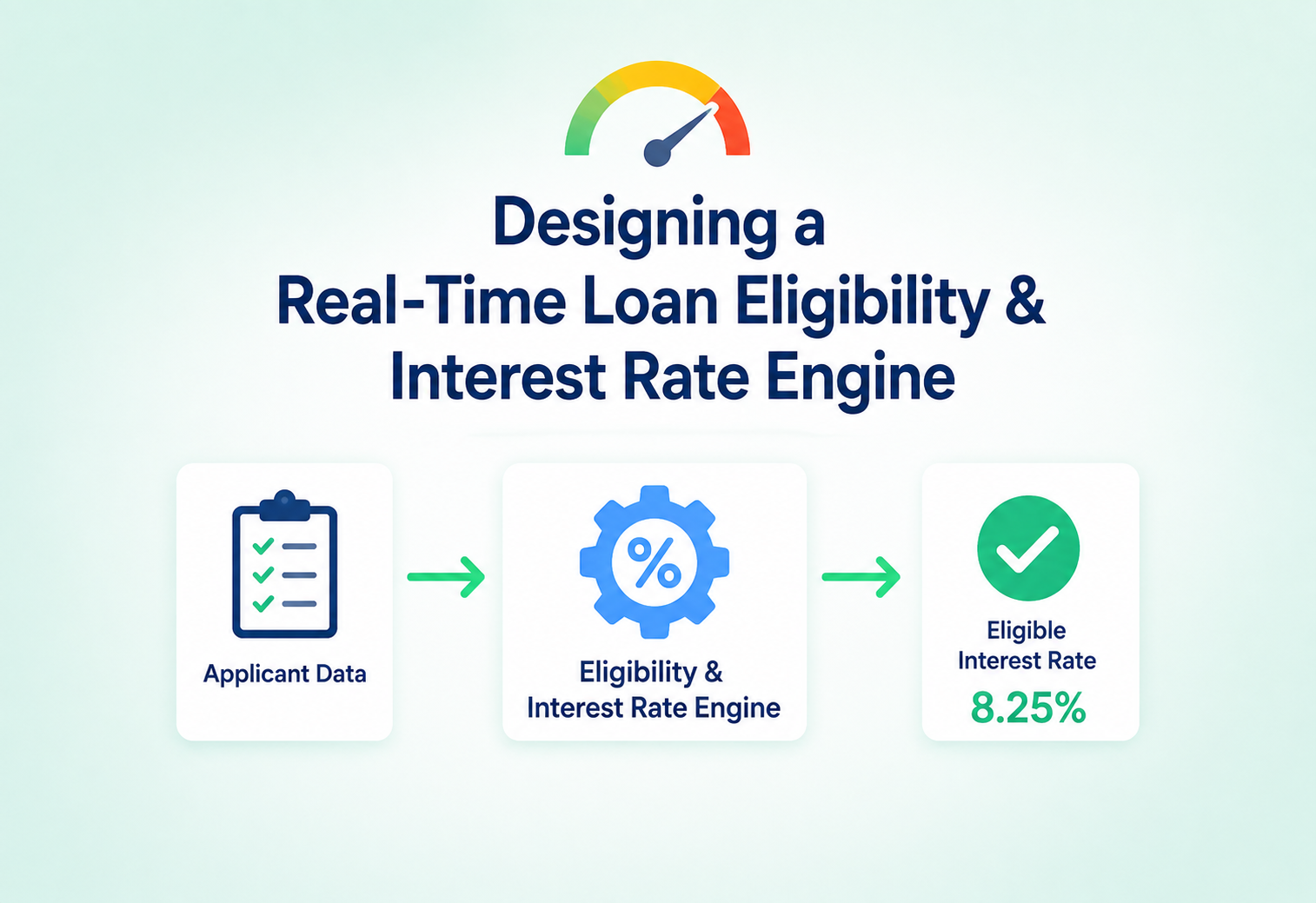
Designing a Real-Time Loan Eligibility & Interest Rate Engine
A production-grade, interview-focused deep dive into building a system that can look at a borrower, a rapidly changing risk model, and current market conditions — and answer “are you eligible, and at what rate?” in under a second, millions of times a day, without ever giving two different customers two different answers to the same question at the same moment.
Introduction and Why This Is Hard
Imagine you walk into a bank in the year 1995 and ask, “Can I get a loan, and what interest rate will I pay?” The loan officer pulls out a paper folder, checks your salary slip, calls your employer to confirm you actually work there, checks a printed table of interest rates that was mailed from head office last month, and tells you to come back in three days. That three-day wait was not laziness — it was simply how long it took humans and paper systems to gather your data and apply a decision.
Fast forward to today. You open a lending app, type in a few details, and within one to two seconds you see: “You are eligible for ₹5,00,000 at 11.2% interest.” That single number on your screen is the output of a system that, behind the scenes, pulled your credit history, calculated your income stability, checked fraud signals, applied a risk model that might have been updated an hour ago, checked current market interest rates, and applied dozens of business rules — all before you finished reading the loading spinner.
This tutorial is about designing exactly that system: a real-time loan eligibility and interest rate engine. We will treat “real-time” seriously — meaning the system must respond in a few hundred milliseconds to low single-digit seconds, at scale, correctly, and safely, even while the risk model that drives the decision is being updated multiple times a day (sometimes multiple times an hour during volatile market conditions).
1.1 A Short History — From Batch Underwriting to Real-Time Decisioning
Lending risk assessment has gone through roughly four eras, each one shortening the loop between “customer asks” and “system answers” by an order of magnitude:
Pre-1990s — Manual Underwriting
Human loan officers made judgment calls using paper documents. Slow, inconsistent, and prone to bias.
1990s – 2000s — Batch Scoring
Banks built centralized mainframe systems that ran credit scoring models overnight. A customer’s score might be a day old by the time it was used.
2000s – 2010s — Rules Engines + Periodic Model Refresh
Rules engines (Drools-style) plus statistical models (logistic regression) retrained monthly or quarterly. Still not truly real-time, but faster and more consistent than manual review.
2010s – Today — Real-Time Continuously-Updated Decisioning
Modern lenders (digital arms of traditional banks and fintechs) compute eligibility and pricing on the fly, using models that update in near real-time as fresh default, market and fraud data arrive. This is the era we are designing for.
1.2 Why This Is a Genuinely Hard Problem
It is tempting to think “this is just an API that takes an applicant’s data and returns a yes/no and a number.” The difficulty is hidden in five simultaneous constraints:
- Low latency: Users expect an answer in the time it takes to load a webpage, not the time it takes to process a form. Think of it like a coffee shop barista who must make your exact custom order (extra shot, oat milk, less foam) in under sixty seconds — every single time, no matter how busy the shop is.
- Correctness under a moving target: The risk model — the “brain” that decides how risky a borrower is — can change while thousands of requests are in flight. It is like changing the recipe for a dish while the kitchen is mid-service; you cannot let half the diners get the old recipe and half get the new one for the same order.
- Consistency and fairness: Two identical applicants applying seconds apart should get the same offer (unless something genuinely changed, like the interest rate moving). Regulators care deeply about this — inconsistent decisions can look like discrimination even if unintentional.
- Auditability: Every decision must be explainable and reproducible months later, because regulators, disputes, and internal audits will ask “why was this customer denied, or given 14% instead of 11%?”
- Massive read amplification, tiny write volume: Millions of eligibility checks happen against a risk model that is updated relatively rarely (minutes to hours) compared to how often it is read (thousands of times per second). This “read-heavy, write-rare-but-critical” pattern shapes almost every architectural decision in this system.
1.3 What “Loan Eligibility and Interest Rate” Actually Means
Before designing anything, let’s be precise about the two outputs this system must produce for every request:
- Eligibility decision: Approved, Declined, or Refer-for-manual-review, based on the applicant’s risk profile against current policy rules (minimum income, debt-to-income ratio, credit bureau score, fraud checks, existing exposure with the lender, regulatory restrictions for the applicant’s region, etc.).
- Interest rate (pricing) offer: A personalized annual percentage rate (APR), usually derived from a base rate (which moves with the market / central bank rate) plus a risk premium (which depends on the applicant’s calculated risk score) plus possibly product-specific adjustments (loan tenure, loan amount, secured vs unsecured).
Both outputs depend on a risk model — a piece of logic (often a machine learning model plus a rules layer) that converts raw applicant data into a risk score. The core design challenge of this system is: how do we serve this risk model’s decisions at massive scale, with very low latency, while the model itself is being retrained, re-tuned, or hot-patched in near real time?
- Why is a lending decision engine considered harder than a simple credit score lookup?
- What does “real-time” actually mean here, in numbers and in user-perceived experience?
- What makes “the model itself is changing” a hard engineering problem, rather than a data science problem?
Architecture and Components
At a high level, the system has to do five jobs: accept a request, gather data about the applicant, compute a risk score using the current model, apply business and pricing rules to translate that score into an eligibility decision and rate, and return an explainable, auditable answer — all within a latency budget of a few hundred milliseconds.
2.1 Component-by-Component Breakdown
2.1.1 API Gateway
The single front door for all eligibility requests. It authenticates the caller (a mobile app, a web app, or a partner bank consuming the lender’s API), applies rate limiting so no single client can flood the system, and routes the request to the Eligibility Orchestrator. Think of it as the receptionist at a busy clinic — checking your ID, making sure you are not cutting the queue, and directing you to the right department.
2.1.2 Eligibility Orchestrator Service
This is the “conductor of the orchestra.” It does not itself compute risk or fetch bureau data — it coordinates the other services in the right order, enforces the latency budget (using timeouts and fallbacks for each downstream call), and assembles the final response. It is a stateless service so that any instance can handle any request, which is critical for horizontal scaling.
2.1.3 Data Aggregator Service
Responsible for gathering all the raw signals needed to compute risk: credit bureau score, KYC / identity verification status, fraud signals, and the applicant’s existing relationship with the lender (past loans, repayment behavior). Many of these calls go to external, sometimes slow, third-party APIs — so the aggregator issues them in parallel rather than one after another, and caches recent results (a bureau score fetched five minutes ago for the same applicant does not need to be fetched again).
2.1.4 Feature Store
A specialized data layer that converts raw signals (income, past defaults, transaction history) into the exact numerical “features” the risk model expects as input — for example, converting “12 on-time payments out of 12” into a normalized “payment reliability score” between 0 and 1. The feature store guarantees that the same feature is computed the same way whether it is being used to train the model offline or to serve a live prediction — this consistency is called avoiding “training-serving skew,” one of the most common causes of ML systems behaving unexpectedly in production.
2.1.5 Model Serving Cluster
A fleet of stateless inference servers that hold the current risk model in memory and can score an applicant’s features in single-digit milliseconds. This cluster is designed to support hot-swapping model versions without downtime — a new model version can be loaded into memory and traffic gradually shifted to it, while the old version keeps serving until it is fully drained.
2.1.6 Rules Engine
Sits right after the model. Even the smartest ML model does not know about hard legal or policy constraints — “never lend more than 3x monthly income,” “decline anyone under 18,” “extra scrutiny for high-risk postal codes.” The rules engine applies these deterministic, auditable rules on top of the model’s probabilistic score. Keeping rules separate from the model matters hugely for compliance: rules can be explained in plain English to a regulator; a raw model score alone often cannot.
2.1.7 Pricing Engine
Converts the final risk assessment into an actual interest rate: base rate (which tracks the central bank / market rate, updated occasionally) plus a risk premium (a function of the risk score) plus product adjustments (tenure, loan amount, collateral). This engine reads from the Rate Card Store, which is itself a small, frequently-cached dataset since rate cards change far less often than individual decisions.
2.1.8 Model Lifecycle Layer (Training, Registry, Publisher)
This is the machinery that keeps the risk model “rapidly changing” in a controlled way. Training pipelines periodically (or continuously) retrain the model on new data. Every trained model is versioned and stored in a Model Registry. A Publisher component handles the actual rollout — pushing a new model version to the serving cluster using a safe deployment strategy (discussed in depth in the Internal Working section).
2.1.9 Decision Ledger (Audit Trail)
Every single decision — inputs, model version used, computed score, applied rules, final rate, and timestamp — is written to an immutable, queryable store. This is not optional in lending; regulators can ask “explain this specific decision from 14 months ago” and the system must be able to answer precisely, including which model version made the call.
2.1.10 Event Stream and Notification Service
Once a decision is made, downstream systems (customer notifications, loan origination workflow, fraud monitoring, analytics) need to know. Rather than the orchestrator calling all of them synchronously (which would slow down the customer-facing response), the decision is published as an event to a stream (like Kafka), and interested services subscribe to it asynchronously.
- Why separate the Rules Engine from the Model Serving layer instead of baking policy rules into the model itself? (Explainability, compliance auditability, and the ability to change hard rules instantly without retraining a model.)
- Why is the Orchestrator stateless? (To allow any instance to handle any request, enabling simple horizontal scaling and fast failover.)
- Why call bureau, KYC, and fraud services in parallel rather than sequentially? (To minimize total latency; sequential calls would add up their individual latencies, while parallel calls only cost as long as the slowest one.)
Internal Working — How a Decision Actually Gets Made
Let’s trace through what happens, step by step, from the moment a request arrives to the moment a rate is displayed on screen, and pay special attention to how the system handles a risk model that might be updated mid-flight.
3.1 Step 1 — Request Arrives and Gets Validated
The API Gateway authenticates the caller and checks that the payload (applicant ID, requested loan amount, tenure, product type) is well-formed. Malformed or unauthenticated requests are rejected immediately — this is cheap to check and prevents wasted work downstream.
3.2 Step 2 — Parallel Data Gathering
The Data Aggregator fires off parallel calls: fetch the applicant’s credit bureau score (or use a cached one if fetched within the last few minutes), fetch KYC status, run a lightweight real-time fraud check, and pull the applicant’s internal repayment history if they are an existing customer. Each call has its own timeout. If a non-critical data source times out (say, a slow secondary bureau), the system can proceed with a slightly less complete feature set and flag the decision as “reduced-confidence” rather than failing the whole request — this is called graceful degradation.
3.3 Step 3 — Feature Assembly
Raw data is transformed into the exact feature vector the model expects: normalized numbers, one-hot encoded categories, computed ratios (like debt-to-income). This happens through the Feature Store, using feature definitions that are versioned right alongside model versions — so a model trained on “feature set v12” is always served with “feature set v12,” never mismatched with a newer or older feature definition.
3.4 Step 4 — Model Inference
The Model Serving Cluster runs inference — essentially plugging the feature vector into the current risk model and getting back a probability, such as “8.3% estimated probability of default in 12 months.” This step is engineered to take single-digit milliseconds because the model is already loaded in memory (no disk reads, no network calls during inference itself).
3.5 Step 5 — Rules Evaluation
The raw model score passes through the Rules Engine, which checks hard constraints: regulatory eligibility (age, region restrictions), internal policy (maximum exposure per customer), and any temporary business overrides (e.g., “pause new unsecured loans above ₹10 lakh this week due to a risk event”). If any hard rule fails, the result is an automatic decline or a routing to manual review, regardless of what the model score said.
3.6 Step 6 — Pricing Calculation
If the applicant passes eligibility, the Pricing Engine computes the offer: final_rate = base_rate + risk_premium(score) + product_adjustment. The base rate comes from the Rate Card Store (cached aggressively, since it changes rarely — maybe once a day or on major market moves). The risk premium is a function that maps the model’s risk score to a rate markup, calibrated so riskier applicants pay more, within regulatory caps on maximum rates.
3.7 Step 7 — Response Assembly, Persistence, and Return
The orchestrator assembles a final response (approved / declined, rate, loan terms) and, in parallel, writes a full audit record to the Decision Ledger and publishes a “decision made” event to the stream. The customer sees only the final response; the audit-write and event-publish happen without adding to the customer’s perceived latency (fire-and-forget with guaranteed delivery, discussed later).
3.8 Handling the “Rapidly Changing Risk Model” Problem
This is the heart of the design challenge. If the risk model can be updated every hour (or more often), how do we avoid chaos — where request A gets scored with model v41 and request B, arriving one millisecond later, gets scored with v42, producing inconsistent offers to near-identical applicants?
The answer is a combination of four techniques:
3.8.1 Versioned, Immutable Models
Every trained model gets a unique, immutable version identifier. The serving cluster never mutates a model in place — it loads a new version alongside the old one, and only switches traffic over deliberately. This is exactly like how software deployments use versioned releases rather than patching a running binary in place.
3.8.2 Atomic, Coordinated Rollout (Not “Trickle” Updates)
Rather than each server independently deciding to pick up a new model whenever it feels like it, a central Publisher coordinates the rollout: it can do a canary rollout (send 1% of traffic to the new model, watch metrics, then ramp to 100%), or a blue-green switch (flip all traffic atomically at a controlled instant). Either way, the switch is a deliberate, observable event — never an uncoordinated race condition across servers.
3.8.3 Sticky Model Version Per In-Flight Request
Once a request has started being processed, it uses the model version that was “current” at the start of that request, even if a new version becomes current microseconds later. This avoids a decision being computed with a mix of old and new logic (for example, features aligned to v41 being fed into a v42 model, which could expect a different feature schema).
3.8.4 Shadow Traffic and Champion / Challenger Testing
Before a new model version ever gets to influence a real customer’s decision, it typically runs as a “challenger” — receiving a live copy of production traffic, computing scores, but not affecting real customer outcomes — while the “champion” (current live model) keeps serving. Engineers and risk analysts compare the challenger’s decisions against the champion’s for days or weeks before promoting it.
A rapidly changing risk model does not mean the system retrains and redeploys a brand-new model every few seconds for every request. In practice, “rapidly changing” usually means: the model is retrained / recalibrated frequently (hourly to daily) based on fresh performance data, and certain lightweight parameters (like the base interest rate, or specific rule thresholds) can change even faster (minutes) through the rules and pricing layers, which are cheaper and safer to update than the ML model itself.
- How do you avoid two requests arriving at nearly the same time getting scored by different model versions in a way that looks unfair? (Pin the model version at the start of a request, and use controlled rollout strategies — canary / blue-green — rather than uncoordinated hot-swapping.)
- What happens if the new model version has a bug and starts producing wildly wrong risk scores? (Canary analysis with automatic rollback triggers, shadow testing before promotion, and rule-engine guardrails — hard caps on rate / eligibility — that limit the blast radius of a bad model.)
- How would you reproduce a decision made three months ago for a regulatory audit? (Because every decision is logged with the exact model version, feature values, and rules applied, you can replay it deterministically using the Decision Ledger and the immutable model artifact from the Model Registry.)
Data Flow and Lifecycle
It helps to separate this system’s data into two very different lifecycles that move at very different speeds: the fast path (a single eligibility request, completing in under a second) and the slow path (the risk model’s continuous training and rollout cycle, taking minutes to days).
4.1 The Fast Path (Per-Request Lifecycle)
- Request enters through the gateway (milliseconds).
- Parallel data-gathering from bureau, KYC, fraud, and internal systems (tens to hundreds of milliseconds — usually the biggest chunk of the latency budget).
- Feature assembly (single-digit milliseconds, mostly in-memory lookups and cached transforms).
- Model inference (single-digit milliseconds if the model is loaded in memory on the serving node).
- Rules evaluation (sub-millisecond to a few milliseconds — pure logic, no external calls).
- Pricing computation (sub-millisecond — arithmetic against a cached rate card).
- Response returned to client; audit write and event publish happen asynchronously and do not block the response.
4.2 The Slow Path (Model and Rate Lifecycle)
- Fresh outcome data flows in continuously — did approved loans actually get repaid, did declined applicants who got loans elsewhere default, are fraud patterns shifting? This data lands in a data lake / warehouse.
- Training pipelines periodically retrain or recalibrate the model using this fresh data, producing a new candidate model version.
- The candidate is validated offline (backtesting against historical data) and then online (shadow traffic, champion / challenger).
- Once validated, the candidate is registered in the Model Registry with a version tag and published through a controlled rollout to the serving cluster.
- Similarly, the base interest rate (tracking market / central bank rates) is updated in the Rate Card Store whenever it changes, and this update propagates through the caching layer within a bounded, known delay (e.g., under one minute) — because pricing based on a stale market rate is a real financial risk.
- Why keep the model retraining pipeline completely decoupled from the real-time serving path? (So that heavy, slow, resource-intensive training work never competes for resources with, or adds latency to, live customer-facing requests.)
- How do you keep the rate card update propagation delay bounded? (Push-based cache invalidation — publish an event when the rate changes — combined with a short cache TTL as a safety net, rather than relying purely on a long TTL.)
Advantages, Disadvantages and Trade-offs
Every ordering approach involves engineering trade-offs. A strong design does not pretend those trade-offs do not exist — it names them clearly and picks the ones the product can genuinely absorb.
5.1 Advantages of This Architecture
- Speed at scale: Parallelized data-gathering and in-memory model inference let the system serve decisions in well under a second, even under heavy load.
- Safe rapid iteration: Canary rollouts and champion / challenger testing let the business improve risk models frequently without risking a bad model impacting all customers at once.
- Explainability and auditability: Separating rules from the ML model, and logging every decision with full context, makes the system defensible to regulators and dispute resolution teams.
- Resilience to partial failures: Graceful degradation (proceeding with reduced data if a non-critical source is down) keeps the system available even when dependencies are not perfect.
5.2 Disadvantages and Costs
- Significant engineering complexity: Feature stores, model registries, canary infrastructure, and audit ledgers are non-trivial systems in their own right, each requiring dedicated ownership.
- Consistency vs freshness tension: Pinning a model version per in-flight request means a request that started just before a rollout uses the “old” model — technically slightly stale, but intentionally so, for fairness and predictability.
- Cost of redundancy: Running shadow / challenger models alongside the live champion model roughly doubles inference compute cost during evaluation periods.
- Operational burden of explainability: Storing full decision context (features, model version, rules fired) for every request at high volume requires substantial, carefully-managed storage and retention policies (often 7+ years for regulatory reasons).
Pros
- Sub-second decisions at high concurrency, even with multiple external dependencies in the critical path.
- Deterministic, replayable audit trail per decision satisfies “explain this from 14 months ago” regulator questions.
- Champion / challenger and canary safety nets keep model changes low-risk.
- Rule / model / pricing separation lets each team ship on its own cadence.
Cons
- Model rollout, feature store and registry infrastructure roughly triple the moving parts compared to a single monolithic scorer.
- Shadow inference literally doubles model-serving cost during evaluation windows.
- Multi-year audit retention is not cheap and requires careful data governance.
- Every added external dependency (bureau, KYC, fraud) is a new potential source of latency and outage.
5.3 Key Trade-off Table
| Decision | Choice Made | What We Gain | What We Give Up |
|---|---|---|---|
| Model versioning | Immutable, versioned models with pinned-per-request usage | Consistency, fairness, reproducibility | Slight delay in a new model’s full effect (rollout takes time) |
| Data gathering | Parallel calls with per-source timeouts and fallbacks | Lower latency, resilience to slow dependencies | Occasional decisions made with partial data (flagged as reduced-confidence) |
| Audit logging | Full synchronous-write-triggered, async-persisted audit trail | Regulatory compliance, explainability | Storage cost, added architectural complexity |
| Caching rate cards | Push-invalidated cache with short TTL fallback | Fast reads, low load on the source of truth | Small window of potential staleness |
Section takeaway
Every choice in this system trades a little bit of “always perfectly fresh” for a lot of “predictable, explainable, and fast.” In regulated financial systems, predictability and explainability are usually worth more than shaving off the last few milliseconds of staleness.
Performance and Scalability
Let’s put real numbers on the target. A typical goal for such a system might be: p50 latency under 250 ms, p99 under 800 ms, supporting 3,000 – 10,000 requests per second at peak (for example, during a marketing campaign or festive loan promotion), with the ability to scale further during unplanned spikes.
6.1 Where Latency Actually Comes From
In practice, for this class of system, the biggest latency contributor is almost always external data gathering — calling third-party credit bureaus and KYC providers — not the model inference itself. This has a big implication for design: optimizing the model to run in 2 ms instead of 5 ms barely matters if a bureau call takes 300 ms. So performance engineering effort should be prioritized accordingly.
Techniques to Reduce Perceived Latency
- Aggressive caching of slow-changing data: A bureau score fetched five minutes ago for the same applicant can often be reused rather than re-fetched, subject to business rules about score freshness.
- Parallelism, not sequencing: Fire all independent external calls at once; total latency becomes the slowest call, not the sum of all calls.
- Precomputation for repeat applicants: For existing customers, some features (like “24-month repayment history”) can be precomputed and refreshed on a schedule rather than calculated live on every request.
- In-memory model serving: Keep the current model fully loaded in the serving process’s memory; never read model weights from disk or a database during a live request.
- Timeouts with sane fallbacks: Every external call has a strict timeout; if it is exceeded, the system falls back to a cached value, a conservative default, or routes to manual review — never lets one slow dependency block the whole request indefinitely.
6.2 Scaling the Model Serving Layer
The model serving cluster is largely stateless (aside from the loaded model itself) and horizontally scalable — add more instances behind a load balancer as request volume grows. Because inference is CPU / GPU-bound and fast, autoscaling based on request rate and CPU utilization works well. During a model rollout, extra capacity is temporarily needed since both old and new model versions may be serving simultaneously.
6.3 Scaling the Data Aggregation Layer
This layer is often the trickiest to scale because it depends on third-party rate limits (a credit bureau might cap how many queries per second it accepts). Techniques here include connection pooling, request batching where the bureau supports it, circuit breakers to stop hammering a struggling dependency, and negotiating higher rate limits with critical data providers as volume grows.
Large digital lenders commonly report that credit bureau and identity verification calls account for 60 – 80% of total end-to-end decision latency, which is why so much engineering investment goes into smart caching, parallel fan-out, and negotiating low-latency SLAs with bureau partners — rather than purely optimizing the ML model’s inference speed.
6.4 Capacity Planning Example
Suppose the business expects 8,000 requests per second at peak, each request needing roughly 5 ms of model inference time on a single core, plus network and queueing overhead. A back-of-envelope calculation: if each serving instance can comfortably handle 500 requests per second, you would provision at least 16 instances for the model serving tier at peak, plus headroom (commonly 30 – 50% extra) for traffic spikes and rolling deployments — landing around 22 – 24 instances, distributed across multiple availability zones.
- Where would you focus your optimization effort first — model inference speed or external data calls? (A strong answer identifies external data calls as the usual bottleneck and explains why optimizing the smaller contributor first is a common mistake — premature optimization on the wrong component.)
- How would you handle a sudden 5x traffic spike during a flash promotion? (Autoscaling policies, pre-warming capacity ahead of known campaigns, circuit breakers to protect downstream dependencies, and graceful degradation — e.g., temporarily relying more on cached bureau data.)
High Availability and Reliability
A lending decision engine going down is not just an inconvenience — it directly blocks customers from getting money they may urgently need, and it can halt a business’s entire loan origination pipeline. High availability here is not a nice-to-have; it is core to the product.
7.1 Redundancy at Every Layer
- Multi-instance, multi-zone deployment: Every stateless service (gateway, orchestrator, model serving, rules engine, pricing engine) runs multiple instances spread across at least two, ideally three, availability zones, so a single data center failure does not take down the whole system.
- No single point of failure in data stores: The cache layer runs as a replicated cluster; the decision ledger database uses synchronous or near-synchronous replication so a single node failure does not lose audit records.
- Redundant model artifacts: The current and previous model versions are always both available and loadable, so a rollback to the previous version can happen in seconds if the new version misbehaves.
7.2 Failure Handling Strategies
- Circuit breakers around every external dependency (bureau, KYC, fraud service) — if a dependency’s error rate crosses a threshold, the circuit “opens” and the system stops calling it for a cooldown period, immediately falling back to cached data or a conservative decision path, instead of piling up slow, failing requests.
- Bulkheads: Isolating resource pools (thread pools, connection pools) per dependency so a problem with one slow external service cannot exhaust resources needed to serve calls to a healthy one.
- Graceful degradation tiers: If everything is healthy, use full data and the full model. If a non-critical signal is unavailable, proceed with a documented “reduced confidence” decision. If critical data (like KYC) is unavailable, route to manual review rather than guessing.
- Automated rollback for bad model versions: If key business metrics (approval rate suddenly spikes or crashes, average score shifts dramatically) move outside expected bounds right after a rollout, an automated alert — or in mature setups, an automated rollback — reverts to the last known-good model version.
7.3 Disaster Recovery
Beyond day-to-day resilience, the system needs a documented disaster recovery plan: regular backups of the decision ledger and model registry, a tested cross-region failover plan (even if the primary region is used for all traffic normally), and a clearly defined Recovery Time Objective (RTO) and Recovery Point Objective (RPO) — for a lending decision system, an RPO close to zero is typical, since losing even a few seconds of audit records is a compliance problem.
- What happens if the model serving cluster becomes completely unavailable? (Fail safely: either fall back to a simpler, previously-validated rules-only decisioning path with conservative limits, or queue requests for asynchronous processing with a “we’ll notify you shortly” response, depending on business tolerance.)
- How do you decide between failing a request versus degrading it? (Tie to data criticality: identity / KYC failures should never be silently bypassed — fraud and compliance risk — while a secondary, non-critical data enrichment source can be safely skipped.)
Security and Compliance
This system handles some of the most sensitive data that exists: income, identity documents, credit history, and financial behavior. Security here is not just about preventing hacks — it is tightly interwoven with legal and regulatory obligations.
8.1 Data Protection
- Encryption in transit and at rest: All data moving between services, and all data stored in databases, caches, and logs, is encrypted. Sensitive fields (like national ID numbers) are additionally tokenized or masked wherever the raw value is not strictly needed.
- Least-privilege access: Each service only has access to the exact data it needs. The Pricing Engine, for example, does not need to see raw identity documents — it only needs a risk score and product parameters.
- PII minimization in logs: Application logs used for debugging must never contain raw personally identifiable information; structured audit logs (which do need full context for compliance) are stored separately with much stricter access controls.
8.2 Authentication and Authorization
- Every request to the API Gateway is authenticated (customer session tokens for app users, signed API keys or OAuth for partner integrations).
- Internal service-to-service calls use mutual TLS and short-lived tokens, so even if the internal network is compromised, services still verify each other’s identity.
- Role-based access control governs who (which human operators) can view raw decision data, override a decision, or trigger a model rollout — with every such action itself logged.
8.3 Fraud and Abuse Prevention
- Rate limiting and anomaly detection at the gateway to catch bots or bad actors probing the system with many rapid-fire applications (a classic pattern in “eligibility testing” fraud, where fraudsters submit slightly varied fake profiles to find gaps in the model).
- Device fingerprinting and velocity checks (how many applications from this device / IP in the last hour) feed into the fraud signal service as additional risk features.
8.4 Regulatory Compliance Considerations
- Fair lending / anti-discrimination: Many jurisdictions legally prohibit using certain attributes (race, religion, sometimes gender or marital status) directly or as close proxies in credit decisions. Feature selection and model audits must actively check for and eliminate proxy discrimination.
- Right to explanation: Regulations like the U.S. Equal Credit Opportunity Act (and equivalents elsewhere) often require lenders to provide specific, meaningful reasons for a denial — which is exactly why the Rules Engine and Decision Ledger are designed to produce human-readable reason codes, not just an opaque model score.
- Data residency: Depending on jurisdiction, applicant data may need to stay within specific geographic boundaries, which affects where data stores and even model serving infrastructure can physically run.
Treating the ML model as a “black box” that only outputs a single opaque score, with no way to explain individual contributing factors, is a serious compliance risk in lending. Production risk models in this domain almost always pair predictions with an explainability layer (such as feature-attribution techniques) so that a specific denial reason (“insufficient income relative to requested amount,” “recent missed payment”) can be generated alongside the score.
- How would you ensure the model does not indirectly discriminate based on protected attributes, even if those attributes are not explicit model inputs? (Proxy variable analysis, fairness testing across demographic slices, and periodic bias audits as part of the model validation pipeline before any rollout.)
- How do you generate an adverse action reason for a declined applicant? (Reason codes tied to both the rules engine — explicit, deterministic — and explainability techniques applied to the model score, e.g., identifying top contributing factors.)
Monitoring, Logging and Metrics
Because this system’s “brain” (the risk model) keeps changing, monitoring is not just about “is the server up” — it is about “is the system making sensible decisions right now, compared to a moment ago.”
9.1 Golden Signals for This System
- Latency: p50 / p95 / p99 for the overall request and for each internal hop (data gathering, inference, rules, pricing) — so you can pinpoint exactly which stage is slow.
- Traffic: Requests per second, broken down by product type and applicant segment.
- Errors: Rate of failed requests, timeouts per dependency, and circuit breaker open / close events.
- Saturation: CPU / memory utilization on the model serving cluster, connection pool utilization for external dependencies.
9.2 Business and Model-Health Metrics (Unique to This Domain)
- Approval rate: Tracked continuously and compared to expected baselines — a sudden jump or drop right after a model rollout is a red flag, even if the system is technically “healthy” from an infrastructure standpoint.
- Average offered interest rate: Similarly monitored for unexpected shifts.
- Score distribution drift: Comparing the distribution of risk scores produced by the current model against historical baselines to catch data drift or model degradation early.
- Champion vs challenger agreement rate: During shadow testing, how often the new candidate model agrees or disagrees with the live model, and on which types of applicants they disagree most.
- Downstream outcome tracking: Feeding back actual loan performance (repayment, default) weeks or months later to continuously validate that the model’s predictions are holding up in reality.
9.3 Alerting Philosophy
Alerts are tiered: infrastructure alerts (a service is down, latency breached SLA) page an on-call engineer immediately. Business / model-health alerts (approval rate moved more than X% from baseline) notify both engineering and the risk / data science team, since the right response might be “roll back the model” rather than “restart a server.”
- How would you detect that a newly deployed model is subtly worse, even though no errors or latency issues are occurring? (Approval rate and score distribution monitoring, champion / challenger comparison, and delayed outcome-based validation — actual defaults vs predicted risk.)
- What would you alert on immediately versus review daily? (Separate acute infra failures — page immediately — from slower-moving model / business drift, which belongs on daily or hourly dashboards, escalated if thresholds are crossed.)
Deployment and Cloud Considerations
This system naturally splits into two deployment concerns: deploying the application services (gateway, orchestrator, rules, pricing) and deploying / rolling out model versions — each with different risk profiles and cadences.

10.1 Application Service Deployment
- Containerized microservices (each component from the architecture diagram runs as its own independently deployable, independently scalable service) orchestrated by a container platform, spread across multiple availability zones.
- Blue-green or canary deployments for application code changes, so a bad deploy of, say, the Rules Engine can be detected on a small percentage of traffic and rolled back before affecting everyone.
- Infrastructure as Code to keep environments (staging, production) consistent and reproducible, which matters enormously for a regulated system where “what changed and when” must be traceable.
10.2 Model Deployment (The Special Case)
Model rollout deserves its own pipeline, distinct from regular application deployment, because the “artifact” being deployed (model weights / parameters) and the validation required (statistical / business validation, not just “does the code compile”) are fundamentally different:
- Offline validation gate: Backtesting against historical data before a model is even eligible for shadow deployment.
- Shadow deployment: Running in parallel with zero customer impact, comparing outputs against the live model.
- Canary rollout: A small percentage of live traffic starts being decided by the new model, with tight monitoring.
- Full rollout: Gradual ramp to 100%, with the previous version kept warm and ready for instant rollback.
10.3 Cloud Considerations
- Multi-region readiness for regulatory data residency and disaster recovery, even if most traffic is served from a primary region.
- Managed services trade-off: Many teams use managed offerings for message streaming, caching, and model serving infrastructure to reduce operational burden, accepting some cost premium and less low-level control in exchange for faster iteration and built-in reliability.
- Cost management: Model serving clusters (especially GPU-backed ones for more complex models) can be a significant cost center; techniques like model quantization, right-sizing instance types, and scaling down during low-traffic windows help manage this without hurting latency SLAs during peak.
| Readiness gate | Why include it in the deploy checklist |
|---|---|
| Automated rollback on business-metric drift | Business regressions (approval-rate swings) can appear before infra alerts fire — the deploy pipeline must react to them. |
| Canary shard subset for every deploy | Blast radius of a bad deploy is capped at the canary shards, never the whole fleet. |
| Shadow-inference cost budgeted | Running challenger + champion in parallel roughly doubles compute during evaluation — budget it upfront. |
| Cross-region failover drill | Failover works on paper. Rehearsal is what proves it works during a 3 AM incident. |
| Backward-compat feature-set matrix | Old model versions must be replayable against their exact feature-set version for audit reproducibility. |
- Why treat model deployment as a separate pipeline from regular application deployment? (Because model changes require statistical / business validation — backtesting, shadow testing, drift analysis — that a normal CI/CD pipeline for application code does not perform, and because rollback criteria differ: business metric thresholds, not just error rates.)
Databases, Caching and Load Balancing
Storage, cache and load-balancing choices interact tightly with the correctness and performance of the whole system — picking the wrong store for the wrong dataset does not merely slow the system down, it can quietly break auditability.
11.1 Choosing the Right Store for Each Job
| Data | Store Type | Why |
|---|---|---|
| Decision Ledger (audit trail) | Append-only, durable relational or document store with strong consistency | Must never lose records; needs precise, queryable history for audits and disputes. |
| Rate Card / Base Rates | Small, heavily-cached key-value store backed by a relational source of truth | Tiny dataset, read extremely often, changes rarely — perfect caching candidate. |
| Feature Store (online) | Low-latency key-value store (in-memory or SSD-backed) | Needs single-digit-millisecond reads for live scoring. |
| Feature Store (offline / training) | Data warehouse / data lake | Needs to hold large historical datasets efficiently for model training, not low-latency reads. |
| Model Registry | Object storage for model artifacts + metadata database for versions | Model files are large binary blobs; version metadata needs structured querying. |
| Applicant Session / Cache | Distributed in-memory cache (Redis-style cluster) | Extremely fast repeated reads for recently-fetched bureau / KYC data within a request window. |
11.2 Caching Strategy
Caching is used at multiple layers, each with a different freshness requirement:
- Rate card cache: Push-invalidated (an event fires the moment the rate changes) with a short TTL as a safety net — because serving a stale interest rate is a direct financial and compliance issue.
- Bureau / KYC response cache: Time-bound (e.g., 5 – 15 minutes) since these external calls are slow and rate-limited, but business policy dictates how “fresh” a bureau score must be to be trusted for a decision.
- Feature cache: Short-lived, per-applicant, to avoid recomputing the same features if a user retries or refreshes an offer within the same session.
This pattern — a small, frequently-read, rarely-written dataset (the rate card) sitting behind a cache with push-based invalidation — is the same pattern used by content delivery networks caching a website’s homepage: the homepage rarely changes, but millions read it, so a cache with an invalidation signal on change beats re-fetching from the origin on every request.
11.3 Load Balancing
- Layer 7 (application-aware) load balancing at the gateway, so routing decisions can consider request type (e.g., routing partner API traffic differently from consumer app traffic).
- Consistent hashing for cache cluster load balancing, so cache lookups for a given applicant reliably hit the same cache node, improving cache hit rates.
- Health-check-aware routing so traffic automatically avoids instances that are unhealthy or mid-restart, particularly important on the model serving tier during rollouts.
- Why use different databases for the online feature store versus the offline / training feature store? (Different access patterns: online needs millisecond point-lookups for a single applicant during live scoring; offline needs efficient large-scale scans and joins over historical data for training, which a low-latency key-value store is not optimized for.)
- Why is the Decision Ledger not just written to the same cache used for fast reads? (The ledger needs durability and strong consistency guarantees — it is a compliance record, cannot be lost — while the cache is optimized for speed and is acceptable to lose or evict.)
APIs and Microservices Design
The system is naturally decomposed into microservices with clear boundaries. The external API surface is deliberately narrow, while the internal service boundaries are shaped by single-responsibility ownership.
12.1 External API Design
The customer-facing (and partner-facing) API is typically a single synchronous endpoint — something like a POST request to an eligibility endpoint carrying applicant and loan request details, returning an eligibility decision and, if approved, a personalized rate and terms. Keeping this a single call (rather than many round trips) matters for perceived speed and simplicity for API consumers.
Idempotency matters here: if a client’s network hiccups and it retries the same request, the system should recognize a repeated request (via an idempotency key) and return the same decision rather than running the whole pipeline twice — both for efficiency and to avoid two slightly different offers confusing a customer.
12.2 Internal Service Boundaries
The microservices are split along clear, single-responsibility lines: the Orchestrator coordinates but does not compute; the Data Aggregator fetches but does not score; the Model Serving cluster scores but does not apply policy; the Rules Engine applies policy but does not price; the Pricing Engine prices but does not decide eligibility. This separation means each team can own, scale, test, and deploy their component independently — a data science team can update the model serving logic without touching the pricing team’s rate calculations.
12.3 Synchronous vs Asynchronous Communication
- Synchronous (request / response): Used for everything on the fast path that directly determines the response the customer is waiting for — data gathering, scoring, rules, pricing.
- Asynchronous (event-driven): Used for everything that does not need to complete before responding to the customer — audit logging, notifications, analytics updates, triggering downstream loan origination workflows once a decision is approved.
- Why is the audit write asynchronous if it is so important for compliance? Does not that risk losing records? (“Asynchronous relative to the customer response” does not mean “unreliable” — it typically uses a durable, guaranteed-delivery mechanism — transactional outbox or a durable queue with retries — so the write is guaranteed to eventually succeed, without making the customer wait for it.)
- Why is idempotency important for this specific API? (Financial decisions must not be duplicated or produce inconsistent results on retry; an idempotency key ensures a network retry returns the original decision, not a new, possibly different one.)
Design Patterns and Anti-Patterns
The patterns worth applying, and the ones worth explicitly avoiding, in a real-time lending decision engine.
13.1 Patterns Used in This System
- Strategy Pattern (conceptually): The Pricing Engine can plug in different rate calculation strategies per product type (secured vs unsecured loans) without changing the orchestration logic around it.
- Circuit Breaker: Protects the system from cascading failures when an external dependency (bureau, KYC) becomes slow or unavailable.
- Bulkhead: Isolates resource pools per dependency so one failing integration cannot starve resources needed by healthy ones.
- Canary Release / Blue-Green Deployment: Used for both application code and model rollouts, to limit the blast radius of any bad change.
- Event-Driven / Publish-Subscribe: Decouples the core decision path from downstream consumers (notifications, analytics, origination workflow).
- CQRS-like separation (conceptually): The online feature store (optimized for fast single-record reads) and the offline feature store (optimized for large-scale historical analysis) are separate, each tuned for its own access pattern, even though they represent overlapping data.
- Champion / Challenger Pattern: A specific pattern in the ML / risk domain for safely testing a new model against the live one using real traffic without customer impact.
13.2 Anti-Patterns to Avoid
- Hot-patching a live model in place: Mutating a running model’s parameters directly instead of deploying a new versioned artifact destroys reproducibility and makes past decisions impossible to audit accurately.
- Baking policy rules directly into the ML model: Makes it far harder to explain decisions to regulators and impossible to make an instant policy change (like pausing a product) without retraining.
- Synchronous chains of external calls: Calling bureau, then KYC, then fraud service, one after another, needlessly stacks up latency that parallel calls would avoid.
- Silent fallback with no flagging: Degrading gracefully due to a missing data source is fine — but doing so without flagging the decision as “reduced-confidence” hides real risk and makes debugging later disagreements nearly impossible.
- Treating the model as a black box with no explainability layer: Leads directly to compliance failures when a denied applicant asks “why,” and the system has no good answer.
- One giant monolithic “decision service”: Cramming data gathering, scoring, rules, and pricing into a single deployable unit makes it impossible to scale, test, or deploy these very differently-behaved concerns independently.
- What is wrong with putting all business rules directly into the trained ML model instead of a separate rules engine? (Loss of explainability, inability to instantly change a hard policy without retraining, and difficulty proving to regulators exactly which rule caused a decision.)
Best Practices and Common Mistakes
Practical wisdom that separates a system that works in a demo from one that works on a bad Monday morning during a partial outage.
14.1 Best Practices
- Pin the model version at request start and carry it through the entire request lifecycle, including the audit log, so every decision is fully reproducible.
- Always validate a candidate model offline and via shadow traffic before it ever influences a real customer decision.
- Define and monitor business-level guardrail metrics (approval rate bounds, average rate bounds) as automated rollout gates, not just infrastructure health checks.
- Design for partial failure from day one — every external dependency should have a defined timeout, fallback behavior, and criticality classification.
- Separate concerns ruthlessly: scoring, policy, and pricing should be three distinct, independently deployable layers.
- Log for explainability, not just for debugging: the audit trail should be designed so a non-engineer (compliance officer, auditor) can understand why a decision was made.
- Keep the rate card and other rapidly-relevant business parameters cheaply and quickly updatable, separate from the (slower to retrain) ML model — this gives the business a fast lever for urgent changes without a full model redeploy.
14.2 Common Mistakes
- Underestimating third-party dependency latency and rate limits until a real traffic spike exposes them — leading to unplanned outages during high-traffic events like festive loan promotions.
- No automatic rollback criteria for model rollouts — relying purely on humans noticing a problem, which is far slower than automated guardrails.
- Testing the model in isolation but not the whole decision pipeline — a perfectly good model can still produce bad customer outcomes if the rules engine or pricing engine has a bug interacting with it.
- Ignoring feature staleness — using cached bureau data that is technically “within TTL” but no longer reflects an applicant’s true current situation (e.g., a huge new debt taken on minutes ago).
- Not load-testing the data aggregation layer against realistic third-party latency distributions — testing only against fast, ideal-case mock responses, then being surprised when real bureau APIs are slower under load.
| Pre-launch checklist | Why it belongs on every launch |
|---|---|
| Chaos test each critical dependency | The whole design exists to survive partial dependency failure — validate under it, not against a clean network. |
| Approval-rate + rate-drift alerts wired to on-call | Silent model regressions are the worst-case customer experience; they should be the loudest alarm you have. |
| Rehearsed model rollback drill | Rollback works on paper. Rehearsal is what proves it works during a 3 AM incident. |
| Explainability spot-check on new model | Verify a random sample of new-model denials still produces sensible reason codes before promoting. |
| Load test at viral-promotion scale | Averages hide the case that actually breaks — the sudden marketing spike. |
Section takeaway
Most production incidents in systems like this trace back to one of two root causes: an external dependency behaving worse than expected, or a model / rule change rolling out without adequate guardrails. Investing early in circuit breakers, graceful degradation, and automated rollout monitoring pays for itself many times over.
Real-World and Industry Examples
The theory becomes much easier to trust once you see the same core pattern turn up, over and over again, in the systems already running at planetary scale.
Digital-First Lenders
Modern digital lending platforms are known for turning around personal loan decisions in seconds by combining automated bureau pulls, bank statement analysis, and continuously retrained risk models — a direct real-world instance of the architecture described in this tutorial, where speed and frequent model iteration were treated as core product differentiators, not afterthoughts.
Buy-Now-Pay-Later Providers
Point-of-sale lending providers must make eligibility and pricing decisions in a few hundred milliseconds at checkout — any slower and the customer abandons the purchase. This pushes even harder on the “fast path” latency requirements described earlier, and these companies are known for heavy investment in low-latency feature stores and real-time fraud detection integrated directly into the eligibility flow.
Traditional Banks’ Digital Lending Arms
Established banks building digital-first lending products have generally had to re-architect legacy, batch-oriented core banking risk assessment into real-time services — often by building a new real-time decisioning layer that sits in front of (and gradually replaces) older batch scoring systems, precisely to compete with faster digital-native lenders.
Card Limit Increase Decisions
Credit card issuers use very similar architectures for “should we raise this customer’s credit limit right now?” decisions — parallel data gathering, versioned risk models, deterministic policy rules, and full audit trails — because the regulatory and consistency requirements are almost identical to the loan-eligibility case, and the same reference architecture generalises directly.
Real-Time Insurance Underwriting
Digital insurers pricing a policy in real time face a structurally identical problem: gather signals about the applicant, run a risk model, apply hard rules, price the premium, log the entire decision. Different domain, same skeleton — which is the strongest indicator that this pattern is a genuine architectural blueprint, not a lending-specific accident.
Common Threads Across the Industry
Nearly all mature real-time lending platforms separate the ML scoring layer from a rules / policy layer for compliance and agility reasons. Champion / challenger and canary rollout patterns for risk models are close to universal in this space, given the direct financial and regulatory consequences of a bad model reaching all customers. And caching plus parallelising external bureau / KYC calls is one of the most consistently cited performance levers, because these third-party calls dominate end-to-end latency far more than in-house computation does.
- How would a point-of-sale (checkout-time) lending flow differ architecturally from a standalone loan application flow? (Even tighter latency budgets, heavier reliance on pre-cached / pre-approved data where possible, and tighter fraud checks given the instant, high-pressure purchase context.)
Frequently Asked Questions
The questions that come up most often in interviews, design reviews, and internal risk conversations for a real-time lending decision engine.
Loading model weights from disk or a database on every single request would add significant, unnecessary latency. Keeping the current model resident in the serving process’s memory means inference only costs the actual computation time, not repeated loading overhead.
This depends entirely on business needs. Full model retraining (using new data on outcomes) might realistically happen daily or weekly, since it requires enough fresh outcome data to be statistically meaningful. What can genuinely change in near real-time are lighter-weight elements: the base interest rate (tracking market movements), specific rule thresholds, and temporary policy overrides — these can update within minutes.
Rules generally take precedence over the model’s score, because rules encode hard legal, regulatory, or firm policy constraints that must never be violated regardless of what a statistical model predicts. The rules engine acts as a deterministic safety layer on top of the probabilistic model.
Generally, no — this is exactly why idempotency keys and short-lived offer caching exist. Within a defined validity window (commonly a few minutes), a repeated request for the same applicant and terms should return the same offer, not a newly recomputed one, both for a good user experience and to avoid the appearance of arbitrary, inconsistent pricing.
Through a combination of sandbox / test environments provided by most bureau and KYC vendors, synthetic data generation that mimics realistic response distributions and latencies, and careful load testing that simulates realistic third-party latency (not just fast, ideal-case responses) to avoid nasty surprises in production.
Yes — the core pattern (parallel data gathering, versioned model serving, a separate rules layer, a pricing / premium layer, full audit logging, and safe rollout mechanics) generalizes well to almost any real-time, regulated financial or risk-based decisioning problem, with domain-specific data sources and rules swapped in.
Summary and Key Takeaways
Designing a real-time loan eligibility and interest rate engine means solving two intertwined problems at once: serving individual decisions with very low latency at high scale, and safely evolving the “brain” behind those decisions — the risk model and rate card — without ever compromising consistency, fairness, or auditability.
The core mental model
This system is really two loosely-coupled pipelines wearing one name: a fast, sub-second per-request scoring path, and a slow, minutes-to-days model and pricing lifecycle. Every architectural choice, from pinned model versions to push-invalidated rate caches to fire-and-forget audit writes, exists to keep those two pipelines from ever getting in each other’s way, while ensuring every individual decision remains explainable, reproducible and fair to the customer receiving it.
Key takeaways to carry into an interview
- Separate the fast path (per-request scoring, milliseconds to a second) from the slow path (model training and rollout, minutes to days) — they have fundamentally different latency, consistency, and risk requirements.
- Version models immutably, pin the version used per in-flight request, and roll out changes gradually (canary, shadow, champion / challenger) — never mutate a live model in place.
- Keep the ML model, the deterministic rules engine, and the pricing engine as separate, composable layers — this is essential for explainability, compliance, and independent iteration speed.
- External data-gathering calls (credit bureau, KYC, fraud checks) are almost always the dominant source of latency — prioritize parallelization, caching, and resilience patterns (circuit breakers, bulkheads, graceful degradation) here above micro-optimizing the model itself.
- Every decision must be fully explainable and reproducible months later — invest early in a durable, detailed audit trail and an explainability layer over the model’s score.
- Monitoring must go beyond infrastructure health to include business and model-health signals (approval rate, score distribution, champion / challenger agreement) since a “technically healthy” system can still be making silently bad decisions after a flawed model rollout.
Built this way, the system can genuinely deliver on the promise a customer sees on their screen — an eligibility answer and a personalized interest rate, arriving in well under a second — while, behind the curtain, safely running a risk model that might be improved, retuned, or corrected multiple times before the customer even finishes their coffee.
The best real-time lending engines are not the ones with the cleverest model, but the ones whose engineering discipline — versioning, guardrails, audit trails, degradation policies — is boring enough to be trustworthy. In a regulated system where every decision may one day need to be defended in front of a regulator or a customer, “boring, explainable, and reproducible” is the highest possible compliment.