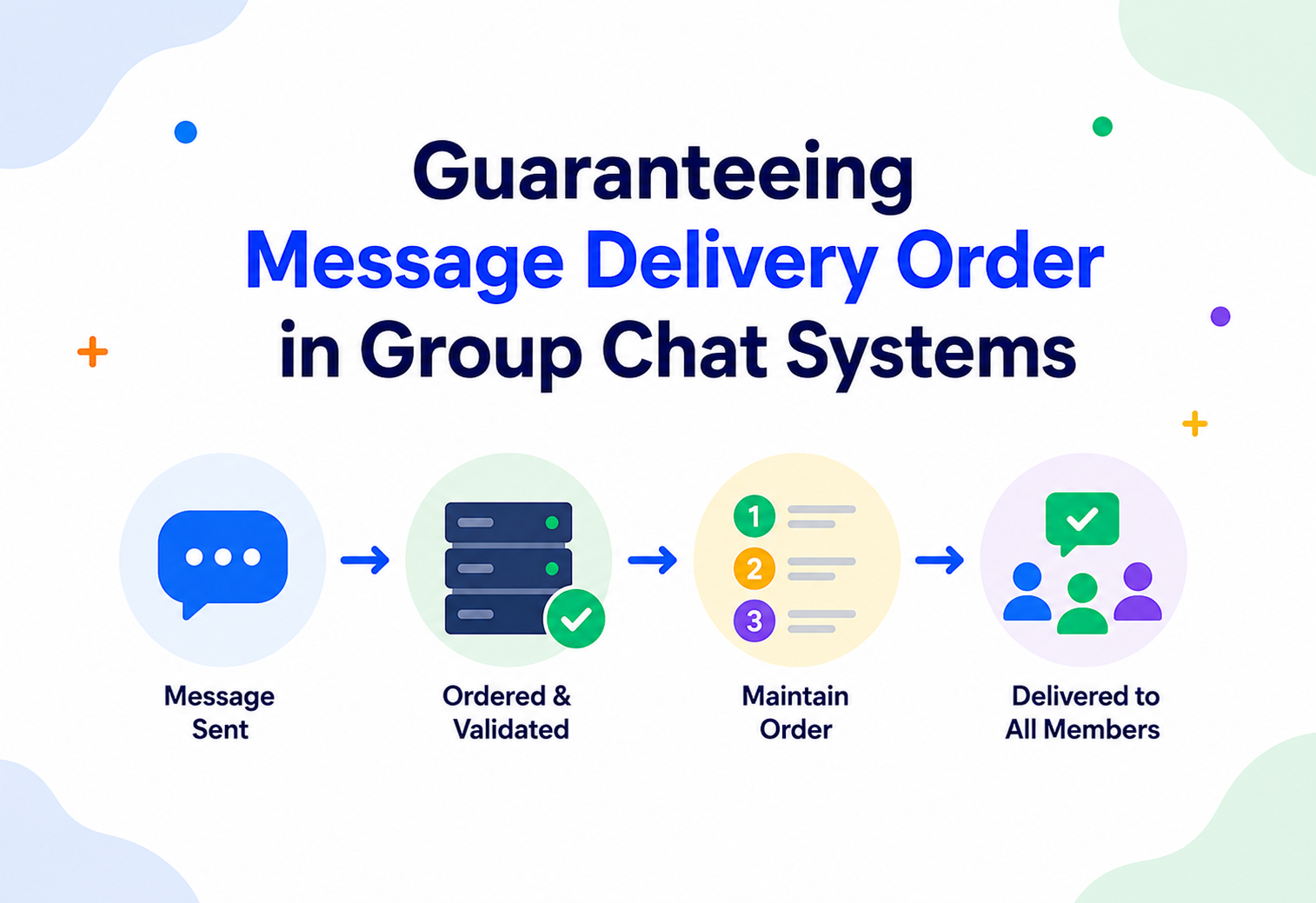
Guaranteeing Message Delivery Order in Group Chat Systems
A production-grade, interview-focused deep dive into how systems like WhatsApp, Slack, Discord and Messenger make sure every participant in a group sees messages in the same, correct order — even when senders are on flaky networks scattered across the globe.
Introduction and History of the Ordering Problem
Imagine three friends — Alice, Bob, and Carol — sitting in a group chat. Alice types “Are we still meeting at 5?” Bob replies “Yes!” a second later. But because Bob’s phone is on a fast Wi-Fi network while Alice’s message got stuck on a slow cellular tower for two seconds, the server might actually receive Bob’s cheerful “Yes!” before it receives Alice’s question. If the server naively forwards messages to everyone in the order it happens to receive them, some group members will see Bob answering a question that has not yet been asked. That is confusing at three people, and at scale — with millions of groups and billions of messages a day — it slowly erodes trust in the product itself.
This is the message ordering problem, and it lives right at the intersection of distributed systems theory and everyday product experience. It is not unique to chat — the same class of problem shows up in collaborative document editing (Google Docs), multiplayer games, distributed databases, and event-driven microservices — but group chat is one of the clearest, most relatable examples, because everyone has felt the low-grade dread of an out-of-order conversation at some point.
1.1 A Brief History
Early chat systems (IRC in the late 1980s) sidestepped the ordering problem almost entirely: a single IRC server handled a channel, so the server’s own receive order was the only order that mattered — no real distributed ordering problem existed. As chat systems grew into globally distributed products serving hundreds of millions of users (Google Talk / XMPP federation in the 2000s, then WhatsApp, Facebook Messenger, Slack, and Discord in the 2010s), a single server could no longer handle either the load or the geographic spread. Companies had to shard chat traffic across many data centers and servers, which reintroduced — at massive scale — the exact ordering problem that distributed systems researchers had been studying since the 1970s.
The theoretical foundation actually predates modern chat apps by decades. Leslie Lamport’s 1978 paper “Time, Clocks, and the Ordering of Events in a Distributed System” introduced logical clocks and the “happens-before” relationship — the bedrock idea that in a distributed system, you cannot trust wall-clock time to order events, but you can derive a consistent logical order from the causal relationships between them. Vector clocks (Fidge and Mattern, 1988) extended this to detect concurrent (non-causally-related) events. Modern chat platforms are, in effect, applied distributed-systems research wrapped in a friendly, animated UI.

1.2 A Short Timeline of the Ordering Problem
1978 — Lamport Logical Clocks
The foundational paper defines “happens-before” and gives distributed systems their first principled way to order events without a shared wall clock.
1988 — Vector Clocks
Fidge and Mattern independently introduce vector clocks, letting the system distinguish true causality from mere coincidence.
1988-1990s — IRC and Single-Server Chat
Early chat systems dodge the distributed-ordering problem entirely by pinning a whole channel to a single server whose arrival order is authoritative.
2000s — XMPP and Federated Chat
Google Talk and similar federated systems bring ordering back as a genuine cross-server problem, but at a scale still tractable per-conversation.
2010s — Planetary-Scale Sharded Chat
WhatsApp, Messenger, Slack and Discord force per-conversation sharded sequencers, replicated logs and consensus protocols to survive geographic sharding at billions of messages a day.
- Why can’t we just use the server’s arrival timestamp to order messages? (Because network delay, retries, and clock skew make arrival order unreliable and not causally meaningful.)
- Why is this harder in a group chat than a 1:1 chat? (More senders means more possible interleavings and a higher chance of concurrent sends colliding.)
- Is this the same problem as database replication ordering? (Conceptually yes — both are instances of the total-order or causal-order broadcast problem in distributed systems.)
1.3 Why the Problem Feels So Small But Actually Is Not
To a first-time reader it can feel almost silly that “getting messages in the right order” is worth an entire system-design tutorial — surely, the intuition goes, we just sort by timestamp and move on. That intuition breaks the moment you accept two facts about the real world: no two devices ever share a perfectly synchronized clock, and no two packets ever traverse the internet in a guaranteed, predictable order. Once those assumptions are stripped away, ordering stops being a sort operation and starts being a coordination problem — how do independent components, spread across the planet, all agree on the same sequence of events without ever asking one another in real time? That is the same question distributed databases, financial ledgers, and multiplayer game engines have to answer, and it is the reason chat systems, of all things, sit on decades of dense theoretical research.
Architecture and Core Components
Before diving into algorithms, it helps to see the full system end to end. At a high level, a production-grade ordered group chat platform has a well-defined layering that separates connection concerns from ordering concerns from delivery concerns.
| Component | Responsibility |
|---|---|
| Client Apps | Mobile / web apps that compose messages, maintain a local causal context, and render the final ordered timeline. |
| Edge / API Gateway | TLS termination, authentication, rate limiting, request routing to the nearest regional cluster. |
| Connection Layer | Persistent WebSocket / MQTT gateways that hold long-lived connections per device and push messages in real time. |
| Sequencer Service | Assigns a monotonically increasing, globally meaningful sequence number to each message per conversation. |
| Message Ingestion Service | Validates, deduplicates, and hands off messages to the sequencer and then to storage and fanout. |
| Fanout / Delivery Service | Delivers the ordered message stream to every online group member and queues for offline members. |
| Conversation Log Store | Append-only, ordered storage of messages per group — the source of truth for order. |
| Metadata Store | Group membership, per-user read / delivery cursors, device lists. |
| Cache Layer | Recent-message cache per conversation to serve fast reads and re-syncs without hitting the log store. |
| Push Notification Service | Wakes offline / backgrounded devices when a new message arrives. |
2.1 Component Deep Dive
API Gateway / Load Balancer. The entry point for all client connections. Handles TLS, authentication token verification, and routes clients to the geographically nearest connection layer. In a system doing millions of requests per minute, this layer must be horizontally scaled and stateless, so any instance can serve any request without carrying session-specific state that would tie a user to a specific gateway.
WebSocket Gateway (Connection Layer). Chat requires low-latency, bidirectional communication, so persistent connections (WebSocket, or MQTT for mobile-optimized battery usage) are strongly preferred over repeated HTTP polling. Each gateway node holds a large number of open connections and needs a way to know which gateway a given user’s device is currently attached to — usually tracked in a fast key-value store like Redis so that the fanout path can find and reach every online recipient in a few milliseconds.
Sequencer Service. This is the heart of the ordering guarantee. Every group (conversation) is assigned an owning sequencer — a logical, sometimes physically sharded, authority that hands out strictly increasing sequence numbers for that conversation only. Because ordering only needs to be consistent within a conversation, not across all conversations globally, the sequencer can be sharded by conversation ID, which is what makes this whole approach scale to billions of concurrent conversations.
Conversation Log. An append-only log (conceptually similar to a partition in Apache Kafka) that stores messages for a conversation in sequencer-assigned order. This log is the durable source of truth — clients resynchronize against it after being offline, and every other subsystem treats what is written here as authoritative.
Fanout Service. Once a message has been durably ordered and stored, the fanout service delivers it to every group member’s active connections, in that same order. For very large groups (broadcast channels with thousands or millions of members), fanout is often done via a fan-out-on-write or fan-out-on-read hybrid strategy, discussed in detail in Chapter 6.
- Why shard the sequencer by conversation instead of having one global sequencer? (A single global sequencer becomes a bottleneck and single point of failure at scale; ordering is only required within a conversation, so sharding by conversation ID gives independent, parallel scalability.)
- What happens if the sequencer for a conversation goes down? (Discussed under High Availability — typically a leader-election / replicated log approach like Raft ensures a new sequencer leader takes over within a bounded time window.)
Internal Working: Clocks, Sequencers and Causal Order
There are three broad strategies used in production systems to establish message order. Real systems typically combine two or three of them rather than pick just one, because each has strengths the others lack.
3.1 Server-Assigned Total Order (Sequencer-Based)
The simplest and most widely used approach: designate one authoritative component per conversation to assign a strictly increasing integer (a sequence number, sometimes called a logical offset) to every message the moment it is durably accepted. All clients then render messages sorted by this sequence number, not by when they personally received them, and not by any embedded client timestamp that a device could have manipulated.
This is called total order broadcast (also “atomic broadcast”) in distributed systems literature: it guarantees that (a) every correct recipient delivers the same set of messages, and (b) every correct recipient delivers them in the exact same order. It deliberately does not try to match “real-world” wall-clock send time — it just needs to be consistent everywhere and, ideally, to respect causality (see 3.3).
A pure sequencer only guarantees a consistent order across all recipients — it does not automatically guarantee the order matches human intent (Bob’s reply still appears before Alice’s question in the example above, because Bob’s message reached the sequencer first). Products handle this UX problem differently: some show a “replying to” reference (quote-reply) so causality is explicit regardless of position; others accept the small inconsistency as a rare, low-stakes UX cost given how much simpler and faster a pure sequencer is compared to enforcing full causal order.
3.2 Logical Clocks (Lamport Timestamps)
A Lamport clock is a simple counter each client and server maintains locally. The rule: whenever you send a message, increment your counter and attach it. Whenever you receive a message, set your local counter to max(local_counter, received_counter) + 1. This produces a “happens-before” partial order: if message A causally influenced message B (e.g., B is a reply to A), the Lamport timestamp of B is guaranteed to be greater than A’s. However, Lamport clocks alone cannot distinguish true causality from coincidence — two unrelated (concurrent) messages can still get comparable timestamps that do not reflect real-world causal relationships, and a total order still needs an external tie-breaker (like server sequence number or sender ID) for messages with equal logical time.
3.3 Vector Clocks and Causal Ordering
Vector clocks extend Lamport clocks so the system can precisely tell whether two events are causally related or truly concurrent. Each participant maintains a vector (array) of counters, one slot per participant. On sending, a participant increments its own slot; the whole vector is attached to the message. On receiving, the recipient takes the element-wise maximum of its local vector and the received vector, then increments its own slot.
Two messages A and B (with vectors V(A), V(B)) are causally ordered if one vector is “less than or equal to” the other in every position (with at least one strictly less). If neither dominates the other, the events are concurrent — meaning no causal relationship exists, and the system is free to display them in either order without violating correctness (this is exactly Bob’s “Yes!” versus Alice’s question if they were truly unrelated).
- Alice sends M1: vector =
[A:1, B:0, C:0] - Bob sends M2 (has not seen M1 yet): vector =
[A:0, B:1, C:0]— concurrent with M1 - Carol replies to M1 after receiving it: vector =
[A:1, B:0, C:1]— causally after M1, concurrent with M2
The system can now correctly render M1 and M2 in any relative order (both are valid), but Carol’s reply must always render after M1 specifically, wherever M2 lands.
- What’s the difference between Lamport clocks and vector clocks? (Lamport clocks give a total order consistent with causality but cannot detect concurrency; vector clocks can detect true concurrency but cost O(n) space per message where n is the number of participants.)
- Why don’t large-scale chat systems use pure vector clocks for million-member broadcast channels? (The vector grows with the number of participants, which is untenable for huge groups — production systems favor a hybrid: server sequencer for total order + causal metadata like “reply-to” pointers for explicit causal links, rather than full vector clocks.)
- How would CRDTs relate to this problem? (Conflict-free Replicated Data Types can merge concurrent updates deterministically without a central sequencer — useful for offline-first collaborative editing, and conceptually related, though most chat apps still prefer a server sequencer because a single readable timeline is a hard product requirement, not just eventual consistency.)
3.4 Hybrid Logical Clocks (HLC)
A pragmatic middle ground used in several modern distributed databases (CockroachDB, MongoDB) and directly applicable to chat: Hybrid Logical Clocks combine a physical wall-clock component with a logical counter. This gives timestamps that are close to real time (useful for humans reading “sent 2 minutes ago”) while still preserving the causality guarantee of Lamport clocks. Many chat systems use something conceptually similar in production: a server-assigned sequence number for strict ordering, plus a wall-clock timestamp purely for display purposes, with the understanding that the two need to disagree gracefully rather than fight each other.
Data Flow and Message Lifecycle
Walking through the full lifecycle of a single group message clarifies how all the pieces from Chapters 2 and 3 fit together in practice.
- Compose: The client generates a temporary local ID (often a UUID) so the message can render optimistically in the sender’s own UI before server confirmation.
- Transmit: The message, along with the client’s last-known causal context (e.g., “reply-to” message ID, or the last sequence number the client has seen for this conversation), is sent over the persistent connection.
- Deduplicate: Mobile networks retry aggressively. The ingestion service checks an idempotency cache (client-generated message ID) to avoid double-sequencing a retried message.
- Sequence: The sequencer for that conversation assigns the next strictly increasing sequence number.
- Persist: The message, with its final sequence number, is appended to the durable conversation log. This step is the linearization point — the moment order becomes fixed and durable.
- Fan out: The fanout service delivers to every online member’s connection(s), in log order, and enqueues for offline members.
- Reconcile: The original sender’s client swaps its optimistic temp ID for the authoritative server sequence number, so the UI does not show a duplicate.
- Sync on reconnect: A device that was offline requests “everything after sequence N” and replays the log gap in the correct order — this is the same pattern used for Kafka consumer offsets.
An append-only log gives you order “for free” as a structural property — position in the log is the order — rather than something you must separately compute and enforce on every read. It also makes replay/resync trivial: a client just asks for everything after its last known offset.
Advantages, Disadvantages and Trade-offs
Every ordering approach involves engineering trade-offs. A strong design does not pretend those trade-offs do not exist — it names them clearly and picks the ones the product can genuinely absorb.

| Approach | Advantages | Disadvantages |
|---|---|---|
| Server sequencer (total order) | Simple mental model; strong consistency; easy client implementation; matches product need for one canonical timeline. | Sequencer is a potential bottleneck / hot spot for very active conversations; requires careful HA design to avoid a single point of failure. |
| Pure Lamport clocks | Fully decentralized; no single point of failure for ordering. | No true concurrency detection; still needs tie-breaking for a final total order; harder to reason about for engineers new to the system. |
| Vector clocks | Precisely distinguishes causal versus concurrent events; strong theoretical guarantees. | O(n) metadata per message; impractical for large groups / broadcast channels; added client complexity. |
| Client wall-clock timestamp only | Trivial to implement. | Clock skew across devices makes this unreliable and exploitable (a user could manually change device time); not recommended for correctness-critical ordering. |
5.1 Pros and Cons of the Sequencer-Backed Approach in Practice
Pros
- Every recipient sees an identical timeline — the strongest possible correctness posture for chat.
- Client code stays simple: sort by sequence number, done.
- Reconnect and resync collapse to a single “give me everything after offset N” call.
- Log-based storage matches the access pattern almost perfectly (append + range scan).
Cons
- The per-conversation sequencer is a coordination hotspot for viral conversations.
- Cross-region round trips to the sequencer add latency for geographically distant participants.
- A pure sequencer can display Bob’s reply before Alice’s question when networks conspire; UX has to compensate.
- Requires operational discipline around leader election, quorum health and gap detection to actually deliver on its promises.
Chapter takeaway
None of these strategies is universally “best.” Almost every production system picks a server sequencer as the backbone for its strong-consistency guarantee, then layers lightweight causal hints (reply-to references, quote replies) on top to preserve intent, and accepts client wall-clock timestamps only as a display detail with no correctness role.
- Would you ever combine multiple approaches in one system? (Yes — this is normal. Use a server sequencer for the canonical, displayed order, but carry a client-Lamport or “reply-to” pointer for causal context, e.g., to make quote-replies robust to reordering.)
- What is the trade-off between strict total order and eventual consistency? (Strict total order gives every client an identical view but requires more coordination and latency; eventual consistency scales better and tolerates partitions but can briefly show different orders on different devices before converging.)
Performance and Scalability
A system designed for millions of requests per minute needs the ordering guarantee to be cheap per message. The three techniques below — sharding, batching, and adaptive fanout — are what makes the sequencer approach scale from a whiteboard sketch into planet-scale reality.
6.1 Sharding the Sequencer by Conversation
Because ordering is only meaningful within a single conversation, the sequencer state (essentially “what is the next sequence number for conversation X”) can be partitioned across many nodes, keyed by conversation ID (often via consistent hashing). This means a busy group chat only contends with itself, not with every other conversation in the system — a crucial property for horizontal scalability that is easy to state in one sentence and non-trivial to preserve under operational load.
6.2 Batching
Rather than doing a round trip to the log store for every single message, ingestion services batch a short window (a few milliseconds) of incoming messages per conversation shard before writing, similar to how Kafka producers batch records. This dramatically increases throughput at the cost of a few milliseconds of added latency — usually an excellent trade given human typing and reading speed, and a trade that becomes strictly better as the conversation gets busier, because the batch fills faster.
6.3 Fan-out Strategy for Group Size
| Group Size | Recommended Strategy | Why |
|---|---|---|
| Small (2 – 250 members) | Fan-out-on-write: push immediately to every member’s active connections. | Low member count makes eager push cheap and gives instant delivery. |
| Large (thousands) | Hybrid: push to online members, lazily materialize for offline members on reconnect. | Avoids wasted work pushing to disconnected sessions while keeping online experience snappy. |
| Massive (broadcast channels, 100k+) | Fan-out-on-read: readers pull from the shared ordered log rather than the server pushing to each one individually. | Pushing to hundreds of thousands of sockets per message does not scale; pull-based reads let a CDN-like cache layer absorb the load. |
6.4 Caching Hot Conversations
The most recent N messages of active conversations are kept in an in-memory cache (Redis or similar) so that reconnects and read-receipts do not hit the durable log store for every request. Cold history beyond the cache window is served from the log store or a colder storage tier such as object storage, on the assumption that older reads are rarer and can tolerate slightly higher latency in exchange for meaningfully lower storage cost.
- How would you scale the sequencer if one single conversation becomes extremely hot (e.g., a viral livestream chat)? (Further shard within a single logical conversation using techniques like sequence-number ranges leased to multiple writers, or accept slightly relaxed ordering — e.g., order only within short time buckets — for that specific hot conversation, trading strict order for throughput.)
- What is the throughput ceiling of a single-sequencer-per-conversation design? (Bounded by the throughput of one coordination node — typically tens of thousands of ops/sec per shard with in-memory counters and batched persistence, which is far beyond the message rate of a normal conversation but can be a real constraint for viral scale.)
High Availability and Reliability
Because the sequencer is a potential single point of failure per conversation shard, production systems replicate it using a consensus protocol. Reliability here is not about avoiding failure — failures happen constantly — but about ensuring that no single failure ever produces an incorrect or gapped order.
7.1 Leader Election via Raft or Paxos
Each sequencer shard is really a small replicated group (e.g., 3 or 5 nodes) using Raft or a similar consensus algorithm. One node is the leader and assigns sequence numbers; followers replicate the log. If the leader fails, the remaining nodes elect a new leader within a bounded time window, and the new leader continues numbering from the last confirmed sequence number — no gaps, no duplicate numbers, because a number is only considered “confirmed” once a quorum of replicas has durably stored it.
7.2 At-Least-Once Delivery + Idempotency
Networks fail, sockets drop mid-acknowledgement, and clients retry aggressively. Rather than pursue the much harder guarantee of exactly-once network delivery, production systems accept at-least-once delivery at the transport layer and make it safe by having clients attach a stable client-generated message ID; the ingestion service deduplicates on that ID before it ever reaches the sequencer. This effectively achieves exactly-once processing semantics without needing a genuinely exactly-once network, which is a much easier engineering goal to actually deliver on in the real world.
7.3 Multi-Region Considerations
For global products, running one sequencer per conversation in a single region means users on the opposite side of the world always pay a round trip to that region for every send — acceptable for chat (tens to a couple hundred milliseconds) but a real trade-off. Alternatives like multi-region active-active sequencing exist but reintroduce more complex conflict resolution (e.g., hybrid logical clocks with region-tagged tie-breakers); most production chat systems instead pin a conversation’s sequencer to the region of its creator or its most active members and accept the added latency for the minority of geographically distant participants.
The append-only conversation log should itself be replicated across availability zones (and ideally regions) independent of the sequencer’s own replication, with periodic snapshotting so that a full region loss does not lose message history — only momentarily pauses new message ordering for affected conversations until failover completes.
- What happens to in-flight messages during a leader failover? (They are held / retried by the ingestion layer until a new leader is elected; because sequence numbers are only confirmed after quorum replication, no already-acknowledged message is lost or renumbered.)
- How do you avoid a “split-brain” where two nodes both think they are the sequencer leader? (Consensus protocols like Raft use terms / epochs and require a majority quorum to become leader, making it mathematically impossible for two nodes to simultaneously believe they hold a valid leader term.)
Security
Ordering guarantees intersect with security in a few important ways — some architectural, some cryptographic, some operational. Getting any of them wrong quietly weakens the whole system.
- Sequence number spoofing: clients must never be trusted to assign their own final sequence number — only the server-side sequencer can, otherwise a malicious client could reorder or overwrite history for other participants.
- Replay attacks: an attacker capturing an encrypted message and re-sending it later should not be able to insert it out of context. Idempotency keys plus authenticated encryption (each message signed / encrypted in a way that ties it to sender, conversation, and a monotonic counter) prevent this.
- End-to-end encryption interaction: in E2EE systems (like WhatsApp’s Signal-protocol-based encryption), the server can still assign an opaque sequence number to the encrypted blob without needing to see the plaintext — ordering and encryption are largely orthogonal concerns, which is an important design insight.
- Denial of service on the sequencer: because the sequencer is a coordination hotspot, it must be protected by strict per-user / per-conversation rate limiting at the ingestion layer to prevent a single abusive client from starving other conversations sharing infrastructure.
- Tampering with causal metadata: “reply-to” references and client-supplied logical clocks should be treated as untrusted hints for UX, not as authoritative security or ordering data — the server-assigned sequence number remains the single source of truth.
A sequence number tells you when something happened relative to other messages in the same conversation. It says nothing about whether the sender was allowed to say it in the first place. Membership checks, admin permissions and rate limits belong to their own dedicated services, and none of them should be inferred from the sequence stream alone.
- Can end-to-end encryption coexist with server-side message ordering? (Yes — the server only needs to see enough metadata, like conversation ID and a client message ID, to sequence and route the message; the payload itself can remain opaque ciphertext.)
Monitoring, Logging and Metrics
Ordering correctness is invisible when it works and highly visible (as user complaints) when it breaks, so proactive monitoring matters more here than in most other subsystems.
| Metric | Why it matters |
|---|---|
| Sequencer assignment latency (p50 / p95 / p99) | Directly impacts perceived message send latency; p99 spikes often indicate contention or GC pauses on a hot shard. |
| Sequence gap detection rate | Counts cases where a client observes a missing sequence number, signaling potential delivery bugs or network partition effects. |
| Fanout delivery latency | Time from “message durably ordered” to “delivered to each online recipient” — the core real-time UX metric. |
| Leader election frequency | Frequent elections indicate an unstable sequencer replica group, often due to network flakiness between nodes rather than node-level failure. |
| Out-of-order client render events | Client-side telemetry when a UI actually had to reorder messages after initial render — a proxy for real user-facing pain. |
| Idempotency cache hit rate | High rates indicate excessive client retries, often a signal of underlying network or connection instability upstream of the ordering path itself. |
Distributed tracing (e.g., OpenTelemetry spans correlated by a message’s client-generated ID) across ingestion → sequencer → log → fanout is essential for debugging ordering anomalies, since the failure could originate in any of these hops. Structured logs should always include conversation ID, assigned sequence number, and client message ID together, so any specific ordering complaint can be reconstructed precisely from log correlation later.
Set alerts on the ratio of gap-detection events to total delivery events, not on the absolute count — absolute count grows with product usage and drowns real regressions in ambient noise, while the ratio stays flat under healthy conditions regardless of scale.
Deployment and Cloud Architecture
A typical cloud deployment separates the system into independently scalable tiers, each with its own operational rhythm and its own failure blast radius.
- Connection layer deployed across many availability zones and regions, auto-scaled on active connection count (not just CPU, since holding idle WebSocket connections is memory-bound, not CPU-bound).
- Sequencer replica groups deployed as stateful sets (e.g., Kubernetes StatefulSets) with anti-affinity rules ensuring replicas of the same shard never land on the same physical host or, ideally, the same availability zone.
- Conversation log store often built on a distributed log system (Kafka-like) or a purpose-built append-only store, deployed with multi-AZ replication and regular cold snapshots to object storage (e.g., S3) for long-term retention and disaster recovery.
- Canary and blue-green deployments for the ingestion and sequencer services are critical — a bad deploy to the ordering-critical path should be rolled out to a small percentage of shards first, with automated rollback triggered by sequence-gap or latency-spike alarms.
| Readiness gate | Why include it in the deploy checklist |
|---|---|
| Automated rollback on sequence-gap alarm | Ordering regressions must roll back automatically — humans in the loop are too slow at chat scale. |
| Canary shard subset for every deploy | Blast radius of a bad deploy is capped at the canary shards, never the whole fleet. |
| Cross-region replication lag SLO | Failover assumes lag is bounded; without an SLO on it, DR promises are aspirational. |
| Load test at typical hot-conversation rate | Averaged traffic is easy; the hard case is one viral conversation, and it should be tested for. |
Databases, Caching and Load Balancing
Storage, cache and load-balancing choices interact tightly with the ordering guarantee — picking the wrong ones does not merely slow the system down, it can quietly weaken correctness.
11.1 Storage Choice for the Conversation Log
The conversation log’s access pattern is almost purely append-and-sequential-read, which makes log-structured storage engines (LSM-trees, as used in Cassandra, RocksDB, or purpose-built systems) a natural fit — they are optimized for high write throughput and range scans by key, exactly matching “give me everything after sequence N for conversation X.”
11.2 Partitioning
The log is partitioned by conversation ID, so a given conversation’s messages always live on the same partition (and thus the same physical nodes as its sequencer, ideally, to minimize cross-node coordination latency). This is a form of data locality that keeps the “assign sequence number → persist” path fast even under heavy load.
11.3 Caching
A write-through cache (Redis or similar) holds the most recent messages per active conversation. Reads for “catch me up” on reconnect first check the cache, falling back to the log store for older history — a classic cache-aside / read-through pattern that keeps the hot path fast and the log store’s load predictable and easy to capacity-plan.
11.4 Load Balancing
Connection-layer load balancing must be connection-aware (sticky), since WebSocket connections are long-lived — a standard round-robin L7 load balancer works for the initial handshake, but the gateway a device lands on is then tracked in a fast registry (e.g., “user X, device Y → gateway node Z”) so the fanout service knows exactly where to push new messages without having to broadcast blindly across the fleet.
- Why not just use a relational database with an auto-increment column for message order? (An auto-increment column on a single relational database works fine at small scale but becomes a write bottleneck and single point of failure at large scale; a sharded, replicated log-structured design decouples ordering scalability from any single database’s throughput ceiling.)
APIs and Microservices
The system is naturally decomposed into microservices with clear boundaries. The boundaries themselves are what make the ordering property survive individual service failures and rewrites.
- Ingestion API — accepts new messages, owns deduplication, is the first line of rate limiting and validation.
- Sequencer API — internal-only service exposing
getNextSequence(conversationId), replicated per shard, protected from the public internet by network policy. - Log Store API — internal append / read interface, exposing offset-based reads similar to a Kafka consumer API.
- Fanout API — subscribes to newly appended log entries and pushes to the connection layer.
- Membership / Metadata Service — owns group membership, read cursors, and device registration, queried by fanout to know who should receive a given message.
These services communicate internally via an event-driven backbone (the log itself often doubles as the event bus — fanout is simply another consumer of the same ordered stream that persistence writes to), which decouples the write path (ingestion → sequencer → log) from the read / delivery path (log → fanout → clients) and lets each scale independently. That decoupling is not merely a nicety — it is the reason a slow recipient can never delay a fast sender, and the reason the read path can be scaled without ever touching the write path.
Design Patterns and Anti-Patterns
The patterns worth applying, and the ones worth explicitly avoiding, in an ordered group chat system.
13.1 Patterns to Use
- Total Order Broadcast / Atomic Broadcast — the core pattern underlying the sequencer approach.
- Event Sourcing — treating the conversation as an append-only sequence of events (messages) that clients replay / project into a UI state, rather than mutable shared state.
- Sharding by Aggregate Root — sharding the sequencer and log by conversation ID (the natural “aggregate root” of a chat) so ordering coordination never crosses shard boundaries unnecessarily.
- Idempotent Receiver — deduplicating retried requests using a client-supplied idempotency key before they reach ordering-critical logic.
- CQRS (Command Query Responsibility Segregation) — separating the write path (ingest + sequence + persist) from the read path (cache-backed fanout / history queries), letting each be optimized independently.
13.2 Anti-Patterns to Avoid
- Trusting client wall-clock timestamps for ordering. Clock skew and manual clock changes make this unreliable and, in security terms, unauthenticated data from an untrusted source.
- One global sequencer for all conversations. Creates an unnecessary single bottleneck; always shard by conversation.
- Synchronous fanout on the critical write path. Blocking message persistence on delivery to every recipient (especially in large groups) couples write latency to the slowest recipient’s connection; persistence and fanout should be decoupled stages.
- Silent gap-swallowing on the client. If a client detects a sequence gap (e.g., missed message 105 between 104 and 106) and just ignores it instead of re-syncing, users silently lose messages — always trigger an explicit re-sync on gap detection.
- Conflating “delivered” with “ordered.” A message can be durably ordered in the log before it is actually delivered to a given device; conflating the two makes reasoning about offline / reconnect scenarios much harder than it needs to be.
Best Practices and Common Mistakes
Practical wisdom that separates a system that works in a demo from one that works on a bad Monday morning during a partial outage.
14.1 Best Practices
- Always give clients a way to detect missing sequence numbers and resynchronize explicitly, rather than assuming delivery is guaranteed by the transport alone.
- Keep the sequencer’s job as narrow as possible (just “assign the next number, durably”), pushing everything else — validation, content moderation, rich-text processing — to earlier or later pipeline stages so the ordering-critical path stays fast and simple.
- Use idempotency keys generated client-side (not server-side) so retries across network failures are still recognized as duplicates.
- Decouple persistence from fanout so that a slow or disconnected recipient never adds latency to the sender’s “message sent” confirmation.
- Version your causal metadata format (reply-to references, client logical clocks) so you can evolve the ordering algorithm without breaking older app versions still in the field.
14.2 Common Mistakes
- Assuming “the server received it first” is the same as “it happened first” — network jitter routinely reorders arrival relative to true send time.
- Under-provisioning the sequencer replica group’s network links, which are what leader-election stability actually depends on — CPU and disk are rarely the bottleneck here, network reliability between replicas is.
- Forgetting that mobile clients reconnect frequently (app backgrounding, network switches) and must always be able to cheaply ask “what did I miss since offset N,” not just “give me everything.”
- Testing ordering logic only under ideal network conditions — production-grade testing must inject latency, packet loss, and reordering (chaos engineering) to validate the guarantees actually hold.
| Pre-launch checklist | Why it belongs on every launch |
|---|---|
| Chaos test with injected packet reorder | The whole system exists to survive reordering — validate under it, not against a clean network. |
| Sequence-gap alerting wired to on-call | Silent gaps are the worst-case customer experience; they should be the loudest alarm you have. |
| Rehearsed sequencer failover drill | Failover works on paper. Rehearsal is what proves it works during a 3 AM incident. |
| Client backward-compat matrix | Old app versions live in the field for years; the ordering wire format must survive them. |
| Load test at viral-conversation scale | Averages hide the case that actually breaks — the single hot conversation. |
Real-World Industry Examples
The theory becomes much easier to trust once you see the same core pattern turn up, over and over again, in the systems already running at planetary scale.
WhatsApp — Sequencer + Per-Chat Ordering
WhatsApp (built on a heavily modified Erlang / FreeBSD stack) assigns each message a server-side ID that establishes order within a chat, while end-to-end encrypting message content using the Signal protocol. The server never needs to see plaintext to correctly sequence and route messages — a clean separation of the ordering concern from the confidentiality concern.
Slack — Channel-Based Ordering + Client Reconciliation
Slack messages carry a server-assigned timestamp-derived ID unique and ordered within a channel. Because Slack channels can have long-lived, high-volume history, the client aggressively caches and only requests deltas (“history since my last known message ID”) on reconnect, closely mirroring the offset-based resync pattern described throughout this tutorial.
Discord — Snowflake IDs
Discord (and originally Twitter, which popularized the pattern) uses “Snowflake” IDs: 64-bit identifiers that embed a timestamp, a worker / shard ID, and a per-shard sequence counter, all generated without central coordination for every single ID. This gives IDs that are k-sortable (roughly time-ordered) and globally unique across a massively sharded system, without needing a single bottlenecked sequencer — a clever engineering trade-off between strict per-shard ordering and system-wide scalability.
Meta / Facebook Messenger — Iris and Sequential IDs
Messenger’s backend (known internally by names like “Iris” in various public engineering write-ups) assigns each message an incrementing sequence ID per thread, stored in a durable, replicated log, closely matching the sequencer-plus-append-only-log architecture described throughout this tutorial, and used specifically to let clients reliably compute “what have I missed” after being offline.
Apache Kafka — the Underlying Pattern
Kafka’s core abstraction — a partitioned, append-only log where each partition guarantees total order of its own messages and consumers track their position via an offset — is architecturally almost identical to what a well-designed group-chat ordering system needs per conversation. Many chat companies either build directly on Kafka-like systems or on custom stores inspired by the same design.
Collaborative Editing (Google Docs, Figma)
Real-time collaborative editors do not usually use a single sequencer; instead they lean on operational transforms or CRDTs to merge concurrent edits deterministically. That is a different point on the trade-off curve than chat — more concurrency-friendly, at the cost of a much more complex client — and it is a useful contrast when reasoning about why chat systems continue to prefer server sequencers.
Frequently Asked Questions
The questions that come up most often in interviews and internal reviews for this class of system.
No. In practice, most production chat systems rely on a single server-assigned total order (sequence number) per conversation and layer lightweight causal hints (like reply-to references) on top, rather than full vector clocks, because vector clocks scale poorly with group size.
This should be structurally impossible if the sequencer is correctly implemented as a single authority (or a properly replicated quorum) per conversation shard — the whole point of the design is to make sequence number collisions unrepresentable, not just unlikely. Any occurrence indicates a serious bug and should trigger high-severity alerting.
Only if that database is the single source of truth for that conversation and is not sharded in a way that breaks the auto-increment’s monotonicity guarantee across shards; for high-scale systems, a dedicated sequencer decoupled from general-purpose database internals gives more control and better scaling properties.
The device stores the last sequence number it successfully processed per conversation and, on reconnect, requests everything strictly after that offset from the log store, applying it in order — identical in spirit to how a Kafka consumer resumes from its last committed offset.
Many products intentionally tolerate brief inconsistency (e.g., two devices momentarily showing slightly different orderings of concurrent messages) in exchange for lower latency and higher availability, converging to the same final order shortly after. Whether strict or eventual consistency is appropriate is a product decision as much as a technical one.

Summary and Key Takeaways
A compact summary of the design and the ideas most worth carrying forward into an interview, a design review, or a real-world implementation.
The core mental model
An ordered group chat system is, at its core, a partitioned total-order broadcast pipeline: one lightweight sequencer per conversation, backed by an append-only replicated log, feeding a fanout stage that delivers the ordered stream to every recipient. Everything else in the architecture — caching, connection stickiness, push notifications, cross-region replication — is in service of making that core loop cheap, reliable, and observable at planetary scale.
Key takeaways to carry into an interview
- Message order in group chat cannot be safely determined by network arrival time or client wall-clock timestamps alone, because network delay and clock skew break both.
- A server-side sequencer, sharded per conversation, assigning strictly increasing sequence numbers, is the industry-standard foundation for guaranteeing a consistent order across all recipients — a specific case of the classic total order broadcast problem from distributed systems theory.
- Lamport clocks and vector clocks provide the theoretical vocabulary for reasoning about causality versus concurrency, but full vector clocks are rarely used directly at chat scale due to their per-participant overhead; lightweight causal hints (reply-to references) are the common practical substitute.
- An append-only conversation log, replicated via consensus (e.g., Raft) for high availability, makes ordering a structural property of storage rather than something recomputed on every read, and makes offline resync straightforward via offset-based catch-up.
- Scalability comes from sharding the sequencer and log by conversation ID, decoupling the write path (ingest → sequence → persist) from the read / delivery path (fanout), and choosing fan-out-on-write versus fan-out-on-read based on group size.
- Security, monitoring, and multi-region deployment all interact with the ordering design — sequence numbers must be server-authoritative and unspoofable, gaps must be detectable and observable, and cross-region latency trade-offs must be made deliberately.
- Real systems like WhatsApp, Slack, Discord, and Messenger all converge on variations of the same core pattern — a sharded, replicated, append-only ordered log — validating it as the proven, production-grade solution to this problem.
The best ordered chat systems disappear from the user’s awareness entirely: conversations feel natural, messages appear where humans expect them, and the underlying machinery of sequencers, quorums and replicated logs is completely invisible. That invisibility is not an accident — it is the direct result of taking distributed-systems fundamentals seriously enough that the product never has to apologize for the physics of the internet.