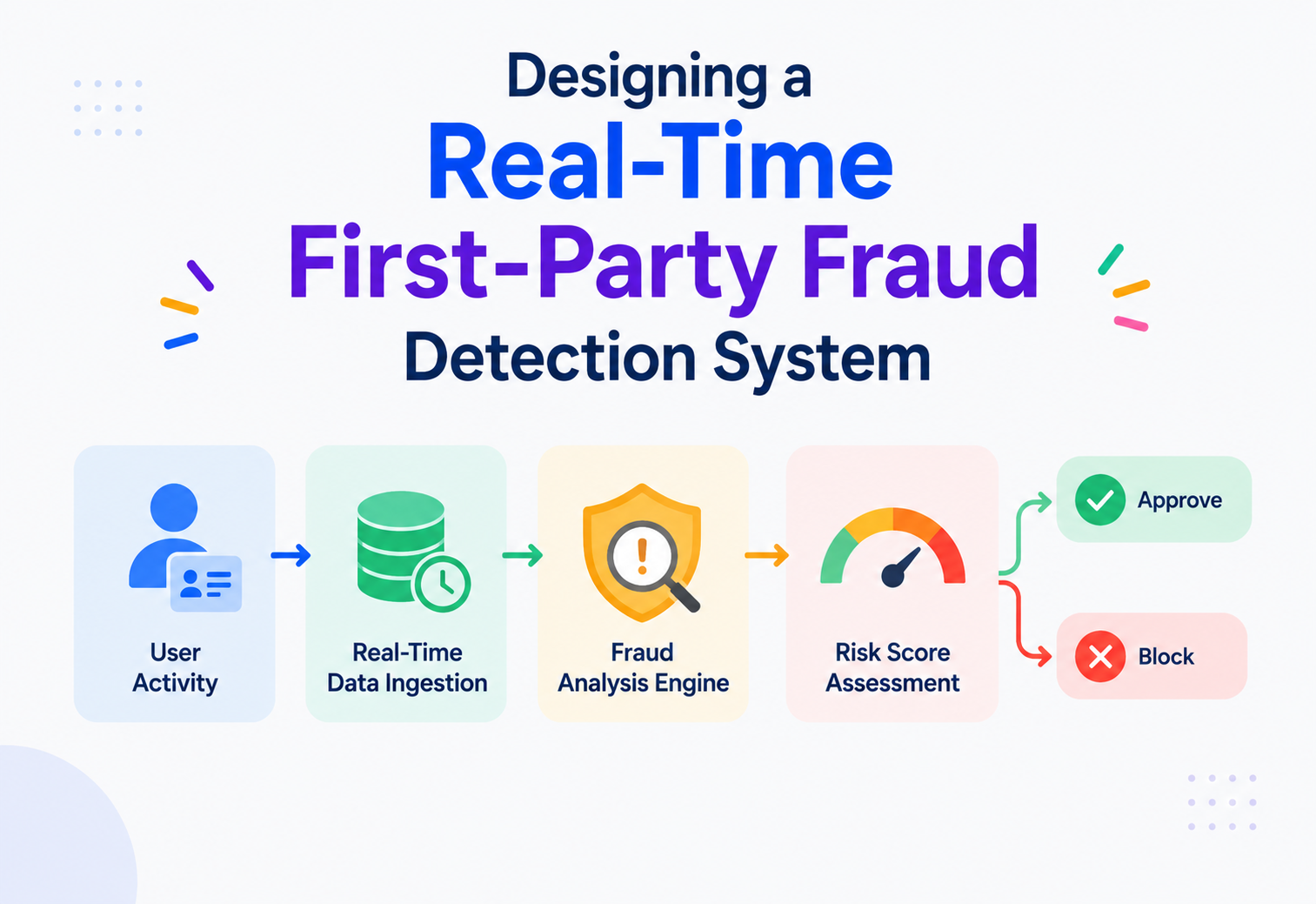
Designing a Real-Time First-Party Fraud Detection System
A complete, interview-depth system-design walkthrough for building a platform that spots customers who open accounts with real intent to use them — and then quietly plan to default, abuse promotions, or exploit credit — before that intent turns into loss.
Introduction & History
When people hear the word “fraud” in banking, they usually picture someone stealing another person’s identity — forging a passport, hijacking an email account, or using a stolen credit card number bought on a dark-web forum. That is third-party fraud, and most fraud systems built in the 2000s and 2010s were designed almost entirely around catching it. But there is a second, quieter category of fraud that has grown enormously as digital banking, buy-now-pay-later (BNPL), and instant-credit products have spread: first-party fraud.
First-party fraud happens when the person opening the account is exactly who they say they are. There is no stolen identity, no forged document, no synthetic Social Security number. A real person, using their real name and real details, opens an account with a bank, a lending app, or an e-commerce platform — and from day one, or after building some trust, they plan to exploit the relationship. This might mean maxing out a credit line and never repaying it, opening ten accounts to claim ten separate sign-up bonuses, disputing legitimate transactions to get free goods (friendly fraud / chargeback abuse), or slowly building a good repayment history only to “bust out” with a huge loan they never intend to pay back.
This type of fraud is genuinely hard to catch, for a reason that trips up a lot of engineers building their first fraud system: every classic identity-verification signal passes. The KYC checks pass. Document verification passes. Face-match passes. The person is real. The fraud is not in who they are — it is in what they intend to do, and intent has to be inferred from patterns of behavior over time, not from a single document check at signup.
Historically, banks handled this with manual underwriting and slow, batch-based credit-bureau checks — a loan officer reviewing an application over days, or a nightly batch job flagging suspicious accounts after the damage was already done. As digital lending and neobanks scaled to millions of new accounts a month, and as promotional abuse became a genuine drain on marketing budgets, the industry shifted toward real-time, streaming, machine-learning-driven fraud platforms that score risk continuously — at signup, at every transaction, and at every credit-line change — instead of once at onboarding.
This tutorial walks through how to design such a system from the ground up: the architecture, the data pipelines, the machine-learning and rules layers, the databases, the scaling strategy for millions of events per minute, and the trade-offs a Staff / Principal engineer would be expected to reason about in a system-design interview.
1.1 Why This Problem Has Become Central
It is worth pausing on why this problem has become so much more central to fintech engineering over the last decade. Three forces converged: first, the shift from in-branch, relationship-based lending to fully digital, app-based onboarding removed the human judgment layer that used to catch “something feels off about this applicant” even when documents checked out. Second, instant credit and BNPL products compressed the underwriting decision from days down to seconds, which meant fraud teams no longer had the luxury of a multi-day review window to observe early behavior before extending real credit. Third, the rise of large-scale promotional and referral marketing — sign-up bonuses, cash-back offers, zero-interest introductory periods — created a direct financial incentive for otherwise ordinary people to game systems that were originally designed assuming good faith. Together, these forces mean that a modern fraud platform cannot be a single “verify identity, then trust forever” gate; it has to be a continuously running, learning system embedded throughout the entire customer relationship.
1.2 A Brief Timeline
Batch, manual underwriting era
Loan officers reviewed applications over days; nightly batch jobs flagged suspicious accounts long after damage was done. Fraud systems overwhelmingly focused on third-party identity theft, not intent.
Digital-first onboarding at scale
Neobanks and digital lenders removed the human-in-the-loop check that used to catch “something feels off” even when documents were valid. Onboarding volume exploded; observation windows shrank.
Instant credit & BNPL
Underwriting decisions compressed from days to seconds. Fraud teams lost the multi-day observation window and needed to reason about intent at the moment of application.
Promotional-abuse epidemic
Sign-up bonuses, referral cash, and zero-interest offers created direct financial incentives for otherwise ordinary users to game systems designed around good faith.
Continuous-scoring ML platforms
The industry converges on streaming, hybrid rules-plus-ML fraud platforms that re-score every meaningful event over an account’s lifetime rather than only at signup.
- Explain, in one paragraph, why classic KYC and document-verification signals are structurally insufficient for first-party fraud.
- Name three market forces from the last decade that made continuous-scoring fraud platforms necessary.
- Why does compressing underwriting to seconds fundamentally change the fraud-detection architecture, not just the latency budget?
Understanding First-Party Fraud Deeply
Before drawing a single box on an architecture diagram, it is worth being precise about what we are actually trying to detect — because the precision of the problem definition drives almost every downstream design decision.
2.1 The Core Distinction: Identity Fraud vs. Intent Fraud
| Dimension | Third-Party (Identity) Fraud | First-Party (Intent) Fraud |
|---|---|---|
| Who is applying? | An impostor using someone else’s stolen identity | The real, genuine account holder |
| What fails? | Identity verification, document authenticity, biometric match | Nothing — identity checks pass cleanly |
| When is it detectable? | Often at onboarding, via document / liveness checks | Usually only through behavior over days, weeks, or months |
| Victim | The person whose identity was stolen, plus the institution | Only the institution — the “victim” and the “fraudster” are the same person |
| Primary detection method | Document forensics, device / IP reputation, biometrics | Behavioral analytics, network / graph analysis, credit-trajectory modeling |
2.2 Common Patterns of First-Party Fraud
Bust-out fraud
A customer builds a clean credit history for months — paying small balances on time — specifically to earn credit-limit increases, then suddenly maxes out every available line across cards and loans and disappears. The most damaging and hardest-to-catch pattern because the early behavior looks genuinely good.
Promotional / bonus abuse
A person creates multiple accounts (using different but real emails, phone numbers, or minor identity variants) to repeatedly claim sign-up bonuses, referral rewards, or promotional interest rates meant for one-time use per person.
Friendly fraud / chargeback abuse
A genuine cardholder makes a purchase, receives the goods or service, and then disputes the charge with their bank claiming it was unauthorized or the goods never arrived — getting a refund while keeping the product.
Never-pay / soft-default intent
A customer opens a BNPL plan or personal loan with the plan of never making the first payment, betting that the collections process is slow, costly, or unlikely to pursue small amounts aggressively.
Application manipulation
Genuine individuals slightly misstate income, employment, or existing debt to qualify for larger credit lines than they can realistically service — not identity fraud, but material misrepresentation.
“How would you distinguish a customer who is genuinely in financial hardship from one who intended to default from day one?” A strong answer talks about trajectory: genuine hardship shows a sudden behavioral inflection (a real customer’s spending, login, and payment patterns were normal, then something changed — job-loss signals, a missed payment followed by partial catch-up attempts). Intent-to-default often shows an unusually rapid, aggressive utilization ramp with no corresponding change in observable life signals, plus network-level correlation with other known bust-out accounts.
Requirements & Scale Assumptions
The functional and non-functional requirements below define the operating envelope the system must sustain — and quietly determine most of the architectural choices that follow.
3.1 Functional Requirements
Score every meaningful action, in real time
Account opening, credit-line request, transaction, credit-limit-increase request, dispute filing, and login / device change — not just onboarding.
Score plus reason codes
Every scored event produces a risk score (e.g., 0–1000) plus explainable reason codes usable by both automated policy engines and human fraud analysts.
Configurable, rapidly-updatable rules
Support rules alongside ML models, pushable in minutes without a redeploy so newly discovered fraud patterns can be blocked immediately.
Coordinated multi-account detection
Graph / network analysis over shared devices, IPs, payment instruments, and addresses across “unrelated” accounts.
Tiered downstream actions
Auto-approve, auto-decline, step-up verification, hold for manual review, silently restrict (limit credit without alerting the fraud ring), or flag for post-hoc investigation.
Feedback loop
Confirmed fraud / non-fraud outcomes (chargebacks, write-offs, manual review verdicts) retrain and continuously improve models.
3.2 Non-Functional Requirements
P99 < 150–200 ms
Synchronous decisions (e.g., “approve this transaction now”) sit in the critical path of the customer experience, so scoring must be fast enough to be invisible.
Millions of scores / minute
Design for major-bank / large-fintech peak load with graceful degradation rather than outages under spikes.
99.99%+ scoring path
A fraud-engine outage must never silently allow all transactions through unchecked — fail-safe design, discussed later.
Eventual for features, strict for audit
Eventual consistency is acceptable for the graph / feature layers; the recorded decision itself must be deterministic and auditable for a given input snapshot.
Auditability & explainability
Every automated decision must be explainable and logged for regulatory review — fair lending, adverse action notices, disputes.
High-Level Architecture
At a high level, the system is a real-time, event-driven pipeline layered with feature stores, a hybrid rules-and-ML decision engine, and a graph-analysis subsystem — all sitting behind an API gateway and feeding back into a case-management and model-retraining loop.
Figure 1 — End-to-end architecture. Blue lines are control flow; red lines are decisions; purple dashed lines are async event streams; orange boxes hold externally-sourced state.
4.1 Core Components Explained
API Gateway
Terminates TLS, authenticates callers (mobile, web, partner systems), enforces per-client rate limits, routes scoring requests to the Decision Orchestrator, and shields internal services from direct exposure.
Decision Orchestrator Service
The “conductor” — receives a scoring request, fans out to feature enrichment, invokes the decision engine, and returns a final verdict within the latency budget. Implements timeouts and fallback logic per downstream dependency.
Real-Time Feature Enrichment Service
Gathers all signals needed to score the event — precomputed features from the online store, fresh graph-risk score, external bureau / device-intelligence calls.
Online Feature Store
A low-latency key-value store (typically Redis or similar) holding precomputed aggregate features per customer / device / account — e.g., “transactions in the last 10 minutes,” “distinct accounts linked to this device in 24 hours.”
Graph / Network Analysis Service
Maintains an entity graph connecting customers, devices, IPs, phone numbers, bank accounts, and payment instruments, and computes network-risk scores such as “this device has been used to open 6 accounts in the past week.”
Hybrid Decision Engine
Combines a deterministic business rules engine (fast, explainable, easy to update) with an ML model serving layer (higher accuracy on subtle patterns) to produce a final composite risk score.
Policy & Action Service
Translates the risk score and reason codes into a concrete action — approve, decline, request step-up verification, silently cap credit, or route to a human analyst.
Event Streaming Backbone (Kafka)
Every meaningful event (login, transaction, application, dispute) is published as a stream, decoupling producers from consumers and enabling both real-time aggregation and offline analytics from one source of truth.
Stream Aggregation Jobs (Flink / Spark)
Continuously compute rolling-window features (velocity counts, trend changes, anomaly deltas) and write them back into the online feature store.
Data Lake / Warehouse
Stores the full historical event stream for offline model training, backtesting, and regulatory reporting.
Model Training & Retraining Pipeline
Periodically (or continuously, via online learning) retrains models on fresh labeled outcomes and pushes new versions to the Model Registry.
Case Management System
Where human fraud analysts review flagged accounts; their verdicts feed back as labels for future training, closing the feedback loop.
Signals & Features That Matter
The single most important design decision in a first-party fraud system is what signals you feed the model, because identity signals alone are useless here — the identity is genuine. The signal categories below are what actually separate good-faith customers from those planning to default or abuse the platform.
5.1 Behavioral Trajectory Signals
- Rate of change in credit utilization (sudden jump from 10% to 95% of available limit).
- Spending category shift (a customer who suddenly buys easily-resellable goods — electronics, gift cards — right before a credit-limit maxout).
- Login and session pattern changes (device switch, unusual login times, sudden burst of activity after months of dormancy — a classic “sleeper account” bust-out precursor).
- Payment behavior trend: on-time payments trending toward minimum-only payments, then toward missed payments.
5.2 Network & Relationship Signals (Graph Features)
- Number of distinct accounts sharing the same device fingerprint, IP subnet, or Wi-Fi network.
- Shared payment instruments (same card or bank account funding multiple “unrelated” accounts).
- Referral graph density — clusters of accounts that all referred each other in a short time window (classic promo-abuse ring signature).
- Address clustering — many accounts registered to the same physical address or a small radius (common in bust-out rings, even when identities are real).
5.3 Velocity Signals
- Applications submitted per device / IP / email-domain per hour / day.
- Transactions per minute on a newly opened account (real customers rarely transact at high velocity in the first hour).
- Credit-limit-increase requests per account per month.
5.4 External Enrichment Signals
- Credit bureau trade-line data — existing debt load, recent hard inquiries across other lenders (a customer opening five credit products in two weeks across different institutions is a strong bust-out indicator).
- Phone / email risk scores from third-party intelligence providers (disposable email domains, VOIP numbers, recently-ported phone numbers).
- Device intelligence (jailbroken / rooted device, emulator detection, known-fraud device reputation databases).
5.5 Promotional / Bonus-Abuse-Specific Signals
- Account creation clustering around a specific promotional campaign launch.
- Referral code reuse patterns and reward-claim timing anomalies.
- Similarity clustering on “genuine but suspicious” identity variants — e.g., the same real name with systematically altered emails (name+1@, name+2@) or minor address variations.
Uber’s risk platform has historically combined device fingerprinting, payment-instrument graph analysis, and behavioral velocity checks to detect promo-code abuse rings where genuine individuals create multiple rider accounts to repeatedly claim first-ride discounts, correlating shared devices and payment cards across accounts that otherwise look unrelated.
Internal Working of the Decision Engine
The heart of the system is the Hybrid Decision Engine, and understanding exactly how it combines rules and machine learning is a common deep-dive area in interviews.
6.1 Why Hybrid (Rules + ML), Not Just ML?
Pure ML models are powerful but slow to update for a newly discovered fraud pattern (retraining and redeploying can take days) and harder to explain to regulators and analysts. Pure rules engines are instant to update and fully explainable but brittle — fraudsters adapt around known rules quickly. Combining both gives you speed of response (rules can be pushed in minutes when a fraud ring is discovered) and depth of pattern detection (ML catches subtle, multi-signal combinations no human would write a rule for).
6.2 The Scoring Pipeline, Step by Step
- Event ingestion: An event (e.g., “credit-limit-increase request”) arrives at the orchestrator with a correlation ID.
- Feature assembly: The enrichment service assembles a feature vector: online-store aggregates (fetched in single-digit milliseconds from Redis), a fresh graph-risk score (computed or cached from the graph service), and any required external bureau calls (executed in parallel with a strict timeout, falling back to cached / default values if the external call is slow).
- Rules evaluation: The rules engine runs first, cheaply, against the feature vector. Hard-block rules (e.g., “device linked to 10+ confirmed fraud accounts”) can short-circuit immediately with an instant decline, skipping the ML call entirely to save latency and cost.
- ML inference: If no hard rule fires, the feature vector is sent to the model serving layer. Typically an ensemble: a gradient-boosted tree model (e.g., XGBoost / LightGBM) for tabular velocity and bureau features, a graph neural network or graph-embedding-based model for network risk, and a sequence model (e.g., an LSTM or transformer over the customer’s event history) for behavioral trajectory.
- Score fusion: Individual model outputs are combined (often via a calibrated meta-model or weighted ensemble) into a single risk score with reason codes indicating which signal groups contributed most.
- Policy mapping: The Policy Service maps the final score plus reason codes to an action based on configurable thresholds — e.g., score under 300 → auto-approve, 300–700 → step-up verification or reduced credit limit, above 700 → decline or manual review.
- Response & logging: The decision, full feature snapshot, and reason codes are returned to the caller and simultaneously published to the event stream for audit, monitoring, and future training data.
6.3 How the ML Ensemble Is Structured
It helps to think of the ML layer as three specialists rather than one generalist model, each looking at the problem from a different angle before their opinions are combined:
Tabular specialist (gradient-boosted trees)
Excels at combining dozens of discrete engineered features — bureau attributes, velocity counts, demographic-adjacent risk factors — into a strong baseline score. Its feature-importance output is naturally interpretable, which is valuable for generating reason codes.
Graph specialist (embeddings / GNN)
Looks purely at the entity’s position within the shared-device / shared-instrument network, learning representations that capture “this account sits inside a suspicious cluster” even when no single tabular feature would flag it.
Sequence specialist (RNN / transformer)
Runs over the ordered event history to capture trajectory — the shape of the customer’s behavior over time — which is exactly the dimension a snapshot-based tabular model structurally cannot see.
A lightweight meta-model (often a simple calibrated logistic regression or a shallow gradient-boosted model) learns how to weight these three specialist outputs based on how reliable each one has historically been for a given segment of traffic — for example, weighting the graph specialist more heavily for brand-new accounts where trajectory data is thin, and weighting the sequence specialist more heavily for older accounts with rich history.
“Your ML model call to the graph service times out. What happens?” This tests fail-safe design thinking. The correct answer: never fail open by default for high-risk decision paths. Use a cached, slightly stale graph score if available (with a “stale” flag that nudges the policy engine toward a more conservative action), and if no cached data exists, apply a conservative default (e.g., route to step-up verification rather than auto-approve) rather than either blocking all traffic or silently approving without a graph signal.
Data Flow & Lifecycle
It helps to trace one customer’s full journey through the system, from account opening to eventual outcome, to see how the pieces connect over time rather than in a single request.
Figure 2 — A single scoring request traverses gateway → orchestrator → enrichment (with graph fan-out) → hybrid decision engine → policy response, and is simultaneously published to Kafka so that stream aggregation, case management, and training data ingestion all consume from the same durable event log.
7.1 Lifecycle Beyond the First Decision
First-party fraud rarely reveals itself in one transaction — the system must track an account’s trajectory over its entire lifecycle.
Onboarding
Initial risk score based on identity signals, device / network graph, and bureau data. Most accounts pass with a low-to-moderate initial risk score since identity fraud is not present.
Early activity
Every transaction, login, and limit-increase request re-scores the account using updated behavioral features. This is where bust-out and promo-abuse patterns begin to surface as trend deviations.
Trust accumulation
As accounts build good history, credit limits and privileges typically increase — the exact mechanism bust-out fraud exploits. The system watches the rate of trust accumulation as its own risk signal (unnaturally fast trust-building is itself suspicious).
Trigger events
A credit-limit-increase request, a large transaction, or an unusual login pattern re-triggers a full re-score using the latest trajectory features, not just point-in-time data.
Outcome & feedback
Eventually the account continues performing well, defaults, or generates a chargeback dispute. These outcomes become training labels fed back into the model training pipeline, closing the loop.
Algorithms, Data Structures & Core Concepts
This section goes deeper into the computer-science foundations that make the pipeline work correctly and cheaply at scale. A common mistake in fraud-system design interviews is jumping straight to “we’ll use XGBoost” without first reasoning about the data-structure and distributed-systems problems that sit underneath the model.
8.1 CAP Theorem in Practice
Every store in this architecture makes a deliberate CAP trade-off rather than chasing consistency everywhere. The online feature store favors availability and partition tolerance over strict consistency (AP) — if a network partition separates two Redis replicas for a few hundred milliseconds, it is far better to serve a slightly stale velocity count than to block the scoring path entirely, since the scoring path has a hard latency budget measured in milliseconds. The audit / decision log, by contrast, favors consistency and partition tolerance (CP) — a regulator or a disputes team must be able to trust that the recorded decision for a given event is the single true record, so writes to this store use a consensus protocol (such as Raft) across a small quorum of nodes, accepting slightly higher write latency in exchange for correctness guarantees that cannot be relaxed.
8.2 Replication & Partitioning Strategy
Kafka topics are replicated with a configurable replication factor (commonly 3) across brokers spread over multiple availability zones, with a minimum in-sync replica (ISR) count enforced on the producer side so that an acknowledged write survives the loss of any single broker. Partitioning is keyed by entity ID (customer ID or device ID) rather than randomly, which guarantees that every event belonging to one entity is processed in order by a single consumer, a property the sequence models and velocity aggregations depend on. The online feature store is partitioned the same way — consistent hashing across shards means that adding or removing a shard only requires rebalancing a small fraction of keys rather than a full re-shard, which matters enormously at millions-of-keys scale.
8.3 Consensus & Failure Recovery
Beyond the audit log, consensus matters wherever multiple instances of a service could otherwise make conflicting decisions — for example, when promoting a new model version into production, a leader-election mechanism ensures only one instance of the model-registry coordinator issues the “activate version N” command, preventing a split-brain scenario where half the serving fleet runs the old model and half runs the new one simultaneously. On failure, stream-processing jobs (Flink) recover from periodically checkpointed state snapshots, replaying only the events since the last checkpoint from Kafka’s durable log, so a crashed aggregation job resumes with correct, complete windowed counts rather than silently under-counting after a restart.

8.4 Graph Analysis for Ring Detection, Expanded
Beyond simple connected-components clustering, production graph-analysis layers typically compute a handful of centrality and density metrics per cluster: degree centrality (how many accounts touch a given device or payment instrument), cluster density (how tightly interconnected a group of accounts is relative to its size), and temporal compression (how quickly a cluster formed — a set of accounts that all appeared within a 48-hour window and share a device is far more suspicious than the same cluster size formed organically over two years). These metrics are recomputed incrementally as new edges arrive rather than recalculated from scratch on every event, using incremental graph algorithms that update only the affected subgraph.
8.5 Approximate Data Structures at Scale
At millions of events per minute, exact counting and exact set-membership structures become memory-prohibitive for high-cardinality keys. Beyond Count-Min Sketch and HyperLogLog mentioned below, Bloom filters are commonly used as a cheap first-pass check — for example, “has this device ID ever been associated with a confirmed fraud case?” — with a small, tunable false-positive rate that trades a modest number of unnecessary deeper lookups for a dramatic reduction in memory footprint compared to storing every known-fraud device ID in an exact hash set replicated across every serving node.
8.6 Concurrency Considerations
The scoring path must handle high concurrent request volume without lock contention. Feature reads and writes to the online store are designed to be lock-free from the application’s perspective — writes are per-key atomic increments (e.g., Redis’s native atomic counter operations) rather than read-modify-write cycles guarded by application-level locks, which would become a severe bottleneck under concurrent load from many parallel stream-processing tasks updating the same customer’s velocity counters simultaneously.
8.7 Graph Analysis for Ring Detection
The entity graph (customers, devices, IPs, payment instruments as nodes; shared usage as edges) is analyzed using community-detection algorithms (e.g., connected components, Louvain modularity clustering) to find tightly-linked clusters of accounts. A cluster where a small number of devices and payment instruments connect a large number of accounts created in a short time window is a strong bust-out or promo-abuse ring signature. Graph embeddings (e.g., node2vec-style representations) turn each entity’s position in this graph into a dense vector that downstream ML models can consume as a feature.
8.8 Sliding-Window Aggregation for Velocity Features
Velocity features (“transactions in the last 10 minutes,” “applications from this IP in the last hour”) are computed using sliding / tumbling window aggregations in the stream-processing layer. For very high-cardinality keys (millions of distinct devices), approximate structures like Count-Min Sketch and HyperLogLog are used to estimate counts and distinct-entity counts with bounded memory, trading a small, controllable error rate for massive space savings compared to exact counting.
8.9 Sequence Modeling for Behavioral Trajectory
A customer’s event history (logins, transactions, payments) is naturally a time series. Sequence models — recurrent networks or transformer-based encoders over the event sequence — learn to detect trajectory patterns (e.g., “utilization climbing unusually fast relative to peer accounts of similar tenure”) that simple point-in-time features would miss entirely.
8.10 Anomaly Detection & Peer-Group Comparison
Rather than judging a customer against fixed thresholds, mature systems compare a customer’s behavior against a dynamically computed peer group (accounts of similar age, product type, and initial risk tier), using techniques like z-score deviation or isolation forests to flag statistically unusual trajectories relative to peers rather than in absolute terms.
8.11 Consensus & Consistency for the Feature Store
Because features are written by many parallel stream-processing jobs and read under tight latency budgets, the online feature store favors eventual consistency with last-write-wins semantics per key, accepting that a feature might be a few hundred milliseconds stale rather than paying the cost of strict consensus (like Raft-based coordination) for every read. Strict consistency is reserved for the decision audit log itself, which is append-only and must be tamper-evident.
“How would you compute ‘distinct devices linked to this account in the last 24 hours’ at millions of events per minute without blowing up memory?” Expect a discussion of HyperLogLog for approximate distinct counts, windowed aggregation in Flink with watermarking for late-arriving events, and periodic compaction of the underlying state store (RocksDB-backed state in Flink) to bound memory growth.
Databases, Caching & Load Balancing
Different pieces of state in this system have wildly different durability and read-pattern requirements. Matching each to the right store is what keeps costs bounded and behavior predictable at scale.
9.1 Store-by-Store Choices
| Store | Technology Choice | Why |
|---|---|---|
| Online Feature Store | Redis / DynamoDB with TTLs | Sub-millisecond reads for real-time scoring; TTL naturally expires stale windowed features. |
| Graph Store | Purpose-built graph database (e.g., Neo4j) or a graph layer over a wide-column store | Efficient multi-hop traversal queries (“accounts within 2 hops of this device”) that relational joins handle poorly at scale. |
| Event Stream | Kafka | High-throughput, durable, replayable log that decouples producers (apps) from consumers (aggregators, training pipeline) and supports reprocessing after bug fixes. |
| Data Lake / Warehouse | Columnar object storage (e.g., Parquet on S3) + a query engine | Cost-efficient long-term storage for training data, backtesting, and regulatory retention requirements. |
| Audit / Decision Log | Append-only, immutable store with strong consistency | Regulatory and dispute-resolution requirements demand a tamper-evident record of exactly what was decided, when, and why. |
| Case Management DB | Relational database (e.g., PostgreSQL) | Strong transactional guarantees for analyst workflows, case assignment, and status tracking. |
9.2 Caching Strategy
Two layers of caching matter most: (1) a hot in-memory cache for graph-risk scores of frequently-seen entities (popular devices, shared corporate IPs) to avoid recomputing expensive graph traversals on every request, with short TTLs to bound staleness; and (2) a negative cache for external bureau / device-intelligence lookups, since repeated lookups for the same entity within a short window are common and external API calls are both slow and metered / costly.

9.3 Load Balancing
The API Gateway layer uses standard Layer 7 load balancing (round-robin with health checks, or least-connections) across stateless orchestrator instances. Because the decision engine’s ML inference can be CPU / GPU-intensive, model-serving instances are load-balanced separately with awareness of model version (to support canary rollouts) and instance warm-up state (avoiding routing traffic to a freshly-started instance that has not loaded model weights into memory yet).
APIs & Microservices Design
The system is decomposed into independently deployable microservices, each owning a clear responsibility, communicating synchronously via REST / gRPC for the request path and asynchronously via Kafka for everything else.
Scoring API
POST /v1/score — accepts an event type and payload, returns a risk score, decision, and reason codes within the latency SLA. gRPC for low latency.
Feature Store API
Read / write API for the online feature store, exposed only to the enrichment service and stream-aggregation jobs, never directly to external callers.
Graph Query API
Supports both real-time single-entity risk lookups and asynchronous batch graph analysis jobs for deeper ring investigation.
Case Management API
CRUD operations for fraud analyst workflows — assigning cases, recording verdicts, escalation.
Model Registry API
Manages model versions, supports canary / shadow deployment metadata, and serves the currently-active model version to the serving layer.
Each service is independently scalable — the ML inference layer, being the most resource-intensive, typically runs on its own auto-scaling fleet (often GPU or high-CPU instances) separate from the lightweight orchestrator and rules-engine services, so a spike in scoring volume scales the expensive component without over-provisioning the cheap ones.
Design Patterns & Anti-Patterns
11.1 Patterns Used
Strangler pattern for rules
New fraud rules are introduced in “shadow mode” (scored but not enforced) before being promoted to active enforcement, allowing safe validation against live traffic without impacting real customers.
Circuit breaker
Calls to external bureaus / device-intelligence providers are wrapped in circuit breakers so a slow or failing third party degrades gracefully (falling back to cached or default-conservative scores) instead of cascading latency into the entire scoring path.
Event sourcing
The Kafka event log is the source of truth for a customer’s full behavioral history, allowing features and even model training data to be recomputed from scratch if logic changes.
Command Query Responsibility Segregation
Write path (ingesting events) and read path (serving low-latency feature lookups) are handled by entirely different, independently-scaled systems (Kafka + stream processors for writes, Redis for reads).
Bulkhead isolation
Each external dependency and each internal microservice runs with its own resource pool / thread pool so that one slow dependency cannot exhaust resources needed by unrelated request paths.
11.2 Anti-Patterns to Avoid
- Fail-open on ML / rules engine outage: Silently approving all requests when the fraud engine is down is a common but dangerous shortcut — it can turn a routine outage into a mass-fraud event, since fraud rings actively probe for exactly this weakness.
- Single monolithic risk score with no reason codes: A black-box score that analysts and regulators cannot interpret creates both compliance risk and operational blind spots when the model is wrong.
- Treating first-party fraud detection as a point-in-time classification problem: Scoring only at signup and ignoring trajectory misses the majority of bust-out and promo-abuse patterns, which only emerge over time.
- Overfitting rules to yesterday’s fraud pattern: Fraud rings adapt quickly; rules with no expiry or review cadence become stale, either causing false positives on legitimate customers or losing effectiveness against evolved tactics.
Setting the decline threshold aggressively low catches more fraud (high recall) but declines more genuine customers (low precision), directly hurting revenue and customer trust. Setting it conservatively high protects the customer experience but lets more fraud losses through. Mature systems avoid a single global threshold and instead use tiered actions (approve / step-up / limit-reduce / decline) so borderline-risk customers face friction rather than an outright decline, preserving both fraud capture and customer experience simultaneously.
Performance & Scalability
At the scale of millions of scoring requests per minute, three bottlenecks dominate: feature-store read latency, ML inference throughput, and Kafka consumer lag on the aggregation layer.
Horizontal scaling of stateless services
The orchestrator, rules engine, and API gateway are stateless and scale horizontally behind load balancers with auto-scaling triggered on CPU and request-queue depth.
Feature store sharding
The online feature store is partitioned (sharded) by entity key (customer ID, device ID) across many Redis / DynamoDB nodes to spread read / write load and avoid hot-key bottlenecks.
Kafka partitioning
Event topics are partitioned by entity ID so that all events for a given customer land on the same partition, preserving per-entity ordering while allowing massive parallel consumption across partitions.
Batching ML inference
Where synchronous latency budgets allow, micro-batching multiple scoring requests into a single model inference call significantly improves GPU / CPU utilization versus one-request-at-a-time inference.
Model complexity tiering
A fast, lightweight model (or the rules engine alone) handles the bulk of low-risk, high-confidence traffic instantly; only ambiguous cases are escalated to the heavier ensemble / sequence models, reducing average inference cost significantly.
Read replicas & caching for bureau data
Bureau and device-intelligence responses are cached with short TTLs since the same device / phone / IP is frequently queried across many unrelated scoring events within a short window.
Figure 3 — Tiered scoring. Rules and lightweight models short-circuit the majority of high-confidence traffic; only genuinely ambiguous events reach the full ensemble, sharply reducing average inference cost.
High Availability & Reliability
Multi-region active-active
The scoring path is deployed active-active across regions, with regional failover so a full regional outage does not take down the entire fraud engine.
Fail-safe defaults
When any critical dependency is unavailable and no cached fallback exists, the system defaults to the more conservative action (step-up verification or hold for review) rather than either blocking all traffic or approving everything blindly.
Kafka replication
Topics are replicated across multiple brokers / availability zones with a minimum in-sync replica count, ensuring no event loss even if a broker fails mid-write.
Idempotent event processing
Every event carries a unique ID; consumers deduplicate to guarantee exactly-once effective processing even after retries or consumer restarts.
Graceful degradation ladder
Under extreme load or partial outage, the system sheds the most expensive, least-critical work first (deep graph traversals, heavy sequence-model inference) while preserving the cheap, high-value rules-engine fast path for the majority of traffic.
Disaster recovery
Regular backups of the case management database, model registry, and configuration, with tested recovery runbooks and defined RPO / RTO targets appropriate to a regulated financial system.
“The fraud scoring service is down for 5 minutes during a traffic spike. What’s your fallback?” A strong answer discusses a pre-agreed fail-safe policy tier (e.g., automatically route all new applications to manual review or apply conservative default limits rather than either full block or full allow), combined with alerting that pages on-call immediately, since every minute of degraded scoring is a window of elevated fraud exposure that must be bounded and monitored, not ignored.
Security
Data encryption
All PII and financial data encrypted at rest (AES-256) and in transit (TLS 1.2+), with field-level encryption for the most sensitive attributes (SSNs, account numbers).
Strict access control
Role-based access control for the case management and model registry systems, with fraud analyst access to raw PII logged and audited separately from routine engineering access.
Model & rules integrity
Changes to production rules or model versions require signed approvals and are logged immutably — itself a fraud-prevention control, since an insider modifying rules to whitelist a fraud ring is a real risk in financial systems.
Adversarial robustness
Because fraud rings actively probe the system, features and thresholds are periodically rotated / obfuscated, and rate limiting plus anomaly detection is applied to the scoring API itself to catch reconnaissance patterns (e.g., an actor submitting many slightly-varied applications to reverse-engineer decision thresholds).
Secrets management
Credentials for external bureau / device-intelligence APIs are stored in a secrets manager with automatic rotation, never hardcoded or logged.
PII minimization in ML features
Features fed to models are engineered to avoid directly encoding legally protected attributes (to reduce disparate-impact / fair-lending risk), with periodic bias audits on model outcomes across protected classes.
Monitoring, Logging & Metrics
15.1 Key Metrics to Track
Operational metrics
P50 / P95 / P99 scoring latency, request throughput, error rate, Kafka consumer lag, feature-store cache hit rate.
Model quality metrics
Precision / recall against confirmed fraud labels, AUC-ROC trend over time, model drift (distribution shift between training data and live traffic), false-positive rate on genuine customers (measured via appeals / complaints).
Business metrics
Fraud loss rate as a percentage of volume, approval rate trend, manual review queue depth and time-to-resolution, promotional-abuse dollars prevented.
15.2 Alerting Philosophy
Alerts in a fraud platform need to distinguish between “the system is broken” and “fraud is happening,” which require very different responses. A latency spike or elevated error rate pages the on-call engineer immediately, since it directly threatens the fail-safe guarantees discussed earlier. A sudden spike in the volume of high-risk scores, by contrast, is not necessarily a system malfunction — it may mean a coordinated fraud ring just launched an attack — and routes instead to the fraud operations team as an urgent investigation trigger rather than an infrastructure incident, often accompanied by an automatic, temporary tightening of thresholds until analysts confirm what is happening.
15.3 Observability Practices
Distributed tracing
Trace IDs propagated across the orchestrator, feature enrichment, graph service, and decision engine to pinpoint exactly which hop is contributing to latency for any given slow request.
Feature and prediction drift monitoring
Comparing live feature distributions against training-time distributions, alerting when a meaningful shift suggests the model is now operating outside its validated range.
Shadow scoring
Running the candidate model in parallel with production on live traffic, comparing outputs, before promoting it to make real decisions.
Structured, correlation-ID-linked logging
Every service produces structured logs so a single customer’s full decision trail can be reconstructed for audits or disputes.
“How would you detect that your model is silently getting worse in production, before fraud losses spike?” This is really asking about drift detection — monitoring the statistical distribution of live input features against the training distribution, tracking proxy metrics like the manual-review override rate (analysts frequently overturning the model’s decision is an early warning sign), and running periodic backtests against freshly-labeled outcomes rather than waiting for aggregate loss-rate metrics to move.
Deployment & Cloud Architecture
Containerized microservices
Deployed on a managed Kubernetes cluster, enabling independent scaling and rolling deployments per service.
Canary / shadow model rollout
New model versions are first shadow-tested (scored but not acted upon), then canaried to a small percentage of live traffic with automated rollback on quality-metric regression, before full promotion.
Multi-cloud / multi-region for regulated markets
Financial platforms operating across jurisdictions often need data residency guarantees (e.g., EU customer data staying in EU regions), driving a regional deployment topology rather than a single global cluster.
Infrastructure as code
Reproducible environments and fast, auditable disaster recovery.
Cost optimization
Tiered model complexity (cheap rules / lightweight model handling the bulk of low-risk traffic) directly reduces compute cost; spot / preemptible instances are used for offline training and batch backtesting jobs where interruption is tolerable, reserving guaranteed capacity for the real-time serving path.
Key Trade-offs Summary
| Decision | Option A | Option B | Recommended Approach |
|---|---|---|---|
| Rules vs. ML | Pure rules — fast, explainable, brittle | Pure ML — accurate, slow to update, opaque | Hybrid: rules for fast, explainable, rapidly-updatable blocks; ML for subtle pattern detection |
| Feature freshness | Always compute live (accurate, slow) | Always use cached (fast, may be stale) | Cached with short TTL + on-demand recompute for high-risk borderline cases |
| Decision threshold | Single global threshold | Tiered actions | Tiered (approve / step-up / limit / decline) to balance precision and recall |
| Consistency | Strong consistency everywhere | Eventual consistency everywhere | Eventual for features / graph; strong for audit / decision log |
| Failure mode | Fail open (allow all) | Fail closed (block all) | Fail to conservative default action (step-up / review), never full open |
Best Practices & Common Mistakes
Best practices
- Score continuously across the customer lifecycle, not just at onboarding — trajectory is the primary signal for first-party fraud.
- Always produce reason codes alongside scores, both for regulatory compliance and to give analysts a starting point for investigation.
- Build the graph / network layer early — coordinated ring detection is one of the highest-leverage capabilities for both bust-out and promo-abuse patterns.
- Treat rules and models as living systems with review cadences, not one-time configurations — fraud patterns evolve continuously.
- Close the feedback loop tightly: every confirmed fraud or false-positive outcome should flow back into training data within a bounded time window.
- Design for peer-group relative comparison rather than fixed absolute thresholds, since a healthy pattern for a high-income, long-tenure customer can be a red flag for a brand-new, thin-file account, and vice versa.
- Invest in reason-code quality as much as raw model accuracy — an analyst who cannot understand why an account was flagged will either rubber-stamp every alert or waste time re-deriving context the system already had.
- Treat the manual-review analyst queue as a first-class product surface, not an afterthought — queue depth, case-assignment logic, and analyst tooling directly determine how much of the model’s value is actually realized.
Common mistakes
- Relying solely on identity / KYC signals, which are structurally blind to first-party fraud by definition.
- Ignoring the network / graph dimension and only modeling each account in isolation, missing coordinated abuse rings entirely.
- Building an unexplainable black-box model that fails regulatory scrutiny or leaves analysts unable to act on flagged cases.
- Setting a single harsh global threshold that generates excessive false positives, damaging genuine customer trust and increasing support costs.
- Failing to plan for graceful degradation, leading to either mass false declines or an exploitable fail-open window during incidents.
Real-World Industry Examples
BNPL platforms
Buy-now-pay-later providers have publicly discussed the challenge of first-party “never-pay” fraud, where genuine customers use BNPL specifically because the underwriting is faster and softer than traditional credit, building risk models around velocity of BNPL usage across merchants and early payment behavior trends rather than identity checks alone.
Major card networks and issuing banks
Large card issuers apply bust-out detection models that specifically watch for the “build trust, then max out” pattern — rapid utilization increases following a period of on-time minimum payments — as a distinct model segment from point-of-sale fraud detection.
E-commerce return / promo abuse
E-commerce platforms at scale run dedicated abuse-detection systems for return fraud and promotional abuse, correlating device, address, and payment-instrument graphs across accounts to detect rings exploiting refund and promo policies with genuine identities.
Ride-share & delivery platforms
These platforms combine device fingerprinting and payment-graph analysis specifically to catch promo / referral abuse rings, since the marginal cost of a fake-but-real referral loop directly erodes marketing ROI.
Digital-first challenger banks
Digital banks that onboard customers entirely online, with no in-branch relationship, have historically been more exposed to bust-out patterns than traditional banks, which pushed the industry toward continuous-scoring architectures (scoring every transaction and limit request, not just the initial application) rather than the older one-time underwriting model.
Streaming and subscription platforms
Free-trial abuse — where the same genuine person repeatedly signs up for free trials under email and payment-method variants — is a lighter-weight but high-volume cousin of promotional-bonus abuse in financial platforms, and the same device / payment-graph clustering techniques apply directly.
Frequently Asked Questions
How is this different from a traditional credit-scoring system?
Traditional credit scoring (like a FICO-style score) is a static, point-in-time assessment of creditworthiness based largely on historical bureau data. A first-party fraud system is dynamic and continuous, specifically tuned to detect intent-driven behavioral shifts and coordinated abuse patterns that a static credit score was never designed to catch.
Can this system fully replace human fraud analysts?
No — it is designed to triage and automate the high-confidence majority of cases (clearly low-risk and clearly high-risk) while routing genuinely ambiguous cases to human analysts, whose verdicts then improve the model. Full automation without human oversight also creates regulatory and fairness risk in credit decisions.
How do you avoid unfairly penalizing genuine customers going through hardship?
By modeling trajectory and deviation from peer-group norms rather than absolute thresholds, and by using tiered, reversible actions (step-up verification, temporary limit reduction) rather than permanent decline / ban decisions wherever the risk signal is ambiguous rather than definitive.
How often should models be retrained?
Label latency matters — chargeback and default outcomes can take weeks to materialize, so a common pattern is continuous online feature updates with periodic (e.g., weekly to monthly) full model retraining, supplemented by rapid rules updates for newly discovered fraud patterns that can’t wait for a retraining cycle.
What happens when two accounts genuinely and innocently share a device — like family members using the same tablet?
Raw graph connectivity alone is never used as a hard decline rule. Shared-device signals are treated as one input among many, weighted by additional context (relationship plausibility, whether the accounts show otherwise-independent, non-suspicious behavior, whether the sharing pattern matches known household patterns rather than ring-formation patterns). Hard declines are reserved for clusters that also show temporal compression, payment-instrument sharing, and coordinated application timing — a single shared device by itself typically only nudges the score, it does not decide it.
How do you handle the cold-start problem for a brand-new account with almost no history?
New accounts naturally have thin behavioral history, so the initial score leans more heavily on identity-adjacent and network signals (device reputation, graph connections to known entities, bureau data) rather than trajectory features, which by definition don’t exist yet. The system compensates by re-scoring more frequently in the first days of an account’s life, since each new event materially changes the available signal, and by applying more conservative default limits / privileges to new accounts until enough trajectory data accumulates to justify expanding them.
Should the same model serve all products (credit cards, BNPL, personal loans) or should each product have its own model?
In practice, most mature platforms use a shared feature and graph infrastructure but train product-specific models, since the definition of “bad outcome” and the relevant behavioral signals differ meaningfully across products — a BNPL never-pay pattern looks different from a credit-card bust-out pattern. Sharing the underlying platform avoids duplicating infrastructure, while product-specific models avoid diluting each model’s accuracy with irrelevant cross-product noise.
Summary & Key Takeaways
The six ideas worth remembering
- First-party fraud is fundamentally an intent detection problem, not an identity verification problem — the customer is real, so classic KYC / identity signals are structurally insufficient on their own.
- The strongest signals are behavioral trajectory (how usage patterns change over time), network / graph relationships (shared devices, IPs, payment instruments across accounts), and velocity (unusually fast trust-building or activity bursts).
- A hybrid rules-plus-ML decision engine balances the need for instant, explainable responses to known patterns with the deeper pattern-detection power of machine learning on subtle, multi-signal combinations.
- The system must be architected for both extreme scale (millions of requests per minute) and strict reliability, with fail-safe (never fail-open) defaults on the critical decision path.
- A tight feedback loop — from analyst verdicts and confirmed chargebacks / defaults back into model retraining — is what allows the system to keep pace with continuously evolving fraud tactics.
- Explainability, auditability, and fairness are not optional extras in a financial fraud system — they are core requirements driven by regulatory obligation and by the practical need for human analysts to act on machine decisions.
The recurring theme across this design is that first-party fraud detection is not a single decision made at signup — it is a continuously running, self-correcting system that watches every event over an account’s lifetime, combines fast rules with deep ML pattern-detection, and stays honest through explainable reason codes and a tight human-in-the-loop feedback path. Get those foundations right, and everything from BNPL never-pay to referral abuse to bust-out fraud becomes a variation of the same underlying platform rather than a fresh engineering effort each time.