Designing an End-to-End Encrypted Messaging System
A complete, interview-grade walkthrough of building a messaging platform where the server can route, store, and deliver every message — while remaining mathematically incapable of reading a single one of them, by design rather than by policy.
Introduction and History
Most systems in software engineering are designed so that the server understands the data flowing through it — a payments platform needs to see the amount to process it, a search engine needs to see the query to answer it. End-to-end encrypted (E2EE) messaging deliberately breaks that assumption. The whole point of the system is that the operator running the servers, storing the data, and routing every packet is cryptographically unable to read the content of a single conversation, even if compelled by a court order, even if an engineer with full database access goes looking, and even if an attacker fully compromises every server the company owns.
The idea of encrypting communication so that only the two endpoints can read it is old — Pretty Good Privacy (PGP), introduced in 1991, let people encrypt email so that only the intended recipient could decrypt it. But PGP had a usability problem that kept it from mainstream adoption: it required users to manually manage long-lived key pairs, manually verify each other’s keys, and manually re-encrypt every new message using static keys, with no protection if a key was ever stolen — every past message encrypted with that key became readable to whoever stole it.
The modern era of E2EE messaging began in 2013 when Trevor Perrin and Moxie Marlinspike designed what became the Signal Protocol, combining a key agreement method with a self-updating encryption ratchet so that keys change automatically with every message, without any user ever touching a “manage my keys” screen. This solved PGP’s two biggest weaknesses at once: it removed the manual key management burden, and it introduced forward secrecy — the property that stealing today’s key does not unlock yesterday’s messages. Signal’s protocol was so effective that WhatsApp adopted it for over a billion users in 2016, and it has since become the de facto foundation that most modern E2EE messaging systems build on, either directly or through protocols inspired by the same core ideas, including the newer, group-native Messaging Layer Security (MLS) standard ratified by the IETF.
This tutorial designs a messaging platform that must satisfy one non-negotiable constraint above all others: the server operator must never be able to read message content, under any circumstances, by design rather than by policy. We will walk through requirements, the cryptographic and system architecture, the internal mechanics of key exchange and message encryption, and the very real operational trade-offs — searchability, spam detection, backups, multi-device support — that this constraint forces onto every other part of the system.
It is worth being precise about what this tutorial means by “the server cannot read messages,” because the phrase gets used loosely in industry marketing. It does not mean the server promises not to look, or that access to plaintext is merely restricted by permissions and audit logs. It means the server, as a matter of mathematics, never possesses the key material required to decrypt the content at any point in its lifecycle — not during transit, not while queued for an offline recipient, not while stored for delivery retries, and not in any backup the server itself might create. Every architectural choice that follows in this tutorial is a direct consequence of holding that single sentence to be true without exception.
1.1 A Short Timeline of Private Messaging
1991 — PGP
Public-key encryption reaches the desktop, but manual key management, static keys, and no forward secrecy keep it out of mainstream adoption.
2004 — OTR (Off-the-Record)
Introduces forward secrecy and deniability for one-to-one chat, but is bolted onto XMPP clients and never becomes a platform default.
2013 — Signal Protocol (X3DH + Double Ratchet)
Automatic, per-message key rotation with strong forward secrecy and post-compromise security. Sets the modern template.
2016 — WhatsApp Adopts Signal Protocol
E2EE goes mainstream: over a billion users, no manual key management, sub-second delivery preserved.
2023 — MLS Standardised by IETF
Tree-based group encryption brings logarithmic-cost membership changes, making very large encrypted groups practical.
Requirements Gathering
Before any cryptography or architecture, it is worth being explicit about what “the server cannot read messages” actually has to guarantee, because this single requirement radiates outward and reshapes almost every other design decision in the system.
2.1 Functional Requirements
- Users can exchange one-to-one messages that only the sender and the intended recipient’s devices can decrypt.
- Users can exchange group messages where only current group members can decrypt, and membership changes (adds/removes) correctly change who can decrypt future messages.
- A user can use multiple devices (phone, laptop, tablet) and read the same conversation on all of them.
- Users can verify that they are actually talking to who they think they are talking to, resistant to a server-side impersonation attempt (a “man-in-the-middle” attack).
- Messages, images, and files sent through the system are all encrypted, not just text.
- Users can optionally back up their message history in a way that survives losing their device, without breaking the “server cannot read content” guarantee.
2.2 Non-Functional / Security Requirements
- Confidentiality: No party other than the sender and intended recipient(s) can ever read plaintext message content — not the server, not a network eavesdropper, not a rogue employee.
- Forward secrecy: Compromise of a device’s current encryption key must not expose previously sent messages.
- Post-compromise security (future secrecy): If a device is briefly compromised, the system must be able to self-heal and restore confidentiality for future messages once the compromise ends, without requiring users to manually reset anything.
- Authentication: Each party must be able to cryptographically verify the identity of who they are messaging, not just trust the server’s word for it.
- Deniability (in some designs): A recipient should not be able to cryptographically prove to a third party that a specific sender wrote a specific message, protecting users from coerced disclosure.
- Metadata minimization: While message content is the primary target, the design should also aim to minimize what metadata (who talks to whom, when, how often) the server can observe, since metadata alone can be highly revealing.
- Availability and scale: The encryption layer must not meaningfully compromise the delivery latency, scalability, or reliability properties expected of any modern chat system.
2.3 What the Server Is Explicitly Allowed and Not Allowed to See
| Data | Server Can See | Server Cannot See |
|---|---|---|
| Message text | Ciphertext only | Plaintext content, ever |
| Media (images, files, voice notes) | Encrypted blob, size, rough timing | Actual media content |
| Sender and recipient identity | Account identifiers, routing information | Nothing extra by default; advanced designs (sealed sender) hide even this from parts of the pipeline |
| Public keys | Every user’s current public key material | Any private key, ever, under any circumstance |
| Group membership | Which accounts belong to which group | Which specific messages a given member has actually read or decrypted |
This table is effectively the specification for every architectural decision in the rest of this tutorial: anything in the “cannot see” column must be enforced by cryptography running on the client, not by a server-side policy or access control rule, because access control can be misconfigured, subpoenaed, or bypassed by an insider — math cannot.
- What is the difference between forward secrecy and post-compromise security, and why do you need both?
- Why can’t “the server promises not to read messages” as a policy ever satisfy this requirement?
- What metadata can still leak even in a perfectly implemented E2EE system, and why does that matter?
Architecture and Components
The architecture looks superficially similar to any large-scale chat system — clients, gateways, a message relay, storage — but the crucial difference is what each component is allowed to touch. The server-side components in this design are deliberately “blind”: they move and store bytes they cannot interpret.
3.1 Client-Side Cryptographic Engine
Every device runs a local cryptographic engine responsible for generating key pairs, performing key exchange, and running the message ratchet (explained in depth in section 4). This engine, and the private keys it manages, never transmits private key material off the device under any circumstance — it is the one component in the entire system that the server-side blindness guarantee depends on completely.
3.2 Local Encrypted Key Store
Private keys and ratchet state are stored on-device, themselves encrypted at rest using platform-level secure storage (such as a hardware-backed keystore or secure enclave where available), so that even someone with physical access to a locked device cannot trivially extract key material.
3.3 Key Server
The Key Server’s only job is to store and distribute public key material: each user’s long-term identity public key plus a batch of one-time and medium-term “prekeys” that other users fetch when they want to start a new encrypted conversation, described fully in section 4.1. Crucially, the Key Server only ever holds public keys — the “public” half of public-key cryptography — so even if it is fully compromised, an attacker gains nothing that lets them decrypt existing conversations.
3.4 Key Transparency Log
A subtle but critical component: since clients must trust the public keys the Key Server hands out, a malicious or compromised Key Server could theoretically hand out an attacker’s public key while claiming it belongs to a legitimate user, enabling an invisible man-in-the-middle attack. A Key Transparency Log, structured similarly to Certificate Transparency used for web TLS certificates, publishes a cryptographically verifiable, append-only, publicly auditable record of every key ever published for every user, so that any tampering by the Key Server becomes detectable rather than silent.
3.5 Message Relay Service and Ciphertext Store
Functionally similar to the Message Service in a conventional chat system, this component assigns delivery order, queues messages for offline recipients, and persists them — but every byte of “message content” it ever touches is ciphertext produced by the sender’s device. The relay cannot decrypt, search, or meaningfully inspect what it is carrying.
3.6 Group Membership Service
Tracks which accounts belong to which group and coordinates the distribution of group encryption keys described in section 4.4, without ever having access to the actual group encryption keys themselves — it manages metadata about membership, not the cryptographic material that would let it read group messages.
3.7 Encrypted Media Blob Storage
Images, voice notes, and files are encrypted client-side before upload, with the encryption key sent to the recipient alongside the message (itself end-to-end encrypted) rather than given to the server, so the media storage layer holds only opaque encrypted blobs, exactly like the message relay.
- Why does the Key Server holding only public keys make its compromise low-impact?
- What specific attack does the Key Transparency Log defend against that plain key distribution does not?
- Why is media encrypted client-side rather than by the storage service itself?
Internal Working
Zooming into the cryptographic engine: how two strangers who have never talked before agree on a secret without the server ever seeing it, and how that secret then evolves per message so that a stolen key never unlocks the whole conversation.
4.1 Establishing a Conversation: X3DH Key Agreement
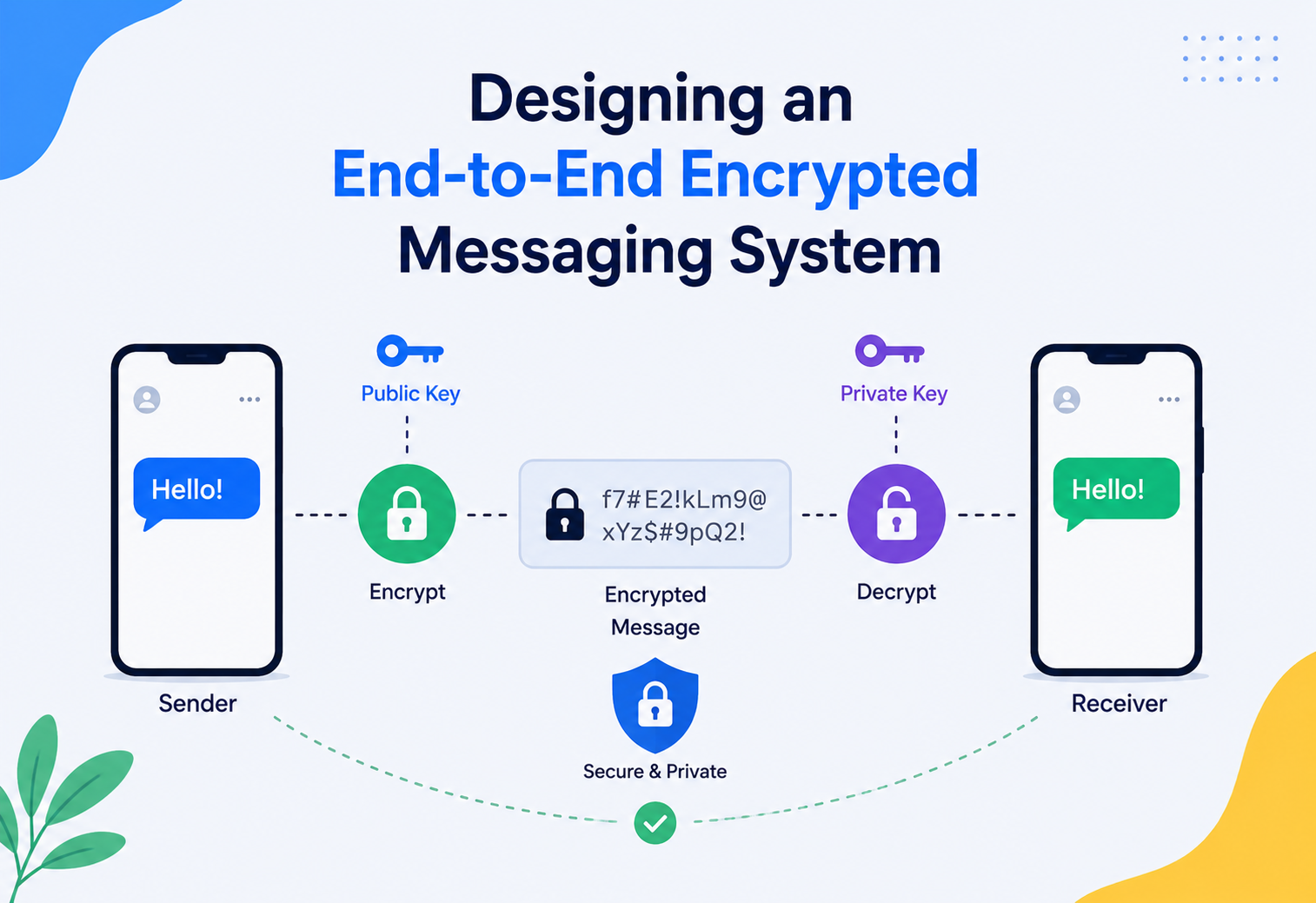
Before two people who have never talked before can send an encrypted first message, they need to agree on a shared secret without ever having communicated directly, and without the server learning that secret. The Extended Triple Diffie-Hellman (X3DH) key agreement protocol solves this using prekeys: every user’s device, in advance, generates and uploads to the Key Server a long-term identity public key, a medium-term signed prekey (rotated periodically and signed by the identity key to prove authenticity), and a batch of one-time prekeys, each intended to be consumed exactly once. When a sender wants to message someone for the first time, their device fetches one such prekey bundle from the Key Server, and locally performs a sequence of Diffie-Hellman key exchanges combining the sender’s and recipient’s identity and prekey material. The output is a shared secret that only the two devices involved could have derived, because it is computed independently on each side from private key material that never left either device — the Key Server merely handed out public keys, and never sees the resulting shared secret at all.
4.2 The Double Ratchet: Forward Secrecy and Post-Compromise Security
A single shared secret from X3DH is only the starting point. Using that same secret to encrypt every subsequent message would mean that stealing it once exposes the entire conversation, past and future. The Double Ratchet Algorithm solves this by continuously deriving new encryption keys as the conversation proceeds, combining two mechanisms:
- Symmetric-key ratchet: Every single message sent advances a one-way key derivation chain, so each message is encrypted with a fresh key derived from, but not reversible to, the previous one. Even if an attacker recovers today’s message key, they cannot work backward to decrypt earlier messages — this is forward secrecy.
- Diffie-Hellman ratchet: Periodically (roughly, whenever the conversation direction switches — one side replies to the other), both sides perform a fresh Diffie-Hellman exchange using new, freshly generated key pairs, folding brand-new randomness into the chain. This means that even if an attacker fully compromises a device’s current state, once a new DH ratchet step occurs, the attacker’s stolen material becomes useless for decrypting anything from that point forward — this is post-compromise security, allowing the system to “heal” after a compromise without any manual user action.
4.3 Message Encryption and Authentication
Each individual message is encrypted using an authenticated encryption scheme (commonly AES-256 in GCM mode, or the ChaCha20-Poly1305 combination on mobile devices where it runs faster without hardware AES acceleration), which provides both confidentiality (the content is hidden) and integrity/authenticity (any tampering with the ciphertext, or a message forged by someone without the correct key, is detected and rejected rather than silently accepted).
4.4 Group Messaging: Sender Keys and MLS
Running a pairwise Double Ratchet between every pair of members in a large group does not scale — a 200-person group would require each sender to individually encrypt every message roughly 200 times. Two approaches address this. The simpler “sender keys” model has each group member generate a single symmetric key used to encrypt all of that member’s messages to the group, distributing that key to every other member individually (encrypted pairwise, once, at join time) rather than re-encrypting every message per recipient; a membership change requires rotating and redistributing keys. The more modern approach, the IETF’s Messaging Layer Security (MLS) protocol, organizes group members into a binary tree structure so that adding or removing a member, or rotating keys, requires work proportional to the logarithm of the group size rather than the full size of the group, making it practical for groups with thousands of members while preserving the same forward secrecy and post-compromise security properties as pairwise conversations.
4.5 Key Verification: Safety Numbers
Because the Key Server (even with a transparency log) is still a party the user did not choose to fully trust, most systems give users a way to verify, out of band, that they share the exact same cryptographic identity keys as the person they are messaging — commonly displayed as a “safety number” or QR code derived from both parties’ public keys. Comparing this number in person or over a trusted separate channel gives users a way to cryptographically detect a man-in-the-middle attack that even a compromised Key Server could not fake, because the comparison happens entirely outside the server’s control.
4.6 Multi-Device Support
A user with a phone, laptop, and tablet needs every device to be able to decrypt incoming messages, but the sender’s device does not inherently know about all of a recipient’s devices at once. The common solution registers each of a user’s devices with its own identity key pair under the same account, and the sending device fetches and encrypts a separate copy of each message for every one of the recipient’s registered devices — meaning a message to someone with three devices is, under the hood, three independently encrypted ciphertexts, each addressed to one specific device’s keys, so a compromise of one device’s keys never exposes the others’ copies.
4.7 Adding and Removing Devices Safely
Linking a new device to an existing account is itself a moment of real cryptographic risk: if done carelessly, it becomes an easy way to smuggle in an attacker-controlled “device” that silently receives copies of every future message. Well-designed systems require an existing, already-trusted device to explicitly approve a new device — typically by scanning a QR code that the new device displays, which encodes a cryptographic proof the existing device verifies before vouching for the new one — rather than allowing account credentials alone (a password, an SMS code) to add a device capable of reading encrypted content. Removing a device revokes its ability to receive new messages going forward, though, consistent with forward secrecy, it does not and cannot retroactively “un-deliver” messages that device already decrypted while it was trusted.
4.8 Identity Key Rotation and Long-Term Key Hygiene
While the medium-term signed prekey rotates regularly and one-time prekeys are consumed and replenished continuously, the long-term identity key is intentionally kept stable for long periods, since it is the anchor that safety-number verification (section 4.5) and the Key Transparency Log depend on — rotating it too frequently would force users to constantly re-verify each other’s identities, undermining the practical usability of the verification mechanism. When an identity key does need to change (a full device compromise recovery, for instance), the change is deliberately made highly visible to the user’s contacts, prompting re-verification rather than silently trusting the new key, since a silent identity key change is exactly the signature of the man-in-the-middle attack this whole verification system exists to catch.
- Walk through X3DH step by step — what does each Diffie-Hellman exchange actually protect against?
- Why does the Double Ratchet need both a symmetric-key ratchet and a Diffie-Hellman ratchet — why isn’t one enough?
- Why does pairwise Double Ratchet not scale to large groups, and how does MLS’s tree structure fix that?
- What attack does comparing safety numbers out of band actually protect against that server-side key distribution alone cannot?
- Why must adding a new device require approval from an already-trusted device rather than just account credentials?
- Why is the long-term identity key rotated far less frequently than prekeys, and what risk does that trade-off introduce?
Data Flow and Lifecycle
Walking a single conversation, step by step, from the first invisible cryptographic handshake to a message rendered on the recipient’s screen — and then to a backup that even the server cannot read.
5.1 First Contact: Establishing Trust
When Alice messages Bob for the first time, her device silently performs the X3DH exchange described in section 4.1, fetching Bob’s public prekey bundle from the Key Server. This all happens before the first message is even typed, typically triggered the moment Alice opens a new conversation, so there is no perceptible delay when she actually hits send.
5.2 Sending a Message
Alice’s device derives the next message key from her side of the Double Ratchet, encrypts the plaintext locally, and sends only the resulting ciphertext, along with the small amount of ratchet public-key material the recipient needs to stay in sync, up to the server. The Message Relay Service treats this exactly like any opaque blob: it assigns delivery ordering metadata, queues it if Bob is offline, and forwards it immediately if he has a live connection — identical to the delivery mechanics of a conventional chat system, just operating on ciphertext instead of plaintext.
5.3 Receiving and Decrypting
Bob’s device receives the ciphertext, uses its own side of the ratchet state (which it advanced independently, without ever needing to talk to the server about it) to derive the matching message key, decrypts locally, and only then does the plaintext ever exist anywhere — inside Bob’s device’s memory, never on any server, never on the wire.
5.4 Group Message Flow
In a group using the sender-keys or MLS model from section 4.4, a sender encrypts once using their current group sending key (or the MLS tree-derived group secret), and the Message Relay Service fans that single ciphertext out to every group member’s queue exactly as described in the fan-out mechanics of a conventional chat system — the relay still cannot read it, since it never possesses the group decryption key, only the routing metadata needed to know who the current members are.
5.5 Encrypted Backups
When a user opts into cloud backup of their message history, the backup itself is encrypted client-side with a key derived from a user-chosen passphrase or a device-generated recovery key that the server never sees in usable form — often protected further by a secure, rate-limited key-escrow mechanism (such as a Secure Value Recovery service backed by dedicated hardware) that limits the number of guesses even someone with full server access could attempt against a weak passphrase, so that backups remain useful for disaster recovery without becoming a backdoor around the encryption guarantee.

Advantages, Disadvantages and Trade-offs
Every guarantee this system provides is paid for by giving something up on the server side of the relationship. Being explicit about that exchange is what turns “we’re E2EE” from a marketing line into a genuine, defensible engineering position.
| Design Decision | Advantage | Trade-off |
|---|---|---|
| Server never holds decryption keys | Content stays confidential even under full server compromise, insider threat, or legal compulsion | Server cannot offer server-side search, spam scanning, or content moderation on message text |
| Forward secrecy via ratcheting | A stolen key does not expose message history | Requires careful, stateful key management on every client device; losing ratchet state can break decryption |
| Per-device encryption for multi-device | Compromise of one device does not expose messages readable by other devices’ independent keys | Sending cost scales with number of recipient devices, increasing client-side work and bandwidth |
| Encrypted client-side backups | Users can recover history after losing a device, without breaking the confidentiality guarantee | A forgotten passphrase with no escrow means permanently unrecoverable history — a real support burden |
| Key Transparency Log | Detects a malicious or compromised Key Server handing out fake keys | Adds infrastructure complexity and a new component that itself must be highly available and tamper-evident |
The recurring theme across this table is that every guarantee this system provides is purchased by giving something up on the server’s side of the relationship: visibility, convenience features that rely on visibility, and some operational simplicity. That trade is precisely the point of the system, but it must be made consciously, feature by feature, rather than discovered as a surprise after launch.
Where This Design Shines
- Consumer messaging where users expect PGP-grade privacy without any PGP-grade effort
- Regulated professions (legal, medical, journalistic) where content confidentiality is table stakes
- Cross-border communication where the operator wants no ability to comply with plaintext requests
- Group collaboration up to thousands of members via MLS-style tree keying
Where It Is Overkill or Wrong-Shape
- Broadcast channels where the whole point is that a wide public audience can read the content
- Platforms whose business model genuinely depends on content moderation via server-side inspection
- Systems where regulators require lawful-access backdoors; those are, by definition, not E2EE
- Tiny closed teams where a shared-secret VPN and TLS meet the actual threat model at lower cost
Section Takeaway
Every convenience that a conventional chat platform gets “for free” from server-side content visibility — server search, content spam filters, easy support debugging, easy backup — has to be redesigned or reasoned about carefully here. The cryptography is the easy part; teaching every other feature to respect the boundary the cryptography draws is where the real engineering happens.
Performance and Scalability
A common worry is that encryption will make everything slow. In practice the cryptography itself is cheap; the interesting scaling problems live in prekey supply, group-key management, and the Key Transparency Log’s consistency requirements.
7.1 Cryptographic Overhead Per Message
Modern authenticated encryption (AES-GCM or ChaCha20-Poly1305) and elliptic-curve Diffie-Hellman operations (commonly on Curve25519) are computationally cheap by design — encrypting a typical text message takes a small fraction of a millisecond on any modern mobile CPU, and even on lower-end hardware this overhead is negligible next to network round-trip time. The cryptography itself is not the bottleneck in a well-designed E2EE system; the surrounding key-management bookkeeping is where complexity, not raw CPU cost, tends to live.
7.2 Prekey Supply and Exhaustion
Because one-time prekeys are each consumed exactly once during X3DH, a device must periodically upload fresh batches to the Key Server, and the Key Server must handle the case where a very popular or very frequently contacted account’s one-time prekeys run out faster than they can be replenished — falling back gracefully to using only the signed (reusable) prekey rather than failing the conversation outright, at a small, acceptable reduction in forward-secrecy strength for that specific initial exchange.
7.3 Scaling the Group Tree (MLS)
The MLS binary-tree structure from section 4.4 is what makes very large encrypted groups computationally tractable: adding or removing a member, or rotating a compromised member’s key, touches a number of tree nodes proportional to the logarithm of group size, not the full membership. For a group of 10,000 members, this is the difference between an operation touching roughly 14 tree nodes versus one touching all 10,000 members’ individual keys — the design choice that makes large encrypted groups feasible at all.
7.4 Delivery Latency Is Unaffected by Encryption
Because encryption and decryption happen entirely client-side and add negligible computational time, the sub-second delivery latency techniques used by any large-scale chat system — the WebSocket gateway fleet, presence-based routing, and asynchronous fan-out covered in a conventional chat system design — apply here without modification. The Message Relay Service moves the same number of bytes at the same speed; it simply cannot read what it is moving.
7.5 Scaling the Key Server and Key Transparency Log
The Key Server is a very high read-to-write ratio system — prekey bundles are fetched far more often than they are uploaded — making it an excellent fit for aggressive caching and read replicas distributed close to users, exactly like any read-heavy metadata service. The Key Transparency Log, by contrast, must remain a strictly append-only, globally consistent structure (commonly implemented as a Merkle tree) so that any client, anywhere, can verify a given key was actually included in the log and has not been silently altered after the fact, which pushes its design toward strong consistency even while the rest of the system optimizes for availability.
on modern mobile CPU
cost vs. group size
— ideal for edge caching
- Why is the cryptographic operation itself rarely the performance bottleneck in an E2EE system?
- What happens when a user’s one-time prekeys run out faster than they can be replenished?
- Why does MLS’s tree structure scale better than sender-keys for very large groups?
High Availability and Reliability
Availability and confidentiality are different problems. The design pattern here is to layer standard multi-region chat-scale HA on the “blind” delivery pipe, and then treat the Key Transparency Log as a separate, stricter consistency concern all its own.
8.1 Server Availability Does Not Protect Message Confidentiality — But Still Matters
It is worth stating plainly: high availability and end-to-end encryption solve two different problems. A perfectly available server that goes down would simply stop delivering ciphertext; it would not expose plaintext. So the availability design for this system largely mirrors any large-scale chat system — multi-region deployment, replicated durable queues, quorum-based storage — layered underneath the cryptographic guarantees rather than replacing them.
8.2 Replicating Ciphertext Safely
Because the Message Relay Service and its storage only ever hold ciphertext, replicating message data across multiple nodes and regions for durability carries none of the additional risk it would if plaintext were involved — a compromised or misconfigured replica leaks nothing more sensitive than any other replica, since all of them are equally blind to content.
8.3 Key Server and Key Transparency Log Availability
The Key Server sits directly on the critical path of starting any new conversation, so its unavailability directly blocks new conversations (though existing conversations with already-established ratchet state continue working uninterrupted). It is replicated across regions like any other read-heavy service. The Key Transparency Log, however, requires more careful failure handling: because it must remain globally consistent and tamper-evident, a naive multi-region active-active deployment risks conflicting, unverifiable states, so most designs elect a single authoritative log (or a small, consensus-coordinated cluster using a protocol like Raft) with read replicas fanned out globally for verification queries.
8.4 Ratchet State Recovery
If a device loses its local ratchet state — through data corruption, an app reinstall, or a factory reset — it cannot resume the existing ratchet chain, since that state exists nowhere else by design. The system must gracefully fall back to establishing a brand-new session through X3DH, which is a deliberate, safe behavior rather than a bug: it is the same trade-off as any system with client-held state, and it is strictly preferable to any design that could recover ratchet state from the server, since that would mean the server had the ability to hold it in the first place.
8.5 Disaster Recovery for Message History
Because the server intentionally cannot decrypt stored ciphertext, “disaster recovery” for message history depends entirely on the client-side encrypted backup mechanism described in section 5.5, rather than any server-side plaintext archive. This is a deliberate inversion of the usual disaster-recovery assumption that the server is the source of truth — here, the user’s own encrypted backup, not the server, is the actual root of recoverability for history.
- Why doesn’t replicating message data for availability weaken the confidentiality guarantee here?
- Why does the Key Transparency Log need stronger consistency than the rest of the system?
- What happens to a conversation if a user’s device loses its local ratchet state, and why is that the correct behavior rather than a bug?
Security
A precise threat model is what separates a real E2EE design from a marketing claim. This section names exactly who this system defends against, exactly what it does not protect against, and the defences (key transparency, sealed sender, deniability, client integrity) that back up each promise.
9.1 Threat Model
A precise threat model is what separates a real E2EE design from a marketing claim. This system is explicitly designed to protect message content against: a fully compromised server (including a malicious insider with database access), a network-level eavesdropper, and a legal or governmental order compelling the operator to hand over data, since the operator genuinely does not possess the means to comply with plaintext. It does not, by itself, protect against a compromised endpoint device — if an attacker controls Alice’s phone directly, they see what Alice sees, which is a fundamental and unavoidable limit of any encryption scheme, not a flaw specific to this design.
9.2 Defending Against a Malicious Key Server: Key Transparency in Depth
The single most dangerous theoretical attack against this architecture is a compromised or dishonest Key Server quietly substituting an attacker’s public key when Alice asks for Bob’s, enabling a silent man-in-the-middle. The Key Transparency Log defends against this by making every published key part of a public, append-only, cryptographically verifiable Merkle tree structure; clients can verify that the specific key they received is included in the tree, and independent auditors can continuously verify that the tree itself has not been tampered with or had entries silently removed or rewritten, turning a previously invisible attack into one that leaves a permanent, detectable public trace.
9.3 Sealed Sender and Metadata Protection
Even with content fully encrypted, the basic act of routing a message reveals metadata: who is talking to whom, and roughly when. Techniques like “sealed sender” address part of this by having the sender encrypt their own identity as part of the message envelope, so that the Message Relay Service can deliver the message to the correct recipient without needing to know who sent it, only cryptographically verifying (without learning) that the sender is authorized to message that recipient. This does not eliminate all metadata — the server still knows who received a message and when — but it meaningfully narrows what the server can observe.
9.4 Deniability
Some designs deliberately construct their authentication so that while Alice and Bob can each be certain, in real time, that a message truly came from the other, neither can later produce a transcript that cryptographically proves to a third party who wrote what — protecting users in scenarios where being able to prove authorship after the fact could itself be dangerous. This is achieved by using key agreement and authentication methods that are only verifiable by the two participants at the time of the conversation, not by a verifiable digital signature that any outside party could check later.
9.5 Protecting Against Compromised or Malicious Clients
Because the client is where all cryptographic operations and key storage actually happen, client software integrity matters enormously: a tampered or malicious client build could theoretically exfiltrate keys or plaintext even though the protocol itself is sound. Defenses include reproducible builds (so independent parties can verify that published app binaries match the publicly auditable source code), code signing, and, for advanced deployments, on-device attestation that the running app has not been modified.
9.6 What This Design Explicitly Does Not Protect Against
- A compromised endpoint device where the attacker can read plaintext exactly as the legitimate user can.
- Metadata analysis at scale — traffic patterns, message frequency, and timing can still reveal social-graph information even when content is fully hidden.
- A user voluntarily sharing message content with a third party after decrypting it.
- Weaknesses introduced by a poorly implemented or backdoored client application, which is why open, auditable client source code is such a common requirement for systems making this claim credibly.
Confusing “encryption in transit” (TLS) with “end-to-end encryption.” A conventional TLS-protected chat system decrypts at the server; the server then holds plaintext, however briefly. That is a fundamentally different threat model — a server compromise there means plaintext exposure. Every architectural choice in this tutorial exists specifically to eliminate that plaintext step on the server side.
- What exactly is in scope and out of scope for this system’s threat model, and why does that distinction matter?
- How does sealed sender reduce metadata exposure without breaking message routing?
- Why is client software integrity just as important as the protocol design itself?
Monitoring, Logging and Metrics
Every monitoring and debugging strategy here has to work entirely from metadata, timing, and error signals, never from content — which is a genuine and recurring engineering challenge, not an afterthought.
10.1 The Central Monitoring Challenge: Observability Without Visibility
A conventional chat system can inspect message content to help debug delivery problems; this system, by design, cannot. Every monitoring and debugging strategy here has to work entirely from metadata, timing, and error signals, never from content — which is a genuine and recurring engineering challenge, not an afterthought.
10.2 Metrics That Remain Fully Available
Delivery Latency
Time from ciphertext acceptance to delivery acknowledgment, unaffected by the fact that content is opaque.
Key Server Latency and Error Rate
How quickly prekey bundle fetches succeed, and how often X3DH setup fails or times out.
Decryption Failure Rate (Client-Reported)
Clients can anonymously report “I received a message I could not decrypt,” a critical signal for detecting ratchet desynchronization bugs, without ever reporting content.
Key Transparency Log Consistency
Continuous automated verification that the log’s Merkle tree root is consistent and has not diverged across replicas.
10.3 Client-Side Diagnostics
Because the server cannot see why a decryption failed, clients are responsible for surfacing structured, content-free diagnostic signals — for example, an error code indicating “ratchet state mismatch” or “missing prekey” — that engineers can aggregate across the fleet to detect systemic protocol bugs without ever needing the actual message content to diagnose them.
10.4 Auditability of the Key Infrastructure
Unlike message content, the Key Transparency Log is deliberately designed to be monitored and audited, including by parties outside the company itself — independent researchers and even other messaging clients can run continuous “gossip” checks, comparing the log state they observe against what other independent observers see, to detect any attempt at a split-view attack where the Key Server might try to show different, inconsistent key histories to different users.
Deployment and Cloud Strategy
Deployment here has two very different halves: the standard, containerized, auto-scaled infrastructure for the “blind” delivery pipe, and a much more tightly change-controlled pipeline for the key infrastructure and client apps, where a mistake breaks confidentiality itself.
11.1 Separation of the Blind Infrastructure and the Key Infrastructure
Even though both the Message Relay and the Key Server can run on standard cloud infrastructure, it is good practice to deploy the Key Transparency Log and its signing infrastructure with tighter isolation and stricter change-control than the general message-routing fleet, since its integrity is the backbone of the entire trust model — a compromise there is far more damaging than a compromise of a single relay node.
11.2 Reproducible Builds and Release Integrity
Because client software is where all sensitive cryptographic operations happen, deployment pipelines for the client apps themselves are treated as security-critical infrastructure: reproducible build pipelines let independent third parties compile the publicly available source code and verify that the resulting binary exactly matches what is distributed through app stores, closing the gap between “the source code is safe” and “the thing actually running on your phone is safe.”
11.3 Progressive Rollout of Protocol Changes
Changes to the cryptographic protocol itself — a new ratchet parameter, a migration to a new elliptic curve, an MLS version upgrade — require extremely careful staged rollout with strict backward compatibility, since two devices running incompatible protocol versions must still be able to negotiate a mutually understood session rather than silently failing to communicate; this is treated with far more caution than a typical backend service deployment, given that a bug here can break confidentiality guarantees rather than just availability.
11.4 Standard Infrastructure for Everything Else
The Message Relay, gateway fleet, and ciphertext storage layer are deployed using the same containerized, auto-scaled, multi-region patterns used by any large-scale chat system, since — as established throughout this tutorial — encryption changes what the infrastructure is allowed to see, not how it needs to scale or fail over.
Databases, Caching and Load Balancing
The storage layer looks almost identical to a normal chat system’s — with one big simplification (no server-side search index over content) and one exotic new store (an append-only Merkle-tree log for keys).
12.1 Storing Ciphertext
The ciphertext message store uses the same access pattern and therefore the same category of database as any large-scale chat system — a wide-column store partitioned by conversation ID, sorted by a time-ordered message ID — with one meaningful simplification: because the server cannot read content, there is no need to design around server-side content search or indexing of message text at all, removing an entire category of secondary indexing work that a conventional chat system’s storage layer has to support.
12.2 Storing Public Key Material
The Key Server’s storage needs are comparatively simple: per-user identity keys, signed prekeys, and pools of one-time prekeys, keyed by user and device ID, with high read throughput and relatively low write throughput. This maps well onto a standard key-value or document store with aggressive caching, since public keys change infrequently relative to how often they are fetched.
12.3 The Key Transparency Log’s Storage Model
Unlike the other stores in this system, the Key Transparency Log is best modeled as an append-only Merkle tree structure, where every new key publication becomes a new leaf, and the tree’s root hash is periodically signed and published so that any client can verify inclusion of a specific key using a small, efficient cryptographic proof rather than downloading the entire log.
12.4 Caching Strategy
Public key bundles are cached aggressively close to users, since they change rarely; ciphertext, by contrast, is generally not cached beyond what is needed for delivery, since it is delivered once and typically deleted from server-side storage shortly after successful delivery to all recipient devices, reducing the amount of ciphertext that needs to persist in any cache or long-term store at all.
12.5 Load Balancing
Load balancing for the gateway and Message Relay tiers follows the same connection-aware strategies used by any large-scale chat system; the Key Server, being a comparatively standard read-heavy HTTP-style service, load balances using conventional L7 techniques without the connection-affinity concerns that apply to the persistent WebSocket layer.
APIs and Microservices
The API surface is small on purpose: a persistent connection for ciphertext, a read-heavy HTTPS endpoint for public keys, an efficient inclusion-proof endpoint for the transparency log, and a metadata-only group management API.
13.1 Protocol Surface
| API / Protocol | Used For | Notes |
|---|---|---|
| WebSocket / persistent connection | Sending and receiving ciphertext in real time | Payload is opaque to the transport, identical mechanics to any real-time chat system |
| REST / HTTPS to Key Server | Publishing and fetching prekey bundles | Public-key-only payloads; safe to cache and serve from edge locations |
| Key Transparency verification API | Clients and auditors verifying inclusion proofs against the log | Must expose small, efficient cryptographic proofs rather than full log downloads |
| Group Membership API | Adding/removing members, coordinating MLS tree updates | Carries membership metadata only, never group decryption keys |
13.2 Service Boundaries
The Key Server, Key Transparency Log, Message Relay, and Group Membership Service are kept as clearly separated services, each with its own scaling profile and its own blast radius: a bug or outage in the Group Membership Service should not be able to leak or misroute Message Relay ciphertext, and a bug in the Message Relay should not be able to corrupt Key Transparency Log state — this separation of concerns is even more important here than in a typical microservices system, because it directly maps onto the separation between “things that can see nothing sensitive” and “things whose integrity underpins the entire trust model.”
13.3 Versioned, Extensible Protocol Encoding
Message envelopes and prekey bundles are encoded using a versioned, schema-based binary format so that protocol upgrades (new ciphersuites, new ratchet parameters, MLS version bumps) can be introduced without breaking older clients mid-migration, mirroring the same backward-compatibility discipline any large messaging platform needs, but with added care since a misparsed cryptographic field is a security bug, not just a display glitch.
Design Patterns and Anti-Patterns
The patterns below are not novel — they are the disciplined re-application of proven building blocks the modern E2EE ecosystem has converged on, alongside the anti-patterns that keep undermining otherwise good systems.
14.1 Patterns Used
- Trust minimization by construction: Every server-side component is designed so that even total compromise of that component yields no plaintext, rather than relying on access-control policy to prevent misuse.
- Ratchet / continuous key derivation: Keys evolve automatically with every message and every conversation turn, rather than remaining static, bounding the damage of any single key exposure.
- Transparency log / Merkle tree auditing: Borrowed from Certificate Transparency, this pattern converts an unverifiable trust assumption (“trust the Key Server”) into a verifiable, publicly auditable one.
- Tree-based group key management (MLS): Logarithmic-cost membership changes instead of linear-cost re-keying, the same algorithmic idea behind efficient Merkle trees applied to group encryption.
- Client-side source of truth for cryptographic state: Ratchet state and private keys live only on the device, making the server structurally incapable of holding the one thing needed to break confidentiality.
14.2 Anti-Patterns to Avoid
- “Trust us” policy-based confidentiality: Claiming end-to-end encryption while the server retains any technical ability to decrypt (for example, holding a master key for “compliance” purposes) is not end-to-end encryption at all, regardless of marketing language, and undermines the entire threat model this design defends against.
- Reusing a single long-term key for every message: Defeats forward secrecy entirely; a single key compromise would expose the whole conversation history, exactly the PGP-era weakness this tutorial’s design set out to avoid.
- Silent, unverifiable key changes: If a user’s key changes and the client does not clearly surface that change for verification, it opens the door to an undetected man-in-the-middle attack; safety-number re-verification prompts exist precisely to close this gap.
- Backdoored or non-transparent backup key escrow: A backup recovery mechanism that allows unlimited or unaudited guesses against a user’s backup passphrase effectively creates a server-side path to plaintext, contradicting the entire design goal.
- Treating metadata as out of scope entirely: Encrypting content while leaving sender, recipient, and timing fully exposed still allows powerful social-graph and behavioral inference, undermining the practical privacy the system is meant to deliver even when the letter of “content encryption” is satisfied.
Best Practices and Common Mistakes
The best practices below are the ones the modern E2EE ecosystem keeps converging on; the mistakes are the ones that keep appearing in incident reports and academic critiques of otherwise well-intentioned systems.
15.1 Best Practices
- Publish client source code and support reproducible builds so the “the server cannot read your messages” claim is independently verifiable rather than taken on faith.
- Design safety-number or equivalent key-verification flows to be genuinely usable, not buried in a settings menu no one finds, since an unused verification feature provides no real protection.
- Default users into forward-secret, ratcheted sessions automatically, without requiring any manual setup, learning from PGP’s core adoption failure.
- Rate-limit and hardware-back any backup key recovery mechanism so a strong confidentiality guarantee for ongoing messages is not undermined by a weak backup passphrase recovery path.
- Treat the Key Transparency Log’s integrity as a top-tier operational priority, with continuous automated consistency verification, since its failure silently undermines every other guarantee in the system.
15.2 Common Mistakes
- Building “E2EE” features that quietly exempt certain message types (group messages, media, backups) from the same guarantees applied to one-to-one text, creating confusing and dangerous gaps in the actual protection users believe they have.
- Underestimating the engineering cost of debugging without content visibility, leading to under-invested, content-blind observability tooling that leaves teams unable to diagnose real production issues.
- Rolling custom, non-peer-reviewed cryptographic protocols instead of building on well-analyzed, widely scrutinized designs like the Signal Protocol or MLS, which have both benefited from years of public cryptographic review that a custom scheme cannot replicate quickly.
- Failing to plan for ratchet state loss (app reinstalls, device resets) gracefully, leading to confusing “message failed to decrypt” experiences instead of a clean, expected re-establishment of a new session.
- Ignoring metadata protection entirely because “the content is encrypted,” missing that metadata alone can reveal sensitive relationship and behavioral patterns.
15.3 A Pre-Launch Readiness Checklist
| Check | Question to Confirm Before Launch |
|---|---|
| Uniform E2EE coverage | Do 1:1, group, media, and backup all satisfy the same content-blindness guarantee? |
| Reproducible builds | Can an independent party rebuild the client and match the published binary bit-for-bit? |
| Key verification UX | Is safety-number verification discoverable and usable, not buried? |
| Prekey supply | Does the Key Server degrade gracefully when one-time prekeys are exhausted? |
| Ratchet state loss | Does an app reinstall lead to a clean X3DH re-session, not a scary error? |
| Transparency log gossip | Are independent observers actively cross-checking the log’s root? |
| Backup escrow | Is the backup passphrase recovery path rate-limited and hardware-anchored? |
Real-World and Industry Examples
The design principles above are not theoretical — they show up, with minor variations, in the messaging infrastructures of every major E2EE platform in wide use today.
Signal
Signal is the reference implementation and origin of the Double Ratchet Algorithm and X3DH, maintained as open-source software with a strong public commitment to minimal metadata retention and features like sealed sender specifically designed to reduce what even Signal’s own servers can observe about who is messaging whom.
WhatsApp adopted the Signal Protocol in 2016 for over a billion users, demonstrating that this cryptographic approach scales to some of the largest messaging populations on earth without compromising the sub-second delivery expectations users have for chat, while layering its own backup and multi-device infrastructure on top of the core protocol.
Apple iMessage
iMessage uses its own end-to-end encrypted protocol rather than the Signal Protocol directly, built around per-device key pairs and, in more recent versions, post-quantum-resistant key exchange additions, reflecting Apple’s tight integration with its own hardware-backed secure key storage across the device ecosystem.
Matrix and the Olm/Megolm Protocols
Matrix, an open, federated messaging protocol, implements its own Olm (pairwise, Double-Ratchet-inspired) and Megolm (group messaging) cryptographic protocols, illustrating how the core ideas in this tutorial — ratcheting for pairwise chats, more efficient group-key schemes for rooms — get adapted for a federated architecture where messages may pass through multiple independently operated servers, none of which can decrypt content.
Messaging Layer Security (MLS) Adoption
MLS, standardized by the IETF specifically to solve the large-group scaling problem described in section 4.4 and section 7.3, has been adopted or piloted by multiple major platforms seeking a common, interoperable, and heavily peer-reviewed standard for group encryption rather than each building and maintaining a bespoke group protocol independently.
Common Thread Across All of Them
Every credible system in this space converges on the same non-negotiables covered throughout this tutorial: private keys that never leave the device, forward secrecy through continuous key ratcheting, some mechanism for users to verify identities out of band, and — increasingly, as regulatory and research scrutiny grows — a genuine effort to minimize, not just encrypt around, the metadata the server can observe.
Frequently Asked Questions
The most common questions that come up in interviews, security reviews, and internal design meetings for E2EE messaging, each answered in the same language a Software Architect would use when explaining trade-offs to a mixed engineering and product audience.
Routing only requires knowing sender and recipient account identifiers, which travel as metadata alongside the ciphertext, not the content itself. Techniques like sealed sender go further, hiding even the sender’s identity from parts of the delivery pipeline while still allowing correct routing, but full anonymity of who-messaged-whom is a much harder, separate problem from content confidentiality.
No — any mechanism that lets a third party, including the platform itself, decrypt messages under any circumstance is, by definition, not end-to-end encryption for those messages; it re-introduces exactly the single point of trust and compromise this entire architecture is designed to eliminate, regardless of how narrowly such access might be scoped or governed.
Detection shifts entirely to metadata and behavioral signals — message frequency, sudden fan-out to many new recipients, patterns of being blocked or reported by many different users — the same category of signals discussed for abuse prevention in a conventional chat system, applied here without any reliance on content inspection at all.
Only if you have not enabled encrypted backup. With client-side encrypted backup enabled, history can be restored on a new device using your backup passphrase or recovery key, without the server ever having had the ability to read that history at any point, before or after the loss.
Server-side search requires the server to index plaintext content, which directly contradicts the core guarantee. Some systems instead offer on-device search, where the search index itself is built and stored locally after the device decrypts its own messages, keeping the “server never sees plaintext” property fully intact.
Summary and Key Takeaways
A compact summary of the design and the ideas most worth carrying forward into any conversation about end-to-end encrypted messaging — whether in an interview, an internal design review, or a public technical write-up.
The Big Picture
An end-to-end encrypted messaging system is really two systems layered on top of each other: a conventional, horizontally scaled, highly available real-time delivery system — the kind covered in any large-scale chat system design — wrapped around a second, entirely separate concern: a client-controlled cryptographic layer that the delivery system is deliberately barred from touching. The two layers must be designed together, because the confidentiality guarantee only holds if every single feature built on top of delivery — search, backups, spam detection, multi-device sync, group membership — is built to respect the boundary the cryptography draws, rather than quietly reaching past it for convenience.
That discipline, applied consistently across every feature rather than just the core message-send path, is what separates a system that is genuinely end-to-end encrypted from one that merely encrypts messages in transit while still trusting the server with the keys.
Key Takeaways
- Confidentiality must be enforced by cryptography running on the client, not by server-side policy. Every architectural decision in this tutorial flows from treating the server as fundamentally untrusted with plaintext, by design, not by promise.
- Forward secrecy and post-compromise security together are what make modern E2EE resilient — a stolen key exposes neither the past (forward secrecy) nor, after the ratchet advances, the future (post-compromise security), solving the exact weakness that limited PGP’s real-world adoption.
- Trust in the Key Server must itself be independently verifiable, which is exactly what a Key Transparency Log provides — turning “trust us” into “verify us.”
- Group encryption at scale needs its own algorithmic approach. Pairwise ratcheting does not scale to large groups; tree-structured protocols like MLS bring membership-change cost down to a logarithm of group size.
- Every convenience feature that relies on server-side content visibility — search, spam scanning by content, server-side backups — must be redesigned to work from the client side or from metadata alone, and that redesign, not the cryptography itself, is usually where the real engineering effort in a system like this goes.
The strongest sentence a builder of an end-to-end encrypted messaging system can honestly say is not “we promise not to look” — it is “we could not look even if we wanted to, and here is the math that proves it.” Every architectural choice in this tutorial exists to make that sentence, and only that sentence, defensible.