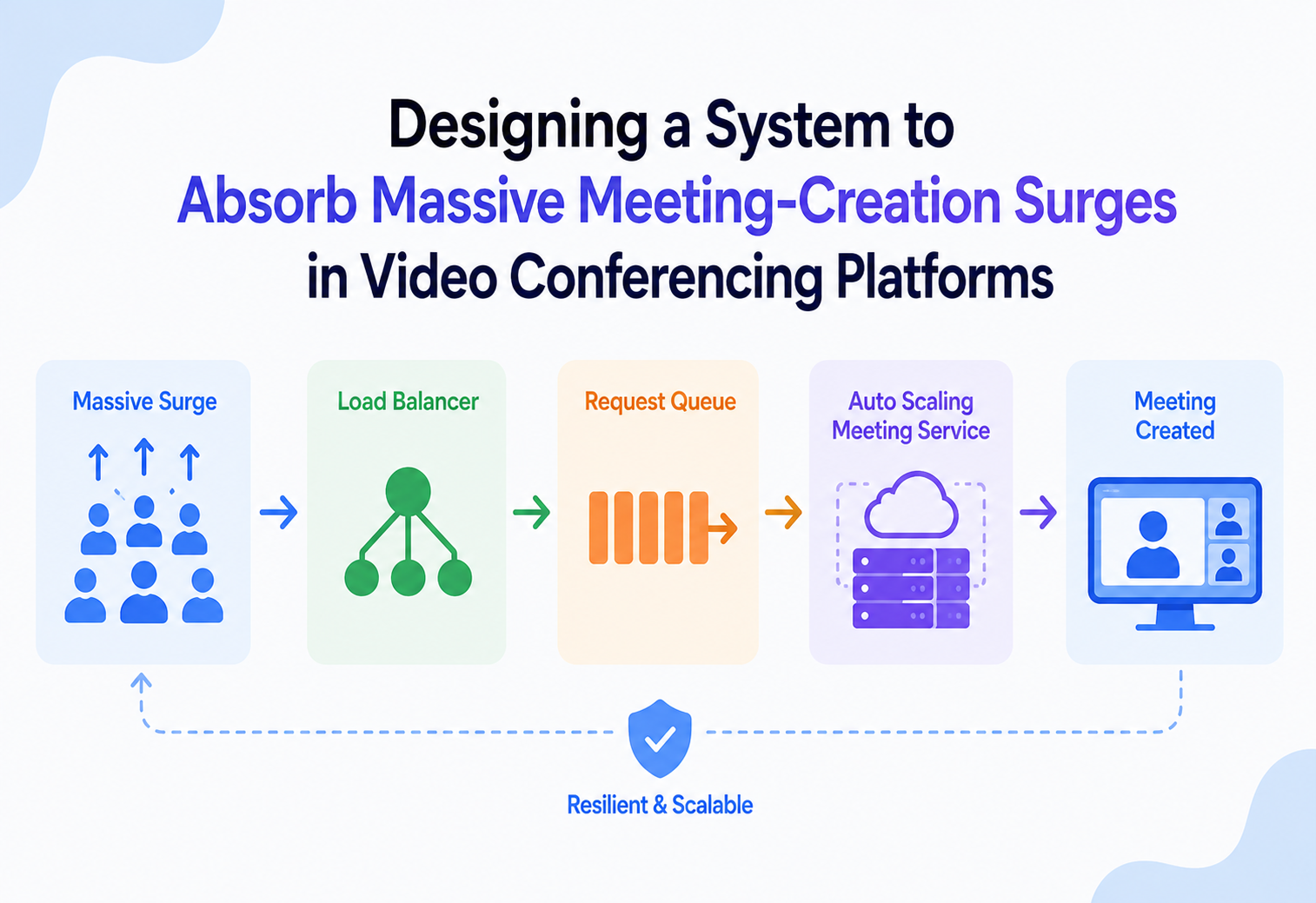
Designing a System to Absorb Massive Meeting-Creation Surges in Video Conferencing Platforms
A production-grade deep dive into handling synchronized-timezone traffic spikes — the “9 AM problem” — for systems like Zoom, Google Meet, and Microsoft Teams.
Introduction & History
Every weekday morning, in every timezone, a wall of humans opens their laptops within the same fifteen minutes and expects their video call to connect instantly. This chapter unpacks why that shared cultural habit turned into one of the most distinctive load patterns in modern infrastructure.
Every weekday morning, something remarkable and mildly terrifying happens inside the data centers of every major video conferencing company. Somewhere between 8:55 AM and 9:05 AM local time, in every populated timezone on Earth, a wave of humans opens their laptops, clicks “Start Meeting” or “Join,” and expects the call to connect in under two seconds. This isn’t a gradual ramp — it’s closer to a cliff. Traffic that was idling at 5% of peak capacity at 8:50 AM can be at 400% of average load by 9:02 AM, then fall back down by 9:15 AM once everyone has settled into their stand-ups.
This pattern is sometimes called the “9 AM problem” or, more formally, a synchronized demand spike — a burst of correlated, near-simultaneous requests triggered by human behavior rather than by any single external event like a news headline or a product launch. It’s a cousin of the classic thundering herd problem, but with a twist: the herd isn’t reacting to a system event (like a cache expiring), it’s reacting to a wall clock and a shared cultural convention — the standard workday start time.
Video conferencing platforms are especially vulnerable to this because a “meeting create” request isn’t just a database write. It’s the trigger for a cascade: allocating a unique meeting room, provisioning media relay capacity, warming up signaling servers, generating cryptographic keys for end-to-end encryption, registering the meeting with calendar integrations, and preparing to accept dozens or hundreds of concurrent audio/video streams the moment participants join. A single click by a user can fan out into ten or more downstream service calls.
Historically, this kind of load pattern existed long before video conferencing — ticket-sales flash sales, tax-filing-deadline traffic, and New Year’s Eve SMS spikes all share the same DNA. But video conferencing adds a unique constraint: the tolerance for failure is nearly zero and highly visible. If a flash sale website is slow, users see a spinner. If a video call fails to start, a person is late to a meeting in front of their boss, and the incident becomes a trending topic within minutes. This visibility is why companies like Zoom, in early 2020, had to re-architect significant parts of their meeting-creation pipeline within weeks as the world shifted overnight from optional video calls to mandatory daily infrastructure.

Enterprise conferencing systems (Cisco, Polycom)
Meetings mostly ran on dedicated on-premise bridges. Load was relatively predictable per customer, and capacity planning was largely a hardware-procurement exercise scoped to a single company’s calendar patterns rather than a global surge problem.
Cloud-hosted conferencing arrives (WebEx cloud, early Zoom, Google Hangouts)
Meetings move to multi-tenant SaaS. Peak load starts to correlate across tenants because everyone shares the same weekday business-hours cadence, but the aggregate volume is still small enough that generous over-provisioning masks the pattern.
The overnight shift to remote work
Zoom’s daily meeting participants jump roughly 20x within weeks. What used to be an over-provisioning problem becomes a fundamental architectural problem: no amount of steady-state capacity is economical when peaks now dwarf baselines by an order of magnitude.
Predictive scaling + fast-path/slow-path re-architectures
Providers publicly discuss shifting from reactive auto-scaling to timezone-aware predictive pre-scaling, and to decoupling minimal “hand back a meeting ID” work from downstream calendar/analytics/recording work — the two ideas central to this tutorial.
Hybrid work as the new steady state
Even as remote-only work moderates, hybrid schedules keep the 9 AM local surge sharp: knowledge workers still open their laptops within the same fifteen-minute window, so the underlying load pattern this document addresses is now a permanent feature of the industry rather than a pandemic-era anomaly.
Why is a “meeting creation surge” architecturally different from a generic traffic spike, like a Black Friday sale?
Strong answer: Because a meeting-create request is a compound operation with strict low-latency downstream dependencies (room allocation, media server assignment, signaling readiness) that must all succeed nearly instantly, and because the load is periodic, predictable in aggregate but not in exact magnitude, and globally distributed across timezones rather than a single origin event.
Understanding the Problem Deeply
Before designing anything, we need to precisely define what we are protecting against. There are actually three distinct but related surges happening around the same time window, and conflating them is a common mistake in system design interviews.
2.1 The Three Surge Types
| Surge Type | Description | Primary Bottleneck |
|---|---|---|
| Meeting Creation Surge | Millions of “schedule/start a new meeting” API calls in a short window | Write-heavy database load, ID generation, room allocation service |
| Join Surge | Participants joining already-scheduled recurring meetings (daily standups) at the same time | Media server (SFU) capacity, signaling server connection counts |
| Authentication/Session Surge | Simultaneous logins/token refreshes as users open their laptops for the day | Auth service, token issuance, session store |
This document focuses primarily on the meeting creation surge as scoped in the problem statement, but because these three surges overlap in the same 10-minute window in practice, any production-grade design must account for all three, and we will touch on join and auth surges where they materially affect the creation path.
2.2 Why “Just Add More Servers” Doesn’t Work
A naive answer is “auto-scale the servers.” This fails for several reasons that are worth stating explicitly because they are exactly what a senior interviewer is listening for:
- Scale-up lag: Cloud auto-scaling (adding new VM/container instances) typically takes 60–300 seconds to provision, boot, and pass health checks. A surge that goes from baseline to peak in under 90 seconds will already have caused failures before new capacity is ready.
- Database is the real bottleneck: Stateless API servers scale horizontally easily; the relational database backing meeting metadata does not scale writes horizontally without significant re-architecture (sharding, partitioning).
- Downstream fan-out amplifies load: If each meeting-create call triggers 5–8 downstream calls (room allocation, media server reservation, calendar sync, notification dispatch, analytics event, billing/quota check), a surge of 1 million requests becomes 5–8 million downstream operations.
- Cost: Provisioning enough steady-state capacity to handle peak-of-peak load 24/7 (when the surge lasts roughly 15–20 minutes per timezone) is economically wasteful — this is the classic capacity vs. cost trade-off central to this entire design.
2.3 Design Goals
p99 < 500 ms even at peak
Meeting-creation latency stays under 500 ms at the 99th percentile even during the peak of a timezone’s surge, since a spinner longer than that gets attributed to “the app is broken.”
99.99% success rate
Roughly 4.3 minutes of allowed full downtime per month for the meeting-creation path, tracked and reported separately from in-meeting stability.
Elastic, not always-on peak
Avoid over-provisioning for 24/7 peak capacity; scale predictively and reactively so the fleet only sits at peak size for the ~15–20 minutes it’s actually needed per timezone.
Graceful, not cliff-edge
When overloaded, degrade non-critical features (recording pre-warm, transcription setup) before ever rejecting core meeting creation.
No cascading failure
A downstream service outage (e.g., calendar sync) must never block or fail the core meeting-creation path — every dependency has an explicit fallback.
What SLA would you propose for meeting creation, and how would you justify it to a business stakeholder?
Strong answer: Tie the SLA to user-perceived trust — video conferencing is now critical business infrastructure, so even 99.9% availability translates to over 43 minutes of monthly downtime, which is unacceptable for a product used for time-sensitive meetings. Target 99.99%, and explicitly separate “meeting creation” SLA from “in-meeting stability” SLA since they have different failure domains.
Architecture & Components
The design centers on a principle we’ll revisit throughout this document: decouple the fast path from the slow path. The fast path is the minimum set of operations required to hand the user a working meeting ID and join URL. The slow path is everything else — calendar invites, analytics, transcription pre-warming, compliance logging — which can happen asynchronously within a few seconds without the user noticing.
3.1 Component Breakdown
| Component | Responsibility | Interviewer Focus |
|---|---|---|
| GeoDNS / Anycast | Routes users to the nearest healthy regional entry point, spreading load geographically before it ever hits a single region | Explains how timezone-correlated surges are naturally partitioned by geography |
| Global Load Balancer | Distributes requests across API gateway instances within a region; performs health checks and connection draining | L4 vs L7 balancing trade-offs |
| Rate Limiter | Enforces per-user, per-org, and global quotas using token bucket algorithms; sheds load before it reaches business logic | Difference between client-facing rate limiting and internal admission control |
| Meeting Creation Service (MCS) | Stateless service executing the fast path: validate, allocate ID, reserve room, write minimal record, return response | Why this must remain stateless and idempotent |
| Distributed ID Generator | Generates globally unique, roughly time-sortable meeting IDs without a central bottleneck (e.g., Snowflake-style) | Why auto-increment primary keys fail at this scale |
| Room Allocation Service | Reserves a logical “room” and pre-assigns capacity tier before any participant joins | Lazy vs eager media resource allocation |
| Priority Queue (Kafka) | Buffers all non-critical downstream work, absorbing burst load without blocking the fast path | Backpressure and consumer lag handling |
| Media Server Scheduler | Assigns meetings to SFU pools based on predicted region load, not just current load | Predictive vs reactive placement |
| Redis Cluster | Caches ID generation counters, rate-limit state, and hot meeting metadata | Cache stampede prevention during surge |
| Sharded Meeting DB | Horizontally partitioned storage for meeting records, sharded by organization ID or region | Shard key selection trade-offs |
Zoom’s infrastructure separates “meeting metadata” services from “media routing” services entirely — the API layer that creates a meeting record has no synchronous dependency on which physical data center will eventually host the audio/video streams. That binding happens lazily, closer to when the first participant actually joins, which is exactly the “fast path vs slow path” split described above.
Internal Working
Zooming in on how a single meeting-create request actually flows through the fast path — and how the system decides whether to let the request in at all.
4.1 The Admission Control Layer
The single most important architectural decision for surviving a surge is admission control — deciding, in microseconds, whether to accept a request at all, before it consumes any expensive downstream resource. This is implemented as a layered set of checks:
- Global circuit breaker check: Is the overall system in a degraded state? If so, reject with a fast, honest 503 and a “retry-after” hint rather than let the request queue behind an already-failing dependency.
- Per-user/per-org token bucket: Prevents any single tenant from consuming disproportionate capacity during the surge (a large enterprise with 50,000 employees starting their day shouldn’t starve smaller customers).
- Adaptive global rate limit: A dynamically adjusted ceiling on total meeting-creation throughput, informed by real-time capacity signals from the media scheduler and database shard health.
How do you decide the rate limit threshold — is it static or dynamic?
Strong answer: Static thresholds undersell capacity during genuinely idle periods and oversell it during degraded periods. A production system should use adaptive rate limiting informed by real-time signals like database replication lag, queue depth, and error rates — effectively a feedback control loop (similar to AIMD used in TCP congestion control) rather than a fixed number.
4.2 Idempotent, Minimal Fast-Path Writes
The fast path performs the absolute minimum work needed to hand back a valid meeting ID and join token:
- Generate a unique meeting ID using a distributed ID generator (no round trip to a central sequence).
- Write a minimal record (meeting ID, owner ID, org ID, creation timestamp, status = “pending”) to the appropriate shard — a single indexed insert.
- Reserve a soft capacity slot with the room allocation service — not a hard media server binding, just a promise that capacity exists in the target region.
- Publish a “meeting created” event to Kafka for all downstream, non-blocking work.
- Return the meeting ID and join URL to the client.
Everything else — populating recurrence rules, syncing to external calendars, sending invite emails, pre-warming transcription models, writing audit logs — happens asynchronously from the Kafka event, consumed by independently scalable worker pools that can lag behind during a surge without the user ever noticing, as long as they catch up within a few seconds.
4.3 Idempotency Keys
Mobile networks and flaky Wi-Fi mean clients will retry requests. Every meeting-create call carries a client-generated idempotency key. The Meeting Creation Service checks a short-TTL cache (Redis) for this key before doing any work; if seen before, it returns the previously generated meeting ID rather than creating a duplicate. This is critical during a surge, when client-side timeouts and retries spike in tandem with server load, creating a feedback loop that can double or triple effective load if not handled.
Without idempotency keys, a slow response during a surge causes the client to retry, which creates a second meeting, which consumes a second room allocation and a second media server reservation — silently doubling resource consumption exactly when resources are scarcest.
Idempotency keys work like a coat-check ticket at a restaurant. The first time you hand it over, you get your coat. If you hand the same ticket over a second time in confusion, you get the same coat — not a mysterious second coat billed to your account. Without the ticket, the second request would look brand-new, and the system would happily go find you another coat that never existed in the first place.
Data Flow & Lifecycle
Trace a single meeting-create call end-to-end, then watch the meeting record move through its lifecycle from pending to archived.
5.1 Lifecycle Stages
- Pending: Meeting record created, capacity reserved, no participants yet.
- Active: First participant joins; media server binding finalized; SFU resources allocated.
- In-progress: Ongoing call; signaling and media flowing.
- Ended: Last participant leaves; resources released back to the pool; async workers finalize recordings and analytics.
- Archived: After a retention window, moved to cold storage tiers.
Notice that the expensive media server binding happens at the Active stage, not at creation. This lazy binding is what allows the system to accept millions of “pending” meetings during a surge without needing millions of dedicated media server slots simultaneously — many scheduled or created meetings never actually start immediately, and even those that do join in a staggered fashion over the following seconds to minutes.
Why not allocate the media server at meeting-creation time to save latency on join?
Strong answer: Eager allocation trades a small amount of join latency for a massive, often wasted, capacity commitment — most created meetings don’t have all participants join instantly, and many scheduled meetings are created far in advance of the actual start time. Lazy allocation at join time, combined with predictive pre-warming for known “surge windows,” gets most of the latency benefit without the capacity waste.
5.2 Handling the “Double Surge” from Recurring Meetings
A large fraction of the traffic in the 9 AM window isn’t new meeting creation at all — it’s the daily instantiation of recurring meetings (standups, syncs) that were scheduled weeks earlier. These recurring meeting instances still need an “occurrence record” created for that specific day, which means the system experiences two overlapping surges: brand-new ad-hoc meetings created by users clicking “New Meeting,” and a wave of recurring-meeting occurrence materialization jobs triggered by the calendar system itself, often just before the scheduled start time.
The design handles this by pre-materializing recurring meeting occurrences well ahead of time — typically the night before, during low-traffic hours — rather than generating the day’s occurrence record at the moment of the surge. This converts what would otherwise be an enormous synchronous burst of “create meeting occurrence” writes into a background batch job that runs when the database has ample spare capacity. Only the lightweight “activate this pre-existing occurrence” operation happens during the actual surge window, which is a far cheaper read-modify-write than a full record creation.
A huge portion of your surge is recurring meetings that already exist in the system — why does that still cause a spike at all?
Strong answer: Even though the meeting series was scheduled long ago, most systems still need to materialize a concrete occurrence (with its own meeting ID, join URL, and capacity reservation) for that specific date, and clients still poll or request the occurrence details right around the scheduled time. The fix is to shift that materialization work earlier, off-peak, so the surge window only needs to perform a cheap activation rather than a full creation.
5.3 State Machine for a Meeting Record
Advantages, Disadvantages & Trade-offs
No design choice is free. This chapter names the trade-offs behind each pillar of the fast-path / slow-path architecture explicitly, so the design is defensible in a review.
| Design Choice | Advantage | Disadvantage / Trade-off |
|---|---|---|
| Fast path / slow path split | Keeps critical latency low; isolates failures | Increased architectural complexity; eventual consistency for secondary data (calendar, notifications) |
| Lazy media server binding | Massive capacity savings during surge | Slightly higher latency at first-join if the target region is unexpectedly saturated |
| Sharded database | Horizontal write scalability | Cross-shard queries (e.g., “all meetings for this user across orgs”) become harder |
| Adaptive rate limiting | Protects system stability under unpredictable load | Risk of false-positive throttling for legitimate bursts if tuned too aggressively |
| Predictive pre-scaling by timezone | Reduces scale-up lag during known surge windows | Requires accurate historical modeling; unusual events (e.g., unscheduled all-hands) can defeat predictions |
| Async event-driven downstream processing | Decouples non-critical work; independently scalable | Introduces eventual consistency; requires careful monitoring of consumer lag |
Performance & Scalability
The single biggest lever for handling this surge is exploiting the fact that it’s predictable. Reactive auto-scaling alone always loses; prediction plus reaction wins.
7.1 Predictive Pre-Scaling by Timezone
Because the surge is periodic and largely predictable — it happens roughly every 24 hours, staggered by timezone — the system doesn’t need to rely solely on reactive auto-scaling. A predictive scaling controller ingests historical load curves per region and pre-warms capacity 10–15 minutes ahead of each region’s local 9 AM, well before reactive metrics like CPU or request rate would trigger a scale-out event.
This hybrid model — predictive pre-scaling as the primary mechanism, with reactive auto-scaling as a safety net for deviations from the prediction — is the industry-standard pattern for handling any periodic, correlated load, whether it’s a video conferencing morning rush, a streaming service’s prime-time spike, or an e-commerce flash sale with a known start time.
7.2 Distributed ID Generation at Scale
A naive auto-incrementing primary key in a single database becomes a hard bottleneck the moment write throughput exceeds what a single leader node can serialize. The solution is a Snowflake-style distributed ID generator: each ID encodes a timestamp, a worker/shard identifier, and a local sequence number, allowing thousands of ID-generation nodes to mint unique, roughly time-ordered IDs with zero coordination between them.
During the 9 AM spike, a single centralized counter service would itself become a single point of failure and a throughput ceiling — exactly the kind of bottleneck the rest of this architecture is designed to eliminate. Distributed ID generation removes any single node from the critical path.
7.3 Queue-Based Load Leveling
For work that doesn’t need to complete synchronously, the system uses queue-based load leveling: instead of processing every downstream task the instant a meeting is created, tasks are pushed to Kafka topics and consumed at a sustainable, independently-scaled rate. During the surge peak, the queue depth grows; workers drain it over the following seconds to minutes once the peak subsides. This converts a spike in arrival rate into a smoother processing rate, which is far cheaper to provision for.
7.4 Capacity Planning Numbers
| Metric | Baseline | Peak Surge (9 AM window) |
|---|---|---|
| Meeting creations / second (global, aggregated across timezones) | ~2,000 | ~40,000+ |
| Meeting creations / second (single large timezone, e.g., US Eastern) | ~300 | ~15,000 |
| Surge duration (per timezone) | — | ~15–20 minutes to reach and decay from peak |
| Required API server fleet multiplier | 1x | 6–8x (pre-warmed, not reactive) |
| DB write throughput multiplier | 1x | 10x+ (absorbed via sharding + minimal writes) |
How would you calculate how many shards you need for the meeting database?
Strong answer: Start from peak writes-per-second per shard your storage engine can sustain (accounting for index maintenance and replication overhead), divide the projected peak global write rate by that number, and round up with headroom (typically 30–40%) for shard-level hotspots caused by uneven organization sizes. Then choose a shard key (organization ID is common) that avoids hotspotting from any single very large customer.
7.5 Algorithmic Considerations: Rate Limiting Under Burst
Not all rate-limiting algorithms behave the same way under a sudden, correlated spike, which makes the choice of algorithm itself a meaningful design decision rather than an implementation detail:
| Algorithm | Behavior Under Burst | Fit for This Problem |
|---|---|---|
| Fixed window counter | Allows up to 2x the intended rate right at window boundaries (boundary burst problem) | Poor — surge traffic clustering near a window edge causes exactly the double-counting failure mode this algorithm is known for |
| Sliding window log | Precise, but memory-expensive at very high request rates | Workable at moderate scale; expensive at tens of thousands of requests/sec per node |
| Token bucket | Allows short bursts up to bucket size, then enforces a steady refill rate | Good — naturally accommodates brief legitimate bursts (e.g., an org’s employees all clicking “join” within the same 5-second window) while still bounding sustained rate |
| Leaky bucket | Smooths bursts into a strictly constant output rate | Good for protecting a fixed-capacity downstream resource (like a media server pool) but adds latency by queuing bursts rather than admitting them |
In practice, the admission-control layer uses token bucket at the per-tenant level (to tolerate natural burstiness of real organizations) combined with leaky bucket-style smoothing at the boundary to the room allocation and media scheduling services, since those downstream systems have genuinely fixed physical capacity that cannot simply absorb a burst the way a stateless API server can.
7.6 Sizing the Warm Compute Pool
A useful back-of-envelope approach for sizing the pre-warmed compute pool ahead of a predicted surge: take the predicted peak requests-per-second for the region, divide by the sustainable throughput of a single fast-path service instance under realistic load-tested conditions (including safety margin for tail-latency degradation as instances approach saturation), and add a buffer — typically 20–30% — to absorb prediction error without falling back entirely on slower reactive scaling. This number is recalculated per region per day based on a rolling window of recent historical peaks, not fixed once and forgotten, since organic user growth steadily shifts the true peak upward over time.

High Availability & Reliability
A meeting-creation failure is highly visible — someone is late to a meeting in front of their boss. The reliability model has to assume dependencies will misbehave and still keep the fast path alive.
8.1 Multi-Region Active-Active
Because the surge itself is regionally distributed by definition (it follows timezones around the globe), the system is naturally suited to an active-active multi-region deployment. Each region independently serves its local surge; a region-level failure only affects users physically routed there, and GeoDNS can redirect traffic to the nearest healthy region during a regional outage — at the cost of increased latency for affected users until the primary region recovers.
8.2 Circuit Breakers and Bulkheads
Every downstream dependency of the Meeting Creation Service (room allocation, ID generator, database shard) is wrapped in a circuit breaker. If room allocation starts timing out under load, the circuit opens and the service falls back to a degraded mode: it still creates the meeting record and returns a join URL, but defers the room/capacity reservation to the join-time path instead of failing the entire request. This is a direct application of the bulkhead pattern — isolating failure domains so one struggling dependency cannot sink the entire fast path.
8.3 Graceful Degradation Ladder
This ladder ensures that the system degrades in a controlled, prioritized way rather than failing catastrophically all at once. Core meeting creation for paying enterprise customers is the last thing to be shed, not the first.
Google Meet’s backend applies a similar tiered degradation strategy during Google Workspace-wide events; during extreme load, features like live captions or background blur availability may be delayed while core call connectivity remains prioritized.
8.4 Disaster Recovery
- RPO (Recovery Point Objective): Sub-second for meeting metadata via synchronous replication within a region, cross-region async replication with a target RPO of under 5 seconds.
- RTO (Recovery Time Objective): Under 60 seconds for automated failover to a standby region via health-check-driven DNS failover.
- Backups: Point-in-time recovery snapshots for the sharded database, tested via regular restoration drills.
8.5 Testing Reliability: Surge-Specific Chaos Engineering
Standard chaos engineering practices (randomly killing instances, injecting network latency) validate general resilience but don’t specifically exercise the surge failure modes this design targets. A mature program adds surge-specific game days: replaying historical peak traffic shapes against a staging environment scaled to a fraction of production capacity (to intentionally induce the same relative overload), while independently injecting a downstream dependency failure (e.g., artificially slowing the room allocation service) during the simulated peak. The goal is to verify that the graceful degradation ladder actually engages in the correct order under realistic combined stress, not just under a single isolated fault — real incidents are far more often the product of two or three compounding issues than a single clean failure.
Security Considerations
A surge window is exactly when the system has the least slack to spend on abuse mitigation — which is exactly when it needs it most. Security has to be fast, layered, and never a blocking dependency.
9.1 Abuse and Bot Protection During Surges
A legitimate surge and a coordinated abuse pattern (e.g., bot-driven meeting spam to exhaust free-tier resources, or a denial-of-service attempt disguised as organic traffic) can look superficially similar in raw request volume. The system must distinguish them:
- Behavioral fingerprinting: Legitimate surges show diverse, geographically-clustered-but-individually-distinct client patterns; abuse often shows anomalously uniform request timing or missing client telemetry.
- CAPTCHA/step-up challenges: Reserved for anomalous patterns only, never applied broadly during a legitimate surge, to avoid adding friction exactly when the system is already stressed.
- Per-account and per-IP quotas: Independent of the adaptive global rate limit, to cap the blast radius of any single compromised account or botnet source.
9.2 Meeting ID Unpredictability
Meeting IDs generated under load must remain cryptographically hard to guess, even though they’re being minted at extremely high throughput. The distributed ID generator’s output is combined with a separate random join-token component that is never derivable from the meeting ID alone, preventing enumeration attacks (“meeting scanning”) during high-volume creation windows.
9.3 Authentication Surge Handling
Because the auth surge overlaps with the meeting-creation surge, the token validation path (JWT signature verification, session lookup) must be extremely fast and horizontally scalable, typically via short-lived signed JWTs validated locally at the gateway without a database round trip, falling back to the session store only for revocation checks on a sampled or cached basis.
9.4 Encryption Key Provisioning
For end-to-end encrypted meetings, per-meeting encryption keys must be generated and distributed to the meeting owner’s client without becoming a synchronous bottleneck. This is handled by a dedicated, horizontally-scaled key management service that pre-generates key material in bulk during low-traffic windows and hands out pre-generated keys during surges rather than computing them on demand.
How do you rate-limit fairly without penalizing legitimate enterprise customers who naturally generate more traffic?
Strong answer: Use tiered, quota-based rate limiting keyed on organization ID and subscription tier rather than a single global per-IP limit, so a large enterprise’s high but legitimate volume doesn’t get flagged the same way a botnet from a single IP range would. Combine with weighted fair-share scheduling under contention so no single very large tenant can starve smaller ones during peak.
9.5 Compliance and Audit Logging Under Load
Regulated customers (financial services, healthcare, government) often require that every meeting-creation event be captured in an immutable audit log for compliance purposes. Writing audit records synchronously on the fast path would reintroduce exactly the kind of blocking dependency this design works to eliminate. Instead, audit logging is treated as a guaranteed-delivery, at-least-once consumer of the same “MeetingCreated” Kafka event used for other async work, with the audit log’s completeness tracked independently and reconciled against the source-of-truth database on a short delay (typically under a few seconds) rather than requiring the audit write to complete before the user gets a response. Deduplication on the audit consumer side (keyed by meeting ID) handles the at-least-once delivery semantics safely.
Monitoring, Logging & Metrics
Observability for surge-shaped load has to answer a specific question: is the system tracking above or below its forecast right now, and by how much?
10.1 Key Metrics to Track
| Metric | Why It Matters |
|---|---|
| Meeting creation p50/p95/p99 latency | Direct measure of user experience during surge |
| Admission control rejection rate | Signals whether the system is proactively shedding load vs. failing organically |
| Kafka consumer lag per topic | Reveals whether async workers are keeping pace with surge-generated events |
| DB shard write latency and replication lag | Early warning for shard-level hotspotting |
| SFU/media server capacity utilization by region | Predicts join-time failures before they happen |
| Idempotency cache hit rate | Indicates client retry storms — a leading indicator of client-perceived slowness |
| Prediction accuracy of the pre-scaling model | Feeds back into improving the predictive scaling controller over time |
10.2 Distributed Tracing
Every meeting-creation request is tagged with a trace ID propagated across the API gateway, MCS, ID generator, room allocation, and database calls. During a surge, distributed tracing (e.g., OpenTelemetry-based) is essential for quickly identifying which specific downstream hop is contributing most to tail latency, rather than guessing from aggregate dashboards alone.
10.3 Alerting Philosophy
- Alert on leading indicators (queue depth growth rate, replication lag trend) rather than only lagging indicators (error rate), since leading indicators give on-call engineers minutes of lead time before user impact.
- Use anomaly-aware alerting that understands the expected daily surge pattern, so the 9 AM spike itself doesn’t trigger false-positive pages every single day.
- Maintain a real-time “surge dashboard” per region showing current load against predicted load, so on-call engineers can immediately see if a region is tracking above or below its forecast.
Microsoft Teams’ engineering blog has described using synthetic, canary meeting-creation transactions run continuously from multiple regions specifically to detect creation-path degradation before real user impact becomes widespread, rather than relying solely on real-traffic error rates.
10.4 Post-Surge Review Loop
After each daily surge window, an automated post-surge report compares predicted load against actual observed load, per region, and flags regions where the deviation exceeded a defined threshold (for example, more than 15% above or below prediction). This feeds directly back into recalibrating the predictive scaling model, closing the loop between observability and capacity planning rather than treating them as separate disciplines. Over time, this turns the predictive model from a static, manually-tuned artifact into a continuously self-correcting system that improves its own forecasts as the user base and their behavior evolve.
Deployment & Cloud Strategy
Where the compute physically lives and how it’s rolled out matters as much as how the code is written — especially when the surge and a bad deploy can collide in the same fifteen-minute window.
11.1 Multi-Region, Multi-AZ Deployment
Compute for the fast-path services (API gateway, MCS, ID generator, room allocation) is deployed across multiple availability zones within each region, behind regional load balancers, with predictive pre-scaling applied per-region ahead of each timezone’s local morning peak.
11.2 Container Orchestration and Fast Scale-Out
Kubernetes (or an equivalent orchestrator) manages the API and worker fleets. Because container cold-start time itself contributes to scale-up lag, a warm pool of pre-provisioned but idle pod replicas is maintained just below the predicted peak, ready to receive traffic instantly rather than needing to schedule new pods from zero during the surge itself.
11.3 CI/CD and Deployment Freezes
Deployments of the meeting-creation fast path are automatically blocked during each region’s predicted surge window via deployment freeze windows tied to the same timezone-aware calendar that drives predictive scaling — a rollout or canary deployment is one of the highest-risk activities to perform exactly when the system has the least slack to absorb an issue.
11.4 Cost Optimization
- Spot/preemptible instances for the async worker pools (calendar sync, analytics), which can tolerate interruption and restart, are used to reduce cost for the bulk of the compute footprint.
- Reserved/committed capacity is used for baseline fast-path compute, with on-demand and pre-warmed autoscaling covering the predictable surge delta.
- Follow-the-sun capacity reuse: Because the surge is timezone-staggered, compute capacity pre-warmed for the Asia-Pacific morning surge can, in principle, be partially reused (via regional rebalancing) for the European surge hours later — though in practice this requires careful capacity-pool design since most cloud providers charge per-region.
11.5 Multi-Cloud and Vendor Considerations
Some large conferencing providers deliberately spread capacity across more than one cloud provider or a mix of cloud and owned data-center capacity, partly for negotiating leverage and partly as an additional layer of resilience against a single provider’s regional outage coinciding with a local surge window. This adds meaningful operational complexity — consistent deployment tooling, network peering, and data residency handling all need to work uniformly across providers — and is generally only justified once scale is large enough that the redundancy benefit outweighs the added complexity; a system in early growth stages is usually better served by deep investment in multi-region resilience within a single cloud provider first.
Context
The meeting-creation fast path has the least slack to absorb an unexpected issue exactly during its regional surge window. Rollouts and canary deployments performed inside that window turn a small regression into a user-visible incident with no time to detect and roll back before impact.
Decision
Deployments of the fast-path services are automatically blocked during each region’s predicted surge window (typically 30 minutes before to 30 minutes after the local 9 AM peak), driven by the same timezone-aware calendar that feeds predictive scaling. Emergency rollbacks are allowed via an explicit break-glass procedure that requires an on-call approver.
Consequences
Reduced deployment cadence for a few hours of each day per region, in exchange for eliminating a significant class of self-inflicted surge-window incidents. Non-fast-path services (analytics workers, reporting) remain deployable throughout.
Databases, Caching & Load Balancing
The data layer is where a surge either lives or dies. Sharding, caching, and stampede prevention all need to be designed for the specific correlated-burst shape of morning-peak traffic.

12.1 Sharding Strategy
Sharding by organization ID keeps all of a given company’s meetings co-located, which simplifies most real-world query patterns (an org’s admin dashboard, billing rollups) while spreading write load across shards during the surge, since different organizations’ employees are creating meetings independently and roughly in parallel. The main risk is hotspotting from disproportionately large organizations, mitigated by sub-sharding very large tenants across multiple shard partitions with a secondary hash.
12.2 Caching Strategy
| Cache Layer | What’s Cached | TTL / Invalidation |
|---|---|---|
| Edge/CDN | Static join-page assets, client SDK bundles | Long TTL, versioned assets |
| Gateway-local cache | Rate-limit token buckets, JWT public keys | Seconds to minutes, refreshed proactively |
| Redis cluster | Idempotency keys, ID generator sequence buffers, org quota counters, hot meeting metadata | Idempotency keys: short TTL (minutes); quota counters: sliding window |
| Read replicas | Non-critical read queries (dashboards, history) | Async replication lag tolerated for non-critical reads |
12.3 Preventing Cache Stampede
When a cache entry (e.g., an organization’s quota counter) expires under heavy concurrent load, naive caching causes a stampede of requests all hitting the database simultaneously to repopulate it. The system mitigates this with request coalescing (only one in-flight request repopulates the cache while others wait on that result) and staggered TTL jitter, so cache entries for different keys don’t all expire in the same instant during the surge.
12.4 Load Balancing Approach
- L4 (transport layer): Used at the outer edge for raw connection distribution with minimal overhead.
- L7 (application layer): Used at the API gateway for content-aware routing — e.g., routing meeting-creation traffic separately from media/signaling traffic, so a spike in one doesn’t starve the other.
- Consistent hashing is used for shard routing to minimize re-distribution churn when shards are added during capacity expansions.
Your database read replicas are lagging during the surge — how does this affect correctness?
Strong answer: As long as reads that must be strongly consistent (like the idempotency check and the just-written meeting record needed for the response) always go to the primary or a synchronously-replicated node, replication lag on secondary read replicas only affects non-critical, eventually-consistent views like dashboards — which is an acceptable trade-off explicitly designed into the system.
12.5 Handling Hot Shards from Very Large Organizations
Even with a well-chosen shard key, a single very large enterprise customer with tens of thousands of employees all starting their workday at the same local time can create a hotspot on the shard holding that organization’s data, since sharding by organization ID inherently keeps that org’s writes concentrated on one partition. The mitigation is a secondary, org-aware sub-sharding scheme applied only above a configurable size threshold: organizations beyond that threshold have their meeting records further hash-partitioned across multiple physical shards, with a lightweight lookup layer (cached aggressively, since it changes rarely) mapping an organization to its set of sub-shards. Smaller organizations, which make up the vast majority of tenants, remain on the simpler single-shard-per-org model, keeping the common case simple while still solving the tail case that would otherwise dominate capacity planning.
APIs & Microservices
The fast-path / slow-path split isn’t just an internal architecture — it’s baked into the API contract itself, and into how services talk to each other.
13.1 API Design
The meeting-creation API is designed to be minimal and fast by contract:
POST /v1/meetings— accepts owner ID, org ID, optional settings, and a client-generated idempotency key; returns meeting ID and join URL synchronously.PATCH /v1/meetings/{id}/settings— a separate, non-blocking endpoint for enriching meeting settings (recording preferences, waiting room config) after the core meeting exists, so the client can update the UI progressively without blocking the initial creation response.
This split — a minimal synchronous creation call plus asynchronous enrichment calls — is itself an application of the fast-path/slow-path principle at the API contract level, not just internally.
13.2 Microservice Boundaries
Each service in the fast path owns a narrow, well-defined responsibility and communicates via well-versioned APIs and events, never sharing a database directly with another service. This enforces the bulkhead principle at the architectural level: a schema change or performance regression in the calendar-sync service cannot directly break the meeting-creation service, because they don’t share storage.
13.3 Backpressure Between Services
The Meeting Creation Service applies explicit backpressure to its own callers (the API gateway) when its downstream Kafka producer buffer approaches capacity, returning a fast 429/503 with a Retry-After hint rather than allowing unbounded in-memory queuing that would eventually cause an out-of-memory crash — a classic and avoidable cause of full outages during a surge.
13.4 Service Mesh Considerations
At the scale of tens of thousands of requests per second fanning out across a dozen or more internal services, a service mesh (such as a sidecar-proxy-based mesh) provides consistent mutual TLS, retry policy, timeout enforcement, and traffic-shaping configuration without requiring every individual service team to reimplement this logic. During a surge, the mesh’s centrally-configured retry budgets are particularly important: without a shared retry budget, several services independently retrying failed calls to an already-struggling downstream dependency can multiply the effective load on that dependency far beyond what any single service’s retry policy intended, turning a minor slowdown into a full outage through uncoordinated retry amplification. A mesh-level retry budget caps the total retry volume across all callers to a shared ceiling, which is very difficult to achieve consistently through per-service configuration alone.
Design Patterns & Anti-Patterns
The design leans on a small, well-worn set of patterns — and pointedly avoids a handful of anti-patterns that convert a manageable surge into a full outage.
14.1 Patterns Applied
Trip on failing dependencies
Isolates failing downstream dependencies from the fast path so a struggling service can’t drag the meeting-creation call down with it.
Separate resource pools
Separate resource pools/services so one overloaded component can’t sink others sharing the same fleet.
Smooth arrival to processing
Smooths a burst in arrival rate into a sustainable processing rate, so downstream workers are provisioned for average, not peak.
Split writes from reads
Write path (fast, minimal) is architecturally separate from read paths (dashboards, history), each optimised independently.
Safe client retries
Safely handles client retries without duplicate side effects — critical during a surge when retry storms compound the original spike.
Remove single-writer bottleneck
Horizontal partitioning by organization ID removes the single-writer bottleneck of a monolithic database primary.
Anticipate periodic load
Anticipates known periodic load rather than purely reacting to it, buying back the 60–300 seconds of reactive scale-up lag.
14.2 Anti-Patterns to Avoid
Calling calendar sync, notification dispatch, and analytics logging synchronously before responding to the user multiplies your effective latency and failure surface by the number of downstream calls — exactly backwards from what a surge-resilient system needs.
A flat global cap either throttles legitimate large enterprises unfairly or, if set high enough to accommodate them, fails to protect the system from a single misbehaving tenant.
Relying solely on CPU/request-rate-triggered scaling for a load pattern that is substantially predictable wastes the single biggest lever available — a scaling controller that already knows the surge is coming in the next 10 minutes.
Buffering excess requests in application memory instead of a proper distributed queue with backpressure leads to out-of-memory crashes that turn a slowdown into a full outage.
Best Practices & Common Mistakes
A distilled operational checklist for teams building or operating this kind of system — and the mistakes that most reliably show up in post-mortems.
Best Practices
- Model the surge explicitly as a first-class load pattern in capacity planning, not an edge case handled by generic auto-scaling policy.
- Separate “fast path” and “slow path” work at both the API and internal-service level, and enforce this separation in code review and architecture review, not just in initial design documents.
- Make every fast-path write idempotent by design, assuming client retries will happen more, not less, during the very windows when the system is under the most stress.
- Continuously validate the predictive scaling model against actual observed load and retrain/recalibrate it — a model that was accurate a year ago may be stale as user growth shifts the surge magnitude.
- Run regular game days / chaos engineering exercises that specifically simulate the surge pattern (not just random failures) to validate degradation ladders behave as designed.
Common Mistakes
- Testing at average load, not peak-surge load. Load tests that use smoothly ramping traffic profiles miss the failure modes that only appear under a near-vertical spike.
- Ignoring the “double surge” effect of retries. Teams often model the surge based on unique user actions and forget that degraded latency itself multiplies request volume via client retries, compounding the very problem being mitigated.
- Treating all regions identically. A one-size-fits-all global capacity plan ignores that some timezones (e.g., those covering dense population centers like India or the US East Coast) produce dramatically larger absolute surges than others.
- Under-investing in the ID generation and shard-routing layer because it “seems simple,” when in practice it’s frequently the true bottleneck once the more visible API layer has been scaled out.
A design that removes reactive auto-scaling entirely in favor of pure prediction is fragile against unusual events — an unscheduled company-wide emergency all-hands, a major news event driving unplanned calls, or simple prediction drift after rapid user growth. Prediction should always be paired with a reactive safety net, never used as a full replacement for it.
Real-World Industry Examples
Publicly-discussed practices from major conferencing providers that map, at a high level, to the ideas in this document.
Overnight scale-up + predictive capacity
Zoom’s rapid 2020 scale-up required re-architecting parts of its meeting-creation and session-management pipeline to handle both a permanent baseline increase and sharper daily synchronized-timezone peaks as remote work became the default. Publicly discussed engineering practices emphasized rapid, largely automated data-center and cloud capacity expansion alongside the kind of predictive, calendar-aware scaling discussed in this document.
Global backbone + Spanner-style DB
Google’s infrastructure benefits from Google’s broader global network backbone and Spanner-style globally distributed database technology, which changes some of the sharding trade-offs discussed above (Spanner offers strongly consistent global writes at the cost of tighter coordination), but the core principles of tiered degradation and predictive capacity by usage pattern remain consistent with the design in this document.
Calendar-first traffic origin
Teams is deeply integrated with Microsoft 365 calendar infrastructure, meaning a large fraction of “meeting creation” traffic actually originates from Outlook calendar events rather than direct in-app clicks — this shifts some of the surge timing earlier (as people schedule/accept invites while planning their day) and requires close coordination between the Exchange/Calendar backend team and the Teams meeting-service team to avoid duplicated surge-handling logic.
Enterprise-cadence predictability
Webex’s architecture documentation has historically emphasized regional media resource pooling and predictive capacity planning tied to enterprise customer calendars, since a large fraction of Webex’s traffic comes from large enterprise contracts with predictable internal meeting cadences (e.g., company-wide all-hands at fixed local times), an even more extreme and predictable version of the synchronized-surge problem.
The specific architectural claims above reflect general, publicly-discussed industry patterns rather than verified citations to a specific paper or blog post — please independently verify any detail before relying on it for a specific claim.
FAQ
Questions that repeatedly come up when engineers first encounter this design, answered directly.
Why not simply over-provision enough capacity to handle peak load all the time?
The surge lasts roughly 15–20 minutes per timezone out of 24 hours. Provisioning full peak capacity permanently across every region would mean paying for compute that sits over 95% idle most of the day — an enormous and unnecessary cost. Predictive pre-scaling captures most of the latency benefit at a fraction of the cost.
How is this different from a classic “thundering herd” cache problem?
A classic thundering herd is usually triggered by a single system event (a cache key expiring) and can often be fixed with request coalescing alone. A timezone-driven meeting surge is triggered by correlated human behavior across millions of independent users and requires system-wide capacity, admission control, and architectural changes, not just a caching fix.
What happens if the predictive scaling model gets the surge timing or magnitude wrong?
The reactive auto-scaler and the graceful degradation ladder act as safety nets — the system will still scale out (with some added latency) and will degrade non-critical features before rejecting core meeting creation, so an imperfect prediction causes a temporary latency increase rather than an outage.
Why use Kafka (or similar) instead of a simple message queue like a basic FIFO queue service?
Kafka’s durable, replicated log model allows multiple independent consumer groups (calendar sync, notifications, analytics) to each process the same event stream at their own pace without competing for or duplicating messages, and it retains data long enough to allow slow consumers to catch up after a surge without data loss.
Does end-to-end encryption complicate surge handling?
It adds one more resource (key material) that must be pre-generated and readily available rather than computed on demand during the surge, but doesn’t fundamentally change the overall fast-path/slow-path architecture.
How would this design change for a startup that can’t afford multi-region, predictive-scaling infrastructure yet?
The core, cheapest-to-implement principles — idempotent writes, an async queue for non-critical work, and a simple reactive auto-scaler with a generous headroom buffer — capture most of the resilience benefit at a fraction of the engineering cost. Multi-region active-active deployment and a fully-tuned predictive scaling model are refinements worth adding once traffic and revenue justify the added operational complexity, not prerequisites for handling a first surge safely.
How do you avoid the predictive scaling model itself becoming a single point of failure?
The predictive controller only ever issues scale-out recommendations that get layered on top of the reactive auto-scaler’s independent decisions; if the predictive service is unavailable, the system simply falls back to purely reactive scaling with a slightly higher risk of transient latency during the surge, rather than losing the ability to scale at all.
Summary & Key Takeaways
Zoomed back out, the entire design is really a bet on discipline: predict what you can, absorb what you can’t, and never let the slow path drag the fast path down.
Key Takeaways
- A meeting-creation surge is a predictable, periodic, geographically-partitioned load pattern driven by human behavior around business hours — this predictability is the single biggest lever for handling it well.
- The core architectural principle is separating the fast path (minimal work needed to hand back a working meeting ID) from the slow path (everything else, processed asynchronously).
- Predictive pre-scaling, informed by historical timezone-based load data, should be the primary scaling mechanism, with reactive auto-scaling as a safety net for deviations.
- Idempotency, distributed ID generation, sharding, and lazy resource binding (especially for expensive media server allocation) are what allow the write path to survive a 10-20x throughput spike without falling over.
- A graceful degradation ladder ensures the system fails safely and fairly — shedding non-critical features and lower-priority traffic before ever rejecting core meeting creation for paying customers.
- Monitoring must include leading indicators specific to surge behavior (queue depth trend, prediction accuracy, idempotency cache hit rate), not just standard error-rate dashboards.
- This entire pattern generalizes well beyond video conferencing — the same fast-path/slow-path, predictive-scaling, and graceful-degradation principles apply to any system facing correlated, periodic, human-behavior-driven load spikes.
Read this system back at the highest level and it is really a bet on discipline: predict what you can, absorb what you can’t, and never let the slow path drag the fast path down. Almost every serious real-world implementation of correlated-burst infrastructure — video conferencing, ticketing, streaming prime-time, tax-filing deadlines — ends up rediscovering the same shape, because the underlying constraint (a wall of humans acting on a shared clock) does not leave much room for anything more clever.