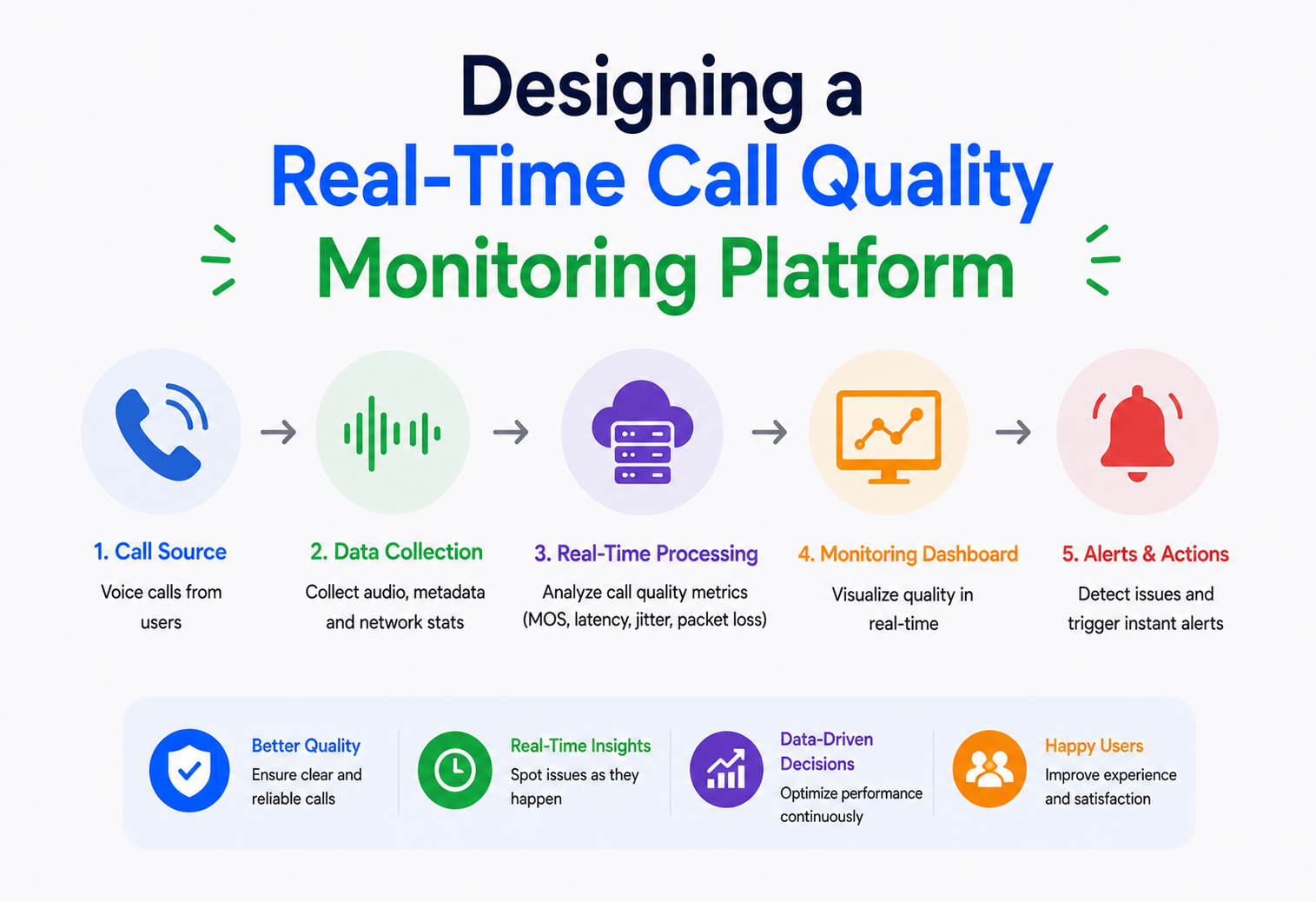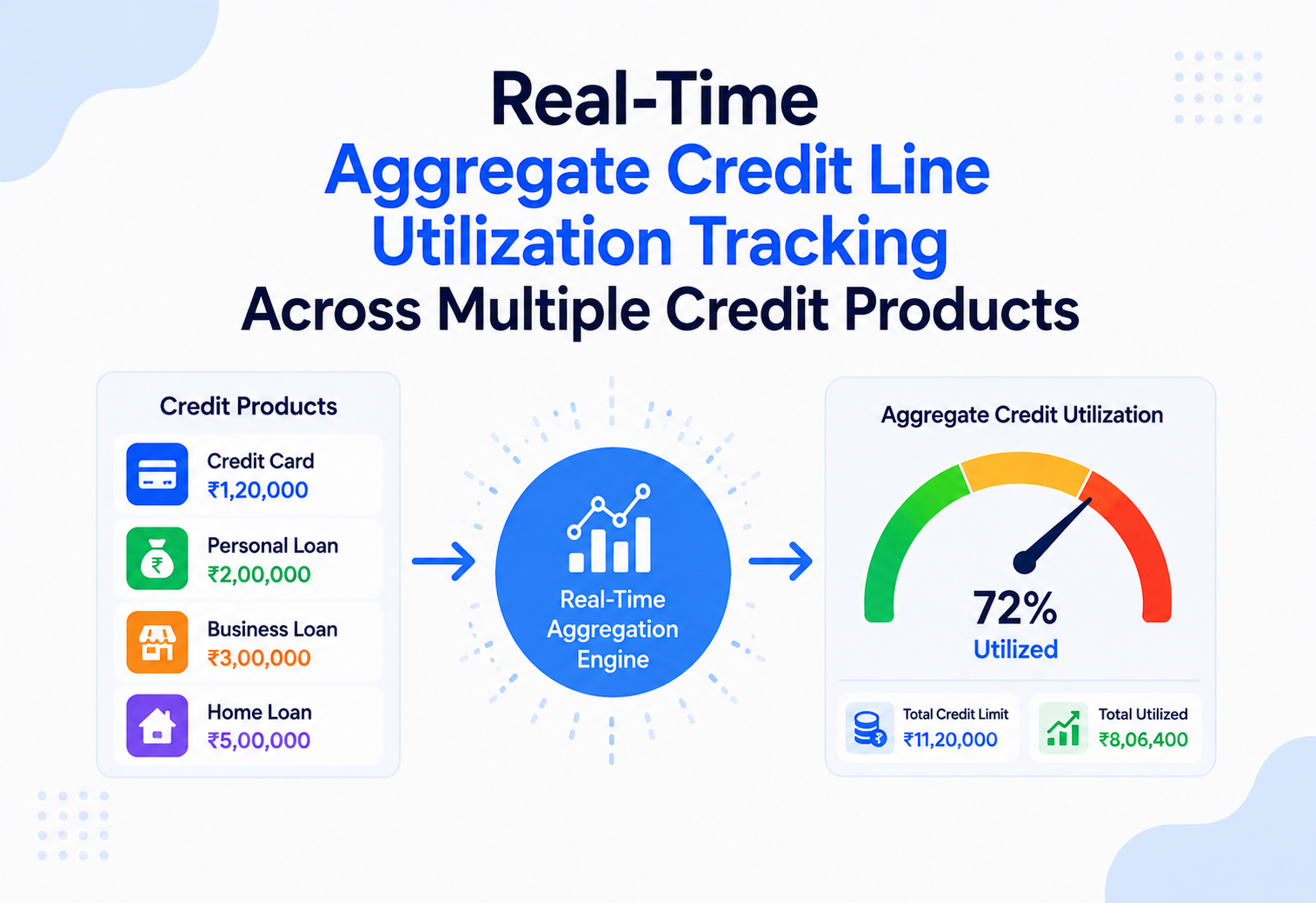
Real-Time Aggregate Credit Line Utilization Tracking Across Multiple Credit Products
A production-grade system design guide for engineers and architects building shared-limit credit enforcement systems at bank scale — covering architecture, concurrency, consistency, resilience, and the patterns that real financial institutions actually use.
Introduction & History
Imagine a customer who holds three products from the same bank — a credit card, a personal line of credit, and a buy-now-pay-later installment plan — and imagine three simultaneous transactions from those three products, all drawing against one shared aggregate credit ceiling. That single scenario is the entire reason this system exists.
Picture the customer sitting in an airport lounge. They open a shopping app and swipe their card for a laptop. At the very same second, an automatic BNPL installment charge fires for a mattress they bought two weeks ago, and a linked line-of-credit transfer moves money to a family member. Three different systems, three different products, three different transaction rails, and yet all three draw from the same underlying promise the bank made: never more than fifty thousand dollars of exposure at once. The bank has decided, based on income, credit bureau data, and risk appetite, that this customer should never owe the bank more than that combined limit — even though each individual product might carry its own smaller sub-limit.
This is the problem that aggregate credit line utilization tracking solves. It is one of the hardest and most quietly important systems inside any modern financial platform, because it sits exactly at the intersection of money movement, correctness, and speed. Get it wrong in one direction and the bank bleeds money by letting customers borrow far beyond what was approved. Get it wrong in the other direction and legitimate transactions get declined, customers get furious, and the bank’s reputation and revenue take a hit. There is no room for eventual consistency when the question is literally “can this person spend this dollar right now.”
Think of a shared family water tank on a rooftop. Three taps in three different bathrooms all draw from it. Each tap has its own maximum flow rate, but the tank itself has a total capacity. If nobody watches the tank in real time, three simultaneous showers can drain it dry — and by the time the next person turns their tap, there is nothing left. The aggregate credit engine is the meter on that tank, checked before any tap is allowed to open.
1.1 From per-product silos to shared ceilings
Historically, credit limit enforcement lived inside each product’s own core banking system. A credit card processor checked the card’s own limit. A personal loan platform checked its own outstanding balance against its own approved ceiling. These systems were built decades apart, often on entirely different technology stacks, sometimes acquired through bank mergers and never truly integrated. For a long time, this was acceptable because most customers held only one product with a given institution, and cross-product exposure was managed loosely through periodic batch reconciliation — sometimes overnight, sometimes only monthly.
Two forces broke that model. The first was the rise of the multi-product financial super-app, where a single fintech or bank offers cards, lines of credit, installment loans, and merchant financing all from one underwriting relationship, with one combined credit decision behind the scenes. The second was the explosion of transaction velocity. When transactions happened at human speed, batch reconciliation was tolerable. When transactions happen at machine speed — with recurring charges, instant transfers, one-click checkout, and API-triggered disbursements — exposure can spike from zero to catastrophic in milliseconds if nothing is watching the aggregate in real time.
1.2 What the modern system looks like
The modern answer is a dedicated aggregate credit utilization tracking system, sometimes called a shared limit engine, a cross-product exposure ledger, or a real-time credit orchestration layer. It sits as a thin, extremely fast, extremely reliable layer above each individual product’s own ledger. Every product, before it commits a transaction that increases the customer’s debt, must ask this central system one question: is there still enough headroom in the aggregate limit to allow this? The system must answer that question correctly even when a dozen products are asking at the exact same instant, and it must answer in single-digit milliseconds because nobody wants to watch a spinner at checkout.
This tutorial walks through how to design such a system from the ground up: the architecture, the concurrency model that prevents a customer from spending the same headroom twice, the data flow across authorization and settlement, the failure modes that matter at bank scale, and the patterns that production systems at large financial institutions actually use.
“Why can’t each product just enforce its own limit independently, with the sum of limits equal to the customer’s approved credit?” A strong answer explains that static per-product sub-limits are simpler but far less capital-efficient and less flexible. If the bank pre-allocates the fifty-thousand-dollar aggregate as fixed slices across three products, an unused slice on one product cannot help a customer who needs headroom on another, which frustrates customers and undersells the bank’s own risk-adjusted capacity. Dynamic aggregate tracking lets the whole limit flex to wherever the customer actually needs it, which is exactly why real institutions build shared, centrally tracked limits instead of static silos.
Architecture & Components
The system is best understood as a small number of tightly scoped services, each with a narrow job, connected by an event backbone and backed by a low-latency data store that acts as the single source of truth for “how much of this customer’s aggregate limit is currently spoken for.”
graph TB
    subgraph Clients["Product Channels"]
        CARD["Card Authorization Network"]
        BNPL["BNPL Installment Engine"]
        LOC["Line of Credit Service"]
        WALLET["Digital Wallet Transfers"]
    end

    subgraph Gateway["Edge Layer"]
        APIGW["API Gateway Auth RateLimit Routing"]
    end

    subgraph Core["Aggregate Exposure Core"]
        ORCH["Credit Orchestration Service"]
        LOCKMGR["Distributed Lock Manager"]
        LEDGER["Real-Time Exposure Ledger"]
        RESV["Reservation Engine Holds and PreAuths"]
        RULES["Limit Rules Engine"]
    end

    subgraph Data["Data Layer"]
        HOTCACHE["In-Memory Balance Cache Sharded By Customer"]
        LEDGERDB["Durable Ledger Store AppendOnly"]
        LIMITSDB["Approved Limits Store"]
    end

    subgraph Async["Event Backbone"]
        BUS["Event Streaming Bus"]
        SETTLE["Settlement Reconciliation Worker"]
        NOTIFY["Notification and Fraud Signal Service"]
    end

    CARD --> APIGW
    BNPL --> APIGW
    LOC --> APIGW
    WALLET --> APIGW
    APIGW --> ORCH
    ORCH --> LOCKMGR
    ORCH --> RULES
    ORCH --> RESV
    RESV --> HOTCACHE
    RESV --> LEDGER
    LEDGER --> LEDGERDB
    RULES --> LIMITSDB
    ORCH --> BUS
    BUS --> SETTLE
    BUS --> NOTIFY
    SETTLE --> LEDGERDB
2.1 API Gateway
Every product channel — whether it is the card network’s authorization message, the BNPL engine’s installment trigger, or the line-of-credit transfer service — enters the system through a single API gateway. The gateway terminates TLS, authenticates the calling service using mutual TLS or signed service tokens, applies per-product rate limiting so a runaway retry loop in one channel cannot starve the others, and routes the request to the Credit Orchestration Service. At million-request-per-minute scale, the gateway is horizontally scaled behind a global load balancer, and it is intentionally kept stateless so any instance can handle any request.
2.2 Credit Orchestration Service
This is the brain of the system. It receives a request that essentially says “customer X wants to increase their exposure by amount Y through product Z,” and it is responsible for orchestrating the sequence of checks and writes needed to answer approve or decline within the tight latency budget. It never owns business rules directly; instead it delegates to the Limit Rules Engine for policy and to the Reservation Engine for the actual balance arithmetic. Its job is coordination, timeout management, and ensuring that partial failures do not leave the system in an inconsistent state.
2.3 Distributed Lock Manager
Because two or more transactions for the same customer can arrive within microseconds of each other from entirely different products, the system needs a way to serialize the check-and-reserve step per customer so that two simultaneous transactions cannot both read the same available headroom and both proceed, together exceeding the limit. The Distributed Lock Manager provides fine-grained, extremely short-lived locks keyed by customer identifier, typically implemented on top of an in-memory data store with atomic compare-and-swap semantics rather than a traditional heavyweight lock service, because the lock must be acquired and released in low single-digit milliseconds.
2.4 Reservation Engine
This component implements the actual hold, or reservation, semantics. When a transaction is authorized, the Reservation Engine does not immediately debit a final balance; it places a reservation against the customer’s available headroom, similar to how a hotel places a hold on a credit card at check-in before the final bill is known. This reservation is what protects the aggregate limit in real time, while the eventual settled amount is reconciled asynchronously once the product-specific system confirms the final transaction amount.
2.5 Real-Time Exposure Ledger
The ledger is the authoritative record of every reservation, settlement, reversal, and adjustment affecting a customer’s aggregate exposure. It is modeled as an append-only event log rather than a single mutable balance row, which gives the system a full audit trail and makes it possible to reconstruct the exact state of exposure at any point in time — a requirement that regulators and internal auditors both demand.
2.6 Limit Rules Engine
Approved aggregate limits are not always a single flat number. Some customers have tiered limits that flex with a promotional period, some have temporary limit increases tied to a verified income change, and some products carry hard sub-caps within the aggregate — for example a rule that no more than twenty percent of the aggregate limit may be drawn through the BNPL product alone. The Limit Rules Engine evaluates these policies quickly, using pre-compiled rule sets cached in memory, so that policy lookups never become the bottleneck.
2.7 In-Memory Balance Cache
The hot path of the system — the actual “does the customer have headroom right now” check — is served from an in-memory cache sharded by customer identifier, so that the working set for any single customer’s exposure fits comfortably in memory and the check-and-reserve operation avoids a disk round trip on the critical path. The cache is kept consistent with the durable ledger through write-through semantics: every reservation writes to the cache and asynchronously, but very quickly, to durable storage.
2.8 Event Backbone
Once a reservation decision has been made, the system publishes an event onto a streaming bus. Downstream consumers, including the settlement reconciliation worker and the fraud and notification service, react to these events asynchronously. This keeps the synchronous, latency-critical path as thin as possible: authorize, reserve, respond, and let everything else happen off the hot path.
API Gateway
Single, stateless entry point per region. Terminates TLS, authenticates callers with mTLS, enforces per-product quotas, and routes to the orchestration service.
Orchestration Service
The coordinator. Owns timeouts, sequencing, and failure boundaries. Delegates policy to Rules, arithmetic to Reservations.
Distributed Lock Manager
Fine-grained, per-customer, lease-based locks — acquired and released in single-digit milliseconds.
Reservation Engine
Places holds against headroom, tracks expiries, converts reservations into settlements once product systems confirm.
Exposure Ledger
Append-only event log per customer. Enables audit, replay, and point-in-time reconstruction.
Rules Engine
Evaluates aggregate limits, sub-caps, tiered offers, and promotional overlays from a pre-compiled rule set.
In-Memory Balance Cache
Sharded by customer_id. Write-through semantics to the durable ledger keep the hot path off disk.
Event Backbone
Streaming bus feeding settlement reconciliation, fraud signals, and notifications off the critical path.
“Why is a distributed lock manager necessary instead of relying purely on database-level atomic operations?” A good answer notes that a single atomic compare-and-swap on one balance row can, in isolation, prevent overspend for a single simple case, but real systems need to combine that atomic balance check with additional multi-step logic — such as evaluating sub-limits, applying velocity rules, and writing to the ledger — and doing all of that as one logically atomic unit across services benefits from an explicit short-lived lock so the whole sequence appears atomic to competing transactions, not just the final balance write.
2.9 Core Data Structures Behind Each Component
Beneath the service boundaries described above sit a handful of deliberately chosen data structures, and the choice of each one matters enormously at this scale.
The in-memory balance cache is, at its simplest level, a hash map keyed by customer identifier, mapping to a small structured record containing current aggregate exposure, the approved limit snapshot, and a version number used for optimistic validation during replication. A plain hash map alone is not sufficient, however, because the system also needs to efficiently find and expire reservations that have outlived their expected settlement window. For this, the Reservation Engine maintains a secondary structure — typically a time-ordered priority queue or a skip list keyed by expiry timestamp — allowing the background expiry sweep to efficiently pop only the reservations whose time has come rather than scanning every active reservation on every sweep cycle.
The durable exposure ledger is modeled as an append-only log, conceptually a linked sequence of immutable events per customer partition, which is exactly the data structure that makes replay, audit, and point-in-time reconstruction efficient: to know a customer’s exposure at any historical moment, the system folds, in order, every event up to that point — an operation that is naturally expressed as a left fold over the event sequence rather than a mutable running total that discards history.
The distributed lock manager, discussed in depth in the concurrency section below, is commonly implemented as a set of atomic key-value entries with an attached time-to-live, using the underlying store’s native atomic compare-and-swap or “set if not exists” primitive as the fundamental building block, rather than any heavier general-purpose distributed coordination service — precisely because the latency budget for lock acquisition is measured in single-digit milliseconds.
Internal Working
To understand the internal working, walk through what happens in the few milliseconds between a customer tapping their card and the terminal showing approved. Every step below runs inside a tight budget, and every step has a specific purpose in the correctness proof.
Request Normalization
The card network sends an authorization message to the gateway. The gateway translates this network-specific message format into a normalized internal request containing the customer identifier, the product identifier, the requested amount, and a unique idempotency key generated by the originating product system. This idempotency key is critical, because network retries are common, and the system must never double-reserve headroom because the same authorization message was retried after a slow response.
Idempotency Check
Before doing anything else, the Credit Orchestration Service checks whether this idempotency key has already been processed. This check is served from the same fast in-memory layer as the balance cache, so it costs almost nothing in latency while completely eliminating an entire category of duplicate-reservation bugs.
Acquire Customer Lock
The orchestration service asks the Distributed Lock Manager for a short-lived lock on the customer identifier. This lock typically has a lease of a few hundred milliseconds and is automatically released either when the orchestration service explicitly releases it after completing the reservation, or when the lease expires — which protects the system against a crashed instance holding a lock forever.
Read Current Exposure
With the lock held, the system reads the customer’s current aggregate exposure from the in-memory balance cache: the sum of all active reservations and settled balances across every product. This read is guaranteed, by virtue of the lock, to be free of races with any other transaction for the same customer.
Evaluate Rules
The Limit Rules Engine checks the requested amount against the aggregate approved limit minus current exposure, and also against any applicable product-specific sub-caps. If the customer is comfortably within all limits, the request proceeds. If the request would breach the aggregate limit or a sub-cap, it is declined immediately, still inside the lock, so no other transaction can slip through in the gap.
Write Reservation
If approved, the Reservation Engine writes a new reservation record to the append-only ledger and updates the in-memory cached balance to reflect the new, higher exposure. Only after this write is confirmed does the system release the customer lock.
Respond and Emit Event
The orchestration service returns an approve or decline response to the calling product channel, and asynchronously publishes an event describing the reservation onto the event bus for downstream consumers such as fraud scoring and customer notifications.
sequenceDiagram
    participant Product as Product Channel
    participant GW as API Gateway
    participant ORCH as Orchestration Service
    participant LOCK as Lock Manager
    participant CACHE as Balance Cache
    participant RULES as Rules Engine
    participant LEDGER as Ledger Store

    Product->>GW: Authorization request plus idempotency key
    GW->>ORCH: Normalized request
    ORCH->>ORCH: Check idempotency key
    ORCH->>LOCK: Acquire lock for customer id
    LOCK-->>ORCH: Lock granted
    ORCH->>CACHE: Read current exposure
    CACHE-->>ORCH: Exposure snapshot
    ORCH->>RULES: Evaluate aggregate and sub caps
    RULES-->>ORCH: Approve or Decline
    alt Approved
        ORCH->>LEDGER: Write reservation event
        ORCH->>CACHE: Update cached balance
    end
    ORCH->>LOCK: Release lock for customer id
    ORCH-->>GW: Decision response
    GW-->>Product: Approve or Decline
“What happens if the service crashes after writing the ledger record but before releasing the lock?” The correct answer is that the lock is leased with a short time-to-live, not held indefinitely, so a crashed instance’s lock simply expires within a few hundred milliseconds and other transactions can proceed. Because the ledger write is idempotent and keyed by the idempotency key, even if a retry occurs after the crash, the system recognizes the already-completed reservation and does not double count it — which is why idempotency and lock leasing are designed together rather than in isolation.
Concurrency Control & Distributed Systems Theory Deep Dive
Because the entire value of this system rests on correctly serializing competing updates to the same customer’s exposure, it is worth stepping back and examining the underlying distributed systems theory that justifies the design choices made above, rather than treating them as arbitrary engineering preferences.
4.1 The CAP Theorem and Where This System Sits
The CAP theorem states that a distributed system experiencing a network partition must choose between consistency and availability, since it cannot guarantee both simultaneously during the partition. Most consumer-facing systems — a social media feed or a product catalog — lean toward availability, happily serving slightly stale data rather than refusing to respond. An aggregate credit exposure system makes the opposite choice for its core write path: during a confirmed partition that prevents the authoritative shard for a customer from being reliably reached, the system prefers to reject or delay a transaction rather than risk approving it against potentially stale exposure data, because the cost of an incorrect approval — real money lent that should not have been — vastly outweighs the cost of a temporarily declined transaction that the customer can simply retry moments later. This is a deliberate, consistency-favoring position within the CAP trade-off space, and it is the correct one for this specific domain even though it would be the wrong choice for many other systems.
4.2 Consensus and Leader Election
To safely determine which region is authoritative for a given customer’s shard at any moment, particularly during failover, the system relies on a consensus protocol conceptually similar to Raft or Paxos, among a small quorum of coordinator nodes. Consensus guarantees that even if some nodes are slow, crashed, or temporarily partitioned, the surviving majority can still agree on exactly one authoritative leader for each shard — and critically, that two different leaders can never simultaneously believe they are authoritative for the same shard, which is the precise guarantee needed to prevent the split-brain double-approval scenario discussed earlier.
4.3 Fencing Tokens
Consensus alone is not quite sufficient in practice, because a leader that has already lost its leadership — for example due to a slow garbage collection pause — may not immediately realize it and could still attempt to write. The system therefore attaches a monotonically increasing fencing token to every leadership term, and the durable store rejects any write carrying a fencing token older than the highest token it has already seen, providing a second, storage-layer line of defense against a stale leader accidentally corrupting state even after it has technically been replaced.
4.4 Replication Strategy
Within a single region, the balance cache and lock manager use synchronous replication to at least one standby replica, meaning a write is not acknowledged as successful until the standby has also durably received it, which guarantees no committed reservation is ever lost to a single node failure. Across regions, replication is asynchronous, since requiring synchronous acknowledgment across a long-haul network link would make the latency budget for every single transaction impossible to meet. This tiered replication strategy — synchronous locally and asynchronous globally — is a common and pragmatic pattern across latency-sensitive financial systems, accepting a small, bounded window of potential data loss only in the rare case of a full regional failure, while guaranteeing zero data loss for the vastly more common single-node failure scenario.
4.5 Partitioning and the Choice of Partition Key
The decision to partition every piece of state by customer identifier — rather than, for example, by product type or by geographic region of the transaction — is the single most consequential partitioning decision in the whole design. Partitioning by customer identifier guarantees that every operation requiring strong consistency, which is exactly the set of operations touching one customer’s exposure, always stays within a single partition, meaning the system never needs a distributed transaction spanning multiple partitions on the hot path. Had the system instead partitioned by product type, a single customer transaction touching their combined exposure across three products would require a genuinely distributed transaction across three partitions, which is dramatically harder to make both fast and correct.
4.6 Two-Phase Commit versus the Saga Pattern
For the rare cases where a single logical operation truly must touch more than one partition — for example a large one-time limit reallocation affecting several customers within a shared corporate credit facility — the system avoids classic two-phase commit, which requires a coordinator to hold locks across every participant for the full duration of the transaction and is notorious for poor availability if the coordinator or any participant is slow. Instead, such rare cross-partition operations are modeled as a saga: a sequence of local transactions, each with a well-defined compensating action that can undo it, coordinated by an orchestrator that can safely retry or roll back the whole sequence if any individual step fails — trading strict atomicity for much better availability and much simpler failure recovery.
4.7 Optimistic Locking as a Complementary Technique
While the primary reservation path uses pessimistic locking, certain lower-contention operations — such as updating a customer’s cached profile-level rule configuration — use optimistic locking instead, attaching a version number to each record and rejecting a write if the version has changed since it was read, then retrying. This mixed strategy — pessimistic where contention is expected and correctness is critical, optimistic where contention is rare and retries are cheap — reflects a broader principle: the concurrency control mechanism should be chosen per operation based on its actual contention profile, not applied uniformly across an entire system.
“Explain why this system favors consistency over availability during a network partition, and what that costs the business.” A complete answer explicitly connects the choice back to the CAP theorem, acknowledges the real cost — some transactions will be declined or delayed during a partition that a more available system would have simply approved against stale data — and explains why that cost is acceptable here specifically because the alternative failure mode, approving exposure the institution never actually agreed to, carries direct, quantifiable financial loss and regulatory risk that a temporarily inconvenienced customer does not.
Data Flow & Lifecycle
A single unit of credit exposure moves through several distinct states over its lifetime — requested, reserved, settled, and eventually either released or written off. Understanding this lifecycle is essential because the aggregate exposure the system protects is not simply “total settled debt,” it is the sum of everything that could still become debt.
5.1 Authorization and Reservation
The lifecycle begins the moment a product channel asks whether a transaction can proceed. If approved, a reservation is created holding that amount against the aggregate limit. This is analogous to how a restaurant places a temporary hold for an estimated bill amount before the final tip-adjusted charge is known.
5.2 Settlement
Some time later — ranging from milliseconds for an instant transfer to several days for a card transaction that clears through the network — the product system reports the final settled amount. The Settlement Reconciliation Worker consumes this event, converts the reservation into a settled ledger entry, and adjusts the aggregate exposure if the settled amount differs from the originally reserved amount, which commonly happens with tips, currency conversion, or partial fulfillment.
5.3 Reversal and Expiry
Reservations are not permanent. If a transaction is declined downstream by the product’s own fraud checks after the aggregate system already approved it, or if a hold simply expires because the merchant never captured it, the reservation must be released back into available headroom. The system uses a combination of explicit reversal events published by product channels and a background expiry sweep that automatically releases any reservation that has outlived its expected settlement window — which protects customers from having phantom holds silently eat into their available credit forever.
5.4 Adjustments and Write-offs
Occasionally an adjustment is needed outside the normal transaction flow: a dispute is resolved in the customer’s favor, a fee is waived, or a balance is written off after a collections process concludes. These flow through the same ledger as first-class, fully audited events rather than as silent balance edits, preserving the append-only guarantee that makes the ledger trustworthy for audits.
| Lifecycle State | Description | Effect on Aggregate Exposure |
|---|---|---|
| Requested | Product channel asks for authorization | No effect until decision is made |
| Reserved | Approved, hold placed against headroom | Increases exposure immediately |
| Settled | Final amount confirmed by product system | Exposure adjusted to settled amount |
| Reversed / Expired | Hold released without settlement | Exposure decreases back to prior level |
| Written off | Balance formally removed as uncollectible | Removed from active exposure, retained in ledger history |
Large card issuers commonly hold an authorization for several days even though the actual purchase amount might differ slightly at settlement — for example when a hotel authorizes an estimated total and later settles the exact amount including incidentals. Aggregate exposure systems must account for this settlement drift explicitly, rather than assuming the reserved amount and the settled amount will always match exactly.
5.5 A Worked Example Through the Lifecycle
Consider a customer with a fifty-thousand-dollar aggregate approved limit who currently has twelve thousand dollars of settled balance across their card and line-of-credit products. A new card authorization for eight hundred dollars arrives at a coffee shop chain’s point-of-sale terminal. The aggregate system computes current exposure at twelve thousand dollars, confirms eight hundred dollars fits comfortably within the remaining thirty-eight thousand dollars of headroom, and creates a reservation, bringing tracked exposure to twelve thousand eight hundred dollars. Three days later, the card network reports final settlement at exactly eight hundred dollars — no tip adjustment in this case — and the reservation transitions cleanly to a settled ledger entry with no exposure change.
Contrast this with a restaurant transaction where an initial reservation of one hundred dollars is placed, but the final settled amount including a gratuity comes in at one hundred eighteen dollars; the Settlement Reconciliation Worker detects this eighteen-dollar increase and atomically adjusts the customer’s tracked exposure upward by that difference at settlement time, ensuring the aggregate ledger always converges to the true settled reality once every product reports back, no matter how the intermediate reservation was originally estimated.
Advantages, Disadvantages & Trade-offs
Centralized aggregate tracking is not a free architectural upgrade — it delivers real benefits in exchange for real costs, and part of designing this system well is being honest about both sides of that ledger.
Advantages
- Capital efficiency: the bank’s total approved exposure can flow to wherever the customer actually needs it instead of being trapped in unused per-product silos.
- Consistent risk enforcement: a single source of truth means the bank never accidentally allows more exposure than its own risk models approved, regardless of which product initiated the transaction.
- Simplified customer experience: customers see one combined available credit figure rather than confusing, disconnected per-product numbers that do not reflect their true borrowing power.
- Regulatory defensibility: a single, auditable, append-only ledger of exposure changes is far easier to defend during a regulatory exam than reconciling numbers scattered across independent product ledgers.
Disadvantages
- Added latency in every product’s transaction path, since every product must now make a network call to a central service instead of checking a local balance.
- A single point of systemic risk: if the aggregate tracking system is unavailable, every product that depends on it for authorization may be forced to either block transactions entirely or fall back to riskier, more permissive local checks.
- Significant engineering complexity in achieving both strict correctness and very low latency simultaneously, which are often competing goals.
- Organizational complexity: multiple product teams, each with their own roadmap and their own on-call rotation, must integrate against one shared contract, which requires strong platform ownership and governance.
6.1 Trade-off: Strict Locking vs Optimistic Concurrency
A pessimistic per-customer lock, as described earlier, guarantees correctness at the cost of some latency and a small amount of contention when a customer genuinely has many simultaneous transactions in flight. An alternative is optimistic concurrency, where the system reads the balance without a lock, computes the new balance, and writes it back only if the balance has not changed since the read, retrying on conflict. Optimistic concurrency scales better under low contention but degrades badly under high contention — which happens to be exactly the adversarial scenario (such as coordinated fraud attempts) that the system most needs to protect against. For this reason, most production aggregate exposure systems favor short, fast pessimistic locks per customer rather than optimistic concurrency for the core reservation path.
6.2 Trade-off: Synchronous Settlement vs Asynchronous Settlement
Settling every transaction synchronously — updating the ledger to its final state before responding to the product channel — would be simpler to reason about but is not feasible given that true settlement amounts for many products are not known for days. Asynchronous settlement, where the hot path only creates a reservation and the true settlement is reconciled later, is the only workable design, but it introduces the complexity of reconciliation logic and the need to handle settlement amounts that differ from reservation amounts.
“How would you handle a scenario where the central aggregate system is completely down, but a product channel absolutely must respond to a transaction within a few hundred milliseconds?” Strong candidates describe a carefully bounded degraded mode: each product channel maintains a small locally cached, conservative estimate of remaining headroom, refreshed frequently, and falls back to that local estimate with a tighter safety margin only during confirmed central-system outages, while flagging every such transaction for asynchronous reconciliation the moment the central system recovers — rather than either blocking all transactions or allowing unlimited local approval.
6.3 Trade-off: Centralized Rules Engine vs Per-Product Rule Logic
Centralizing all limit-related business rules inside a single shared Rules Engine ensures consistent policy enforcement across every product and makes it possible to reason about a customer’s complete risk picture in one place, but it also means every product team must express their own product-specific sub-cap logic through a shared, necessarily somewhat generic rules configuration language rather than freely writing arbitrary custom code, which can feel restrictive to a product team with an unusual, highly specific requirement. Institutions that get this trade-off right typically invest in making the shared rules configuration language expressive enough to cover the large majority of legitimate product-specific needs, while maintaining a deliberately high bar and a formal review process for any request to extend that language further — preventing the rules engine from slowly accumulating so much special-case complexity that it becomes as fragile and hard to reason about as the fragmented per-product logic it was designed to replace.
Performance & Scalability
At the scale of a large financial platform, this system must sustain millions of authorization requests per minute across peak shopping periods, with p99 latency requirements typically under fifty milliseconds end to end — and the truly latency-critical inner check-and-reserve step budgeted in the single-digit milliseconds.
7.1 Sharding by Customer Identifier
The single most important scalability decision is sharding all state — both the in-memory balance cache and the distributed lock manager — by customer identifier using consistent hashing. Because no cross-customer coordination is ever required, this shards near-linearly: adding more nodes proportionally increases throughput with no coordination overhead between shards.
7.2 Hot Key Mitigation
A small number of customers, particularly commercial or high-net-worth accounts with very high transaction velocity, can create hot keys that overwhelm a single shard. The system mitigates this with adaptive load shedding on a per-key basis and, for known extremely high-velocity accounts, dedicated shard assignment so their traffic does not degrade the shared pool.
7.3 Read-Heavy vs Write-Heavy Optimization
The check-and-reserve path is both a read — current exposure — and a write — new reservation — on every single request, making this workload genuinely write-heavy rather than read-heavy, unlike many systems that can lean on read replicas and caching alone. This is why the in-memory cache is designed with write-through semantics directly on the hot path rather than a read-through cache pattern that would be more common in read-dominated systems.
7.4 Batching and Connection Pooling
Durable ledger writes are batched in small time windows, typically single-digit milliseconds, using a write-ahead buffer, which dramatically reduces the number of discrete disk-bound operations without meaningfully increasing perceived latency, since the batching window is far smaller than network round-trip time. Connection pools to the durable store are pre-warmed and sized based on observed peak concurrency rather than default framework values — which is a common and costly oversight in real deployments.
7.5 Capacity Planning
Capacity planning uses Little’s Law: the number of concurrent in-flight requests equals arrival rate multiplied by average time in system. Given a target of millions of requests per minute and a latency budget of tens of milliseconds, engineers compute the required concurrency and provision shard count and connection pool sizes with meaningful headroom above modeled peak, plus additional headroom reserved specifically for flash-sale and holiday-season traffic spikes that exceed typical seasonal patterns.
Large digital wallet providers processing instant peer-to-peer transfers design their balance-check services around sub-ten-millisecond p99 latency targets specifically because their own product experience promises instant transfers, and any latency in the underlying exposure check directly shows up as visible lag in the customer-facing app.
“How do you prevent a single very active customer from becoming a bottleneck for everyone else?” The expected answer covers per-key rate limiting and adaptive load shedding scoped to the individual customer’s shard, combined with dedicated shard placement for known high-velocity accounts, so that one customer’s transaction volume is isolated from the latency experienced by the rest of the customer base.
7.6 Latency Budget Breakdown
A useful exercise when designing this system is to explicitly allocate the end-to-end latency budget across each hop, rather than only setting a single aggregate target. A typical breakdown for a fifty-millisecond total budget might allocate roughly five milliseconds to network transit between the calling product channel and the gateway, five milliseconds for gateway authentication and routing, ten milliseconds for lock acquisition under moderate contention, ten milliseconds for the balance read and rules evaluation, ten milliseconds for the reservation write and cache update, and the remaining budget as headroom for tail latency variance and the return trip. Making this breakdown explicit during design review forces the team to identify which specific hop is most at risk of consuming more than its fair share under load, well before that becomes a production incident.
| Hop | Budget (ms) | Dominant Cost |
|---|---|---|
| Client to gateway network | ~5 | Physical distance + TLS handshake |
| Gateway auth & routing | ~5 | mTLS validation, quota lookup |
| Lock acquisition | ~10 | Contention on same-customer transactions |
| Balance read + rule eval | ~10 | Cache lookup + rule evaluation |
| Reservation write + cache update | ~10 | Write-through to durable ledger |
| Return trip + headroom | ~10 | Tail latency variance |
7.7 Backpressure and Overload Protection
Even a well-sharded, well-provisioned system can be pushed beyond its safe operating capacity during an unexpected traffic spike, a coordinated fraud attempt, or a downstream dependency slowdown. The orchestration service implements backpressure using bounded request queues and load shedding, rejecting new requests with a clear, fast “system busy, retry shortly” response once queue depth crosses a defined threshold, rather than accepting unbounded work and allowing every in-flight request to slow down together until the entire service becomes unresponsive. This is a deliberate trade — sacrificing some requests explicitly and predictably to protect the latency and correctness of the requests the system does accept — which is a far better outcome for both the business and the customer than an uncontrolled, unpredictable collapse.
7.8 Retry Storms and Jitter
When the aggregate system experiences even a brief slowdown, every product channel waiting on a response may retry simultaneously the moment their own timeout expires, and if every client uses the same fixed retry interval, this creates a retry storm that can turn a brief, minor slowdown into a sustained overload. The system mitigates this by requiring every calling product channel to implement exponential backoff with randomized jitter on retries, spreading retry attempts out over time rather than allowing them to synchronize — a small client-side discipline that meaningfully protects the shared infrastructure during exactly the moments it is most vulnerable.
High Availability & Reliability
Because this system sits on the critical path of money movement, its uptime is directly the uptime of every product it serves — and every design decision below exists to keep the failure blast radius small, well understood, and recoverable.
8.1 Multi-Region Active-Active Design
Because this system sits on the critical path of money movement, a regional outage cannot be allowed to halt transaction authorization entirely. Production designs typically run active-active across at least two geographic regions, with each customer’s shard pinned to a home region for writes, and cross-region asynchronous replication of the durable ledger to allow rapid failover.
8.2 Failover and Split-Brain Prevention
During a regional failover, the system must guarantee that the same customer’s lock and reservation state is never active in two regions simultaneously, since that would reintroduce the exact double-spend problem the system exists to prevent. This is achieved with a consensus-backed leader election per shard, so only one region is ever authoritative for a given customer’s write path at a time, with automatic and fast — but not instantaneous — handoff during a detected regional failure.
8.3 Idempotency as a Reliability Mechanism
Idempotency keys, introduced earlier for correctness, also serve as a critical reliability mechanism. When a product channel experiences a timeout waiting for a response, it must retry, and the idempotency layer guarantees that retry is safe regardless of whether the original request actually succeeded, failed, or is still in flight — which removes an entire category of ambiguous failure handling from every calling product team.
8.4 Graceful Degradation
The system defines explicit degraded modes rather than a single binary up-or-down state. If the durable ledger store is temporarily unreachable but the in-memory cache and lock manager remain healthy, the system can continue authorizing transactions while queuing ledger writes for replay, accepting a small, bounded window of durability risk in exchange for continued availability — a decision made deliberately and documented, not accidentally discovered during an incident.
8.5 Disaster Recovery
Beyond regional failover, the system maintains point-in-time recoverable backups of the durable ledger and regularly tested recovery runbooks, because the ledger is not just an operational data store — it is a legally significant financial record that must be recoverable even from a catastrophic, low-probability event affecting an entire cloud provider region.
“How do you prevent split-brain during a failover where both regions briefly believe they are authoritative for the same customer?” A well-prepared answer describes consensus-based leader election per shard, fencing tokens attached to every write so a stale leader’s writes are rejected by the durable store even if it briefly believes it is still authoritative, and a deliberate preference for briefly rejecting transactions over risking a double-approval during the ambiguous handoff window.
8.6 Chaos Engineering and Failure Injection
Because the failure modes that matter most for this system — a mid-transaction node crash, a slow but not fully failed downstream dependency, a partial network partition between two regions — are precisely the failure modes that are hardest to reproduce through ordinary testing, mature teams operating systems like this run regular, deliberate chaos engineering exercises against production or a production-equivalent environment. These exercises intentionally kill individual nodes, inject artificial network latency between regions, and simulate a downstream dependency returning slow or malformed responses, verifying that the system’s documented degraded-mode behavior actually occurs as designed rather than only as described in an architecture document that nobody has actually validated under real conditions.
8.7 Runbook Discipline and On-Call Readiness
Given the financial and reputational stakes of an incident affecting this system, on-call engineers are supported by detailed, regularly rehearsed runbooks covering the most likely failure scenarios: a regional failover, a durable ledger store slowdown, an unexpected spike in lock contention for a specific customer segment, and a sudden rise in decline rate that might indicate either a genuine limit-related issue or a bug in the rules engine. These runbooks are treated as living documents, updated after every real incident and periodically rehearsed through simulated exercises, rather than written once and left to grow stale.
8.8 Recovery Time and Recovery Point Objectives
The platform team sets explicit recovery time objectives — how quickly service must be restored after a failure — and recovery point objectives — how much recent data can acceptably be lost — for each failure category the system anticipates. A single-node failure within a region typically carries a recovery time objective measured in seconds, thanks to synchronous local replication, and a recovery point objective of zero, since no committed write is ever lost. A full regional outage carries a longer recovery time objective, typically a small number of minutes to allow consensus-based failover to complete safely, and a small but non-zero recovery point objective bounded by the asynchronous cross-region replication lag — a trade-off that is explicitly documented, communicated to every dependent product team, and factored into their own resilience planning rather than left as an undocumented, implicit assumption.
| Failure Category | Typical RTO | Typical RPO |
|---|---|---|
| Single node in a region | Seconds | Zero (sync local replication) |
| Full regional outage | A few minutes | Bounded by async cross-region lag |
| Durable store slowdown | Seconds (degraded mode) | Bounded queued-write window |
Security
A system that decides in real time how much money can be lent is inherently a high-value target — for external attackers and, less obviously, for insider misuse. Security here is not a feature layered on top; it is baked into every boundary, key, and decision path.
9.1 Authentication and Authorization Between Services
Every product channel calling into the aggregate system authenticates using mutual TLS certificates issued and rotated by an internal certificate authority, combined with short-lived signed service tokens carrying scoped permissions, so that a compromised credential from one product channel cannot be used to impersonate another product or to bypass the aggregate limit checks entirely.
9.2 Data Protection
Customer identifiers and monetary amounts flowing through the system are encrypted in transit using TLS and encrypted at rest using envelope encryption with keys managed by a dedicated key management service, with strict field-level access controls so that engineers debugging the orchestration service do not have blanket access to raw customer financial data.
9.3 Fraud and Abuse Signals
The event bus feeds a real-time fraud signal service that watches for suspicious patterns specifically enabled by the aggregate model — such as an attacker rapidly probing multiple product channels in sequence to discover the exact remaining headroom before executing a coordinated multi-product attack designed to extract maximum value before detection.
9.4 Regulatory Compliance
The system is designed with PCI DSS scope minimization in mind, keeping raw card numbers entirely outside the aggregate exposure system’s boundary and instead operating only on tokenized references, and it maintains full auditability to satisfy regulations that require financial institutions to demonstrate exactly how and why every credit decision was made — including the ability to reconstruct the exact aggregate exposure state at any historical point in time.
9.5 Least Privilege and Internal Threat Modeling
Internal access to override or manually adjust a customer’s ledger is restricted to a small, audited set of operational tools, every manual adjustment requires dual authorization from two separate employees, and every such action is itself written as a fully attributed ledger event — treating insider risk with the same seriousness as external attack risk.
“What specific new attack surface does aggregating limits across products introduce compared to isolated per-product limits?” The strongest answers point out that aggregation creates an incentive and an opportunity for attackers to fan out a single stolen identity across multiple product channels simultaneously to extract the full aggregate limit before any single product’s own fraud detection has time to notice — which is exactly why real-time cross-product velocity and pattern signals, not just per-product fraud scoring, are essential companions to the aggregate exposure system itself.
9.6 Secure Software Development Lifecycle
Because this system directly enforces financial risk controls, every code change touching the reservation, locking, or rules evaluation logic goes through mandatory security-focused code review in addition to ordinary functional review, static analysis tooling tuned to flag suspicious patterns such as unguarded balance mutations, and a dedicated pre-production environment where changes are validated against a comprehensive suite of concurrency and correctness tests before ever reaching production traffic.
9.7 Threat Modeling for the Reservation Path
A structured threat model for this system explicitly considers scenarios including a malicious or compromised product channel attempting to submit forged authorization requests, an internal actor attempting to manipulate rule configuration to grant themselves or an accomplice inflated credit exposure, and a sophisticated external attacker attempting to exploit timing differences between the aggregate check and each product’s own local processing to slip a transaction through during a narrow, otherwise-undetectable window. Each identified threat is paired with a specific, documented mitigation, and the threat model itself is revisited whenever a new product channel or a significant architectural change is introduced.
9.8 Key Management and Rotation
Encryption keys protecting customer financial data at rest are rotated on a defined schedule and immediately upon any suspected compromise, with the key management service maintaining a full history of prior key versions so that historical ledger entries encrypted under an older key remain readable, and access to key rotation and revocation controls is itself restricted and audited with the same rigor applied to the ledger data those keys protect.
Monitoring, Logging & Metrics
You cannot operate a system this sensitive by watching aggregate dashboards alone — the metrics that matter are the ones tied directly to correctness, contention, and customer-visible outcome.
10.1 Golden Signals
The system tracks latency, traffic, error rate, and saturation for the check-and-reserve path specifically, with p50, p95, and p99 latency dashboards broken out by product channel, since a latency regression affecting only one product channel can otherwise hide inside an aggregate average that still looks healthy.
10.2 Business-Level Metrics
Beyond infrastructure metrics, the system tracks decline rate by reason code, lock contention rate per customer segment, and reservation-to-settlement drift — the difference between reserved and eventually settled amounts — since a sudden rise in drift can indicate either a product integration bug or a shift in fraud patterns worth investigating.
10.3 Distributed Tracing
Every request carries a trace identifier propagated across the gateway, orchestration service, lock manager, rules engine, and ledger store, allowing engineers to reconstruct the exact path and timing of any individual transaction, which is essential both for debugging latency regressions and for responding to a specific customer dispute about why a transaction was declined.
10.4 Alerting and Anomaly Detection
Alerts are tuned around leading indicators rather than only lagging ones: rising lock wait times, an uptick in idempotency key collisions suggesting retry storms, and unusual spikes in decline rate for a specific product channel all trigger investigation before they escalate into customer-visible incidents.
10.5 Audit Logging
Every decision, approve or decline, is logged with the full evaluated context, including which specific rule caused a decline, both for regulatory audit purposes and to allow customer support teams to explain a decline to a confused customer without needing to escalate to engineering.
Large card networks and issuers maintain detailed decline-reason taxonomies, distinguishing an aggregate-limit decline from a fraud-hold decline or a product-specific sub-cap decline, because customer support scripts and regulatory reporting both depend on being able to state the precise reason a transaction was not approved.
10.6 Service Level Objectives and Error Budgets
The platform team responsible for this system defines explicit service level objectives — for example ninety-nine point nine nine percent of authorization requests completing successfully within the defined latency budget over a rolling thirty-day window — and tracks the corresponding error budget consumption closely. When the error budget for a given period is nearly exhausted, the team deliberately shifts priority away from new feature work and toward reliability improvements, a discipline that keeps reliability from being perpetually deprioritized in favor of the next product integration, which is a common failure pattern in less mature organizations.
Deployment & Cloud
A system on the money-movement path cannot be deployed the same casual way a stateless read service can — every deployment choice, from rollout speed to environment parity, exists to protect state that must not be dropped mid-transaction.
11.1 Deployment Topology
The stateless services — gateway, orchestration, and rules engine — are deployed as independently scalable container fleets behind regional load balancers, using rolling or canary deployments so a bad release affects only a small percentage of traffic before automated rollback triggers on elevated error rates.
11.2 Infrastructure as Code
The entire topology, including shard counts, cache cluster sizing, and cross-region replication configuration, is defined declaratively and version controlled, so that disaster recovery in a new region is a matter of running a known, tested deployment pipeline rather than manual reconstruction under pressure.
11.3 Blue-Green and Canary Releases for Stateful Components
The lock manager and balance cache require particular care during deployment, since they hold transient but critical state. Production systems typically use rolling node replacement with graceful draining, ensuring in-flight locks are allowed to complete or expire naturally before a node is removed from the cluster, rather than a hard cutover that could drop active locks mid-transaction.
11.4 Multi-Cloud and Vendor Lock-In Considerations
Given the criticality of this system, some institutions deliberately design the durable ledger store and event bus around open, portable technologies rather than a single cloud vendor’s proprietary managed service, accepting some operational overhead in exchange for the ability to migrate or run active-active across cloud providers if a single vendor experiences a prolonged outage.
“Would you deploy the lock manager as a fully managed cloud service or self-host it?” A thoughtful answer weighs the operational simplicity of a managed service against the criticality and latency sensitivity of this specific component, noting that many institutions choose to self-host or run a carefully tuned managed offering with reserved, non-shared capacity specifically for the lock manager, because noisy-neighbor latency variance in a shared managed tier is unacceptable for a component sitting on the critical authorization path.
11.5 Environment Parity and Pre-Production Validation
Given how sensitive this system is to concurrency behavior specifically, teams invest heavily in keeping pre-production environments genuinely representative of production, including realistic multi-node cache clusters and lock manager topology rather than simplified single-node substitutes — because many of the correctness bugs that matter most in this domain, race conditions and lock contention edge cases, simply do not manifest in a simplified, low-concurrency test environment and would otherwise only be discovered for the first time under real production load.

Databases, Caching & Load Balancing
The data-tier choices below flow directly from the two hard constraints the system operates under: sub-ten-millisecond hot-path reads, and provable correctness under concurrent writes to the same customer.
12.1 Choosing the Durable Ledger Store
The durable ledger favors an append-only, horizontally partitionable store with strong per-partition ordering guarantees, since the system needs to replay a customer’s exposure history in order to reconstruct state, but does not need cross-customer transactional guarantees — making it a natural fit for partitioning by customer identifier with strict ordering within each partition.
12.2 In-Memory Cache Design
The balance cache is deliberately not a general-purpose cache with arbitrary eviction; it is closer to a sharded, replicated, in-memory database purpose-built for this workload, with synchronous replication to at least one standby replica per shard so a single node failure does not lose in-flight reservation state.
12.3 Consistency Model
The system deliberately chooses strong consistency for the reservation write path, accepting the associated latency cost, because this is a domain where an inconsistent read directly translates into real financial loss — unlike many consumer-facing systems where eventual consistency is an acceptable trade for lower latency and higher availability.
12.4 Load Balancing Strategy
At the gateway layer, standard round-robin or least-connections load balancing across stateless service instances is sufficient. Internally, however, requests must be consistently routed to the correct shard owner for a given customer identifier, which is implemented through a routing layer using consistent hashing rather than a generic load balancer — since correctness, not just load distribution, depends on every request for a given customer reaching the same shard.
12.5 Caching Beyond the Balance Cache
Approved limit values and rule configurations, which change far less frequently than balances, are cached separately with a longer time-to-live and an explicit invalidation event published whenever an underwriting system updates a customer’s approved limit, ensuring the rules engine never evaluates a request against a stale, out-of-date limit.
Neobanks offering instant account opening and immediate credit access design their limits cache invalidation path with particular care, since a newly underwritten customer’s very first transaction can occur within seconds of approval, leaving essentially no time for a stale cache entry to naturally expire before it must be correct.
12.6 Handling Hot Partitions in the Durable Store
Just as the in-memory layer can experience hot keys for very high-velocity customers, the durable ledger store’s underlying partitions can experience similar imbalance if partition boundaries are drawn naively — for example if customer identifiers are assigned sequentially and a burst of new account openings all land in the same narrow identifier range. Production deployments avoid this by using a well-distributed hash of the customer identifier, rather than the raw identifier itself, as the partitioning key, spreading load evenly across the underlying storage nodes regardless of any patterns in how identifiers happen to be assigned upstream.
APIs & Microservices
The public shape of this system — the API surface every product team codes against — is deliberately small, because a wide, churning contract at this scale is itself an incident waiting to happen.
13.1 API Contract Design
The core authorization API exposed to product channels is intentionally minimal: a single synchronous endpoint accepting customer identifier, product identifier, requested amount, and idempotency key, returning an approve or decline decision along with a decline reason code when applicable. Keeping this contract narrow and stable is essential because dozens of product teams integrate against it, and a wide, frequently changing contract creates enormous coordination overhead across the organization.
13.2 Reversal and Settlement APIs
Separate from the synchronous authorization API, asynchronous APIs exist for reporting settlement and reversal events, deliberately decoupled from the authorization path so that a slow or unreliable settlement report from one product channel can never add latency to another product’s real-time authorization requests.
13.3 Microservice Boundaries
Each component described in the architecture section is deployed as an independently owned microservice with its own deployment pipeline and on-call rotation, but they are deliberately kept within a single bounded context, sharing a common data model for exposure and reservations, because splitting this domain too finely across teams tends to recreate the exact cross-system consistency problem the whole design exists to eliminate.
13.4 Backward Compatibility and Versioning
Because dozens of product integrations depend on this API, changes are additive wherever possible, with new optional fields rather than breaking changes to existing ones, and any genuinely breaking change is rolled out through a formally versioned endpoint with a long, actively managed deprecation window for the previous version.
“Should the authorization check be a synchronous REST call or an asynchronous message?” The expected answer is that authorization must be synchronous because the calling product channel needs an immediate approve or decline decision to complete its own transaction flow, typically within a service-level agreement of tens of milliseconds, whereas settlement and reversal reporting are naturally asynchronous because their timing is dictated by external settlement networks rather than by the customer’s immediate expectation of a response.
13.5 API Design for Debuggability
Beyond the core fields needed for the authorization decision itself, the API contract is deliberately designed to make production debugging tractable at scale: every response, whether approved or declined, carries a trace identifier that engineers can use to pull the exact sequence of internal steps that produced that decision, and every decline response carries enough structured detail — the specific limit that was breached, the exposure snapshot used in the evaluation — for a customer support representative or an automated dispute-handling system to explain the outcome without needing to file an engineering ticket for routine cases.
13.6 Rate Limiting and Fair Usage Across Product Channels
Because many independent product teams share this single piece of infrastructure, the API layer enforces per-product-channel rate limits and quota allocations, ensuring that a bug or an unexpectedly popular new feature in one product cannot silently consume a disproportionate share of shared capacity at the expense of every other product relying on the same infrastructure. These quotas are set collaboratively with each product team based on their expected and historical traffic patterns, and are revisited whenever a product team anticipates a significant change in their own volume, such as a major marketing campaign or a new market launch.
13.7 Contract Testing Between Product Teams and the Core Platform
To keep the shared API contract stable while still allowing dozens of independent product teams to move quickly, the platform team maintains a formal contract testing suite that every product integration must pass both at initial onboarding and continuously in their own deployment pipeline thereafter, catching any accidental drift between what a product channel actually sends and what the contract specifies long before that drift causes a production incident — and giving product teams fast, actionable feedback without requiring a manual review from the platform team for every routine change.
Design Patterns & Anti-patterns
A short list of patterns to reach for, and an equally short list of anti-patterns that show up again and again in real post-incident reviews of systems in this domain.
Useful Patterns
- Reservation pattern: holding provisional exposure rather than committing final amounts immediately, essential wherever the true final amount is not known at authorization time.
- Idempotency key pattern: making every state-changing operation safely retryable, which is foundational for reliability in any distributed financial system.
- Sharded pessimistic locking: serializing only the operations that truly require serialization, scoped as narrowly as possible — here to a single customer — rather than locking broadly.
- Event-driven settlement: decoupling the latency-critical authorization path from the naturally slower and more variable settlement process.
- Circuit breaker between product channels and the core service: preventing a slow or failing aggregate system from cascading into failures across every dependent product.
Anti-patterns to Avoid
- Checking then acting without a lock: reading available headroom and writing a new reservation as two separate, unsynchronized operations is the single most common root cause of real-world overspend incidents in systems like this.
- Treating the aggregate system as eventually consistent: applying a general-purpose eventual consistency pattern, appropriate for many distributed systems, to a domain where a stale read directly causes financial loss.
- Overloading the synchronous path with non-critical work: performing fraud scoring, notification generation, or analytics logging synchronously inside the authorization path instead of publishing events and letting those concerns run asynchronously.
- Single global lock instead of per-customer sharded locks: a naive implementation might reach for one global lock to guarantee correctness, which trivially guarantees correctness but destroys throughput and cannot scale to real transaction volume.
- Silent balance corrections: directly mutating a balance to fix a discrepancy instead of writing a compensating, fully audited ledger event, which destroys the auditability the entire system depends on.
“Describe a real incident pattern caused by the check-then-act anti-pattern.” Strong candidates describe a scenario where two transactions for the same customer arrive within the same few milliseconds, each independently reads the same “sufficient headroom” balance before either has written its own reservation, and both proceed to approve, jointly exceeding the aggregate limit — which is precisely the race condition that per-customer locking is designed to eliminate.
Best Practices & Common Mistakes
The patterns above translate into a short list of everyday discipline that consistently separates teams who operate this system well from teams who keep getting surprised by it.
Best Practices
- Keep the synchronous authorization path as thin as possible, deferring everything that does not need to happen before responding to the calling product.
- Design idempotency into every API from day one, not retrofitted after the first production incident caused by a duplicate retry.
- Treat decline reason codes as a first-class product feature, not an afterthought, since customer support and compliance both depend on precise, consistent reasoning.
- Model the aggregate ledger as append-only from the very first design review, since retrofitting an audit trail onto a mutable balance model later is enormously expensive.
- Build a dedicated reconciliation job that continuously compares the aggregate system’s understanding of exposure against each product’s own local ledger, catching drift before it becomes a customer-facing or regulatory problem.
Common Mistakes
- Underestimating settlement drift — the gap between reserved and eventually settled amounts — which if ignored slowly corrupts the accuracy of available headroom over time.
- Failing to expire stale reservations, leaving phantom holds that silently reduce a customer’s available credit long after the underlying transaction has actually been abandoned or declined downstream.
- Treating the aggregate service’s uptime as independent from the uptime of every product it serves, when in reality an outage here cascades directly into every dependent product’s ability to transact.
- Insufficient load testing at realistic peak concurrency, only to discover lock contention bottlenecks for the first time during an actual holiday shopping spike.
- Allowing product teams to bypass the aggregate check “just this once” for a special internal transaction type, which reliably becomes a permanent, unaudited hole in the system’s guarantees.
“How would you catch settlement drift before it becomes a customer complaint?” A strong answer describes a continuous, automated reconciliation process comparing the aggregate ledger’s view of each customer’s exposure against the sum of each individual product’s own authoritative balance, alerting on any discrepancy above a small tolerance threshold, and routing confirmed drift into an operational queue for investigation well before it accumulates into something a customer or regulator would notice.
15.1 Building a Reconciliation Culture
Beyond specific technical practices, mature teams operating a system like this cultivate a broader organizational habit of treating small discrepancies as signals worth investigating rather than noise to be dismissed. A one-cent difference between the aggregate ledger’s computed exposure and a product’s own local balance, appearing once, might genuinely be rounding noise; the same discrepancy appearing consistently across thousands of transactions is very likely an early signal of a subtle integration bug, and teams that build automated tooling and clear ownership around chasing down even small discrepancies tend to catch expensive correctness issues weeks or months before a team that only reacts to large, customer-visible incidents.
15.2 Documentation as a Correctness Tool
Because so many independent product teams integrate against this system, precise, example-rich documentation of exactly how reservation, settlement, and reversal semantics work is itself a correctness tool, not merely a convenience. Teams that under-invest in this documentation reliably see recurring integration bugs where a new product team makes a reasonable but incorrect assumption about, for example, whether a reservation is automatically released on timeout or requires an explicit reversal call — and that single misunderstanding can silently leak headroom or block legitimate customer transactions for months before anyone notices the pattern.
Real-World Industry Examples
Several categories of financial institutions have publicly discussed or are widely understood to operate systems conceptually similar to the one described here, each adapted to their own product mix.
Multi-Product Relationships
Major card issuers that also offer personal lines of credit and installment products under one underwriting relationship maintain centralized exposure tracking so that a customer’s combined revolving and installment debt never exceeds the single risk-based ceiling set at underwriting, even though each product may present its own sub-limit and statement to the customer.
Buy-Now-Pay-Later Platforms
BNPL providers that allow a customer to hold multiple concurrent installment plans must track the combined outstanding balance across every active plan in real time to decide whether a new plan can be approved at checkout — functionally solving the same aggregate exposure problem this tutorial describes, just with a single product type rather than several.
Digital-First Neobanks
Neobanks offering combined checking, credit, and short-term lending products from a unified account experience invest heavily in real-time shared limit infrastructure specifically because their entire value proposition is instant, unified access to credit — which makes any latency or correctness gap in the aggregate exposure system immediately visible to the customer.
Payment Networks and Processors
Payment networks that process authorization requests on behalf of many issuing banks provide infrastructure and guidance for issuers to implement velocity and exposure checks efficiently at the scale of global transaction volume, recognizing that authorization latency directly affects the checkout experience for merchants and customers across their entire network.
Commercial & Corporate Credit Platforms
Platforms serving corporate customers with multiple credit facilities — such as combined trade credit, corporate card programs, and revolving credit lines for a single company — face an even more complex version of this problem, often needing to track exposure not just per customer but across a hierarchy of related corporate entities sharing a single approved facility.
Corporate card programs that issue many individual employee cards against one company-level credit facility must enforce the aggregate company limit in real time across potentially thousands of simultaneous employee transactions, which is architecturally the same shared-limit problem described in this tutorial, scaled to a hierarchy of card holders under one parent facility instead of one individual customer across several products.
16.1 What These Examples Have in Common
Across every one of these institution types, the underlying architectural pattern converges on the same handful of ideas described throughout this tutorial: a narrow, fast, synchronous check-and-reserve path; state partitioned by the entity whose exposure is being protected — whether that entity is an individual customer, a BNPL plan holder, or a corporate parent facility; an asynchronous settlement and reconciliation layer decoupled from the authorization hot path; and an append-only, fully auditable record of every change to exposure. The specific technology choices differ considerably from one institution to another — some rely heavily on managed cloud data stores, others run substantial portions of this infrastructure on self-hosted systems for latency or regulatory reasons — but the shape of the problem and the shape of the solution remain remarkably consistent across the industry, which is exactly why this pattern is worth understanding deeply rather than memorizing as a single fixed implementation.
16.2 Scale Comparison Across Institution Types
| Institution Type | Typical Peak Load Driver | Distinguishing Design Pressure |
|---|---|---|
| Large card issuer with multiple products | Holiday shopping season authorization volume | Long settlement windows and significant reservation-to-settlement drift |
| BNPL platform | Flash sales and checkout-time plan approval | Very tight authorization latency budget at the point of sale |
| Digital-first neobank | Instant peer-to-peer transfer bursts | Sub-ten-millisecond latency expectations baked into the product promise |
| Global payment network | Cross-border, multi-issuer authorization volume | Extremely high fan-out across many independent issuing institutions |
| Corporate credit platform | Simultaneous employee card usage against one facility | Hierarchical exposure aggregation across many card holders under one limit |
Frequently Asked Questions
A collection of the questions that come up most often, both from engineers new to this domain and from experienced interviewers stress-testing a candidate’s reasoning.
Static sub-limits are simpler to implement but waste approved capacity whenever a customer’s actual usage pattern does not match the fixed allocation, and they require manual reallocation whenever a customer’s behavior shifts — which does not scale across millions of customers with different usage patterns across products.
Every decline carries a structured reason code, distinguishing an aggregate-limit decline from a product-specific sub-cap decline or a fraud-related hold, which flows through to customer-facing messaging and to customer support tooling so a clear, accurate explanation can always be given.
Because writes for a given customer are only ever authoritative in that customer’s currently assigned home region, one of the two requests is routed to the authoritative region and processed under its per-customer lock, while the other is either forwarded to the same authoritative region or, if the routing layer cannot immediately determine the authoritative region, briefly delayed until it can — which prioritizes correctness over shaving a few additional milliseconds off tail latency in an extremely rare scenario.
The system does not retroactively cancel existing reservations, since doing so could reverse transactions the customer already believes are complete; instead, the new lower limit takes effect for all future transactions, and the customer’s available headroom is correctly computed as zero or negative until existing exposure naturally settles or expires down below the new ceiling.
No system can guarantee perfect correctness under every conceivable failure mode, particularly during a genuine split-brain scenario or a catastrophic multi-region outage; production systems instead aim for an extremely small, well-understood, and monitored blast radius for any correctness gap, paired with fast automated detection and reconciliation, rather than claiming an impossible absolute guarantee.
The aggregate exposure system and the fraud detection system are complementary but distinct: the exposure system answers “does approving this transaction stay within what was promised,” while fraud detection answers “does this transaction look like it was not actually initiated by the legitimate customer,” and both signals typically feed into the final authorization decision together.
Caching the balance check itself, rather than just the rarely changing approved limit value, at the edge would reintroduce exactly the race condition the whole system exists to prevent, since two edge caches for the same customer could each independently believe there is sufficient headroom and both approve simultaneously. Latency is reduced instead by keeping the authoritative check extremely fast, through in-memory state and tight regional locality, rather than by distributing the authoritative decision itself.
When a product is closed, any outstanding balance on that product either transitions to a payoff schedule or is settled immediately, and once fully settled, the corresponding exposure is released from the aggregate ledger through an explicit closure event, permanently freeing that headroom for the customer’s remaining products — while the historical record of the closed product’s contribution to past exposure remains in the ledger for audit purposes.
Promotional or temporary limit increases are modeled as time-bound overlays on top of the customer’s base approved limit, evaluated by the Limit Rules Engine alongside the base limit, and the engine automatically reverts to the base limit once the promotional window expires, without requiring a manual intervention or a separate migration step — which avoids an entire class of expiry-related bugs that manual processes tend to introduce.
New product integrations go through a structured certification process including contract testing against the authorization API, chaos-style fault injection to confirm the product channel degrades gracefully if the aggregate system is slow or unavailable, and load testing at several multiples of the product’s expected peak volume — since underestimating a new product’s eventual popularity is a common and costly mistake.
Summary & Key Takeaways
Real-time aggregate credit line utilization tracking exists because modern customers hold multiple credit products from a single institution, and the institution’s own risk promise is made at the customer level, not the product level.
The system must answer one deceptively simple question — “is there still room within the approved aggregate limit” — correctly and quickly, even when many products are asking simultaneously for the same customer.
The architecture centers on a narrow, latency-optimized synchronous path: a customer-sharded distributed lock, an in-memory balance cache, and an append-only exposure ledger, working together to make the check-and-reserve operation both fast and provably correct under concurrent access. Everything that does not need to happen before responding to the calling product — settlement reconciliation, fraud analysis, notifications — is deliberately pushed off the hot path onto an asynchronous event backbone.
Correctness in this domain cannot be relaxed to eventual consistency, because a stale read translates directly into real financial exposure the institution never approved. This is why the design deliberately favors strong consistency and short-lived pessimistic locking over the eventual-consistency and optimistic-concurrency patterns that serve many other high-scale systems well but would be dangerous here.
Reliability is achieved not by assuming failures will not happen, but by designing explicitly for them: idempotency keys make retries safe, lease-based locks prevent a crashed instance from freezing the system, multi-region active-active deployment with fenced, consensus-elected authoritative writers prevents split-brain, and continuous reconciliation catches the inevitable small drift between reserved and settled amounts before it becomes a customer or regulatory problem.
Finally, this system is as much an organizational challenge as a technical one. A narrow, stable API contract, clear ownership boundaries, and a shared understanding across every product team that nothing bypasses the aggregate check, ever, are what actually make the guarantees this tutorial describes hold true in production — not just in the architecture diagram.
Key takeaways an interviewer wants to hear
- Shard state by customer to enable correctness without sacrificing throughput.
- Keep the synchronous path thin and push everything else to asynchronous events.
- Treat reservations, not final balances, as the unit of real-time protection.
- Design idempotency and lease-based locking together as complementary reliability mechanisms.
- Never trade strong consistency for latency on the actual balance check — in this specific domain, a fast wrong answer is far more costly than a slightly slower correct one.
- Model the ledger as append-only from day one, because retrofitting an audit trail onto a mutable balance model later is prohibitively expensive.
- Design for failure explicitly, with documented degraded modes, chaos-verified failover, and continuously running reconciliation.