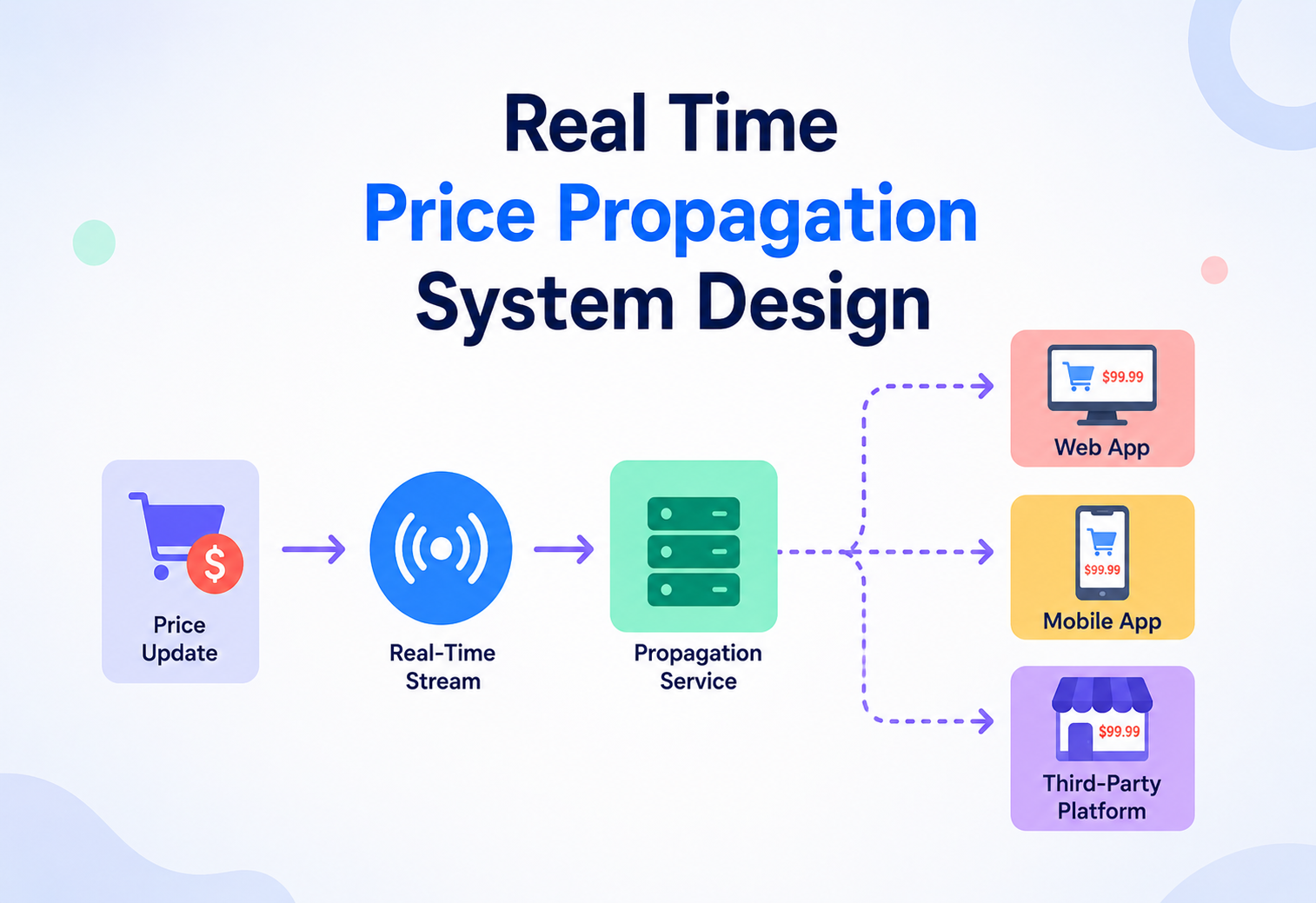
Real-Time Price Propagation: Updating Millions of Rendered Product Pages Within Seconds
A complete, beginner-to-interview-ready walkthrough of how large e-commerce platforms change a product’s price once and have that new price appear correctly everywhere — on cached pages, CDN edges, mobile apps, search results, and open browser tabs — in near real time, without breaking under millions of requests per second.
Introduction and History
Imagine you run a large online store. A rival just dropped the price of a popular headphone by 15%. Your pricing team reacts instantly and cuts your price too. But here is the catch: your product page for that headphone has already been rendered and cached millions of times — on your CDN, in your application cache, on a customer’s phone from an hour ago, in search engine snippets, and inside a comparison-shopping widget. If even a fraction of those cached copies keep showing the old, higher price, you lose sales, confuse customers, and in some jurisdictions you can even run into legal trouble for advertising an incorrect price.
This is not a hypothetical problem. It is one of the most common “hard” system design problems asked at senior and staff engineering interviews, precisely because it forces you to reason about caching, consistency, event-driven architecture, and scale all at once.
Historically, this problem did not exist in this form. In the early days of the web (1990s), most pages were rendered fresh on every request — a customer asked for a page, the server read the price from the database, and sent back HTML. There was no caching layer to worry about, but there was also no way to serve millions of users cheaply, because every single request hit the database.
As traffic exploded in the 2000s, engineers introduced caching everywhere — in-memory caches like Memcached and later Redis, full-page HTML caching, and Content Delivery Networks (CDNs) that serve pages from servers physically close to the user. Caching solved the scale problem beautifully, but it created a new one: staleness. The moment you cache something, you have made a promise to serve it fast — and a competing promise to eventually make it correct becomes much harder to keep.
Modern platforms like Amazon, Flipkart, Uber, and Airbnb solved this by building dedicated price propagation or cache invalidation pipelines: event-driven systems whose entire job is to detect a price change the instant it happens and chase down every single copy of the old price across the system, replacing or invalidating it before a customer can see stale data.
Fresh-render web
1990s: every request read directly from the database and rendered HTML. Simple and always correct, but impossible to scale to millions of users cheaply.
The caching everywhere era
2000s: Memcached, Redis, full-page HTML caches, and CDNs solved scale but created a brand-new class of bugs called cache staleness.
Event-driven invalidation
Modern platforms (Amazon, Flipkart, Uber, Airbnb) built dedicated price-propagation pipelines to hunt down every cached copy the instant a price changes.
Think of a large newspaper printing house that already printed and distributed a million copies of tomorrow’s paper, and then discovers a stock price on the front page is wrong. They cannot un-print the papers. Instead, they rush a corrected “stop press” bulletin to every newsstand, radio station, and news ticker so that anyone reading the wrong number also sees the correction almost immediately. Our system is that stop-press bulletin — but for web pages, and delivered in under a second.
Problem and Motivation
Let us define the problem precisely, the way an interviewer would expect you to restate it before designing anything.
A product’s price changes in the source-of-truth database. Millions of already-rendered representations of that product’s page exist across multiple layers (CDN edge caches, application-level caches, statically generated HTML snapshots, mobile app local caches, search indexes, and open browser tabs). We need the new price to become visible everywhere within a few seconds, without re-rendering every page from scratch on every single request, and without overwhelming the primary database.
2.1 Why this is genuinely hard
Scale of fan-out
A single price change for a popular product might need to invalidate or update millions of cached objects across hundreds of CDN edge locations worldwide.
Multiple independent caching layers
Browser cache, CDN cache, reverse-proxy cache, application cache (Redis), search index, and pre-rendered static snapshots all cache the same fact (the price) independently and can go stale independently.
Correctness vs cost
Never caching anything guarantees correctness but destroys performance and multiplies database load. Caching aggressively guarantees performance but risks showing wrong prices.
Legal and trust implications
Displaying an incorrect (especially higher) price can violate consumer protection laws in many countries and damages customer trust.
Spikes coincide with changes
Flash sales and price drops are exactly when traffic to that product page spikes hardest — the worst possible moment for the system to be slow or wrong.
“Why not just disable caching for price-sensitive fields?” — Be ready to explain that disabling caching for high-traffic pages does not scale: a popular product page might get 50,000 requests per second during a flash sale, and every one of those hitting the primary database directly would require an enormous, expensive database fleet just to survive a few minutes of traffic.
2.2 Goals
| Goal | Description |
|---|---|
| Low propagation latency | New price should be visible to nearly all users within 1–5 seconds of the change being committed. |
| High read throughput | Handle millions of page views per minute for hot products without hammering the primary database. |
| Bounded staleness | Even in failure scenarios, no cached copy should serve a price older than a defined TTL ceiling (e.g., 60 seconds). |
| No lost updates | If a price changes twice in quick succession, the system must never let an older change “win” over a newer one. |
| Graceful degradation | If the invalidation pipeline is delayed, the system should still be safe (fail toward showing “checking latest price” rather than a wrong price on checkout). |
2.3 Non-goals
- We are not designing the pricing algorithm itself (dynamic pricing, demand-based pricing) — only how a decided price value gets propagated.
- We are not covering full order/payment/checkout consistency, only enough to explain why checkout always re-validates price server-side.
2.4 Framing the problem as a CAP-theorem trade-off
It helps to explicitly place this problem on the consistency-availability spectrum before designing anything. The CAP theorem tells us that under a network partition, a distributed system must choose between consistency (every reader sees the latest write) and availability (every request gets a response, even if possibly stale). For product page rendering, we deliberately choose availability with bounded, eventually-consistent staleness — a page is always allowed to respond, even if the price it shows is a few seconds old — while for the checkout and payment path we deliberately choose strong consistency, always reading the true, current price directly from the primary database before money changes hands. This split is the single most important design decision in the whole system: it lets us cache aggressively everywhere it is safe to do so, while drawing a hard, non-negotiable line at the one place where staleness would actually cost money.
2.5 Quantifying “millions of pages”
To make the scale concrete: a mid-size marketplace might have 50 million active product listings. A single price change on one popular item might be represented in 20-plus different cached artifacts once you count CDN edge nodes (often 200-plus points of presence worldwide, each potentially holding its own cached copy), application-level Redis clusters in multiple regions, a pre-rendered HTML snapshot, a search index document, and any client-side caches on mobile apps. Multiply this by thousands of price changes happening every minute across the catalog during a sale event, and you can see why “just purge everything” quickly becomes an engineering problem in its own right, not an afterthought.
Imagine trying to correct a single wrong sentence that has been photocopied and mailed to a hundred cities overnight. You cannot recall the letters — you have to send a follow-up correction to every mail room, every post box, and every desk where the letter has already been read, faster than anyone can act on the wrong information. That is exactly what price propagation does, at internet scale, thousands of times a minute.
Architecture and Components
At a high level, the system has six logical layers: clients, edge/CDN, gateway, application services, an event backbone, and storage. Every component in the diagram below is labeled with exactly what role it plays, because in an interview you should never draw an unlabeled box.
3.1 Component-by-component explanation
Load Balancer
The Load Balancer is the front door for all traffic that is not already served by the CDN edge. It performs TLS termination, distributes requests across many API Gateway instances using algorithms like round-robin or least-connections, and continuously health-checks backend nodes so a failed instance is pulled out of rotation within seconds.
API Gateway
The API Gateway sits behind the load balancer and is responsible for authentication, authorization, rate limiting per client, request validation, and routing each request to the correct microservice — for example, price-update requests go to the Price Service, while page-view requests go to the Page Render Service. It also often does response caching for very short TTLs (1–2 seconds) as a first line of defense against sudden traffic spikes.
Price Service
This is the single, authoritative owner of price data. Every write to a product’s price — whether from an internal pricing tool, a seller dashboard, or an automated repricing algorithm — must go through this service. Centralizing writes here means we always have one clear point where a “price changed” event can be generated, instead of trying to detect price changes from many different systems.
Change Data Capture (CDC)
Rather than asking the Price Service to remember to publish an event every time it writes (which is fragile — a bug or a crash after the DB write but before the event publish would silently lose the update), we attach a CDC connector like Debezium directly to the database’s write-ahead log (WAL). Every committed row change is captured automatically and turned into an event, guaranteeing we never miss a price change even if application code has bugs.
Kafka Cluster (Event Backbone)
Kafka acts as a durable, ordered, replayable log of every price change. Multiple independent consumers — cache invalidation, page rendering, search indexing, and real-time notifications — can all read the same stream of events independently, at their own pace, without competing with each other or with the Price Service.
Cache Invalidation Service
This is the fanout coordinator. For every price-change event, it decides which caches need to be touched: Redis keys to delete or update, CDN paths to purge, and search documents to patch. It batches and rate-limits these calls so a burst of price changes does not overwhelm the CDN’s purge API.
CDN Edge Nodes and Purge Agent
CDN edge nodes hold cached HTML/JSON close to the end user, drastically reducing latency and origin load. The Purge Agent is the interface that lets our backend tell hundreds of geographically distributed edge nodes “this URL is now stale” — most modern CDNs support both hard purges (delete immediately) and soft purges (serve stale while revalidating in background).
Redis Cache
Redis stores rendered page fragments and price lookup keys with short TTLs. It is the first layer application servers check before hitting the primary database, absorbing the vast majority of read traffic.
Page Render Service
Responsible for server-side rendering (SSR) or incremental static regeneration (ISR) of product pages. On receiving a price-change event, it can proactively re-render the hot pages (top N products by traffic) so the very next cache-miss request is served fresh HTML instantly rather than waiting for a slow render.
Notification Gateway (WebSocket/SSE)
For customers who already have the page open in their browser, we do not want to wait for them to refresh. This gateway maintains persistent WebSocket or Server-Sent-Events connections and pushes a small “price updated” message directly to the open tab, which then updates the DOM in place.
Search Index
Product search and category listing pages also show price, and they are backed by a separate search engine like Elasticsearch. The invalidation service patches the relevant document’s price field so search results stay consistent with the product page itself.
Object Store (Static Snapshots)
For extremely high-traffic, mostly-static product pages, some platforms pre-render full HTML and store it in an object store like Amazon S3, served through the CDN. When price changes, the Page Render Service regenerates and overwrites this snapshot.

3.2 Component responsibility and latency budget
A useful exercise when presenting this architecture in an interview is to assign each hop in the pipeline a rough latency budget, so the overall “seconds, not minutes” promise is grounded in concrete numbers rather than a vague aspiration.
| Hop | Typical latency | What can make it slower |
|---|---|---|
| Database write to WAL commit | ~5–20 ms | Lock contention on a very hot product row |
| CDC capturing WAL entry | ~10–100 ms | CDC connector lag under high write volume |
| Kafka publish and consumer pickup | ~10–50 ms | Under-provisioned partitions or slow consumer groups |
| Redis/cache invalidation | ~5–20 ms | Network latency to a remote Redis cluster |
| CDN purge propagation globally | ~200 ms – 3 s | Provider-side propagation delay across all edge locations |
| Page re-render | ~50–300 ms | Complex pages with many dependent data calls |
Adding these up, a realistic end-to-end propagation time for the majority of the pipeline lands well under two seconds, with the CDN’s own internal global propagation typically being the single largest and least controllable contributor — which is exactly why the WebSocket push path exists as a parallel, faster channel for users who are already actively viewing the page.
3.3 Read-your-writes consistency for the price administrator
There is a subtle user-experience requirement worth calling out: the person who just changed the price should never see the old price reflected back to them, even for a brief moment, or they will reasonably assume the update failed. This is called read-your-writes consistency, and it is solved simply by having the Price Service’s own confirmation response to the admin dashboard include the new price and version directly from the write it just performed, rather than the dashboard making a separate read call that might hit a not-yet-invalidated cache.
3.4 What happens if each component fails, in isolation
A genuinely useful way to stress-test any architecture diagram is to mentally remove one box at a time and ask what actually breaks. If the Load Balancer fails, traffic simply cannot reach the platform at all — this is why load balancers themselves are deployed in redundant pairs or as a managed, highly available cloud service rather than as a single instance. If the API Gateway fails, all backend services become unreachable even though they themselves are healthy, which is why gateway instances are also horizontally scaled and load-balanced rather than run as a single point of failure. If the Price Service fails, new price changes simply cannot be accepted, but critically, already-committed prices remain fully correct and servable — reads are entirely unaffected, only writes pause until the service recovers. If Kafka becomes unavailable, no new events flow to any consumer, so cache invalidation, re-rendering, and notifications all stall, but because the Price Service already committed the price to the database before publishing depended on Kafka being healthy, no data is lost — it simply queues up and flows once Kafka recovers, assuming the Price Service itself buffers or retries publishing rather than dropping events on a Kafka outage. If a single Redis node fails, requests fall through to the origin and repopulate a healthy replica, at the cost of a temporary increase in database load proportional to how much traffic that node was serving. If the CDN itself has an outage, this is the most severe failure mode in the entire system, since it is the layer absorbing the vast majority of read traffic — this is precisely why serious platforms consider a multi-CDN strategy, so a single provider’s outage degrades rather than eliminates edge caching capacity.
“Why use CDC instead of publishing the event directly from the Price Service code?” — The strongest answer is reliability: CDC ties event generation to the actual committed database transaction, not to application code executing correctly afterward. This eliminates an entire class of “dual write” bugs where the database update succeeds but the event publish fails or vice versa.
Internal Working
Let us walk through what actually happens, step by step, from the moment someone clicks “Save” on a new price to the moment a shopper across the world sees it.
- An authorized user or automated system sends a price update request through the API Gateway to the Price Service.
- The Price Service validates the request (permissions, price sanity bounds, currency) and writes the new price to the primary database inside a transaction, along with a monotonically increasing version number or timestamp.
- The database commits the transaction and appends the change to its write-ahead log.
- The CDC connector picks up this WAL entry within milliseconds and publishes a structured
PriceChangedevent to Kafka, partitioned by product ID so that all changes for the same product are strictly ordered. - Three consumer groups read this event independently and in parallel:
- The Cache Invalidation Service deletes or updates the Redis key for that product and calls the CDN purge API for that product’s URL.
- The Page Render Service re-renders the product page HTML in the background and writes the fresh snapshot to the object store, so the next request is served instantly rather than triggering a slow render.
- The Notification Gateway looks up which open WebSocket connections are currently viewing that product and pushes a tiny “price updated” payload.
- The CDN edge nodes, upon receiving the purge signal, drop their cached copy. The very next request for that page is a cache miss, which is routed to the origin, which now returns freshly rendered HTML with the correct price — and the CDN re-caches this new version.
- Any shopper who already had the page open sees the price update via the WebSocket push without needing to refresh at all.
- Regardless of any of the above succeeding perfectly, every cached copy still carries a short TTL (for example, 30–60 seconds) as a safety net, guaranteeing an absolute upper bound on staleness even if a purge call is lost.
Say a T-shirt costs ₹999 and the seller drops it to ₹799. The Price Service writes ₹799 to the database. Within a second, Kafka carries this news to three teams working in parallel: one team erases the old sticky-note price (₹999) from the shop window (Redis/CDN), another team quickly reprints a new price tag and hangs it up before anyone even asks (pre-render), and a third team walks up to customers already standing at that shelf and tells them directly, “it is ₹799 now” (WebSocket push).
4.1 Idempotency and exactly-once effects
Kafka, like almost every distributed messaging system, offers “at-least-once” delivery by default — meaning a consumer might occasionally see the same PriceChanged event twice, for example after a consumer restart replays a few unacknowledged messages. Our downstream consumers must therefore be idempotent: processing the same event twice must produce exactly the same end state as processing it once. This is why every consumer checks the event’s version number before acting — deleting an already-deleted cache key, or purging an already-purged CDN path, is harmless and safe to repeat, but only if the consumer first confirms the event is not older than what it has already applied.
4.2 Ordering guarantees in practice
Kafka guarantees ordering only within a single partition, not across the whole topic. By partitioning the price-change-events topic on product ID, we ensure all changes for the same product always arrive at any given consumer in the exact order they were committed, while changes for different products can be processed fully in parallel across many partitions and consumer instances — giving us both correctness and horizontal scalability at the same time.
Data Flow and Lifecycle
The sequence diagram below traces a single price-change request end to end, showing exactly which component talks to which, and in what order.
5.1 Lifecycle of a single price fact
It helps to think of a price value as having a lifecycle with distinct states: Committed (written to the database, the only place it is guaranteed correct), In-flight (the change event is traveling through Kafka to consumers), Propagating (invalidation and re-render calls are being made across caches and CDN), and finally Converged (every layer of the system now agrees on the new price). The entire goal of this architecture is to shrink the time between Committed and Converged as much as possible, while guaranteeing Converged always eventually happens even if individual steps fail.
Committed
Written to the database. The only place the value is guaranteed correct.
In-flight
The change event is traveling through Kafka to consumers.
Propagating
Invalidation and re-render calls are being made across caches and CDN.
Converged
Every layer of the system now agrees on the new price.
“What happens if two price changes for the same product arrive close together — how do you avoid an older event overwriting a newer one?” — Explain Kafka partitioning by product ID (guarantees ordering per key) combined with a version number or timestamp check at the consumer: a consumer applying a cache update should discard any event whose version is older than the version it already has cached.
Advantages, Disadvantages, and Trade-offs
| Aspect | Advantage | Trade-off / Cost |
|---|---|---|
| Event-driven fanout | Decouples price writes from every downstream consumer; new consumers can be added without touching the Price Service | Adds operational complexity: you now run and monitor a Kafka cluster |
| CDN purge on change | Near-instant global consistency for new visitors | CDN purge APIs have rate limits and can be slow at very large fanout (millions of products) |
| WebSocket push | Zero-latency update for users already on the page | Maintaining millions of persistent connections is expensive and needs its own scaling strategy |
| TTL safety net | Guarantees a hard upper bound on staleness even during failures | Every cache miss beyond the TTL adds load back to origin, so TTL tuning is a balancing act |
| Pre-rendering hot pages | Removes render latency from the critical path for popular products | Wasted work if a product is re-rendered but never viewed again before the next change |
It is worth dwelling on the most philosophically important trade-off in this table: choosing eventual consistency for browsing and strong consistency for checkout. Many engineers new to this problem instinctively want the entire system to be strongly consistent everywhere, reasoning that “showing a wrong price is bad, so let us never show a possibly-wrong price.” In practice this instinct, if followed literally, means routing every single page view through the primary database, which simply cannot survive the read volume of a popular e-commerce platform. The insight that unlocks a workable design is realizing that browsing and buying have fundamentally different consistency requirements: a shopper glancing at a product page can tolerate a price that is a second or two out of date, because nothing irreversible happens from that glance. The moment they commit to buying, however, staleness becomes unacceptable, because now real money and a real contractual obligation are on the line. Recognizing this asymmetry — and deliberately applying different consistency guarantees to different parts of the same user journey — is the single most transferable lesson from this entire system design problem, and it applies far beyond pricing to almost any read-heavy, write-light system with a “point of no return” step somewhere in its flow.
6.1 Multi-currency and tax complications
Real-world pricing rarely stops at a single number. Platforms operating across countries must propagate not just a price but also the correct currency, applicable tax treatment, and any region-specific promotional adjustments — all of which can change independently of the base price itself. A robust design treats “the displayed price” as a small, versioned computation over several independent inputs (base price, currency conversion rate, tax rules, active promotions) rather than a single flat field, and the propagation pipeline must be able to invalidate a cached page when any one of those inputs changes, not only when the base price itself changes. This adds real complexity, but the same event-driven, versioned architecture described throughout this tutorial extends naturally to cover it: each input simply becomes its own event type feeding into the same Cache Invalidation Service.
Data Consistency Models, Explained
Since this entire design hinges on choosing the right consistency model for the right part of the system, it is worth spelling out the main models an interviewer expects you to know and where each one shows up in this architecture.
| Model | Guarantee | Where it is used here |
|---|---|---|
| Strong consistency | Every read sees the most recent committed write, immediately | Checkout price re-validation, direct reads from the primary database |
| Read-your-writes consistency | A user always sees their own prior writes, even if others might briefly see stale data | The admin dashboard confirming a price change back to the person who made it |
| Eventual consistency | All replicas converge to the same value eventually, with no fixed time bound unless separately enforced | CDN edge caches and Redis before an active purge lands |
| Bounded staleness | Eventual consistency with an explicit maximum lag guarantee | Any cache layer once you attach a TTL ceiling on top of it |
Notice that “eventual consistency” on its own is actually a fairly weak guarantee — it promises convergence but not a deadline. This is exactly why this design never relies on eventual consistency alone; every cache in the system is eventual-consistency-plus-a-TTL, which upgrades the weak guarantee into the much more useful bounded-staleness guarantee, giving both engineers and the business a concrete number they can reason about and put in a service-level objective.
Performance and Scalability
The core scalability principle here is the classic read-heavy, write-light pattern: price reads (page views) vastly outnumber price writes (actual price changes) — often by a ratio of 100,000:1 or more. This tells us exactly where to invest: reads must be served almost entirely from cache and CDN, and only writes need to touch the primary database directly.
8.1 Sharding and partitioning
Kafka partitions by product ID so that changes for a single product stay ordered while different products can be processed in full parallel across many consumer instances. The primary database itself is typically sharded by product category or seller ID, so no single database node bears the entire write load.
8.2 Hot key problem
A flash-sale product can become a “hot key” — a single Redis key or CDN URL receiving disproportionate traffic. Mitigations include: replicating the hot key across multiple Redis nodes (read replicas), adding a short random jitter to TTLs so caches do not all expire at the exact same millisecond (“thundering herd”), and using request coalescing at the origin so that if 10,000 requests miss cache for the same key simultaneously, only one actually queries the database while the other 9,999 wait for that single result.
8.3 Batching invalidations
During a large sale event where thousands of prices change within seconds, the Cache Invalidation Service batches purge calls (for example, one CDN API call listing 500 URLs instead of 500 separate calls) to respect CDN provider rate limits and reduce network overhead.
“How would you handle a Black Friday event where 50,000 prices change in the same 10 seconds?” — Talk about batching purge requests, prioritizing invalidation for high-traffic products first (using a traffic-ranked queue), and letting lower-traffic products rely more heavily on the TTL safety net rather than an immediate purge.
8.4 Back-of-the-envelope capacity estimation
It is good interview practice to size the system with rough numbers. Assume 50 million product page views per day platform-wide, roughly 600 requests per second on average but bursting to 50,000 requests per second for a single flash-sale product. If Redis and CDN together absorb 99.9% of reads (a realistic hit ratio for a well-tuned cache), the primary database only needs to handle roughly 0.1% of that traffic directly — around 50 requests per second even at peak — which a modestly sized database cluster handles comfortably. This single calculation is usually enough to justify the entire caching architecture to an interviewer: without caching, that same flash-sale burst would require the database to survive 50,000 requests per second, which is a completely different, far more expensive scaling problem.
50M views/day
Platform-wide product page views, roughly 600 req/s average.
50K req/s
Burst load for a single flash-sale product page.
99.9%
Realistic hit ratio for a well-tuned Redis + CDN combination.
~50 req/s
What actually reaches the primary database, even at peak.
8.5 Read replicas and cache warm-up
Just before a scheduled sale event goes live, mature platforms proactively “warm” the cache and CDN for the products going on sale, pre-populating Redis and pre-rendering hot product pages a few minutes before the price change is publicly visible, so the very first wave of traffic never has to suffer a cold cache-miss storm at the worst possible moment.
8.6 Request coalescing in detail
Request coalescing deserves a closer look because it is one of the more elegant techniques in this design. When a cache entry expires or is invalidated for an extremely popular product, it is common for thousands of nearly simultaneous requests to all miss the cache at once and attempt to fetch the fresh value from the origin, a pattern often called a “thundering herd.” Without coalescing, all of those requests independently hit the database or the render service, potentially overwhelming it with duplicate work for what is ultimately the exact same piece of data. A coalescing layer sitting in front of the origin recognizes that multiple in-flight requests are asking for the same key, lets exactly one of them proceed to actually do the work, and has all the others simply wait for and share that single result once it completes. This turns a potential spike of thousands of redundant origin calls into just one, at the cost of a small amount of added latency for the requests that had to wait.
8.7 Horizontal scaling of stateless services
Because the Page Render Service, Cache Invalidation Service, and Notification Gateway are all designed to be stateless — holding no request-specific data in local memory between calls — they scale horizontally simply by adding more instances behind the load balancer, with no special coordination required between instances. This is a deliberate architectural choice: any state that does need to persist, like which WebSocket connections are subscribed to which product, is kept in a shared, externally accessible store (such as Redis) rather than in an individual instance’s local memory, so that any instance can handle any request and instances can be added or removed freely as load changes throughout the day.
High Availability and Reliability
Every component in this pipeline must assume its downstream neighbor can be temporarily unavailable, and must not lose data as a result.
Kafka replication
Each partition is replicated across at least 3 brokers, so a single broker failure does not lose in-flight price events.
Consumer offset management
Consumers commit their read offset only after successfully processing an event, so a crashed consumer resumes exactly where it left off after restart rather than skipping events.
Dead-letter queues
Events that repeatedly fail to process (for example, a malformed price payload) are routed to a dead-letter topic for manual inspection instead of blocking the entire pipeline.
Circuit breakers
If the CDN purge API is down, the Cache Invalidation Service trips a circuit breaker, stops hammering it, and relies on the TTL safety net until the API recovers.
Database replication
The primary database has synchronous replicas for durability and asynchronous read replicas to offload read traffic, with automatic failover if the primary node goes down.
If the entire Cache Invalidation Service goes down for five minutes, no active purges happen — but because every cache entry still carries a bounded TTL, the absolute worst case is that a customer sees a price up to TTL-seconds old, never indefinitely stale. This is why the TTL safety net is non-negotiable in the design, not an optional nicety.
9.1 Backpressure handling
During extreme bursts, if the Cache Invalidation Service starts falling behind Kafka’s incoming event rate, consumer lag rises. Rather than trying to process every single event with equal priority, well-designed consumers apply backpressure intelligently: they keep up with high-traffic product events in near real time while deliberately allowing lower-traffic product events to queue slightly longer, trusting the TTL safety net to cover the gap. This graceful degradation under load is far preferable to the service falling over entirely or processing everything so slowly that even hot products go stale.
9.2 Multi-region failover
If an entire cloud region hosting the Price Service and primary database becomes unavailable, traffic fails over to a standby region with a synchronously or near-synchronously replicated database. Because CDN edge nodes are already globally distributed and independent of any single region, read traffic for already-cached pages continues to be served with minimal disruption even during a regional outage — only new price writes are blocked until failover completes, which is an acceptable trade-off given how rare full regional outages are.
9.3 Graceful degradation from the customer’s point of view
It is worth explicitly designing what a customer experiences when parts of this pipeline are degraded, rather than leaving it as an accident of implementation. If the Notification Gateway is down, a customer simply does not get instant live updates on an open tab — a minor, invisible degradation, since the page will still show the correct price on their next natural refresh or navigation, well within the TTL window. If the CDN purge path is degraded, pages fall back to the TTL for freshness, meaning a slightly longer but still bounded window of possible staleness while browsing. The one thing that must never degrade, under any combination of failures, is the checkout price check itself — so that endpoint is deliberately built as the simplest, most direct path in the entire system, reading straight from the primary database with no caching layer in between at all, precisely so it has the fewest possible failure modes of anything in this architecture.
9.4 Health checks and automatic recovery
Every service in this pipeline exposes a liveness check (is the process still running and able to respond at all) and a separate readiness check (is the process not just alive, but actually able to do useful work right now — for example, does it have a healthy connection to Kafka and Redis). The load balancer and orchestration layer use these to automatically remove an unhealthy instance from rotation and replace it, without requiring a human to notice and intervene for the common case of a single instance becoming unhealthy.
Security
Price manipulation is a high-value attack target — an attacker who can forge a price-change event could sell a product at ₹1 or make prices swing unpredictably.

AuthN & AuthZ
Only authenticated, authorized internal services or verified seller accounts can call the Price Service’s write endpoints, enforced at the API Gateway with signed tokens and role-based access control.
Input validation
The Price Service enforces sane bounds (a price cannot suddenly drop by 99% without a secondary approval workflow) to catch both attacks and fat-finger mistakes.
Event integrity
Kafka topics are secured with TLS in transit and access-controlled with ACLs so only trusted services can produce or consume price-change events.
Checkout re-validation
No matter what price a cached page displays, the checkout/payment service always re-reads the authoritative price from the primary database before finalizing an order — this is the single most important security control in the entire system.
Audit logging
Every price change is logged with who made it, when, and the before/after value, both for fraud investigation and regulatory compliance.
“What if a cache bug shows a customer an old, lower price, and they complete checkout at that price?” — This is exactly why checkout must always re-fetch the authoritative price server-side rather than trusting whatever price the client sends. If the confirmed price differs from what the user saw, the standard pattern is to show a “price has changed, please confirm” screen rather than silently charging a different amount.
10.1 Rate limiting price-write endpoints
The API Gateway enforces per-seller and per-service rate limits on price-update calls, preventing a misbehaving automated repricing script from flooding the Price Service and Kafka with an unreasonable volume of changes for a single product in a short window.
10.2 Anomaly detection on price changes
Beyond simple bounds checking, mature platforms run lightweight anomaly detection on the stream of price-change events itself — flagging, for example, a product whose price has changed more than a handful of times in a minute, or a seller account whose price changes deviate sharply from historical patterns, routing these to a human review queue before they take effect for very high-traffic items.
10.3 Encryption and secrets management
All traffic between the client and the edge, and between every internal service in this pipeline, is encrypted in transit using TLS, including the connection between Kafka brokers and consumers, which is easy to overlook since internal traffic can feel “safe” simply because it is inside a private network boundary. Database credentials, CDN API keys, and any signing keys used to authenticate internal service-to-service calls are stored in a dedicated secrets manager (such as HashiCorp Vault or a cloud provider’s native secrets service) rather than in configuration files or environment variables checked into source control, and are rotated on a regular schedule so a leaked credential has a limited window of usefulness to an attacker. Sensitive fields at rest, such as the audit log’s record of who changed a price and when, are protected with encryption at rest on the underlying storage volumes as a standard defense-in-depth measure.
10.4 Least-privilege access to the write path
Only a small, well-defined set of internal services and authenticated automated systems should ever be authorized to call the Price Service’s write endpoints. This is enforced through role-based access control at the API Gateway, combined with mutual TLS between internal services so that even a compromised network segment cannot impersonate an authorized caller. Human access for manual price corrections goes through a separate, more heavily audited administrative interface with its own approval workflow for unusually large changes, rather than sharing the same automated write path used by repricing algorithms.
Monitoring, Logging, and Metrics
Because this system’s entire purpose is speed and correctness of propagation, its most important metric is propagation latency: the time between a price commit in the database and the moment every cache layer reflects it.
| Metric | Why it matters |
|---|---|
| End-to-end propagation latency (p50/p95/p99) | Directly measures whether the system meets its “seconds, not minutes” promise |
| Kafka consumer lag | Rising lag means invalidation is falling behind price changes — an early warning sign |
| CDN purge success/failure rate | Failed purges mean stale content may persist until TTL expiry |
| Cache hit ratio | Falling hit ratio after a deploy can indicate over-aggressive invalidation hurting performance |
| Stale-price incident count | Business-facing metric: how often a real customer actually saw a wrong price |
| WebSocket connection count and push latency | Tracks real-time notification path health separately from the cache path |
Distributed tracing (for example with OpenTelemetry) should tag every price-change event with a single trace ID at the moment it is created, so engineers can follow that one event across CDC, Kafka, invalidation, CDN, and notification in one unified trace view, rather than piecing logs together manually across five different systems.
11.1 Alerting thresholds
Good alerting here is tiered rather than binary. A soft warning fires when p95 propagation latency crosses, say, 5 seconds, giving on-call engineers time to investigate before customers notice. A hard page fires if p99 latency crosses the TTL ceiling itself (meaning the safety net is now the only thing protecting correctness), or if Kafka consumer lag grows unboundedly, since either condition means stale prices could realistically reach real customers.
11.2 Synthetic monitoring
Beyond passively watching real traffic, teams run synthetic “canary” price changes on a small set of test products at regular intervals, then automatically measure how long it actually takes for that change to appear on the live product page, CDN, and search index — turning “we think propagation is fast” into a continuously measured, verified fact rather than an assumption.
11.3 What a good operational dashboard looks like
An on-call engineer should be able to answer “is the pricing pipeline healthy right now?” within seconds of glancing at a single dashboard, without digging through logs. A well-designed dashboard for this system typically groups panels into three tiers: a top row showing the headline propagation-latency percentiles and current Kafka consumer lag across all consumer groups, so the overall health of the pipeline is visible at a glance; a middle row breaking down cache hit ratios and CDN purge success rates per region, since regional CDN issues are common and easy to miss if everything is aggregated globally; and a bottom row surfacing business-facing signals like the count of confirmed stale-price incidents and checkout price-mismatch events, which is ultimately the metric that matters most to the business even though it sits furthest downstream from the technical pipeline itself.
11.4 Search index and cross-system consistency checks
Because the search index is updated by its own independent consumer, it is possible in rare failure scenarios for the product page and the search result snippet for the same product to briefly disagree on price. A periodic reconciliation job — comparing a sample of product prices in the primary database against what the search index currently holds — catches this class of drift proactively, well before a customer notices the same product showing two different prices in two different parts of the site, which is a particularly damaging kind of inconsistency because it is so visibly obvious to end users.
Deployment and Cloud Considerations
This architecture is naturally suited to a multi-region cloud deployment. The Price Service and primary database typically live in one or two regions (to keep writes strongly consistent), while CDN edge nodes and read replicas of the cache are deployed globally to keep read latency low everywhere.
Kubernetes
Application services (Price Service, Cache Invalidation Service, Page Render Service, Notification Gateway) are typically deployed as independently scalable Kubernetes deployments, each with its own horizontal pod autoscaler tuned to its own traffic pattern.
Managed Kafka
Most teams use a managed offering (Amazon MSK, Confluent Cloud) rather than self-hosting Kafka, to reduce operational burden around broker upgrades and partition rebalancing.
Blue-green deploys
Because the invalidation service is on the critical correctness path, deployments use blue-green or canary rollouts with automatic rollback if error rates spike, rather than risky in-place updates.
Multi-CDN strategy
Larger platforms often run two CDN providers simultaneously for redundancy, meaning the Purge Agent must be able to fan out purge calls to multiple CDN vendors’ APIs.
12.1 Disaster recovery and backups
The primary database is backed up continuously using write-ahead-log shipping to a secondary storage location, allowing point-in-time recovery to any second within the retention window if a bad deploy or human error corrupts price data. Kafka topics themselves also act as a natural, replayable backup of every price change: if a downstream cache or search index is ever found to be inconsistent, operators can simply rewind the consumer group’s offset and replay events from an earlier point to rebuild correct state, rather than needing a separate backup mechanism for derived data.
12.2 Cost optimization
Running a globally distributed CDN, a large Kafka cluster, and a fleet of stateless application services is not free, so cost-conscious teams apply a few concrete levers. First, TTL tuning directly trades cost against freshness: a slightly longer TTL on low-traffic products meaningfully reduces CDN purge API calls and re-render compute without materially harming the customer experience, since few people are viewing those pages anyway. Second, tiered compute — reserved or committed-use instances for steady baseline load, combined with autoscaled spot or burstable instances for the Page Render Service during traffic spikes — keeps the expensive rendering workload from being provisioned at peak capacity around the clock. Third, right-sizing Kafka partition counts and broker instance types to actual sustained throughput (rather than over-provisioning for a rare worst case) is one of the most common places teams overspend without realizing it.
12.3 Infrastructure-as-code and environment parity
Every environment — local development, staging, and production — should be defined through infrastructure-as-code (Terraform, Pulumi, or similar) so that the Kafka topic configuration, cache TTL defaults, and service scaling rules are identical in shape across environments and differ only in scale. This matters specifically for this system because a subtle bug in event ordering or idempotency handling is often invisible at the small scale of a local development environment and only surfaces under real production concurrency, so staging environments should be provisioned with realistic (if smaller) partition counts and consumer group configurations rather than a single simplified instance of everything.
12.4 A simple capacity planning worksheet
When sizing this system for a new deployment, work through these questions in order: What is the peak page-view rate for the single hottest product you need to support (this drives cache and CDN capacity, not the average across the catalog)? What is the peak rate of price changes per second across the whole catalog during your busiest known event (this drives Kafka partition count and consumer throughput)? What staleness window is acceptable to the business, in seconds (this drives your TTL, and indirectly, how aggressively you need active invalidation to actually work)? And finally, what is an acceptable cost per additional second of staleness reduction (this is what ultimately decides how much infrastructure investment — more CDN purge capacity, more pre-rendering compute — is actually justified, since driving propagation latency from two seconds to two hundred milliseconds has a real, quantifiable cost that should be weighed against the real, but often smaller than assumed, business benefit).

Concurrency, Consensus, and Failure Recovery
A frequently underestimated part of this system is what happens when multiple writers try to change the same product’s price at nearly the same instant — for example, an automated repricing engine and a human merchandiser both updating the same product within milliseconds of each other.
13.1 Optimistic concurrency control
Rather than locking the price row for the duration of every write (which would serialize all writes to a hot product and hurt throughput), the Price Service uses optimistic concurrency control: each write includes the version number it expects to be overwriting, and the database update is conditional on that version still matching. If two writers race, the second writer’s conditional update fails, and that writer’s request is retried against the now-current version. This keeps the common case (no contention) fast while still preventing a rare race condition from silently corrupting the price.
13.2 Why we do not need distributed consensus here
It is worth explicitly noting in an interview that this system does not need a distributed consensus protocol like Raft or Paxos for price writes themselves, because all writes for a given product are funneled through a single logical owner — the Price Service backed by one primary database. Consensus protocols matter when multiple independent nodes must agree on a single value without a designated leader; here, the primary database already plays that leader role, and its own internal replication (leader-follower with synchronous acknowledgment from at least one replica) is sufficient to guarantee no committed write is ever lost.
13.3 Failure recovery walkthrough
Consider a concrete failure: the Cache Invalidation Service crashes halfway through processing a batch of 200 price-change events. Because Kafka only advances a consumer’s committed offset after successful processing, every event in that batch that had not yet been fully processed is redelivered to a newly started instance of the service after it recovers. The idempotency guarantees discussed earlier mean this redelivery is completely safe — some events might be processed twice, but never incorrectly, and no event is ever silently dropped. This replay-on-restart behavior is precisely why we invest in making every consumer idempotent up front, rather than treating it as an edge case to handle later.
13.4 Networking considerations
The CDN purge API calls, WebSocket pushes, and cross-region database replication all depend on network reliability that engineers cannot fully control. To stay resilient, every outbound network call in this pipeline uses sensible timeouts (so a slow CDN API does not block the invalidation consumer indefinitely), exponential backoff with jitter on retries (so a brief network blip does not turn into a synchronized retry storm across thousands of parallel workers), and connection pooling to avoid the overhead of establishing a fresh TCP and TLS handshake for every single outbound request.
Databases, Caching, and Load Balancing in Depth
14.1 Primary database choice
A relational database like PostgreSQL is a strong default for the price-of-record table because price changes need ACID transactional guarantees (you never want a half-applied price update) and because CDC tooling like Debezium has first-class, mature support for Postgres’s write-ahead log.
14.2 Caching layers, and why we need more than one
It is tempting to think “just use Redis” and be done, but real systems layer multiple caches because each one optimizes for a different distance from the user:
| Layer | Distance from user | Typical TTL |
|---|---|---|
| Browser cache | On-device | Seconds, honors cache-control headers |
| CDN edge cache | ~10–50ms (nearest edge) | 10–60 seconds for price-sensitive pages |
| Redis application cache | Same region as app servers | 30–120 seconds |
| Static HTML snapshot (object store) | Regenerated on-demand or on event | Until next price change event |
The general rule: the closer a cache is to the user, the shorter its TTL should be, because it is the hardest one to actively purge quickly and reliably.
14.3 Load balancing strategy
The Load Balancer uses Layer 7 (application-aware) routing so it can make smarter decisions than pure round-robin — for example, routing all requests for a given product ID consistently to the same Page Render Service instance to maximize local render-cache hit rates, a technique called consistent hashing.
14.4 Database schema design
A minimal but production-honest schema for the price-of-record table looks like this:
CREATE TABLE product_price (
    product_id      BIGINT PRIMARY KEY,
    price_amount    NUMERIC(12, 2) NOT NULL,
    currency        CHAR(3) NOT NULL,
    version         BIGINT NOT NULL DEFAULT 1,
    updated_by      VARCHAR(64) NOT NULL,
    updated_at      TIMESTAMPTZ NOT NULL DEFAULT now()
);

CREATE TABLE product_price_history (
    id              BIGSERIAL PRIMARY KEY,
    product_id      BIGINT NOT NULL,
    price_amount    NUMERIC(12, 2) NOT NULL,
    currency        CHAR(3) NOT NULL,
    version         BIGINT NOT NULL,
    updated_by      VARCHAR(64) NOT NULL,
    updated_at      TIMESTAMPTZ NOT NULL
);
Separating a small, hot product_price table from an append-only product_price_history table matters for two reasons: it keeps the row that every read query touches small and cache-friendly, and it gives us a complete, queryable audit trail for compliance and dispute resolution without bloating the hot path. The version column is what powers both the optimistic concurrency control discussed earlier and the staleness checks every downstream consumer performs.
14.5 Consistent hashing, explained simply
Imagine arranging all your backend servers around a circular dial, and also placing every product ID on that same dial using a hash function. Each request for a product is routed to the next server clockwise from its position on the dial. The benefit is that when you add or remove a server, only a small slice of the dial’s traffic needs to move to a new server — unlike naive hashing, where changing the server count reshuffles almost all keys at once. This keeps render-cache locality stable even as the Page Render Service fleet scales up and down with traffic.
14.6 Cache invalidation strategies compared
| Strategy | How it works | Best for |
|---|---|---|
| TTL-only | Cache entries simply expire after a fixed time | Low-traffic, less price-sensitive pages |
| Active purge | Backend explicitly tells cache/CDN to drop a specific key on change | High-traffic, price-sensitive pages needing near-instant updates |
| Write-through | Cache is updated with the new value at write time, not just invalidated | Very hot keys where you want to avoid the next request being a cache miss at all |
| Soft purge / stale-while-revalidate | Serve the old cached value immediately while asynchronously fetching the new one in the background | Balancing perceived latency with eventual freshness |
Amazon’s product pages use a layered caching strategy where the price block is often fetched and rendered as a fragment separate from the rest of the page, specifically so that a price change only needs to invalidate a tiny fragment rather than the entire, much larger product page HTML — a pattern called Edge Side Includes (ESI) or fragment caching.
APIs and Microservices
Each service exposes a narrow, well-defined API. Here is a simplified Price Service write endpoint in Java (Spring Boot style):
@RestController
@RequestMapping("/api/v1/products")
public class PriceController {

    private final PriceService priceService;

    public PriceController(PriceService priceService) {
        this.priceService = priceService;
    }

    @PutMapping("/{productId}/price")
    public ResponseEntity<PriceUpdateResponse> updatePrice(
            @PathVariable String productId,
            @RequestBody @Valid PriceUpdateRequest request) {

        PriceUpdateResult result = priceService.updatePrice(
                productId,
                request.getNewPrice(),
                request.getCurrency(),
                request.getUpdatedBy()
        );

        return ResponseEntity.ok(new PriceUpdateResponse(
                result.getProductId(),
                result.getNewPrice(),
                result.getVersion(),
                result.getCommittedAt()
        ));
    }
}
And the consumer side, listening for price-change events and invalidating the Redis cache:
@Component
public class PriceChangeConsumer {

    private final RedisTemplate<String, String> redisTemplate;
    private final CdnPurgeClient cdnPurgeClient;

    @KafkaListener(topics = "price-change-events", groupId = "cache-invalidation-service")
    public void handlePriceChange(PriceChangedEvent event) {

        String cacheKey = "product:price:" + event.getProductId();
        Long cachedVersion = getCachedVersion(cacheKey);

        if (cachedVersion != null && cachedVersion >= event.getVersion()) {
            return; // stale or duplicate event, skip
        }

        redisTemplate.delete(cacheKey);
        cdnPurgeClient.purge("/products/" + event.getProductId());
    }
}
Notice the version check before invalidating — this is the guard that prevents an out-of-order or duplicate Kafka delivery from undoing a more recent update, which is a critical correctness detail interviewers specifically look for.
Here is a simplified batching CDN purge client that groups individual purge requests together to respect the CDN provider’s rate limits:
@Component
public class CdnPurgeClient {

    private final Queue<String> pendingPaths = new ConcurrentLinkedQueue<>();
    private final CdnApiHttpClient httpClient;

    public void purge(String path) {
        pendingPaths.add(path);
    }

    @Scheduled(fixedDelay = 500)
    public void flushBatch() {
        List<String> batch = new ArrayList<>();
        String path;
        while ((path = pendingPaths.poll()) != null && batch.size() < 500) {
            batch.add(path);
        }
        if (!batch.isEmpty()) {
            httpClient.purgeUrls(batch);
        }
    }
}
And the Notification Gateway, pushing a live update to any browser tab currently subscribed to that product:
@Component
public class PriceNotificationConsumer {

    private final WebSocketSessionRegistry sessionRegistry;

    @KafkaListener(topics = "price-change-events", groupId = "notification-gateway")
    public void handlePriceChange(PriceChangedEvent event) {

        List<WebSocketSession> subscribers =
                sessionRegistry.getSubscribers(event.getProductId());

        PricePushMessage message = new PricePushMessage(
                event.getProductId(), event.getNewPrice(), event.getVersion());

        for (WebSocketSession session : subscribers) {
            session.sendAsync(message);
        }
    }
}
15.1 Why microservices here, specifically
Splitting Price Service, Cache Invalidation Service, Page Render Service, and Notification Gateway into separate deployable units means each can be scaled, deployed, and even written in a different language, independently — a traffic spike in page rendering does not force the invalidation service to also scale, and a bug in the notification path can be rolled back without touching price writes at all.
15.2 API contract details
A well-designed price-update endpoint does not just accept a new number; it needs enough context to be safe and auditable. The request payload typically includes the expected current version (for optimistic concurrency), the new price and currency, an identifier for who or what initiated the change, and an optional reason code (manual correction, automated repricing, promotional event) that feeds directly into the audit log and anomaly detection discussed earlier. The response, in turn, always echoes back the authoritative committed version and timestamp, which is what powers the read-your-writes guarantee for the admin dashboard.
| Field | Type | Purpose |
|---|---|---|
| expectedVersion | long | Enables optimistic concurrency control; rejects the write if stale |
| newPrice | decimal | The new price value to apply |
| currency | string (ISO 4217) | Prevents ambiguity when a catalog spans multiple currencies |
| updatedBy | string | Attribution for audit logging and anomaly detection |
| reasonCode | enum | Classifies the change for later analysis and compliance review |
15.3 Testing strategy
Because correctness here spans multiple services and an asynchronous event pipeline, unit tests alone are not enough. A thorough strategy layers four kinds of tests: unit tests for pure logic like version comparison and idempotency checks; integration tests that spin up a real (or embedded) Kafka broker and database to verify a price write genuinely produces the expected sequence of downstream events; contract tests that ensure the event schema published by the Price Service and the schema expected by each consumer never silently drift apart as services evolve independently; and end-to-end synthetic tests, as described earlier, that continuously measure real propagation latency in production rather than only in a staging environment.
Design Patterns and Anti-Patterns
| Pattern | Why it is used here |
|---|---|
| Change Data Capture (CDC) | Guarantees no price change is ever missed, by reading directly off the database’s transaction log |
| Event sourcing (partial) | Every price change is an immutable, ordered event, giving a full audit trail for free |
| Cache-aside | Application checks cache first, falls back to database on miss, then repopulates cache |
| Write-through invalidation | Cache is proactively invalidated on write rather than waiting passively for TTL expiry |
| Circuit breaker | Protects the system from a slow or failing downstream dependency like the CDN purge API |
| Request coalescing | Collapses many simultaneous cache-miss requests for the same key into a single origin call |
16.1 Compensating actions for partial failures
Occasionally a price change needs to be reversed shortly after it was applied — for example, a merchandiser fat-fingers a decimal point and a ₹4,999 item briefly shows as ₹49.99. Rather than building special-case “undo” logic, the correct fix is simply to issue a new, corrected price change through the exact same pipeline, with a higher version number, exactly as described in the FAQ. This is a lightweight relative of the saga pattern used in distributed transactions: instead of trying to roll back a distributed operation that has already partially propagated, you move forward with a new compensating operation that supersedes it. It is a simpler and more robust mental model than trying to “undo” propagation that may already be partially complete across dozens of CDN edge nodes, some of which may not even be reachable for a true rollback at that exact moment.
16.2 Anti-patterns to avoid
A tempting but fragile shortcut is to have the Price Service write to the database and then separately publish a Kafka event in the same application code path, as two distinct operations. If the process crashes after the database commit but before the event publish succeeds, that price change silently never reaches any downstream consumer, and nothing in the system will ever know a change happened. CDC avoids this entirely by deriving the event directly and automatically from the database’s own committed transaction log, so there is no window where a write can succeed without eventually producing an event.
Caching a price “forever” on the assumption that active invalidation will always work is a dangerous simplification. Active invalidation depends on a chain of network calls, message queues, and external CDN APIs, any one of which can fail. Without a TTL ceiling, a single lost purge call has no automatic recovery path and can leave a wrong price visible indefinitely until someone notices manually.
A surprisingly common real-world bug is a checkout flow that accepts the price the browser or app sends back as part of an order request, rather than re-fetching it server-side. This is both a correctness risk (stale cache) and a security risk (a malicious client could simply send a lower price directly), and the fix is the same in both cases: never trust price data coming from the client at the moment of payment.
Making the Price Service wait for every cache layer, every CDN edge, and the search index to all confirm invalidation before returning a success response to the person who made the change couples the fastest part of the system (a single database write) to the slowest and least reliable part (fanning out across dozens of external systems). This makes ordinary price updates unnecessarily slow and makes the whole write path fragile to any single downstream failure. The event-driven, asynchronous fanout pattern used throughout this design exists specifically to avoid this coupling.
Best Practices and Common Mistakes
17.1 Best practices
Always version or timestamp price data
Every price record and every event derived from it should carry a monotonically increasing version number or a precise timestamp. Without this, there is no reliable way for a downstream consumer to tell whether an incoming event is newer or older than what it has already applied, which opens the door to the exact “old price wins” bug this whole architecture is designed to prevent.
Set a hard TTL ceiling everywhere
Even on data you also actively invalidate. Active invalidation should be treated as an optimization for speed, never as the sole correctness mechanism, because any real distributed system will occasionally drop a message, fail an API call, or crash mid-operation — and when that happens, the TTL is the only thing standing between a transient failure and an indefinitely wrong price.
Prioritize invalidation by traffic
Not every product deserves the same urgency. A trending product with tens of thousands of concurrent viewers needs its cache purged within a second or two; a niche product viewed a handful of times a day can comfortably wait several seconds longer without any real customer impact, freeing up invalidation capacity for the products that matter most.
Fragment your caching
Cache the price block of a product page as an independently addressable, independently invalidatable unit, separate from the rest of the page’s HTML (images, descriptions, reviews). This means a price change only needs to touch a tiny fragment rather than forcing a full page re-render and re-cache, which is both faster and cheaper at scale.
Re-validate price at payment, always
No matter how fast and reliable the propagation pipeline becomes, the checkout and payment service must independently re-read the authoritative price from the primary database before finalizing any transaction. This single rule is what converts every other potential bug in this system from “a customer might be charged the wrong amount” into “a customer might briefly see a slightly stale price while browsing.”
17.2 Common mistakes
Mobile apps often cache more aggressively and for longer than web browsers, since app developers are naturally cautious about network usage and battery life. A propagation design built only with web browsers in mind can leave mobile users seeing stale prices far longer than intended, which is why a push notification channel or explicit app-level cache versioning is usually needed as a separate invalidation path for native apps.
Teams frequently discover, during an actual flash sale, that their CDN provider silently throttles purge API calls beyond a certain rate — exactly the moment when purge volume is highest. Load-testing the purge path itself, not just the read path, before a major sale event avoids an unpleasant surprise in production.
Retrofitting proper invalidation into a system that was built assuming “cache once, forget about it” is significantly harder than designing for it from day one, because existing caching code rarely has a clean hook for “this specific value just changed” — it is usually simpler to rebuild the caching layer around events than to patch invalidation logic in after the fact.
If different services rely on their own local wall-clock timestamps to decide event ordering instead of a single authoritative version number issued by the database, small clock differences between servers can cause a newer event to be incorrectly treated as older than an event that was actually issued earlier — another strong argument for version numbers over timestamps wherever ordering correctness genuinely matters.
Extended Case Study: A Flash-Sale Price Drop, Minute by Minute
To tie every component together, let us walk through a single realistic scenario end to end, the way you might narrate it on a whiteboard in an interview.
| Time | What happens |
|---|---|
| T minus 5 minutes | The marketing team schedules a flash sale on a popular wireless earbud model, dropping the price from ₹4,999 to ₹2,999 at exactly 12:00 PM. Ahead of the sale, the platform’s operations tooling pre-warms the Redis cache and pre-renders the product page with the upcoming price held in a “scheduled” state, and pre-scales the Page Render Service and Cache Invalidation Service fleets in anticipation of the traffic surge, since flash sales are known in advance and do not need to be treated as a surprise event from an infrastructure standpoint. |
| T = 0 seconds | At exactly 12:00 PM, a scheduled job (itself just another authorized caller of the Price Service’s write API) submits the price change. The Price Service validates it, writes ₹2,999 to the database with an incremented version number, and the transaction commits. |
| T + 50 ms | The CDC connector observes the committed row change in the write-ahead log and publishes a PriceChanged event to the appropriately partitioned Kafka topic. |
| T + 100 ms | The Cache Invalidation Service, Page Render Service, and Notification Gateway all consume the event in parallel. The invalidation service deletes the Redis key and issues a CDN purge call for this specific, very hot product URL, marking it high-priority so it is not batched behind lower-traffic products. |
| T + 300 ms | The Page Render Service finishes re-rendering the product page with the new price and writes the fresh snapshot to the object store, so that the very next cache-miss request — which is likely to arrive within milliseconds given the traffic this product is about to receive — is served instantly rather than triggering a slow synchronous render under load. |
| T + 500 ms to T + 2 s | The CDN purge propagates across its global network of edge locations. Users in regions closer to the origin see the new price slightly sooner than users on the far side of the world, which is an accepted and expected characteristic of global CDN propagation rather than a bug. |
| T + 100 ms (parallel) | Every shopper who already had this product page open — likely a significant number, since flash sales are usually pre-announced and shoppers refresh the page waiting for the clock to strike 12:00 — receives an instant WebSocket push updating the displayed price in place, with zero dependency on cache purge timing at all. |
| T + 5 minutes | Traffic to the product page spikes sharply as the deal spreads on social media. Because the CDN and pre-warmed Redis cache absorb the overwhelming majority of this traffic, the primary database sees only a small, manageable trickle of requests — the same handful of requests per second it would see on any ordinary day — completely insulated from the surge happening two layers above it. |
| T + 20 minutes | A customer completes checkout for this product. Regardless of which cached price their browser displayed, or how long ago it was cached, the checkout service re-reads the current, authoritative ₹2,999 price directly from the primary database before confirming the order, guaranteeing the correct amount is charged no matter what happened anywhere else in the propagation pipeline. |
Walking through a concrete timeline like this in an interview does two things: it proves you understand how the individual components actually interact under real conditions, and it naturally surfaces the reasoning behind design decisions — like pre-warming ahead of a known event, or prioritizing purge calls by traffic — that might otherwise sound arbitrary if listed as disconnected bullet points.
Real-World and Industry Examples
Amazon
Renders product pages with the price as a separately cacheable fragment, allowing price updates to invalidate only a tiny piece of a much larger, mostly-static page — dramatically reducing the volume of data that needs to be purged and re-rendered on every change.
Uber & ride-hailing
Deal with an even more extreme version of this problem: surge pricing can change every few seconds for a given area. They rely heavily on real-time push (WebSocket/gRPC streaming) rather than page caching at all, because the “page” in their case is a live app screen, not a cacheable HTML document.
Flipkart
During large sale events (like Big Billion Days) pre-scale their cache invalidation and rendering fleets ahead of the event, and often stagger price-drop announcements slightly to avoid every single invalidation and traffic spike landing in the same second.
Airbnb
Faces a related but distinct version of this problem: nightly prices depend on dynamic factors like demand and length-of-stay, so rather than caching a single fixed price per listing, they cache pricing rules and recompute the final displayed price at request time from those rules, trading a small amount of extra compute per request for much simpler cache invalidation.
Netflix
While not selling physical goods, apply the same underlying pattern to plan pricing and regional promotions: a plan-price change is propagated through an internal event bus to configuration caches at the edge, ensuring the correct localized price is shown consistently across web, mobile, and TV apps without every single client needing to query a central pricing service on every screen load.
19.1 Alternative Designs Considered, and Why They Were Rejected
A strong system design answer does not just present one solution — it shows you evaluated and consciously rejected reasonable alternatives. Here are three that commonly come up.
19.1.1 Polling-based invalidation
Instead of an event-driven pipeline, each cache layer could periodically poll the database for products whose updated_at timestamp is newer than the last time it checked. This is simpler to build initially, since it needs no Kafka cluster or CDC connector. It was rejected here because its best-case latency is bounded by the poll interval (polling every 5 seconds means up to 5 seconds of guaranteed staleness even in the best case, not the worst case), and because it wastes significant database load continuously scanning for changes across millions of products, the overwhelming majority of which have not changed since the last poll.
19.1.2 Client-side short polling for price refresh
Another option is having the browser itself poll a lightweight price-check endpoint every few seconds while a product page is open, rather than using a WebSocket push. This avoids the complexity of maintaining persistent connections, but was rejected as the primary mechanism because it multiplies request volume by every open tab times the poll frequency, most of which return “no change,” making it far less efficient than a push-based model where the server only sends data when something actually changed. Some platforms do use light client-side polling as a fallback for clients that cannot maintain a WebSocket connection, but it is deliberately not the primary channel.
19.1.3 No caching, database-backed pages only
The simplest possible design serves every page view with a direct database read, guaranteeing perfect consistency with zero propagation delay at all. This was rejected purely on scalability grounds: a popular product page can receive tens of thousands of requests per second during a sale, and routing all of that directly at the primary database would require a database fleet sized for worst-case peak load around the clock, which is both technically risky and financially wasteful compared to a caching architecture sized for typical load with headroom for bursts.
19.2 Internationalization and Regional Considerations
Global platforms add another dimension of complexity worth mentioning briefly: the same product might have genuinely different prices, currencies, and even different active promotions in different countries, driven by local market conditions, import duties, and regional pricing strategy. This means the cache key for a rendered price fragment typically needs to include not just the product ID but also the customer’s detected region or storefront, and a single “price change” event from the pricing team might actually fan out into several region-specific sub-events, each independently propagated through the same pipeline described throughout this tutorial. The architecture does not need to fundamentally change to support this — it simply means the granularity of what counts as “a price” is a composite of product and region, rather than product alone.
Glossary, FAQ, and Summary
20.1 Glossary of key terms
| Term | Plain-English meaning |
|---|---|
| Cache invalidation | Telling a cache that the value it is storing is no longer correct, so it should be deleted or refreshed. |
| TTL (Time To Live) | A timer attached to cached data that automatically expires it after a set duration, even if nobody explicitly invalidates it. |
| CDC (Change Data Capture) | A technique for detecting every change made to a database by reading its internal transaction log, rather than relying on application code to report changes. |
| Event backbone | A durable, ordered messaging system (like Kafka) that lets many independent services react to the same stream of events. |
| Idempotency | A property where doing the same operation more than once has the same effect as doing it exactly once. |
| Eventual consistency | A guarantee that all copies of a piece of data will agree eventually, but not necessarily at the exact same instant. |
| Optimistic concurrency control | Allowing concurrent writes to proceed without locking, but detecting and rejecting a write if the underlying data changed since it was read. |
| Consistent hashing | A way of distributing keys across servers so that adding or removing a server only reshuffles a small fraction of keys, not all of them. |
| Fragment caching | Caching a small, independently updatable piece of a page rather than the entire page as one unit. |
20.2 Frequently asked questions
Why not skip caching for price and always hit the database?
Because read traffic for popular products vastly outnumbers price-change events, and the database simply cannot absorb millions of direct reads per second economically. Caching with fast, reliable invalidation gives you both speed and correctness.
What is the single most important safety mechanism?
Server-side price re-validation at checkout. It means that no matter what a stale cache shows a customer while browsing, the actual transaction always uses the true, current price from the database.
How do you handle a price change that needs to be rolled back?
Exactly the same way as any other price change — a correction is just another PriceChanged event with a higher version number, flowing through the identical pipeline. No special-casing is needed.
Why use both TTL and active invalidation?
Active invalidation gives you speed (seconds); TTL gives you a guarantee (a hard upper bound on staleness even if active invalidation completely fails). Relying on only one leaves you either slow or unsafe.
Why partition Kafka by product ID?
Because the ordering guarantee we actually need is per-product: two changes to the same product’s price must never be applied out of order. Partitioning by product ID gives exactly that guarantee while still spreading unrelated products across many partitions for parallelism. Partitioning by seller ID would still allow two changes to the same product to land in different partitions if a seller manages many products, breaking the ordering guarantee we depend on.
Could you use a simpler polling approach?
Yes, and for a small system it might even be reasonable — have each cache layer poll the database every few seconds for changed prices. But polling does not scale well: it wastes resources checking products that have not changed, and its best-case latency is bounded by the poll interval, whereas an event-driven pipeline reacts within milliseconds of a real change and does no wasted work on unchanged products.
How do you test this whole pipeline before relying on it?
Beyond unit and integration tests, run controlled chaos experiments: kill the Cache Invalidation Service mid-flight and verify the TTL safety net still bounds staleness correctly; introduce artificial Kafka consumer lag and confirm alerts fire before the TTL threshold is breached; and run the synthetic canary price changes described earlier continuously in production to catch regressions the moment they appear.
What would you change for a smaller catalog?
At a much smaller scale, several pieces of this architecture become optional. A dedicated Kafka cluster and CDC connector may be overkill; a simpler publish-subscribe mechanism, or even direct application-level cache invalidation calls after a database write, can be perfectly adequate. The core principles — bounded staleness via TTL, server-side re-validation at checkout, and prioritizing invalidation for the highest-traffic items — remain valuable at any scale.
How do you decide the right TTL value?
Start from the business tolerance for staleness (commonly 30–120 seconds for e-commerce pricing), then validate that active invalidation reliably completes well within that window under normal conditions, leaving meaningful headroom. The TTL should be a genuine safety net, not the primary mechanism — if the system is routinely relying on TTL expiry rather than active invalidation, that is a signal the active invalidation path itself needs investigation.
Why not merge Price Service and Cache Invalidation Service?
They are kept separate deliberately. The Price Service’s job — validating and durably committing a price change — has completely different reliability and latency requirements from the Cache Invalidation Service’s job — fanning out to a large, sometimes-flaky set of external caches and CDN APIs. Keeping them separate, connected only through the asynchronous event backbone, means the flakiest part of the system can degrade without ever threatening the core guarantee that a validated price write always succeeds quickly and durably.
20.3 Putting it all together
Stepping back from the individual components, this design ultimately rests on a small number of ideas working together rather than any single clever trick. A single authoritative write path through the Price Service, backed by Change Data Capture, guarantees that no price change is ever silently lost, regardless of what happens downstream. An event backbone decouples that single source of truth from an arbitrary number of independent consumers — cache, CDN, search, real-time notifications — each of which can evolve, fail, and recover on its own schedule without taking the others down with it. Layered caching, from Redis close to the application through to CDN edges close to the user, absorbs the overwhelming majority of read traffic so that the primary database only ever has to handle a small, steady trickle of requests even during the largest sales events. And a deliberate, explicit split between eventually-consistent browsing and strongly-consistent checkout means the system can be fast and cheap where staleness is harmless, while remaining strict and safe at the one point where it genuinely matters. None of these ideas is unique to pricing — the same pattern of CDC plus event backbone plus layered caching plus a strongly consistent point-of-no-return step shows up repeatedly across large-scale systems handling inventory counts, seat availability, and account balances, which is exactly why this particular problem is such a popular and durable interview question.
Key takeaways
- Price propagation is fundamentally a cache-invalidation problem at massive fan-out scale, not a rendering problem.
- Change Data Capture on the database’s write-ahead log is the most reliable way to guarantee no price change is ever missed.
- An event backbone like Kafka lets multiple independent consumers (cache, CDN, search, notifications) react to the same change in parallel without coupling to each other.
- Always combine active invalidation (for speed) with bounded TTLs (for a correctness guarantee).
- The single non-negotiable safety net is re-validating price server-side at checkout, regardless of how good the propagation pipeline is.
A well-built price propagation pipeline is the equivalent of a newsroom that can correct a printed edition mid-delivery: the presses do not stop, the trucks do not turn back, but a corrected slip reaches every reader before the wrong number can shape a single decision. Every architectural choice in this design — CDC, Kafka, the layered caches, the WebSocket push, the TTL floor, the checkout re-validation — exists in service of that one promise.