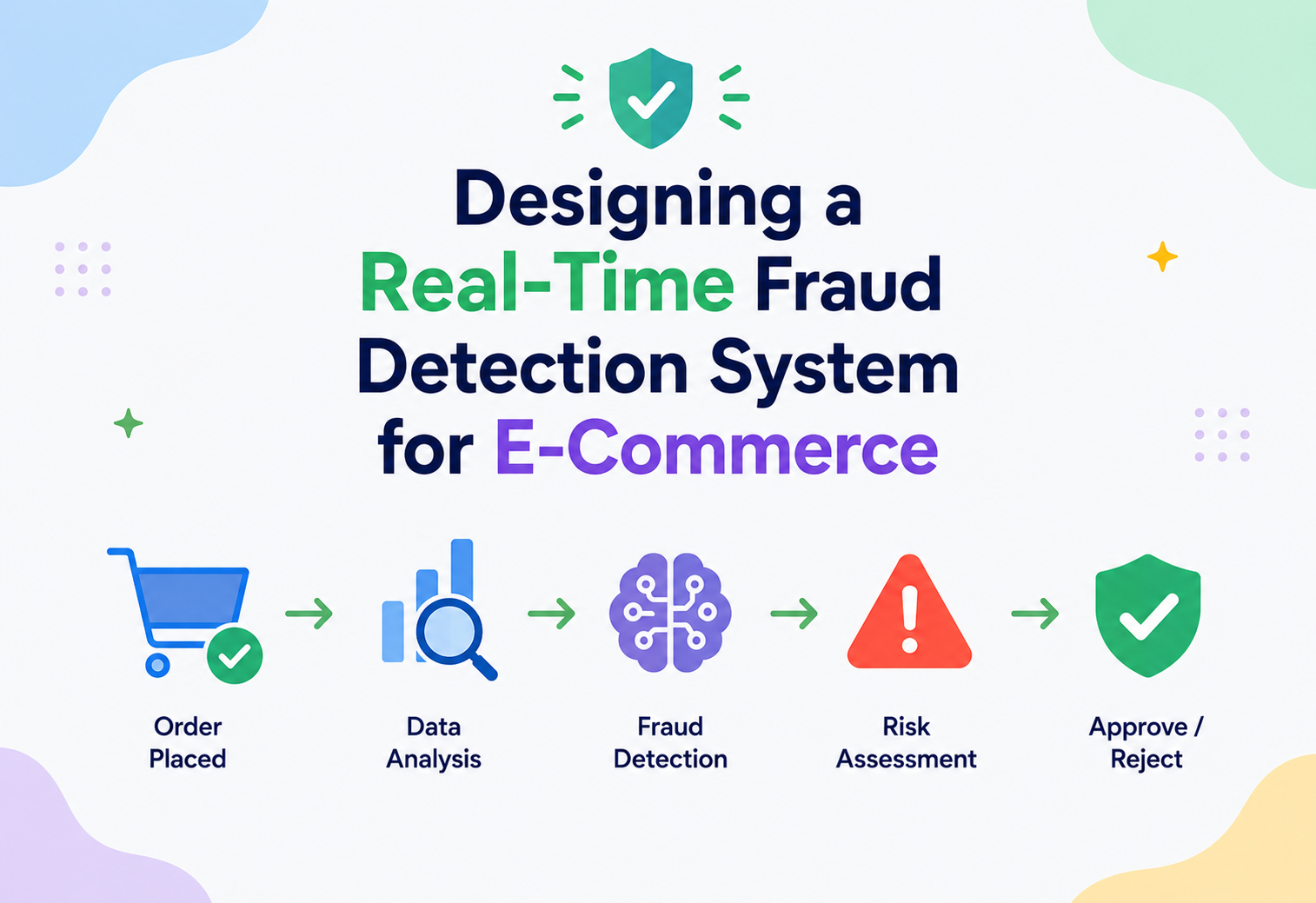
Designing a Real-Time Fraud Detection System for E-Commerce
A complete, ground-up engineering guide to building a system that catches fraudulent transactions in milliseconds — without turning away the honest customers who keep the business alive.
Introduction and History
Before we draw a single box on an architecture diagram, we need to understand what “fraud” actually means to a computer system, and why catching it in real time is one of the hardest problems in all of software engineering.
Imagine a busy toll booth on a highway. Thousands of cars pass through every minute. Most drivers are honest commuters going to work. But a small number are driving stolen cars, using fake license plates, or trying to sneak through without paying. The toll booth operator has a fraction of a second to decide: let this car through, or stop it for inspection. Stop too many honest cars, and traffic backs up for miles and commuters get furious. Let too many stolen cars through, and the highway authority loses money and its reputation.
A real-time fraud detection system for an e-commerce platform is exactly this toll booth, except the “cars” are online purchases, the “highway” is your checkout flow, and the decision has to be made not in a few seconds but in well under 200 milliseconds, because a shopper waiting for a spinning loading icon will abandon the purchase.
In plain terms: fraud detection is the practice of analyzing a transaction — who is buying, what they are buying, from which device, from which location, using which card — and deciding, before the payment is finalized, whether this transaction looks like it was made by the real, legitimate account owner or by someone impersonating them (a criminal using a stolen credit card, a bot performing a coordinated attack, or an account takeover).
1.1 A Short History of Payment Fraud and Its Countermeasures
1970s – 1980s: Manual Review Era
Fraud in mail-order and telephone-order (MOTO) commerce was caught almost entirely by human clerks who compared signatures, called banks, and used printed lists of stolen card numbers distributed to merchants weekly.
1990s: Rule-Based Systems
As the internet enabled e-commerce, the first automated systems appeared: simple “if-then” rules such as “decline if billing and shipping address are in different countries” or “decline if the same card is used more than 5 times in an hour.”
2000s: Statistical Scoring and Early Machine Learning
Companies like PayPal and later Visa (through CyberSource) began applying statistical models and early machine learning (logistic regression, decision trees) to score transactions with a numeric risk value instead of a binary yes/no rule.
2010s: Real-Time Streaming and Deep Learning
The rise of streaming platforms (Apache Kafka, Apache Flink) allowed features to be computed on the fly. Gradient-boosted trees (XGBoost, LightGBM) and later deep neural networks and graph neural networks became standard for detecting subtle fraud rings and account takeover patterns.
2020s and Beyond: Adaptive, Explainable, and Federated
Modern systems combine real-time streaming features, graph-based network analysis (to catch fraud rings), explainable AI (so a human can understand why a transaction was declined), and adaptive models that retrain continuously as fraud patterns evolve.
Every generation of fraud detection technology exists because criminals adapted to the previous generation. This is an arms race, not a one-time engineering project. Any system you design must be built to evolve, not just to work on day one.
“Why can’t we just use a fixed set of rules written by humans?” A strong answer explains that fraudsters actively test and reverse-engineer static rules, so rules alone become stale within weeks; a layered system combining rules, machine learning, and human review is far more resilient.
1.2 Why This Guide Uses E-Commerce Checkout as the Running Example
Fraud detection principles apply across many domains — banking transfers, insurance claims, telecom sign-ups, ride-hailing bookings — but e-commerce checkout is an especially instructive example because it combines nearly every hard constraint fraud engineers face at once: a strict, user-facing latency budget measured in a few hundred milliseconds, extremely high and unpredictable traffic volume during sales events, a genuinely adversarial population actively trying to defeat the system, and a delayed, incomplete feedback signal in the form of chargebacks that arrive weeks after the original decision. Mastering this one scenario in depth, as this guide sets out to do, gives you a design vocabulary and a mental toolkit that transfers directly to nearly any other real-time risk-scoring problem you might later encounter.
Think of the checkout as a highway toll booth: the vast majority of cars are honest commuters and must pass through unhindered, a tiny fraction may be stolen or unpaid, and the operator has a fraction of a second per car. The fraud engine is the operator; the rest of this guide is the design of that operator’s toolkit.
Problem and Motivation
Let’s define the actual engineering problem we are solving, in precise terms, before we design anything.
The problem statement: Design a system that, for every checkout attempt on an e-commerce platform, decides within a strict latency budget whether to approve, decline, or send for manual review the transaction — while minimizing both fraud losses (false negatives, where fraud slips through) and customer friction (false positives, where a genuine customer is wrongly blocked).
2.1 Why Is This Genuinely Hard?
A beginner might think: “just check if the card number is stolen, and reject the ones that are.” The real difficulty is that fraud is not a fixed pattern — it is an adversarial, moving target. Consider these challenges:
Extreme Latency Constraints
The decision must be made while the customer is actively waiting on a checkout page. Anything above roughly 200–300ms measurably increases cart abandonment.
Asymmetric Costs
Blocking a real customer (false positive) damages trust and future revenue; missing real fraud (false negative) causes direct monetary loss and chargebacks. Both costs must be balanced, not just minimized independently.
Massive, Bursty Scale
Traffic during flash sales, festive seasons (like Black Friday), or viral product launches can spike to 10–50× normal volume within minutes.
Concept Drift
Fraud patterns that worked yesterday stop working today because criminals adapt. Models trained on stale data silently degrade.
Sparse Ground Truth
You often don’t know a transaction was fraudulent until weeks later, when a chargeback arrives from the bank. Labels are delayed and incomplete.
Coordinated Attacks
Organized fraud rings deliberately spread their attacks across many accounts, cards, and devices to avoid triggering any single simple rule.
2.2 Real-Life Analogy: The Airport Security Line
Think of an airport security checkpoint. Most travelers are ordinary passengers. A tiny fraction may be carrying something dangerous. Security cannot physically pat down every single passenger in detail — the line would never move, and the airport would grind to a halt. Instead, airports use layered screening: a quick scan for everyone (like a lightweight rule engine), a risk-based selection for random or flagged additional screening (like machine learning scoring), and a small manual security team for the rare, ambiguous cases (like a human fraud analyst). This layered approach — cheap fast checks for everyone, expensive precise checks for a few — is the exact blueprint we will use for fraud detection.
2.3 Beginner Example
Imagine Priya buys a $40 T-shirt from an online store using the same card and same phone she always uses, shipping to her home address as always. This transaction should sail through instantly — it looks exactly like her normal behavior.
Now imagine a stranger, minutes later, uses the same card number but from a device in a different country, buying five $900 gift cards shipped to a freight-forwarding address, and this has never happened on that card before. This transaction should be stopped or at least flagged, because it deviates sharply from established behavior and matches known fraud patterns (high value, gift cards which are easy to resell, new device, new location, new shipping address).
Fraud detection is not the same as payment processing or credit checks. Payment processors verify that a card is valid and has funds; fraud detection asks a different question entirely: even if the card is valid and funded, is the person actually the legitimate cardholder acting normally?
2.4 A Simple Framework for Quantifying the Decision
To turn this problem into something an engineering team can actually optimize, it helps to express the cost of every possible outcome in concrete monetary terms rather than treating “catch fraud” and “keep customers happy” as vague, competing goals. For a given transaction, the expected cost of approving it can be thought of, in simplified form, as the probability that it is fraudulent multiplied by the loss if it turns out to be fraud, while the expected cost of declining it can be thought of as the probability that it is genuine multiplied by the lost revenue and long-term customer value that a wrongful decline destroys. Written simply: approving is worse when probability of fraud times fraud loss exceeds probability of legitimacy times the value of that customer relationship, and declining is worse in the opposite case. This framing makes explicit that the “right” decision threshold is not a fixed universal number, but depends on the specific dollar values at stake for each transaction, which is exactly why segment-specific thresholds, introduced later in this guide, matter so much in practice.
2.5 The Business Stakeholders Involved
Unlike a purely internal engineering system, a fraud detection platform sits at the intersection of several business functions, each with a legitimate but sometimes competing perspective. The risk and fraud team cares primarily about minimizing monetary loss and chargeback ratios. The product and growth team cares primarily about conversion rate and customer experience, since every additional second of friction or every wrongful decline directly reduces sales. The compliance and legal team cares about meeting regulatory obligations, such as mandatory sanctions screening and data privacy requirements. A well-designed system, and the team that builds it, must serve all three simultaneously rather than optimizing narrowly for just one, which is why this guide repeatedly frames technical choices, like the decision threshold or the manual review capacity, in terms of the business trade-offs they represent.
Core Concepts
Let’s build a shared vocabulary. Every term below will be used repeatedly through the rest of this guide.
Transaction
What: A single checkout attempt — one purchase event with an amount, a payment method, a buyer, items, and a destination.
Why it matters: It is the fundamental unit our system scores.
Analogy: A single car passing through the toll booth.
Practical example: Customer 9931 buying a $220 pair of headphones with a Visa card ending 4432, shipping to Mumbai.
Feature
What: A measurable signal derived from raw data that helps distinguish fraud from legitimate behavior — for example, “number of transactions from this card in the last 10 minutes” or “distance in kilometers between billing address and IP-derived location.”
Why it matters: Machine learning models don’t understand raw transactions; they understand numeric and categorical features computed from them.
Analogy: A doctor doesn’t just look at a patient; they check specific vital signs — temperature, pulse, blood pressure. Features are the vital signs of a transaction.
Feature Store
What: A specialized system that computes, stores, and serves features both for real-time scoring (online store, usually backed by an in-memory database like Redis) and for training models later (offline store, usually a data warehouse).
Practical example: When a scoring request arrives, the fraud service asks the online feature store, “how many transactions has this card made in the last hour?” and gets an answer in single-digit milliseconds because it was precomputed by a streaming job.
Risk Score
What: A single number, usually between 0 and 1 (or 0 and 1000), representing the estimated probability or degree of fraud risk for a transaction.
Analogy: Like a credit score, but computed instantly for a single purchase instead of over years of financial history.
Rules Engine
What: A component that evaluates deterministic, human-written “if-then” conditions, such as “decline if card is on a known stolen-card blacklist” or “flag if more than 3 failed payment attempts occurred in the last 5 minutes.”
Why it matters: Rules are fast, fully explainable, and excellent for catching known, obvious fraud patterns and legal or compliance requirements instantly, without waiting for a machine learning model to “learn” them.
Velocity Check
What: A check on how frequently something is happening — how many times has this card, device, IP address, or account been used within a recent time window.
Analogy: If one person tries to swipe an ID badge at ten different office doors within sixty seconds, something is clearly wrong — that is a velocity red flag.
Device Fingerprinting
What: Collecting non-personally-identifying technical attributes of a browser or device (screen resolution, installed fonts, timezone, browser plugins, hardware identifiers) to recognize the same device across sessions, even if cookies are cleared.
Practical example: The same physical laptop is used to attempt purchases on twelve different stolen credit cards; device fingerprinting links all twelve attempts together even though the “customer name” is different each time.
Chargeback
What: A forced reversal of a payment, initiated by the cardholder’s bank, typically because the cardholder disputes the charge as fraudulent or unauthorized.
Why it matters: Chargebacks are usually the delayed “ground truth” label used to retrain fraud models — they tell the system, weeks later, “this transaction you approved was actually fraud.”

False Positive vs. False Negative
| Term | Meaning | Business Impact |
|---|---|---|
| False Positive | Legitimate transaction wrongly declined or flagged | Lost sale, customer frustration, brand damage |
| False Negative | Fraudulent transaction wrongly approved | Direct monetary loss, chargeback fees, potential fines |
| True Positive | Fraud correctly caught | Loss avoided |
| True Negative | Legitimate transaction correctly approved | Normal, healthy business |
Precision, Recall, and the Decision Threshold
Precision answers: “of all transactions we flagged as fraud, what fraction were actually fraud?” Recall answers: “of all the fraud that actually happened, what fraction did we catch?” These two values trade off against each other; raising the score threshold that triggers a decline increases precision but lowers recall, and vice versa. Choosing this threshold is a business decision as much as a technical one.
“How would you decide where to set the decline threshold?” Strong candidates explain that the threshold should be chosen by modeling the expected monetary cost of false positives versus false negatives (often called a cost-sensitive threshold), and that it should differ by transaction segment — a $20 purchase can tolerate more risk than a $2,000 purchase.
3D Secure (3DS)
What: An additional authentication step (like an OTP sent to the cardholder’s phone) that can be triggered for risky transactions, shifting liability for fraud from the merchant to the card issuer if the customer passes the challenge.
Why it matters: It gives the fraud system a middle option beyond a binary approve/decline — a way to add friction only for genuinely risky cases while keeping most checkouts frictionless.
Reason Codes
What: A short, human-readable list of the top factors that pushed a particular transaction’s risk score up or down, generated alongside the score itself (for example, “new device,” “shipping address differs from billing by over 500 kilometers,” “unusually high order value for this account”).
Why it matters: Reason codes are what let a human analyst, a customer support agent, or an auditor understand a decision instead of treating the model as an unexplainable black box. Without them, disputing or reviewing a decision becomes guesswork.
Analogy: Like a doctor’s diagnosis notes attached to a lab result — the number alone tells you something is wrong, but the notes tell you why.
Synthetic Identity Fraud
What: A form of fraud where a criminal fabricates a new identity by blending real information, such as a legitimately issued but unused national ID number, with fake details like a made-up name and address, rather than stealing an existing person’s full identity.
Why it matters: Because there is no real victim to notice and report the fraud early, synthetic identities can operate undetected for a long time, slowly building up a trustworthy-looking transaction history before committing large-scale fraud, which makes them especially hard for velocity-based rules to catch and often requires graph-based network analysis instead.
Graph-Based Fraud Detection
What: A technique that models accounts, devices, cards, addresses, and IP addresses as nodes in a graph, with transactions as edges connecting them, then looks for suspicious structural patterns such as dense clusters, shared devices across many seemingly unrelated accounts, or short paths linking a known fraudulent account to a new one.
Why it matters: Individual transaction-level features often miss coordinated fraud rings, because each individual transaction can look perfectly normal in isolation; it is only the network of relationships between entities that reveals the ring.
Practical example: Twenty seemingly unrelated new accounts, created over several weeks with different names and emails, all share the same device fingerprint and the same shipping address — a graph view surfaces this instantly, while a purely per-transaction model would likely miss it entirely.
Graph-based analysis is typically implemented using a dedicated graph database or a graph-processing layer built on top of the streaming pipeline, and it is usually run as a periodic batch or near-real-time enrichment step rather than a fully synchronous, per-transaction computation, since traversing a large, constantly growing entity graph at true millisecond latency for every single checkout remains a genuinely difficult engineering problem even today.
Behavioral Biometrics
What: Passive signals captured from how a person physically interacts with a device, including typing rhythm, mouse movement patterns, touchscreen pressure, and scroll speed, used to build a behavioral profile of the genuine account owner.
Why it matters: These signals are extremely difficult for a fraudster to replicate convincingly, even if they have stolen a password, a card number, and a device fingerprint, making behavioral biometrics a strong additional layer against account takeover specifically.
Chargeback Ratio and Card Network Monitoring Programs
What: The percentage of a merchant’s total transactions that result in a chargeback over a given period. Card networks run formal monitoring programs, such as Visa’s and Mastercard’s excessive-chargeback programs, that impose escalating fines and, eventually, the loss of card-processing privileges if a merchant’s chargeback ratio exceeds defined thresholds.
Why it matters: This turns fraud detection from a nice-to-have cost-saving measure into an existential business requirement, since crossing a chargeback ratio threshold repeatedly can cause a merchant to lose the ability to accept card payments entirely.
Practical example: A merchant processing 100,000 transactions a month with 150 confirmed fraud-related chargebacks sits at a 0.15 percent chargeback ratio; most card network programs set their initial warning threshold somewhere near this level, meaning a fraud detection system’s job includes keeping the business comfortably clear of a threshold like this, not merely reacting after it has already been crossed.
Architecture and Components
Now we assemble these concepts into a coherent system. Every box below plays a specific, necessary role — nothing is decorative.
Fig 4.1 — End-to-end architecture: every box is labeled with the component category it represents (load balancer, API gateway, service, cache, database, or pipeline). Solid arrows show the synchronous checkout path; dashed teal arrows show the asynchronous learning and analytics path.
4.1 Why Not a Single Monolithic Fraud Module?
A beginner might reasonably ask why this needs so many separate moving pieces instead of one application that does everything: fetches data, checks rules, runs a model, and returns a decision. Early-stage platforms often do start this way, and there is nothing wrong with a simple monolith when transaction volume and team size are both small. The architecture in this guide becomes necessary once several pressures appear at once: the ML Scoring Service needs specialized compute and a release cadence measured in days, driven by data science experimentation, while the Order Service needs the stability and infrequent releases typical of core transactional business logic; the Rules Engine needs to be editable by risk analysts through a UI within minutes, without waiting on an engineering deployment cycle at all; and the asynchronous analytics and training pipeline needs to process enormous historical volumes in batch, on a completely different schedule than the millisecond-level synchronous decision path. Splitting these concerns into separate services lets each one scale, deploy, and evolve on its own natural rhythm, at the cost of the added operational complexity of running, monitoring, and coordinating multiple independent services, which is precisely the trade-off explored throughout the rest of this guide.
4.2 Component-by-Component Breakdown
| # | Component | Role |
|---|---|---|
| 1 | CDN & Edge Layer | Caches static checkout page assets close to the user geographically, and absorbs the first wave of any denial-of-service traffic before it ever reaches your data centers. Not directly involved in fraud scoring, but critical so that the checkout page itself loads fast and reliably. |
| 2 | Load Balancer | Distributes incoming HTTPS requests across many identical instances of the API Gateway, performs TLS termination (decrypting HTTPS so backend services don’t each need to manage certificates), and continuously health-checks backend instances, routing traffic away from any that are unhealthy. Typically a Layer 7 load balancer such as an ALB, NGINX, or Envoy, so it can route based on URL path in addition to simple round-robin. |
| 3 | API Gateway | The single front door for all client requests. It authenticates the caller (verifying the session token or API key), applies rate limiting (to stop a single client from overwhelming the system or from being used for card-testing attacks), and routes each request to the correct backend microservice. It is also where request-level logging and basic input validation happen. |
| 4 | Order Service | Owns the checkout workflow itself — creating the order record, calculating totals, and orchestrating calls to the Fraud Detection Service and the Payment Service. It treats fraud detection as a required step in the checkout saga. |
| 5 | Fraud Detection Service (FDS) | The heart of this system. Given a transaction, it gathers the necessary features, runs the rules engine and the ML scoring service in parallel, combines their outputs in a decision engine, and returns one of three verdicts: approve, decline, or route to manual review (or trigger a step-up authentication challenge like 3D Secure). It must respond within the latency budget even under peak load. |
| 6 | Rules Engine | Runs fast, deterministic checks: card or device blacklists, velocity limits, geographic mismatches, and compliance rules (for example, regulatory sanctions lists that must legally be checked, called OFAC/sanctions screening). Rules are usually managed by risk analysts through a UI, not by engineers redeploying code, so that response to new fraud patterns can happen in minutes. |
| 7 | Feature Store | Maintains two views of the same features: an online store (typically Redis or a similar low-latency key-value store) for millisecond-level lookups during real-time scoring, and an offline store (a data warehouse) used to train and validate models. Feature consistency between these two — called training-serving skew avoidance — is a critical and often underestimated engineering challenge. |
| 8 | ML Scoring Service | Hosts one or more trained machine learning models (commonly gradient-boosted trees for speed and interpretability, sometimes supplemented by graph neural networks or deep learning models for detecting fraud rings) behind a low-latency inference API. Auto-scales based on request volume. |
| 9 | Decision Engine | Combines the rules engine’s verdict and the ML score, applying business logic like segment-specific thresholds (“high-value orders need a stricter threshold”), and produces the final action. This is also where 3D Secure step-up challenges get triggered for borderline-risk transactions. |
| 10 | Event Bus (Kafka) | Publishes every decision as an event so that downstream systems — case management, analytics, streaming feature aggregation — can consume it asynchronously without slowing down the synchronous checkout path. |
| 11 | Streaming Pipeline (Apache Flink) | Continuously aggregates events into the rolling features the online feature store needs, such as “transactions per card per rolling 10-minute window,” updating them in near real time. |
| 12 | Case Management Service | A tool used by human fraud analysts to review transactions flagged as “manual review,” see all relevant signals in one place, and make a final approve/decline decision, which then feeds back into model training as a labeled example. |
| 13 | Data Lake, Warehouse & Training Pipeline | Stores historical transactions, features, decisions, and chargeback outcomes, which are used to periodically retrain and validate the ML models before promoting a new version through the Model Registry. |
Notice the split between the synchronous, latency-critical path (client to load balancer to gateway to fraud service to decision) and the asynchronous, throughput-critical path (Kafka to streaming pipeline, case management, and training). This separation is the single most important architectural decision in this entire system.
“Where would you put the rules engine versus the ML model — in sequence or in parallel?” The strongest answer is parallel, because running them sequentially would add up their latencies, while running them concurrently lets you take the maximum of two smaller latencies instead of the sum.
Internal Working
Let’s go one level deeper: what actually happens, in what order, inside the Fraud Detection Service when a single request arrives?
5.1 Step-by-Step Internal Flow
- Request received: The Order Service calls the Fraud Detection Service with a transaction payload: buyer ID, card token (never a raw card number — see Security), amount, currency, items, device fingerprint, IP address, shipping address.
- Feature enrichment: The service issues parallel, low-latency lookups to the online feature store: recent transaction velocity for this card, this device, this IP, and this account; historical average order value for this account; distance between IP-derived location and billing address; account age.
- Rules evaluation: Concurrently, the rules engine checks blacklists (stolen card lists, sanctioned countries, banned devices), hard velocity limits, and compliance rules. Any hard rule match can short-circuit straight to a decline, skipping ML scoring entirely to save time.
- ML inference: The enriched feature vector is sent to the ML Scoring Service, which returns a probability score along with reason codes (which features contributed most to the score, for explainability).
- Score fusion: The Decision Engine combines the rules verdict and ML score using configured business logic and thresholds specific to the transaction’s segment (amount tier, product category, customer tenure).
- Decision issued: One of approve, decline, step-up challenge (3D Secure), or manual review is returned to the Order Service, typically within 80–150 milliseconds end to end.
- Asynchronous logging: Regardless of the outcome, the transaction, its features, and the decision are published to Kafka for audit, analytics, and future model training — this happens without blocking the response to the customer.
Fig 5.1 — Sequence diagram showing the synchronous checkout path and the asynchronous event publishing that happens without adding latency. Solid arrows are requests; dashed grey arrows are responses; dashed teal is the async Kafka publish.
5.2 Sample Java Code: The Decision Engine
Below is a simplified but realistic Java implementation showing how the rules verdict and ML score are fused into a single decision.
public class DecisionEngine {

    private static final double DECLINE_THRESHOLD = 0.85;
    private static final double REVIEW_THRESHOLD  = 0.55;

    public Decision evaluate(RuleVerdict ruleVerdict, double mlScore, Transaction txn) {

        // Hard rule violations short-circuit immediately, skipping ML entirely
        if (ruleVerdict.isHardDecline()) {
            return Decision.decline(ruleVerdict.getReason());
        }

        // Segment-specific threshold: high value orders are judged more strictly
        double effectiveDeclineThreshold = DECLINE_THRESHOLD;
        if (txn.getAmount() > 1000.0) {
            effectiveDeclineThreshold = 0.70;
        }

        if (mlScore >= effectiveDeclineThreshold) {
            return Decision.decline("ml_score_high:" + mlScore);
        }

        if (mlScore >= REVIEW_THRESHOLD) {
            // Borderline: prefer a step-up challenge over an outright decline
            if (txn.supports3DS()) {
                return Decision.stepUpChallenge();
            }
            return Decision.manualReview();
        }

        return Decision.approve();
    }
}
Note: real thresholds are tuned continuously against live outcome data, not hard-coded constants as shown here for clarity.
5.3 Sample Java Code: Velocity Feature Lookup with a Circuit Breaker
public class FeatureClient {

    private final RedisClient redisClient;
    private final CircuitBreaker circuitBreaker;

    public FeatureVector fetchFeatures(String cardToken, String deviceId) {
        try {
            return circuitBreaker.executeSupplier(() -> {
                int txnCountLastHour = redisClient.get("velocity:card:" + cardToken);
                int deviceTxnCount   = redisClient.get("velocity:device:" + deviceId);
                return new FeatureVector(txnCountLastHour, deviceTxnCount);
            });
        } catch (CallNotPermittedException circuitOpen) {
            // Redis is unhealthy: fall back to conservative default features
            // rather than failing the whole checkout
            return FeatureVector.conservativeDefault();
        }
    }
}
Notice the fallback: if the feature store is unavailable, the system degrades gracefully to conservative defaults instead of blocking every single checkout.
A frequent mistake is making the fraud check a hard, blocking dependency with no fallback. If the Fraud Detection Service or its dependencies (Redis, the ML service) go down and there is no fallback path, the entire checkout — and therefore all revenue — goes down with it. Always design a safe degraded mode.
5.4 A Closer Look at Feature Engineering
The quality of a fraud model is bounded almost entirely by the quality of its features, often more than by the choice of algorithm itself. Below is a representative sample of feature categories used in a real deployment, each explained in plain terms.
| Feature Category | Example Feature | Why It Signals Risk |
|---|---|---|
| Velocity | Number of transactions on this card in the last 10 minutes | Legitimate shoppers rarely make many rapid purchases; fraudsters testing a stolen card often do |
| Behavioral history | Deviation of current order value from this account’s historical average | A sudden, unusually large purchase differs from an established personal pattern |
| Geolocation | Distance between IP-derived location and registered billing address | A large mismatch, absent a plausible travel context, is a classic fraud indicator |
| Device | Number of distinct accounts recently seen using this exact device fingerprint | One device driving many different identities suggests automated or ring-based fraud |
| Network and graph | Shortest path length in the entity graph to a device or address already linked to confirmed fraud | Proximity in the network to known bad actors raises suspicion even with no direct history |
| Product and merchant | Whether the order consists heavily of easily resellable items such as gift cards or electronics | Certain product categories are disproportionately targeted because stolen goods convert to cash quickly |
| Temporal | Whether the transaction occurs at an unusual hour relative to this account’s typical activity pattern | Account takeover attempts often happen outside the victim’s normal, established usage hours |
Each of these raw signals is turned into a numeric or categorical feature that both the rules engine and the ML model can consume, and each is computed consistently across the online serving path and the offline training path to avoid the training-serving skew problem discussed later in this guide.
Data Flow and Lifecycle
Let’s trace a transaction across its entire lifecycle, from the moment it is created to the moment it is finally settled or charged back, weeks later.
Fig 6.1 — Full lifecycle of a transaction, including the delayed chargeback path that eventually supplies training labels. Dashed edges represent the delayed, asynchronous feedback that arrives days or weeks later.
6.1 Why the Delayed Chargeback Path Matters So Much
This is one of the most misunderstood aspects of fraud systems by newcomers. When a transaction is approved, that does not mean it was correctly approved. Weeks later, the real cardholder may notice the unauthorized charge on their statement and dispute it with their bank, generating a chargeback. This is often the only reliable signal telling the fraud system “you were wrong about this one.” Because this feedback loop is delayed, fraud models must be retrained continuously as new labels trickle in, and any system design must budget for this delay rather than assuming instant feedback.
6.2 Data Flow Across the Three Timescales
| Timescale | What Happens | Typical Technology |
|---|---|---|
| Milliseconds (synchronous) | Feature lookup, rules evaluation, ML inference, decision returned to checkout | Redis, gRPC, in-memory model serving |
| Seconds to minutes (near real-time) | Streaming aggregation updates rolling velocity features; decision events published for downstream consumption | Kafka, Apache Flink or Kafka Streams |
| Days to weeks (batch) | Chargebacks arrive, labels are finalized, models retrained and evaluated, thresholds recalibrated | Data warehouse, Spark, ML training pipelines |
“How do you handle the fact that fraud labels arrive weeks after the transaction?” A good answer discusses using proxy labels in the short term (like immediate customer disputes or account lockouts) and running a delayed but rigorous retraining pipeline once true chargeback labels arrive, plus monitoring for model performance decay in between.
Advantages, Disadvantages and Trade-offs
No architecture is free. Let’s be explicit about what this design gains and what it costs.
Advantages
- Sub-200ms decisions keep checkout friction low for the overwhelming majority of legitimate customers.
- Layered defense (rules plus ML plus human review) catches both known and novel fraud patterns.
- Asynchronous event pipeline allows continuous learning without slowing down the critical path.
- Graceful degradation (circuit breakers, fallback defaults) keeps checkout available even during partial outages.
- Explainable reason codes support compliance, dispute handling, and analyst trust in the system.
Disadvantages
- Significant engineering complexity: multiple services, a streaming pipeline, and an ML platform must all be built and maintained.
- Feature and model drift require constant monitoring and retraining investment — this is never “done.”
- Low-latency requirements limit model complexity; the most accurate models are sometimes too slow to use online.
- False positives, even if statistically rare, cause real, visible harm to real customers and brand trust.
- Requires deep collaboration between engineering, data science, risk analysts, and compliance teams — an organizational, not just technical, challenge.
7.1 Key Trade-off: Latency vs. Model Sophistication
A deep neural network or a large ensemble of models might catch more fraud than a single gradient-boosted tree, but if it takes 400ms to run, it may blow the entire latency budget. Teams often solve this with a tiered approach: a fast, lightweight model runs for every transaction, while a slower, more powerful model runs only on the subset flagged as borderline by the fast model, effectively spending your latency budget only where it is most needed.
7.2 Key Trade-off: Precision vs. Recall (Revisited)
As discussed in Core Concepts, raising the decline threshold catches more fraud (higher recall) but wrongly blocks more good customers (lower precision). This is not solved once — it is continuously re-tuned as the business’s risk appetite, fraud rate, and customer complaint volume shift over time.
7.3 Key Trade-off: Centralized vs. Segmented Models
A single global model is simpler to maintain, but a model trained separately per segment (for example, electronics versus groceries versus digital gift cards) often performs better because fraud patterns differ sharply by product category and price point. Segmentation adds operational overhead — more models to monitor and retrain.
Start with a single, well-tuned global model and clear, auditable rules. Only move to per-segment models once you have enough labeled data per segment to justify the added complexity — premature segmentation is a common source of wasted engineering effort.
7.4 Key Trade-off: Build Versus Buy
Many organizations face a genuine decision between building this entire architecture in-house, as described throughout this guide, or purchasing a third-party fraud detection platform, such as Stripe Radar or a dedicated fraud vendor, and integrating it through an API. Building in-house offers full control over features, thresholds, and data, and avoids the recurring per-transaction fees vendors typically charge, but demands sustained investment in specialized data science and platform engineering talent that many companies, especially smaller ones, simply do not have available. Buying a vendor solution gets a reasonably capable system running far faster and benefits from fraud patterns learned across the vendor’s entire customer base, but introduces a hard external dependency, ongoing per-transaction cost, and less flexibility to encode business-specific rules or handle unusual product categories. Many growing companies start by buying a vendor solution and gradually build specific in-house components, most commonly a custom rules layer or a graph-based fraud-ring detector tailored to their own product catalog, once their fraud losses at scale justify the engineering investment.
7.5 Key Trade-off: Immediate Friction Versus Delayed Friction
A step-up challenge like 3D Secure, presented to the customer during checkout, adds a small amount of immediate friction to a comparatively large number of borderline transactions. Manual review, by contrast, adds a much larger amount of delayed friction, since the customer may wait minutes or hours for a decision, but only to a much smaller number of the most ambiguous transactions. Neither option is universally better; a business selling low-cost, low-risk digital goods might favor immediate friction to keep checkout instantaneous for nearly everyone, while a business selling high-value physical goods with meaningful fraud exposure might accept more delayed-review volume in exchange for stronger loss prevention on its highest-value orders.
Performance and Scalability
How does this system stay fast and correct when traffic surges 20× during a flash sale?
8.1 Scaling the Synchronous Path
- Horizontal auto-scaling: The API Gateway, Fraud Detection Service, and ML Scoring Service are all stateless and can scale out horizontally behind the load balancer, adding more instances as request volume rises.
- Connection pooling: Every service maintains pre-warmed connection pools to Redis and downstream services, avoiding the latency cost of establishing new TCP connections under load.
- Caching hot features: Frequently accessed, slow-changing features (like account age or historical average order value) are cached with short TTLs to avoid recomputation on every single request.
- Model quantization and batching: ML models are often quantized (using lower-precision numbers) to speed up inference, and inference requests can be micro-batched at the model server level for GPU efficiency without adding perceptible latency.
8.2 Scaling the Asynchronous Path
- Kafka partitioning: Events are partitioned (for example, by card token or account ID) so that streaming aggregation jobs can process partitions in parallel across many worker nodes.
- Backpressure handling: If the streaming pipeline falls behind during a traffic spike, it should degrade by serving slightly staler features rather than crashing or blocking the synchronous path, which must never be affected by asynchronous pipeline slowness.
8.3 Applying Little’s Law to Capacity Planning
Little’s Law states that the average number of requests in a system (L) equals the average arrival rate (λ) multiplied by the average time each request spends in the system (W): L = λ × W. If our Fraud Detection Service must sustain 10,000 transactions per second and each takes 100 milliseconds on average to process, the system must be able to hold roughly 10,000 × 0.1 = 1,000 requests “in flight” concurrently. This directly tells us how many worker threads or concurrent connections each service instance needs, and therefore how many instances we need in total.
Fig 8.1 — Using Little’s Law to translate throughput and latency targets into concrete instance counts.
8.4 Handling Traffic Bursts: Flash Sales and Festive Peaks
Predictable spikes (announced flash sales, festive shopping days) are handled with pre-scaling — provisioning extra capacity in advance based on historical patterns, rather than relying solely on reactive auto-scaling, which can lag behind a sudden spike by tens of seconds. Unpredictable spikes are handled with aggressive auto-scaling policies, generous connection pool sizing, and load shedding as a last resort (briefly routing a small fraction of low-risk, low-value transactions through a lighter-weight, rules-only fast path if the ML service becomes saturated).
“Traffic just spiked 15× in two minutes during a flash sale — what happens to your fraud system?” Strong answers mention pre-scaling based on business calendar awareness, circuit breakers to protect the ML tier, and a graceful fallback to a cheaper rules-only path rather than an outright outage.
8.5 Load Testing and Capacity Validation
Capacity plans calculated on paper must be validated against reality before a real flash sale ever arrives. Teams typically run three kinds of load tests against a staging environment that mirrors production as closely as possible:
- Steady-state load tests: Sustained traffic at expected peak volume for an extended period, verifying the system holds its latency targets without memory leaks or slow resource exhaustion over time.
- Spike tests: A sudden, sharp jump in traffic within seconds, verifying that auto-scaling and connection pools react fast enough before customer-facing latency degrades noticeably.
- Soak tests: Elevated load sustained for many hours, uncovering slow degradations such as connection pool exhaustion or gradually growing queue backlogs that only appear after extended run time.
Results from these tests directly inform the auto-scaling policies, connection pool sizes, and pre-scaling schedules discussed above, replacing guesswork with measured evidence.
8.6 Regional and Segment-Specific Scaling
Traffic is rarely uniform across geography or product category, and neither is fraud risk, so capacity planning benefits from being broken down along these same lines rather than treated as one single global number. A flash sale concentrated in one region should trigger targeted auto-scaling in that region’s cluster rather than a blunt global scale-out, and a product category known to attract disproportionate fraud attention, such as gift cards or high-end electronics, may warrant dedicated capacity on the ML Scoring Service so a surge in fraudulent attempts against that specific category cannot degrade latency for the much larger volume of unrelated, low-risk purchases happening at the very same moment.
High Availability and Reliability
A fraud detection outage is a checkout outage. This section is about making sure that never happens, or that it happens as briefly and gracefully as possible.
9.1 Redundancy at Every Layer
- Multi-zone deployment: Every service runs across at least three availability zones within a region so the loss of one data center does not cause an outage.
- Multi-region failover: For platforms operating globally, a secondary region stands ready to take traffic if the primary region fails entirely, coordinated by a global traffic manager or DNS-based failover.
- Database replication: The transaction database is replicated synchronously within a region and asynchronously across regions, trading a small amount of cross-region consistency for continued availability during regional failures.
Fig 9.1 — Multi-region deployment providing regional failure tolerance for the fraud detection platform.
9.2 Circuit Breakers and Timeouts
Every call from the Fraud Detection Service to an external dependency (Redis, the ML Scoring Service, the rules engine) is wrapped in a strict timeout and a circuit breaker. If a dependency starts failing repeatedly, the circuit breaker “opens,” and requests immediately fall back to a safe default (such as the conservative feature defaults shown earlier) instead of piling up and eventually crashing the whole service under a backlog of slow requests.
9.3 Graceful Degradation Ladder
Rather than a simple “up or down” system, a well-designed fraud service degrades in stages:
- Full mode: Rules, ML scoring, and feature enrichment all functioning normally.
- Reduced-feature mode: Feature store degraded; falls back to cached or conservative default features, ML model still runs.
- Rules-only mode: ML Scoring Service unavailable; decisions rely solely on the rules engine, which is simpler and has fewer dependencies.
- Fail-safe mode: Nearly everything down; a very small, hard-coded set of critical blacklist checks runs, and most transactions default to manual review rather than blind approval or blind decline.
Some teams design a fail-safe mode that defaults to “approve everything” to avoid blocking revenue during an outage. This can be catastrophic, since a real outage is exactly the kind of event that sophisticated fraud rings monitor for and exploit. A better fail-safe default routes ambiguous transactions to manual review or applies conservative, aggregate limits rather than blind approval.
9.4 Disaster Recovery Targets
| Metric | Typical Target | Meaning |
|---|---|---|
| RTO (Recovery Time Objective) | < 5 minutes | Maximum acceptable time to restore service after a failure |
| RPO (Recovery Point Objective) | < 30 seconds | Maximum acceptable data loss window during a failure |
| Availability SLA | 99.99% | No more than about 52 minutes of downtime per year |
“What should the system do if the ML model server is completely down?” A well-rounded answer describes automatic circuit-breaker-driven fallback to rules-only scoring, combined with more conservative thresholds and increased routing to manual review, rather than either blind approval or a full checkout outage.
9.5 Runbooks and Game Days
Redundant infrastructure alone does not guarantee a fast, correct response during a real incident; the humans operating the system need clear, rehearsed procedures too. Every major failure scenario identified for this system, such as the Redis feature store becoming unreachable, the ML Scoring Service returning elevated error rates, or an entire region failing over, has a corresponding written runbook describing exactly what an on-call engineer should check first, which dashboards to consult, and which specific mitigation steps to take, so that a stressful three-in-the-morning incident does not depend on someone improvising a correct response from scratch. Beyond documentation, many mature teams run scheduled “game days,” where a failure is deliberately and safely triggered in a controlled environment, and the on-call team responds to it in real time exactly as they would during a genuine incident. This validates both the technical fallback behavior described earlier in this section and the human response process together, and routinely surfaces gaps, such as a runbook referencing a dashboard that no longer exists, that would otherwise only be discovered during an actual, high-pressure outage.
Security
A fraud detection system handles some of the most sensitive data on the entire platform. Its own security posture must be exceptionally strong.
10.1 Protecting Payment Data: Tokenization
Raw card numbers should never flow through the fraud detection pipeline at all. Instead, a payment gateway or tokenization service converts the card number into a non-reversible token the very first time it is used, and every downstream service — including the fraud system — works only with this token. This drastically reduces the scope of PCI DSS (Payment Card Industry Data Security Standard) compliance, since services that never touch raw card data have a much lighter compliance burden.
10.2 Transport and API Security
- TLS everywhere: All traffic, including internal service-to-service calls, is encrypted in transit, not just the public-facing checkout endpoint.
- Zero trust internal networking: Services authenticate each other with short-lived mutual TLS certificates or signed service tokens rather than assuming the internal network is inherently safe.
- API key and rate limiting at the gateway: Prevents abuse such as card-testing attacks, where a criminal scripts thousands of small transactions to test which stolen card numbers are still valid.
- Least privilege access: Each service and each human operator has access only to the specific data and actions it strictly needs — engineers should not have blanket read access to raw customer PII in production.
10.3 Card Testing Attacks: A Fraud-Specific Threat
Card testing is when criminals use automated scripts to attempt many small purchases with different stolen card numbers, purely to discover which cards are still active before using them for larger fraud elsewhere. This is why rate limiting and velocity rules at the API Gateway and Rules Engine layers are considered security controls, not just performance controls — they directly stop this attack pattern.
10.4 Protecting the ML Model Itself
- Adversarial robustness: Sophisticated fraudsters may deliberately probe the system with slightly varied transactions to reverse-engineer the decision boundary; models and rules should be periodically audited for such probing patterns (a sudden series of near-identical, incrementally varied transactions from a similar device cluster is itself a red flag).
- Model and feature access control: Feature definitions and model weights are sensitive intellectual property and, if leaked, could let criminals reverse-engineer what triggers a decline; access to model artifacts is tightly restricted.
10.5 Data Privacy and Compliance
Fraud systems process significant personal data (device details, location, purchase history), which brings regulations like GDPR into scope. This means data minimization (collecting only what is genuinely needed), a defined data retention period (not keeping raw feature logs forever), and clear audit trails showing why any given decision was made — both for regulators and for handling customer disputes fairly.
No component in this architecture, including internal services, should implicitly trust another simply because it is “inside the network.” Every request should be authenticated, authorized, and logged, whether it originates from the public internet or from another internal microservice.
“How do you keep raw card numbers out of your fraud detection pipeline entirely?” The expected answer centers on payment tokenization at the very first point of card entry, so the fraud system, like nearly every other internal service, only ever handles non-reversible tokens.
10.6 Encryption at Rest and Insider Threat Protection
Every data store touched by this system — the transaction database, the feature store, the data lake — encrypts data at rest using managed encryption keys, so that even a stolen disk or an unauthorized database snapshot is unreadable without the corresponding key. Beyond external attackers, insider threat is a genuine concern in fraud systems specifically, since an employee with excessive access could tip off fraud rings about detection thresholds or blacklist criteria. This is mitigated by strict least-privilege access controls, mandatory audit logging of every access to sensitive rule configurations and model parameters, and separation of duties so that no single individual can both write a rule change and approve it into production unreviewed.
10.7 Secure Handling of Personally Identifiable Information
Device fingerprints, IP addresses, and shipping details are all personally identifiable information under most privacy regulations. The system applies field-level access controls so that, for example, a data scientist tuning a model can see anonymized or hashed identifiers sufficient for training, while only a narrowly scoped compliance or fraud-investigation role can see the raw underlying identity behind a specific flagged case.
Monitoring, Logging and Metrics
You cannot manage what you cannot measure, and fraud, uniquely among engineering problems, actively tries to hide from your measurements.
11.1 System Health Metrics
- Latency percentiles (p50, p95, p99): Average latency hides the painful tail; a p99 latency spike means 1% of customers are having a genuinely bad checkout experience, which at scale can still be thousands of people per hour.
- Error rates: Tracked per dependency (Redis, ML service, rules engine) so an on-call engineer can immediately see which specific component is degrading.
- Throughput: Transactions per second, tracked against forecast, to catch both under-provisioning risk and unusual demand spikes that could themselves be a sign of an automated attack.
- Circuit breaker state: Dashboards showing which circuit breakers are open, so operators immediately know which fallback mode the system is currently running in.
11.2 Fraud-Specific Business Metrics
- Approval rate: The percentage of transactions approved, watched for sudden drops (possible over-blocking) or spikes (possible model failure letting fraud through).
- Chargeback rate: The ultimate lagging measure of how much fraud actually got through, tracked over rolling windows since it arrives with a delay.
- Manual review queue depth and age: If analysts cannot keep up, transactions sit in review too long, frustrating customers just as much as an outright decline.
- Model score distribution drift: Comparing today’s distribution of ML scores to a recent baseline; a sudden shift can indicate concept drift, a new fraud pattern, or a broken feature pipeline.
- Feature freshness: Measuring the lag between an event happening and it being reflected in the online feature store, since stale velocity features silently weaken fraud detection.
11.3 Distributed Tracing
Since a single checkout request touches many services, a distributed tracing system (such as one built on OpenTelemetry) assigns a single trace ID to each request and follows it through every service hop, letting engineers see exactly where time was spent — in the load balancer, gateway, feature lookup, rules engine, or ML inference — rather than guessing.
Fig 11.1 — Alert routing: system-health alerts page engineers, while business-risk alerts page fraud and data science teams directly.
“How would you detect that your fraud model has silently degraded in production?” Strong answers mention monitoring the distribution of model scores over time (drift detection), tracking approval and chargeback rate trends, and running periodic shadow evaluations of new candidate models against live traffic before fully promoting them.
11.4 Structured Audit Logging
Beyond operational metrics, every single decision made by this system is recorded as a structured, immutable audit log entry containing the transaction identifier, the exact rule and model version involved, the resulting score, the reason codes, and the final action taken. This audit trail serves three distinct purposes that are each individually important: it lets a fraud analyst reconstruct exactly why any specific historical transaction was approved or declined when a customer disputes the outcome; it satisfies regulatory requirements in many jurisdictions that mandate an explainable, traceable basis for automated decisions affecting consumers; and it provides the ground-truth record needed to correctly attribute a later chargeback back to the specific model and rule version that made the original decision, which is essential for accurately evaluating that version’s real-world performance.
11.5 Synthetic Transaction Canaries
In addition to monitoring real customer traffic, many mature fraud platforms continuously send small, clearly labeled synthetic test transactions through the entire pipeline, end to end, purely to verify the whole system is behaving correctly, independent of whether real customer volume happens to be high or low at that moment. A synthetic transaction crafted to be obviously fraudulent should reliably be declined, and a synthetic transaction crafted to look obviously legitimate should reliably be approved. If either canary transaction starts producing an unexpected result, that is a strong, fast signal that something in the pipeline has broken, often catching an issue well before it would show up clearly in aggregate business metrics.
Deployment and Cloud
How does this system get built, tested, deployed, and safely updated — especially the ML models, which change far more often than traditional application code?
12.1 Containerization and Orchestration
Each microservice (Order Service, Fraud Detection Service, ML Scoring Service, Rules Engine, Case Management) is packaged as a container and orchestrated by a platform like Kubernetes, which handles scheduling, health checks, auto-scaling, and rolling restarts across the fleet.
12.2 Deployment Strategies for Application Code
Standard service code changes use blue-green or canary deployments: a new version is deployed alongside the old one and receives a small percentage of traffic first (canary), with automated checks on error rate and latency before gradually shifting all traffic over, allowing instant rollback if anything looks wrong.
12.3 Deployment Strategies for ML Models — a Different Discipline
Deploying a new fraud model is riskier than deploying regular code, because a bad model can silently approve fraud or silently block good customers without throwing any visible error. The standard practice is:
- Offline validation: The candidate model is evaluated against a held-out historical dataset, checking precision, recall, and fairness across customer segments.
- Shadow deployment: The new model runs in production in parallel with the current live model, scoring real traffic, but its output is only logged, never used for actual decisions.
- A/B testing or gradual rollout: Once shadow results look healthy, the new model is given a small percentage of real decision-making traffic, with close monitoring of approval rate and downstream chargeback trends.
- Full promotion via the Model Registry: Only after sustained healthy performance is the new model promoted to be the default for all traffic, with the previous version kept available for instant rollback.
12.4 Infrastructure as Code
All infrastructure — Kubernetes clusters, Kafka topics, Redis clusters, IAM roles, networking rules — is defined in version-controlled configuration (using tools like Terraform), so environments are reproducible, changes are peer-reviewed before applying, and disaster recovery can rebuild an entire region’s infrastructure from code rather than manual clicking.
12.5 Multi-Cloud and Regional Considerations
Large e-commerce platforms often run across multiple cloud regions or even multiple cloud providers to satisfy data residency regulations (some countries require certain customer data to remain within their borders) and to reduce the blast radius of any single provider’s outage.
The ML Scoring Service is often the most expensive component to run continuously at peak capacity. Autoscaling this tier aggressively during off-peak hours, and using spot or preemptible compute instances for offline model training (which can tolerate interruption), meaningfully reduces infrastructure spend without touching the always-on, latency-critical serving path.
“Why not just deploy a new fraud model the same way you deploy a normal microservice update?” The expected answer is that a bad model version can cause silent, hard-to-detect business harm (approving fraud, blocking good customers) rather than an obvious crash, so shadow deployment and gradual rollout with business-metric monitoring are essential extra safeguards beyond a typical canary release.
12.6 Feature Flags for Rules and Thresholds
Separately from code and model deployments, individual rules and decision thresholds are typically controlled through a feature-flagging or dynamic-configuration system rather than being hard-coded into the deployed application. This allows a risk analyst to disable a newly written rule within seconds if it starts misfiring in production, or to adjust a segment-specific threshold in response to an emerging fraud campaign, without waiting for a full code build, review, and deployment cycle. Because these changes bypass the normal code-deployment safety net, they are still subject to their own lightweight approval and audit process, and every change is logged with who made it and when, so that a sudden shift in approval rate can always be traced back to a specific configuration change if needed.
Databases, Caching and Load Balancing
Let’s zoom into the data layer choices that make sub-200ms decisions possible at high scale.
13.1 Transaction Database
Stores every transaction, its features at decision time, and the final verdict, for audit, dispute handling, and future training. Given the sheer volume, this database is typically sharded — split across many physical database instances, commonly by a key like customer ID or transaction date, so that no single machine has to hold or serve the entire dataset. A mix of a relational database (for strongly structured transaction records requiring strict consistency) and a wide-column or document NoSQL store (for flexible, high-volume feature and log data) is common.
13.2 Choosing a Sharding Key
The choice of shard key has significant, lasting consequences, so it deserves careful thought rather than a default choice. Sharding by customer ID keeps all of a single customer’s transactions together on one shard, which makes per-customer queries (like fetching a full account history for an analyst investigating a case) fast, since they never need to fan out across multiple shards. Sharding by transaction date instead makes time-range queries efficient, such as pulling all transactions from a particular day for a batch retraining job, but scatters a single customer’s history across many shards, making per-customer lookups slower. Many production systems use a composite or hybrid strategy, for example sharding primarily by a hashed customer ID for the live transactional path, while maintaining a separately organized, date-partitioned copy in the data warehouse purely for analytical and training workloads, so each access pattern gets the layout best suited to it.
Choosing a shard key based purely on how the data looks today, without considering the platform’s expected growth, is a frequent and expensive mistake. A shard key that works well at ten million transactions per day can create severe hot spots, where one shard receives disproportionately more traffic than others, once volume grows tenfold, and re-sharding a live, high-volume production database is a difficult and risky migration to perform later.
13.3 Online Feature Store: Why Redis
Redis (or a similar in-memory key-value store) is the default choice for the online feature store because feature lookups must complete in single-digit milliseconds, and Redis’s in-memory design, combined with rich data structures (sorted sets are ideal for rolling time-window counts), fits this requirement precisely. Redis Cluster mode shards the keyspace across multiple nodes for both capacity and throughput scaling.
13.4 Caching Strategy
| Cache Layer | What It Stores | Typical TTL |
|---|---|---|
| CDN / Edge cache | Static checkout page assets | Hours to days |
| Redis feature cache | Rolling velocity counts, recent device and account behavior | Minutes |
| In-memory local cache (per instance) | Rules engine configuration, blacklists | Seconds to a few minutes, invalidated on rule change |
| Model artifact cache | Loaded model weights in the ML Scoring Service memory | Until a new model version is promoted |
13.5 Load Balancing Strategies in Depth
At the edge, a Layer 7 load balancer routes based on URL path and can perform TLS termination and basic request validation. Internally, service-to-service calls often use client-side load balancing (each service instance is aware of and chooses among healthy downstream instances directly, reducing an extra network hop) combined with health checks that quickly remove an unhealthy instance from rotation, preventing requests from being routed to a service that will only time out.

13.6 Cache Invalidation Challenges
The well-known engineering saying that there are only two hard problems in computer science, cache invalidation and naming things, applies directly here. A stale blacklist cache that has not yet picked up a newly reported stolen card could let a known-bad card through for the length of its TTL, while an overly short TTL on the same cache could add unnecessary load and latency by forcing frequent re-fetches from the source of truth. This system addresses the problem by using different invalidation strategies for different data: blacklist and rule configuration changes trigger an explicit, immediate cache invalidation event pushed to every instance the moment an analyst makes a change, since these are rare, high-stakes updates, while high-volume, fast-changing velocity features simply rely on short, fixed TTLs, since the acceptable staleness window for a rolling ten-minute count is naturally small and self-correcting as the window itself moves forward.
13.7 Consistency Considerations: CAP Theorem in Practice
The CAP theorem states that during a network partition, a distributed system must choose between consistency (every read sees the latest write) and availability (every request gets a response). For fraud detection, the practical choice is nuanced: feature lookups favor availability — a slightly stale velocity count is far better than blocking checkout entirely — while the final decision and transaction record favor consistency, since two conflicting decisions about the same transaction, or a lost record of a decline, would be a serious correctness and compliance problem.
Fig 13.1 — Cache-aside pattern used for online feature lookups, backfilling Redis on a miss.
“Would you choose strong or eventual consistency for the velocity features?” The best answer explains that eventual consistency is acceptable and even preferable here, because the latency cost of strong consistency across a distributed cache would violate the checkout latency budget, and a few seconds of feature staleness rarely changes a fraud decision meaningfully.
APIs and Microservices
How do these services actually talk to each other, and why is this decomposed into microservices rather than one large application?
14.1 Why Microservices Here
Splitting the system into Order Service, Fraud Detection Service, Rules Engine, ML Scoring Service, and Case Management lets each be built, scaled, deployed, and owned independently. The ML Scoring Service, for example, needs GPU or specialized compute and a completely different release cadence (frequent model updates) compared to the Order Service, which changes far less often and needs different, transaction-focused database guarantees.
14.2 Synchronous API: gRPC for Internal Calls
Internal, latency-critical calls (Order Service to Fraud Detection Service, Fraud Detection Service to ML Scoring Service) commonly use gRPC rather than REST, because gRPC’s binary protocol buffer serialization and use of HTTP/2 multiplexing shave meaningful microseconds off every call compared to JSON over REST, which matters a great deal when the total latency budget is only around 150 milliseconds.
14.3 Public-Facing API: REST for the Checkout Client
The client-facing API (what the web and mobile checkout apps call) typically remains REST over HTTPS, since it prioritizes broad client compatibility, cacheability, and simplicity over the last few milliseconds of performance that matter more on internal, high-fan-out calls.
14.4 Idempotency: A Non-Negotiable Requirement
Because networks are unreliable, a client may retry a checkout request that actually succeeded on the server but whose response was lost in transit. Without protection, this could create a duplicate order or duplicate charge. Every checkout request therefore includes a client-generated idempotency key, and the Order Service stores the outcome keyed by this value so that a retried request with the same key simply returns the original result instead of processing the purchase twice.
public class IdempotencyInterceptor {

    private final IdempotencyStore store;

    public Response handle(Request request) {
        String idempotencyKey = request.getHeader("Idempotency-Key");

        Optional<Response> existing = store.lookup(idempotencyKey);
        if (existing.isPresent()) {
            return existing.get(); // Safe to return cached result, no duplicate processing
        }

        Response result = processCheckout(request);
        store.save(idempotencyKey, result);
        return result;
    }
}
14.5 The Checkout Saga Pattern
A single checkout touches multiple services and data stores: inventory reservation, fraud check, payment capture, and order confirmation. Rather than a single distributed transaction (which is slow and fragile across services), the system uses a saga: a sequence of local transactions, each with a defined compensating action if a later step fails. For example, if the Fraud Detection Service declines a transaction after inventory was already reserved, a compensating action releases that inventory reservation back to available stock.
Fig 14.1 — Checkout saga with compensating actions for the fraud-decline and payment-failure branches.
“What happens to a reserved inventory item if the fraud check declines the transaction after reservation?” The expected answer describes the compensating transaction in the saga pattern, which releases the reservation, and emphasizes that this compensation must itself be reliable, typically implemented with retries and dead-letter handling in case the release action itself fails.
14.6 Authentication and Authorization Between Services
Every internal API call in this architecture carries its own identity, separate from the end customer’s session. The Order Service authenticates to the Fraud Detection Service using a short-lived service token or mutual TLS certificate, and the Fraud Detection Service in turn authorizes exactly which operations that caller may invoke, following the principle of least privilege discussed earlier under Security. This matters because a compromised or buggy downstream service should never be able to silently request, for example, a full historical dump of another customer’s transaction history simply because it holds a generically valid internal credential.
14.7 Rate Limiting as an API-Layer Concern
Rate limiting is enforced at multiple layers for different reasons. At the API Gateway, a per-client-IP or per-account rate limit protects the whole platform from generic abuse and denial-of-service style traffic. Within the Fraud Detection Service itself, a finer-grained rate limit tied specifically to card tokens and device fingerprints exists purely to catch card-testing behavior, since a legitimate customer will essentially never attempt dozens of checkouts with different card numbers within a short window, while an automated fraud script frequently will. These two rate limits serve different purposes and are tuned independently, with the gateway-level limit protecting infrastructure capacity and the fraud-specific limit protecting against a known attack pattern.
14.8 API Versioning and Backward Compatibility
As the Fraud Detection Service’s request and response schema evolves, for instance adding a new field for a richer device signal, it must remain backward compatible with the Order Service and any other existing callers, since these services are deployed independently and cannot be forced to upgrade in lockstep. New fields are added as optional with sensible defaults, and any genuinely breaking change is released as an explicitly versioned new API endpoint, allowing callers to migrate on their own schedule while the old version continues operating until every caller has moved off it.
Design Patterns and Anti-Patterns
A tour of the recurring, named patterns this design leans on, and the traps engineers commonly fall into.
None of the patterns below were invented specifically for fraud detection; they are general distributed-systems patterns that happen to fit this problem particularly well, because a fraud platform combines exactly the ingredients that make these patterns valuable: strict latency requirements, unreliable downstream dependencies, a multi-step business process spanning several services, and a need for a durable, replayable audit trail. Recognizing which general pattern solves which specific pain point is often more useful during an interview or a real design discussion than memorizing the pattern names in isolation.
15.1 Patterns Used
Circuit Breaker
Stops cascading failures by short-circuiting calls to a repeatedly failing dependency, giving it time to recover while the caller falls back to a default behavior.
Saga
Coordinates a multi-step business process across services using local transactions plus compensating actions, instead of a fragile distributed transaction.
Cache-Aside
Application code checks the cache first, and on a miss, loads from the source of truth and writes back to the cache, used for feature lookups.
CQRS
Command Query Responsibility Segregation: the write path (recording a decision) and the read path (analysts querying case history, or dashboards aggregating metrics) use different, independently optimized data models.
Event Sourcing (partial)
Every decision is stored as an immutable event on Kafka, giving a full, replayable audit trail useful for compliance and for retraining pipelines.
Bulkhead
Isolates resource pools (thread pools, connection pools) per dependency so a slowdown in one (say, the rules engine) cannot exhaust resources needed to call another (say, the ML service).
Strangler Fig
Used when migrating from an old, monolithic fraud module to this new architecture — new traffic is gradually routed to the new services while the old module is slowly “strangled” out of use.
15.2 Anti-Patterns to Avoid
Anti-Patterns
- Synchronous chain with no fallback: Treating every downstream call as mandatory and blocking, so any single dependency failure takes down all of checkout.
- Black-box scoring with no explainability: Deploying a model that produces a score with no reason codes, making disputes, audits, and analyst review nearly impossible to handle fairly.
- One-size-fits-all threshold: Using a single global decline threshold for a $10 digital gift card and a $5,000 electronics order, ignoring that risk tolerance should scale with transaction value and product type.
- Silent model staleness: Deploying a model once and never monitoring for drift, allowing it to quietly become less accurate as fraud patterns evolve.
- Over-reliance on IP address alone: Using IP geolocation as the sole location signal, ignoring that VPNs, mobile carrier NAT, and legitimate travel make IP-based location noisy and often unreliable in isolation.
“A fraud model without an explanation is a decision without accountability.”
— A common principle among risk engineering teams
“Why use a saga instead of a two-phase commit distributed transaction across the inventory, fraud, and payment services?” A strong answer notes that two-phase commit requires all participants to hold locks until every service agrees, which does not scale well across independently owned microservices and would badly hurt latency and availability at this system’s scale.
Best Practices and Common Mistakes
Concrete, hard-earned lessons for anyone actually building a system like this.
16.1 Best Practices
- Always separate the synchronous decision path from asynchronous analytics and training paths — never let a slow analytics query or training job add latency to a live checkout.
- Version and test rules like code: Even though risk analysts author rules through a UI, rule changes should go through staged rollout and monitoring, exactly like a software deployment, because a bad rule can block or approve at massive scale instantly.
- Build explainability in from day one — reason codes are far cheaper to build alongside a model than to bolt on afterward, and are essential for disputes and regulatory audits.
- Continuously monitor for both technical and business drift — track infrastructure health and business outcome metrics (approval rate, chargeback rate) side by side, since a “healthy” system by CPU and latency metrics can still be silently failing at its actual job.
- Segment thresholds and models thoughtfully by transaction value, product category, and customer tenure, rather than applying one policy everywhere.
- Design an explicit, tested fail-safe mode rather than letting the system fail in an undefined way; know in advance exactly what happens when each dependency is unavailable.
- Close the feedback loop deliberately: build clear pipelines for chargebacks and analyst decisions to flow back into training data, since this loop is what keeps the entire system relevant over time.
- Keep feature computation identical across training and serving: wherever possible, share the same feature-computation code between the offline training pipeline and the online serving path, rather than maintaining two separate implementations that can silently drift apart in behavior.
- Give analysts full context, not just a score: a case management tool that shows only a numeric risk score forces analysts to guess; showing the reason codes, the relevant transaction history, and any linked entities from the graph view produces far faster and more accurate manual decisions.
- Budget engineering time for the “boring” asynchronous pipeline: teams often over-invest in the flashy real-time scoring path and under-invest in the streaming aggregation and retraining pipeline, even though the entire system’s long-term accuracy depends heavily on that less visible plumbing working correctly.
16.2 Common Mistakes
- Ignoring the false-positive cost: Optimizing purely to minimize fraud loss without measuring lost revenue and customer churn from wrongful declines, which can quietly cost more than the fraud itself.
- Treating manual review as an afterthought: Under-resourcing the analyst team so the review queue backs up for hours, effectively turning “flag for review” into “decline by delay” for genuine customers.
- Not testing for training-serving skew: Computing a feature slightly differently in the offline training pipeline versus the online serving path, silently degrading model accuracy in production in ways that are hard to detect.
- Overfitting rules to recent fraud incidents: Writing narrow rules reactively after every incident until the rule set becomes an unmanageable, contradictory pile that is hard to reason about or maintain.
- Forgetting regulatory and regional nuances: Applying identical fraud logic globally, ignoring that payment behaviors, regulations (like mandatory 3D Secure in certain regions), and typical fraud patterns vary meaningfully by country.
If you cannot explain, in one sentence, why a specific transaction was declined, you are not ready to decline it automatically at scale — route it to manual review instead until your explainability tooling catches up.
16.3 Testing Strategies Specific to Fraud Systems
Traditional unit and integration tests are necessary but far from sufficient for a system like this, since the hardest bugs are often behavioral rather than purely functional. Several additional testing practices are commonly layered on top:
- Shadow testing: As described in the deployment section, running new rules or model versions against live traffic without letting them affect real decisions, comparing their output to the current production system to catch unexpected behavior before any customer is impacted.
- Adversarial testing: Deliberately crafting transactions designed to probe known weaknesses, such as slowly escalating amounts to test velocity rule boundaries, or a security and risk team simulating how a sophisticated fraud ring might attempt to evade detection, to proactively find and close gaps before real criminals do.
- Chaos engineering: Intentionally injecting failures into staging or even carefully controlled production environments, such as artificially slowing down or killing the Redis feature store, to verify that circuit breakers, timeouts, and fallback defaults behave exactly as designed under real failure conditions rather than only in theory.
- Backtesting against historical fraud: Running a candidate rule or model against a historical dataset with known chargeback outcomes to measure precisely how many known fraud cases it would have caught and how many good customers it would have wrongly blocked, before it ever touches live traffic.
- Fairness and bias testing: Systematically checking that false-decline rates remain consistent across customer segments such as geography, device type, and account tenure, catching unintended discriminatory patterns before they reach production.
“How would you test a new fraud rule before rolling it out to all customers?” A strong answer walks through backtesting against historical labeled data first, then shadow deployment against live traffic to compare outcomes with the current system, followed by a small-percentage gradual rollout with close monitoring, mirroring the same staged rollout discipline used for ML models.
Real-World Industry Examples
How do real companies apply these exact principles at massive scale?
17.1 PayPal
PayPal was one of the earliest large-scale adopters of machine learning for fraud detection, moving from rule-based systems in the early 2000s to sophisticated real-time ML scoring that evaluates hundreds of features per transaction, combining device intelligence, behavioral biometrics, and network-graph analysis to detect coordinated fraud rings across millions of linked accounts. Publicly available accounts of PayPal’s engineering history describe an early and deliberate shift toward the layered, adaptive philosophy this guide has emphasized throughout: static rules alone proved insufficient against organized fraud rings almost immediately, pushing the company toward continuously retrained models and, later, graph-based techniques capable of spotting coordinated behavior across accounts that looked entirely unremarkable in isolation.
17.2 Stripe (Stripe Radar)
Stripe’s Radar product is a widely used example of exactly this architecture pattern made available as a service to other merchants: real-time machine learning scoring trained across a large, shared network of transactions (with appropriate privacy safeguards), combined with configurable custom rules that individual merchants can author for their specific risk tolerance.

17.3 Amazon
Amazon’s fraud detection spans the entire purchase lifecycle — from account creation and login anomaly detection, through checkout risk scoring, to post-purchase return-fraud detection — reflecting the principle that fraud detection is not a single checkpoint but a continuous thread across the entire customer journey.
17.4 Visa and Mastercard Network-Level Scoring
Beyond individual merchants, card networks like Visa (through Visa Advanced Authorization) and Mastercard run their own real-time scoring at the network level, seeing transaction patterns across millions of merchants simultaneously, which lets them detect fraud rings that no single merchant could see in isolation, since a criminal spreading small test transactions across many unrelated stores would be invisible to any one merchant’s own system.
17.5 Uber
Uber applies the same layered real-time detection philosophy to a different but related problem: fraudulent rides and payment abuse, including stolen-card-funded ride bookings and driver-side incentive fraud. Their systems similarly combine device and account velocity signals with graph analysis to detect coordinated rings of fake accounts created to exploit promotional incentives, showing that this architecture pattern generalizes well beyond pure retail checkout to any marketplace involving real-time payment decisions.
17.6 Shopify
As a platform serving a huge number of independent merchants rather than a single storefront, Shopify’s fraud detection must generalize across wildly different merchant categories, from small apparel shops to large electronics retailers, each with different baseline fraud patterns. Shopify addresses this by blending a shared, cross-merchant model that benefits from pooled data with merchant-configurable rules, echoing the same shared-network-plus-custom-rules pattern seen in Stripe Radar, and demonstrating how a fraud platform can serve many different risk profiles from one underlying architecture.
17.7 Common Threads Across These Examples
- All combine deterministic rules with adaptive machine learning rather than relying on either alone.
- All treat latency budgets as a hard engineering constraint, not a nice-to-have.
- All invest heavily in explainability and human-analyst tooling, not just model accuracy metrics.
- All continuously retrain on fresh outcome data, treating the model as a living system rather than a one-time deliverable.
“Why might a card network detect a fraud ring that an individual merchant’s own fraud system misses?” The expected answer is about the breadth of visibility — a card network observes the same stolen card or device being used across many unrelated merchants, a cross-merchant pattern that is invisible to any single merchant’s isolated dataset.
Frequently Asked Questions
Ten questions that come up repeatedly when engineers first study or design a system like this.
Why not just decline every transaction above a certain risk score, with no manual review option?
Because ML scores are probabilistic estimates, not certainties. For borderline scores, a human analyst or a step-up authentication challenge (like 3D Secure) resolves ambiguity far more accurately and fairly than a rigid binary cutoff, preserving good customers who happen to score moderately risky for legitimate reasons, such as a new device or unusual but genuine travel.
How is this different from a login or account-takeover detection system?
They are closely related and often share infrastructure (device fingerprinting, velocity features, the same feature store), but a checkout fraud system focuses specifically on the purchase event itself, while account-takeover detection focuses on unauthorized access to an account, which may or may not lead to a fraudulent purchase.
Can this system work entirely without machine learning, using rules alone?
It can function, but with meaningfully worse accuracy over time, since static rules cannot adapt to new fraud patterns without a human rewriting them, and sophisticated fraud rings actively probe for and exploit known rule boundaries. Rules remain valuable for known, explicit, and compliance-driven checks, but ML scoring is what keeps the system adaptive.
How often should the ML model be retrained?
This varies by business, but many mature platforms retrain on a cadence ranging from weekly to monthly, supplemented by continuous drift monitoring that can trigger an out-of-cycle retrain if performance degrades sharply and suddenly, for example in response to a newly discovered large-scale fraud campaign.
What is the single most important latency optimization in this whole design?
Running the rules engine and ML scoring concurrently rather than sequentially, and using a precomputed online feature store rather than computing features from raw historical data at request time. Together, these two decisions typically account for the largest share of the total latency budget saved.
How do you handle a completely new customer with no purchase history at all?
This “cold start” case is handled by relying more heavily on device, network, and population-level signals (is this device or IP associated with any prior fraud, is the shipping address a known freight-forwarder, does the purchase pattern match known first-time-fraud signatures) rather than account-history features, which simply do not exist yet for a brand-new customer.
Should fraud detection logic live inside the Order Service instead of as a separate microservice?
Keeping it separate is strongly preferred, because the Fraud Detection Service has a fundamentally different scaling profile, release cadence for its ML models, and specialized data dependencies compared to the Order Service. Bundling them together would force both to scale, deploy, and fail together, defeating the isolation benefits described earlier under microservices and the bulkhead pattern.
How do you prevent the ML model from simply learning to discriminate against certain demographics or regions?
This is addressed through deliberate fairness evaluation during offline validation, checking that false-decline rates are not disproportionately higher for any protected or regional segment, combined with excluding directly discriminatory attributes from the feature set and regularly auditing reason codes for patterns that could indicate indirect bias through proxy features.
What happens if the manual review queue grows faster than analysts can process it?
Well-designed systems monitor queue depth and average wait time as first-class operational metrics, and can respond automatically by tightening the ML score band that routes to manual review (sending fewer borderline cases to humans and resolving them algorithmically instead) until staffing catches up, always favoring a documented, monitored trade-off over letting the queue silently balloon.
Does a small e-commerce business really need all of this, or is it only relevant at massive scale?
The full multi-region, graph-analysis, custom-model version of this architecture is genuinely only justified at significant scale. A small business can and should still apply the same underlying principles at a much smaller scope: a lightweight rules engine covering the handful of fraud patterns most relevant to its own product catalog, a basic velocity check on payment attempts, and a vendor-provided scoring API rather than an in-house model, capture a large share of the benefit described throughout this guide with a small fraction of the engineering investment.
Summary and Key Takeaways
Let’s bring everything together into a concise mental model you can carry forward.
The Core Idea in One Paragraph
A real-time fraud detection system for e-commerce is a layered decision pipeline sitting between the load balancer and gateway on one side and the order and payment services on the other. It combines fast, explainable deterministic rules with adaptive machine learning scoring, computed from features served by a low-latency online store, to render an approve, decline, step-up-challenge, or manual-review decision within a strict latency budget — while an entirely separate asynchronous pipeline captures every decision as an event, feeding analytics, human case review, and continuous model retraining, so the system keeps adapting as fraud patterns evolve.
Key Takeaways
- The single biggest architectural decision is separating the synchronous, latency-critical checkout path from the asynchronous, throughput-critical learning and analytics path.
- Rules and machine learning are complementary, not competing: rules handle known, explicit, and compliance-driven cases instantly, while ML handles subtle, evolving patterns.
- Every dependency in the synchronous path needs a defined, tested fallback behavior — an undefined failure mode in this system is a checkout outage.
- False positives and false negatives both carry real business cost, and the correct decision threshold is a continuously tuned business decision, not a fixed engineering constant.
- Explainability and human review are not optional extras; they are core to compliance, dispute resolution, and long-term trust in the system.
- The feedback loop from chargebacks and analyst decisions back into model training is what keeps this system relevant as fraud tactics inevitably change.
- Scale this architecture incrementally, starting with rules and a simple online feature store, and adding machine learning, graph analysis, and multi-region resilience only once real transaction data justifies the added operational complexity.
Treat this system the way you would treat airport security, not a lock on a door: it is a continuously adapting, layered process built around an asymmetric, evolving adversary, not a single static barrier you build once and walk away from.
Where to Go From Here
If you are building a system like this for the first time, resist the temptation to design the entire architecture described in this guide on day one. Start small: a synchronous rules engine with a handful of well-understood, high-confidence checks, backed by a simple online feature store, is enough to catch a meaningful share of obvious fraud immediately, while giving your team the operational experience needed before introducing machine learning scoring, graph-based network analysis, and multi-region high availability. Add each additional layer only once you have concrete evidence, ideally from your own transaction and chargeback data, that it will meaningfully move the specific trade-off between fraud loss and customer friction that matters most to your business at that stage of growth. This incremental, evidence-driven path is exactly how nearly every real-world fraud platform described in the industry examples above actually evolved, from a modest rule-based checkpoint in its early years into the layered, adaptive system it operates today.