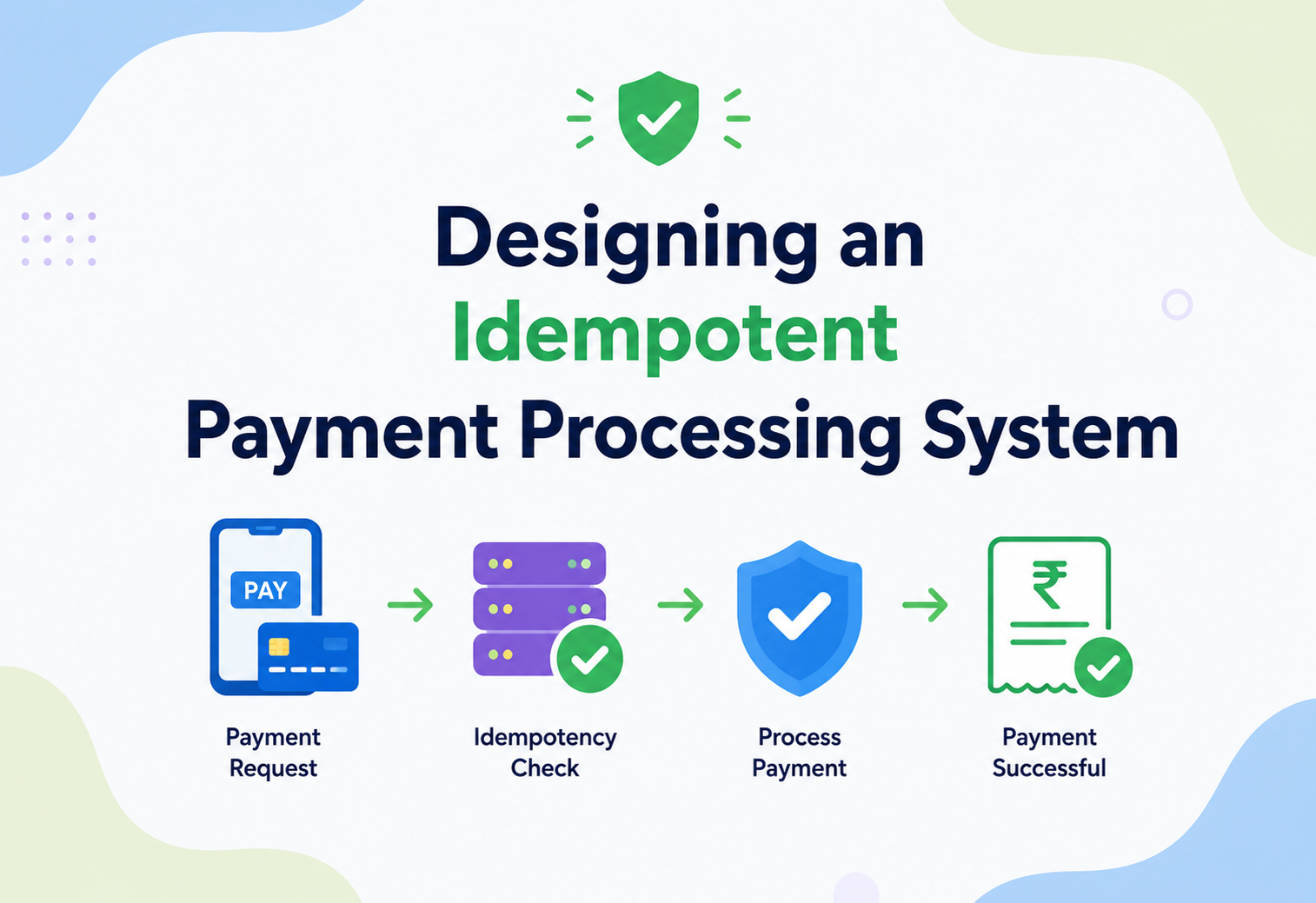
Designing an Idempotent Payment Processing System
How to guarantee a transaction is charged exactly once, even when a client retries after a network timeout — at a scale of millions of requests per minute. A ground-up walkthrough of the client-generated idempotency key, the layered defences behind it, and every trade-off, failure mode, and safety net a production payment stack needs.
Introduction and History
Why one of the most feared bugs in all of software engineering — the accidental double charge — is really a very old problem in distributed systems wearing a new outfit.
Picture yourself paying for something online. You tap “Pay Now,” your phone’s internet flickers for a moment, and the screen just spins. Frustrated, you tap “Pay Now” again. A few seconds later, both attempts go through, and you check your bank statement to find you have been charged twice for the same order. This is one of the most feared bugs in all of software engineering, because it involves real money, real customer trust, and often, real legal and regulatory consequences.
The root of this problem is something every network engineer learns early: a network request can fail in a way where you, the sender, genuinely cannot tell whether the other side actually received and processed it, or not. The response telling you “yes, it worked” might have been lost on the way back to you, even though the payment itself went through perfectly on the server. This uncertain middle ground — called “at least once versus exactly once” delivery — has existed since the earliest distributed computing systems, long before the internet or online shopping existed.
Early payment systems in the 1970s and 1980s, built for bank mainframes and point-of-sale terminals, already grappled with this exact issue, using techniques like unique transaction reference numbers and manual reconciliation reports run overnight. As online payments exploded in the 2000s with the rise of e-commerce, and then again in the 2010s with mobile payments and instant transfers, the same fundamental problem returned at a vastly larger scale, and the industry converged on a now-standard solution: the idempotency key. This document walks through, piece by piece, how to design a payment system that uses this idea, and the surrounding architecture, to guarantee a transaction is processed exactly once, no matter how many times a client retries, even under the load of millions of requests per minute.

Think of a wedding RSVP card with a unique guest number printed on it. If you mail your RSVP card and never hear back, so you mail a second, identical card just to be safe, the host’s assistant simply checks the guest number against a list. If that guest number has already been recorded, the assistant throws the duplicate card away without recounting you. The unique number is what lets the assistant safely ignore duplicates, no matter how many times the same card arrives.
“Why can’t we just rely on TCP to guarantee a request is only processed once?” A good answer clarifies that TCP guarantees reliable delivery of bytes over a single connection, but says nothing about what happens at the application level once a client gives up waiting and opens a brand-new connection to retry; the server has no way to know a “new” request is actually a retry unless the client tells it so explicitly.
1.1 Why This Problem Never Fully Goes Away
It is tempting to think this is solvable once and forgotten, but the truth is that network timeouts are a permanent, unavoidable fact of distributed systems, not a bug to be fixed. Mobile networks drop packets, data centres experience brief partition events, load balancers occasionally kill slow connections, and client apps have their own retry logic that engineers do not always control. A well-designed payment system does not try to prevent timeouts from happening, since that is impossible; instead, it is designed so that a retry after a timeout is always, provably, safe.
1.2 A Very Short History of the Idempotency Key
Unique Transaction Reference Numbers
Mainframe-era banking systems already used printed reference numbers on cheques and settlement files, plus overnight reconciliation reports, to catch and undo duplicate postings. The idea — give every attempt an identity — is essentially unchanged today.
Web Payments and the Return of the Problem
As e-commerce scaled, the same “did my POST go through?” ambiguity from the mainframe era reappeared over HTTP. Early online storefronts routinely dealt with duplicate charges caused by users refreshing the checkout page, and the industry began standardising on client-supplied unique keys as the cure.
The Modern Idempotency Key API
Modern payment platforms like Stripe made the client-supplied Idempotency-Key header a first-class, publicly documented feature of their API, and downstream industries followed. It moved from a niche best practice to an expected standard for any serious payment integration.
Idempotency as a System-Wide Discipline
As payments moved onto microservice architectures with Kafka event pipelines, teams realised idempotency isn’t just an API concern — every internal hop, every consumer, every retry loop needs the same discipline, because duplicates can now be introduced deep inside the system, not just at the outer edge.
Problem and Motivation
Why “just retry on timeout” is one of the most quietly dangerous defaults in backend engineering, and why the fix has to be deliberate.
Let us break down precisely why “just retry on timeout” is dangerous without extra design, and why this is genuinely one of the harder problems in backend engineering.
2.1 The Core Problem
- Ambiguous timeouts: When a client does not receive a response within its timeout window, it has no way to know whether the server never received the request, received it but has not finished processing, or finished processing successfully and the response was simply lost on the way back.
- Client retries are necessary and expected: Mobile apps, browsers, and payment SDKs are built to retry on timeout, because most of the time a timeout really does mean the request was lost, and refusing to retry would make the product feel broken on flaky networks.
- Double charging is unacceptable: Unlike most retryable operations, charging a customer’s card twice for one order causes direct financial harm, damages trust, and can trigger chargebacks, regulatory scrutiny, and support costs far larger than the value of engineering effort saved by skipping this design work.
- Massive concurrent volume: At scale, millions of payment requests per minute means millions of opportunities for a network hiccup, so even a tiny per-request probability of a timeout translates into a large absolute number of retries every single minute.
- Multiple systems in the chain: A single payment touches the marketplace’s own services, an external payment gateway, and often a card network and issuing bank behind that, and a retry can occur at any layer of this chain, not just between the customer’s device and the marketplace.
A customer’s phone loses signal for two seconds right after tapping “Pay.” The app, seeing no response, automatically retries the exact same payment request. If the server has no memory of the first attempt, it will process this “new” request completely independently, charging the customer a second time for the same order.
Large payment processors such as Stripe require every charge request to include a client-generated idempotency key, and explicitly document that retrying a request with the same key will safely return the original result instead of creating a second charge, precisely because this problem is so common and so costly to get wrong.
2.2 Why Naive Approaches Fail
Naive “Duplicate Detection” Ideas That Break
- “Has this customer paid this exact amount in the last few seconds?” — blocks the perfectly legitimate case of two separate real orders of the same amount within a short window (e.g., two identical coffees). Any customer hit by this would rightly consider the app broken.
- “Please do not click twice.” — relies on human discipline over a flaky network, which is exactly where the temptation to retry is strongest. Users will always double-tap; the system must handle it.
- “Just rely on TCP.” — TCP guarantees byte delivery on a single connection, not application-level exactly-once processing across brand-new retries on brand-new connections.
- “Deduplicate on the request body hash.” — conflates genuinely identical intents with genuinely repeated intents, and any small variation (a fresh timestamp, a new nonce) silently breaks it.
The only robust solution is to give every payment attempt an identity — the idempotency key — generated once by the client and reused on every retry of that same logical attempt, so the server can definitively recognise a retry as a retry, not as a new request.
“Who should generate the idempotency key, the client or the server?” The correct answer is the client, specifically once per logical user action such as one tap of the pay button, because only the client knows for certain whether a new network call is a fresh action or a retry of a previous one; a server-generated key would defeat the purpose, since a retried request would simply get a new key each time.
2.3 The Scale of the Challenge in Numbers
A target of one million requests per minute works out to roughly 16,700 requests per second sustained, with realistic peaks during a major sale event reaching 50,000 to 80,000 requests per second for short bursts. Even a very small, well-engineered network failure rate — say one in every one thousand requests genuinely timing out on the way back to the client — would still mean 50 to 80 retries every single second at peak, each one requiring the system to correctly recognise it as a duplicate rather than processing it as new.
Now consider a worse, but entirely realistic, scenario: a brief regional network disruption, perhaps a mobile carrier outage affecting a large city, causing a much larger spike in timeouts across thousands of concurrent customers within the same few seconds. Without the idempotency guarantees described in this document, this single external event could translate directly into thousands of duplicate charges within moments — each one a real customer complaint, chargeback, and support ticket. This is precisely the kind of correlated failure scenario that makes idempotency not an optional refinement but a mandatory, load-bearing part of the architecture for any payment system operating at this scale.
Architecture and Components
A layer-by-layer walkthrough of the system, from the customer’s device all the way to the external bank, with every box explicitly labelled by what kind of component it is.
3.1 Component-by-Component Explanation
| Component | Purpose |
|---|---|
| Client Layer | The web or mobile app generates a single unique idempotency key (typically a UUID) the moment the customer taps “Pay,” and stores it locally. If the request times out and the app retries, it reuses this exact same key rather than generating a new one — the single most important client-side rule in this entire system. |
| CDN Edge Node | Serves static assets like the checkout page’s JavaScript and styling. Payment requests themselves, being sensitive and personalised, are never cached at the CDN layer and always pass through to the origin. |
| Global Load Balancer | Routes each request to the nearest healthy region using DNS-based Anycast routing, minimising network latency before any payment logic runs, and rerouting automatically if an entire region becomes unavailable. |
| API Gateway | The API Gateway (commonly Kong or Envoy) is the front door. It authenticates the request, enforces rate limits per customer, and performs basic validation, including rejecting any payment request that is missing an idempotency key header — accepting such a request would reopen the exact door this whole design is meant to close. |
| Regional Load Balancer | A Layer 7 load balancer (such as NGINX or a cloud Application Load Balancer) spreads traffic evenly across many replicas of the Payment Orchestrator, so no single instance becomes a bottleneck or a single point of failure. |
| Payment Orchestrator | Stateless microservice that coordinates the overall workflow: it is the first place the idempotency key is checked against the Idempotency Key Store, and it sequences the calls to the Fraud and Risk Service and the Payment Execution Service, without itself holding any long-lived state. |
| Idempotency Key Store | A Redis cluster that supports atomic “claim this key if it does not already exist” operations. This is the heart of the duplicate-prevention mechanism, and its atomicity guarantee is what makes it safe even when two retries of the same request arrive at almost the exact same instant. |
| Fraud & Risk Service | Scores the transaction for fraud risk before money moves. Critically, this scoring itself must also respect the idempotency key, so a retried request does not get scored twice and potentially receive two different risk decisions. |
| Payment Execution Service | Runs the actual payment state machine: inserting a record into the Ledger Database, calling out to the external Payment Gateway Adapter, and updating the final status. Every step it performs is itself safe to retry internally. |
| Ledger Database | Strongly consistent relational database (typically PostgreSQL) holding the authoritative record of every transaction. A unique database constraint on the idempotency key column is the last line of defence: even if every other layer somehow allowed a duplicate through, the database itself will physically reject a second insert with the same key. |
| Payment Gateway Adapter | Integration microservice that talks to the external payment processor, card network, or bank. Most external payment gateways also support their own idempotency keys, so this adapter forwards our internal key (or a derived version) to the external system too, adding a second layer of protection outside our own infrastructure. |
| Event Bus | A Kafka cluster carries payment status change events to downstream systems such as order fulfilment, customer notifications, and accounting, decoupling these concerns from the critical, latency-sensitive payment path. |
| Reconciliation Service | Batch microservice that periodically compares our Ledger Database against the external payment gateway’s own records, catching the rare edge cases where a payment’s true outcome was genuinely unknown at the time (for example, our system timed out waiting for the gateway, and the gateway’s own response was lost), and resolving them safely. |
| Monitoring Stack | Prometheus and Grafana track latency, error rates, and specifically the rate of duplicate idempotency key hits — itself a valuable signal of network health and client retry behaviour. |
“Where exactly is the single point of truth that prevents a duplicate charge?” A strong answer explains that there are deliberately two layers: the fast-path check against the Redis Idempotency Key Store, which handles the overwhelming majority of retries cheaply, and the database’s unique constraint on the idempotency key column, which is the absolute, unbreakable guarantee, even if the Redis check were somehow bypassed or had a bug.
3.2 Why a Dedicated Idempotency Store Instead of Just Logging Requests
A reasonable early question is why we need a dedicated Redis-based Idempotency Key Store at all, rather than simply logging every incoming request and checking the log before processing a new one. The problem is speed and atomicity: a traditional log is designed for durability and sequential writing, not for the kind of instantaneous, atomic “claim this key only if nobody else has” check that must happen on the hot path of every single payment request, often within a few milliseconds, and often with many concurrent requests racing to claim the same key at nearly the same instant. Redis, with its single-threaded command execution model and native atomic operations, is purpose-built for exactly this kind of check, which is why it sits directly in the critical path rather than a general-purpose log or the main ledger database itself, which is comparatively much slower to query at this frequency and this level of concurrency.
Internal Working
Zooming in on exactly what happens inside the system when a client’s request times out and it retries — the moment of truth for every guarantee we’re promising.
4.1 The Atomic Claim Operation
The very first thing the Payment Orchestrator does with an incoming request is attempt to atomically claim the idempotency key in Redis, using a command such as SET key value NX, which only succeeds if the key does not already exist. This single atomic operation is what safely handles the case where two retries of the same request arrive at almost the exact same millisecond — perhaps because a client’s retry logic fired just as the original request’s slow response was finally arriving: only one of the two concurrent attempts will win the claim, and the other will immediately see that the key is already taken.
public class IdempotencyKeyStore {

    private final RedisTemplate<String, String> redisTemplate;
    private static final Duration LOCK_TTL = Duration.ofMinutes(10);

    public IdempotencyKeyStore(RedisTemplate<String, String> redisTemplate) {
        this.redisTemplate = redisTemplate;
    }

    public ClaimResult claim(String idempotencyKey) {
        Boolean claimed = redisTemplate.opsForValue()
            .setIfAbsent(key(idempotencyKey), "IN_PROGRESS", LOCK_TTL);

        if (Boolean.TRUE.equals(claimed)) {
            return ClaimResult.NEWLY_CLAIMED;
        }

        String status = redisTemplate.opsForValue().get(key(idempotencyKey));
        if ("IN_PROGRESS".equals(status)) {
            return ClaimResult.ALREADY_IN_PROGRESS;
        }
        return ClaimResult.ALREADY_COMPLETED;
    }

    private String key(String idempotencyKey) {
        return "idempotency:" + idempotencyKey;
    }
}
4.2 Handling the “Already In Progress” Case
A tricky, important case is when a retry arrives while the original attempt is still actively being processed, not yet finished. Simply rejecting the retry outright would be wrong, since the client legitimately needs an answer. Instead, the Orchestrator holds the retry request briefly — polling the key’s status for a short window, typically a few seconds — and once the original attempt completes, returns that same final result to the retry, rather than starting a second, parallel execution.
4.3 The Database as the Final Safety Net
Even with the Redis-based claim working correctly, good engineering practice never relies on a single layer of protection for something this important. The Ledger Database table has a unique constraint on the idempotency key column, so even in the rare case of a Redis failure, a bug, or a claimed key expiring too early, a genuine duplicate insert attempt will be rejected by the database itself with a constraint violation — which the Payment Execution Service catches and treats as “this was already processed,” rather than as an error.
CREATE TABLE payment_transactions (
    id BIGSERIAL PRIMARY KEY,
    idempotency_key VARCHAR(64) NOT NULL UNIQUE,
    customer_id     BIGINT      NOT NULL,
    amount_cents    BIGINT      NOT NULL,
    currency        CHAR(3)     NOT NULL,
    status          VARCHAR(20) NOT NULL,
    created_at      TIMESTAMP   NOT NULL DEFAULT now(),
    updated_at      TIMESTAMP   NOT NULL DEFAULT now()
);public class PaymentExecutionService {
private final PaymentTransactionRepository repository;
private final PaymentGatewayAdapter gatewayAdapter;
public PaymentResult execute(PaymentRequest request) {
try {
repository.insertPending(request.getIdempotencyKey(),
request.getCustomerId(), request.getAmountCents(),
request.getCurrency());
} catch (DuplicateKeyException e) {
// Another concurrent attempt already inserted this row
return repository.findByIdempotencyKey(request.getIdempotencyKey())
.toResult();
}
GatewayResponse response = gatewayAdapter.charge(request);
repository.updateStatus(request.getIdempotencyKey(), response.getStatus());
return new PaymentResult(response.getStatus(), response.getTransactionId());
}
}“What if the payment gateway call itself times out, so you genuinely do not know if the charge succeeded?” This is the hardest case in the whole system. A strong answer describes marking the transaction as an explicit UNKNOWN state rather than guessing, and relying on the Reconciliation Service to later query the gateway’s own transaction status API to definitively resolve it, rather than blindly retrying the charge — which could cause the very duplicate this design exists to prevent.
4.4 Choosing a Safe Lock Time-to-Live
The time-to-live set on a freshly claimed, still-in-progress idempotency key deserves careful thought. If it is set too short, a slow but otherwise legitimate payment attempt — perhaps delayed by a genuinely slow external gateway response — could have its lock expire while still processing, opening a dangerous window where a retry might slip through and start a second, parallel execution. If it is set too long, a request that crashed or failed in an unusual way partway through, without ever reaching a final state, could leave a key stuck as falsely IN_PROGRESS for an unnecessarily long time, blocking any legitimate retry from proceeding.
A common, well-tested approach uses a moderate lock time-to-live, generously longer than the ninety-ninth percentile expected processing time, combined with a background sweep process that detects and safely resolves any key that has remained IN_PROGRESS far longer than should ever legitimately happen — treating it as a signal to trigger the same reconciliation path used for the UNKNOWN gateway state.
Data Flow and Lifecycle
The complete life of a payment attempt — from the customer’s tap, through a network timeout and a retry, to a final, safely-once confirmation.
- Key Generation: The client generates a unique idempotency key once, at the moment the customer taps “Pay,” and stores it locally so it survives across retries of that same logical payment attempt.
- Initial Request: The request, carrying the idempotency key in a header, travels through the CDN, Global Load Balancer, API Gateway, and Regional Load Balancer to a Payment Orchestrator instance.
- Atomic Claim: The Orchestrator attempts to atomically claim the key in Redis. If successful, this is a genuinely new attempt, and processing continues.
- Risk Scoring: The Fraud and Risk Service evaluates the transaction, itself keyed by the idempotency key so it is not scored twice on a retry.
- Ledger Insert: The Payment Execution Service inserts a
PENDINGrow into the Ledger Database, protected by the unique constraint on the idempotency key. - External Charge: The Payment Gateway Adapter calls the external payment processor, forwarding the idempotency key so the external system has its own duplicate protection too.
- Network Timeout: Suppose the response from either our own system or the external gateway is lost in transit back to the client. The client’s timeout fires, and it has no confirmation.
- Client Retry: The client automatically retries, sending the identical request with the identical idempotency key.
- Fast Lookup, Not Re-Execution: The Orchestrator checks the key’s status in Redis, finds it already
COMPLETED(or stillIN_PROGRESS, handled as described earlier), and returns the already-computed final result directly, without re-running any payment logic or contacting the external gateway again. - Asynchronous Side Effects: In parallel, once the transaction reaches a final state, an event flows through Kafka to trigger order fulfilment and a customer notification — exactly once, regardless of how many times the client retried the underlying request.
- Reconciliation Safety Net: Periodically, the Reconciliation Service compares our Ledger Database against the external gateway’s own transaction records, catching and resolving any transactions left in an
UNKNOWNstate due to a timeout on the gateway call itself.
A customer’s train enters a tunnel right after they tap “Pay” for a 2,500 rupee order. Their idempotency key, generated once, is a1b2c3d4. The first request reaches the server and completes successfully, but the confirmation response never reaches the phone before the tunnel cuts the connection. When the train exits the tunnel forty seconds later, the app automatically retries using the same key a1b2c3d4. The server recognises this key as already COMPLETED and instantly returns the original confirmation, and the customer’s card is charged exactly once.
Advantages, Disadvantages and Trade-offs
Every design choice in this system pays for something and costs something else — here they are, side-by-side, so nothing is smuggled in.
| Aspect | Advantage | Disadvantage / Trade-off |
|---|---|---|
| Client-generated idempotency keys | Definitively distinguishes retries from genuinely new requests | Requires disciplined client-side implementation across every client platform |
| Redis-based atomic claim | Extremely fast, handles the vast majority of duplicate checks cheaply | Adds an extra network hop and a new piece of critical infrastructure |
| Database unique constraint | Absolute, unbreakable final guarantee against duplicate rows | A rejected insert must be handled gracefully, adding code complexity |
Holding retries during IN_PROGRESS state | Avoids parallel duplicate execution of a still-running attempt | Adds latency to a genuinely concurrent retry, and needs a sane timeout |
| Reconciliation with external gateway | Resolves the rare truly ambiguous cases safely and correctly | Introduces an eventual consistency window rather than instant certainty |
The central trade-off in this system is certainty versus latency. We could, in theory, make every single request wait for a fully confirmed, reconciled answer from the external payment gateway before responding, but this would be unacceptably slow. Instead, this design pushes the truly hard, rare, ambiguous cases into an asynchronous reconciliation process, while keeping the common, fast path — a genuinely new request or a clean retry of a completed one — extremely quick.
Performance and Scalability
Millions of requests per minute, tens of thousands per second at peak, a heavy external dependency — the numbers force every layer to be scaled and shaped deliberately.
The target for this system is millions of requests per minute — roughly 16,700 requests per second sustained, with peaks potentially reaching 50,000 to 80,000 requests per second during high-traffic events such as a major sale. Let us look at how this design holds up.
7.1 Horizontal Scaling of Stateless Services
The Payment Orchestrator, Fraud and Risk Service, and Payment Execution Service are all stateless, holding no important data in local memory between requests. This means we can run as many replicas as needed behind the Regional Load Balancer, scaling horizontally with an auto-scaler that watches CPU usage and request queue depth — exactly the same core scaling strategy used across almost every high-throughput backend system.
7.2 The Idempotency Store as a Critical Hot Path
Every single payment request, whether new or a retry, must pass through the Redis Idempotency Key Store, making it one of the most heavily hit components in the entire system. It is deployed as a sharded, replicated cluster, splitting the key space across many nodes so no single node becomes a bottleneck, with keys automatically expiring after a reasonable window (typically ten minutes to a few hours) since a key only needs to remain useful for as long as a client might realistically still be retrying.
7.3 Keeping the Common Path Fast
The overwhelming majority of requests are genuinely new attempts, not retries, so the atomic claim in Redis succeeds immediately and processing proceeds without any extra delay. For the smaller fraction that are retries of an already-completed transaction, the Orchestrator returns the stored final response directly from Redis, which is dramatically faster than re-running the full payment workflow — meaning retries are actually cheaper for the system to handle than fresh requests.
UNKNOWN state for genuinely ambiguous PSP timeouts — resolved asynchronously by the Reconciliation Service into a real terminal state.7.4 Connection Pooling to the External Gateway
Calls to the external Payment Gateway Adapter are the slowest step in the entire pipeline, often 200 to 600 milliseconds, and external gateways impose their own rate limits. The Payment Gateway Adapter maintains carefully sized connection pools and applies its own internal queuing and backpressure, so a burst of incoming traffic does not simply forward an unmanageable flood of concurrent requests to the external gateway, which could get the marketplace’s integration throttled or temporarily blocked.
7.5 Capacity Planning With Real Numbers
At a peak of 80,000 requests per second, if a single Payment Execution Service instance can safely handle around 500 requests per second — accounting for the relatively heavier work of a database insert and an external call compared to a simple read — we would need roughly 160 instances at peak, scaled up gradually as load climbs rather than provisioned permanently. The Redis Idempotency Key Store, holding keys for a bounded recent window (perhaps 50 million active keys at any given moment, each a small entry of well under a kilobyte), comfortably fits within a modestly sized cluster with room to spare. The Ledger Database’s write throughput, since every request results in at most one insert, is the primary scaling constraint on that layer, which is why the ledger is typically sharded by customer ID or transaction ID range across multiple database clusters once a single cluster’s write capacity is approached.
“What happens if the Redis Idempotency Key Store itself becomes overloaded during a huge traffic spike?” A strong answer discusses horizontal sharding of the Redis cluster ahead of time, sized with real headroom above expected peak, combined with the database unique constraint as a fallback safety net that still prevents a true duplicate charge even if Redis briefly degrades — at the cost of somewhat higher latency for the affected requests.
7.6 Backpressure Toward the External Gateway
It is important to recognise that our own system can often scale its internal compute layer far more elastically than the external payment gateway can absorb sudden bursts of traffic. If our Payment Orchestrator fleet auto-scales up to handle 80,000 requests per second internally, but the external gateway’s contractually agreed rate limit is only 20,000 requests per second, blindly forwarding every request as fast as it arrives would simply overwhelm the gateway and cause a cascade of failures that then, ironically, generate exactly the kind of client-side timeouts and retries this whole system is built to survive.
The Payment Gateway Adapter therefore applies explicit backpressure, using a bounded queue and controlled concurrency limits that respect the external gateway’s known capacity, returning a clear, honest “please retry shortly” response to requests that cannot yet be forwarded, rather than accepting unlimited work it cannot actually deliver on.
High Availability and Reliability
A payment system that is frequently unavailable is a business emergency, not just an inconvenience — so redundancy and safe failure handling are designed into every layer.
8.1 Redundancy at Every Layer
Every service runs multiple replicas spread across multiple availability zones, and the Redis Idempotency Key Store and Ledger Database both run in clustered, replicated configurations, so the loss of any single machine, rack, or even an entire data centre does not take the payment system down.
8.2 Handling Ambiguous External Gateway Failures
The hardest reliability case in this entire system is a timeout on the call to the external payment gateway itself. Blindly retrying that call risks the exact duplicate charge this design exists to prevent, since we cannot be certain the first attempt did not already succeed on the gateway’s side. Instead, the transaction is marked UNKNOWN, and the Payment Gateway Adapter uses the gateway’s own transaction status lookup API (if available, using the same idempotency key) to definitively determine the true outcome before either confirming success or safely retrying.
8.3 Circuit Breakers on the External Gateway
If the external payment gateway starts failing or timing out repeatedly, a circuit breaker (using a library such as Resilience4j) opens and stops sending new charge attempts to it for a cooldown period, immediately marking new incoming requests as temporarily unavailable, with clear messaging back to the client, rather than letting every request pile up waiting on a failing dependency.
@CircuitBreaker(name = "paymentGateway", fallbackMethod = "handleGatewayUnavailable")
public GatewayResponse charge(PaymentRequest request) {
    return gatewayClient.charge(request);
}

public GatewayResponse handleGatewayUnavailable(PaymentRequest request, Throwable t) {
    return GatewayResponse.temporarilyUnavailable();
}
8.4 Idempotency Key Expiry Policy
Idempotency keys cannot be kept forever, both for storage efficiency and because customers do not retry indefinitely. A carefully chosen expiry window — typically 24 hours — balances giving genuinely slow or delayed retries enough time to be recognised, against not accumulating unbounded storage. This expiry window is documented clearly for client developers, so they understand the guarantee only holds within that window.
8.5 Disaster Recovery
The Ledger Database is replicated across regions with a well-tested failover process, and the entire payment stack can run in an active-active or active-passive multi-region configuration, so that a full regional outage does not stop the marketplace from processing payments, with the Global Load Balancer rerouting traffic automatically to a healthy region.
8.6 Testing Reliability on Purpose
Mature payment teams regularly run controlled chaos engineering exercises — deliberately injecting timeouts into the simulated external gateway call, killing a Redis node, or simulating a database failover during a test transaction — specifically to verify that the idempotency guarantees described in this document hold up in practice, not just on paper. Automated tests that fire the exact same payment request twice in rapid succession, simulating a real client retry, are a standard, mandatory part of the test suite for any payment system.
“How would you test that your system truly never double charges, beyond just reading the code?” A strong answer describes automated integration tests that deliberately fire concurrent duplicate requests with the same idempotency key at the running system and assert exactly one ledger row and exactly one external charge resulted, along with periodic reconciliation reports in production comparing internal and external transaction counts as an ongoing, live check.
Security
Payment systems are one of the highest-value targets on the internet — security here has to be layered, thorough, and boring to attackers.
9.1 Rate Limiting and Abuse Prevention
The API Gateway enforces per-customer and per-IP rate limits using a token bucket algorithm, preventing both accidental retry storms from a buggy client and deliberate abuse — such as an attacker probing the payment endpoint rapidly to test stolen card numbers, a pattern known as card testing fraud.
9.2 Idempotency Key Ownership Validation
An idempotency key must be scoped to the authenticated customer who created it. The system must reject any attempt to reuse or guess another customer’s idempotency key, since without this check, an attacker could potentially interfere with or read the cached result of someone else’s transaction.
9.3 PCI DSS Compliance
Handling card data brings the system into scope for the Payment Card Industry Data Security Standard (PCI DSS). In practice, most marketplaces avoid ever touching raw card numbers directly by using tokenisation: the external Payment Gateway Adapter exchanges sensitive card details for an opaque token during checkout, and only that token — never the raw card number — flows through our own Payment Execution Service and Ledger Database, dramatically shrinking the amount of infrastructure that needs to meet the strictest compliance requirements.
In practice, this means the checkout page’s card entry form typically submits card details directly to the payment gateway’s own hosted fields or SDK, bypassing our servers entirely, and our system only ever receives and stores the resulting token, which is useless to an attacker outside the context of our specific merchant account and cannot be reversed back into the original card number.
9.4 Encryption in Transit and at Rest
Every network hop in the diagram, from the client all the way to the external gateway, uses TLS encryption. The Ledger Database encrypts sensitive fields at rest, and access to raw transaction data is tightly scoped through role-based access control, with all access logged for audit purposes.
 You may likeDesigning a Photo-Sharing System That Serves Billions of Images in Under 100ms, Globally
9.5 Fraud and Risk Scoring
The Fraud and Risk Service evaluates signals such as unusual transaction velocity, mismatched billing and shipping locations, and device fingerprinting, before a charge is attempted — and, importantly, this scoring itself respects the idempotency key so a retried request is never re-scored and potentially flagged inconsistently from its original attempt.
9.6 Audit Logging
Every state transition of a payment, from RECEIVED through to COMPLETED or FAILED, is recorded in an immutable audit log, separate from the operational database, since regulators and internal fraud investigations both require a complete, tamper-evident history of exactly what happened to every transaction and when.
“How do you prevent an attacker from replaying an old, legitimate idempotency key to trigger unwanted behaviour?” A thoughtful answer explains that a completed key simply returns its original cached result rather than re-executing anything, so replaying it cannot cause a new side effect, and that keys are scoped to the authenticated customer and expire after a bounded window, further limiting any replay risk.
Monitoring, Logging and Metrics
Given the financial stakes, observability for this system needs to be both broad and unusually precise — every duplicate hit, every UNKNOWN transaction, is a story worth reading.
10.1 Key Metrics to Track
| Metric | Why It Matters |
|---|---|
| Request rate and latency percentiles (p50 / p95 / p99) | Tracked separately for new attempts versus retries — retries should be noticeably faster (cached response, no PSP call) |
| Duplicate key hit rate | How often an incoming request matches an already-claimed idempotency key — a direct proxy for real-world client retry behaviour and network health |
UNKNOWN state count | Transactions stuck in the ambiguous UNKNOWN state, awaiting reconciliation — should normally be a very small, near-zero number |
| External gateway error rate and latency | Since this is the slowest and least controllable part of the system, it is often the first thing to degrade |
| Reconciliation mismatch count | How many transactions the Reconciliation Service finds disagreeing between our ledger and the external gateway’s records — should also normally be extremely close to zero |
10.2 Distributed Tracing
A unique trace ID, generated at the API Gateway, follows a request through every service it touches. This is especially valuable for payments, because when investigating a customer complaint about a specific transaction, engineers can pull up the complete trace — including both the original attempt and any retries — and see exactly what happened at each step.
10.3 Structured, Immutable Logging
Every service emits structured JSON logs including the idempotency key and trace ID, sent to a centralised logging system. For payment-specific events, logs are also written to an append-only, tamper-evident audit trail, since payment logs often need to be retained far longer than typical application logs for compliance reasons.
10.4 Alerting and Service Level Objectives
A reasonable SLO for this system might state that 99.9 percent of payment requests resolve, successfully or with a clear failure, within 3 seconds, and that the count of transactions stuck in the UNKNOWN state for more than 5 minutes stays at zero under normal operation. Alerts fire immediately, paging the on-call engineer, if the UNKNOWN count rises above zero for a sustained period — this specific metric is one of the most direct early warnings of a real problem in the payment pipeline.
“Which single metric would you watch most closely for this system?” A strong answer names the count of transactions in the UNKNOWN state, since a healthy system should keep this at or very near zero, and any sustained rise is a direct, early signal that something in the payment pipeline — most likely the external gateway integration — needs immediate attention.
10.5 Dashboards Built for Different Audiences
A mature monitoring setup for a payment system typically maintains at least two distinct dashboards, because engineers and business stakeholders need different views of the same underlying data. An engineering-facing dashboard focuses on latency percentiles, error rates, circuit breaker state, and infrastructure health — the kind of detail needed to diagnose a technical incident quickly. A business and finance-facing dashboard, by contrast, focuses on transaction success rate, total processed volume, and the reconciliation mismatch count over time, giving non-engineering stakeholders visibility into the health of the payment system without needing to interpret raw infrastructure metrics, and building shared trust that the guarantees described throughout this document are holding up in production, not just in design documents.
Deployment and Cloud
All services are packaged as containers and orchestrated with Kubernetes, with deployment practices tuned for the extra caution a payment system demands.
11.1 Careful, Gradual Rollouts
New versions of the Payment Execution Service or Payment Gateway Adapter are rolled out using a canary strategy, receiving a very small slice of real traffic first — often as low as 1 percent — with close monitoring of the UNKNOWN state count and error rate before gradually increasing traffic to the new version, since a subtle bug in payment logic can be far more costly than in most other systems.
11.2 Auto-Scaling
A Horizontal Pod Autoscaler watches CPU usage and request queue depth for the Payment Orchestrator and Payment Execution Service, adding replicas automatically as load climbs, which matters both for handling normal daily traffic patterns and for absorbing sudden spikes during major sale events.
11.3 Multi-Region Deployment
The stack is deployed across multiple geographic regions for both latency and resilience, with the Ledger Database using a carefully chosen replication strategy — often a single writable primary region per customer’s data with read replicas elsewhere — since payment data typically has strict consistency and regulatory data residency requirements that are more restrictive than the shipping cost or catalogue data seen in other parts of a marketplace.
11.4 Infrastructure as Code
All infrastructure, including the Redis cluster, database cluster, Kubernetes configuration, and networking rules, is defined in code using tools such as Terraform, ensuring environments are reproducible and every change goes through code review — especially important for a system where a misconfiguration could have direct financial consequences.

“Why would you use an even more cautious rollout strategy for this system compared to, say, a product recommendation service?” A good answer notes that a bug in a recommendation service might show a slightly worse suggestion — a low-cost, easily reversible mistake — while a bug in payment logic could cause real financial harm to real customers, so the acceptable blast radius for a bad deployment is far smaller, justifying slower, more heavily monitored rollouts.
Databases, Caching and Load Balancing
Different data has different physics — the ledger, the idempotency store, and the reporting workload each need a different storage shape.
12.1 Choosing the Ledger Database
We chose PostgreSQL, a strongly consistent relational database, for the Ledger, specifically because payment records require strict ACID guarantees — meaning a transaction is either fully recorded or not recorded at all, with no partial or inconsistent state ever visible — and because the unique constraint feature is exactly the tool needed to enforce the idempotency guarantee at the storage layer.
12.2 Why Not a NoSQL Store for the Ledger
Many other parts of a marketplace, such as the shipping rate table discussed in other guides in this series, benefit from NoSQL stores optimised for massive read throughput. The Ledger is different: its defining requirement is strong consistency and correctness under concurrent writes, not primarily read throughput, so a relational database with proper transactions and constraints is the better fit here, even though it generally scales horizontally with more operational effort than a NoSQL store.
12.3 Sharding the Ledger for Scale
As transaction volume grows, a single PostgreSQL cluster’s write throughput eventually becomes the limiting factor. The Ledger is sharded, typically by customer ID or a hash of the idempotency key, across multiple independent database clusters, so write load is spread horizontally, while each individual shard still enforces its own strict unique constraint and ACID guarantees within its own scope.
12.4 Redis Cluster Design for Idempotency Keys
The Idempotency Key Store runs as a sharded, replicated Redis cluster. Keys use a bounded time-to-live (typically 24 hours, matching the documented client retry window), and replication ensures that the loss of a single Redis node does not silently lose a key’s claimed status, which could otherwise risk a duplicate execution slipping through.
12.5 Load Balancing Strategy
Global Load Balancer
Routes to the nearest healthy region using DNS-based Anycast routing, minimising network latency before any payment logic runs.
Regional Layer-7 LB
Within each region, distributes traffic using health-checked least-connections routing, so no single Orchestrator instance is overloaded and unhealthy instances are automatically removed from rotation.
Shard Routing
Within the Ledger and Redis clusters, consistent hashing directs each key to a specific shard, so scaling out only requires moving a small fraction of the data.
“Since the Ledger Database needs strong consistency, doesn’t that limit how much you can scale it?” A balanced answer acknowledges the trade-off directly: yes, a strongly consistent database is harder to scale than an eventually consistent NoSQL store, but sharding by customer or key hash lets you scale horizontally while keeping each shard strongly consistent within itself, which is an acceptable and standard trade-off for data where correctness matters more than raw throughput.
12.6 Read Replicas for Reporting and Reconciliation
Since the Ledger Database’s primary role is to safely accept writes with strict consistency, read-heavy workloads that do not need up-to-the-millisecond freshness — such as the Reconciliation Service’s periodic comparison job, business reporting dashboards, and customer support lookups — are routed to read replicas rather than the primary write node. This keeps the primary free to focus on what it does best, accepting and safely committing new transaction writes at the throughput the business demands, while still giving every other part of the organisation fast, reliable access to transaction data without risking any impact on payment processing latency itself.
APIs and Microservices
The contract each service exposes — and why splitting the payment flow into distinct services beats one large monolith at this scale.
13.1 The Public Payment API
POST /api/v1/payments
Headers:
  Idempotency-Key: a1b2c3d4-5678-90ef-ghij-klmnopqrstuv

Request Body:
{
  "orderId":            "ORD-93211",
  "amountCents":        250000,
  "currency":           "INR",
  "paymentMethodToken": "tok_9f8e7d6c"
}

Response Body:
{
  "transactionId":  "TXN-77123",
  "status":         "COMPLETED",
  "idempotencyKey": "a1b2c3d4-5678-90ef-ghij-klmnopqrstuv"
}
13.2 Internal Service Contracts
Internal services communicate over gRPC, chosen for its speed and strongly typed contracts — particularly valuable here since a mismatched field type or an ambiguous optional field in a payment message could cause exactly the kind of subtle bug this whole system is designed to prevent. The idempotency key is threaded through every internal call in the chain, not just the initial client-facing request.
13.3 Why Microservices Fit This Problem
Separating the Payment Orchestrator, Fraud and Risk Service, Payment Execution Service, and Payment Gateway Adapter allows each to scale and evolve independently. The Fraud and Risk Service, for example, might need to integrate new machine learning models frequently, while the Payment Execution Service — handling the most safety-critical logic — changes far more conservatively and infrequently, and this separation lets each team move at the pace appropriate to their component’s risk profile.
13.4 Error Handling and Idempotency at the API Level
The public API always returns the same response shape for a given idempotency key, whether this is the very first call or the tenth retry, which is the concrete, observable guarantee the entire architecture is built to deliver. A missing idempotency key header is rejected immediately at the API Gateway with a clear error, rather than being silently accepted and treated as if a key were auto-generated, since that would quietly defeat the entire protection this design provides.
{
  "error": {
    "code":      "MISSING_IDEMPOTENCY_KEY",
    "message":   "An Idempotency-Key header is required for payment requests",
    "retryable": false
  }
}“Should the idempotency key be a required or optional header?” It should be required and strictly validated, rejecting the request outright if missing — because making it optional would mean any client that forgets to send it loses all duplicate protection, silently reopening the exact vulnerability this system exists to close.
Design Patterns and Anti-patterns
The reusable ideas this architecture leans on, and the tempting shortcuts that will quietly wreck it.
14.1 Patterns Used
Idempotency Key
The central pattern of this entire document — a client-generated unique identifier used to safely distinguish retries from new requests, threaded through every hop in the system.
Circuit Breaker
Protects the system from a failing or slow external payment gateway by opening after repeated failures and short-circuiting further calls to a safe fallback path.
Saga-Style State Machine
The payment workflow is modelled as an explicit state machine with well-defined transitions, including an honest UNKNOWN state for genuinely ambiguous outcomes — not pretending every operation always resolves cleanly to success or failure.
Outbox / Event-Driven Notification
Payment status changes are published as events through Kafka only after the database transaction is safely committed, so downstream systems like order fulfilment never act on a status that could still be rolled back.
Reconciliation
A periodic, independent batch process cross-checks two systems of record (our ledger vs. the external PSP), catching and healing the rare inconsistencies that real-time logic alone cannot fully prevent.
Tokenisation
Raw card data is exchanged with the PSP for an opaque token at the very edge of the system, so no internal service ever handles PANs — shrinking PCI-DSS scope dramatically.
14.2 Anti-patterns to Avoid
Anti-patterns
- Server-generated idempotency keys: Defeats the entire purpose — a genuine retry would receive a different key each time and be treated as a brand-new request.
- Checking for duplicates by amount and customer alone: Incorrectly blocks legitimate back-to-back separate purchases of the same amount, which happens more often than engineers new to this problem tend to expect.
- Blindly retrying a timed-out external gateway call: Risks causing the exact duplicate charge on the external side that this whole design exists to prevent; ambiguous outcomes must be resolved through status lookup or reconciliation, never through a blind retry of a payment-mutating call.
- Relying on Redis alone, without a database constraint: Treats a cache — which can in rare cases lose data or have a bug — as the sole source of truth for something this financially critical, rather than as a fast-path optimisation backed by an unbreakable database guarantee.
- Skipping idempotency on “internal” retries: Assuming only client-to-server retries matter, while ignoring that internal service-to-service calls (Execution Service → Gateway Adapter) can just as easily be retried by internal retry logic or a Kafka consumer redelivering a message, and need the exact same protection.
“Where else in this pipeline, besides the client-to-server call, could a duplicate accidentally be introduced?” A sharp answer points out that Kafka consumers can redeliver a message after a consumer crash before committing its offset, and that internal service-to-service retries follow the same ambiguous-timeout problem as the client-facing call — meaning idempotency needs to be considered at every hop in the chain, not just the outermost one.
Best Practices and Common Mistakes
The habits mature payment teams share — and the recurring, expensive failures that catch newer ones.
15.1 Best Practices
- Generate the idempotency key once per logical user action, on the client, and reuse it consistently across every retry of that same action.
- Enforce a unique database constraint on the idempotency key as the final, unbreakable safety net — never rely on the cache layer alone.
- Model payment state explicitly, including an honest
UNKNOWNstate for genuinely ambiguous outcomes, rather than forcing every path into success or failure. - Thread the idempotency key through every internal service call and every external gateway call in the chain, not just the initial client-facing request.
- Build and continuously run an automated reconciliation process comparing internal records against the external gateway’s records.
- Write automated tests that deliberately fire duplicate concurrent requests and assert exactly one side effect resulted.
15.2 Common Mistakes
- Treating idempotency as purely a client-side concern and not enforcing it on the server, trusting clients to simply “not retry too much.”
- Forgetting that Kafka consumers, cron jobs, and internal retries can also produce duplicates, and only protecting the outermost client-facing API.
- Setting the idempotency key expiry window too short, so a legitimately slow retry — perhaps after a long mobile network outage — arrives after the key has already expired and is incorrectly treated as brand new.
- Blindly retrying an external gateway call after a timeout instead of checking its status first, risking a real duplicate charge on the external side.
- Not testing the concurrent duplicate scenario specifically, since normal functional tests naturally send one request at a time and never exercise the exact race condition this system is built to handle.
15.3 A Pre-Launch Readiness Checklist
Before launching or significantly changing this system, experienced teams verify a short list of critical items:

- The database unique constraint actually exists and is enforced — not just planned in a design doc.
- A load test specifically fires concurrent duplicate requests with the same idempotency key and confirms exactly one charge results.
- The Reconciliation Service is running and its mismatch count is being actively monitored, not just built and forgotten.
- Circuit breaker thresholds for the external gateway are tuned from real observed latency and error rates, not guessed.
- The on-call team knows exactly what the
UNKNOWNtransaction state means and has a clear, documented runbook for investigating it.
“If you could only add one automated test to this system, what would it be?” A strong candidate answer is a test that fires two truly concurrent requests with the identical idempotency key at the running system and asserts that exactly one row exists in the Ledger Database and exactly one charge was made to the external gateway — since this directly exercises the core race condition the entire design exists to solve.
15.4 Documenting the Contract for Client Developers
A subtle but important best practice is treating the idempotency behaviour as a clearly documented contract for whoever builds the client applications, not just an internal backend implementation detail. This documentation should explicitly state when to generate a new key versus reuse an existing one, how long a key remains valid, and exactly what the client should do if it receives a response indicating the original request is still in progress. Without this clarity, well-meaning client developers on a mobile team or a third-party integration partner can easily undermine the entire design — for example by accidentally generating a fresh key on every retry attempt, which silently reopens the exact vulnerability this whole architecture was built to close.
Real-World Industry Examples
Every serious payment platform independently converges on the same core discipline — strong evidence the pattern reflects the problem, not fashion.
Idempotency-Key Header
Stripe’s public API documentation explicitly describes supporting an Idempotency-Key header on payment creation requests, guaranteeing that retrying a request with the same key returns the original result rather than creating a second charge — one of the clearest, most widely referenced real-world implementations of the pattern covered here.
Large Marketplaces & Ride-Hailing
Major marketplaces and on-demand platforms that process high volumes of payments — from e-commerce checkout to ride fare charges — rely on the same fundamental idempotency key and state machine approach described here, since the underlying problem (ambiguous network timeout between client and server) is universal across payments, not specific to any one platform.
Card Networks & Banks
Traditional card networks and banking systems have long used similar concepts under different names, such as unique transaction reference numbers and daily reconciliation reports between banks, showing that the reconciliation pattern used here is not a new invention but a modern, automated, near-real-time version of a decades-old, well-proven banking practice.
Cloud Payment Infrastructure
Many cloud-based payment infrastructure providers now offer idempotency key support as a built-in, first-class feature of their APIs, reflecting how thoroughly this pattern has become an industry-standard expectation for any serious payment integration, rather than an advanced or optional technique.
Airline & Travel Booking
Airline and travel booking systems face an even more visible version of this same problem, since a duplicate booking is not just a financial error but can also accidentally reserve a genuinely limited resource, such as the last seat on a flight, twice. These platforms have historically used similar unique reservation reference identifiers, generated once per booking attempt and carried through every retry, for exactly the same reason payment idempotency keys exist: to make a network timeout during a critical, resource-consuming operation always safe to retry.
A large marketplace processing a major sale event will typically see its idempotency duplicate-hit rate climb noticeably during periods of network instability, such as when a popular mobile carrier experiences regional congestion — exactly the kind of real-world signal that validates why this design pattern exists and is worth the engineering investment.
FAQ, Summary and Key Takeaways
A rapid-fire tour of the questions that come up most often, followed by the durable lessons worth carrying away from this entire walkthrough.
17.1 Frequently Asked Questions
What if the client forgets to send an idempotency key at all?
The API Gateway should reject the request outright with a clear validation error, rather than silently generating one on the server’s behalf, since a server-generated key on every call would defeat the entire purpose of the protection.
How long should an idempotency key remain valid?
A common, reasonable window is 24 hours — long enough to cover realistic retry scenarios (including a customer’s device being offline for an extended period), while still keeping the Idempotency Key Store’s storage requirements bounded and predictable.
What happens if the customer genuinely wants to make two separate, identical purchases in quick succession?
Since the idempotency key is generated once per distinct user action (one tap of the pay button), two separate taps naturally produce two separate keys, and are correctly processed as two separate, legitimate charges — unlike naive amount-based duplicate detection, which would incorrectly block this.
Does using an idempotency key slow down every single payment request?
The added latency is small — typically a few milliseconds for the Redis atomic claim operation — a very worthwhile trade-off given the guarantee it provides. For retries specifically, the system is actually faster, since it returns a cached result instead of re-running the full payment workflow.
Is an idempotency key the same thing as a transaction ID?
No, though they are related. The idempotency key is generated by the client, once per attempt, specifically to guard against duplicate processing of that attempt. The transaction ID is generated by the server once processing genuinely begins, and uniquely identifies the resulting record in the Ledger Database. A single idempotency key maps to at most one transaction ID, but the two serve different purposes and are usually stored as separate fields.
What if two different idempotency keys are accidentally used for what was really the same customer action (e.g., a client-side bug)?
This is a genuine gap that pure idempotency key logic cannot fully close on its own, which is why the Fraud and Risk Service also applies a secondary, softer check for suspiciously similar transactions arriving in a short window — flagging them for review rather than automatically blocking them, since some such cases are legitimate separate purchases while others are true client-side bugs worth fixing at the source.
17.2 Key Takeaways
Key Takeaways
- Network timeouts are unavoidable in distributed systems — the goal is never to prevent them, but to make retrying after one always provably safe.
- A client-generated idempotency key, reused across retries of the same logical action, is the foundational mechanism that makes exactly-once payment processing possible.
- Layered protection matters: a fast Redis-based atomic claim handles the common case cheaply, while a database unique constraint provides an unbreakable final guarantee.
- Genuinely ambiguous outcomes (such as a timed-out external gateway call) should be modelled honestly as an explicit
UNKNOWNstate, resolved through status lookup or reconciliation — never through a blind retry. - The idempotency key must be threaded through every hop in the system, including internal service-to-service calls and asynchronous event consumers, not just the outermost client-facing API.
- Continuous reconciliation against the external payment gateway’s own records is the essential safety net that catches the rare cases real-time logic alone cannot fully resolve.
17.3 Closing Thoughts
This design gives a marketplace the ability to process payments at massive scale while providing one of the strongest guarantees a financial system can offer a customer: that a single tap of the “Pay” button, no matter how many times the network forces it to be retried, results in exactly one charge. Achieving this is less about any single clever trick, and more about consistently applying the same discipline — an identity for every attempt, layered protection, and honest handling of ambiguity — at every single layer of the system.
If you are approaching this as a system design interview question, the strongest signal you can give is not simply naming “idempotency key” as a buzzword, but walking through, layer by layer, exactly where duplicates could sneak in — from the client’s own retry logic, through internal service calls, all the way to the external gateway integration — and showing a concrete, layered defence at each one, including an honest plan for the genuinely ambiguous cases that no amount of clever request-response logic alone can fully resolve. That combination of breadth (from the client to the bank) and depth (understanding exactly why each layer of protection is necessary rather than redundant) is what separates a surface-level answer from a truly production-ready design.
Finally, it is worth remembering that this kind of system is never truly “finished” on day one. Real production payment systems evolve continuously as new failure modes are discovered in practice, as external gateway behaviour changes, and as transaction volume grows well beyond initial estimates. The teams that operate these systems successfully over the long term are the ones who treat monitoring, reconciliation, and chaos testing not as one-time launch tasks, but as an ongoing, permanent part of how the system is run — because the cost of complacency in a payment system is measured directly in real customers’ money and real customers’ trust. Building this discipline in from the very first version of the system, rather than retrofitting it after a costly incident, is consistently the difference between a payment platform customers quietly trust and one that makes headlines for the wrong reasons. It is, in the end, a small amount of extra engineering discipline in exchange for a guarantee that customers will never even notice is there — which, for a payment system, is exactly the point.