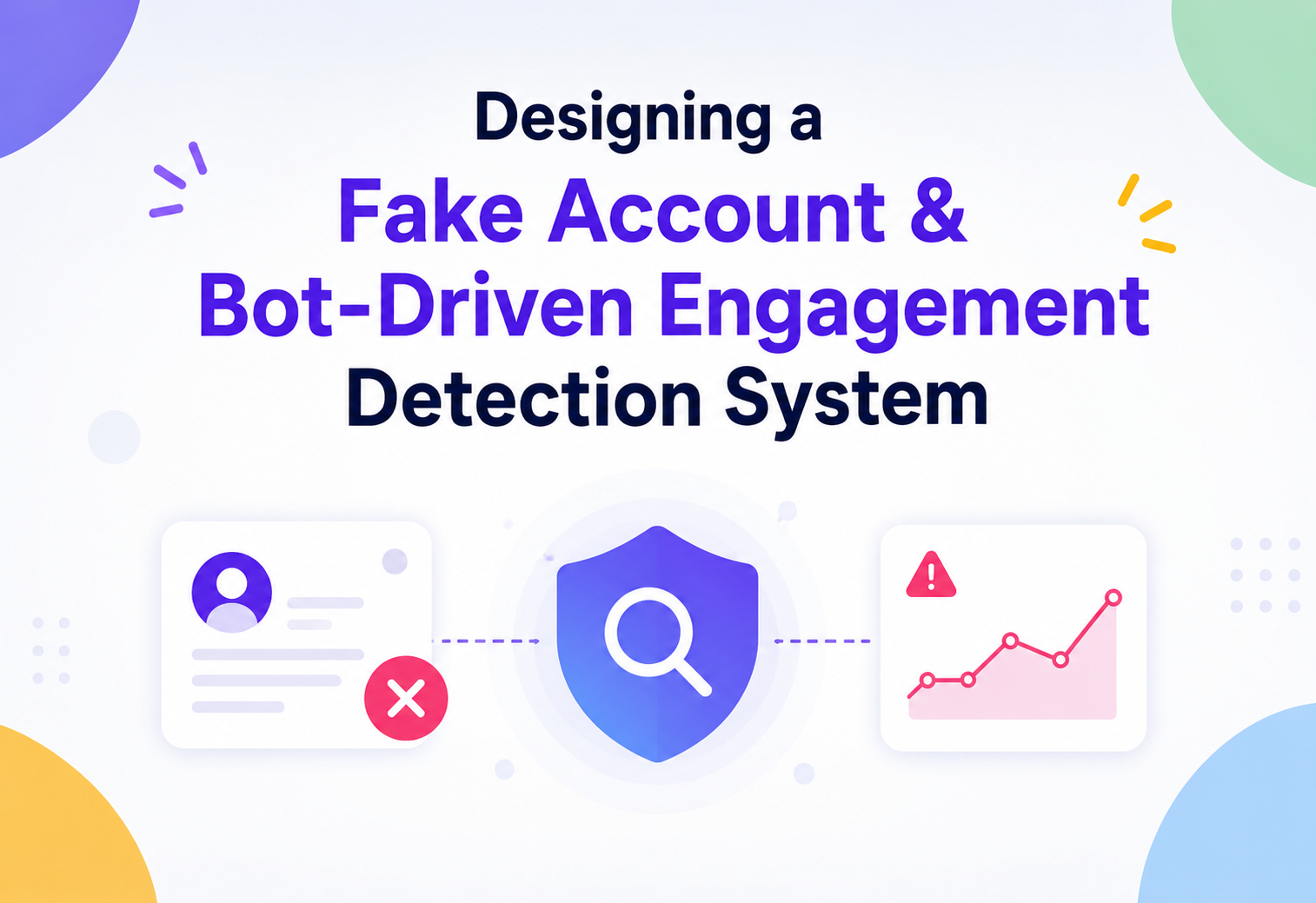
Designing a Fake Account & Bot-Driven Engagement Detection System
Behind every platform’s follower count, comment section, and trending list there is a quieter number nobody sees: how many of those accounts actually belong to a real person. This tutorial builds the system that answers that question continuously, at the scale of a major social platform, while an adversary on the other side is actively working to make the answer wrong.
Introduction & History
Somewhere on every major social platform, at this exact moment, thousands of accounts are being created that were never meant to represent a real person. Some exist to inflate a follower count for hire. Some exist to manipulate a trending topic or an election conversation. Some exist purely to click “like” on paid posts thousands of times a day, indistinguishable at a glance from a real, enthusiastic fan. Detecting and removing these accounts — quickly, accurately, and without wrongly catching real people in the process — is one of the most adversarial, cat-and-mouse system design problems in the entire industry, because unlike almost every other system in this tutorial series, the “traffic” this system defends against is actively, deliberately trying to defeat it.
The problem is nearly as old as the social web itself. Early online communities dealt with simple spam bots — scripts that created accounts to post links or advertisements, detectable with fairly blunt tools like CAPTCHA challenges and basic rate limiting. As platforms grew large enough to matter economically and politically, the incentives to fake authenticity grew right alongside them: follower counts became a currency for influencer marketing deals, engagement numbers became inputs to advertising rates and content ranking algorithms, and coordinated inauthentic accounts became tools for information operations, giving well-resourced, patient adversaries strong reasons to invest heavily in building accounts that looked, behaviorally, as close to real people as possible. What had once been a mostly nuisance-level problem, worth a modest engineering investment, became a strategically significant one, worth a dedicated organisation’s sustained, long-term attention.
This shifted fake-account detection from a simple filtering problem into a genuine arms race. Early defences relied on obvious signals — an account created seconds ago, sending hundreds of identical messages, was easy to catch with basic rules. Modern adversaries space out account creation over weeks, use residential proxy networks to appear geographically distributed, mimic realistic human posting patterns with randomised delays, and sometimes even employ real, low-paid humans to perform the “boring” parts of running a fake account, defeating detection systems built purely around catching robotic timing patterns. Detection systems evolved in response — moving from simple rule-based filters toward graph-based trust propagation, behavioural machine learning, and coordinated-network analysis, precisely because no single signal remains reliable once an adversary learns what it is looking for.
What makes this a genuinely rich system design topic, distinct from the moderation pipeline covered elsewhere in this series, is the shift from judging a single piece of content in isolation to judging an identity, and often a whole network of coordinated identities, over time. A fake account rarely reveals itself in a single action; it reveals itself in a pattern — who it connects with, when it acts, how closely its behaviour mirrors thousands of other suspicious accounts acting in near-lockstep. Building a system that can see that pattern, at the scale of a graph with billions of nodes and edges, within a time budget short enough to matter, is the challenge this tutorial works through end to end.

1.1 A Short Timeline
Simple spam-bot detection using basic rules — rate limits, CAPTCHA at signup, blocklisted email domains. Effective against unsophisticated scripted abuse, largely blind to coordinated or patient adversaries.
Social platforms scale into the hundreds of millions of users; follower counts and engagement metrics become commercially valuable, driving demand for fake engagement services. Platforms begin developing dedicated integrity and trust & safety engineering teams.
Graph-based trust propagation algorithms (inspired by academic Sybil-defence research) and early machine learning classifiers on behavioural features become standard, catching coordinated networks that individual-account rules missed entirely.
Large-scale coordinated inauthentic behaviour (state-linked information operations, commercial engagement farms) drives investment in real-time streaming detection, deep behavioural embeddings, and cross-platform signal sharing, alongside growing public transparency reporting and regulatory scrutiny.
“Why is detecting fake accounts fundamentally harder than detecting, say, spam content?” A strong answer names the adversarial and temporal dimension directly: spam content can often be judged from the content itself, in isolation, at a single point in time; a fake account is judged by a pattern of behaviour accumulated over time, in the context of a much larger network of other accounts, against an adversary actively adapting to evade whatever signals the defender is currently using — turning this into an ongoing arms race rather than a problem with a single fixed correct answer.
Detecting a single fake account by its individual features is like trying to spot a single counterfeit banknote by staring at it under a lamp. Detecting coordinated fake-account networks by their graph structure is like noticing that a hundred banknotes with the same serial number just walked through the same door of the same bank branch within five minutes of each other. Any one note might, at a glance, look convincing. The pattern of a hundred appearing together is unmistakable, and it is a pattern the counterfeiter cannot hide simply by making the individual notes look more convincing.
Problem & Motivation
Before reaching for architecture diagrams, it is worth sitting with what actually makes this problem hard, because the difficulty here is different in character from a pure throughput or latency challenge — it is a problem of making a confident judgement about intent and identity, at scale, against an adaptive opponent.
2.1 No Single Signal Is Reliable On Its Own
A brand-new account is not automatically fake — real people sign up for the first time every second. A fast posting rate is not automatically a bot — a genuinely enthusiastic new user, or a professional social media manager, can legitimately post quickly. An account using a VPN is not automatically suspicious — many real users have entirely legitimate privacy or geographic reasons for using one. Every individual signal a designer might reach for first turns out, on its own, to be a weak, noisy indicator that produces unacceptable numbers of both false positives and false negatives if used in isolation. Reliable detection depends on combining dozens of weak signals into a much stronger composite judgement, and on graph-level context that no single account’s data can reveal by itself.
2.2 Coordination Is the Real Tell, and It Is Expensive to See
A single, carefully-built fake account can be extremely difficult to distinguish from a real person acting unusually. But fake accounts rarely exist alone — they are built and operated in batches, by the hundreds, thousands, or millions, because their value comes from aggregate effect (inflating a follower count, swinging a trending topic, driving ad-fraud clicks). That coordination is the single strongest signal available, but seeing it requires analysing relationships across enormous numbers of accounts simultaneously — a fundamentally different computational problem than scoring one account against a static rule set, closer to large-scale graph analysis than traditional request-response processing.
2.3 The Cost of Getting It Wrong Is Asymmetric and Severe in Both Directions
Wrongly banning a real user’s account causes serious, sometimes irreversible harm — lost social connections, lost business presence, lost access to years of personal content and history, and a serious trust hit to the platform when it happens publicly and visibly. Wrongly leaving a large coordinated fake-account network active causes a different but equally serious harm — manipulated public discourse, defrauded advertisers paying for fake engagement, and a slow erosion of the platform’s overall trustworthiness as a place where real human interaction happens. Unlike a system where one type of error is clearly worse than the other, this system has to manage both with real seriousness, which is precisely why a tiered, evidence-weighted response system (rather than a single ban/no-ban decision) becomes essential, echoing a pattern seen elsewhere in this tutorial series but with its own distinct considerations here.
2.4 Detection Must Operate at Multiple, Very Different Time Scales Simultaneously
Some fake-account behaviour needs to be caught in real time — blocking an obviously automated signup flow before it ever creates an account, or throttling an account mid-attack as it rapidly follows thousands of others in a short window. Other fake-account behaviour only becomes visible over days or weeks, as a slow-building pattern of coordination across thousands of dormant accounts gradually activating in a synchronised way emerges from graph analysis that simply is not computable in real time at that scale. A complete system needs both a fast, real-time layer and a slower, deep, periodic batch-analysis layer working together.
2.5 Doing the Back-of-Envelope Math
It is worth reasoning through rough numbers explicitly, the way a strong candidate would in an interview. Suppose a major platform’s social graph contains 2 billion accounts and, conservatively, 200 billion directed relationship edges (follows, messages, shared-device links). A naive algorithm comparing every pair of accounts directly would require on the order of 4 × 10¹⁸ comparisons — computationally impossible regardless of available hardware. This single observation is what justifies nearly every algorithmic choice in this tutorial: partitioned, distributed graph processing instead of a single-machine computation; locality-sensitive hashing instead of pairwise similarity comparison; and trust propagation, which operates in time roughly proportional to the number of edges rather than the square of the number of accounts, making a full-graph pass computationally tractable within a bounded time window even at this scale.
Now consider the real-time side: if the platform processes 1 million new signups per day, that is roughly 12 signups per second on average, with peaks easily several times higher during regional peak hours or a coordinated attack burst. At a 500-millisecond scoring budget per signup, a single scoring service instance handling requests sequentially could theoretically process only 2 signups per second — meaning the real-time layer needs dozens of horizontally-scaled instances simply to keep pace with average load, before accounting for the substantial additional headroom needed to absorb sudden attack-driven traffic spikes without degrading the legitimate signup experience for everyone caught in the same burst.
A moderation pipeline judges a piece of content. This system has to judge an identity — and identities, unlike a photo or a paragraph, reveal what they really are only through patterns that unfold over time and only make sense in the context of thousands of other identities around them.
“If a single fake account is designed carefully enough to mimic real behaviour perfectly, how would you ever catch it?” The strong answer resists the temptation to claim any single-account signal is unbeatable, and instead pivots to network-level defence: even a perfectly-mimicked individual account is extremely difficult to fully decouple from the infrastructure and coordination required to operate it at any meaningful scale — shared device fingerprints, shared IP ranges or proxy providers, synchronised creation timing, or connections to other suspicious accounts in the social graph. The strength of this system comes from making individual mimicry insufficient, by making network-level coordination the primary signal rather than any single account’s behaviour.
Requirements: What We’re Actually Building
As with any serious system design exercise, pinning requirements down explicitly before sketching architecture pays off — and this problem rewards that discipline more than most, since “detect fake accounts” is dangerously vague without concrete scope. Naming the specific functional and non-functional targets up front also makes the later architectural trade-offs — real-time versus batch, precision versus recall, automation versus human judgement — feel like the natural, well-motivated consequences of stated requirements, rather than arbitrary design choices pulled out of thin air.
3.1 Functional Requirements
- Score accounts for fake/bot likelihood at signup time, before an account gains meaningful platform access.
- Continuously monitor ongoing account behaviour post-signup for evolving risk signals.
- Detect coordinated networks of accounts acting in suspicious concert, not just individually suspicious accounts.
- Apply a tiered response — friction (CAPTCHA, verification), throttling, distribution limiting, suspension, or permanent ban — based on confidence and severity.
- Support human analyst review for ambiguous or high-impact cases (verified accounts, large follower counts, escalated appeals).
- Provide an appeals mechanism for users who believe they were wrongly actioned.
- Maintain a detailed, auditable record of every detection signal and decision for review, appeals, and regulatory transparency.
3.2 Non-Functional Requirements
| Requirement | Target |
|---|---|
| Signup-time risk scoring latency | ~200–500 ms end-to-end to avoid degrading the signup experience |
| Ongoing behavioural scoring latency | Seconds to minutes depending on severity |
| Deep network / graph analysis cadence | Hourly-to-daily batch (typically < 24 hours full-graph cycle) |
| Scale | Millions of signups per day; billions of daily behavioural events; billions of nodes and edges in the social graph |
| Precision under adversarial pressure | Resilient to attackers actively probing and adapting over time |
| False-positive rate on automated bans | Very low; lower-confidence cases route to friction or human review rather than an outright ban |
| Auditability | Every decision explainable and traceable for internal QA and user-facing appeals |
| Adaptability | Fast iteration on signals and models; static defences degrade as adversaries learn |
Candidates often default to “train a classifier on account features and ban anything above a threshold,” missing the two ideas that separate a strong answer from a shallow one: first, that network-level, graph-based coordination signals are often more powerful than any individual account’s features; and second, that a single binary ban/no-ban decision is the wrong shape for a problem with this asymmetric error cost — a tiered response system, with escalating friction and human review for ambiguous cases, is what a mature design actually looks like.
Think about how a busy airport handles security. Everyone goes through some baseline screening (the signup-time real-time layer). A subset gets flagged for a secondary check by an officer (medium-risk friction). A very small number get quietly re-examined against watch lists and travel-pattern analyses that only run once a day off site (the batch graph analysis). And the highest-stakes cases are always resolved by a trained human, never by an algorithm alone. That layered, tiered response is exactly what this system aspires to, applied to identities on a social platform instead of passengers at a gate.
Architecture & Components
The architecture below runs two detection paths side by side, on two different time scales — a fast, real-time behavioural and rules layer for immediate signals, and a slower, periodic graph-analysis layer for coordinated-network detection — both feeding into a shared risk-scoring and decision layer.
4.1 High-Level Architecture Diagram
4.2 Component Breakdown
Ingestion API Gateway
Entry point for signup, login, and behavioural action events, forwarding to both the real-time feature service and the durable event stream for later graph analysis.
Real-Time Feature Service
Computes fast, immediately-available signals — device fingerprint, IP reputation, action velocity, basic behavioural heuristics — for use in signup-time and near-real-time scoring.
Real-Time Risk Scorer
Combines rules and a lightweight ML classifier to produce an immediate risk score for time-sensitive decisions like signup gating.
Graph Ingestion & Store
Continuously builds and updates a graph representation of accounts and their relationships (follows, messages, shared devices/IPs), the foundation for coordination-based detection.
Batch Graph Analysis
Runs periodic, computationally heavy graph algorithms — trust propagation, community/cluster detection — across the full graph to surface coordinated fake-account networks invisible at the individual-account level.
Risk Decision Engine
Aggregates real-time scores, graph-based trust scores, and cluster membership into a unified risk assessment, applying policy thresholds to decide the appropriate tiered response.
Analyst Review Queue
Holds ambiguous or high-impact cases for trained human analysts, prioritised by potential harm and confidence level, mirroring the human-in-the-loop pattern used elsewhere in trust & safety systems.
Ban Propagation Service
Ensures an account-action decision (ban, suspend, throttle) is reliably and quickly reflected across every service that needs to enforce it — login, posting, messaging, and content distribution.
“Why run graph analysis as a separate, slower batch process instead of computing it in real time for every account action?” Graph algorithms that reason about coordination across large portions of the social graph (trust propagation, community detection) are computationally expensive and often require a globally consistent snapshot of the graph to produce meaningful results — recomputing them on every single account action, in real time, at the scale of billions of edges, is not computationally feasible with current techniques. Running them periodically in batch, while a lighter real-time layer handles immediately actionable individual-account signals, is the practical engineering compromise that makes both fast response and deep coordination detection possible within the same system.
Internal Working
Let’s trace what actually happens to an account across its lifecycle, from the moment of signup through months of ongoing monitoring, since the interesting engineering here spans very different time horizons within a single account’s story. Walking through a concrete account’s journey this way, rather than staying purely at the level of named components, is exactly the kind of depth an interviewer wants to see once the high-level architecture is already on the table, and it is a useful habit to practise narrating out loud, connecting each step back to the specific trade-off or requirement it addresses.
5.1 Step 1 — Signup-Time Risk Assessment
The moment a signup request arrives, the real-time feature service gathers everything immediately available: device fingerprint, IP address and its reputation (is it a known VPN, proxy, or data-centre IP commonly used for abuse?), email domain patterns, and behavioural signals from the signup flow itself (typing cadence, mouse movement patterns, time spent on each form field — genuine human signup behaviour differs measurably from scripted automation). These feed into the real-time risk scorer, which returns a score within a few hundred milliseconds, well within the latency budget for a smooth signup experience.
5.2 Step 2 — Tiered Signup Response
Rather than a binary allow/block decision, the signup flow applies graduated friction based on the risk score: low-risk signups proceed immediately; medium-risk signups face an additional verification step (phone number confirmation, a CAPTCHA challenge); high-risk signups may be blocked outright or granted only a heavily restricted account (unable to follow large numbers of accounts or post publicly) pending further verification.
5.3 Step 3 — Ongoing Behavioural Monitoring
Every subsequent action — posts, likes, follows, messages — flows through the event stream, both updating real-time behavioural features (posting velocity, follow/unfollow ratios, content similarity to known spam patterns) and feeding the graph ingestion service, which incrementally updates the account’s position and relationships within the broader social graph.
5.4 Step 4 — Periodic Deep Graph Analysis
On a recurring schedule (commonly daily, sometimes more frequently for especially sensitive periods like elections), the batch graph analysis pipeline runs trust-propagation and community-detection algorithms across the full graph, surfacing clusters of accounts exhibiting suspicious coordinated patterns — near-identical creation timing, shared device or IP fingerprints, synchronised posting or following behaviour, or membership in a network heavily connected to previously confirmed fake accounts.

5.5 Step 5 — Signal Aggregation and Decision
The decision engine combines the real-time behavioural score with the account’s graph-derived trust score and any cluster membership flags into a unified risk assessment, applying policy thresholds that determine the appropriate response tier, exactly mirroring the tiered-decision pattern used in the moderation pipeline discussed elsewhere in this series, adapted here to account-level rather than content-level judgement.
5.6 Step 6 — Action and Propagation
For accounts crossing an action threshold, the automated action service applies the appropriate response and the ban propagation service ensures every dependent system — authentication, posting, messaging, content distribution — reflects the new account status quickly and consistently, since a banned account still able to log in or post anywhere in the system undermines the entire point of the action.
Twitter (now X) and other major platforms have published research and engineering blog posts describing graph-based trust and reputation propagation systems, inspired by academic Sybil-defence algorithms, specifically designed to identify large coordinated networks of fake accounts that individual-account behavioural analysis alone would miss — directly reflecting the batch graph-analysis layer described in this architecture.
Data Flow & Lifecycle
Seeing the two time-scales — fast signup scoring and slow graph analysis — as a single combined sequence makes the overall shape of the system concrete, and is exactly the kind of diagram worth sketching directly in an interview.
6.1 Read Path: Account Status Checks
- Every authenticated request (login, post, follow) checks the account’s current status against a fast, cached status lookup before proceeding.
- If an account’s status changes mid-session (a ban applied while the user is actively logged in), the propagation service invalidates active sessions promptly rather than waiting for the session to naturally expire.
- Appealed accounts retain a distinct status (under review) that may restore limited access pending a human decision, rather than remaining fully banned or fully active during the appeal window.
“An account passes signup-time screening cleanly but is later identified as part of a large coordinated network during batch analysis three days later — what happens?” This tests whether a candidate’s design treats detection as a one-time gate or an ongoing process. The strong answer: the decision engine re-evaluates any account whenever new signals arrive, including days or weeks after signup; the batch analysis output triggers a fresh risk assessment incorporating the new graph-derived signals, potentially escalating a previously “clean” account to restricted or banned status — detection has to remain continuous across the account’s entire lifetime, not just at creation.
Algorithms & Data Structures
This system leans heavily on graph algorithms in a way most other systems in this tutorial series do not — understanding a handful of them deeply is what separates a strong answer from a generic “run some machine learning on it” response.
7.1 Trust Propagation (SybilRank-Style Algorithms)
Inspired by academic Sybil-defence research, trust-propagation algorithms start from a small set of manually-verified, high-confidence “trusted seed” accounts (real, well-established users) and propagate a trust score outward through the social graph, similar in spirit to how PageRank propagates authority through links between web pages. The key insight: because fake-account networks are typically only sparsely connected to the genuine, trusted portion of the graph (creating fake connections into a real trusted community at scale is expensive and risky for an attacker), trust scores decay rapidly as they attempt to flow into regions of the graph dominated by coordinated fake accounts, leaving those regions with a visibly low aggregate trust score even though no individual account within them may look obviously fake in isolation.
public class TrustPropagation {

    private static final int ITERATIONS = 10;
    private static final double DAMPING = 0.85;

    // graph: accountId -> list of connected accountIds
    public Map<String, Double> propagate(
            Map<String, List<String>> graph,
            Set<String> trustedSeeds) {

        Map<String, Double> trust = new HashMap<>();
        for (String node : graph.keySet()) {
            trust.put(node, trustedSeeds.contains(node) ? 1.0 : 0.0);
        }

        for (int i = 0; i < ITERATIONS; i++) {
            Map<String, Double> next = new HashMap<>();
            for (String node : graph.keySet()) {
                double incoming = 0.0;
                List<String> neighbors = graph.get(node);
                for (String neighbor : neighbors) {
                    int neighborDegree = graph.get(neighbor).size();
                    incoming += trust.get(neighbor) / Math.max(neighborDegree, 1);
                }
                double base = trustedSeeds.contains(node) ? 1.0 : 0.0;
                next.put(node, base * (1 - DAMPING) + DAMPING * incoming);
            }
            trust = next;
        }
        return trust; // low scores indicate weak connectivity to the trusted core
    }
}
7.2 Community / Cluster Detection
Coordinated fake-account networks tend to form unusually dense, tightly-connected clusters — accounts that follow each other, engage with the same narrow set of content, and connect to a suspiciously similar set of other accounts. Community-detection algorithms (such as label propagation or the Louvain method) identify these dense clusters efficiently even in graphs with billions of edges, surfacing candidate coordinated networks for further investigation, distinct from the organic, much more loosely-connected structure of a genuine social graph.
7.3 Locality-Sensitive Hashing for Behavioural Similarity
Two accounts posting nearly identical captions, following near-identical sets of other accounts, or exhibiting near-identical timing patterns are strong evidence of coordination, but comparing every account against every other account directly does not scale. As with the perceptual-hashing approach used in the moderation pipeline discussed elsewhere in this series, Locality-Sensitive Hashing lets the system efficiently find accounts with highly similar behavioural fingerprints without an expensive pairwise comparison across the entire user base.
7.4 Union-Find (Disjoint Set) for Connected Component Analysis
Once individual signals (shared device fingerprint, shared IP subnet, near-identical behavioural hash) suggest pairs of accounts are linked, a Union-Find data structure efficiently groups accounts into connected clusters — merging any two accounts found to share a strong linking signal into the same group, and ultimately partitioning the entire suspicious population into distinct candidate networks for investigation, in close to linear time even across millions of accounts.
public class UnionFind {
    private final Map<String, String> parent = new HashMap<>();

    public void makeSet(String accountId) {
        parent.putIfAbsent(accountId, accountId);
    }

    public String find(String accountId) {
        String root = accountId;
        while (!parent.get(root).equals(root)) {
            root = parent.get(root);
        }
        // Path compression for efficiency
        while (!parent.get(accountId).equals(root)) {
            String next = parent.get(accountId);
            parent.put(accountId, root);
            accountId = next;
        }
        return root;
    }

    public void union(String a, String b) {
        String rootA = find(a);
        String rootB = find(b);
        if (!rootA.equals(rootB)) {
            parent.put(rootA, rootB); // merge two suspicious clusters
        }
    }
}
7.5 Bloom Filters & Fast Device / IP Reputation Lookups
Just as with known-bad content hashes in the moderation pipeline, a Bloom filter provides an extremely fast first-pass check against known-bad device fingerprints or IP ranges previously associated with confirmed fake-account networks, letting the signup-time real-time scorer skip an expensive full lookup for the overwhelming majority of genuinely new, unseen devices and IPs.
7.6 Anomaly Detection for Behavioural Outliers
Unsupervised anomaly-detection techniques (such as isolation forests or density-based clustering like DBSCAN) applied to behavioural feature vectors help surface accounts behaving unusually compared to the broader population, without needing labelled training examples of every possible fake-account pattern — particularly valuable for catching genuinely novel evasion techniques a supervised classifier, trained only on previously known fake-account patterns, would not yet recognise.
| Technique | Used for | Why |
|---|---|---|
| Trust propagation (SybilRank-style) | Identifying regions of the graph weakly connected to genuine users | Robust to individual account mimicry; targets structural network weakness |
| Community detection | Surfacing dense, suspicious clusters | Finds coordination invisible at the individual-account level |
| Locality-sensitive hashing | Behavioural similarity matching at scale | Avoids expensive pairwise comparison across the full user base |
| Union-Find | Grouping linked accounts into candidate networks | Near-linear time clustering from pairwise linking signals |
| Bloom filter | Fast known-bad device/IP lookup | Skips expensive checks for the vast majority of clean signups |
| Anomaly detection (isolation forest, DBSCAN) | Catching novel, previously unseen evasion patterns | Does not require labelled examples of every attack pattern in advance |
“Why is trust propagation more resistant to adversarial evasion than a supervised behavioural classifier alone?” A supervised classifier learns patterns from previously labelled examples, and a sufficiently patient, well-resourced adversary can iteratively probe and adapt their behaviour specifically to avoid whatever patterns the classifier has learned. Trust propagation instead targets a structural property of the graph — genuine connectivity to a trusted core — that is fundamentally expensive and risky for an attacker to fake at scale, since forging enough real, high-trust connections to escape detection would require actually infiltrating and convincing large numbers of genuine trusted users, a far harder and more detectable undertaking than simply tuning behavioural timing.
Concurrency & Stream Processing
This system’s concurrency model spans two very different regimes — low-latency, per-request scoring at signup time, and massively parallel, distributed graph computation during batch analysis.
8.1 Real-Time Scoring Concurrency
The signup-time and behavioural real-time scorer needs to serve requests with tight latency budgets under high concurrent load. As with other high-throughput services in this tutorial series, this is achieved through stateless, horizontally-scaled scoring service instances, with feature lookups served from fast in-memory caches rather than synchronous calls to slower backing stores wherever possible.
8.2 Distributed Graph Computation
Batch graph analysis at billions-of-edges scale requires distributed graph-processing frameworks (such as Apache Spark’s GraphX, or Pregel-style bulk synchronous parallel systems) that partition the graph across many machines and process it in coordinated rounds — each machine computes updates for its local partition of the graph, exchanges boundary information with neighbouring partitions, and repeats until the algorithm (like the trust-propagation iteration shown earlier) converges. This is a fundamentally different concurrency model than request-response services: computation proceeds in synchronised global rounds across the whole cluster, rather than independent, uncoordinated requests.
8.3 Backpressure During Coordinated Attack Bursts
A large-scale coordinated signup attack (thousands of fake accounts created within minutes) can spike load on the real-time scoring layer well beyond normal traffic patterns. The system applies backpressure similarly to the patterns described elsewhere in this series — prioritising full-featured scoring for lower-confidence, ambiguous signups while applying faster, lighter heuristics (or simply elevated friction by default) during a detected burst, rather than letting scoring latency degrade to the point of breaking the signup experience for legitimate users caught in the same traffic spike.
8.4 Idempotency Across the Pipeline
As with every other event-driven pipeline in this series, at-least-once delivery through the event stream means graph updates and behavioural feature computations must be designed to be safely reprocessed without corrupting state — an idempotent design where reprocessing the same signup or action event twice never double-counts a behavioural signal or creates duplicate graph edges.

“How would your system handle a sudden burst of 50,000 fake signups within a five-minute window?” A strong answer combines several ideas: real-time velocity-based signals (unusually high signup rate from a similar IP range or device fingerprint cluster) should trigger elevated friction automatically and immediately, even before any individual account is confidently classified; the burst itself becomes a strong real-time signal in its own right, distinct from any single account’s individual features; and the batch graph analysis will later confirm and formally cluster the network, but the real-time layer needs to react within the attack window itself, not days later.
8.5 Networking Considerations for High-Volume Signal Collection
Beyond compute concurrency, the real-time layer’s networking design directly shapes both latency and detection quality. A few details matter more here than in many other systems:
- IP reputation lookups at low latency: checking an incoming IP against reputation databases (known proxy/VPN ranges, data-centre IP blocks, previously flagged ranges) needs to complete within single-digit milliseconds to stay inside the overall signup scoring budget, typically served from an in-memory, geographically-distributed reputation cache rather than a centralised remote lookup.
- Device fingerprint collection over the client connection: client-side signals (browser or device characteristics, subtle timing and interaction data) need to be gathered and transmitted efficiently without adding perceptible delay to the signup flow itself, typically collected asynchronously and attached to the signup request rather than blocking form submission on their collection.
- Connection pooling to the feature and scoring services: given the request volume passing through the real-time layer, persistent connection pools between the gateway and downstream scoring services avoid the overhead of repeatedly establishing new connections for every single signup or behavioural event.
- Regional data locality for privacy and latency: processing signup and behavioural signals as close as possible to the user’s region both reduces latency and helps satisfy data-residency requirements that increasingly apply to personal and behavioural data under regional privacy regulations.
Consistency & Ban Propagation
As with the content moderation pipeline discussed elsewhere in this series, this system’s consistency requirements vary meaningfully by component, and explicitly reasoning through that variation demonstrates real design maturity.
9.1 Strong Consistency for Account Status Enforcement
Once an account is banned or suspended, that status needs to propagate reliably and quickly to every service enforcing access — authentication, posting, messaging, API access — because a banned account that can still log in or post anywhere represents a direct enforcement failure with real consequences. This pushes account-status propagation toward strong, synchronous consistency guarantees, similar to the takedown-propagation reasoning covered in the moderation pipeline tutorial.
9.2 Eventual Consistency for Graph Analysis and Trust Scores
The underlying social graph used for batch trust-propagation and cluster-detection analysis can tolerate meaningful staleness — a graph snapshot that’s a few hours old is perfectly adequate for identifying large-scale coordinated networks, since genuine coordination patterns persist and strengthen over time rather than appearing and disappearing within minutes. This component deliberately favours availability and computational efficiency over perfect real-time freshness.
| Component | Consistency model | Reasoning |
|---|---|---|
| Account ban / suspension enforcement | Strong / synchronous | A banned account must stop being able to act everywhere, quickly and reliably |
| Social graph snapshot for batch analysis | Eventual consistency | Coordination patterns persist over time; hours of staleness has minimal impact |
| Real-time behavioural feature store | Near-real-time, tolerant of brief staleness | Individual scoring decisions benefit from freshness but can tolerate seconds of lag |
| Analyst review queue assignment | Strong, single-source | Two analysts must never be assigned the exact same case simultaneously |
9.3 Consensus for Distributed Graph Computation Checkpoints
Distributed graph-processing frameworks running trust propagation or cluster detection across many machines need reliable coordination to know when a computation round has genuinely completed across the entire cluster before proceeding to the next round — typically achieved through a coordination service (like ZooKeeper or etcd, both built on Raft-style consensus) tracking checkpoint completion across all worker nodes, ensuring the algorithm does not proceed with a partial, inconsistent view of the graph.
“If your graph analysis runs on a snapshot that’s a few hours old, could a fast-moving coordinated attack slip through undetected during that window?” Yes, and a strong answer acknowledges this directly rather than glossing over it: this is exactly why the system needs both layers working together — the real-time scoring layer catches obviously anomalous behaviour (unusual velocity, shared device/IP signals) within the attack window itself, while the batch graph layer provides deeper, more confident confirmation and catches slower-building coordination the real-time layer is not well-suited to see. Neither layer alone is sufficient; the combination is the actual defence.
Caching Strategy
Caching here focuses heavily on keeping the real-time scoring path fast, since signup and behavioural scoring decisions sit directly in a latency-sensitive user-facing path.
10.1 Feature Caching
Frequently-needed features — an IP address’s reputation score, a device fingerprint’s prior history, an account’s current behavioural risk score — are cached in a fast distributed cache (Redis or similar), refreshed on a short TTL or invalidated explicitly when new relevant signals arrive, avoiding repeated expensive computation or database lookups on every single request.
10.2 Graph-Derived Score Caching
Trust-propagation scores and cluster-membership flags, computed during the slower batch analysis layer, are cached and served to the real-time decision engine as a fast lookup, rather than requiring the real-time path to ever touch the underlying graph store directly — the expensive computation happens once per batch cycle, and the result is reused cheaply across all subsequent real-time scoring requests until the next batch cycle refreshes it.
10.3 Negative Caching for Known-Clean Signals
Just as a Bloom filter provides a fast “definitely not known-bad” check, caching recently-verified-clean device fingerprints and IP addresses (that have passed scrutiny without issue) avoids redundant reputation lookups for the same repeat-legitimate infrastructure, particularly relevant for shared corporate networks or common mobile carrier IP ranges generating large volumes of entirely legitimate traffic. Without this kind of negative caching, a large office network or a popular mobile carrier’s shared IP range could otherwise trigger repeated, redundant reputation checks for what is, in aggregate, an enormous volume of entirely ordinary, non-suspicious traffic — a meaningful and avoidable cost at platform scale.
Caching graph-derived trust scores between batch cycles means the real-time decision engine is, by design, working with somewhat stale network-level information — an account that becomes part of a coordinated network moments after the last batch analysis ran will not reflect that in its cached trust score until the next cycle. This is an accepted, deliberate trade-off given the computational cost of real-time graph analysis at this scale, mitigated by the real-time behavioural layer catching the most urgent, fast-moving attack patterns independently.
Database & Graph Design
This system’s storage layer needs to support genuinely different access patterns: fast key-based lookups for real-time scoring, complex graph traversal for coordination analysis, and durable, auditable long-term storage for decisions.
11.1 Choosing a Graph Storage and Processing Approach
For a graph at the scale of a major platform’s full social network — billions of nodes and tens or hundreds of billions of edges — a specialised graph database (like Neo4j for smaller-scale or query-heavy use cases) often is not sufficient alone; large-scale coordination analysis typically runs on distributed graph-processing frameworks (Spark GraphX, or custom Pregel-style systems) reading from a graph representation stored across a distributed storage layer, with a separate, smaller, faster graph database or in-memory graph index serving targeted, real-time relationship queries (like “does this new account share a device fingerprint with any known-bad account?”).
11.2 Schema Design
-- Account risk state (fast lookup, frequently updated)
CREATE TABLE account_risk (
    account_id       TEXT PRIMARY KEY,
    risk_score       DOUBLE,
    trust_score      DOUBLE,      -- from graph trust propagation
    cluster_id       TEXT,         -- null if not part of a flagged cluster
    status           TEXT,         -- 'active' | 'restricted' | 'suspended' | 'banned'
    last_updated     TIMESTAMP
);

-- Graph edges (relationship signals feeding batch analysis)
CREATE TABLE account_edges (
    from_account     TEXT,
    to_account       TEXT,
    edge_type        TEXT,     -- 'follows' | 'shared_device' | 'shared_ip' | 'messages'
    weight           DOUBLE,
    created_at       TIMESTAMP,
    PRIMARY KEY (from_account, to_account, edge_type)
);

-- Decision audit log (append-only)
CREATE TABLE risk_decisions (
    decision_id      UUID,
    account_id       TEXT,
    decision         TEXT,       -- 'approved' | 'restricted' | 'banned' | 'escalated'
    decided_by       TEXT,       -- 'model:v2.3' | 'analyst:8821' | 'graph_batch:2026-07-26'
    signals          TEXT,       -- serialized signal summary for explainability
    decided_at       TIMESTAMP,
    PRIMARY KEY (account_id, decided_at)
) WITH CLUSTERING ORDER BY (decided_at DESC);
11.3 Partitioning the Graph for Distributed Processing
Distributing a graph of this scale across many machines for batch processing requires a partitioning strategy that minimises the number of edges crossing between partitions (since cross-partition communication is the dominant cost in distributed graph algorithms) — common approaches include partitioning by account creation region or community structure detected in a previous analysis pass, iteratively refining partition quality over successive batch runs rather than solving optimal partitioning from scratch every time.
11.4 Hash Partitioning vs. Graph-Aware Partitioning
The simplest partitioning strategy — hashing each account ID to assign it to a partition — distributes load evenly but ignores the graph’s actual structure entirely, meaning two heavily-connected accounts are just as likely to end up on different partitions as two unrelated ones, maximising expensive cross-partition edge traffic during computation. Graph-aware partitioning strategies instead try to keep densely-connected regions of the graph together on the same partition, using techniques like recursive graph bisection or leveraging previously-computed community structure as a partitioning hint. The trade-off is real: graph-aware partitioning reduces cross-partition communication substantially (often the single largest lever for reducing overall batch analysis runtime) but costs more to compute and maintain as the graph continuously changes, requiring a genuine engineering judgement call about how much partitioning sophistication is worth its own overhead at a given scale.
11.5 Retention and Evidentiary Requirements
As with the moderation pipeline’s audit trail, risk-decision records often carry extended retention requirements — supporting appeals, internal quality audits, and in some cases legal or regulatory inquiries into coordinated platform manipulation — while the underlying raw behavioural event data (individual clicks, precise timestamps) typically follows shorter retention windows aligned with privacy regulations and data minimisation principles.

“Why not store the entire social graph in a single graph database and query it directly for every risk decision?” At the scale of a major platform’s full graph, a single graph database, however well-optimised, becomes a scalability and performance bottleneck for the kind of full-graph algorithms (trust propagation, community detection) this system depends on — these algorithms are fundamentally distributed computations, better served by a distributed graph-processing framework that partitions the workload across many machines, with a smaller, faster graph index reserved for narrow, targeted real-time relationship lookups rather than full-graph analysis.
Analyst Review & Appeals
As with content moderation, human judgement remains an essential, permanent part of this system — particularly for cases where the cost of a wrong automated decision is highest.
12.1 When Human Review Matters Most
Automated action is appropriate for high-confidence cases at scale, but certain situations specifically warrant human analyst review before action: accounts with large followings or verified status (where a wrongful ban carries outsized visibility and reputational cost), borderline cluster-membership cases where an account’s connections could plausibly be coincidental rather than coordinated, and any case escalated through the appeals process.
12.2 Analyst Tooling and Context
An effective analyst console surfaces the full evidence trail behind a flagged account — its behavioural timeline, its position and connections within the flagged cluster, similar accounts already confirmed as fake or confirmed as legitimate — giving analysts the graph-level context needed to make a confident, well-informed judgement rather than evaluating an account in isolation, disconnected from the network signal that originally flagged it. Effective tooling often includes an interactive visualisation of the relevant portion of the graph around a flagged account, letting an analyst visually trace connection patterns and shared infrastructure in a way that raw tabular data simply does not convey as intuitively — a genuinely important usability investment given how much analyst throughput and decision quality depends on quickly grasping a case’s full network context.
12.3 Appeals as a Feedback Loop, Not Just a Remedy
A wrongly-actioned account that successfully appeals is not only a remedy for that individual user — it is valuable signal for improving the detection system itself. Systematic patterns in overturned decisions (a particular feature correlating with false positives, a specific legitimate use case the models had not accounted for) feed back into model retraining and threshold tuning, treating appeals data as an active quality-improvement input rather than only a customer-service function.
12.4 Balancing Analyst Throughput With Case Complexity
Unlike simpler content moderation decisions, evaluating a potentially coordinated account network can require an analyst to review connections across dozens or hundreds of related accounts to make a confident judgement — a fundamentally more time-consuming task than reviewing a single flagged post. Review queue design accounts for this by weighting case complexity alongside urgency and potential impact when prioritising analyst workload, rather than treating every case as equally quick to resolve.
Meta has published numerous public reports describing dedicated internal investigation teams that combine automated detection with specialised human analyst investigation to identify and remove large coordinated inauthentic networks, including those linked to information operations — illustrating exactly the kind of deep, network-level human review this section describes, applied at real operational scale with public accountability through periodic transparency reporting.
Scalability & Load Balancing
Each layer of this system scales along a different dimension, and understanding which resource actually constrains each layer is key to designing it well.
13.1 Horizontal Scaling of Real-Time Scoring
The real-time feature and scoring services are stateless and scale horizontally behind a load balancer, similar to the pattern used throughout this tutorial series, handling signup and behavioural scoring traffic that grows roughly proportionally with overall platform activity, plus sharp, unpredictable spikes during coordinated attack bursts.
13.2 Scaling Distributed Graph Computation
Batch graph analysis scales by adding more worker nodes to the distributed processing cluster, with total processing time for a full-graph pass roughly a function of graph size divided by available parallel compute capacity — teams typically provision this capacity to complete a full analysis pass within a defined window (commonly a target of under 24 hours for daily analysis), scaling the cluster up as the graph itself grows over time. Beyond simply adding machines, meaningful speedups also come from algorithmic improvements — better graph partitioning to reduce cross-node communication, and incremental computation techniques that update only the portions of the graph affected by recent changes rather than recomputing trust scores across the entire graph from scratch on every single cycle.
13.3 Load Balancing for the Analyst Review Queue
Case assignment to analysts balances raw queue depth against case complexity and analyst specialisation (some analysts focus on specific regions, languages, or attack patterns), similar in spirit to the specialty-based queue segmentation used in the moderation pipeline, ensuring the highest-impact, most time-sensitive cases reach the most qualified available analyst rather than simply the next analyst in a first-in-first-out queue.
| Reference Number | Meaning |
|---|---|
| Billions | Of edges in a major platform’s social graph |
| < 24 hr | Typical batch graph analysis cycle target |
| 200–500 ms | Signup-time scoring latency budget |
| Elastic | Autoscaling for coordinated attack bursts |
“The social graph has grown 10x since this system was first designed — what breaks first, and how would you address it?” Strong answer: the batch graph analysis layer is typically the first bottleneck, since its processing time scales with graph size and it is already running against a time-bound target (like completing within 24 hours); addressing it means horizontally scaling the distributed processing cluster, potentially increasing analysis frequency for the highest-risk graph regions while reducing frequency for stable, well-established, low-risk regions of the graph, and continuing to refine graph partitioning strategy to minimise cross-partition communication overhead as the graph grows.
High Availability & Reliability
Failures here carry meaningful consequences in both directions, echoing the same asymmetric stakes discussed in the problem section — a failure that lets a coordinated attack through, and a failure that wrongly restricts real users at scale, are both serious operational incidents.
14.1 Fail-Safe Behaviour for Signup-Time Scoring
If the real-time risk-scoring service becomes unavailable, the signup flow needs a defined fallback rather than either blocking all signups platform-wide or allowing every signup through unchecked — a common approach applies a moderate default friction level (like a standard CAPTCHA challenge) to all signups during the outage, a conservative middle ground that neither fully blocks legitimate growth nor fully exposes the platform to unchecked automated signups during the degraded period. This fallback behaviour is worth deciding and documenting well in advance of any actual outage, since the pressure of a live incident is exactly the wrong moment for a team to be improvising a brand-new policy decision about how much risk the business is willing to accept for however long the degraded period lasts.
14.2 Redundancy in the Batch Graph Pipeline
A failed batch analysis run should not silently skip a full cycle of coordination detection — the pipeline is designed to detect a failed or incomplete run and either retry automatically or alert on-call engineers promptly, since a silently missed analysis cycle creates an invisible detection gap that could persist for a full additional cycle before anyone notices. Building automated completeness checks into the pipeline itself — verifying that every partition was processed and every expected output was produced before marking a cycle complete — is a small additional investment that pays for itself the first time it catches a partial failure that would otherwise have gone unnoticed.
14.3 Multi-Region Considerations
While the social graph itself is inherently global and not naturally partitionable by region the way independent per-post counters are, real-time scoring infrastructure is typically deployed across multiple regions for latency and resilience, with the underlying graph store and batch analysis pipeline operating as a centralised (though internally distributed and redundant) system, given that coordination analysis fundamentally depends on visibility across the whole graph rather than a regional slice of it. This distinction between a genuinely regional real-time layer and a fundamentally global analytical layer is itself worth stating explicitly, since it is a natural point of confusion for a design that otherwise leans heavily on the regional-deployment patterns used throughout the rest of this tutorial series.
14.4 Disaster Recovery Rehearsals
As with the other trust & safety systems in this series, teams operating this system benefit from scheduled disaster-recovery drills — simulating a graph store outage, a corrupted batch analysis run, or a failed ban-propagation event — verifying that fallback behaviours and recovery procedures actually work under realistic conditions rather than only in design documents. These drills matter especially for the graph store and batch pipeline, since a full graph rebuild from raw event history at billions-of-edges scale can take considerably longer than teams initially assume when the plan exists only on paper, and discovering that gap for the first time during an actual production incident is a far more costly way to learn it than during a scheduled, controlled rehearsal.
“Should the signup flow fail open or fail closed if the risk-scoring service is completely unavailable?” As with the moderation pipeline’s fail-safe discussion, the honest answer depends on risk tolerance and is itself the insight being tested: failing fully open (allowing all signups unchecked) risks a flood of unscreened fake accounts during the outage window; failing fully closed (blocking all signups) risks losing genuine new users and real platform growth during the outage. A moderate default-friction fallback, applying baseline verification to everyone during the degraded period, is usually the pragmatic middle ground production systems land on.
Security & Adversarial Resistance
This section is, in many ways, the heart of the entire system — nearly every other design decision in this tutorial exists in service of resisting an adaptive, resourceful adversary.

15.1 Assume the Adversary Can Observe Outcomes
A sophisticated attacker can create test accounts, observe which ones get flagged and which survive, and iteratively refine their approach based on that feedback — the same probing dynamic discussed in the moderation pipeline tutorial, but arguably even more central here, since building and testing fake accounts at scale is precisely the adversary’s core activity. Detection systems account for this by avoiding overly transparent, easily-reverse-engineered signals, favouring genuinely structural signals (like graph-level trust propagation) that are expensive and risky for an attacker to defeat even with extensive testing. It is worth internalising that this probing is not a hypothetical edge case worth a passing mention — commercial fake-engagement services operate essentially as businesses, with their own incentive to continuously test and refine their offerings against major platforms’ defences, meaning the adversary here is often organised, well-resourced, and persistent in a way that is genuinely different from the more opportunistic threats many other systems in this tutorial series need to defend against, and worth naming explicitly rather than assuming away in a design conversation.
15.2 Protecting the Detection Infrastructure Itself
Detection thresholds, model internals, and the specific set of features used for scoring are treated as sensitive, tightly access-controlled information — a leak of this information (whether through an insider, a security breach, or overly informative error messages exposed to end users) would give sophisticated adversaries a significant advantage in evading detection.
15.3 Defending Against Infrastructure-Level Evasion
Sophisticated fake-account operations invest in evading infrastructure-level signals directly — using large pools of residential proxy IPs to avoid data-centre IP reputation flags, randomising device fingerprints, or renting real human labour to perform account actions that resist behavioural-automation detection entirely (sometimes called “click farms”). Countering this requires signals that remain meaningful even against this kind of investment — most importantly, the graph-level coordination signal, since even real humans operating fake accounts for pay still create the same kind of suspiciously dense, coordinated connection patterns in the social graph that trust propagation and cluster detection are designed to surface.
15.4 Cross-Platform and Industry Signal Sharing
Similar to the shared hash-database approach used for known-bad content in the moderation pipeline, some platforms participate in limited, carefully governed cross-industry signal sharing for known bad infrastructure (confirmed malicious IP ranges, device fingerprints associated with large-scale fraud) — amplifying detection effectiveness beyond what any single platform’s own data alone would reveal, while navigating real privacy and competitive-sensitivity constraints around exactly what can be shared and how. This kind of cooperation tends to be narrower and more cautious than the CSAM-focused hash sharing described in the moderation pipeline tutorial, given the more commercially sensitive and competitively delicate nature of fraud and abuse signals between companies that are, in most other respects, direct market competitors.
“A well-funded adversary starts using real, paid humans to operate fake accounts instead of bots, specifically to evade your behavioural automation detection — how does your system respond?” This is a direct test of whether a candidate over-relies on behavioural-automation signals alone. The strong answer pivots to the graph-level coordination signal as the primary defence: even human-operated fake accounts, if they are being run in service of the same underlying goal (inflating engagement for a specific set of paying clients, promoting the same narrow set of content), still exhibit the dense, suspiciously coordinated connection patterns that trust propagation and cluster detection are built to catch, regardless of whether the accounts are operated by bots or paid humans.
Monitoring, Logging & Metrics
As with the moderation pipeline, monitoring here needs to track ongoing detection quality, not just conventional system health — a quietly degrading detection system is a more dangerous failure mode than an outright outage.
16.1 Key Metrics to Track
| Metric | Why it matters |
|---|---|
| Precision and recall against confirmed cases | Tracks false-positive and false-negative rates, validated continuously through analyst review and appeal outcomes |
| Signup-time scoring latency (P50 / P95 / P99) | Ensures fraud screening is not degrading the legitimate signup experience |
| Batch graph analysis completion time and success rate | A failed or delayed batch run creates an invisible detection gap |
| Appeal overturn rate | A rising rate signals the system may be over-flagging legitimate accounts |
| Cluster detection volume and size distribution | Sudden shifts can indicate either a new large-scale attack or a detection regression |
| Analyst review queue depth and case complexity | Rising depth for high-severity cases signals a capacity or triage problem |
16.2 Continuous Adversarial Monitoring
Beyond standard metrics, dedicated analysts and automated systems continuously monitor for signs of new evasion techniques emerging in the wild — sudden shifts in the characteristics of accounts evading detection, chatter on external forums where fake-account operators discuss techniques, or unusual patterns in appeal volume that might indicate a coordinated attempt to game the appeals process itself. This kind of external, outward-looking monitoring complements the internal, metrics-driven monitoring described above — the two together give a team both a quantitative read on how the system is currently performing and a qualitative, forward-looking sense of how the threat landscape is likely to shift next.
16.3 SLOs for Detection Quality
As with content moderation, mature teams define explicit service-level objectives for detection performance — for example, a target recall rate against a curated set of known coordinated networks, or a maximum acceptable false-positive rate for automated high-confidence bans — tracked with an error budget that triggers deeper investigation and a deliberate slowdown of unrelated changes when quality metrics drift outside acceptable bounds. Defining these targets explicitly, and reviewing them on a regular cadence with both engineering and trust & safety policy stakeholders in the room, keeps the system’s actual performance grounded in a shared, agreed-upon standard rather than an informal, individually-held sense of “good enough” that can drift unnoticed over time as the underlying threat landscape shifts.
16.4 Explainability in Monitoring Dashboards
Dashboards surface not just aggregate detection volume but the underlying signal composition behind decisions — what fraction of actions were driven primarily by graph-based trust scores versus real-time behavioural signals versus device/IP reputation — helping engineers and analysts understand which detection layer is doing the most work at any given time, and where investment in improvement would have the greatest impact.
Major platforms including Meta and X have published regular transparency reports estimating the prevalence of fake accounts on their platforms and detailing the volume of accounts removed for platform manipulation, reflecting exactly this kind of continuous, externally-accountable monitoring of detection system performance at real operational scale.
Deployment & Cloud
17.1 Multi-Region Deployment for Real-Time Components
Real-time scoring infrastructure deploys across multiple regions for latency and resilience, similar to other latency-sensitive systems in this series, while the graph store and batch analysis pipeline typically operate as a centralised, though internally distributed and redundant, global system reflecting the inherently global nature of coordination analysis.
17.2 Managed Cloud Services Mapping
| Component | AWS | GCP |
|---|---|---|
| Event stream | Kinesis / MSK | Pub/Sub |
| Distributed graph processing | EMR with Spark GraphX | Dataproc with Spark GraphX |
| Real-time feature cache | ElastiCache for Redis | Memorystore for Redis |
| Graph index / relationship store | Neptune | Self-managed graph DB on GKE |
| Audit log storage | DynamoDB + S3 (cold tier) | Bigtable + Cloud Storage (cold tier) |
17.3 Cost Optimisation
Distributed graph computation at billions-of-edges scale is a significant compute cost driver, similar to GPU inference cost in the moderation pipeline. Cost optimisation strategies include incremental graph updates (recomputing only affected portions of the graph rather than a full recomputation on every cycle where feasible), tiered analysis frequency (more frequent deep analysis for high-risk graph regions, less frequent for stable, well-established regions), and aggressive caching of graph-derived scores so the expensive computation is amortised across many real-time scoring requests rather than repeated per request. Spot or preemptible compute instances, where available, can also meaningfully reduce the cost of the batch graph-processing cluster specifically, since batch analysis jobs can typically tolerate occasional worker interruption and restart far more gracefully than the latency-sensitive real-time scoring layer ever could.
“Batch graph analysis costs are growing faster than the platform’s user base — how would you control that?” Good answer: investigate whether incremental, rather than full, graph recomputation is feasible for at least part of the pipeline, since most of the graph changes relatively little between cycles; consider adaptive analysis frequency based on region risk level rather than a uniform schedule for the entire graph; and continue refining graph partitioning to reduce the cross-partition communication overhead that often dominates distributed graph computation cost at scale.
APIs & Microservices
18.1 API Design
POST /v1/signup
Response: 200 OK
{
  "accountId": "u_88213",
  "status": "active",
  "verificationRequired": false
}

POST /v1/signup   (medium-risk case)
Response: 200 OK
{
  "accountId": "u_88214",
  "status": "pending_verification",
  "verificationRequired": true,
  "verificationMethod": "phone_otp"
}

GET /internal/v1/accounts/{accountId}/risk
(internal service-to-service only)
{
  "accountId": "u_88213",
  "riskScore": 0.12,
  "trustScore": 0.94,
  "clusterId": null,
  "status": "active"
}

POST /v1/accounts/{accountId}/appeal
Response: 202 Accepted
{
  "appealId": "ap_22190",
  "status": "queued_for_review"
}
18.2 Microservice Boundaries
As with the moderation pipeline, each major detection path — real-time behavioural scoring, graph ingestion and analysis, and analyst review tooling — is owned by teams with genuinely different expertise, from applied machine learning and streaming systems to large-scale distributed graph computation and trust & safety policy. Clean boundaries between these services let each team iterate independently against a shared, stable contract feeding the central decision engine, which matters especially here given how differently the real-time and batch-graph teams’ release cadences typically look — a real-time scoring model might be retrained and redeployed weekly, while a change to the underlying graph-partitioning strategy might be a multi-month undertaking evaluated far more cautiously given its systemic blast radius.
18.3 Decision Thresholds as Externally Configurable Policy
Mirroring the policy-as-configuration pattern used in the moderation pipeline, risk thresholds and response tiers are kept externally configurable by trust & safety policy teams, allowing fast adjustment in response to an actively evolving threat landscape (a new attack pattern, an upcoming high-risk event like an election) without requiring an engineering deployment cycle for every policy change.
“Why keep the internal risk-score API separate from any public-facing account status endpoint?” Exposing granular risk scores or the underlying signals directly to end users (or to any external caller) would hand a sophisticated adversary a direct feedback loop for iteratively refining their evasion techniques — the internal API, restricted to trusted internal services, allows full detail for legitimate internal use (analyst tooling, further automated processing), while any user-facing status communication stays deliberately limited to what is necessary for a fair appeals process, without revealing exploitable detail.
Design Patterns & Anti-Patterns
Naming these patterns precisely matters for the same reason it mattered in the moderation pipeline tutorial: it signals that the architecture emerged from deliberate reasoning about the problem’s specific shape, rather than being assembled from generic building blocks without a clear sense of which problem each one is actually solving.
19.1 Patterns Used in This Design
Multi-signal Ensemble Decisioning
Combining real-time behavioural scores, graph-derived trust scores, and cluster membership rather than relying on any single detection technique, improving resilience against evasion targeting any one signal.
Tiered Response
Escalating friction and action (allow, verify, restrict, ban) based on confidence, rather than a single binary decision, reducing the cost of both false positives and false negatives.
Human-in-the-Loop
Automated systems handle high-confidence cases at scale, deferring ambiguous or high-impact decisions to trained analysts, with outcomes feeding back into ongoing model improvement.
Lambda-Style Dual-Speed Processing
A fast, real-time layer for immediately actionable signals, paired with a slower, deeper batch layer for computationally expensive graph analysis — a close relative of the classic “lambda architecture” pattern from big-data systems design.
Policy-as-Configuration
Detection thresholds and response tiers live as externally adjustable configuration, decoupling policy iteration speed from engineering deployment cycles.
Trust Propagation From a Seed Set
Bootstrapping network-wide trust scores from a small, manually verified trusted core, rather than attempting to independently verify every account.
19.2 Anti-Patterns to Avoid vs. Correct Alternatives
Anti-patterns
- Relying solely on individual-account behavioural signals — misses coordination, the strongest and most reliable signal available
- Single binary ban/no-ban threshold — ignores the asymmetric cost of false positives and false negatives
- Treating detection as a one-time, signup-only gate — misses accounts that only reveal coordination patterns well after creation
- Exposing detailed risk signals or thresholds externally — hands adversaries a direct feedback loop for evasion
- Static, never-retrained models — guarantees eventual obsolescence against an adaptive adversary
Correct Alternatives
- Combine individual and network-level signals as independent, mutually reinforcing detection paths
- Multi-tier confidence bands with human review for ambiguous, high-impact cases
- Continuous, lifetime monitoring with re-evaluation triggered by new signals at any point
- Minimal, carefully considered external transparency, protecting detection-signal detail
- Ongoing model retraining fed by confirmed cases, appeals outcomes, and emerging attack patterns
“How does the ‘lambda architecture’ idea from big-data systems apply to this specific problem?” A strong answer draws the direct parallel: lambda architecture pairs a fast, approximate real-time processing layer with a slower, more thorough batch layer, later reconciling or complementing each other’s output — exactly the shape of this system’s real-time behavioural scoring paired with slower, deeper batch graph analysis, each compensating for what the other layer structurally cannot do within its own time budget.
Best Practices & Common Mistakes
The practices below work together as a system, much like the platform they are built to protect — leaning too heavily on any single one, while neglecting the others, tends to be exactly where a well-resourced adversary finds their way in.

20.1 Best Practices
- Always combine individual-account and network-level graph signals — neither is sufficient alone against a sophisticated adversary.
- Build tiered, confidence-weighted responses rather than a single binary ban decision.
- Treat detection as continuous and lifelong for every account, not a one-time signup gate.
- Invest genuinely in appeals and human review — both as a fairness mechanism and as an ongoing quality-improvement feedback loop.
- Protect detection-signal detail from external exposure, minimising the feedback an adversary can use to evade the system.
- Retrain and re-evaluate models continuously, assuming the threat landscape will keep shifting indefinitely.
- Version and audit every decision, tracing it back to the exact signals and model version that produced it.
20.2 Common Mistakes
Over-indexing on behavioural automation signals (timing patterns, click cadence) while under-investing in graph-based coordination detection. Behavioural signals are the easiest for a patient adversary to defeat through careful mimicry; graph-level coordination is structurally far harder to fake at scale.
Treating a wrongly-banned real user as an acceptable, unavoidable cost of aggressive detection. At scale, even a small false-positive rate translates into a large absolute number of harmed real users — under-investing in appeals and precision tuning erodes platform trust in ways that compound over time.
Assuming a detection model, once trained and deployed, will remain effective indefinitely. A model that is not continuously retrained against fresh confirmed cases and emerging evasion patterns degrades in effectiveness as adversaries adapt specifically around its known blind spots.
Building the full multi-layer, graph-scale architecture before actual scale and risk justify it. A small or early-stage platform is usually better served starting with basic rate limiting, CAPTCHA, and simple heuristic rules, growing into graph-based coordination detection as the platform’s scale and the commercial incentive for attackers to target it genuinely increase.
Letting detection thresholds and models stagnate after initial launch because early results looked strong. Early success against unsophisticated attackers is not evidence the system will hold up against a more determined adversary who has not yet found it worth their time to target — complacency after an initially quiet period is a recurring pattern in how large coordinated networks eventually go undetected for longer than they should.
Real-World & Industry Examples
Twitter’s engineering teams have historically published research on graph-based trust and reputation systems for identifying coordinated inauthentic networks, and the platform has periodically published estimates of bot and fake-account prevalence, illustrating both the technical approach and the ongoing public accountability dimension of this problem at real operational scale. The platform’s public struggles with bot prevalence estimates during high-profile corporate events also underscore just how genuinely difficult accurate measurement is even for a company with deep internal access to its own behavioural and graph data — a useful, humbling reminder that no organisation, however well-resourced, claims to have this problem fully and permanently solved.
Meta publishes regular Coordinated Inauthentic Behaviour reports, describing specific investigations combining automated detection with deep analyst investigation to identify and remove large networks of fake accounts, often linked to specific commercial or political actors — a direct, publicly documented real-world example of the analyst-review and network-investigation layer described in this tutorial. These reports typically detail not just the volume of accounts removed but the specific coordination patterns identified — shared infrastructure, synchronised posting behaviour, thematically coordinated content — illustrating the kind of graph-level evidence trail this tutorial’s architecture is specifically designed to surface for analyst review.
LinkedIn has publicly discussed using machine learning and graph-based analysis specifically to detect fake profiles used for professional-network scams and fraudulent recruiting schemes, an interesting variant of this problem given LinkedIn’s professional-identity context adds distinct signals (employment history plausibility, professional network structure) beyond what a general social platform would use.
Instagram has described specific efforts targeting “engagement pods” and purchased-follower networks — coordinated groups of accounts (sometimes automated, sometimes real people paid to participate) artificially inflating likes and comments for hire — a direct real-world instance of the coordinated-cluster detection problem this tutorial’s graph analysis layer is built to solve.
Much of the graph-based trust-propagation approach described in this tutorial traces back to academic research on Sybil attacks in peer-to-peer and social network systems, including algorithms like SybilRank and SybilGuard, which formally established the trust-propagation-from-a-seed-set approach later adapted and scaled by industry engineering teams into the production systems described throughout this tutorial.
Advantages, Disadvantages & Trade-offs
Advantages of This Architecture
- Combines fast individual-account signals with deep network-level coordination detection, resilient to evasion targeting any single layer
- Tiered response substantially reduces the cost of both false positives and false negatives compared to a single threshold
- Graph-based trust propagation targets a structurally expensive-to-fake property, raising the cost of evasion for even well-resourced adversaries
- Continuous, lifelong monitoring catches coordination that only emerges well after initial signup
- Human analyst review and a genuine appeals process protect against the real, serious cost of wrongful account action
Disadvantages & Costs
- Substantial infrastructure cost for distributed graph computation at billions-of-edges scale
- Significant ongoing investment in specialised analyst teams and their tooling
- Batch analysis latency creates an inherent detection lag for the deepest, most confident network-level signal
- Permanent, unresolvable arms race — no fixed “finished” state, requiring continuous model and signal iteration
- Genuine risk of wrongful action against real users, requiring ongoing, careful precision tuning and a well-resourced appeals process
As with the other trust & safety systems covered in this tutorial series, the appropriate scale of investment here tracks the platform’s actual size and the commercial incentive attackers have to target it — a small, early platform with limited follower-count or engagement-driven monetisation faces far less sophisticated attack pressure than a major platform where fake engagement has real, direct financial value to buy and sell, and the architecture should grow accordingly rather than being built out fully from day one. This growth path is itself worth stating explicitly in an interview setting, since it demonstrates an understanding that good system design is inseparable from actual business and threat context, not a fixed blueprint applied identically regardless of scale.
Testing, Load Testing & Chaos Engineering
23.1 Red-Team Simulation of Coordinated Attacks
Internal red teams deliberately attempt to build and operate simulated fake-account networks using realistic evasion techniques (spaced-out creation timing, varied device fingerprints, human-like behavioural patterns) specifically to test whether the detection system, particularly the graph-based coordination layer, successfully identifies the simulated network — surfacing gaps before real adversaries find and exploit them.
23.2 Precision / Recall Regression Testing Against Confirmed Cases
Every model or threshold change is validated against a curated, held-out set of confirmed fake-account networks and confirmed legitimate accounts before deployment, with automated checks blocking any deployment that would regress precision or recall below defined acceptable bounds — the same rigour applied to decision-quality metrics as to conventional functional test suites.
23.3 Load Testing for Coordinated Attack Bursts
Load tests specifically simulate sudden, large-scale coordinated signup or engagement bursts, verifying that the real-time layer’s backpressure and elevated-friction fallback behaviours actually engage correctly under realistic attack-scale load, not just under smoothly distributed average traffic.
23.4 Chaos Engineering for Graph Pipeline Resilience
Deliberately injecting failures into the distributed graph-processing pipeline — killing worker nodes mid-computation, introducing artificial delays in graph store replication — validates that the pipeline correctly detects and recovers from partial failures, rather than silently producing an incomplete or corrupted analysis pass that would otherwise go unnoticed until a detection gap was discovered too late. Because a corrupted or partial batch analysis run can be far harder to notice than an outright pipeline crash — the job appears to complete “successfully” while quietly producing degraded or incomplete trust scores — these chaos experiments are particularly valuable for surfacing the kind of silent-failure modes that standard monitoring, tuned mainly around obvious crashes and timeouts, can easily miss entirely.
“How would you validate that your graph-based trust propagation algorithm actually works before trusting it in production?” Strong answer: validate against a carefully constructed synthetic graph containing known, labelled coordinated clusters embedded within a realistic background of genuine social-graph structure, confirming the algorithm correctly assigns low trust scores to the planted clusters; then shadow-test the algorithm against live production data without acting on its output, comparing its flagged clusters against confirmed cases from other detection layers and human review before ever allowing it to trigger automated action.
Frequently Asked Questions
A supervised behavioural classifier learns from previously seen patterns, and a patient, well-resourced adversary can iteratively adapt specifically to evade whatever the classifier has learned to recognise. Graph-based coordination signals target a structurally different, much harder to fake property — genuine connectivity to a trusted core of real users — making the combination of both approaches far more resilient than either alone.
Through the tiered response system and human review for ambiguous cases: an account with unusual but not clearly coordinated behaviour receives lighter friction (verification, temporary restriction) rather than an outright ban, and genuinely high-impact or ambiguous cases route to trained analysts who can recognise legitimate unusual-but-real usage patterns that a purely automated system might misjudge.
No — and that is a deliberate, important framing rather than an admission of failure. Because the system operates against an adaptive, resourced adversary, it requires continuous investment in retraining, new signal development, and adversarial testing indefinitely, much like security systems in other domains that similarly never reach a permanently “solved” state.
Content moderation judges a specific piece of content, largely in isolation, at a single point in time. This system judges an identity and its relationships, over an account’s entire lifetime, in the context of a much larger network — a fundamentally graph-centric problem rather than a primarily classification-centric one, even though both systems share underlying patterns like tiered response, human-in-the-loop review, and policy-as-configuration.
That the strongest defence against a sophisticated, adaptive adversary rarely comes from a single clever signal — it comes from combining multiple, structurally independent signals (individual behaviour, device/IP infrastructure, and critically, network-level graph coordination) such that defeating the system requires an adversary to simultaneously defeat several genuinely different, mutually reinforcing detection mechanisms at once.
The core principles — combining individual and network signals, tiered response, continuous monitoring — still apply, but at a smaller scale, a simpler graph database and even periodic manual or lightweight scripted analysis may substitute for a full distributed graph-processing cluster, growing into the heavier infrastructure described in this tutorial only once genuine scale and attacker incentive justify the investment.
Yes, in a few concrete ways: growing regulatory expectations around platform transparency and manipulation reporting push teams toward more rigorous, auditable decision logging than they might otherwise build purely for internal purposes, and some jurisdictions increasingly expect meaningful, timely appeals processes as a baseline requirement rather than an optional feature — both of which reinforce, rather than conflict with, the audit-trail and human-review design choices already central to this architecture.
Primarily through the tiered-friction design at signup — the vast majority of legitimate new users experience no friction at all, since only accounts triggering genuine risk signals face additional verification steps — combined with ongoing monitoring of the false-positive rate and appeal-overturn rate as first-class metrics the team is explicitly accountable for, not just detection volume or recall alone.
Summary & Key Takeaways
Designing a fake account and bot-detection system is, fundamentally, a problem of building durable defences against an adversary who is actively watching, learning, and adapting — which is precisely what separates it from most other systems in this tutorial series, and precisely why no single clever signal, however well designed, is ever sufficient on its own. It is also a genuinely instructive system to internalise even outside the specific domain of social platforms, because the same underlying tension — an automated system trying to make confident judgements about intent, against an adversary actively probing and adapting around whatever signals the system currently relies on — shows up directly in fraud detection, spam filtering, ad-click verification, and any other domain where the very people the system is trying to catch have a direct financial or strategic incentive to study and defeat it.
Key Takeaways
- No individual signal — device, IP, behaviour, or timing — is reliable alone; strength comes from combining many independent, structurally different signals.
- Coordination across accounts is the strongest and most expensive-to-fake signal available, which is why graph-based trust propagation and cluster detection sit at the centre of this design.
- A dual-speed architecture — fast real-time scoring paired with slower, deeper batch graph analysis — lets the system catch both immediate attacks and slow-building coordinated networks.
- A tiered response system, not a single ban/no-ban threshold, manages the genuinely asymmetric cost of false positives and false negatives.
- Human analyst review and a real appeals process remain permanent, essential components — both a fairness safeguard and an ongoing feedback loop improving the automated system over time.
- Consistency requirements vary meaningfully by component: strong, fast propagation for enforcement decisions; deliberate eventual consistency for the underlying graph used in deep analysis.
- This is an ongoing arms race by nature, not a problem with a final, permanent solution — the architecture has to be built for continuous adaptation from day one.
Great fake-account detection systems are not built by chasing the single cleverest signal — they are built by ensuring that any adversary who wants to win has to simultaneously defeat a fast individual-behavioural layer, a structural graph-coordination layer, an infrastructure-reputation layer, and a set of trained human eyes looking specifically for what all three have collectively missed. Individually, each of those layers is imperfect. Together, and only together, they are strong enough to keep a platform’s follower counts, comment sections, and trending lists honest — not perfectly, but well enough that real human interaction remains the dominant, and dominant-feeling, thing happening on the platform.