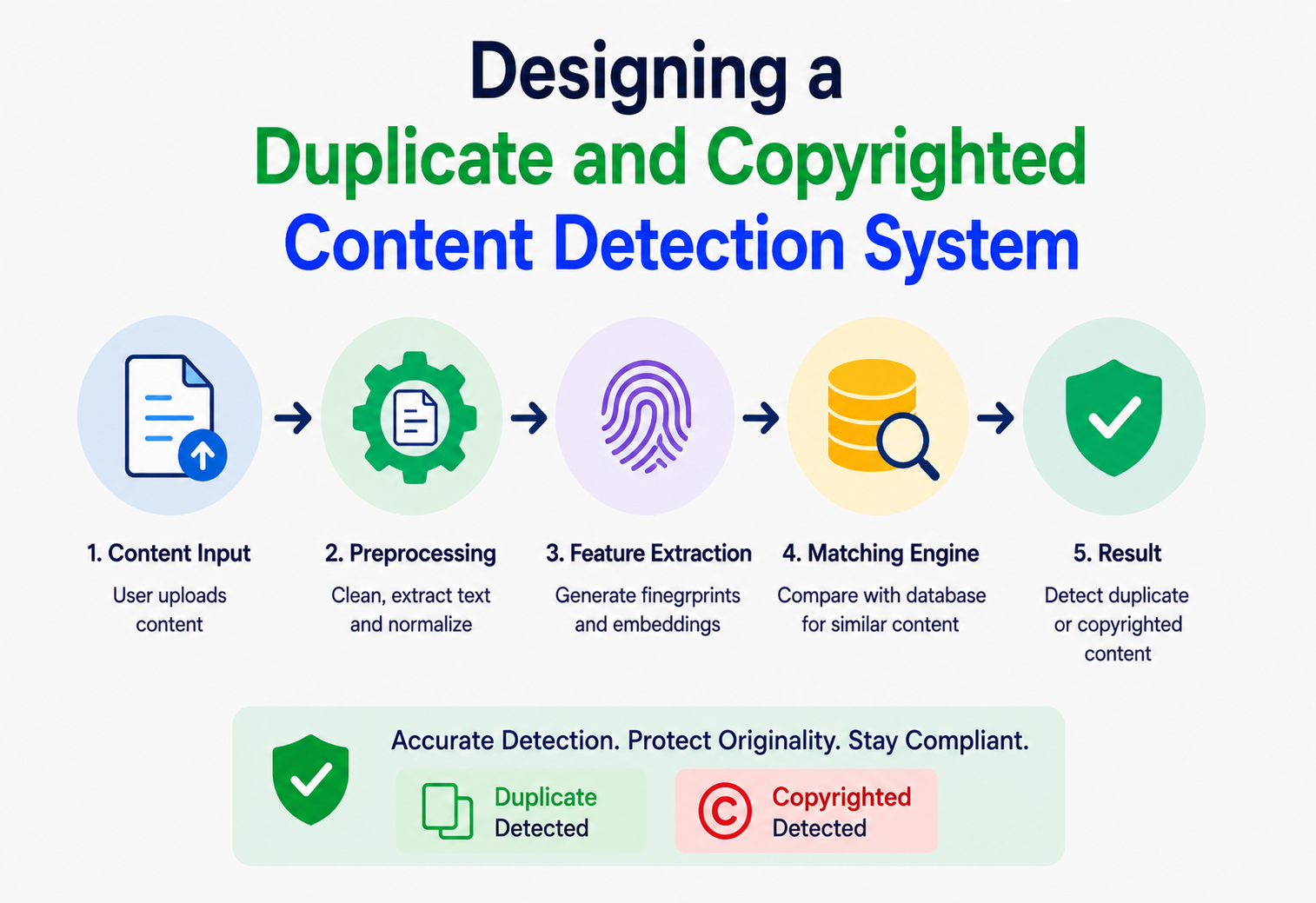
Designing a Duplicate & Copyrighted Content Detection System
A complete, interview-ready walkthrough of how large user-generated content (UGC) platforms fingerprint, match, and act on duplicate or copyrighted uploads at the scale of hundreds of millions of files a day — inspired by systems like YouTube Content ID, Facebook Rights Manager, and Audible Magic.
Introduction and History
Imagine a library that lets anyone in the world drop off a book, on any subject, at any time, for free, and instantly puts that book on the shelf for everyone to read. That is roughly what a user-generated content (UGC) platform does — except instead of books, it is videos, images, songs, and audio clips, and instead of thousands of drop-offs a day, it is millions. Somewhere in that flood, some of what people upload is not theirs to share. A person re-uploads a movie clip, a song ripped from an album, or someone else’s viral video with the watermark cropped out. The platform now has a problem: it is hosting copyrighted material without permission, and the original creator — a musician, a film studio, a fellow creator — is losing recognition, control, and revenue.
A duplicate and copyrighted content detection system is the part of a UGC platform’s backend that automatically looks at every new upload, compares it against a giant reference library of known copyrighted works and previously-seen uploads, and decides what to do: let it through, flag it for a human, block it, or hand the ad revenue to the rights holder instead of the uploader. This is one of the most fascinating system design problems in the industry because it blends distributed systems, media processing, machine learning, legal compliance, and massive scale — all at once.
1.1 A short timeline of automated content protection
Piracy goes mainstream
Digital piracy explodes with MP3 sharing (Napster, 1999) and early peer-to-peer video sharing. Rights holders rely purely on manual complaints and lawsuits — there is no automated detection at all.
DMCA enacted
The Digital Millennium Copyright Act is passed in the United States, creating the legal “notice and takedown” process: a rights holder sends a takedown notice, and the platform must remove the content or lose its safe-harbor legal protection. This becomes the legal backbone that automated systems are built to serve.
YouTube Content ID
YouTube launches Content ID, the first large-scale automated fingerprint-matching system for video and audio, allowing rights holders to upload reference files and choose an automatic action — block, mute, monetize, or track — when a match is found on upload.
Audio fingerprinting matures
Companies like Audible Magic and consumer apps like Shazam (originally 2002, reaching massive scale this decade) prove that a few seconds of audio can be reliably matched against millions of reference tracks in near real time.
Every major platform builds one
Facebook, Instagram, TikTok, and Twitch all build their own variants — Rights Manager, audio/video matching pipelines, and perceptual hashing at ingest — extending detection beyond copyright to also catch re-uploaded misinformation, banned content, and CSAM using industry-shared hash databases like PhotoDNA.
Multi-modal, cross-platform
Detection systems combine classical fingerprinting, deep-learning embeddings, and cross-platform hash-sharing consortia (like the GIFCT for terrorist content and NCMEC/PhotoDNA for child safety), running at the scale of hundreds of millions of pieces of content per day, with match decisions returned in seconds to minutes.
This is a favorite “advanced” system design interview question because it forces you to reason about media processing pipelines, similarity search at scale (not just exact-match lookups), asynchronous workflows, legal/business rules layered on top of a technical system, and multi-tenant fairness (treating every rights holder and every uploader consistently). It is a superset of a “search system” and a “recommendation system” combined with strict correctness requirements.
1.2 Who are the stakeholders?
Before designing anything, it helps to name everyone who has a stake in this system, because each of them pulls the design in a slightly different direction.
Creators
Want fast publishing, minimal false positives, and a fair, transparent way to dispute a wrong decision.
Studios, labels, artists
Want near-total recall (nothing infringing slips through), flexible monetization options, and confidence their catalog is protected globally.
Audience
Want a platform full of original, high-quality content rather than recycled reposts crowding recommendations.
Compliance teams
Need an auditable, defensible process that satisfies DMCA-style safe-harbor requirements and regional regulation (like the EU Copyright Directive).
Engineering
Needs the system to run reliably at massive scale without becoming the slowest, most expensive part of the upload pipeline.
Good system design here is really about finding an architecture and a set of policies that keep all five of these groups reasonably satisfied at once — no single stakeholder can “win” completely without breaking the system for someone else. A platform that only optimizes for rights holders (blocking aggressively) drives away creators; one that only optimizes for fast, frictionless publishing invites lawsuits and catalog withdrawal. Recognizing this multi-stakeholder tension up front, and treating threshold tuning and policy design as an ongoing balancing act rather than a one-time technical decision, is often what separates a merely functional design from one an interviewer will consider genuinely thoughtful.

A detection system is like a customs checkpoint at an airport: it has to be fast enough that travelers do not miss their flights, thorough enough that nothing dangerous slips through, and fair enough that legitimate travelers with unusual items are not humiliated by an over-eager scan. Push any one of those dials too far and the entire system loses trust.
Problem and Motivation
Let’s build the motivation from first principles, the way an interviewer would want you to reason about it.
2.1 The core tension
A UGC platform wants two things that pull in opposite directions. First, it wants to accept uploads instantly — nobody wants to wait an hour before their video goes live, and platforms compete on how fast and frictionless uploading feels. Second, it must respect copyright law and licensing deals; if it doesn’t, rights holders sue, pull their catalog, or regulators impose fines. The detection system is the referee that tries to satisfy both: let legitimate, original content through fast, while catching duplicate or infringing content before (or very shortly after) it reaches an audience.
2.2 What “duplicate” actually means here
It is tempting to think duplicate detection is just “check if we’ve seen this exact file before” — a simple checksum comparison. In reality, almost nothing that gets re-uploaded is byte-for-byte identical to the original. People re-encode videos at a different bitrate, crop out watermarks, flip the video horizontally, speed it up by 5%, add a picture-in-picture reaction overlay, change the audio pitch slightly, or re-record a song by singing over a karaoke track. A byte-level hash (like MD5 or SHA-256) breaks the moment a single pixel or byte changes — so it is nearly useless here. The system instead needs to recognize perceptual similarity: “this still looks like / sounds like the same underlying work to a human,” even though the bits are completely different.
Video re-uploads
Trimmed clips, re-encoded resolutions, added subtitles, mirrored frames, or slowed/sped-up playback of a movie, TV show, or another creator’s video.
Audio re-uploads
A song used as background music, pitch-shifted covers, re-recorded audio, or a full album re-uploaded as an “album mix” video.
Image re-uploads
A meme reposted with a different watermark, a photo cropped and recompressed, or AI-upscaled versions of an original photograph.
Text / document re-uploads
Plagiarized articles, re-typeset e-books, or code snippets copied without attribution (less common but same underlying pattern).
2.3 Business and legal motivation
- Legal exposure: under the DMCA and similar laws worldwide, platforms need a functioning notice-and-takedown process to keep “safe harbor” protection from being sued directly for user uploads.
- Rights holder relationships: music labels and film studios license their catalogs to platforms on the condition that infringing use is either blocked or monetized on their behalf — detection systems are the technical enforcement of those contracts.
- Creator trust: original creators need confidence that their work won’t be stolen and monetized by someone else, or the platform loses its best content suppliers.
- Platform integrity and cost: duplicate content also wastes storage, CDN bandwidth, and recommendation-system attention on content that adds no new value to users.
- Regulatory pressure: many jurisdictions (EU’s Copyright Directive Article 17, for example) now expect large platforms to make “best efforts” to prevent unauthorized copyrighted uploads proactively, not just react to complaints.
When this question is asked, interviewers are rarely testing whether you know a specific hashing algorithm. They are testing whether you can (1) correctly frame “duplicate” as a similarity problem rather than an equality problem, (2) design a pipeline that scales to huge upload volumes without becoming the bottleneck for publishing content, and (3) reason about the trade-off between precision (don’t block legitimate content) and recall (don’t miss real infringement).
“A false positive here removes someone’s original work and damages trust. A false negative lets stolen content spread. Both failure modes are expensive — the system has to be tuned, not just built.”
2.4 Functional requirements
- Every new upload must be checked against a reference library of copyrighted works shortly after upload.
- The system must support multiple content modalities: video, audio, and images, each with modality-specific matching logic.
- Rights holders must be able to register reference works and configure per-territory policies (block, mute, monetize, track).
- Uploaders must be notified of any claim and be able to dispute it through a defined workflow.
- The system must maintain an auditable record of every match, decision, and dispute for legal defensibility.
2.5 Non-functional requirements
- Scale: hundreds of millions of uploads per day across a global user base, with reference libraries in the billions of fingerprints.
- Latency: upload acknowledgment in well under a second; match decisions ideally within seconds to a couple of minutes for the vast majority of uploads.
- Availability: the upload path must remain available even if the matching subsystem degrades — content should never be lost.
- Accuracy: both precision and recall need to be extremely high, since errors in either direction carry real legal and business cost.
- Auditability: every automated decision needs to be explainable and reversible through the dispute process.
Stating functional and non-functional requirements explicitly — out loud, before drawing any diagram — is exactly what distinguishes a strong answer from a mediocre one on this kind of question. It signals that you’re treating this as a real product with competing constraints, not just a fun hashing puzzle.
Core Concepts
Before we draw any boxes and arrows, we need a shared vocabulary. Every term below is explained the way you’d explain it to someone who has never worked on media systems before.
3.1 Fingerprinting
What: a fingerprint is a small, fixed-size digital “summary” extracted from a piece of media (a video, image, or audio clip) that captures its perceptually important features — the shapes, the loudness pattern, the color layout — while throwing away exact pixel/byte values.
Why: comparing full videos byte-by-byte is both slow and useless, because re-encoded copies never match byte-for-byte. A fingerprint lets you compare a compact “signature” instead of the whole file, and two signatures will be close to each other if the underlying content is similar, even if the files are completely different at the byte level.
Think of a human fingerprint. Two photographs of your finger taken with different cameras, in different lighting, will never be pixel-identical — yet the ridge pattern (the “fingerprint” itself) is stable enough to prove it’s the same finger. Media fingerprinting does the same thing for a song or video: it extracts the stable “ridge pattern” of the content.
Beginner example: imagine reducing a photo to a tiny 8×8 grid of “is this patch light or dark” bits. Two versions of the same photo — one JPEG, one PNG, one resized — will produce a very similar 8×8 grid, while two unrelated photos produce very different grids.
Software example: a perceptual hash (pHash) for images: resize to 32×32, convert to grayscale, run a DCT (Discrete Cosine Transform), keep the low frequencies, and produce a 64-bit hash from whether each frequency is above or below the average.
Production example: YouTube’s Content ID generates both a video fingerprint (based on frame-level visual features over time) and a separate audio fingerprint for every reference file a rights holder uploads, then matches new uploads against both independently, since audio and video can be reused separately (a song used as background over unrelated footage, for example).
3.2 Hashing vs. perceptual hashing vs. embeddings
It helps to think of these techniques as points along a spectrum from “extremely strict but fragile” to “extremely flexible but expensive,” and production systems typically use more than one of them together rather than picking just one.
| Technique | What it captures | Tolerant to small changes? | Typical use |
|---|---|---|---|
| Cryptographic hash (SHA-256, MD5) | Exact byte sequence | No — one changed bit changes the whole hash | Exact duplicate detection (same file re-uploaded unmodified) |
| Perceptual hash (pHash, aHash, dHash) | Coarse visual/audio structure | Yes — small crops, recompression, resizing | Near-duplicate images, thumbnails |
| Audio fingerprint (Chromaprint / Shazam-style constellation) | Spectral peaks over time | Yes — pitch shift, noise, re-recording, speed change (to a degree) | Song / audio-track matching |
| Deep-learning embedding (CNN / audio transformer vector) | Semantic and structural similarity | Yes — very robust to edits, filters, re-encoding, even re-filming a screen | Robust video/image matching, hard cases classical hashing misses |
3.3 Similarity search / nearest-neighbor search
What: once every reference work and every uploaded file has a fingerprint (usually a vector of numbers), “finding a match” becomes “finding the nearest vectors in a huge collection” — this is called approximate nearest neighbor (ANN) search.
Why: with millions to billions of reference fingerprints, you cannot compare a new upload’s fingerprint against every single one linearly — that would take too long. ANN structures organize the vector space so you only compare against a small, likely-relevant subset.
Finding a matching sock in a giant sock drawer. If socks were unsorted, you’d check every single one. If they are pre-sorted into bins by color and size, you jump straight to the right bin and only compare within it.
Production example: systems like this typically use Locality-Sensitive Hashing (LSH), HNSW (Hierarchical Navigable Small World graphs), or product-quantization-based ANN indexes (FAISS, ScaNN, Milvus, Vespa) to search billions of fingerprint vectors in single-digit milliseconds.
3.4 Content ID / reference library
What: a curated collection of “known” copyrighted works — songs, films, TV episodes — submitted by rights holders (or ingested from licensing deals), each stored with its fingerprint(s) and a policy of what to do when a match is found.
Why: detection is fundamentally a matching problem against this reference set; without it there is nothing to compare new uploads to. Building and maintaining trust in who is allowed to add references (so random users can’t claim ownership of others’ work) is itself a major sub-system.

3.5 Match policy / claim & dispute
What: when a match is found, the system doesn’t always block content outright. Rights holders configure a policy: block worldwide, block in specific countries, mute the audio, monetize (place ads and redirect revenue to the rights holder), or simply track for statistics. The uploader is usually notified and can dispute a match they believe is a false positive or falls under fair use / fair dealing.
Think of airport customs. A scanner flags a bag (the match), but a human officer decides the actual consequence based on policy — confiscate, tax, or wave through — and the traveler can appeal the decision.
“Why can’t you just use SHA-256 to detect duplicates?” Be ready to explain that cryptographic hashes only catch byte-identical re-uploads, and almost all real infringement involves at least a re-encode, which completely changes every byte, so the system must rely on perceptual/robust fingerprinting and approximate similarity search instead.
3.6 Confidence scoring
What: a numeric value (often 0 to 1) representing how certain the system is that a candidate is a true match, combining signals like Hamming distance, cosine similarity of embeddings, and the number/consistency of aligned audio hash pairs.
Why: a single hard yes/no answer throws away useful information. A confidence score lets the Policy Engine apply different behavior at different certainty levels — auto-act at very high confidence, queue for human review at medium confidence, ignore at low confidence — which is far more forgiving of the inherent uncertainty in similarity matching than a binary decision would be.
3.7 Claim vs. strike
What: a claim is a content-ID-style match that triggers a configurable policy (block/mute/monetize/track) without directly penalizing the uploader’s account. A strike is a formal violation record tied to a specific legal takedown notice, which can accumulate and eventually lead to account-level consequences like suspension.
Why the distinction matters: most re-uploads are handled as claims — a technical, largely automated, low-stakes process. Strikes are reserved for a legally significant takedown request and carry much higher scrutiny, since they affect a person’s ability to use the platform at all, not just one piece of content.
Practical implication for the system design: because a strike can lead to account suspension, the workflow around it needs a stronger evidentiary trail, a longer and more formal dispute window, and typically a human review step before the strike is finalized — whereas a claim’s automated policy action can safely apply immediately and be adjusted later through the standard dispute process, since it doesn’t carry the same account-level risk.
3.8 Multi-modal fusion
What: combining signals from more than one fingerprinting technique — visual frame hashes, audio fingerprints, and deep embeddings — into a single, more reliable match decision rather than relying on any one signal alone.
A doctor doesn’t diagnose from a single symptom; they combine temperature, blood pressure, and lab results. Similarly, this system combines multiple independent “symptoms” of similarity before committing to a diagnosis of “this is a match.”
Production example: a short-form video that reuses a copyrighted song as background audio over entirely original footage would score low on visual similarity to the reference film or video, but high on audio similarity to the reference track — a system relying only on visual fingerprints would miss this case entirely, which is exactly why the video and audio matching pipelines run independently and their results are combined rather than one being treated as a stand-in for the other.
Architecture and Components
Now let’s assemble the full end-to-end system. Every box below names the concrete infrastructure component involved — load balancer, API gateway, queue, worker pool, database — so the diagram reads like a real production architecture, not an abstract sketch.
4.1 Component-by-component breakdown
Load Balancer
Distributes incoming traffic (L4/L7) across many identical service instances, handles TLS termination, and removes unhealthy nodes from rotation. Every externally-facing service sits behind one.
API Gateway
Single entry point for authentication, per-user rate limiting (so one account can’t flood the pipeline), request validation, and routing to the correct backend microservice.
Message Queue (Kafka)
Decouples every processing stage so upload traffic spikes don’t directly overload fingerprinting or matching; also gives durability and replay if a downstream service crashes mid-processing.
Transcoding Workers
Normalize every upload into standard renditions (resolution, sample rate) so fingerprinting always runs on a consistent input regardless of what the user originally uploaded.
Fingerprint Service
Extracts perceptual hashes, audio constellation maps, and/or deep embeddings from the normalized media, producing compact vectors for search.
ANN / Vector Index
Sharded, in-memory-heavy index (FAISS/Milvus/Vespa) that finds the closest reference fingerprints to a query fingerprint in milliseconds, out of billions of entries.
Policy Engine
Applies the rights holder’s configured action (block / mute / monetize / track / territory restrictions) once a match crosses the confidence threshold.
Notification Service
Informs uploaders of a match and its consequence, and gives them a path to dispute — itself fronted by the same load balancer + API gateway pattern as any other service.
Notice the upload path (client → CDN → load balancer → API gateway → upload service) is deliberately short and fast, so the user sees “upload complete” quickly. Everything computationally expensive — transcoding, fingerprinting, ANN search, policy decisions — happens asynchronously behind message queues. This is the single most important architectural decision in this system.
4.2 Why every hop sits behind a load balancer and API gateway
It’s worth pausing on why this pattern repeats at nearly every service boundary in the diagram rather than only at the public edge. Internally, the Matching Service, Policy Engine, and Notification Service are each called by multiple upstream producers and need to scale independently — placing a load balancer in front of each one means any individual instance can be added, removed, or replaced (during a deploy, a crash, or routine autoscaling) without upstream callers needing to know or care which specific instance handled their request. The internal API gateway layer additionally enforces consistent authentication between services, applies per-service rate limits (so one noisy internal consumer can’t overwhelm a shared dependency like the ANN index), and gives a single place to apply cross-cutting policies like request logging and tracing headers — which is exactly why the monitoring, logging, and tracing systems shown in the diagram’s cross-cutting band tap into the gateway and load balancer layers rather than needing to be wired into every individual service by hand.
Internal Working
Let’s zoom into what actually happens, step by step, from the moment a file finishes uploading to the moment a decision is made.
5.1 Step-by-step through the pipeline
Ingestion and normalization
The Upload Service receives the raw file (behind the load balancer and API gateway) and writes it to object storage. It immediately publishes a message to Kafka rather than doing any heavy work inline — this keeps the “upload complete” response fast. A pool of transcoding workers picks up the message and converts the media into standard forms: a fixed frame rate and resolution for video, a fixed sample rate mono track for audio. This step matters because fingerprinting algorithms are sensitive to input format — comparing a fingerprint generated from a 24fps clip to one from a 30fps clip of the same content can introduce noise if not normalized first.
Feature extraction (fingerprinting)
For video: the system samples frames at a fixed interval, computes a perceptual hash or a CNN embedding for each sampled frame, and also generates an audio fingerprint from the extracted audio track. For images: a single perceptual hash (or embedding) is computed. For audio: a “constellation map” of spectral peaks over time is built (this is the Shazam-style approach) — essentially plotting the loudest frequency at each moment and hashing pairs of nearby peaks.
Candidate retrieval (ANN search)
The freshly generated fingerprint(s) are sent to the Matching Service, which queries the ANN index. Because exact equality is rare, the index returns the top-K nearest neighbors along with a similarity score for each. This step must be fast (single-digit milliseconds to low tens of milliseconds) even though the index may hold billions of vectors, which is why approximate — not exact — nearest-neighbor structures are used.
Verification and scoring
A raw ANN “nearest neighbor” is a candidate, not a confirmed match. The Matching Service runs a more expensive, precise verification pass only on the small number of candidates returned (for example, aligning frame-by-frame or comparing full audio spectrograms) to compute a final confidence score. This two-stage “cheap broad search, then expensive precise check” pattern is critical for both speed and accuracy.
Policy application
If the confidence score crosses the rights holder’s configured threshold, the Policy Engine looks up the matched reference’s configured action and applies it — this can vary per territory, since a rights holder may license a song in the US but not in another country. The decision, along with full match evidence, is stored for auditability and potential disputes.
Notification and dispute handling
The uploader is notified of the claim/match. If they believe it is a false positive, or that their use qualifies as fair use / fair dealing / properly licensed, they can file a dispute, which routes to either an automated re-check or a human review queue depending on confidence and the rights holder’s dispute settings.
“Why do you need both an ANN search step and a separate verification step — why not just trust the ANN result?” Because ANN search trades some accuracy for massive speed; it is tuned to quickly shortlist plausible candidates, not to make a final legal/financial decision. The verification pass spends more compute on a tiny candidate set to get a trustworthy confidence score, avoiding costly false positives at scale.
5.2 Handling partial matches
A very common real-world case is a piece of content that only partially overlaps with a reference work — for example, a ten-minute video that includes thirty seconds of a copyrighted song, or a compilation video stitching together clips from several different copyrighted films. The fingerprinting step doesn’t just generate one fingerprint for the whole file; it generates a sequence of fingerprints over time (one per sampled frame or audio window), which lets the Matching Service detect and report exactly which segments of the upload matched which reference works, rather than a single all-or-nothing verdict for the entire file. This segment-level granularity is what allows a policy like “mute only the 30 seconds containing the copyrighted song” rather than blocking the entire ten-minute video.
5.3 Reference onboarding flow (rights holder side)
The matching pipeline described above only works once a reference work actually exists in the system. Rights holders go through their own onboarding and submission flow: they authenticate through the partner portal, upload their original work (the master recording or film), the same fingerprinting service used for uploads generates the reference fingerprint(s), and this new reference is written to the reference fingerprint database and propagated to the ANN index shards. Only after this propagation completes will new uploads start being checked against it — meaning there is a small window (usually seconds, bounded by the eventual-consistency propagation delay discussed in the data layer section) between when a rights holder submits a reference and when it becomes fully enforceable across every shard.
Data Flow and Lifecycle
Let’s trace the full lifecycle of a single uploaded file as a state machine — this is a common whiteboard exercise interviewers ask for.
6.1 Synchronous vs. asynchronous boundaries
It’s worth being explicit about which parts of this lifecycle are synchronous (the user waits) and which are asynchronous (happen in the background).
User-facing, must be fast
File upload and initial storage write; basic validation (file type, size limits, auth); returning an upload confirmation / ID to the client.
Background, can take seconds to minutes
Transcoding into normalized renditions; fingerprint generation; ANN search and verification; policy application and notification.
Because matching is asynchronous, content is often technically “live” (viewable, especially to the uploader’s own followers) for some window of time before a match decision comes back. Platforms handle this differently: some make content “unlisted” until a first-pass check clears, others publish immediately and retroactively apply the policy action once matching completes. This trade-off between publishing latency and infringement exposure window is a great thing to raise proactively in an interview.
6.2 Re-evaluation on reference library changes
The lifecycle above describes a single upload’s journey, but the reference library itself changes constantly — new reference works are added, existing ones are updated, and occasionally references are removed (a licensing deal ending, for instance). This means content that was previously in a “no match” published state can, in principle, need re-evaluation later if a matching reference work is added after the fact. Most large platforms handle this with a periodic re-scan process: previously-published content is re-run through the matching pipeline on a rolling schedule (rather than instantly on every reference change, which would be prohibitively expensive), catching newly-registered infringing matches within a reasonable window without re-processing the entire content library on every single reference update.
Algorithms and Data Structures
This section walks through the core algorithms with working Java examples. These are simplified, teaching-oriented implementations — production systems use highly optimized native libraries (OpenCV, FFmpeg, FAISS via JNI bindings) — but the logic mirrors the real thing closely enough to build intuition.
7.1 Perceptual hashing (image / video frame fingerprinting)
The classic approach: shrink the image, convert to grayscale, run a Discrete Cosine Transform (DCT) to capture low-frequency structure, and compare each frequency to the average to produce a bit string.
public class PerceptualHash {

    // Simplified pHash: assumes a 32x32 grayscale double[][] pixel input
    public static long compute(double[][] pixels) {
        double[][] dct = applyDCT(pixels);            // frequency-domain transform
        double[] lowFreq = extractTopLeft(dct, 8, 8); // keep the 8x8 low-frequency block
        double average = mean(lowFreq, 1);            // skip the DC term (index 0)

        long hash = 0L;
        for (int i = 1; i < lowFreq.length; i++) {
            hash <<= 1;
            if (lowFreq[i] > average) {
                hash |= 1;
            }
        }
        return hash; // 63-bit perceptual fingerprint
    }

    // Hamming distance: number of differing bits between two hashes
    public static int hammingDistance(long h1, long h2) {
        return Long.bitCount(h1 ^ h2);
    }

    public static boolean isNearDuplicate(long h1, long h2, int threshold) {
        return hammingDistance(h1, h2) <= threshold; // e.g. threshold = 10 out of 63 bits
    }

    private static double[][] applyDCT(double[][] input) { /* DCT-II implementation */ return input; }
    private static double[] extractTopLeft(double[][] m, int w, int h) { return new double[w * h]; }
    private static double mean(double[] arr, int skip) { return 0.0; }
}
The key idea: instead of exact equality, we compute Hamming distance — how many bits differ between two hashes. Two perceptually similar images will have a small Hamming distance (a handful of differing bits out of 63), while two unrelated images will differ in roughly half the bits, since the hash behaves like a coin flip for unrelated content.
7.2 Audio fingerprinting (Shazam-style constellation map)
Audio fingerprinting works differently: it finds the loudest (“peak”) frequency at many points in time, then hashes pairs of nearby peaks. This makes the fingerprint robust to background noise, since noise rarely creates a strong new spectral peak at exactly the right time and frequency.
public class AudioFingerprint {

    public record Peak(int timeMs, int frequencyHz) {}
    public record HashPoint(long hash, int anchorTimeMs) {}

    // Step 1: pick the strongest frequency peak in each short time window
    public static List<Peak> extractPeaks(float[][] spectrogram) {
        List<Peak> peaks = new ArrayList<>();
        for (int t = 0; t < spectrogram.length; t++) {
            int bestBin = argMax(spectrogram[t]);
            peaks.add(new Peak(t * 10, bestBin * 10)); // 10ms frames, 10Hz bins (illustrative)
        }
        return peaks;
    }

    // Step 2: combine nearby peak pairs into a compact hash (anchor + target)
    public static List<HashPoint> buildConstellationHashes(List<Peak> peaks) {
        List<HashPoint> hashes = new ArrayList<>();
        for (int i = 0; i < peaks.size(); i++) {
            Peak anchor = peaks.get(i);
            for (int j = i + 1; j < Math.min(i + 6, peaks.size()); j++) {
                Peak target = peaks.get(j);
                int deltaTime = target.timeMs() - anchor.timeMs();
                long combinedHash = ((long) anchor.frequencyHz() << 32)
                                  | ((long) target.frequencyHz() << 14)
                                  | deltaTime;
                hashes.add(new HashPoint(combinedHash, anchor.timeMs()));
            }
        }
        return hashes;
    }

    private static int argMax(float[] row) {
        int best = 0;
        for (int i = 1; i < row.length; i++) if (row[i] > row[best]) best = i;
        return best;
    }
}
Matching then becomes: look up each query hash in an inverted index of reference hashes, and if enough hashes line up with a consistent time offset against one particular reference track, that’s a strong signal of a real match — a technique borrowed directly from the original Shazam paper.
7.3 Approximate Nearest Neighbor search (Locality-Sensitive Hashing)
To search billions of embedding vectors quickly, LSH groups similar vectors into the same “buckets” using random projections, so you only compare against candidates in the same bucket instead of the entire dataset.
public class LSHIndex {

    private final Map<String, List<String>> buckets = new ConcurrentHashMap<>();
    private final double[][] randomPlanes; // pre-generated random hyperplanes

    public LSHIndex(int numPlanes, int dimensions) {
        randomPlanes = new double[numPlanes][dimensions];
        Random rnd = new Random(42);
        for (double[] plane : randomPlanes)
            for (int j = 0; j < dimensions; j++) plane[j] = rnd.nextGaussian();
    }

    // Each vector gets a bucket signature based on which side of each hyperplane it falls on
    private String signature(double[] vector) {
        StringBuilder sb = new StringBuilder();
        for (double[] plane : randomPlanes) {
            sb.append(dot(plane, vector) >= 0 ? '1' : '0');
        }
        return sb.toString();
    }

    public void index(String referenceId, double[] vector) {
        buckets.computeIfAbsent(signature(vector), k -> new ArrayList<>()).add(referenceId);
    }

    // Returns candidate IDs in the same bucket - a tiny fraction of the full dataset
    public List<String> queryCandidates(double[] queryVector) {
        return buckets.getOrDefault(signature(queryVector), List.of());
    }

    private static double dot(double[] a, double[] b) {
        double sum = 0;
        for (int i = 0; i < a.length; i++) sum += a[i] * b[i];
        return sum;
    }
}
“How would you tune the number of hyperplanes in LSH?” More planes create more, smaller buckets: faster lookups per bucket but a higher chance of missing a true match that landed in a neighboring bucket (lower recall). Fewer planes create larger buckets: higher recall but slower per-query comparison. In production, this is often solved with multiple hash tables (multi-probe LSH) to balance both, or by switching to graph-based methods like HNSW which don’t have this same bucket-boundary problem.
7.4 Verification pass (deep embedding cosine similarity)
Once ANN search returns candidates, the verification stage computes a more precise similarity score — commonly cosine similarity between deep embedding vectors — to confirm or reject the candidate before any policy action is taken.
public class MatchVerifier {

    private static final double MATCH_THRESHOLD = 0.92;

    public record VerificationResult(String referenceId, double confidence, boolean isMatch) {}

    public static VerificationResult verify(double[] queryEmbedding,
                                            String referenceId,
                                            double[] referenceEmbedding) {
        double similarity = cosineSimilarity(queryEmbedding, referenceEmbedding);
        boolean isMatch = similarity >= MATCH_THRESHOLD;
        return new VerificationResult(referenceId, similarity, isMatch);
    }

    private static double cosineSimilarity(double[] a, double[] b) {
        double dot = 0, normA = 0, normB = 0;
        for (int i = 0; i < a.length; i++) {
            dot += a[i] * b[i];
            normA += a[i] * a[i];
            normB += b[i] * b[i];
        }
        return dot / (Math.sqrt(normA) * Math.sqrt(normB) + 1e-9);
    }

    // Rank multiple ANN candidates and keep only those clearing the threshold
    public static List<VerificationResult> verifyAll(double[] queryEmbedding,
                                                     Map<String, double[]> candidates) {
        List<VerificationResult> results = new ArrayList<>();
        for (Map.Entry<String, double[]> entry : candidates.entrySet()) {
            VerificationResult r = verify(queryEmbedding, entry.getKey(), entry.getValue());
            if (r.isMatch()) results.add(r);
        }
        results.sort((x, y) -> Double.compare(y.confidence(), x.confidence()));
        return results;
    }
}
Notice this verification step only runs against the small handful of candidates the ANN index returned — perhaps 20 to 50 — rather than the full reference library of billions, which is exactly why the two-phase design is affordable even though cosine similarity over full embeddings is far more expensive per-comparison than the coarse bucket lookup used in the first phase.
7.5 Complexity summary
| Structure | Build time | Query time | Notes |
|---|---|---|---|
| Linear scan | O(1) | O(n·d) | Only feasible for small reference sets |
| LSH | O(n·d·p) | O(d·p + bucket size) | p = number of hyperplanes; approximate, tunable recall |
| HNSW graph | O(n·log n) | O(log n) typical | Higher memory use, very high recall, industry favorite |
| Inverted index (audio hashes) | O(n·h) | O(h) | h = hashes per track; exact-match on combinatorial hash buckets |
Advantages, Disadvantages and Trade-offs
Why automated detection wins
Catches infringement at massive scale that manual review could never handle; lets rights holders monetize reused content instead of only being able to block it; reduces legal exposure and helps maintain safe-harbor protections; deters casual re-uploading once creators know matches are near-certain; provides auditable, consistent decisions rather than ad-hoc human judgment calls.
Limitations to acknowledge
False positives can wrongly block original, licensed, or fair-use content; determined bad actors can evade fingerprinting (heavy edits, mirrored/inverted video, audio pitch-shifted far enough); massive infrastructure and ongoing tuning cost; fair use / parody / commentary is a legal judgment call that automated systems handle poorly; disputes create a support and review burden that scales with false-positive rate.
8.1 The central trade-off: precision vs. recall
Every threshold you set in this system — Hamming distance cutoffs, embedding cosine-similarity thresholds, number of aligned audio hashes required — is really a dial between two error types.
- False positive (precision failure): the system claims a match that isn’t really infringing — an original creator’s video gets blocked or demonetized incorrectly.
- False negative (recall failure): the system misses real infringing content, letting stolen material spread freely.
Because both failure modes carry real cost (angry creators vs. angry rights holders), most production systems deliberately set thresholds conservatively for automatic blocking action, and route “medium confidence” matches to a human review queue instead of guessing.
“How would you decide where to set the match confidence threshold?” A strong answer mentions running the matcher against a labeled evaluation dataset, plotting a precision-recall curve, picking an operating point based on business cost of each error type, and continuously re-tuning as new content types and evasion techniques appear — this is an ML systems answer as much as a distributed systems one.
8.2 Latency vs. accuracy
A more thorough, multi-signal verification pass (checking visual embeddings, audio fingerprints, and frame-level alignment together) produces a more trustworthy match decision, but takes longer and costs more compute per upload than a lighter single-signal check. Platforms often resolve this by tiering: a fast, single-signal check runs first and handles the easy majority of cases (either a very clear match or clearly no match at all), while only the ambiguous middle band of uploads — where confidence sits close to the threshold — gets escalated to the full, expensive multi-signal verification. This keeps average latency and cost low while still applying maximum rigor exactly where it’s needed most.
8.3 Centralization vs. per-territory policy complexity
A rights holder might license a song for streaming in the United States but not in another country, or a film studio might have a distribution deal that varies by region. Supporting this properly means the Policy Engine needs to evaluate policy per upload and per viewer territory, which adds real complexity (a single piece of content can be simultaneously blocked in one country, monetized in another, and simply tracked in a third) — but skipping this granularity by applying one global policy either over-blocks content unnecessarily in regions where it’s actually licensed, or under-protects rights holders in regions where it isn’t.
8.4 Build vs. buy
Not every platform needs to build this entire pipeline in-house. Smaller platforms often integrate a third-party fingerprinting service (like Audible Magic) via API rather than building fingerprint generation, reference libraries, and ANN infrastructure from scratch. The trade-off is control and cost: building in-house gives full control over matching logic, thresholds, and policy flexibility, and can be cheaper at very large scale, but requires significant upfront engineering investment; buying is faster to integrate and offloads the ongoing tuning burden, but limits customization and ties the platform to a vendor’s roadmap and pricing.
Performance and Scalability
At the scale of hundreds of hours of video uploaded every minute, every stage of the pipeline needs its own scaling strategy.
9.1 Scaling the ingestion path
The upload service and API gateway are stateless and horizontally scaled behind a load balancer — adding more instances linearly increases upload throughput. Object storage (S3/GCS) scales natively and shouldn’t be a bottleneck if multipart/resumable uploads are used for large files.
9.2 Scaling transcoding and fingerprinting
These are the most CPU-intensive stages. They run as an autoscaled worker pool consuming from Kafka — the queue absorbs bursts, and worker count scales based on queue depth (consumer lag), not just CPU usage, which is a more accurate scaling signal for queue-based systems.
9.3 Scaling the matching layer
The ANN index is the trickiest component to scale because it typically wants to live mostly in memory for speed. Common strategies:
- Sharding by reference ID range or hash prefix, so each shard holds a fraction of the reference library and query fan-out happens across shards in parallel.
- Replication of each shard for both read throughput and fault tolerance.
- Tiered indexes: a smaller, hot index for recently-added or high-value reference works (frequently matched) kept fully in memory, with a larger, cooler index on faster-than-disk storage (NVMe) for the long tail.
- Batching queries where possible, since ANN libraries are often more efficient processing many queries together than one at a time.
Typical ANN query latency
At scale, sharded HNSW/FAISS clusters routinely serve single-digit-millisecond nearest-neighbor queries even at billions of vectors.
Reference vectors per shard cluster
Sharding and replication make it feasible to scan a total reference set orders of magnitude larger than any single machine could hold.
Scaling model for every stateless tier
Upload, matching, policy, and notification services all scale by adding more replicas behind their load balancer — no vertical-scaling ceiling.
Autoscaling trigger for workers
Transcoding and fingerprinting fleets scale on Kafka consumer lag, a better signal than CPU alone for queue-driven pipelines.
9.4 Capacity planning example
Suppose the platform receives 500 hours of video per minute. If each hour of video, once sampled at one frame every 2 seconds, produces roughly 1,800 frame fingerprints, that’s 500 × 1,800 = 900,000 frame fingerprints generated per minute, or about 15,000 per second, needing to be matched against the reference index. This single number drives how many fingerprinting workers and how many ANN query-serving replicas are needed — and it’s exactly the kind of back-of-envelope math interviewers want to see you do out loud.
Using Little’s Law (L = λ × W), if fingerprints arrive at 15,000/second and each takes an average of 8ms to process through the matching service, the system needs roughly 15,000 × 0.008 ≈ 120 concurrent matching workers in flight at steady state — a useful sanity check for sizing the worker pool.
9.5 Handling traffic spikes and long-tail content
Upload volume is rarely flat — it spikes around major cultural events, viral trends, and regional daytime peaks as different time zones wake up. A well-designed pipeline handles this in a few complementary ways:
- Queue-based buffering: since transcoding and fingerprinting consume from Kafka rather than being called synchronously, a traffic spike simply grows the queue depth temporarily rather than causing request failures — the trade-off is a longer time-to-decision during the spike, which is usually acceptable.
- Predictive autoscaling: worker pools can pre-scale ahead of known high-traffic events (a major sports final, a highly anticipated album release) based on historical patterns, rather than reactively scaling only after load has already arrived.
- Priority lanes: some platforms route uploads from high-risk categories (accounts with prior infringement history, content in categories with heavy licensing agreements like music) through a higher-priority queue so they get matched faster, while lower-risk uploads can tolerate a slightly longer queue wait.
9.6 Reducing average-case cost with tiered matching
Not every upload needs the full, expensive pipeline. A cheap first-pass check — comparing a lightweight hash against only the “hot,” most-frequently-matched reference works cached in Redis — can resolve a large fraction of uploads (especially the most commonly reused viral clips and popular songs) almost instantly, without ever touching the full ANN index. Only uploads that miss this fast path fall through to the full fingerprinting and ANN search pipeline, which meaningfully reduces average infrastructure cost and average latency across the whole system.
High Availability and Reliability
Uploads must never be lost, even if downstream fingerprinting or matching services are temporarily unavailable — this shapes several design decisions.
10.1 Durability first, matching second
The moment a file is safely written to object storage and its metadata committed, the upload is considered “safe” — everything after that (transcoding, fingerprinting, matching) can fail and retry without any risk of losing the user’s content. This separation of “durable write” from “processing” is the same pattern used in most large-scale asynchronous systems.
10.2 Failure handling patterns
Retry with backoff
Transient failures in transcoding or fingerprinting workers trigger retries with exponential backoff and jitter, avoiding thundering-herd retry storms.
Dead-letter queues
Messages that repeatedly fail processing are routed to a dead-letter queue for manual inspection rather than blocking the pipeline or looping forever.
Circuit breakers
If the ANN index cluster becomes slow or unhealthy, the Matching Service trips a circuit breaker, queuing requests rather than piling up timeouts and cascading failure upstream.
Bulkheads
Separate worker pools and queues per media type (video/audio/image) so a spike or bug in one pipeline can’t starve resources needed by the others.
10.3 Redundancy across the stack
- Multi-AZ / multi-region deployment for stateless services (upload service, matching service, policy engine) so a single data center failure doesn’t take down uploads globally.
- Replicated reference fingerprint databases and ANN shards so read queries can be served from a healthy replica if the primary is degraded.
- Kafka replication factor ≥ 3 so in-flight messages survive broker failures without data loss.
10.4 Graceful degradation
A resilient system doesn’t just aim for “fully up” or “fully down” — it defines intermediate degraded modes that keep the most important guarantees intact even when a dependency is unhealthy. If the deep-embedding verification model becomes unavailable, the Matching Service can temporarily fall back to a coarser perceptual-hash-only comparison for the highest-confidence, most obvious matches, deferring the harder, more ambiguous cases to a review queue until the primary model recovers, rather than either blocking all uploads or silently skipping matching altogether. Designing explicit fallback behavior for each critical dependency, ahead of time, is what separates a system that degrades gracefully from one that fails catastrophically the moment any single component has a bad day.
The reference fingerprint database favors availability and partition tolerance over strict consistency (an AP system) — it’s acceptable for a newly-added reference work to take a few seconds to propagate to all ANN shards, but it’s not acceptable for the matching service to become unavailable during a network partition between data centers.
“What happens if the entire matching service goes down for 10 minutes?” A good answer: uploads keep flowing and get durably queued in Kafka; nothing is lost, but there is now a matching backlog. Depending on business policy, content might publish immediately and get a matching decision retroactively applied, or stay in a “pending review” state until the backlog clears — this is a genuine product decision, not just an engineering one.
10.5 Disaster recovery and backup
Beyond day-to-day component failures, the system needs a plan for larger-scale disasters — a full region outage, a corrupted reference database, or an accidental deletion of a large chunk of reference fingerprints.
- Cross-region replication of the reference fingerprint database and the ANN index snapshots, so a full region failure can fail over to a secondary region within a defined recovery time objective (RTO).
- Point-in-time snapshots of the metadata store (claims, policies, disputes) taken frequently enough to meet a defined recovery point objective (RPO) — typically minutes, not hours, given how business-critical this data is.
- Immutable audit logs stored separately from the operational databases, so even if the live reference database is corrupted, the full history of what was matched, claimed, and disputed can be reconstructed.
- Regular disaster-recovery drills — actually failing over to the secondary region on a schedule to verify the runbooks work, rather than assuming they will when a real incident occurs.
What happens if the ANN index is accidentally rebuilt from a stale or corrupted snapshot? Every currently-matched piece of content could silently lose its match status, or previously-cleared content could suddenly appear to match something it shouldn’t. Guarding against this means treating index rebuilds as a carefully gated, monitored operation — comparing key statistics (total reference count, match rate on a canary traffic sample) against the previous index before fully cutting over.
Security
This system handles sensitive intellectual property and personal uploads, so security spans several layers.
11.1 Protecting the reference library
Only verified rights holders (validated through a legal onboarding process) can add reference works and set policies — this prevents abuse where a bad actor falsely claims ownership of someone else’s content to have it blocked or monetized in their favor. Every reference addition and policy change is logged in an immutable audit trail.
11.2 Protecting uploader data
- Encryption in transit (TLS everywhere, including internal service-to-service calls) and encryption at rest for raw media in object storage.
- Least privilege access control — fingerprinting workers can read raw media but never need to write to the reference database; the policy engine can read match results but never needs raw file access.
- API key / OAuth-based authentication for the rights-holder portal, with MFA required for accounts that can submit takedown policies at scale.
11.3 Abuse prevention
Rate limiting at the API gateway prevents both upload spam (someone scripting thousands of tiny uploads to probe the system) and reference-library abuse (a rights holder account submitting an unreasonable volume of false claims). A dispute and appeal process with human oversight acts as a safety valve against automated over-blocking, and repeated abusive false claims from a rights holder account can trigger a manual compliance review.
11.4 Defending against adversarial evasion attempts
Because the stakes for evading detection are real (continued ad revenue on infringing content, avoiding a strike), some uploaders deliberately probe the system for weaknesses — testing which combination of crop, speed change, or filter causes a known copyrighted clip to slip through undetected. The system treats this as an ongoing adversarial problem rather than something solved once: fingerprinting techniques are periodically red-teamed internally (the security and ML teams actively try to defeat their own matching pipeline using known evasion tricks), detection coverage is expanded to catch newly-discovered evasion patterns, and accounts exhibiting a suspicious pattern of near-miss re-uploads (many uploads that are each individually just below the match threshold, but clearly related to each other) can be flagged for additional scrutiny even without a single confirmed match, since the pattern itself is a meaningful signal.
Fingerprints of copyrighted reference works are themselves somewhat sensitive — if exposed, a bad actor could potentially study them to engineer evasion techniques. Access to the raw ANN index and reference fingerprint database is restricted to internal services only, never exposed through any public API, and access is itself logged and monitored.
11.5 Privacy and compliance considerations
Claims, disputes, and takedown notices inevitably contain personal information — uploader names, contact details, sometimes government ID during identity verification for a formal counter-notice. This data falls squarely under privacy regulations like GDPR and CCPA, which adds requirements on top of pure security:
- Data minimization: only store the personal fields actually required for the legal takedown/dispute process, not arbitrary extra profile data.
- Right to access and deletion: uploaders and claimants must be able to request their personal data, and have it deleted where legally permitted (noting that some records must be retained for a statutory period to satisfy legal defensibility requirements).
- Data residency: some jurisdictions require personal data about their citizens to be stored within regional boundaries, which affects how the metadata store (claims, disputes, notifications) is architected and replicated.
11.6 Zero trust between internal services
Rather than assuming everything inside the private network is trustworthy, each internal service authenticates every call — commonly via short-lived mutual TLS certificates issued through a service mesh — so that even if one microservice is compromised, it cannot silently impersonate another or read data outside its explicitly granted scope. Combined with the least-privilege access control mentioned above, this limits the blast radius of any single compromised component. This matters especially for a system like this one, where a compromised low-privilege service (say, a notification worker) should never be able to pivot into reading raw reference fingerprints or modifying a rights holder’s policy configuration, even if an attacker gains a foothold there.
Monitoring, Logging and Metrics
Because this system makes consequential decisions (blocking content, redirecting revenue), observability isn’t optional — it’s how the team catches problems before they become PR incidents or lawsuits.
12.1 Key metrics to track
| Metric | Why it matters |
|---|---|
| Upload-to-decision latency (p50/p95/p99) | How long uploaders wait to know if their content has any claim against it |
| Match precision / recall (sampled & human-labeled) | Direct measurement of false positive and false negative rates |
| Kafka consumer lag per topic | Early warning that a processing stage is falling behind incoming volume |
| ANN index query latency & error rate | Core dependency for the entire matching path — any degradation cascades |
| Dispute rate and dispute overturn rate | A rising overturn rate signals thresholds may be miscalibrated toward false positives |
| Worker pool CPU / GPU utilization | Drives autoscaling decisions for transcoding and fingerprinting fleets |
12.2 Tooling
- Prometheus + Grafana for real-time metrics dashboards and alerting thresholds (e.g., page on-call if consumer lag exceeds 5 minutes).
- Centralized structured logging (ELK stack or Loki) so a single upload_id can be traced across every microservice log.
- Distributed tracing (OpenTelemetry + Jaeger) to see exactly where time is spent for a slow-to-resolve upload — transcoding queue wait, fingerprint computation, or ANN search.
- Offline evaluation pipelines that periodically replay a labeled “golden set” of known matches and known non-matches through the live matching service to catch silent precision/recall regressions before they affect real users.
Precision and recall can quietly degrade over weeks as new evasion techniques spread on the internet (a new video-editing trick that reliably fools the current fingerprinting approach). Continuous, automated evaluation against a labeled golden set — not just infrastructure health metrics — is what catches this kind of silent model drift.
12.3 Alerting and on-call response
Not every metric deserves a page in the middle of the night — good alerting design separates symptoms that need immediate human attention from ones that can wait for the next business day.
| Signal | Response |
|---|---|
| Kafka consumer lag exceeding a critical threshold for 5+ minutes | Immediate page — content is not being processed and the backlog is growing |
| ANN index error rate above baseline | Immediate page — matching accuracy or availability may be compromised |
| Dispute overturn rate creeping upward over days | Ticket for the ML/policy team — likely threshold recalibration needed, not an outage |
| Storage utilization trending toward capacity | Ticket for capacity planning — proactive, not urgent |
This tiered response model keeps on-call engineers focused on genuine incidents while still surfacing slower-moving quality issues (like gradually rising false positives) to the right team through a different channel.
12.4 Dashboards for different audiences
Engineering teams want infrastructure health (latency, error rates, queue depth). Trust-and-safety and legal teams want business-level views (claims processed, disputes resolved, overturn rates by rights holder). Rights holders themselves, through the partner portal, want visibility into how their own catalog is performing (matches found, estimated revenue from monetized claims). Building separate, purpose-fit dashboards on top of the same underlying metrics pipeline avoids overwhelming any one audience with irrelevant detail.
Deployment and Cloud
This system is a natural fit for a cloud-native, containerized deployment model.
13.1 Infrastructure as Code
Every component — load balancers, API gateway configuration, Kafka clusters, worker pool autoscaling rules, ANN index shard topology — is defined declaratively (Terraform, CloudFormation, or Pulumi) so environments (staging, production, disaster-recovery region) stay consistent and reproducible.
13.2 Containerization and orchestration
Stateless services (upload service, matching service, policy engine, notification service) run as containers orchestrated by Kubernetes, letting each be scaled and deployed independently. Transcoding and fingerprinting workers, which are CPU/GPU heavy, typically get their own node pools with appropriate hardware (GPU nodes for deep-learning embedding extraction, high-CPU nodes for FFmpeg transcoding).
13.3 Deployment strategy
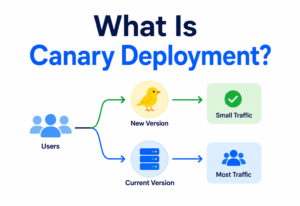
Given how consequential a bad matching-service deploy could be (imagine a bug that suddenly matches everything, blocking huge amounts of legitimate content), this system leans heavily on canary deployments: a new version of the matching service receives a small percentage of traffic first, with precision/recall and error-rate metrics closely monitored, before a full rollout. Blue-green deployment is used for the policy engine, since a bad policy rule change should be instantly reversible.
13.4 Cost optimization
- Use spot/preemptible instances for the transcoding worker pool, since jobs are retryable and idempotent — a killed spot instance just requeues the message.
- Tier storage: recently uploaded raw media on hot storage, older raw uploads moved to cheaper cold/archive storage once processing and any dispute window has passed.
- Cache hot reference fingerprints (frequently-matched popular songs and shows) in memory to avoid repeated expensive lookups on the full ANN index.
13.5 Multi-region topology
A global platform typically runs this pipeline across several geographic regions rather than one central location, for two reasons: reducing upload latency for users far from a single data center, and satisfying data-residency requirements that require certain personal or content data to stay within a specific jurisdiction. The upload service, transcoding workers, and fingerprint generation typically run close to where users actually are (regional deployment), while the reference fingerprint database and ANN index are more often globally replicated, since the whole point of matching is to compare against the same complete reference library no matter which region an upload originates from. Keeping the “policy decision” data (claims, disputes) region-aware, while keeping the “what does this content look like” data (fingerprints) globally consistent, is a subtle but important split in a multi-region design.
13.6 Feature flags for gradual algorithm rollout
Beyond canary traffic percentages, feature flags let the team enable a new fingerprinting algorithm or a new confidence threshold for specific cohorts first — for instance, only for a specific content category, or only for a specific rights holder who has opted into early access — before rolling it out platform-wide. This gives an extra layer of control beyond simple percentage-based canaries, letting risk be managed along business-relevant dimensions, not just infrastructure ones.
Databases, Caching and Load Balancing
14.1 Choosing the right database for each job
| Data | Store | Why |
|---|---|---|
| Reference fingerprints (billions of rows, simple key lookups) | Cassandra / DynamoDB (wide-column, sharded) | Needs massive horizontal write/read scale, simple access patterns, high availability over strict consistency |
| Rights holder accounts, claims, policies, disputes | PostgreSQL | Relational integrity matters here — a claim must correctly reference a valid rights holder and policy; supports transactions |
| Raw & processed media files | Object storage (S3/GCS) | Cheap, durable, virtually unlimited blob storage with CDN integration |
| Hot fingerprint / recent match cache | Redis | Sub-millisecond lookups for frequently-matched popular content, reduces load on the ANN index |
| Match/audit events | Kafka + a columnar data warehouse (BigQuery/Redshift) | Append-only event stream feeding both real-time processing and long-term analytics |
14.2 Sharding the reference fingerprint database
With billions of reference fingerprints, a single database node is impossible — the data is sharded, typically by a hash of the reference ID, spreading both storage and query load evenly across many nodes. Each shard is also replicated (commonly 3 replicas) so a single node failure doesn’t cause data loss or a query hotspot on the remaining nodes.

14.3 Caching strategy
A small fraction of reference works (globally popular songs, viral videos) account for a disproportionate share of all matches — a classic Zipfian / long-tail distribution. Caching these “hot” fingerprints and their match decisions in Redis dramatically reduces load on the full ANN index and reference database, since most incoming uploads that do match will match something in this hot set.
14.4 Load balancing across the stack
Every service boundary in this system sits behind a load balancer: an L7 load balancer (NGINX/Envoy/ALB) at the edge for client traffic, and internal load balancing (often via a service mesh like Istio/Linkerd, or client-side load balancing in the Kafka consumer group model) between internal microservices. For the ANN index specifically, query fan-out to shards is itself a form of load balancing — the Matching Service queries all relevant shards in parallel and merges results, rather than sending all traffic to one shard.
“Why Cassandra/DynamoDB for the reference fingerprint store instead of PostgreSQL?” Because the access pattern is simple (write once, read by key, occasionally scan), the scale is enormous (billions of rows), and availability under partition matters more than strict transactional consistency — exactly the sweet spot for a wide-column NoSQL store, while PostgreSQL is kept for the smaller, relationally-rich claims/policy data where consistency and joins genuinely matter.
14.5 Consistency model across the data layer
Different pieces of data in this system genuinely need different consistency guarantees, and a common mistake is applying one blanket consistency model everywhere:
- Reference fingerprint writes can tolerate eventual consistency — it’s fine if a newly-submitted reference work takes a few seconds to propagate to every ANN shard and replica, since the alternative (blocking the write until every replica acknowledges) would hurt availability for no meaningful benefit.
- Policy and claims data generally needs strong consistency — if a rights holder updates a policy from “block” to “monetize,” that change should apply consistently to every subsequent decision immediately, since inconsistent policy application across regions could mean the same piece of content is blocked in one data center and allowed in another simultaneously.
- Dispute records need strict consistency and durability, since they form part of the legal audit trail and must never be silently lost or duplicated.
14.6 Idempotency keys in the data layer
Because Kafka delivers messages with an “at-least-once” guarantee by default (a message might be redelivered after a consumer crash, even if it was actually processed), every write to the reference or claims database is keyed by a stable idempotency key (typically the upload_id combined with a processing stage identifier), so a redelivered message updates the same row rather than creating a duplicate claim or double-counting a match.
APIs and Microservices
The system exposes a small set of well-defined APIs, both for end users (uploaders) and for rights holders managing their reference catalog.
15.1 Representative API surface
// Uploader-facing
POST   /v1/uploads                     // initiate upload, returns upload_id
GET    /v1/uploads/{id}/status         // poll or receive webhook for match/claim status
POST   /v1/uploads/{id}/disputes       // file a dispute against a claim

// Rights-holder-facing
POST   /v1/references                  // submit a new reference work + fingerprint
PUT    /v1/references/{id}/policy      // configure block/mute/monetize/track + territories
GET    /v1/references/{id}/matches     // list content matched against this reference

// Internal, service-to-service only (never public)
POST   /internal/v1/fingerprint        // media -> fingerprint vector(s)
POST   /internal/v1/match              // fingerprint -> candidate matches + confidence
15.2 Why microservices, not a monolith
Each stage — upload, transcode, fingerprint, match, policy, notify — has wildly different resource needs (I/O heavy vs. CPU heavy vs. GPU heavy) and wildly different scaling curves (upload traffic follows daily/weekly user activity patterns; matching load follows upload volume with a processing lag). Splitting these into independent microservices lets each be scaled, deployed, and even written in a different language/runtime suited to its workload, without one team’s changes risking another stage’s stability.
Of this microservice split
Independent scaling per stage based on its own bottleneck (CPU, GPU, I/O); independent deployability — the policy engine can ship a rule change without redeploying fingerprinting code; clear failure isolation via the queue-based boundaries between stages.
Of this microservice split
Operational complexity — many services, queues, and databases to run and monitor; end-to-end latency includes queueing delay at every hop; debugging a single upload’s journey requires distributed tracing, not just reading one log file.
15.3 Webhook-based status delivery
Rather than forcing uploaders and rights holders to constantly poll a status endpoint, the system pushes events through webhooks whenever an upload’s status changes — this is both more efficient and gives faster notification than polling.
{
  "event": "upload.match_decision",
  "upload_id": "up_8f21ac",
  "reference_id": "ref_44210",
  "confidence": 0.97,
  "policy_action": "monetize",
  "territories_affected": ["US", "CA", "UK"],
  "dispute_url": "https://platform.example/disputes/up_8f21ac",
  "timestamp": "2026-07-28T09:14:02Z"
}
15.4 API versioning and backward compatibility
Because rights holders build automated integrations against this API (bulk-submitting reference catalogs, programmatically reading match reports), the API is versioned explicitly in the URL path (/v1/, /v2/) rather than silently changed. New optional fields can be added to responses without a version bump, but any change to existing field meaning or removal of a field requires a new version, with the previous version supported for a defined deprecation window so integrations aren’t broken overnight.
Design Patterns and Anti-patterns
16.1 Patterns used well
Event-driven pipeline
Kafka topics between every stage decouple producers from consumers, letting each stage scale and fail independently.
Two-phase matching
Cheap ANN candidate retrieval followed by expensive precise verification — the same “coarse then fine” pattern used in search engines and recommendation systems.
Bulkhead isolation
Separate resource pools per media type prevent one overloaded pipeline from starving the others.
Strangler fig for algorithm upgrades
New fingerprinting/embedding models run in shadow mode alongside the old one, with results compared before fully cutting over — avoids a risky big-bang model swap.
Idempotent processing
Every worker operation is keyed by upload_id so retried messages (after a crash or timeout) never double-process or double-charge a claim.
16.2 Common anti-patterns to avoid
- Synchronous matching in the upload path: forces users to wait minutes for a decision before their content even saves — kills the product experience.
- Exact-hash-only duplicate detection: trivially defeated by any re-encode, crop, or edit.
- Single global threshold for every content type: music, film, and user memes have very different false-positive tolerances and should not share one blanket confidence cutoff.
- No dispute path: guarantees the system will wrongly punish legitimate creators with zero recourse, eroding trust in the whole platform.
- Treating the ANN index as a single point of truth: without a verification pass, approximate search errors flow directly into legal/financial decisions.
A tempting shortcut is to skip the verification stage and act directly on raw ANN similarity scores to save latency and cost. This looks fine in early testing but degrades badly at scale, because ANN indexes trade some accuracy for speed by design — at billions of vectors, “close enough” candidates appear far more often than intuition suggests, and unverified matches translate directly into wrongful takedowns.
16.3 The backpressure pattern in practice
When the fingerprinting or matching stage falls behind, message queue depth grows. Rather than letting this backlog grow unbounded (which risks memory pressure on the queue broker and unpredictable delays for every upload), the system applies backpressure: the upload service can slow down how aggressively it accepts new uploads for further processing (while still safely storing the raw file), or route to a secondary, lower-throughput fingerprinting path, until the primary pipeline catches up. This trades some short-term latency for long-term system stability, rather than letting an overloaded queue eventually take down the entire pipeline.
16.4 Saga pattern for multi-step policy application
Applying a policy decision (updating the claims database, notifying the uploader, updating monetization routing, logging the audit trail) touches multiple services and data stores. Rather than wrapping all of this in one giant distributed transaction (which would be slow and fragile across service boundaries), the system uses a Saga pattern: each step publishes an event on completion, the next step reacts to it, and if any step fails, a compensating action (like reversing a partially-applied policy) runs to keep the overall system in a consistent state without needing a single all-or-nothing transaction spanning every microservice.
Best Practices and Common Mistakes
17.1 Best practices
- Separate “fast path” ingestion from “slow path” analysis so publishing speed never depends on matching speed.
- Always run a verification pass on ANN candidates before taking any consequential action.
- Continuously evaluate against a labeled golden dataset to catch silent precision/recall drift as evasion techniques evolve.
- Give every party — uploader and rights holder — visibility and a dispute mechanism, since automated systems will make mistakes at scale no matter how well-tuned.
- Version and audit every reference fingerprint and policy change, since a wrong policy update can incorrectly block or unblock huge amounts of content instantly.
- Combine multiple fingerprinting signals (visual + audio +, increasingly, deep embeddings) rather than relying on one technique, since different evasion tricks defeat different techniques.
17.2 Common mistakes
- Tuning thresholds once at launch and never revisiting them as content patterns and evasion techniques shift over time.
- Under-provisioning the ANN index’s memory footprint, causing latency spikes as the reference library grows past its original capacity plan.
- Not isolating rights-holder reference-submission access, allowing a compromised or malicious account to add false reference claims at scale.
- Ignoring regional/territory licensing differences and applying one global policy everywhere, causing legal exposure in markets with different rights.
- Measuring only infrastructure health (CPU, latency) and never measuring actual match quality (precision/recall) in production.
17.3 Operational playbook for tuning thresholds over time
Because match confidence thresholds directly control the precision/recall trade-off, treating them as a fixed constant set once at launch is a recipe for slow, invisible quality decay. A healthier operational pattern looks like this: maintain a continuously growing, human-labeled evaluation dataset covering both true matches and known false-positive-prone edge cases (parody, commentary, fair-use compilations); run this dataset through the live matching pipeline on a regular cadence (daily or weekly); track precision and recall trends over time rather than single point-in-time snapshots; and route any proposed threshold change through the same canary-deployment process used for code changes, since a threshold adjustment can have just as large an impact on real users as a code bug.
17.4 Building trust with both sides of the marketplace
Ultimately, the long-term health of this system depends on both uploaders and rights holders trusting that it is fair. That means publishing clear, plain-language policies about what triggers a claim, giving uploaders visibility into exactly which reference work triggered a match (not just “your content was flagged”), giving rights holders confidence their catalog is protected without requiring them to manually police the platform themselves, and treating repeated wrongful claims from either side as a signal worth investigating rather than noise to be ignored.
If you remember five things from this section
- Duplicate detection here means similarity, not equality — perceptual fingerprints, not cryptographic hashes.
- Ingestion and matching must be decoupled asynchronously so upload speed never depends on matching speed.
- Matching is always two-phase: fast approximate candidate retrieval, then a precise verification pass.
- Every threshold is a precision/recall trade-off with real business and legal cost on both sides.
- Disputes and human review are a required safety valve, not an optional nice-to-have.
Real-World Industry Examples
Content ID
The best-known implementation. Rights holders upload reference audio/video, and every new upload is fingerprinted and matched against a library reportedly holding tens of millions of reference assets. Matches trigger a rights holder’s chosen policy — most commonly “monetize,” which quietly redirects ad revenue rather than blocking the video outright, aligning incentives so rights holders benefit from reuse instead of just fighting it.
Facebook / Rights Manager
Similar in spirit to Content ID but built for Facebook and Instagram’s shorter-form, high-volume content, integrating video and image matching with the broader Meta content-moderation stack, which also reuses fingerprinting infrastructure for other trust-and-safety problems like flagging previously-removed harmful content re-uploaded under a new account.
Detection as a service
A third-party licensed fingerprinting service used by many smaller platforms and services that don’t want to build this entire pipeline themselves — an example of “detection as a service,” showing this problem is valuable and hard enough that a whole industry exists just to provide it to other companies.
Consumer audio matching
Not a copyright-enforcement system, but the audio fingerprinting technique it popularized (the constellation-map approach shown earlier) is foundational to how music matching works across the industry, including inside platforms’ copyright pipelines.
Cross-industry hash sharing
For especially harmful content categories (child sexual abuse material, and separately, terrorist/extremist content via the GIFCT consortium), companies share hash databases with each other and with organizations like NCMEC, so a piece of harmful content identified on one platform can be instantly recognized if re-uploaded to a different platform — the same underlying fingerprinting technology applied to a safety problem rather than a copyright one.
Proactive + post-publication
Runs both proactive matching at upload time and post-publication scanning, since short-form content spreads and gets remixed extremely quickly — a “duet” or “stitch” of copyrighted material needs to be caught even when it is combined with new, original footage, requiring the matching pipeline to work on partial/segment-level matches rather than only whole-file matches.
Live-stream matching
Faces a distinct challenge: live streaming. Because content is being broadcast in real time, matching (for background music playing in a streamer’s room, for example) has to run against a rolling buffer of the live stream with very tight latency budgets, since a delayed match still exposes the stream to viewers before any action can be taken — pushing the “fast path vs. slow path” trade-off to its most extreme form.
Cross-platform reuse detection
Because Meta operates multiple platforms (Facebook, Instagram, and formerly others), fingerprints and match decisions are shared across products, so content removed or claimed on one platform can be immediately recognized if the same file, or a near-duplicate, is re-uploaded to a sibling platform — an example of designing the reference library and ANN index as a shared platform-wide service rather than duplicating it per product.
Notice that copyright detection, misinformation re-upload detection, and child-safety hash matching all reuse the exact same core architecture (fingerprint → ANN match → policy action) with different reference libraries and different policies plugged in. Recognizing this pattern — one general architecture serving multiple trust-and-safety problems — is a strong signal of systems-thinking in an interview.
Frequently Asked Questions
Can this system detect a video re-uploaded after being mirrored or flipped horizontally?
Classical perceptual hashes can be defeated by a horizontal flip unless the system explicitly generates a mirrored fingerprint variant to check against too. Deep-learning embedding-based fingerprints tend to be far more robust here since they can be trained to be invariant to flips, rotation, and other geometric transforms — this is one reason production systems increasingly lean on embeddings rather than classical hashes alone.
How does the system handle legitimate re-uploads, like a licensed remix or an official cover song?
This is exactly why matches trigger a policy lookup rather than an automatic block. Rights holders can pre-configure specific licensed uses (an official remix, a covered artist’s licensed version) to be allowed or monetized differently, and uploaders always retain a dispute path if a legitimate use is flagged incorrectly.
What happens during the window between upload and match decision?
This varies by platform policy. Some platforms keep content unlisted/pending until an initial fast pass completes (often within seconds to a couple of minutes for the highest-confidence, most common matches), while others publish immediately and retroactively apply any policy action once the full pipeline completes — trading a short window of exposure for faster publishing.
Why not just use a large language model or general image classifier for this instead of specialized fingerprinting?
General classifiers answer “what is this content about” (a cat, a car, a pop song), while this problem needs “is this the same specific work as this other specific work” — a much finer-grained similarity/identity question. Specialized fingerprinting and embedding models trained specifically for near-duplicate detection perform far better here than general-purpose classifiers, though modern systems do increasingly borrow embedding techniques originally developed for classification/retrieval models.
How does the system scale the ANN index as the reference library keeps growing?
By adding more shards (horizontal scaling) as the reference set grows past what a single shard can hold in memory efficiently, and by periodically re-balancing/re-indexing as usage patterns shift, keeping the most frequently-matched references in the fastest-access tier.
How do live streams get checked for copyrighted content if there’s no finished file to fingerprint yet?
The stream is broken into short rolling segments (a few seconds each), and each segment is fingerprinted and matched independently and continuously as the stream plays, rather than waiting for the whole broadcast to end. This keeps the same fingerprint-then-match architecture but shrinks the unit of work down to segment-level granularity to fit a live latency budget.
What stops a rights holder from falsely claiming content that isn’t actually theirs?
Onboarding for reference-submission access requires legal verification of ownership, every claim is logged in an auditable trail tied to a specific account, uploaders retain a dispute path, and accounts with a pattern of overturned/abusive claims can be flagged for manual compliance review or have their submission privileges restricted.
Does this system also help with content beyond copyright, like detecting re-uploaded misinformation?
Yes — the same fingerprint-and-match architecture is commonly reused with a different reference library (previously fact-checked false content instead of copyrighted works) and a different policy set (labeling or reducing distribution instead of blocking/monetizing), which is why this pattern shows up across many trust-and-safety systems, not just copyright enforcement.
How is a short audio clip, like a 15-second song snippet in a video, still detected reliably?
Audio fingerprinting doesn’t need the whole track to find a match — the constellation-hash technique described earlier only needs enough aligned spectral peak pairs within the available snippet to exceed a confidence threshold, which is why apps like Shazam can identify a song from just a few seconds of noisy audio. The same robustness carries over to the copyright-matching pipeline, letting it flag short embedded clips inside much longer uploads.
What’s the difference between this system and a general plagiarism checker for text or code?
The underlying pattern is conceptually similar — generate a compact fingerprint of the content, then search for near-matches against a reference corpus — but the fingerprinting techniques differ by medium. Text plagiarism detection typically relies on shingling (breaking text into overlapping word sequences) and MinHash-style similarity rather than perceptual hashing or spectral peak analysis, since text has no meaningful “pixel” or “frequency” structure to exploit the way images, video, and audio do.
Summary and Key Takeaways
Detecting duplicate and copyrighted content across a user-generated content platform is fundamentally a similarity search problem wrapped in a legal and business policy layer, running at extreme scale. The technical core — fingerprint generation, approximate nearest-neighbor matching, and a verification pass — sits inside a broader asynchronous pipeline that carefully keeps the fast, user-facing upload path separate from the slower, resource-intensive analysis path.
Key takeaways
- Duplicate detection must handle perceptual similarity, not byte-exact matching, because virtually all real re-uploads involve some transformation (re-encoding, cropping, pitch shifting).
- The architecture separates fast synchronous ingestion (load balancer → API gateway → upload service → object storage) from slow asynchronous analysis (transcoding → fingerprinting → ANN matching → policy) via message queues.
- Matching is two-phase: cheap approximate candidate retrieval (LSH/HNSW-based ANN search) followed by an expensive, precise verification step before any consequential action is taken.
- Every confidence threshold in the system is a genuine precision-vs-recall trade-off with real cost on both sides — wrongly blocking legitimate creators, or letting real infringement spread.
- The system needs strong reliability guarantees (durable queues, retries, circuit breakers) since uploads must never be lost even when downstream analysis fails temporarily.
- Security and governance around who can add reference works and set policies are as important as the matching algorithm itself, since this system directly controls revenue and content visibility.
- A functioning dispute and human review path is mandatory — at this scale, some false positives and false negatives are inevitable, and the system must have a safety valve.
- The same fingerprint → match → policy architecture generalizes far beyond copyright, powering misinformation re-upload detection and industry-wide child-safety hash sharing (PhotoDNA).
If you take one architectural habit away from this whole design, let it be this: whenever a step in a pipeline is both expensive and only occasionally necessary, look for a way to filter cheaply first and pay the expensive cost only on the survivors. That single idea — cheap filter, then expensive verification — shows up again and again in this system, from the hot-cache check before the full pipeline, to ANN candidate retrieval before precise cosine-similarity verification, and it’s a pattern worth carrying into almost any large-scale system design problem you encounter next.
A great detection system is less like a locked gate and more like a river with a fine mesh in it: the water (legitimate content) keeps flowing at full speed, but the drift (infringing re-uploads) is caught quietly along the way — and the fisherman who owns the river always knows what was caught, why, and how to appeal a mistake.