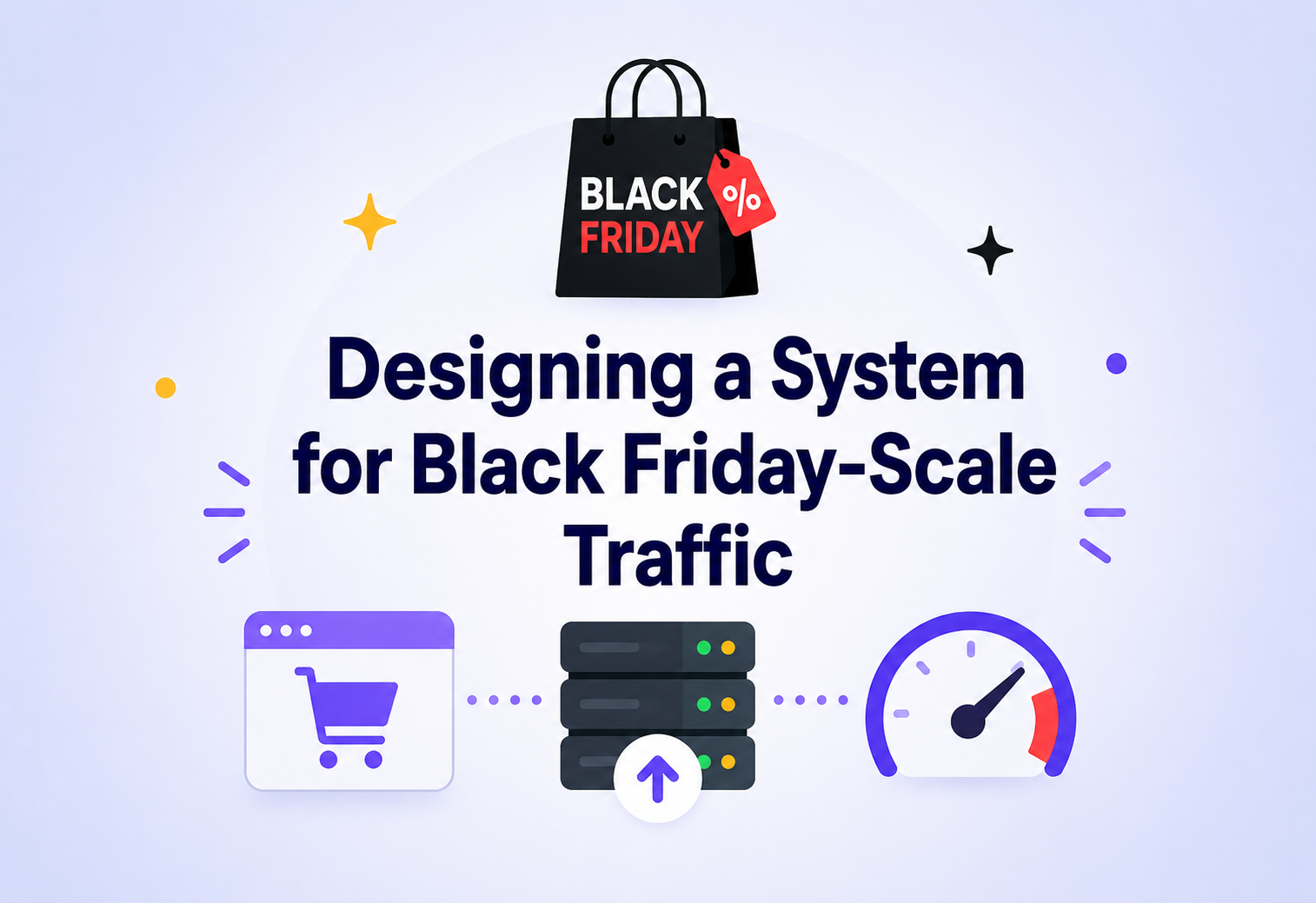
Designing a System for Black Friday-Scale Traffic
How e-commerce platforms like Amazon, Walmart, and Shopify absorb a 50x traffic spike sustained across a 48-hour window — without crashing, without over-provisioning for the other 363 days of the year, and without losing a single paid order.
Introduction & History
Picture a highway built to comfortably carry 2,000 cars an hour. Now imagine that once a year, for two full days, 100,000 cars all try to use that same highway at once. If you built the highway for the average day, it collapses into gridlock the moment the surge begins. This is exactly the challenge an e-commerce platform faces during Black Friday and Cyber Monday: traffic that is normally a gentle stream turns into a flash flood, arriving in a predictable window but at a genuinely unpredictable peak intensity.
A Black Friday-scale traffic system is the set of architectural decisions, infrastructure patterns, and operational practices that let a platform absorb a 20x to 50x spike in traffic for a sustained 24 to 48 hour window — covering browsing, searching, adding to cart, and checking out — without the site slowing to a crawl, without orders being lost, and without paying for that same 50x capacity the other 363 days of the year.
1.1 Why This Is Fundamentally Different from “Normal” Scaling
Most scalability discussions assume traffic grows gradually — you notice load creeping up over weeks or months and add capacity accordingly. Black Friday breaks that assumption in three specific ways that shape every decision in this tutorial.
The Spike Is Sudden
Traffic does not ramp up gently; it can roughly double within a single hour as a flash sale opens, giving auto-scaling systems very little warning time to react.
The Spike Is Sustained
Unlike a five-minute viral traffic burst, this load persists for 24 to 48 hours continuously, meaning the system must sustain peak capacity, not just absorb a brief shock.
The Cost of Failure Is Uniquely High
A single hour of checkout downtime during Black Friday can cost a large retailer more revenue than an entire week of downtime on a normal day, making the stakes for this specific 48-hour window disproportionately high.
1.2 A Short History of the Problem
Manual Over-Provisioning
Retailers bought and racked physical servers months in advance, sized for their best guess of Black Friday peak, and then let most of that hardware sit idle for the rest of the year. Guessing wrong in either direction was extremely costly.
Virtualization & Early Cloud Bursting
Virtual machines let companies squeeze more workloads onto the same hardware, and the first “cloud bursting” patterns emerged — running the baseline load on owned infrastructure and bursting excess load into a public cloud.
Elastic Auto-Scaling Matures
Public cloud auto-scaling groups became reliable enough that companies began scaling entire fleets up and down automatically based on real-time metrics, dramatically reducing the need for manual capacity guesswork.
Chaos Engineering & Game-Day Testing
Companies like Netflix and Amazon popularized deliberately injecting failures into production-like environments well before the real event, so that Black Friday readiness became a rehearsed, tested capability rather than a hopeful assumption.
Predictive Pre-Scaling & Queue-Based Load Shedding
Modern platforms combine machine-learning traffic forecasts with proactive pre-scaling ahead of the spike, plus graceful, queue-based load shedding (virtual waiting rooms) for the rare moments demand still exceeds even a well-provisioned system’s capacity.
By the end of this tutorial, you will understand every layer of this system — from the CDN edge all the way down to how a database survives fifty times its normal write load — and why each design decision exists specifically because of the unique shape of Black Friday demand.
1.3 Why This Problem Sits at the Intersection of Several Disciplines
Designing for this kind of event is rarely a single specialist’s job. It pulls together at least four distinct engineering disciplines, and a strong system designer needs to move fluently between them, even without being a deep expert in every one.
Distributed Systems
The pipeline must coordinate a large, dynamically resized fleet of servers, a partitioned database, and an asynchronous message queue, all staying correct and available under extreme, sustained concurrency.
Capacity Planning & Forecasting
Historical traffic data, marketing calendars, and statistical forecasting models all feed into deciding how much capacity to pre-provision, and when.
Site Reliability Engineering
Game-day rehearsals, alert tuning, and a live command-center operating model turn a theoretical architecture into a system a real team can actually operate calmly under pressure.
Business & Finance
Every scaling decision trades real infrastructure cost against real revenue risk, and the best engineering answer is often also the best financial answer once both sides of that trade-off are made explicit.
Keeping this framing in mind helps you answer follow-up interview questions gracefully, since interviewers often probe from whichever of these four angles matches their own background — moving comfortably between “how does Kafka handle this backlog” and “how do you decide how much to pre-scale” and “how do you justify this cost to the business” is exactly the kind of well-rounded judgement senior system design interviews are designed to surface.
Problem & Motivation
Let’s ground this in real numbers, because the specific shape of the spike drives nearly every architectural decision that follows.
~2K req/s
Requests per second on a typical day.
~100K req/s
Requests per second during peak Black Friday minutes.
48 hr
Sustained elevated load window.
$X M/min
Estimated revenue lost per minute of checkout downtime.
Provision for the 50x peak and you waste enormous amounts of money running idle capacity for 363 days a year. Provision only for the average day and the system falls over in the first ten minutes of the sale, at the exact moment your business needs it most.
2.1 Why This Is a Genuinely Hard System Design Problem
Elasticity Under Time Pressure
Auto-scaling must react within minutes, not hours, since the spike itself can double within a single hour once a headline deal goes live.
Stateful Bottlenecks
Application servers scale horizontally with ease, but the database, inventory counters, and payment gateway do not scale linearly just by adding more machines — they need entirely different techniques.
Correctness Under Contention
Thousands of shoppers may try to buy the last unit of a doorbuster item within the same second; the system must never oversell inventory, even under extreme concurrent write pressure.
Cost Discipline
Cloud infrastructure costs scale with usage; a poorly designed system can burn an enormous unplanned bill precisely during the highest-revenue days of the year if scaling isn’t bounded and monitored.
Dependency Fragility
Third-party payment processors, tax calculation services, and shipping-rate APIs were not necessarily built for a 50x spike either, and can become the true bottleneck even when your own systems scale perfectly.
Human Operational Load
Even the best-automated system needs an on-call team ready to respond within minutes; the entire event compresses a full year’s worth of “worst day” risk into a 48-hour window.
2.2 The Economics of Over- Versus Under-Provisioning
It is tempting to think of this purely as an engineering problem, but it is equally a financial optimization problem. Every additional server kept running “just in case” has a real, continuous dollar cost. Every minute of checkout downtime during peak hours has a real, often larger, dollar cost in lost revenue plus long-term brand damage as frustrated shoppers complete their purchase on a competitor’s site instead. The entire architecture described in this tutorial exists to push that trade-off curve in your favour — scaling capacity elastically and automatically so you pay close to the true cost of serving actual demand, rather than picking one fixed number and living with the consequences of guessing wrong in either direction.
“Why not just permanently run the servers at Black Friday capacity to be safe?” — a strong answer discusses the direct cost of idle infrastructure for 363 days a year, the operational complexity of managing a much larger fleet full-time, and the fact that “safe” is also not free: a permanently over-scaled fleet still needs a database, cache, and downstream dependencies that must independently handle that scale, meaning the real bottlenecks would remain unsolved even with unlimited compute.
2.3 The Three Stakeholders Whose Needs Must All Be Balanced
| Stakeholder | What They Need | What Happens If Ignored |
|---|---|---|
| Shoppers | A fast, working checkout, honest stock availability, and clear communication if they must wait | Abandoned carts, lost sales to competitors, lasting brand damage from a visibly broken experience |
| Merchants / sellers on the platform | Accurate inventory counts and reliable order data flowing through to fulfilment | Overselling leads to cancelled orders, refund costs, and damaged merchant trust in the platform |
| The business / finance function | Infrastructure spend that scales sensibly with revenue rather than a blank check for “just in case” capacity | Runaway cloud costs during the exact days meant to be the most profitable of the year |
2.4 Why “Average Day” Metrics Are Actively Misleading Here
A team that only looks at average daily or even average hourly traffic when sizing infrastructure will badly underestimate what actually needs to be handled, because the real risk lives in a short, extreme burst layered on top of an already elevated 48-hour baseline — the single worst five-minute window, right as a headline deal opens, can be many times higher than even the elevated hourly average for the whole event. Capacity planning for this problem must be done against peak-minute or even peak-second projections, not daily or hourly averages, or the system will look adequately provisioned on paper while still failing at the exact moment it matters most.
Core Concepts
Before drawing the architecture, let’s build a shared vocabulary for the techniques that make elastic, spike-tolerant systems possible.
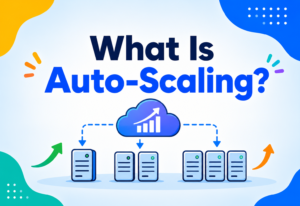
3.1 Horizontal Auto-Scaling
What: Automatically adding or removing identical server instances based on real-time load, rather than making a single server more powerful (vertical scaling).
Why: A fleet of many small, identical, stateless servers can absorb a 50x spike simply by multiplying its size, something a single, even very powerful, machine can never do past a certain physical ceiling.
Practical example: A cloud auto-scaling group watches average CPU utilization or request queue depth across the fleet, and automatically launches new identical application server instances when that metric crosses a threshold, then terminates them once load subsides.
3.2 Predictive Pre-Scaling
What: Proactively scaling the fleet up ahead of an anticipated spike, based on historical patterns and marketing calendars, rather than waiting for reactive metrics to cross a threshold.
Why: Reactive auto-scaling always has a lag — launching a new server, waiting for it to boot, warm its caches, and pass a health check can take minutes. If a spike arrives faster than that lag, purely reactive scaling falls behind the wave.
Beginner example: Knowing that a big sale starts at midnight, the team scales the fleet to near-peak capacity by 11:45 p.m., rather than waiting for the flood of traffic to trigger scaling after the fact.
3.3 Load Shedding and the Virtual Waiting Room
What: A deliberate mechanism that, once the system nears its safe capacity limit, holds excess users in an ordered queue (a “waiting room”) rather than letting them all hit the backend at once and degrading service for everyone.
Why: It is far better for a shopper to see “You are number 4,000 in line, estimated wait 3 minutes” than for the entire site to become slow or crash for every single visitor simultaneously.
Production example: Ticketing platforms and sneaker-drop retailers use exactly this pattern for extremely popular, limited-supply launches, admitting users into the actual store at a controlled rate.
3.4 Backpressure and Circuit Breakers
What: Backpressure is a signal that flows backward through a system, telling upstream components to slow down because a downstream component is overloaded. A circuit breaker is the mechanism that acts on this signal, temporarily stopping calls to a failing dependency.
Why: Without backpressure, a slow database can cause application servers to pile up waiting threads, which then slows down the load balancer, which then affects the CDN’s perception of origin health — a small problem cascading into a total outage.
3.5 Connection Pooling
What: Reusing a fixed, bounded set of already-open database connections across many requests, rather than opening a brand-new connection for every single incoming request.
Why: Opening a new database connection is expensive (a multi-step network handshake); at 50x load, naively opening one connection per request would exhaust the database’s maximum connection limit within seconds.
3.6 Read Replicas and Cache-Aside
What: A read replica is a copy of the database that serves read-only queries, taking load off the primary database, which is reserved for writes. Cache-aside means the application checks a fast in-memory cache first, only falling back to the database on a cache miss.
Why: Black Friday traffic is overwhelmingly read-heavy — millions of shoppers browsing product pages for every one shopper who actually completes checkout — so offloading reads is one of the single highest-leverage scaling techniques available.
3.7 Idempotency Keys
What: A unique identifier attached to a request (such as “place this exact order”) so that if the request is retried due to a network blip, the server recognises it as a duplicate and does not process it twice.
Why: Under high load and flaky mobile networks, clients frequently retry requests. Without idempotency, a shopper could be charged twice or an item could be shipped twice for a single click of “Place Order.”
3.8 Rate Limiting
What: Restricting how many requests a single client, account, or IP address can make within a given time window, rejecting or delaying requests beyond that limit.
Why: Without rate limiting, a single misbehaving client — whether a buggy retry loop or a scalper’s bot — can consume a disproportionate share of shared capacity, degrading service for every other shopper at the worst possible moment.
3.9 Exponential Backoff with Jitter
What: A retry strategy where a failed request waits progressively longer before retrying (doubling the delay each time), with a small random jitter added to avoid many clients retrying in perfect lockstep.
Why: Under extreme load, naive immediate retries from thousands of clients simultaneously can turn a brief, recoverable blip into a self-inflicted retry storm that overwhelms the very system that was just starting to recover. Backoff with jitter spreads retries out over time, giving the system room to stabilise.
Beginner example: If a checkout request fails, a well-behaved client waits roughly 1 second before its first retry, then roughly 2 seconds, then roughly 4 seconds, each with a small random adjustment, rather than retrying instantly and repeatedly.
Every technique in this section exists to convert a sudden, unpredictable, 50x spike into a smooth, predictable, absorbable load curve at every single layer of the stack — the edge, the application tier, the cache, and the database.
Architecture & Components
Let’s assemble every concept above into one coherent picture. Every box below is a distinct, independently scalable component, labelled explicitly.
Every box above maps to a real, independently deployable and scalable service. Let’s walk through each one.
4.1 Component Breakdown
CDN
Caches product images, CSS, JavaScript, and even entire cacheable HTML pages at edge locations close to shoppers, absorbing the overwhelming majority of browsing traffic before it ever reaches your origin infrastructure.
WAF & DDoS Protection
Filters malicious or automated bot traffic (scalper bots trying to buy out doorbuster inventory) before it consumes capacity meant for real shoppers.
Virtual Waiting Room
Activated only when incoming demand exceeds the system’s tested safe capacity; holds shoppers in an ordered, fair queue and admits them at a controlled rate rather than letting the backend collapse under uncontrolled concurrency.
Load Balancer
Distributes admitted traffic across a large, dynamically resized fleet of application servers, continuously health-checking instances so traffic never routes to an unhealthy or still-booting server.
API Gateway
The single front door handling authentication, per-shopper and per-IP rate limiting, and routing requests to the correct backend service.
Product / Cart / Checkout Services
Independently deployed, independently auto-scaled microservices, each scaled according to its own load profile — catalog browsing scales far larger than checkout, since far more shoppers browse than buy.
Cache Layer (Redis Cluster)
Serves the overwhelming majority of product-page reads directly from memory, dramatically reducing load on the database tier during the highest-traffic hours.
Database Read Replicas
Absorb read-heavy catalog and search queries, keeping the primary database free to focus on the far more sensitive write path of orders and inventory.
Order Queue (Kafka)
Decouples the fast, synchronous checkout submission from the heavier order-processing workflow, letting the system smooth out bursts rather than processing every order request synchronously and immediately.
Order Processing Worker Pool
Consumes the order queue at a sustainable, horizontally scalable rate, performing inventory decrement, payment capture, and confirmation in a controlled, auditable sequence.
Inventory Service
Uses atomic, carefully-locked stock decrement operations to guarantee the platform never oversells a doorbuster item, even under extreme concurrent demand for the last few units.
Payment Service & Circuit Breaker
Wraps calls to the external payment gateway with a circuit breaker, since third-party payment providers can themselves become a bottleneck under 50x load, and a slow gateway must never stall the entire order pipeline.
Auto-Scaling Controller
Continuously watches real-time metrics (queue depth, CPU, request latency) across every service and adjusts fleet sizes automatically, informed also by scheduled pre-scaling ahead of the known sale start time.
“Why put a queue between Checkout and Order Processing instead of processing every order synchronously?” — order processing involves multiple slower, less predictable steps (inventory locking, an external payment gateway call, notification dispatch). Making the shopper-facing checkout API wait synchronously for all of this would tie up gateway and application threads for far longer than necessary, and any slowdown in payment processing would directly slow down every shopper trying to check out. A queue absorbs bursts, lets checkout return a fast “order received” response, and lets order processing scale and retry independently, at a pace the downstream dependencies can actually sustain.
Internal Working
Let’s zoom into two of the trickiest internal mechanisms: atomic inventory decrement under extreme contention, and the auto-scaling controller’s decision logic.
5.1 Atomic Inventory Decrement
When a doorbuster item has 50 units in stock and 5,000 shoppers click “Buy Now” within the same second, the system must guarantee exactly 50 successful purchases — never 51, and ideally never noticeably fewer than 50 due to overly conservative locking. This is achieved with an atomic, conditional decrement operation directly at the database or a dedicated in-memory counter service, rather than a naive “read stock, check if greater than zero, then write new stock” sequence, which is vulnerable to a classic race condition under concurrent access.
public class InventoryService {

    private final JdbcTemplate jdbcTemplate;

    public boolean tryReserveStock(String sku, int quantity) {
        // Atomic conditional update: only decrements if enough stock remains.
        // The WHERE clause and the UPDATE happen as one atomic database operation,
        // so concurrent requests can never both succeed past the last unit.
        String sql = "UPDATE inventory " +
                     "SET available_stock = available_stock - ? " +
                     "WHERE sku = ? AND available_stock >= ?";

        int rowsAffected = jdbcTemplate.update(sql, quantity, sku, quantity);

        // rowsAffected == 1 means the reservation succeeded;
        // rowsAffected == 0 means stock was insufficient, request must fail fast.
        return rowsAffected == 1;
    }
}
Notice that the “check stock” and “decrement stock” happen inside a single atomic SQL statement, not as two separate steps in application code. This single-statement approach is what prevents overselling: the database itself guarantees that only as many concurrent requests as there is remaining stock can ever succeed, regardless of how many thousands of requests arrive in the same millisecond.
5.2 Auto-Scaling Controller Decision Logic
A naive auto-scaler that reacts purely to average CPU can be dangerously slow to respond to a sudden spike, since CPU usage often lags behind the true bottleneck (such as growing queue depth or rising request latency). A more robust controller combines multiple signals and reacts to the leading indicator, not just the lagging one.
public class AutoScalingDecisionEngine {

    private static final double QUEUE_DEPTH_HIGH_WATERMARK = 5000;
    private static final double P99_LATENCY_HIGH_MS        = 400;
    private static final int    MIN_FLEET_SIZE             = 20;
    private static final int    MAX_FLEET_SIZE             = 2000;

    public ScalingDecision decide(FleetMetrics metrics, int currentFleetSize) {

        boolean queuePressure   = metrics.getQueueDepth()  > QUEUE_DEPTH_HIGH_WATERMARK;
        boolean latencyPressure = metrics.getP99LatencyMs() > P99_LATENCY_HIGH_MS;

        if (queuePressure || latencyPressure) {
            // Scale aggressively: double the fleet, bounded by the configured max,
            // because waiting for a small incremental step during a fast-moving
            // spike would let the backlog grow faster than capacity arrives.
            int target = Math.min(currentFleetSize * 2, MAX_FLEET_SIZE);
            return ScalingDecision.scaleTo(target, "Queue or latency pressure detected");
        }

        if (metrics.getAvgCpuUtilization() < 0.3 && currentFleetSize > MIN_FLEET_SIZE) {
            // Scale down conservatively and slowly to avoid oscillation.
            int target = Math.max((int) (currentFleetSize * 0.9), MIN_FLEET_SIZE);
            return ScalingDecision.scaleTo(target, "Sustained low utilization");
        }

        return ScalingDecision.noChange();
    }
}
Notice the scale-down logic reduces fleet size by only 10 % at a time, while scale-up doubles aggressively. This asymmetry is deliberate: scaling up too slowly during a genuine spike risks a real outage, while scaling down too aggressively risks flapping the fleet size up and down repeatedly (thrashing), which wastes both compute and the warm-up time newly launched instances need before they are useful.
“Why not scale purely on CPU utilization?” — CPU is a lagging indicator for many workloads, especially I/O-bound services waiting on downstream calls like a database or payment gateway. A service can be severely overloaded (growing queue depth, rising latency, timing out requests) while individual instance CPU stays moderate because threads are mostly blocked waiting on slow dependencies rather than computing. Queue depth and tail latency (p99) are much more direct proxies for “are we actually falling behind,” and a robust auto-scaler should react to those first.
Data Flow & Lifecycle
Let’s trace one checkout request through the system as a sequence of messages, including what happens if the system is near its capacity limit.
6.1 Order Lifecycle States
| State | Meaning |
|---|---|
SUBMITTED | Checkout accepted the request and published it to the order queue |
STOCK_RESERVED | Inventory service successfully decremented available stock atomically |
PAYMENT_PENDING | Payment capture call is in flight with the external gateway |
CONFIRMED | Payment succeeded; order is finalised and confirmation sent |
FAILED_OUT_OF_STOCK | Stock reservation failed; shopper notified before any payment was attempted |
FAILED_PAYMENT | Payment declined after stock was reserved; reserved stock is released back to inventory |
Notice the Checkout Service responds to the shopper immediately after publishing to the queue, not after the entire multi-step order workflow finishes. This keeps the shopper-facing response time fast and predictable regardless of downstream payment gateway latency, at the cost of the shopper’s confirmation email arriving a few seconds after the “order received” message rather than instantly — a trade-off almost every shopper is happy to accept in exchange for a checkout button that never appears to hang.
Advantages, Disadvantages & Trade-offs
Advantages of This Architecture
- Elastic auto-scaling means infrastructure cost tracks actual demand closely, rather than being fixed at a permanent worst-case size.
- Queue-based order processing smooths bursty checkout traffic into a sustainable, controllable rate for downstream dependencies.
- The virtual waiting room provides a graceful, fair degradation path instead of an uncontrolled crash when true demand exceeds even a well-provisioned system’s capacity.
- Read replicas and caching offload the overwhelming majority of read traffic, protecting the most sensitive write path (orders and payments).
Disadvantages & Challenges
- Significant additional operational complexity compared to a single, simple monolithic deployment.
- Asynchronous order processing introduces eventual consistency — a shopper’s order may briefly show “processing” rather than an instant final result.
- Auto-scaling still has a reaction lag; without predictive pre-scaling, an extremely sudden spike can outrun even a fast-reacting controller.
- Third-party dependencies like payment gateways may not scale as gracefully as your own infrastructure, becoming the true bottleneck despite your own system being well-designed.
7.1 Key Trade-off: Reactive vs Predictive Scaling
| Approach | Pros | Cons |
|---|---|---|
| Purely reactive auto-scaling | No manual planning required; adapts to genuinely unexpected traffic patterns | Always has a lag between the spike starting and new capacity coming fully online |
| Purely predictive pre-scaling | Capacity is ready before the spike even begins, eliminating reaction lag entirely | Relies on accurate forecasts; wastes cost if the predicted spike doesn’t materialise as expected |
| Hybrid (predictive baseline + reactive top-up) | Best of both — a safe pre-scaled floor plus reactive scaling for any surprise beyond the forecast | More complex to build and tune than either approach alone |
7.2 Key Trade-off: Strict Consistency vs Availability at the Inventory Layer
A strictly consistent, single-database inventory counter guarantees you never oversell, but becomes a write bottleneck and single point of contention under extreme concurrency. Sharding inventory counters by SKU across multiple database partitions improves throughput dramatically, but requires careful design so that popular doorbuster items (which naturally concentrate load onto their specific shard) do not become a new hotspot. Most large platforms accept a small, deliberate amount of engineering complexity here in exchange for protecting the one guarantee that truly cannot be violated: never selling more units than physically exist.
Performance & Scalability
Let’s ground the scaling story in concrete numbers and formulas that a senior engineer would actually use for capacity planning.
8.1 Applying Little’s Law to the Order Queue
Little’s Law states $L = lambda W$, where $L$ is the average number of items in the system, $lambda$ is the arrival rate, and $W$ is the average time an item spends in the system. If orders arrive at 2,000 per second ($lambda$) during peak minutes, and each order takes an average of 3 seconds ($W$) to fully process through inventory, payment, and confirmation, the queue will stabilise holding $L = 2{,}000 times 3 = 6{,}000$ orders in flight at any moment. This single number tells you exactly how many concurrent order-processing workers you need provisioned to keep the queue from growing unbounded during the peak window.
8.2 Horizontal Scaling of Stateless Application Tiers
Because product catalog, cart, and checkout services hold no persistent state locally, doubling the traffic they must handle is, in principle, solved simply by doubling the number of running instances behind the load balancer — provided the load balancer itself, the API gateway, and every downstream dependency scale in step as well. This is why stateless service design is treated as a near-mandatory prerequisite for this entire architecture, not merely a nice-to-have.
8.3 Caching Hit-Rate Math
If 95 % of product-page reads are served directly from the cache layer, the database read replicas only need to sustain 5 % of total read volume. At 100,000 requests per second of peak product-page traffic, a 95 % cache hit rate means the database tier only needs to absorb 5,000 requests per second — a number an appropriately sized set of read replicas can handle comfortably, compared to the impossible task of absorbing the full 100,000 requests per second directly.
8.4 CDN Offload for Static and Cacheable Content
Product images, CSS, JavaScript bundles, and even entire cacheable marketing pages served from the CDN edge never touch your origin infrastructure at all. For a typical e-commerce site, this can remove 80 % or more of total request volume from the origin, meaning your application and database tiers only ever need to handle a fraction of the raw traffic number a shopper’s browser generates.
Combining an 80 % CDN offload with a 95 % cache hit rate on the remaining traffic means the database tier, in this example, ends up handling roughly 1 % of the raw shopper-facing request volume — turning an otherwise impossible 100,000 requests per second problem into a comfortably solvable 1,000 requests per second problem at the data layer.
“If your auto-scaler takes 3 minutes to bring new instances online, but a spike doubles traffic in 1 minute, what do you do?” — this is exactly why predictive pre-scaling exists. Discuss scheduling a pre-scale event ahead of a known sale start time based on historical traffic patterns, maintaining a warm buffer of slightly above-forecast capacity throughout the entire 48-hour window rather than scaling tightly to the current instantaneous load, and combining this with request queueing or graceful load shedding as a safety net for the residual risk that the forecast itself underestimates true demand.
8.5 CAP Theorem Trade-offs in This System
The CAP theorem states a distributed data store can only guarantee two of three properties during a network partition: consistency, availability, and partition tolerance. This architecture deliberately makes different choices for different pieces of state, and articulating why is a strong signal in a system design interview.
| Component | Choice | Reasoning |
|---|---|---|
| Inventory counters | Favours consistency (CP) | Two concurrent writes both succeeding on the last unit of stock is a real business failure (overselling), not a minor inconvenience, so correctness must never be sacrificed here. |
| Order Queue (Kafka) | Favours availability (AP) with at-least-once delivery | It is safer to occasionally reprocess a duplicate order event, guarded by idempotency, than to lose an order event entirely during a partition. |
| Product catalog cache | Favours availability (AP) | A shopper briefly seeing a slightly stale price or stock badge on a product page is a minor issue, not a safety failure, so cache reads stay available even under replication lag. |
| Database read replicas | Favours availability (AP) with eventual consistency | A newly placed order being reflected in “recently viewed”-style read queries a few seconds late is an acceptable trade-off for keeping read capacity highly available under peak load. |
This table illustrates an important general principle: CAP trade-offs are not made once for the “whole system,” but individually for each piece of state, based on the true cost of inconsistency versus the true cost of unavailability for that specific piece of data.
High Availability & Reliability
9.1 Multi-AZ and Multi-Region Deployment
Every stateful component — the primary database, the order queue cluster, the cache cluster — is deployed across at least three availability zones, so the loss of a single data centre during the highest-revenue window of the year does not interrupt order processing.
9.2 Graceful Degradation Chain
Payment Gateway Slow or Down
Circuit breaker trips; orders are held in a retry-with-backoff state rather than failing outright, and shoppers see a brief “processing your payment” state instead of an error.
Cache Cluster Degraded
Falls back to reading directly from database read replicas for the affected keys, accepting higher latency temporarily rather than serving errors.
Order Queue Consumer Lag Rising
Auto-scaling adds more order-processing worker instances to the consumer group; if lag continues rising beyond a threshold, the checkout service itself begins shedding load via the virtual waiting room.
A Single Service’s Fleet Exhausted
Non-critical features (personalised recommendations, “customers also bought” widgets) are disabled first to free up capacity for the truly essential browse-cart-checkout path.
9.3 Feature Flags as a Reliability Tool
Non-essential features — recommendation widgets, live chat, loyalty-point animations — are wired behind feature flags that can be disabled instantly and centrally if the system approaches its capacity limits, freeing up compute and database capacity for the features that actually matter during the highest-stakes hours: browsing, cart, and checkout.

9.4 Chaos Engineering and Game-Day Rehearsals
Weeks before the real event, teams run deliberate failure-injection exercises against a production-scale staging environment — killing database replicas, injecting artificial payment-gateway latency, and simulating a sudden 10x traffic burst — to verify that every fallback path described above actually works as designed, rather than discovering a gap for the first time during the real event.
Under extreme load, network retries are common and expected, not exceptional. Every order-submission endpoint must accept an idempotency key from the client, so that a shopper’s accidental double-click, or an automatic client-side retry after a timeout, never results in a duplicate charge or a duplicate inventory decrement.
“How do you make sure a spike in one region doesn’t take down the whole platform globally?” — discuss regional isolation, deploying independent, self-sufficient stacks per major geographic region so that a traffic spike or partial outage in one region’s infrastructure does not directly consume shared capacity needed by shoppers in another region, combined with global load balancing (often DNS or anycast-based) that can shift traffic away from a struggling region toward healthy ones.
9.5 Consensus and Leader Election for Queue Partition Ownership
The order queue is itself a partitioned, replicated system, since a single broker cannot durably hold the entire event stream while remaining highly available under peak load. Partition ownership is coordinated using a consensus protocol under the hood of the messaging platform, ensuring exactly one broker is ever the active leader for a given partition at any moment. If that leader fails, the remaining replicas run a leader election to promote a new one automatically. The practical consequence for the order-processing worker pool is that consumers must always be written to tolerate partition reassignment gracefully, rejoining the correct partition and resuming from the last committed offset without any manual intervention, even in the middle of the highest-traffic minute of the entire event.
9.6 Failure Recovery Drills at True Scale
Reliability that only exists on a design document is not reliability. Mature teams schedule game days weeks ahead of the real event where they deliberately fail a database replica, inject artificial payment-gateway latency, and simulate a sudden multiplier on top of already-elevated traffic, verifying that every fallback path described in this tutorial behaves exactly as designed — falling back gracefully, alerting the right people, and recovering automatically — well before the real 48-hour window ever begins.
Security
10.1 Bot and Scalper Mitigation
Automated bots attempting to buy out limited-quantity doorbuster items before real shoppers can, or scraping pricing data at high volume, consume capacity that should serve genuine customers. The WAF layer combines rate limiting per IP and per account, browser fingerprinting, and behavioural analysis (a request pattern with inhumanly fast add-to-cart timing) to identify and throttle this traffic before it reaches backend services.
DDoS Protection
The CDN and WAF layer absorb volumetric attacks at the edge, far from origin infrastructure, which is especially important during a period when distinguishing a malicious traffic surge from a genuine shopper surge is inherently harder than usual.
Rate Limiting Per Account & IP
Prevents any single shopper session, whether malicious or simply a misbehaving client retry loop, from consuming a disproportionate share of gateway or checkout capacity.
Payment Data Handling
Sensitive payment details are tokenised at the edge and never touch application servers directly in raw form, minimising PCI compliance scope and reducing the blast radius of any potential breach.
Fraud Detection on Rapid Order Bursts
A sudden burst of orders from a single new account, or a pattern matching known card-testing fraud, triggers additional verification steps without blocking the overwhelming majority of legitimate high-volume shoppers.
10.2 Why Security Posture Must Adapt Specifically During This 48-Hour Window
Fraud and bot activity itself often spikes during Black Friday, precisely because attackers know that a flood of legitimate high-volume traffic makes malicious traffic easier to hide within. Security thresholds tuned for a normal day may be miscalibrated for this period, so many platforms deploy temporarily adjusted fraud-detection sensitivity and additional bot-mitigation rules specifically for this window, then revert afterward. This temporary retuning is itself a coordinated effort between the security, fraud, and infrastructure teams, since overly aggressive fraud rules during peak hours risk falsely blocking a meaningful number of genuine shoppers at exactly the moment the business can least afford that friction, while overly permissive rules risk letting a wave of automated fraud through during the one window attackers are most incentivised to target.
“How do you tell the difference between a legitimate flash-sale traffic surge and a DDoS attack?” — legitimate surges tend to correlate tightly with a specific, expected trigger (a sale start time, a marketing email send) and show human-like request diversity across pages, session behaviour, and device types. Attack traffic often shows unnatural uniformity — identical request patterns, missing typical browser headers, or traffic concentrated on a narrow set of endpoints rather than a natural browsing distribution. Modern WAF and bot-management layers score traffic on these behavioural signals in real time rather than relying on volume alone.
Monitoring, Logging & Metrics
11.1 Key Metrics to Track
| Metric | Why It Matters |
|---|---|
| Checkout success rate | The single most important business-impact metric; a drop here directly correlates with lost revenue |
| p50 / p95 / p99 latency per service | Tail latency (p99) reveals a struggling subset of instances even when the average looks fine |
| Order queue depth and consumer lag | A leading indicator of whether order processing is keeping pace with incoming demand |
| Cache hit rate | A sudden drop signals rising database load is imminent, before the database itself shows stress |
| Fleet size vs. target capacity | Confirms auto-scaling is actually keeping pace with real-time demand, not lagging behind |
| Payment gateway error and timeout rate | An early warning that a critical third-party dependency is becoming the true bottleneck |
11.2 The Black Friday Command Centre
Most large retailers staff a dedicated, cross-functional war room for the entire 48-hour window, with real-time dashboards surfacing exactly the metrics above, and clear, pre-agreed thresholds for who has the authority to trigger a mitigation (disabling a feature flag, activating the virtual waiting room, manually forcing a fleet scale-up) without needing to escalate through a lengthy approval chain in the middle of a live incident.
Alert thresholds tuned for a normal Tuesday are almost always wrong for this window and must be explicitly recalibrated beforehand, or the on-call team will either be flooded with expected-but-noisy alerts, or miss a genuinely abnormal signal buried underneath them.
“What’s the very first metric you’d look at if checkout latency suddenly spikes at 12:01 a.m. on Black Friday?” — a strong candidate walks the dependency chain methodically: check the order queue depth and consumer lag first (is order processing keeping pace), then check payment gateway latency and error rate (is the external dependency the bottleneck), then check database and cache health (is the data layer under stress), rather than guessing randomly — demonstrating a structured, dependency-graph-aware debugging approach under pressure.
Deployment & Cloud Architecture
12.1 Change Freeze Windows
Most large e-commerce platforms enforce a strict code and configuration change freeze for a period before and during the entire Black Friday window, since even a well-tested change carries some risk, and that risk is simply not worth taking during the highest-stakes hours of the year. Only pre-approved, tested emergency fixes are permitted to deploy during the freeze. This freeze typically extends beyond application code to include infrastructure configuration, third-party library upgrades, and even seemingly minor content or pricing updates, since the goal is to minimise every avoidable source of surprise during the one window where the team’s ability to safely investigate and roll back an unexpected regression is most constrained by sheer traffic volume and organisational attention being stretched thin.
12.2 Blue-Green and Canary Strategies Before the Freeze
Any infrastructure or application changes intended to be live for Black Friday are rolled out well in advance using standard blue-green or canary deployment strategies, validated under synthetic load tests that simulate the expected 50x spike, so that by the time the change freeze begins, the production environment has already been running stably at realistic scale for days.
12.3 Infrastructure as Code and Capacity Reservations
The target pre-scaled fleet sizes, database read replica counts, and cache cluster sizing for the event are defined declaratively as code and version-controlled, and cloud capacity is explicitly reserved in advance with the provider, since even elastic cloud infrastructure can face regional capacity constraints during widely-known high-demand shopping events if not reserved ahead of time.
12.4 The Event Timeline
| Phase | Timing | Key Activity |
|---|---|---|
| Load testing | 4–8 weeks before | Simulate the expected 50x spike against a production-scale environment; fix any bottleneck found |
| Game-day rehearsal | 2–3 weeks before | Inject deliberate failures (database failover, payment gateway latency) and verify graceful degradation |
| Change freeze begins | ~1 week before | Only pre-approved emergency fixes are permitted to deploy |
| Pre-scaling | Hours before sale start | Fleet, cache, and database read capacity scaled proactively ahead of the known traffic curve |
| Live command centre | Entire 48-hour window | Cross-functional team monitors dashboards and holds authority to trigger pre-agreed mitigations |
| Scale-down and retrospective | Days after | Fleet gradually returns to baseline size; team reviews what worked and what needs improvement next year |
Using spot or preemptible instances for the stateless, easily-replaceable application tier (never for the database or order queue) during the pre-scaled surge period can meaningfully reduce the cost of the temporary capacity increase, provided the fleet is designed to tolerate individual instance termination gracefully.
Databases, Caching & Load Balancing
13.1 Primary Database Write Path Protection
The primary database is reserved almost exclusively for the write-heavy, correctness-critical order and inventory path. Every read query that can possibly be served elsewhere — from cache, from a read replica, or from a denormalised search index — is deliberately routed away from the primary, preserving its full capacity for the one workload that cannot be offloaded: transactional writes that must never be lost or duplicated.
13.2 Sharding Inventory by SKU
For platforms with an extremely large catalog, inventory counters are sharded across multiple database partitions keyed by SKU, so that overall write throughput scales roughly linearly with the number of shards. A small number of extremely popular doorbuster SKUs will still concentrate heavy write contention onto their specific shard, which is why some platforms further split load for the very hottest handful of SKUs onto dedicated, especially provisioned partitions known in advance from marketing calendars.
13.3 Cache Layer Design
A distributed in-memory cache cluster sits directly in front of the read replicas for product catalog data. Cache warming — proactively populating the cache with expected hot product pages before the sale begins — avoids a painful “cold cache” period right at the moment traffic first spikes, when every request would otherwise miss the cache and hit the database simultaneously.
13.4 Load Balancing Strategy
Layer 7 load balancing at the edge routes by path so that catalog-browsing traffic, cart traffic, and checkout traffic can each scale their backend pools independently, rather than a single undifferentiated pool that must be sized for the sum of all three. Health-aware, least-connections routing internally ensures a newly launched, still-warming instance does not immediately receive a full share of traffic before it is ready.
“Why not just add more read replicas indefinitely to handle any load?” — read replicas reduce read load on the primary but each replica still applies the primary’s write stream to stay up to date, meaning replication lag can grow under extremely heavy write volume, and every replica added also adds a small amount of replication overhead back on the primary. Beyond a certain point, aggressive caching and CDN offload provide far better return than simply adding more replicas, since they remove load from the database tier entirely rather than merely redistributing it.
13.5 Normalization Versus Denormalization Under Peak Read Load
The core catalog and order tables are kept reasonably normalised to avoid update anomalies — a price change or stock correction should only ever need to be written in one place. The shopper-facing read path, by contrast, is deliberately denormalised into flattened, pre-joined documents optimised purely for fast retrieval, refreshed asynchronously whenever the underlying normalised data changes. This split matters enormously at 50x scale: a normalised schema optimised for write correctness is rarely the same shape that serves reads fastest, and trying to serve both needs from one schema forces a compromise that hurts during the exact hours when read performance matters most.
APIs & Microservices
14.1 Sample Idempotent Checkout API
@RestController
@RequestMapping("/api/v1/checkout")
public class CheckoutController {

    private final OrderService orderService;
    private final IdempotencyStore idempotencyStore;

    @PostMapping("/submit")
    public ResponseEntity<OrderResponse> submitOrder(
            @RequestHeader("Idempotency-Key") String idempotencyKey,
            @RequestBody OrderRequest request) {

        // If we've already processed this exact idempotency key,
        // return the original result instead of creating a duplicate order.
        Optional<OrderResponse> existing = idempotencyStore.get(idempotencyKey);
        if (existing.isPresent()) {
            return ResponseEntity.ok(existing.get());
        }

        OrderResponse response = orderService.submitAsync(request);
        idempotencyStore.save(idempotencyKey, response);

        return ResponseEntity.accepted().body(response);
    }
}
14.2 Why Microservices, Not a Monolith, for This Domain
Catalog browsing, cart management, and checkout each have wildly different load profiles and scaling needs during the event — catalog traffic can be a hundred times higher in volume than checkout traffic, yet checkout carries far higher correctness stakes per request. Splitting these into independently scalable services lets each be sized, scaled, and even degraded independently, so an overwhelmed catalog service does not need to take down the more sensitive checkout path with it.
14.3 Synchronous vs Asynchronous API Design
The public checkout API is synchronous but intentionally lightweight — it validates the request, writes an initial record, and publishes an event, returning quickly. All the heavier downstream work (inventory reservation, payment capture, notification) happens asynchronously through the order queue, exactly as detailed in the data flow section, keeping the shopper-facing response time predictable regardless of how loaded the downstream order-processing pipeline is at that moment.
“Would you use REST or gRPC for internal service-to-service calls in this architecture?” — for extremely high-throughput internal calls, such as the checkout service publishing to the order queue’s client library or the inventory service’s internal calls, gRPC’s binary protocol and connection multiplexing reduce overhead meaningfully compared to REST/JSON at this volume. Public-facing APIs consumed by the shopper’s browser or mobile app remain REST/JSON for broad compatibility and ease of debugging, since that boundary is not the primary throughput bottleneck.
Design Patterns & Anti-patterns
15.1 Patterns Worth Knowing
Circuit Breaker
Wraps the external payment gateway call so a slow or failing gateway degrades gracefully rather than stalling the entire order pipeline.
Bulkhead
Isolates thread and connection pools per downstream dependency, so a struggling payment gateway cannot starve resources needed for inventory or notification calls.
Queue-Based Load Levelling
The order queue smooths bursty checkout submissions into a steady, sustainable rate that downstream services can reliably keep up with.
Cache-Aside
Application code checks the cache first and falls back to the database only on a miss, dramatically reducing read load on the data tier.
CQRS
Catalog reads are served through a separately optimised, heavily cached read path, entirely distinct from the write path used to manage inventory and orders.
Graceful Degradation / Feature Toggling
Non-essential features are disabled under load via feature flags, preserving capacity for the core browse-cart-checkout flow.
15.2 Anti-patterns to Avoid
Common Mistakes
- Naive read-then-write inventory checks: checking stock and decrementing it as two separate steps invites a race condition and overselling under high concurrency; always use a single atomic conditional operation.
- Synchronous, blocking checkout that waits for payment gateway completion: ties up gateway threads and directly exposes shoppers to third-party latency spikes.
- Scaling reactively only, with no pre-scaling: auto-scaler lag can allow a very sudden spike to overwhelm the system before new capacity comes online.
- Treating all traffic as equally important: without prioritising checkout over less critical browsing features under load, a struggling system degrades everything equally instead of protecting what matters most.
- No load testing at true peak scale beforehand: discovering a bottleneck for the first time during the real event is far more costly than finding it during a rehearsal.
Best Practices & Common Mistakes
Pre-scale Ahead of Known Events
Combine historical traffic forecasts with scheduled pre-scaling, rather than relying solely on reactive auto-scaling for a predictable, calendar-known event.
Load Test at True Peak Scale
Simulate the full expected 50x spike against a production-scale environment weeks in advance, not merely a modest multiple of normal traffic.
Rehearse Failure with Game Days
Deliberately inject failures into a staging environment ahead of time to verify every fallback and degradation path actually works as designed.
Protect the Write Path Above All Else
Offload every possible read to cache and replicas so the primary database’s full capacity is reserved for the correctness-critical order and inventory writes.
Freeze Changes During the Event
Enforce a strict change freeze for the event window itself, having validated all needed changes well in advance of the freeze.
Recalibrate Alert Thresholds for the Event
Normal-day alert thresholds are usually wrong for this window; retune them beforehand so the on-call team isn’t flooded or blind at the worst possible time.
Treating Black Friday readiness as a one-time infrastructure build rather than an annual operational discipline. Traffic patterns, catalog size, marketing strategy, and even the competitive landscape change year over year, so last year’s capacity plan and rehearsed failure scenarios must be revisited and re-validated every single year, not simply reused unchanged.
Real-World / Industry Examples
Amazon
Runs extensive internal load testing well ahead of Prime Day and Black Friday, pre-scaling its vast fleet of services based on detailed historical demand forecasting, and has publicly discussed using chaos-engineering-style fault injection to validate resilience ahead of major shopping events.
Walmart
Has publicly described re-architecting significant parts of its e-commerce platform around cloud-native, horizontally scalable microservices specifically to handle Black Friday-scale demand more elastically than its earlier, more monolithic infrastructure allowed.
Shopify
Serves an enormous number of independent merchant storefronts simultaneously during Black Friday / Cyber Monday, and has discussed using a combination of aggressive caching, sharded databases per merchant pool, and a dedicated real-time command centre to monitor and respond to the surge across its entire multi-tenant platform.
Ticketing & Sneaker-Drop Platforms
Companies handling extremely concentrated, short-duration demand spikes for limited-supply items have popularised the virtual waiting room pattern as a core, user-facing feature, rather than an emergency fallback, since their normal operating mode already resembles a smaller-scale, more frequent version of the Black Friday problem.
“How would a virtual waiting room, as used by ticketing platforms, integrate into the architecture we’ve discussed?” — the waiting room sits logically between the WAF and the load balancer, admitting shoppers to the actual backend at a rate the auto-scaled fleet and downstream dependencies can sustainably handle, rather than allowing every arriving request through immediately. Its own capacity to hold waiting shoppers must itself be highly scalable and cheap to run, since during the most extreme moments of a spike, the waiting room may need to hold far more shoppers than the backend can admit at once.
17.1 A Common Pattern Across All of These Companies
Despite differing catalog sizes, business models, and technology stacks, every major platform facing this problem converges on the same underlying shape: aggressive edge caching to shrink the traffic that ever reaches origin infrastructure, elastic and often predictively pre-scaled compute for the stateless application tier, a queue-based buffer protecting the correctness-critical order and payment path, and a rehearsed, monitored operational process spanning the full event window rather than a single deployment made once and left alone. This convergence, again, signals that the architecture reflects genuine constraints of the problem rather than any one company’s particular history or technology preference. Recognising this pattern is itself a valuable interview signal: when very different organisations, built on very different stacks, independently arrive at the same shape of solution for the same class of problem, that convergence is strong evidence the shape reflects the true nature of the problem rather than an accident of any single company’s engineering culture.
Frequently Asked Questions
This depends on how long new instances take to boot, warm caches, and pass health checks, plus a safety margin. Many platforms begin pre-scaling several hours before the expected start of the sale, and continue monitoring closely to add further reactive capacity if actual traffic exceeds the forecast used for pre-scaling.
The circuit breaker around the payment service prevents a slow gateway from cascading into a full pipeline stall, holding affected orders in a retry-with-backoff state. Some platforms also negotiate dedicated, higher-capacity connections or rate limits with their payment providers specifically ahead of major sale events, since the gateway’s own capacity is outside the platform’s direct control.
Typically no — it activates automatically only when real-time metrics show the system approaching its safe capacity limit, most often during the first hour or two after a major sale opens, and deactivates once demand settles into a level the fully scaled system can absorb directly without queuing.
Through a single atomic, conditional decrement operation at the database or dedicated inventory service level, as shown in the internal working section, which guarantees the number of successful reservations can never exceed the actual remaining stock, regardless of how many concurrent requests arrive in the same instant.
The specific numbers matter less than the underlying principles. Even a platform seeing a 5x or 10x spike benefits from the same core techniques — caching, read replicas, queue-based order processing, and auto-scaling — scaled proportionally to its own traffic profile; the architecture is a spectrum of techniques to apply as needed, not an all-or-nothing commitment reserved only for the largest retailers.
18.1 Glossary of Key Terms
| Term | Plain-English Meaning |
|---|---|
| Horizontal auto-scaling | Adding or removing identical server instances behind a load balancer based on real-time load. |
| Predictive pre-scaling | Provisioning extra capacity ahead of a known event, using historical patterns rather than waiting for reactive metrics. |
| Virtual waiting room | A user-facing queue that holds excess shoppers in order and admits them at a controlled rate when the backend nears capacity. |
| Circuit breaker | A wrapper around a failing dependency that temporarily stops calling it, preventing cascading failure while it recovers. |
| Backpressure | An upstream signal that a downstream component is overloaded, causing callers to slow down instead of pushing harder. |
| Idempotency key | A unique request identifier so a retried request is recognised as a duplicate and never processed twice. |
| Cache-aside | A pattern where the application checks the cache first and falls back to the database only on a miss. |
| Bulkhead | Isolating thread and connection pools per downstream dependency so one failing dependency cannot starve the others. |
| Little’s Law | $L = lambda W$: the relationship between arrival rate, average time in system, and average items in flight. |
Summary & Key Takeaways
Key Takeaways
- The unique shape of Black Friday demand — sudden, sustained for 48 hours, and disproportionately costly to get wrong — drives every architectural decision in this system.
- Core building blocks: horizontal auto-scaling, predictive pre-scaling, load shedding via virtual waiting rooms, backpressure and circuit breakers, connection pooling, and read replicas with aggressive caching.
- A full architecture spanning CDN, WAF, virtual waiting room, load balancer, API gateway, independently auto-scaled catalog / cart / checkout services, a queue-based order-processing pipeline, and an atomically-protected inventory layer.
- Reliability patterns — circuit breakers, bulkheads, feature-flagged graceful degradation, and rehearsed chaos-engineering game days validating every fallback before the real event.
- Scaling techniques grounded in Little’s Law for order-queue capacity planning, and layered offload (CDN, then cache, then read replicas) that can turn an impossible raw traffic number into a comfortably solvable one at the data layer.
- The ongoing operational reality: readiness for this event is an annual discipline of forecasting, rehearsal, and post-event review, not a one-time infrastructure build.
- CAP trade-offs are made per-piece-of-state, not once for the whole system: inventory favours consistency, queue and cache favour availability, based on the true cost of each kind of failure.
- Fail toward preserving the write path. Every read that can be offloaded from the primary database should be, so the one workload that cannot be recovered from — a lost or duplicated paid order — is protected above all else.
If you take away only one idea from this entire tutorial, let it be this: every decision described here — pre-scaling ahead of the spike, queueing orders instead of processing them all synchronously, caching aggressively to protect the database, and rehearsing failure long before it can happen for real — traces back to the same two constraints stated at the very beginning. The load is sudden and sustained, and the cost of getting it wrong during this specific 48-hour window is disproportionately higher than any other day of the year. Once you hold those two constraints firmly in mind, the specific architectural choices in this tutorial stop looking like an arbitrary checklist of cloud best practices and start looking like the natural, almost inevitable response to the true shape of the problem itself. It is also worth remembering that no architecture, however carefully designed, replaces the discipline of rehearsal — the teams that handle this event most smoothly year after year are the ones who treat every game day, every load test, and every post-event retrospective as seriously as the live event itself, because by the time real shoppers are hitting “Place Order” at midnight, every meaningful engineering decision has already been made, tested, and either validated or corrected, long before the clock struck twelve.