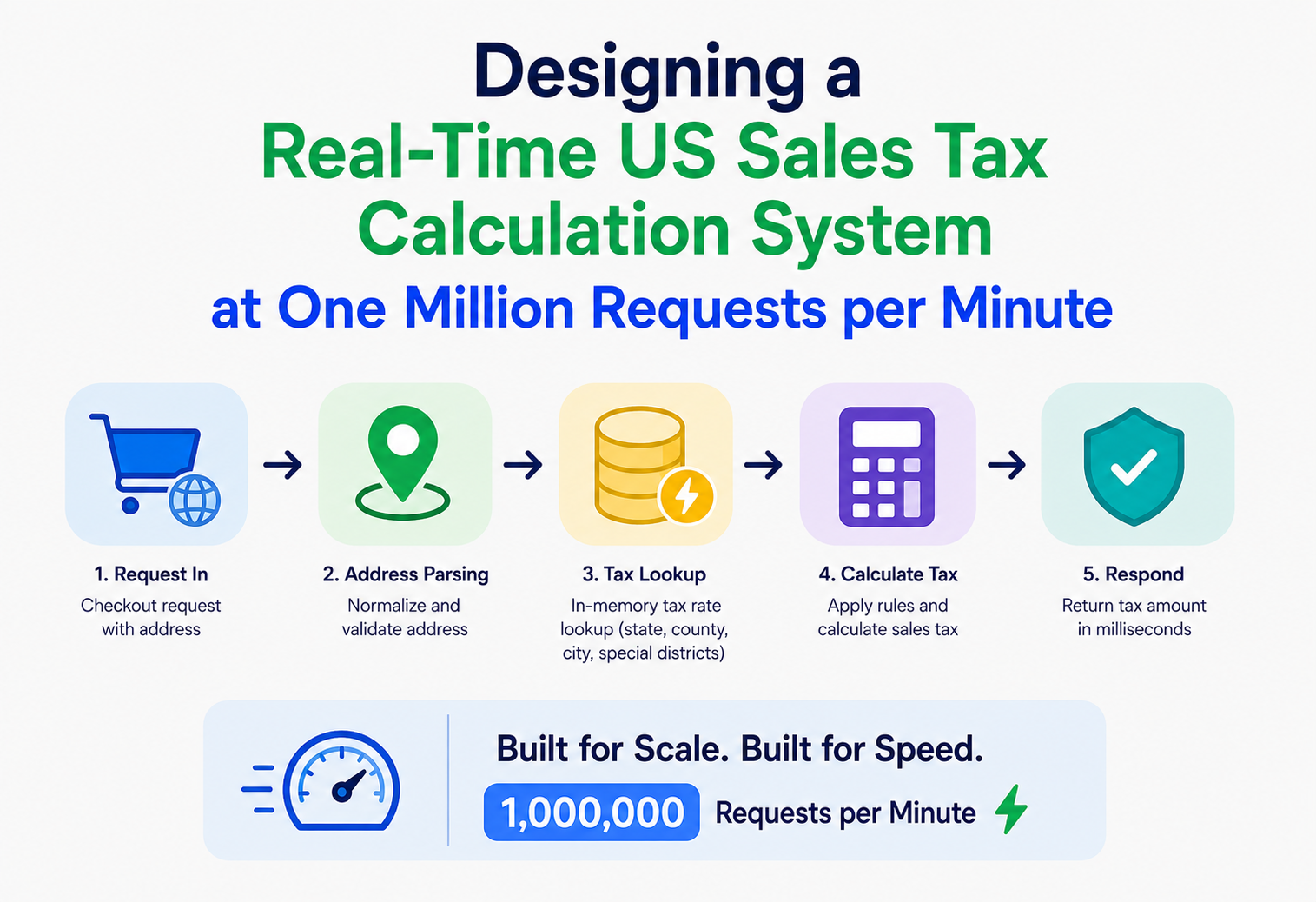
Designing a Real-Time Sales Tax Calculation System Across Thousands of US Jurisdictions
A marketplace tax engine that is instant, correct, and survives one million requests a minute — built from first principles through to production concerns.
Introduction
Imagine you run an online marketplace that ships products to every state in the United States. On the surface, “sales tax” sounds like one simple number — multiply the price by a percentage. In reality, the United States has no single national sales tax. Instead, tax is set by a patchwork of over 13,000 separate tax jurisdictions: states, counties, cities, and even special districts like transit zones or stadium districts, each with their own rate, their own rules about which products are taxable, and their own rules about when a business even has to collect tax there at all.
Now add the business reality of a large marketplace: at peak moments — a flash sale, a holiday shopping event, a viral product — the checkout page might need to calculate tax for over a million carts every single minute, and every one of those calculations must return in well under a second, because a slow checkout page loses sales. And the answer must be correct, because getting sales tax wrong is not just a bad user experience — it can create real legal and financial liability for the business.
This tutorial designs that system from the ground up: a tax calculation engine that is fast enough for a global storefront, accurate enough to survive an audit, and resilient enough to keep working when a jurisdiction’s rules change overnight or a downstream data provider goes down. We build it the same way you would explain it to a smart 10-year-old, and then go deep enough to satisfy a senior system design interview.
Throughout this tutorial, we treat “one million requests per minute” not as a marketing number but as a concrete engineering constraint that shapes every single design decision — from how aggressively we cache, to how we shard our database, to how we structure our failure handling. A design that is merely correct but cannot sustain that throughput is not actually a solution to the problem this tutorial sets out to solve, and a design that is fast but occasionally wrong creates legal and financial exposure that no amount of speed can excuse. Both properties have to hold at the same time, and reconciling that tension is the central engineering challenge this tutorial walks through.

A horizontally-scaled, heavily-cached tax calculation service with jurisdiction resolution, a sharded rules database, an asynchronous rate-update pipeline, and a capacity strategy explicitly designed and load-tested for one million requests per minute.
History and Evolution of Sales Tax Systems
Sales tax in the United States began as a simple, local idea: a state or city government would set one flat rate, and shopkeepers would add it at the register. For decades, this was genuinely simple software — a single lookup table with maybe 50 entries, one per state, was close enough for most businesses that only sold where they had a physical store.
The complexity exploded for two connected reasons. First, local governments increasingly layered their own taxes on top of the state rate — a county tax, a city tax, sometimes a special district tax for something like public transit or a sports stadium — meaning the “correct” rate for a single street address could be a combination of four or five separate numbers, not one. Second, and more dramatically, the rise of e-commerce meant a business no longer needed a physical store in a state to sell there. For years, the legal rule (from a 1992 Supreme Court case) was that a state could only require a business to collect its sales tax if that business had a physical presence there. This meant early online retailers often collected no sales tax at all outside their home state.
That changed permanently in 2018, when the United States Supreme Court decided South Dakota v. Wayfair, Inc., ruling that a state could require an out-of-state seller to collect sales tax based purely on economic activity in that state — commonly, crossing a threshold like 200 transactions or $100,000 in sales — even with zero physical presence. This concept, called economic nexus, instantly multiplied the tax complexity every online marketplace had to handle, because a seller could now owe tax-collection obligations in dozens of states simultaneously, each with its own threshold, its own rates, and its own product taxability rules.
This regulatory shift is exactly why an entire industry of tax-calculation platforms (Avalara, Vertex, TaxJar, and others) exists today, and why any marketplace operating at scale needs a purpose-built tax engine rather than a spreadsheet of rates. This tutorial designs the architecture that class of system is built on.
The Problem and Business Motivation
3.1 Why is this hard?
- Jurisdictional overlap: A single delivery address can sit inside a state, a county, a city, and a special taxing district all at once, each contributing its own rate to the total.
- Product taxability rules: Groceries might be tax-exempt in one state and taxed in another; clothing under a certain price might be exempt in some jurisdictions during specific date windows (tax holidays); digital goods and services have their own separate, inconsistent rules across states.
- Nexus determination: A marketplace must know, per seller and per state, whether tax collection is even legally required there, based on rolling transaction and revenue thresholds that change over a trailing 12-month window.
- Address ambiguity: Postal ZIP codes do not line up cleanly with tax jurisdiction boundaries — a single ZIP code can span parts of two different cities with two different combined tax rates.
- Constant rate changes: Local governments change rates throughout the year, sometimes with only days of notice, and the system must apply new rates exactly on their legal effective date, not a moment before or after.
3.2 Why speed matters as much as correctness
Tax calculation typically happens on the checkout page, directly in the critical path between “customer decided to buy” and “customer paid.” Industry conversion-rate studies consistently show that even small amounts of added checkout latency measurably reduce completed purchases. This means the tax engine cannot be the slow part of checkout — it must return an answer in single-digit to low double-digit milliseconds, even while being provably correct against a rule set with tens of thousands of jurisdiction combinations. A checkout flow that feels instantaneous for tax but slow for shipping cost calculation, or vice versa, still feels slow overall to the customer, so every component on the critical path shares an equal responsibility for keeping total latency low.
3.3 Why correctness carries real financial risk
Unlike a cosmetic bug, an incorrect tax calculation has direct legal and financial consequences. Under-collecting tax can leave a business owing the shortfall out of its own pocket during an audit, plus penalties and interest. Over-collecting tax can create consumer complaints and, in some states, separate legal exposure for improperly collected funds. This is why the architecture in this tutorial treats the tax rules database with the same seriousness as a financial ledger — every rate has a documented source, an effective date, and full auditability. Unlike many other kinds of software bugs, a tax calculation bug does not just need to be fixed going forward; it often needs to be traced backward across every affected historical transaction, which is precisely why the audit trail design covered in Section 9.4 is not an optional add-on but a foundational requirement.
Calculating sales tax correctly at checkout is a bit like a cashier needing to instantly know not just “what state am I in,” but also exactly which county, city, and special district lines cross the exact spot the customer is standing on, what special rules apply to the exact item being bought, and whether today happens to fall inside a tax-free shopping weekend — and doing all of that in the time it takes to blink, for every single customer, all day long.
“Why can’t you just calculate tax with a simple lookup of state and ZIP code?” Good answer: Because ZIP codes are a postal delivery construct, not a tax jurisdiction boundary — a single ZIP code can overlap multiple cities or special districts with different combined rates, and using ZIP alone can produce a legally incorrect rate. Correct jurisdiction resolution requires geocoding the actual delivery address down to a precise point and matching it against jurisdiction boundary data, not just matching a five-digit code to a table.
Core Concepts You Must Know
4.1 Tax jurisdiction
A tax jurisdiction is any governmental body with the legal authority to levy its own tax rate — a state, a county, a city, or a special-purpose district. A single physical address can fall inside several overlapping jurisdictions at once, and the final tax rate is typically the sum of each applicable jurisdiction’s individual rate. In some states, jurisdictions can also define their own separate rules about which product categories are taxable, meaning two neighboring cities in the same state can legitimately tax the exact same product differently, not just at a different rate but under entirely different eligibility rules.
4.2 Nexus
Nexus is the legal connection between a business and a state that creates an obligation to collect that state’s sales tax. Nexus can be created by physical presence (an office, warehouse, or employee in the state) or by economic activity (crossing a sales or transaction-count threshold), as established by the Wayfair decision discussed in Section 2. For a marketplace facilitating sales on behalf of many independent sellers, nexus can additionally be affected by so-called marketplace facilitator laws, under which the marketplace itself, rather than the individual seller, becomes responsible for collecting and remitting tax in a given state once its own combined marketplace-wide activity there crosses the threshold, adding yet another layer the Nexus Determination Service must track correctly per state.
4.3 Product taxability category
Not everything is taxed the same way. Products are grouped into taxability categories (general merchandise, groceries, clothing, digital goods, services, and so on), and each jurisdiction defines its own rules for which categories are taxable, exempt, or taxed at a special reduced rate.
4.4 Geocoding and jurisdiction resolution
Geocoding converts a street address into precise geographic coordinates (latitude and longitude). Jurisdiction resolution then matches those coordinates against a map of jurisdiction boundaries to determine exactly which state, county, city, and special districts apply — the geographic equivalent of figuring out exactly which overlapping circles on a map contain a single point.
Imagine several transparent colored sheets stacked on top of a city map — one sheet outlines the state, another the county, another the city, another a special transit district. Dropping a pin on an exact address and looking straight down through all the sheets tells you every jurisdiction that pin falls inside, all at once.
4.5 Effective-dated rules
Tax rates and rules are effective-dated, meaning each rule has a start date (and often an end date) during which it legally applies. The system must always evaluate “what rule was in effect on this exact transaction date,” which means storing full rate history, not just the current rate, since past transactions may need to be recalculated or audited using the rate that applied at the time.

4.6 Cache-first computation
Because jurisdiction rules change relatively infrequently (compared to how often they are looked up), the system is designed to serve the overwhelming majority of requests from an in-memory cache, only falling back to the full rules database on a cache miss, and only recomputing from raw rules when the underlying data actually changes.
4.7 Idempotency and determinism
Given the same address, product category, transaction date, and rule set, the tax calculation must always return the exact same result, every time, on every server. This determinism is what makes aggressive caching and horizontal scaling safe — there is no hidden state that could make two servers disagree on the same input.
4.8 CAP theorem, applied to tax rules
As with the inventory problem, a distributed system cannot fully guarantee consistency, availability, and partition tolerance simultaneously. Here, the system deliberately favors availability and low latency for the read path (checkout must always get a fast answer), while treating the tax rules database as the single strongly-consistent source of truth for writes, propagating rule updates to the read-optimized cache asynchronously but with strict effective-date gating so a not-yet-effective rate can never leak into a live calculation early.
4.9 Sharding by jurisdiction
Because jurisdiction data is naturally partitionable (a California rule never needs to be joined against a Texas rule in a single calculation), the rules database and cache are sharded by state, and further by jurisdiction hierarchy within a state. This lets the system scale close to linearly by adding more shards, rather than every request contending for one shared resource.
4.10 Consensus and replication
Rate updates are applied through a replicated, consensus-backed database (using a protocol such as Raft) so that a rate change is durably agreed upon by a majority of nodes before being considered committed, preventing a scenario where a crashed primary node causes a published rate change to be silently lost.
4.11 Concurrency control for rule updates
Multiple rate-ingestion jobs, or a manual correction alongside an automated feed update, could in theory try to modify the same jurisdiction’s rule at the same time. The rules database uses optimistic locking (a version column checked at write time, the same core mechanism used for safely updating shared counters in many concurrent systems) so that a conflicting concurrent write is detected and retried rather than silently overwriting another in-flight change. Because rule writes are relatively rare compared to reads, the small overhead of an occasional retry is a good trade for avoiding the throughput cost of pessimistic, lock-everything-up-front writes.
4.12 Algorithmic complexity of jurisdiction lookup
A geocoded point-in-polygon jurisdiction lookup is, in the worst case, proportional to the number of candidate boundary polygons it must check. Naively checking every jurisdiction boundary in the country for every request would not scale. In practice, this is solved with a spatial index (such as an R-tree or a geohash-based grid), which narrows the search to only the small number of boundaries actually near the target point before doing the more expensive precise polygon check, turning an otherwise linear scan into a near-constant-time lookup for any single address.
Architecture and Components
Below is the full high-level architecture. Every core infrastructure component — the load balancer, the API gateway, the rate limiter, the cache cluster, and the database — is drawn as its own labeled box so the request path is unambiguous.
5.1 Component-by-component explanation
Load Balancer
A globally distributed, Layer 7 load balancer (using anycast routing) directs each customer’s request to the nearest healthy regional cluster, minimizing network latency before the request even reaches application code, and automatically routing around an entire unhealthy region during an outage.
This is like a large hospital’s central switchboard automatically connecting an incoming emergency call to whichever nearby hospital branch currently has free capacity, rather than always ringing one specific building regardless of how busy it is.
API Gateway
The single front door for every tax calculation request. It authenticates the calling merchant or internal service, applies request validation, and routes traffic to the Tax Calculation Service, while also being the natural place to attach consistent logging and tracing headers used later for debugging and monitoring.
Rate Limiter
Sits just behind the gateway and enforces a fair-usage ceiling per tenant (per merchant or per API key) using a token bucket algorithm, so that one very high-traffic customer cannot exhaust shared capacity and degrade the experience for everyone else on a multi-tenant platform.
Tax Calculation Service Cluster
The core, stateless compute layer that receives a normalized request (address, product category, amount, transaction date) and returns a calculated tax amount. Because it is fully stateless and deterministic (Section 4.7), it can be scaled horizontally to essentially any number of instances behind the load balancer.
Address Normalization Service
Converts a raw, user-typed address into a standardized, geocoded form and resolves it down to the precise combination of overlapping jurisdictions, as described in Section 4.4.
Nexus Determination Service
Determines, per seller and per state, whether that seller currently has an active tax-collection obligation, based on rolling transaction and revenue totals tracked over the trailing period required by that state’s economic nexus rule.
Cache Cluster (Redis, sharded)
Holds precomputed jurisdiction rate combinations and product taxability rules in memory, sharded by jurisdiction so that the enormous majority of checkout requests are served in single-digit milliseconds without touching the database at all.
Jurisdiction Rules Database (PostgreSQL, partitioned)
The authoritative, durable source of truth for every jurisdiction’s effective-dated rates and taxability rules, partitioned by state to keep any single partition’s size and query load manageable as the rule set grows.
Rate Ingestion Service and Message Queue
Regularly pulls updated rates and rules from authoritative tax-data providers and government sources, validates them, and publishes change events onto a Kafka topic, which both the database writer and the cache invalidation process consume, keeping the two in sync without tightly coupling them.
Rate Reconciliation Job
Runs on a schedule to independently re-verify that the live rules database matches the latest authoritative source data, catching any drift caused by a missed update, a data provider error, or a bug in the ingestion pipeline before it can affect real transactions.
Monitoring and Alerting Stack
Tracks latency, error rates, cache hit ratios, and rate-freshness per jurisdiction, and pages an on-call engineer if calculation latency rises, a jurisdiction’s data goes stale, or the reconciliation job detects a mismatch.

“Why separate Address Normalization and Nexus Determination from the core Tax Calculation Service instead of doing it all in one service?” Good answer: Each of these has a different scaling profile and a different rate of change. Address normalization is a relatively generic, reusable capability that could even be shared with other parts of the platform (like shipping cost calculation). Nexus determination depends on slowly-changing, per-seller rolling totals and can be cached far more aggressively than a live tax rate lookup. Splitting them lets each be scaled, cached, and evolved independently, and keeps the core Tax Calculation Service focused and fast.
Internal Working: How the Pieces Cooperate
Let’s trace the normal, healthy-path request end to end.
- The customer submits a cart with a shipping address at checkout. The request hits the global load balancer, which routes it to the nearest healthy regional cluster.
- The API Gateway authenticates the request and forwards it through the rate limiter to the Tax Calculation Service.
- The Tax Calculation Service asks the Address Normalization Service to resolve the raw address into a precise jurisdiction key (state, county, city, and any special districts).
- Using that jurisdiction key plus the product’s taxability category and the transaction date, the service checks the Redis cache for a precomputed rate.
- On a cache hit (the overwhelming majority of the time), the rate is returned immediately. On a cache miss, the service queries the partitioned rules database, computes the combined rate, returns it, and populates the cache for future requests.
- In parallel, the Nexus Determination Service confirms the seller actually has a collection obligation in that state; if not, the tax amount returned is zero, by design, not by omission.
- The final calculated tax amount is returned up through the gateway to the client, and the full request is logged with a trace ID for later auditing.
6.1 Sequence diagram of the normal flow
6.2 Java example: the core calculation
@Service
public class TaxCalculationService {

    private final JurisdictionCache jurisdictionCache;
    private final NexusService nexusService;

    public TaxResult calculate(TaxRequest request) {
        JurisdictionKey key = addressResolver.resolve(request.getShipToAddress());

        if (!nexusService.hasActiveNexus(request.getSellerId(), key.getState())) {
            return TaxResult.zero(key); // no obligation, no tax collected
        }

        CombinedRate rate = jurisdictionCache.get(key, request.getProductCategory(), request.getTransactionDate());
        if (rate == null) {
            rate = ratesRepository.computeCombinedRate(key, request.getProductCategory(), request.getTransactionDate());
            jurisdictionCache.put(key, request.getProductCategory(), request.getTransactionDate(), rate);
        }

        BigDecimal taxAmount = request.getTaxableAmount()
                .multiply(rate.getCombinedRate())
                .setScale(2, RoundingMode.HALF_UP);

        return new TaxResult(key, rate, taxAmount);
    }
}
6.3 Handling rounding correctly
Tax amounts must use fixed-point decimal arithmetic (such as Java’s BigDecimal), never floating-point types like double, because floating-point rounding errors on monetary values can produce results that are off by a cent — a small error individually, but one that becomes a real accounting and audit problem at the scale of millions of transactions, and one that some jurisdictions have explicit, legally mandated rounding rules for.
6.4 Handling out-of-order rate updates
The rate ingestion pipeline (Section 5.1) can, like any distributed pipeline, occasionally deliver update events out of order — for example, a correction issued a minute after the original update might, due to network timing, arrive at the cache-invalidation consumer before the original update it is meant to correct. Each rate-update event carries the jurisdiction’s rule version and its own publish timestamp, and the consumer only applies an incoming update if its version is newer than what is currently cached, discarding stale, out-of-order events rather than letting them incorrectly overwrite a more recent value. This mirrors the same sequence-number technique used broadly in distributed event processing.
public void applyRuleUpdateIfNewer(RuleUpdateEvent event) {
    CachedRule current = jurisdictionCache.getRaw(event.getJurisdictionKey());

    if (current != null && event.getRuleVersion().compareTo(current.getRuleVersion()) <= 0) {
        return; // stale or duplicate update, safely ignore
    }

    jurisdictionCache.put(event.getJurisdictionKey(), event.toCachedRule());
}
6.5 Why the request path never talks to the ingestion pipeline directly
It is worth being explicit about a design choice implied throughout this tutorial: the live Tax Calculation Service never calls the Rate Ingestion Service, and never waits on the Kafka rate-update topic directly. The two are connected only indirectly, through the shared cache and database that the ingestion pipeline writes to and the calculation service reads from. This separation means a slowdown, backlog, or even a full outage in rate ingestion has zero direct effect on checkout latency — the calculation service simply continues serving from whatever rates are currently cached, unaware that anything upstream is struggling, until ingestion recovers and fresh rates flow through again. This is the same decoupling principle that underlies the message-queue-based architectures used broadly in high-throughput systems: producers and consumers of data should never be forced to move at the same speed.
Data Flow and Lifecycle of a Tax Rule
Every tax rule moves through a controlled lifecycle before it can ever affect a live transaction.

| Stage | Description |
|---|---|
| Draft | Newly ingested from a tax authority feed, not yet verified. |
| Validated | Passed automated checks (valid rate range, valid jurisdiction ID, no conflicting overlapping rule). |
| Staged | Approved and scheduled, but its effective date has not yet arrived; it must not affect any live calculation. |
| Active | Effective date has been reached; this is now the rule used for live calculations in that jurisdiction. |
| Superseded | A newer rule has taken over as Active; this rule remains available for recalculating historical transactions. |
| Archived | Retained for the legally required audit period, then removed from hot storage. |
7.1 Why the Staged state matters so much
A common and serious bug in tax systems is applying a new rate before its legal effective date, or continuing to apply an old rate after it. The Staged state exists specifically to let a rate be fully loaded, validated, and ready ahead of time, while a strict effective-date check in the calculation path guarantees it can never be selected before its legal start date, regardless of when it was technically written to the database.
7.2 Handling partial batch failures during ingestion
Rate-data providers often deliver bulk updates covering thousands of jurisdictions in a single feed. If a handful of records in that batch fail validation (an unrecognized jurisdiction code, a rate outside a plausible range), the correct behavior is to accept and process every valid record normally while routing only the failing records to a manual review queue, rather than rejecting or blocking the entire batch. Blocking the whole batch over a small number of bad records would unnecessarily delay thousands of legitimate, correct rate updates simply because a handful of unrelated records had a problem.
Handling One Million Requests Per Minute
One million requests per minute is roughly 16,700 requests per second sustained, and real traffic is never perfectly smooth — a flash sale can push instantaneous peaks well above that average. This section designs specifically for that number, end to end.
8.1 The scaling decision tree
8.2 Why caching is the single biggest lever
The number of distinct jurisdiction and product-category combinations in the entire United States, while large (tens of thousands), is tiny compared to one million requests per minute. This means the vast majority of live traffic is requesting the exact same small set of combined rates over and over — a textbook case for a very high cache-hit ratio. A well-warmed cache can realistically serve upward of 99% of requests without ever touching the database, turning a “one million requests per minute to the database” problem into a “one million requests per minute to an in-memory cache, with maybe a few thousand database reads per minute” problem, which is a dramatically easier engineering target.
8.3 Capacity math
At 16,700 requests per second, if each stateless Tax Calculation Service instance can comfortably handle 1,000 requests per second (a conservative, realistic number for a cache-hit-dominated workload), the system needs roughly 17 instances at that exact moment, plus meaningful headroom for traffic spikes and for safely handling a rolling deployment where some instances are temporarily out of rotation. In practice, teams provision for at least 2 to 3 times the calculated baseline and rely on autoscaling to grow further during unexpected spikes, rather than provisioning for the peak alone and wasting capacity the rest of the time.
8.4 Horizontal partitioning of the cache itself
A single Redis node, however powerful, has a ceiling on throughput. The cache cluster is sharded by jurisdiction (state, and further by county or city where volume is high), spreading both the memory footprint and the request load across many cache nodes, so that no single node becomes the bottleneck even as total request volume grows into the millions per minute.
8.5 Connection and thread pool sizing
At this scale, even small inefficiencies multiply. Each service instance must use a bounded, well-tuned connection pool to Redis and to the database, sized so it neither starves under load (too few connections, requests queue up waiting) nor overwhelms the downstream system (too many connections, the cache or database itself becomes the bottleneck). This is typically tuned empirically under realistic load testing rather than guessed from a formula.
8.6 Graceful degradation under extreme load
If load somehow exceeds even the scaled-up capacity (for example, during an unplanned traffic spike faster than autoscaling can react), the system should shed load intelligently rather than fail unpredictably: return a slightly conservative, cached-but-not-perfectly-fresh rate rather than an error, prioritize completing in-flight checkouts over starting brand new ones, and surface clear capacity metrics so autoscaling and, if necessary, human operators can react quickly.
8.7 Protecting against slow external dependencies
Address normalization and nexus lookups sometimes depend on external geocoding providers or third-party data sources. Every such call is wrapped in its own circuit breaker with an aggressive timeout, so that a slow external dependency degrades gracefully (falling back to a coarser, cached jurisdiction resolution) rather than backing up thread pools and cascading into a full outage of the Tax Calculation Service at exactly the moment traffic is highest. This is the same failure-isolation principle used broadly in resilient distributed systems: an external dependency’s bad day should never become your own outage.
8.8 Load testing methodology
Before trusting this architecture to actually sustain one million requests per minute in production, the team runs a dedicated load test that ramps traffic from a baseline up to, and modestly beyond, the target rate, in a staging environment configured identically to production. This test specifically measures P99 latency, cache hit ratio, autoscaling reaction time, and error rate at each traffic level, and the release is only considered scale-ready once it sustains the target with acceptable P99 latency and zero error-rate degradation, not merely once average latency looks acceptable.
“At one million requests per minute, what is your single biggest bottleneck risk, and how do you mitigate it?” Good answer: The database is the biggest risk if it were hit directly on every request, since relational databases do not scale to that read volume as cheaply or easily as an in-memory cache. The mitigation is aggressive, sharded caching with a very high hit ratio, so the database only ever needs to serve cache misses and periodic rule updates — a workload orders of magnitude smaller than the raw request volume. Beyond that, the second biggest risk is any single point of synchronous coordination (like a single global lock), which is why the entire Tax Calculation Service is designed to be stateless and shardable with no cross-instance coordination required per request.
Correctness and Jurisdiction Resolution
9.1 Precise address-to-jurisdiction mapping
Rather than relying on ZIP codes, the Address Normalization Service geocodes the delivery address to precise coordinates and performs a point-in-polygon lookup against official jurisdiction boundary data, correctly handling addresses that sit near a jurisdiction border where a ZIP-code-based system would frequently get the answer wrong.
9.2 Handling ambiguous or invalid addresses
When an address cannot be confidently geocoded (a typo, an incomplete address, a rural route without a precise geocode), the system falls back to the most granular jurisdiction it can confidently resolve (for example, state and county, even without a precise city or district), applies a documented conservative default, and flags the transaction for review rather than silently guessing or failing the checkout outright.

9.3 Automated rule validation
Every ingested rate change passes through automated sanity checks before reaching the Validated state in Section 7: is the new rate within a plausible range compared to its historical value, does it conflict with another rule for the same jurisdiction and effective date, and does it come from a recognized, trusted data source. Rates that fail these checks are held in Draft state for manual review rather than being automatically trusted.
9.4 Audit trail
Every calculated tax amount is logged with the exact rule version, jurisdiction combination, and rate used to produce it, so that months later, during a tax audit, the business can prove precisely which rule was applied to any historical transaction and why, satisfying the record-keeping requirements most tax authorities expect.
9.5 Handling temporary rules: tax holidays and special exemptions
Beyond standard, long-lived rates, many states periodically declare temporary tax holidays — short windows, often a single weekend, during which specific product categories (commonly school supplies or clothing under a certain price) become tax-exempt. These are modeled as ordinary effective-dated rules with both a start and an end date, using the exact same Staged-to-Active-to-Superseded lifecycle from Section 7, rather than as a special one-off code path. Treating tax holidays as just another effective-dated rule, instead of a special case bolted onto the system, means the same validation, caching, and audit-trail machinery already built for every other rule automatically applies to them as well, with no separate logic to maintain or forget to update the following year.
9.6 The product taxability rule engine
Determining whether a specific product is taxable in a specific jurisdiction combines two pieces of data: the jurisdiction’s rules for a given taxability category (Section 4.3), and the product’s own assigned category, which is typically set once by the seller or the marketplace’s catalog system and rarely changes. Because taxability-category-to-jurisdiction mappings are far smaller in number than the full address space of possible delivery locations, they are cached separately from combined jurisdiction rates, with an even longer TTL, since a “is clothing taxable in this state” rule changes far less often than a numeric rate does. Separating these two cache layers — rates and taxability rules — lets each be tuned and invalidated independently, since they change on very different schedules.
Databases, Caching, and Load Balancing
10.1 Choosing the database
PostgreSQL, partitioned by state, is well suited to the jurisdiction rules table because rule writes need strong consistency (you cannot have two conflicting active rates for the same jurisdiction and date) and because the schema benefits from relational integrity between jurisdictions, product categories, and effective-dated rules.
10.2 Caching strategy
- Cache-aside with long TTLs: Since rules change infrequently relative to read volume, cached entries can safely use TTLs measured in hours, dramatically reducing database load.
- Active invalidation on rule change: Rather than relying purely on TTL expiry, the rate-update Kafka events (Section 5.1) explicitly invalidate or refresh the relevant cache keys the moment a new rule becomes Active, so a legally-required rate change is never delayed by a stale cache entry.
- Pre-warming for known events: Ahead of a known high-traffic event (a major sale), the cache can be proactively pre-warmed with the full set of commonly-requested jurisdiction and category combinations, avoiding a wave of simultaneous cache misses right when traffic first spikes.
10.3 Load balancing considerations
The global load balancer routes by geographic proximity to minimize latency, while health checks verify each regional cluster can actually reach its local cache and database dependencies, automatically routing traffic away from a degraded region entirely rather than sending customers to a cluster that will time out.
10.4 Sharding the rules database
Partitioning the rules database by state (and, for very high-volume states, further by county) keeps each partition’s size and query load manageable, and lets the reconciliation job in Section 5.1 verify partitions independently and in parallel, rather than scanning the entire national rule set as a single serial operation.
10.5 Data structures behind the scenes
- Hash maps back the Redis cache’s jurisdiction-and-category lookups, giving O(1) average-time reads regardless of how many total combinations exist across the country.
- A spatial index (an R-tree or geohash grid, introduced in Section 4.12) narrows a full address down to a small set of candidate jurisdiction boundaries before the precise point-in-polygon check runs, avoiding a full linear scan of every boundary in the country.
- A sorted, time-indexed structure on rule effective dates lets the system efficiently answer “which rule was active on this specific past date” for audit and recalculation purposes, without scanning the full rule history for a jurisdiction every time.
APIs and Microservices
11.1 Example API contract
POST /v1/tax/calculate
Request:
{
  "sellerId": "SELLER-88231",
  "shipToAddress": {
    "line1": "500 Market St",
    "city": "San Francisco",
    "state": "CA",
    "postalCode": "94105"
  },
  "productCategory": "GENERAL_MERCHANDISE",
  "taxableAmount": 129.99,
  "transactionDate": "2026-08-03"
}

Response 200:
{
  "jurisdiction": {
    "state": "CA",
    "county": "San Francisco",
    "city": "San Francisco",
    "specialDistricts": ["SF-TRANSIT"]
  },
  "combinedRate": 0.08625,
  "taxAmount": 11.21,
  "nexusApplied": true,
  "ruleVersion": "CA-SF-2026-07-01"
}
Notice the response includes ruleVersion and full jurisdiction breakdown, not just a final number — this is essential for the audit trail described in Section 9.4 and lets downstream systems display an itemized tax breakdown if required.
11.2 Service boundaries and protocol choice
The Tax Calculation Service exposes a REST API externally for simplicity and broad compatibility with merchant integrations, while internal calls between the Tax Calculation Service, Address Normalization Service, and Nexus Determination Service use gRPC for lower latency and strongly-typed contracts, since these are high-frequency, purely internal calls where every millisecond and every serialization byte matters at this request volume.
11.3 Batch API for non-real-time use cases
Beyond the real-time checkout endpoint, a separate batch API allows sellers to submit large sets of historical transactions for bulk recalculation (useful for filing amended returns or auditing past periods), deliberately routed through a different, lower-priority processing path so bulk workloads never compete with latency-sensitive checkout traffic for the same capacity.
Design Patterns and Anti-patterns
12.1 Useful patterns
| Pattern | Why it helps here |
|---|---|
| Cache-Aside with active invalidation | Keeps checkout latency extremely low while guaranteeing effective-dated correctness on rule changes. |
| Sharding by jurisdiction | Lets both the database and cache scale close to linearly with request volume. |
| Bulkhead | Isolates the real-time checkout path from bulk/batch recalculation workloads so one never starves the other. |
| Circuit Breaker | Protects the system if an external address-validation or nexus data provider becomes slow or unavailable. |
| Event Sourcing for rate history | Makes full audit trail and historical recalculation possible without special-casing. |
12.1.1 The Saga pattern for correcting a miscalculated transaction
Even with every safeguard in this design, a rare correction is sometimes still necessary — for example, a tax authority retroactively adjusts a rate weeks after the fact. Rather than directly mutating a completed, already-paid order, the system runs a saga: issue a corrective adjustment record referencing the original transaction, calculate the delta using the corrected rule version, and coordinate any necessary refund or additional charge through the payment system as an explicit, independently-reversible step, with the original transaction’s audit record left untouched and immutable. This keeps the audit trail from Section 9.4 fully intact even when corrections happen, since auditors need to see both what was originally calculated and what was later adjusted, not a silently overwritten number.
12.2 Anti-patterns to avoid
Calculating tax with floating-point arithmetic introduces rounding errors that compound at scale and can fail an audit.
Using ZIP code alone for jurisdiction resolution produces incorrect rates near jurisdiction boundaries, a well-known source of real-world tax disputes.
Applying a new rate the instant it is ingested, without effective-date gating, risks applying a rate before it is legally in force.
One shared, unsharded cache for the entire country creates a single point of contention that undermines the whole scaling strategy at one million requests per minute.
Treating nexus as a one-time setup step is dangerous — economic nexus thresholds are rolling and must be continuously reevaluated, not configured once and forgotten.
Performance and Scalability
Building on Section 8, a few additional levers matter specifically for sustained performance at scale.

- Connection pooling and keep-alive: Reusing HTTP and database connections avoids the overhead of establishing a new connection on every single request, which matters enormously at tens of thousands of requests per second.
- Precomputation for high-traffic jurisdictions: The combined rate for a small number of extremely high-traffic jurisdictions (major metro areas) can be precomputed and kept permanently warm in cache, rather than relying purely on reactive cache population.
- Read replicas for the rules database: Even though most reads are cache hits, cache-miss traffic and the reconciliation job can be pointed at read replicas, keeping the primary database free to focus on rule-update writes.
Large payment processors and tax platforms serving national e-commerce traffic maintain regional points of presence specifically so a customer in Seattle and a customer in Miami both get a fast, locally-served response rather than both being routed through one distant, central data center.
13.1 Capacity math revisited
Returning to the numbers from Section 8.3: at roughly 16,700 requests per second sustained, with a 99% cache-hit ratio, only about 167 requests per second actually need to reach the database layer at steady state — a workload any well-tuned partitioned PostgreSQL cluster with read replicas handles comfortably, with enormous headroom to spare. This is the concrete payoff of the caching-first design: the eye-catching “one million requests per minute” number, once filtered through a well-warmed cache, becomes an entirely manageable database workload, which is exactly why cache hit ratio is treated as the single most important operational metric in Section 16.
13.2 Warm-up and cold-start considerations
A freshly deployed or freshly scaled-up service instance starts with an empty local view of the world and must rely on the shared Redis cache cluster (not a local, per-instance cache) for its very first requests to still be fast, which is exactly why the cache lives in a shared, dedicated cluster rather than in each application instance’s own memory — a newly added instance is immediately as fast as every existing instance, with no individual warm-up period required.
High Availability and Reliability
- Multi-region deployment: Running the full stack in multiple geographic regions means a single region’s outage does not take down checkout nationwide.
- Database replication with automatic failover: A primary-replica setup with consensus-based leader election (Section 4.10) ensures rule writes can continue even if the current primary fails.
- Graceful degradation to last-known-good rates: If the rules database becomes fully unreachable, the Tax Calculation Service continues serving from cache using the most recent successfully-cached rates rather than failing checkout outright, with clear monitoring flagging that the system is in this degraded mode.
- Independent scaling of ingestion vs. calculation: A slow or failing external rate-data provider (Section 5.1) should never be able to slow down or block live tax calculations, since the two are fully decoupled through the message queue.
14.1 Disaster recovery
Beyond routine availability, the rules database is backed up on an automated schedule with point-in-time recovery enabled, so the team can restore to any specific moment, not just the most recent backup, which matters given how tightly rule correctness is tied to exact effective dates and times. A documented recovery time objective and recovery point objective are agreed with the business ahead of time, and disaster recovery procedures are periodically tested with an actual simulated failover, not just reviewed on paper.
Security
- Authenticated API access: Every calling merchant uses scoped API keys or OAuth tokens, rotated regularly.
- Tenant isolation: Rate limiting and data access are strictly scoped per tenant so one merchant’s traffic or data can never affect or leak into another’s.
- Immutable audit logs: Calculation logs used for audit purposes are write-once and tamper-evident, since they may be relied upon as legal evidence during a tax audit.
- Encrypted data at rest and in transit: Address data is personally identifiable information in many contexts and must be encrypted both in the database and over the network.
- Least privilege for the rate ingestion pipeline: The ingestion service should only have write access to the specific rules tables it manages, reducing the blast radius of any compromised credential.
15.1 Verifying inbound rate feed authenticity
Rate updates pulled from external tax-data providers are fetched over authenticated, encrypted connections, and where the provider supports it, each payload’s signature is verified before ingestion, using the same constant-time comparison approach used broadly for verifying webhook authenticity — comparing a computed HMAC signature against the received one using a timing-safe equality check, so an attacker cannot infer the correct signature by measuring response timing differences on near-miss guesses.
public boolean isValidFeedSignature(String payload, String receivedSignature, String sharedSecret) {
    Mac hmac = Mac.getInstance("HmacSHA256");
    hmac.init(new SecretKeySpec(sharedSecret.getBytes(StandardCharsets.UTF_8), "HmacSHA256"));
    byte[] computed = hmac.doFinal(payload.getBytes(StandardCharsets.UTF_8));
    String computedHex = HexFormat.of().formatHex(computed);
    return MessageDigest.isEqual(
        computedHex.getBytes(StandardCharsets.UTF_8),
        receivedSignature.getBytes(StandardCharsets.UTF_8)
    );
}Every trust boundary in this system — merchant to gateway, ingestion to database, service to service — should assume the caller might be hostile or compromised until proven otherwise. Authentication, per-tenant scoping, signature verification, and least privilege are cheap in the design phase and enormously expensive to retrofit after a breach.
Monitoring, Logging, and Metrics
| Metric | Why it matters |
|---|---|
| P50 / P99 calculation latency | Directly tied to checkout conversion; P99 catches the slow tail that averages hide. |
| Cache hit ratio | The single strongest indicator of whether the system can sustain target request volume without overloading the database. |
| Requests per second per region | Feeds autoscaling decisions and capacity planning. |
| Rate freshness per jurisdiction | Confirms rule updates are propagating on schedule, especially around known effective-date changes. |
| Reconciliation mismatch count | Surfaces silent data-quality drift between the live rules and authoritative sources. |
Alerts should escalate by severity: a warning for rising P99 latency or a dipping cache hit ratio, and an immediate page for any reconciliation mismatch, since an incorrect live tax rate is a direct financial and legal risk that requires fast remediation.
16.1 Distinguishing symptoms from root causes
A rising P99 latency is a symptom that could have several different root causes — a falling cache hit ratio, an overloaded database shard, a slow external geocoding dependency, or simple traffic growth outpacing current capacity. Dashboards should surface these underlying signals side by side (cache hit ratio, per-shard database latency, external dependency latency, current requests-per-second against provisioned capacity) rather than only showing the single aggregate latency number, so an on-call engineer can diagnose the actual cause in seconds rather than guessing during an active incident.
Deployment and Cloud Strategy
- Kubernetes across multiple regions, with the Tax Calculation Service configured for horizontal pod autoscaling driven by request rate and latency, not just CPU usage alone.
- Managed, sharded Redis (such as Amazon ElastiCache or Redis Enterprise) for the cache cluster, with cluster-mode enabled to support horizontal sharding.
- Managed PostgreSQL with cross-region read replicas and automated, tested failover.
- Canary releases for any change to calculation logic, given the direct financial impact of a calculation bug, with automated rollback if error rates or discrepancy alerts rise post-deployment.
- Load testing as a release gate: Every significant release is load-tested against a simulated one-million-requests-per-minute scenario in a staging environment before being promoted to production, rather than discovering capacity issues during an actual peak event.
17.1 Infrastructure as Code
The Kubernetes clusters, Kafka topics, database instances, and cache clusters described throughout this tutorial are defined in code (using a tool such as Terraform), rather than configured by hand in a cloud console. This makes every environment reproducible, subjects infrastructure changes to the same code review process as application code, and lets the team quickly stand up an identical staging environment for the load testing described in Section 8.8.
17.2 Cost optimization at scale
Running enough compute capacity to comfortably absorb one million requests per minute around the clock, even during quiet overnight hours when actual traffic might be a tiny fraction of that, would be wasteful. Autoscaling based on real-time request rate, combined with scheduled scale-up ahead of known high-traffic events (holidays, major sales), keeps compute cost roughly proportional to actual demand rather than provisioned for a permanent worst case. The cache cluster, being memory-bound rather than compute-bound, is sized primarily around the total working set of frequently-requested jurisdiction combinations, which grows far more slowly than raw request volume does.
Advantages, Disadvantages, and Trade-offs
No architecture is free of trade-offs, and being explicit about them is usually what separates a strong system design answer from a merely correct one. Every choice below intentionally accepts a small, bounded, well-understood risk in exchange for a much larger benefit in speed, resilience, or legal correctness.
| Decision | Advantage | Trade-off |
|---|---|---|
| Heavy caching with long TTLs | Sustains one million requests per minute without overwhelming the database | Requires disciplined active invalidation to avoid ever serving a legally outdated rate |
| Sharding by jurisdiction | Near-linear scalability and fault isolation | Added operational complexity in routing and rebalancing shards |
| Effective-date gating (Staged state) | Guarantees legal correctness of when a rate applies | Adds a delay between a rule being ready and it becoming usable, requiring careful scheduling |
| Decoupled ingestion via message queue | A slow external data provider never blocks live checkout traffic | Introduces eventual consistency between the authoritative source and the live system, bounded but non-zero |
Best Practices and Common Mistakes
19.1 Best practices
- Always use fixed-point decimal arithmetic for any monetary or tax-rate calculation.
- Precisely geocode addresses rather than relying on ZIP-code-only jurisdiction lookups.
- Treat every rule change as effective-dated, never as an instantaneous overwrite of the current rate.
- Load-test explicitly against your real target scale (in this case, one million requests per minute), not just against a comfortable, smaller benchmark.
- Keep an immutable, queryable audit trail of every calculation, since tax systems are eventually audited, not just monitored.
19.2 Common mistakes
- Treating tax calculation as a simple percentage lookup and underestimating jurisdiction overlap and product taxability complexity.
- Applying a single global cache TTL to every jurisdiction, rather than tuning based on how frequently each jurisdiction’s rules actually change.
- Forgetting to continuously reevaluate economic nexus thresholds, leading to either under-collection or unnecessary over-collection of tax.
- Coupling the real-time checkout path directly to an external tax-data provider’s API, instead of decoupling through an internal cache and asynchronous ingestion pipeline.
- Under-provisioning for peak traffic because average daily volume looks comfortable, without explicitly modeling flash-sale or holiday peak multipliers.
19.3 A short checklist before going live
Before launching or significantly changing this system in production, it helps to walk through a concrete checklist rather than relying on memory:
- Has every jurisdiction’s rate been validated against its authoritative source, with a documented effective date?
- Is the cache sharded appropriately, and has the hit ratio been verified under realistic simulated load?
- Has the system been load-tested at or beyond one million requests per minute, measuring P99 latency specifically, not just the average?
- Is nexus determination continuously reevaluating rolling thresholds, rather than being configured once per seller and forgotten?
- Does every calculation log a full, immutable audit trail including the exact rule version applied?
- Are circuit breakers and timeouts configured for every external dependency, including geocoding and nexus data providers?
- Has a full regional failover been tested end to end, not just reviewed on a diagram?
Real-World Industry Examples
Avalara & Vertex
Dedicated tax-calculation platforms that many large marketplaces integrate with rather than building the full jurisdiction rules database themselves, precisely because maintaining accurate, effective-dated rates across thousands of US jurisdictions is a specialized, continuously-updated data problem in its own right. These platforms maintain large in-house tax research teams whose sole job is tracking legislative changes across every state, county, and city, feeding exactly the kind of rate-ingestion pipeline described in Section 5.1.
Amazon
Given its scale as both a first-party retailer and a marketplace for third-party sellers, Amazon operates its own large-scale internal tax calculation infrastructure, needing to resolve nexus and jurisdiction correctly for millions of sellers shipping to every part of the country simultaneously, at a request volume that plausibly exceeds the one-million-per-minute target this tutorial designs around, particularly during major shopping events.
Shopify
Provides built-in sales tax calculation for its merchants, including automatic tracking of economic nexus thresholds per state, directly reflecting the Nexus Determination Service pattern described in Section 5.1, since most small merchants have no practical way to track this manually across dozens of states, and getting it wrong could expose an individual small business owner to real financial risk.
Stripe Tax
Offered as an add-on to Stripe’s payments platform, Stripe Tax exposes tax calculation as a simple API call at checkout, hiding this exact architecture — jurisdiction resolution, cached rates, nexus tracking — behind a single request-response contract for the calling merchant, similar in spirit to the API contract shown in Section 11.1, letting even a small merchant benefit from infrastructure that would be impractical to build in-house.
Frequently Asked Questions
Why not just precompute and cache every possible jurisdiction and category combination in advance, permanently?
This is a reasonable optimization for high-traffic jurisdictions and is used in Section 13, but doing it exhaustively for every low-traffic rural jurisdiction and every rare product category combination would waste significant cache memory on data that is rarely, if ever, requested. A cache-aside strategy with pre-warming for known hot paths gets most of the benefit without the waste.
How do you handle a mid-transaction rate change, such as a rate becoming Active while a customer is actively checking out?
The rate used is always the one effective on the transaction’s finalized date and time, determined at the moment payment is captured, not at the moment the cart was first loaded. This is a deliberate, documented business rule, and it is why every calculation logs its exact rule version (Section 11.1) — so the applied rate is always traceable and defensible.
What happens if the external rate-data provider sends a clearly wrong number, like a 500% tax rate?
The automated validation step in Section 9.3 checks incoming rates against plausible historical ranges and rejects outliers into a manual review queue rather than auto-publishing them, precisely to prevent a data-provider error from ever reaching a live customer transaction.
Does this architecture only work for the United States?
The core patterns — jurisdiction resolution, effective-dated rules, aggressive caching, sharding, nexus-style obligation checks — generalize well to other countries’ tax systems (such as VAT in the European Union), though the specific jurisdiction hierarchy and nexus rules would need to be modeled differently for each region’s legal framework.
How do you avoid a “thundering herd” of cache misses right after a major rate change is published?
When a widely-used jurisdiction’s rate changes, actively invalidating its cache entry (Section 10.2) means the very next request for that jurisdiction becomes a cache miss, and without care, a burst of simultaneous requests could all miss at once and hammer the database with the identical query. This is solved with request coalescing: the first request for a given key triggers the database read and repopulates the cache, while concurrent requests for that same key wait briefly for that in-flight result rather than each independently querying the database, collapsing what could be thousands of simultaneous identical queries into one.
Should every product category get the same caching and validation treatment?
No. High-volume categories like general merchandise justify the most aggressive pre-warming and monitoring, since they represent the bulk of traffic, while rare or highly specialized categories can rely on standard cache-aside behavior without dedicated pre-warming. This mirrors the same risk-tiering idea used for prioritizing reconciliation effort in other high-scale systems — concentrate the most expensive protections where they matter most.
Summary and Key Takeaways
Key Takeaways
- US sales tax is not one number — it is the sum of overlapping state, county, city, and special-district rates, resolved precisely from a geocoded address, not a ZIP code.
- The 2018 Wayfair decision made economic nexus a first-class, continuously-evaluated concern for any marketplace selling nationally, not a one-time setup step.
- Correctness requires effective-dated rules with strict gating, fixed-point arithmetic, and a full audit trail — because tax mistakes carry real legal and financial risk, not just user-experience cost.
- Speed at one million requests per minute is achieved primarily through a very high cache-hit ratio, sharded by jurisdiction, backed by a database that only needs to handle a small fraction of total traffic.
- Stateless, deterministic calculation logic is what makes horizontal scaling and aggressive caching safe in the first place.
- Decoupling rate ingestion from live calculation through a message queue means a slow or failing external data provider never becomes a checkout outage.
- Real platforms like Avalara, Vertex, Amazon, Shopify, and Stripe Tax all converge on these same patterns because the underlying problem — huge data volume, strict correctness requirements, and extreme low-latency demands — is fundamental to operating a national marketplace.
- None of these techniques exist in isolation; caching, sharding, effective-date gating, and circuit breakers reinforce each other, and removing any single one weakens the guarantees the whole system provides.
The deeper lesson here mirrors many large-scale systems: the hard part is rarely the arithmetic itself — multiplying a price by a rate is trivial. The hard part is building the surrounding infrastructure that guarantees you are using the correct rate, for the correct jurisdiction, on the correct date, for a correctly-determined obligation, a million times a minute, without ever slowing down the customer standing at checkout waiting for their total. Once you internalize that framing, the rest of the architecture — the caching, the sharding, the circuit breakers, the audit trail — stops looking like a pile of separate techniques and starts looking like a single, coherent answer to one clearly stated problem.
Correct rule, correct jurisdiction, correct date, correct obligation — a million times a minute, without ever making the customer wait. Everything in this article is an implementation detail of that single sentence.