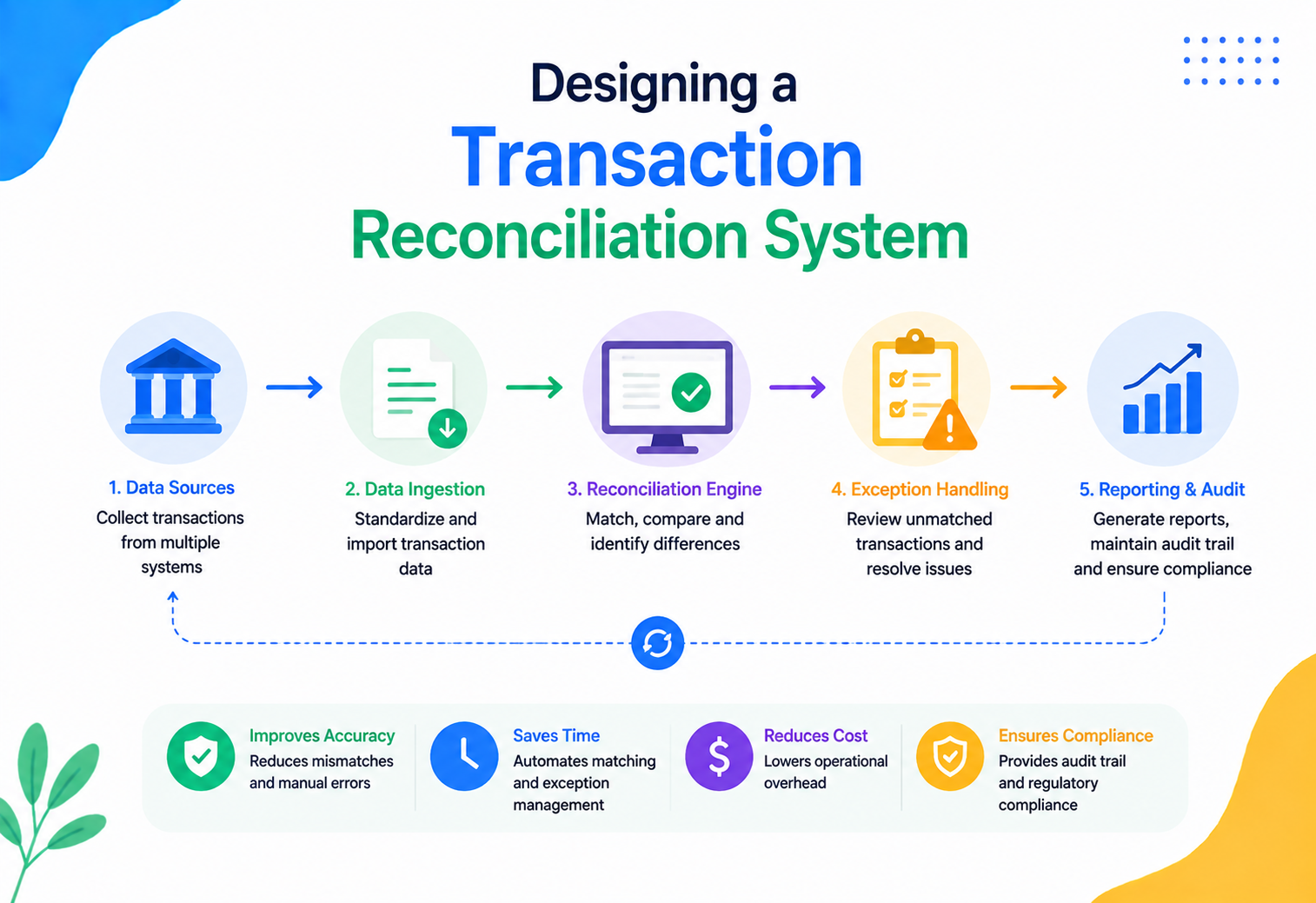
Designing a Transaction Reconciliation System
How do you prove, every single day, that millions of transactions your platform says happened actually match what the banks say happened — without losing a single rupee, dollar or cent and without a human reading every row?
Introduction & History
Imagine you run a lemonade stand, but instead of one stand, you have thousands of them across the world and instead of collecting cash yourself, you let dozens of different banks collect the money on your behalf and send it to you later. Every evening, you need to answer one simple question: “Did I actually receive all the money that my records say I should have received?” If a bank sends you less than expected, or sends money for a sale you never recorded, you need to catch it — fast and at massive scale.
This is exactly the problem a Transaction Reconciliation System solves for any payment platform — whether it is a digital wallet, a card network, a marketplace like Amazon or a fintech like Stripe or Razorpay. Every payment a customer makes travels through several systems: the platform’s own internal ledger (the platform’s own bookkeeping of “what happened”) and then, separately, the banking partner’s settlement records (the bank’s own bookkeeping of “what money actually moved”). These two records are created by two completely different systems, often owned by two completely different companies and they must be proven to match — every day, for millions of transactions.
Reconciliation is not a new idea. Long before computers, accountants at banks reconciled paper ledgers by hand at the end of each day — a process called “balancing the books”. As transaction volumes exploded with the rise of credit cards in the 1960s–70s and then exploded again with the internet and mobile payments in the 2000s–2010s, manual reconciliation became physically impossible. A single large payment platform today can process tens of millions of transactions per day and reconciliation had to evolve from a nightly Excel-sheet exercise into a real-time, automated, distributed system capable of handling a million or more events per minute during peak load — think Black Friday, a big cricket match with in-app payments or a flash sale.
Think of reconciliation like checking your monthly bank statement against your own checkbook register. You wrote down every check you wrote (your ledger). The bank has its own record of every check that actually cleared (their settlement record). Once a month, you compare the two line by line to make sure nothing is missing, duplicated or wrong. A payment platform does this same comparison — except instead of 20 checks a month, it is millions of transactions a day, across dozens of bank partners, in multiple currencies and it must be done automatically within minutes or hours, not weeks.
In this tutorial, we will design a production-grade Transaction Reconciliation System from the ground up — the architecture, the databases, the matching logic, how it scales to a million requests per minute, how it stays highly available, how it stays secure and how a Staff or Principal Engineer would defend every decision in a system design interview.

Problem & Motivation
Let us define the problem precisely. A payment platform has two independent sources of truth about the same set of financial events:
- Internal Ledger: The platform’s own database that records every transaction it believes happened — a customer paid $50, a merchant was credited $48 after fees, a refund of $10 was issued and so on.
- Bank Settlement Records: Files or API responses sent by banking partners (card networks, ACH operators, UPI switches, local banks) describing what money actually moved between accounts, usually delivered in batches — end-of-day settlement files, intraday API callbacks or nightly SFTP drops.
These two records can disagree for many real reasons and the system’s entire job is to find and classify every disagreement:
| Discrepancy type | Example | Why it happens |
|---|---|---|
| Missing on bank side | Ledger shows a charge, bank settlement file has no matching entry | Payment failed silently at the bank, network timeout, file delivery delay |
| Missing on ledger side | Bank settled money, but no internal transaction exists | Ledger write failed after payment succeeded, duplicate bank entry |
| Amount mismatch | Ledger says $50.00, bank settled $49.50 | Currency conversion rounding, unexpected bank fee, partial capture |
| Timing mismatch | Transaction recorded on Day 1, bank settles on Day 3 | Weekend / holiday batch delays, cross-border settlement cycles |
| Duplicate entries | Same transaction appears twice in either system | Retry logic without idempotency, file re-delivery |
Unreconciled money is not a cosmetic bug — it is either lost revenue, a regulatory violation or a fraud signal. Financial regulators (PCI-DSS, SOC 2, RBI guidelines in India, PSD2 in Europe) often require platforms to reconcile settlements daily and report discrepancies within a fixed window. Getting this wrong can mean fines, loss of banking partnerships or worse — silently losing money at scale for months before anyone notices.
The motivation for building a dedicated, automated system (instead of a nightly cron job with a SQL script) comes down to three forces pulling at once: scale (millions of transactions per day, spikes to a million per minute), correctness (money math must be exact — no floating-point rounding tricks) and speed (finance teams and merchants need same-day or near-real-time visibility into discrepancies, not a report that arrives a week later).
There is also a fourth, less obvious force: partner diversity. A payment platform of any real size does not settle with just one bank — it settles with dozens of banking partners, card networks and local payment rails, each with its own file format, delivery schedule, timezone convention and quirks. A system that hardcodes assumptions about “the bank’s” file format breaks the moment a second banking partner is onboarded. This is why, as we will see in the architecture, the parsing and validation layer is deliberately built as a pluggable, per-partner adapter system rather than a single monolithic parser.
Core Concepts
3.1 Ledger
A ledger is simply an ordered, append-only record of financial events — “who owes whom, how much and when”. Think of it as a diary where every entry, once written, is never erased or edited, only added to (and corrected with a new offsetting entry if needed). This “append-only” property is critical for auditability: regulators and auditors need to see the full, untampered history.
3.2 Settlement
Settlement is the actual movement of money between bank accounts to make a transaction final. When you pay with a card, the “authorisation” happens instantly, but the real money often moves hours or days later in a batch process called settlement. The bank sends a settlement file (or an API feed) describing exactly what was settled.
3.3 Matching (or “reconciliation matching”)
Matching is the process of pairing a ledger record with its corresponding settlement record based on shared identifiers — usually a transaction ID, but sometimes a combination of amount, date and merchant reference when IDs do not line up cleanly (called fuzzy matching).
3.4 Tolerance window
Because of currency rounding and small fee differences, reconciliation systems allow a small tolerance — for example, a $0.01 difference might still be considered “matched” rather than flagged as an exception, depending on business rules.
3.5 Idempotency
An operation is idempotent if doing it multiple times has the same effect as doing it once. This matters enormously here: if a bank file gets delivered twice (which happens more often than you would think, due to retries), the system must not double-count it.
Idempotency is like a movie ticket with a barcode. Scanning the same ticket twice at the door does not let two people in — the second scan is simply rejected because the system remembers “this ticket was already used”. A reconciliation system stamps every settlement record with a unique key so re-processing the same file never creates duplicate entries.
3.6 Exception
An exception is any transaction that could not be automatically and confidently matched. These get routed to a human-reviewable queue with full context (amount, timestamps, both-sided records) so an operations analyst can resolve them.
3.7 Break / discrepancy
Industry term for a confirmed, unresolved mismatch between the two ledgers — literally, the books do not “balance”.
3.8 CAP theorem in this context
The CAP theorem says a distributed system can only guarantee two of three properties during a network partition: Consistency, Availability and Partition tolerance. For financial reconciliation, we generally favour consistency over availability for the core ledger writes (we would rather momentarily reject a write than record wrong money), while the read-heavy reporting and dashboard layers can favour availability with eventual consistency.
“Would you design this system as strongly consistent or eventually consistent?” A strong answer: “The matching and ledger-write path should be strongly consistent — money correctness is non-negotiable. But the read path (dashboards, reports, search) can be eventually consistent via a CQRS-style read replica or a separate results store, because a report being 2 seconds stale does not cause financial harm, while a wrong balance does.”
3.9 Distributed locking & leader election
When multiple instances of the Bank File Ingestion Service poll the same SFTP folder, we need to guarantee only one instance processes a given file. This is solved with distributed locking — before processing file X, an instance must acquire a lock named lock:file:{fileId} in Redis (using SET key value NX PX ttl, an atomic “set if not exists with expiry”) or via a coordination service like ZooKeeper / etcd. If the lock acquisition fails, another instance already owns that file and this instance simply skips it. The TTL ensures that if the owning instance crashes mid-processing, the lock eventually expires and another instance can pick up the work — trading a small window of risk for guaranteed forward progress.
3.10 Bloom filters for fast duplicate detection
Checking “have I seen this settlement record ID before?” against a database for every single incoming record, at a million-per-minute scale, would hammer the database with point lookups. A Bloom filter — a compact, probabilistic data structure — sits in front of the database as a first-pass filter. It can say “definitely not seen before” with 100% certainty (letting the record flow straight through) or “possibly seen before” (in which case and only then, we pay for the more expensive database check). Because false positives are rare and false negatives are impossible by construction, this cuts duplicate-check database load by well over 90% in practice.
Think of a Bloom filter like a bouncer with a very good but imperfect memory of faces. If he says “I have definitely never seen you”, he is always right — let them through the fast lane. If he says “you look familiar”, he might be wrong, so he checks your ID properly (the slow, definitely-correct database check) just to be safe.
3.11 Data structures behind the matching engine
Internally, the Matching Engine relies on a few well-known data structures doing a lot of quiet, heavy lifting: hash maps (transaction ID to ledger entry, O(1) average lookup) power the deterministic matching pass; a sorted index (B-tree, as used by Postgres) on (merchant_ref, date) powers the range-scan needed for fuzzy matching within a date window; and an in-memory LRU cache keeps the most recently accessed ledger entries hot without unbounded memory growth. Understanding these underlying structures is what lets an engineer reason correctly about Big-O cost when tuning the matching pipeline for scale — a naive linear scan over all of a merchant’s transactions to find a fuzzy match would be catastrophic at volume; an indexed range query is not.
Architecture & Components
Every box in this architecture that receives external or inter-service traffic sits behind a Load Balancer and is reached only through the API Gateway, which handles authentication, authorisation and rate limiting before any request touches business logic. This is called out explicitly in each node below so the flow of “how a request actually reaches a service” is never ambiguous.
4.1 Component breakdown
DNS + Global Traffic Manager
The very first hop. Routes banking partners and internal services to the nearest healthy regional deployment using GeoDNS, so a bank in Frankfurt does not send its settlement file all the way to a US region unless it has to.
Load Balancer
A Layer 7 load balancer (e.g., an ALB/NLB equivalent or Envoy-based) terminates TLS, performs health checks against backend instances and spreads incoming traffic evenly. This is the component that lets us scale horizontally — add more instances behind it and it just starts sending them traffic.
API Gateway
Sits right after the load balancer. Handles authentication (mTLS for bank partners, OAuth2 / JWT for internal callers), authorisation, per-partner rate limiting (critical, since a misbehaving bank integration should never be able to overwhelm the system), request validation and routing to the correct downstream microservice.
Bank File Ingestion Service
Polls SFTP / API endpoints of each banking partner on a schedule (or receives push webhooks), downloads settlement files and hands them to the parser. It is stateless and horizontally scalable — each instance can own a subset of bank partner polling jobs, coordinated via a distributed lock (e.g., using Redis or ZooKeeper) so two instances never process the same file twice.
File Parser and Validator Service
Parses bank-specific file formats (fixed-width, CSV, XML, ISO 20022 for many modern banking rails) into a common internal schema, validates checksums and record counts against the file’s own header / trailer records and rejects malformed files back to an error queue rather than silently ingesting bad data.
Ledger Event Consumer Service
Subscribes to the platform’s internal transaction event stream (every payment, refund, chargeback or fee event published by the core payments system) and forwards a normalised copy into the reconciliation pipeline.
Kafka streaming backbone
The backbone that decouples ingestion from processing. Ledger events and settlement events land on separate topics, partitioned by a key (typically merchant ID or transaction ID hash) so that all events for the same transaction land on the same partition — this is what lets the Matching Engine process them in order without cross-partition coordination.
Normalization Service
Converts both ledger and settlement records into one canonical internal format: standardised currency codes, UTC timestamps and a derived matching key. This is where the two very different “shapes” of data (internal ledger schema vs. 12 different bank file schemas) become comparable.
Matching Engine Service
The heart of the system. Applies deterministic matching first (exact transaction ID + amount), then fuzzy matching rules for records that did not exact-match (amount within tolerance, date within a settlement window, reference number similarity). Emits a match result: RECONCILED, PARTIALLY_MATCHED or UNMATCHED.
Exception Management Service
Owns the lifecycle of unmatched / partially-matched records — creating a case, assigning it to an operations queue, tracking resolution and re-triggering matching if a late-arriving record shows up.
Reporting and Reconciliation API
Read-optimised API that powers dashboards, daily reconciliation reports and finance / compliance exports. Deliberately separated from the write path (CQRS) so heavy reporting queries never slow down the matching pipeline.
Data layer
A Redis cache cluster for hot lookups during matching, sharded PostgreSQL for the ledger and settlement records (strong consistency, relational integrity), a Cassandra-based results store optimised for high write throughput and time-range queries and object storage for archiving raw bank files (needed for audits).
Supporting services
Notification Service (alerts operations and finance teams), Audit Log Service (immutable record of every state change, required for compliance) and the Monitoring / Observability stack (metrics, distributed tracing, centralised logs).
“Why put a message queue between ingestion and matching instead of calling the Matching Engine directly?” Answer: decoupling. If the Matching Engine is slow or down, ingestion can keep accepting bank files without blocking or losing data — Kafka acts as a durable buffer. It also lets us scale ingestion and matching independently and replay historical events for debugging or backfills.
Internal Working
Let us trace exactly what happens when a bank sends a settlement file, step by step, through a sequence diagram.
5.1 The matching algorithm, in plain English
The Matching Engine works in two passes, just like how you would first look for an exact receipt match in a pile of papers before squinting at ones that are “close enough”:
- Pass 1 — Deterministic matching: Look up the settlement record’s transaction ID directly against the ledger. If found and the amount matches exactly (or within a configured tolerance, e.g., ₹0.01), mark it RECONCILED immediately. This handles the vast majority — often 95%+ — of transactions.
- Pass 2 — Fuzzy matching: For anything left over, search using secondary keys: merchant reference number, amount + date window, or card’s last-4 + amount + approximate timestamp. If a confident fuzzy match is found, mark it PARTIALLY_MATCHED and queue for lightweight review; if nothing is found even after the fuzzy pass, mark it UNMATCHED and create a full exception case.
5.2 Matching Engine — simplified Java implementation
public class MatchingEngine {

    private final LedgerRepository ledgerRepository;
    private final ReconciliationResultRepository resultRepository;
    private final ExceptionService exceptionService;
    private static final BigDecimal TOLERANCE = new BigDecimal("0.01");

    public MatchResult match(SettlementRecord settlement) {
        // Pass 1: Deterministic match on transaction id
        Optional<LedgerEntry> exact =
            ledgerRepository.findByTransactionId(settlement.getTransactionId());

        if (exact.isPresent() && amountsMatch(exact.get().getAmount(), settlement.getAmount())) {
            return recordMatch(settlement, exact.get(), MatchStatus.RECONCILED);
        }

        // Pass 2: Fuzzy match on merchant ref + amount + date window
        List<LedgerEntry> candidates = ledgerRepository
            .findByMerchantRefAndDateRange(
                settlement.getMerchantRef(),
                settlement.getSettlementDate().minusDays(1),
                settlement.getSettlementDate().plusDays(1)
            );

        for (LedgerEntry candidate : candidates) {
            if (amountsMatch(candidate.getAmount(), settlement.getAmount())) {
                return recordMatch(settlement, candidate, MatchStatus.PARTIALLY_MATCHED);
            }
        }

        // No match found at all -> raise an exception case
        exceptionService.createException(settlement, ExceptionReason.NO_LEDGER_MATCH);
        return recordMatch(settlement, null, MatchStatus.UNMATCHED);
    }

    private boolean amountsMatch(BigDecimal ledgerAmount, BigDecimal settlementAmount) {
        // Always compare using BigDecimal, never float/double, to avoid rounding errors
        return ledgerAmount.subtract(settlementAmount).abs()
                .compareTo(TOLERANCE) <= 0;
    }

    private MatchResult recordMatch(SettlementRecord settlement, LedgerEntry ledger, MatchStatus status) {
        ReconciliationResult result = ReconciliationResult.builder()
                .settlementId(settlement.getId())
                .ledgerId(ledger != null ? ledger.getId() : null)
                .status(status)
                .matchedAt(Instant.now())
                .build();
        resultRepository.save(result);
        return new MatchResult(status, result);
    }
}
Never compare monetary amounts using float or double. Binary floating-point cannot represent values like 0.1 exactly, so two “equal” amounts computed differently can compare as unequal, creating phantom reconciliation breaks. Always use BigDecimal (Java) or an equivalent fixed-point / decimal type and store money as integer minor units (cents / paise) in the database wherever possible.
5.3 State machine for a transaction record
5.4 Idempotent ingestion — simplified Java implementation
Bank files sometimes get re-delivered (a retry after a network blip or a bank’s own system re-sending a “just in case” copy). The ingestion service must detect and skip anything already processed, using a fast Bloom-filter pre-check backed by a durable idempotency store.
public class IdempotentFileIngestor {

    private final BloomFilter<String> recentFileFilter; // fast, in-memory pre-check
    private final IdempotencyKeyStore idempotencyStore; // durable, source of truth
    private final KafkaProducer<String, SettlementBatch> producer;

    public IngestResult ingest(SettlementFile file) {
        String idempotencyKey = buildKey(file);

        // Fast path: bloom filter says "definitely not seen" -> skip DB check
        if (recentFileFilter.mightContain(idempotencyKey)) {
            // Slow path: confirm against durable store before trusting the maybe
            if (idempotencyStore.exists(idempotencyKey)) {
                return IngestResult.skippedDuplicate(file.getFileName());
            }
        }

        List<SettlementRecord> records = parseAndValidate(file);
        SettlementBatch batch = SettlementBatch.builder()
                .idempotencyKey(idempotencyKey)
                .records(records)
                .receivedAt(Instant.now())
                .build();

        // Persist the key BEFORE publishing, so a crash after publish
        // never leaves us without a duplicate-detection record
        idempotencyStore.save(idempotencyKey, file.getChecksum());
        recentFileFilter.put(idempotencyKey);

        producer.send(new ProducerRecord<>("settlement-events", batch.getMerchantId(), batch));
        return IngestResult.accepted(file.getFileName(), records.size());
    }

    private String buildKey(SettlementFile file) {
        // Bank id + file name + checksum uniquely identifies a file delivery
        return file.getBankId() + ":" + file.getFileName() + ":" + file.getChecksum();
    }
}
Notice the idempotency key is saved to the durable store before the event is published to Kafka. This ordering matters: if the process crashes right after publishing but before recording the key, a retry would re-publish a duplicate. Saving the key first (even at the small cost of occasionally recording a key for a publish that then fails) is the safer failure mode for a financial pipeline, since a false “already processed” can be manually investigated, but a silent duplicate payment record cannot.
Data Flow & Lifecycle
A single transaction’s data touches the system twice, at two different points in time and the reconciliation pipeline’s job is to eventually bring both touches together:
- T+0 (transaction time): Customer pays. The core payments system writes a ledger entry and publishes a “PaymentCompleted” event onto the internal event stream. The Ledger Event Consumer picks this up within seconds and stores a normalised copy.
- T+1 to T+3 (settlement time): The bank batches transactions and, depending on the rail (card networks vs. ACH vs. UPI vs. wire), sends a settlement file anywhere from same-day to 2–3 business days later. The Bank File Ingestion Service picks this up, parses it and normalises it.
- Matching window: Once both sides exist in the normalised store, the Matching Engine attempts to pair them. If the settlement side arrives before the ledger side (rare, but possible with fast rails), the record waits in a “pending match” state with a TTL and matching is retried when the missing side shows up.
- Terminal state: Every record eventually reaches RECONCILED or WRITTEN_OFF (after manual review), which is what closes the books for that day / batch.
Because ledger and settlement events can arrive in either order, the matching pipeline cannot assume the ledger record always exists first. This is why the Normalization Service writes to a shared, keyed store (Redis + Postgres) rather than performing matching purely in a stream-join — a settlement record arriving at 2 AM should still be able to find a ledger record written at 11 PM the previous day, potentially days later.
6.1 Batch vs. streaming reconciliation
Most production systems use a hybrid: streaming for same-day, low-latency matching (catch fraud and failures fast) and a nightly batch reconciliation job that re-runs matching against the full day’s data as a safety net — catching anything the streaming path missed due to late-arriving files, ordering issues or transient failures. The batch job is the “final answer” used for financial close and audit reporting.
Advantages, Disadvantages & Trade-offs
Advantages
- Catches revenue leakage and fraud within minutes instead of weeks
- Removes manual, error-prone spreadsheet reconciliation
- Creates an audit trail that satisfies regulators automatically
- Scales horizontally to handle traffic spikes (flash sales, festive seasons)
- Decouples ingestion from matching, so a bank outage does not cascade
Disadvantages / costs
- Significant infrastructure cost — Kafka, sharded databases, caches, all running 24/7
- Operational complexity — many moving microservices to monitor and deploy
- Fuzzy matching can produce false positives if tuned too loosely
- Requires deep integration work per banking partner (every bank’s file format differs)
- Eventual consistency in the read path means dashboards can lag by seconds
7.1 Key trade-off: strict matching vs. fuzzy matching
Stricter matching (exact ID + exact amount only) produces fewer false positives but pushes more transactions into the manual exception queue, increasing operational headcount cost. Looser fuzzy matching reduces the exception queue but risks incorrectly pairing two different transactions that happen to share an amount and rough timeframe — a serious problem if it hides a real discrepancy. Most mature systems tune this per-partner, since a bank with clean, well-structured IDs needs less fuzzy matching than one with messy legacy file formats.
7.2 Key trade-off: synchronous vs. asynchronous matching
Matching synchronously (as soon as a settlement record arrives) gives the freshest possible view but couples ingestion throughput to matching throughput. Asynchronous matching via Kafka decouples them, letting ingestion absorb spikes without dropping data — at the cost of a small, bounded delay before a transaction’s status is known.
Performance & Scalability — Designing for 1 Million Requests/Minute
Let us ground this in real numbers. A million requests per minute is roughly 16,667 requests per second sustained, with realistic peaks 2–3x higher during bursts — so the system must comfortably absorb 40,000–50,000 requests / second at peak without falling over. Here is how each layer is designed to hit that number.
8.1 Partitioning strategy
Both Kafka topics and the Matching Engine instances are partitioned by hash(merchant_id + transaction_id). This guarantees all events for one transaction land on the same partition (so ordering is preserved) while spreading load evenly across hundreds of partitions. The database layer mirrors this with consistent hashing across shards, so adding a new shard only requires reshuffling a small fraction of the keyspace.
8.2 Horizontal scaling at every tier
| Layer | Scaling mechanism | Target capacity |
|---|---|---|
| Load Balancer | Managed, auto-scales connections; stateless | 100K+ concurrent connections |
| API Gateway | Stateless pods, horizontal pod autoscaling on CPU/RPS | 50K req/sec per cluster |
| Kafka | Add brokers + partitions; consumer groups scale linearly | Millions of events/min per topic |
| Matching Engine | Stateless consumers, scale by partition count | ~5K matches/sec per instance |
| Redis Cache | Cluster mode, sharded by key hash slot | Sub-millisecond reads at 1M+ ops/sec |
| Postgres (Ledger/Settlement) | Range / hash sharding across many nodes, read replicas | Tens of thousands of writes/sec aggregate |
| Cassandra (Results) | Add nodes, consistent hashing ring | Very high write throughput, linear scaling |
8.3 Reducing load before it hits the database
- Cache-aside pattern: The Matching Engine checks Redis before querying Postgres for candidate ledger entries, cutting database read load dramatically for hot, recent transactions.
- Batching: Settlement files are processed in chunks (e.g., 10,000 records per batch job) rather than row-by-row API calls, reducing per-record overhead.
- Backpressure: Kafka consumer lag is monitored; if the Matching Engine falls behind, ingestion continues writing to Kafka (which absorbs the burst) rather than blocking upstream services.
- Bulk writes: Reconciliation results are written to Cassandra in batches using prepared statements, not one write per record.
“Black Friday traffic is 5x normal — walk me through what breaks first and how you would fix it.” Strong answer: Kafka consumer lag on the Matching Engine partition group is usually the first bottleneck, since matching does the heaviest per-record work (multiple lookups). Fix: increase partition count ahead of the event, add more consumer instances (bounded by partition count, so partitions must be pre-provisioned generously) and temporarily relax fuzzy-matching depth to reduce per-record CPU cost, catching up the backlog with the full-depth nightly batch job afterward.
8.4 Back-of-the-envelope capacity planning
A useful interview habit is deriving concrete numbers rather than waving hands at “it scales”. Let us do the math for our 1M requests / minute target:
- Sustained throughput: 1,000,000 / 60 ≈ 16,667 events/sec. With a realistic 2.5x burst multiplier during peak windows, design for ~42,000 events/sec.
- Kafka partitions needed: If a single partition consumer can sustainably process ~2,000 events/sec (including the DB / cache round-trips involved in matching), we need at least 42,000 / 2,000 ≈ 21 partitions per topic, rounded up and padded for headroom — typically provisioned at 48–64 partitions to allow future consumer scale-out without a repartition.
- Matching Engine instances: One instance per partition (at minimum) means ~48–64 pod replicas at peak, scaled down to a much smaller baseline (e.g., 8–12) during off-peak hours via Kubernetes Horizontal Pod Autoscaler.
- Database write capacity: If each matched record generates one write of roughly 500 bytes, 42,000 writes/sec × 500 bytes ≈ 21 MB/sec sustained write throughput — well within range for a properly sharded Cassandra cluster, but would saturate a single unsharded Postgres instance, confirming our earlier decision to shard.
- Redis cache sizing: If we keep 3 days of hot transactions cached, at roughly 1KB per cached entry and 20M transactions/day, that is 3 × 20M × 1KB ≈ 60 GB of cache data — comfortably fits a modestly sized Redis Cluster with room to grow.
This kind of estimation — even if the exact constants are approximate — demonstrates the ability to translate a business requirement (“a million requests a minute”) into concrete infrastructure sizing decisions, which is exactly what a Staff Engineer interview is probing for.
8.5 Concurrency model
Within a single Matching Engine instance, records from different Kafka partitions are processed on separate worker threads (or separate async event loops in a reactive framework), since ordering only needs to be preserved within a partition, not across partitions. This lets one instance fully utilise multi-core hardware — a common pattern is one consumer thread pulling from a partition, handing work off to a bounded thread pool for the actual matching logic (which includes I/O-bound cache / DB calls) and committing the Kafka offset only after the write is durably persisted, to avoid losing work on a crash between “processed” and “committed”.
High Availability & Reliability
A reconciliation system cannot afford to silently lose a settlement file — that is literally the definition of “money going missing”. Every layer is designed with redundancy and explicit failure handling.
9.1 No single point of failure
- Multi-AZ deployment: Every stateless service runs across at least 3 availability zones; losing one AZ does not take down the system.
- Kafka replication: Topics are replicated with a factor of 3, so broker failure does not lose in-flight events.
- Database replication: Each Postgres shard has synchronous replicas for failover, plus async cross-region replicas for disaster recovery.
- Idempotent consumers: Every consumer tracks processed message IDs (or uses Kafka’s exactly-once semantics with transactional producers) so a consumer crash-and-restart never double-processes a settlement file.
9.2 Retry & dead-letter handling
Transient failures (a downstream database timeout, a temporary network blip) are retried with exponential backoff and jitter. Messages that fail repeatedly (say, after 5 retries) are routed to a dead-letter queue rather than blocking the pipeline forever — an alert fires and an engineer investigates without the rest of the day’s transactions getting stuck behind one bad record.
9.3 Disaster recovery
Raw settlement files are archived immutably in object storage (with versioning) the moment they are received — before any parsing happens. If a bug in the parser corrupts data downstream, the system can always re-ingest from the original raw file, giving a clean recovery path. RPO (Recovery Point Objective) is targeted near-zero via synchronous replication on the ledger / settlement databases; RTO (Recovery Time Objective) is minimised with automated failover (typically under 60 seconds for stateless tiers, a few minutes for database failover).
Treating the Matching Engine as the sole “processor” of a settlement file without first durably storing the raw file is a classic failure mode — if the file is only held in memory during parsing and the process crashes, that day’s settlement data can be lost entirely if the bank does not support re-download. Always persist raw input before any transformation.
9.4 Consensus and coordinated failure recovery
Some operations genuinely need cluster-wide agreement rather than simple per-instance locking — for example, “which instance is currently the leader responsible for triggering the nightly full-batch reconciliation job”. This is a textbook use case for a consensus protocol like Raft, typically consumed off-the-shelf via etcd or ZooKeeper rather than implemented from scratch. A leader is elected among candidate instances; if the leader crashes or becomes unreachable, the remaining nodes detect the missing heartbeat and elect a new leader within a bounded time window, ensuring the nightly job always runs exactly once even during infrastructure failures.
Failure recovery follows a layered strategy depending on blast radius:
| Failure scope | Recovery mechanism | Typical recovery time |
|---|---|---|
| Single pod / instance crash | Kubernetes restarts automatically; Kafka rebalances partitions to healthy consumers | Seconds |
| Availability zone outage | Load balancer and Kubernetes reroute traffic to remaining healthy AZs | Under a minute |
| Database primary failure | Automated failover promotes a synchronous replica to primary | Tens of seconds to a few minutes |
| Full region outage | Manual or automated failover to a warm standby region using replicated data | Minutes to tens of minutes, per DR runbook |
9.5 Chaos testing
Mature reconciliation platforms periodically run controlled failure-injection exercises — deliberately killing a Matching Engine pod mid-batch, introducing artificial network latency between the service and its database, or simulating a Kafka broker loss — in a staging or shadow-production environment. This validates that the retry, dead-letter and failover mechanisms designed on paper actually behave correctly under real failure conditions, rather than discovering gaps for the first time during an actual incident.
9.6 Runbooks and operational readiness
Every alert defined in the monitoring layer maps to a documented runbook — a step-by-step guide an on-call engineer follows during an incident, rather than improvising under pressure at 3 AM. A good runbook for “Kafka consumer lag exceeding SLA”, for example, walks through checking current partition count versus consumer instance count, confirming whether autoscaling has already kicked in, identifying whether the lag is isolated to one banking partner (often a sign of a partner-specific data quality issue) or system-wide (often a sign of a genuine capacity shortfall) and the exact commands or dashboard links needed to scale out consumer instances immediately. Runbooks are treated as living documents, updated after every incident postmortem and tested periodically through game-day exercises so the team’s muscle memory stays current even for failure modes that rarely occur in practice.
Security
This system touches financial data end-to-end, so it sits squarely under PCI-DSS and SOC 2 scope.
- Transport security: All bank file transfers use SFTP over SSH or mutual TLS; internal service-to-service traffic uses mTLS.
- Encryption at rest: Ledger, settlement and results databases are encrypted at rest (AES-256), with separate key management (KMS) per data classification tier.
- Field-level protection: Sensitive fields like full card numbers are never stored — only tokenised references or last-4 digits, keeping the system out of the highest PCI-DSS scope tiers where possible.
- AuthN / AuthZ at the gateway: Each banking partner authenticates with a unique certificate or API key; internal callers use short-lived JWTs scoped to specific operations (read-only reporting vs. write access to exception resolution).
- Least privilege: The Reporting API has read-only database credentials; only the Matching Engine and Normalization Service can write to the core tables.
- Immutable audit log: Every state transition (who resolved an exception, when and how) is written to an append-only audit log, satisfying compliance requirements for traceability.
- Rate limiting and abuse protection: Per-partner rate limits at the API Gateway prevent a compromised or misbehaving integration from flooding the pipeline.
“How would you prevent a malicious actor from injecting a fake settlement file to hide a fraudulent transaction?” Answer: authenticate every bank connection with partner-specific certificates (not shared credentials), validate file signatures / checksums provided by the bank where supported, cross-check settlement totals against the file’s own header / trailer record counts and treat any file from an unrecognised or unauthenticated source as untrusted input routed to a quarantine queue for manual review, never auto-processed.
10.1 Compliance considerations
Beyond PCI-DSS, a reconciliation system typically falls under several overlapping regulatory regimes depending on geography and the nature of the platform:
- SOC 2 Type II: Requires demonstrable, continuous controls around data access, change management and monitoring — the immutable audit log and role-based access control directly support this.
- GDPR (Europe) / data localisation laws: If settlement data includes any personal data (cardholder name, account holder details), it must be handled per regional data residency rules — often requiring reconciliation infrastructure to be regionally deployed rather than globally centralised.
- Central bank / regulator mandates: Many jurisdictions (e.g., RBI in India, the Federal Reserve in the US for certain rails) mandate same-day or next-day reconciliation with formal discrepancy reporting — which is exactly what drives the “streaming plus nightly batch safety net” design discussed earlier.
10.2 Data retention and right-to-erasure tension
Financial audit requirements typically mandate retaining transaction records for 7+ years, which can be in tension with data-subject erasure rights under privacy law. The common resolution is to tokenise or pseudonymise personally identifiable fields after an active window while retaining the financial amounts and identifiers needed for audit — satisfying both requirements without deleting financially material records.
Monitoring, Logging & Metrics
You cannot trust a reconciliation system you cannot observe — the entire point of the system is trust in numbers, so its own health metrics matter enormously.
11.1 Key metrics to track
| Metric | Why it matters |
|---|---|
| Reconciliation match rate (%) | Core business KPI — a sudden drop signals a pipeline bug or a bank integration issue |
| Kafka consumer lag | Tells you if matching is falling behind ingestion in real time |
| Exception queue size and age | Growing queue = operations team cannot keep up, or a systemic matching bug exists |
| End-to-end matching latency (p50 / p95 / p99) | How long from settlement file receipt to matched status |
| File ingestion failure rate | Detects malformed files or bank format changes early |
| Total settled amount vs. total ledger amount (daily) | The ultimate sanity check — the actual dollar-level balance |
11.2 Tracing and logging
Every transaction carries a correlation ID from the moment it enters the ledger through to its final reconciliation status, propagated across every service via distributed tracing (OpenTelemetry-style spans). This lets an engineer answer “what happened to transaction X?” in seconds instead of grepping logs across 8 services. Structured logs (JSON) are centralised, with PII / sensitive fields redacted before indexing.
11.3 Alerting
Alerts fire on: match rate dropping below a threshold (e.g., below 98% for a given bank partner), consumer lag exceeding a time-based SLA, dead-letter queue growth and any daily balance discrepancy exceeding a configured dollar threshold — the last one typically pages a human immediately, since it is the highest-severity signal the system can produce.
11.4 Dashboards for different audiences
Not every stakeholder needs the same view into the system, so the monitoring layer is deliberately split into three tiers. Engineering dashboards focus on infrastructure health — consumer lag, error rates, pod restarts, database connection pool saturation — the signals needed to keep the pipeline itself running. Operations dashboards focus on the exception queue — open case count, average time-to-resolution, cases aged past SLA — the signals a reconciliation analyst uses to triage their day. Finance and compliance dashboards focus on business-level outcomes — daily reconciled amount, outstanding discrepancy total, trend lines by banking partner — the signals used for financial close and regulatory reporting. Building all three from the same underlying event stream (rather than three disconnected systems) ensures every audience is looking at numbers that are provably consistent with each other.
11.5 SLA definitions
A well-run reconciliation platform commits to explicit, measurable SLAs rather than vague promises of “fast reconciliation”. Typical targets look like this:
| Commitment | Typical target |
|---|---|
| Streaming match latency (p95) | Under 5 minutes from settlement record ingestion to matched status |
| Daily batch reconciliation completion | Within 2 hours of the last settlement file for the business day |
| Exception case first response | Within 4 business hours during normal operations |
| System availability (ingestion path) | 99.95% monthly uptime |
These SLAs, once published internally (and sometimes externally to banking partners), directly shape architecture decisions — for instance, the “5 minute p95 match latency” target is exactly why the design favours streaming matching via Kafka over a purely batch-oriented approach.
Deployment & Cloud
Services are packaged as containers and deployed on Kubernetes, giving us declarative scaling, self-healing (crashed pods restart automatically) and rolling deployments with zero downtime.
- Blue-green or canary deploys for the Matching Engine specifically — since bugs in matching logic have direct financial consequences, changes are rolled out to a small percentage of traffic first, with match-rate metrics watched closely before full rollout.
- Infrastructure as Code (Terraform or equivalent) defines every environment, so disaster recovery regions can be stood up predictably and consistently.
- Multi-region active-active for the edge / gateway tier, with the core ledger / settlement databases typically active-passive (single write region) to keep financial writes strongly consistent, with cross-region read replicas for reporting.
- Separate environments (dev, staging, prod) with staging fed by anonymised / synthetic bank file samples for safe testing of new bank integrations.
12.1 Rollback strategy
Every deployment is paired with a fast, tested rollback path. Because the Matching Engine’s behaviour is driven partly by configuration (tolerance thresholds, per-partner fuzzy-matching rules) rather than only code, configuration changes are versioned and deployed independently from code releases, using a feature-flag style system. This means a bad matching-rule change can be reverted in seconds via a config flag flip, without waiting for a full container rebuild-and-redeploy cycle — a meaningful difference when a bad rule change is actively misclassifying live financial transactions.
12.2 Cost optimisation
Given the bursty nature of payment traffic (predictable daily peaks, occasional flash-sale spikes), the platform mixes reserved / committed-use capacity for baseline load with autoscaled on-demand or spot-style capacity for burst absorption on the stateless tiers (API Gateway, Matching Engine). Stateful tiers (databases, Kafka brokers) run on reserved capacity, since they cannot scale down as elastically. Cold, older reconciliation data (beyond the active audit window) is tiered from the primary Cassandra cluster into cheaper object storage with a queryable archive layer, cutting storage cost for data accessed rarely but still legally required to be retained.
Databases, Caching & Load Balancing
13.1 Why different databases for different jobs (polyglot persistence)
| Store | Chosen technology | Reason |
|---|---|---|
| Ledger / Settlement records | Sharded PostgreSQL | Strong consistency, relational integrity, mature transaction support for financial correctness |
| Reconciliation results | Cassandra | Very high write throughput, naturally time-series shaped data, linear horizontal scaling |
| Hot lookup cache | Redis Cluster | Sub-millisecond reads for candidate matching, reduces database read pressure |
| Raw file archive | Object Storage (S3-compatible) | Cheap, durable, versioned storage for audit and replay |
| Streaming backbone | Kafka | Durable, ordered, replayable event log; decouples producers from consumers |
13.2 Load balancing strategy
The edge Load Balancer uses round-robin with health-check-based ejection at Layer 7. Within Kafka, “load balancing” happens through partition assignment — each consumer instance in a consumer group is assigned a subset of partitions and Kafka automatically rebalances when instances join or leave, giving us elastic scaling without manual partition management.
13.3 Caching strategy
Cache-aside for candidate ledger lookups (write-through on ledger normalisation, so the cache is warm by the time settlement records arrive), with a TTL of a few days matching the typical settlement window, after which cold data falls back to Postgres. Cache keys are structured as ledger:{merchant_id}:{txn_id} to enable fast point lookups without scanning.
13.4 Sharding strategy in detail
The ledger and settlement Postgres clusters are sharded using consistent hashing on merchant ID rather than simple modulo hashing. The difference matters at scale: with modulo hashing (shard = hash(key) % N), adding a single new shard changes the target shard for almost every existing key, forcing a massive, disruptive data migration. Consistent hashing arranges shards on a conceptual ring, so adding a new shard only reassigns the fraction of keys that fall in the region of the ring near the new shard — typically around 1/N of the data, not all of it.
Choosing merchant ID (rather than transaction ID) as the shard key is deliberate: it keeps all of a single merchant’s transactions co-located on one shard, so a merchant’s daily reconciliation report never needs a cross-shard scatter-gather query — a single shard can answer it directly. The trade-off is that very high-volume “whale” merchants can create hot shards; this is mitigated with a secondary sub-sharding scheme for the handful of merchants that individually exceed a configured transaction-volume threshold.
APIs & Microservices
The system exposes a small, well-scoped set of REST / gRPC APIs behind the gateway:
| Endpoint | Purpose |
|---|---|
| POST /v1/settlements/upload | Bank partner pushes a settlement file (alternative to SFTP polling) |
| GET /v1/reconciliation/status/{transactionId} | Look up a single transaction’s reconciliation status |
| GET /v1/reconciliation/report?date=&merchant= | Fetch a daily reconciliation summary report |
| GET /v1/exceptions?status=OPEN | List open exception cases for the operations queue |
| POST /v1/exceptions/{id}/resolve | Mark an exception as manually resolved with a reason code |
Internally, services communicate via gRPC for low-latency synchronous calls (e.g., Exception Service calling Notification Service) and Kafka for asynchronous, high-volume event flows (ingestion to matching). This split — synchronous APIs for control-plane operations, async events for data-plane volume — is a common and effective microservices pattern for high-throughput systems.

14.1 API design details worth getting right
- Idempotency keys on write endpoints:
POST /v1/settlements/uploadrequires an idempotency key header, so a retried upload (due to a client timeout, for example) never creates a duplicate settlement batch — mirroring the same idempotency principle used internally for file ingestion. - Cursor-based pagination:
GET /v1/exceptionsuses opaque cursor tokens rather than page numbers, since offset-based pagination degrades badly on large, actively-changing result sets and can skip or duplicate rows as new exceptions are created mid-scroll. - Explicit error codes: Every API error response carries a machine-readable error code (e.g.,
PARTNER_NOT_AUTHORIZED,FILE_CHECKSUM_MISMATCH,DUPLICATE_SUBMISSION) in addition to a human-readable message, so calling systems (including bank partner integrations) can programmatically branch on failure type rather than parsing free-text strings. - Versioned contracts: All endpoints are versioned in the URL path (
/v1/), so breaking changes ship as a new version rather than silently changing behaviour underneath existing integrations — banking partner integrations, in particular, are slow-moving and cannot tolerate silent contract changes.
Design Patterns & Anti-patterns
Patterns used
- CQRS (Command Query Responsibility Segregation): Writes (matching) and reads (reporting) use separate paths and even separate stores, so heavy report queries never contend with the matching pipeline.
- Event Sourcing (partial): The Kafka event log serves as a replayable source of truth for ledger and settlement events, enabling reprocessing after bug fixes.
- Saga-like exception workflow: An unmatched transaction moves through a defined series of states with compensating actions (manual match, write-off) rather than being silently dropped.
- Circuit Breaker: Calls from ingestion services to downstream systems trip open on repeated failure, preventing cascading overload.
- Idempotent Consumer: Every message carries a unique key; consumers de-duplicate before processing.
Anti-patterns to avoid
- Synchronous chained calls across the whole pipeline: Calling matching, then exception handling, then notification all synchronously in one request creates a fragile chain where one slow service stalls everything.
- Matching directly against production OLTP tables at full file volume: Running millions of fuzzy-match queries directly against the live ledger database during peak load will degrade the payments platform itself — always go through the cache / results layer.
- Silent data drops on parse failure: Rejecting a malformed record without logging or alerting turns a data quality bug into “missing money” that nobody notices for weeks.
- Using floating-point arithmetic for money: Covered earlier, but worth repeating — this is one of the most common real-world bugs in financial systems.
15.3 Strategy pattern for per-partner parsing
Since every banking partner delivers a different file format, the File Parser and Validator Service implements a Strategy pattern: a common SettlementFileParser interface with one concrete implementation per bank (e.g., VisaFileParser, LocalBankAchParser, Iso20022Parser), selected at runtime based on the source partner’s identity. Onboarding a new banking partner then means adding one new implementation class and a routing entry, without touching the Matching Engine, the Kafka topic structure or any downstream service at all — a clean illustration of the Open-Closed Principle in a real production system.
public interface SettlementFileParser {
    List<SettlementRecord> parse(RawFile file) throws ParseException;
    boolean supports(String bankPartnerId);
}

public class ParserRegistry {
    private final List<SettlementFileParser> parsers;

    public SettlementFileParser resolve(String bankPartnerId) {
        return parsers.stream()
                .filter(p -> p.supports(bankPartnerId))
                .findFirst()
                .orElseThrow(() -> new UnsupportedPartnerException(bankPartnerId));
    }
}
Best Practices & Common Mistakes
16.1 Best practices
- Always persist the raw, untouched bank file before any transformation — it is your source of truth for replay and audit.
- Design matching keys and tolerance rules per banking partner, not globally, since file quality varies widely.
- Run a nightly full-batch re-reconciliation as a safety net on top of streaming matching.
- Make every write idempotent using unique settlement / ledger identifiers.
- Track the “total dollar balance” metric, not just “percentage matched” — a 99% match rate can still hide a very large dollar-value discrepancy in the remaining 1%.
- Build the Exception Management UI / API early — it is often under-invested in, yet it is what operations teams live in daily.
16.2 Common mistakes
- Treating reconciliation as a one-time nightly batch job instead of a continuously running pipeline, leading to late fraud / failure detection.
- Hardcoding bank-specific file parsing logic inline in the core matching service, making it hard to onboard new banking partners without redeploying core logic.
- Not versioning bank file format changes — banks do change their file layouts and an unversioned parser breaks silently.
- Underestimating exception queue growth during high-traffic events, leaving operations teams overwhelmed exactly when scrutiny is highest.
Real-World / Industry Examples
Stripe
Stripe’s ledger and reconciliation systems reconcile payment intents against acquiring bank and card network settlement reports across dozens of countries and currencies, with automated exception workflows feeding their finance and support teams for merchant payout accuracy.
PayPal
PayPal operates large-scale batch and near-real-time reconciliation between its internal wallet ledger and settlement files from banking partners and card networks worldwide, historically one of the heaviest nightly batch-processing workloads in the company.
Amazon (Marketplace Payments)
Amazon reconciles seller payouts against bank transfer confirmations at enormous scale, given the volume of third-party marketplace transactions settling across many regional banking rails.
UPI / NPCI
India’s UPI ecosystem requires every participating bank and PSP to reconcile transactions against the National Payments Corporation of India’s switch records daily, a regulatory-mandated process given UPI’s billions of monthly transactions.
Across all of these, the same core pattern repeats: event-driven ingestion, a durable streaming backbone, a matching engine with deterministic-then-fuzzy logic and a human-in-the-loop exception workflow — the exact architecture we have built in this tutorial.
17.1 A composite case study: flash sale day
Consider a hypothetical but realistic scenario combining several of the patterns above. A large e-commerce platform runs a 24-hour flash sale, driving transaction volume to 8x normal levels. The Ingestion Layer, pre-scaled ahead of the known event based on historical Black Friday data, absorbs the burst into Kafka without loss. The Matching Engine, running at its pre-provisioned peak partition count, keeps consumer lag under five minutes throughout the event by temporarily reducing fuzzy-matching depth for the lowest-risk transaction categories (small consumer purchases under a configured amount threshold), while keeping full-depth matching active for high-value transactions where a missed discrepancy would be more costly. The Exception Management queue grows but stays within operational capacity because false-positive exceptions are minimised by the tuned tolerance thresholds discussed earlier. By the following morning, the nightly full-batch reconciliation job re-processes the entire day at full matching depth, closing out any records the streaming path had deprioritised — and the finance team has a fully reconciled, audit-ready daily close by the committed SLA, despite the 8x traffic spike.
Frequently Asked Questions
Q: Why not just use a database JOIN to match ledger and settlement records?
A SQL join works fine for small, single-database datasets, but breaks down at scale: the two record sets often live in different systems entirely, arrive at different times (sometimes days apart), need fuzzy comparison logic beyond simple equality and require streaming / incremental processing rather than a full-table batch scan every time. A dedicated matching pipeline gives you incremental, event-driven matching with proper state tracking.
Q: How is this different from a general-purpose ETL pipeline?
It shares some DNA (ingest, transform, load) but reconciliation adds domain-specific concerns that generic ETL does not: financial correctness guarantees (BigDecimal math, idempotency), a formal exception workflow with human review and compliance-grade auditability requirements.
Q: What happens if a bank sends a corrupted or incomplete file?
The File Parser and Validator Service checks the file’s header / trailer record counts and checksums. If validation fails, the file is quarantined (not processed), the raw file is still archived and an alert notifies both the operations team and, typically, the bank partner’s integration contact to resend a corrected file.
Q: How do you handle multi-currency reconciliation?
Amounts are normalised to a base currency using the exchange rate in effect at transaction time (stored alongside the record, not recalculated later, since rates change) and matching compares both the original-currency amount and the normalised amount, since rounding during conversion is a common source of small discrepancies.
Q: Can this system detect fraud, not just accounting errors?
Yes, indirectly — unusual patterns like ledger entries with no corresponding settlement across many transactions from one merchant, or settlement amounts consistently higher than ledger amounts, are exactly the kind of signal that gets surfaced through the exception queue and can feed a separate fraud detection system as an input signal.
Q: How would you test the Matching Engine’s correctness before deploying a change?
Three layers: unit tests against known matching edge cases (exact match, tolerance-boundary match, no match), a replay test suite that re-runs the new matching logic against a large sample of historical production data and diffs the results against the previous version’s known-good output and a canary deployment that routes a small percentage of live traffic through the new version while comparing match-rate metrics against the baseline before full rollout.
Q: What is the difference between this and a plain accounting reconciliation tool like QuickBooks-style software?
Traditional accounting reconciliation tools are built for human-paced, relatively low-volume matching (hundreds to thousands of records) with a UI-driven workflow. This system is built for machine-paced, extremely high-volume matching (millions per day, spikes to a million per minute) where the vast majority of matching must happen with zero human involvement and humans only touch the small residual exception queue.
Q: How do you handle a banking partner that changes their settlement file format without notice?
The File Parser and Validator Service is built with a per-partner, versioned schema / adapter (a strategy pattern — one parser implementation per bank format version). Unexpected schema drift trips the file’s validation step (unexpected column count, missing expected header fields), routing the file to quarantine and alerting engineering, rather than attempting a best-effort parse that could silently corrupt data.
Summary & Key Takeaways
Key takeaways
- The core problem is proving that two independently-produced records of the same financial events — an internal ledger and a bank’s settlement file — agree, at massive scale, with zero tolerance for silent errors.
- Architecture: Every request flows through a Load Balancer and API Gateway before reaching any service; ingestion (ledger events + bank files) is decoupled from processing via Kafka; a Matching Engine applies deterministic-then-fuzzy matching; unresolved cases flow into an Exception Management workflow.
- Scaling to a million+ requests / minute comes from horizontal partitioning at every tier — Kafka partitions, sharded databases, stateless service replicas — all keyed consistently by transaction / merchant identity so related events always land together.
- Correctness over convenience: BigDecimal for money math, idempotent consumers, immutable raw-file archival and a nightly batch safety net on top of real-time streaming matching.
- Reliability and security are not afterthoughts — multi-AZ deployment, encrypted transport and storage, strict least-privilege access and a fully auditable trail are baseline requirements, not nice-to-haves, in financial systems.
- The human-in-the-loop exception queue is just as important as the automated matching engine — no matching algorithm reaches 100% and a well-designed system makes the remaining cases easy and fast for a human to resolve.
If you take one idea away from this entire design, let it be this: reconciliation is not a reporting feature bolted onto a payments platform — it is the system that lets everyone else, from engineers to auditors to regulators, actually trust the numbers the platform produces. Every architectural choice here — the append-only ledger, the idempotent consumers, the BigDecimal money math, the immutable audit log — exists to protect that trust at a scale where no human could ever verify it by hand.