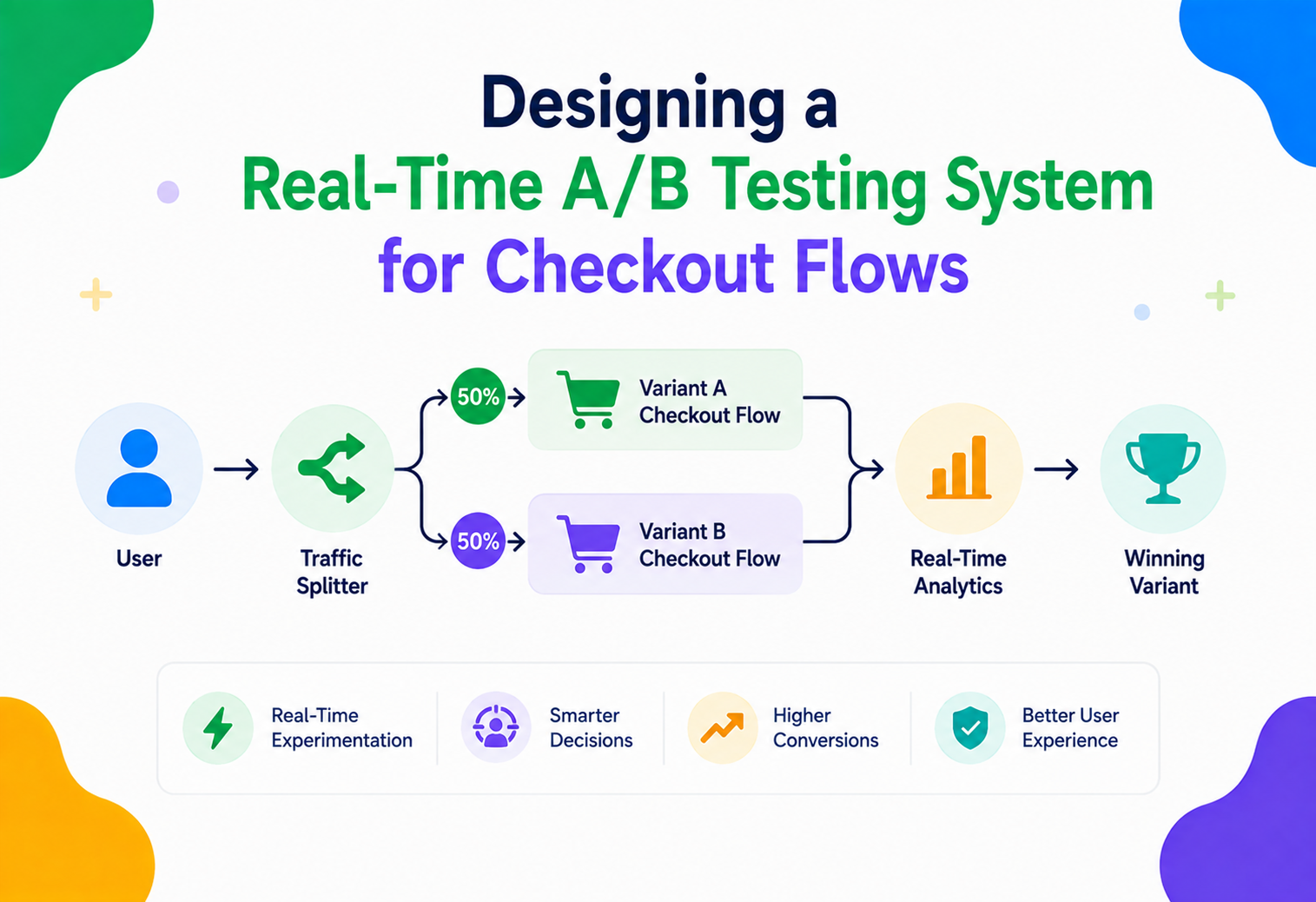
Designing a Real-Time A/B Testing System for Checkout Flows
A complete, beginner-to-production system design walkthrough: how to assign millions of shoppers per minute into checkout-flow experiment variants, keep that assignment perfectly consistent for each shopper, and measure the effect on conversion rate in near real time — without ever slowing down the checkout itself.
Introduction and History
Imagine two friends buy the exact same jacket from the exact same online store, at almost the exact same time. One of them sees a checkout page with a single “Buy Now” button. The other sees a checkout page broken into three clear steps, with a progress bar at the top. Neither of them notices anything odd — to each of them, the page they see just is the checkout page. But behind the scenes, the store deliberately showed two different designs to two different, randomly chosen groups of customers, specifically so it could measure which design gets more people to actually finish their purchase. This is called an A/B test (also called a “split test” or, when there are more than two variants, a “multivariate test”): you split your traffic into groups, show each group a different variant of something, and measure which variant performs better against a clearly defined metric.
A/B testing itself is an old idea — it’s really just the scientific method (form a hypothesis, run a controlled experiment, measure the outcome) applied to product decisions, and statisticians have used randomised controlled trials for over a century in agriculture and medicine. What’s changed is the scale and speed at which internet companies can run these experiments. A large e-commerce platform doesn’t run one experiment a year; it often runs dozens of experiments simultaneously, on the same page, for the same users, and expects results within days, not months. Doing this manually, or even with simple flat-file configuration, breaks down completely once you’re dealing with millions of shoppers checking out per minute during a big sale event.
This tutorial builds, from the ground up, a system that can: consistently assign each shopper to a checkout-flow variant, serve that decision to the checkout page in milliseconds without adding latency to the critical purchase path, safely support many concurrent experiments without them interfering with each other, and compute statistically sound conversion-rate results in near real time — all while surviving traffic spikes of a million or more requests per minute.
1.1 A Short Timeline of Product Experimentation
Early 20th Century — Randomised Controlled Trials in Science
Statisticians formalise randomised controlled trials in agriculture and medicine, giving product experimentation its intellectual foundation long before the internet exists.
1990s — Early Web A/B Tests
Direct-response marketing teams begin comparing two versions of a web landing page against a single conversion metric, largely by manual configuration and after-the-fact database queries.
2000s — The First In-House Experimentation Platforms
Search, advertising and large e-commerce companies build the first serious internal experimentation platforms, treating “run a controlled experiment” as a first-class engineering primitive rather than a bespoke, one-off exercise per team.
2010s — Real-Time Streaming, Sequential Statistics, Bandits
Kafka-style event backbones, windowed stream processors, sequential-testing methodology and multi-armed-bandit allocation make it feasible to run many concurrent experiments continuously across huge user populations, with results updated in near real time rather than after weeks.
Today — Platform-Grade, Guardrail-Driven Experimentation
Modern platforms bake in Sample Ratio Mismatch detection, automated guardrail kill switches, edge-resolved bucketing, and sequential-testing-safe statistics as standard, so every product team gets these safeguards by default rather than having to reinvent them each time.
“Why is A/B testing on a checkout flow considered higher-stakes than A/B testing on, say, a homepage banner?” A strong answer notes that checkout sits directly on the revenue path — a bug or a bad variant here can directly cost real money within minutes, assignment must be rock-solid consistent (a shopper flip-flopping between checkout variants mid-purchase is a broken, possibly abandoned, experience), and the system must add essentially zero latency, since checkout page speed itself is known to affect conversion — so the very act of testing must not distort the thing being measured.
Problem and Motivation
Let’s unpack why this is a genuinely hard system design problem, layer by layer.
2.1 The Assignment-Consistency Problem
Once a shopper is assigned to “Variant B” of the checkout flow, they must see Variant B every single time they return to checkout — on every page load, every retry after a failed payment, even if they close the tab and come back an hour later. If the assignment is inconsistent, two things go wrong: the shopper gets a confusing, glitchy experience, and the experiment’s data becomes statistically invalid, because you can no longer cleanly attribute an outcome to a single variant. This means assignment must be deterministic (the same input always produces the same output) rather than randomly re-rolled on every request.
2.2 The Zero-Added-Latency Problem
The checkout page is the single most latency-sensitive page on the entire site — every extra 100 milliseconds of load time has a measurable, well-documented negative effect on conversion. This means the experiment-assignment lookup absolutely cannot involve a slow network call to a heavyweight backend service sitting in the critical path. The system has to be architected so that variant assignment is effectively “free” from the checkout page’s point of view — typically resolved locally at the edge or from an extremely fast in-memory cache, not from a round trip to a central experimentation database.
2.3 The “Millions of Requests a Minute” Scale Problem
At peak (think Black Friday, a flash sale, or a viral product moment), checkout-related traffic can spike to well over a million requests per minute — roughly 16,000–20,000+ requests per second sustained, with even higher instantaneous bursts. Every layer of this system — assignment, event logging, and metrics aggregation — has to be designed to absorb that volume without becoming the bottleneck, and without dropping experiment exposure or conversion events, since dropped events silently corrupt the experiment’s results.
2.4 The Statistical Validity Problem
Even with perfect engineering, it’s easy to get the statistics wrong. Peeking at results too early and stopping a test the moment it looks “significant” (a mistake called “peeking”) inflates the false-positive rate. Running many experiments simultaneously on overlapping user populations can cause interaction effects, where one experiment’s result is contaminated by another. The system needs to bake in safeguards — proper sample-size planning, sequential-testing-aware statistics, and experiment isolation and interaction detection — rather than leaving correct statistical practice entirely up to whichever team happens to be running a given test.
2.5 The Blast-Radius Problem
Because this system controls what the checkout page actually looks like and does, a misconfigured experiment (for example, one variant accidentally hiding the payment button, or routing a percentage of real users into a broken code path) can directly cause lost revenue and abandoned carts within minutes. The system needs fast, reliable kill switches and automated guardrail monitoring that can pull the plug on a bad experiment before it causes significant damage.
2.6 The Fixed-Split Versus Adaptive-Allocation Problem
A traditional A/B test holds the traffic split fixed (say, 50/50) for the entire duration of the experiment, even after it becomes fairly clear which variant is winning — this is intentional, because a fixed split is what makes the classical statistical guarantees valid. But holding a losing variant at 50% traffic for the full test duration has a real opportunity cost: every shopper routed to a worse checkout flow during that time is a shopper who converted at a lower rate than they otherwise would have. Some experimentation platforms address this with adaptive allocation (multi-armed bandit) approaches that gradually shift more traffic toward the currently-better-performing variant while the test is still running. This is a genuine design trade-off, not a strictly-better replacement for classical fixed-split testing: bandit approaches reduce the cost of running the experiment but make the statistical analysis meaningfully more complex, and are generally better suited to short-lived, tactical decisions than to experiments where you specifically need a clean, unbiased estimate of the effect size for a long-term strategic decision.
Core Concepts
Before drawing a single architectural box, let’s put names to the small vocabulary that shows up in every layer of this design.
| Term | Meaning (Plain English) |
|---|---|
| Experiment | A defined test comparing two or more variants of something (e.g., checkout flow) against a target metric. |
| Variant / Arm | One specific version being tested — “Control” (the current default) and “Treatment” (the new version) are common names for a two-variant test. |
| Bucketing / Assignment | The process of deterministically deciding which variant a given user falls into, typically via a hash function. |
| Exposure Event | A logged record that a specific user actually saw a specific variant — the foundation for correct analysis. |
| Conversion Event | A logged record that the user completed the target action (for example, completed checkout), used to compute the conversion rate per variant. |
| Statistical Significance / p-value | A measure of how likely an observed difference between variants happened by random chance rather than a real effect. |
| Sample Ratio Mismatch (SRM) | A data-quality red flag where the actual traffic split between variants doesn’t match the intended split (for example, 48/52 instead of 50/50), which usually indicates a bug in the assignment or logging pipeline. |
| Guardrail Metric | A secondary metric (for example, checkout error rate, page latency) monitored alongside the primary metric to catch a variant that’s technically “winning” but breaking something else. |
3.1 A Closer Look: Deterministic Bucketing
How do you make sure the same shopper always lands in the same variant, without needing to look anything up in a database on every request? The standard technique is consistent hash bucketing. You take a stable identifier for the user (a logged-in user id, or a long-lived anonymous device/cookie id for guests), combine it with the experiment’s unique name, run it through a fast, well-distributed hash function (like MurmurHash), and map the resulting hash value into a bucket — commonly 0 to 9999 or 0 to 99. If the experiment is a 50/50 split, buckets 0–4999 might mean “Control” and 5000–9999 might mean “Treatment.” Because hashing the same input always produces the same output, the same user always lands in the same bucket for that experiment, with zero storage or lookup required to reproduce the decision — it can be computed anywhere, including directly at the edge, purely from the user id and experiment name.
Salting the hash input with the experiment name (rather than hashing the user id alone) is what allows the same user to be independently, unpredictably assigned across different experiments — otherwise a user who’s always in “Treatment” for one test would suspiciously always land in “Treatment” for every other test too, which would bias results whenever two experiments happen to interact.
“Why use a hash function for bucketing instead of storing each user’s assignment in a database?” The strong answer is about latency and scale: a hash computation is a microsecond-level, stateless, purely local operation that can run at the edge or in a client SDK with zero network calls, while a database lookup at a million-plus requests per minute would require an enormous, latency-sensitive, highly available lookup service just for what should be a trivial decision. Hashing trades a tiny bit of flexibility (you can’t easily hand-override one specific user’s bucket without extra logic) for essentially unlimited scalability.
Architecture and Components
Now let’s design the system end to end. Given the “millions of requests per minute” requirement, the guiding principle throughout is: keep the checkout critical path as close to zero-added-latency as possible by resolving assignment locally at the edge, and push all the heavy lifting (event ingestion, aggregation, statistics) into an asynchronous, horizontally scalable pipeline that never blocks a purchase. Every box below states which infrastructure component — API Gateway, Load Balancer, and so on — fronts or manages it.
Let’s walk through the components in detail.

4.1 API Gateway
The API Gateway is the single front door for all external traffic: it terminates TLS, authenticates requests, applies coarse-grained rate limiting, and routes to the correct internal service — either the Checkout Service for actual purchase traffic, or the Event Ingestion Service for asynchronous exposure and conversion event traffic. Keeping these two traffic types routed separately (even though both pass through the same gateway) means a spike in event-logging volume can never starve actual checkout request capacity.
4.2 Load Balancer
Every stateless service tier — Checkout Service, Experiment Config Service, Event Ingestion Service, Statistics Engine, Kill Switch Service, Dashboard — sits behind its own dedicated Load Balancer, using Layer 7 routing with health-check-based failover so unhealthy pods are automatically removed from rotation. At the target scale of a million-plus requests per minute, each of these tiers is independently horizontally autoscaled behind its Load Balancer, so a surge in checkout traffic doesn’t require over-provisioning the (much lower-volume) Config or Dashboard tiers.
4.3 Edge / Client-Side Bucketing SDK
This is the component that makes zero-added-latency assignment possible. A lightweight SDK, embedded in the checkout page or app, holds a locally cached copy of active experiment definitions (which experiments are running, their bucket ranges, and their variant configurations) and computes the deterministic hash-based assignment entirely on the client or at the CDN edge — no network round trip required for the actual bucketing decision on each page load.
4.4 Experiment Config Service
This is the low-traffic, low-latency-tolerant control-plane service where product teams define experiments (name, hypothesis, traffic split, variant configs, target metric, guardrail metrics, start and end dates). It periodically pushes updated experiment definitions out to the edge config cache (for example every few seconds via a pub/sub push or short-polling mechanism), so new experiments and kill-switch changes propagate quickly without every single checkout request needing to hit this service directly.
4.5 Event Ingestion Service
Receives exposure events (“user X saw variant B of experiment Y”) and conversion events (“user X completed checkout”) from the client. This service is intentionally kept extremely thin — minimal validation, no heavy business logic — because it must absorb the full firehose of traffic at checkout scale, immediately handing events off to the message broker rather than doing any expensive processing inline.
4.6 Message Broker (Kafka)
All exposure and conversion events flow through Kafka, partitioned by experiment id, decoupling the high-throughput, latency-sensitive ingestion path from the heavier downstream aggregation and statistics work. This also provides durability and replay-ability — if a bug is found in the aggregation logic, events can be reprocessed from the retained log.
4.7 Stream Processing Layer & Statistics Engine
A windowed stream-processing layer continuously aggregates raw events into per-experiment, per-variant counters (exposures, conversions, revenue) at short time intervals. The Statistics Engine consumes these aggregates and applies proper statistical methodology — including sequential testing corrections so that “peeking” at results early doesn’t invalidate the experiment — to produce a continuously updated verdict: no significant difference yet, Treatment winning, Control winning, or a guardrail breach.
4.8 Auto Kill Switch Service
If the Statistics Engine detects a guardrail metric breach (for example, a spike in checkout errors or a payment failure rate for one variant), this service automatically pushes an updated experiment config that routes 100% of traffic to the safe control variant, without waiting for a human to notice and react.
“Where exactly does variant assignment happen, and why does that placement matter at this scale?” The expected answer: assignment happens client-side or at the CDN edge, using a locally cached config and a pure hash computation — not via a synchronous call to a central backend service. At a million-plus requests per minute, a synchronous “ask a service which variant to show” call on every checkout page load would itself become the single largest scaling bottleneck and latency addition in the entire system, directly undermining the goal of not affecting the very conversion rate being measured.
Internal Working
Let’s trace what actually happens, step by step, for one shopper going through checkout.
Page Load
The shopper’s browser requests the checkout page; the CDN serves the page shell along with the latest locally-cached experiment configuration bundle (pushed from the Experiment Config Service moments earlier).
Local Bucketing
The Bucketing SDK, running in the browser or app, takes the shopper’s stable id, combines it with the experiment name, computes a hash, and determines the bucket — entirely locally, in well under a millisecond, no network call involved.
Render Variant
The checkout page renders according to the assigned variant (for example, single-page checkout vs. multi-step checkout).
Log Exposure (Async, Non-Blocking)
The SDK fires an asynchronous, “fire-and-forget” exposure event to the Event Ingestion Service, without waiting for a response and without blocking the page render or the checkout flow in any way.
Checkout Proceeds Normally
The Checkout Service processes the actual purchase (address, payment, order creation) exactly as it would without any experiment involved — the Checkout Service itself doesn’t need deep awareness of experiment logic, just of which UI or flow variant was rendered, since business logic for placing an order stays the same underneath.
Log Conversion (Async, Non-Blocking)
When the order successfully completes, a conversion event is fired asynchronously, tagged with the same experiment and variant the shopper was exposed to.
Ingest and Stream
The Event Ingestion Service validates basic event shape and publishes to Kafka, partitioned by experiment id for ordered, parallel processing.
Aggregate
The Stream Processing Layer maintains rolling per-variant counts (exposures, conversions, revenue) in short time windows, continuously updating the Aggregate Metrics Store.
Analyse
The Statistics Engine periodically recomputes conversion rates, confidence intervals, and guardrail checks per experiment, using sequential-testing-safe methodology so a team can safely check results at any time without inflating false positives.
React
If a guardrail is breached, the Auto Kill Switch Service pushes a config update that routes all traffic to the safe control variant, propagating to the edge config cache within seconds.
During a flash sale, an e-commerce platform is running an experiment: 50% of shoppers see the existing two-step checkout (Control), and 50% see a new single-page checkout (Treatment). Traffic surges to 1.2 million requests per minute. Because assignment is resolved locally via the Bucketing SDK, the surge adds no measurable latency to bucketing itself. Fifteen minutes in, the Statistics Engine detects that the Treatment variant’s payment-failure guardrail metric has spiked sharply above its historical baseline — likely a bug in the new single-page flow’s payment integration. The Auto Kill Switch Service automatically shifts 100% of new traffic to Control within seconds of detection, without anyone paging an engineer, limiting the blast radius of the bug to a small window of affected shoppers rather than the full duration of the sale.
5.1 How Config Propagation Actually Works
It’s worth being precise about the mechanism connecting the Experiment Config Service to millions of individual shopper sessions, since “push config to the edge” can otherwise sound a little hand-wavy. In practice this works through a short-interval polling or pub/sub-based fan-out: the Experiment Config Service publishes its current, versioned configuration bundle (typically well under a few hundred kilobytes, even with hundreds of active experiments, since each experiment’s definition is tiny) to a small number of regional CDN origin points. Each CDN edge node, and each client-side SDK instance, independently pulls or subscribes to updates on a short interval — commonly every few seconds to under a minute, tunable per deployment. Because the config bundle is versioned, a client can cheaply check “is my cached version still current?” without re-downloading the full bundle on every check, using a simple version or etag comparison. This design means a brand-new experiment, or a kill-switch update, doesn’t need to reach a million individual sessions instantly and atomically — it just needs to reach the relatively small number of CDN edge nodes quickly, and those nodes then serve the updated config to every session that requests it going forward, which is what lets propagation stay fast even at extreme shopper-side scale.
Data Flow and Lifecycle
The sequence below traces one exposure-to-conversion lifecycle end to end, again labelling which tiers sit behind a Load Balancer versus which are asynchronous, queue-driven components.
“What happens if the Event Ingestion Service is completely down when a shopper completes checkout?” A good answer: the checkout transaction itself must never be blocked or fail because of this — event sending is fire-and-forget with a short client-side timeout and local buffering and retry with a capped backoff, so a temporarily unavailable ingestion path only risks losing some experiment data (which degrades statistical precision slightly) rather than ever risking a lost sale. Monitoring on event volume vs. actual checkout volume (a form of sample ratio and completeness check) catches sustained data loss so the team knows to treat that time window’s experiment data cautiously.
6.1 Java Code Example: Deterministic Bucketing
public class ExperimentBucketer {

    private static final int BUCKET_COUNT = 10000;

    // Deterministically assigns a user to a bucket for a given experiment,
    // using a stable hash so the same user always lands in the same bucket.
    public int assignBucket(String userId, String experimentName) {
        String input = experimentName + ":" + userId;
        long hash = Hashing.murmur3_128()
                .hashString(input, StandardCharsets.UTF_8)
                .asLong();
        int bucket = (int) Math.floorMod(hash, BUCKET_COUNT);
        return bucket;
    }

    public String resolveVariant(String userId, ExperimentConfig config) {
        if (!config.isActive()) {
            return config.getDefaultVariant();
        }
        int bucket = assignBucket(userId, config.getExperimentName());
        for (VariantRange range : config.getVariantRanges()) {
            if (bucket >= range.getStart() && bucket < range.getEnd()) {
                return range.getVariantName();
            }
        }
        return config.getDefaultVariant();
    }
}
6.2 Java Code Example: Non-Blocking Event Emission
public class ExposureEventEmitter {

    private final AsyncHttpClient httpClient;
    private static final Duration TIMEOUT = Duration.ofMillis(150);

    // Failures are swallowed intentionally: losing an event is acceptable,
    // blocking a purchase is not.
    public void emitExposure(String userId, String experimentName, String variant) {
        ExposureEvent event = ExposureEvent.builder()
                .userId(userId)
                .experimentName(experimentName)
                .variant(variant)
                .timestamp(Instant.now())
                .build();

        httpClient.preparePost("/v1/events/exposure")
                .setBody(JsonUtil.toJson(event))
                .setRequestTimeout((int) TIMEOUT.toMillis())
                .execute()
                .toCompletableFuture()
                .exceptionally(ex -> {
                    metricsRecorder.incrementCounter("exposure_event_emit_failed");
                    return null; // swallow - never propagate to checkout flow
                });
    }
}
6.3 Java Code Example: Sequential Significance Check
public class SequentialStatsEngine {

    // Uses a sequential testing boundary rather than a fixed-sample p-value,
    // so results can be checked at any time without inflating false positives.
    public ExperimentVerdict evaluate(VariantAggregate control, VariantAggregate treatment) {
        double controlRate = control.getConversions() / (double) control.getExposures();
        double treatmentRate = treatment.getConversions() / (double) treatment.getExposures();

        double zScore = computeSequentialZScore(control, treatment);
        double currentBoundary = sequentialBoundary(control.getExposures() + treatment.getExposures());

        if (Math.abs(zScore) > currentBoundary) {
            String winner = treatmentRate > controlRate ? "TREATMENT" : "CONTROL";
            return ExperimentVerdict.significant(winner, controlRate, treatmentRate);
        }
        return ExperimentVerdict.inconclusive(controlRate, treatmentRate);
    }

    private double computeSequentialZScore(VariantAggregate control, VariantAggregate treatment) {
        double p1 = control.getConversions() / (double) control.getExposures();
        double p2 = treatment.getConversions() / (double) treatment.getExposures();
        double pooled = (control.getConversions() + treatment.getConversions())
                / (double) (control.getExposures() + treatment.getExposures());
        double se = Math.sqrt(pooled * (1 - pooled)
                * (1.0 / control.getExposures() + 1.0 / treatment.getExposures()));
        return (p2 - p1) / se;
    }

    private double sequentialBoundary(long totalSampleSize) {
        // Boundary widens for small samples and tightens as sample size grows,
        // following an alpha-spending function to control cumulative false-positive risk.
        return 1.96 + (5.0 / Math.sqrt(totalSampleSize + 1));
    }
}
Checkpoint — What We’ve Covered So Far
We’ve established why real-time checkout A/B testing is hard — deterministic, always-consistent assignment; zero added latency on the purchase path; surviving million-plus-requests-per-minute traffic; and getting the statistics right — and walked through an architecture where an API Gateway fronts all traffic, dedicated Load Balancers front every scalable service tier, variant assignment resolves locally at the edge with no network call, and Kafka-backed streaming decouples event logging from statistics computation. Next, we’ll cover trade-offs, scaling at extreme volume, reliability, and security.
Advantages, Disadvantages and Trade-offs
Every architectural choice above buys something and pays for something. Let’s put the trade-offs on a single table before revisiting the highest-stakes ones.
| Aspect | Advantage | Disadvantage / Trade-off |
|---|---|---|
| Client-side bucketing | Zero added latency; scales infinitely with no backend lookup | Config propagation delay means a brand-new experiment isn’t instantly live everywhere |
| Async, fire-and-forget events | Never blocks or slows the checkout transaction | Some event loss is possible under extreme failure; requires completeness monitoring |
| Sequential testing statistics | Safe to check results any time without inflating false positives | More complex to implement and explain than a simple fixed-sample p-value |
| Automated kill switches | Limits blast radius of a bad variant within seconds | Risk of false-positive shutdowns if guardrail thresholds are miscalibrated |
| Many concurrent experiments | Faster overall product iteration velocity | Risk of interaction effects between overlapping experiments if not isolated carefully |
Advantages
- Bucketing costs effectively zero at any scale because it never leaves the shopper’s device or the CDN edge.
- The purchase path and the analytics pipeline can fail independently — a broken ingestion tier does not become a broken checkout.
- Sequential-testing-safe statistics let product teams monitor results continuously without silently corrupting the false-positive rate.
- Guardrail-driven automatic kill switches convert “bad variant shipping money on the floor for hours” into a seconds-long, self-mitigated incident.
- Kafka-backed replayable event logs mean a bug found in aggregation logic later doesn’t force throwing away historical experiments.
Costs to Accept
- New experiments become live only after config propagation reaches every edge node, which is fast but not instantaneous.
- Event loss is possible in the worst failure modes and must be surfaced through completeness monitoring rather than assumed away.
- Sequential-testing methodology takes real explanation before non-statisticians trust it.
- Guardrail thresholds require careful tuning; a jumpy threshold can shut down variants that were merely noisy rather than bad.
- Running many overlapping experiments needs deliberate layering and isolation, not just enthusiasm from many product teams at once.
“What’s the risk of running too many simultaneous experiments on the same checkout page, and how would you mitigate it?” Good answers mention interaction effects (Experiment A’s treatment might only look good because it happens to pair well with Experiment B’s control, and vice versa), and mitigation strategies: experiment layering and namespaces that guarantee mutual exclusivity for experiments touching the same UI surface, orthogonal randomisation (different salt per experiment layer) for experiments that are known to be independent, and automated interaction-effect detection that flags suspicious correlated result swings across concurrently running tests.
It’s worth noting explicitly that these trade-offs are not one-time architectural decisions made once and forgotten — they need periodic revisiting as the platform’s usage grows. A configuration that was perfectly reasonable when the team ran five concurrent experiments might need real reconsideration once dozens of teams are running hundreds of experiments simultaneously across every corner of the checkout flow, at which point experiment layering, guardrail thresholds, and even the aggregation window sizes discussed later in this tutorial may all need retuning to match the platform’s new scale of usage.
Performance and Scalability
8.1 Back-of-the-Envelope Capacity Estimation
The prompt specifically calls for a “million requests in a minute” scenario, so let’s ground the design in real numbers.
- Target sustained load: 1,000,000 requests/minute ≈ 16,667 requests/second sustained, with realistic peak bursts commonly 2–3x that, so provisioning for roughly 40,000–50,000 requests/second at burst is a safer target.
- Checkout page loads: If each page load triggers one bucketing decision (resolved locally, effectively free) and one exposure event, the Event Ingestion tier alone needs to sustain on the order of 16,000–50,000 events/second just from exposures, before adding conversion events, retries, and other instrumentation.
- Kafka partitioning: With, say, 200 concurrent active experiments and topics partitioned by experiment id, an even distribution gives each partition roughly 80–250 events/second at target load — comfortably within a single partition’s throughput capacity, while still allowing horizontal scale-out by adding partitions if a single very-high-traffic experiment needs more parallelism.
- Aggregate store write volume: Rather than writing one row per raw event, the Stream Processing Layer pre-aggregates into short (for example, 10-second) windowed counters per experiment and variant, collapsing tens of thousands of raw events per second into a vastly smaller number of aggregate upserts per second — this pre-aggregation step is what keeps the downstream metrics store from becoming the bottleneck.
- Config propagation: Even at this event volume, the Experiment Config Service itself sees comparatively tiny traffic (occasional pushes to CDN edge nodes, not once per checkout request), so it can be provisioned far more conservatively than the ingestion or checkout tiers.
This estimate shows the key insight driving the whole design: the “hot,” latency-critical path (bucketing) is engineered to cost effectively zero at any scale because it’s local computation, while the genuinely high-volume component (event ingestion) is a thin, horizontally-scalable, purely-additive write path that hands off to a queue immediately rather than doing expensive work inline.
8.2 Horizontal Scaling of the Ingestion Tier
The Event Ingestion Service is fully stateless and autoscales on request rate and CPU, sitting behind its Load Balancer. Because its only job is lightweight validation plus a publish to Kafka, individual pods can sustain very high throughput, and the tier scales near-linearly by adding pods.
8.3 Kafka Partitioning Strategy
Partitioning by experiment id keeps all events for one experiment ordered and co-located for the Stream Processing Layer, while spreading load across many partitions for parallelism. A very high-traffic single experiment (for example, a sitewide checkout redesign) can be given extra partitions specifically to avoid a hot-partition bottleneck.
In practice, it’s worth explicitly planning for the uneven distribution of traffic across experiments rather than assuming every experiment gets an equal share. A sitewide checkout redesign experiment might account for a large fraction of all checkout traffic, while dozens of smaller, more targeted experiments (say, testing a shipping-method label change for one specific product category) each see comparatively tiny volume. Assigning a fixed number of partitions per experiment regardless of its traffic share would leave the high-traffic experiment’s partitions overloaded while dozens of low-traffic experiments sit on mostly-idle partitions. A better approach ties partition allocation to expected traffic share at experiment creation time, with the option to dynamically add partitions to an already-running high-traffic experiment if its actual volume exceeds the original estimate — Kafka supports increasing partition counts for an existing topic, though consumer-side logic needs to tolerate the resulting temporary rebalance.

8.4 Pre-Aggregation and Windowing
The Stream Processing Layer uses short tumbling or sliding windows (for example, 10–30 seconds) to pre-aggregate raw events into per-variant counters before they ever reach the Aggregate Metrics Store, turning a firehose of individual events into a small, steady stream of counter increments — this is the single biggest lever for keeping the metrics store’s write volume manageable at scale.
8.5 Caching the Experiment Config at the Edge
Experiment configuration is small, changes infrequently relative to request volume, and is read on effectively every checkout page load — a textbook case for aggressive edge caching. Pushing config to the CDN and to client-side SDK caches, refreshed every few seconds, means the vast majority of requests never need to contact any backend service at all for the assignment decision.
“At a million-plus requests per minute, what’s most likely to become your bottleneck first, and why?” Strong candidates recognise that with local bucketing and pre-aggregated streaming, the most likely early bottleneck isn’t raw request handling — it’s usually the Aggregate Metrics Store’s write and update throughput if pre-aggregation windows are too short, or Kafka partition hot-spotting if a single experiment isn’t given enough partitions relative to its share of traffic. Naming a specific, non-obvious bottleneck (rather than a generic “the database”) is what separates a strong answer here.
High Availability, Reliability & Advanced Topics
This chapter first walks through the reliability principles that keep the purchase path safe, then covers the CAP theorem, sequential-testing statistics, algorithms, and disaster recovery considerations that together turn this from “a working experiment platform” into “a trustworthy one.”
9.1 Never Block the Purchase Path
This is the single most important reliability principle in the whole system: every experiment-related call (bucketing, event emission) must be non-blocking, with aggressive short timeouts and safe fallbacks. If the SDK’s local config cache is somehow empty or stale (a rare failure case), it falls back immediately to the default and control variant rather than waiting on any network call — a shopper should never see a broken or delayed checkout page because of an experimentation glitch.
9.2 Idempotent Event Processing
Because event emission can be retried (client-side network hiccups, at-least-once Kafka delivery semantics), each event carries a unique event id, and the Stream Processing Layer deduplicates on this id within its aggregation window, so a retried event never double-counts a conversion.
9.3 Circuit Breakers and Graceful Degradation
Calls from the Event Ingestion Service to Kafka are wrapped in a circuit breaker; if Kafka becomes briefly unavailable, the ingestion service buffers events locally for a short bounded period and drops the oldest events first if the buffer fills, rather than blocking or crashing — a brief gap in experiment data is an acceptable trade-off, a crashed ingestion tier affecting checkout availability is not.
9.4 Multi-Region Deployment
The Checkout Service, Event Ingestion Service, and edge config caches are deployed across multiple regions, with the CDN and Load Balancers routing shoppers to their nearest healthy region. The Aggregate Metrics Store and Statistics Engine can operate on a slightly relaxed, eventually-consistent view across regions, since experiment decisions don’t need sub-second global consistency to be useful. This matters in practice at global e-commerce scale: a shopper in one region should never experience degraded checkout performance because of an issue localised to infrastructure serving a completely different region.
9.5 Fast, Reliable Kill Switches
The Auto Kill Switch Service is treated as one of the most critical, highest-reliability components in the system, since its entire purpose is limiting damage from a bad experiment. It’s deployed with extra redundancy and a fast propagation path directly into the edge config push mechanism, so a detected guardrail breach can reach essentially all edge nodes within single-digit seconds. This service is also given its own independent monitoring and alerting, separate from the general system dashboards, specifically because if the kill switch itself silently fails, the team loses their primary safety net exactly when they need it most — a failure mode worth designing against deliberately rather than assuming away.
9.6 CAP Theorem in This System
Different parts of this system make deliberately different Consistency-vs-Availability trade-offs:
- Bucketing decision: Strongly favours Availability — a shopper must always get a fast, deterministic assignment even if their local config is a few seconds stale relative to the very latest experiment definition update. A brief propagation delay for a brand-new experiment is a completely acceptable cost.
- Order and payment writes: Strongly favours Consistency, exactly as in any e-commerce checkout system — you cannot have an eventually-consistent view of whether a payment succeeded.
- Aggregate experiment metrics: Favours Availability and eventual consistency — a dashboard showing metrics that are a few seconds behind real time is entirely fine for a business decision made over days, not milliseconds.
9.7 Why Sequential Testing Matters (and the Statistics Behind It)
Classic fixed-sample statistical significance testing assumes you decide your sample size in advance and only look at the result once, at the end. In practice, teams want to monitor a live experiment continuously and often stop it as soon as it “looks” significant — and doing this with a naive fixed-sample p-value dramatically inflates the real false-positive rate, because you’re effectively giving yourself many chances to get a lucky-looking result. Sequential testing methods (such as alpha-spending functions or always-valid confidence sequences) solve this by using a significance boundary that mathematically accounts for the fact that the data is being checked repeatedly over time, keeping the true false-positive rate controlled no matter when a team chooses to look at or stop the experiment. This is precisely why the code example in section 6.3 uses a sample-size-dependent boundary rather than a single fixed 1.96 z-score cutoff.

9.8 Data Structures and Algorithms Under the Hood
Consistent Hashing (MurmurHash)
Powers deterministic bucketing; a good hash function is essential so that bucket assignment is uniformly distributed and doesn’t accidentally correlate with unrelated user attributes.
HyperLogLog
Used in the Stream Processing Layer to efficiently estimate unique-user exposure counts per variant at very large scale, without needing to store every individual user id, trading a small, well-understood error margin for enormous memory savings.
Sliding / Tumbling Window Aggregation
The core stream-processing pattern for pre-aggregating raw events into short time buckets before persisting, keeping downstream write volume low regardless of raw event throughput.
Token Bucket Rate Limiting
Used at the API Gateway to protect the Event Ingestion tier from any single misbehaving client (for example, a buggy retry loop) from overwhelming shared capacity.
9.9 Disaster Recovery, Backup and Cost Optimisation
Raw experiment events are retained in Kafka for a short window (days) and then archived into a data lake or warehouse for cheaper, longer-term storage and deep post-hoc analysis, with periodic restore drills confirming the archival pipeline actually works. Since pre-aggregation dramatically shrinks the write volume hitting the more expensive Aggregate Metrics Store, the biggest cost lever in this system is tuning the aggregation window size correctly — too short wastes compute and storage on near-duplicate writes, too long delays how quickly a guardrail breach can be detected, directly trading cost against reaction speed.
“Why can’t you just use a standard fixed-sample t-test and check it once a day?” Because most real experimentation teams want (and will do anyway, whether officially supported or not) continuous monitoring, and a fixed-sample test’s guarantees are violated the moment you look more than once. Building sequential-testing-safe statistics into the platform itself protects every team’s experiments from this extremely common statistical pitfall, rather than relying on every individual analyst to know and follow the rule.
Security
Because this system controls what the checkout page actually renders and does, its security posture is inseparable from checkout’s own — a compromise here can directly redirect revenue or silently poison experiment results.
- Authentication & authorisation: The API Gateway enforces authentication for all traffic; only authorised product and experimentation teams can create or modify experiment configs through the Experiment Config Service, gated by role-based access control.
- Config integrity: Experiment configuration pushed to the edge is signed, and the client SDK verifies the signature before applying it, preventing a compromised CDN node or man-in-the-middle from silently injecting a malicious “variant” that alters checkout behaviour.
- Event validation: The Event Ingestion Service performs schema and sanity validation (plausible timestamps, known experiment ids, rate limits per client id) to prevent malformed or spoofed events from corrupting experiment results.
- Least privilege for the Kill Switch Service: It has narrow, specific permission to push config changes only, not broader system access, limiting blast radius if it were ever compromised.
- PII handling: User identifiers used for bucketing are hashed or pseudonymised wherever possible in logs and analytics stores, and raw event data retention follows the platform’s standard data-privacy and deletion policies.
- Encryption: TLS in transit everywhere; sensitive order and payment data at rest is encrypted, following the same standards as the rest of the checkout system.
- Secrets management: Credentials for signing experiment config bundles and for internal service-to-service authentication are stored in a dedicated secrets manager and rotated regularly, never embedded in client-distributed code or configuration.
- Web Application Firewall (WAF): Sits in front of the API Gateway to filter common attack patterns before they reach the Event Ingestion or Checkout Service tiers, providing a defence layer above application-level validation.
“How would you prevent someone from manipulating which variant they’re assigned to?” Good answers note that because bucketing is deterministic and based on a stable user or device id, a sophisticated user could theoretically infer the hashing scheme and try to manufacture an id landing in a favourable bucket. Defences include using a server-issued, non-user-controllable stable id (rather than a purely client-supplied one) as the hash input where possible, and, for experiments with real monetary stakes (like a pricing test), avoiding purely client-side trust entirely by validating the assignment server-side at the point of an actual financial transaction.
Monitoring, Logging and Metrics
Because this system silently affects revenue, its monitoring has to be tuned specifically to catch failures that would otherwise go unnoticed until a team spots them in a dashboard days later.
11.1 Key Metrics to Track
Sample Ratio Mismatch (SRM)
Detects assignment or logging bugs before they silently invalidate an experiment’s results.
Exposure-to-Page-Load Ratio
Flags event loss if exposure events fall meaningfully short of actual checkout page loads.
Guardrail Metric Deltas
Error rate, latency, payment failures — direct signal that a variant may be actively harming the business, independent of the primary metric.
Kafka Consumer Lag
Indicates whether the stats pipeline is keeping up with event volume in real time.
Config Propagation Latency
Push-to-edge-apply time; measures how quickly a kill-switch decision actually takes effect for real shoppers.
Checkout Latency by Variant
Confirms the experimentation system itself is adding effectively zero overhead, split per variant to catch a variant that inadvertently slows checkout.
11.2 Designing Good Alerts, Not Just Dashboards
A small number of high-signal alerts matter far more than a large dashboard nobody watches in real time:
- SRM alert: Automatically flags and can auto-pause any experiment whose actual traffic split deviates statistically significantly from its configured split, since this almost always indicates a real bug rather than random noise.
- Guardrail breach alert: Pages the responsible team (and can trigger the Auto Kill Switch) the moment a monitored guardrail metric crosses a predefined danger threshold for any active variant.
- Pipeline health alert: Fires if Kafka consumer lag or event-ingestion error rates spike, since a stalled pipeline means the team is currently flying blind on live experiment results.
- Latency parity alert: Fires if checkout page latency for any variant diverges meaningfully from others, since the experimentation system itself adding latency would contaminate the very conversion-rate result being measured.
Deployment and Cloud
- Kubernetes orchestrates all stateless service tiers (Checkout, Config, Ingestion, Statistics, Kill Switch, Dashboard), each with its own Horizontal Pod Autoscaler tuned to its own traffic pattern — ingestion scales on raw request volume, statistics scales more on CPU-bound aggregation work.
- CDN and edge compute host the bucketing SDK’s config bundle and, where supported, can run the bucketing logic directly at the edge (edge functions) for regions far from the origin, further minimising latency.
- Managed Kafka (or an equivalent managed streaming platform) provides the event backbone without the operational overhead of self-managed brokers, with topic partition counts tuned per the capacity estimate in section 8.1.
- Managed databases with cross-region read replicas back the Experiment Config DB and Results DB; the Aggregate Metrics Store is typically a time-series-optimised store chosen for high write throughput of small, frequent counter updates.
- CI/CD with canary deployment is used especially for the Statistics Engine and Kill Switch Service, since bugs there directly affect whether experiments are correctly measured and whether bad variants get shut down in time.
- Infrastructure as Code version-controls Kafka topic configuration, autoscaling policies, and edge caching rules, so capacity changes ahead of a known high-traffic event (like a planned flash sale) are reproducible and reviewable rather than manual, ad-hoc changes.
“How would you prepare this system specifically for a planned traffic spike, like a scheduled flash sale expected to hit a million-plus requests per minute?” Look for: pre-scaling the ingestion and checkout tiers ahead of time rather than relying purely on reactive autoscaling (which has ramp-up lag), increasing Kafka partition counts for high-traffic experiments in advance, load-testing the full pipeline at the expected peak beforehand, and considering temporarily reducing the number of concurrent experiments running on the checkout page during the highest-risk window to simplify what needs to be monitored closely.
Databases, Caching and Load Balancing
13.1 Experiment Config Database
Low write volume, read-light in production (since reads are served from edge caches, not this database directly) — a straightforward replicated relational or document store is sufficient, prioritising correctness and ease of administration over raw throughput.
13.2 Aggregate Metrics Store
This store needs to sustain frequent small counter increments (per experiment, per variant, per short time window) at high volume. A time-series-oriented or wide-column store, sharded by experiment id, fits this access pattern well — reads are typically “give me this experiment’s counters over the last N hours,” which maps naturally to a time-partitioned schema.
13.3 Sharding Strategy in Detail
- Aggregate Metrics Store sharding key: Sharded by experiment id, since nearly all queries are scoped to a single experiment; this keeps a given experiment’s full metric history co-located for fast dashboard queries.
- Replication: Leader-follower replication with reads served from followers for dashboard traffic, reserving leader reads for the Statistics Engine’s near-real-time significance checks where freshness matters more.
- Hot experiment handling: A small number of very high-traffic, sitewide experiments (like a full checkout redesign) can be given dedicated shard capacity, similar in spirit to how Kafka partition counts are increased for high-traffic experiments.
13.4 Distributed Cache
Beyond the client-side and edge config cache, an internal Redis-based cache can hold the most recently computed Statistics Engine verdicts, so the Dashboard tier can serve near-instant reads without recomputing significance tests on every page view.
13.5 Load Balancing Strategy
Every internal tier uses health-check-based Load Balancing; the Event Ingestion tier specifically benefits from consistent-hash-based routing keyed on experiment id where feasible, so that a given experiment’s events tend to land on the same downstream processing path, simplifying local buffering and reducing cross-node coordination.
13.6 A Quick Side-by-Side of the Stores
| Store | Technology Shape | What It Holds | Dominant Access Pattern |
|---|---|---|---|
| Experiment Config DB | Replicated relational or document store | Experiment definitions, variant configs, kill-switch state | Low-volume writes, reads primarily served via edge cache |
| Aggregate Metrics Store | Time-series / wide-column, sharded by experiment id | Windowed per-variant counters (exposures, conversions, revenue) | Frequent small upserts, range scans by experiment + time |
| Order & Payment DB | Sharded relational, strong consistency | Orders, payment attempts, receipts | Transactional writes, always-consistent reads |
| Dashboard Verdict Cache | Redis | Latest Statistics Engine verdict per experiment | Near-instant reads for dashboard views |
| Data Lake / Warehouse | Object storage / columnar analytics | Raw event archive, long-term retention | Occasional large historical queries |
“Why does the Aggregate Metrics Store need a time-series shape, while the Config DB does not?” Because the access pattern is fundamentally different. The Config DB serves a small, occasionally-changing set of definitions that dashboards and SDKs read via cache. The Aggregate Metrics Store, by contrast, is under constant streaming write pressure and mostly answers “how did this experiment behave over the last N minutes or hours” — a shape that time-series and wide-column engines are designed for.
APIs and Microservices
Every service boundary in this system is a place where the “never block the purchase path” principle either holds or breaks. The three APIs below make that discipline explicit.
14.1 Exposure Event API
POST /v1/events/exposure
Body:
{
  "eventId": "evt-9f31-exposure",
  "userId": "user-88213",
  "experimentName": "checkout-single-page-v2",
  "variant": "TREATMENT",
  "timestamp": "2026-08-03T14:22:01Z"
}

Response 202 Accepted:
{ "status": "queued" }
14.2 Experiment Config Fetch API (Edge / CDN)
GET /v1/config/active-experiments
Response 200 OK:
{
  "experiments": [
    {
      "name": "checkout-single-page-v2",
      "active": true,
      "variants": [
        { "name": "CONTROL",   "bucketRange": [0, 5000] },
        { "name": "TREATMENT", "bucketRange": [5000, 10000] }
      ]
    }
  ],
  "configVersion": "2026-08-03T14:20:00Z"
}
14.3 Statistics Engine Results API
GET /internal/v1/experiments/checkout-single-page-v2/results
Response 200 OK:
{
  "controlConversionRate":   0.0412,
  "treatmentConversionRate": 0.0447,
  "verdict":                 "TREATMENT_SIGNIFICANT",
  "sampleSize":              812340,
  "guardrails": {
    "paymentFailureRate": "WITHIN_BOUNDS"
  }
}
Each service owns its own data store and communicates through well-defined APIs or asynchronous events, never by reaching directly into another service’s database — the Checkout Service, for example, has no direct dependency on the Statistics Engine or its database, keeping the purchase path fully decoupled from experimentation analysis.
“Why is the exposure event API asynchronous (202 Accepted) rather than confirming the event was fully processed?” Because requiring full end-to-end confirmation (validated, published to Kafka, aggregated) before responding would tie the response time to the slowest part of the pipeline, defeating the entire purpose of keeping this off the checkout critical path. A 202 response confirms only that the event was safely queued for processing, which is all the calling client actually needs to know.
Design Patterns and Anti-Patterns
15.1 Patterns Used
Event-Driven Architecture
Kafka as the backbone decoupling ingestion from aggregation and analysis, allowing each stage to scale independently.
CQRS-Like Split
Config writes go through the Experiment Config Service; the vastly more frequent config reads are served from edge caches populated via a separate propagation path.
Circuit Breaker
Protects the ingestion path from cascading failure if Kafka or downstream systems degrade, dropping oldest events rather than crashing.
Strangler / Bounded Context
Checkout business logic and experimentation logic live in cleanly separated services, so experimentation can evolve independently without risking checkout stability.
Feature-Flag-Style Kill Switch
The Auto Kill Switch Service reuses the same config-push mechanism as normal experiment updates, making “shut off a variant” just another config change rather than a special-cased emergency code path.
Idempotent Consumer
Every stream-processing consumer deduplicates by event id within its aggregation window, making at-least-once delivery safe to process as effectively-once.
15.2 Anti-Patterns to Avoid
Synchronous Backend Bucketing
Calling a central experimentation backend for the variant decision on every checkout page load directly reintroduces the exact latency and scaling bottleneck the whole architecture is designed to avoid.
Re-Randomising on Every Request
Breaks the fundamental requirement of consistent, sticky variant assignment and invalidates experiment results.
One-Shot Significance Check
Checking significance once and stopping without sequential-testing-aware methodology leads to a high real-world false-positive rate, shipping “winning” variants that were actually noise.
Blocking on Event Logging
Blocking checkout on event-logging confirmation ties purchase reliability to the health of the analytics pipeline, which should never be allowed to happen.
One Shared Database
Sharing a single database across all services recreates monolithic coupling and makes it impossible to scale the ingestion tier independently from, say, the low-traffic config tier.
15.3 Testing Strategy for a Revenue-Critical System
- Shadow mode for new experiments: Before an experiment is allowed to actually alter what shoppers see, its assignment and logging pipeline can run in a dry-run mode, verifying correct bucketing distribution and event flow with zero customer-facing impact.
- Load testing at target and burst scale: The full pipeline is regularly load-tested at the million-plus-requests-per-minute target, and at realistic burst multiples above it, specifically validating that checkout latency stays flat regardless of experimentation traffic.
- Chaos testing on Kafka and ingestion: Deliberately killing ingestion pods and broker nodes in staging verifies that circuit breakers and local buffering behave as designed, and that checkout itself remains fully unaffected.
- Statistical simulation testing: The Statistics Engine’s sequential-testing logic is validated against simulated data with known, injected effect sizes (including a “no real effect” null case) to confirm its false-positive and false-negative rates match theoretical expectations before it’s trusted with real experiment decisions.
Best Practices and Common Mistakes
| Best Practice | Common Mistake It Prevents |
|---|---|
| Resolve variant assignment locally or at the edge | Adding a synchronous backend dependency to the checkout critical path |
| Use sequential-testing-safe statistics from day one | Teams “peeking” at results and stopping early on noise, shipping false winners |
| Monitor guardrail metrics with automated kill switches | A broken variant silently costing revenue for hours before anyone notices |
| Actively monitor for Sample Ratio Mismatch | Silently corrupted results from an unnoticed assignment or logging bug |
| Isolate experiments touching the same UI surface | Uncontrolled interaction effects between overlapping tests |
| Make event ingestion fully non-blocking and best-effort | Analytics pipeline health becoming a checkout availability risk |
Real-World and Industry Examples
Large e-commerce and technology companies broadly converged on very similar architectural building blocks for experimentation platforms — the underlying skeleton (edge assignment, async event pipeline, sequential statistics, automated guardrails) shows up again and again because the core problem, “safely and quickly measure the effect of a change on a critical, high-volume user flow,” is fundamentally the same shape everywhere it appears.
Large E-Commerce Platforms
Deterministic hash-based bucketing computed close to the user, event-driven pipelines for exposure and conversion logging decoupled from the product’s critical path, and internally-built experimentation platforms exposed as a shared internal service used by many product teams simultaneously — precisely so every team doesn’t have to solve the “how do I assign users to variants safely” problem from scratch.
Streaming and Social Platforms
Apply the exact same bucketing and sequential-statistics ideas to feed-ranking and recommendation experiments, treating “which ranking model produced a longer session” as structurally identical to “which checkout flow produced a higher conversion rate.”
Ride-Hailing and Food-Delivery Platforms
Apply the same architectural skeleton to pricing and matching-algorithm experiments — where a bad variant can affect real-world driver earnings and rider wait times in minutes, making guardrail-driven kill switches at least as important as they are for e-commerce checkout.
Airlines and Travel Booking
Share the same high-stakes, latency-sensitive, revenue-critical characteristics as e-commerce checkout, and often go a step further by layering geographic and device-type stratification on top of basic random assignment, ensuring a variant isn’t judged a “winner” purely because it happened to draw a disproportionate share of a higher-converting user segment by random chance — a useful pattern to borrow for any checkout experimentation platform serving a genuinely diverse, global shopper base.
A particularly instructive lesson many of these platforms learned the hard way is the importance of Sample Ratio Mismatch monitoring: numerous public post-mortems from major tech companies describe experiments that ran for days or weeks with subtly corrupted results due to an unnoticed assignment or logging bug, before automated SRM detection became a standard, mandatory safeguard baked directly into the experimentation platform rather than something left to individual analysts to manually check.
Frequently Asked Questions
The most common questions that arise when engineers first approach this design, answered directly and without hedging.
Bucketing uses the most stable identifier available at each point — typically a long-lived anonymous device/cookie id before login, and the authenticated user id after. To keep assignment consistent across that transition, the system links the anonymous id to the user id at login time and re-resolves using the user id going forward, while the underlying bucket value itself stays the same as long as the hash input transition is handled deliberately (for example, by carrying forward the anonymous id’s assignment rather than recomputing fresh once a user id becomes available, if a consistent experience across the transition matters for that specific experiment).
This is handled through experiment “layers” or namespaces: experiments that could plausibly touch the same UI element are placed in the same mutually-exclusive layer, so a given shopper can only ever be in one experiment from that layer at a time. Experiments in different layers, believed to be independent, use different hash salts so their assignments are uncorrelated with each other.
With short aggregation windows (seconds) and a fast edge config propagation path, well-instrumented guardrail metrics can typically be detected and auto-mitigated within roughly tens of seconds to a couple of minutes from when the underlying issue starts — fast enough to meaningfully limit financial impact during even a high-traffic event, though not instantaneous.
Not for the core assignment and statistics pipeline described here — deterministic hashing and classical sequential-testing statistics are sufficient and, importantly, are far more explainable and auditable than an ML-based approach, which matters a great deal when the output directly justifies a revenue-affecting product decision. Some platforms do layer ML on top for more advanced use cases, like automatically allocating more traffic toward a currently-winning variant (a multi-armed-bandit approach) instead of a fixed 50/50 split, but that’s an optional enhancement, not a core requirement.
Because conversion rate is affected by countless other factors that change over time regardless of any checkout change — seasonality, marketing campaigns, macroeconomic conditions, site-wide outages elsewhere. A simple before-and-after comparison can’t separate the effect of the checkout change from all of this other noise. A properly randomised, concurrent A/B test is what lets you isolate the causal effect of the change itself, which is the entire point of building this system rather than just shipping changes and eyeballing a dashboard.
Even with sequential-testing methodology allowing results to be checked at any time, there’s still a practical minimum duration worth respecting: experiments should generally run for at least one full weekly cycle, since shopper behaviour on checkout can differ meaningfully between weekdays and weekends, and stopping mid-week risks a result skewed by that day-of-week effect rather than reflecting the variant’s true, steady-state performance. The platform can enforce this as a soft guardrail — surfacing a clear warning if a team tries to conclude an experiment before at least one full cycle has completed, even if the sequential test has technically crossed its significance boundary.
This is a revenue-sensitive topic in the sense that a mistake here can directly cost real sales within minutes — if you’re building something similar in production, involve your data science and finance teams early when setting default sample-size, significance, and guardrail thresholds.
Summary and Key Takeaways
Real-time checkout A/B testing sits at the intersection of latency, scale, and statistics — let’s condense everything into the ideas worth carrying forward.
Key Takeaways
- Real-time checkout A/B testing is really three hard problems stacked together: zero-added-latency, always-consistent variant assignment; surviving million-plus-requests-per-minute event volume; and getting the underlying statistics genuinely right.
- An API Gateway fronts all external traffic, and every scalable internal service tier — Checkout, Experiment Config, Event Ingestion, Statistics Engine, Kill Switch, Dashboard — sits behind its own Load Balancer for elasticity and fault isolation.
- Variant assignment is resolved locally via deterministic hash-based bucketing at the edge or client, deliberately keeping the checkout critical path free of any synchronous experimentation-related network call.
- Exposure and conversion events are fired asynchronously and never block the purchase; Kafka-backed streaming and windowed pre-aggregation absorb the full event volume without becoming a bottleneck.
- Sequential-testing-safe statistics, Sample Ratio Mismatch monitoring, and automated guardrail-driven kill switches are non-negotiable given how directly this system’s decisions affect revenue.
- Treat this as a revenue-critical system from day one: build in non-blocking design, idempotent event processing, fast kill switches, and rigorous statistical safeguards, rather than adding them reactively after a bad experiment causes real damage.
- At the scale of a million-plus requests per minute, the deciding architectural choice is always the same one: never let something that measures the checkout flow become something that also slows it down.
The systems that get this right don’t win by making bucketing clever — they win by making bucketing boring, deterministic, and effectively free, and then investing all their remaining engineering energy into a bulletproof event pipeline, honest statistics, and a kill switch that fires in seconds. That’s the shape of every serious experimentation platform in production, even when the surface details differ from one company to the next.