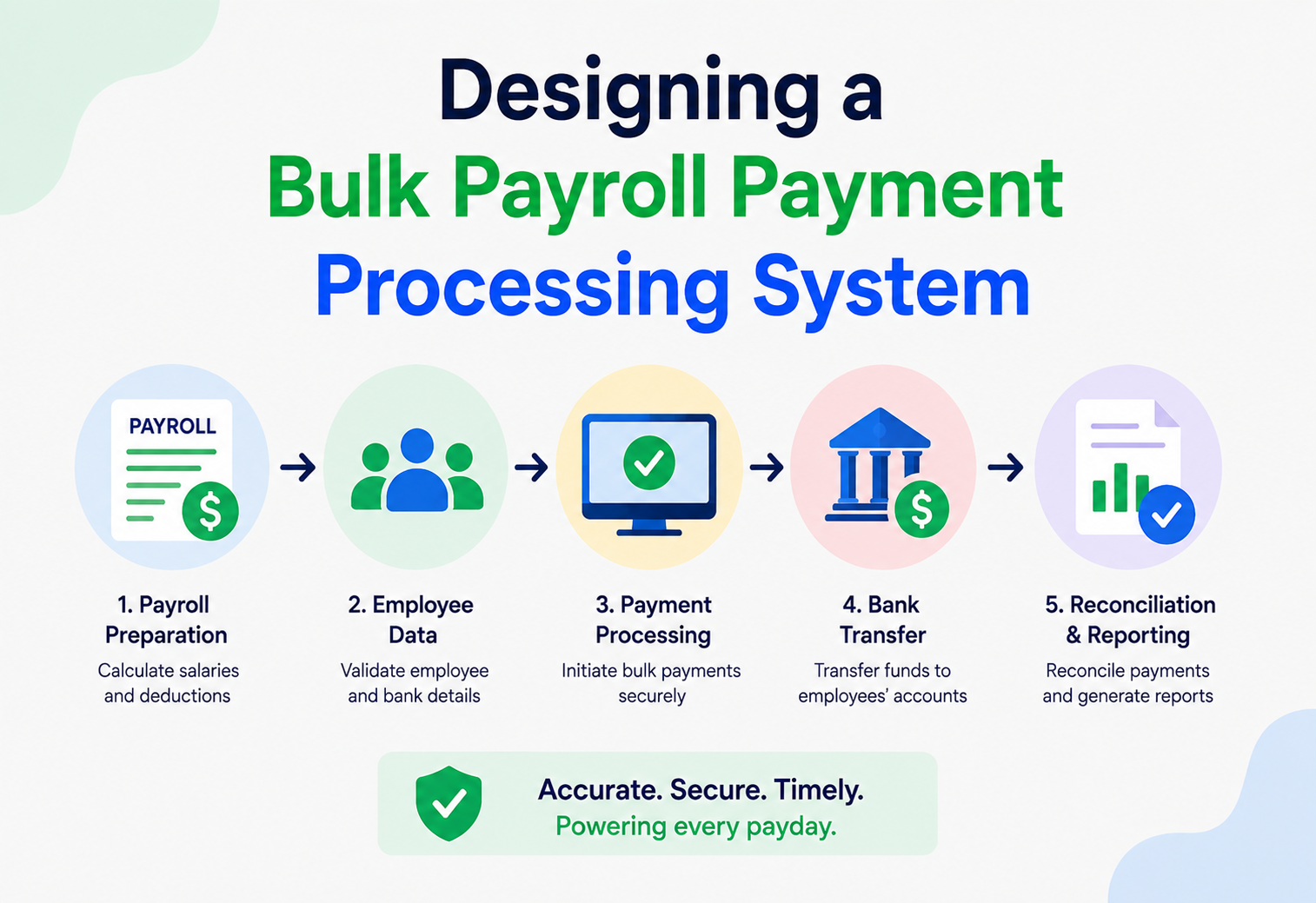
Designing a Bulk Payroll Payment Processing System
A complete, beginner-to-production system design walkthrough: how to pay 50,000 employees the correct amount, exactly once, every single pay period — even when servers crash mid-run, networks blip, and the same “process payroll” button gets clicked twice by accident — using idempotency keys, the Saga pattern, the outbox pattern, and chunk-level checkpointing working together at platform scale.
Introduction and History
Twice a month (or every week, depending on the company), something quietly momentous happens: tens of thousands of people’s rent, groceries, and mortgage payments become possible because their paycheck landed correctly, on time, in the right bank account. Payroll is one of the least forgiving domains in all of software engineering — not because the logic is exotic, but because the consequences of getting it wrong are immediate, personal, and often legally regulated. Pay someone twice by mistake, and the company may struggle to claw the money back. Pay someone nothing because a server crashed mid-batch, and that person may not be able to pay their own bills on time, no matter how quickly the bug gets fixed the next morning.
This tutorial designs a system to process bulk payroll runs — the coordinated payment of an entire company’s workforce for a single pay period — for an organisation with 50,000 employees, built as a platform capable of scaling to serve many such organisations simultaneously (as a payroll processor or embedded-payroll platform would). That is where the “millions of requests per minute” scale requirement comes in: while a single company’s payroll run processes 50,000 employees, the underlying platform validates, calculates, ledgers, and disburses at a scale of many concurrent payroll runs across thousands of client companies, generating millions of individual internal operations (validations, ledger entries, notifications, status updates) during peak processing windows — like the start of a month, when many companies’ pay dates cluster together.
1.1 A Short History of the Problem
Era 1 — Manual Ledgers & Paper Checks (pre-1970s)
Payroll clerks manually calculated wages, taxes, and deductions, then wrote paper checks. Errors were common and reconciliation was entirely manual, often taking days at the end of each pay cycle.
Era 2 — Batch Mainframe Processing (1970s–1990s)
Dedicated payroll systems ran as scheduled batch jobs on mainframes, computing gross-to-net pay and generating checks or early direct-deposit files. Exactly-once guarantees relied heavily on operational discipline (careful manual restart procedures) rather than software-enforced idempotency.
Era 3 — Client-Server Payroll Software (1990s–2000s)
Dedicated payroll applications (on-premise or early SaaS) automated gross-to-net calculation and integrated with banking networks (ACH in the US) for direct deposit, but batch runs were still largely monolithic — a failure partway through often required a full manual audit before any retry.
Era 4 — Cloud-Native, API-Driven, Exactly-Once Payroll Platforms (today)
Modern payroll platforms (and embedded-payroll APIs used by other software products) process payroll as a distributed, event-driven workflow with explicit idempotency keys, durable state machines, and automated reconciliation against banking rails — allowing safe automatic retries of a failed or partially completed batch without any risk of double-paying or skipping an employee.
This tutorial designs an Era-4 system, with exactly-once correctness as the central, non-negotiable design constraint that shapes every component — much like the 100 ms latency budget shaped the fraud-detection system in a related tutorial, except here the hard constraint is correctness and idempotency rather than raw speed.
By the end of this tutorial you will be able to answer, in interview-level depth, questions like: how do you guarantee that a distributed system spanning calculation, ledger, and external banking-rail services pays every single employee exactly once, even when individual machines crash mid-batch; how do you structure a 50,000-employee batch so that a partial failure only requires redoing a small fraction of the work rather than starting over; how do you detect and safely recover from a payment that the bank silently rejects hours after your system believed it had succeeded; and how do you scale all of this to handle many companies’ payroll runs clustering around the same common pay dates. Every architectural box below is explicitly labelled — API Gateway, Load Balancer, Payroll Run Orchestrator, Idempotency & Ledger Service, and so on — exactly as you would draw them on a whiteboard in a real system design interview.
“Why can’t you just use a single database transaction wrapping the whole payroll run?” A strong answer explains that a single ACID transaction across 50,000 employees, spanning multiple external systems (tax calculation services, banking rails, notification services), is neither technically feasible (external systems don’t participate in your database’s transaction) nor desirable (a single giant transaction would hold locks and resources for an unacceptably long time, and any single failure would force a full rollback and restart of all 50,000 payments). Instead, the system needs per-employee idempotent units of work, coordinated through a durable, resumable workflow — the Saga pattern, discussed later in this tutorial.
Problem and Motivation
2.1 Problem Statement
Design a system that, given a company’s payroll input (employee list, hours worked, salary data, tax and benefit elections) for a specific pay period, calculates the correct net pay for every one of 50,000 employees, moves the right amount of money through banking rails to each employee’s bank account, and guarantees that every employee is paid the correct amount exactly once — even in the presence of partial failures, retries, network errors, and concurrent duplicate trigger requests — while operating as a multi-tenant platform capable of handling millions of underlying operations per minute across many simultaneous client payroll runs.
2.2 Why This Is Hard
| Challenge | Why It Is Hard |
|---|---|
| Exactly-once semantics across distributed systems | The payment itself is executed by an external banking rail (ACH, RTP, wire, or card network) that the payroll system does not fully control transactionally; guaranteeing “exactly once” across this boundary requires idempotency keys and reconciliation, not just a database transaction. |
| Partial failure mid-batch | With 50,000 employees in a single run, some individual payments will inevitably fail transiently (a bad bank routing number, a downstream service hiccup) while the vast majority succeed — the system must isolate and retry only the failures without re-processing the successes. |
| Correctness of calculation | Gross-to-net calculation involves tax withholding (which varies by jurisdiction and can change between pay periods), benefit deductions, garnishments, and bonuses — an error here isn’t just a technical bug, it can be a legal compliance violation. |
| Idempotent retries at massive fan-out | 50,000 individual payment instructions must each be retryable independently and safely, which means the system needs a durable, per-employee idempotency key, not just a single key for the whole batch. |
| Multi-tenant scale | As a platform serving many companies, payroll runs cluster around common pay dates (1st and 15th of the month are extremely common), creating enormous synchronised load spikes the system must absorb without missing legally mandated pay dates. |
| Auditability & compliance | Payroll is subject to extensive regulatory requirements (tax reporting, labour law, data privacy); every calculation and payment must be traceable and reproducible for audits, sometimes years later. |
A common and dangerous mistake is treating “retry the whole batch” as an acceptable failure-recovery strategy. If 49,998 of 50,000 employees were paid successfully and the process crashes before the last 2, blindly re-running the entire batch from scratch would double-pay 49,998 people. The system must always resume from exactly where it left off, at the individual-employee level, never at the whole-batch level.
2.3 Goals
- Functional: correct gross-to-net calculation and exactly-once disbursement for every employee in a payroll run, with automatic, safe recovery from partial failures.
- Non-functional: horizontal scalability to millions of underlying operations per minute across concurrent multi-tenant payroll runs, 99.99%+ availability around legally mandated pay dates, full auditability, and strong security and compliance for sensitive financial and personal data.
2.4 Non-Goals
This system is not a general accounting or general-ledger platform (though it integrates with one), not a tax-filing system (though it produces the data tax filing depends on), and not a time-and-attendance tracking system (it consumes hours-worked data as an input rather than capturing it). It is scoped specifically to the calculation and exactly-once disbursement of a payroll run once its inputs are finalised.
Core Concepts You Need First
Before drawing a single architectural box, it is worth putting names to the small handful of concepts that show up repeatedly in every layer of this design. Each one below is presented with the same four-lens explanation: what it is, why it matters here, an everyday analogy, and a concrete example anchored to payroll.
3.1 Exactly-Once Semantics
What: A guarantee that a given operation (like “pay employee X for pay period Y”) takes effect exactly one time, even if the request to perform it is sent, retried, or duplicated multiple times.
Why: It is the single most important property of this entire system — without it, retries (which are unavoidable in any distributed system) risk double-paying or skipping employees.
Analogy: A vending machine that remembers it already dispensed your snack even if you press the button twice in frustration when the display flickers, so you don’t get two snacks (or none) by accident.
Example: Submitting the same payment instruction twice, due to a client retry after a network timeout, results in the employee being paid once, not twice.
3.2 Idempotency Key
What: A unique identifier attached to an operation so that performing the same operation multiple times with the same key has the same effect as performing it once.
Why: This is the concrete mechanism that makes exactly-once semantics achievable in practice — the system checks “have I already done this?” before acting.
Analogy: A wedding RSVP card with a unique guest number — submitting the same RSVP card twice doesn’t add a second guest to the headcount.
Example: Every individual payment instruction carries a key like payroll_run_id + employee_id + pay_period_id, and the Disbursement Service refuses to execute a second payment for a key it has already processed.
3.3 Saga Pattern
What: A way of managing a long-running business transaction that spans multiple independent services or systems, by breaking it into a sequence of local transactions, each with a defined compensating (undo) action if a later step fails.
Why: A single payroll run touches calculation, tax withholding, ledger posting, and bank disbursement — systems that can’t participate in one shared ACID transaction — so the Saga pattern coordinates them safely, with a clear rollback story if something goes wrong partway through.
Analogy: Booking a multi-leg vacation (flight, hotel, car rental) — if the hotel booking fails after the flight is already booked, you cancel the flight (a compensating action) rather than leaving things in a half-booked, inconsistent state.
Example: If tax withholding calculation succeeds but the actual bank disbursement fails permanently, a compensating action reverses the ledger entry that had already tentatively recorded the payment as pending.
3.4 Outbox Pattern
What: A pattern where a service writes both its primary data change and the event it needs to publish into the same local database transaction (into an “outbox” table), with a separate process relaying outbox entries to a message broker.
Why: It guarantees that “I recorded this payment as pending” and “I published an event to trigger the actual bank transfer” either both happen or neither happens — avoiding the classic bug where a service crashes after updating its database but before publishing the event that would have triggered the next step.
Analogy: Writing a to-do list entry and mailing a request for help in the very same envelope, so you can never end up having sent the request without also remembering you sent it.
Example: The Payroll Calculation Service writes each employee’s computed net pay into its own database and an outbox table in one transaction; a relay process then reliably publishes a PayCalculated event to Kafka.
3.5 Batch Chunking & Checkpointing
What: Splitting a very large batch of work (50,000 employees) into smaller chunks that are processed and checkpointed independently, so that a failure only requires resuming from the last successfully completed chunk, not the very beginning.
Why: Without chunking, a crash at employee number 49,999 out of 50,000 could force reprocessing all 49,999 already-successful payments, risking duplicate payments if idempotency isn’t perfectly enforced everywhere, and wasting significant time even if it is.
Analogy: Saving your progress in a long video game level in stages, rather than only at the very start of the level, so a crash doesn’t send you all the way back to zero.
Example: The 50,000-employee batch is split into 500 chunks of 100 employees each; the orchestrator records which chunks have fully completed, and a restart only reprocesses incomplete chunks.
3.6 Reconciliation
What: The process of comparing the payroll system’s internal record of what it believes it paid against the external banking rail’s authoritative record of what actually moved, to detect and resolve any discrepancy.
Why: Because the banking rail is external and sometimes asynchronous (a file-based ACH batch can take hours to fully settle, and settlement can still fail after initial acceptance), the payroll system’s own internal state is not automatically guaranteed to match reality — reconciliation is the safety net that catches any drift.
Analogy: Balancing your chequebook against your bank statement at the end of the month to catch any transaction that didn’t go through as expected.
Example: A nightly reconciliation job compares every PAID-marked payment against the ACH return file, flagging any payment that the bank actually rejected (e.g., due to a closed account) for manual remediation.

3.7 Dead-Letter Queue (DLQ)
What: A separate queue where messages or events that repeatedly fail processing are routed, instead of being retried forever or silently dropped.
Why: Some individual payment failures are not transient (for example, a permanently invalid bank account) and need human review rather than infinite automatic retries that would never succeed.
Analogy: A mail carrier’s “return to sender” bin for letters with an undeliverable address, rather than the carrier trying to deliver the same letter forever.
Example: After three failed disbursement attempts for one employee due to an invalid routing number, that payment instruction moves to a DLQ for a payroll specialist to investigate and correct.
3.8 Compensating Transaction
What: An explicit action that semantically undoes the effect of an earlier completed step in a Saga, used when a later step fails and the whole business transaction needs to be rolled back — since there is no single database transaction to simply abort.
Why: In a multi-service workflow, “undo” isn’t automatic the way it is inside a single ACID transaction; each step that could need reversing must have its own explicitly designed undo action.
Analogy: If you’ve already mailed a cheque and then discover the recipient’s address was wrong, you can’t “unsend” the mail — you have to take a deliberate follow-up action (stop payment, request a return) to compensate.
Example: If a ledger entry was marked PENDING and tax withholding was calculated, but the employee’s bank account is later found to be permanently invalid, a compensating action reverses the PENDING ledger entry and flags the underlying gross pay amount for re-issuance via a corrected account on a future run.
3.9 Two-Phase Commit vs. Saga (Why Saga Wins Here)
What: Two-phase commit (2PC) is a classical distributed-transaction protocol where a coordinator asks all participants to “prepare” and only commits if every participant agrees, guaranteeing atomicity across systems.
Why the Saga pattern is preferred instead: 2PC requires every participant (including an external banking rail) to support the same transactional protocol and to hold locks and resources until every other participant responds — completely impractical when one “participant” is an asynchronous external banking network that settles hours later and has no notion of “prepare.” The Saga pattern instead accepts that each step commits independently and immediately, with compensating actions handling the rare rollback case, trading strict atomicity for practical feasibility at this scale and across this many independent systems.
Analogy: 2PC is like asking every vendor in a multi-vendor wedding (caterer, venue, band) to hold their commitment in a tentative, reversible state until all three simultaneously confirm — workable with three cooperative vendors, but impossible when one of them (the venue) operates on its own booking system that doesn’t support “tentative holds” at all.
Architecture and Components
Let’s design the system, layer by layer, with every box explicitly labelled by the type of component it represents.
4.1 Component Responsibilities
| Component | Responsibility |
|---|---|
| HR / Payroll Admin Client | Where a company’s payroll administrator reviews and triggers a payroll run for the current pay period. |
| Edge / CDN + WAF | TLS termination, DDoS protection, first line of defence for all incoming traffic. |
| API Gateway | Single entry point for run-triggering and status requests; enforces authentication, per-tenant rate limiting, and request validation. |
| Load Balancer (L4 / L7) | Distributes incoming requests across many stateless service instances, performing health checks to route around unhealthy nodes. |
| Payroll Run Orchestrator | Owns the Saga workflow for an entire payroll run; splits the employee batch into chunks, tracks checkpointed progress, and coordinates calculation, ledger, and disbursement steps. |
| Payroll Calculation Service | Computes gross-to-net pay per employee (tax withholding, benefits deductions, garnishments) using the outbox pattern to reliably publish results. |
| Tax & Compliance Service | Provides jurisdiction-specific tax withholding rules and rates, versioned so calculations remain reproducible for audits. |
| Message Broker (Kafka) | Durable, partitioned event backbone connecting calculation, ledger, and disbursement stages, absorbing bursts around common pay dates. |
| Idempotency & Ledger Service | Maintains the authoritative, append-only record of every payment’s state (PENDING / PAID / FAILED) keyed by idempotency key, enforcing exactly-once at the data layer via a unique constraint. |
| Disbursement Service | Executes the actual money movement via banking rails (ACH, RTP, wire), checking the Idempotency & Ledger Service before ever issuing a new payment instruction. |
| Banking Rail / ACH Network | External payment infrastructure (for example the ACH network in the US) that actually moves funds to each employee’s bank account, operating asynchronously and providing return / settlement files. |
| Reconciliation Service | Periodically compares internal ledger state against banking-rail settlement or return files, flagging discrepancies for remediation. |
| Dead-Letter Queue & Remediation Workflow | Captures permanently failed individual payments for human review rather than infinite retry. |
| Notification Service | Informs employees and payroll administrators of payment status (paid, delayed, failed) via email, SMS or push. |
| Serving API + its own Gateway / LB | A separate, isolated read path for payroll administrators’ dashboards and employee-facing “view my pay stub” queries, so read traffic never competes with the disbursement-critical path. |
| Audit & Data Lake | Immutable, long-retention archive of every calculation, decision, and payment event, required for regulatory audits and historical reporting. |
“Why does the Idempotency & Ledger Service sit as its own distinct component instead of being folded into the Disbursement Service?” Answer: separating them means the source of truth for “has this payment already happened?” is independently reliable and independently auditable, and it can be consulted by multiple services (Disbursement, Reconciliation, the Serving API) without each needing its own notion of payment state. It also means the Disbursement Service itself can be stateless and horizontally scaled without risk, since correctness lives in the ledger’s unique constraint, not in the disbursement workers’ own memory.
4.2 Component Deep-Dive
API Gateway
What: The single entry point for payroll administrators triggering a run and for status and read queries. Why here: centralises authentication and per-tenant rate limiting across potentially thousands of client companies sharing this platform, and validates that a run-trigger request is well-formed before it ever reaches the orchestrator.
Load Balancer
What: Distributes requests across many stateless service replicas (Orchestrator, Calculation Service, Disbursement Service instances). Why here: at platform scale, with many companies’ payroll runs potentially overlapping around common pay dates, no single instance of any service could handle the combined load; the load balancer’s health checks also ensure a struggling instance is removed from rotation before it causes cascading slowness.
Payroll Run Orchestrator
What: A durable workflow engine (often built on a framework supporting long-running, checkpointed state machines) that owns the overall Saga for a payroll run. Why here: a payroll run can take minutes to hours to fully settle (bank disbursement is asynchronous); the orchestrator’s job is to durably remember exactly which of the 50,000 employees have completed which stage, so it can resume correctly after any crash or restart.
Idempotency & Ledger Service
What: A service backed by a database with a strict unique constraint on the idempotency key (payroll_run_id + employee_id + pay_period_id), recording every payment’s lifecycle state. Why here: this is the single source of truth that makes “exactly once” enforceable at the data layer, not just as an application-level convention — even if multiple disbursement workers somehow raced to process the same employee, the database’s unique constraint would reject the duplicate.
Disbursement Service
What: The service that actually calls out to banking rails (ACH batch file generation, or real-time rails like RTP for faster payment methods) to move money. Why here: isolating this as its own service means banking-rail-specific complexity (file formats, rail-specific retry and timeout behaviour) doesn’t leak into the calculation or orchestration logic, and it can be scaled and monitored independently given its direct financial-transaction responsibility.
Reconciliation Service
What: A service that ingests settlement and return files from banking rails (which can arrive hours after the original disbursement request) and compares them against the ledger’s recorded state. Why here: banking rails are asynchronous and can reject a payment after initial acceptance (for example, a closed account discovered during actual settlement); without reconciliation, this kind of late failure would go silently unnoticed, and an employee might never actually receive funds the ledger believes were successfully paid.
Internal Working
Let’s trace, step by step, exactly what happens when a payroll administrator clicks “process payroll” for a 50,000-employee run.
Payroll Trigger
A payroll administrator reviews the current pay period’s inputs (hours worked, salary changes, new hires and terminations) and triggers a payroll run through the client, which passes through the API Gateway and Load Balancer to the Payroll Run Orchestrator.
Deduplication of the Trigger Itself
The Orchestrator first checks whether a run with this exact payroll_run_id (itself an idempotency key, generated deterministically from company ID + pay period, or supplied by the client with its own idempotency key) has already been started — protecting against the administrator accidentally clicking “process payroll” twice.
Chunking and Calculation Requests
On a fresh run, the Orchestrator splits the 50,000 employees into chunks (for example, 500 chunks of 100 employees) and, for each employee, publishes a calculation request carrying the per-employee idempotency key to Kafka.
Gross-to-Net Calculation with the Outbox Pattern
The Payroll Calculation Service consumes these requests, computes gross-to-net pay per employee (using the Tax & Compliance Service for jurisdiction-specific withholding rules), and writes the result plus a PayCalculated event into its local database and outbox table in a single local transaction.
Ledger Insertion Under a Unique Constraint
A relay process publishes each PayCalculated event from the outbox to Kafka, which the Idempotency & Ledger Service consumes, inserting a PENDING record keyed by the idempotency key — protected by a unique database constraint, so even a duplicate event (from an at-least-once redelivery) cannot create a second pending record.
Disbursement Submission
The Disbursement Service consumes newly-created PENDING ledger entries and, checking the ledger first, issues the actual payment instruction to the banking rail (for example, adding the employee to the day’s ACH batch file), then updates the ledger entry to SUBMITTED.
Asynchronous Settlement and Reconciliation
The banking rail processes the batch asynchronously (often overnight for ACH) and eventually returns a settlement or return file; the Reconciliation Service ingests this file and updates each ledger entry to its final state: PAID (confirmed successful) or FAILED (for example, account closed), the latter routing to the Dead-Letter Queue & Remediation Workflow for a payroll specialist to correct (perhaps re-issuing via a corrected bank account on a subsequent run).
Checkpointed Resumption
Throughout, the Orchestrator tracks chunk-level completion; if it crashes or is restarted at any point, it resumes exactly where it left off by querying which chunks and employees already have a ledger entry, re-publishing calculation requests only for employees who don’t yet have one.
Notification and Audit
The Notification Service, subscribed to ledger state-change events, informs employees and the payroll administrator of final payment status, and the Audit & Data Lake durably archives every event for compliance.
Data Flow and Lifecycle
As in the earlier tutorials in this series, this system has two lifecycles running together: the short-but-critical lifecycle of a single employee’s payment (from calculation request to final PAID or FAILED status), and the long-running lifecycle of the overall payroll run’s Saga, which doesn’t complete until every one of the 50,000 individual payment lifecycles has reached a terminal state. The sequence diagram below focuses on a single employee’s payment lifecycle, since that is where the exactly-once guarantee is enforced.
“What happens if the Disbursement Service crashes right after submitting to the bank but before updating the ledger to SUBMITTED?” Good answer: on restart, the Disbursement Service (or a reconciliation sweep) checks the banking rail’s own status for that idempotency key or reference before assuming nothing happened — many banking rail integrations support querying “was this reference already submitted?” precisely to handle this ambiguous window safely, rather than blindly resubmitting and risking a duplicate. Where the rail doesn’t support such a query, the system errs on the side of a short, monitored manual hold rather than an automatic blind retry for that specific payment.
Achieving Exactly-Once Payment
This section is the heart of the entire design — let’s go through the concrete mechanisms, layered together, that make “exactly once” an enforceable guarantee rather than a hopeful description.
7.1 Deterministic, Composite Idempotency Keys
What: Every payment instruction’s idempotency key is deterministically derived from payroll_run_id + employee_id + pay_period_id, never a randomly generated ID.
Why: A deterministic key means that even if the same logical payment request is generated twice (by a retry, a duplicate trigger click, or a redelivered message), it always produces the identical key, allowing every downstream system to recognise and reject the duplicate rather than accidentally treating it as new.
7.2 Database-Enforced Uniqueness (Not Just Application Logic)
What: The Idempotency & Ledger Service’s database schema places a hard unique constraint on the idempotency key column, rather than relying purely on an application-level “check then insert” pattern.
Why: Application-level checks (“query if it exists, then insert if not”) are vulnerable to race conditions when multiple workers process messages concurrently; a database-level unique constraint is the only fully race-proof enforcement, turning a would-be duplicate insert into a rejected or caught exception instead of a silently successful second row.
7.3 At-Least-Once Delivery + Deduplication = Effectively-Once Processing
What: Rather than trying to achieve true exactly-once message delivery (which is famously difficult across independent distributed systems), the design accepts at-least-once delivery (Kafka’s standard, robust guarantee) at the messaging layer, combined with idempotent, dedup-aware processing at the application and database layer.
Why: This combination is mathematically equivalent to exactly-once processing (the actual business effect happens once) even though the underlying messages might be delivered more than once — it is a far more achievable and battle-tested engineering target than pursuing exactly-once delivery as an end in itself.
7.4 The Outbox Pattern at Every Stage Boundary
What: As described in Chapter 3, every service that both changes its own state and needs to trigger a downstream action does so via the outbox pattern, guaranteeing the state change and the triggering event are never split by a crash.
Why: Without this, a crash between “I calculated this employee’s pay” and “I published the event telling the ledger about it” could silently strand that employee in limbo — appearing neither correctly paid nor correctly retried.
7.5 Chunk-Level Checkpointing in the Orchestrator
What: As described in Chapter 3, the Orchestrator’s progress is durably checkpointed at the chunk level, so a restart resumes only unfinished work.
Why: This bounds the “blast radius” of any single failure to, at most, the small chunk that was in flight, rather than the entire 50,000-employee run, and it makes recovery fast (only re-examine the last few chunks) rather than requiring a full scan of all 50,000 employees’ status on every restart.
7.6 Java: A Simplified Idempotent Payment Recorder
// IdempotentPaymentRecorder.java
// Assumes a unique constraint on idempotency_key in the payments table.
public class IdempotentPaymentRecorder {

    private final PaymentRepository paymentRepository;

    public IdempotentPaymentRecorder(PaymentRepository paymentRepository) {
        this.paymentRepository = paymentRepository;
    }

    /**
     * Attempts to record a new pending payment. Returns the existing
     * record if this idempotency key was already processed, instead
     * of creating a duplicate — safe to call multiple times.
     */
    public PaymentRecord recordPendingPayment(String payrollRunId, String employeeId,
                                               String payPeriodId, long netPayCents) {

        String idempotencyKey = buildIdempotencyKey(payrollRunId, employeeId, payPeriodId);

        try {
            PaymentRecord newRecord = new PaymentRecord(
                idempotencyKey, payrollRunId, employeeId, payPeriodId,
                netPayCents, PaymentStatus.PENDING
            );
            return paymentRepository.insertIfAbsent(newRecord);
            // insertIfAbsent relies on the database’s unique constraint on
            // idempotency_key; a duplicate insert attempt raises a constraint
            // violation, which the repository translates into a lookup-and-return
            // of the existing record rather than propagating an error.
        } catch (DuplicateKeyException e) {
            // Another concurrent attempt (or a retry) already recorded this
            // payment — fetch and return the existing, authoritative record.
            return paymentRepository.findByIdempotencyKey(idempotencyKey)
                .orElseThrow(() -> new IllegalStateException(
                    "Duplicate key conflict but no existing record found for " + idempotencyKey));
        }
    }

    private String buildIdempotencyKey(String payrollRunId, String employeeId, String payPeriodId) {
        return payrollRunId + ":" + employeeId + ":" + payPeriodId;
    }

    public enum PaymentStatus { PENDING, SUBMITTED, PAID, FAILED }

    public record PaymentRecord(String idempotencyKey, String payrollRunId, String employeeId,
                                 String payPeriodId, long netPayCents, PaymentStatus status) {}

    public interface PaymentRepository {
        PaymentRecord insertIfAbsent(PaymentRecord record) throws DuplicateKeyException;
        java.util.Optional<PaymentRecord> findByIdempotencyKey(String key);
    }

    public static class DuplicateKeyException extends RuntimeException {}
}
Relying only on a “SELECT to check, then INSERT if not found” pattern in application code, without a database-level unique constraint, is a classic race-condition bug. Under concurrent processing (which is exactly what horizontally scaling this system for 50,000+ employees requires), two workers can both perform the SELECT, both see “not found,” and both proceed to INSERT — resulting in two payments for the same employee. The unique constraint is what makes this impossible, turning a subtle timing bug into a loud, immediately caught exception.
Advantages, Disadvantages and Trade-offs
Every architectural choice above buys something and pays for something. Let’s list what this design gains and what it costs, side by side.
Advantages
- Employees are guaranteed to be paid correctly and exactly once, even across crashes, retries, and duplicate trigger requests — the single most important property for a payroll system’s trustworthiness.
- Chunk-level checkpointing means a partial failure only requires reprocessing a small fraction of the batch, not the entire 50,000-employee run, minimising both recovery time and risk.
- Separating calculation, ledger, and disbursement into independent services allows each to be scaled, tested, and evolved on its own schedule — for example, adding a new tax jurisdiction’s rules doesn’t require touching disbursement logic at all.
- Built-in reconciliation catches the class of failures (late bank-side rejections) that no amount of internal idempotency alone could prevent, since those failures originate entirely outside the payroll system’s control.
- Because every stage’s events are durably logged and replayable, the system can reconstruct exactly what happened for any employee’s payment months or years later — an essential property for compliance audits and dispute resolution alike.
Disadvantages & Trade-offs
- Complexity vs. correctness: A simple, single-transaction batch script is far easier to build and reason about initially, but cannot safely recover from partial failure at this scale — the Saga-based, chunked, idempotent design trades implementation complexity for correctness guarantees that are non-negotiable in payroll.
- Latency of full settlement: Because banking rails like ACH settle asynchronously (often overnight), the system cannot report a payment as fully, finally confirmed within seconds — it must clearly distinguish
SUBMITTEDfromPAIDstates rather than pretending otherwise. - Operational overhead of reconciliation: Building and maintaining reconciliation against every supported banking rail’s specific file formats and timing is significant ongoing engineering investment, not a one-time cost.
- Idempotency key management complexity: Correctly deriving and consistently propagating composite idempotency keys across every service boundary is a discipline that must be enforced through shared libraries and conventions, since a single service that generates its own random ID instead of using the shared deterministic key silently reintroduces the duplicate-payment risk.
- Harder-to-test failure modes: Verifying correct behaviour under partial failure requires deliberately engineered chaos and fault-injection testing rather than ordinary happy-path tests, adding meaningfully to the testing investment required before the system can be trusted with real paycheques.
“Would a simpler design ever be appropriate here?” For a very small company (say, 5 employees) processed manually with careful human double-checking, a simpler batch script with less architectural sophistication might be an acceptable, lower-cost trade-off. At 50,000 employees processed automatically and repeatedly every pay period, the probability of some partial failure occurring during at least one run over time approaches certainty, making the more complex, exactly-once-by-design architecture the only responsible choice.
Performance and Scalability
The platform must absorb the predictable but enormous synchronised load spikes that hit around common pay dates, without ever missing a legally mandated pay date. Let’s look at concrete numbers and the techniques each layer uses to hold up.
9.1 Back-of-the-Envelope Estimation (Million-Operations-Per-Minute Scenario)
- A single 50,000-employee payroll run, chunked into 500 chunks of 100, generates roughly 50,000 calculation requests, 50,000 ledger insertions, and 50,000 disbursement instructions — 150,000+ discrete operations for one company’s one pay period.
- As a multi-tenant platform, common pay dates (the 1st and 15th of the month, and every-other-Friday cycles) cause many companies’ runs to cluster together; assuming a peak scenario of a few hundred large companies (each with tens of thousands of employees) triggering runs within the same processing window, the platform can see on the order of tens of millions of individual operations within a peak processing hour — translating to a sustained rate in the range of a million or more operations per minute during the most concentrated bursts.
- Each operation is lightweight (a database write, a small event publish), so the dominant scaling concern is horizontal throughput and database write capacity, not per-operation compute cost.
- Kafka topic partitioning by
payroll_run_id(or a hash combining run ID and employee ID) spreads load evenly across partitions while preserving per-employee ordering where it matters (for example, calculation must complete before disbursement for the same employee).
9.2 Scaling Techniques Per Layer
| Layer | Scaling Technique |
|---|---|
| API Gateway / Load Balancer | Horizontally auto-scaled stateless instances; per-tenant rate limiting prevents one very large company’s run from starving smaller tenants’ requests. |
| Payroll Run Orchestrator | Sharded by payroll_run_id across many workflow-engine instances, each independently managing its own subset of in-flight runs. |
| Payroll Calculation Service | Stateless, horizontally scaled consumers of the calculation-request topic; scales directly with Kafka partition count and consumer group size. |
| Idempotency & Ledger Service | Database sharded or partitioned by payroll_run_id or company ID, since the unique-constraint enforcement only needs to be consistent within a single employee’s key space, not globally serialised. |
| Disbursement Service | Horizontally scaled workers pulling from a per-banking-rail queue, respecting each rail’s own throughput and file-submission-window constraints (for example, ACH batch cutoff times). |
| Kafka | Scaled via additional brokers and partitions; using acks=all for payment-related topics specifically, since correctness matters far more than raw throughput for this data. |
9.3 Storage & State Sizing
- Idempotency & Ledger database: A single 50,000-employee run produces 50,000 ledger rows; across a platform serving thousands of client companies with, say, an average of a few hundred employees each, a full month’s worth of pay periods (assuming bi-weekly cycles) generates on the order of tens of millions of ledger rows monthly — comfortably handled by a sharded relational database with proper indexing on the idempotency key and company ID.
- Kafka retention: Payment-critical topics are retained for a period spanning at least the full settlement and reconciliation window (commonly several days to allow for delayed bank return files), plus additional buffer for replay in case of a downstream consumer issue.
- Orchestrator workflow state: Each in-flight run’s chunk-completion state is a small, bounded record (a few hundred bytes per chunk); even with thousands of concurrent in-flight runs during a peak processing window, total active workflow state remains in the tens of megabytes range, trivial relative to the request-throughput scaling challenge.
9.4 Handling Synchronised Pay-Date Spikes
- Pre-scheduled capacity: Since pay dates are known well in advance (unlike an unpredictable traffic spike), capacity for the Orchestrator, Calculation Service, and Disbursement Service fleets can be pre-scaled ahead of known high-concentration dates rather than relying purely on reactive autoscaling.
- Staggered submission windows within a legal deadline: Where the legally mandated pay date allows some flexibility in exact processing time, the platform can smooth load by staggering when different companies’ runs begin processing within the same business day, rather than every run starting at the identical instant.
- Backpressure-aware chunk processing: If Calculation Service consumer lag grows during a spike, the Orchestrator’s chunked design naturally tolerates the slowdown — chunks simply take longer to complete, without any risk of double-processing or skipped employees, since progress is only ever checkpointed once a chunk is fully, correctly done.
Large payroll processors serving many thousands of client companies are known to build significant capacity headroom and staggered internal processing schedules specifically around the most common pay dates (month-start and mid-month), since these dates predictably concentrate an enormous share of total platform volume into a narrow processing window — a pattern very similar to a retailer’s Black Friday capacity planning, but recurring twice a month rather than once a year.
High Availability and Reliability
A missed pay date isn’t just an outage — it’s a serious legal, financial and personal event for every affected employee. This system is built for continuous, reliable operation and for safe, precise recovery when something inevitably does go wrong.
- Multi-AZ deployment: Every stateful component (the Orchestrator’s workflow state store, the Idempotency & Ledger database, Kafka) is deployed across multiple availability zones, so a single zone failure never halts an in-progress payroll run.
- Durable, resumable workflow state: The Orchestrator’s chunk-level progress is persisted durably (not just held in memory), so an Orchestrator instance crash and restart — or even a full instance replacement — resumes exactly where the run left off.
- Graceful degradation of non-critical paths: If the Notification Service is temporarily unavailable, disbursement itself continues unaffected; notifications are queued and delivered once the service recovers, since being told about a payment late is far less harmful than the payment itself being delayed or duplicated.
- Circuit breakers around external banking-rail calls: If a specific banking rail’s API is degraded, the Disbursement Service can hold affected payments in a clearly visible “awaiting rail” state rather than repeatedly retrying against a known-degraded dependency, alerting operators well before any legal pay-date deadline is at risk.
- Disaster recovery: Kafka topics and the ledger database are replicated cross-region for the payroll-critical data path; the Audit & Data Lake archive serves as the ultimate reference for full historical reconstruction if ever needed.
- Chaos testing: Regularly killing Orchestrator instances, Calculation Service workers, and Ledger database nodes in a staging environment specifically during a simulated large payroll run, verifying that resumption is correct and that no employee ends up duplicated or skipped before a real incident tests this behaviour for the first time in production.
- Explicit health checks and readiness gating: The Load Balancer only routes traffic to service instances that report themselves as fully ready (not merely “started”), which matters especially for the Orchestrator, since an instance that’s still loading its workflow state should not yet accept new run-trigger requests.
10.1 Failure Scenarios Worked Through
| Failure | System Behaviour |
|---|---|
| Orchestrator instance crashes mid-run | A replacement instance picks up the run from its last durably checkpointed chunk state; already-completed chunks are never reprocessed. |
| Calculation Service fails for a specific employee (for example, bad tax data) | That employee’s calculation request is retried a bounded number of times, then routed to the Dead-Letter Queue for a payroll specialist to correct, without blocking the other 49,999 employees. |
| Duplicate “process payroll” click by an administrator | The Orchestrator recognises the identical payroll_run_id as already in progress (or completed) and returns the existing run’s status rather than starting a second, duplicate run. |
| Banking rail rejects a payment after initial acceptance | The Reconciliation Service detects the mismatch against the ledger’s SUBMITTED state during its next settlement-file ingestion and transitions that payment to FAILED, routing it to remediation for correction and re-issuance on a subsequent run. |
| Entire region becomes unreachable | Cross-region replication of the ledger and workflow state allows the run to resume in a standby region, with the Idempotency & Ledger Service’s unique constraints preventing any duplicate payment even if some in-flight operations had already partially succeeded before the region failure. |
“How do you handle the legal deadline pressure of a mandated pay date if something goes seriously wrong mid-run?” A strong answer distinguishes between the vast majority of employees (who should always be paid on time, since the chunked, idempotent design isolates failures to a small subset) and a small number of individually failed payments needing manual remediation — the architecture is specifically designed so a localised failure never puts the entire run’s on-time completion at risk, converting what could be an all-or-nothing crisis into a small, manageable, well-monitored exception queue.
Security
This system handles bank account numbers, national tax identifiers, and the direct authority to move real money into real employee accounts. Security is inseparable from correctness here — a compromise doesn’t just leak data, it can redirect paycheques.
- Strong authentication & authorisation: Payroll administrators authenticate via multi-factor authentication given the sensitivity of triggering real money movement; role-based access ensures only authorised personnel can trigger a run or modify tax or benefit configuration.
- Encryption everywhere: TLS for all network communication; encryption at rest for bank account numbers, salary data, and tax identifiers, with field-level encryption for the most sensitive fields (bank routing / account numbers, national tax IDs) rather than relying solely on whole-database encryption.
- Least-privilege access: The Calculation Service only has access to the salary and tax data it needs; the Disbursement Service’s banking-rail credentials are isolated in a dedicated secrets store with tightly scoped access, since a compromise here directly threatens real money movement.
- Immutable audit logging: Every calculation, ledger state transition, and disbursement action is immutably logged with who or what triggered it, since payroll audits (internal, and sometimes regulatory) require reconstructing exactly what happened and why, sometimes years after the fact.
- Segregation of duties: The system enforces that no single person can both modify an employee’s bank account details and trigger a payroll run affecting that same employee without a second reviewer’s approval, mitigating insider-threat risk around fraudulent payment redirection.
- PII / data privacy compliance: Employee personal and financial data is handled according to applicable regional data-protection regulations, with data minimisation applied so services only receive the specific fields they need rather than a full employee profile.
- Secure credential rotation for banking-rail integrations: Credentials used to submit files or API calls to banking rails are rotated on a regular schedule and stored in a dedicated secrets-management system rather than embedded in application configuration, since these credentials represent one of the highest-value targets in the entire platform.
Allowing a single administrator to both update an employee’s bank account details and trigger the payroll run in the same session, with no additional verification step, is a well-known fraud vector: an attacker who compromises one administrator account, or a malicious insider, could redirect an employee’s pay to an unauthorised account. A mandatory cooling-off period or secondary approval step for bank detail changes materially reduces this risk.
Monitoring, Logging and Metrics
A silent failure in payroll is worse than a loud one, because it can quietly leave employees unpaid without anyone realising in time. Monitoring for this system is specifically tuned to catch the kind of failures that would otherwise go unnoticed until an angry employee call arrives.
12.1 Key Metrics to Track
Run Completion Rate by Legal Deadline
The single most business-critical metric — measures whether employees are actually being paid on time.
Per-Employee Payment Failure Rate
Payments routed to the DLQ each run; an early signal of data-quality issues such as stale bank details.
Chunk Processing Latency & Retries
Surfaces whether the batch is progressing normally or stuck retrying a problematic chunk.
Reconciliation Discrepancy Count
Directly measures how often the ledger’s believed state diverges from the banking rail’s actual settlement outcome.
Idempotency-Key Duplicate Rejections
A non-zero rate is healthy — the safety net is catching duplicates. A sudden spike, however, warrants investigation into why so many duplicates are being generated upstream.
Kafka Consumer Lag (Payment Topics)
An early warning that calculation or disbursement processing is falling behind relative to the incoming request rate.
12.2 Logging & Tracing
- Structured, correlation-ID-tagged logs (using the idempotency key) across every service hop, so a single employee’s payment can be traced end to end from calculation through final settlement.
- Distributed tracing spanning Orchestrator → Calculation Service → Ledger → Disbursement → Reconciliation, allowing a stuck or delayed payment to be pinpointed to its exact stage.
- Dashboards showing live run progress (chunks completed / total chunks, employees paid / total employees) for both platform operators and individual company payroll administrators, since visibility into an in-progress run’s health is itself an important product feature, not just an internal operational tool.
12.3 Alerting Priorities Specific to Payroll
Not every anomaly deserves the same urgency in this domain. A single employee’s payment routed to the Dead-Letter Queue is a routine, expected occurrence handled through a normal remediation queue with same-day service targets, not a page. A run falling meaningfully behind schedule with a legal pay-date deadline approaching, or a sudden spike in reconciliation discrepancies across many employees at once (potentially indicating a systemic banking-rail integration issue rather than isolated bad data), are the alerts that warrant immediate, escalated on-call response — the alerting configuration should reflect this asymmetry explicitly rather than treating every anomaly as equally urgent.
Payroll platforms commonly expose a real-time “run status” view to payroll administrators showing exactly how many employees have been processed and how many remain, specifically because payroll administrators — who are personally accountable to their own company’s employees for on-time, correct pay — need visibility into progress, not just a final “done” or “failed” notification after the fact.
Deployment and Cloud
Deployment discipline for this system is unusually strict because the blast radius of a bad change lands directly on real employees’ bank accounts, not just a dashboard’s error rate.
- Containerisation + orchestration: All stateless services (Calculation Service, Disbursement Service, Serving API) are containerised and run on Kubernetes for self-healing and rolling deployments.
- Durable workflow engine: The Payroll Run Orchestrator is built on a workflow-engine framework designed for long-running, checkpointed state machines, deployed with its state store replicated for durability.
- Managed streaming infrastructure: Kafka (self-managed or a managed offering) provides the durable event backbone; particular care is taken with retention settings on payment-critical topics given their compliance and audit importance.
- Infrastructure as Code: Terraform (or similar) defines the Kubernetes clusters, database clusters, and networking, enabling reproducible, auditable environments — especially important given the regulatory scrutiny financial and payroll systems attract.
- Canary deployment for calculation logic changes: Changes to tax-calculation rules or gross-to-net logic are validated in shadow mode against real (but not yet finalised) payroll data before being trusted for a live run, given how costly a calculation error would be.
- Strict change freezes around known pay dates: Non-critical deployments are deliberately withheld in the hours immediately surrounding scheduled payroll runs, reducing the risk of an unrelated deployment introducing instability during the most business-critical processing windows.
- Feature-flagged rollout of new banking-rail integrations: A newly supported rail (or a new region’s rail) is enabled behind a feature flag for a small, carefully monitored subset of companies first, rather than switched on platform-wide, limiting the exposure of any integration-specific bug to a small, recoverable group.
Databases, Caching and Load Balancing
Different parts of this system have genuinely different storage needs. Rather than forcing them all through a single database, the design deliberately picks the right storage engine for each workload shape.
- Idempotency & Ledger database: A strongly consistent, transactional database (not an eventually-consistent store) given the hard uniqueness-constraint requirement at the core of the exactly-once guarantee; sharded by company or tenant ID to scale horizontally while keeping each shard’s consistency requirements local and manageable.
- Payroll Calculation database: Owns its own data per the database-per-service pattern, storing computed pay details and the outbox table for reliable event publishing.
- Tax & Compliance rules store: A versioned, read-heavy store of jurisdiction-specific tax rules, cached aggressively at the Calculation Service level since these rules change infrequently (though must be updated precisely when they do, given legal compliance implications).
- Audit & Data Lake: A durable, long-retention (often multi-year, per regulatory requirements) archive of every event, optimised for occasional large historical queries (audits) rather than low-latency access.
- Load balancing strategy: L4 / L7 load balancing across stateless service replicas; Kafka’s partition-key-based routing (by
payroll_run_idor employee ID) ensures a given employee’s sequence of events is processed in order by a consistent consumer, which matters for correctness in the calculation-then-disbursement ordering.
14.1 A Quick Side-by-Side of the Stores
| Store | Technology | What It Holds | Access Pattern |
|---|---|---|---|
| Idempotency & Ledger DB | Sharded relational (strong consistency) | Payment lifecycle records keyed by idempotency key | High-throughput inserts with unique-constraint enforcement, targeted reads |
| Calculation DB + Outbox | Per-service relational | Computed pay details + pending outbox events | Local transaction spanning row change and outbox insert |
| Tax & Compliance Store | Versioned read-heavy store + cache | Jurisdiction-specific withholding rules | Read-mostly, refreshed on regulatory updates |
| Audit & Data Lake | Object storage / columnar analytics | Every event, immutably archived | Occasional large historical scans for audits |
“Why does the Idempotency & Ledger Service need strong consistency while other parts of the system can tolerate eventual consistency?” Because the unique-constraint enforcement that prevents double-payment is fundamentally a strong-consistency requirement — two concurrent attempts to insert the same idempotency key must be serialised and one must definitively fail, which eventually-consistent systems cannot guarantee. Other parts of the system, like notification delivery or dashboard read freshness, can tolerate being a few seconds stale without any risk to the core correctness guarantee.
APIs and Microservices
Every service boundary in this system is a place where an idempotency key must be carried, honoured, and independently checked. The public API and the internal event contracts below make this discipline explicit.
15.1 Sample Orchestrator API
POST /v1/payroll-runs
Request:
{
  "companyId": "company_8821",
  "payPeriodId": "2026-08-payperiod-b",
  "idempotencyKey": "company_8821:2026-08-payperiod-b",
  "triggeredBy": "admin_4471"
}

Response 202 Accepted:
{
  "payrollRunId": "run_9f2a1c",
  "status": "IN_PROGRESS",
  "totalEmployees": 50000,
  "completedEmployees": 0
}
GET /v1/payroll-runs/{payrollRunId}/status
Response 200:
{
  "payrollRunId": "run_9f2a1c",
  "status": "IN_PROGRESS",
  "totalEmployees": 50000,
  "completedEmployees": 48213,
  "failedEmployees": 4,
  "chunksCompleted": 483,
  "chunksTotal": 500
}
Note the deterministic idempotencyKey supplied on the trigger request itself — if the administrator’s client retries this exact POST request (for example, due to a network timeout on the original request), the Orchestrator recognises the identical key and returns the existing run’s current status rather than starting a second, duplicate run. This is a classic microservices architecture, with the Orchestrator, Calculation Service, Ledger Service, and Disbursement Service each owning a distinct domain and communicating primarily through durable, ordered events rather than tightly coupled synchronous calls.
15.2 Internal Event Contract (Simplified)
// PayCalculated event, published via the outbox pattern
message PayCalculated {
  string payroll_run_id = 1;
  string employee_id = 2;
  string pay_period_id = 3;
  string idempotency_key = 4;
  int64 net_pay_cents = 5;
  int64 calculated_at_ms = 6;
}

// PaymentStatusChanged event, published by the Idempotency and Ledger Service
message PaymentStatusChanged {
  string idempotency_key = 1;
  string previous_status = 2;
  string new_status = 3;
  int64 changed_at_ms = 4;
}
A schema registry enforces backward and forward compatibility on these events, since the Ledger Service, Disbursement Service, Reconciliation Service, Notification Service, and Audit / Data Lake all independently consume them without needing to coordinate deployments with the Calculation Service team.
Design Patterns and Anti-Patterns
Every architectural choice above is an instance of a well-known pattern, and every dangerous shortcut is a well-known anti-pattern. Let’s name them explicitly.
16.1 Patterns Used
Saga Pattern
Coordinates the multi-step, multi-service payroll workflow (calculation → ledger → disbursement) with defined compensating actions if a later step fails permanently.
Outbox Pattern
Guarantees a service’s local state change and its published event are never split by a crash, at every stage boundary in the pipeline.
Idempotent Consumer
Every consumer of an event checks a durable idempotency key before acting, making at-least-once delivery safe to process as effectively-once.
Checkpointed Batch Processing
The 50,000-employee run is chunked with durable progress tracking, bounding the blast radius of any single failure.
Dead-Letter Queue
Permanently failing individual payments are isolated for human review rather than retried indefinitely or silently dropped.
CQRS
The disbursement-critical write path is entirely separate from the read-heavy administrator and employee dashboard path, each with its own API Gateway and Load Balancer.
16.2 Anti-Patterns to Avoid
Whole-Batch Retry
The single most dangerous anti-pattern in this domain — blindly re-running the entire batch after a partial failure risks mass duplicate payments.
Application-Only Duplicate Check
“SELECT then INSERT” without a database-enforced unique constraint is vulnerable to race conditions under concurrent processing.
Random Idempotency Keys
Randomly generated (rather than deterministic) keys defeat the entire purpose, since a retry of the same logical request would generate a different key and no longer be recognised as a duplicate.
“Submitted” = “Paid”
Treating an initial rail submission as equivalent to confirmed settlement ignores the asynchronous, sometimes-failing nature of banking rails and leads to false confidence and undetected payment failures.
Synchronous Rail Calls Inline
Blocking calls to the banking rail directly inside the main calculation or orchestration flow couples the batch’s overall progress to a slow, external system’s availability and latency, rather than decoupling via durable queues.
16.3 Testing Strategy
Beyond ordinary unit and integration tests, this system needs: chaos and fault-injection testing that deliberately kills the Orchestrator, Calculation Service, or Disbursement Service mid-run in staging to verify that resumption is correct and no duplicate or skipped payments result; idempotency regression tests that deliberately re-submit identical requests (at every service boundary) and assert the system’s state is unchanged after the second submission; reconciliation simulation tests that feed synthetic bank return and settlement files (including simulated late rejections) to verify the Reconciliation Service correctly detects and routes discrepancies; and large-scale load tests simulating multiple concurrent 50,000-employee runs to validate the platform’s behaviour under realistic synchronised pay-date peak conditions before it is ever tested for real by an actual peak. It’s also worth maintaining a small, permanent “golden” test company with deliberately tricky payroll scenarios (a mid-period salary change, a garnishment, a multi-state employee) that runs through the full pipeline on every significant release, catching calculation regressions long before they could ever reach a real employee’s paycheque.
Best Practices and Common Mistakes
17.1 Best Practices
- Always derive idempotency keys deterministically from stable business identifiers, never from a randomly generated value or a timestamp.
- Enforce uniqueness at the database layer, never relying solely on application-level duplicate checks.
- Design every stage boundary with the outbox pattern so a local state change and its triggering event can never be split by a crash.
- Build reconciliation as a first-class, continuously running component from day one, not as an afterthought bolted on after a payment-mismatch incident.
- Provide payroll administrators clear, real-time visibility into in-progress run status, since payroll is a domain where “trust but verify” visibility materially reduces anxiety and support burden.
17.2 Common Mistakes
- Under-provisioning the Idempotency & Ledger database’s write capacity, causing contention exactly during the synchronised pay-date spikes when correctness matters most.
- Forgetting to version tax-calculation rules, making a later calculation error impossible to accurately reproduce or audit against the rules that were actually in effect at the time.
- Not testing the “duplicate trigger” scenario explicitly (an administrator double-clicking “process payroll”) until it happens for the first time in production.
- Coupling the Disbursement Service’s release cycle to the Calculation Service’s, slowing down the ability to fix a banking-rail-specific bug independently of unrelated calculation logic changes.
17.3 A Pre-Launch Readiness Checklist
| Area | Question |
|---|---|
| Idempotency | Is the unique constraint on the idempotency key present in the ledger schema, and has a duplicate-insert scenario been verified end to end? |
| Chunk Resumption | Have Orchestrator crashes been simulated mid-chunk to confirm the run resumes without reprocessing completed chunks? |
| Reconciliation | Do synthetic bank return files with deliberate late rejections correctly transition ledger entries to FAILED and route to the DLQ? |
| Monitoring | Are consumer lag, run-completion-by-deadline, and reconciliation discrepancy metrics wired to alerts with sensible thresholds? |
| Security | Have field-level encryption, MFA on administrator accounts, and segregation of duties on bank-detail changes been reviewed and confirmed? |
| Change Management | Is a pre-pay-date change freeze in the deployment calendar, and does the on-call rota know it? |
Real-World Examples
The patterns above aren’t theoretical: they show up in the real payroll and payment platforms that keep tens of millions of people paid every month.
ADP
One of the largest payroll processors globally, operating at a scale spanning many millions of employees across client companies, relying on highly automated, exactly-once-oriented batch processing given the sheer volume and legal criticality of on-time, correct pay.
Gusto
A modern payroll platform for small-to-mid-sized businesses, publicly emphasising reliability engineering specifically around payroll runs, given that even a single incorrect or missed payment for one employee is a serious trust and compliance event.
Workday
An enterprise HR / payroll platform used by many large organisations, integrating payroll calculation with broader HR data (time tracking, benefits) while maintaining the same exactly-once disbursement discipline this tutorial describes.
Stripe (Embedded Payroll / Treasury-Adjacent Infrastructure)
Provides underlying payment infrastructure (including ACH and other rails) that payroll platforms build on top of, exposing idempotency-key support directly in its APIs — a direct, productised reflection of the idempotent-request pattern central to this tutorial’s design.
Deel & Rippling
Multi-tenant, multi-country payroll platforms operating across many jurisdictions simultaneously, meaning their tax-and-compliance layer must handle far more variation than a single-country system, while still maintaining the same core exactly-once ledger discipline for every employee in every country they support.
A recurring theme across all of these real-world payroll systems is that reconciliation against the banking rail’s own records is never treated as optional tooling — it’s built and monitored with the same seriousness as the primary disbursement path itself, precisely because the banking rail is the one part of the system that no amount of internal idempotency can fully control. Several of these platforms also publicly emphasise their “no double payment, no missed payment” track record as a core trust signal to prospective enterprise customers, underscoring how central this guarantee is to the entire product’s value proposition, not just an internal engineering detail.
FAQ
The most common questions that arise when engineers first approach this design, answered directly and without hedging.
The disbursement attempt for that employee either fails immediately (if validated upfront) or is later flagged by reconciliation when the bank’s return file reports the rejection; either way, that single employee’s payment is routed to the Dead-Letter Queue for a payroll specialist to correct and re-issue, without affecting any other employee’s payment in the same run.
At-least-once means a message or instruction might be delivered or attempted more than once; exactly-once processing means that even if delivery happens more than once, the actual business effect (the employee being paid) happens exactly one time. This system achieves the latter by combining at-least-once delivery (Kafka’s native guarantee) with idempotent, database-enforced deduplication at every processing stage.
Because it spans external systems (banking rails) that don’t participate in your database’s transaction, and because holding locks and resources for an operation touching 50,000 rows across potentially hours of asynchronous bank settlement would be both technically impractical and operationally dangerous — a single stuck lock could block unrelated work. The Saga pattern with per-employee idempotent steps is what makes this both correct and practical at scale.
The database-enforced unique constraint on the idempotency key is the final safety net regardless of how such a race might occur — one of the two concurrent attempts will succeed in creating the ledger entry, and the other will hit a duplicate-key rejection and simply return the already-created record, exactly as shown in the Java example in Chapter 7.
This varies by banking rail — ACH transfers commonly require a lead time of one to several business days before the pay date to allow for batch submission and settlement, which is why the Orchestrator’s Saga can span hours, and why reconciliation against a settlement file arriving well after initial submission is a normal, expected part of the workflow rather than an edge case.
For a very small, single-stage workflow, perhaps — but payroll inherently spans multiple sequential stages with different failure and compensation semantics (a calculation failure is handled very differently than a bank-side rejection discovered during reconciliation), and a durable orchestrator that can resume a long-running, multi-stage process from exactly where it left off is what makes correct, safe recovery from partial failure tractable at 50,000-employee scale. A simple retry queue alone doesn’t give you the same visibility into and control over which stage each employee’s payment is in.
Because the idempotency key is scoped to payroll_run_id + employee_id + pay_period_id, and payroll_run_id is itself scoped to a specific company’s run, the same underlying person appearing as an employee at two different client companies produces entirely distinct idempotency keys and ledger entries — the two payments are correctly treated as unrelated, since they represent genuinely separate employment relationships and separate legal payment obligations.
Summary and Key Takeaways
Payroll is one of the least forgiving domains in all of software engineering, and this design has walked through, piece by piece, how to meet its non-negotiable correctness requirements at platform scale. Let’s condense everything into the ideas worth carrying forward.
Key Takeaways
- Exactly-once payment correctness for a 50,000-employee payroll run is achieved not through a single giant transaction, but through deterministic idempotency keys, database-enforced uniqueness, the outbox pattern, and chunk-level checkpointing working together.
- The Saga pattern is the right tool for coordinating a long-running, multi-service workflow (calculation → ledger → disbursement) that spans external systems no single database transaction could ever encompass.
- At-least-once message delivery combined with idempotent, deduplicating processing at every stage is a far more achievable and battle-tested target than pursuing true exactly-once delivery, and it produces the same business outcome: each employee paid exactly once.
- Reconciliation against the banking rail’s own settlement records is not optional — it’s the only mechanism that catches failures originating entirely outside the payroll system’s control, such as a late account-closure rejection.
- Scaling to a million-plus operations per minute at platform scale is achieved through horizontal scaling of every stateless component, sharding the ledger by tenant, and pre-scheduled capacity around known, synchronised pay-date spikes rather than purely reactive autoscaling.
- Security and auditability are inseparable from correctness in this domain — immutable audit logs, segregation of duties around bank-detail changes, and field-level encryption of sensitive financial data are as essential to the design as the exactly-once mechanics themselves.
Great bulk payment systems aren’t built by trying to make one giant, all-or-nothing operation more reliable — they are built by breaking that operation into 50,000 small, individually idempotent, individually recoverable pieces, each carrying its own memory of whether it has already happened, so that even a chaotic mix of crashes, retries, and duplicate clicks converges on the same, correct answer: every employee paid, once, on time.