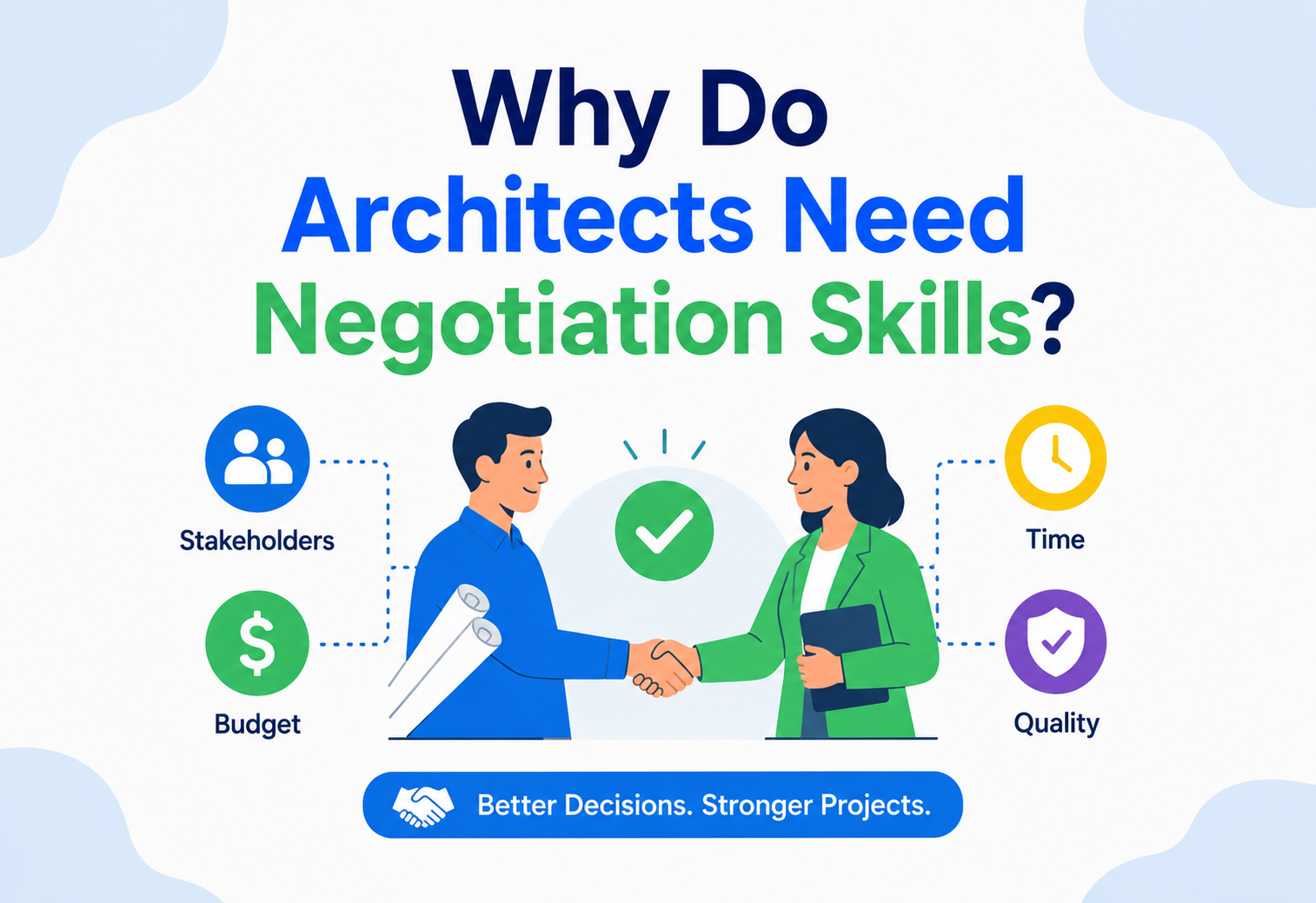
Why Do Architects Need Negotiation Skills?
Not the boardroom kind, with raised voices and folded arms. The everyday kind — the one that happens over a coffee-stained set of drawings, when a client’s dream and a client’s budget are sitting at the same table and someone has to help them get along.
Introduction
Ask a young architect what they studied for, and they’ll talk about light, proportion, materials, the way a staircase can change how a whole house breathes. Nobody warns them about the Tuesday afternoon meeting where a client wants floor-to-ceiling glass on a budget that barely covers a good window. Nobody mentions the contractor who calls at 5:45pm to say the steel delivery is three weeks out, or the city official who reads the plans upside down and still finds something to object to. And yet, if you ask architects further into their careers what actually keeps them up at night, it’s rarely a design problem. It’s a people problem wearing a design problem’s clothes.
This is a piece about that. Not about clever tactics or catchphrases you can drop into a meeting to seem tougher than you feel. Just a slow, honest look at why negotiation — real, human, sometimes uncomfortable negotiation — is quietly one of the most important skills an architect will ever build, and how it tends to sneak up on people who thought they’d signed up for a career about buildings.
Most architects didn’t choose this job to talk people out of things. They chose it to make something beautiful. Negotiation just came with the lease.
Part One — The Architect Sits in the Middle of Everything
There’s a reason this profession attracts a particular kind of tension headache. An architect is rarely making a decision that only affects one person.
A single line on a drawing might need to satisfy a client’s taste, a structural engineer’s math, a contractor’s budget, a city’s fire code, a neighbor’s view, and — somewhere in there — the architect’s own sense of what’s right. Nobody else on a project sits at quite so many intersections at once.
An interior designer answers mostly to the client. A structural engineer answers mostly to physics and code. A contractor answers mostly to cost and schedule. But the architect is the one holding all of those conversations at the same time, often translating between people who don’t naturally speak the same language — the client who says “I want it to feel open” and the engineer who says “that wall is load-bearing,” and somehow finding a sentence that makes both of them feel heard.
That’s not a drafting skill. That’s a negotiation skill, even if nobody calls it that on the syllabus.

1.1 The Myth of the Lone Genius at the Drafting Table
Architecture school, for all its brilliance, sometimes sells a quiet myth: the architect as solitary visionary, hunched over a model at 2am, wrestling only with form and idea. It’s a romantic image, and it isn’t entirely false — there is real solitary craft in this work. But it leaves out the fact that almost nothing an architect designs gets built without first surviving a gauntlet of other people’s opinions, budgets, fears, and egos.
A design is not finished when it’s beautiful. It’s finished when it’s beautiful and affordable and structurally sound and legal and buildable in the time available and something the client still loves after the fortieth conversation about it. Getting from the first version to that version is not a drafting process. It’s a series of conversations, each one a small negotiation, stacked on top of each other until a building appears.
“The first sketch is an act of imagination. Everything after that is an act of negotiation.”
— usually said over the second coffee of the day
Part Two — The Many Rooms an Architect Negotiates In
It helps to name the rooms, because they each ask for something slightly different. An architect doesn’t negotiate once, in one style, with one kind of person. They move through several different conversations in a single week, each with its own rhythm and its own stakes.
The gap between wanting and affording
Clients arrive with a future life already living in their heads. They rarely arrive with a clear sense of what that future actually costs — in money, time, or trade-offs they haven’t thought about yet.
Vision vs. physics
Structural, mechanical, electrical, civil — engineers love the same building for entirely different reasons. Nobody wins outright. The building wins, if the conversation goes well.
The honest cost of things
Contractors know what a material actually costs this month, and which beautiful idea on paper turns into three weeks of headaches on site.
Rules never written with your project in mind
Zoning boards, building departments, planning commissions — institutional negotiations that call for a particular kind of patience.
The small daily negotiations nobody notices
Whose design direction wins, how deadlines get worked out, how much creative freedom to hand to someone new. These feel like Tuesday.
Objections nobody asked for
The negotiation that isn’t in the contract at all — the people next door who can slow a project down in ways no engineer or code official ever could.
Quality against price
Lighting designers, landscape architects, custom fabricators, furniture suppliers — each with their own opinion and their own commercial interest.
2.1 The Client, and the Gap Between Wanting and Affording
This is the negotiation everyone thinks of first, and for good reason — it happens the most often and it touches the most nerves. Clients arrive with a version of their future life already living in their heads: the kitchen where the whole family gathers, the office lobby that makes the right first impression, the home that finally feels like enough space to breathe in. They rarely arrive with a clear sense of what that future actually costs, in money, in time, in trade-offs they haven’t thought about yet.
The architect’s job here is delicate. Say no too bluntly, too early, and you become the person who crushed the dream before it had a chance to become a plan. Say yes too easily, and you’re setting up a much harder conversation six months later, when the budget and the drawings finally collide and somebody has to be the one to explain why.
A couple wants a home with an open, soaring living room and a modest budget to match a modest lot. They’ve seen the photos online — the fifteen-foot ceilings, the wall of glass, the floating staircase. The architect could say, flatly, “that’s not possible here.” Instead, a good one asks a quieter question first: what is it about that room that you actually want to feel? Sometimes the answer isn’t the ceiling height at all. It’s the sense of never feeling boxed in. And once that’s on the table, there might be three other ways to get there — a change in window placement, a shift in ceiling angle, a connection to the outdoors — that a fifteen-foot ceiling was never the only route to.
That question — what do you actually want to feel — is negotiation, even though it doesn’t look like haggling over a price. It’s the architect trading a flat “no” for a deeper “why,” and in doing so, finding room to say yes to something that still fits.
2.2 The Engineer, and the Tug Between Vision and Physics
Structural, mechanical, electrical, civil — architects spend enormous amounts of time in rooms with engineers who love the same building for entirely different reasons. An architect might want a column gone because it interrupts a sightline. A structural engineer might need that column because without it, the second floor has nowhere to rest.
This negotiation rarely gets loud. It usually sounds like two people quietly trading small concessions over a shared drawing — can the column move six inches, can it become a slimmer profile, can it hide inside a wall instead of standing in the open. Nobody wins outright. The building wins, if the conversation goes well.

2.3 The Contractor, and the Honest Cost of Things
Once a design is approved, it has to survive contact with the people who actually build it — and contractors carry a very different kind of knowledge than architects do. They know what a material actually costs this month, how long a particular detail actually takes to install, and which beautiful idea on paper turns into three weeks of headaches on site.
Here, negotiation often looks like defending the intent of a design without becoming precious about every detail. A good architect learns to ask, before pushing back on a contractor’s suggested change, “what does this actually cost us if I hold firm — in money, in time, in the relationship?” Sometimes holding firm is exactly right. Sometimes the contractor’s substitution is not a compromise at all, but a better idea that came from someone who’s actually built forty of these before.
2.4 The City, and the Rules That Were Never Written With Your Project in Mind
Zoning boards, building departments, planning commissions — these are negotiations with an institution rather than an individual, and they call for a particular kind of patience. The person reviewing your permit application didn’t design your building and doesn’t share your excitement about it. They’re checking it against a rulebook written for thousands of buildings that came before yours, some of which behaved badly enough to earn the rule in the first place.
Architects who do well here treat the reviewer less like an obstacle and more like someone with their own set of pressures — a stack of other applications, a boss who asks hard questions, a public that shows up angry at hearings. Approaching that person with genuine curiosity about what they actually need to see, rather than frustration about what they’re blocking, tends to move things faster than any clever argument does.
2.5 The Team, and the Small Daily Negotiations Nobody Notices
Inside the firm itself, negotiation shows up in smaller, quieter forms — deciding whose design direction wins when two team members disagree, working out deadlines with a junior architect who’s already stretched thin, deciding how much creative freedom to hand to someone new versus how much to hold onto. These negotiations rarely feel like negotiations. They feel like Tuesday. But the habits built here — listening first, explaining reasoning, trading ideas instead of issuing orders — are the same habits that show up later in the client meetings that actually matter.
2.6 The Neighbors, and the Objections Nobody Asked For
On many projects — especially additions, renovations, and anything near a shared property line — there’s a negotiation that isn’t in the contract at all: the one with the people next door. A neighbor worried about losing afternoon sun, or about a new window looking straight into their kitchen, or simply about months of construction noise, can slow a project down in ways no engineer or code official ever could, through objections at a public hearing or an informal complaint that quietly stalls a permit.
Architects rarely have direct authority in this conversation, and that’s exactly what makes it a negotiation rather than a decision. The tools are softer here — an early conversation before the objection hardens into a formal complaint, a small design adjustment that costs little but addresses a genuine concern, a willingness to explain the project honestly instead of letting rumor fill the silence. Architects who treat neighbors as another stakeholder worth listening to, rather than an obstacle to route around, often save their clients months of delay that a purely technical approach never would have avoided.
2.7 The Vendors and Specialists, Negotiating Quality Against Price
Lighting designers, landscape architects, custom fabricators, furniture suppliers — on larger projects, an architect is often coordinating a small constellation of specialists, each with their own opinion about what the project needs and their own commercial interest in how much of the budget flows their way. Keeping this group aligned is its own quiet negotiation, usually less about winning any single argument and more about maintaining a shared sense of priority: which parts of the project are non-negotiable in quality, and which parts have room to flex if money gets tight later. Architects who set that hierarchy early, and revisit it openly as the project evolves, avoid a lot of the friction that shows up when everyone assumes their own piece of the puzzle is the one that matters most.
Part Three — What Negotiation Actually Means, Once You Strip the Drama Away
Say the word “negotiation” and a lot of people picture something adversarial — two sides across a table, each trying to get more than the other, one person walking away a winner. That picture makes architects uncomfortable, and honestly, it should. Nobody wants to treat a client’s home, or a public building, or a hospital, like a used-car sale.
But that picture is also wrong, or at least incomplete. The most useful definition of negotiation isn’t “a contest.” It’s closer to this: a conversation where two or more people, who each want something slightly different, try to find a way forward that respects what actually matters to each of them. That’s it. No raised voices required. No winner necessary.
Under that definition, an architect negotiates constantly, often without noticing. Choosing where to spend a limited budget is a negotiation with the client’s own competing priorities. Deciding how much to push back on a code official is a negotiation with time and risk. Even choosing which of two structural solutions to propose to an engineer is a small negotiation between elegance and ease.

Not a performance of toughness
Not a trick to get someone to agree to something against their interest. Not a contest with a winner and a loser sitting at the same table.
A structured way of listening
A search for the version of the project that lets everyone keep the thing they truly can’t live without.
3.1 Interests, Not Positions
One idea, borrowed from the world of professional mediators, has quietly changed how a lot of architects handle these conversations: the difference between a position and an interest.
A position is what someone says they want. “I want the kitchen island to be marble.” An interest is the deeper reason underneath that want. Maybe the real interest is that marble feels like the material their grandmother’s kitchen had, and this project is quietly about honoring that memory. Maybe the interest is simpler — they just want the kitchen to photograph well for family gatherings. Those two interests lead to very different conversations, and very different acceptable substitutes, even though the position — “marble island” — sounded identical at first.
Architects who get good at negotiation tend to get good at this one habit: when a client, contractor, or colleague states a firm position, they get curious about the interest hiding behind it, instead of arguing with the position directly. It turns “no, we can’t do that” into “help me understand why that particular thing matters to you” — and that single shift in framing solves more disagreements than any counter-argument ever could.
People rarely argue about what they actually want. They argue about the first solution they thought of. Your job is to find the second solution, the one nobody’s argued about yet.
Part Four — The Traps Architects Fall Into
Design school teaches critique — defending your idea in front of a panel that’s actively looking for its weaknesses. It’s excellent training for confidence and thick skin. It’s less excellent training for the softer, slower art of finding agreement with someone who isn’t trying to tear your idea apart, just trying to afford it. A few patterns show up again and again.
4.1 Defending the Design Like It’s the Architect’s Own Reputation
It’s easy, after weeks of work on a design, to feel like a challenge to the drawing is a challenge to your competence. That feeling makes negotiations personal when they don’t need to be. A client asking to change a window isn’t questioning your talent. They’re trying to solve for something — light, privacy, cost — and the window is just the current best guess at how to do it. Architects who negotiate well learn to hold their designs a little more loosely in conversation, even while holding their standards tightly in practice.
Confusing critique of a design choice with critique of the person who made it. The moment the drawing becomes about you, the negotiation stops being about the building.
4.2 Saying Yes Too Quickly to Keep the Peace
Conflict-avoidance is common in a field full of thoughtful, detail-oriented people who’d rather solve a problem quietly than have an uncomfortable conversation about it. But saying yes to a change you don’t actually believe in — just to end a tense meeting — almost always creates a bigger problem later, when the consequence of that “yes” shows up in a cost overrun or a structural issue nobody flagged in time. A short uncomfortable conversation now is nearly always cheaper than a long uncomfortable one later.
Agreeing to something you don’t believe in just to end an uncomfortable meeting. Every polite yes is a bill the project pays later, usually with interest.
4.3 Over-Explaining Instead of Listening
When a client or contractor pushes back, the instinct is often to explain harder — more reasoning, more technical detail, more justification for the original decision. Sometimes that’s exactly right. But often, what the other person actually needs first is to feel heard, not out-argued. A pause, a genuine question, a moment of “tell me more about what’s worrying you here” — these do more to move a stuck conversation forward than the most airtight explanation ever will.
Answering an emotional concern with a technical rebuttal. Sometimes the other person doesn’t want to be persuaded first — they want to be heard first.
4.4 Treating Every Negotiation as One Big Final Decision
Big disagreements feel like they need to be resolved all at once, in one decisive conversation. In practice, most good outcomes come from breaking a large negotiation into smaller, lower-stakes decisions made over time — a materials workshop here, a budget check-in there — so that nobody feels like they’re being asked to give up everything in a single meeting. Architects who slow the process down this way tend to end up with clients who trust them more, not less.

Forcing a whole difficult conversation into one meeting. Slicing it into smaller conversations over weeks almost always produces better answers and calmer people.
Part Five — A Composite Story, the Kind of Conversation That Happens Every Week, Somewhere
None of the people in this story are real. But almost every architect who reads it will recognize the shape of it, because some version of it happens constantly, on projects large and small.
An architect is six weeks into a renovation for a young family. The design includes a large rear extension with a wall of sliding glass doors opening onto the garden — the single feature the clients fell in love with in the first meeting. Then the contractor’s estimate comes back, and the glazing alone would eat nearly a third of the entire budget.
The old instinct would be to walk in and deliver the bad news directly: “we can’t afford the glass wall, here’s a smaller window instead.” Technically true, and almost guaranteed to feel, to the client, like losing the best part of the project.
Instead, the architect starts differently — not with the bad news, but with a question. When you picture using this room, what’s actually happening in that moment? It turns out the clients aren’t picturing the glass itself. They’re picturing their kids playing in the garden while they cook dinner, being able to see them the whole time without stepping outside. The glass was never the goal. The sightline was.
That reframes the whole conversation. A slightly smaller run of glazing, positioned precisely at the sightline from the kitchen counter to the garden, delivers almost the entire feeling the family wanted — at a fraction of the cost. The saved budget goes toward better-quality flooring the clients had quietly been worried about giving up. Nobody “lost.” The architect didn’t defend a position; they found the interest underneath it, and built toward that instead.
This is what negotiation looks like in the daily life of an architect. It’s rarely dramatic. It’s a habit of asking one more question before delivering bad news, of treating a budget constraint as a design problem instead of a wall to run into, of trusting that most disagreements have a version of “yes” hiding somewhere inside the “no.”
Part Six — When the Stakes Get Higher
Most of an architect’s negotiations are small and low-drama — a materials swap here, a scheduling nudge there. But every career eventually includes the heavier ones: a change order that will genuinely strain the client’s finances, a delay caused by nobody’s fault that still needs to be absorbed by somebody, a dispute over whether a mistake belongs to the design or the build. These conversations carry real money and real risk, and they deserve a slightly different kind of care.
6.1 Delivering Hard News Early, Not Politely Late
The instinct, when a number gets worse or a timeline slips, is to keep working quietly and hope the problem resolves itself before anyone has to be told. It rarely does. The architects who handle bad news best are usually the ones who deliver it earliest — while there’s still time to adjust, still options on the table, still a sense that everyone is solving the problem together rather than discovering it too late to do anything but argue about blame.
6.2 Putting the Trade-off in Writing, Plainly
When a decision genuinely has no perfect answer — cheaper material versus longer lifespan, faster schedule versus tighter tolerances — the most useful thing an architect can do is lay the trade-off out in plain language and let the client make an informed choice, rather than quietly picking a side and hoping it goes unnoticed. Clients trust architects less when they feel like decisions happened to them, and far more when they feel like they were genuinely part of making them, even the hard ones.
6.3 Protecting the Relationship Even While Disagreeing About the Problem
In a genuine dispute — over a construction defect, a missed deadline, a cost overrun — it’s tempting to treat the disagreement as a battle to be won on the facts alone. But most of these situations still end with the same people needing to keep working together to finish the building. Architects who separate “we disagree about what happened” from “we are enemies now” tend to reach resolutions faster, and tend to still have a working relationship left over once the dispute is settled.
Early honesty is cheaper than late honesty. Written trade-offs are calmer than remembered ones. A disagreement about facts should not become a disagreement about whether the other person is trustworthy.
Part Seven — The Underneath Skills, What Negotiation Actually Draws On
Nobody is born knowing how to do this well. It’s built from a handful of quieter habits, most of which can be practiced long before anyone calls themselves “good at negotiation.”
7.1 Listening Past the First Sentence
Most people, under a little stress, say the first version of their concern before they’ve fully worked out what’s actually bothering them. “This is too expensive” might really mean “I’m scared we’ve made a decision we can’t undo.” Architects who listen past the first sentence — who ask a gentle follow-up instead of responding to the surface complaint — end up solving the real problem instead of arguing with a symptom of it.
7.2 Comfort With Silence
A pause in a difficult conversation feels unbearable to a lot of people, and the instinct is to fill it — with reassurance, with more explanation, with a quick concession just to make the discomfort stop. But silence is often where the other person does their own best thinking. Letting a hard question sit in the room for a few extra seconds, without rushing to rescue it, tends to produce better answers than filling every gap.

7.3 Separating the Person From the Problem
A frustrated contractor and a frustrating problem are two different things, even when they arrive in the same phone call. Architects who can mentally separate “this person is upset” from “this issue needs solving” tend to stay calmer, think more clearly, and — ironically — end up making the other person feel more respected in the process.
7.4 Knowing Your Own Walk-Away Point, in Advance
Some negotiations involve a line that shouldn’t move — a structural safety margin, a code requirement, a material substitution that would genuinely compromise the building. Knowing that line before the conversation starts, rather than discovering it under pressure in the middle of a heated meeting, makes it far easier to hold firm calmly instead of defensively.
7.5 Patience With Process
Buildings take a long time. So do the agreements that make them possible. Architects who expect every negotiation to resolve in a single meeting set themselves up for frustration. The ones who treat negotiation as an ongoing relationship — checking in, revisiting, adjusting gradually — tend to arrive at better outcomes with far less bruising along the way.
Listening past the first sentence
The surface complaint is rarely the real one. A gentle follow-up unlocks the actual worry.
Comfort with silence
Don’t rush to rescue a hard question. Silence is often where the best thinking happens.
Person vs. problem
An upset contractor and a difficult problem are two separate things. Treat them separately.
Walk-away point known in advance
Draw the immovable line before the meeting, not during it.
Patience with process
Buildings take time. So do the agreements that make them possible.
Part Eight — Where This Skill Actually Gets Built
The encouraging part of all this is that negotiation, unlike some talents, is genuinely learnable — and architects tend to build it in the same slow, cumulative way they build a design eye: through repetition, reflection, and a willingness to notice what worked and what didn’t.
8.1 Watching the Senior People in the Room
Junior architects often learn negotiation the same way they learn to detail a roof — by watching someone more experienced do it first. Sitting in on client meetings, even ones that don’t directly involve you, is one of the fastest ways to absorb the rhythm of a good negotiation: when a senior architect pauses, when they push back, when they let something go without a fight.
8.2 Debriefing After Hard Conversations
A short habit, worth more than it looks: after a difficult meeting, spend five minutes asking what actually happened. What did the other person seem to care about most? What almost derailed the conversation? What would you say differently next time? This kind of quiet reflection, done consistently, builds negotiation instincts far faster than reading about theory ever will.
8.3 Practicing the Reframe in Low-Stakes Moments
The “interests, not positions” habit — asking why something matters instead of arguing with what someone said they want — doesn’t need a high-stakes client meeting to practice. It works in small daily disagreements too: with a colleague about which font to use on a presentation, with a partner about weekend plans. Building the habit small makes it available automatically when the stakes get higher.
8.4 Getting Comfortable Saying “Let Me Think About That”
Not every question needs an answer in the moment it’s asked. One of the most underrated negotiation tools is simply permission to pause: “that’s a fair point, let me think it through and come back to you tomorrow.” It protects against the two most common negotiation mistakes — agreeing too fast under pressure, or arguing too hard out of surprise.
Watch someone experienced do it. Debrief with yourself after every hard meeting. Practice the reframe on small daily disagreements. Get comfortable saying “let me think about that” before answering. Do these four things for a year and you will be measurably better at this than most of the profession.
Part Nine — Frequently Asked Questions
The questions that come up most often when architects — new and experienced — think seriously about the role negotiation plays in their work.
Isn’t negotiation just for architects who deal directly with clients?
Not really. Even architects working mostly inside a large firm, on technical documentation or coordination, are negotiating constantly — with structural teams over details, with project managers over timelines, with fellow designers over creative direction. The audience changes. The underlying skill doesn’t.

Does being a good negotiator mean being more assertive or more agreeable?
Neither, exactly. It means being genuinely curious about what the other person needs, while staying clear about what actually can’t move. Some of the best negotiators in this field are quiet, patient listeners rather than forceful talkers.
What if the client or contractor simply won’t budge?
Sometimes that happens, and no amount of skillful conversation changes it. In those moments, the goal shifts from “reach agreement” to “make the disagreement as clear and low-cost as possible” — documenting the trade-offs plainly, so everyone understands exactly what they’re choosing, even if they don’t choose what you’d have picked.
How is this different from just being a good communicator?
Communication is the delivery. Negotiation is the strategy underneath it — deciding what to say, when to say it, what to ask instead of assert, and when to let silence do the work. Good communicators without negotiation instincts often explain themselves beautifully and still lose the conversation.
Can introverted architects be good negotiators?
Often better ones, in fact. Negotiation rewards listening more than talking, patience more than charisma, and careful preparation more than quick wit. Many of the most respected negotiators in any field are quiet by nature — they just listen unusually well.
Is it unprofessional to say “let me get back to you” instead of answering right away?
Not at all — it’s often the more professional choice. Rushed answers, given under the pressure of an in-the-moment question, are where most avoidable mistakes happen. Clients and contractors generally respect a considered answer delivered a day later far more than a quick one that has to be walked back.
How do you negotiate with someone who has more power in the relationship — a major developer client, for instance?
Preparation matters even more here. Knowing your non-negotiables in advance, having the technical and code-based reasoning ready to support them, and framing pushback around shared risk — the developer’s own liability, timeline, or reputation — tends to carry more weight than framing it as the architect’s personal preference. Power imbalances don’t disappear, but they can be narrowed with good information and a calm, well-prepared case.
In Closing — The Architect as Translator
Maybe the simplest way to say all of this is that an architect is a kind of translator — moving between a client’s hopes, an engineer’s calculations, a contractor’s realities, and a city’s rules, trying to find the sentence, the drawing, the compromise that lets all of those different languages describe the same building.
Negotiation isn’t a detour from that work. It is that work, most of the time — quiet, patient, often invisible in the finished building, but present in every choice that made the building possible at all. The staircase that finally worked, the glass wall that became a sightline instead, the column that moved six inches and saved the room — none of those happened because someone won an argument. They happened because someone asked one more question, listened a little longer, and found the version of “yes” that had been sitting there the whole time, waiting to be noticed.
None of this shows up on a floor plan. Nobody photographs the six drafts of a hard conversation, or the pause before someone finally said “tell me more about what’s worrying you here.” But walk through almost any building that feels genuinely right — one where the light falls the way it should, where the budget didn’t hollow out the parts that mattered, where the neighbors stopped objecting and started visiting — and what you’re standing in is the physical result of a hundred small negotiations that went well. That’s the part of the craft nobody teaches in the first year of school, and it might be the part that matters most by the last year of a career.
Key Takeaways
- Every stakeholder an architect works with wants something slightly different — negotiation is how those differences become one building instead of a standoff.
- The strongest negotiators ask about interests, not positions — the “why” underneath the “what.”
- Most negotiation skill is built quietly, through listening, reflection, and small everyday practice — not big dramatic showdowns.