What Is DDoS?
A ground-up guide to Distributed Denial of Service attacks — how they work, why they succeed, and how modern systems are architected to survive them at internet scale.
What Is DDoS?
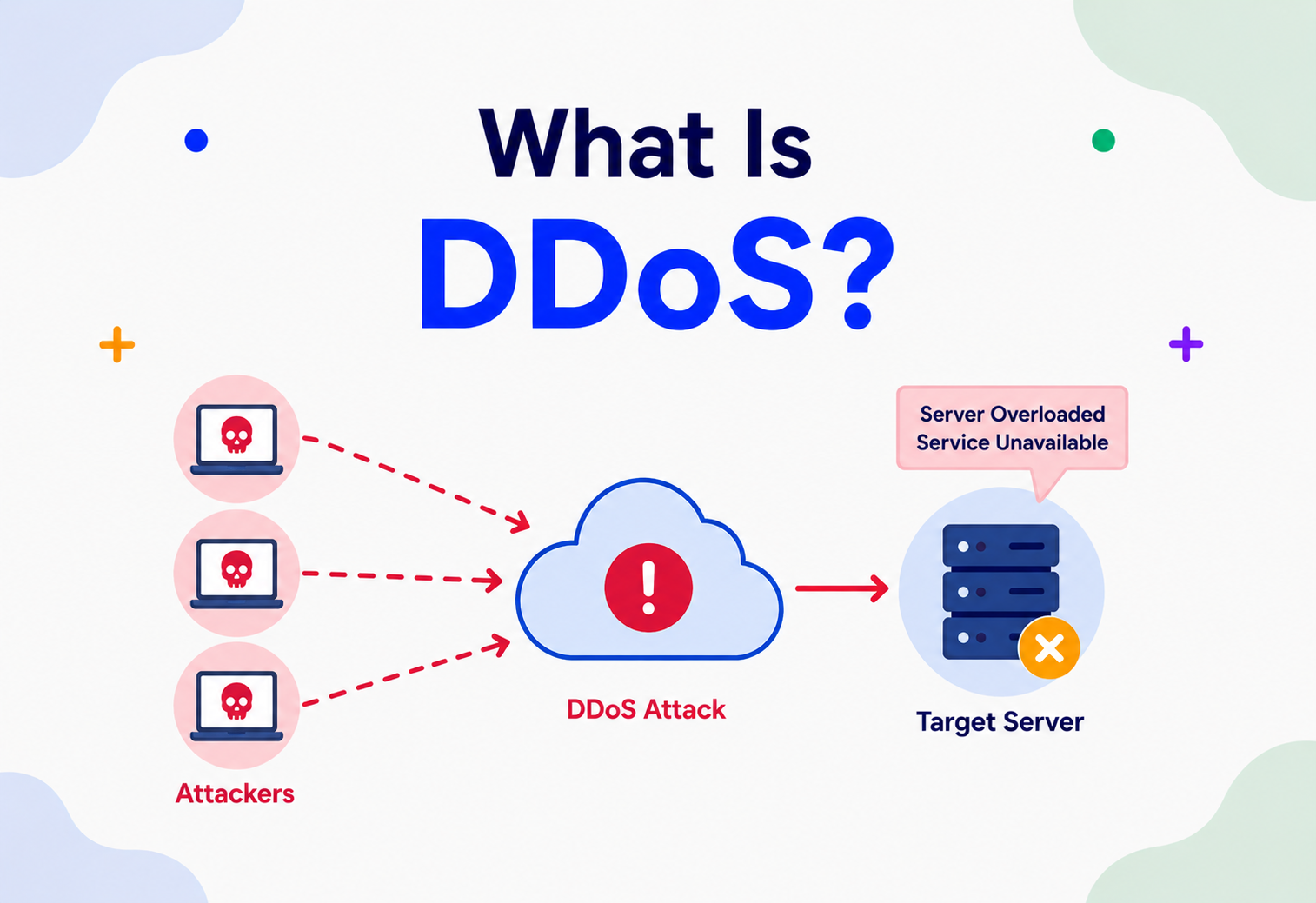
A DDoS attack is the internet equivalent of ten thousand people crowding a coffee shop’s only door — the shop is not robbed, not damaged, just made unusable. Understanding that single image is more than half of understanding the problem.
Imagine a small coffee shop with one door. One customer at a time walks in, orders, and leaves — everything works fine. Now imagine ten thousand people crowd around that single door at once, not to buy coffee, but just to stand there and block anyone else from getting in. The shop hasn’t been robbed or damaged. It’s just… unusable. Real customers can’t get through the crowd.
That’s the essence of a Distributed Denial of Service (DDoS) attack. It’s an attempt to make an online service — a website, an API, a game server, a bank’s login page — unavailable to its real users by overwhelming it with traffic from many different sources at the same time. The word breaks down cleanly:
- Denial of Service (DoS): the goal — stop the service from serving anyone.
- Distributed: the method — the traffic comes from many machines spread across the internet, not one.
Unlike a data breach, a DDoS attack usually doesn’t steal anything. Nobody necessarily reads your private messages or copies your database. Instead, it drowns the “front door” of a system in so much traffic — legitimate-looking requests, malformed packets, or both — that real users simply cannot get through, or the system crumbles trying to process the flood.

A DDoS attack is like a prank caller getting a thousand friends to all call the same pizza shop at the exact same time, all day. The phone line isn’t broken — it’s just permanently busy, so nobody who actually wants a pizza can ever get through.
1.1 A brief history
DDoS did not appear fully-formed. Each of the following moments marks a step where the attack technique got cheaper, larger, or more accessible — and each pushed defenders to respond in kind.
1996 — The first documented DoS attack
Panix, one of the earliest internet service providers, was taken offline by a “SYN flood” — a technique that abuses the way computers open network connections. It was crude by today’s standards, but it proved the concept: you don’t need to break in to cause damage.
2000 — Mafiaboy and the dot-com giants
A 15-year-old using the alias “Mafiaboy” knocked Yahoo!, eBay, CNN, and Amazon offline within days of each other, using a network of hijacked university computers. It was one of the first times the public understood DDoS as a real threat to major companies.
2010 — Operation Payback
Loosely organized online groups used simple, freely available flooding tools to attack payment companies as a form of protest, showing that DDoS had become accessible to non-experts — a tool of activism as much as crime.
2016 — The Mirai botnet
Mirai infected hundreds of thousands of insecure “Internet of Things” devices — home routers, security cameras, DVRs — turning them into an army of attack traffic generators. It was used to take down Dyn, a major DNS provider, breaking access to Twitter, Netflix, Reddit, and more for hours.
2023–2026 — The Tbps era
Cloud providers now routinely report attacks measured in terabits per second, powered by new amplification techniques and ever-larger botnets, while mitigation has matured into a specialized, automated discipline running at global scale.
1.2 DoS vs. DDoS — why “distributed” changes everything
Before botnets became common, attackers launched simple DoS (Denial of Service) attacks from a single machine. Defenders had an easy answer: identify the one IP address sending the flood, and block it at the firewall. Problem solved in seconds.
“Distributed” broke that easy answer. When traffic arrives from thousands or millions of different IP addresses simultaneously — many of them real home internet connections belonging to unaware victims — you can’t simply block “the attacker’s IP,” because there isn’t one attacker’s IP. There are thousands, and most of them look, individually, exactly like an ordinary customer. This single shift, from one source to many, is what turned DDoS from a nuisance into one of the hardest availability problems in computer science, and it’s why an entire industry of specialized mitigation now exists around it.
1.3 Why “open” internet infrastructure makes this worse
Part of what makes DDoS uniquely difficult is that the internet was designed in an era of mutual trust between a small number of research institutions. Core protocols like UDP and IP were never built with an adversarial internet in mind — nothing in the base protocol stops a machine from claiming to be someone else, or from sending far more traffic than is polite. Decades later, this same open, trusting design is what lets modern web services scale so easily to billions of users — and it’s exactly the same property attackers exploit to scale their floods.
Whether you become a backend engineer, an SRE, a security engineer, or an architect, you will eventually be asked: “How would our service behave if we were DDoSed right now?” The answer is never one tool — it is a design conversation about layers, budgets, and trade-offs. This guide gives you the vocabulary for that conversation.
Why Does This Matter?
Every online service has a finite capacity built out of physical resources — and any finite thing can be overwhelmed if the incoming demand is pushed high enough. That single fact is what makes DDoS an unavoidable engineering problem, not an optional one.
Every online service has a capacity — a maximum amount of traffic, connections, or computation it can handle at once. This capacity is finite because it’s built from real, physical resources: network bandwidth, CPU cycles, memory, database connections, file handles. DDoS attacks exploit a simple, unavoidable truth: any system that has a maximum capacity can be overwhelmed if the incoming demand is pushed high enough.
This matters because more of the world’s essential activity than ever runs through the internet: banking, healthcare records, emergency communication, government services, retail, and the software that businesses use to operate day-to-day. When a critical service goes down, the damage isn’t abstract — hospitals can lose access to patient systems, an online retailer can lose a day’s revenue in an hour, and a smaller company can lose customer trust it never gets back.
2.1 Who launches these attacks, and why?
DDoS is not a single-motive phenomenon. It is used by very different actors for very different reasons, which is why defenders can’t assume anything about who might target them or when.
Extortion
Attackers demand payment to stop an ongoing attack, or to prevent one — a digital protection racket aimed at businesses that can’t afford downtime.
Competitive sabotage
Taking down a rival’s website during a big sale, product launch, or esports tournament to cause reputational and financial harm.
Hacktivism
Groups attack organizations to protest a policy, political stance, or business practice, using downtime as a form of public statement.
Smokescreen
A DDoS attack distracts security teams while attackers attempt a separate, quieter intrusion — like data theft — somewhere else in the network.
Nation-state conflict
Government-linked groups disrupt another country’s infrastructure, media, or financial systems as part of geopolitical conflict.
“Booter” services
Attacks are now sold as a paid service — anyone can rent a botnet for a few dollars, dramatically lowering the skill needed to launch one.
A large flood can saturate a small business link in seconds. Mature automated mitigation typically reacts in minutes. A sustained, targeted campaign can last hours to days. The gap between how fast damage arrives and how fast a human can react is exactly why automated, pre-configured defense matters.
2.2 The economics of asymmetry
One of the most important things to understand about DDoS is that it’s fundamentally asymmetric: the cost to launch an attack is often far lower than the cost to defend against it. A single attacker renting a botnet for a modest fee can generate traffic that would cost a defender vastly more in bandwidth and infrastructure to simply absorb. This asymmetry is exactly why amplification techniques are so attractive to attackers — they multiply an already lopsided cost equation even further in the attacker’s favor — and why defenders have had to respond not with brute-force capacity alone, but with smarter, automated filtering that can tell attack traffic apart from real users cheaply, at scale.
2.3 Availability as a security property
Security is often summarized with the “CIA triad”: Confidentiality, Integrity, and Availability. Most popular discussion of cybersecurity focuses on the first two — keeping secrets secret, and keeping data unaltered. DDoS is the clearest possible illustration of why availability deserves equal weight: a system can keep every secret perfectly and never have a single record tampered with, and still fail its users completely if it simply cannot be reached when needed.
You cannot “fix” DDoS the way you fix a bug. There is no patch that makes a service immune. What you can do is raise the cost of a successful attack until it stops being worth an attacker’s time — and shrink the time to recovery when one still gets through.
The Building Blocks You Need to Understand DDoS
Before you can reason about defense, you need a shared vocabulary for the attackers’ toolbox: what a bot is, how bots coordinate, what makes one attack “volumetric” and another “application-layer,” and why amplification is so devastating.
3.1 Bots and botnets
A bot is a computer or device that has been infected with malware and can be remotely controlled without its owner’s knowledge — this could be a laptop, a smart camera, a router, or even a smart fridge. A botnet is simply a large collection of these bots, all controlled by the same attacker. Think of it like a puppeteer who has secretly wired thousands of puppets across the world; with one signal, every puppet moves at once.
3.2 Command and Control (C2)
The attacker doesn’t email each bot individually. Instead, bots regularly “check in” with a Command and Control (C2) server — a central hub that issues instructions like “attack this IP address, on this port, starting now.” Modern botnets sometimes avoid a single C2 server (which is an easy target to shut down) by using peer-to-peer designs, where bots pass instructions to each other.
3.3 Volumetric vs. protocol vs. application-layer attacks
DDoS attacks aren’t all the same shape. They’re generally grouped into three families based on which layer of the network they target — and each family needs a different kind of defense, because each family exhausts a different resource.
| Type | Target Layer | What it floods | Example technique |
|---|---|---|---|
| Volumetric | Network (L3/L4) | Raw bandwidth | UDP flood, DNS amplification |
| Protocol | Transport (L4) | Server/firewall connection state | SYN flood, ACK flood |
| Application | Application (L7) | App logic, CPU, database | HTTP flood, Slowloris |
3.4 Amplification and reflection
Some of the largest attacks don’t rely on raw botnet size at all — they use a trick called amplification. The attacker sends a small request to a public server (like a DNS or NTP server) but forges the “return address” to be the victim’s IP address. The server, doing nothing wrong itself, sends a much larger response to the victim. Send a 60-byte request, get a 3,000-byte response delivered to someone else — that’s a 50x amplification factor, for free, from the attacker’s perspective.
Amplification attacks abuse legitimate internet infrastructure. The DNS servers being used aren’t compromised — they’re just doing their normal job, unaware they’re being tricked into attacking someone else. This is why source-IP spoofing prevention across the internet (not just at your own network) is a shared responsibility.
3.5 Zombie IoT devices
The explosion of “smart” devices — cameras, routers, thermostats — has created millions of endpoints that are often never updated, ship with default passwords, and sit online 24/7. This makes them ideal, quiet recruits for botnets, since a compromised camera keeps recording video normally while silently flooding traffic in the background.
3.6 Attack surface
An attack surface is the total set of points where an outside party could try to interact with your system — every open port, every public API endpoint, every DNS record, every third-party integration. The bigger and less inventoried your attack surface, the more places an attacker can probe for the cheapest way to cause damage. Reducing attack surface — closing unused ports, retiring unused subdomains, requiring authentication on internal-only endpoints — shrinks the number of doors an attacker can crowd around in the first place.
3.7 Protocol-weakness attacks vs. brute-force floods
Not every DDoS attack wins through sheer traffic volume. Some exploit a specific weakness in how a protocol or piece of software behaves — for example, a request that is cheap for the attacker to send but expensive for the server to process, sometimes tied to a known vulnerability (a “CVE”). A single, carefully crafted request exploiting such a flaw can sometimes achieve more damage than a million ordinary ones, which is why patching known protocol and software vulnerabilities is itself considered part of DDoS defense, not a separate concern.
3.8 Spoofing
IP spoofing means forging the “from” address on a packet. It’s central to both reflection attacks (forging the victim’s address so replies go to them) and to hiding the true origin of an attack, making it harder for defenders and investigators to trace bots back to their source.
Everything else in this guide sits on top of these eight ideas. If you can explain botnets, C2, the three attack families, amplification, IoT recruitment, attack surface, protocol weaknesses, and spoofing to a teammate in your own words, you already understand the shape of the problem better than most people who read about it in the news.
The Anatomy of an Attack — and a Defense
To understand DDoS architecture, it helps to look at both sides: the attacker’s pipeline that produces the flood, and the layered defense a well-run production system builds to survive it.
4.1 Defensive components, layer by layer
Anycast network
The same IP address is announced from many global data centers, so incoming traffic (attack or legitimate) is automatically spread across dozens of locations instead of hitting one point.
Scrubbing centers
Specialized facilities that inspect traffic in bulk, strip out malicious packets, and forward only clean traffic onward to the real servers.
Edge / CDN layer
Caches and serves static content close to users, absorbing huge request volumes before they ever reach the origin servers.
Web Application Firewall (WAF)
Inspects application-layer requests for malicious patterns, bad bots, and abusive request rates.
Rate limiters
Enforce per-client or per-endpoint request caps, so one source can’t monopolize shared resources.
Load balancers
Distribute surviving traffic evenly across many backend servers so no single server becomes an overload point.
Bot detection / fingerprinting
Analyzes signals like browser fingerprint, TLS handshake details, and behavioral patterns to flag automated traffic that evades simple rate limits.
DNS-level protection
Protects the DNS layer itself with redundant, geographically distributed resolvers, since a DNS outage makes a service unreachable even if the servers behind it are perfectly healthy.
4.2 Why layering matters more than any single component
None of these components is a silver bullet on its own. Anycast spreads load but doesn’t distinguish good traffic from bad. A WAF understands application logic but does nothing against a pure bandwidth flood that never reaches it. The real defensive strength comes from the combination: each layer is responsible for catching what got past the layer before it, and each layer is cheaper to operate than the one behind it — filtering obviously malicious traffic at the network edge, before it ever reaches the more expensive, more precise inspection happening at the application layer.
How the Major Attack Types Actually Work
The families in Chapter 3 are useful shorthand, but real attacks have real mechanics. Once you can describe SYN floods, amplification, HTTP floods, and slow-and-low attacks in one paragraph each, you can reason about which defense stops which one — and which do nothing at all.
5.1 SYN flood (protocol attack)
Every TCP connection — the handshake underlying most internet traffic — starts with a three-step exchange: the client sends SYN, the server replies SYN-ACK and reserves memory for the connection, and the client is supposed to finish with ACK. In a SYN flood, the attacker sends a storm of SYN packets but never sends the final ACK. The server keeps reserving memory for connections that will never complete, until it runs out of resources and can’t accept real connections anymore.
5.2 UDP / DNS amplification (volumetric attack)
UDP is a “fire and forget” protocol with no handshake, which makes it easy to forge the sender’s address. An attacker sends small DNS queries to open DNS resolvers with the victim’s IP spoofed as the sender. The resolvers dutifully send their (much larger) answers straight to the victim, who never asked for anything.
5.3 HTTP flood (application-layer attack)
Here the attacker doesn’t need forged packets at all — bots simply make normal-looking HTTP requests (page loads, search queries, login attempts) but at massive volume. Because these look like real browser traffic, they’re much harder to filter than a raw packet flood, and they hit the parts of your system that are the most expensive per-request: application logic and database queries.
5.4 Slowloris (low-and-slow attack)
Instead of sending a huge volume, Slowloris opens many connections and sends data extremely slowly — just enough to keep each connection alive without ever finishing the request. A server with a limited number of concurrent connection slots can be exhausted by only a few hundred such connections, using almost no bandwidth at all.
5.5 A minimal token-bucket rate limiter
Here’s a minimal Java example showing the core idea behind a token bucket rate limiter, one of the most common building blocks used to blunt application-layer floods:
public class TokenBucket {
    private final long capacity;
    private double tokens;
    private final double refillRatePerMs;
    private long lastRefillTimestamp;

    public TokenBucket(long capacity, double refillRatePerSecond) {
        this.capacity = capacity;
        this.tokens = capacity;
        this.refillRatePerMs = refillRatePerSecond / 1000.0;
        this.lastRefillTimestamp = System.currentTimeMillis();
    }

    public synchronized boolean allowRequest() {
        refill();
        if (tokens >= 1) {
            tokens -= 1;
            return true; // request allowed
        }
        return false; // request rejected — client is over its rate limit
    }

    private void refill() {
        long now = System.currentTimeMillis();
        double tokensToAdd = (now - lastRefillTimestamp) * refillRatePerMs;
        tokens = Math.min(capacity, tokens + tokensToAdd);
        lastRefillTimestamp = now;
    }
}
Each client (identified by IP, API key, or session) gets its own bucket. Every request costs one token; tokens refill steadily over time. When the bucket runs dry, further requests from that client are rejected until it refills — this is exactly how most real-world API gateways throttle abusive callers, whether the abuse is intentional or just a misbehaving script.

5.6 NTP amplification, in detail
The Network Time Protocol (NTP), used to synchronize clocks across the internet, has a command called monlist that asks an NTP server to list the last few hundred machines it has talked to. A tiny request can trigger a response many times larger, and — like DNS amplification — the attacker spoofs the victim’s address as the sender. Because monlist served no purpose that most users needed, modern NTP servers largely disable it by default, a good example of how removing an unnecessary feature can close off an entire attack technique.
5.7 Smurf attacks and the ICMP era
An older but historically important technique, the Smurf attack, sends an ICMP “ping” to a network’s broadcast address with the victim’s address spoofed as the sender. Every device on that network replies at once — to the victim, not the attacker — multiplying a single ping into hundreds of responses. Most networks now refuse to forward pings sent to broadcast addresses specifically because of this history.
5.8 Circuit breakers: containing overload before it cascades
Whether the traffic flooding a system is malicious or just an unexpected surge in real users, the underlying defensive pattern is the same: stop calling an overloaded dependency instead of piling more load onto it. A circuit breaker tracks recent failures from a downstream call and “trips open” once failures cross a threshold, failing fast instead of waiting on doomed requests:
public class CircuitBreaker {
    private enum State { CLOSED, OPEN, HALF_OPEN }

    private State state = State.CLOSED;
    private int failureCount = 0;
    private final int failureThreshold;
    private long openedAt;
    private final long resetTimeoutMs;

    public CircuitBreaker(int failureThreshold, long resetTimeoutMs) {
        this.failureThreshold = failureThreshold;
        this.resetTimeoutMs = resetTimeoutMs;
    }

    public synchronized boolean allowCall() {
        if (state == State.OPEN) {
            if (System.currentTimeMillis() - openedAt > resetTimeoutMs) {
                state = State.HALF_OPEN; // try one test call
                return true;
            }
            return false; // fail fast, don’t add load to a struggling dependency
        }
        return true; // CLOSED or HALF_OPEN: allow the call through
    }

    public synchronized void recordSuccess() {
        failureCount = 0;
        state = State.CLOSED;
    }

    public synchronized void recordFailure() {
        failureCount++;
        if (state == State.HALF_OPEN || failureCount >= failureThreshold) {
            state = State.OPEN;
            openedAt = System.currentTimeMillis();
        }
    }
}
During a flood, this pattern prevents a single overwhelmed dependency — say, a database under application-layer attack — from also dragging down every other service that calls it, buying the rest of the system time to keep serving what it can.
The Lifecycle of an Attack — and a Response
Every DDoS incident, no matter the technique, moves through the same seven stages. Naming those stages turns a chaotic outage into a repeatable, rehearsable playbook.
Reconnaissance
The attacker researches the target — its public IP ranges, DNS records, hosting provider, and any known weak points.
Weaponization / recruitment
A botnet is assembled or rented, often from existing criminal infrastructure, sized to the target’s estimated capacity.
Launch
The C2 server signals all bots to begin sending traffic to the target simultaneously, often ramping up over seconds.
Saturation
Bandwidth, connection tables, or application resources fill up; legitimate users begin experiencing timeouts and errors.
Detection
Monitoring systems flag abnormal traffic volume, unusual geographic distribution, or spikes in error rates.
Mitigation
Scrubbing, rate limiting, and traffic filtering engage — automatically in mature setups — to separate attack traffic from real users.
Recovery & post-mortem
Services return to normal; the team reviews logs, updates defenses, and documents lessons learned for next time.
In modern cloud-protected environments, steps 5 and 6 increasingly happen in seconds rather than minutes, because detection systems compare live traffic against learned baselines and can trigger mitigation automatically — no human has to be paged before the first countermeasure activates.
The last stage is the one most easily skipped when everyone is exhausted after an incident. It is also the stage that pays for itself many times over: every rehearsed retrospective moves reconnaissance-through-recovery a little bit faster the next time.
Trade-offs in DDoS Defense Strategy
There is no single “turn on DDoS protection” switch. Every mitigation approach carries a trade-off between cost, latency, false positives, and protection depth — and choosing well means knowing which trade-offs you are actually willing to make.
Always-on cloud scrubbing — Pros
- Protection starts before an attack is even detected locally.
- Scales to attack sizes far beyond what any single company could absorb.
- Offloads the operational burden to specialists.
Always-on cloud scrubbing — Cons
- Adds a small amount of latency to every request, even when there’s no attack.
- Ongoing subscription cost regardless of whether you’re attacked.
- Requires trusting a third party with your traffic.
On-demand mitigation — Pros
- No added latency or cost during normal operation.
- Simpler architecture when attacks are rare.
On-demand mitigation — Cons
- Detection and activation delay means some downtime is nearly guaranteed.
- Rerouting traffic mid-attack (e.g., changing DNS) can itself take time to propagate.
Similarly, aggressive rate limiting stops floods effectively but risks blocking real users during legitimate traffic spikes (a flash sale, a viral post) — a false positive that looks, from a business point of view, exactly like a successful attack.
Every legitimate user you block during an attack is a real business cost too. Mature defenses are tuned not just to catch bad traffic, but to minimize collateral damage to good traffic — because a customer who gets a “you look suspicious” page during checkout may not come back.
Defending at Internet Scale
Modern volumetric attacks are measured in terabits per second — more raw bandwidth than most companies’ entire internet connection, let alone a single server. Defending at this scale is not about buying a bigger firewall; it is about architectural distribution.
8.1 Anycast: turning one address into hundreds
With Anycast routing, the same IP address is broadcast from dozens or hundreds of data centers worldwide. The internet’s normal routing (BGP) sends each user’s traffic to their nearest location automatically. This means an attack’s traffic is naturally split across all those locations too — a 2 Tbps attack might arrive as roughly 20 Gbps at each of 100 facilities, a far more manageable number.
8.2 Horizontal scaling and elasticity
Cloud-based auto-scaling lets an application layer add capacity dynamically when load increases. This helps with moderate spikes but is not, by itself, a DDoS defense — scaling up in response to an attack just means you’re paying more to also get flooded, unless it’s paired with filtering that keeps illegitimate traffic from ever reaching the scaled-up servers.
Scalability solves the problem of “too many legitimate users.” DDoS mitigation solves the problem of “traffic that shouldn’t count as legitimate at all.” Confusing the two is a common design mistake — you cannot auto-scale your way out of an attack designed to be bigger than your budget.
8.3 Peering and transit capacity
Behind Anycast and auto-scaling sits an even more basic resource: the raw physical bandwidth of the network links connecting a data center to the rest of the internet. Large cloud and CDN providers negotiate enormous “peering” agreements directly with other networks, giving them access to aggregate bandwidth measured in many terabits per second — bandwidth no single customer could economically buy on their own. This is one of the core reasons organizations route traffic through large third-party networks during an attack: it’s not just about smarter filtering, it’s about borrowing a pipe far larger than any one company would build for itself.
8.4 Cost of scale versus cost of an outage
DDoS mitigation at scale isn’t free — scrubbing capacity, Anycast networks, and 24/7 monitoring all carry real infrastructure and staffing costs. But this has to be weighed against the cost of an outage: lost revenue during downtime, support costs handling the incident, and, often the largest cost of all, damage to customer trust. For any business whose revenue meaningfully depends on uptime, the economics almost always favor investing in mitigation capacity ahead of time rather than absorbing the cost of an unplanned outage later.
Designing Systems That Stay Up Under Attack
High availability (HA) design principles that exist for hardware failures and traffic spikes turn out to be equally valuable against DDoS, because both problems boil down to the same thing: part of the system is unavailable or overloaded — keep serving users anyway.
Redundancy
No single server, data center, or network link should be a single point of failure; attackers (and outages) will find and exploit exactly that point.
Graceful degradation
Under load, serve a simplified or cached version of a page rather than failing entirely — a slow response beats no response.
Circuit breakers
When a downstream dependency (like a database) is overwhelmed, stop calling it temporarily rather than piling up requests that will all fail anyway.
Bulkheads
Isolate resources per feature or tenant so that one overwhelmed component can’t sink the entire system, the way watertight compartments keep a ship afloat.
Failover regions
Maintain the ability to reroute traffic to a healthy region or provider if one location is saturated or unreachable.
Chaos engineering
Deliberately inject failure and load in controlled tests so that weaknesses are found by your own team, not by an attacker.
9.1 The CAP theorem angle
The CAP theorem states that a distributed system can’t simultaneously guarantee perfect Consistency, Availability, and Partition tolerance — it has to trade off between them when a network problem occurs. A DDoS attack is, in effect, a deliberately induced network partition: it separates users from your service just as surely as a fiber cut would. Systems designed with CAP trade-offs already in mind — for example, choosing to serve slightly stale cached data rather than no data at all when a backend is unreachable — tend to degrade far more gracefully under attack than systems that assume the network will always behave.
9.2 Recovery time objectives
High-availability planning usually defines a target Recovery Time Objective (RTO) — how quickly a service must be restored after an incident — and a Recovery Point Objective (RPO) — how much data loss, if any, is acceptable. Applying these same objectives to DDoS scenarios forces concrete, testable answers to questions like “how many minutes can we tolerate before automated mitigation must kick in?” rather than leaving availability targets as a vague aspiration.
Almost every technique in this chapter was invented for reasons that had nothing to do with DDoS — disk failures, network partitions, rack outages, deployment mistakes. The reason they carry over so cleanly is that from a system’s point of view, “a component is overloaded and can’t answer” looks the same whether the cause is a hardware fault or a hostile flood.
Hardening a System Against DDoS
There is no single “DDoS switch” to flip. Hardening happens in three layers — network, application, and organizational — and skipping any one of them leaves an opening large enough for the other two not to matter.
10.1 Network-level hardening
- Ingress filtering / BCP38: ISPs and networks block outgoing packets with spoofed source addresses, reducing the raw material available for reflection attacks.
- SYN cookies: a server can respond to SYN floods by encoding connection state into the SYN-ACK response itself instead of reserving memory upfront, defeating the memory-exhaustion trick.
- Firewalls and ACLs: block traffic from known-bad IP ranges and disallow unnecessary protocols/ports at the network edge.
10.2 Application-level hardening
- CAPTCHAs and JavaScript challenges: distinguish real browsers (which can execute JavaScript and solve challenges) from simple bot scripts.
- Web Application Firewalls (WAF): apply rulesets that catch known malicious request patterns and abusive clients.
- API keys and authentication on expensive endpoints: require identity before granting access to costly operations, enabling per-identity rate limits.
10.3 Organizational practices
- Maintain a written, rehearsed DDoS incident response plan, including who to call at your ISP or mitigation provider.
- Keep IoT and embedded devices on your own network updated and off default credentials, so your infrastructure doesn’t become someone else’s botnet.
- Run regular tabletop exercises simulating an attack, the same way fire drills prepare people for a real emergency.
DDoS protection is not “installing an antivirus for your server.” It has to be designed into network architecture, traffic routing, and application behavior — there’s no single patch that prevents it.
10.4 Defense in depth
No single control above is sufficient by itself — SYN cookies don’t stop an HTTP flood, and a WAF doesn’t stop a volumetric attack that never reaches the application layer at all. Real-world resilience comes from stacking these controls so that whatever gets past one layer is caught by the next, the same “defense in depth” philosophy used throughout security engineering generally, from physical building security to data encryption.
10.5 The shared responsibility model
When infrastructure runs on a cloud provider, DDoS defense is typically split: the provider secures the underlying network and physical infrastructure, while the customer is responsible for configuring rate limits, authentication, and monitoring correctly on top of it. A perfectly protected cloud network still won’t save an application that exposes an unauthenticated, expensive endpoint to the public internet — that gap belongs to the application owner, not the cloud provider.
Seeing an Attack Before It Becomes an Outage
You cannot mitigate what you cannot see. Effective DDoS monitoring depends on establishing a normal traffic baseline and alerting on meaningful deviations from it — not just raw traffic volume, which naturally varies by time of day and season.
Traffic volume & rate
Bits per second and packets per second, tracked per network segment, compared against historical baselines.
Connection metrics
New connections per second, half-open connection counts, and connection table utilization — key signals for SYN floods.
Request-level metrics
HTTP error rates (especially 5xx and 429), request latency percentiles (p95/p99), and requests per client IP.
Geographic & source distribution
Sudden traffic from unusual countries or a disproportionate share from data-center IP ranges (rather than residential ISPs) is a red flag.
Upstream provider signals
Your ISP or CDN often detects and reports abnormal patterns before your own systems show visible symptoms.
Synthetic monitoring
Automated probes that repeatedly test real user journeys from outside your network, catching degradation that internal metrics might miss.
Well-run teams build dashboards showing these signals side by side and configure alerts tuned to avoid both extremes: missing a real attack, and “alert fatigue” from too many false alarms during ordinary traffic spikes.
11.1 Logging for post-incident analysis
During an active attack, logs are often too voluminous to read line by line — but they remain essential afterward. Detailed access logs, connection logs, and mitigation-system logs let a team reconstruct exactly which technique was used, which defenses triggered (and when), and whether any legitimate traffic was mistakenly blocked. This “post-mortem” analysis is what turns one incident into a permanently improved defense rather than a one-time firefight that gets forgotten.
11.2 Distributed tracing during overload
In a microservices environment, distributed tracing — tagging each request with an identifier that follows it across every service it touches — becomes especially valuable during an attack, because it shows precisely where in a request’s journey time is being lost. Without tracing, an application-layer flood can look like a vague, system-wide slowdown; with tracing, it’s often possible to pinpoint the exact overloaded service or database query the attack is exploiting.
Where DDoS Mitigation Actually Runs
Almost no organization builds DDoS mitigation entirely in-house today; it is typically layered across a few providers, each responsible for a different slice of the problem.
| Layer | Typical provider type | What it handles |
|---|---|---|
| ISP / transit | Network carriers | Bulk volumetric filtering upstream of your own network |
| CDN / edge | Content delivery networks | Absorbs and caches web traffic close to users; blocks common L7 attacks |
| Cloud provider shield | Public cloud platforms | Always-on protection for cloud-hosted infrastructure and load balancers |
| Specialized scrubbing | Dedicated DDoS mitigation vendors | Deep packet inspection and traffic cleaning during large or sophisticated attacks |
A typical production deployment routes all public traffic through a CDN/edge layer first, which itself sits behind or alongside cloud-provider DDoS protection, with a contract in place for emergency scrubbing capacity if an attack exceeds normal thresholds. This layered “defense in depth” mirrors how HA design uses multiple redundant layers rather than trusting any single safeguard.
12.1 Multi-cloud and multi-CDN strategies
Some organizations deliberately split traffic across more than one cloud or CDN provider. This adds operational complexity, but it removes a single provider outage or a provider-specific attack technique as a total single point of failure — if one provider’s network is struggling, DNS or traffic-management tooling can shift load to the other within minutes.
How Backend Infrastructure Choices Affect Resilience
Attackers aim at whatever is most expensive to serve. The cheaper you can make your average request, the less damage any given flood can do — which is why caching, load balancing, and connection management are not just performance optimizations, they are DDoS controls too.
13.1 Caching
Every request served from a cache is a request that never reaches your database. Aggressive caching of read-heavy content (product pages, articles, search results) dramatically shrinks the “expensive surface area” an application-layer flood can hit, since attackers gain far less by hammering pages that are served in microseconds from memory rather than computed fresh each time.
13.2 Load balancing
Load balancers distribute surviving traffic across many backend instances, preventing any single server from becoming a bottleneck — and modern load balancers can also perform basic health checks and pull overloaded instances out of rotation automatically, containing damage rather than letting it cascade.
13.3 Database connection limits
Databases have a hard cap on concurrent connections. A flood of requests that each open a new database connection can exhaust this cap long before network bandwidth becomes the bottleneck. Connection pooling — reusing a fixed, smaller set of database connections across many requests — prevents this class of exhaustion.
The cheapest request to defend against is the one that never reaches your database.
DDoS in a Microservices World
Microservice architectures multiply the number of network endpoints, internal APIs, and service-to-service calls — each one a potential target, and each one a potential amplifier if it calls other services in turn.
- API gateways centralize rate limiting and authentication for all external traffic, so individual microservices don’t each need to reinvent flood protection.
- Per-endpoint rate limits matter because not all endpoints cost the same — a search endpoint that triggers a complex database query deserves a stricter limit than a static health-check endpoint.
- Internal request amplification is a subtle risk: a single external request that fans out into ten internal service calls means an attacker gets a 10x “amplification” effect on your own infrastructure, for free.
- Service mesh timeouts and retries must be tuned carefully — aggressive automatic retries between services can turn a minor overload into a self-inflicted flood as failed requests are retried again and again.
14.1 Rate limiting strategies compared
| Strategy | Granularity | Good for | Weakness |
|---|---|---|---|
| Per-IP | Network address | Simple, cheap to apply at the edge | Easily defeated by large botnets or shared NATs |
| Per-API-key / per-user | Authenticated identity | Precise, fair across shared IPs | Requires authentication before limiting, doesn’t help unauthenticated endpoints |
| Per-endpoint | Route or operation | Protects the most expensive operations specifically | Needs ongoing tuning as endpoints change in cost |
| Global / system-wide | Whole service | Last line of defense against total overload | Blunt — can degrade service for everyone at once |
Mature systems usually combine several of these simultaneously: a coarse per-IP limit at the edge, a precise per-key limit at the API gateway, and a global circuit breaker as a final safety net if everything else is somehow exceeded.
14.2 GraphQL and query-cost attacks
APIs that let clients construct their own queries — GraphQL being the most common example — introduce a subtler risk: a single, small request can ask for an enormous, deeply nested amount of data or computation. Defending these APIs requires estimating and capping the “cost” of a query before executing it, not just counting requests, since a flood of one request each could still be devastating if each one is disproportionately expensive.
What to Do — and What to Avoid
Most successful defenses look boring on paper: rate-limit at every layer, break the circuit when a dependency struggles, serve static content from the edge, practice failover before you need it. Most failures come from a small set of anti-patterns that quietly undo all of that.
Good patterns
- Rate limiting at every layer: edge, gateway, and per-service.
- Circuit breakers between services to contain cascading failure.
- Static content served from CDN, never from origin servers directly.
- Automatic, tested failover across regions or providers.
Anti-patterns
- Relying on a single provider or region with no failover plan.
- Unbounded retry logic with no backoff between services.
- Treating DDoS defense as a one-time setup rather than an ongoing practice.
- Exposing expensive, unauthenticated endpoints directly to the public internet.
A particularly common anti-pattern is the retry storm: when a service starts timing out, clients (or other services) retry failed requests automatically. If retries aren’t spaced out with exponential backoff and jitter, this retry traffic itself becomes a self-inflicted denial-of-service layered on top of whatever caused the original slowdown.
15.1 Exponential backoff with jitter, in practice
The fix for retry storms is simple in principle but easy to get wrong: instead of every failed client retrying immediately (or all retrying after exactly the same delay, which just synchronizes the storm into repeating waves), each client should wait progressively longer between attempts, with a small random offset so that clients don’t all retry in lockstep:
public class BackoffCalculator {
    private final long baseDelayMs;
    private final long maxDelayMs;

    public BackoffCalculator(long baseDelayMs, long maxDelayMs) {
        this.baseDelayMs = baseDelayMs;
        this.maxDelayMs = maxDelayMs;
    }

    public long nextDelay(int attempt) {
        long exponential = (long) (baseDelayMs * Math.pow(2, attempt));
        long capped = Math.min(exponential, maxDelayMs);
        long jitter = (long) (Math.random() * capped * 0.3); // up to 30% jitter
        return capped - jitter;
    }
}
Spread across thousands of clients, this small amount of randomness is what prevents a synchronized “thundering herd” from re-forming every time a fixed retry interval elapses — a subtle but important defensive pattern that shows up throughout distributed systems design, not just DDoS resilience specifically.
15.2 Bulkhead pattern, applied to multi-tenant systems
In systems serving many customers or tenants from shared infrastructure, a flood aimed at (or accidentally caused by) one tenant should not be able to consume all shared resources and degrade service for every other tenant. Partitioning resource pools — separate connection pools, separate rate-limit buckets, even separate compute quotas per tenant — contains the blast radius of any single overloaded tenant to that tenant alone, mirroring how a ship’s watertight bulkheads keep one flooded compartment from sinking the whole vessel.
Getting DDoS Readiness Right
Everything in this chapter is either free or cheap. It is also what actually separates organizations that shrug off attacks from ones that spend a bad afternoon on the front page of a tech-news site.
16.1 Best practices
- Establish traffic baselines early, so anomalies are detectable in the first place.
- Use Anycast and CDN distribution for anything public-facing at meaningful scale.
- Pre-negotiate emergency scrubbing capacity with a provider before you need it — during an active attack is the worst time to be signing a new contract.
- Separate critical services (payments, auth) from less critical ones so a flood on one doesn’t take down everything.
- Rehearse the incident response plan, including internal communication, not just the technical mitigation steps.
16.2 Common mistakes
- Assuming “we’re too small to be a target” — smaller sites are often attacked precisely because they have weaker defenses.
- Testing DDoS defenses only in theory, never with an actual load test against a staging environment.
- Leaving default credentials on internal IoT or network devices, unintentionally contributing bots to someone else’s botnet.
- Forgetting that DNS itself is a target — if your DNS provider goes down, your service is unreachable even if your servers are perfectly healthy.
16.3 A practical readiness checklist
Know your baseline
Document normal traffic volume, error rates, and geographic distribution so anomalies are obvious, not guesswork.
Map your dependencies
List every third-party service (DNS, payment processor, auth provider) whose outage would take you down too, even if your own servers are fine.
Pre-arrange escalation contacts
Have direct contact information for your ISP, CDN, and mitigation provider ready before an incident, not looked up mid-attack.
Test under load
Run regular load tests against staging environments that simulate both legitimate spikes and attack-like patterns.
Practice the runbook
Walk through the incident response plan as a team periodically, the same way organizations run fire drills for physical emergencies.
Review after every incident
Even a near-miss or a false alarm is worth a short retrospective — most improvements to DDoS defenses come from real incidents, not theory.
Landmark Attacks, and What They Taught the Industry
The best way to understand where DDoS defense is today is to look at the incidents that shaped it — each of these attacks left the industry visibly changed.
Dyn (2016)
The Mirai IoT botnet targeted Dyn, a major DNS provider, taking down access to Twitter, Netflix, Spotify, and Reddit for hours across the US. It proved that a single point of infrastructure — DNS — can create outages far beyond one company’s own servers, pushing the industry toward multi-provider DNS.
GitHub (2018)
GitHub absorbed a then-record 1.35 Tbps attack using a memcached amplification technique. Its cloud DDoS mitigation service detected and rerouted traffic within minutes, and the site was back to normal in under 20 minutes — a widely cited example of automated mitigation working as designed.
AWS (2020)
Amazon Web Services reported mitigating a 2.3 Tbps attack using CLDAP reflection, absorbed entirely within its own Anycast network without customer-visible impact, demonstrating the scale that global cloud infrastructure can now defend against.
Google Cloud (2023)
Google disclosed defending against a then-record request-rate attack exploiting an HTTP/2 protocol weakness, showing that even well-established, standardized protocols can harbor exploitable flaws years after widespread adoption.
Spamhaus (2013)
An anti-spam organization was hit with a DNS amplification attack that, at the time, was among the largest ever recorded, spilling over to congest internet exchange points shared by many unrelated organizations — an early, vivid example of how amplification attacks can have blast radius well beyond the intended target.
Estonia (2007)
A wave of coordinated attacks disrupted government, banking, and media websites across an entire country following a political dispute, becoming one of the first widely cited examples of DDoS used as a tool in a geopolitical conflict rather than against a single company.
The consistent lesson across all of these incidents: the organizations that recovered fastest were the ones with layered, pre-built, tested mitigation — not the ones improvising a response mid-attack.
Every one of these landmark events pushed a specific piece of defense — multi-provider DNS, automated Tbps-scale scrubbing, protocol-level HTTP/2 hardening — from “interesting research idea” to “expected industry baseline.” The best time to adopt the next one is before it becomes news.
Frequently Asked Questions
A grab-bag of the questions almost every engineer, product manager, and executive asks the first time they seriously think about DDoS.
Is DDoS the same as hacking?
Not exactly. Hacking usually implies breaking into a system to steal or alter data. DDoS is about overwhelming availability — it doesn’t require breaking in at all, and often nothing is stolen.
Can a home internet connection be DDoSed?
Yes — this is sometimes called a “booter” attack, often used against individuals in online gaming, where a rival floods an opponent’s home IP address to knock them offline mid-match.
Is it illegal to launch a DDoS attack?
Yes, in most countries, launching a DDoS attack against a system you don’t own or have explicit permission to test is a criminal offense, regardless of the attacker’s motive.
Can DDoS attacks be completely prevented?
Not with absolute certainty — but layered mitigation, redundancy, and monitoring can reduce both the likelihood of a successful attack and the time it takes to recover from one that occurs.
Does a firewall stop DDoS attacks?
A traditional firewall alone is not enough. It can block known-bad traffic, but a large volumetric attack can overwhelm the network link in front of the firewall entirely, before the firewall ever gets a chance to inspect the traffic.
How is DDoS different from a regular traffic spike?
The traffic pattern, source diversity, and request behavior differ — a real spike (like a product launch) usually shows realistic browsing patterns and geographic spread matching your actual customer base, while attack traffic often shows unnatural uniformity or origin from data-center IP ranges rather than residential users.
Do small businesses actually need DDoS protection?
Yes. Attack tools and “booter” services have become inexpensive and easy to use, and smaller organizations often have thinner defenses and smaller internet connections, meaning even a modest attack can knock them fully offline — while the same attack might barely register against a large, well-defended target.
Can VPNs or proxies protect against DDoS?
A VPN can hide your real IP address from casual observation, which helps individuals avoid being directly targeted, but it is not a substitute for proper mitigation infrastructure for a production service — if your VPN provider’s endpoint gets flooded, you’re still affected.
What’s the difference between DDoS and a “bot attack” like credential stuffing?
Credential stuffing and content scraping use bots to try to gain unauthorized access or extract data — the goal is theft or fraud, not necessarily downtime. The two categories can overlap (both use automated traffic and both benefit from rate limiting and bot detection) but their objectives, and sometimes their defenses, differ.
Key Takeaways
If you remember only one page from this guide, remember this one. Everything else is elaboration.
What to remember about DDoS
- DDoS attacks aim to make a service unavailable by overwhelming it with traffic from many distributed sources — not to steal data.
- Attacks fall into three families: volumetric (bandwidth), protocol (connection state), and application-layer (app logic) — each needs a different defense.
- Amplification and reflection let attackers generate outsized traffic from small requests, abusing legitimate internet infrastructure.
- Defense is layered: Anycast and CDN distribution, scrubbing centers, WAFs, rate limiting, and load balancing all play different roles.
- Many of the same principles behind high availability — redundancy, graceful degradation, circuit breakers — directly strengthen DDoS resilience too.
- Detection depends on knowing your normal traffic baseline; monitoring connection state, error rates, and source distribution catches attacks early.
- The organizations that recover fastest from real attacks are the ones that tested and rehearsed their defenses long before an attack happened.
As you continue exploring system design, you will find that most of what makes a system fast, reliable, or scalable also makes it more resistant to DDoS — and vice versa. Rate limits, caching, redundancy, circuit breakers, and layered architecture are not separate disciplines; they are one shared toolbox applied to overlapping problems. Building that instinct — treating availability as an engineering property to be designed for, not hoped for — is what turns understanding DDoS from a security topic into a habit of good architecture.