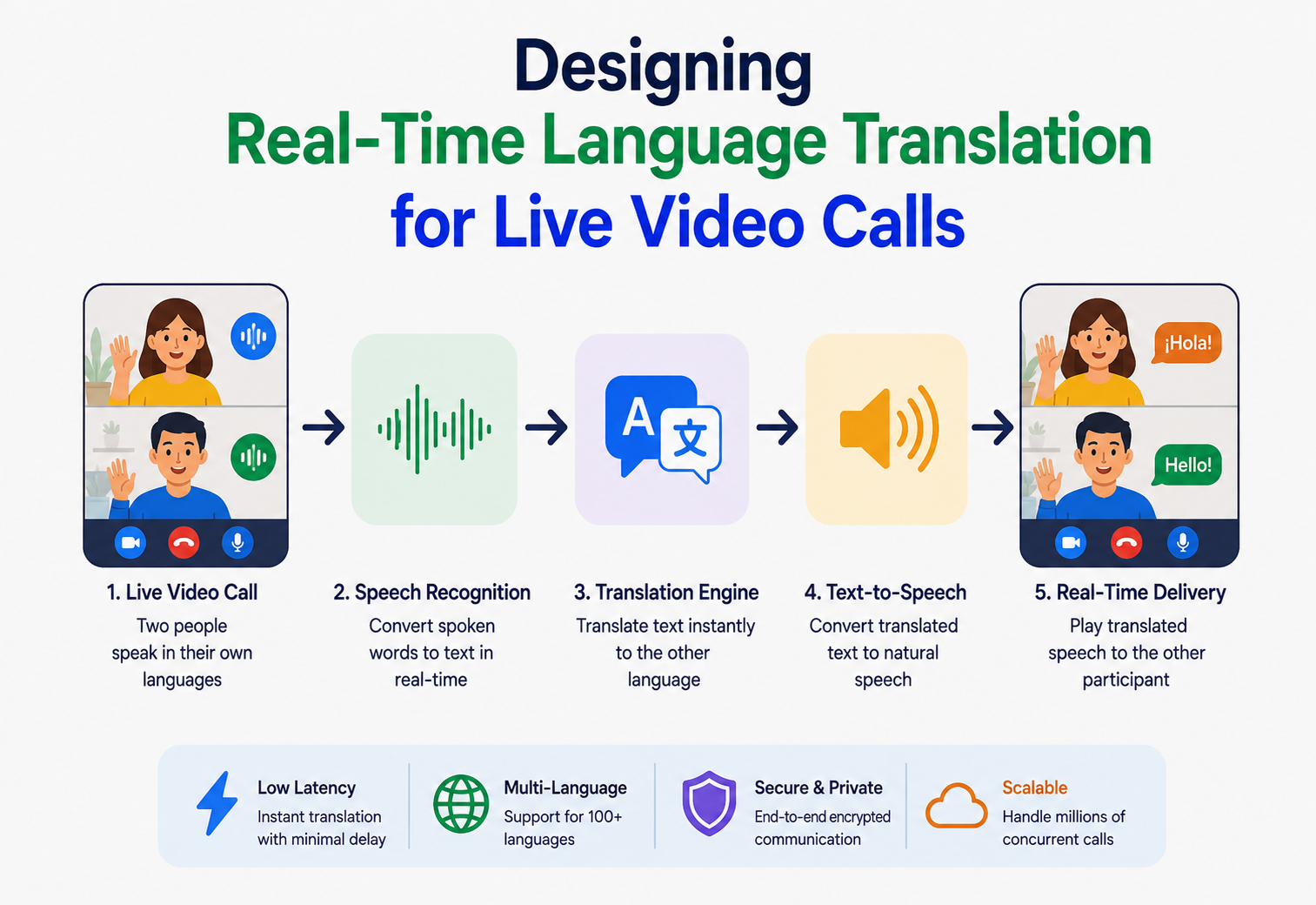
Designing Real-Time Language Translation for Live Video Calls
A complete system design walkthrough covering architecture, ASR / MT / TTS pipelines, WebRTC media routing, latency budgeting, scaling to millions of concurrent minutes, reliability, and security — written for interview preparation and real production understanding.
Introduction & History
Imagine two people on a video call — one speaking Japanese in Tokyo, the other speaking Spanish in Madrid. A few years ago, this call would have needed a human interpreter sitting in on the conversation, translating sentence by sentence, with awkward pauses and delays. Today, systems like Microsoft Teams’ live translated captions, Google Meet’s real-time subtitles, Zoom’s AI Companion translation, and Skype Translator do this automatically, converting speech from one language to text or speech in another language, in near real time, while the call is still happening.
This is one of the hardest problems in applied real-time systems, because it sits at the intersection of three very different engineering disciplines: low-latency real-time media transport (the same technology that powers video calls), streaming machine learning inference (speech recognition and translation models that must produce partial results within milliseconds), and large-scale distributed systems (because this has to work for millions of simultaneous calls without falling over).
A Brief History
Real-time speech translation research goes back decades, but it only became practical for consumer products in the last ten years, driven by three parallel advances. First, automatic speech recognition (ASR) moved from rigid, dictionary-based systems to deep learning models that could handle natural, messy, overlapping speech. Second, machine translation moved from statistical phrase-based translation to neural machine translation (NMT), which produces far more fluent and context-aware output. Third, and most importantly for this system, both ASR and NMT learned to work in a streaming fashion — producing partial, continuously-refined output as audio arrives, instead of waiting for someone to finish speaking before processing anything.
Skype Translator, launched around 2014, was one of the first mainstream attempts at real-time speech-to-speech translation in a video call. It proved the concept was possible but suffered from noticeable delay and translation quality issues. Since then, transformer-based architectures, better streaming inference techniques, and dramatically cheaper GPU inference have made the experience good enough for daily use in products like Google Meet, Microsoft Teams, and Zoom.
In this tutorial, we will design such a system from scratch: a real-time language translation layer that sits on top of a live video call, converting spoken language from one participant into captions or synthesized speech that another participant can understand, with the smallest latency the underlying technology allows, at the scale of millions of concurrent call-minutes per day.

Not a video calling system itself (we assume WebRTC-based calling infrastructure already exists), but the translation layer that plugs into it — capturing audio, recognizing speech, translating it, and delivering the result back to other participants with minimal added delay.
Understanding the Problem
Before drawing any boxes and arrows, we need to be precise about what “real-time” and “minimal added latency” actually mean here, because these constraints shape every architectural decision that follows.
2.1 Functional Requirements
Speech capture & LID
Capture a speaker’s audio during a live video call and detect which language they are speaking.
Speech-to-text
Convert speech to text in the source language (transcription) with a streaming-first model.
Translate
Translate that text into one or more target languages, one per listener’s preference.
Captions or dubbing
Deliver the translated result to other participants either as live captions (subtitles) or as synthesized spoken audio (voice dubbing), depending on product mode.
Many-to-many calls
Support many-to-many calls: a call with five participants speaking three different languages must fan out translations correctly to each listener’s preferred language.
Timing & conversation flow
Keep translated captions/audio reasonably synchronized with the original speaker’s lip movement and the flow of conversation, and handle interruptions, overlapping speech, silence, and speaker changes gracefully.
2.2 Non-Functional Requirements
- Low latency: The end-to-end delay from a word being spoken to its translation appearing for the listener should ideally be under 2 to 3 seconds, and the “added” latency on top of the existing call’s audio/video delay should be minimized as much as possible — every extra millisecond in the pipeline directly hurts conversational flow.
- High accuracy: Poor transcription or mistranslation in a business or medical context can cause real harm, so quality cannot be sacrificed carelessly for speed.
- Massive scale: The system must support millions of concurrent call-minutes, with translation requests arriving continuously as small audio chunks, not as large batch jobs.
- High availability: A translation outage should degrade gracefully (e.g., fall back to captions only, or turn translation off) rather than dropping the underlying call.
- Privacy and security: Voice data is sensitive biometric and personal information; it must be encrypted in transit, processed with strict data handling policies, and, ideally, not stored longer than necessary.
- Multilingual coverage: Support dozens of source and target languages, including low-resource languages, with acceptable quality.
- Cost efficiency: Running GPU-backed ASR and translation models for millions of concurrent minutes is expensive; the design must be efficient about when and how much compute it uses.
2.3 Why This Is Architecturally Hard
The fundamental tension in this system is between latency and accuracy. Speech recognition and translation models generally produce better results when they can see more context — for example, waiting until the end of a sentence before translating it, because word order and meaning can change based on what comes later in the sentence. But waiting for a full sentence adds delay that breaks the feel of a live conversation. The entire design revolves around resolving this tension using streaming models, incremental re-translation, and careful latency budgeting across every hop in the pipeline.
- “Why can’t we just batch process each sentence after the speaker finishes talking?” — Because that adds several seconds of dead air per turn, which feels unnatural and breaks conversational flow, especially in fast back-and-forth exchanges.
- “What’s the difference between latency in a normal video call and latency in this system?” — Normal call latency is mostly network transport delay; here we add substantial compute latency from ASR and MT/TTS inference on top of that transport delay.
- “How would requirements differ for captions-only vs. voice dubbing?” — Voice dubbing needs text-to-speech synthesis and audio mixing, adds more latency, and requires careful volume/prosody handling; captions-only is lighter weight and usually the first mode shipped.
High-Level Architecture
At a high level, the system has two parallel planes: the existing real-time media plane (audio and video packets flowing between participants through the video calling infrastructure) and a new translation plane that taps into the audio stream, runs it through a speech-to-text-to-translation pipeline, and pushes results back out to viewers as captions or synthesized audio.
Two design decisions stand out immediately and are worth explaining, because they are exactly the kind of thing an interviewer will probe.
3.1 Decision 1: Tap, Don’t Interrupt
The translation plane receives a duplicated copy of the audio stream; it never sits in the critical path of the original call’s audio delivery. This means that even if the entire translation pipeline crashes, the underlying video call between participants continues completely unaffected — participants just lose captions or dubbed audio temporarily. This “tap” pattern (sometimes called a side-car or shadow pipeline) is a core reliability principle: never let an auxiliary feature become a single point of failure for the core product.
3.2 Decision 2: Separate Data Channel for Results
Translated captions and metadata are delivered to clients over a separate low-overhead data channel (e.g., WebRTC data channels or a WebSocket connection) rather than being muxed into the audio/video stream itself. This keeps the translation plane decoupled from the media transport layer, and lets us update or restart translation services without touching the video/audio pipeline.
Core Components Explained
Let’s go through every major building block in depth, the way an interviewer would expect for a senior-level system design discussion.
Voice Activity Detection
Before any expensive processing happens, the client (or an early edge service) runs a lightweight VAD model to distinguish speech from silence or background noise. This matters enormously for both latency and cost: sending only actual speech segments downstream avoids wasting GPU inference cycles on silence, and it lets the system know precisely where a speech segment starts and ends, which is the trigger for beginning transcription.
Language Identification
Because a speaker’s language is not always known in advance (especially in multilingual meetings), a fast LID model runs on the first second or two of detected speech to determine the source language. In practice, most products let users manually select their spoken language to skip this step and remove the associated latency, but automatic detection remains valuable for ad hoc or unconfigured calls.
Streaming Speech Recognition
This is the heart of the pipeline. Unlike traditional “batch” speech recognition, a streaming ASR model consumes small audio frames (20–100 ms each) continuously and emits a constantly-updating transcript hypothesis. Early words appear almost immediately as “partial” (unstable) results, and as more audio context arrives, the model revises and stabilizes earlier words, eventually emitting a “final” result. Modern streaming ASR is built on architectures like RNN-Transducers (RNN-T) or streaming Conformer/transformer encoders, specifically designed to produce output incrementally.
Streaming Machine Translation
Translation is fed the ASR’s evolving transcript. Translation quality generally benefits from seeing a complete sentence (because word order, gender agreement, and verb placement can differ drastically between languages — German often places the verb at the end of a clause), but waiting for a full sentence adds latency. The solution is incremental re-translation: the MT model translates the partial transcript as it stands, and if new words change the meaning, it quickly re-translates and the caption on screen updates — tuned with a re-translation stability policy to avoid captions “flickering” too aggressively.
Text-to-Speech (Dubbing)
When the product offers translated spoken audio rather than just captions, a streaming TTS model converts translated text into synthesized speech. This adds the most latency of any component in the pipeline (because natural-sounding speech synthesis benefits from more textual context) and introduces the extra challenge of mixing this synthesized voice into the call’s audio output without clashing with the original speaker’s still-audible voice — usually solved by ducking (lowering the volume of) the original audio while the translated audio plays.
Session Orchestrator
A stateful coordination service tracks, for every active call, which participants are speaking, which languages are involved, and which downstream pipeline instances (ASR, MT, TTS) are currently allocated to that call. It is responsible for spinning up and tearing down per-call pipeline resources, handling participant joins/leaves, and routing translated output to the correct set of listeners based on each listener’s chosen display/audio language.
SFU & Media Edge
This is part of the underlying video calling infrastructure (not built new for translation), but it matters here because it is the point where we tap the audio stream. An SFU receives each participant’s media stream and forwards it to other participants without decoding/re-encoding video. For translation, we configure the SFU (or a nearby media relay) to duplicate a decoded audio stream out to the translation plane, ideally from the nearest regional edge node to minimize the extra network hop.
Caption/Delivery Service
A lightweight fan-out service that pushes translated caption text (and optionally synthesized audio chunks) to each listening client over a persistent low-latency channel, tagged with timing metadata so the client can render captions in sync with the ongoing call audio.
- “Why not run ASR directly on the client device?” — On-device ASR reduces network latency and improves privacy, and is increasingly used for the first pass, but device compute is limited (especially on phones), multilingual model size is large, and translation quality models are typically too large to run well on-device, so most production systems use a hybrid: lightweight on-device VAD/wake processing with heavier ASR/MT running server-side or on a nearby edge GPU.
- “Why separate ASR and MT into different services rather than one combined speech-to-translated-text model?” — Separating them allows independent scaling (ASR is needed for every call; MT scales with the number of distinct target languages requested), independent model upgrades, reuse of the same ASR transcript across multiple target-language translations in a multi-participant call, and easier debugging/monitoring of each stage’s latency and quality separately.
Internal Working — The Translation Pipeline in Detail
Let’s trace exactly what happens, frame by frame, from the moment a speaker utters a word to the moment a listener sees or hears the translation.
5.1 Audio Framing and Buffering
Raw audio captured by the microphone is typically sampled at 16 kHz or 48 kHz and split into small frames (commonly 20 milliseconds each, matching typical WebRTC audio packetization). These frames are batched into slightly larger windows (for example 100 to 300 milliseconds) before being handed to the ASR model, because feeding a model one 20 ms frame at a time is inefficient; there’s a deliberate trade-off here between “how small a chunk we send” (lower latency) and “how efficient inference is” (batching improves GPU utilization).

5.2 Endpointing
The system needs to know when a speaker has finished a phrase or sentence, a process called endpointing. This can be done acoustically (a pause in speech beyond some threshold, say 300–700 milliseconds of silence) or semantically (the ASR/MT model recognizes the current text forms a grammatically complete unit). Endpointing quality directly affects perceived latency and correctness: cut too early and you truncate meaning; wait too long and you add dead air.
5.3 Incremental ASR Decoding
As audio frames stream in, the ASR model’s decoder (commonly an RNN-Transducer or streaming Conformer-Transducer) emits token hypotheses continuously, using techniques like beam search constrained to a small number of candidates to stay fast. Early tokens are marked “unstable” and may be revised; once enough right-context has been seen and the model’s confidence stabilizes (or an endpoint is detected), tokens are marked “final” and are no longer revised. This partial/final distinction is exactly what lets captions appear instantly while still being corrected if the model changes its mind.
5.4 Sentence Segmentation for Translation
Because translating word-by-word produces poor quality (translation needs some syntactic context), the pipeline groups the ASR’s evolving token stream into translation units — typically clauses or short phrases bounded by punctuation predictions or a rolling word-count/time window. The MT model translates each unit as soon as it looks “translatable,” and re-translates it if the ASR later revises earlier words.
5.5 Streaming Neural Machine Translation
The MT model, often a transformer encoder-decoder or a decoder-only model fine-tuned for translation, is configured for simultaneous translation: rather than reading the entire source sentence before producing any output (as classic MT does), it uses a “wait-k” style policy — waiting for k source words before starting to emit target words, then continuing to consume source tokens and emit target tokens in an interleaved fashion. This lets translation begin well before the speaker finishes their sentence, at the cost of occasionally needing to revise earlier translated words when new source context arrives (particularly important for languages with different word orders).
5.6 Optional Text-to-Speech Synthesis
If voice dubbing is enabled, translated text segments are handed to a streaming TTS model (commonly based on neural vocoders paired with acoustic models like FastSpeech-style or diffusion-based architectures tuned for low-latency streaming synthesis) which generates audio incrementally as text arrives, rather than waiting for a full sentence.
5.7 Delivery and Client-Side Rendering
Translated captions (with timing and stability metadata) are pushed to listener clients over a low-latency channel. The client renders partial captions immediately (often shown in a lighter/greyed style) and updates them smoothly as final text arrives, avoiding jarring text replacement. For audio dubbing, the client’s audio mixer ducks the original speaker’s volume and plays the synthesized translated audio, buffered just enough to stay reasonably in sync with the video.
Google Meet’s live translated captions use exactly this partial-then-final pattern: viewers see grey, provisional text that updates in place as the speaker continues talking, and the text settles into black, finalized captions once the model is confident the segment is complete. This design choice — showing something immediately rather than a blank screen — is a deliberate latency-hiding technique: perceived latency drops even when actual model latency stays the same, because the user sees continuous progress instead of a pause.
Data Flow & Lifecycle
Let’s walk through the full lifecycle of a translation session, from call setup to teardown.
6.1 Session Initialization
When a call starts and a participant enables live translation, the client sends a request to the Session Orchestrator specifying the participant’s spoken language (or “auto-detect”) and each listener’s desired caption/audio language. The orchestrator allocates or reserves capacity on the ASR and MT service pools for this call and registers the call’s audio tap with the nearest regional media edge node.
6.2 Steady-State Streaming
While the call is active, audio frames flow continuously from the media edge into the ASR service. The ASR service maintains per-speaker streaming state (a “decoding session”) so that context from previous frames informs the recognition of new frames, without needing to resend earlier audio. Transcripts stream out to the MT service, which similarly maintains per-segment translation state, and translated output streams to the orchestrator, which fans it out to every listener who requested that target language — importantly, if three listeners in a call all want the same target language, the translation is computed once and multicast, not recomputed per listener.
6.3 Handling Turn-Taking and Overlap
Multi-party calls often have overlapping speech. The system runs a separate ASR/MT pipeline instance per active speaker’s audio track (not per listener), so overlapping speakers are transcribed and translated independently and in parallel; the orchestrator then interleaves or queues captions for display based on timestamps, and the client UI typically shows the most recent speaker’s caption prominently while others queue briefly.
6.4 Speaker or Participant Changes
When a new participant joins, the orchestrator spins up a new per-speaker pipeline binding on demand; when a participant leaves or stops speaking for an extended period, their ASR/MT session is torn down or moved to an idle, low-resource state after a timeout, freeing GPU capacity for other calls.
 You may likeDesigning a Photo-Sharing System That Serves Billions of Images in Under 100ms, Globally
6.5 Session Teardown
When the call ends, the orchestrator releases all allocated ASR/MT/TTS session resources, flushes any short-lived buffers, and, per data retention policy, ensures raw audio and intermediate transcripts used only for real-time processing are not persisted beyond what is explicitly needed (e.g., for abuse investigation or opt-in call recording).
Latency Budget & Performance
Because the entire point of this system is “minimal added latency,” we need to think about latency the way a performance engineer would: as a budget, allocated in milliseconds across each stage, with a target total and a plan for what happens when a stage runs over budget.
7.1 A Representative Latency Budget
| Stage | Typical Added Latency | Notes |
|---|---|---|
| Client audio capture + framing | 20–40 ms | Small frame sizes minimize this but increase network overhead if too small. |
| Network transport to translation edge | 20–80 ms | Depends heavily on distance to nearest regional edge node; this is why regional deployment matters so much. |
| Voice Activity Detection | 5–15 ms | Lightweight model, often runs on CPU. |
| Streaming ASR (per partial update) | 150–400 ms | Largest single contributor; depends on model size and GPU batching strategy. |
| Streaming MT (per partial update) | 100–300 ms | Grows with sentence complexity and wait-k policy chosen. |
| Text-to-Speech (dubbing mode only) | 200–500 ms | Only applies when audio dubbing is enabled; skipped for captions-only mode. |
| Delivery to listener client | 20–60 ms | Depends on listener’s distance from the delivery edge node. |
Summed, a captions-only pipeline commonly lands in the 400 ms–1 second range for the first partial caption to appear, with finalized captions trailing the actual speech by roughly 1–2 seconds. A voice-dubbing pipeline typically adds another half a second to a full second on top of that, which is why most products ship captions before they ship full audio dubbing — the perceptual bar for “does this feel synced” is much stricter for audio than for text.
7.2 Latency Reduction Techniques
- Regional GPU placement: Deploy ASR/MT inference clusters in the same regions as the video calling infrastructure’s media edge nodes, so the extra network hop for translation is a few milliseconds rather than crossing continents.
- Chunked, streaming inference: Both ASR and MT models are specifically chosen/trained for streaming (causal or limited-lookahead architectures) rather than full-sequence models that require the entire input before producing output.
- Dynamic batching with latency-aware scheduling: GPU inference servers batch multiple concurrent calls’ audio frames together to improve throughput, but batching windows are capped (for example, 10–20 ms) so batching does not itself become a latency source.
- Model quantization and distillation: Serving smaller, quantized (e.g., int8) versions of ASR/MT models trades a small amount of accuracy for significantly faster inference and higher throughput per GPU.
- Speculative partial translation: Beginning translation on partial, not-yet-final ASR output (accepting that some words may need re-translation) rather than waiting for finalized transcripts.
- Wait-k policies tuned per language pair: Language pairs with very different word orders (e.g., English-to-Japanese) may need a slightly larger “k” (more lookahead) for acceptable quality, while similar-order pairs (e.g., English-to-Spanish) can use a smaller k for lower latency — this is a per-language-pair tuning knob.
7.3 Trade-off: Stability vs. Speed
An important, often-overlooked trade-off is caption stability. A model tuned to show output as early as possible will revise its guesses more often, causing visible “flicker” as words change on screen — annoying for readers. A model tuned to wait longer before showing output is more stable but feels laggy. Production systems expose this as a tunable parameter and often default to a middle ground: show partials quickly but apply a short stabilization delay (for instance, 300 ms) before locking a word as final, so it only flips once or twice rather than many times.
- “If you had to cut 200 ms out of this pipeline, where would you look first?” — Usually the ASR stage, since it’s the largest single contributor; options include a smaller/quantized model, a more aggressive streaming architecture, or moving inference physically closer to the user.
- “How do you decide the wait-k value for simultaneous translation?” — It’s tuned per language pair based on how much reordering the pair typically needs, and validated against a target latency/quality trade-off curve using human evaluation, not just automated metrics.
- “Why measure ‘added latency’ rather than just ‘total latency’?” — Because some baseline delay (network transport, video encode/decode) already exists in any video call; the interesting engineering metric is how much extra delay the translation feature introduces on top of that baseline.
Scalability
The system must support millions of concurrent call-minutes — meaning, at any given moment, potentially hundreds of thousands of simultaneous speech streams needing continuous ASR and MT inference. This is fundamentally a GPU capacity and scheduling problem layered on top of a real-time streaming problem.
8.1 Horizontal Scaling of Inference Clusters
ASR and MT services run as pools of stateless-per-request (but session-aware) inference workers behind a scheduling layer. Each worker hosts one or more model replicas on a GPU and can serve many concurrent streaming sessions by batching their audio/text micro-requests together. As demand grows, more worker instances are added; a scheduler routes new sessions to workers with available capacity, ideally within the same region as the call to keep latency low.
8.2 Session Affinity
Streaming ASR and MT are stateful — each active speaker’s session carries decoder state (partial hypotheses, translation context) between consecutive audio chunks. This means, unlike typical stateless web requests, we cannot freely load-balance every request to a random worker; the system needs session affinity, routing all frames for a given speaker’s session to the same worker instance (or replica group) for the session’s duration, typically implemented via consistent hashing or a session-to-worker mapping maintained by the orchestrator.
8.3 Autoscaling Based on Concurrent Sessions, Not Just CPU
Traditional autoscaling triggers off CPU or request-rate metrics, but the right signal here is concurrent active speech sessions per region, since that maps directly to GPU memory and compute needs. The system tracks this metric per region and scales GPU worker pools ahead of demand using predictive scaling based on historical call volume patterns (e.g., scaling up before typical business-hours peaks in each region).
8.4 Language-Pair Sharding
Loading every possible language model onto every GPU worker is wasteful. Instead, MT workers are often sharded by language pair or language family, with popular pairs (e.g., English-Spanish, English-Mandarin) getting dedicated, heavily-replicated capacity, while less common pairs share a smaller pool of general multilingual models. Modern multilingual NMT models that can handle many language pairs within a single model (rather than one model per pair) also help reduce the total number of distinct models that need to be hosted and kept warm.
8.5 Handling Traffic Spikes
Global events, holidays, and regional business hours create predictable and unpredictable spikes in concurrent call volume. The system uses a combination of pre-provisioned baseline capacity, fast-autoscaling burst capacity (accepting a brief cold-start latency penalty during rapid scale-up), and graceful degradation — for example, temporarily switching some sessions to a smaller/faster model variant during extreme load rather than rejecting translation requests outright.
- “Why can’t ASR/MT workers be treated as purely stateless like a typical microservice?” — Because streaming decoding carries session state (hidden states, partial hypotheses) between chunks; losing that state mid-session would force a restart and a visible glitch in output, so session affinity and careful failover matter more here than in stateless services.
- “How would you estimate GPU capacity needed for X million concurrent call-minutes?” — Estimate average concurrent active-speech sessions (accounting for the fact not everyone talks simultaneously), multiply by per-session GPU memory/compute footprint for the chosen model size, add headroom for peak variance and failover capacity, then divide by achievable batching throughput per GPU.
High Availability & Reliability
Translation is an enhancement layered on top of a call, not the call itself — so the guiding reliability principle is: a translation failure must never break the underlying call. Beyond that, the system still needs its own resilience story so that translation itself stays usable.

9.1 Graceful Degradation Ladder
Rather than a binary “translation works or the whole feature dies,” the system is designed with fallback levels: full voice dubbing degrades to captions-only if TTS capacity is unavailable; live captions degrade to a “translation temporarily unavailable” indicator if ASR/MT capacity is exhausted, while the call itself continues uninterrupted; and if language identification fails, the system falls back to the participant’s previously known or manually selected language rather than blocking output entirely.
9.2 Failover for Stateful Sessions
Because ASR/MT sessions carry state, a worker failure mid-session is handled by periodically checkpointing lightweight session state (recent transcript context, not raw audio) to a fast in-memory store, so a session can be quickly rehydrated on a healthy replica with only a brief, usually imperceptible, gap in output rather than a full session restart.
9.3 Multi-Region Redundancy
Each region’s worker pools are deployed across multiple availability zones, and the global orchestrator can reroute a call’s translation session to a healthy nearby region if an entire region degrades, accepting a temporary latency increase in exchange for continued availability.
9.4 Circuit Breakers and Load Shedding
Under extreme load or partial outages, the orchestrator applies circuit breakers around the ASR/MT/TTS services: if a service’s error rate or latency crosses a threshold, new session requests are temporarily rejected or downgraded (e.g., disabling TTS while keeping captions running) rather than piling up requests that will fail anyway and risk cascading the failure into a healthy adjacent service.
9.5 Health Checks and Warm Standby Capacity
Because GPU workers can take non-trivial time to cold-start (loading multi-gigabyte models into GPU memory), the system maintains warm standby capacity in each region rather than relying purely on reactive autoscaling, which would be too slow to absorb sudden spikes without visible degradation.
- “What’s the blast radius of an MT service outage?” — Ideally just the translation captions/audio for the affected calls; the underlying call, video, and audio between participants should be entirely unaffected because the translation plane only taps a copy of the stream.
- “How do you avoid a thundering herd when a region recovers from an outage?” — Gradually ramp traffic back (e.g., weighted routing that slowly shifts sessions back to the recovered region) rather than an instant cutover, combined with autoscaling that has already pre-warmed some capacity before the cutover begins.
Security & Privacy
Voice is biometric data, and transcripts of private conversations are highly sensitive. Security here is not an afterthought — it shapes core architecture decisions.
10.1 Encryption in Transit
The duplicated audio stream sent from the media edge to the translation plane, and the resulting captions/audio sent back to clients, must be encrypted end-to-end between infrastructure hops (e.g., using SRTP for media and TLS for data channels), matching the security posture of the underlying call itself.
10.2 Minimal Data Retention
Raw audio and intermediate transcripts used purely for real-time processing should be held only in memory for the duration needed to produce output, then discarded — not written to persistent storage — unless the user has explicitly opted into call recording or transcript saving, in which case that data falls under separate, clearly disclosed retention and consent policies.
10.3 Tenant and Session Isolation
In a multi-tenant deployment (e.g., a platform serving many enterprise customers), ASR/MT worker scheduling must guarantee that one customer’s audio, transcripts, or model customizations (like custom vocabulary for industry jargon) are never accessible to another tenant’s session, typically enforced through strict per-session context isolation and access-controlled routing at the orchestrator layer.
10.4 Consent and Transparency
Participants should be clearly notified when live translation (and any associated processing or optional recording) is active in a call, since some jurisdictions have legal requirements around notifying participants that their speech is being processed or recorded, and because trust in the product depends on users understanding what is happening to their voice data.
10.5 Model and Prompt Injection Considerations
If custom vocabulary lists, glossaries, or user-supplied context are fed into ASR or MT models to improve domain-specific accuracy (e.g., a company’s product names), that input should be validated and sandboxed so it cannot be used to manipulate model behavior in unintended ways or leak information across sessions.
10.6 Compliance
Depending on target markets, the system needs to account for regulations such as GDPR (EU), which governs processing of voice biometric data and requires clear legal basis and data subject rights, and similar regional data protection and telecommunications regulations, which may require in-region data processing (data residency) rather than routing audio to a distant region purely for latency or cost reasons.
Voice biometrics are among the most sensitive personal data. Persisting audio or transcripts for model improvement must be strictly opt-in, anonymized where feasible, and clearly disclosed. Silent harvesting of live call data for training will destroy user trust and can trigger regulatory action.
- “How would you support a customer who requires all voice data to stay within a specific country’s borders?” — Deploy dedicated ASR/MT capacity within that region and enforce routing rules at the orchestrator so sessions from that tenant never leave the approved region, even under failover, accepting reduced failover options as a deliberate trade-off for compliance.
- “Should translated transcripts be stored for quality improvement of the models?” — Only with clear, opt-in user consent and anonymization/de-identification where feasible; default behavior should favor privacy, not silent data collection.
Monitoring, Logging & Metrics
Because quality here is partly subjective (does this feel natural?) and partly objective (is the latency within budget?), monitoring needs to cover both technical health and translation quality.
11.1 Latency Metrics
Time-to-first-partial
Time from speech start to the first caption appearing on a listener’s screen — the most user-visible latency metric.
Time-to-final
Time from speech end to a caption being marked final and stable.
Stage-level breakdown
Separate timers around VAD, ASR, MT, TTS, and network delivery, so regressions can be isolated to a specific stage rather than only seeing an aggregate slowdown.
11.2 Quality Metrics
- Word Error Rate (WER): Standard ASR accuracy metric, comparing recognized text to ground truth, tracked per language and per audio condition (e.g., noisy vs. clean).
- BLEU / COMET scores: Standard machine translation quality metrics, though production systems increasingly rely more on human evaluation and user-facing signals (like caption correction rates, if users can flag bad translations) since automated metrics don’t fully capture conversational fluency.
- Caption revision rate: How often a partial caption changes before finalizing — a proxy for both model confidence and the flicker/stability trade-off discussed earlier.
11.3 System Health Metrics
- GPU utilization and memory pressure per worker pool, per region.
- Concurrent active sessions per region, compared against provisioned capacity.
- Error rates and timeout rates for each pipeline stage.
- Session failover/rehydration counts, as a signal of underlying infrastructure instability.
11.4 Distributed Tracing
Every audio chunk and its downstream transcript/translation carries a trace ID that follows it through VAD, ASR, MT, and delivery, allowing engineers to reconstruct the full path and timing of any individual utterance when debugging a specific reported issue — critical in a pipeline with this many hops, since a naive aggregate latency dashboard alone would not reveal where a specific slow-down happened.
11.5 Real User Monitoring (RUM)
Client applications report perceived experience metrics (caption render time, audio sync drift, dropped caption events) directly from real user sessions, since server-side metrics alone cannot capture last-mile network conditions or client rendering delays.
- “How would you detect that translation quality degraded after a model update, before users complain?” — Canary the new model on a small percentage of traffic, compare automated quality metrics and revision rates against the baseline model in real time, and gate full rollout on those metrics staying within an acceptable band, alongside sampled human review.
- “What’s the danger of only monitoring average latency?” — Averages hide tail latency; a small percentage of sessions with very high latency (e.g., due to a specific language pair or a struggling GPU node) can badly hurt the experience for real users even while the average looks healthy, so p95/p99 latency per stage matters more.
Deployment & Cloud Infrastructure
12.1 Regional GPU Clusters
ASR, MT, and TTS inference workloads run on GPU-backed compute clusters deployed in multiple geographic regions, co-located as close as possible to the video calling infrastructure’s media edge nodes to minimize the network leg of the latency budget. Kubernetes (or a similar container orchestration platform) is a natural fit for managing these worker pools, using GPU-aware node scheduling and custom autoscalers driven by the concurrent-session metrics discussed earlier rather than generic CPU-based autoscaling.
12.2 Model Serving Infrastructure
Models are served through a dedicated inference-serving layer optimized for streaming workloads — supporting persistent, stateful streaming connections (rather than simple request/response), dynamic batching with bounded wait windows, and fast model loading/versioning so new model releases can be rolled out with canary and rollback support without disrupting active sessions.
12.3 Blue-Green and Canary Deployments
Because this system serves live, ongoing sessions rather than stateless request/response traffic, deployments need to be session-aware: new model or service versions are rolled out to a small percentage of new sessions first (canary), while existing in-flight sessions on the old version are allowed to complete naturally (drain) rather than being abruptly cut over, avoiding a jarring mid-call model switch that could momentarily disrupt caption quality or continuity.
12.4 Edge Presence
Beyond regional GPU clusters, lightweight edge components (VAD, audio framing, and the data-channel delivery path) benefit from being deployed even closer to users — via CDN-adjacent edge points of presence — so the “last mile” network legs on both the capture and delivery sides are as short as possible, since these legs are pure network latency with no compute trade-off to exploit.
12.5 Infrastructure as Code and Multi-Cloud Considerations
Given GPU capacity constraints and cost differences across cloud providers, many production deployments of this kind of system are built to run across multiple cloud providers or a hybrid of cloud and dedicated GPU capacity, using infrastructure-as-code tooling to keep regional deployments consistent and using an abstraction layer in the scheduler so the orchestrator does not need to know which underlying cloud a given worker pool runs on.
Databases, Caching & Load Balancing
13.1 What Actually Needs Persistent Storage
Much of this system is deliberately stateless-in-storage — raw audio and live transcripts flow through memory and are not written to a database by default. The things that do need persistent storage are: call and session metadata (participants, chosen languages, session start/end times) for orchestration and billing; user/tenant configuration such as custom vocabularies, glossaries, and language preferences; model version and deployment metadata; and, only if explicitly opted in, saved transcripts or recordings.
13.2 Session Metadata Store
A low-latency key-value or document store (such as a distributed store like Redis for hot session state and a durable document database for longer-lived call metadata) tracks each active call’s participants, language settings, and which worker instances are currently bound to which speaker sessions — this is read and written frequently during a call’s lifetime and must stay fast and consistent enough for the orchestrator to route audio correctly in real time.
13.3 Caching Strategies
Model weight caching
Frequently used language-pair models are kept warm in GPU memory across worker pool instances rather than loaded on demand, since model load time is far too slow for real-time use.
Glossary / terminology
Tenant-specific custom vocabularies are cached in memory near the ASR/MT workers so they don’t need a database round-trip on every session start.
Translation memory
For repeated or templated phrases (e.g., common meeting phrases), a translation memory cache can shortcut full MT inference for exact or near-exact repeated segments, though this must be used carefully since conversational speech is rarely identical twice.
13.4 Load Balancing
Two distinct load balancing problems exist here. First, connection-level load balancing routes each new session to an appropriate regional cluster and, within that cluster, to a worker with available capacity — this needs to be session-aware (sticky) because of the stateful streaming decoding discussed earlier, unlike typical round-robin load balancing for stateless HTTP requests. Second, GPU-level batching within a worker acts as a form of micro load-balancing, grouping many small concurrent inference requests together to make efficient use of each GPU’s parallel compute, with careful tuning so this batching does not introduce unacceptable latency for any individual session.
13.5 Why Not a Traditional Relational Database for Hot Path Data
Session-routing and streaming decoder state changes many times per second per active call and must be read with sub-millisecond latency by the orchestrator; a traditional relational database, even a fast one, is the wrong tool for this specific hot path, which is why an in-memory store is used there, with relational or document databases reserved for less latency-sensitive metadata like billing records, historical call summaries, and tenant configuration.
- “Would you use SQL or NoSQL for session state?” — Neither in the traditional sense for the hot path; an in-memory store (like Redis) is preferred for sub-millisecond session routing data, while a document or relational store handles durable, less time-sensitive metadata like tenant settings and billing.
- “How would you avoid a translation-memory cache returning a stale or contextually wrong cached translation?” — Scope cache keys tightly (e.g., by language pair, tenant, and possibly recent conversational context), keep the cache for only very short, low-ambiguity phrases, and always allow the live MT model to override the cache if confidence in the cached match is low.
APIs & Microservices Design
14.1 Service Boundaries
Session Orchestrator
Owns call/session lifecycle and routing decisions.
ASR Service
Streaming speech-to-text; scales with the number of active speakers.
MT Service
Streaming text translation; scales with distinct target languages requested.
TTS Service
Streaming text-to-speech; needed only in voice dubbing mode.
Caption/Delivery Service
Fan-out of caption events and dubbed audio to listener clients.
LID + Tenant Config
Language identification and tenant configuration services support the pipeline with policy, glossary, and language-detection data.
This separation allows each to scale independently (MT scales with number of target languages requested; ASR scales with number of active speakers) and to be owned, deployed, and upgraded by different teams without tightly coupling release cycles.
14.2 Protocol Choices
For the continuous, low-latency, bidirectional streaming needed between VAD/ASR/MT/TTS stages, a persistent streaming protocol such as gRPC bidirectional streaming (over HTTP/2) is a natural fit internally between services, since it avoids the overhead of repeated connection setup and supports efficient binary framing of audio and text chunks. For delivering results to end-user clients already connected via WebRTC, a WebRTC data channel or a WebSocket connection is used, matching the persistent, low-latency needs of the use case rather than a request/response REST API, which would be a poor fit for continuously streaming partial captions.
14.3 Public-Facing API for Developers
For third-party developers who want to embed live translation into their own video products (a realistic productization of this system), a higher-level API is exposed: a session-creation endpoint to start a translation session bound to a call, a streaming endpoint (WebSocket or gRPC stream) to send audio and receive captions/audio, and configuration endpoints to set source/target languages, custom vocabulary, and dubbing vs. captions mode. This public API sits behind the same orchestrator and inherits the same latency and reliability characteristics as the first-party product.
14.4 API Contract Considerations
Because output is inherently incremental, the API contract must explicitly model partial versus final results (rather than a single “translation” field), include timing/sequence metadata so clients can correctly order and replace partial results, and include confidence or stability indicators so client applications can choose how aggressively to display still-evolving text.
14.5 Backward Compatibility and Versioning
As ASR/MT/TTS models evolve, the orchestration and delivery layer’s external API contract is kept stable and versioned independently of internal model versions, so that upgrading the underlying translation model does not require every client application to change its integration code — the API describes stable concepts like “partial caption event” and “final caption event,” not model-specific internals.
- “Why gRPC streaming internally but WebSocket externally, rather than the same protocol everywhere?” — Internal services benefit from gRPC’s strong typing, code generation, and HTTP/2 multiplexing efficiency for service-to-service calls; externally, WebSocket (or WebRTC data channels, which the client is already using for the call) is simpler for diverse client platforms (web, mobile, desktop) to integrate against without requiring gRPC-web complexity on every client.
- “How would you design the API so a client can distinguish a still-changing caption from a finished one?” — Every caption event carries an explicit status field (partial or final), a monotonically increasing sequence number per segment, and a segment ID so the client can correctly replace a prior partial with a newer partial or lock in a final without ambiguity.
Design Patterns & Anti-Patterns
Useful Design Patterns
- Side-car / shadow pipeline: The translation plane taps a duplicated stream rather than sitting inline in the call’s critical path, so failures are isolated (already discussed in Section 3).
- Pipeline with backpressure: Each stage (VAD → ASR → MT → TTS) is a distinct pipeline stage with bounded internal buffers; if a downstream stage slows down, backpressure signals propagate upstream so the system can drop or coalesce redundant partial updates rather than growing unbounded queues.
- Circuit breaker: Isolates failing dependencies to prevent cascading failure (already discussed under reliability).
- Bulkhead: Resource pools (GPU capacity) are partitioned per region and, in multi-tenant deployments, sometimes per major tenant tier, so one region’s or tenant’s load spike cannot exhaust capacity needed by others.
- Event-driven fan-out: A single ASR transcript for a speaker can drive multiple parallel MT translations (one per distinct target language requested by listeners) and multiple delivery fan-outs, modeled as an event published once and consumed by many downstream translation/delivery workers.
- Speculative execution with cancellation: Beginning MT translation on a not-yet-final ASR partial, and cancelling/replacing that work if the partial changes significantly, trades some wasted compute for lower perceived latency.
Anti-Patterns to Avoid
- Translation inline in the media path: If translation processing sits directly in the path that delivers the original audio/video to other participants, any translation slowdown or crash directly degrades or breaks the underlying call — a serious reliability anti-pattern already addressed by the tap/side-car design.
- Waiting for full sentences before translating: Treating this like a traditional batch translation problem reintroduces multi-second dead air per speaking turn, defeating the entire purpose of a “real-time” system.
- One monolithic speech-to-translated-speech model: While research is heading toward more end-to-end speech-to-speech models, a fully opaque single model makes it far harder to independently scale, debug, monitor, and improve each stage (recognition vs. translation vs. synthesis), and makes it impossible to reuse a single transcript across multiple target languages without redundant recomputation.
- Ignoring session affinity in load balancing: Randomly load-balancing streaming audio chunks across different ASR worker replicas without sticky routing destroys the decoder’s context window, causing garbled or repeatedly-restarting transcriptions.
- Treating caption stability as unimportant: Optimizing purely for “show text as fast as possible” without any stabilization leads to distracting, constantly-flickering captions that hurt the user experience even though raw latency numbers look great on a dashboard.
- Global, unscoped autoscaling without regional awareness: Scaling a single global pool of GPU workers without regional placement forces cross-region network hops for many users, silently reintroducing the latency the entire system was designed to avoid.
Best Practices & Common Mistakes
16.1 Best Practices
Optional enhancement
Always design the translation plane as an optional, decoupled enhancement — never a required dependency for the underlying call to function.
Explicit latency budgets
Budget latency explicitly per pipeline stage and set concrete targets (not just an overall “make it fast” goal), so regressions can be traced to a specific cause.
Streaming-native models
Prefer streaming-native model architectures over adapting batch models, since retrofitting streaming behavior onto a model designed for full-sequence input is usually a losing trade-off in both latency and engineering complexity.
Tune stabilization deliberately
Tune the partial-result stabilization delay deliberately as a product decision, balancing perceived responsiveness against caption flicker, and validate with real user testing rather than pure latency benchmarks.
Regional GPU placement
Deploy GPU inference capacity regionally, co-located with the underlying video infrastructure’s media edges, rather than centralizing in a small number of global data centers.
Partial/final in API day one
Design the public/internal API contract around explicit partial/final semantics from day one, since retrofitting this into a “single final result” API later is disruptive to every client integration.
Minimal-retention defaults
Treat voice data with strict minimal-retention defaults, and make any persistence (recording, transcript saving) an explicit, clearly-consented opt-in.
Distributed tracing from day one
Instrument distributed tracing across every pipeline stage from the start; debugging a five-stage streaming pipeline without end-to-end tracing is extremely painful in production.
16.2 Common Mistakes
- Underestimating how much network latency contributes to the total budget, and over-indexing purely on model inference speed while ignoring the extra hop introduced by routing audio to a separate translation plane.
- Treating BLEU or WER scores as the whole quality story, when real conversational usability depends heavily on latency, stability, and how translation handles disfluencies, false starts, and interruptions — things standard offline metrics don’t capture well.
- Failing to plan for multi-party, multi-language calls from the start, then having to bolt on per-listener language fan-out and multi-speaker overlap handling as an afterthought.
- Not load testing with realistic session affinity and failover scenarios, only with simple stateless load generators that don’t reflect how streaming decoder state behaves under real failure conditions.
- Assuming on-device processing alone will meet latency and quality needs without accounting for the real limitations of mobile compute and multilingual model size, then having to redesign around server-side inference late in the project.
Real-World / Industry Examples
Live Translated Captions
Google Meet offers live captions that can be translated into a listener’s preferred language in real time, using Google’s streaming speech recognition and translation infrastructure. The product deliberately ships captions-only rather than full audio dubbing for most use cases, reflecting the latency and quality trade-offs discussed throughout this tutorial — text captions tolerate a slightly looser sync tolerance than synthesized audio would.
Live Translated Captions
Microsoft Teams supports real-time translated captions across a large number of languages in meetings, built on Microsoft’s Azure AI speech and translation services, with per-participant language preference so each attendee can see captions in their own chosen language simultaneously in the same meeting — a direct real-world example of the multi-listener fan-out architecture described in Section 6.
AI Companion Translated Captions
Zoom’s translated captions feature integrates with its existing live transcription pipeline, translating recognized speech into a viewer-selected language, again favoring the lower-latency, lower-risk captions-first approach over full voice dubbing for general meeting use.
Skype Translator (early attempt)
Skype Translator (launched in the mid-2010s) was an early attempt at full speech-to-speech translation, including synthesized voice output, not just captions. It demonstrated real user demand for this capability but also surfaced the latency and quality challenges that later products deliberately worked around by shipping captions-first — a useful historical lesson in scoping a hard real-time ML problem incrementally rather than attempting the hardest mode (full voice dubbing) first.
On-device & hybrid approaches
Various platforms have explored pushing lightweight parts of this pipeline (VAD, and increasingly smaller on-device ASR models) closer to or onto the client device to shave network latency off the critical path, reflecting the broader industry trend toward hybrid edge/cloud architectures for latency-sensitive AI features, while still relying on larger server-side or nearby-edge models for the heavier translation and synthesis work.
Frequently Asked Questions
Why is captions-only usually shipped before full voice dubbing?
Captions tolerate a looser timing relationship with the original speaker’s audio and video than synthesized speech does — a caption appearing a second late still reads naturally, while dubbed audio that drifts out of sync with lip movement or overlaps awkwardly with the original voice feels jarring. Captions also avoid the extra latency and complexity of text-to-speech synthesis and audio mixing, making them a lower-risk, faster-to-ship first version of the feature.
How does the system handle a speaker switching languages mid-sentence (code-switching)?
This is one of the harder real-world cases. Production systems typically handle it with ASR models trained to be robust to code-switching within a primary expected language, and by re-running language identification periodically (not just once at session start) so a sustained switch to a different language is detected and the pipeline adapts, accepting that very short, occasional code-switched phrases may not be perfectly handled.
What happens if the network briefly drops for a listener?
The delivery channel is designed to resynchronize gracefully: on reconnect, the client requests the current state of the active caption segment rather than replaying the entire session history, and any missed synthesized audio for dubbing mode is simply skipped rather than played back-to-back out of sync, prioritizing staying “live” over perfect completeness.
Can this system support low-resource languages with limited training data?
Partially, and it is an active challenge. Multilingual models that share representations across many languages help low-resource languages benefit from data in related or higher-resource languages, but quality and latency tuning for these language pairs typically lags behind major pairs like English-Spanish or English-Mandarin, and products are usually transparent with users about which languages are in “beta” quality.
How is cost controlled given expensive GPU inference at this scale?
Through a combination of aggressive dynamic batching to maximize GPU utilization, model quantization/distillation to reduce per-session compute cost, tearing down idle per-speaker sessions quickly, sharing a single ASR/MT computation across multiple listeners requesting the same target language, and predictive autoscaling to avoid both costly over-provisioning and expensive emergency burst capacity.
Does this system need to store audio for the models to keep improving?
Not by default — most production systems improve models using separately collected, consented training data rather than silently harvesting live call audio. Any use of real call data for model improvement should be strictly opt-in, anonymized where possible, and clearly disclosed, consistent with the privacy principles discussed in Section 10.
Summary & Key Takeaways
Designing real-time translation for live video calls is fundamentally an exercise in managing a latency budget across a chain of increasingly sophisticated streaming machine learning models, while never letting that added complexity threaten the reliability of the underlying call. The winning architecture taps a copy of the audio stream rather than sitting inline, uses streaming-native ASR and MT models that emit and revise partial results incrementally, and fans out translated output efficiently to potentially many listeners with different language preferences in the same call.
Key Takeaways
- Treat translation as a side-car/shadow pipeline that taps the media stream — never a hard dependency for the call itself to keep working.
- Use streaming ASR and simultaneous MT models that emit partial, continuously-revised output, rather than waiting for complete sentences.
- Budget latency explicitly, stage by stage, and place GPU inference regionally, close to the underlying call infrastructure’s media edges.
- Session affinity matters: streaming decoding is stateful, so routing and failover must preserve that state, unlike typical stateless microservices.
- Scale around concurrent active speech sessions and GPU capacity, not generic CPU/request-rate metrics, and shard model capacity by language pair.
- Design graceful degradation from full voice dubbing, down to captions-only, down to a clear “translation unavailable” state — never a hard call failure.
- Handle voice data with strict, minimal-retention privacy defaults and clear user consent for anything beyond real-time, in-memory processing.
- Ship captions before full voice dubbing; it is lower latency, lower risk, and easier for users to tolerate imperfect synchronization.
- Model the API around explicit partial and final result semantics from the very beginning, since this is core to how the whole system behaves.
“Correctness and speed pull against each other at the model level, not just the infrastructure level — the interviewer’s real question is whether you naturally reach for streaming-first thinking, session-aware scaling, and graceful degradation.”
Tap, don’t interrupt
Duplicate the audio stream into the translation plane. The original call must survive any translation failure.
Partial → final
Emit unstable partials early, stabilize with more context, lock as final. Users see progress, not blank silence.
Wait-k simultaneous MT
Tune wait-k per language pair; accept occasional re-translation as the cost of live conversational feel.
Session-affine scaling
Streaming decoders are stateful. Sticky routing + checkpoint rehydration = graceful failover.
Regional GPU, edge delivery
Compute near the media edge, delivery from a POP near the listener — every extra hop hurts.
Privacy by default
In-memory only unless the user explicitly opts in. Voice biometrics deserve the strictest defaults.
Interviewers asking this question are typically probing whether a candidate can reason about a system where “correctness” and “speed” pull against each other at the model level, not just at the infrastructure level — and whether the candidate naturally reaches for streaming-first thinking, session-aware scaling, and graceful degradation rather than treating this as just another CRUD-style microservices design problem.