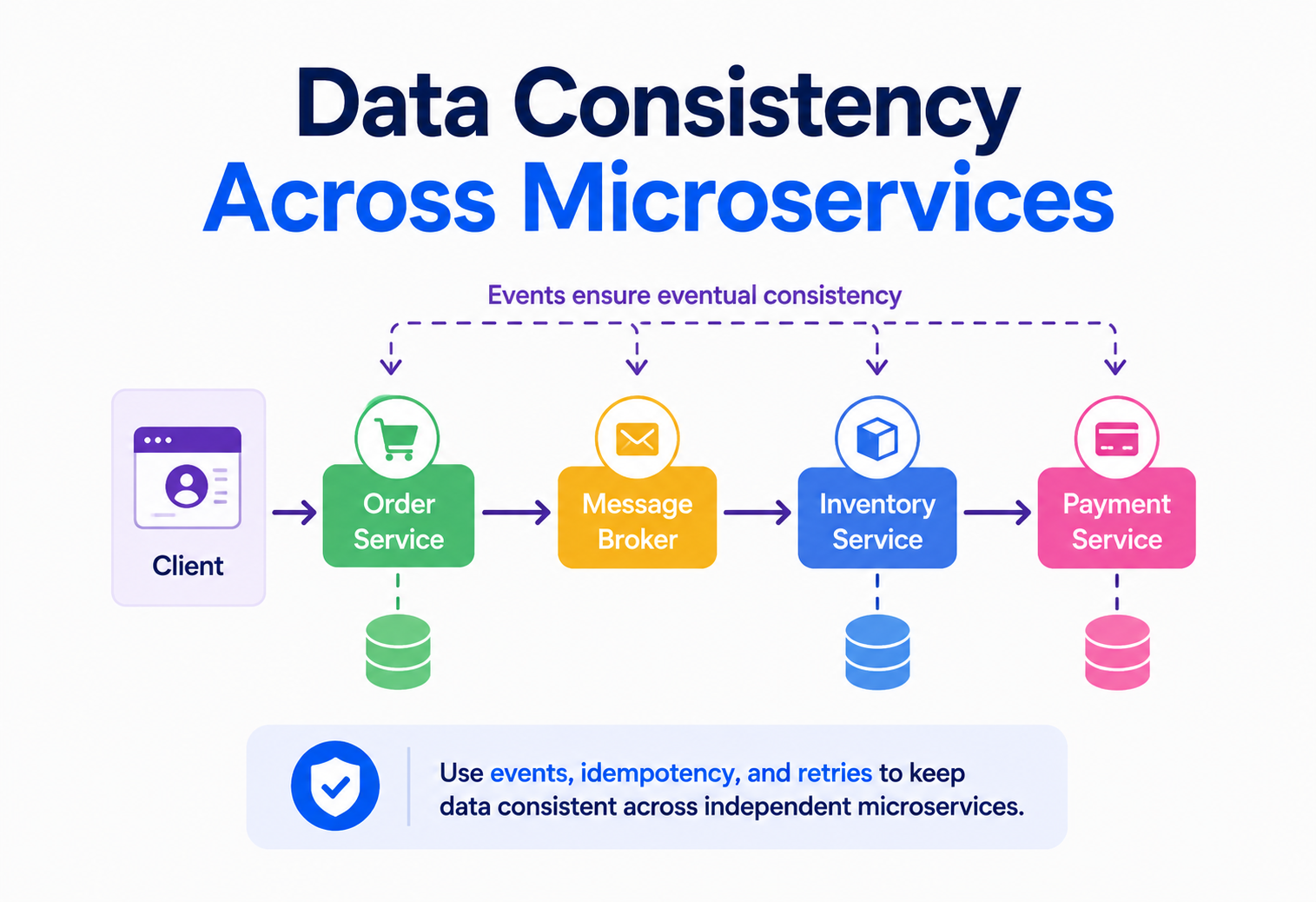
Data Consistency Across Microservices — and Why It Is So Hard?
A complete, beginner‑to‑production guide to how independent services keep their private databases in agreement — with real diagrams, real code, and real failure stories from the systems every engineer eventually has to reason about.
Introduction & History
Data consistency across microservices is the discipline of keeping many small, independently‑owned databases in agreement about the same real‑world facts — and it is one of the hardest, most interview‑relevant, and most production‑critical topics in modern software engineering.
Imagine you and your best friend keep a shared diary, but each of you has your own copy at home. Every time something happens, you both have to write it down separately in your own copy. Now — what happens if you write “we went to the park” but your friend, in their copy, writes “we went to the mall”? Whose diary is correct?
That small, silly example is exactly the problem huge companies like Amazon, Netflix, and Uber deal with every single second. Except instead of two diaries, they have hundreds of small computer programs, each keeping its own private notebook of information, and all of those notebooks have to agree with each other well enough that the business keeps working correctly.
A short history — from one big brain to many small brains
In the early days of software (the 1990s and early 2000s), most applications were built as a monolith: one large program with one large database. Think of it as a single giant notebook that only one person ever writes in. Because there was only one notebook, there was never any disagreement. If the notebook said “5 items in stock,” that was simply true, everywhere, instantly.
As companies grew, that one giant notebook became a bottleneck. Thousands of engineers were editing the same giant codebase, one bug could take down the entire application at once, and scaling meant copying the whole massive program even if only one small part of it was actually busy. Around 2011–2015, companies like Netflix, Amazon, and later almost every large tech company, began splitting their giant applications into small, independent services — each responsible for one job, each with its own private database. This became known as the microservices architecture.
Splitting the notebook solved the scaling problem beautifully. But it created a brand‑new problem that barely existed before: now there are many notebooks, owned by many different teams, and they must somehow agree on facts about the same real‑world things — like “how many phones are left in the warehouse” or “has this customer paid for their order.” That agreement problem is called data consistency, and it is the beating heart of this entire tutorial.
What it is A way of building an application as a collection of small, independent services, each doing one job well, each deployed and scaled separately, and — importantly — each usually owning its own database.
Why it exists To let large engineering teams work independently, deploy independently, and scale only the parts of the system that actually need scaling on any given day.
Where it’s used Netflix, Amazon, Uber, Spotify, Airbnb, and most modern cloud‑native companies.
Analogy Instead of one giant restaurant kitchen where a single head chef controls everything, you have many small food stalls (grill stall, drinks stall, dessert stall), each run by its own small team, each with its own ingredients storage.
Problem & Motivation
Let’s build the problem from scratch using a concrete e‑commerce example. This same example will keep coming back throughout the tutorial so every abstract idea has a real story attached to it.
Say you are building “ShopFast,” an online store. In a microservices world, you might split your system into these independent services:
- Order Service — owns the “orders” table, knows what a customer ordered.
- Payment Service — owns the “payments” table, knows whether money was actually collected.
- Inventory Service — owns the “stock” table, knows how many items are left in the warehouse.
- Shipping Service — owns the “shipments” table, knows what has been dispatched to whom.
Each service has its own database, and no service is allowed to reach directly into another service’s database. That is one of the golden rules of microservices, and we will unpack exactly why later. Instead, services talk to each other over the network, using APIs or messages.
Here is the core question this whole tutorial answers: if placing one order requires four separate databases to each correctly record their piece of the story, what happens when one of those four steps fails halfway through?
Imagine the Order Service successfully creates the order and the Payment Service successfully charges the customer’s card. But right after that, the Inventory Service’s server crashes before it can reduce the stock count. Now the customer has paid for a phone that was never actually reserved — and if someone else buys the last one in the meantime, you now owe two phones but only have one.
In a single monolith with one database, this problem is solved by something called a transaction — a way of saying “either all of these changes happen together, or none of them happen at all.” But across microservices, there is no single database to wrap a transaction around. Each service’s database transaction is local to that service only. The gap between what a business operation needs (all‑or‑nothing across services) and what the technology naturally gives you (all‑or‑nothing only within one service) is exactly why data consistency across microservices is hard.
Think of planning a surprise birthday party with four friends: one buys the cake, one books the hall, one sends invitations, and one arranges music. If the person booking the hall suddenly cancels because the hall got double‑booked, but the other three don’t find out in time, you end up with a cake, invited guests, and music — but no place to have the party. Coordinating four independent people (or services) to reach one correct, shared outcome is dramatically harder than one person doing everything themselves.
Core Concepts
Before going deeper, let’s carefully define every important term. These words appear constantly in system design interviews and real production discussions, so take your time here — a shaky vocabulary is what usually derails otherwise good answers.
What it is A guarantee about how “correct” or “up‑to‑date” data looks when different parts of a system read it. In distributed systems, it specifically means: when data changes in one place, how quickly and reliably does every other place that has a copy of that data find out and update itself?
Why it exists Because in microservices, data is often copied or referenced across many services. If those copies drift apart and disagree, the business can make wrong decisions — like selling something it doesn’t have, or shipping something nobody paid for.
Analogy Several clocks hanging in different rooms of the same house. Consistency asks: do all the clocks show the same time, and if one of them is changed, how quickly do the others catch up?
Practical example A customer’s “loyalty points” balance shown on the mobile app should match the balance used by the checkout service when applying a discount — otherwise the customer sees one number and gets charged based on another.
What it is A group of operations that must succeed or fail together, as a single atomic unit. Databases guarantee this using a property set called ACID.
Why it exists So that a partial, broken update (like taking money out of one account but never adding it to another) can never happen, no matter what crashes in the middle.
Analogy Swapping seats with a friend on a train — either you both move, or neither of you moves. You never end up with both of you standing in the aisle because only one seat swap somehow “succeeded.”
What it is The four guarantees a traditional single database gives for a transaction:
- Atomicity — all steps happen, or none do.
- Consistency — the database moves from one valid state to another valid state (integrity rules like “balance cannot be negative” are never broken).
- Isolation — transactions running at the same time don’t see each other’s half‑finished work.
- Durability — once a transaction is confirmed, it survives even a power cut or crash.
Why it exists To make a single database trustworthy for money, inventory, and other critical facts.
Where it’s used Traditional relational databases like PostgreSQL, MySQL, and Oracle — usually within one service’s own database in a microservices world.
What it is An alternative philosophy used by many distributed and NoSQL systems, opposite in spirit to ACID. Instead of demanding perfect, instant agreement everywhere, the system promises the data will become correct soon, and stays available even during disagreement.
Why it exists Because insisting on instant, perfect agreement across many machines (or services) over an unreliable network is either impossible or extremely slow. BASE trades a little short‑term accuracy for a lot more speed and uptime.
Analogy A news headline that says “Breaking: Team X might have won” and gets corrected an hour later with the exact final score. The information was available immediately, even though it wasn’t 100% precise yet.
What it is Every read of the data returns the most recent write, no matter which server or service answers the read. There is zero delay, zero chance of seeing stale (old) data.
Practical example A bank must show a strongly consistent balance — you should never see your old balance a moment after a bank employee has already recorded your deposit.
Trade‑off Strong consistency usually needs more coordination between machines, which makes the system a bit slower and slightly less available during network problems.
What it is If no new updates are made, all copies of the data will eventually become identical — but for some period of time after an update, different readers might see different (stale) versions.
Practical example When you update your profile picture on a social media app, some of your friends might see the old picture for a few seconds before the new one shows up everywhere — that lag is eventual consistency in action.
Where it’s used Product catalogs, “like” counts, search indexes, recommendation feeds — places where a few seconds of staleness is genuinely harmless.
What it is A middle ground: operations that are causally related (one clearly happened because of another) are seen by everyone in the same order, but unrelated operations can be seen in different orders by different people without breaking anything.
Analogy If you post a question in a group chat and then someone replies to it, everyone should see the question before the reply. But two unrelated messages sent at the same time by two different people can appear in any order without confusing anyone.
What it is An operation is idempotent if doing it once has exactly the same effect as doing it many times.
Why it exists Networks are unreliable — messages can be delivered twice, retries happen after timeouts. If “charge the customer $50” were run twice by accident, that’s a disaster. Idempotency is what makes retries safe.
Practical example Pressing an elevator button five times doesn’t call five elevators — the “call elevator to this floor” request is idempotent by design.
What it is A transaction that spans more than one database or service, needing all of them to agree on commit or rollback together.
Why it’s hard Each service can crash independently, the network between them can fail independently, and there is no single “referee” database to lock everything at once (at least, not without heavy coordination protocols like Two‑Phase Commit, discussed later).
CAP Theorem & PACELC
No discussion of data consistency is complete without CAP — one of the most quoted, most misunderstood ideas in distributed systems — and its more practical cousin, PACELC.
The CAP theorem was first stated by computer scientist Eric Brewer in 2000 and later formally proven by Seth Gilbert and Nancy Lynch in 2002. It has since become the single most cited result in distributed systems interviews — and, unfortunately, one of the most frequently misused.
What it is In any distributed data system, when a network failure (a “partition”) happens between nodes, you can only keep two of these three properties, not all three:
- Consistency (C) — every node sees the same, most recent data.
- Availability (A) — every request gets a response (success or failure), even if some nodes are down.
- Partition tolerance (P) — the system keeps working even when network messages between nodes are lost or delayed.
Why it exists Because in the real world, networks do fail — cables get cut, routers crash, data centers lose connectivity. Since partitions are unavoidable in any truly distributed system, you must always choose Partition tolerance, which really means you are choosing between Consistency and Availability during the partition.
Two branches of the same bank lose their phone line to each other (a “partition”). A customer walks into Branch A and asks to withdraw $500. Branch A can either (a) refuse the withdrawal until it can confirm with Branch B that there is really $500 available — choosing Consistency over Availability — or (b) allow the withdrawal based on the last known balance, risking that Branch B also lets someone withdraw the same money — choosing Availability over Consistency.
| System type | Prioritizes | Example systems | Good for |
|---|---|---|---|
| CP | Correctness over uptime | MongoDB (default), HBase, ZooKeeper, traditional RDBMS clusters | Banking ledgers, inventory counts, payments |
| AP | Uptime over instant correctness | Cassandra, DynamoDB, CouchDB | Shopping carts, social feeds, product catalogs |
PACELC — the theorem’s more practical cousin
CAP only describes behaviour during a network partition. But most of the time, there is no partition — the network is healthy! So what governs the trade‑off then? That is exactly what PACELC, proposed by Daniel Abadi in 2010, adds to the picture:
If there is a Partition, trade off Availability vs Consistency (same as CAP). Else (the network is fine), trade off Latency vs Consistency — because even with a perfectly healthy network, waiting for every replica to agree before responding still takes extra time.
Why it matters It reminds engineers that consistency has a cost even on a perfectly healthy day, not only during rare outages. This is why interview answers that only mention CAP are considered incomplete by senior interviewers.
Architecture & Components
To understand why consistency is hard, you need to actually see the moving parts of a microservices system and how they are wired together.
The “database per service” rule
The single most important architectural decision in microservices is this: each service owns its own database, and no other service is allowed to touch that database directly. All access must go through the owning service’s API or through events it publishes.
The Inventory Service owns a table called stock. If the Shipping Service wants to know how many items are left, it must call GET /inventory/{productId} on the Inventory Service’s API — it must never run a SQL query directly against the Inventory Service’s database, even though technically the network path might allow it.
Why this rule exists is worth understanding deeply:
- Encapsulation — the Inventory team can change their database schema, or even switch from PostgreSQL to MongoDB, without breaking anyone else, as long as the API contract stays the same.
- Independent scaling — if Inventory gets hit with heavy traffic during a flash sale, only its database needs to scale, not everyone else’s.
- Blast radius — if Inventory’s database gets corrupted or overloaded, other services are not directly dragged down with it.
But this very rule is exactly why data consistency becomes hard — because now, related pieces of information about the same real‑world event (an order) are split across multiple, independently‑owned, independently‑failing storage systems, connected only by network calls.
Two communication styles, two consistency stories
Synchronous (REST / gRPC)
- Service A calls Service B and waits for a direct response.
- Simple to reason about, but couples the caller’s uptime to the callee’s uptime.
- Good for reads that must return a fairly fresh answer right now.
Asynchronous (Events / Messages)
- Service A publishes “OrderPlaced” and moves on; Service B reacts whenever it can.
- Services stay decoupled and resilient to each other’s downtime.
- Introduces a time gap between action and reaction — the very definition of eventual consistency.
Internal Working: How Consistency Is Actually Achieved
Now we get to the heart of the tutorial — the actual techniques engineers use to keep multiple databases in agreement despite crashes, slow networks, and duplicate messages.
1. Two‑Phase Commit (2PC) — the “old school” approach
What it is A protocol where a central coordinator asks every participating database, “Can you commit this change?” (Phase 1: Prepare). Only after every single participant says “yes, I’m ready” does the coordinator tell them all to actually commit (Phase 2: Commit). If even one participant says “no,” everyone is told to roll back instead.
Why it exists It was designed to give distributed transactions the same all‑or‑nothing guarantee as a single‑database transaction.
Why it’s rarely used in microservices today The coordinator is a single point of failure and a bottleneck. While waiting for every participant to reply, all involved databases must hold locks on the affected rows — so if one service is slow or crashes mid‑protocol, everyone else stays blocked, sometimes for a long time. This directly hurts availability, which is usually unacceptable at internet scale.
2. The Saga Pattern — the modern, microservices‑native approach
What it is Instead of one giant distributed transaction, a saga breaks the business process into a sequence of small local transactions, each in a single service’s own database. If any step fails, the saga runs compensating transactions to undo the effects of the steps that already succeeded, rather than performing a true database‑engine rollback.
Why it exists To achieve eventual, reliable consistency without requiring every service to hold locks and wait on each other — keeping each service fast and independently available.
Analogy Booking a multi‑city trip: flight, hotel, and car rental. If the hotel booking fails after you have already booked the flight, you don’t magically “undo” the flight booking in one atomic action — you explicitly cancel the flight (a compensating action) to get back to a sane state.
There are two common ways to coordinate a saga:
Orchestration
- One central “orchestrator” service explicitly tells each service what to do next, step by step.
- Easy to understand and trace — the whole workflow lives in one place.
- Used by: Netflix Conductor, Camunda, AWS Step Functions, Temporal.
Choreography
- No central controller — each service listens for events and reacts, publishing its own events in turn.
- More decoupled, but harder to trace the overall flow across many services.
- Commonly used with Kafka / RabbitMQ event‑driven pipelines.
public class OrderSagaOrchestrator {

    private final OrderClient orderClient;
    private final PaymentClient paymentClient;
    private final InventoryClient inventoryClient;

    public void placeOrder(OrderRequest request) {
        String orderId = orderClient.createOrder(request);   // step 1: local txn
        try {
            paymentClient.chargeCustomer(request.getCustomerId(), request.getAmount()); // step 2
            inventoryClient.reserveStock(request.getProductId(), request.getQty());     // step 3
            orderClient.markOrderConfirmed(orderId);          // step 4
        } catch (PaymentFailedException e) {
            orderClient.cancelOrder(orderId);                 // compensate step 1
        } catch (OutOfStockException e) {
            paymentClient.refundCustomer(request.getCustomerId(), request.getAmount()); // compensate step 2
            orderClient.cancelOrder(orderId);                 // compensate step 1
        }
    }
}
Notice something important: each client call here is a network call to another service, and each of those services commits its own local transaction. There is no global lock across all three databases — which is exactly what makes this approach scalable, but also why, for a brief window, an order might exist as “created” before payment is confirmed. That brief window is eventual consistency, made explicit and controlled.
3. The Outbox Pattern — solving the “dual write” problem
There is a sneaky bug that catches many engineers off guard: what if a service needs to both update its own database and publish an event about that update, but the process crashes between the two? You would either lose the event, or publish an event for a database write that never actually happened.
What it is Instead of writing to the database and separately publishing to the message broker, the service writes both the business data and a row describing the event into the same local database transaction (an “outbox” table). A separate background process then reads the outbox table and reliably publishes those events to the message broker, marking them as sent.
Why it exists Because a single local database transaction is atomic — either both the business row and the outbox row are saved, or neither is. This turns an unreliable “write to two different systems” problem into a reliable “write to one system, then relay” problem.
@Transactional
public void placeOrder(OrderRequest request) {
    Order order = new Order(request.getCustomerId(), request.getProductId(), request.getQty());
    orderRepository.save(order);                      // business write

    OutboxEvent event = new OutboxEvent(
        "OrderPlaced",
        order.getId(),
        toJson(order)                                  // event payload
    );
    outboxRepository.save(event);                      // same DB, same transaction
}
// A separate poller/CDC process later reads unsent OutboxEvent rows
// and publishes them to Kafka, then marks them as sent.
4. Change Data Capture (CDC)
What it is A technique that watches a database’s internal transaction log — the same log the database uses for crash recovery — and streams every row change out as an event, in real time, without the application needing to explicitly publish anything.
Why it exists It gives you outbox‑pattern‑like reliability without requiring every service to manually manage an outbox table — the database’s own commit log becomes the single source of truth for “what changed.”
Where it’s used Debezium (built on Kafka Connect) is the most popular open‑source CDC tool, used at LinkedIn, at Netflix‑adjacent companies, and in thousands of production systems to keep search indexes, caches, and analytics stores in sync with the primary database.
5. Idempotent consumers and deduplication
Because messages can be delivered more than once (a network hiccup causes a retry, for example), every consumer of an event should be written so that processing the same event twice causes no harm.
@Transactional
public void handleOrderPlaced(OrderPlacedEvent event) {
    if (processedEventRepository.existsById(event.getEventId())) {
        return; // already handled — safe to ignore the duplicate
    }
    inventoryRepository.reserveStock(event.getProductId(), event.getQty());
    processedEventRepository.save(new ProcessedEvent(event.getEventId()));
}
This pattern — check if we’ve seen this exact event ID before, and record that we’ve now handled it, in the same transaction as the actual work — is one of the most common and most interview‑relevant patterns in event‑driven microservices.
6. Optimistic locking (handling concurrent writes within one service)
Even inside a single service’s own database, two requests can try to update the same row at nearly the same time. A common, lightweight defence is optimistic locking using a version number.
@Entity
public class StockItem {
    @Id
    private String productId;
    private int quantity;

    @Version               // Hibernate automatically checks & increments this
    private long version;  // on every UPDATE, preventing "lost updates"
}

// If two requests read version=5 at the same time and both try to save,
// only the first UPDATE succeeds (it changes version 5 -> 6).
// The second UPDATE, still expecting version=5, matches zero rows,
// and Hibernate throws OptimisticLockException — the caller can safely retry.Data Flow & Lifecycle
Let’s trace one order from birth to completion, and watch exactly when and how consistency is achieved (or temporarily broken) at every step.
Notice the order goes through explicit states: PENDING → CONFIRMED (or CANCELLED if something fails). This is a critical, often‑overlooked lesson: consistency across microservices is rarely instant, so your data model must have an explicit state machine that represents “not yet settled” states. A customer‑facing UI should be honest about this — showing “Payment processing…” rather than pretending everything is already final.
Amazon’s order pipeline shows exactly this kind of state: “Order Placed” → “Payment Processing” → “Order Confirmed” → “Shipped” → “Delivered.” Each transition typically corresponds to a different backend service completing its part of a saga, and the UI is intentionally built to reflect these intermediate states rather than hiding them from the user.
Design Patterns & Anti‑patterns
A tour of the patterns that make eventual consistency livable — CQRS, event sourcing, compensating transactions — plus the three anti‑patterns that keep showing up in real production post‑mortems.
Pattern: CQRS (Command Query Responsibility Segregation)
What it is Splitting the “write” model (commands that change data) from the “read” model (queries that fetch data), often using entirely different data stores optimized for each job.
Why it exists Write‑optimized and read‑optimized data shapes are often very different. A checkout write needs strong correctness on a few rows; a product search read needs blazing‑fast lookups across millions of rows. CQRS lets each side scale and evolve independently, usually connected by the same events discussed above (a service’s write triggers an event that updates a separate read‑optimized store, such as Elasticsearch).
Trade‑off The read model is often eventually consistent with the write model — search results might lag a few seconds behind the latest write.
Pattern: Event Sourcing
What it is Instead of storing only the current state of an object (like “balance = $120”), you store the complete sequence of events that led to that state (e.g., “Deposited $100,” “Deposited $50,” “Withdrew $30”). The current state is rebuilt by replaying the events.
Why it exists It gives you a perfect, auditable history, and it pairs beautifully with event‑driven microservices — the event log itself becomes the natural mechanism for other services to stay in sync.
Where it’s used Banking ledgers, order histories, and Kafka‑based architectures at companies including LinkedIn and Uber for internal state propagation.
Pattern: Two‑Way Door / Compensating Transactions
Already covered under Sagas — but worth repeating as a named pattern, because interviewers love asking about it directly: a compensating transaction is a new, forward‑moving action that semantically reverses an earlier action’s effect, rather than a true database rollback. “Refund the payment” compensates “charge the payment”; it does not erase the fact that a charge briefly happened.
Anti‑pattern: The Shared Database
Letting multiple services read and write directly to the same database tables “just to keep things simple.” This destroys the whole point of microservices — you can no longer change one service’s schema without breaking others, and you lose any clear ownership of consistency rules. It quietly turns your microservices into a “distributed monolith”: all the deployment complexity of microservices, with none of the independence benefits.
Anti‑pattern: Chatty Synchronous Chains
If Service A calls Service B, which calls Service C, which calls Service D — all synchronously, all within one user request — you have built a fragile chain. If D is slow, the whole chain is slow; if D is down, the whole chain fails. This also tends to push teams toward using distributed transactions (like 2PC) to “fix” consistency, which reintroduces every availability problem discussed earlier.
Anti‑pattern: Silent Data Loss on Retry
Retrying a failed network call without idempotency protection can cause duplicate charges, duplicate emails, or double stock reservations. Many real production incidents — including well‑publicized double‑charging bugs at major e‑commerce and ride‑sharing companies — have traced back to exactly this mistake.
Pattern comparison at a glance
| Pattern | Consistency style | Best for | Watch out for |
|---|---|---|---|
| Two‑Phase Commit | Strong | Small, low‑traffic systems needing strict correctness | Blocking, low availability, poor scaling |
| Saga (orchestrated) | Eventual | Multi‑step business workflows (order, booking, onboarding) | Must design careful compensations |
| Saga (choreographed) | Eventual | Loosely‑coupled, event‑driven systems | Hard to trace / debug across many services |
| Outbox + CDC | Eventual, reliable | Any service that must publish events tied to DB writes | Slight lag between write and event delivery |
| CQRS | Eventual (read side) | Read‑heavy systems with different read / write shapes | Read replicas can lag writes briefly |
Advantages, Disadvantages & Trade‑offs
Eventual consistency buys availability and performance, but it demands more complex application code and honest UX. The core question engineers must keep asking is “does this specific piece of data really need to be strong?”
Advantages of embracing eventual consistency
- Higher availability — services keep working even if a downstream service is briefly down.
- Better performance — no waiting on distributed locks across the network.
- Independent scaling and deployment of each service.
- Failure in one service doesn’t automatically freeze every other service.
Disadvantages / costs
- Application code becomes more complex (state machines, compensations, retries).
- Users may briefly see “not‑yet‑settled” data, which needs thoughtful UX.
- Debugging is harder — a bug might only appear as a rare timing‑dependent race condition.
- Requires strong monitoring and tracing discipline to catch stuck or failed sagas.
The fundamental trade‑off engineers must always ask themselves: “Does this specific piece of data need to be strongly consistent, or can it tolerate being eventually consistent?” Not every field in your system needs bank‑grade correctness. A “number of likes” counter can lag by a second; an “account balance” usually cannot.
A group project where every member must call a meeting and get everyone’s live approval before doing anything (strong consistency) will be extremely safe but painfully slow. A group where each member just does their assigned task and posts updates in a shared chat (eventual consistency) moves much faster, but occasionally two people might briefly duplicate effort before noticing the chat update.
Consistency is not free — it is paid for in either latency, availability, or engineering complexity. The interesting question is always which of those three you are choosing to spend.
Performance & Scalability
Consistency mechanisms are not free — they cost latency, throughput, or both. Understanding those costs is essential for designing systems that actually scale.
- Synchronous distributed locking (like 2PC) adds round‑trip network latency for every participant, multiplied by the number of participants, and holds locks the whole time — this directly limits throughput under load.
- Quorum‑based replication (used by databases like Cassandra and DynamoDB) lets you tune consistency vs. speed per‑request: write to
Wreplicas and read fromRreplicas, and ifW + R > total replicas, you are guaranteed to see the latest write (this is called a “quorum read”), at some latency cost. - Asynchronous replication (leader writes immediately, followers catch up afterward) gives excellent write latency but a real risk of stale reads from followers, and even potential data loss if the leader crashes before followers replicate.
- Batching and buffering events (rather than publishing one at a time) can drastically increase throughput in an event‑driven pipeline, at the cost of a slightly larger consistency lag window.
What it is The time delay between a write landing on the primary (leader) database and that same write becoming visible on a replica (follower) database.
Practical example You update your address on an e‑commerce site, and it is saved instantly to the primary database. But the “read replica” used to render your order history page hasn’t caught up yet, so for a split second, your order history might still show the old address.
Scaling techniques and their consistency impact
| Technique | What it does | Consistency impact |
|---|---|---|
| Read replicas | Serve reads from copies of the primary DB | Slight staleness possible (“replication lag”) |
| Sharding / Partitioning | Split data across multiple DB instances by key | Cross‑shard transactions become distributed transactions |
| Caching (e.g. Redis) | Serve hot reads from memory | Cache can go stale; needs an invalidation strategy |
| Async messaging | Decouple producers and consumers | Introduces the eventual consistency window intentionally |
High Availability & Reliability
Consistency and availability are constantly in tension — as CAP taught us — so building a highly available system that is also acceptably consistent requires deliberate design, not luck.
Consensus algorithms
What it is Algorithms that let a group of machines agree on a single value or sequence of operations, even if some machines crash or messages are lost — usually by electing a leader and requiring a majority (“quorum”) of nodes to agree before confirming a write.
Why it exists To make replicated data strongly consistent and fault‑tolerant at the same time, without needing all nodes to be alive — just a majority.
Where it’s used etcd and ZooKeeper (used for service configuration and leader election), CockroachDB, and many modern distributed databases use Raft internally.
Analogy A group of friends deciding on a restaurant by majority vote — as long as more than half agree, the decision is final, even if a couple of friends’ phones are switched off and can’t vote.
Failure recovery strategies
- Retries with exponential backoff — retry failed calls with increasing delays, avoiding overwhelming a struggling service.
- Circuit breakers — after repeated failures, stop calling a failing service for a while, failing fast instead of piling up timeouts.
- Dead‑letter queues — messages that repeatedly fail to process are moved aside for manual inspection instead of blocking the whole queue forever.
- Saga timeout & reconciliation jobs — background jobs that scan for orders stuck in
PENDINGtoo long and either retry or automatically compensate them.
@Scheduled(fixedDelay = 60000)
public void reconcileStuckOrders() {
    List<Order> stuck = orderRepository
        .findByStatusAndCreatedAtBefore(OrderStatus.PENDING, Instant.now().minusSeconds(300));

    for (Order order : stuck) {
        SagaState state = sagaStateRepository.findByOrderId(order.getId());
        if (state.isPaymentConfirmed() && !state.isStockReserved()) {
            inventoryClient.reserveStock(order.getProductId(), order.getQty()); // retry
        } else if (!state.isPaymentConfirmed()) {
            orderService.cancelOrder(order.getId());                            // compensate
        }
    }
}
This kind of “reconciliation” or “auditor” job is extremely common in real production systems — it is the safety net that catches sagas that got stuck due to a crash, a lost message, or a bug that nobody has noticed yet.
Security
Data consistency mechanisms touch security in a few important, easy‑to‑miss ways. The rule of thumb: any place where you rely on remembering an ID, replaying a log, or propagating a change asynchronously is a place a thoughtful attacker will probe.

- Replay attacks — because idempotent consumers rely on remembering event IDs, an attacker who can forge or replay old events might try to trigger duplicate actions if IDs and authentication are not verified together. Always validate that events come from a trusted source (using message signing or mutual TLS between services) in addition to deduplication.
- Eventual consistency and authorization — if a permission change (e.g., revoking a user’s access) is itself propagated asynchronously, there can be a short window where a now‑unauthorized user still succeeds at an action, because the “you’re revoked” event has not reached every service yet. Security‑sensitive checks (like authorization) often need stronger, near‑real‑time consistency than ordinary business data.
- Outbox tables as an attack surface — since the outbox table sits in the same database as business data, it must follow the same access‑control and encryption rules; sensitive fields inside event payloads should be encrypted or omitted, not accidentally exposed to every downstream consumer.
- Audit trails — event sourcing naturally provides a tamper‑evident history, which is valuable for compliance (e.g., financial regulations like PCI‑DSS or SOX), but that same event log must be protected and access‑controlled carefully since it can contain a complete history of sensitive user actions.
Monitoring, Logging & Metrics
You cannot fix what you cannot see. In a distributed system, consistency problems are often invisible until a customer complains — so proactive observability is essential, not optional.
Distributed tracing
What it is A technique where every request is tagged with a unique “trace ID” that follows it across every service it touches, letting engineers reconstruct the full journey of one order (or one event) across many services in a single visual timeline.
Why it exists A single “place order” action might touch five services — without a shared trace ID, correlating logs from five different services during an incident is nearly impossible.
Where it’s used Tools like Jaeger, Zipkin, and the OpenTelemetry standard; adopted widely at Uber (which originally built Jaeger), Netflix, and Google (whose internal Dapper system inspired all of these).
Key metrics to track for consistency health
| Metric | What it tells you |
|---|---|
| Saga completion time (p50 / p95 / p99) | How long orders typically take to reach a final state |
| Stuck / pending orders count | How many sagas are stalled somewhere mid‑flow right now |
| Event consumer lag | How far behind consumers are from the latest published events (e.g. Kafka consumer lag) |
| Compensation / rollback rate | How often sagas fail and need to be undone — a rising trend signals a problem upstream |
| Replication lag (seconds) | How stale read replicas are compared to the primary database |
| Duplicate event rate | How often the same event ID is seen more than once (should be handled by idempotency, but worth tracking) |
Netflix built internal tools to detect and auto‑heal “stuck” workflow instances inside its Conductor orchestration engine, alerting engineers when too many workflows sit in a non‑terminal state for too long — exactly the “reconciliation job” idea shown earlier, but at massive scale.
Deployment & Cloud
Consistency patterns need real, running infrastructure to keep their promises — brokers, orchestrators, managed databases, and multi‑region designs each shape what “consistent” is even willing to mean.
- Message brokers such as Apache Kafka, RabbitMQ, or managed cloud equivalents (Amazon SQS/SNS, Google Pub/Sub, Azure Service Bus) are the backbone of asynchronous, event‑driven consistency.
- Orchestration engines such as AWS Step Functions, Temporal, or Camunda are increasingly used instead of hand‑rolled saga orchestrators, because they provide built‑in retry, timeout, and state‑persistence out of the box.
- Kubernetes is commonly used to deploy each microservice independently, with health checks and auto‑restarts helping recover a crashed service quickly — reducing the window during which a saga can get stuck.
- Managed databases with built‑in replication (Amazon Aurora, Google Cloud Spanner, CockroachDB) offer strong consistency guarantees across regions using consensus protocols under the hood, trading some write latency for correctness at global scale.
- Multi‑region deployments add another layer of the consistency puzzle: should a write in the US region be visible instantly in the EU region? Most companies choose eventual consistency across regions to keep latency low for global users, reserving strong consistency for within‑region critical paths.
Databases, Caching & Load Balancing
Every consistency decision eventually shows up as a concrete choice about databases, caches, and load balancers. Choosing badly here is where good architecture quietly turns into a production nightmare.
Choosing a database for the consistency you need
| Database type | Typical consistency model | Examples |
|---|---|---|
| Relational (SQL) | Strong (ACID) within one instance | PostgreSQL, MySQL |
| Distributed SQL | Strong, across nodes / regions, via consensus | Google Spanner, CockroachDB, YugabyteDB |
| Document / wide‑column NoSQL | Tunable — often eventual by default | MongoDB, Cassandra, DynamoDB |
| In‑memory cache | Usually eventual; must be actively invalidated | Redis, Memcached |
Caching and staleness
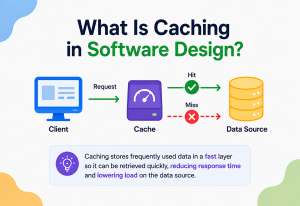
Caching is one of the most common places where inconsistency quietly creeps in. A cache is, by definition, a copy of data that can drift out of sync with the source of truth.
Imagine writing today’s cafeteria menu on a whiteboard at the entrance (the “cache”) while the actual kitchen list (the “source of truth”) gets updated when a dish runs out. If nobody erases and rewrites the whiteboard, people keep ordering a dish that’s already gone.
- Cache‑aside — the application checks the cache first; on a miss, it reads from the database and populates the cache. Simple, but stale entries can linger until they expire.
- Write‑through — writes go to the cache and database together, keeping them in sync immediately, at the cost of slightly slower writes.
- TTL (Time To Live) — every cached entry automatically expires after a set time, bounding how stale it can ever get; a very common, simple, and effective safety net.
- Event‑driven invalidation — when the source data changes, an event tells the cache to invalidate or refresh the relevant key — this pairs naturally with the outbox / CDC patterns discussed earlier.
Load balancing and consistency
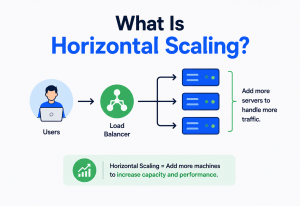
Load balancers distribute traffic across multiple instances of the same service. This matters for consistency because if a user’s request for “confirm payment” hits Instance A, and their next request for “check payment status” hits Instance B, both instances must be reading from data that is actually in sync — usually the shared database, not local instance memory. That is exactly why microservices should be designed to be stateless: any instance can handle any request, because the real state lives in the shared database, not inside the running process.
Best Practices & Common Mistakes
The habits mature teams share when working with distributed data, and the mistakes that keep resurfacing in post‑mortem after post‑mortem.
Best Practices
- Decide, per data type, whether it truly needs strong or eventual consistency — do not default to “strong everywhere.”
- Make every event consumer idempotent, always.
- Use the outbox pattern (or CDC) instead of ad‑hoc dual writes.
- Model intermediate states explicitly (PENDING, CONFIRMED, FAILED) rather than pretending operations are instant.
- Build reconciliation / auditor jobs to catch and fix stuck workflows automatically.
- Invest early in distributed tracing — you will need it during your first real incident.
- Version your events (e.g.,
OrderPlacedV2) so consumers can evolve independently.
Common Mistakes
- Sharing one database across multiple services “temporarily” (it never stays temporary).
- Publishing an event and writing to the database as two separate, non‑atomic steps.
- Assuming network calls always succeed and never timing out or retrying.
- Building consumers that aren’t idempotent, causing double charges or double shipments on retry.
- Ignoring consumer lag until a customer notices stale data.
- Trying to force strong, synchronous consistency everywhere “to be safe,” and crippling system availability and performance as a result.
Real‑World & Industry Examples
The patterns in this tutorial are not academic — every large technology company runs a variation of them, and their public engineering blogs and open‑source tools tell most of the story if you know where to look.
Netflix’s playback and billing systems are split across hundreds of microservices. They built Conductor, an open‑source orchestration engine, specifically to manage long‑running sagas (like account sign‑up flows involving billing, provisioning, and notifications) with built‑in retry and compensation support, and strong observability into “stuck” workflows.
Amazon’s order and fulfillment system is a textbook example of the saga pattern in the wild — order placement, payment, inventory reservation, and shipping are separate services, and the customer‑facing order status explicitly reflects the current, sometimes not‑yet‑final, state of that saga. Amazon’s DynamoDB, built for internal use before becoming a public AWS product, was specifically designed around tunable, eventual consistency to preserve availability during network partitions — directly informed by CAP theorem thinking.
Uber’s trip lifecycle (request ride → match driver → start trip → end trip → charge payment → rate) spans many services and uses event‑driven, eventually‑consistent pipelines built on Kafka. Uber also created Jaeger, one of the most widely used distributed tracing systems, precisely because debugging consistency and latency issues across hundreds of services demanded better tracing tools than existed at the time.
Airbnb’s booking and payment flow uses saga‑style compensations — if a payment fails after a reservation is tentatively held, the reservation is automatically released. Traditional banking core systems, by contrast, still lean heavily on strong consistency (often via distributed SQL databases or careful two‑phase‑commit‑like protocols) for actual money movement between accounts, because the cost of being wrong is far higher than the cost of being slightly slower.
FAQ, Summary & Key Takeaways
The questions engineers and interview candidates ask most often about this topic, followed by a compact summary and the takeaways worth remembering long after you close this page.
Frequently Asked Questions
Is eventual consistency “less correct” than strong consistency?
No — it is a different guarantee, not a weaker promise of correctness. It guarantees correctness will be reached, just not instantly. The right choice depends entirely on what the data is used for and how tolerant that use case is of temporary staleness.
Can I just use distributed transactions (2PC) everywhere and avoid this whole problem?
Technically yes, but it usually is not practical at scale — 2PC couples every participating service’s availability together and hurts performance under load, which defeats much of the purpose of using microservices in the first place.
What’s the difference between a saga and a normal database transaction?
A database transaction is atomic and isolated by the database engine itself. A saga is a sequence of separate local transactions coordinated by application code, using compensating actions instead of a true rollback if something fails partway through.
Do I need Kafka to build a saga?
No — sagas can be built with synchronous REST calls too (orchestration‑style), though message brokers like Kafka or RabbitMQ are extremely common because they naturally support the asynchronous, resilient communication style that makes sagas robust to temporary service downtime.
How do I decide if a piece of data needs strong consistency?
Ask: “What is the real‑world cost of showing slightly stale or temporarily wrong data here?” Money, safety, and legal compliance usually demand strong consistency. Counters, feeds, and recommendations usually tolerate eventual consistency just fine.
Summary
Microservices split one application into many independently deployed services, each owning its own database — a design that unlocks huge benefits in scalability and team independence, but breaks the simple, single‑database transaction guarantees developers once took for granted. Data consistency across microservices is the discipline of designing around that gap: understanding CAP and PACELC trade‑offs, choosing the right consistency model per data type, and using patterns like Sagas, the Outbox pattern, CDC, idempotent consumers, and CQRS to reach reliable, eventual correctness without sacrificing availability and performance. Production‑grade systems succeed not by avoiding inconsistency entirely, but by making the inconsistency window small, visible, monitored, and automatically recoverable.
Key Takeaways
- Core truthThere is no free lunch: consistency, availability, and low latency constantly trade off against each other in distributed systems.
- Core truthEach microservice should own its own database; never share a database across services.
- PatternUse Sagas with compensating transactions instead of distributed 2PC transactions for cross‑service workflows.
- PatternUse the Outbox pattern (or CDC) to avoid the “dual write” problem when publishing events tied to database changes.
- RuleAlways make event consumers idempotent — networks retry, and duplicates will happen.
- Design ruleModel intermediate states explicitly instead of pretending multi‑service operations are instant.
- Operational ruleInvest in distributed tracing and reconciliation jobs before you need them in an incident, not during one.
Stepping back, the through‑line of this whole guide is quietly simple: consistency across microservices is never about eliminating disagreement between databases — it is about shortening it, containing it, and making it visible enough that a human or a background job can always bring the system back to a correct, honest state. The systems that feel dependable year after year are the ones whose teams treated that discipline as everyday engineering, long before any customer ever noticed.