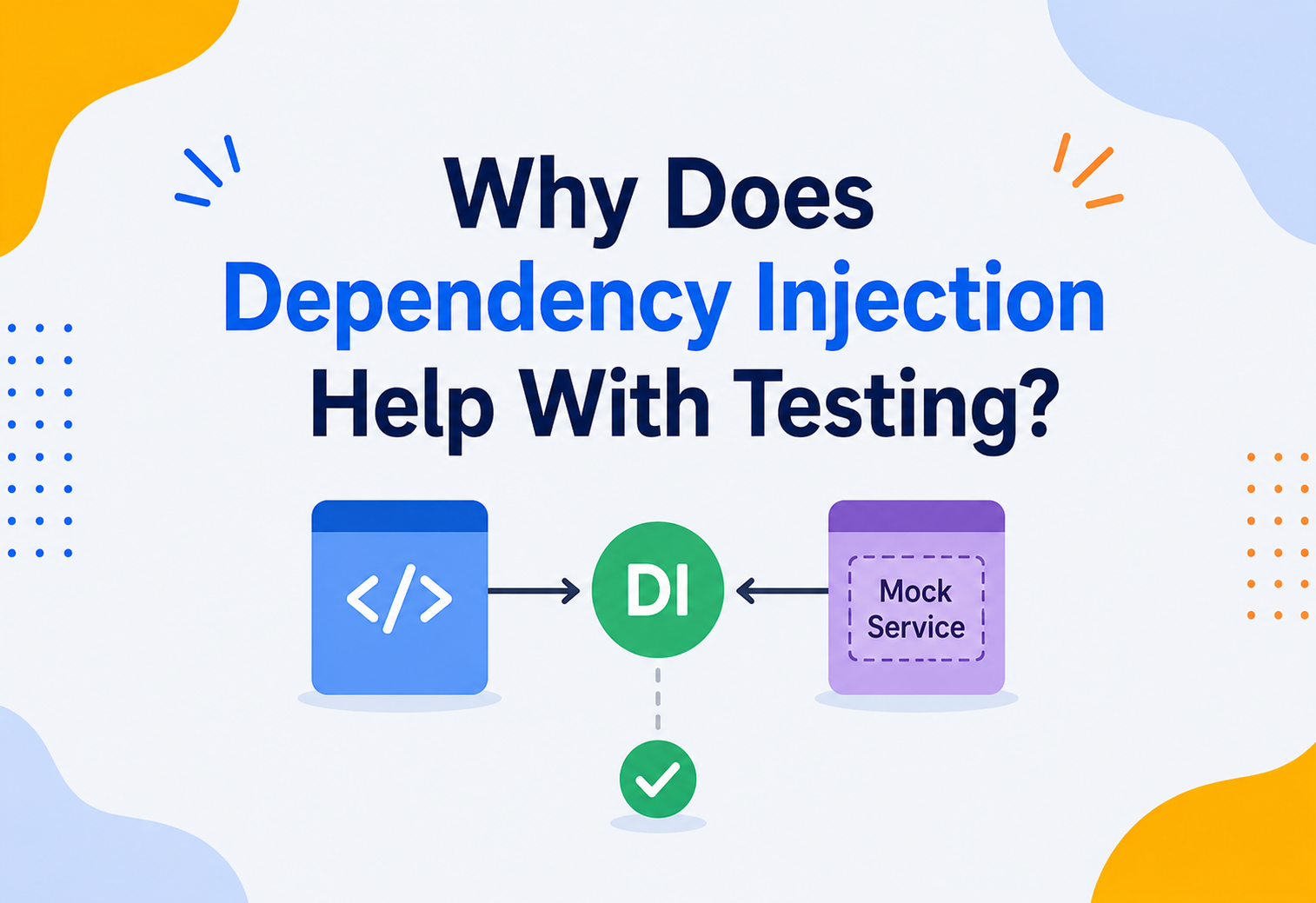
Why Does Dependency Injection Help With Testing?
Movie stunts are never performed by the actual movie star. A trained stunt double, dressed identically, takes the fall instead — so the real actor never gets hurt, and the crew can try the scene again and again until it’s perfect. Testing software leans on almost the exact same trick, and Dependency Injection is what makes that trick possible.
The Big Idea, in One Breath
Think about crash-testing a new car design. Engineers don’t strap a real human into the driver’s seat and slam the car into a wall to see what happens. Instead, they use a crash-test dummy — something shaped just like a person, sitting exactly where a person would sit, reacting to the impact in a measurable way, without any real risk to an actual human being. The dummy lets engineers run the same dangerous test again and again, tweaking one small thing at a time, learning exactly what they need to learn, safely and repeatably.
Testing software leans on this exact same trick, and Dependency Injection is what makes the trick possible. A class that needs to send an email, charge a credit card, or query a live database can’t safely do any of those things every single time an automated test runs — that would mean real emails, real charges, and real database changes happening constantly, just from running tests. Instead, when a class receives its dependencies from the outside rather than building them itself, a test can quietly swap in a safe, harmless stand-in instead of the real thing — the crash-test dummy standing in for the real driver.
Picture a cooking class practicing knife skills using rubber practice knives before ever touching a real blade. The rubber knife is handed to the student from outside — nobody expects the student to forge their own blade — and it behaves enough like a real knife for the student to practice grip, movement, and technique safely. Once the technique is solid, a real knife can be swapped in for actual cooking. Dependency Injection gives software the same privilege: practice, and later verify, behavior using a safe stand-in, before ever touching the real, consequential tool.
This guide focuses specifically on the testing side of Dependency Injection — the reason it shows up so often in conversations about writing reliable, well-tested software, and honestly, where testing fits alongside DI’s other genuine benefits, since testing isn’t actually the whole story.
It’s worth being upfront about something many quick explanations skip past: Dependency Injection doesn’t automatically make code well-tested. It doesn’t write a single test for you, and it doesn’t guarantee anyone actually will. What it does is remove a very specific, very real obstacle — the impossibility of safely substituting a fake for a dependency that a class insists on building itself. Clearing that obstacle doesn’t force good testing to happen, but it makes good testing dramatically easier to choose, which over time tends to mean a great deal more of it actually gets written.

What Makes Testing Hard Without It
To appreciate why Dependency Injection matters so much for testing, it helps to picture a class that builds its own dependencies internally, with no way for a test to intervene.
hard-to-test.tsclass PriceCalculator {
    calculateTotal(itemId: string) {
        const db = new LiveDatabaseConnection()
        const price = db.fetchPrice(itemId)
        const taxRate = new LiveTaxRateApi().getCurrentRate()
        return price * (1 + taxRate)
    }
}
Testing calculateTotal() here means actually connecting to a real database and a real external tax rate service, every single time the test runs. That single design choice quietly creates an entire family of testing headaches.
Real network calls take real time
A test that should run in milliseconds instead waits on a real database and a real API every time.
Outside factors can break the test
A slow network, a down server, or a changed tax rate can make an otherwise-correct test suddenly fail.
Results can differ each run
If the live tax rate changes between test runs, the exact same test can produce a different result.
Tests can cause real side effects
A test touching a real database can accidentally create, modify, or delete real records.
Notice that none of these problems are really about calculateTotal()‘s actual logic — the math of multiplying a price by a tax rate is simple and easy to verify. The pain comes entirely from being forced to drag real, live, unpredictable systems along for the ride, just to test a small, self-contained calculation.
There’s also a quieter, more human cost worth mentioning: when tests are slow and unreliable, engineers gradually stop trusting them. A test suite that occasionally fails for reasons completely unrelated to a real bug teaches a team to shrug off red test results rather than investigate them — a habit that can eventually let genuine bugs slip through, hidden among a pile of false alarms. Fixing the root cause, rather than learning to tolerate flaky tests, usually starts with removing the real, unpredictable dependencies a test never actually needed to touch in the first place.
Reason 1: Swappable Stand-Ins
The single biggest reason Dependency Injection helps testing is remarkably simple: if a dependency is handed to a class from the outside, a test can hand it something different instead — a safe, predictable stand-in, rather than the real thing.
easy-to-test.tsclass PriceCalculator {
    constructor(private priceLookup: PriceLookup, private taxRates: TaxRateProvider) {}

    calculateTotal(itemId: string) {
        const price = this.priceLookup.fetchPrice(itemId)
        const taxRate = this.taxRates.getCurrentRate()
        return price * (1 + taxRate)
    }
}
Now a test can hand PriceCalculator a fake price lookup that always returns exactly 100, and a fake tax provider that always returns exactly 0.08, guaranteeing the exact same, entirely predictable inputs every single time the test runs — regardless of what’s happening with any real database or any real external service.
The dependency itself doesn’t need to change at all between production and testing. Only what gets handed in changes — the real implementation in production, a safe stand-in during a test — and that swap is only possible because the class never insisted on building its own dependencies in the first place.
This single ability — swap the real thing for a safe stand-in — is genuinely the foundation underneath almost every other testing benefit Dependency Injection provides. Everything covered in the rest of this guide is really just a different angle on this same core capability.
It’s worth noticing, too, that this swap doesn’t require rewriting PriceCalculator‘s actual logic at all — only what gets passed into its constructor changes between a production run and a test run. This is a genuinely important distinction: the code being tested is exactly the same code that runs in production, line for line. A test isn’t checking some separate, simplified version of the logic — it’s checking the real thing, just supplied with controlled, predictable inputs instead of unpredictable, live ones.

Reason 2: Testing One Thing at a Time
Good tests are supposed to answer one clear question: “does this specific piece of logic work correctly?” When a class drags real dependencies along with it, a test can no longer answer that question cleanly — a failure might mean the logic is wrong, or it might just mean the database was briefly unreachable, and untangling which one actually happened wastes real engineering time.
Dependency Injection lets a test isolate exactly the logic it wants to check, and nothing else. By injecting simple, controlled stand-ins for every dependency, a test can be confident that if it fails, the failure genuinely points to a problem in the class’s own logic — not a flaky network, not a slow server, not a coincidental change in some unrelated live system.
This idea has a name in the testing world: the unit in “unit test.” A unit test is meant to test one small, well-defined unit of logic in isolation, and Dependency Injection is precisely what makes that kind of true isolation practical for classes that would otherwise be tangled up with databases, network calls, and other real-world systems.
Isolation also pays off enormously when a test does eventually fail. In a tangled, non-injected codebase, a failing test might send an engineer chasing down a dozen unrelated systems — was it the database, the network, a third-party service, or the actual logic? — before finally finding the real cause. In a properly isolated test built around injected fakes, there’s really only one place left to look: the class’s own logic, since everything else was already replaced with something simple, predictable, and known to behave correctly. That narrowing of “where could this possibly have gone wrong” is one of the most underrated, everyday time-savers Dependency Injection provides.
Reason 3: Fast, Repeatable Results
Once dependencies are swapped for lightweight stand-ins, tests stop waiting on real networks, real disks, and real external services — and the difference in speed is genuinely dramatic. A test that might take several seconds while waiting on a real database can often run in a few milliseconds using an injected fake instead.
Waiting on a real database during a test is like waiting for a real pizza to be delivered before checking whether your recipe’s math is correct. A fake dependency is like using a stopwatch and a calculator instead — you get your answer instantly, without needing the real pizza to show up at all.
Speed isn’t just a nice convenience — it changes how often tests actually get run. A test suite that finishes in ten seconds gets run constantly, every time a developer saves a file, catching mistakes within moments. A test suite that takes twenty minutes because it’s waiting on real external systems gets run far less often, meaning mistakes linger uncaught for much longer, sometimes making it all the way to a real user before anyone notices.
Repeatability matters just as much as speed. A test using injected, controlled stand-ins produces the exact same result every single time it runs, on any machine, at any time of day — nothing about a live external system’s current mood or momentary hiccup can sneak in and quietly change the outcome. This predictability is what allows a team to trust a red test result completely: if the test fails, something genuinely changed in the logic, not in the weather outside a distant server.
Same Class, Tested Two Ways
Let’s see the full contrast side by side, testing the exact same piece of logic with and without injected dependencies.
priceCalculator.test.ts// A tiny, controlled fake — no real database, no real network call
class FakePriceLookup implements PriceLookup {
    fetchPrice(itemId: string) { return 100 }
}

class FakeTaxRateProvider implements TaxRateProvider {
    getCurrentRate() { return 0.08 }
}

test("calculates total with tax correctly", () => {
    const calculator = new PriceCalculator(new FakePriceLookup(), new FakeTaxRateProvider())
    expect(calculator.calculateTotal("item-1")).toBe(108)
})
This test runs in a fraction of a millisecond, needs no internet connection, produces the exact same result whether it’s run at midnight or noon, on a laptop or a build server, and fails only if calculateTotal()‘s actual math is genuinely wrong — never because of an unrelated hiccup somewhere far outside the code actually being tested.

The Test Double Family
The fake stand-ins injected during testing have a general name — test doubles, borrowed from the same “stunt double” idea this guide opened with. There are a few common flavors, each suited to a slightly different testing need.
| Test Double | What It Does | Example |
|---|---|---|
| Dummy | Passed in just to satisfy a requirement, but never actually used or checked. | An empty logger object handed in only because the constructor requires one. |
| Stub | Returns fixed, pre-programmed answers when asked, with no real logic behind it. | A fake tax provider that always returns exactly 0.08, no matter what. |
| Fake | A simplified, working version of the real thing — functional, but not production-grade. | An in-memory list standing in for a real database table. |
| Mock | Records exactly how it was called, so a test can verify the right calls happened. | Checking that send() was called exactly once, with the correct message. |
| Spy | Wraps a real object while quietly recording what happens, without changing its real behavior. | Watching a real calculation run while also logging every call made to it. |
None of these five types require Dependency Injection to exist as a concept, but all five become dramatically easier to actually use once a class accepts its dependencies from the outside. Without injection, there’s simply nowhere to hand a dummy, stub, fake, mock, or spy to — the class already built its own real dependency before a test ever got the chance to intervene.
Test doubles are the actors. Dependency Injection is the stage door that lets them walk on set.
Real-World Examples
This relationship between Dependency Injection and testing shows up constantly across professional software development.
Spring’s testing support
Spring applications frequently swap real beans for mock implementations specifically during test configuration, relying entirely on the framework’s injection system.
Built-in mocking libraries
Popular .NET mocking tools work hand-in-hand with the framework’s dependency injection system to swap real services for test doubles automatically.
Fast pipelines depend on it
Modern CI pipelines that run thousands of tests on every code change rely heavily on fast, injected test doubles to stay quick enough to be useful.
Writing tests before the code
TDD leans heavily on injected interfaces, since a test is often written before a real implementation of a dependency even exists yet.
Airline and banking systems offer a particularly high-stakes real-world example. Nobody wants an automated test suite to accidentally book a real flight or move real money between real accounts, simply because a test happened to run. Dependency Injection is precisely what allows these systems to be tested thoroughly and constantly, using safe stand-ins for booking systems and payment processors, without ever touching anything real during a routine test run.
Medical and safety-critical software offers perhaps the clearest possible case for why this matters so much. Software controlling something like an infusion pump or a diagnostic device has to be tested exhaustively, under every conceivable condition, including rare failure scenarios that would be genuinely dangerous or impossible to trigger on a real device. Injected fakes let engineers simulate those rare, dangerous conditions safely and repeatedly — a sensor reporting an impossible value, a connection dropping at exactly the wrong moment — situations that would be far too risky, or simply impossible, to reliably reproduce using real hardware alone.

Strengths and Trade-offs for Testing Specifically
Strengths
- Tests run in milliseconds instead of waiting on real external systems.
- Test results are fully repeatable, regardless of outside conditions.
- Failures point clearly to real logic problems, not unrelated flakiness.
- Makes true unit testing genuinely practical, not just theoretical.
- Works naturally with popular mocking and testing libraries in nearly every language.
Trade-offs
- Writing good test doubles takes real thought and adds some extra code.
- Overly detailed mocks can quietly test implementation details rather than real behavior.
- Teams new to testing may over-mock, replacing so much that a test barely exercises real logic.
- Injected fakes can drift out of sync with how the real dependency actually behaves.
- Some integration-level testing still genuinely needs the real dependency, not a stand-in.
Unit tests using injected fakes are wonderful for fast, focused checks — but they don’t replace the need for some real integration tests that verify the actual, real dependency behaves the way your fakes assumed it would.
Is Testing the Only Reason to Use It?
It’s worth addressing a genuinely fair point directly: testing is often the very first benefit engineers learn about Dependency Injection, and it’s tempting to think it’s the entire point of the technique. It isn’t — testing is simply the most visible and easiest-to-demonstrate benefit, not the only one.
Flexibility in production too
Swapping a payment provider or a logging tool without editing the classes that use them is valuable even outside of testing.
Clearer class design
A constructor listing real dependencies makes a class’s true requirements honest and visible, independent of any test.
Configuration across environments
The exact same code can run against different databases or services in development, staging, and production, just by changing what’s injected.
Encourages loose coupling generally
The habit of depending on interfaces rather than concrete classes improves a codebase’s health well beyond any test suite.
A genuinely useful way to think about it: testing benefits enormously from Dependency Injection, but it’s really a downstream reward of a much broader habit — designing classes that depend on general shapes rather than specific, hardcoded tools. That habit happens to make testing dramatically easier as a side effect, but it was already worth adopting for the sake of flexibility, clarity, and maintainability, even on a hypothetical project that never wrote a single automated test at all.
This distinction is worth keeping in mind specifically because it changes how a team should think about a class that seems “hard to test.” The instinct might be to add dependency injection purely as a testing workaround, bolted on reluctantly just to make a test pass. A healthier instinct treats testability as a signal about the class’s overall design — a class that’s hard to test in isolation is very often also a class that’s tightly coupled, hard to reuse, and hard to change safely, entirely independent of whether anyone ever writes a test for it at all. Fixing the design fixes both problems at once.
Common Pitfalls and Best Practices When Testing With DI
Over-Mocking Everything
It’s possible to inject so many mocks into a test that the test ends up checking whether mocks were called correctly, rather than whether the actual logic produces the right result. A healthy test should verify real, meaningful outcomes wherever possible, reaching for a mock specifically to observe interactions only when that interaction itself is genuinely the thing worth verifying.

Fakes That Drift From Reality
A fake dependency is only useful if it behaves reasonably similarly to the real thing it’s standing in for. If the real payment processor starts rejecting a certain kind of request and the injected fake was never updated to reflect that, tests can happily keep passing while the real production code quietly breaks. Periodically checking fakes against real behavior, or supplementing unit tests with a smaller number of real integration tests, helps catch this kind of silent drift.
Forgetting Integration Tests Entirely
Fast, isolated unit tests using injected fakes are wonderful, but a healthy test suite still needs some slower tests that exercise real dependencies together, confirming that the pieces genuinely work correctly when wired up for real. Relying purely on unit tests with fakes, and skipping integration testing altogether, can leave real wiring mistakes undiscovered until they reach production.
Testing Framework Plumbing Instead of Logic
Occasionally a test ends up mostly checking that dependency injection itself worked — that the right object was created and wired up — rather than checking any actual business behavior. This kind of test rarely catches real bugs and mostly just adds maintenance overhead; it’s usually more valuable to test what a class actually does with its dependencies, not merely that it received them.
Use the smallest, simplest test double that gets the job done — a stub instead of a mock whenever you don’t actually need to verify how something was called, and a mock only when the interaction itself is the real thing worth checking.
Key Takeaways
Remember This
- Dependency Injection helps testing because a class that receives its dependencies from outside can be handed safe, controlled stand-ins during a test instead of real, unpredictable ones.
- This makes true unit testing — checking one piece of logic in complete isolation — genuinely practical, rather than just a theoretical ideal.
- Injected test doubles make tests dramatically faster and fully repeatable, since they no longer depend on real networks, databases, or external services.
- Common test doubles include dummies, stubs, fakes, mocks, and spies, each suited to a slightly different testing need.
- Testing is a major, visible benefit of DI, but not its only one — flexibility, clarity, and loose coupling matter just as much, even outside of testing.
- Fast unit tests using fakes work best alongside real integration tests, since fakes can quietly drift out of sync with how the real dependency actually behaves.