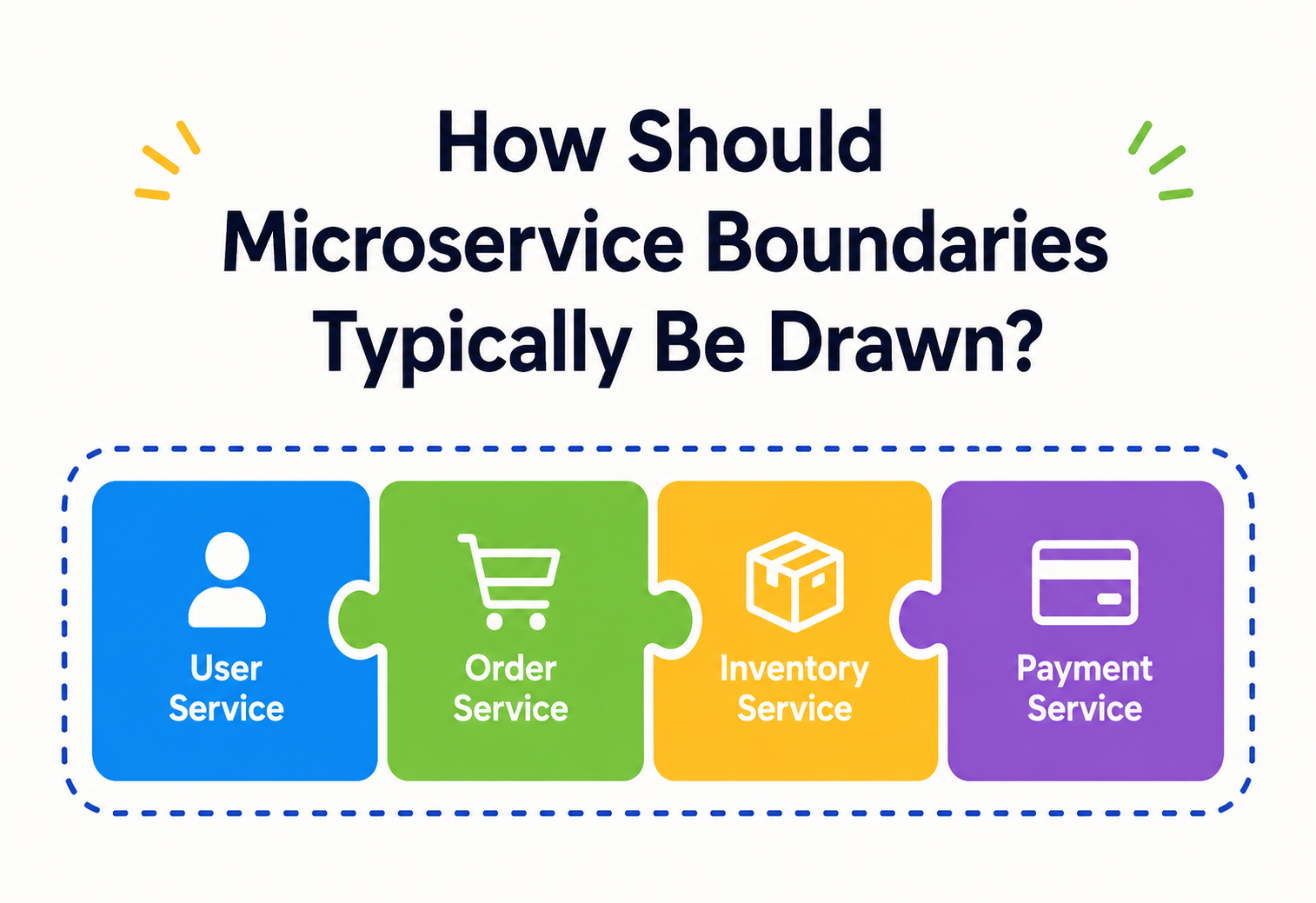
How Should Microservice Boundaries Typically Be Drawn?
A complete, beginner‑to‑production guide to deciding where one microservice ends and another begins — using business meaning, not folder structure, as your ruler. Domain‑driven. Team‑shape aware. Netflix / Amazon / Uber / Shopify real‑world.
Introduction & History
Imagine a big kitchen in a busy restaurant. If one person had to chop vegetables, grill meat, bake bread, wash dishes, and also greet customers at the door, the kitchen would fall apart the moment it got busy. So restaurants split work into stations: a grill station, a salad station, a dessert station, a dishwashing station. Each station has its own tools, its own space, and its own person in charge. When the dessert station is slow, it does not stop the grill station from working.
A microservice boundary is exactly this kind of station wall in software. It is the invisible line that says, “Everything inside this line is one team’s job, one deployable unit, and one area of business knowledge. Everything outside this line belongs to someone else.” Drawing that line well is one of the most important — and most misunderstood — skills in modern software architecture.
To understand why boundaries matter so much, it helps to look at where microservices came from.
A short history
For most of the 1990s and 2000s, the dominant way to build large business applications was the monolith: one big application, one codebase, one deployable artifact, usually one database. Companies like Amazon and Netflix started out this way too. It worked well when the team was small and the product was simple.
But as these companies grew, the monolith started to hurt. Amazon has spoken publicly about how, in the early 2000s, its retail website was a large monolithic application where teams stepped on each other’s code, a small change in one area could break something unrelated, and every release required careful coordination across many teams. Amazon’s engineering leadership pushed for a shift toward small, independently owned services communicating over well‑defined interfaces — an approach that is now widely credited as one of the earliest large‑scale examples of what we now call microservices architecture.
Netflix went through something similar around 2008–2009 after a major database corruption incident that kept its DVD‑shipping business offline for three days. That outage pushed Netflix toward decoupled, independently deployable services running on the cloud, so that a failure in one part of the system could not bring down the whole company.
The term “microservices” itself became popular a bit later, around 2011–2014, championed publicly by thinkers like James Lewis and Martin Fowler, who described it as a way of building a single application as a suite of small services, each running in its own process, communicating over lightweight mechanisms, and independently deployable.
Think of a school. In the early years, one teacher might handle every subject for a small class — math, art, science, reading — because the class is small and simple. As the school grows to a thousand students, you don’t keep one giant teacher doing everything. You hire a math teacher, an art teacher, a science teacher. Each teacher owns their subject completely, has their own classroom (their own “space”), and can improve their teaching without needing permission from every other teacher. Microservices apply this same idea to software: instead of one giant program doing everything, you have many small, focused programs, each owning one subject.
What nobody tells beginners clearly enough is this: microservices are not primarily a technology decision. They are a boundary decision. You can use the fanciest container orchestration platform in the world, but if you draw your service boundaries in the wrong place, you will end up with something worse than a monolith — a “distributed monolith” that has all the coordination pain of a monolith plus all the network complexity of distributed systems, with none of the benefits of either. This tutorial exists to teach you, from first principles, how to draw those lines correctly.
Problem & Motivation
Before we talk about how to draw boundaries, we need to understand what problem boundaries are actually solving. Let’s build this up from scratch, the way you would explain it to someone who has never written a large application.
What happens without boundaries
Picture a single application where the code for “user accounts,” “payments,” “shipping,” “product catalog,” and “reviews” all live in the same codebase, share the same database tables, and get deployed together as one unit. In the beginning, with three developers, this is fast and simple. There is nothing wrong with a monolith at small scale — in fact it is usually the right choice.
But as the company grows to 50, 100, or 500 engineers working on the same codebase, several problems appear, almost like symptoms of a disease:
- Change collision: Two teams touch the same file in the same week, and their changes conflict or silently break each other’s features.
- Slow deployment: To release a tiny fix to the “reviews” feature, you must first make sure “payments,” “shipping,” and everything else in the monolith still compiles, passes tests, and is safe to ship — because it is all one unit.
- Unclear ownership: When something breaks in production, it is not obvious which team is responsible, because the code for many concerns is tangled together.
- Scaling waste: If only the “product search” part of the app is under heavy load on Black Friday, you still have to scale the entire monolith — including parts nobody is using heavily — because you cannot scale one internal module independently.
- Cognitive overload: A new engineer joining the team has to understand a giant tangled codebase before they can safely make even a small change.
Imagine a giant box of LEGO where every single brick is glued to every other brick into one solid block shaped like a castle. If you want to change just the color of one window, you cannot — you’d have to break apart the whole castle. Now imagine instead that the castle is built from separate, unglued LEGO bricks. You can pop out the window brick, replace it, and snap it back in, without touching the tower or the gate. Microservices try to keep your system built from bricks you can pop in and out — but only if you decided, correctly, where one “brick” ends and the next begins.
Why “just split the code into services” is not enough
Here is the trap that almost every team new to microservices falls into: they think splitting means picking technical layers — for example, one service for “the database access layer,” one for “business logic,” one for “the API layer.” This feels organized, but it is exactly backwards. It creates services that must always change together (because a single business feature touches all three layers), which means you now pay the network cost of remote calls between services, but you get none of the independence benefit. You have built a monolith that talks to itself over HTTP — slower, more fragile, and harder to debug than the original monolith.
The real problem microservice boundaries must solve is this: how do we divide a large, evolving business into independently changeable, independently deployable, independently scalable units — without creating so much communication and coordination overhead between those units that we lose more than we gain?
“Microservices” does not mean “many small pieces of code.” It means “many small, independently deployable pieces of a business.” The size of the code is not the goal. The independence of the business capability is the goal. A microservice can be 200 lines or 20,000 lines — what matters is whether it owns one clear piece of business responsibility end‑to‑end.
This is exactly why boundary design is the single hardest and most consequential decision in microservices architecture — harder than choosing a message broker, harder than choosing Kubernetes vs. a simpler platform, harder than picking a programming language. Get the boundaries right, and most other decisions become easy. Get them wrong, and no amount of tooling will save you.
Core Concepts
To draw good boundaries, you need a small vocabulary of ideas. We will build each one from the ground up.
3.1 Business capability
What it is: A business capability is something a company does to deliver value, described in plain business language, not technical language — “manage inventory,” “process payments,” “recommend products,” “handle customer support.”
Why it exists: Business capabilities change far less often than the technical implementation underneath them. A company will always need to “process payments,” even if it swaps out the payment provider five times. Anchoring service boundaries to capabilities, rather than to current technology, makes the boundaries stable over time.
Where it’s used: This is the very first exercise in almost every real microservices migration — list out what the business actually does, independent of any code.
Think of a lemonade stand. Its business capabilities are: “make lemonade,” “take money from customers,” “keep track of how much lemonade and cups are left,” and “decide the price.” Even if you change how you make the lemonade — using a jug instead of squeezing lemons by hand — the capability “make lemonade” stays the same. The capability is the what, not the how.
3.2 Bounded Context (from Domain‑Driven Design)
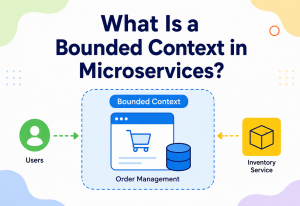
WhatA bounded context is a boundary within which a particular business term has one precise, consistent meaning. Outside that boundary, the same word might mean something completely different. This concept comes from Eric Evans’ 2003 book Domain‑Driven Design, and it is, in practice, the single most important idea for drawing microservice boundaries correctly.
WhyLarge businesses use the same word to mean different things in different departments, and pretending there is one universal meaning for every word causes enormous confusion and bugs.
Where usedEvery serious microservices design effort at large companies today starts with identifying bounded contexts before writing a single line of service code.
Think about the word “book.” In a library, “book” means a physical or digital item you can borrow and must return. In an airline, “book” means to reserve a seat on a flight — it’s a verb, not a noun! In an accountant’s world, “to book” means to record a transaction in the ledger. These are not the same “book” at all — they just share a spelling. Each of these is happening inside its own bounded context.
In an e‑commerce company, “Product” means different things in different contexts: in Catalog it has title, description, images, category; in Inventory it is mostly a SKU with stock count and warehouse; in Pricing it is a SKU with price, currency, discounts, tax rules; in Shipping it is mostly weight, dimensions, fragility. Trying to build one giant “Product” class that satisfies all four contexts leads to a bloated, brittle object every team is afraid to touch. Each bounded context keeps its own “Product” model, sized exactly for what it needs.

3.3 Cohesion and coupling
What they are: Cohesion measures how strongly the responsibilities inside one unit belong together. Coupling measures how much one unit depends on the internal details of another unit. The goal for good boundaries is always: high cohesion inside a service, low coupling between services.
Why they exist: These two ideas, borrowed from structured programming in the 1970s (particularly the work of Larry Constantine and Edward Yourdon), predict how easy or painful a system will be to change. High internal cohesion means related things move together, so changes stay local. Low external coupling means one service can change its internals without breaking others.
A toolbox with all the screwdrivers in one drawer, all the wrenches in another, is highly cohesive — related tools are grouped together. If you also need to duct‑tape your wrench drawer to your neighbor’s hammer drawer so that neither of you can open your drawer without the other’s permission, that’s tight coupling — and it’s miserable.
3.4 The Single Responsibility Principle, applied to services
What it is: At the class level, the Single Responsibility Principle says a class should have only one reason to change. At the service level, this becomes: a microservice should have only one reason to change, driven by one business capability, owned by one team.
Why it matters for boundaries: If two unrelated business rules change for two unrelated reasons but live inside the same service, then every deployment of that service risks breaking a feature nobody intended to touch, and two different teams end up fighting over the same release calendar.
3.5 Conway’s Law
What it is: First stated by computer scientist Melvin Conway in 1967, Conway’s Law observes that organizations design systems that mirror their own communication structure. In simple words: the shape of your org chart tends to leak into the shape of your software.
Why it exists: Communication has a cost. Teams that talk to each other easily and frequently naturally build tightly integrated software. Teams that rarely talk naturally build loosely coupled software, because they simply don’t coordinate enough to create tight coupling.
Where it’s used: Deliberately, in a strategy sometimes called the “Inverse Conway Maneuver” — instead of letting the org chart accidentally shape the software, companies restructure teams around the boundaries they want in the software, so the natural communication patterns reinforce clean boundaries instead of fighting them.
Amazon’s well‑known “two‑pizza team” principle — a team should be small enough to be fed with two pizzas — is a direct, deliberate application of Conway’s Law. Each small team owns a service end‑to‑end, including its design, its data, its deployment, and even sometimes on‑call support (“you build it, you run it”). This organizational shape naturally produces small, independently ownable services, because the team boundary is the service boundary.
3.6 Aggregates and transactional boundaries
What it is: An aggregate, another Domain‑Driven Design term, is a cluster of related objects that must always be kept consistent together, treated as a single unit for the purpose of data changes. An “Order” and its “OrderLineItems” might form one aggregate, because you never want an order to be saved in a state where the line items don’t add up to the order total.
Why it matters for boundaries: A microservice boundary should generally not cut through the middle of an aggregate. If “Order” and “OrderLineItems” need to be updated together, atomically, in one transaction, they almost always belong in the same service — because splitting them across a network means you can no longer guarantee they stay consistent in a single, simple transaction.
Architecture & Components
Now that we have vocabulary, let’s look at what a well‑bounded microservices architecture actually looks like structurally — what pieces exist, and how a boundary shows up physically in a running system.
4.1 What a “service” is made of
A properly bounded microservice typically owns four things completely, without sharing them with any other service:
- Its own data store — a database, schema, or set of tables that no other service is allowed to read or write directly.
- Its own business logic — the rules that decide what is allowed to happen within its capability.
- Its own API contract — a well‑defined, versioned interface (REST, gRPC, events) that other services use to interact with it.
- Its own deployment pipeline — it can be built, tested, and released independently of every other service.
If any of these four is shared — for example, two services reading from the same database tables — the boundary is not real. It is a boundary drawn on a whiteboard, but not enforced in the running system, and it will erode over time until the two “services” are really one hidden monolith split across two repositories.
Fig 1 — Each service owns its API, logic, and database completely. Services only ever talk to each other through published APIs.
4.2 The Bounded Context Map
Before boundaries become services, teams usually draw a “context map” — a diagram of all the bounded contexts in the business and how they relate to each other. This is a discovery tool, not code.
Fig 2 — A context map for a simplified e‑commerce business. Arrows show which context depends on which — this dependency direction strongly hints at where service boundaries should go.
4.3 Layers within a well‑bounded service
Inside a single, well‑bounded microservice, you will usually still see internal layering — but this layering happens inside the boundary, not as the boundary. A typical structure:
| Layer | Responsibility |
|---|---|
| API / Controller layer | Accepts requests, validates input shape, translates to internal calls |
| Domain / Service layer | Business rules, the actual “brain” of the capability |
| Repository / Persistence layer | Reads and writes to the service’s own database |
| Integration layer | Publishes events or calls other services’ APIs |
A very common beginner mistake is to confuse these internal layers with service boundaries — creating an “api‑service,” a “logic‑service,” and a “database‑service” as three separate microservices. This is the “layered splitting” trap mentioned earlier. Layers belong inside a boundary; they are not boundaries themselves.
Internal Working: How You Actually Draw the Line
This is the heart of the tutorial — the concrete, repeatable process for deciding where one service ends and another begins.
5.1 Step 1 — Discover the domain through Event Storming
Event Storming, a workshop technique invented by Alberto Brandolini around 2013, brings business experts and engineers into a room (physical or virtual) with a giant wall of sticky notes. Participants write every significant business event in orange notes — “Order Placed,” “Payment Failed,” “Item Shipped,” “Inventory Reserved” — and place them in time order along the wall.
Once the events are laid out, natural clusters appear — groups of events that clearly belong to the same story. These clusters are your first hint at bounded contexts, discovered from real business language, not from a database schema someone drew five years ago.
If you were event‑storming a food delivery app, you might end up with clusters like: “Order Placed → Order Confirmed → Order Cancelled” (Order cluster), “Rider Assigned → Rider En Route → Rider Arrived” (Delivery cluster), and “Payment Authorized → Payment Captured → Payment Refunded” (Payment cluster). Each cluster is a strong candidate to become its own service.
5.2 Step 2 — Identify aggregates and consistency boundaries
Within each cluster, ask: “Which pieces of data must always be true together, at the same instant, inside one transaction?” Group those into an aggregate. The rule of thumb from Domain‑Driven Design: one transaction should touch one aggregate. If you find yourself needing two‑phase commit across two aggregates to keep data consistent, that’s a strong signal those aggregates should live inside the same service (or you need to redesign the aggregate).
5.3 Step 3 — Test the boundary with the “change reason” question
For every candidate boundary, ask: “If the business changes rule X, does it touch only this cluster, or does it force changes in another cluster too?” If a single business change routinely forces edits across two proposed services, they are not truly separate contexts yet — you have drawn the line in the wrong place.
5.4 Step 4 — Test the boundary with team ownership
Ask: “Could one small team (5–9 people) own this service end‑to‑end — including its data, its API, its deployment, and its on‑call rotation — without needing another team’s approval for routine changes?” If the answer is no, the boundary is probably too small or drawn in a way that creates dependency.
5.5 Step 5 — Test the boundary with the database question
Ask: “Can this service’s data model live in its own database, with no foreign keys pointing into another service’s tables?” If two proposed services need to JOIN across each other’s tables to answer common questions, this is one of the strongest signals that you have split a single bounded context into two pieces by mistake.
Fig 3 — A practical checklist loop for validating a candidate microservice boundary before committing to it.
5.6 Sizing: how big should a microservice actually be?
Beginners often ask for a rule like “under 1,000 lines of code” or “under 10 endpoints.” These numeric rules are misleading, because size in lines of code has nothing to do with business cohesion. A payments service handling regulatory tax rules across 40 countries might legitimately be large. A “gift‑wrapping preference” service might legitimately be tiny. The right test is not size — it is: does this unit map to exactly one reason to change, owned by exactly one team?
That said, two informal heuristics are genuinely useful as sanity checks, not hard rules:
- The two‑pizza team heuristic (Amazon): if the team needed to fully understand and safely operate this service would be larger than 5–9 people, the service may be doing too much.
- The “can you rewrite it in two weeks” heuristic (popularized in Netflix‑style thinking): if rewriting a service from scratch, given its current understanding, would take more than a couple of weeks, that’s a signal it may be bundling more than one capability.
Data Flow & Lifecycle
Boundaries are not just about where code lives — they profoundly shape how data moves through the system over time. Let’s trace a real request end‑to‑end.
6.1 A request’s journey across boundaries
Consider a customer placing an order in an e‑commerce system with well‑drawn boundaries: Order Service, Inventory Service, Payment Service, Shipping Service, Notification Service.
Fig 4 — Order Service makes two synchronous calls for things that must be confirmed before responding to the customer (stock, payment), then publishes an asynchronous event for things that can happen slightly later (shipping, notification). This mix of sync and async is deliberate, based on business urgency — not accident.
6.2 Why the boundary decides sync vs. async
Notice that the boundary lines directly shaped the communication style. Stock reservation and payment had to be synchronous, because the customer needs an immediate yes/no answer before their order is confirmed. Shipping and notification could be asynchronous, because the customer does not need to wait for a shipping label to be printed before seeing “Order Confirmed” on their screen. Good boundary design always asks: “What must happen before I can respond to the user, and what can happen slightly later?”
6.3 Data ownership and the “single source of truth” rule
Each piece of data has exactly one owning service — the only service allowed to write it. Every other service that needs that data either calls the owning service’s API, or keeps a local, read‑only, eventually‑consistent copy (sometimes called a “replica” or “materialized view”).

The Inventory Service owns stock counts. The Order Service does not keep its own authoritative stock count — instead it either calls Inventory’s API to check stock at order time, or subscribes to a StockLevelChanged event and keeps a local read‑only cache for fast, non‑critical checks (like showing “Only 3 left!” on the product page). If Order Service ever writes directly to Inventory’s stock table, the boundary is broken, even if the two run as separate deployables.
6.4 Data lifecycle: creation, propagation, and eventual consistency
When one service’s data changes, that change often needs to “ripple” to other services that keep read‑only copies. This typically happens through an event: the owning service publishes an event describing what changed (ProductPriceChanged, CustomerAddressUpdated), and any interested service subscribes and updates its own local copy. This means, for a short window of time, different services may show slightly different versions of the truth — this is called eventual consistency, and accepting it deliberately, in the right places, is one of the prices you pay for having independent boundaries.
Some data absolutely cannot tolerate even a brief window of inconsistency — for example, “has this payment already been charged?” For these cases, keep the data inside one aggregate, inside one service, inside one strongly‑consistent transaction, rather than spreading it across boundaries and hoping eventual consistency resolves fast enough.
Advantages, Disadvantages & Trade‑offs
Every architectural choice trades one thing for another. Being honest about both sides is what turns boundary design from a trend into an engineering discipline.
7.1 Advantages of well‑drawn boundaries
| Benefit | Why it happens |
|---|---|
| Independent deployability | A team can release a change to their service without waiting for, or coordinating with, other teams |
| Fault isolation | A crash or slowdown in one service does not automatically bring down unrelated services |
| Independent scaling | You can add more instances of just the heavily‑used service (e.g. Search) without over‑provisioning everything else |
| Technology freedom | Each team can pick the best language / database for their specific problem, since the boundary hides implementation details |
| Clear ownership | When something breaks, it’s obvious which team to page |
| Faster onboarding | A new engineer only needs to understand one small service to be productive, not the entire system |
7.2 Disadvantages and costs
| Cost | Why it happens |
|---|---|
| Network complexity | Function calls become network calls, which can fail, time out, or arrive out of order |
| Distributed debugging | A single user request may now span 6 services; tracing “what went wrong” is much harder than reading one stack trace |
| Data consistency challenges | You lose simple ACID transactions across boundaries and must design for eventual consistency |
| Operational overhead | More services means more things to deploy, monitor, secure, and keep alive |
| Duplicated effort | Some logic (e.g. input validation) may need to be re‑implemented in multiple services |
| Boundary mistakes are expensive | Moving a capability from one service to another later requires data migration and API changes across teams |
If your team is small (under ~15–20 engineers), your domain is not yet well understood, or you don’t have mature deployment and monitoring practices, a well‑structured monolith — often called a “modular monolith,” where boundaries exist as clean internal modules but everything still deploys together — is usually the better starting point. Many companies, including Amazon and Shopify at different points, have publicly discussed pulling some services back into a modular monolith when the operational cost of many tiny services outweighed the benefit for that particular part of the system.
7.3 The core trade‑off, in one sentence
Microservice boundaries trade the simplicity of a single deployable unit for the independence of many small ones — and that trade is only worth making when the independence you gain (faster releases, isolated scaling, clear ownership) outweighs the coordination cost you take on (network calls, eventual consistency, more moving parts to operate).
Performance & Scalability
Good boundaries are a prerequisite for good scaling — but only if they line up with actual load patterns.
8.1 Boundaries enable independent scaling
Because each service is its own deployable unit, you can run five copies of the Search Service and only one copy of the Refund Service, matching resources to real demand. This is only possible because the boundary makes each service a self‑contained, stateless‑where‑possible unit that a load balancer can distribute traffic across.
Fig 5 — Because Search and Refund are separate, correctly bounded services, they can be scaled to completely different instance counts based on their independent traffic patterns.
8.2 Boundaries and latency
Every boundary you cross at runtime costs latency — typically 1–50 ms for an internal network call, depending on infrastructure. If a boundary forces a single user‑facing request to make ten sequential remote calls, you have turned a fast in‑process function call chain into a slow relay race. This is one reason the aggregate rule from Section 5.2 matters so much: keeping strongly related data inside one service avoids unnecessary network hops for common operations.
8.3 Fan‑out and the N+1 boundary problem
A subtle boundary mistake is splitting data so finely that assembling one screen requires calling many services (e.g. a product page calling Catalog, Pricing, Inventory, Reviews, and Recommendations separately for every item in a list). This is sometimes solved with a Backend‑for‑Frontend (BFF) pattern or an API Gateway aggregation layer that fans out the calls in parallel and stitches results together, so the boundary cost is paid once, in parallel, rather than serially by the client.
Netflix’s API Gateway layer (historically built around a system called Zuul, and its precursor patterns) exists specifically to absorb this fan‑out cost — aggregating calls to dozens of backend microservices into a single response tailored for each device type (TV, mobile, web), so boundary‑crossing costs don’t leak all the way to the end user’s device.
8.4 Caching across boundaries
Because remote calls are expensive, services commonly cache data they read frequently from other services — but only for data they don’t own, and always with a clear expiration or invalidation strategy (often driven by the events discussed in Section 6.4), so cached copies don’t silently go stale forever.
High Availability & Reliability
9.1 Boundaries as blast‑radius containers
One of the biggest reliability wins from good boundaries is limiting the “blast radius” of a failure. If the Recommendations Service crashes, a well‑bounded system should still let customers browse, add to cart, and check out — recommendations simply disappear or degrade gracefully, rather than taking down checkout.
Think of a ship built with watertight compartments below deck. If one compartment floods, doors seal it off, and the rest of the ship stays afloat. If the whole hull were one open space, one leak would sink the entire ship. Boundaries are the watertight doors of your architecture.
9.2 Patterns that only work because boundaries exist
- Circuit Breaker: If Service A keeps failing when Service B calls it, B “trips a breaker” and stops calling A for a while, failing fast instead of piling up slow, doomed requests. This only makes sense because A and B are separate, independently failing units.
- Bulkhead: Named after the ship analogy above — separate thread pools or connection pools per downstream dependency, so a slow Payment Service can’t exhaust the resources needed to keep talking to a healthy Inventory Service.
- Graceful degradation: A boundary lets you define a fallback (“show cached recommendations” or “hide the recommendations widget entirely”) for exactly one capability, without redesigning the whole page.
// Java — a simplified Circuit Breaker style call using Resilience4j
CircuitBreaker breaker = CircuitBreaker.ofDefaults("inventoryService");

Supplier<StockResponse> decorated = CircuitBreaker
    .decorateSupplier(breaker, () -> inventoryClient.checkStock(productId));

StockResponse response = Try.ofSupplier(decorated)
    .recover(throwable -> StockResponse.unknownFallback())
    .get();
This code lets the Order Service keep functioning — with a safe fallback — even if the Inventory Service, across the boundary, becomes slow or unavailable, instead of letting one failing service cascade into a system‑wide outage.
9.3 Redundancy and replication within a boundary
Reliability inside a single service boundary usually comes from running multiple instances behind a load balancer, with the service’s database replicated (a primary plus one or more read replicas) so a single machine failure does not mean data loss or downtime. This is a service‑internal concern — the boundary hides these details from every other service.
9.4 Disaster recovery across boundaries
Because each service typically owns its own datastore, disaster recovery planning must happen per‑service (backup schedules, restore drills, cross‑region replication) — but boundaries also mean a disaster affecting one service’s database does not automatically corrupt every other service’s data, since there is no shared database to corrupt.
Security
10.1 Boundaries as security perimeters
A clean boundary is also a natural place to enforce access control. Each service can independently decide who is allowed to call it, and with what permissions, rather than relying on one giant application‑wide security check.
10.2 Authentication and authorization across services
In most modern systems, a user authenticates once (often via OAuth 2.0 / OpenID Connect) and receives a token (commonly a JWT — JSON Web Token). This token is passed along with every request as it crosses service boundaries, so each service can independently verify who is calling and what they’re allowed to do, without needing to call a central “am I logged in?” service on every single request.
Fig 6 — The token is validated at the edge and then propagated across every boundary, letting each service enforce its own fine‑grained authorization independently.
10.3 Service‑to‑service security
Beyond user identity, services also need to trust each other. A common modern approach is mutual TLS (mTLS), often provided automatically by a service mesh (such as Istio or Linkerd), so that every boundary‑crossing call is encrypted and both sides cryptographically verify who they’re talking to — preventing an attacker who gets inside the network from impersonating a trusted service.
10.4 Why boundary design reduces attack surface
When each service owns its own database and exposes only a narrow, well‑defined API, an attacker who compromises one service cannot automatically reach every other service’s data — they are limited to what that one service’s API and permissions allow. This is the security equivalent of the blast‑radius benefit discussed under reliability.

A frequent boundary‑related security mistake is granting a service’s database credentials overly broad network access “just in case,” or allowing internal services to skip authentication entirely because “it’s internal traffic.” Zero‑trust practice today assumes any service could be compromised, so every boundary crossing should still be authenticated and authorized, even between two services that are both “yours.”
Monitoring, Logging & Metrics
Once you have many independently deployed services, understanding what’s happening across all of them becomes its own discipline. Good boundaries make this tractable; bad boundaries make it a nightmare, because failures don’t stay contained to one place.
11.1 Distributed tracing
What it is: A trace follows a single user request as it hops across every service boundary it touches, tagging each hop with a shared trace ID. Why it exists: With ten services involved in one request, you cannot just read one log file anymore — you need to reconstruct the whole journey. Tools like OpenTelemetry, Jaeger, and Zipkin implement this today.
Fig 7 — A trace waterfall shows exactly which service, across which boundary, is consuming the most time — here, the Payment Service call is clearly the slowest hop.
11.2 Centralized logging
Each service still writes its own logs locally, but well‑run systems ship those logs to a central store (like an ELK stack — Elasticsearch, Logstash, Kibana — or a hosted equivalent) tagged with the service name and the trace ID, so engineers can search across every boundary at once instead of SSH‑ing into ten different machines.
11.3 Metrics and the four golden signals
Google’s Site Reliability Engineering practice popularized four “golden signals” every service boundary should expose: latency (how long requests take), traffic (how much load it’s under), errors (rate of failed requests), and saturation (how full its resources are). Because each service is independently deployed, each one needs its own dashboard for these four signals — you cannot rely on one application‑wide dashboard anymore.
11.4 Health checks and readiness probes
Every service boundary should expose a simple /health or /ready endpoint so that load balancers and orchestration platforms (like Kubernetes) know whether to send traffic to a given instance — a small but essential contract that makes the boundary operationally self‑describing.
Deployment & Cloud
12.1 Independent CI/CD pipelines
A true boundary implies a true, separate pipeline: its own repository (or clearly separated folder with independent build/release triggers in a monorepo), its own automated tests, its own build artifact (commonly a container image), and its own deployment schedule. If two services must always be deployed together for the system to work, they are not really independently bounded — this is a strong tell that the boundary is not correctly drawn or not correctly decoupled.
12.2 Containers and orchestration
Modern microservices are typically packaged as containers (using Docker or similar tools) and run under an orchestration platform such as Kubernetes, which handles scheduling instances, restarting failed ones, and routing traffic. Boundaries map naturally onto this model: one service typically becomes one container image and one deployable unit (often a Kubernetes Deployment) with its own scaling rules.
# A minimal Kubernetes Deployment reflecting one service boundary
apiVersion: apps/v1
kind: Deployment
metadata:
  name: inventory-service
spec:
  replicas: 3
  selector:
    matchLabels:
      app: inventory-service
  template:
    metadata:
      labels:
        app: inventory-service
    spec:
      containers:
        - name: inventory-service
          image: registry.example.com/inventory-service:1.4.2
          ports:
            - containerPort: 8080
          readinessProbe:
            httpGet:
              path: /ready
              port: 8080
One boundary maps to one Deployment, one image, one scaling policy — entirely independent from every other service’s Deployment.
12.3 Deployment strategies that boundaries make possible
- Canary releases: route a small percentage of traffic to a new version of one service, without touching any other service.
- Blue‑green deployment: run two full versions of one service side by side and switch traffic instantly, again isolated to that one boundary.
- Feature flags: toggle new behavior inside one service’s boundary without needing a new deployment of any other service.
12.4 The strangler fig pattern for migrating boundaries
Named after a type of fig tree that grows around a host tree and eventually replaces it, the strangler fig pattern (popularized by Martin Fowler) is the standard, low‑risk way to carve microservices out of an existing monolith: put a routing layer in front of the monolith, gradually redirect specific, well‑understood capabilities to new services one at a time, and only retire the corresponding monolith code once the new service has proven itself in production.
Fig 8 — The router incrementally peels capabilities away from the monolith into new, correctly‑bounded services, without a risky “big bang” rewrite.
Databases, Caching & Load Balancing
13.1 Database‑per‑service
The golden rule: each service owns its own database (or schema), and no other service is allowed to connect to it directly. This is the single most important technical enforcement of a boundary — without it, the boundary exists only in documentation, not in reality, and any two services sharing tables are secretly one tightly coupled unit no matter how the code is organized.
| Approach | What it means | When it’s appropriate |
|---|---|---|
| Separate database instances | Each service has its own physical database server | Large, high‑traffic services with different scaling / reliability needs |
| Separate schemas, shared instance | One database server, but strict schema‑per‑service, no cross‑schema queries | Smaller systems where running many database servers is not yet cost‑justified |
| Shared database (anti‑pattern) | Multiple services read / write the same tables directly | Never intentionally — this breaks the boundary |
13.2 Polyglot persistence
Because each service owns its database, different services are free to use different database technologies suited to their access patterns: a relational database (PostgreSQL, MySQL) for the Order Service’s strongly consistent transactions, a document store (MongoDB) for the flexible, evolving Catalog Service, a search‑optimized store (Elasticsearch) for the Search Service, and an in‑memory store (Redis) for the Session or Cart Service.
13.3 Caching across boundaries
Caching typically happens at several boundary‑aware layers:
- Client‑side / CDN caching: for data that rarely changes and is safe to serve stale for a while (product images, static catalog data).
- API Gateway caching: caching whole responses for frequently requested, low‑personalization endpoints.
- Service‑local caching: a service caching data it reads from another service’s API, invalidated by events, as discussed in Section 6.4.
- Distributed cache (Redis, Memcached): shared within one service’s boundary across its own instances, never shared across service boundaries as a backdoor communication channel.
Using a shared Redis instance as an informal way for two services to “just pass data to each other” without going through a proper API or event contract quietly recreates the shared‑database anti‑pattern in a new disguise — now both services depend on undocumented cache keys instead of undocumented tables.
13.4 Load balancing at the boundary
Every service boundary typically sits behind a load balancer (a simple round‑robin or least‑connections balancer, or increasingly, a service mesh sidecar proxy) that distributes incoming calls across that service’s healthy instances — a boundary‑scoped concern, separate from the API Gateway that routes traffic between different service boundaries.
APIs & Service Communication
A boundary is only useful if the way services talk across it is well designed. This section covers the practical mechanics.
14.1 Choosing a communication style
| Style | Best for | Trade‑off |
|---|---|---|
| REST over HTTP / JSON | Simple request / response, human‑readable, widely supported | Higher payload size, no strict contract by default |
| gRPC (protocol buffers) | High‑throughput internal service‑to‑service calls | Strict typed contract, faster, but less human‑readable |
| Asynchronous events (Kafka, RabbitMQ, SNS/SQS) | Notifying multiple interested services of something that happened, without waiting for a reply | Eventual consistency, harder to trace / debug |
| GraphQL (usually at a gateway) | Letting clients ask for exactly the fields they need across multiple backing services | Added query complexity and caching challenges |
14.2 API contracts as the boundary’s public promise
A service’s API is a contract — a promise about what it accepts and what it returns. Because other teams build against this contract, changing it carelessly breaks other services. This is why boundary‑respecting teams practice API versioning and backward‑compatible changes (adding optional fields is usually safe; removing or renaming fields is usually a breaking change requiring a new version).
// Java — a simple, well-bounded REST controller for the Inventory Service
@RestController
@RequestMapping("/api/v1/inventory")
public class InventoryController {

    private final InventoryService inventoryService;

    public InventoryController(InventoryService inventoryService) {
        this.inventoryService = inventoryService;
    }

    // Inventory Service owns stock data completely.
    // No other service is allowed to read this from a shared database.
    @GetMapping("/{sku}")
    public ResponseEntity<StockLevelResponse> getStock(@PathVariable String sku) {
        StockLevel stock = inventoryService.getStockLevel(sku);
        return ResponseEntity.ok(new StockLevelResponse(sku, stock.getQuantity()));
    }

    @PostMapping("/{sku}/reserve")
    public ResponseEntity<ReservationResponse> reserveStock(
            @PathVariable String sku,
            @RequestBody ReservationRequest request) {

        Reservation reservation = inventoryService.reserve(sku, request.getQuantity());
        return ResponseEntity.ok(new ReservationResponse(reservation.getId(), reservation.getStatus()));
    }
}
The controller exposes only what Inventory chooses to expose — stock levels and a reservation action — not its internal table structure. Any other service, in any language, can call this API without knowing anything about how Inventory stores its data internally.
14.3 The API Gateway pattern
Rather than exposing every internal service directly to the outside world, most production systems put an API Gateway at the edge — a single entry point that handles routing, authentication, rate limiting, and sometimes response aggregation, before forwarding requests to the right internal service.
14.4 Event‑driven communication and choreography vs. orchestration
Orchestration: one service (like Order Service) actively directs the whole workflow, calling other services in sequence and deciding what happens next. Choreography: each service reacts independently to events published by others, with no single service directing the show. Orchestration is easier to understand and trace but creates a central point that knows about everyone; choreography scales better organizationally but can make the overall flow harder to see as a whole.
Uber’s engineering blog has described moving parts of its trip lifecycle toward event‑driven, choreography‑style communication between services (trip, driver matching, pricing, payments) precisely because a purely orchestrated model created a bottleneck of knowledge and coupling in whichever service was doing the orchestrating.
Design Patterns & Anti‑patterns
15.1 Good patterns for drawing and enforcing boundaries
Decompose by Business Capability
Draw the first cut of service boundaries directly from the list of things the business does (Section 3.1), before any technical concerns enter the picture.
Decompose by Subdomain (Domain‑Driven Design)
Classify parts of the domain as Core (your true competitive advantage — deserves the most design investment and usually its own dedicated service), Supporting (necessary but not differentiating), and Generic (solved problems like authentication or payments, often bought or reused rather than custom‑built).
Database‑per‑Service
Covered in Section 13.1 — the enforcement mechanism that makes a boundary real, not just conceptual.
Saga Pattern
Since a single ACID transaction can’t span multiple service boundaries, a saga breaks a multi‑step business process into a sequence of local transactions, each with a corresponding “compensating” action to undo it if a later step fails. For example: reserve stock → charge payment → if payment fails, release the stock reservation as compensation.
Fig 9 — A saga: when the payment step fails, the Order Service triggers a compensating action to undo the earlier stock reservation, keeping the system consistent without a distributed transaction.
Anti‑Corruption Layer
A translation layer at the edge of a bounded context that converts an external system’s model (perhaps a legacy system, or a partner’s API) into your own clean domain model, so foreign, messy concepts never leak in and corrupt your service’s internal design.
Strangler Fig
Covered in Section 12.4 — the standard incremental path from monolith to well‑bounded services.
15.2 Anti‑patterns to watch for
Many small deployable services that must nonetheless all be deployed together, or that constantly break each other with routine changes. All the network overhead of microservices, none of the independence benefit — usually caused by boundaries drawn along technical layers instead of business capabilities.
Two or more services reading and writing the same tables. This is the single most common way teams accidentally destroy a boundary they thought they had drawn.
A single user action requires a long, sequential chain of remote calls between many tiny services — usually a sign the boundary is drawn too finely, cutting through what should have been a single aggregate.
A service so small (sometimes literally one endpoint) that the operational overhead of running, monitoring, and securing it as an independent deployable unit costs more than the coupling it was meant to avoid.
The opposite extreme — one service absorbs more and more responsibility over time because it’s “already there,” slowly turning back into a monolith wearing a microservices costume.
Splitting services to match existing org charts or to avoid uncomfortable conversations between teams, rather than to match real business capability — this inverts Conway’s Law in the wrong direction, letting accidental organizational friction shape the software instead of a deliberate design decision.
Best Practices & Common Mistakes
16.1 Best practices
- Business firstStart with the business, not the database. List business capabilities and bounded contexts before opening a schema designer.
- Coarse firstPrefer starting with fewer, coarser services. It is far easier to split a service later, once real usage patterns are known, than to merge two services that were split too early and are now deeply entangled through their APIs.
- EnforceEnforce boundaries with database‑per‑service, always. Treat a shared table as a hard failure of the design, not a shortcut.
- ContractsDesign APIs as public contracts from day one, with versioning, even if only one internal team currently calls them.
- ConwayLet teams and services mirror each other deliberately, applying the Inverse Conway Maneuver rather than letting the org chart accidentally dictate poor boundaries.
- RevisitRevisit boundaries as the business changes. A boundary that was correct two years ago may no longer match how the business actually operates today — treat boundaries as a living design decision, not a one‑time diagram.
- ObservabilityInvest in distributed tracing and centralized logging early, before you have enough services for a production incident to become a multi‑hour scavenger hunt.
16.2 Common mistakes
- Splitting by technical layer (API layer, logic layer, data layer) instead of by business capability — covered extensively above, but common enough to repeat.
- Copy‑pasting an org chart directly into service boundaries without checking whether it actually reflects clean business capabilities.
- Ignoring transactional boundaries — splitting an aggregate that must be consistent across two services, then discovering data can drift out of sync in production.
- Treating boundary decisions as permanent and unchangeable, which discourages teams from fixing mistakes early, when they’re cheap, rather than years later, when they’re expensive.
- Over‑engineering from day one — designing 40 microservices for a product with 3 users and 2 engineers, when a well‑modularized monolith would let the team learn the domain faster and split later with much better information.
- Forgetting the human side — a boundary nobody can operate on‑call, or that no single team feels ownership over, will decay no matter how clean it looked on the whiteboard.
Real‑World & Industry Examples
Amazon’s shift away from a single monolithic retail application, described publicly by its engineering leadership, involved forcing teams to expose their functionality only through service interfaces — no direct database access between teams — which is precisely the database‑per‑service enforcement mechanism described in Section 13.1, applied at enormous organizational scale.
Netflix’s move to cloud‑based microservices after its 2008 database corruption incident led it to build many independently deployable services (for recommendations, playback, billing, content metadata, and more), fronted by an API Gateway layer that aggregates results for different device types, closely matching the fan‑out and gateway aggregation patterns discussed in Sections 8.3 and 14.3.
Uber’s engineering blog has documented its evolution toward a large number of independently owned services aligned to specific business capabilities (trip management, pricing, driver matching, payments), along with the organizational and tooling investment required to keep thousands of services discoverable and manageable — illustrating that boundary design does not stop being work once services exist; it requires ongoing platform investment to stay healthy at scale.
Shopify has publicly discussed its “modular monolith” approach for its core commerce platform — deliberately keeping clean, enforced internal module boundaries (mirroring bounded contexts) within a single deployable application for a long time, splitting out true microservices only for capabilities that had a clear, independent scaling or ownership need. This is a useful real‑world counter‑example to the idea that “more microservices is always better” — boundary discipline matters more than boundary count.
In every one of these companies, the decision to split a boundary out into its own service was driven by a concrete organizational or scaling pain point that had already been felt — not by a belief that microservices are inherently superior. Boundaries were drawn where real pain justified the cost of independence.
FAQ, Summary & Key Takeaways
Frequently Asked Questions
Should I start with many small microservices or one modular monolith?
For most teams, especially small ones or teams new to a domain, start with a modular monolith — clean internal boundaries, single deployment. Split a module into its own service only once you have a concrete, felt need (independent scaling, independent release cadence, a dedicated team) rather than splitting speculatively.
How do I know if I’ve drawn a boundary in the wrong place?
Watch for the warning signs covered throughout this tutorial: frequent cross‑service database JOINs or foreign keys, a single business change routinely forcing edits across two “separate” services, two services that must always be deployed together, or one team needing another team’s approval for routine changes inside their own service.
Is it okay for boundaries to change over time?
Yes — and it should be expected. As the business evolves, what once looked like one capability may split into two, or two supporting capabilities may merge. Treat your context map as a living document, and budget time to refactor boundaries the same way you’d budget time to refactor code.
What’s the difference between a bounded context and a microservice?
A bounded context is a modeling concept — a boundary of consistent meaning for business terms. A microservice is an implementation choice — a deployable unit. In good designs, they usually map closely (often one bounded context per service), but a bounded context can also exist as a well‑isolated module inside a monolith, without being its own deployable service.
How many microservices is “too many”?
There’s no universal number. The right test is whether each service still maps to a clear, single business capability with a team that can own it end‑to‑end. If you find yourself with services that exist mainly because “we split everything up,” rather than because of a genuine independence need, you likely have too many, regardless of the count.
Summary
Drawing microservice boundaries well starts with understanding the business, not the technology. You discover bounded contexts through techniques like Event Storming, validate them against aggregate consistency needs, team ownership, and database independence, and enforce them technically through database‑per‑service and well‑versioned APIs. Good boundaries deliver independent deployability, fault isolation, and clear ownership — at the cost of network complexity, eventual consistency, and more operational surface area. Real companies — Amazon, Netflix, Uber, Shopify — all arrived at their current boundaries by responding to real, felt pain, not by chasing microservices as a trend for its own sake. The single best test for any candidate boundary remains simple: does it map to one business capability, owned by one team, with one reason to change?
Key Takeaways
- 01Business capability first. Boundaries should follow what the business does, not the shape of your database or your org chart by accident.
- 02Bounded Context is your ruler. Where a business term’s meaning changes, a boundary probably belongs.
- 03Never split an aggregate. Data that must be consistent in one transaction belongs in one service.
- 04Enforce with database‑per‑service. A boundary without data isolation is not a real boundary.
- 05Team shape matters. Use Conway’s Law deliberately — structure teams to match the boundaries you want.
- 06Start coarse, split later. It’s cheaper to split an overly broad service than to merge two overly narrow ones.
- 07Boundaries are living decisions. Revisit them as the business changes — they are never truly “done.”
- 08Real pain, not trends. Split a service because of a concrete, felt need — not because “microservices are best practice.”
“A microservice can be 200 lines or 20,000 lines — what matters is whether it owns one clear piece of business responsibility end‑to‑end.”