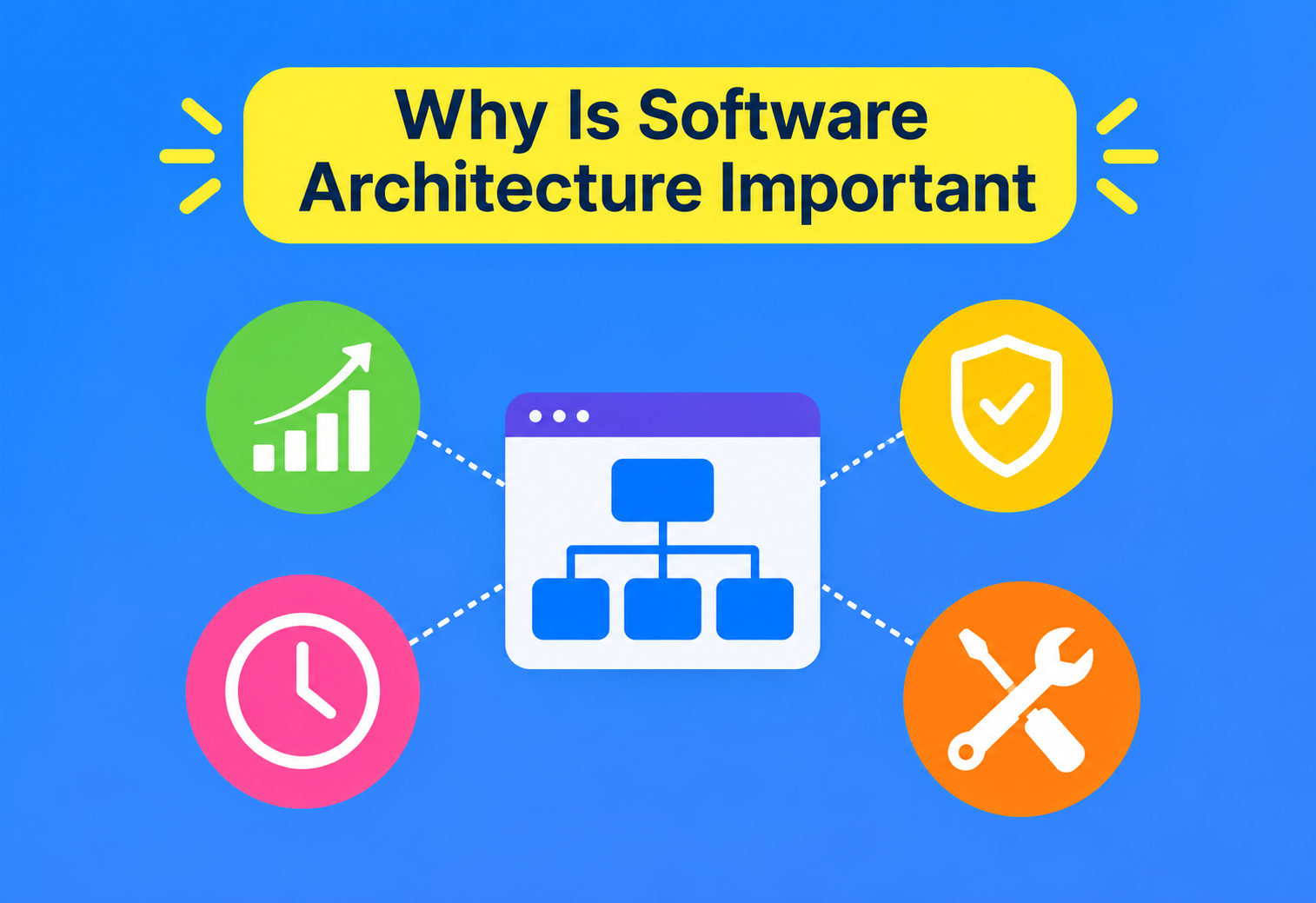
Why Is Software Architecture Important?
The decisions no one sees, made early, that quietly decide whether the product ships on time, scales when it needs to, and survives its first three years without a rewrite.
The Big Idea, in One Breath
Architecture is the small set of decisions, made early, that quietly decide whether every later decision is cheap or ruinously expensive.
Every piece of software has an architecture, whether anyone drew it or not. If nobody drew it, the architecture is whatever accidentally emerged from the first few commits. Sometimes that accident works. More often it turns into the reason a two-quarter feature roadmap keeps slipping into next year.
Architecture matters because it decides three things upstream: what is easy to change later, what is hard to change later, and what is never going to change without a rewrite. Everything downstream — team velocity, incident rate, cloud bill, staff attrition — is a downstream effect of those three answers.
Think of a ship’s hull. Passengers never see it. Crew barely think about it once the vessel is at sea. But the shape of the hull, laid down in the shipyard, has already decided how fast the ship can go, how much cargo it can carry, how well it handles rough water, and how much fuel it burns for the rest of its working life. You can repaint any deck at any time. You cannot re-lay the keel while the ship is sailing.
Software architecture is the keel. Product features are the paint.

The Core Reasons It Matters
Six real-world outcomes flow directly from having a coherent architecture — and directly deteriorate without one.
Change stays cheap
New features slot into a shape that already anticipated them. What could be a two-week task never becomes a two-quarter one.
Systems survive scale
Load grows. Users grow. Data grows. A good architecture bends where it needs to bend and holds where it needs to hold.
Failures stay contained
Something will break. When it does, it takes down one thing, not everything. Recovery is measured in minutes, not days.
Teams can move in parallel
Clear boundaries let two, five, twenty teams work independently without stepping on each other. Without boundaries, everyone eventually waits on everyone.
Cost is predictable
The bill grows with the business, not faster than the business. Surprises come from features, not from the platform.
Talent stays
Engineers leave systems they cannot understand. A legible architecture attracts and keeps the people you need.
Architecture is not a nice-to-have. It is the difference between a business that can adapt and one that spends every quarter apologising for its own systems.
The Cost of Skipping It
Architectural decisions get exponentially more expensive to change the later you make them.
The curve is the point of the whole discussion. A design decision that costs an hour to change in a whiteboard sketch costs a day to change in a prototype, a week during build, a quarter after launch, and sometimes a small startup’s entire year in a mature system.
“We’ll fix it later” sounds reasonable when the number is “1×”. It sounds different at “100×”. And the honest surprise is not that fixing it later is expensive — everyone agrees that is expensive. The honest surprise is that most teams do not realise which decisions are on the curve until they are already past the cheap end.
What thoughtful architecture buys
- Predictable roadmap
- Cheap iteration on features
- Contained incidents
- Onboarding measured in weeks
- A platform the business can trust
What skipping it costs
- Missed release dates you cannot explain
- Rewrites disguised as “refactors”
- Outages that stretch across services
- Onboarding measured in quarters
- Senior engineers who quietly start job-hunting
What Leadership Actually Gets
A good architecture is not a technical achievement. It is a set of business options that would otherwise not exist.
The best way to explain the value of architecture to a non-technical audience is to describe the options it produces. Every design decision either creates or forecloses an option that the business may need later. Good architects trade options carefully; bad ones give them away for short-term speed.
Enter a new market
Regional launch, new currency, new language, new regulator — each is easy or almost impossible depending on choices already made in the first year.
Absorb an acquisition
Buying another company’s product and folding it into yours is a design problem long before it is a business one.
Pivot the business model
Free to paid, B2C to B2B, single-tenant to SaaS. The architecture either bends, or the pivot is a rebuild.
Sell an API
The internal API becomes a product. Easy if the boundaries are clean; embarrassing if they are not.
Move to another cloud
Not a common move, but one worth being able to make. Architecture decides whether the answer is “a project” or “a company crisis”.
Ship a mobile / offline mode
Depends entirely on whether the data flow was designed to allow it.
Managing Complexity and Technical Debt
Systems get more complex whether you help them or not. Architecture is how you keep the complexity worth carrying.
Software has a physics: every feature added to a system increases the surface area of everything else. Left alone, that growth is quadratic. The whole point of architecture is to design boundaries that turn that quadratic growth back into something closer to linear.
Two kinds of complexity
Essential complexity
The complexity of the problem itself. A stock exchange is genuinely complicated. Payroll for 40 countries is genuinely complicated. You cannot design this away.
Accidental complexity
Complexity you added because the design was rushed, the abstractions were wrong, or the same idea got implemented three different ways. You can design this away, and architects earn their salary doing exactly that.
Technical debt, honestly
Technical debt is not a moral failing. It is a deliberately-taken shortcut that speeds you up now and slows you down later. Every real team carries some. Healthy teams know what debt they have, why they took it, and when they plan to repay it.
When a team cannot list its top three pieces of tech debt in one sentence each, the debt has stopped being debt and become the platform. That is the point where architecture is quietly missing.
Good architecture does not eliminate debt. It creates the boundaries that make debt local — contained to one service, one module, one team — instead of spreading through the whole system like damp.

The Quality Attributes
The whole reason architecture exists: to trade one desirable property against another, on purpose.
“Non-functional requirements” is the industry’s worst-named category. These are not the requirements that are optional; they are the requirements the users notice when they are missing.
| Attribute | Users notice when it’s missing |
|---|---|
| Performance | The page takes eight seconds. The report never finishes. The click has no acknowledgement. |
| Scalability | Everything is fine until Monday morning, when everyone shows up at once. |
| Availability | The status page has three red dots. The customer support line is on fire. |
| Reliability | Things almost work. Every fifteenth request quietly fails. Nobody trusts the system. |
| Security | A bug bounty report arrives. A journalist calls. A regulator asks a very specific question. |
| Maintainability | New feature estimates keep doubling. Every change breaks two other things. |
| Cost efficiency | The cloud bill grows faster than revenue. Nobody can explain which service costs what. |
These attributes trade against each other. You cannot maximise all of them at once, and pretending you can is the fastest way to a design that satisfies nobody. Architecture is the discipline of choosing the trades deliberately.
How Architecture Reduces Risk
Not by preventing failure — failure will happen — but by making failure cheap, local, and recoverable.
The single clearest sign of a mature architecture is what happens when something goes wrong. A brittle system amplifies failures: one queue backs up, one dependency times out, and within minutes the whole platform is on the incident channel. A well-architected system localises them: one feature degrades, everything else keeps working, and the on-call engineer has more coffee than adrenaline.

Design for isolation
Bulkheads between services. When one fails, the others are not sitting behind the same connection pool waiting to be dragged down.
Design for graceful degradation
Non-critical features fail visibly and locally. The site still lets people buy things when the recommendations engine is down.
Design for observability
You cannot fix what you cannot see. Logs, metrics and traces are architectural choices, not afterthoughts.
Design for reversibility
Deploys can be rolled back in minutes. Schema changes are backwards-compatible. Feature flags exist. The blast radius of a mistake is small.
Design for the drill
Disaster recovery, region failover, chaos experiments — practised regularly, not just documented.
Signs of Weak Architecture
You do not need a formal review to see it. These six signs show up before anyone admits there is a problem.
Every estimate is a shrug
Nobody can predict how long anything will take, because every change touches too many places.
The same bug keeps coming back
Fixed here, reappears there. The same idea lives in five places, each subtly different.
Onboarding takes months
New engineers cannot orient themselves. There is no clear boundary they can own end-to-end.
Small changes need big releases
A one-line fix needs to be coordinated with four other teams and shipped in a monthly window.
Incidents keep spreading
One service degrades and half the platform notices. Blast radiuses are always larger than expected.
Nobody wants to touch the core
There is a module everyone routes around. It is written into all the roadmap risk sections and never actually addressed.
Any one of these on its own is normal. Two or three together, chronically, is the shape of an architecture that is quietly costing the business more than anyone has bothered to measure.
The Real Challenges of Getting It Right
Good architecture is unusually hard for reasons that have very little to do with technology.
If good architecture were purely a technical problem, we would have solved it. It is hard because it lives at the intersection of technology, business, timing and people — and each of those pulls in a slightly different direction.

Decisions early, information late
You have to choose before you know. The cheapest time to decide is also the least-informed time. Good architecture manages that gap by keeping decisions reversible where possible.
Invisible when it works
A great architecture produces no drama, and drama is what leadership tends to notice. The reward for a smooth quarter is often less investment in the architecture next quarter.
Consensus without authority
The architect rarely owns the teams whose work they shape. Every important decision has to be earned, not mandated.
Every win costs somewhere
More availability costs cost. More flexibility costs performance. Every improvement lands on someone’s constraint.
The architecture problem is rarely which pattern to pick. It is which trade to make, out loud, in front of people who will remember it later.
How Architecture Evolves With the Business
A system that never changes shape is a system that is quietly falling behind. Healthy architectures evolve in stages, on purpose.
The startup shape
Single service, single database, small team, everything in one repo. Right answer for the first year or two. Wrong answer thereafter.
The modular monolith
Same deployable, cleaner internal boundaries. Real modules that could become services later. Where most successful products spend their most productive years.
The first split
One or two well-chosen services extracted, usually because they have different scaling or ownership needs. Not because “microservices” is on a roadmap.
Platform & product
A platform team emerges. Common concerns — auth, data, deployment — are lifted into shared services. Product teams stop reinventing them.
Federated shape
Many teams, many services, clear contracts. The architecture is now a set of standards and interfaces as much as a diagram.
These stages are not a maturity ladder to climb as fast as possible. Each stage is fit for a size of business and a stage of product. Skipping ahead is expensive; staying too long is also expensive. Architecture is the discipline of moving between them at the right time.
Common Myths, Cleared Up
The topic attracts strong opinions from people who have not paid the bill. A few of them are worth answering directly.
“Architecture only matters for huge companies.”
Big companies see the pain of missing architecture more visibly, but small companies pay it earlier. A five-person team with a tangled codebase spends a much larger fraction of its time on rework than a two-hundred-person one. Architecture is not about size; it is about whether the system will still be worth changing in twelve months.

“If it works today, the architecture must be fine.”
Working today is the easiest thing a system does. The interesting question is what happens on the day the load doubles, the team doubles, a regulator writes to you, or the founder’s original assumption stops being true. Architecture is judged by what the system does under those conditions, not by whether the demo runs.
“Spending time on architecture slows a project down.”
Doing architecture badly slows projects down. Doing it well is often invisible in month one and unmistakable by month twelve. What actually slows projects down is skipping the trade-off conversation and discovering, six months in, that the design cannot bend the way the business now needs.
“Architecture is just diagrams.”
Diagrams are the least of it. The real product of architecture is a set of decisions written down, with the trade-offs made explicit, and the boundaries drawn where they will hold. Without those, a beautiful diagram is decoration.
Key Takeaways
The whole guide, compressed into a handful of lines you can carry into your next architecture conversation.
Remember This
- Every system has an architecture. The only question is whether it was designed or whether it emerged from the first few commits by accident.
- Cost of change is exponential. An architectural decision is roughly 1× at design, 25× after launch, and 100×+ at scale. That curve decides where your architecture effort should land.
- Architecture is trade-offs. Performance vs. cost. Availability vs. simplicity. Speed of delivery vs. long-term flexibility. There is no design that maximises all of them.
- Quality attributes are the real requirements. Performance, availability, reliability, security, maintainability, scalability, cost. Users notice them only when they are absent.
- Business options are the currency. Every design decision either creates or forecloses an option the business may one day need.
- Debt is not a failure; ignoring it is. Healthy teams know their top three pieces of tech debt in one sentence each.
- Weak architecture leaves fingerprints. Shrugged estimates, spreading incidents, months-long onboarding, and a module everyone routes around.
- The architecture is alive. Businesses evolve; systems must evolve with them. The point is not to reach the end state — it is to move between shapes at the right time.