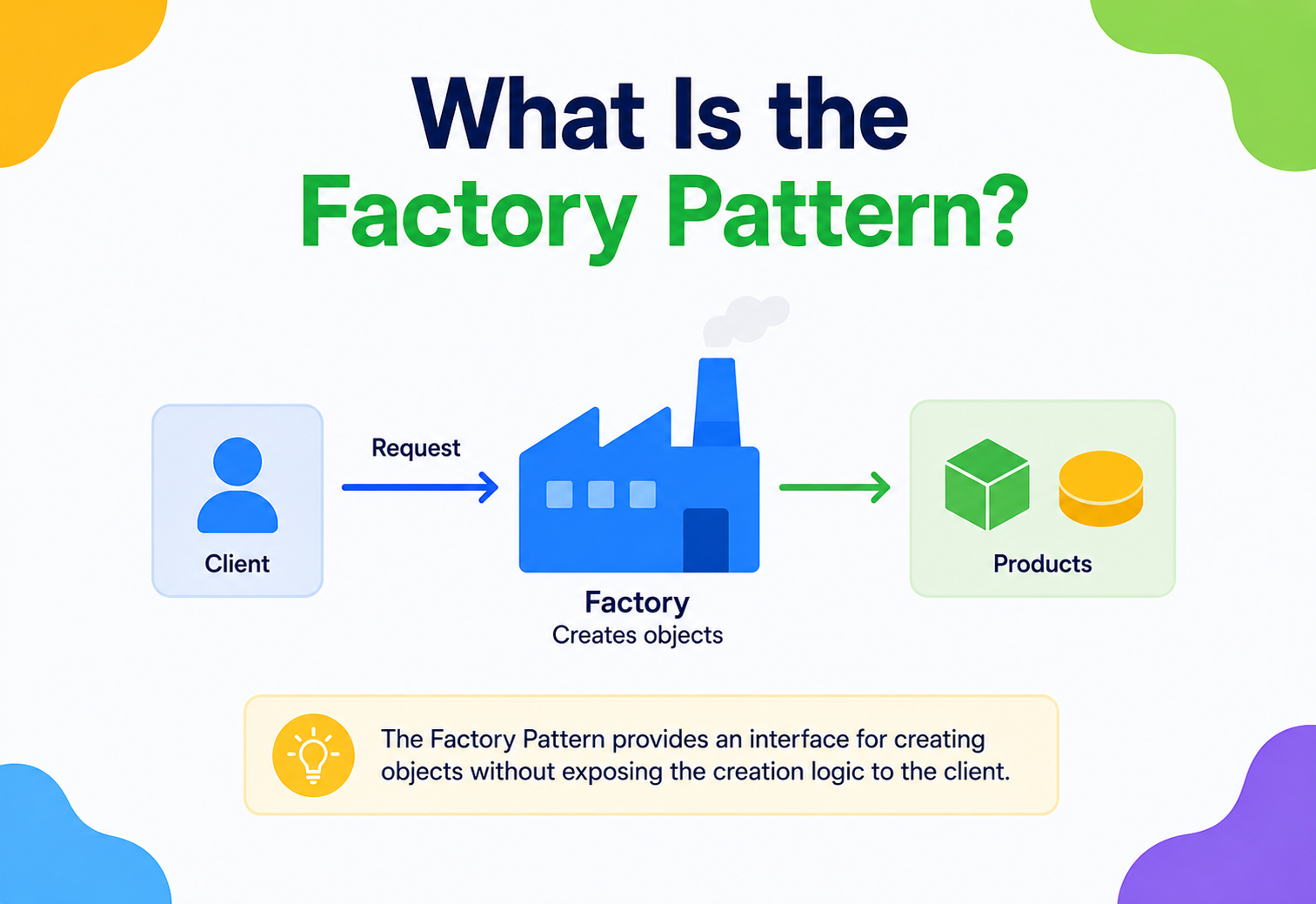
What Is the Factory Pattern?
Order a pizza and you never tell the kitchen how to knead the dough or fire the oven — you just say “one pepperoni, please” and trust the kitchen to handle the rest. The Factory pattern gives your code that exact same trust: ask for what you need, let a dedicated builder handle the messy details.
The Big Idea, in One Breath
Picture yourself at a pizza counter. You don’t walk up and personally knead dough, stretch it out, add exactly the right amount of sauce, and manage the oven temperature yourself — that would be strange, and slow, and you’d probably get it wrong. Instead, you simply say “one pepperoni pizza, please,” and the kitchen — full of people and equipment you never see or think about — handles every messy detail of actually making it. You just receive a finished pizza, ready to eat.
The Factory pattern brings that same everyday convenience into software. Instead of every part of a program personally handling the messy details of building a specific object — deciding which exact class to use, setting up its internal pieces correctly — that responsibility gets handed off to a dedicated “factory,” whose entire job is producing the right object on request. The rest of the program simply asks for what it needs and trusts the factory to deliver it, fully built and ready to use.
Think about a toy vending machine. You press a button for the toy you want, and a moment later, it drops down, fully assembled, wrapped, ready to play with. You never see the assembly line, the packaging process, or the quality checks happening behind the scenes — and you don’t need to. All you need is to know which button gets you which toy. A software factory works exactly the same way: press the right button (call the right method), and out comes a fully built object.
What makes this small shift so powerful is what it frees the rest of the program from needing to know. The code that wants a pizza, or a toy, or an object, never has to worry about how many steps go into making it, which ingredients or sub-parts are involved, or how the process might change next year when the kitchen gets a new oven. All of that complexity stays neatly tucked away inside the factory, out of sight and out of mind for everyone else. That separation — between “asking for something” and “actually building it” — turns out to be one of the most valuable habits in all of software design, and the Factory pattern is simply the most direct, well-known way of putting it into practice.
What the Factory Pattern Really Is
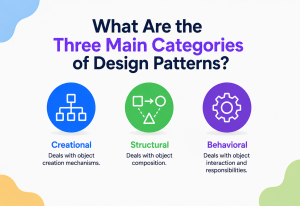
Formally, the Factory Method pattern is a creational design pattern that defines a dedicated method for creating an object, but lets the exact class being created be decided elsewhere — often by a subclass, or by a simple decision inside the factory itself. Instead of scattering the raw “build a new object of this exact class” instruction throughout a codebase, that decision gets centralised into one predictable, well-organised place.
If someone asks “what does the Factory pattern actually do?”, the honest answer is: it replaces “I’ll build this myself, right here, right now” with “I’ll ask someone whose whole job is building this correctly, and trust what they hand back.”
It’s worth being precise about what makes this genuinely different from simply writing a helper function that returns a new object. A helper function can do that too, technically — but the Factory Method pattern specifically describes a structured, extensible approach where the decision of which class to build can be overridden, swapped, or extended later without touching the code that actually asks for the object. That extensibility, more than the simple act of wrapping object creation in a method, is the real heart of the pattern.
There’s a useful distinction worth drawing here between two different jobs a piece of code can do: using an object, and deciding which class of object to use. Most well-written classes are excellent at the first job and shouldn’t be burdened with the second at all. A shopping cart class should be superb at calculating totals and applying discounts — it has no business also containing a long list of if-statements deciding whether today’s shipping calculator should be the standard one, the express one, or the international one. The Factory pattern exists specifically to pull that second job — deciding which class — out of classes that shouldn’t have to think about it, and hand it to something whose entire purpose is making exactly that decision well.
A Little History
Factory Method is one of the five creational patterns in the original 1994 catalogue written by Erich Gamma, Richard Helm, Ralph Johnson, and John Vlissides — the four authors nicknamed the “Gang of Four” — in their book Design Patterns: Elements of Reusable Object-Oriented Software. It sits alongside Singleton, Abstract Factory, Builder, and Prototype as one of the foundational ways of managing how objects come into existence.
The underlying idea, though, predates that formal catalogue by quite a bit. Object-oriented programmers had been quietly writing “creation helper” methods and functions for years before 1994, simply because the problem the pattern solves — rigid, scattered object creation becoming a maintenance headache — kept showing up naturally as programs grew larger. The Gang of Four’s real contribution was noticing this recurring shape clearly enough to name it, document its structure formally, and give the software community a shared, precise vocabulary to talk about it.
Factory Method is frequently cited as one of the most widely used patterns in real, professional codebases — considerably more common in everyday practice than several of its flashier-sounding creational siblings, precisely because the problem it solves (rigid object creation) shows up so often, in such ordinary, unglamorous ways.
It’s also worth noting how the pattern’s reputation has evolved since 1994. Unlike Singleton, which has attracted decades of ongoing debate and criticism, Factory Method has remained a remarkably uncontroversial, steadily respected part of the catalogue. Part of the reason is structural: Factory Method doesn’t introduce global state, doesn’t complicate automated testing, and doesn’t create the same hidden, tangled dependencies that make Singleton such a frequent subject of criticism. It solves a narrow, well-defined problem — flexible object creation — without dragging along the same kinds of side effects, which is likely why it has quietly earned a permanent, comfortable place in the everyday toolkit of working software architects.
Why Delegate Creation at All?
It’s worth understanding exactly what goes wrong when object creation isn’t delegated, because that’s the real motivation behind the entire pattern. In most programming languages, creating an object directly — writing something like new SpecificClass() — hard-wires a decision permanently into that exact spot in the code.
Swap the class later
If the exact class needs to change later — a new payment provider, a new document format — only the factory needs updating, not every place that uses it.
One place, not fifty
Centralising creation logic in one factory avoids repeating the same setup code in every corner of a program that needs the object.
Depend on a shape, not a class
Calling code depends only on a general interface, never on the specific concrete class actually being built behind the scenes.
Swap in a fake easily
A factory can be told to produce a lightweight test double instead of the real object, without touching the code that uses it.
Picture a delivery app that directly creates a CarRoute object in twenty different places throughout its codebase, every time it needs to calculate a delivery. The day the company adds bicycle deliveries, every single one of those twenty places needs to be found and carefully updated. A factory avoids this entirely — teach the one factory about the new BicycleRoute class, and every part of the app that asks the factory for a route automatically benefits, without being touched at all.
There’s a broader lesson hiding inside this delivery app example: rigid object creation doesn’t just cost time when a change is needed — it actively discourages teams from making changes at all. When adding a new feature means hunting down twenty scattered edit points, each one a small risk of introducing a typo or a missed spot, engineers naturally start to dread that kind of change, and the business ends up moving slower than it needs to. A well-placed factory doesn’t just save typing on the day a new type is added — it quietly protects a team’s willingness to keep improving the product over the following months and years, because each new addition stays cheap and low-risk instead of growing more painful every time.
The Anatomy of a Factory Method
Every proper Factory Method implementation is built from four structural roles working together. Understanding these four roles makes it far easier to recognise and build the pattern in any language.
- Product. A shared interface or base type describing what every object the factory can build has in common.
- ConcreteProduct. One specific, actual class that implements the Product interface — there’s usually more than one of these.
- Creator. A class that declares the factory method itself, and usually also contains other logic that uses the product, without needing to know its exact class.
- ConcreteCreator. A specific version of the Creator that overrides the factory method to decide exactly which ConcreteProduct to build.
It’s worth pausing on why the Creator itself usually contains more than just the factory method. If all a Creator did was build a product and immediately hand it back, engineers would often just use a plain function instead. The real value shows up when the Creator also contains meaningful logic that uses the product it built — like the notify() method shown shortly, which calls create_channel() and then immediately puts the result to work sending a message. That combination — one method deciding what to build, another method actually using it — is what allows the “using” logic to stay completely unaware of which specific class is involved, while the “deciding” logic stays cleanly isolated in its own small, overridable piece.
Building One, Step by Step
The clearest way to understand the pattern is to watch it grow from a rigid, ordinary approach into a properly flexible one, one small change at a time.
Step One: The Rigid Starting Point
class EmailNotification:
    def send(self, message):
        return f"Emailing: {message}"

def notify_user(message):
    # EmailNotification is hard-wired right here — changing
    # the notification type means editing this exact function.
    notifier = EmailNotification()
    return notifier.send(message)
This works, but only for email. The moment the product needs to support text messages too, someone has to open this exact function and add special-case logic directly inside it — a pattern that gets messier every time a new notification type is added.

Step Two: Introducing a Factory Method
class Notifier:
    def create_channel(self):
        # The factory method — subclasses decide what this returns.
        raise NotImplementedError

    def notify(self, message):
        channel = self.create_channel()
        return channel.send(message)

class EmailNotifier(Notifier):
    def create_channel(self):
        return EmailNotification()

class SMSNotifier(Notifier):
    def create_channel(self):
        return SMSNotification()

# The calling code never mentions a specific class by name
notifier = EmailNotifier()
print(notifier.notify("Your order shipped!"))
Now the notify() method has no idea, and doesn’t need to know, whether it’s working with email, text messages, or a channel that doesn’t exist yet. Adding a new notification type means writing one new small subclass — notify() itself never needs to change, no matter how many new channels get added in the future.
abstract class Notifier {
    protected abstract Channel createChannel();

    public String notify(String message) {
        Channel channel = createChannel();
        return channel.send(message);
    }
}

class EmailNotifier extends Notifier {
    protected Channel createChannel() {
        return new EmailChannel();
    }
}
Notice how closely the Java version mirrors the Python one, structurally — an abstract method standing in for the factory method, and a subclass overriding it to decide the concrete class. That structural similarity across languages is exactly what makes design patterns so valuable as a shared vocabulary: once you’ve understood the shape of Factory Method in one language, recognising and applying it in an entirely different one becomes almost automatic.
Three Flavors of “Factory”
One genuinely common source of confusion is that the word “factory” gets used loosely to describe three related but distinctly different approaches. Untangling them clearly is one of the most useful things a working engineer can do.
| Approach | How It Decides | Extensibility |
|---|---|---|
| Simple Factory | One method with an if/switch statement choosing the class | Requires editing the factory itself to add new types |
| Factory Method | Subclasses override a method to decide the class | Add a new subclass — no existing code needs editing |
| Abstract Factory | One object produces a whole family of related classes | Add a new factory implementation for a whole new family |
def create_notification(channel_type):
    # Not a true Factory Method — no subclasses involved,
    # just a single function branching on a type string.
    if channel_type == "email":
        return EmailNotification()
    elif channel_type == "sms":
        return SMSNotification()
    raise ValueError("Unknown channel")
A “Simple Factory” is genuinely useful and extremely common — but strictly speaking, the Gang of Four never listed it as one of their 23 official patterns. It’s more of a convenient, everyday idiom that borrows the same spirit as Factory Method, without needing subclassing to work.
The true Factory Method pattern specifically relies on subclassing to let the decision vary — that’s what allows brand-new product types to be added later without ever touching the original, already-tested code. A Simple Factory, by contrast, needs its one central method edited every time a new type is introduced, which is faster to write initially but doesn’t offer the same long-term extensibility.
In everyday practice, plenty of professional teams reach for a Simple Factory first, precisely because it’s quicker to write and perfectly adequate when the list of product types is small and doesn’t change often. The upgrade to a true Factory Method with subclassing tends to happen naturally, once the if-statement chain inside a Simple Factory starts growing uncomfortably long, or once different teams need to add their own product types without waiting for permission to edit a shared, central file. Recognising that moment — when a Simple Factory’s convenience starts being outweighed by its rigidity — is a genuinely useful architectural instinct to develop over time.
Real-World Use Cases
Factory Method shows up constantly in real, working software, often in places engineers don’t immediately think to name as “a design pattern.” Here are some of its most common homes.
Buttons that match the platform
A cross-platform app can ask a factory for “a button,” and receive a Windows-styled button, a Mac-styled button, or a mobile-styled button, depending on where it’s running.
The right reader for the file
A factory can inspect a file’s extension and hand back the correct parser — one for PDFs, another for spreadsheets — without the calling code needing to know the difference.
Swappable providers
An online store can ask a factory for “a payment processor,” receiving whichever specific provider is configured, without checkout logic ever mentioning a specific company’s class by name.
Spawning the right enemy
A game level can ask a factory to “spawn an enemy,” letting the factory decide — based on difficulty or level number — exactly which enemy class to create.
Many popular frameworks and standard libraries include Factory Method-style methods built right in, even if their documentation doesn’t always use that exact name — a strong signal of just how naturally useful this pattern turns out to be once a codebase grows past a certain size.
It’s worth walking through one of these examples a little further, since seeing the reasoning in full makes the benefit much more concrete. Take the document parser scenario: a content management system needs to accept uploads in several formats — PDF, Word documents, plain text, spreadsheets — and extract readable text from each one. Without a factory, the upload-handling code would need to know about every single parser class directly, checking file extensions and importing each parser type by name. With a factory in place, the upload handler simply asks “give me a parser for this file,” hands over the file extension, and receives back something it can call extract_text() on, with zero awareness of which specific class is actually doing the work underneath. Adding support for a brand-new file format later, say e-book files, means writing one new parser class and registering it with the factory — the upload handler itself never needs a single line changed.

Factory Method and the Open/Closed Principle
Factory Method has an especially close relationship with the Open/Closed Principle — one of the well-known SOLID design principles, which says software should be open for extension but closed for modification. In plain words: it should be possible to add new behaviour without editing code that already works and has already been tested.
Look back at the notification example from earlier. Adding support for push notifications means writing one small new subclass, PushNotifier, with its own create_channel() method. Nothing about Notifier.notify() — the already-tested, already-working code — needs to be touched at all. That’s the Open/Closed Principle in direct action, and Factory Method is one of the most natural, commonly cited ways of achieving it in everyday object-oriented code.
If adding a new “kind” of something to your system means editing a long chain of if-statements scattered through existing code, that’s a strong signal a Factory Method refactor — replacing the chain with subclasses — might make future additions noticeably safer and easier.
It’s worth being honest about the limits of this relationship too. Factory Method helps a codebase stay open for extension specifically around which class gets created — it doesn’t automatically make every other part of a system flexible. A team could apply Factory Method perfectly to their notification system while leaving dozens of other rigid, hard-to-extend decisions untouched elsewhere in the same codebase. The Open/Closed Principle is a broad goal for an entire system’s design; Factory Method is simply one particularly effective, well-understood tool for achieving that goal in the specific, narrow area of object creation.
Pros and Cons
Like every pattern, Factory Method is a genuine trade-off, not a free upgrade. Weighing both sides honestly is what separates thoughtful use from applying it out of habit.
Strengths
- New product types can be added without editing existing, tested code.
- Calling code depends only on a general interface, not a specific class.
- Creation logic lives in one predictable, well-organised place.
- Makes swapping in test doubles considerably easier.
Trade-offs
- Introduces extra classes and a bit more code for simple cases.
- Can feel like unnecessary ceremony when only one product type will ever exist.
- Requires understanding an extra layer of indirection when reading the code.
The honest guidance most experienced architects settle on: Factory Method earns its place once a program genuinely has, or is very likely to soon have, more than one kind of object to create in a given situation. For a single, permanently fixed class that will never need a sibling, a plain constructor call is often simpler, clearer, and perfectly fine.
A helpful way to weigh the trade-off in the moment is to ask two quick questions before reaching for the pattern: “will there realistically be more than one kind of this object, now or fairly soon?” and “will the decision of which kind to build need to change independently of the code that uses it?” If the honest answer to both is yes, the extra classes and indirection Factory Method introduces are very likely to pay for themselves quickly. If the honest answer to either is no, a simpler, more direct approach is usually the better choice, at least until the situation genuinely changes.
Factory Method vs. Other Creational Patterns
Factory Method is often confused with its creational siblings, so it’s worth placing them side by side to see exactly where each one earns its keep.
| Pattern | Core Focus | When It Fits Best |
|---|---|---|
| Factory Method | One product, decided by a subclass | You need to swap which single class gets built |
| Abstract Factory | A whole family of related products together | You need matching sets of objects that must stay consistent |
| Builder | Assembling one complex object step by step | The object has many optional parts or configuration steps |
| Prototype | Cloning an existing object | Building from scratch is more expensive than copying |
A useful way to remember the difference between the two most commonly confused patterns: Factory Method answers “which one class should I build?” while Abstract Factory answers “which whole matching set of classes should I build together?” A UI toolkit choosing a single button class is Factory Method; that same toolkit producing a matching button, checkbox, and scrollbar that all visually belong to the same theme is Abstract Factory.
It’s also worth knowing that these patterns aren’t mutually exclusive rivals — in real, mature codebases, they frequently appear together, each handling the part of the problem it’s best suited for. An Abstract Factory that produces a whole family of UI components might internally rely on several individual Factory Methods, one per component type, to actually construct each piece. Recognising when a problem calls for one pattern alone, versus a thoughtful combination of several, is one of the marks of an architect who has moved beyond memorising pattern names and started genuinely understanding the problems each one is built to solve.
Common Pitfalls
The pattern’s clarity hides a handful of failure modes that only reveal themselves once a system has been maintained for a while. Recognising them early is cheaper than untangling them after the fact.
Reaching for It When One Class Will Ever Exist
If a program genuinely, permanently only ever needs one kind of object, wrapping its creation in a full Factory Method hierarchy adds structure without adding any real benefit — a plain constructor is simpler and just as flexible for that specific case.
Confusing a Simple Factory With the Full Pattern
As covered earlier, a single method with an if-statement is a perfectly reasonable everyday tool, but calling it “the Factory Method pattern” in a design discussion can create confusion about how extensible the code actually is.
Letting the Factory Know Too Much
A factory that starts making business decisions — not just “which class to build,” but “what this object should actually do” — has drifted beyond its intended job. A factory’s responsibility should stay narrowly focused on construction, not on broader application logic.
Building an Unnecessarily Deep Hierarchy
It’s possible to over-apply the pattern, creating layers of Creator and ConcreteCreator subclasses for situations that will realistically only ever need two or three variations. A deep, elaborate hierarchy built to anticipate variety that never actually materialises adds ongoing maintenance cost without ever delivering the flexibility it was meant to provide.
A factory method that’s grown a long list of unrelated parameters and special-case branches. That’s often a sign the factory is quietly trying to do more than just decide which class to build.
Frequently Asked Questions
A handful of questions come up again and again the first time a team considers reaching for Factory Method. Getting straight answers on them early prevents a lot of second-guessing later.
Is Factory Method only useful in languages with classes and inheritance?
The classic implementation relies on subclassing, but the underlying idea — centralising and delegating object creation — shows up in other styles of programming too, often expressed through plain functions passed around instead of subclasses.
Do I need to memorise the formal Creator/Product terminology to use this pattern well?
Not at all. Most working engineers think in plain terms — “let a subclass decide which class to build” — and only reach for the formal vocabulary when discussing the pattern explicitly with teammates or documenting a design decision.
How is Factory Method different from just calling a class’s constructor directly?
A constructor is fixed to one specific class the moment it’s written. A factory method can be overridden to return a different class entirely, without the code that calls it ever needing to change — that flexibility is the entire point of the pattern.
Can a Factory Method return different products based on runtime conditions?
Yes — this is extremely common. A ConcreteCreator’s factory method can check configuration, user input, or environment details before deciding exactly which ConcreteProduct to build, all while keeping that decision cleanly separated from the rest of the program.
Does using Factory Method always mean better code?
No — as covered in the pitfalls section, it’s a genuine trade-off. It earns its place specifically when object creation is likely to vary or grow over time; for a truly fixed, single-class situation, it can add unnecessary complexity rather than removing any.
Key Takeaways
Everything above collapses neatly into a handful of durable ideas — the ones worth carrying into any future project where object creation is likely to vary or grow over time.
Remember This
- Dedicated creation method. The Factory Method pattern defines a dedicated method for creating an object, while letting the exact class built be decided elsewhere, often by a subclass.
- Four roles. It’s built from four roles: Product, ConcreteProduct, Creator, and ConcreteCreator, working together.
- Three flavors. “Simple Factory,” “Factory Method,” and “Abstract Factory” are three related but genuinely different approaches, often confused under one loose label.
- Everywhere in the wild. The pattern shows up constantly in UI toolkits, document parsers, payment systems, and game development.
- Enables Open/Closed. It has a close, natural relationship with the Open/Closed Principle — adding new product types shouldn’t require editing existing, tested code.
- Costs indirection. Its main cost is extra classes and indirection, which is only worth paying once object creation genuinely needs to vary or grow.
- Factory ≠ Abstract Factory. Factory Method answers “which one class should be built,” while Abstract Factory answers “which whole matching family of classes should be built together.”