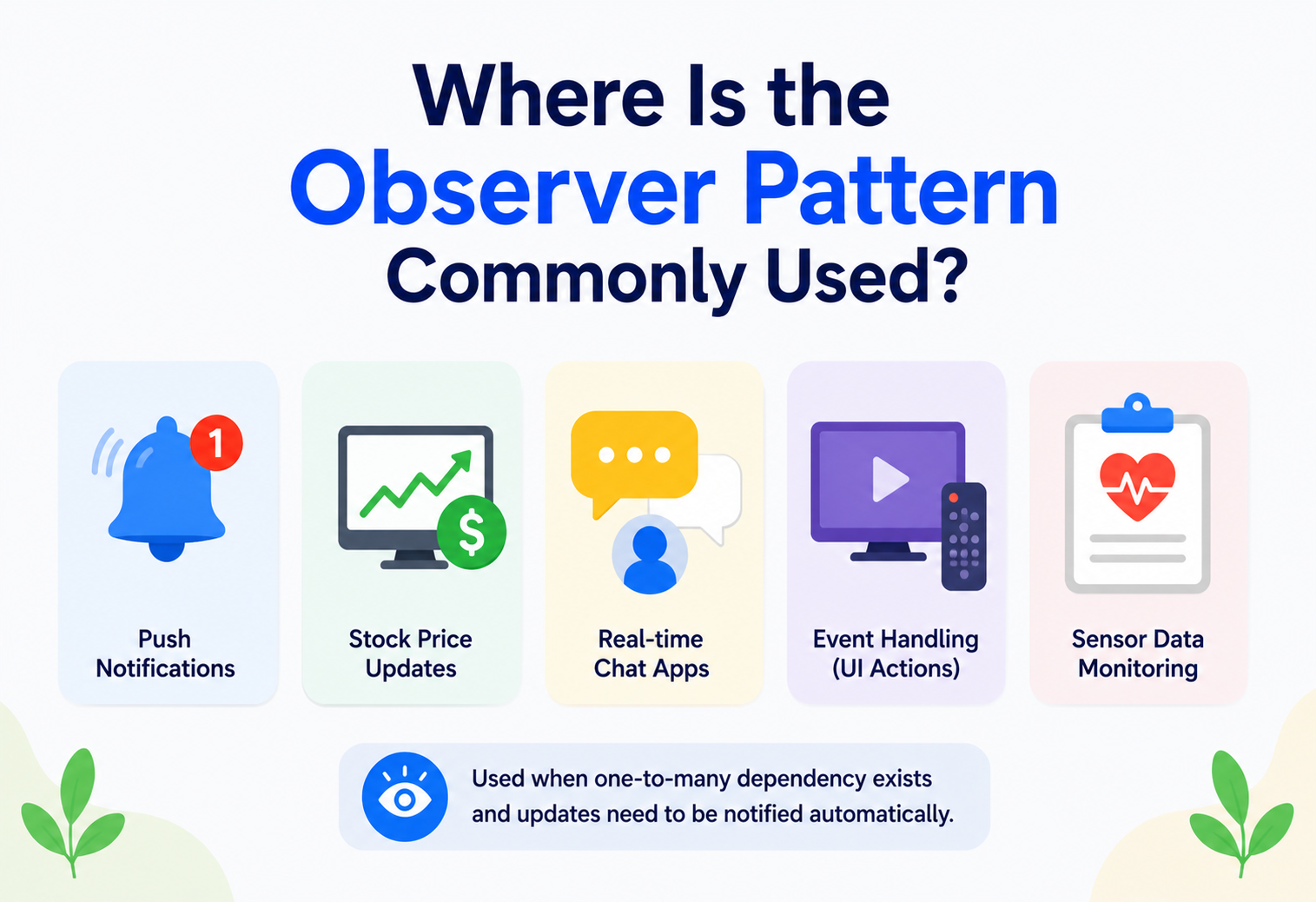
Where Is the Observer Pattern Commonly Used?
From the moment you unlock your phone to the moment a stock ticker flashes red, something is quietly watching, waiting, and reacting. This is a tour of exactly where the Observer pattern hides in plain sight across modern software.
The Big Idea, in One Breath
Dozens of tiny watchers are quietly paying attention in every device you own, registered to be told the moment something worth knowing about actually occurs.
Right now, somewhere in the device you are reading this on, dozens of tiny “watchers” are quietly paying attention — one waiting to notice if you tap the screen, another waiting to notice if your battery gets low, another waiting to notice if a new message arrives. None of them are constantly shouting “has anything happened yet?” at the top of their lungs. They are simply registered, patiently, to be told the moment something worth knowing about actually occurs.
That quiet, everywhere-at-once habit is the Observer pattern, and once you know to look for it, you start noticing it almost everywhere in modern technology. This guide takes a tour through the specific corners of software where Observer shows up most often — not just as an abstract idea, but as a real, working piece of countless systems people use every single day, often without any idea it is there.
Think about a school building during a fire drill. A single alarm system does not personally walk to every classroom and knock on the door — it simply sounds once, and every classroom that is “listening” reacts on its own, following whatever plan makes sense for that room. The gym reacts differently from the science lab, which reacts differently from the library, yet all of them heard the exact same single signal. Modern software is full of alarms just like that one, sounding constantly, all across different corners of technology.
What makes this tour genuinely worth taking, rather than just a list of trivia, is what it reveals about good software design more broadly. The same small, elegant idea — announce once, let interested parties react independently — turns out to be flexible enough to solve problems as different as keeping a mobile screen in sync with a database, keeping a factory‘s safety sensors connected to a control room, and keeping millions of social media followers informed the instant someone they follow posts something new. Seeing that same pattern surface again and again, in wildly different contexts, is one of the clearest demonstrations of just how durable a genuinely good architectural idea can be.
A Quick Recap First
A subject keeps a list of interested observers and automatically notifies all of them the moment something meaningful changes — without needing to know exactly who is listening.
Just to make sure we are starting from the same place: the Observer pattern lets one object, called a subject, keep a list of interested objects, called observers, and automatically notify all of them whenever something meaningful changes — without the subject needing to know exactly who is listening or how many there are.
This guide focuses specifically on where this idea shows up in real, working systems — the domains, industries, and everyday tools where “something happened, and interested parties should hear about it automatically” turns out to be exactly the right way to think about the problem.
GUIs and Frontend Frameworks
The single most common home for Observer — and also the one most people interact with every waking hour. Every event listener, every reactive framework, every UI redraw sits on top of it.
The single most common home for the Observer pattern is also the one most people interact with every waking hour: graphical user interfaces. Every time a button reacts to being tapped, every time a form field validates itself as you type, every time a screen redraws because underlying data changed — an Observer-style relationship is quietly at work underneath.
button.addEventListener("click", () => {
    // This function is an observer, registered to react
    // the moment the button (the subject) announces a click.
    console.log("Button was clicked!");
});
Modern frontend frameworks push this idea even further with what is often called reactivity. A framework’s underlying data store acts as a subject, and any part of the interface that displays that data automatically registers itself as an observer. The moment the data changes — a new item added to a cart, a counter incremented — every part of the screen depending on it updates itself immediately, without the programmer writing a single explicit “please refresh now” instruction anywhere.
The term “reactive programming,” widely used across modern frontend development, is essentially a more automated, more deeply integrated evolution of the same core Observer idea — data changes, and everything watching that data reacts, cascading automatically through an entire interface.
It is worth appreciating just how much manual work this quietly saves. In the earliest days of interactive web pages, engineers frequently had to write their own careful, hand-rolled code to check “has this value changed since I last looked?” and manually trigger a screen update if so — essentially reinventing a small piece of the Observer pattern from scratch, again and again, in every project. Modern frontend frameworks absorbed that entire responsibility into their core design, meaning a developer today can simply declare “this piece of the screen depends on this piece of data,” and trust the framework’s internal, Observer-powered machinery to keep everything correctly synchronised from that point forward.
MVC and MVVM Architectures
One Model, several Views, all staying in sync automatically. The model has no idea, and does not need to know, how many views exist or what each one looks like.
Zooming out from individual buttons to whole application architectures, Observer sits at the very heart of the classic Model-View-Controller pattern and its close relative, Model-View-ViewModel. In both, a “model” holds the actual application data, while one or more “views” display that data to the user — and the model has no idea, and does not need to know, how many views exist or what they each look like.
This is exactly why the same underlying data can be displayed as a mobile app, a web dashboard, and a printed report simultaneously, all staying accurate, without the core data logic needing separate custom code for each one. The model simply announces “something changed,” and each view — built independently, potentially by entirely different teams — decides for itself how to reflect that change visually.
This separation carries a real, practical business benefit worth spelling out. A company building a banking app might have a mobile team, a web team, and a team building an internal admin dashboard, all working from the same underlying account data. Because that data plays the role of subject, and each team’s interface plays the role of an independent observer, the three teams can build, test, and release their work almost entirely independently — a change to how the mobile app displays a balance has no risk of breaking the web dashboard, since neither one depends on the other directly, only on the same shared, faithfully-announcing model underneath.
Game Development
Games are built from dozens of independent systems — audio, UI, achievements, AI — all needing to react to the same handful of core events without being tightly wired together.
Game engines lean on Observer constantly, precisely because games are built from dozens of independent systems that all need to react to the same handful of core events — a player being hit, an achievement being unlocked, a level being completed — without being tightly wired together.
Watching for milestones
An achievement system observes gameplay events quietly in the background, unlocking a trophy the moment a qualifying condition is met, without gameplay code needing to know achievements exist at all.
Reacting to the action
Sound effects and music cues often subscribe to game events — footsteps, explosions, victory — triggering the right audio the instant the relevant action occurs.
Health bars and score displays
An on-screen health bar observes the player character’s health value, updating visually the moment it changes, without the character needing to know a health bar exists.
Enemies reacting to the world
Non-player characters can observe events like “player entered this room,” reacting with appropriate behaviour without being explicitly told to check constantly.
This separation matters enormously in game development specifically, because games are famously prone to becoming tangled, fragile messes as more features get bolted on. A well-known resource on game architecture patterns highlights Observer as one of the most effective tools for keeping gameplay logic, audio, UI, and achievement systems cleanly separated, each able to evolve independently without breaking the others.
It is worth noting one important nuance that game developers specifically have raised over the years: in performance-critical situations, like a fast-paced action game running dozens of Observer relationships every single frame, a poorly implemented notification system can introduce a measurable performance cost. Because of this, some game engines use specialised, highly optimised variations of Observer — sometimes built around efficient event queues rather than direct method calls — precisely to capture the pattern’s organisational benefits without paying an unacceptable performance penalty in a genre where every fraction of a millisecond genuinely matters.
Real-Time Data and Financial Systems
Few domains depend on instant, reliable notification quite like financial technology. Trading platforms, currency converters, portfolio dashboards — all rely on Observer running constantly.
Few domains depend on instant, reliable notification quite like financial technology. A trading platform showing live stock prices, a currency converter reacting to exchange rate shifts, a portfolio dashboard recalculating the moment a holding’s value changes — all of these rely on Observer-style notification running constantly, often thousands of times per second.
Beyond trading floors, everyday consumer finance apps use the same underlying idea — a spending tracker that instantly updates a budget chart the moment a new transaction is recorded, or a fraud detection system that watches account activity and immediately alerts a security team the moment something suspicious occurs. The financial world’s obsession with speed and accuracy makes it one of the most natural, high-stakes homes for this pattern.
It is worth understanding why polling is genuinely unacceptable in this specific domain, rather than merely inconvenient. In most everyday apps, a notification arriving a second or two late is a minor annoyance at worst. In financial trading, a price update arriving even a fraction of a second late can mean the difference between a profitable trade and a costly one, especially for automated trading systems making decisions faster than any human could react. This is precisely why financial technology has, for decades, been one of the most demanding and sophisticated proving grounds for event-driven, Observer-based architecture, often pushing the underlying idea to genuinely extreme levels of speed and reliability.
Social Media and Notifications
Every “follow” button, every notification bell, every “someone liked your post” alert is Observer operating at a genuinely massive scale.
Every “follow” button, every notification bell, every “someone liked your post” alert is Observer operating at a genuinely massive scale. When you follow an account, you are essentially subscribing as an observer to that account’s activity — and the moment they post, everyone subscribed gets notified, whether that is a handful of friends or millions of followers.
A social media platform with a hundred million users is not running a hundred million constant checks per second asking “did anyone I follow post something?” It is running the Observer pattern at enormous scale — the moment a post is published, the system looks up exactly who is subscribed, and only they receive the news.
Push notifications on a phone extend this same idea beyond a single app entirely. An app can register interest in certain kinds of events with the phone’s operating system, and the moment something relevant happens — even while the app itself is not running — the operating system, acting as a subject at the device level, wakes the app just long enough to deliver the news.
The scale involved here is genuinely worth pausing on. A single popular post from a widely followed account might need to notify tens of millions of observers within seconds of being published — an engineering challenge that goes far beyond the simple, in-memory list of observers described in the classic 1994 pattern. Large platforms achieve this by layering the same core idea across many machines working together, essentially running countless smaller Observer relationships in parallel, coordinated by infrastructure specifically built to handle that kind of massive, near-instantaneous fan-out. The underlying concept stays remarkably simple even as the engineering required to deliver it at that scale becomes remarkably sophisticated.
Distributed Systems and Message Buses
Observer’s core idea scales up into event-driven architecture, where entire independent services communicate by announcing events other services can subscribe to.
At a larger architectural scale, Observer’s core idea scales up into what is usually called event-driven architecture, where entire independent services — not just objects within one program — communicate by announcing events that other services can subscribe to.
class EventBus:
    def __init__(self):
        self._subscribers = {}

    def subscribe(self, event_type, handler):
        self._subscribers.setdefault(event_type, []).append(handler)

    def publish(self, event_type, data):
        # Every service that subscribed to "order.placed" reacts,
        # without the publisher knowing who they are.
        for handler in self._subscribers.get(event_type, []):
            handler(data)

bus = EventBus()
bus.subscribe("order.placed", lambda order: print(f"Shipping: {order}"))
bus.subscribe("order.placed", lambda order: print(f"Invoicing: {order}"))
bus.publish("order.placed", "Order #4521")
An online store’s checkout service might publish a single “order placed” event, and entirely separate services — shipping, invoicing, inventory, analytics — each independently subscribe to that event and react in their own way. As explored in more depth in a companion guide on Observer versus Publish/Subscribe, this distributed version typically adds a message broker between publishers and subscribers, but the founding idea — announce once, let interested parties react independently — traces directly back to the same core pattern.
The business value of this arrangement becomes especially clear when a company needs to add an entirely new capability later. Suppose the same online store later wants to add a loyalty points system that awards points whenever an order is placed. Because the checkout service already publishes an “order.placed” event that other services can freely subscribe to, adding loyalty points means writing one new, independent service that subscribes to that existing event — with zero changes required to the checkout service itself, and zero risk of accidentally breaking shipping, invoicing, or inventory in the process. This is precisely the kind of flexibility large, evolving organisations depend on as they continuously add new features to systems that already serve real customers around the clock.
IoT and Sensor Networks
Constantly polling a battery-powered sensor would drain its battery in hours. Event-driven notification keeps the same sensor running for months on a single charge.
Smart homes and connected devices depend heavily on Observer-style notification, precisely because constantly polling a battery-powered sensor would drain its battery in hours instead of months. A smart thermostat, a doorbell camera, a motion sensor — all typically report changes the moment they happen, rather than waiting to be repeatedly asked.
Lights, locks, and thermostats
A smart home hub observes dozens of individual devices, reacting to changes — a door unlocking, a temperature threshold crossed — by triggering automated routines.
Factory floor monitoring
Equipment sensors notify a central monitoring system the instant a reading crosses a safety threshold, enabling immediate response rather than delayed discovery.
Health and fitness tracking
A fitness tracker’s heart-rate sensor can notify a connected app the moment a reading enters an unusual range, without the app needing to constantly re-check.
Weather and air quality
Networks of environmental sensors notify central systems of significant changes, powering everything from weather apps to air-quality alerts.
Battery life alone makes the case for Observer over polling especially compelling in this domain — a sensor that only communicates when something genuinely changes can often run for months or years on a single small battery, where constant polling would exhaust it in a fraction of that time.
Safety-critical industrial settings raise the stakes further still. Imagine a factory floor with pressure sensors monitoring dozens of pieces of heavy machinery. A monitoring system that only checked each sensor once a minute, rather than being immediately notified the instant a dangerous reading occurred, could allow up to sixty seconds to pass before anyone became aware of a genuinely hazardous condition — an unacceptable delay in a safety-critical context. Observer-style, event-driven monitoring collapses that delay down to a matter of milliseconds, notifying the right people the instant a threshold is crossed rather than waiting for the next scheduled check to happen to catch it.
Version Control and File Systems
A quieter, less visible home for Observer sits at the operating system level itself — file-syncing tools, code editors, and version control all observe folders instead of endlessly re-scanning them.
A quieter, less visible home for Observer sits at the operating system level itself. File-syncing tools, code editors, and version control systems frequently register as observers of a folder’s contents, reacting the instant a file is created, modified, or deleted, rather than repeatedly re-scanning an entire directory from scratch.
This is precisely how a cloud storage app notices you have saved a new version of a document within a second of hitting save, and how a code editor’s built-in version control indicator updates the instant you modify a tracked file — both are observing the file system directly, at a level below the applications themselves, reacting to notifications the operating system provides rather than constantly checking file timestamps in a loop.
Development tools build entire workflows on top of this same low-level capability. A build tool that automatically re-compiles code the moment a source file is saved, a test runner that immediately re-executes tests when relevant code changes, a live-reloading web server that refreshes a browser tab the instant a file is edited — all of these depend on registering as an observer of the file system, reacting instantly to genuine changes rather than repeatedly scanning an entire project folder every few seconds, which would be both slow and wasteful on anything but the smallest of projects.
Is Observer “Abandoned” by Industry?
Reactive libraries, cloud event services, sophisticated state managers — has the classic 1994 pattern quietly fallen out of use? The honest answer: absorbed, not abandoned.
Given how much modern development has shifted toward newer tools — reactive programming libraries, managed cloud event services, sophisticated state management frameworks — it is a fair question to ask whether the classic Observer pattern, as originally described in 1994, has quietly fallen out of use.
What has genuinely changed
- Few engineers hand-write a classic Subject/Observer class pair today.
- Reactive libraries and framework built-ins have absorbed most of the manual work.
- Distributed systems increasingly favour full Pub/Sub with a broker, not raw Observer.
What has not changed at all
- The underlying idea — notify interested parties automatically — is more common than ever.
- Every framework mentioned above is built on top of Observer’s core concept.
- Understanding Observer makes every one of these modern tools easier to reason about.
The honest answer is that Observer has not been abandoned so much as it has been absorbed — its core idea is so foundational that it has been baked directly into the syntax and built-in tools of nearly every modern language and framework, which paradoxically makes it look less visible even as it becomes more universally used. Engineers today are far more likely to write subject.subscribe(observer) using a framework’s built-in reactive tools than to hand-roll the classic Subject and Observer classes from the original 1994 catalogue — but the reasoning underneath, and the problem being solved, remains exactly the same.
This same pattern of “absorption rather than abandonment” has happened to several other older, foundational ideas in software history, and it is worth recognising the shape of it, because it tends to repeat. An idea proves genuinely useful, gets used constantly by hand for years, and eventually becomes so universally valuable that language designers and framework authors bake it directly into their tools, so future engineers barely need to think about it explicitly at all. That is not a sign the idea has become obsolete — quite the opposite. It is usually the clearest possible sign that an idea has become so foundational, so trusted, that the industry decided it deserved to be built into the very foundations rather than reimplemented by hand in every single project.
Native Tools Across Languages
Almost every major programming language and platform now offers a built-in tool that implements Observer directly — saving engineers from writing the classic Subject/Observer classes by hand.
Almost every major programming language and platform now offers some built-in tool that implements the Observer idea directly, saving engineers from writing the classic Subject and Observer classes by hand.
| Language / Platform | Built-In Tool | What It Does |
|---|---|---|
| JavaScript | EventTarget / addEventListener | Native browser support for subscribing to and announcing events |
| Java | PropertyChangeListener | A standard library interface for observing changes to an object’s properties |
| C# | Events and Delegates | Language-level syntax specifically designed for publishing and subscribing to notifications |
| Python | Observer libraries / signals | Community libraries and frameworks offering ready-made publish-subscribe tools |
| Reactive Extensions | RxJS, RxJava, and similar | A more powerful, composable evolution of Observer, treating event streams as first-class data |
Reactive Extensions deserve a special mention, since they represent one of the most significant modern evolutions of the original idea. Rather than a simple list of observers reacting to one kind of event, reactive libraries treat an entire stream of events as something that can be filtered, combined, delayed, and transformed, much like working with a list or array — while still relying, underneath all that extra power, on the same fundamental subject-and-observer relationship this pattern first formalised decades ago.
It is worth appreciating what this table really shows when read as a whole: no major platform in modern software development lacks some built-in way to express “notify me when this changes.” That near-universal presence, across languages as different as JavaScript, Java, C#, and Python, is itself strong evidence for just how fundamental the underlying idea has proven to be. When a concept becomes common enough that language and framework designers feel obligated to build first-class support for it directly into their tools, that is usually the clearest sign available that the concept has earned a permanent place in how software gets built.
Frequently Asked Questions
Five honest questions that come up over and over — and honest answers to each.
Which industry uses the Observer pattern the most?
It is difficult to single out just one, since the pattern is genuinely widespread — but frontend and user-interface development probably represents its single most universal, everyday use, given that virtually every interactive screen relies on some form of event-driven, Observer-style notification underneath.
Do I need to implement Observer manually in modern development?
Rarely, in most mainstream application development — as covered in the tools section, most languages and frameworks now provide built-in equivalents. Manually implementing the classic pattern is more common in situations without a convenient built-in option, like certain embedded systems or specialised libraries.
Is Observer used more in frontend or backend development?
Both, though somewhat differently. Frontend development tends to use it directly and constantly for UI reactivity, while backend and distributed systems more often use its larger-scale relative, event-driven architecture and Publish/Subscribe, particularly in microservices and cloud-based systems.
Why does game development rely on it so heavily?
Games are built from many independent, fast-moving systems — audio, UI, AI, achievements — that all need to react to shared events without becoming tightly wired together. Observer keeps these systems cleanly separated, letting each one evolve independently without risking the others breaking.
Will the Observer pattern still matter in the future?
Almost certainly, in some form. As covered in the “abandoned” discussion, its core idea has proven durable enough to be absorbed directly into language features and frameworks across every major platform — a strong signal that the underlying problem it solves, notifying interested parties automatically, is not going away any time soon.
Key Takeaways
Announce once, let interested parties react independently — the same small, elegant idea flexible enough to power interfaces, games, trading floors, social feeds, factories, and file systems alike.
Remember this
- The Observer pattern shows up constantly across GUIs, MVC/MVVM architectures, game development, financial systems, social media, IoT, and version control tools.
- Frontend frameworks build entire “reactive” systems on top of the same core Observer idea, automating what used to require manual subscription code.
- Financial and IoT systems favour Observer specifically because polling would be too slow, too wasteful of battery, or both.
- Social media follow and notification systems are Observer running at massive, global scale.
- At the distributed systems level, Observer’s idea evolves into event-driven architecture and Publish/Subscribe, often via a message broker.
- Observer has not been abandoned by the industry — it has been absorbed directly into the built-in tools of nearly every modern language and framework.
- Reactive Extensions (RxJS, RxJava, and similar) represent one of the pattern’s most powerful modern evolutions, treating entire event streams as composable data.