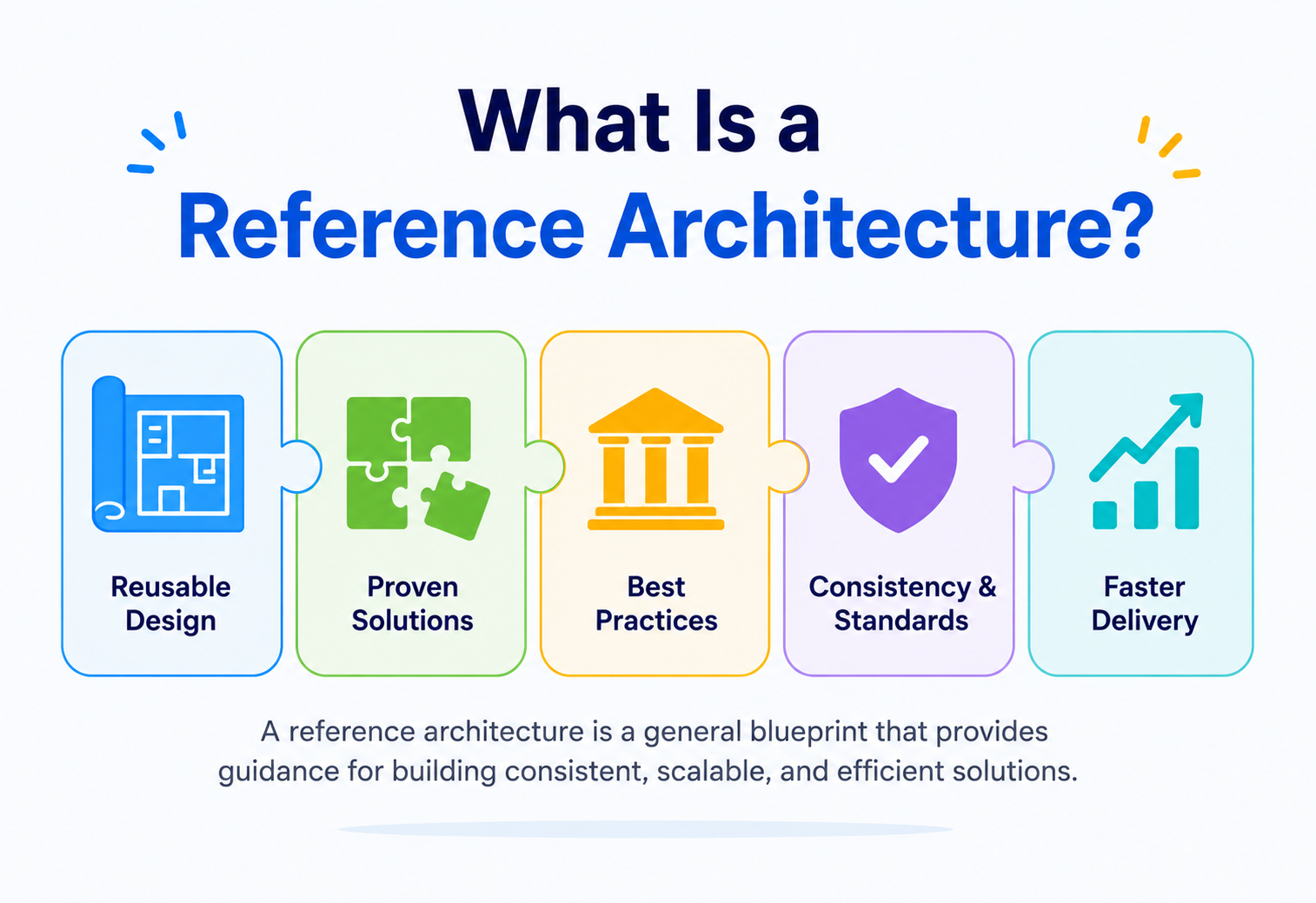
What Is a Reference Architecture?
Not every team has to invent the wheel from scratch. Somewhere, someone has already solved a very similar problem — and written down how they did it. That written-down wisdom is called a reference architecture, and it quietly saves companies enormous amounts of time and pain.
The Big Idea, in One Breath
A trusted recipe book doesn’t bake the bread for you — but it saves you from every mistake someone else has already made and solved. Reference architectures are that recipe book for software.
Imagine you are learning to bake bread for the very first time. You could spend months experimenting on your own — burning a dozen loaves, guessing at oven temperatures, wondering why the dough won’t rise. Or, you could open a trusted recipe book written by someone who has baked thousands of loaves before you, showing exactly which steps matter, which ingredients to use, and which mistakes to avoid.
That recipe book doesn’t bake the bread for you. You still have to choose your own oven, your own flour, your own kitchen. But it saves you from repeating every mistake that has already been made and solved by someone else. In the world of software, that recipe book has a name: a reference architecture.
Think about furniture assembly instructions. A company that makes bookshelves doesn’t write a brand-new instruction manual from scratch for every single customer’s living room. They write one well-tested set of instructions once, and every customer follows that same proven pattern — adjusting only small details like which wall to lean it against. A reference architecture works the same way for building software systems.
What a Reference Architecture Really Is
A well-tested, reusable template. Deliberately general, so many different teams can each adapt it to their own situation — the way many bakers can each follow one bread recipe using their own ovens.
A reference architecture is a well-tested, reusable template that shows how to structure a particular type of system — written by people who have already built something similar and learned what works. It usually combines a diagram (boxes and arrows showing the major pieces) with written explanations (why those pieces exist, and how they should connect).
The key word here is reusable. A reference architecture isn’t built to describe one specific company’s actual, finished system. Instead, it describes a general pattern that many different teams, in many different companies, can each adapt to their own situation — the way many different bakers can each follow the same bread recipe using their own ovens.
If someone asks “do we have a reference architecture for this?”, they are really asking: “Has someone already figured out a solid way to build something like this, so we don’t have to start from a blank page?”
Reference architectures show up everywhere technology gets built at scale — in banking, healthcare, retail, cloud computing, government systems, and manufacturing. Wherever a type of problem repeats often enough, someone eventually writes down the best way to solve it, and that write-up becomes the reference that others lean on.

Why Reference Architectures Exist
Three quiet reasons they earn their keep — plus a very human one: they let people who have never met describe the same system using the same words.
Building software is expensive, and mistakes made early tend to get more costly the longer they go unnoticed. Reference architectures exist to catch a huge number of those mistakes before a single line of code is written, by leaning on lessons other people already paid for.
There is also a quieter, very human reason reference architectures exist: they let people who have never met — an architect in one country and a developer in another — talk about the same system using the same vocabulary and the same mental picture. That shared understanding is worth more than it sounds, especially on large projects with many teams working at once.
Reference Architecture vs. Solution Architecture
Recipe versus meal. Reference architectures are implemented from, never directly. Once a team fills in the specifics, it becomes a solution architecture.
These two terms get confused constantly, so it is worth pinning down the difference clearly. A reference architecture is the recipe. A solution architecture is the actual meal someone cooked, in their own kitchen, using that recipe.

| Question | Reference Architecture | Solution Architecture |
|---|---|---|
| What is it? | A reusable, general-purpose template | A specific design for one real system |
| Who uses it? | Many different teams, across many projects | One team, building one particular product |
| Can you run it directly? | No — it is a guide, not a finished design | Yes — it is meant to be implemented as-is |
| How specific is it? | Deliberately general, leaves room to adapt | Very specific — exact tools, exact servers |
| Example | “A common pattern for e-commerce checkout systems” | “How ShopExample Inc. built its own checkout system” |
A reference architecture is never directly implemented — it is implemented from. Once a team fills in the real details, it becomes a solution architecture.
What’s Actually Inside One
Six small parts — scope, diagram, building blocks, vocabulary, principles, best practices — that together give a reader everything they need to understand and apply the template.
A well-written reference architecture is more than a single picture. It is usually a small collection of parts that together give a reader everything they need to understand and apply it.
What it does (and doesn’t) cover
A clear statement of the problem this reference is meant to solve, and where its boundaries stop.
The visual map
Boxes representing major components, and lines showing how information flows between them.
Reusable pieces
Named components — like “authentication service” or “payment gateway” — that recur across similar systems.
A shared glossary
Definitions of important terms, so every team reading it means the same thing by the same word.
Guiding rules
Statements like “data should never travel unencrypted,” which shape decisions without dictating every detail.
Lessons already learned
Notes on what tends to go wrong, and how experienced teams have avoided or fixed it before.
Not every reference architecture includes all of these, and that is fine — a short, focused one-page diagram with a paragraph of explanation can be just as useful as a fifty-page document, depending on how big and how risky the problem is.
Levels of Detail: From Broad Sketch to Ready-to-Use
A ladder from broad, industry-wide sketches down to organisation-specific templates — and one final rung labelled “solution architecture,” where a specific system finally lives.
Not all reference architectures sit at the same zoom level. Some are drawn with a very wide lens, covering an entire industry. Others are drawn much closer up, ready to be picked up and used almost immediately. It helps to picture this as a ladder, from general at the top to specific at the bottom.

Types and Real-World Examples
Not a niche idea. Reference architectures quietly shape huge parts of the technology many of us rely on every day, even when we never see them directly.
Reference architectures aren’t a niche idea — they quietly shape huge parts of the technology many of us rely on every day, even if we never see them directly.
“Well-architected” frameworks
Major cloud companies publish reference architectures showing proven ways to build reliable, secure applications on their platforms.
SCOR Model
A widely used reference for how goods, information, and money should flow through a supply chain, used across many industries.
Public sector standards
Government agencies publish reference architectures so different departments build compatible, secure digital services.
Data platform patterns
Common blueprints for collecting, storing, and processing data reliably, often reused across very different companies.
Even inside a single large company, it is common to see several reference architectures at once — one for how mobile apps should be built, one for how data should be stored, and one for how new services should talk securely to old, older systems still running in the background.
How a Reference Architecture Actually Gets Built
Not invented in a meeting room. Harvested from real projects that already succeeded and failed enough times to know what works.
Reference architectures don’t appear out of nowhere. They are usually the result of real project experience, carefully written down so the next team doesn’t have to learn the same lessons the hard way.

Notice the Pattern
Someone realises the same kind of problem keeps showing up across different projects, solved slightly differently each time.
Gather the Lessons
Architects study past solutions — what worked well, what caused pain, what everyone wishes they’d known earlier.
Draft the Template
The common structure is drawn as a diagram, described in writing, and given a shared vocabulary.
Test It on Real Projects
The draft is tried out on an actual system, and rough edges get smoothed based on what teams struggle with.
Publish and Maintain
The finished reference is shared widely, then reviewed and updated as technology and lessons continue to evolve.
How Teams Actually Use One, Day to Day
Rarely copied word-for-word. Used as a checklist and starting sketch, adapted honestly to the project’s real size, budget, and constraints.
In practice, a reference architecture rarely gets copied exactly. Instead, teams use it as a checklist and a starting sketch, adjusting it to fit their own project’s size, budget, and constraints.
A new project usually begins by pulling up the relevant reference architecture and asking: which of these building blocks do we actually need? Which of these principles apply to us? Where does our situation genuinely differ from the general pattern, and why? Answering those questions honestly is what turns a general-purpose reference into a specific, working solution.
Copying a reference architecture word-for-word without asking whether it truly fits your situation. A reference is a strong starting point, not a rulebook that overrides common sense about your own project’s needs.
Reference architectures also earn their keep during reviews and audits. When a new system’s design is being checked for soundness, comparing it against a trusted reference architecture gives reviewers a fast, fair way to spot what’s missing — the same way a pilot runs through a pre-flight checklist instead of trusting memory alone.

Benefits and Trade-offs
A well-informed starting suggestion, never a locked cage. Should speed up good decisions, never replace the thinking needed to make them.
Like every tool in software architecture, reference architectures come with real advantages — and a few trade-offs worth knowing about before leaning on one too heavily.
Strengths
- Saves time by starting from proven, tested ground
- Reduces costly mistakes that others have already made
- Gives teams a shared language for faster collaboration
- Makes onboarding new engineers noticeably faster
Trade-offs
- Can be applied too rigidly, ignoring a project’s real needs
- May grow outdated if not reviewed and refreshed regularly
- Adds little value for truly unusual, one-of-a-kind problems
- Requires real discipline to keep documentation accurate
The healthiest relationship with a reference architecture treats it as a well-informed starting suggestion, not a locked cage. It should speed up good decisions, never replace the thinking needed to make them.
Common Pitfalls
Three recurring traps — treating it as gospel, letting it go stale, or skipping the “why” behind each decision — each of which quietly turns a helpful guide into a misleading one.

Treating It as Gospel
Some teams follow a reference architecture so strictly that they end up building something that technically matches the diagram but doesn’t actually solve their real problem well. The reference is a guide, not a substitute for understanding your own project’s unique constraints.
Letting It Go Stale
Technology changes fast, and a reference architecture written five years ago may recommend tools or patterns that have since fallen out of favour. A reference that nobody updates slowly turns from a helpful guide into a misleading trap.
Skipping the “Why”
A diagram alone, without the reasoning behind each decision, tempts teams to copy structure without understanding purpose. The written explanation behind each choice is often more valuable than the picture itself.
Before adopting a reference architecture, ask who wrote it, when it was last reviewed, and whether it was built from real project experience — not just theory.
Key Takeaways
If you remember only these six ideas from the whole guide, you’ll be able to spot, adopt, or push back on a reference architecture with confidence.
Remember This
- A reusable template. A reference architecture is a reusable, well-tested template for structuring a particular type of system.
- Diagrams plus reasoning. It combines a diagram with written explanations, vocabulary, and lessons learned from real projects.
- Recipe versus meal. It is different from a solution architecture — one is the recipe, the other is the finished, specific meal.
- Different levels of zoom. Reference architectures exist at different levels, from broad industry patterns down to organisation-specific templates.
- Adapt, don’t copy. Good ones save time, reduce mistakes, and give teams a shared language — but only when adapted sensibly.
- Only useful while fresh. They need regular review; an outdated reference can quietly do more harm than having no reference at all.