How Does an Architect Work with Stakeholders?
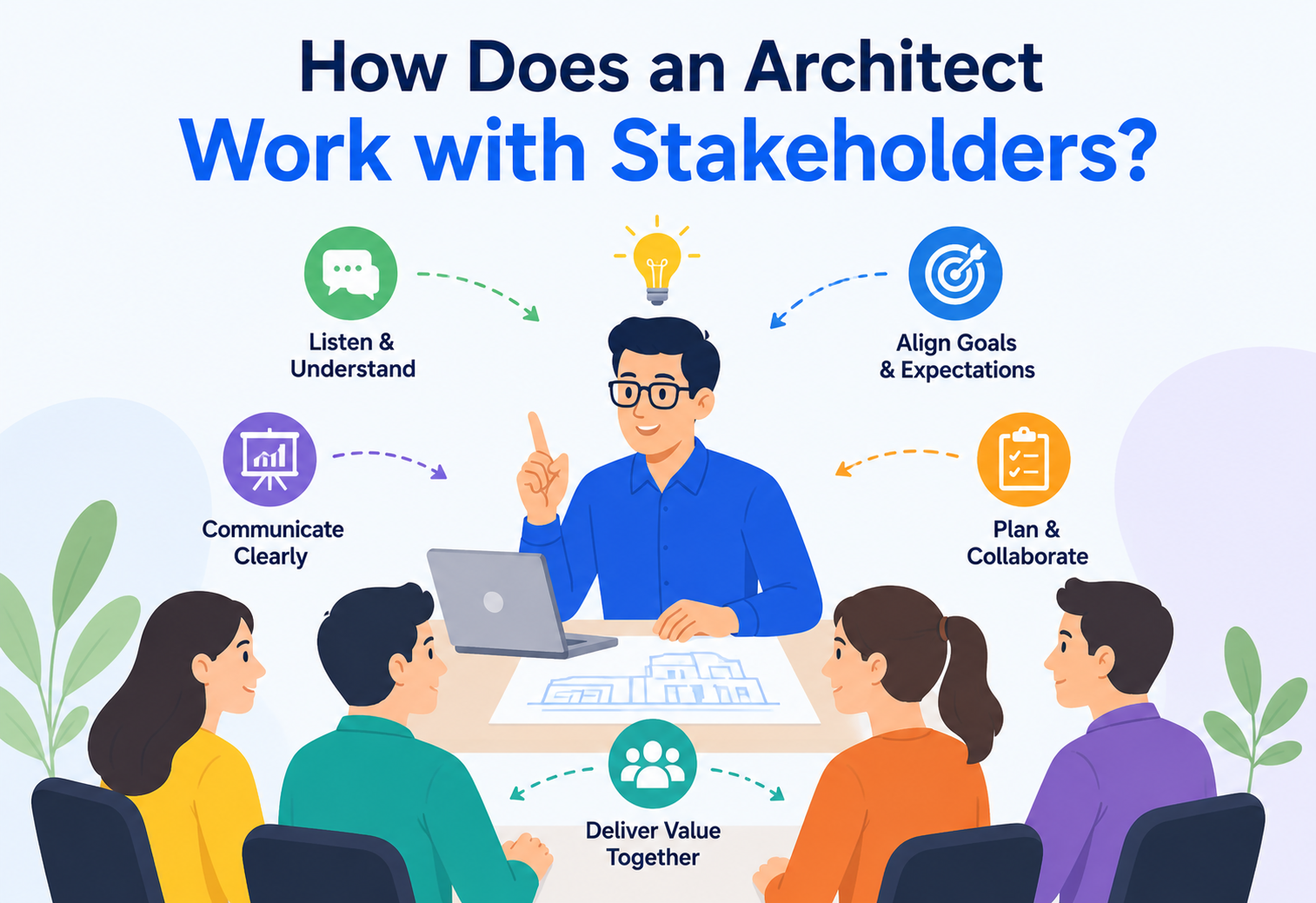
A system isn’t judged by how elegant its diagrams look. It is judged by whether the people who depend on it — from the CEO to the person answering support tickets — actually get what they need. Working well with stakeholders is how an architect makes sure of that.
The Big Idea, in One Breath
Grandma wants quiet, the teenagers want music, and someone else is footing the bill. Every project is that party — and the architect is really the planner, listening carefully to everyone before proposing a workable plan.
Imagine planning a big family celebration. Grandma wants a quiet, traditional gathering. The teenagers want music and games. The person paying for the venue wants to stay within budget. Nobody is wrong — they simply care about different things, and a good party planner has to genuinely listen to each of them before deciding on a plan that leaves everyone reasonably happy.
Building software involves the exact same balancing act, just with different people. A business leader cares about cost and speed to market. A security officer cares about data protection. An end user just wants something that works without frustration. These different people, each with a stake in how the system turns out, are called stakeholders — and a huge part of an architect’s real job is listening to all of them, and turning their sometimes-conflicting wishes into one workable design.
Think of an orchestra conductor. Each musician plays a completely different instrument, reads a different part of the score, and has their own opinion about tempo and volume. The conductor’s job isn’t to play every instrument — it is to listen carefully to all of them and bring their individual efforts together into one piece of music everyone can be proud of.
Who Counts as a Stakeholder
Not just the people paying the bill. Anyone affected by, influencing, or genuinely interested in the outcome — visible team and invisible team alike.
A stakeholder is anyone who is affected by a system, has influence over it, or has a genuine interest in whether it succeeds or fails. That definition is deliberately broad — stakeholders aren’t just the people paying for the project. They include the people using it every day, the people maintaining it after launch, and sometimes even people outside the organisation entirely, like regulators or partner companies.
If someone asks “who are the stakeholders on this project?”, they are really asking: “Whose opinion actually matters here, and whose day-to-day life will this system change?”
It helps to think in two overlapping groups: the visible team — people obviously connected to the project, like developers and product managers — and the invisible team — people who aren’t in the room but whose cooperation the project still genuinely needs, like a support team who will field calls about it, or a compliance officer who will eventually review it.
Why This Work Matters
A technically brilliant system that ignores real stakeholder needs is still a failure — just a beautifully engineered one.
A technically brilliant system that ignores what stakeholders actually need is still a failure — just a beautifully engineered one. Working closely with stakeholders is how an architect makes sure the thing being built actually solves the right problem, for the right people, in a way the organisation can genuinely support.
There is a sobering truth many experienced architects learn the hard way: a project can be technically excellent and still be quietly sabotaged, simply because an important stakeholder was never properly consulted and later withdrew their support.
Step One: Finding Everyone Who Matters
The org chart is only the first hint. Real influence lives in four overlapping groups — and one habit keeps them from slipping through the net.
Before an architect can engage stakeholders well, they first have to find them — and this step is trickier than it sounds. It is tempting to only think of the people listed on an official project chart, but real influence often sits outside that formal structure entirely.
The obvious names
Executives, product owners, project sponsors — people whose stake in the project is written into the org chart.
The quiet power players
A senior engineer everyone trusts, or a long-tenured employee whose opinion carries real weight despite no formal title.
Who lives with the result
Support teams, operations staff, and end users, who inherit the day-to-day consequences of every design decision.
Outside the building
Regulators, partner companies, and vendors, whose requirements can quietly shape what the system is even allowed to do.
A useful habit is simply asking, repeatedly: “who else is affected by this that we haven’t spoken to yet?” — and continuing to ask it throughout the project, not just once at the very beginning.
The Power/Interest Grid
Not every stakeholder needs weekly meetings. A simple 2×2 grid decides where to spend attention — and where a light touch is enough.
Once stakeholders are identified, not all of them need — or want — the same level of attention. A simple, widely used tool called the power/interest grid helps architects decide where to focus their limited time and energy.
This isn’t about ranking people’s importance as human beings — it is a practical tool for allocating limited attention wisely. A quiet department with little stake in the outcome doesn’t need weekly meetings, while someone with both strong influence and strong interest deserves close, ongoing collaboration.
Speaking Everyone’s Language
Handing every stakeholder the same technical diagram usually satisfies none of them. One honest design, several tailored explanations.
Different stakeholders don’t just have different opinions — they often need entirely different explanations of the same system. A security officer cares about data flows and access controls. A finance leader cares about cost and timelines. Handing both of them the exact same technical diagram usually satisfies neither.
A good architect doesn’t force everyone to learn one language. They translate the same underlying design into whatever language each audience actually understands.
This is why architects often prepare several different “views” of the same system — a simple diagram of costs and timelines for leadership, a detailed technical diagram for engineers, and a plain-language summary of what will change for the people using it day to day. Each view answers a different set of honest concerns, without contradicting the others.

How Architects Actually Engage, Step by Step
Not one meeting. A five-beat rhythm — identify, understand, prioritise, communicate, revisit — that repeats and readjusts through the whole project.
Working with stakeholders isn’t one meeting — it is an ongoing rhythm that repeats and adjusts throughout a project’s life.
Identify
Build as complete a list as possible of everyone affected by, or influential over, the project.
Understand
Learn what each stakeholder genuinely cares about, in their own words, not assumptions made on their behalf.
Prioritise
Use tools like the power/interest grid to decide how much time and attention each group genuinely needs.
Communicate
Share the right information, in the right format, at the right moments — not everything, to everyone, all the time.
Revisit
Check back in regularly, since interests, priorities, and even who counts as a stakeholder can shift as a project evolves.
Handling Conflicting Interests
Rarely does every stakeholder want the same thing. Making the trade-off visible and honest — instead of quietly picking a middle ground — is the architect’s real move.
It is rare for every stakeholder to want the exact same thing. A business leader might push for a fast launch, while a security team pushes back, insisting on more time for careful review. Neither is being unreasonable — they are simply optimising for different, equally valid priorities.
An architect’s job in these moments isn’t to silently pick a winner. It is to make the trade-off visible and honest: naming the real cost of each option clearly enough that the people with the authority to decide can make an informed choice, rather than an uninformed compromise nobody actually agreed to.

Quietly picking a “middle ground” without telling anyone a trade-off was made. Stakeholders trust architects far more when disagreements are surfaced honestly than when they are smoothed over silently.
Tools and Techniques
Four simple, well-worn tools. None are complicated on their own; their power comes from being used consistently.
A handful of simple, well-worn tools make stakeholder work considerably more manageable, especially as a project grows in size and complexity.
A living roster
A simple table listing each stakeholder, their concerns, and their place on the power/interest grid.
Who hears what, and when
A plan defining which updates go to which groups, through which channel, on what schedule.
Structured group conversations
Focused sessions that bring several stakeholders together to surface concerns and agree on priorities directly.
Tailored explanations
Different diagrams or documents built specifically for the concerns of a particular stakeholder group.
None of these tools are complicated on their own — their real value comes from being used consistently, revisited regularly, and genuinely acted on rather than filed away and forgotten.
Benefits and Trade-offs
Real time and interpersonal skill invested up front pay back many times over — but the cost is honest, and worth naming.

Investing real time in stakeholder engagement pays off, but it isn’t free, and it isn’t always comfortable — especially when it surfaces disagreement early rather than later.
Strengths
- Surfaces conflicting needs while they are still cheap to resolve
- Builds genuine support that protects a project through difficult moments
- Improves the quality of the design itself through wider real-world input
- Reduces painful surprises late in a project’s timeline
Trade-offs
- Takes real time away from purely technical design work
- Can slow decisions when too many voices are consulted on small choices
- Requires genuine interpersonal skill, not just technical expertise
- Risks decision paralysis if every disagreement is treated as equally urgent
The healthiest approach scales engagement to the stakes involved — deep, careful consultation for major architectural decisions, and a much lighter touch for smaller, low-risk ones.
Common Pitfalls
Three recurring mistakes turn stakeholder work into a checkbox instead of a conversation. Each has the same tell: someone important ends up genuinely surprised.
Only Talking to the Obvious People
Focusing exclusively on the formal project team, while ignoring the informal but influential voices around it, often leads to unpleasant surprises late in a project.
Treating Stakeholders as an Obstacle
Viewing stakeholder input as a delay to push through, rather than genuinely valuable information, tends to produce systems that are technically sound but poorly matched to real needs.
Engaging Once, Then Going Quiet
Gathering input at the very start and never checking back in leaves a project vulnerable to drifting away from what stakeholders actually still need by the time it launches.
If a stakeholder would be genuinely surprised by the finished system, they probably weren’t engaged enough, or often enough, along the way.
Key Takeaways
If you remember only these six ideas from the whole guide, you’ll be able to hold a confident, honest conversation about how good architects actually work with stakeholders.
Remember This
- Broad definition. Stakeholders are anyone affected by, influential over, or genuinely interested in a system’s success.
- Look beyond the org chart. Finding them means looking toward informal influence and downstream users too, not only the formal team.
- Attention as a limited resource. The power/interest grid helps architects allocate time sensibly, rather than equally to everyone.
- Several honest tellings. Different stakeholders often need different explanations of the same system, tailored to their real concerns.
- Engagement is a rhythm. Identify, understand, prioritise, communicate, revisit — not a one-time task at the start.
- Make conflicts visible. Conflicting stakeholder interests should be surfaced and resolved honestly, not quietly smoothed over.