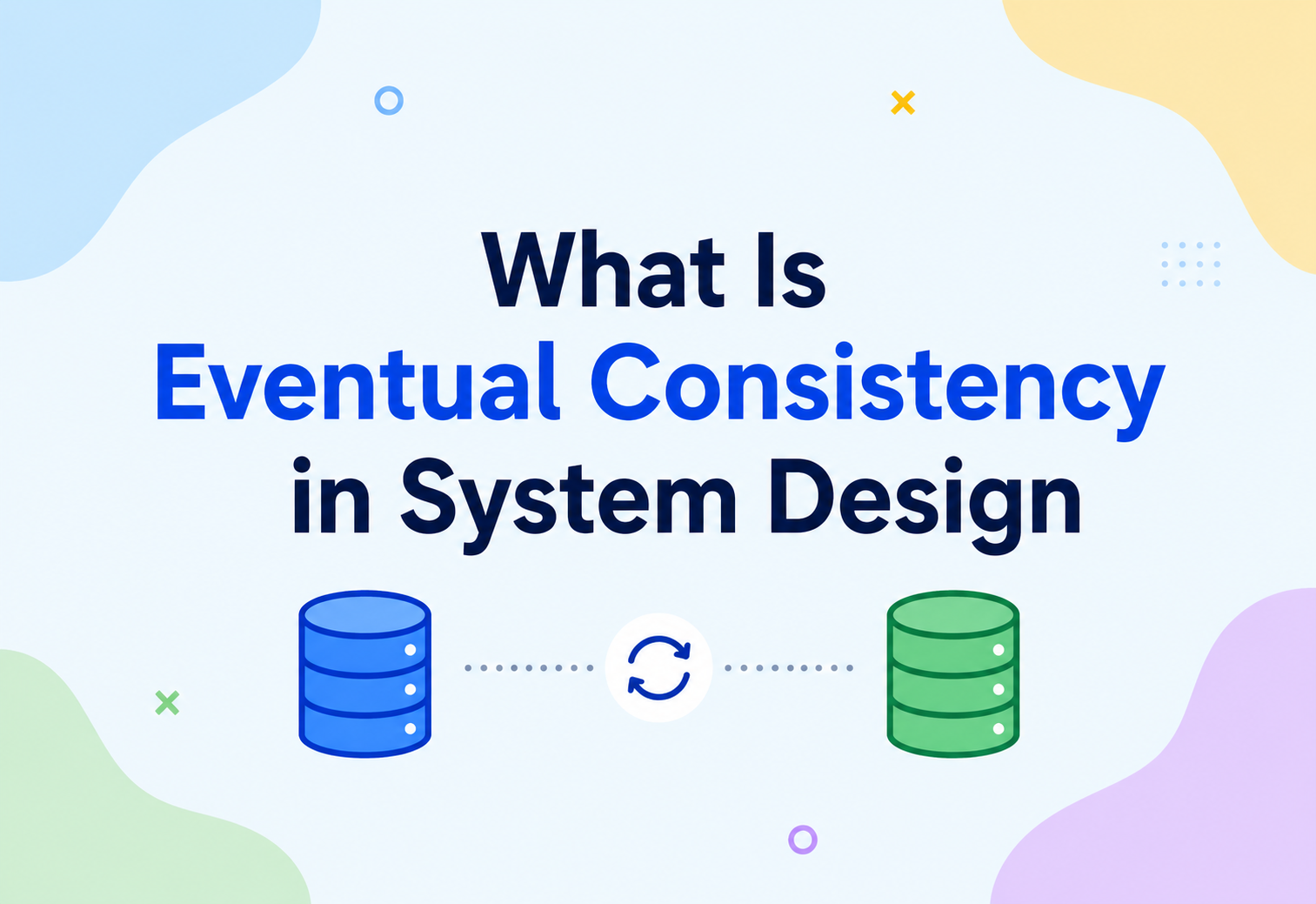
What Is Eventual Consistency in System Design?
A beginner‑to‑production walkthrough of the guarantee that runs quietly behind DNS, shopping carts, social feeds, CDNs, and the world’s largest databases: different copies of the same data may briefly disagree — but if writes stop and the network heals, they are guaranteed to end up identical. Built for readers starting from zero and going all the way to interview‑ready depth.
Introduction & History
Eventual consistency is a rule that many large systems follow: it is fine if different copies of data briefly disagree, as long as they all agree eventually once things settle down.
Imagine you and your best friend are texting about weekend plans. You send a message, but your friend’s phone has bad network signal. Your message does not arrive right away — it sits somewhere between your phone and theirs. A few seconds later, once the signal comes back, the message finally shows up. For a brief moment, you and your friend “disagreed” about what was said. But eventually, both of your phones showed the exact same conversation.
That short gap — where two places do not agree yet, but will agree soon — is the entire idea behind eventual consistency. It is a rule that many large computer systems follow: “it is okay if different copies of data disagree for a little while, as long as they all agree eventually, once things settle down.”
What Is Eventual Consistency?
Eventual consistency is a guarantee used in distributed systems (systems made of many computers working together) that says: if no new changes are made to a piece of data, then every copy of that data, spread across different machines, will eventually become identical.
It does not promise that all copies are identical right now. It only promises that they will converge — become the same — given enough time.
Eventual consistency means: “different copies of the same data might briefly disagree, but if you stop making changes and just wait, they will all end up looking the same.”
Why Does This Term Exist?
In the early days of computing, most applications ran on a single computer with a single database. There was only one copy of the data, so there was nothing to “agree” on — one copy is automatically consistent with itself.
But as companies grew — think early Amazon, Google, and eBay in the late 1990s and early 2000s — a single computer could no longer handle millions of users. Engineers had to spread data across many computers (servers) in many locations (data centres) around the world. The moment you have more than one copy of the same data, a new question appears: what happens if two copies temporarily show different values?
A Short History
The term “eventual consistency” was popularised in distributed‑computing research through the 1990s, but it became a mainstream engineering concept after 2007, when Amazon published a famous paper describing Dynamo, the internal system that powered Amazon’s shopping cart. Dynamo needed to stay available even during network failures, so Amazon’s engineers designed it to accept writes on multiple machines and let the copies “catch up” with each other later, rather than freezing the system until everyone agreed.
Around the same time, Google published papers on Bigtable and later Amazon, Facebook, and LinkedIn engineers built systems like Cassandra and Voldemort, all leaning on eventual consistency to serve enormous numbers of users spread across the globe without slowing down or going offline.
Today, eventual consistency is a foundational concept taught alongside the CAP theorem in every system‑design course, and it directly shapes how databases like Amazon DynamoDB, Apache Cassandra, Riak, and even DNS (the system that turns website names into computer addresses) are built.
The Problem & Motivation
Physics does not let networks be instant. When a system must serve users all over the world, engineers face a choice between making everyone wait for perfect agreement — and letting copies catch up on their own.
To understand why eventual consistency exists, we first need to understand the problem it solves. Let us build it up step by step.
Step 1: Why We Copy Data at All
Imagine a popular online store with customers in India, the USA, and Germany. If all customer data lived on a single server in India, then every American or German customer’s request would have to travel halfway around the world and back. That takes time — often 200 to 300 milliseconds just for the round trip. Multiply that by millions of clicks per day, and the store feels painfully slow.
The fix is to place copies of the data closer to each group of users — one server near India, one near the USA, one near Germany. This is called replication. Now every user talks to a nearby copy, and the app feels instant.
The restaurant chain
Think of a popular restaurant chain. Instead of forcing every customer in the country to travel to one central kitchen, the chain opens branches in every city. Each branch has its own stock of ingredients — a “copy” of the menu items — so customers get served quickly nearby.
A global video platform
A global video streaming platform stores a copy of “trending movies today” on servers in every continent, so a user in Mumbai and a user in Toronto both get fast answers from a nearby server instead of one far‑away server.
Step 2: The New Problem This Creates
Once you have copies, a new question appears. Suppose a customer in India updates their shipping address. That update goes to the India server first. Now:
- The India copy has the new address.
- The USA and Germany copies still have the old address, until the update travels over the network to them.
For a short window of time — maybe 50 milliseconds, maybe 2 seconds — the three copies disagree. If a warehouse in Germany checks the address during that exact window, it might ship to the old address.
Step 3: Two Possible Solutions
System designers have two broad choices when copies can disagree:
1. Make everyone wait.
Before confirming the address update as “successful,” force all three copies to update together, at the same time, before responding to the user. This guarantees everyone always sees the same value — but it is slow, and if the German server is temporarily unreachable, the whole update fails, even though India and USA were ready.
2. Let copies catch up later.
Confirm the update as soon as the India copy has it. Let the update quietly spread to USA and Germany in the background, over the next few milliseconds or seconds. The system stays fast and available, but there is a brief window where copies disagree.
Option 1 is called strong consistency. Option 2 is called eventual consistency. Neither is “better” in an absolute sense — they are trade‑offs, and choosing between them is one of the most important decisions a system designer makes.
Getting this choice wrong is expensive. A banking system that treats balance updates with “eventual consistency” carelessly might let someone withdraw money twice before the copies catch up. A social media “like count” that insists on strong consistency for every single like would grind to a halt under Instagram‑scale traffic. Knowing when to use which is a core system‑design skill.
Step 4: Why Networks Make This Unavoidable
You might ask: why not just make the network instant? Because physics will not allow it. Data cannot travel faster than the speed of light, and real‑world networks are far slower than that limit due to routing, congestion, and hardware. A message from India to the USA takes roughly 150–250 milliseconds round trip, no matter how good your engineers are. On top of that, networks sometimes fail entirely — cables get cut, routers crash, data centres lose power.
Because delays and failures are guaranteed to happen sometimes, distributed systems must decide, ahead of time, what to do when copies cannot talk to each other right away. Eventual consistency is one well‑tested answer to that question.
Core Concepts
Consistency is a spectrum, not a switch. CAP forces a choice during a partition. Convergence, stale reads, replicas, conflicts, and bounded staleness are the vocabulary that lets you talk about it precisely.
3.1 The Consistency Spectrum
Consistency is not a simple on/off switch — it is a spectrum. On one end you have very strict guarantees; on the other end, very relaxed ones.
| Consistency Model | What It Guarantees | Speed / Availability |
|---|---|---|
| Strong (Linearizable) Consistency | Every read sees the latest write, instantly, everywhere | Slower, less available during failures |
| Sequential Consistency | All nodes see operations in the same order (not necessarily real‑time) | Moderate |
| Causal Consistency | Related (cause‑and‑effect) operations are seen in order; unrelated ones may differ | Fast |
| Eventual Consistency | All copies converge eventually, if writes stop | Fastest, most available |
Eventual consistency sits at the relaxed end of this spectrum. It sacrifices “always agree immediately” in exchange for speed and the ability to keep working even when parts of the system are unreachable.
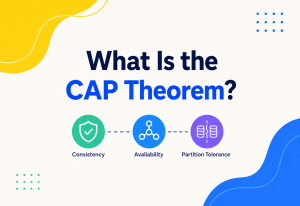
3.2 The CAP Theorem
No discussion of eventual consistency is complete without the CAP theorem, first proposed by computer scientist Eric Brewer in 2000 and later proven formally by Seth Gilbert and Nancy Lynch in 2002. It states that a distributed data system can only fully guarantee two out of these three properties at the same time:
- Consistency (C): every read receives the most recent write, everywhere.
- Availability (A): every request receives a (non‑error) response, even if it is not the latest data.
- Partition Tolerance (P): the system keeps working even if network communication breaks between some machines.
Here is the key insight: network partitions (P) are a fact of life — cables get cut, servers lose connectivity, cloud regions go down. Since you cannot avoid P, the real everyday choice for engineers is: during a partition, do you favour C (refuse requests to guarantee correctness) or A (answer requests, even if the answer might be slightly stale)?
Systems that choose Availability during a partition are, by definition, using eventual consistency — they keep serving reads and writes on both sides of the broken network, and reconcile the differences once the network heals.
3.3 Convergence — The Heart of Eventual Consistency
Convergence means that once all copies have received all updates, they will settle into the exact same final state. This is the actual promise being made — not “instant agreement,” but “guaranteed agreement, eventually, once things stop changing and messages finish delivering.”
Three friends and a scoreboard
Imagine three friends each writing down the score of a cricket match on their own notebook, but they are sitting in different rooms and can only pass notes. Right after a six is hit, only the friend closest to the TV writes it down. A minute later, once the note is passed around, all three notebooks show the same score. They “converge.”
Instagram comments
When you post a comment on Instagram, your friend across the world might see it three seconds later than your other friend sitting next to you. Instagram’s comment system is eventually consistent — it does not hold up your post until every server worldwide has it.
3.4 Stale Reads
A stale read happens when you ask a copy for data, and that copy has not yet received the latest update. It is not wrong data forever — just temporarily outdated data. Eventually consistent systems accept stale reads as the price of speed and availability.
3.5 Replicas and Nodes
A node is a single machine (server) participating in the system. A replica is a copy of a piece of data stored on a node. Systems typically keep multiple replicas — often 3 — spread across different machines, racks, or even data centres, so that losing one machine does not lose the data.
3.6 Conflict — When Two Writes Disagree
What happens if two different users update the same piece of data on two different replicas at nearly the same time, before the replicas have synced? Now you have a genuine conflict — two different “true” values with no obvious winner. Eventually consistent systems must have a strategy to resolve this, which we will cover in the Internal Working section.
Two people edit the same shared shopping list app on their phones while both are offline (say, in a subway tunnel). Person A adds “milk.” Person B, unaware, adds “bread” to their local offline copy at the same moment. When both phones come back online, the app must merge both additions — this is a conflict that eventual consistency must resolve, usually by keeping both changes rather than discarding one.
3.7 Why “Eventually” Does Not Mean “Whenever”
A common misunderstanding among beginners is thinking that “eventual” is a vague, unbounded promise — as if the system might take an hour, a day, or forever to agree. In well‑engineered production systems, this is almost never true in practice. The word “eventual” is doing real mathematical work here: it means “guaranteed to happen, assuming the system keeps running and messages keep being delivered, no matter how many times a message is delayed or retried.” In practice, engineering teams measure this window carefully and treat it like any other performance metric, such as response time or error rate. A production system that does not measure its own inconsistency window does not fully understand its own behaviour.
It also helps to separate two very different situations that both get casually called “eventual consistency”:
- Bounded staleness: the system guarantees replicas will never be more than, say, 2 seconds or 10 versions out of date. This is measurable, testable, and something you can put in a Service Level Agreement.
- Unbounded eventual consistency: the system only promises convergence “at some point,” with no guaranteed ceiling. This is riskier and should be reserved for genuinely low‑stakes data where an occasional longer delay causes no real harm.
Architecture & Components
Three replication shapes — single‑leader, multi‑leader, leaderless — plus quorums, gossip, anti‑entropy, and vector clocks make an eventually consistent system work in practice.
4.1 Replication Topologies
There are three common ways to arrange replicas.
Single‑Leader (Primary‑Replica) Replication
One node is the “leader.” All writes go to the leader first, and the leader forwards (“replicates”) the change to the other nodes, called “followers” or “replicas.” Reads can be served by the leader or, for speed, by followers — but followers might be slightly behind, giving you eventual consistency on read replicas.
Multi‑Leader Replication
Multiple nodes can each accept writes independently — useful when you have data centres in different countries and want each one to accept local writes without waiting on the others. This increases the chance of conflicts, since two leaders can accept different changes to the same data at the same time.
Leaderless Replication
No single node is “in charge.” Any replica can accept a write, and the write is spread (“gossiped”) to other replicas afterward. Amazon’s Dynamo and Apache Cassandra use this model. It is extremely resilient — there is no single leader to lose — but requires careful conflict resolution.
4.2 Quorums (Read/Write Quorum Systems)
Many leaderless systems use a technique called quorum‑based replication. Suppose you have N replicas of a piece of data:
- W = the number of replicas that must confirm a write before it is considered successful.
- R = the number of replicas that must respond to a read before returning a result.
If W + R > N, the system guarantees that every read overlaps with the most recent write on at least one replica — giving strong‑ish consistency; but if W + R ≤ N, reads can return stale data faster and with higher availability. This “tunable consistency” is why databases like Cassandra let engineers pick, per query, how strict they want to be.
4.3 Anti‑Entropy and Gossip Protocols
To make sure replicas eventually converge even without new writes, systems run background processes:
- Gossip protocol: nodes periodically exchange information with a few random peers, like rumours spreading through a school, until everyone has heard the news.
- Anti‑entropy repair: nodes periodically compare their data with each other (often using efficient techniques like Merkle trees) and fix any differences found.
- Read repair: when a client reads data from multiple replicas and notices they disagree, the system quietly fixes the outdated replica right then.
4.4 Vector Clocks and Version Vectors
Since there is no single global clock across machines, eventually consistent systems need a way to tell “which update happened before which.” A vector clock is a small data structure — essentially a counter per replica — attached to each write, which lets the system detect whether one update clearly happened after another, or whether they happened independently (a true conflict). We will dig into this in the next section.
Internal Working
Trace one write end‑to‑end, learn vector clocks and CRDTs, and see a minimal Java implementation of both a vector clock and a toy eventually consistent key‑value store.
5.1 How a Write Actually Travels Through the System
Let us trace one write end‑to‑end in a typical leaderless, quorum‑based eventually consistent store (similar to how Cassandra or DynamoDB work internally):
1. A client sends a write request.
“Set user_142’s address to ‘221B Baker Street’.”
2. The request is routed to the right replicas.
Usually via consistent hashing to a small set of replica nodes responsible for that data — say 3 nodes: A, B, and C.
3. The write is sent to all 3 in parallel.
Tagged with a timestamp or a vector‑clock entry so the system can order it correctly later.
4. The system waits for W acknowledgements.
Say W = 2. As soon as 2 out of 3 confirm, the client is told “success” — even though node C might not have it yet.
5. Node C catches up in the background.
Either through the original replication message arriving late, gossip from A or B, or a later anti‑entropy repair pass.
6. All three replicas now agree.
The system has “converged.”
5.2 Vector Clocks Explained Simply
Imagine every replica keeps a personal counter of how many times it has personally made a change to a value. A vector clock is just a list of these counters — one entry per replica — attached to every version of the data.
Three chefs, one recipe card
Picture three chefs (A, B, C) all allowed to add ingredients to a shared recipe card, but they are in different kitchens. Every time a chef adds something, they stamp the card with their own name and how many times they have personally edited it so far, like “A:2, B:1, C:0.” By comparing these stamps, anyone can tell whose edit came after whose — or if two edits happened independently, at the same time, without either knowing about the other.
Logical time ≠ arrival time
Without vector clocks, a system might wrongly overwrite a newer value with an older one just because it arrived later over a slow network connection. Vector clocks let the system tell “logical time” apart from “arrival time.”
If Version 1 has clock {A:1, B:0, C:0} and Version 2 has clock {A:1, B:1, C:0}, then Version 2 clearly “descends from” Version 1 — it saw everything Version 1 saw, plus one more change. But if Version 2 has clock {A:0, B:1, C:0} instead, neither version descends from the other — they happened concurrently, and that is a genuine conflict that needs resolving.
5.3 Conflict Resolution Strategies
When two writes truly conflict, systems typically use one of these strategies:
| Strategy | How It Works | Used By |
|---|---|---|
| Last‑Write‑Wins (LWW) | Keep the write with the latest timestamp, discard the other | Cassandra (default), Riak (optional) |
| Multi‑Value / “Siblings” | Keep both versions, let the application or user pick the correct one | Riak, Amazon Dynamo (shopping cart) |
| CRDTs (Conflict‑free Replicated Data Types) | Use special data structures that merge automatically without any conflict, mathematically guaranteed | Redis (some types), Riak, collaborative editors |
| Application‑level merge | Custom business logic decides how to combine conflicting writes (e.g., “union of two shopping carts”) | Amazon’s original Dynamo shopping cart |
Last‑Write‑Wins sounds simple and safe, but it can silently lose data. If clocks on different machines are not perfectly synchronised (they never are, in the real world), “latest timestamp” can pick the wrong winner. Systems that care about correctness often prefer CRDTs or multi‑value resolution over naive LWW.
5.4 CRDTs — A Closer Look
Conflict‑free Replicated Data Types are special‑purpose data structures mathematically designed so that merging two versions always produces a sensible, deterministic result — no matter what order the merges happen in. Simple examples:
- G‑Counter (Grow‑only counter): each replica tracks its own increments; the total is the sum across replicas. Merging two counters just means taking the max of each replica’s count — impossible to lose an increment.
- OR‑Set (Observed‑Remove Set): a set that can have items added and removed, designed so concurrent add/remove operations merge predictably.
CRDTs power real products like Redis’s counters and collaborative text editors (similar in spirit to how Google Docs merges two people typing at once).
5.5 Java Example: A Minimal Vector Clock
import java.util.HashMap;
import java.util.Map;

public class VectorClock {
    private final Map<String, Integer> clock = new HashMap<>();

    // Called when this replica makes a local write
    public void increment(String replicaId) {
        clock.merge(replicaId, 1, Integer::sum);
    }

    // Merge another replica's clock into this one after gossip/sync
    public void merge(VectorClock other) {
        for (Map.Entry<String, Integer> entry : other.clock.entrySet()) {
            clock.merge(entry.getKey(), entry.getValue(), Math::max);
        }
    }

    // true if 'this' happened strictly before 'other' (no conflict)
    public boolean happensBefore(VectorClock other) {
        boolean strictlyLess = false;
        for (String replica : allReplicas(other)) {
            int a = this.clock.getOrDefault(replica, 0);
            int b = other.clock.getOrDefault(replica, 0);
            if (a > b) return false;       // this saw something other didn't
            if (a < b) strictlyLess = true;
        }
        return strictlyLess;
    }

    private Iterable<String> allReplicas(VectorClock other) {
        var keys = new java.util.HashSet<>(clock.keySet());
        keys.addAll(other.clock.keySet());
        return keys;
    }
}
This tiny class captures the essence of what real distributed databases do internally: track “who has seen what” so the system can reliably tell an old update apart from a genuinely new, conflicting one.
5.6 The “Happens‑Before” Relation
Computer scientist Leslie Lamport introduced the idea of a “happens‑before” relation to describe cause‑and‑effect between events in a distributed system, even when there is no shared clock. If event A causes event B — for example, you read a message and then reply to it — then A “happens‑before” B, and every replica should agree on that ordering. But if two events happen completely independently, with no causal link between them, there is no meaningful “before” or “after” at all, and the system is free to order them however is convenient, as long as it stays consistent about it afterwards. Vector clocks are, at their core, a practical way of implementing this happens‑before relation on real hardware, which is why they show up again and again across different eventually consistent databases, from Amazon’s original Dynamo to modern systems like Riak.
5.7 Java Example: A Toy Eventually Consistent Key‑Value Store
import java.util.*;
import java.util.concurrent.*;

// A tiny simulation: 3 replicas, async replication, last-write-wins.
public class EventuallyConsistentStore {

    static class Replica {
        final String name;
        final Map<String, String> data = new ConcurrentHashMap<>();
        final Map<String, Long> timestamps = new ConcurrentHashMap<>();

        Replica(String name) { this.name = name; }

        void applyWrite(String key, String value, long ts) {
            // Last-write-wins: only accept if newer than what we have
            Long existing = timestamps.get(key);
            if (existing == null || ts > existing) {
                data.put(key, value);
                timestamps.put(key, ts);
            }
        }
    }

    public static void main(String[] args) throws InterruptedException {
        List<Replica> replicas = List.of(
            new Replica("US-East"), new Replica("EU-West"), new Replica("AP-South")
        );

        ExecutorService network = Executors.newFixedThreadPool(3);
        long writeTime = System.currentTimeMillis();

        // Client writes to the nearest replica (US-East) instantly...
        replicas.get(0).applyWrite("user_142_address", "221B Baker Street", writeTime);
        System.out.println("Client sees: WRITE ACKNOWLEDGED (fast, local)");

        // ...and the update is replicated to the others with simulated network delay
        for (int i = 1; i < replicas.size(); i++) {
            Replica r = replicas.get(i);
            network.submit(() -> {
                try { Thread.sleep(150); } catch (InterruptedException ignored) {}
                r.applyWrite("user_142_address", "221B Baker Street", writeTime);
                System.out.println(r.name + " converged.");
            });
        }

        network.shutdown();
        network.awaitTermination(2, TimeUnit.SECONDS);

        for (Replica r : replicas) {
            System.out.println(r.name + " -> " + r.data.get("user_142_address"));
        }
    }
}
Notice the pattern: the client gets an instant “success” from the nearest replica, while the other two replicas catch up moments later on a background thread — exactly mirroring how a real system like Cassandra behaves under the hood.

Data Flow & Lifecycle
The client is acknowledged fast, well before every replica has the data. Convergence happens moments later, in the background — and the “inconsistency window” is the time between these two events.
Let us follow the complete lifecycle of a single piece of data, from the moment it is written to the moment every replica agrees on it.
6.1 The “Inconsistency Window”
The time between step 3 (client told “success”) and step 6 (all replicas agree) is called the inconsistency window. In healthy, well‑designed systems on a good network, this window is usually milliseconds to a couple of seconds. During network problems, it can stretch to minutes or, in extreme cases, hours — but it does not stay inconsistent forever, which is the whole point.
6.2 Read Path
When a client reads data, it typically contacts one or more replicas (depending on the configured “read quorum” R). If it contacts multiple replicas and notices a mismatch, most systems perform read repair — quietly updating the stale replica to the latest known value as a side effect of the read, speeding up convergence.
6.3 Handling Deletes
Deleting data in an eventually consistent, leaderless system is trickier than it sounds. If node A deletes a value but node B never received the delete message (perhaps it was offline), and B later gossips its old copy back to A, the data could reappear as a “zombie” — a value that should be gone. To prevent this, systems use tombstones: instead of truly deleting a value, they mark it as “deleted at time T” and keep that marker around for a while, so any old copy that shows up later is recognised as outdated and correctly suppressed.
Advantages, Disadvantages & Trade‑offs
Eventual consistency buys availability, low latency, and massive scale — at the cost of stale reads, conflict complexity, and harder debugging. Choose it per type of data, not for the whole system.
Advantages
- High availability: the system keeps accepting reads and writes even during network failures or when some servers are down.
- Low latency: clients talk to the nearest replica instead of waiting for a distant, authoritative copy.
- Better scalability: since replicas do not need to constantly coordinate on every single operation, the system can handle far more traffic.
- Resilience to partitions: the system does not grind to a halt just because two data centres cannot currently talk to each other.
Disadvantages
- Stale reads: users can briefly see outdated information.
- Conflict complexity: engineers must design conflict‑resolution logic (LWW, CRDTs, application merges), which adds real engineering effort.
- Harder debugging: “why did the user see the wrong value for 3 seconds” is a much harder bug to reproduce than a simple crash.
- Not suitable everywhere: some data (bank balances, seat reservations, inventory counts near zero) genuinely needs stronger guarantees.
When to Choose Eventual Consistency
Good fits: social‑media feeds, “like” and view counters, product recommendations, DNS records, shopping‑cart contents, search‑index updates, activity logs, caching layers, comment sections, presence indicators (“online now”).
When to Avoid It
Poor fits: bank account balances and money transfers, airline seat booking, inventory for the very last unit of a product, authentication and session tokens, medical dosage systems, anything where “briefly wrong” causes real‑world harm or financial loss.
A strong system‑design answer rarely says “I will use eventual consistency for everything” or “I will use strong consistency for everything.” Real systems mix both — for example, an e‑commerce platform might use strong consistency for the final “charge the card and confirm the order” step, but eventual consistency for the product catalogue, reviews, and recommendation engine.
Performance & Scalability
Eventual consistency exists largely because of performance and scalability needs — it cuts write latency, boosts throughput, and lets a cluster scale near‑linearly.
8.1 Latency Improvements
In a strongly consistent system, a write often cannot be confirmed until it has reached every replica (or a majority, depending on design), including ones far away. In an eventually consistent system, a write can be confirmed as soon as it reaches a nearby replica (or a small quorum), and the far‑away replicas catch up asynchronously. This can cut write latency from hundreds of milliseconds down to single‑digit milliseconds.
8.2 Throughput Improvements
Because replicas do not need to constantly negotiate and block on each other for every operation, each node can process far more operations per second. This is one reason systems like Cassandra can handle extremely high write volumes — think sensor data from millions of IoT devices, or activity events from a massive mobile app.
8.3 Horizontal Scalability
Eventually consistent systems are usually designed with partitioning (also called sharding) baked in from the start — data is split across many nodes by key, using techniques like consistent hashing, so adding more machines increases capacity almost linearly, without a central coordinator becoming a bottleneck.
8.4 Caching and Eventual Consistency
Caches (like Redis or a CDN) are, by nature, eventually consistent copies of the “true” data. When the underlying data changes, the cache is updated or invalidated shortly after — not instantly. This is one of the most common, everyday examples of eventual consistency that almost every engineer works with, even if the rest of their system is strongly consistent.
When you update your profile photo on a social app, you might see the old photo for a few seconds on a friend’s device because a CDN edge cache near them has not refreshed yet. That is eventual consistency happening quietly, at massive scale, every single day.
High Availability & Reliability
Because replicas are already spread out and the system does not wait on every one for every write, eventually consistent systems naturally survive partitions, machine loss, and even data‑centre failures.
9.1 Surviving Network Partitions
When part of the network becomes unreachable — say, the link between a US and an EU data centre goes down — an eventually consistent system typically lets both sides keep operating independently (“split‑brain” by design, not by accident). Once the link is restored, the two sides reconcile their differences.
9.2 Replication Factor
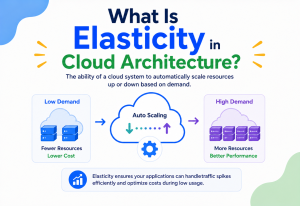
Most production systems store 3 or more copies of every piece of data (a “replication factor” of 3), spread across different racks, availability zones, or regions, so that losing any single machine — or even an entire data centre — does not lose data.
9.3 Hinted Handoff
If a replica is temporarily down when a write arrives, some systems (like Cassandra and Dynamo) use a clever trick called hinted handoff: a healthy neighbouring node temporarily stores the write “on behalf of” the down node, along with a hint saying “please deliver this to node X once it is back.” When the down node recovers, the hint is delivered, and the system converges without losing the write.
9.4 Disaster Recovery
Because replicas are already spread geographically, eventually consistent systems often have strong natural disaster‑recovery properties — losing an entire region does not mean losing data, since other regions already hold (or will soon hold) a copy. Regular backups and periodic full‑data verification (anti‑entropy repair) further protect against silent data corruption over time.
9.5 Self‑Healing
A well‑designed eventually consistent system is largely “self‑healing” — gossip protocols, read repair, and anti‑entropy processes continuously work in the background to detect and fix any differences between replicas, without needing a human to intervene for routine, small‑scale drift.
Security
Stale permission checks, replay attacks, encryption between replicas, and tombstone data leakage are the four extra security angles that only show up once you accept eventual consistency.
Eventual consistency introduces a few security considerations that do not exist in single‑copy systems:
- Stale permission checks: if a user’s access is revoked on one replica but another replica has not caught up yet, that replica might still grant access for a short window. Sensitive authorisation data (like “is this user still an admin?”) is often kept strongly consistent, or checked against a fast, centralised cache with a short expiry, specifically to avoid this risk.
- Replay and reordering attacks: since eventually consistent systems often accept out‑of‑order writes, systems must be careful that an attacker cannot “replay” an old, legitimate write to undo a more recent security‑relevant change.
- Encryption in transit and at rest: since data is constantly moving between replicas over the network (gossip, replication traffic), that traffic must be encrypted (TLS) just like client‑facing traffic, to prevent eavesdropping between data centres.
- Tombstone data leakage: deleted data (tombstones) can sometimes linger longer than expected on lagging replicas, which is a concern under privacy regulations like GDPR that require timely deletion — engineers must ensure tombstone cleanup (“compaction”) actually happens within required timeframes.
Never build authentication or authorisation decisions (“is this session valid,” “is this user an admin”) purely on top of loosely bounded eventual consistency without a maximum staleness guarantee. Use strongly consistent stores, or eventually consistent stores with a tightly bounded and monitored inconsistency window, for anything security‑critical.
Monitoring, Logging & Metrics
“Eventual” is a promise about time, so monitoring that time is essential. Six specific metrics turn a vague guarantee into an accountable Service Level Objective.
Because “eventual” is a promise about time, monitoring that time is essential. Key metrics teams track:
| Metric | What It Tells You |
|---|---|
| Replication lag | How far behind (in time or in number of operations) each replica is from the latest write |
| Read repair rate | How often reads discover and fix mismatched replicas — a rising rate can signal replication problems |
| Quorum failure rate | How often writes and reads fail to reach the required number of replicas |
| Hinted handoff queue size | How much “pending work” is queued for recovering nodes |
| Conflict / merge rate | How often genuinely concurrent, conflicting writes occur |
| Gossip convergence time | How long it takes for a change to spread to the entire cluster |
Modern observability stacks (Prometheus + Grafana, Datadog, or cloud‑native tools like Amazon CloudWatch) are used to graph these metrics over time, with alerts firing if replication lag or quorum failures exceed safe thresholds. Distributed tracing tools (like OpenTelemetry or Jaeger) help engineers follow a single write across multiple replicas to debug exactly where and why a delay happened.
Set a Service Level Objective (SLO) for your inconsistency window — for example, “99.9% of writes are visible on all replicas within 2 seconds” — and alert automatically when the system breaches it. This turns a vague promise (“eventually”) into something measurable and accountable.
Deployment & Cloud
Every major cloud provider offers a managed eventually consistent store — each with slightly different knobs for tuning the consistency vs. speed trade‑off.
Cloud providers offer managed, eventually consistent databases so teams do not have to build replication logic themselves:
- Amazon DynamoDB: offers “eventually consistent reads” by default (cheaper, faster) and optional “strongly consistent reads” (more expensive, slightly slower) per query.
- Azure Cosmos DB: offers five tunable consistency levels, from “Strong” down to “Eventual,” letting engineers pick the right trade‑off per use case.
- Google Cloud Spanner: notably offers strong, globally consistent transactions using synchronised atomic clocks (TrueTime) — an example of engineering effort spent to avoid eventual consistency where it matters.
- Apache Cassandra (self‑managed or via DataStax Astra / Amazon Keyspaces): a classic leaderless, tunable‑consistency, multi‑region database.
When deploying multi‑region systems, engineers must configure replication factor, choose consistency levels per operation, and plan for cross‑region network costs (data transfer between cloud regions is often billed separately and can be a meaningful line item at scale). Deployment pipelines typically use rolling upgrades, one region or availability zone at a time, so the system remains available (in the eventually consistent sense) even while being updated.
Databases, Caching & Load Balancing
NoSQL stores are built for eventual consistency; relational stores get it accidentally the moment you add a read replica; caching layers are eventual consistency in disguise.
13.1 NoSQL Databases and Eventual Consistency
Many popular NoSQL databases were purpose‑built around eventual consistency to achieve massive scale:
- Apache Cassandra: leaderless, tunable consistency (ONE, QUORUM, ALL per query).
- Amazon DynamoDB: managed key‑value / document store, descendant of the original Dynamo paper.
- Riak: one of the earliest open‑source Dynamo‑inspired databases, known for its CRDT support.
- MongoDB (with secondary reads): can be configured for eventually consistent reads from secondary replicas for higher read throughput.
- CouchDB: uses multi‑version concurrency and conflict revision trees, resolved either automatically or by the application.
13.2 Relational Databases Are Not Immune
Even traditional relational databases (PostgreSQL, MySQL) become eventually consistent the moment you add read replicas for scaling reads. A common pattern is “read from replica, write to primary” — and if you read your own write immediately from a replica that has not caught up yet, you can momentarily see stale data. This is why patterns like read‑your‑writes consistency exist (routing a user’s own reads to the primary, or a replica known to be caught up, right after they write).
13.3 Caching Layers
Caching is one of the most common real‑world applications of eventual consistency. A cache (Redis, Memcached, or a CDN edge node) holds a copy of data that can become stale the moment the source of truth changes. Common strategies to manage this:
- TTL (Time To Live): automatically expire cached data after a fixed time, bounding the staleness window.
- Cache invalidation on write: explicitly clear or update the cache entry when the underlying data changes.
- Write‑through caching: update the cache and the database together, reducing (but not eliminating) staleness.
13.4 Load Balancing and Consistency
Load balancers distribute traffic across many replica servers. If a load balancer does not know (or care) which replica has the freshest data, users can be routed to a stale replica right after making a change elsewhere. Techniques like sticky sessions (routing a user’s requests consistently to the same server for a while) or consistency tokens (the client remembers “the version I last saw” and the load balancer routes to a replica at least that fresh) help smooth over this issue.
APIs & Microservices
Across services, eventual consistency shows up as events, queues, and the Saga pattern — not as one distributed transaction. APIs should be honest about the staleness their consumers will observe.
14.1 Eventual Consistency Across Services
In a microservices architecture, different services often own different pieces of data, and keeping them in sync usually happens asynchronously — through events, not direct database sharing. For example, when an Order Service creates a new order, it publishes an “OrderCreated” event. An Inventory Service and a Notification Service each consume that event independently and update their own data a moment later. For a brief window, the Order Service “knows” about the order before the Inventory Service does — a service‑level form of eventual consistency.
14.2 Event‑Driven Architecture and Message Queues
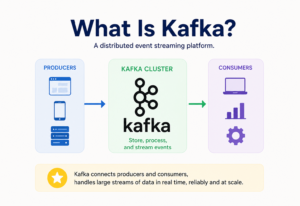
Tools like Apache Kafka, RabbitMQ, and Amazon SQS / SNS are the backbone of this pattern. A service writes an event to a queue or stream, and other services process it whenever they get to it — usually within milliseconds, but not instantly and not guaranteed in strict lockstep.
14.3 The Saga Pattern
When a business process spans multiple services (for example, “reserve inventory, charge payment, schedule shipping”), a single all‑or‑nothing database transaction is not possible across service boundaries. The Saga pattern breaks the process into a sequence of local transactions, each with a corresponding “compensating action” to undo it if a later step fails — accepting temporary inconsistency between services in exchange for resilience and independence.
14.4 API Design Considerations
When an API is backed by an eventually consistent store, good API design should be honest about it:
- Return a version number or timestamp with responses, so clients can detect if a subsequent read is stale relative to a previous write.
- Offer a way to request stronger consistency for specific critical operations, if the underlying store supports it (like DynamoDB’s per‑request consistency setting).
- Document expected staleness bounds (e.g., “search results may lag up to 5 seconds behind writes”) so client developers are not surprised.
After you post a new listing on an online marketplace, the “My Listings” page (reading from a strongly consistent path) shows it immediately, while the general search results (reading from an eventually consistent search index like Elasticsearch) might take a few seconds to include it. This split is a deliberate, common design choice.
Design Patterns & Anti‑patterns
Read‑your‑writes, monotonic reads, bounded staleness, CQRS, and event sourcing are the patterns that make “eventual” usable. Silent LWW, undefined windows, and money on top of loose consistency are the anti‑patterns.
Useful Patterns
- Read‑Your‑Writes Consistency: ensure a user always sees their own recent writes, even if other users might briefly see stale data — usually by routing that user’s reads to the same replica they wrote to, or to the primary, for a short period.
- Monotonic Reads: once a user has seen a certain version of the data, never show them an older version afterwards, even if they hit a different, laggier replica next time.
- Bounded Staleness: guarantee that no replica is ever more than X seconds or Y versions behind — a middle ground between strict consistency and unbounded eventual consistency.
- CQRS (Command Query Responsibility Segregation): separate the “write model” (strongly consistent) from the “read model” (eventually consistent, optimised for fast queries), syncing the read model asynchronously from write events.
- Event Sourcing: store every change as an immutable event; current state (and any replica’s state) is derived by replaying events — naturally supports eventual consistency across derived views.
Anti‑Patterns to Avoid
- Silent data loss via careless Last‑Write‑Wins: blindly picking “latest timestamp wins” without considering clock skew or business meaning can quietly discard valid user data.
- Treating eventual consistency as “eventually, whenever”: not measuring or bounding the inconsistency window at all, so it can silently grow to minutes or hours without anyone noticing.
- Using eventual consistency for money or safety‑critical state: applying it to bank balances, medical dosages, or elevator control without extremely careful design is a classic, dangerous mistake.
- Ignoring conflicting writes entirely: assuming conflicts “probably will not happen” instead of designing an explicit resolution strategy.
- Skipping tombstones for deletes: naively deleting data without a tombstone can cause deleted data to reappear (“zombie” resurrection) after a network partition heals.
An early e‑commerce inventory system decremented stock counts independently on each regional server without any coordination, assuming “it will balance out eventually.” During a flash sale, this let the same last unit of a product be sold to multiple customers in different regions at once — a textbook case of applying eventual consistency somewhere it did not belong.
Best Practices & Common Mistakes
Six habits that keep “eventually” a short, measurable, trustworthy promise — and five mistakes that quietly turn it into a source of hard‑to‑reproduce production bugs.
Best Practices
- Classify your data first. Decide, per type of data, whether it truly needs strong consistency or can tolerate eventual consistency, instead of picking one model for the whole system.
- Bound your staleness. Define and monitor a maximum acceptable inconsistency window, and alert when it is exceeded.
- Design conflict resolution deliberately. Choose LWW, CRDTs, or application‑level merges consciously, based on what “correct” means for that specific data.
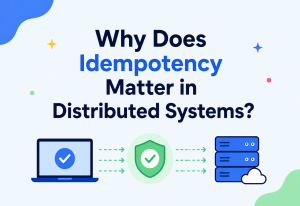
- Use idempotent writes. Since messages can be retried or delivered more than once in distributed systems, design writes so applying them twice has the same effect as applying them once.
- Communicate staleness to users when it matters. A small “last updated 3 seconds ago” or a loading indicator can turn a confusing inconsistency into an expected, trustworthy experience.
- Test for partition scenarios. Deliberately simulate network failures in staging environments (a practice sometimes called chaos engineering) to see how your system actually behaves when replicas cannot talk to each other.
Common Mistakes
- Assuming “eventual” means “soon” without ever measuring how soon.
- Forgetting that clients can read their own stale data right after writing (violating read‑your‑writes expectations, which frustrates users — “I just saved this, why did it disappear?”).
- Not accounting for clock skew between servers when relying on timestamps for conflict resolution.
- Applying eventual consistency uniformly across an entire application instead of case by case.
- Not building dashboards or alerts for replication lag until after an incident has already happened.
Real‑World & Industry Examples
From Amazon’s shopping cart and Netflix’s Cassandra clusters to DNS — the world’s largest eventually consistent system — the pattern quietly powers the modern internet.
DynamoDB & the shopping cart
The original Dynamo paper described how Amazon’s shopping‑cart service needed to always accept “add to cart” requests, even during network issues, because a failed add‑to‑cart directly costs sales. It used eventual consistency with multi‑value conflict resolution — if two devices added different items to the same cart while a network partition was happening, both changes were merged when the partition healed, rather than one silently overwriting the other.
Cassandra at scale
Netflix uses Cassandra extensively (it helped popularise Cassandra outside LinkedIn) for things like viewing history, personalisation data, and A/B testing data — content where being off by a second or two does not affect the viewing experience, but where availability across many global regions is critical.
Location and trip matching
Uber’s location and trip‑matching systems favour availability and low latency — a driver’s location update reaching the rider’s app half a second late is a normal, acceptable trade‑off compared to the app becoming unresponsive during high load or network hiccups.
The world’s largest EC system
The Domain Name System (DNS), which translates website names like “example.com” into computer addresses, is a giant, decades‑old eventually consistent system. When you update a domain’s DNS record, it can take minutes to 48 hours (based on a setting called TTL) to “propagate” to every DNS server in the world. Almost everyone who has used the internet has unknowingly relied on eventual consistency through DNS.
Feeds and counters
Like counts, comment counts, and feed rankings on Facebook, Instagram, and X are classic eventually consistent data — a like might take a moment to appear to everyone, but the system stays fast and available for hundreds of millions of simultaneous users, which matters far more than perfect real‑time accuracy of a counter.
Collaborative editing
When multiple people type in the same document at once, each person’s device applies their own keystrokes instantly (for responsiveness), while the system merges everyone’s edits in the background using conflict‑resolution techniques closely related to CRDTs — a great everyday example of eventual consistency most people do not realise they are using.
Airlines & e‑commerce
When an airline updates a flight’s price or an online store updates a product’s stock, the change usually reaches the primary database instantly, but the search index that powers “search flights” or “search products” pages is often updated moments later by a background pipeline. This is why a search results page can occasionally show a price or availability that is a few seconds out of date, while clicking into the specific item shows the fresh, authoritative value — two different consistency levels used deliberately for two different parts of the same product.
Edge caches worldwide
Every time you visit a website, static files like images, videos, and stylesheets are often served from a CDN edge server near you rather than the original source server. When the website owner updates a file, that update spreads to CDN edge servers around the world over the following seconds to minutes, depending on cache settings — yet another everyday, large‑scale instance of eventual consistency working quietly behind the scenes of the modern internet.
FAQ, Summary & Key Takeaways
The questions people ask most about eventual consistency — plus a few interview‑style bonuses — and the six ideas worth carrying with you after you close this tab.
Frequently Asked Questions
Is eventual consistency the same as “eventually correct”?
Not quite. Eventual consistency guarantees replicas will agree with each other eventually. It does not, by itself, guarantee the value is “business‑correct” — that depends on how conflicts are resolved.
Does eventual consistency mean the system is unreliable?
No — it is actually often more reliable in the sense of staying available during failures. It trades immediate agreement for continued uptime, which is a deliberate, well‑tested engineering choice, not a flaw.
How long does “eventual” usually take?
In healthy systems, typically milliseconds to a few seconds. It can stretch much longer during network problems, which is why monitoring replication lag matters.
Can a system be both strongly and eventually consistent?
Yes. Most large real‑world systems mix both — strong consistency for critical operations (like payments) and eventual consistency for everything else (like recommendations, feeds, and search).
Is eventual consistency only for NoSQL databases?
No. Even traditional relational databases become eventually consistent once you add read replicas, and caching layers in almost any system introduce eventual consistency, regardless of the underlying database type.
Bonus: interview‑style questions
Explain eventual consistency in one sentence. Beginner
Different copies of the same data may briefly disagree, but if no new changes are made, they are guaranteed to become identical — the promise is convergence over time, not instant agreement.
Why does CAP force a choice between C and A? Intermediate
Because network partitions (P) are unavoidable in real systems. During a partition, the system must either refuse requests to stay consistent (CP) or serve requests knowing some may be stale (AP). You cannot fully have C, A, and P all at once during a partition.
Why can “Last‑Write‑Wins” silently lose data? Intermediate
Because clocks on different machines are never perfectly in sync. A write with a slightly “wrong” higher timestamp can overwrite a genuinely later write from another machine, and neither the user nor the system realises anything was lost.
What is a vector clock and what does it detect? Advanced
A vector clock is a small counter‑per‑replica structure attached to each write. Comparing two vector clocks reveals whether one write causally happened before another (a clear ordering) or whether they happened concurrently on different replicas (a genuine conflict that needs explicit resolution).
How would you make an eventually consistent system feel “correct” to a user who just wrote something? Advanced
Apply read‑your‑writes consistency: after a user writes, route that same user’s reads to the replica or primary that has the new version for a short period, or attach a consistency token so the load balancer picks a replica at least that fresh. Other users can still see the older data briefly — only the writing user needs the immediate‑visibility guarantee.
Summary
Eventual consistency is a design choice, not a flaw. It exists because real networks are slow and unreliable, and because forcing every copy of data to agree instantly, everywhere, is often too slow or too fragile for systems that need to serve millions of users around the world. By allowing brief disagreement between replicas — and guaranteeing they will converge once things settle — eventually consistent systems achieve speed, availability, and massive scalability, at the cost of occasionally showing slightly outdated information.
The skill of a good system designer is not picking eventual consistency everywhere, or avoiding it everywhere — it is knowing, precisely, which pieces of data can tolerate it, which strategy to use for resolving conflicts, and how to measure and bound the inconsistency window so “eventually” stays a short, predictable, and trustworthy promise.
Key Takeaways
- Copies of data can briefly disagree, but always converge once writes stop.
- The CAP theorem forces a choice between Consistency and Availability during a network partition — and real networks always partition eventually.
- Vector clocks and CRDTs help systems detect and resolve conflicting writes safely, without silently losing data.
- Gossip, anti‑entropy, and read repair quietly keep replicas converging in the background, without human intervention.
- Great for feeds, caches, and counters; risky for money, seats, and security decisions.
- Always measure and bound your inconsistency window — do not leave “eventually” undefined, or it will silently drift into “never.”
The systems that stay calm under real‑world stress are almost always the ones whose engineers treated eventual consistency as a deliberate, measured trade — not as a shortcut. Choose it consciously, bound its window, and it will quietly carry the weight of the internet the way it already does for DNS, shopping carts, comment threads, and the caches that make everything else feel instant.